Market Minds Advisory
Urinary Retention Therapeutics Market

Urinary Retention Therapeutics Market: Treating the Prostate, Not the Bladder

Nearly every drug in this market relaxes or shrinks the prostate, while a substantial share of retention is caused by a bladder muscle that simply will not contract and has no approved therapy.

Lead Analyst

Alice Ballenger

Published

September 2026

Make Smarter Decisions with Customized Research Insights

Request a free sample report and evaluate market opportunities, growth trends, and competitive dynamics relevant to your business needs.

2025 MARKET VALUE$4.2BMarket Size 2025
2036 FORECAST VALUE$6.2BBase Case , 2026 to 2036
CAGR 2026 TO 20363.6 %Bull 4.8% / Bear 2.4%
INCREMENTAL OPPORTUNITY$1.9BNet 10- year value creation
EXPANSION MULTIPLE1.43x2036 value over 2026 base
Strategic Levers
M&A Pipeline
Regional Outlook
Country Rankings
Competitive Intelligence
Segmental Deep-dive
Call-Us : 91 93563 13602

Executive Snapshot and Market Trajectory

This market treats the cause it knows how to treat. Alpha blockers and reductase inhibitors address bladder outlet obstruction from the prostate, while around 38% of retention arises from a detrusor muscle that will not contract properly, for which no effective approved therapy exists anywhere.
The consequence falls hardest on the people that pharmacology never reached. Around 9% of women presenting in retention receive any drug therapy at all, because essentially the entire armamentarium is prostate directed. They are catheterised instead, which works, costs far more and is a considerably worse experience than swallowing a tablet. Nobody designed that outcome; it followed from where the successful pharmacology happened to land, and nothing has been developed since to correct it.
Meanwhile almost nothing carries value. Roughly 96% of prescriptions are generic and standard oral therapy costs four dollars monthly, so a market serving an ageing population produces volume and very little revenue. Combination fixed dose therapy grows at 5.4%, half again the market rate of 3.6%, on adherence rather than on any new mechanism. Only 54% of acute presentations start therapy before catheter removal, and most services simply skip it.
Market Definition
Pharmacological treatment of urinary retention and its underlying causes, covering alpha adrenergic blockers, five alpha reductase inhibitors, combination fixed dose therapy, cholinergic and detrusor directed agents, phosphodiesterase inhibitors used in this indication, and adjunctive and supportive pharmacotherapy. Measured at manufacturer net selling value attributable to this indication. Excludes urinary catheters and drainage devices, surgical and minimally invasive prostate procedures, overactive bladder therapy, and urodynamic diagnostics.
Base Year Value
$4.2B in 2025 (MMA Primary Research Dataset, August 2026)
Forecast Period
2026 to 2036, eleven discrete annual values
CAGR
3.6% base case. Bull 4.8%. Bear 2.4%.
Fastest Growth Segment
Combination Fixed Dose Therapy: 5.4% CAGR
Fastest Growth Country
Colombia: 6.4% CAGR
Fastest Growth Region
South Asia and Pacific: 5.4% CAGR
Largest Region
East Asia: 28% of 2025 global value
Market Leaders
Astellas Pharma, GSK, Sanofi, Recordati, Viatris. Source: MMA Primary Research Dataset, July 2026.
Primary Survey
n=3,800 procurement and R&D decision-makers, Q4 2025, six countries
Methodology
Demand-side build-up, cross-validated against public data, 47 expert interviews

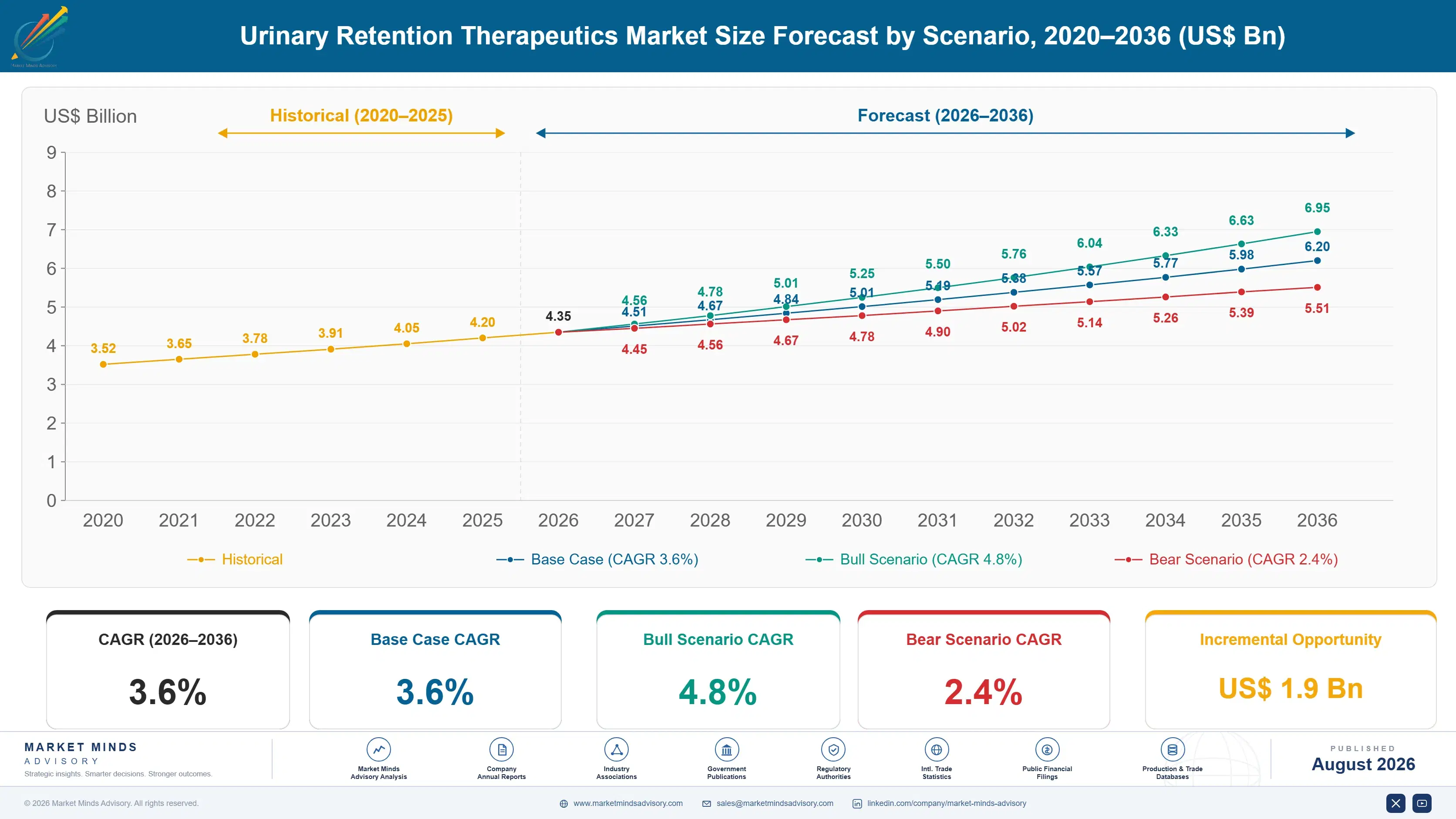
Urinary Retention Therapeutics Market Forecast Scenarios

urinary-retention-therapeutics-market-size-forecast-scenario-1787641098466
Growth ran near 2.8% between 2020 and 2025 as ageing male populations expanded the treated base while genericisation removed almost all remaining value from it. Combination fixed dose products held up better than single agents, since a single tablet supports adherence in a population taking several medicines already. Detrusor directed therapy went essentially nowhere, because nothing effective reached approval anywhere.
Base case 3.6% rests on three mechanisms. Combination fixed dose therapy grows at 5.4% on adherence in older patients managing multiple medicines. Cholinergic and detrusor directed agents grow at 4.6% from a very small base as clinical attention turns toward underactive bladder. And Colombia grows fastest of any country at 6.4% on urology service access widening alongside a rapidly ageing population. None of the three depends on prevalence rising, which is close to universal with male age anyway.
The bull case at 4.8% assumes a genuinely effective detrusor directed agent reaching approval, which would create a segment where none currently exists and reach a population that receives catheterisation rather than treatment. The bear case at 2.4% is procedural intervention displacing pharmacotherapy further, since minimally invasive prostate procedures increasingly offer a durable alternative to taking tablets indefinitely.

The Cause Nobody Can Treat

Urinary retention has two quite different mechanical causes and pharmacology has only ever solved one of them. Outlet obstruction from prostatic enlargement responds well to smooth muscle relaxation and to shrinking the gland, and both drug classes are cheap and universally available. Around 38% of retention instead reflects a detrusor muscle that fails to generate adequate contraction, and no approved therapy addresses that with any reliability.
TOP FIVE CONCENTRATION32%Originators hold few positions against widespread generic supply
RETENTION FROM UNDERACTIVE BLADDER38%Cases caused by the bladder rather than by obstruction
WOMEN TREATED PHARMACOLOGICALLY9%Women in retention receiving any drug therapy at all
GENERIC SHARE OF PRESCRIPTIONS96%Portion of treatment supplied without any patent protection
ALPHA BLOCKER INITIATION RATE54%Acute presentations started on therapy before catheter removal
MONTHLY THERAPY COST4 USDPrice of standard oral treatment for a single month
That gap falls unevenly across patients. Around 9% of women presenting in retention receive any pharmacological treatment at all, since almost the entire therapeutic armamentarium is directed at a gland they do not have. The alternative offered is catheterisation, which relieves the retention, costs a great deal more over time and represents a considerably worse experience than taking a tablet each morning. Nobody designed that outcome; it followed from where the pharmacology landed.
Commercially the market is a study in volume without value. Roughly 96% of prescriptions are generic and a month of standard oral therapy costs around four dollars, so an ageing population expands the treated base while revenue barely moves. Only 54% of acute presentations start an alpha blocker before catheter removal, a free improvement many services skip.
"We solved the prostate and called the problem solved. The patients whose bladders will not squeeze get a catheter and a leg bag, and there is no pipeline behind them worth the name."
Director, Urology and Ageing Populations Practice · MMA Healthcare and Life Sciences Practice · August 2026

Market Trends

Underactive bladder gaining recognition without gaining therapy

Around 38% of retention reflects detrusor underactivity rather than outlet obstruction, and clinical attention to that has grown considerably while therapeutic options have not. Cholinergic and detrusor directed agents grow at 4.6% from a base small enough that the rate flatters it. Recognition without treatment produces better diagnosis and identical management, which is a frustrating position for clinicians and an unserved population for anybody prepared to develop something. Better diagnosis without better treatment produces identical management and a great deal of clinical frustration. Nobody is developing anything for them at present.
Market Impact: Colombia growing fastest at 6.4%
Fixed dose combinations winning on adherence rather than mechanism

Combination fixed dose therapy grows at 5.4% because an older patient already taking several medicines takes one tablet more reliably than two, not because the combination does anything the components could not do separately. Adherence in this population is genuinely poor and the clinical consequence is retention recurrence. That is a formulation argument rather than a pharmacological one, and it is essentially the only value creation left in the category. Fixed dose products also resist substitution, since a pharmacist cannot casually swap one tablet for two without prescriber involvement. Prescribers appreciate that.
Market Impact: Only 54% started on therapy

Market Opportunities and Growth Drivers

Urology access widening in rapidly ageing populations

Colombia grows fastest of any country at 6.4% as urology service access widens while the population ages quickly, which converts men who would previously have presented in crisis into men managed pharmacologically beforehand. Access rather than prevalence determines the treated population, since prostatic enlargement is close to universal with age. Suppliers mapping opportunity against demographic data alone are sizing a population that never reaches a urologist. Service capacity data is published in most markets and predicts treated volume considerably better than demographics do. Demographics size nothing useful here. Nobody uses it commercially.
Market Impact: Roughly 96% of prescriptions generic

Acute presentation representing a large untreated opportunity

Only around 54% of men presenting in acute retention are started on an alpha blocker before catheter removal is attempted, despite consistent evidence that doing so improves the chance of voiding successfully. The intervention costs almost nothing and the alternative is a further catheterisation and another admission. That variation is a protocol failure rather than a clinical disagreement, and it is entirely addressable through emergency department pathway work. Emergency pathway work costs almost nothing and reaches a decision urology clinic promotion never touches at all. Protocol rather than opinion is what varies between institutions.
Market Impact: Therapy costs 4 dollars monthly

Market Restraints and Challenges

Complete genericisation removing value from growing volume

Roughly 96% of prescriptions carry no patent protection and a month of standard therapy costs around four dollars, so an ageing population produces treated patients rather than revenue. The root cause is that the therapeutic questions here were answered decades ago with molecules that have long since expired. Commercially it removes any incentive to invest. Formulation, combination and adherence work are the only remaining routes to any differentiation. Combination formulation is essentially the last differentiation anybody has left here. Ageing populations produce patients rather than revenue, which is an uncomfortable position for anybody planning investment.
Market Impact: Around 38% lack effective therapy

Procedural alternatives displacing indefinite medical therapy

Minimally invasive prostate procedures increasingly offer durable relief without indefinite tablet taking, and patients weighing years of daily medication against a single intervention frequently choose the intervention. The root cause is that the drugs manage rather than resolve the obstruction. Commercially it caps duration of therapy per patient. Combination formulations and early initiation are what pharmacological suppliers can realistically offer against that. Procedural capacity keeps expanding across developed markets, and the trade patients are weighing is a decade of tablets against a single day. Early initiation is the other response.
Market Impact: Combinations growing at 5.4% annually
4 additional market trends, 3 additional growth drivers, and 2 additional restraints and challenges are covered in the full report. Contact sales@marketmindsadvisory.com to access the complete intelligence.

Segment CAGR and Growth Architecture

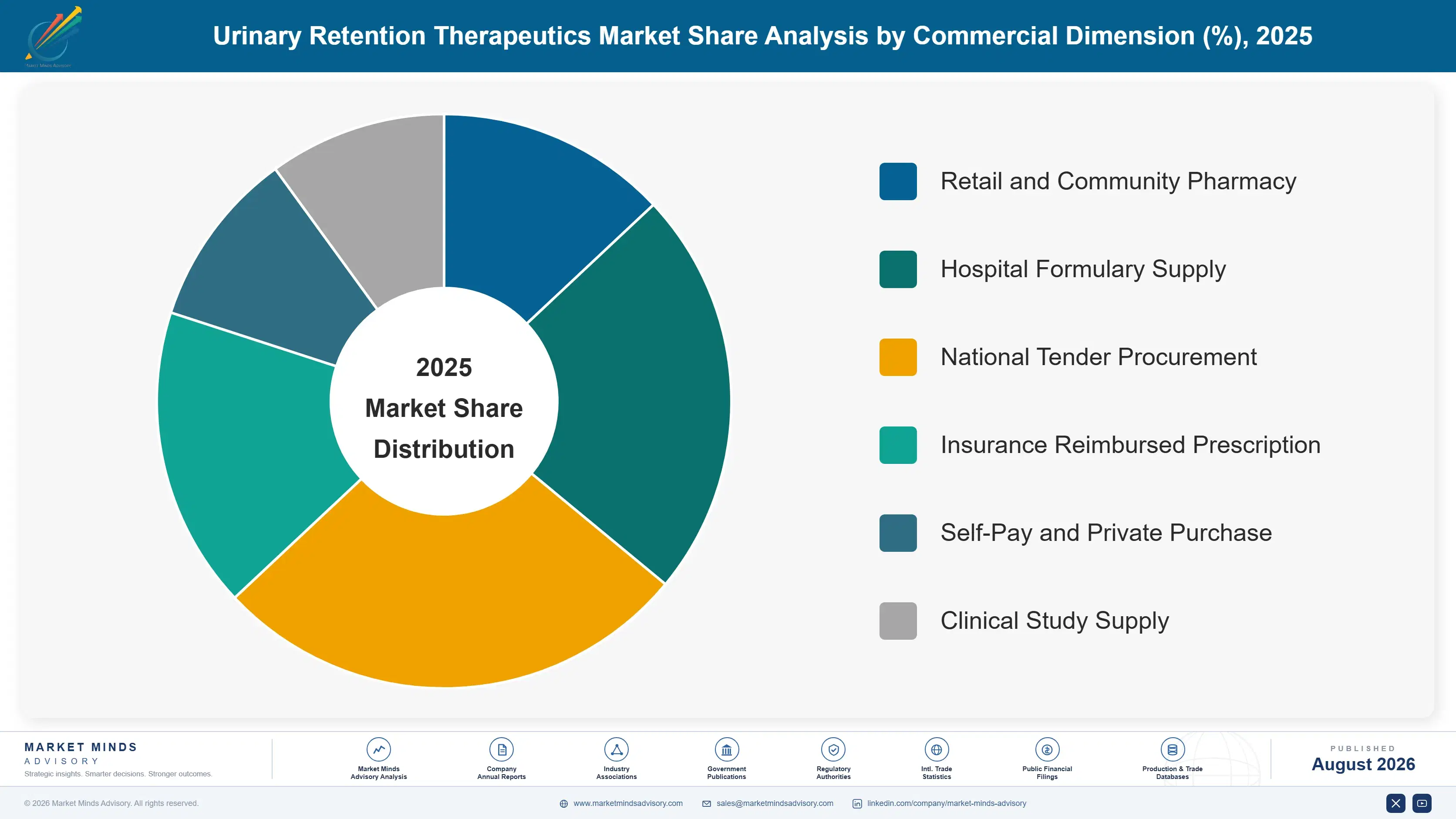
Six segments split by therapy class, because class determines the mechanism addressed, the population it can serve, whether protection remains and the value it carries per patient. Formulation and dosing variants sit inside each class. Care setting and channel dimensions are handled separately within the framework here. Class decides the population reached. Population follows from mechanism.
urinary-retention-therapeutics-market-market-share-analysis-1787641099007

Combination Fixed Dose Therapy

Growing at 5.4%, half again the market rate of 3.6%, fixed dose combinations pair an alpha blocker with a reductase inhibitor in a single tablet, which matters because adherence in older patients managing several medicines is genuinely poor and non-adherence produces retention recurrence. Nothing pharmacological is added by combining them. The value created is entirely in formulation and in the swallowing of one tablet rather than two, which is the last differentiation available anywhere in this category. Substitution resistance is the quieter benefit, since splitting one tablet back into two requires a prescriber decision. Retention recurrence is the clinical consequence of poor adherence, which is what makes this a genuine preference rather than marketing.
CAGR 5.4%

Cholinergic and Detrusor Directed Agents

At 4.6% these agents attempt to address the roughly 38% of retention caused by inadequate detrusor contraction rather than by outlet obstruction, and they do so with limited effectiveness and considerable systemic side effects. Growth comes from a very small base and from rising clinical recognition rather than from any improvement in what is available. This is the clearest unmet need in the indication and simultaneously the least commercially attractive one to address. Around 9% of women in retention receive any pharmacotherapy at all, which is the same gap seen from a different direction and equally unaddressed by anybody. Systemic side effects constrain use considerably even where the agents help.
CAGR 4.6%
Full segment breakdown across 6 segments available in the complete report.

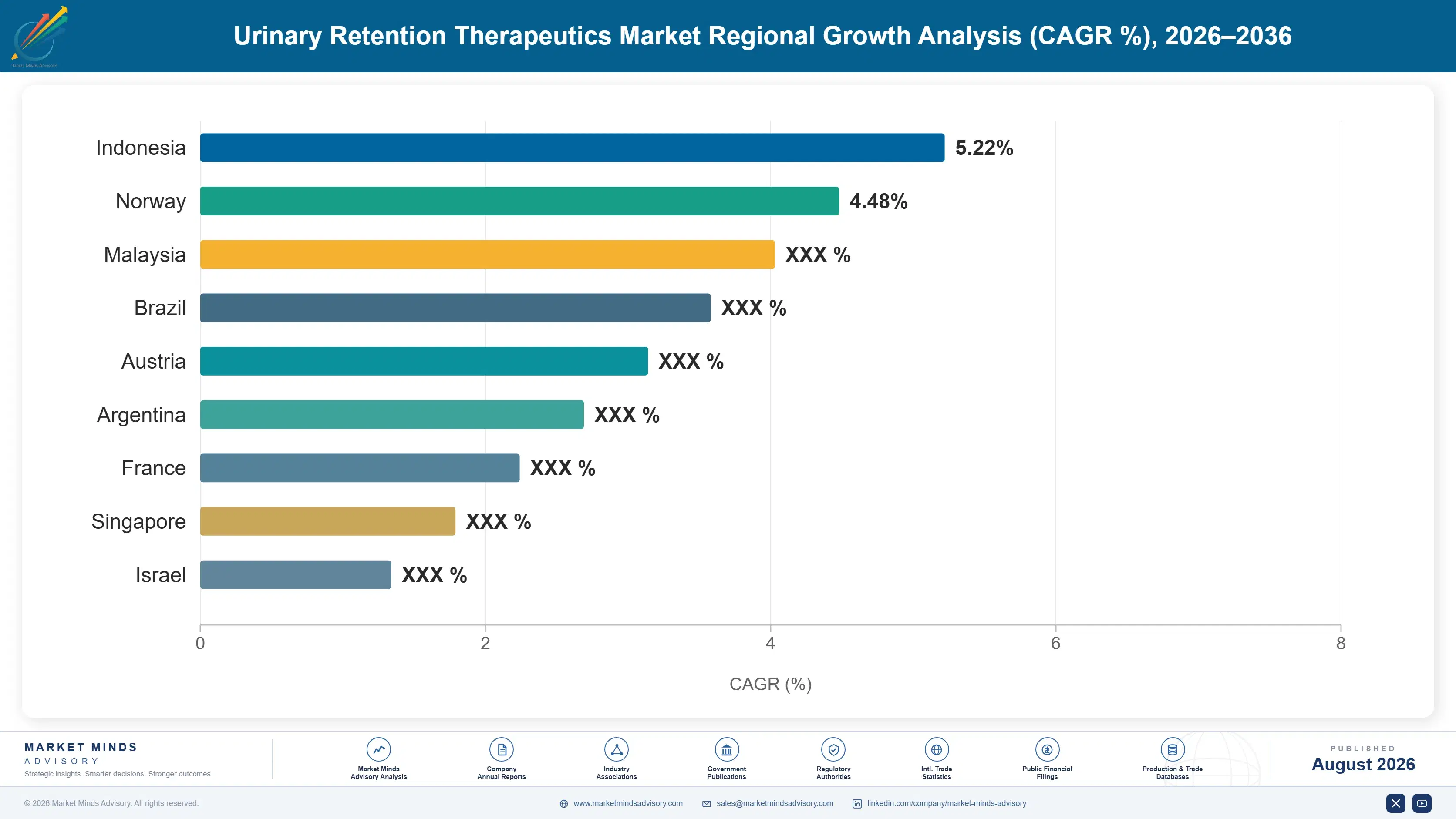
Regional Architecture and Country Demand Map

East Asia holds 28% of value on ageing male population scale that no other region matches. North America and Western Europe follow at 24% each on drug pricing and established urology services respectively. South Asia and Pacific grows fastest of the seven regions covered here.

North America

Urology access is broad and diagnosis rates are high, which means the treated population closely approximates the affected one rather than lagging behind it. Minimally invasive prostate procedures have expanded considerably and displace indefinite medical therapy for men who would rather not take tablets for a decade. Drug pricing gives the region its share despite generic supply. Growth at 2.8% reflects procedural displacement offsetting demographic expansion. Emergency pathway initiation before catheter removal nonetheless varies considerably between institutions in ways the evidence does not justify. Minimally invasive prostate procedures have expanded considerably and displace indefinite medical therapy for many men who prefer not to take tablets for a decade. Access is broad throughout.
Share: 24% | CAGR: 2.8% (2026 to 2036)

Western Europe

Established urology services and structured referral pathways mean acute retention is generally managed to protocol, though alpha blocker initiation before catheter removal still varies more between hospitals than the evidence justifies. Generic pricing is aggressive and health technology assessment removed branded positions long ago. Procedural alternatives are widely available. Regional growth of 2.2% is the slowest anywhere on complete genericisation and procedural displacement together. Structured referral pathways mean acute retention is generally managed to protocol, though initiation practice still differs more between hospitals than it should. Generic pricing is aggressive and health technology assessment removed the last branded positions from this indication some years ago now. Procedural alternatives are widely available.
Share: 24% | CAGR: 2.2% (2026 to 2036)
Regional intelligence for 5 additional markets available in the complete report: East Asia, South Asia and Pacific, Latin America, Middle East and Africa, Eastern Europe. Contact sales@marketmindsadvisory.com.
urinary-retention-therapeutics-market-country-cagr-analysis-1787641099533

Four Moves in a Four Dollar Market

Almost everything here is generic, the population it serves keeps growing and the cause it cannot treat keeps being diagnosed more often. What remains is formulation, protocol work at the point of crisis, and a genuinely unserved population nobody has bothered to develop for. Nothing else is left. Chemistry offers nothing. Formulation is all.

Compete on formulation, because chemistry is finished

Roughly 96% of prescriptions are generic and a month of therapy costs around four dollars, which leaves no pharmacological argument available to anybody. Fixed dose combinations grow at 5.4% purely because an older patient managing several medicines takes one tablet more reliably than two. Formulation, palatability and dosing convenience are the only differentiation this category still supports, and they are worth more than they look. Substitution resistance is worth as much as the adherence argument itself. A pharmacist cannot split one tablet into two without a prescriber deciding to allow it.
Market Impact: Combinations growing at 5.4% every single year now

Fix the acute pathway that costs nothing to fix

Only around 54% of acute retention presentations are started on an alpha blocker before catheter removal is attempted, despite consistent evidence that it improves successful voiding. The intervention is effectively free and the alternative is another catheterisation. Suppliers working emergency department protocols rather than urology clinics reach a decision point that determines whether a patient becomes a treated one at all. Around 46% of presentations receive no therapy before the attempt, which is a straightforward protocol gap rather than any clinical disagreement between specialists. The intervention is free. Emergency departments decide it.
Market Impact: Raises the current 54% therapy initiation rate today

Develop for the bladder nobody has treated

Around 38% of retention reflects detrusor underactivity with no effective approved therapy, and around 9% of women in retention receive any drug at all because the armamentarium targets a gland they do not have. That is a large, identified and entirely unserved population. Development economics are difficult in a category priced at four dollars a month, which is precisely why nobody has done it. The need is documented and the population identified. Around 9% of women in retention receive any drug at all, which is the same gap from a different direction and equally unaddressed.
Market Impact: Addresses the 38% left entirely untreated right now

Follow urology access rather than population ageing

Colombia grows fastest at 6.4% because urology access is widening while the population ages, and access rather than prevalence determines who actually gets treated. Prostatic enlargement is close to universal with age, so demographic data sizes a population and says nothing about how much of it reaches a prescriber. Service capacity data predicts treated volume considerably better and is published in most markets. Prostatic enlargement is close to universal with age, which makes demographic data almost useless as a commercial planning input here. Access decides everything. Capacity data is published.
Market Impact: Follows the 6.4% Colombian urology access growth rate

Who Controls the Margin Pool

Participation is measured on annual net revenue attributable to this indication, and the top five hold 32%. Concentration is low because roughly 96% of prescriptions are generic, which leaves originators holding only combination formulations and a handful of positions in markets where branded prescribing habits persist. The gap to challengers is formulation capability rather than anything about the molecules, all of which anybody can now manufacture.
Competition runs on three fronts. Formulation and combination decide whatever differentiated value remains. Tender and reimbursement pricing decide generic volume across public systems. And urology relationships decide prescribing habit in markets where branded generics still command preference. Each front rewards a different capability, and very few participants hold more than one of them properly.

Pressure ahead comes from procedural alternatives displacing chronic therapy and from continued generic pricing pressure. Expect suppliers with combination formulations and emergency pathway presence to hold up best. Rankings shift on whoever develops anything for the untreated cause. Concentration should stay low given complete genericisation. Single agent generic manufacturers without combination capability look most exposed, since nothing they supply can escape tender pricing at any point.
urinary-retention-therapeutics-market-company-positioning-matrix-1787641100060

Competitive Moat and Risk Dimensions

ASTELLAS PHARMA

Moat: Urology heritage and prescriber familiarity

Decades of urology presence built around alpha blockade give the business prescriber familiarity that persists well beyond patent expiry, particularly in markets where branded generic prescribing habits remain strong. That relationship also supports combination formulation adoption, since a urologist choosing between essentially identical products defaults to the name attached to the original evidence.
ASTELLAS PHARMA

Risk: Generic pricing eliminating value

Roughly 96% of prescriptions in this indication carry no protection and a month of therapy costs around four dollars, which leaves almost nothing to defend commercially regardless of heritage. Volume growth from ageing populations translates into negligible revenue, and no promotional investment changes an arithmetic that expired patents already settled.
GSK

Moat: Reductase inhibitor and combination position

Established reductase inhibitor positions and combination formulations reach the segment growing fastest in this category, where the value created is adherence rather than pharmacology. Combination products also resist substitution slightly better than single agents, since a pharmacist cannot casually swap a fixed dose combination for two separate tablets without prescriber involvement.
GSK

Risk: Procedural displacement of chronic therapy

Minimally invasive prostate procedures offer durable relief without indefinite daily medication, and patients weighing a decade of tablets against a single intervention increasingly choose the intervention. That caps therapy duration per patient in a way no formulation improvement addresses, and procedural capacity keeps expanding across developed markets.

Players Tracked

Prominent Players

Astellas Pharma
GSK
Sanofi
Recordati
Viatris

Other Key Players

Teva
Sandoz
Sun Pharmaceutical Industries
Aurobindo Pharma
Cipla
Dr Reddys Laboratories
Zydus Lifesciences
Hikma Pharmaceuticals
Lupin
Torrent Pharmaceuticals
Kyorin Pharmaceutical
Ono Pharmaceutical
Menarini Group
Pierre Fabre
Bayer

Recent Developments

MARCH 2026

Emergency pathway adds alpha blocker before catheter removal

An emergency care network added routine alpha blocker initiation to its acute retention pathway before attempting catheter removal, following an audit showing initiation had been happening in only about half of presentations. Successful voiding rates improved immediately afterwards. The intervention had cost the service nothing at all.
Signal: A free intervention with clear evidence behind it was simply not being done at all consistently
SEPTEMBER 2025

Guideline recognises underactive bladder as distinct entity

A urology guideline formally recognised detrusor underactivity as a distinct cause of retention requiring separate assessment, while acknowledging that no effective approved pharmacological therapy currently exists for the condition. Assessment recommendations followed regardless. Management options remained essentially unchanged for those patients. Nothing therapeutic followed. Frustration followed.
Signal: Better diagnosis without any actual new treatment simply produces identical management and considerably more clinical frustration
DECEMBER 2025

Procedural volumes displace long term medical therapy

A health system reported minimally invasive prostate procedure volumes rising while chronic alpha blocker prescribing fell, as patients weighing indefinite daily medication against a single intervention increasingly chose the procedure instead. Therapy duration per patient shortened measurably. Nobody had modelled that into their forecasts. Nobody had forecast it.
Signal: Managing an obstruction indefinitely competes rather badly against the option of simply resolving the thing once

Actives, Formulation and Tenders

Active pharmaceutical ingredients carry around 39% of generic tablet cost, produced by a concentrated group of manufacturers largely in India and China. Formulation and tabletting absorb roughly 24%, rising considerably for fixed dose combinations requiring separate release profiles in one tablet. Packaging and distribution take about 15%. Regulatory maintenance, pharmacovigilance and quality release account for the balance.
Cardiovascular and urological active ingredient pricing moved with Asian capacity across recent years, per published pharmaceutical ingredient market reporting and Viatris annual reporting for 2025 on input cost commentary. Generic manufacturers absorbed most of it, since tenders award on price against fixed budgets and a month of therapy already costs around four dollars in total. Combination products passed slightly more through, since formulation complexity narrows the field of manufacturers able to supply them at all.

Exposure divides on formulation complexity rather than on scale. A single agent generic manufacturer carries ingredient cost against tender pricing offering no pass through whatsoever. A combination product manufacturer carries higher formulation cost supported by pricing that adherence value sustains. A branded originator carries neither meaningfully but faces volume erosion that no cost position addresses at all.
urinary-retention-therapeutics-market-cost-volatility-analysis-1787641100255

Secure active ingredient supply on multi-year terms

Active ingredients carry close to two fifths of generic tablet cost and come from a concentrated manufacturing base where capacity swings between years. Multi-year agreements secure both price and availability, and the commitment is straightforward because demand in this indication grows predictably with population age structure rather than moving cyclically. Demand grows predictably. Cycles are not a factor.

Invest in combination formulation rather than single agents

Fixed dose combinations grow at 5.4% while single agents grow at a fraction of that, and combinations resist substitution better because a pharmacist cannot casually split one into two. Formulation capability is the only remaining source of differentiation in a category where the chemistry was settled decades ago and priced accordingly. Formulation is the last lever.

Position through emergency pathways rather than urology clinics

Only around 54% of acute presentations are started on therapy before catheter removal, which is a protocol gap rather than a clinical disagreement. Emergency department pathway work costs very little and converts crisis presentations into treated patients, reaching a decision point that urology clinic promotion never touches at all. Protocol gaps close cheaply. Emergency access is cheap.

Portfolio Architecture for Margin Defence

Margin here follows formulation rather than mechanism, because the mechanisms were established decades ago and the molecules that deliver them cost almost nothing. Single agent generic alpha blockers and reductase inhibitors earn margins in the high single digits to high teens, procured through tenders awarding on price with no other characteristic assessed. Ageing populations expand the base without expanding the revenue.
Branded generics in markets with persistent prescribing habit do better in the high teens to low thirties, because prescriber familiarity sustains a premium that has no pharmacological justification and everybody involved knows it. Habit erodes slowly but it does erode, and nothing replaces it. Nothing else supports the price.

Fixed dose combinations and any protected formulation hold the strongest position, reaching into the low forties, where adherence value and substitution resistance both support pricing that single agents cannot approach. Those margins depend on prescribers continuing to value a single tablet, which is a real clinical consideration in a population where non-adherence produces retention recurrence. Non-adherence produces retention recurrence in this population, which makes the single tablet argument a genuine clinical consideration rather than a marketing one.

Single Agent Generic Therapy

Off patent tablets procured through tenders awarding purely on delivered price. The nine point range reflects manufacturing scale and ingredient sourcing rather than any clinical difference between the suppliers. Price decides every award.
Gross Margin: 9-18%

Branded Generics in Habit Markets

Products sustaining a premium on prescriber familiarity rather than any pharmacological difference. The thirteen point range reflects how strongly branded prescribing habit persists in each particular market. Habit sustains the premium.
Gross Margin: 18-31%

Fixed Dose Combinations and Protected Formulations

Formulations supported by adherence value and resistance to casual substitution. The twelve point range reflects formulation complexity and how much prescribers weigh single tablet convenience. Adherence carries genuine value. Recurrence is the risk.
Gross Margin: 30-42%
urinary-retention-therapeutics-market-portfolio-architecture-1787641100751

High-value Sub-segments and Strategic Watch-out

Combination Fixed Dose Therapy

High value and the fastest growth at 5.4%, created entirely by adherence rather than by any pharmacological addition. Substitution resistance is the quiet second benefit that pharmacists cannot easily bypass. Prescribers value the single tablet genuinely, since non-adherence produces retention recurrence in this population. Substitution is harder.
Gross Margin: 30-42%

Cholinergic and Detrusor Directed Agents

High value and growing at 4.6% from a very small base, addressing the roughly 38% of retention nothing effective currently treats. Limited effectiveness and systemic side effects both constrain use. Clinical recognition is rising faster than anything therapeutic is arriving to meet it. Effectiveness stays limited.
Gross Margin: 24-38%

Single Agent Alpha Blockers

The volume core, essential clinically and worth almost nothing commercially at around four dollars a month. Ageing populations expand the treated base while revenue barely moves at all. Tender committees award purely on delivered price with nothing else assessed at all. Volume grows regardless. Revenue barely moves.
Gross Margin: 9-18%

Untreated Population Exposure

The strategic watch-out. Around 38% of retention and around 91% of affected women receive no pharmacotherapy, and the range reflects whether anybody develops for them or leaves the gap open. Development economics are difficult at four dollars a month, which is why nobody has tried.
Gross Margin: 0-40%

Indefinite Until Something Replaces It

Demand here is chronic and long running, because medical therapy manages obstruction rather than resolving it and a man who responds well continues taking tablets for years. That produces genuine annuity consumption at four dollars a month, which is a large number of patient years generating a small amount of revenue. Duration matters far more than initiation in determining what any patient is worth. Duration is everything.
Stickiness follows tolerability rather than efficacy, since the agents perform similarly and the differences patients notice are side effects. A man tolerating one alpha blocker rarely switches, and a man who does not tolerate it switches once and then stays. Fixed dose combinations hold better still, because reverting to separate tablets feels like a step backwards to both patient and prescriber. Reverting feels like a step backwards.

The deciding party shifts with the setting and most suppliers only reach one of them. Emergency physicians decide whether acute presentations are started on therapy at all. Urologists decide chronic management and whether a procedure is offered instead. General practitioners write most of the repeat prescriptions and rarely revisit the choice unless something goes wrong.
urinary-retention-therapeutics-market-end-use-penetration-index-1787641101246

Where We Would Put Effort

These are among the four positions where our research anticipates prominent divergence between winners and laggards over the coming forecast period. Each is grounded in the demand model, the regulatory perimeter, and the announced capacity pipeline.
01 / FORMULATION LED DIFFERENTIATION

The chemistry was finished decades ago

Roughly 96% of all prescriptions in this indication are generic and a month of standard therapy costs around four dollars, which leaves no pharmacological argument available to anybody selling into it. The only pricing power left sits in formulation, and fixed dose combinations are growing at 5.4% purely because an older patient managing several medicines takes one tablet considerably more reliably than two. Formulation, palatability and dosing convenience are the only differentiation this category still supports, and they are worth more than they look.
02 / ACUTE PATHWAY PROTOCOL WORK

Half of them never start therapy

Only around 54% of acute urinary retention presentations are ever started on an alpha blocker before catheter removal is even attempted in the emergency department, despite consistent evidence that doing so improves the chance of voiding successfully. The intervention costs almost nothing at all in any setting and the alternative is another catheterisation and a further admission. Suppliers working emergency department protocols rather than urology clinics reach the exact decision point that determines whether somebody becomes a treated patient at all.
03 / UNTREATED CAUSE DEVELOPMENT

Nobody built anything for them

Around 38% of all retention reflects detrusor underactivity with no effective approved therapy anywhere in the world, and around 9% of women presenting in retention receive any drug at all because the entire armamentarium targets a gland they do not possess. That is a large, clearly identified and completely unserved patient population sitting in plain view of every company in the category. Development economics are genuinely difficult in a category priced at around four dollars a month, which is precisely why nobody has yet attempted it.
04 / SERVICE ACCESS TARGETING

Demography sizes nothing useful here

Colombia grows fastest of any country covered at 6.4% because urology service access is widening while the population ages rapidly, and access rather than prevalence is what determines who actually receives treatment for any of this. Prostatic enlargement is close to universal with age, so demographic data sizes a population and says nothing about how much of it ever reaches a prescriber. Urology service capacity data predicts treated volume considerably better than prevalence does and is published openly in most of the markets that matter.

Engagement Snapshot From the Field

A live engagement with an industry participant carrying material or product regulatory and market exposure ahead of a defining policy shift, showing how our research translates into a defensible multi-year portfolio strategy.
MARKET MINDS ADVISORY · CLIENT ENGAGEMENT SUMMARY
Urinary Retention Therapeutics Producer Strategic Portfolio Review and Transition Roadmap 2026·Investment Scenario on Urinary Retention Therapeutics Exposure Evaluation 2025-26
CLIENT PROFILE
A generic pharmaceutical manufacturer supplying alpha blockers and reductase inhibitors across European and Latin American markets, at annual revenue near 280 million dollars (client-reported, unverified by MMA). Combination formulation capability was limited and commercial coverage ran through urology specialists. Emergency departments had never been engaged about acute pathway initiation anywhere. Coverage was specialist led. Formulation was outsourced.
STRATEGIC CHALLENGE
Tender pricing had eroded margin to almost nothing while combination products the business could not make were taking prescription share. Management wanted to understand whether formulation investment was justified in a category where a month of therapy costs four dollars. Volume was rising while revenue was not. A decision was needed.
MMA APPROACH
MMA analysed prescription share shifts between single agent and combination products, quantified acute pathway initiation rates across customer regions, assessed procedural displacement of chronic therapy, and sized the untreated detrusor and female populations. Interviews with 47 experts covered urology, emergency medicine, general practice, formulation development and hospital procurement. Untreated populations were sized separately.
KEY FINDINGS
  1. Combination products were taking share steadily on adherence grounds, and the client had been treating that as a marketing effect rather than a genuine clinical preference.
  2. Acute pathway initiation rates varied enormously between hospitals in the same system, and no supplier had ever engaged emergency departments about the protocol at all.
  3. Procedural displacement was reducing therapy duration per patient measurably, which shortened the lifetime value of every newly initiated patient the client acquired.
  4. The untreated detrusor and female populations were large and identified, and no development programme anywhere was addressing either of them in any serious way.
CLIENT PROFILE
A generic pharmaceutical manufacturer supplying alpha blockers and reductase inhibitors across European and Latin American markets, at annual revenue near 280 million dollars (client-reported, unverified by MMA). Combination formulation capability was limited and commercial coverage ran through urology specialists. Emergency departments had never been engaged about acute pathway initiation anywhere. Coverage was specialist led. Formulation was outsourced.
STRATEGIC CHALLENGE
Tender pricing had eroded margin to almost nothing while combination products the business could not make were taking prescription share. Management wanted to understand whether formulation investment was justified in a category where a month of therapy costs four dollars. Volume was rising while revenue was not. A decision was needed.
MMA APPROACH
MMA analysed prescription share shifts between single agent and combination products, quantified acute pathway initiation rates across customer regions, assessed procedural displacement of chronic therapy, and sized the untreated detrusor and female populations. Interviews with 47 experts covered urology, emergency medicine, general practice, formulation development and hospital procurement. Untreated populations were sized separately.
KEY FINDINGS
  1. Combination products were taking share steadily on adherence grounds, and the client had been treating that as a marketing effect rather than a genuine clinical preference.
  2. Acute pathway initiation rates varied enormously between hospitals in the same system, and no supplier had ever engaged emergency departments about the protocol at all.
  3. Procedural displacement was reducing therapy duration per patient measurably, which shortened the lifetime value of every newly initiated patient the client acquired.
  4. The untreated detrusor and female populations were large and identified, and no development programme anywhere was addressing either of them in any serious way.
RECOMMENDED STRATEGY
Phase 1: Phase one: invest in fixed dose combination formulation, since adherence is a genuine clinical preference and combinations resist substitution better. Phase 2: Phase two: engage emergency department pathways where initiation rates vary, because urology clinic coverage never reaches that decision. Urology promotion misses it. Phase 3: Phase three: assess the untreated detrusor population seriously, since nobody else is and the need is documented. The gap is well documented.
OUTCOME
The manufacturer began combination formulation development during 2026 and prescription share stabilised in two markets (client-reported, unverified by MMA). Emergency pathway engagement was piloted, and an assessment of detrusor directed development was commissioned. Single agent tender participation was reduced in the least rewarding markets. Formulation became the priority.

Frequently Asked Questions

Foundational context covering the market sizes, CAGR, scope, country, region and competition that inform every finding below. This section is provided to cover basics and most often pre-purchase conversations, answered from the MMA Primary Research Dataset.

What is the current size of the Urinary Retention Therapeutics Market?

MMA sizes it at USD 4.2 billion in 2025, rising to USD 4.35 billion in 2026. The figure covers pharmacotherapy attributable to this indication at manufacturer net selling value.

How large will the Urinary Retention Therapeutics Market be by 2036?

USD 6.20 billion by 2036, an incremental USD 1.85 billion over the 2026 base and an expansion multiple of 1.43 times. Combination formulations carry most of that gain.

What is the CAGR for the Urinary Retention Therapeutics Market 2026 to 2036?

3.6% in the base case, with a bull case at 4.8% and a bear case at 2.4%. Procedural displacement of chronic therapy drives most of the spread.

Which segment is growing fastest?

Combination fixed dose therapy at 5.4%, half again the market rate of 3.6%. The value created is adherence in older patients rather than any pharmacological addition.

Who are the major companies in the Urinary Retention Therapeutics Market?

Astellas Pharma, GSK, Sanofi, Recordati and Viatris lead on attributable revenue. Fifteen further participants are profiled in the full report on the same consistent basis.

Which country is growing fastest?

Colombia at 6.4%, where urology service access is widening while the population ages rapidly, converting crisis presentations into managed patients before any crisis arrives instead of afterwards.

Report Segmentation Architecture

The full report scope spans multiple orthogonal segmentation dimensions, with cross-tabulated demand data provided for each dimension pair. Coverage extends further to regional breakdowns, trend trajectories, and the competitive detail needed to support segment-level decision-making.

By Therapy Class

  • Alpha Adrenergic Blockers
  • Five Alpha Reductase Inhibitors
  • Combination Fixed Dose Therapy
  • Cholinergic and Detrusor Directed Agents
  • Phosphodiesterase Inhibitors
  • Adjunctive and Supportive Pharmacotherapy

By End-Use Industry

  • Urology Outpatient Services
  • Emergency Departments
  • General Practice and Primary Care
  • Long-Term Care Facilities
  • Neurourology and Spinal Services
  • Clinical Trial Programmes

By Commercial Dimension

  • Retail and Community Pharmacy
  • Hospital Formulary Supply
  • National Tender Procurement
  • Insurance Reimbursed Prescription
  • Self-Pay and Private Purchase
  • Clinical Study Supply

By Region

  • North America
  • Western Europe
  • East Asia
  • South Asia and Pacific
  • Latin America
  • Middle East and Africa
  • Eastern Europe

Scope, Methodology, and Coverage

Every figure in this report is reproducible from documented input assumptions. The scope below maps the historical period, the forecast horizon, the segmentation dimensions, and the countries covered, alongside the underlying primary and qualitative methodology.
Historical Period
2020 to 2025
Forecast Period
2026 to 2036
Base Year
2025 (USD billions; MMA Primary Research Dataset, August 2026)
Market Definition
Pharmacological treatment of urinary retention and its underlying causes, covering alpha adrenergic blockers, five alpha reductase inhibitors, combination fixed dose therapy, cholinergic and detrusor directed agents, phosphodiesterase inhibitors used in this indication, and adjunctive and supportive pharmacotherapy. Measured at manufacturer net selling value attributable to this indication. Urinary catheters and drainage devices, surgical and minimally invasive prostate procedures, overactive bladder therapy, and urodynamic diagnostics are excluded from scope.
Quantitative Units
USD billions (net prices); treated patients; USD per patient year by therapy class
Segmentation Dimensions
Therapy class; end-use industry; commercial dimension; region
Regions Covered
North America, Western Europe, East Asia, South Asia and Pacific, Latin America, Middle East and Africa, Eastern Europe
Countries Covered
United States, Canada, Mexico, Germany, France, United Kingdom, Italy, Spain, Japan, China, South Korea, Taiwan, India, Australia, Indonesia, Brazil, Colombia, Saudi Arabia, South Africa, Poland
Key Companies Profiled
Astellas Pharma, GSK, Sanofi, Recordati, Viatris, Teva, Sandoz, Sun Pharmaceutical Industries, Aurobindo Pharma, Cipla, Dr Reddys Laboratories, Zydus Lifesciences, Hikma Pharmaceuticals, Lupin, Torrent Pharmaceuticals, Kyorin Pharmaceutical, Ono Pharmaceutical, Menarini Group, Pierre Fabre, Bayer
Quantitative Methodology
Primary survey, n=3,800 respondents, Q4 2025, six countries; demand-side model with trade association cross-validation
Qualitative Methodology
47 expert interviews, Q4 2025; applied to validate demand model assumptions, identify emerging dynamics, and assess competitive positioning
Report Format
PDF and XLSX data workbook (Word format preview document)
Publisher
Market Minds Advisory
Report Code
MMA-2026-HLT-142
Published
August 2026
Contact
sales@marketmindsadvisory.com | www.marketmindsadvisory.com

Purchase the full Urinary Retention Therapeutics Market Report (2026 to 2036).

The full report treats urinary retention as a condition where pharmacology solved one cause and left the other entirely alone, which explains both the shape of the market and the population it never reaches. It sizes all six therapy classes independently through 2036, quantifies the untreated detrusor and female populations, and measures acute pathway initiation rates against evidence. Regional chapters cover all seven regions with urology service access assessed separately from population ageing. Competitive profiling covers 20 participants on one consistent net revenue basis. Initiation practice is benchmarked by institution throughout.
Six therapy classes sized independently through 2036
Untreated detrusor and female populations quantified by market
Acute pathway initiation rates measured against published evidence
Urology service access assessed separately from population ageing regionally
Procedural displacement tracked against chronic therapy duration
Twenty participants profiled on one consistent net revenue basis

Built For The People Who Decide

From boardroom strategy to bench-side execution, this report is read cover-to-cover by leaders shaping the next decade of their industry, turning demand scenarios, market dynamics and valuation benchmarks into decisions.
CXOs/ Presidents/ VPs/ Managers
M&A and Corporate Development
Strategy Teams and R&D Heads
Procurement and Product Directors
Regulatory and Compliance Leaders
Investor Relations and Equity Analysts