Market Minds Advisory
Urinary Bag Market

Urinary Bag Market: Designed for a Ward, Lived With at Home

The product was engineered around a hospital bed, a drip stand and a nurse, and around four fifths of the people using one are managing it alone in a bathroom.

Lead Analyst

Alice Ballenger

Published

September 2026

Make Smarter Decisions with Customized Research Insights

Request a free sample report and evaluate market opportunities, growth trends, and competitive dynamics relevant to your business needs.

2025 MARKET VALUE$2.4BMarket Size 2025
2036 FORECAST VALUE$4.4BBase Case , 2026 to 2036
CAGR 2026 TO 20365.6 %Bull 6.8% / Bear 4.4%
INCREMENTAL OPPORTUNITY$1.8BNet 10- year value creation
EXPANSION MULTIPLE1.72x2036 value over 2026 base
Strategic Levers
M&A Pipeline
Regional Outlook
Country Rankings
Competitive Intelligence
Segmental Deep-dive
Call-Us : 91 93563 13602

Executive Snapshot and Market Trajectory

Around 78% of people using a urinary drainage bag are living at home rather than lying in a hospital bed. The product was designed around a ward, a drip stand and a nurse with two free hands, none of which are present in use.
Leg bags and body worn systems grow at 8.4%, half again the market rate of 5.6%, because the people who live with this equipment care about whether it shows through clothing, whether the tap can be opened one-handed and whether it holds enough to get through a meeting. None of that appears in a hospital tender document. Nobody writing those documents meets anybody who lives with the equipment.
Reimbursement then works against them. Community allowances typically fund about four bags a month against a recommended change interval of seven days, so users routinely keep a bag beyond its intended life. That is a supply decision producing an infection risk, in a system where each episode costs thousands against a bag costing two dollars. A closed system is already opened roughly six times a day. Nobody attributes the contamination back to it.
Market Definition
Urine collection and drainage bags and associated closed system components, covering bedside drainage bags, leg bags and body worn systems, urostomy pouching systems, night drainage bags and stands, catheter valves and flip-flo systems, and paediatric and specimen collection bags. Measured at manufacturer selling value. Excludes urinary catheters themselves, continence pads and absorbent products, bedpans and urinals, and urodynamic equipment.
Base Year Value
$2.4B in 2025 (MMA Primary Research Dataset, August 2026)
Forecast Period
2026 to 2036, eleven discrete annual values
CAGR
5.6% base case. Bull 6.8%. Bear 4.4%.
Fastest Growth Segment
Leg Bags and Body Worn Systems: 8.4% CAGR
Fastest Growth Country
Turkey: 9.6% CAGR
Fastest Growth Region
South Asia and Pacific: 7.6% CAGR
Largest Region
East Asia: 28% of 2025 global value
Market Leaders
Coloplast, Convatec, Hollister, Becton Dickinson, Teleflex. Source: MMA Primary Research Dataset, July 2026.
Primary Survey
n=3,800 procurement and R&D decision-makers, Q4 2025, six countries
Methodology
Demand-side build-up, cross-validated against public data, 47 expert interviews

Urinary Bag Market Forecast Scenarios

urinary-bag-market-size-forecast-scenario-1787641079970
Growth ran near 4.4% between 2020 and 2025 as long-term catheterisation shifted further into community and home settings across most developed health systems. Body worn products grew considerably faster than bedside drainage throughout, since the population using them was expanding while hospital length of stay kept falling. Reimbursement allowances changed very little across the period despite the shift in where the products are used.
Base case 5.6% rests on three mechanisms. Leg bags and body worn systems grow at 8.4% as the community population expands and users express preferences that hospital procurement never registered. Catheter valves grow at 7.2% as an alternative to continuous drainage for suitable users. And Turkey grows fastest of any country at 9.6% on urology service expansion and home care provision developing together. None depends on catheterisation rates rising. Catheterisation rates move slowly with population age.
The bull case at 6.8% assumes community reimbursement allowances aligning with recommended change intervals, which would raise consumption per user substantially without adding a single new patient. The bear case at 4.4% is allowances tightening further under community care budget pressure, which caps consumption regardless of clinical guidance and pushes users toward extending bag life beyond what anybody recommends.

The Ward Left, the Design Stayed

The design assumptions behind most of these products belong to a setting the majority of users never occupy. A bedside drainage bag assumes a bed frame to hang from, a nurse to empty it and a patient who is lying down. Around 78% of people with an indwelling catheter are at home, standing up, dressed, and managing the equipment themselves, frequently with reduced dexterity and often with one hand occupied holding something else.
TOP FIVE CONCENTRATION46%Continence care specialists hold strong positions against general suppliers
USERS LIVING AT HOME78%Share of catheterised people managing drainage outside any hospital
REIMBURSED BAGS MONTHLY4 bagsCommunity allowance set against the recommended replacement interval
RECOMMENDED CHANGE INTERVAL7 daysPeriod after which a drainage bag should be replaced
DAILY SYSTEM BREAK EVENTS6Times a closed drainage system is opened each day
BAG UNIT COST2 USDPrice of a single drainage bag against an infection episode
That gap explains why body worn products grow at 8.4% while bedside drainage grows at a fraction of it. The people who live with this equipment for months or years judge it on whether it shows under trousers, whether the outlet tap can be operated without looking, whether the straps chafe and whether capacity lasts through an ordinary working morning. Hospital tender documents ask about none of those things.
Supply arrangements then create a clinical problem out of an administrative one. Community allowances commonly fund around four bags a month against a recommended seven day change interval, which leaves users stretching bag life or reusing components. A closed system is opened roughly six times daily, and an infection episode costs thousands against a bag costing two dollars.
"Somebody specified this for a patient lying in a bed being cared for by a nurse. The person actually using it is trying to empty it in a public toilet without anybody noticing, and nothing in the product acknowledges that."
Director, Continence Care and Community Health Practice · MMA Medical Devices and Diagnostics Practice · August 2026

Market Trends

Long-term catheterisation moving decisively into the home

Around 78% of people with an indwelling catheter now manage drainage at home rather than in hospital, which changes every relevant design criterion from hanging arrangements to one-handed operation. Body worn systems grow at 8.4% as that population expands. Products still specified around ward assumptions serve a shrinking share of actual use, and the buyers writing those specifications rarely meet anybody who lives with the equipment daily. Discretion, one-handed operation and comfort through a working day decide preference, and none of them appears in a tender specification anywhere. Nobody asks the user.
Market Impact: Turkey growing fastest at 9.6%

Reimbursement allowances lagging recommended replacement intervals

Community supply typically funds around four bags a month against a recommended seven day change interval, which arithmetically obliges users to keep bags beyond their intended life. The gap is an administrative artefact rather than a clinical position, and nobody involved defends it on evidence. It nonetheless drives reuse behaviour directly, in a category where a closed system is already opened roughly six times daily. Nobody defends the gap on evidence because no clinical evidence supports it at all. Reuse behaviour follows directly from an allowance nobody set clinically, in a category where contamination risk is already present.
Market Impact: Catheter valves growing at 7.2%

Market Opportunities and Growth Drivers

Urology capacity and home care provision expanding together

Turkey grows fastest of any country at 9.6% as urology service capacity and organised home care provision expand at the same time, which converts diagnosed patients into supported community users rather than leaving them managing alone. Suppliers organised around hospital procurement are covering the setting where a shrinking minority of use occurs. Home care provision data predicts consumption considerably better than catheterisation rates alone. Suppliers organised around catheterisation statistics alone are sizing a population without knowing how much of it is actually supported. Support determines consumption. Provision data beats prevalence data.
Market Impact: Around 78% of use is domestic

Catheter valves offering an alternative to continuous drainage

Catheter valves grow at 7.2% by allowing suitable users to fill and empty the bladder normally rather than draining continuously into a bag, which preserves bladder capacity and removes the visible equipment for much of the day. Not every user is suitable and clinical assessment is required, which limits uptake to services with the capacity to assess properly rather than simply to supply. Where continence services can assess properly, user preference for valves over continuous drainage is pronounced and consistent. Services able to supply but not assess default everybody to continuous drainage regardless of suitability.
Market Impact: Change intervals run 7 days

Market Restraints and Challenges

Specification written for a setting most users never occupy

Hospital procurement writes the specification and around 78% of use happens at home, where the criteria that matter are discretion, one-handed operation, comfort and capacity through a working day. The root cause is that the paying institution and the living user are different people entirely. Commercially it selects products nobody chose. User panels, community formulary input and prescriber engagement are what actually change it. Hospital tenders govern a few days while community prescribing governs years. User panels and community formulary input are the routes that actually change a specification, and both take time.
Market Impact: Around 78% now manage at home

Allowance limits driving reuse beyond intended life

Community allowances funding around four bags a month against a seven day recommended interval oblige users to extend bag life, which raises contamination risk in a system already opened roughly six times daily. The root cause is an allowance set administratively rather than clinically. Commercially it caps consumption per user below what guidance recommends. Evidence submissions to commissioning bodies are the only route that has ever changed one. Nobody has submitted such evidence in most markets, which is why the gaps persist. Consumption stays capped meanwhile. Nobody has submitted any.
Market Impact: Four bags fund 7 day intervals
4 additional market trends, 3 additional growth drivers, and 2 additional restraints and challenges are covered in the full report. Contact sales@marketmindsadvisory.com to access the complete intelligence.

Segment CAGR and Growth Architecture

Six segments split by product type, because type determines where the product is used, who selects it, the criteria that decide selection and the reimbursement route it travels. Capacity and material variants sit inside each type. Care setting and channel dimensions are handled separately within the framework here. Type decides who chooses it. Setting follows from it.
urinary-bag-market-market-share-analysis-1787641080569

Leg Bags and Body Worn Systems

Growing at 8.4%, half again the market rate of 5.6%, body worn systems serve the roughly 78% of catheterised people living at home, where the product is worn under clothing for the whole day and operated by the user rather than by a nurse. Selection criteria that decide adoption include visibility under clothing, one-handed tap operation, strap comfort and capacity through a working morning, none of which appear anywhere in a hospital tender specification. Allowance limits nonetheless cap consumption below what any manufacturer recommends, which constrains the segment regardless of how strongly users prefer one product over another. Community prescribers rather than hospital procurement decide who supplies this segment month after month.
CAGR 8.4%

Catheter Valves and Flip-Flo Systems

At 7.2% catheter valves allow suitable users to fill and empty the bladder in the usual pattern rather than draining continuously, which maintains bladder capacity and removes visible equipment for most of the day. Clinical assessment is required and not every user is suitable, so uptake follows the availability of continence services able to assess rather than merely supply. Where those services exist, user preference for valves over continuous drainage is pronounced. Uptake therefore follows the availability of services able to assess rather than the availability of the product, which is an unusual constraint in a consumable category. Bladder capacity is preserved rather than lost, which matters considerably for anybody who may have the catheter removed later.
CAGR 7.2%
Full segment breakdown across 6 segments available in the complete report.

Regional Architecture and Country Demand Map

East Asia holds 28% of value on population ageing and catheterisation volume that no other region matches. North America follows at 26% on community reimbursement and body worn product penetration together. South Asia and Pacific grows fastest of the seven regions covered here. Provision drives both.

North America

Community reimbursement for continence products is more established here than in most markets, which supports body worn product penetration well above hospital driven regions. Allowance quantities nonetheless sit below recommended replacement intervals across most programmes, producing the same reuse behaviour seen elsewhere. Home health provision is extensive and organised. Growth at 4.8% reflects a mature user base with product mix improving rather than population expanding rapidly. Community prescribers rather than hospital procurement decide the majority of long-term supply, which most suppliers here have structured around properly. Allowance quantities sit below recommended replacement intervals across most programmes, producing the same reuse behaviour seen elsewhere. Home health provision is extensive and well organised.
Share: 26% | CAGR: 4.8% (2026 to 2036)

Western Europe

Continence services are the most developed anywhere, with specialist nurses able to assess for catheter valves and body worn systems rather than defaulting to continuous drainage for everybody. That capability lifts the product mix considerably above what supply arrangements alone would produce. Community formularies vary by country and by region within them. Regional growth of 4.2% is the slowest anywhere on mature services and stable catheterisation rates. Specialist continence nurses can assess for valves and body worn systems rather than defaulting everybody to continuous drainage, which lifts the product mix considerably. Community formularies vary by country and by region within them, which makes pan-European positioning genuinely difficult. Continence services here are the most developed anywhere covered.
Share: 24% | CAGR: 4.2% (2026 to 2036)
Regional intelligence for 5 additional markets available in the complete report: East Asia, South Asia and Pacific, Latin America, Middle East and Africa, Eastern Europe. Contact sales@marketmindsadvisory.com.
urinary-bag-market-country-cagr-analysis-1787641081089

Four Moves Toward the Actual User

The specification is written by a hospital, the allowance is set by an administrator, and the product is lived with by somebody neither of them has met. What remains available is reaching the community prescriber, evidencing the allowance gap and designing for the bathroom rather than the ward. Three parties, one product. Only one lives with it.

Design for one hand and a bathroom door

Around 78% of users manage drainage at home, standing, dressed and frequently with limited dexterity, which makes one-handed tap operation, discreet profile and secure strapping the criteria that actually decide preference. Body worn systems grow at 8.4% on precisely those attributes. Products engineered around a bed frame and a nurse are solving a problem that a shrinking minority of the user population actually has. Around 78% of use happens outside any hospital. Dexterity is frequently limited and hands are frequently occupied, which makes tap design the attribute users mention most consistently.
Market Impact: Serves the 78% who manage entirely at home

Reach the community prescriber, not the hospital tender

Hospital procurement writes specifications for a setting where a minority of use occurs, while community prescribers and continence nurses decide what the long-term user actually receives month after month. Suppliers organised around acute tenders are competing for the smaller and shrinking part of the market. Community formulary inclusion is slower to win and considerably more durable once it has been achieved. Around 78% of use occurs under community prescription rather than hospital supply, and the two channels share almost no evaluation criteria at all. Acute tenders shrink annually. Durability follows patience.
Market Impact: Reaches the whole 78% of domestic users directly

Evidence the allowance gap to commissioning bodies

Community allowances funding around four bags a month against a recommended seven day interval oblige users to extend bag life, which raises infection risk in a system opened roughly six times daily. Nobody defends the gap on clinical evidence because none supports it. Evidence submissions to commissioning bodies are the only mechanism that has ever moved an allowance, and raising one lifts consumption per user immediately. Raising an allowance from four bags toward the recommended seven day interval lifts consumption per user immediately and without adding a single patient. A system opened roughly 6 times daily carries enough risk already.
Market Impact: Closes the 4 bag monthly allowance shortfall entirely

Support assessment capacity, not just supply

Catheter valves grow at 7.2% but require clinical assessment that many services cannot provide, so uptake follows assessment capacity rather than product availability or price. Suppliers funding training and assessment tools expand the addressable population rather than competing for the existing one. That is unusual in a consumable category and it is the only lever here that grows the market rather than redistributing it. Growing the market beats redistributing it. Training and assessment tools expand the addressable population rather than competing over the one that already exists. Nobody else funds it.
Market Impact: Catheter valves growing at 7.2% every single year

Who Controls the Margin Pool

Participation is measured on annual revenue from urinary drainage products, and the top five hold 46%. Concentration is moderate because continence care specialists competing on user experience sit alongside general medical suppliers competing on hospital tender pricing, and the two rarely meet in the same purchasing conversation. The gap to challengers is community relationship rather than manufacturing, and neither transfers into the other channel easily.
Competition runs on three fronts. User preference decides community body worn selection, mediated through continence nurses and prescribers. Tender pricing decides hospital bedside drainage volume. And service support decides catheter valve adoption, which depends on assessment capacity rather than product. Each front rewards a different capability, and very few participants hold more than one of them properly.

Pressure ahead comes from catheterisation moving further into community settings and from user preference gaining weight in prescribing. Expect continence specialists with community relationships to gain against hospital tender suppliers. Rankings shift on whoever designs for the person rather than the ward. Concentration should rise in community and stay low in tenders. Hospital tender suppliers without community relationships look most exposed, since the setting they serve carries a steadily shrinking share of total use.
urinary-bag-market-company-positioning-matrix-1787641081629

Competitive Moat and Risk Dimensions

COLOPLAST

Moat: User design and reach

Product development built around how people actually live with continence equipment, combined with direct relationships with community prescribers and users, reaches the decision that governs long-term supply rather than the hospital tender that governs a few days of it. That user understanding accumulates over decades and is genuinely difficult for a general supplier to acquire quickly.
COLOPLAST

Risk: Allowance limits capping consumption

Community allowances funding around four bags a month against a seven day recommended interval cap consumption per user regardless of product quality or user preference, since nobody can use what nobody will fund. Changing an allowance requires evidence submission to a commissioning body, which is slow, uncertain and entirely outside any supplier's direct control.
CONVATEC

Moat: Continence portfolio and home delivery

Combining drainage products with catheters and home delivery services places the business inside the routine that a long-term user depends on every month, which is a considerably stickier position than supplying any individual component. Home delivery in particular creates a relationship with the user that tender based competitors have no route to establish at all.
CONVATEC

Risk: Hospital tender price competition

Bedside drainage bags are procured through hospital tenders awarding on price with user experience irrelevant, which pulls a meaningful share of volume toward suppliers competing on manufacturing cost alone. Defending it requires either bundling or accepting margins that community products would never tolerate, and neither is comfortable.

Players Tracked

Prominent Players

Coloplast
Convatec
Hollister
Becton Dickinson
Teleflex

Other Key Players

B Braun
Cardinal Health
Medline Industries
Amsino International
Romsons Group
Poly Medicure
Wellspect HealthCare
Great Bear Healthcare
Manfred Sauer
Cure Medical
Sterimed
Narang Medical
Flexicare Medical
Vygon
Asid Bonz

Recent Developments

MARCH 2026

Commissioning body raises monthly drainage bag allowance

A commissioning body raised its monthly drainage bag allowance after reviewing evidence linking extended bag reuse to infection risk, aligning supply with the manufacturer recommended replacement interval for the first time in years. Consumption per user rose immediately across the region. Nobody had defended the previous figure clinically.
Signal: An administrative allowance had quietly been setting the clinical practice without anybody ever defending it properly
SEPTEMBER 2025

User panel reshapes body worn product design brief

A manufacturer rebuilt its body worn product brief around a user panel rather than clinical specification, prioritising one-handed operation, garment visibility and strap comfort over features that had never influenced any actual preference. Clinical specification had driven the previous design. Users had never been consulted about any of it.
Signal: The criteria that actually decide user preference had never once appeared in any tender document anywhere
JANUARY 2026

Continence service expands valve assessment capacity

A continence service expanded its catheter valve assessment capacity and valve uptake rose sharply among suitable users, confirming that adoption had been limited by assessment availability rather than by product access or price. Product access had been unchanged throughout. Only the assessment capacity had altered.
Signal: Assessment capacity rather than any product availability had been limiting valve adoption entirely throughout the service

Film, Fittings and Sterilisation

Polyvinyl chloride and alternative films carry around 33% of drainage product cost, with plasticiser free materials costing meaningfully more than conventional grades. Moulded connectors, taps and non-return valves absorb roughly 26%, and tap mechanism quality is precisely what determines one-handed usability. Sterilisation and packaging take about 14%. Assembly labour, quality release and distribution account for the balance.
Polymer film and moulding costs both moved across recent years, per published plastics market reporting and Coloplast annual reporting for 2025 on input cost commentary. Manufacturers passed movements through more readily in community reimbursed products, where prices are set periodically against tariffs, than in hospital tenders where annual awards reset with nothing carried forward. Community tariffs are reviewed periodically and reflect outcome, which makes evidence submission a more productive route than negotiation.

Exposure divides on channel rather than on scale. A hospital tender supplier carries film and moulding cost against pricing that recognises nothing but delivered cost. A community product manufacturer carries higher material specification supported by reimbursement tariffs reflecting user outcome. A vertically integrated producer with its own moulding carries tap mechanism cost internally, which matters because that component decides the user experience.
urinary-bag-market-cost-volatility-analysis-1787641081846

Invest in tap mechanism design rather than film substitution

Tap and outlet mechanism quality decides whether a user can operate the product one-handed and without looking, which is the single attribute long-term users mention most and the one general suppliers consistently neglect. Material substitution saves pennies and changes nothing anybody notices, while mechanism improvement changes preference and is genuinely difficult to copy. Mechanisms are hard to copy.

Align product tariffs with reimbursement review cycles

Community reimbursement tariffs are set periodically while film and moulding costs reset far more often, leaving manufacturers absorbing movement between reviews. Submitting cost evidence during review cycles addresses the timing mismatch, and commissioning bodies accustomed to indexed medical supply pricing accept the mechanism where it is presented with proper evidence. Evidence supports the submission.

Move toward plasticiser free films ahead of restriction

Conventional plasticised films face tightening regulatory attention in several markets and cost more to replace under pressure than by plan. Qualifying alternative materials in advance avoids a forced substitution at unfavourable pricing, and community prescribers increasingly ask about material composition for users wearing products against skin continuously. Planning beats forced substitution here. Skin contact is continuous.

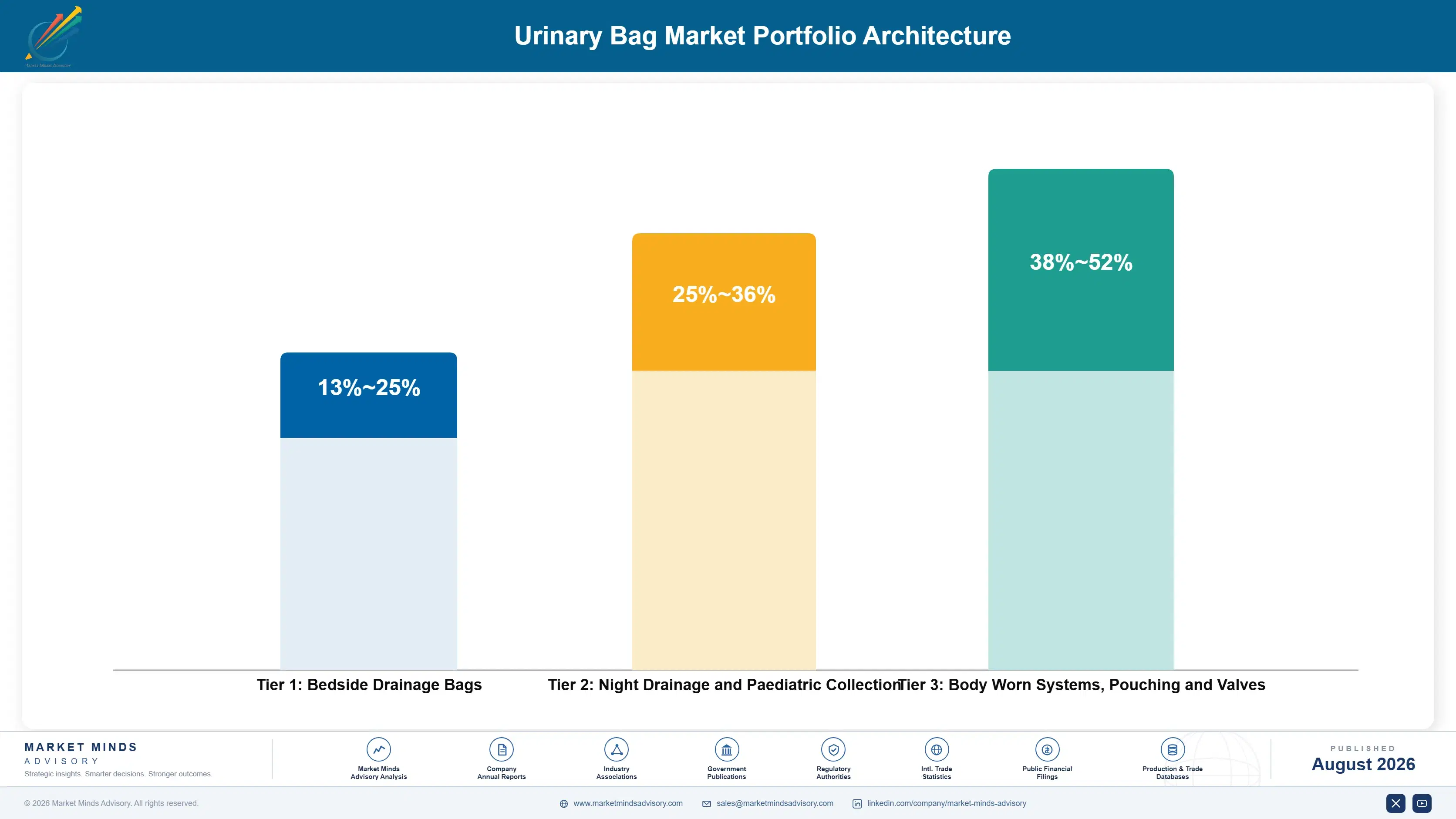
Portfolio Architecture for Margin Defence

Margin here follows who chooses the product rather than what it costs to make, because a hospital tender evaluates delivered price while a community prescriber weighs whether somebody can live with the thing. Bedside drainage bags earn margins in the low teens to mid twenties, awarded on price with user experience entirely absent from the evaluation. Nothing about living with the product is assessed at that level.
Night drainage systems and paediatric collection products do better in the mid twenties to mid thirties, because both carry format specific requirements and neither is bought in the volumes that drive tender aggression. Volume thresholds rather than capability keep the field narrower here. Paediatric formats in particular require quite different sizing.

Body worn systems, urostomy pouching and catheter valves hold the strongest position, reaching into the low fifties, where user preference genuinely decides selection and reimbursement tariffs reflect outcome rather than delivered cost. Those margins depend on community prescribing continuing to weigh user experience, which is the entire basis on which continence specialists have built their positions. Continence specialists built their entire positions on community prescribing continuing to weigh what a person can actually manage.

Bedside Drainage Bags

Products awarded on hospital tender price with user experience entirely absent from evaluation. The twelve point range reflects manufacturing scale and film sourcing rather than any difference users would notice.
Gross Margin: 13-25%

Night Drainage and Paediatric Collection

Formats with specific requirements bought in volumes below tender aggression thresholds. The eleven point range reflects format specialisation and how narrow the qualified supplier field actually becomes. Volumes stay below tender scale.
Gross Margin: 25-36%

Body Worn Systems, Pouching and Valves

Products where user preference genuinely decides selection and tariffs reflect outcome. The fourteen point range reflects design quality and how directly the supplier reaches community prescribers. Preference rather than price decides.
Gross Margin: 38-52%
urinary-bag-market-portfolio-architecture-1787641082449

High-value Sub-segments and Strategic Watch-out

Leg Bags and Body Worn Systems

High value and the fastest growth at 8.4%, serving people who wear the product all day and judge it on discretion and one-handed operation. Allowance limits cap consumption regardless of preference. Community prescribers rather than hospital procurement decide who actually supplies them. Allowances still cap it.
Gross Margin: 38-52%

Catheter Valves and Flip-Flo Systems

High value and growing at 7.2% by removing visible equipment for most of the day. Uptake follows continence assessment capacity rather than product availability or delivered price anywhere. Clinical assessment is required and not every user is suitable for one. Services must assess first. Suitability varies.
Gross Margin: 36-50%

Bedside Drainage Bags

The volume core, procured on hospital tender price where nothing about how it is used gets evaluated. It serves the setting where a shrinking minority of total use now occurs. Delivered price is the only variable that any hospital tender actually evaluates. Use is shrinking there.
Gross Margin: 13-25%

Allowance Constraint Exposure

The strategic watch-out. Four bags a month against a seven day interval caps consumption administratively, and the range reflects whether a supplier submits evidence or simply accepts the ceiling. Commissioning bodies move only on evidence, and almost nobody submits any. Ceilings are administrative. Evidence moves them.
Gross Margin: 0-45%

Every Week, for Years

Demand here is genuinely long running, because a person with a long-term indwelling catheter uses drainage products every day for years and frequently for the rest of their life. That produces consumption measured in decades rather than episodes, and it makes each community user worth many times what a hospital admission generates. Retention matters far more than acquisition in a category most suppliers treat as a tender business. Decades, not episodes.
Stickiness follows familiarity and confidence rather than any contract. A user who has learned to operate a particular tap without looking, whose skin tolerates a particular strap and who knows the capacity will last a morning does not change willingly. Community prescribers respect that reluctance because a change that goes badly produces a distressed patient and an avoidable clinic appointment.

The deciding party depends entirely on setting and most suppliers cover only one. Hospital procurement decides bedside drainage on price. Community prescribers and continence nurses decide long-term supply, weighing what the user can actually manage. The user decides whether they persist with it, which nobody records but which determines whether the prescription repeats at all.
urinary-bag-market-end-use-penetration-index-1787641082948

Where We Would Put Effort

These are among the four positions where our research anticipates prominent divergence between winners and laggards over the coming forecast period. Each is grounded in the demand model, the regulatory perimeter, and the announced capacity pipeline.
01 / USER CENTRED DESIGN

The bed frame left years ago

Around 78% of people with an indwelling catheter manage drainage at home, standing and dressed and frequently with quite limited dexterity, which makes one-handed tap operation, a discreet profile and secure strapping the attributes that actually decide their preference. Body worn systems are growing at 8.4% on precisely those criteria rather than on price. Products still engineered around a bed frame and an attending nurse are solving a problem that only a shrinking minority of users actually has any more.
02 / COMMUNITY PRESCRIBER ACCESS

Tenders govern the shortest stay

Hospital procurement writes the specifications governing at most a few days of any patient's use, while community prescribers and continence nurses then go on to decide what a long-term user actually receives every month for years afterwards. Suppliers who are still organised around acute hospital tenders are competing for the smaller and steadily shrinking part of this whole market. Community formulary inclusion takes considerably longer to win, and it proves far more durable once it has actually been achieved anywhere.
03 / ALLOWANCE EVIDENCE SUBMISSION

An administrator set clinical practice

Community allowances funding around four bags a month against a recommended seven day change interval oblige users to extend bag life, which raises contamination risk in a closed system that is already opened roughly six times a day. Nobody defends that gap on clinical evidence, because no clinical evidence supports it anywhere at all. Evidence submissions to commissioning bodies are the only mechanism that has ever succeeded in moving an allowance, and raising one lifts consumption per user almost immediately.
04 / ASSESSMENT CAPACITY SUPPORT

Growing the market, not the share

Catheter valves are growing at 7.2%, but they require clinical assessment that many continence services simply cannot provide at all, so uptake here follows assessment capacity rather than product availability or delivered price at all. Suppliers who fund training and assessment tools genuinely expand the addressable population rather than competing over the one that already exists. That is genuinely unusual in a consumable category, and it is the only lever available here that grows the market rather than redistributing it.

Engagement Snapshot From the Field

A live engagement with an industry participant carrying material or product regulatory and market exposure ahead of a defining policy shift, showing how our research translates into a defensible multi-year portfolio strategy.
MARKET MINDS ADVISORY · CLIENT ENGAGEMENT SUMMARY
Urinary Bag Producer Strategic Portfolio Review and Transition Roadmap 2026·Investment Scenario on Urinary Bag Exposure Evaluation 2025-26
CLIENT PROFILE
A continence products manufacturer supplying drainage bags and related systems to hospital and community customers across European and Middle Eastern markets, at annual revenue near 310 million dollars (client-reported, unverified by MMA). Selling ran through hospital tenders and community prescriber engagement was limited. Community prescribers were reached through distributors the business never spoke to. Design followed specification.
STRATEGIC CHALLENGE
Hospital tender margins had compressed to very little while body worn products the business made well were not reaching community users. Management wanted to understand whether the community channel was accessible or whether the business should accept a tender based future. Volume was holding while margin disappeared. A direction was needed.
MMA APPROACH
MMA traced where long-term users actually obtained products, quantified allowance limits against recommended change intervals, gathered user preference criteria through structured panels, and assessed continence assessment capacity across customer regions. Interviews with 47 experts covered continence nursing, community prescribing, commissioning, urology and product design. Allowance limits were documented separately by region.
KEY FINDINGS
  1. The overwhelming majority of long-term use occurred at home under community prescription, a channel the client reached almost entirely through distributors it never spoke to.
  2. User preference criteria centred on one-handed operation, garment visibility and strap comfort, none of which appeared in any hospital tender specification the client had ever answered.
  3. Allowance limits capped consumption below recommended intervals in every region examined, and no supplier had submitted evidence to any commissioning body about it.
  4. Catheter valve uptake tracked continence assessment capacity rather than product access, which meant supply side effort produced very little without service support alongside.
CLIENT PROFILE
A continence products manufacturer supplying drainage bags and related systems to hospital and community customers across European and Middle Eastern markets, at annual revenue near 310 million dollars (client-reported, unverified by MMA). Selling ran through hospital tenders and community prescriber engagement was limited. Community prescribers were reached through distributors the business never spoke to. Design followed specification.
STRATEGIC CHALLENGE
Hospital tender margins had compressed to very little while body worn products the business made well were not reaching community users. Management wanted to understand whether the community channel was accessible or whether the business should accept a tender based future. Volume was holding while margin disappeared. A direction was needed.
MMA APPROACH
MMA traced where long-term users actually obtained products, quantified allowance limits against recommended change intervals, gathered user preference criteria through structured panels, and assessed continence assessment capacity across customer regions. Interviews with 47 experts covered continence nursing, community prescribing, commissioning, urology and product design. Allowance limits were documented separately by region.
KEY FINDINGS
  1. The overwhelming majority of long-term use occurred at home under community prescription, a channel the client reached almost entirely through distributors it never spoke to.
  2. User preference criteria centred on one-handed operation, garment visibility and strap comfort, none of which appeared in any hospital tender specification the client had ever answered.
  3. Allowance limits capped consumption below recommended intervals in every region examined, and no supplier had submitted evidence to any commissioning body about it.
  4. Catheter valve uptake tracked continence assessment capacity rather than product access, which meant supply side effort produced very little without service support alongside.
RECOMMENDED STRATEGY
Phase 1: Phase one: build direct community prescriber engagement, since that is where long-term supply is actually decided month after month. Tenders decide days. Phase 2: Phase two: rebuild body worn product design around user panels rather than clinical specification, because preference criteria differ completely. Specifications miss it. Phase 3: Phase three: submit allowance evidence to commissioning bodies, as nobody has and the gap has no clinical defence. Evidence moves allowances.
OUTCOME
The manufacturer established community prescriber engagement during 2026 and body worn product volumes rose in two regions (client-reported, unverified by MMA). User panels were incorporated into design, and allowance evidence submissions were prepared for three commissioning bodies. Tender only selling was reduced across the European business.

Frequently Asked Questions

Foundational context covering the market sizes, CAGR, scope, country, region and competition that inform every finding below. This section is provided to cover basics and most often pre-purchase conversations, answered from the MMA Primary Research Dataset.

What is the current size of the Urinary Bag Market?

MMA sizes it at USD 2.4 billion in 2025, rising to USD 2.53 billion in 2026. The figure covers urine collection and drainage products at manufacturer selling value.

How large will the Urinary Bag Market be by 2036?

USD 4.36 billion by 2036, an incremental USD 1.83 billion over the 2026 base and an expansion multiple of 1.72 times. Body worn systems carry most of that gain.

What is the CAGR for the Urinary Bag Market 2026 to 2036?

5.6% in the base case, with a bull case at 6.8% and a bear case at 4.4%. Community reimbursement allowances drive most of the spread between them.

Which segment is growing fastest?

Leg bags and body worn systems at 8.4%, half again the market rate of 5.6%. Around 78% of catheterised people now manage drainage at home rather than in hospital.

Who are the major companies in the Urinary Bag Market?

Coloplast, Convatec, Hollister, Becton Dickinson and Teleflex lead on urinary drainage revenue. Fifteen further participants are profiled in the full report on the same basis.

Which country is growing fastest?

Turkey at 9.6%, where urology service capacity and organised home care provision are expanding at the same time across a large and rapidly ageing population.

Report Segmentation Architecture

The full report scope spans multiple orthogonal segmentation dimensions, with cross-tabulated demand data provided for each dimension pair. Coverage extends further to regional breakdowns, trend trajectories, and the competitive detail needed to support segment-level decision-making.

By Product Type

  • Bedside Drainage Bags
  • Leg Bags and Body Worn Systems
  • Urostomy Pouching Systems
  • Night Drainage Bags and Stands
  • Catheter Valves and Flip-Flo Systems
  • Paediatric and Specimen Collection Bags

By End-Use Industry

  • Home and Community Care
  • Acute Hospital Wards
  • Long-Term Care Facilities
  • Urology and Continence Clinics
  • Rehabilitation and Spinal Services
  • Paediatric Care Settings

By Commercial Dimension

  • Community Prescription Supply
  • Hospital Tender Procurement
  • Home Delivery Service Contracts
  • Retail Pharmacy Channels
  • Distributor and Dealer Supply
  • Self-Pay and Private Purchase

By Region

  • North America
  • Western Europe
  • East Asia
  • South Asia and Pacific
  • Latin America
  • Middle East and Africa
  • Eastern Europe

Scope, Methodology, and Coverage

Every figure in this report is reproducible from documented input assumptions. The scope below maps the historical period, the forecast horizon, the segmentation dimensions, and the countries covered, alongside the underlying primary and qualitative methodology.
Historical Period
2020 to 2025
Forecast Period
2026 to 2036
Base Year
2025 (USD billions; MMA Primary Research Dataset, August 2026)
Market Definition
Urine collection and drainage bags and associated closed system components, covering bedside drainage bags, leg bags and body worn systems, urostomy pouching systems, night drainage bags and stands, catheter valves and flip-flo systems, and paediatric and specimen collection bags. Measured at manufacturer selling value. Urinary catheters themselves, continence pads and absorbent products, bedpans and urinals, and urodynamic equipment are excluded from scope.
Quantitative Units
USD billions (current prices); units shipped; USD per unit by product type
Segmentation Dimensions
Product type; end-use industry; commercial dimension; region
Regions Covered
North America, Western Europe, East Asia, South Asia and Pacific, Latin America, Middle East and Africa, Eastern Europe
Countries Covered
United States, Canada, Mexico, United Kingdom, Germany, Denmark, France, Sweden, Japan, China, South Korea, Taiwan, India, Australia, Indonesia, Brazil, Argentina, Turkey, Saudi Arabia, Poland
Key Companies Profiled
Coloplast, Convatec, Hollister, Becton Dickinson, Teleflex, B Braun, Cardinal Health, Medline Industries, Amsino International, Romsons Group, Poly Medicure, Wellspect HealthCare, Great Bear Healthcare, Manfred Sauer, Cure Medical, Sterimed, Narang Medical, Flexicare Medical, Vygon, Asid Bonz
Quantitative Methodology
Primary survey, n=3,800 respondents, Q4 2025, six countries; demand-side model with trade association cross-validation
Qualitative Methodology
47 expert interviews, Q4 2025; applied to validate demand model assumptions, identify emerging dynamics, and assess competitive positioning
Report Format
PDF and XLSX data workbook (Word format preview document)
Publisher
Market Minds Advisory
Report Code
MMA-2026-MED-126
Published
August 2026
Contact
sales@marketmindsadvisory.com | www.marketmindsadvisory.com

Purchase the full Urinary Bag Market Report (2026 to 2036).

The full report treats urinary drainage as a category designed around a hospital bed and lived with in a bathroom, which explains why tender specifications and user preferences have almost nothing in common. It sizes all six product types independently through 2036, quantifies reimbursement allowances against recommended change intervals, and documents the criteria that actually decide user preference. Regional chapters cover all seven regions with community provision assessed separately from catheterisation volume. Competitive profiling covers 20 participants on one consistent revenue basis. Prescriber decision routes are mapped by care setting throughout.
Six product types sized independently through 2036
Reimbursement allowances quantified against recommended replacement intervals by market
User preference criteria documented through structured panel research
Community provision assessed separately from catheterisation volume regionally
Continence assessment capacity mapped against catheter valve adoption
Twenty participants profiled on one consistent revenue basis

Built For The People Who Decide

From boardroom strategy to bench-side execution, this report is read cover-to-cover by leaders shaping the next decade of their industry, turning demand scenarios, market dynamics and valuation benchmarks into decisions.
CXOs/ Presidents/ VPs/ Managers
M&A and Corporate Development
Strategy Teams and R&D Heads
Procurement and Product Directors
Regulatory and Compliance Leaders
Investor Relations and Equity Analysts