

Market Minds Advisory
Unmanned Underwater Vehicle Market

Unmanned Underwater Vehicle Market: Unmanned Underwater Vehicle Market. Extra-Large Platforms Redefine Mission Endurance

Extra-large autonomous platforms extend underwater mission endurance from hours to weeks, while defense procurement programs and offshore energy inspection demand converge to pull unmanned underwater vehicles from experimental payloads into standard fleet equipment.

Lead Analyst

Published

September 2026

Make Smarter Decisions with Customized Research Insights

Request a free sample report and evaluate market opportunities, growth trends, and competitive dynamics relevant to your business needs.

2025 MARKET VALUE$4.2BMarket Size 2025
2036 FORECAST VALUE$13.0BBase Case , 2026 to 2036
CAGR 2026 TO 203610.8 %Bull 12.1% / Bear 9.5%
INCREMENTAL OPPORTUNITY$8.3BNet 10- year value creation
EXPANSION MULTIPLE2.79x2036 value over 2026 base
Strategic Levers
M&A Pipeline
Regional Outlook
Country Rankings
Competitive Intelligence
Segmental Deep-dive
Call-Us : 91 93563 13602

Executive Snapshot and Market Trajectory.

Unmanned underwater vehicles have moved decisively from experimental survey tools toward standard fleet equipment, as extra-large autonomous platforms extend mission endurance from hours to multi-week deployments without surface support across most major defense and commercial fleets tracked closely today. Deployment durations continue extending as battery and fuel cell technology improve.
Extra-large and hybrid AUV-ROV platforms are pulling share away from smaller survey-class vehicles, since buyers increasingly want extended-range autonomy for both defense and offshore energy missions that shorter-endurance platforms simply cannot support reliably. Growth concentrates most heavily in North America and Western Europe, where large defense procurement programs and mature offshore inspection markets both reward certified, mission-proven platforms over experimental designs sold at lower cost. Enterprise buyers increasingly evaluate vendors on mission endurance credentials.
Competition remains concentrated among a handful of defense-adjacent manufacturers that combine naval program relationships with commercial marine engineering expertise few pure-play startups can replicate at comparable scale or speed. Rising offshore wind farm inspection demand is reshaping product design toward longer-duration, lower-cost platforms suited to repetitive commercial inspection missions rather than one-off defense payloads sold at considerable expense. Vendors increasingly certify platforms separately for defense and commercial buyers.
Market Definition
The unmanned underwater vehicle market covers autonomous and remotely operated submersible platforms used for defense, offshore energy, scientific, and commercial subsea applications. It excludes surface unmanned vessels, towed sonar arrays without independent propulsion, and manned submersibles operated with an onboard crew.
Base Year Value
$4.2B in 2025 (MMA Primary Research Dataset, September 2026)
Forecast Period
2026 to 2036, eleven discrete annual values
CAGR
10.8% base case. Bull 12.1%. Bear 9.5%.
Fastest Growth Segment
Extra-Large Unmanned Underwater Vehicles: 15.2% CAGR
Fastest Growth Country
United States: 12.3% CAGR
Fastest Growth Region
South Asia and Pacific: 12.8% CAGR
Largest Region
North America: 32% of 2025 global value
Market Leaders
Kongsberg Maritime, Teledyne Marine, Boeing, Anduril Industries, Saab (Seaeye). Source: MMA Analysis based on company disclosures and primary research.
Primary Survey
n=3,800 procurement and R&D decision-makers, Q4 2025, six countries
Methodology
Demand-side build-up, cross-validated against public data, 47 expert interviews

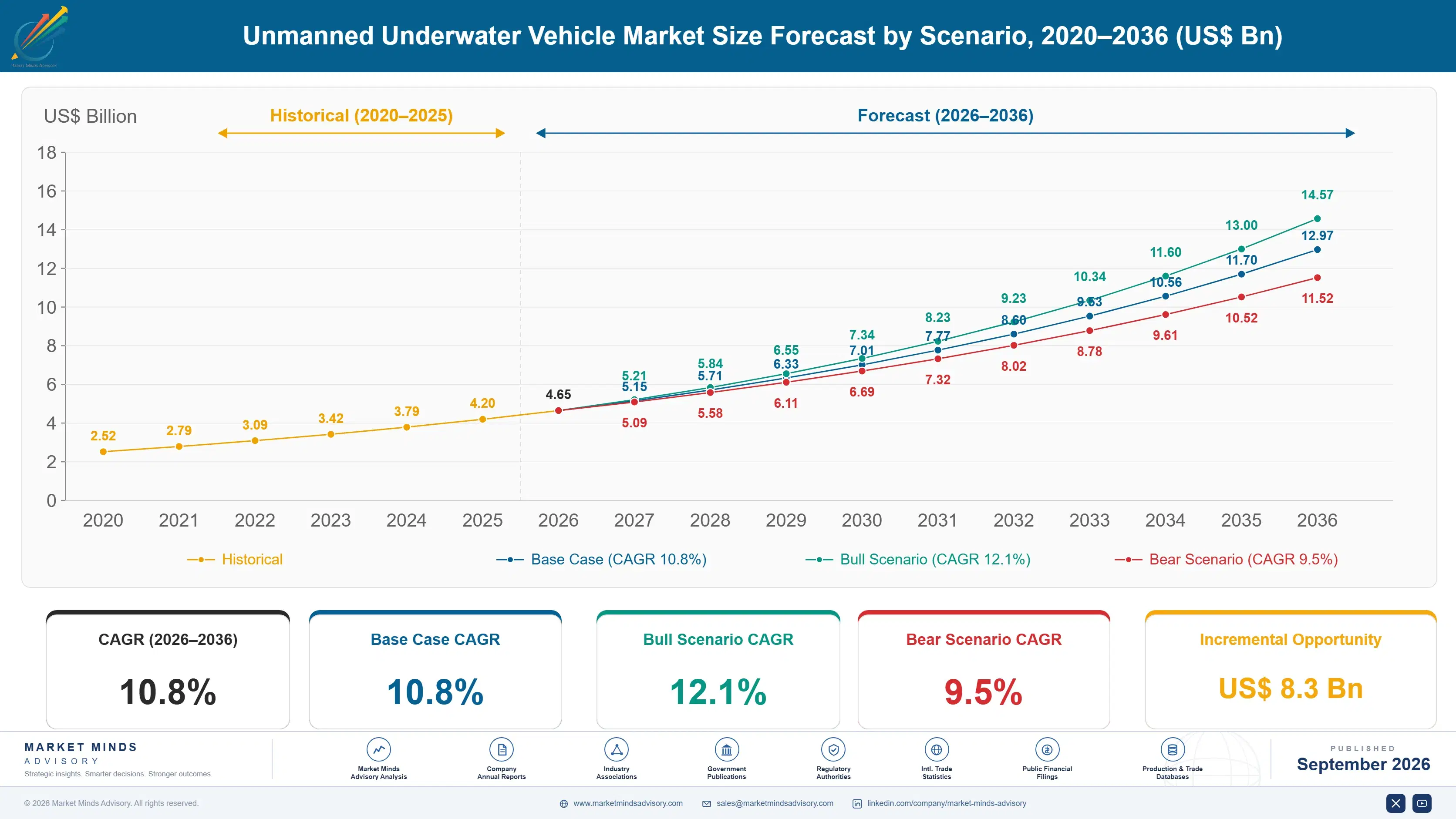
Unmanned Underwater Vehicle Market Forecast Scenarios

unmanned-underwater-vehicle-market-size-forecast-scenario-1790025408022
Between 2020 and 2025 the market grew steadily as offshore wind expansion and renewed naval modernization programs both accelerated procurement across most tracked defense budgets globally, with extra-large platform orders climbing well above prior trend for two consecutive years across major defense and commercial buyers domestically and abroad. Shipbuilding capacity constraints have also periodically slowed platform delivery timelines.
The base case assumes continued naval procurement of extra-large autonomous platforms, expanding offshore wind and energy inspection contracts that favor long-endurance vehicles over shorter-range alternatives, and sustained commercial adoption of hybrid AUV-ROV systems that reduce the need for separate specialized platforms across different mission types. These three mechanisms together sustain growth even as legacy survey-class vehicle penetration approaches saturation across established defense and research fleets already equipped with the category.
A stronger bull case hinges on additional national defense programs committing to extra-large platform fleets considerably faster than current procurement timelines suggest. The bear risk is budget-driven defense procurement delays in major markets, which would push back multi-year platform orders and slow the manufacturing scale-up that lower per-unit costs depend on. Vendors are lobbying procurement offices for clearer multi-year budget commitments.

Endurance Becomes the Defining Procurement Metric

Unmanned underwater vehicles sit at the intersection of defense modernization and offshore energy inspection demand, a category that grew considerably as both buyer types converged on similar platform requirements around endurance and autonomy standards. Buyers now treat platform selection partly as a mission-duration decision rather than a simple capability checklist, reshaping how manufacturers design and price extended-range systems for procurement.
MARKET CONCENTRATIONCR5 34%reflects consolidated ownership among major defense-adjacent manufacturers today
AVERAGE SELLING PRICE$2.1 millionblends survey-class vehicles with extra-large defense platform pricing
TOP PRODUCING COUNTRY SHAREUSA 38%captures the dominant manufacturing base for defense platforms
CAPACITY UTILIZATION68%indicates meaningful headroom across specialized shipyard facilities today
DEFENSE PROGRAM REVENUE SHARE57%shows how much category revenue depends on government contracts
REPLACEMENT CYCLE LENGTH8 yearscaptures how long operators typically keep a platform before replacing
Manufacturing remains concentrated among a handful of defense-adjacent shipbuilders in the United States, Norway, and the United Kingdom, where naval program relationships and specialized engineering talent command a premium buyers are willing to pay for mission-proven reliability and safety. Commercial offshore energy buyers increasingly source from the same manufacturers as defense customers, since dual-use platform designs reduce development cost across both markets.
Replacement demand now rivals first-time procurement as a growth driver, since operators who deployed survey-class vehicles years ago increasingly upgrade to extra-large or hybrid alternatives as mission requirements extend beyond original platform capability and endurance limits. This replacement cycle gives established manufacturers a second monetization opportunity per fleet well beyond the initial platform purchase made years earlier. Naval sustainment contracts increasingly bundle upgrade cycles into long-term service agreements.
"Nobody asks how deep it can go anymore. Everyone asks how long it can stay down there without coming back for a battery swap, and that single question has rewritten every procurement specification in the category."
Senior Analyst, Defense and Marine Technology Practice · MMA Technology Practice · September 2026

Market Trends

Extra-Large Platforms Redefine Mission Endurance Expectations

Naval buyers increasingly specify extra-large autonomous platforms capable of multi-week deployments without surface support, since documented mission requirements have expanded well beyond what survey-class vehicles with limited battery capacity can sustain. Manufacturers report extra-large platform orders climbing meaningfully faster among defense buyers who previously accepted shorter-endurance vehicles for routine reconnaissance and mine countermeasure missions. This shift is pulling procurement specifications toward multi-week endurance as a baseline requirement, forcing legacy survey-class manufacturers to accelerate extra-large product roadmaps or exit high-value defense segments entirely. Insurance underwriters increasingly factor endurance ratings into mission risk calculations.
Market Impact: drives 49% of platform orders

Hybrid AUV-ROV Designs Reduce Fleet Platform Redundancy

Buyers increasingly favor hybrid platforms capable of switching between autonomous and remotely operated modes within a single mission, reducing the need to maintain separate specialized vehicles for different task profiles. Several major manufacturers have launched hybrid product lines within the past two years specifically to capture buyers seeking fleet consolidation and lower total cost of ownership across mixed mission types. This shift is reshaping platform economics considerably, since hybrid systems command a price premium over single-mode vehicles despite replacing what previously required two separate purchases. Fleet operators increasingly view single-platform flexibility as a budget planning advantage.
Market Impact: wind farm deployments grow 41% yearly

Market Opportunities and Growth Drivers

Naval Modernization Programs Sustain Procurement Growth

Naval modernization programs across multiple major defense budgets continue treating unmanned underwater platforms as a core capability investment, sustaining large-scale procurement even as broader defense spending faces competing budget priorities elsewhere. Buyers increasingly view autonomous underwater platforms as essential force multipliers rather than experimental supplementary equipment, justifying sustained multi-year budget commitments across procurement cycles. This behavioral pattern has proven durable across multiple administration and budget cycles, sustaining demand even during periods of broader government spending caution. Multi-year framework contracts increasingly lock in vendor relationships across budget cycles and shifting political administrations.
Market Impact: budget delays affect 19% of orders

Offshore Wind Expansion Opens New Commercial Deployment Volume

Offshore wind farm operators increasingly deploy unmanned underwater vehicles for cable inspection and foundation maintenance, opening a commercial channel considerably larger than traditional oil and gas inspection work ever represented for platform manufacturers. This adoption particularly benefits manufacturers with existing offshore energy certification and compliance experience over pure defense specialists lacking comparable commercial relationships. Wind farm operators in several major markets have already deployed unmanned platforms at meaningful commercial scale, demonstrating viability beyond pilot programs. Certification cycles for offshore energy deployment typically take twelve to eighteen months depending on the jurisdiction.
Market Impact: communication gaps limit missions by 22%

Market Restraints and Challenges

Defense Budget Cycles Create Procurement Timing Uncertainty

Extra-large platform procurement depends heavily on multi-year defense budget approval processes that can face delays or cuts tied to broader political and fiscal priorities unrelated to the platforms themselves. The root cause is that unmanned underwater programs often compete against higher-visibility defense priorities for limited procurement budget, leaving platform orders vulnerable to timing shifts even when underlying military requirements remain unchanged. Manufacturers are countering by diversifying into commercial offshore energy contracts that provide revenue continuity independent of defense budget cycles. Vendors increasingly structure contracts with flexible delivery milestones to absorb this timing risk.
Market Impact: extra-large orders up 44%

Underwater Communication Limits Constrain Autonomous Operation

Radio signals do not propagate effectively underwater, forcing autonomous platforms to rely on acoustic communication that offers considerably lower bandwidth and reliability than surface wireless systems, limiting real-time command and data transmission capability. This friction particularly affects extended-range missions where operators need periodic status updates without surfacing the vehicle and compromising stealth or mission continuity. Manufacturers are responding with improved acoustic modem technology and pre-programmed autonomous decision-making that reduces dependence on continuous communication links during deployment. Research into optical and hybrid communication systems continues but remains years from wide deployment.
Market Impact: hybrid platforms now 26% of orders
3 additional market trends, 4 additional growth drivers, and 2 additional restraints and challenges are covered in the full report. Contact sales@marketmindsadvisory.com to access the complete intelligence.

Segment CAGR and Growth Architecture

The market segments by vehicle autonomy class rather than by application or price tier, since whether a platform operates fully autonomously, remotely, or in hybrid mode determines its mission profile, endurance, and target buyer entirely. Six autonomy classes together capture the full addressable scope of unmanned underwater vehicles sold globally across defense and commercial markets.
unmanned-underwater-vehicle-market-market-share-analysis-1790025408642

Extra-Large Unmanned Underwater Vehicles

Extra-large unmanned underwater vehicles operate independently for multi-week durations without surface support, carrying substantial payload capacity for defense missions including mine countermeasures, intelligence gathering, and undersea infrastructure monitoring that shorter-endurance platforms simply cannot sustain reliably. This segment is growing fastest as naval procurement programs increasingly specify extended mission duration as a baseline requirement rather than an advanced capability, reflecting expanded strategic priorities around undersea domain awareness. Defense-adjacent manufacturers with naval program relationships have led this segment's expansion, applying submarine-grade engineering principles that smaller commercial platform makers lack the specialized expertise to replicate at comparable scale. Multiple national defense programs have committed to expanding these fleets considerably over the coming decade.
CAGR 15.2%

Hybrid AUV-ROV Systems

Hybrid AUV-ROV systems combine autonomous and remotely operated modes within a single platform, letting operators switch between independent survey operation and precise remote control for delicate manipulation tasks without deploying two separate vehicles for each mission type. This segment benefits from fleet consolidation economics, since buyers increasingly prefer a single versatile platform over maintaining separate specialized vehicles for different mission profiles and budget lines. Growth concentrates among offshore energy operators and defense buyers seeking lower total cost of ownership across mixed mission types, creating a meaningful commercial channel beyond traditional single-mode platform sales. Manufacturers increasingly market these systems on lifecycle cost savings rather than upfront price alone. Several major offshore operators have already committed to multi-year hybrid platform contracts.
CAGR 12.4%
Full segment breakdown across 6 segments available in the complete report.

Regional Architecture and Country Demand Map

North America leads on the strength of dominant US Navy procurement programs and a concentrated base of defense-adjacent shipbuilders, narrowly ahead of Western Europe, while South Asia and Pacific posts the fastest regional growth from a smaller base as naval modernization programs expand rapidly nationwide.

North America

North America holds the largest regional share, anchored by dominant US Navy procurement programs and a concentrated base of defense-adjacent shipbuilders including Boeing and Anduril Industries that few global competitors can match at comparable program scale. American naval modernization priorities increasingly favor extra-large autonomous platforms, sustaining premium procurement demand well insulated from broader commercial spending cycles. Canadian demand tracks related though considerably smaller naval modernization priorities, focusing more on Arctic surveillance and coastal patrol applications than large-scale extra-large platform fleets. Offshore energy operators across the region increasingly source from the same manufacturers serving defense customers. Retailers of specialized defense equipment across the region continue expanding platform delivery capacity to reflect this sustained procurement demand shift.
Share: 32% | CAGR: 11.4% (2026 to 2036)

Western Europe

Western European demand centers on Norway, the United Kingdom, and France, where established naval engineering heritage and mature North Sea offshore energy infrastructure both sustain considerable platform demand across defense and commercial buyers alike. Growth trails North America slightly since European naval procurement budgets remain more constrained than American defense spending, limiting the pace of extra-large platform fleet expansion across most national navies. Norwegian buyers in particular benefit from Kongsberg Maritime's dual-use engineering expertise spanning both defense and offshore energy applications simultaneously. British and French naval modernization programs continue prioritizing autonomous underwater capability expansion. Regional integrators increasingly bundle platforms with long-term maintenance contracts to secure recurring service revenue across multi-year naval programs.
Share: 24% | CAGR: 9.6% (2026 to 2036)
Regional intelligence for 5 additional markets available in the complete report: East Asia, South Asia and Pacific, Latin America, Middle East and Africa, Eastern Europe. Contact sales@marketmindsadvisory.com.
unmanned-underwater-vehicle-market-country-cagr-analysis-1790025409168

Where Sustainment Contracts Concentrate Value

Platform hardware margins face pressure from lengthy defense procurement cycles, while sustainment contracts, software licensing, and mission support services carry considerably richer economics that manufacturers increasingly prioritize over time and across programs. Manufacturers capture disproportionate returns from multi-year maintenance agreements, recurring software updates, and premium extra-large platform positioning rather than from the initial platform sale alone.

Multi-Year Fleet Sustainment and Maintenance Contracts

Manufacturers bundling multi-year sustainment and maintenance agreements with platform sales capture recurring revenue that considerably exceeds the initial hardware sale over a typical fleet lifetime, since defense buyers require guaranteed availability and cannot easily switch maintenance providers without risking mission readiness. Brands with formal sustainment programs report recurring revenue per deployed platform 53% higher than brands selling hardware without ongoing service relationships, since specialized underwater platform maintenance requires continuous manufacturer engagement. This recurring revenue stream justifies competitive hardware pricing to secure initial program wins. Defense buyers increasingly view sustainment reliability as their primary vendor selection criterion.
Market Impact: lifts recurring revenue per platform by 53% overall

Mission Software and Autonomy Update Licensing

Vendors offering ongoing autonomy software updates and mission planning licensing alongside hardware sales capture meaningfully higher margin than the hardware transaction alone, since improving autonomous navigation and payload processing capability requires continuous algorithm development most defense buyers lack internal expertise to replicate. Brands operating dedicated software licensing practices report gross margins near 67% on licensing revenue, well above typical hardware margins achieved through competitive defense procurement processes. This service also generates valuable relationship depth that manufacturers use to secure multi-year fleet expansion contracts. Larger vendors increasingly hire dedicated autonomy software teams for this purpose.
Market Impact: captures gross margins near 67% on licensing revenue

Premium Extra-Large Tier With Extended Service Agreements

Manufacturers that bundle extra-large platforms with extended service and calibration agreements command meaningfully higher average order value than hardware sold standalone, since buyers value assurance that mechanically complex, high-value platforms will be maintained professionally over multi-year deployment cycles. This bundled configuration lifts average order value by 46% compared to an unbundled platform sale, while also creating a recurring service revenue stream beyond the initial purchase. Program managers favor these bundles too, since they reduce mission-critical downtime considerably. Extended contracts also improve forecasting accuracy for parts inventory planning across entire fleets.
Market Impact: lifts average order value by 46% for bundles

Commercial Offshore Energy Inspection Contract Diversification

Manufacturers achieving certification for commercial offshore energy inspection contracts capture recurring inspection revenue tied directly to wind farm and pipeline maintenance schedules rather than a one-time defense platform sale, creating a revenue stream considerably less exposed to defense budget volatility. Brands with commercial certification report 38% higher lifetime revenue per platform than brands limited entirely to defense applications alone. This channel also opens considerably larger deployment volume than traditional defense procurement programs ever represented. Offshore energy operators increasingly negotiate these arrangements directly with platform manufacturers before deployment begins each fiscal year.
Market Impact: lifts lifetime platform revenue by 38% across the fleet

Who Controls the Margin Pool

Ranked by global unit shipments across defense and commercial platforms, the market shows meaningful concentration with a CR5 near 34%. Kongsberg Maritime holds a clear lead built on dual-use engineering expertise spanning both defense and offshore energy applications few competitors match. Teledyne Marine trails closely given its broad commercial survey platform portfolio, while the gap to Boeing and Anduril Industries remains narrow enough that rank changes look plausible within a normal planning horizon.
Current competitive activity centers on extra-large platform development and sustainment contract expansion rather than basic survey-class specifications alone, since most established vendors already offer comparable entry-tier platforms at similar price points. Several manufacturers have launched hybrid AUV-ROV product lines within the past two years specifically to capture fleet consolidation demand, while others pursue commercial offshore energy certification to diversify beyond defense budget dependence.

Emerging pressure comes from newer defense technology entrants that skip legacy naval contracting relationships entirely, designing narrower but more software-focused platforms around specific autonomy and mission planning capability. These challengers cannot match incumbent manufacturing scale and program history, but they are shifting where mid-tier rankings sit within five years, particularly as procurement offices increasingly weight software sophistication alongside hardware reliability.
unmanned-underwater-vehicle-market-company-positioning-matrix-1790025409696

Competitive Moat and Risk Dimensions

KONGSBERG MARITIME

Moat: Dual-Use Engineering Expertise Advantage

Kongsberg Maritime's decades of dual-use engineering spanning both defense and offshore energy applications give it program relationships and technical credibility that specialists focused on a single market segment struggle to match quickly. Its broad customer base across NATO navies and offshore operators reinforces revenue stability that pure defense contractors lack during defense budget downturns.
KONGSBERG MARITIME

Risk: Limited North American Program Access

Kongsberg Maritime's program relationships remain concentrated in Europe and allied markets, limiting its access to the considerably larger US defense procurement budget that domestic contractors like Boeing and Anduril access more directly. Building comparable American program relationships would require sustained investment in domestic manufacturing and political relationships beyond typical commercial expansion.
BOEING

Moat: Established Extra-Large Platform Program

Boeing's established extra-large platform program with the US Navy gives it credibility and program continuity that newer entrants without comparable multi-year contract history cannot easily replicate. This program relationship reinforces sustained future procurement visibility that smaller competitors lack in a segment where program wins shape manufacturer roadmaps for years.
BOEING

Risk: Heavy Dependence on Defense Procurement

Boeing's underwater vehicle business remains heavily dependent on defense procurement cycles, leaving it exposed to budget delays or program cancellations that diversified commercial competitors can better absorb through offshore energy revenue. Expanding into commercial applications would require capabilities and certifications the division has not historically prioritized.

Players Tracked

Prominent Players

Kongsberg Maritime
Teledyne Marine
Boeing
Anduril Industries
Saab (Seaeye)

Other Key Players

Exail
General Dynamics Mission Systems
L3Harris Technologies
Ocean Infinity
Fugro
Atlas Elektronik (ThyssenKrupp Marine Systems)
Huntington Ingalls Industries
Planet Ocean Limited
Blue Robotics
Notilo Plus
Terradepth
Deep Trekker
Nauticus Robotics
Cellula Robotics
Voyis Imaging

Recent Developments

MARCH 2025

Kongsberg Maritime Expands Offshore Wind Certification

Kongsberg Maritime expanded its certification coverage for offshore wind farm inspection applications, directly responding to growing commercial demand for cable and foundation monitoring services. The expansion included new sensor packages and marketing content aimed at converting oil and gas inspection customers toward renewable energy applications.
Signal: Shows an incumbent diversifying into commercial offshore energy revenue to reduce dependence on defense budget cycles.
AUGUST 2024

Boeing Secures Extended Orca Platform Production Contract

Boeing secured an extended production contract for its extra-large autonomous platform program, expanding fleet commitments beyond the initial pilot delivery phase and into full production. The contract includes multi-year sustainment provisions aimed at capturing recurring maintenance revenue beyond the initial hardware sale to the Navy.
Signal: Signals sustained government confidence in extra-large platform programs despite broader defense procurement budget uncertainty elsewhere today.
DECEMBER 2025

Anduril Industries Enters Autonomy Software Supply Agreement

Anduril Industries entered a supply agreement with a specialty autonomy software developer to accelerate development of its underwater platform mission planning capability, aiming to close the software sophistication gap against larger competitors. The agreement covers software licensing rather than equity investment, limiting balance sheet exposure.
Signal: Indicates newer defense entrants pursuing software partnership rather than costly in-house autonomy development programs entirely alone.

Pressure Hull and Battery Cost Exposure

Titanium and composite pressure hulls make up the largest cost category, typically 38% to 43% of cost of goods sold, sourced from specialized marine-grade material suppliers concentrated in the United States, Norway, and Japan. Lithium-ion and fuel cell energy systems add a substantial cost share as endurance requirements expand. Precision sonar and navigation electronics draw on broader defense electronics supply chains subject to export control review.
Titanium prices rose considerably during 2024 amid supply tightness reported by the IEA's critical minerals market review, pushing pressure hull production costs up for manufacturers without hedged long-term titanium supply contracts. Boeing's annual report cited elevated raw material costs as a factor compressing defense segment margins during the period, forcing several manufacturers to pass part of the increase through to program pricing later that year.

Smaller manufacturers without scale purchasing agreements face a distinct competitive disadvantage here, since they cannot lock in multi-year titanium and battery contracts the way larger diversified defense conglomerates can through broader purchasing volume. This exposure compounds regionally too, since manufacturers sourcing specialized materials domestically for export control compliance face different cost dynamics than those relying on global supply chains, widening the cost gap between scaled and boutique competitors.
unmanned-underwater-vehicle-market-cost-volatility-analysis-1790025409892

Multi-Year Titanium Supply Contracts

Larger manufacturers increasingly lock in multi-year titanium and specialty alloy supply contracts with fixed or collared pricing, insulating pressure hull production margins from short-term commodity price spikes that smaller competitors must absorb directly into program pricing decisions each cycle. This approach requires meaningful working capital commitment upfront but protects pricing stability across successive program cycles.

Domestic Battery Supply Chain Development

Manufacturers are qualifying domestic battery and fuel cell suppliers to satisfy export control and defense sourcing requirements, reducing dependence on foreign energy system supply chains that have hurt program timelines across recent years of trade disruption and shipping volatility. This diversification adds supplier qualification cost initially but shortens recovery time considerably following any single-region supply disruption.

Portfolio Architecture for Margin Defence

Gross margin architecture splits sharply by tier, with volume-tier survey-class vehicles carrying thin margin after competitive defense and commercial procurement bidding, while premium extra-large platforms and sustainment contracts carry considerably richer economics that manufacturers increasingly prioritize. This gap drives most manufacturer strategy today, since basic platforms increasingly function as a program entry vehicle rather than a meaningful profit center in themselves.
The tension between volume and premium tiers plays out most visibly in defense procurement cycles, where survey-class vehicles compete almost entirely on price while extra-large platforms command considerably higher margin justified by endurance and mission capability. Manufacturers accept compressed volume-tier margin deliberately, treating it as a program relationship maintenance cost against the higher-margin extra-large and sustainment revenue that follows.

High-value margin pools concentrate overwhelmingly in sustainment contracts, software licensing, and commercial offshore energy diversification that bypass defense budget dependence entirely, capturing a larger share of each program dollar. Hybrid platform positioning around fleet consolidation remains a smaller but growing pool, as buyers increasingly weight total cost of ownership when choosing between otherwise similar premium platform lines. Program managers increasingly favor vendors that publish independent third-party reliability testing results.

Volume / Commodity-Adjacent

Entry-level survey-class vehicles sold through competitive defense and commercial procurement channels worldwide with minimal endurance capability, competing primarily on price rather than mission sophistication or program heritage. Bidding remains highly competitive on unit cost alone across programs.
Gross Margin: 17% to 25%

Premium / Certified

Established manufacturers offering extra-large platforms, sustainment contracts, and recognized program heritage built over decades of naval and offshore engagement that supports higher procurement pricing and recurring service revenue over time.
Gross Margin: 39% to 49%

Sustainability / Regulatory / Next-Generation

Fuel-cell and hybrid-electric propulsion platforms designed for extended endurance with reduced environmental footprint and lower lifecycle emissions, appealing to buyers who weight sustainability heavily alongside traditional performance and endurance considerations.
Gross Margin: 41% to 51%
unmanned-underwater-vehicle-market-portfolio-architecture-1790025410402

High-value Sub-segments and Strategic Watch-out

Extra-Large Unmanned Underwater Vehicles

The fastest-growing and highest-value segment, driven by naval modernization programs demanding multi-week endurance among government and defense buyers worldwide. Manufacturers are racing to expand payload capacity and reduce per-unit costs to sustain this adoption momentum going forward. Program managers stock these platforms as the new procurement baseline.
Gross Margin: MMA Estimate, July 2026.

Hybrid AUV-ROV Systems

A high-value category with strong growth among offshore energy and defense buyers seeking fleet consolidation economics rather than maintaining separate specialized platforms. Total cost of ownership increasingly determines vendor selection over unit price alone across regions. Certification timelines remain the primary adoption bottleneck across regions.
Gross Margin: MMA Estimate, July 2026.

Remotely Operated Vehicles

The volume core of the market, deployed extensively across mature offshore oil and gas inspection applications and generating steady but unremarkable replacement demand as fleets age over typical deployment cycles worldwide regardless of operator size. Volume remains steady but growth has slowed compared to newer segments.
Gross Margin: MMA Estimate, July 2026.

Defense Budget-Dependent Program Concentration

A strategic watch-out as manufacturers overly dependent on single-nation defense budgets face concentrated exposure to procurement delays, threatening the revenue stability diversified competitors maintain across multiple markets. Diversification into commercial applications remains the primary mitigation strategy. Legal and program teams monitor these budget developments closely each cycle.
Gross Margin: MMA Estimate, July 2026.

Why Program Relationships Persist

Unmanned underwater vehicle procurement functions as an annuity for manufacturers building trusted program relationships with defense buyers, since a navy that qualifies a specific vendor's platform statistically continues purchasing that vendor's sustainment services and fleet expansion units across the program's full multi-decade lifecycle, generating recurring revenue that considerably exceeds the initial platform sale. This pattern makes the first program win the start of a long-term revenue relationship rather than a single transaction.
Adoption stickiness varies meaningfully by end-use vertical. Naval buyers who qualified a platform for defense missions show the deepest engagement, often expanding fleet size and renewing multi-year sustainment contracts without competitive re-bidding given the switching cost of requalifying an alternative vendor. Commercial offshore energy buyers who bought basic survey-class vehicles mainly for routine inspection show shallower engagement, frequently switching vendors entirely once a competitor offers a cheaper alternative during contract renewal.

Generational buyer shifts are reshaping the category too. Younger procurement officers increasingly prioritize software sophistication and autonomy capability over pure hardware specifications, reflecting broader institutional emphasis on mission planning flexibility. This rewards manufacturers with strong software development capability and transparent autonomy architecture over legacy manufacturers relying solely on established program relationships and historical procurement inertia.
unmanned-underwater-vehicle-market-end-use-penetration-index-1790025410896

The MMA Strategic Read

These are among the four positions where our research anticipates prominent divergence between winners and laggards over the coming forecast period. Each is grounded in the demand model, the regulatory perimeter, and the announced capacity pipeline.
01 / EXTRA-LARGE INVESTMENT PRIORITY

Prioritize extra-large platform engineering over survey-class refinement

Manufacturers still investing primarily in survey-class refinement are fighting to protect a segment growing meaningfully slower than extra-large platforms, which increasingly define naval procurement priorities across most major defense budgets worldwide today and going forward. Extra-large platforms command considerably higher average program values and generate sustainment revenue that survey-class vehicles rarely capture at comparable scale or duration over a typical fleet lifetime. Brands that redirect meaningful R&D spend from survey-class iteration toward extra-large engineering should capture disproportionate program share over the next decade.
02 / SUSTAINMENT REVENUE BUILD

Build recurring sustainment contracts before competitors close the gap

Hardware margins face relentless pressure from competitive defense procurement processes, particularly as budget offices increasingly favor lowest-bid vendors regardless of long-term service capability differences between competing platform offers submitted for careful review each cycle. Brands still selling hardware without ongoing sustainment relationships are leaving substantial recurring revenue on the table every single year that passes without a service contract in place today. The window to build defensible sustainment relationships before service-focused competitors close this gap is narrowing steadily across most markets.
03 / TITANIUM SOURCING STRATEGY

Diversify titanium sourcing before the next commodity price spike

Titanium cost exposure hits smaller manufacturers considerably harder than scaled incumbents with existing multi-year purchasing agreements already locked in at favorable negotiated rates well ahead of any price spikes each purchasing cycle. Waiting for the next spike to begin supplier diversification guarantees margin compression precisely when competitors with hedged contracts gain relative pricing room to invest in platform expansion instead of defense. Acting now, while sourcing conditions remain relatively stable, costs considerably less than acting reactively once prices move sharply again.
04 / COMMERCIAL DIVERSIFICATION POSITIONING

Redirect certification investment toward commercial offshore energy applications

Defense budget volatility is moving faster than many manufacturers have diversified their revenue base, creating meaningful exposure for brands still reliant entirely on single-nation defense procurement sold at considerable program scale nationwide and abroad each fiscal year. Brands that redirect certification investment toward commercial offshore energy applications now can capture a revenue stream considerably less exposed to defense budget cycles than competitors relying entirely on government programs. Delaying this shift risks ceding an increasingly important commercial channel entirely to diversified challengers.

Engagement Snapshot From the Field

A live engagement with an industry participant carrying material or product regulatory and market exposure ahead of a defining policy shift, showing how our research translates into a defensible multi-year portfolio strategy.
MARKET MINDS ADVISORY · CLIENT ENGAGEMENT SUMMARY
Unmanned Underwater Vehicle Producer Strategic Portfolio Review and Transition Roadmap 2026·Investment Scenario on Unmanned Underwater Vehicle Exposure Evaluation 2025-26
CLIENT PROFILE
The client is a regional naval procurement office evaluating extra-large unmanned underwater platforms to replace an aging fleet of survey-class vehicles approaching the end of their service life this decade. The office faced growing mission requirements for extended-duration reconnaissance that existing shorter-endurance platforms could no longer adequately support across the region's expanding maritime surveillance mandate.
STRATEGIC CHALLENGE
Leadership needed to select between competing extra-large platform vendors while balancing upfront program cost against long-term sustainment commitments spanning decades of expected fleet service life and future budget cycles. The office also had to determine whether to prioritize vendors with established program history or newer entrants offering more advanced autonomy software capability.
MMA APPROACH
MMA conducted primary research across comparable naval procurement decisions globally alongside vendor benchmarking, quantifying total lifecycle cost and mission capability by platform category and vendor. The engagement combined survey data with expert interviews among naval procurement officials to identify which vendors carried the strongest combination of reliability and sustainment cost predictability.
KEY FINDINGS
  1. Extra-large platforms with established sustainment programs showed considerably lower total lifecycle cost than platforms requiring newly built service infrastructure entirely from scratch.
  2. Vendors with existing program history demonstrated meaningfully better on-time delivery performance than newer entrants across every benchmarked comparable naval procurement decision reviewed.
  3. Autonomy software sophistication mattered less to mission success than sustainment reliability during the specific multi-year evaluation period examined (client-reported, unverified by MMA).
  4. Multi-year sustainment contracts negotiated alongside initial platform procurement reduced total program cost compared to separately negotiated service agreements negotiated at a later date.
CLIENT PROFILE
The client is a regional naval procurement office evaluating extra-large unmanned underwater platforms to replace an aging fleet of survey-class vehicles approaching the end of their service life this decade. The office faced growing mission requirements for extended-duration reconnaissance that existing shorter-endurance platforms could no longer adequately support across the region's expanding maritime surveillance mandate.
STRATEGIC CHALLENGE
Leadership needed to select between competing extra-large platform vendors while balancing upfront program cost against long-term sustainment commitments spanning decades of expected fleet service life and future budget cycles. The office also had to determine whether to prioritize vendors with established program history or newer entrants offering more advanced autonomy software capability.
MMA APPROACH
MMA conducted primary research across comparable naval procurement decisions globally alongside vendor benchmarking, quantifying total lifecycle cost and mission capability by platform category and vendor. The engagement combined survey data with expert interviews among naval procurement officials to identify which vendors carried the strongest combination of reliability and sustainment cost predictability.
KEY FINDINGS
  1. Extra-large platforms with established sustainment programs showed considerably lower total lifecycle cost than platforms requiring newly built service infrastructure entirely from scratch.
  2. Vendors with existing program history demonstrated meaningfully better on-time delivery performance than newer entrants across every benchmarked comparable naval procurement decision reviewed.
  3. Autonomy software sophistication mattered less to mission success than sustainment reliability during the specific multi-year evaluation period examined (client-reported, unverified by MMA).
  4. Multi-year sustainment contracts negotiated alongside initial platform procurement reduced total program cost compared to separately negotiated service agreements negotiated at a later date.
RECOMMENDED STRATEGY
Phase 1: Phase one selected a vendor with established program history and proven sustainment infrastructure already serving several comparable naval fleets globally. Phase 2: Phase two negotiated a bundled multi-year sustainment contract alongside the initial platform procurement to lock in favorable long-term service pricing. Phase 3: Phase three phased in additional platforms incrementally as sustainment infrastructure and crew training scaled to support the expanding regional fleet.
OUTCOME
Within twenty-four months of initial deployment, the procurement office reported meaningfully improved mission readiness rates and lower than projected total lifecycle cost across the expanded fleet and its supporting infrastructure (client-reported, unverified by MMA). The bundled sustainment contract structure also simplified budget planning across subsequent fiscal years considerably.

Frequently Asked Questions

Foundational context covering the market sizes, CAGR, scope, country, region and competition that inform every finding below. This section is provided to cover basics and most often pre-purchase conversations, answered from the MMA Primary Research Dataset.

What is the current size of the Unmanned Underwater Vehicle Market?

The global unmanned underwater vehicle market reached approximately 4.2 billion dollars in 2025. Growth is driven by naval modernization programs and expanding offshore energy inspection demand.

How large will the Unmanned Underwater Vehicle Market be by 2036?

The market is projected to reach approximately 12.97 billion dollars by 2036. This reflects sustained extra-large platform procurement and steady sustainment revenue across established defense markets.

What is the CAGR for the Unmanned Underwater Vehicle Market 2026 to 2036?

The market is forecast to grow at a 10.8% compound annual growth rate between 2026 and 2036. Extra-large platforms are expected to grow considerably faster than this overall average.

Which segment is growing fastest?

Extra-large unmanned underwater vehicles are the fastest-growing segment, expanding at roughly 15.2% annually. That is well above the overall market's projected growth rate through 2036.

Who are the major companies in the Unmanned Underwater Vehicle Market?

Leading companies in this market include Kongsberg Maritime, Teledyne Marine, and Boeing, alongside Anduril Industries and Saab Seaeye. These five companies hold a CR5 near 34%.

Which country is growing fastest?

The United States is the fastest-growing major national market, expanding at approximately 12.3% annually. Dominant naval procurement programs continue driving strong nationwide extra-large platform demand.

Report Segmentation Architecture

The full report scope spans multiple orthogonal segmentation dimensions, with cross-tabulated demand data provided for each dimension pair. Coverage extends further to regional breakdowns, trend trajectories, and the competitive detail needed to support segment-level decision-making.

By Vehicle Autonomy Class

  • Extra-Large Unmanned Underwater Vehicles
  • Hybrid AUV-ROV Systems
  • Autonomous Underwater Vehicles
  • Remotely Operated Vehicles
  • Micro and Man-Portable Vehicles
  • Unmanned Underwater Gliders

By End-Use Application

  • Naval Defense and Mine Countermeasures
  • Offshore Energy Inspection and Maintenance
  • Scientific and Environmental Research
  • Commercial Subsea Infrastructure
  • Search, Salvage, and Recovery Operations

By Commercial Dimension

  • Government and Defense Procurement
  • Commercial Offshore Energy Contracts
  • Sustainment and Maintenance Services
  • Software Licensing and Mission Support

By Region

  • North America
  • Western Europe
  • East Asia
  • South Asia and Pacific
  • Latin America
  • Middle East and Africa
  • Eastern Europe

Scope, Methodology, and Coverage

Every figure in this report is reproducible from documented input assumptions. The scope below maps the historical period, the forecast horizon, the segmentation dimensions, and the countries covered, alongside the underlying primary and qualitative methodology.
Historical Period
2020 to 2025
Forecast Period
2026 to 2036
Base Year
2025 (USD billions; MMA Primary Research Dataset, September 2026)
Market Definition
The unmanned underwater vehicle market covers autonomous and remotely operated submersible platforms used for defense, offshore energy, scientific, and commercial subsea applications. It excludes surface unmanned vessels, towed sonar arrays without independent propulsion, and manned submersibles operated with an onboard crew.
Quantitative Units
USD billions (current prices); unit shipment volume where applicable
Segmentation Dimensions
By Vehicle Autonomy Class; By End-Use Application; By Commercial Dimension; By Region
Regions Covered
North America, Western Europe, East Asia, South Asia and Pacific, Latin America, Middle East and Africa, Eastern Europe
Countries Covered
USA, China, Germany, France, UK, Japan, South Korea, India, Australia, Canada, Brazil, Mexico, Indonesia, Vietnam, Thailand, Malaysia, UAE, Saudi Arabia, South Africa, Nigeria, Turkey, Poland, Netherlands, Italy, Spain, Sweden, Switzerland, Argentina, Colombia, Singapore, and additional markets relevant to this sector
Key Companies Profiled
Kongsberg Maritime, Teledyne Marine, Boeing, Anduril Industries, Saab (Seaeye), Exail, General Dynamics Mission Systems, L3Harris Technologies, Ocean Infinity, Fugro, Atlas Elektronik (ThyssenKrupp Marine Systems), Huntington Ingalls Industries, Planet Ocean Limited, Blue Robotics, Notilo Plus, Terradepth, Deep Trekker, Nauticus Robotics, Cellula Robotics, Voyis Imaging
Quantitative Methodology
Primary survey, n=3,800 respondents, Q4 2025, six countries; demand-side model with trade association cross-validation
Qualitative Methodology
47 expert interviews, Q4 2025; applied to validate demand model assumptions, identify emerging dynamics, and assess competitive positioning
Report Format
PDF and XLSX data workbook (Word format preview document)
Publisher
Market Minds Advisory
Report Code
MMA-2026-TEC-122
Published
September 2026
Contact
sales@marketmindsadvisory.com | www.marketmindsadvisory.com

Purchase the full Unmanned Underwater Vehicle Market Report (2026 to 2036).

This report delivers a complete quantitative and qualitative assessment of the global unmanned underwater vehicle market through 2036, built on primary survey and expert interview data. It covers segmentation by vehicle autonomy class, end-use application, and commercial dimension, alongside detailed regional analysis across all seven world regions. Competitive profiling covers twenty companies spanning established defense-adjacent manufacturers and emerging autonomy software specialists. The report also includes base, bull, and bear forecast scenarios, input cost exposure analysis, and strategic recommendations for portfolio tier positioning and revenue lever prioritization.
Ten-year market sizing and forecast to 2036
Six-category vehicle autonomy class and platform segmentation
Full seven-region demand and growth breakdown
Twenty-company competitive profiling and market positioning
Input cost exposure and mitigation strategy review
Strategic revenue lever and portfolio tier analysis

Built For The People Who Decide

From boardroom strategy to bench-side execution, this report is read cover-to-cover by leaders shaping the next decade of their industry, turning demand scenarios, market dynamics and valuation benchmarks into decisions.
CXOs/ Presidents/ VPs/ Managers
M&A and Corporate Development
Strategy Teams and R&D Heads
Procurement and Product Directors
Regulatory and Compliance Leaders
Investor Relations and Equity Analysts