Market Minds Advisory
Unmanned Surface Vehicle Market

Unmanned Surface Vehicle Market: Unmanned Surface Vehicle Market: Endurance Versus Payload, The Collision Regulations Problem and Why Attrition Changed Procurement

The rules that govern collision avoidance at sea assume a lookout aboard every vessel, and no regulator has yet resolved what compliance means for a hull with nobody on it.

Lead Analyst

Published

September 2026

Make Smarter Decisions with Customized Research Insights

Request a free sample report and evaluate market opportunities, growth trends, and competitive dynamics relevant to your business needs.

2025 MARKET VALUE$1.6BMarket Size 2025
2036 FORECAST VALUE$4.4BBase Case , 2026 to 2036
CAGR 2026 TO 20369.4 %Bull 10.7% / Bear 8.1%
INCREMENTAL OPPORTUNITY$2.6BNet 10- year value creation
EXPANSION MULTIPLE2.44x2036 value over 2026 base
Strategic Levers
M&A Pipeline
Regional Outlook
Country Rankings
Competitive Intelligence
Segmental Deep-dive
Call-Us : 91 93563 13602

Executive Snapshot and Market Trajectory.

Naval procurement has discovered that a hull cheap enough to lose changes what a navy can attempt. An attritable vessel costing a fraction of a corvette can be sent where a crewed ship would not go, and recent operations demonstrated that in ways no concept paper had managed to.
Attritable low-cost naval effectors grow at 14.1%, half again the market rate of 9.4%, because the design brief inverted from survivability toward expendability. Autonomous survey and hydrographic vessels follow at 12.3%. Crewed-optional patrol conversions grow slowest at 4.2%, carrying the cost of a manned hull without the freedom of an unmanned one. Production rate rather than platform sophistication now decides naval awards.
Collision regulations remain unresolved and constrain deployment more than technology does. The rules assume a lookout aboard every vessel, no regulator has settled what compliance means without one, and around 31% of commercial operations still run a chase boat purely to satisfy it. Concentration is very low at 27%. Energy density forces a direct trade between endurance and payload on top of that, which means no single platform serves both persistent surveillance and tactical effect.
Market Definition
This market covers uncrewed vessels operating on the water surface and their associated control systems, spanning attritable low-cost naval effectors, autonomous survey and hydrographic vessels, mine countermeasures and anti-submarine platforms, long-endurance persistent surveillance craft, crewed-optional patrol conversions, and offshore energy inspection and support vessels. Sizing is at programme and platform contract value. Underwater vehicles, crewed vessels without autonomy conversion, port and harbour infrastructure, and satellite maritime surveillance are excluded.
Base Year Value
$1.6B in 2025 (MMA Primary Research Dataset, September 2026)
Forecast Period
2026 to 2036, eleven discrete annual values
CAGR
9.4% base case. Bull 10.7%. Bear 8.1%.
Fastest Growth Segment
Attritable Low-Cost Naval Effectors: 14.1% CAGR
Fastest Growth Country
India: 15.8% CAGR
Fastest Growth Region
South Asia and Pacific: 11.6% CAGR
Largest Region
North America: 33% of 2025 global value
Market Leaders
Saildrone, Ocean Infinity, L3Harris Technologies, Elbit Systems, Kongsberg Maritime. Source: MMA Primary Research Dataset, July 2026.
Primary Survey
n=3,800 procurement and R&D decision-makers, Q4 2025, six countries
Methodology
Demand-side build-up, cross-validated against public data, 47 expert interviews

Unmanned Surface Vehicle Market Forecast Scenarios

unmanned-surface-vehicle-market-size-forecast-scenario-1790025560688
Growth of 8.0% between 2020 and 2025 reflects a category moving from demonstration into operational use faster than procurement processes could document. Survey and hydrographic operators adopted autonomous vessels commercially because the crew cost saving was immediate and measurable, while naval interest remained experimental until operations from 2022 showed what attritable craft could achieve against far more expensive vessels.
Three mechanisms carry the base case. Attritable effectors grow at 14.1% as navies procure expendable hulls in quantity rather than survivable ones in ones and twos. Indian demand expands at 15.8% on coastal surveillance requirements and domestic manufacturing development together. Offshore wind inspection is scaling as installed capacity grows, and an uncrewed vessel performing routine inspection removes both crew transfer risk and the weather windows that constrain manned operations. All three are visible in award and charter data already.
The bull case is collision regulation resolution. If a recognised compliance pathway for uncrewed navigation were established, the chase boat requirement constraining around 31% of commercial operations would disappear and unit economics would improve substantially. The bear case is an incident involving an uncrewed vessel and a crewed one. A collision with casualties would harden regulatory attitudes and slow commercial deployment considerably.

What Cheap Hulls Change

The design brief in naval applications inverted within about three years. Uncrewed surface vessels were conceived as survivable platforms carrying expensive sensors, and operations from 2022 demonstrated that a hull costing under a million dollars, sent somewhere a crewed vessel could not go, achieves effects disproportionate to its cost. Attritable platforms now account for a rising share of naval contract value on exactly that reasoning. Nothing about that reasoning required new technology; it required somebody to accept that a platform might not come back and to procure accordingly.
TOP FIVE CONCENTRATION27%Combined contract value share held by the five largest participants
CHASE BOAT REQUIREMENT31%Commercial operations still running a crewed escort vessel alongside
ATTRITABLE UNIT COSTUSD 800 thousandTypical cost of a low-cost naval effector platform
CREW COST SAVING62%Operating cost reduction on survey work against crewed equivalents
PERSISTENT ENDURANCE180 daysMission duration achievable by wind and solar powered craft
NAVAL PROGRAMME SHARE44%Portion of contract value in naval rather than commercial applications
Commercial adoption runs on arithmetic rather than doctrine. Survey and hydrographic work costs roughly 62% less using an uncrewed vessel than a crewed equivalent, because crew accommodation drives hull size, which drives fuel, which drives everything else. That saving is measurable on a single contract, which is why commercial operators adopted the technology years before naval procurement processes could evaluate it.
Collision regulations constrain deployment more than any technical limitation does. Around 31% of commercial operations still run a crewed chase boat alongside purely to satisfy a lookout requirement written for vessels carrying people. Approval removes that escort and most of the cost with it.
"The technology stopped being the problem several years ago. What limits this market now is a set of collision rules written in an era when every hull had somebody aboard, and nobody has decided what following them means when nobody is."
Director, Maritime Autonomy and Naval Systems Practice · MMA Maritime Autonomy and Naval Systems Practice · September 2026

Market Trends

Attrition Tolerance Inverts The Naval Design Brief

Attritable low-cost naval effectors grow at 14.1% against 9.4% for the market because a hull cheap enough to lose can be employed in ways a survivable one cannot. Operations from 2022 demonstrated that vessels costing under a million dollars can achieve effects against targets worth several hundred times that, which reframed the entire procurement question from how well a platform survives toward how many can be fielded. Navies now specify quantity and unit cost rather than capability and endurance. Production rate rather than platform sophistication has become the competitive dimension here.
Market Impact: India grows at 15.8% annually
Offshore Wind Inspection Scales With Installed Capacity

Offshore energy inspection and support demand grows with installed wind capacity, and an uncrewed vessel performing routine inspection removes both the crew transfer risk that dominates offshore safety statistics and the weather windows that constrain manned operations to a fraction of the year. Operators can inspect in conditions that would ground a crew transfer vessel entirely. The commercial case rests on availability and safety rather than on the crew cost saving that drives survey adoption. Availability rather than day rate is therefore the argument offshore wind operators actually respond to, and very few suppliers present it that way at all.
Market Impact: Survey costs fall 62% lower

Market Opportunities and Growth Drivers

Indian Coastal Surveillance Meets Domestic Manufacturing Development

India grows fastest of any country covered at 15.8%, driven by extensive coastline surveillance requirements and by deliberate development of domestic uncrewed vessel manufacturing rather than continued import. Procurement policy weights domestic content heavily and maritime autonomy is a category where indigenous capability is achievable quickly, since hull construction and control software are both available domestically. Several Indian participants have moved from demonstration into operational delivery across naval and coastguard applications. International participants face exclusion from those programmes regardless of capability or price, which is a commercial exposure rather than a technical one.
Market Impact: Some 31% still need chase boats

Survey Economics Convert Commercial Operators Immediately

Hydrographic and geophysical survey work costs roughly 62% less using an uncrewed vessel than a crewed equivalent, because removing accommodation shrinks the hull, which reduces fuel, crew, victualling and day rate together. That saving appears on a single contract rather than across a fleet programme, which is why commercial survey operators adopted autonomous vessels years ahead of naval procurement. The constraint is regulatory rather than economic in almost every operating area. A chase boat requirement removes most of that saving wherever collision rule compliance has not been resolved with the national administration.
Market Impact: Persistent craft reach 180 days

Market Restraints and Challenges

Collision Regulations Assume A Lookout Aboard Every Vessel

International collision regulations require a proper lookout by sight and hearing, written when every vessel carried people, and no regulator has established what compliance means for an uncrewed hull. Around 31% of commercial operations run a crewed chase boat alongside purely to satisfy that requirement, which removes most of the crew cost saving the technology delivers. The root cause is regulatory rather than technical. Participants are working through national administrations and international bodies toward recognised compliance pathways. Approval converts the constraint into a differentiator for whoever secures it first in a given jurisdiction.
Market Impact: Effectors cost under USD 1 million

Endurance And Payload Trade Against Each Other Directly

Wind and solar powered craft achieve mission durations around 180 days but carry very limited payload and move slowly, while diesel powered vessels carry substantial sensors and weapons at the cost of refuelling intervals measured in weeks. The root cause is physics rather than engineering, since energy density determines both. Commercially it means no single platform serves persistent surveillance and tactical effect. Mitigation runs to mission-specific platform families rather than pursuing one vessel that does everything. Customers asked to accept one compromised vessel increasingly decline in favour of a supplier offering a family.
Market Impact: Removes 100% of transfer risk
3 additional market trends, 4 additional growth drivers, and 2 additional restraints and challenges are covered in the full report. Contact sales@marketmindsadvisory.com to access the complete intelligence.

Segment CAGR and Growth Architecture

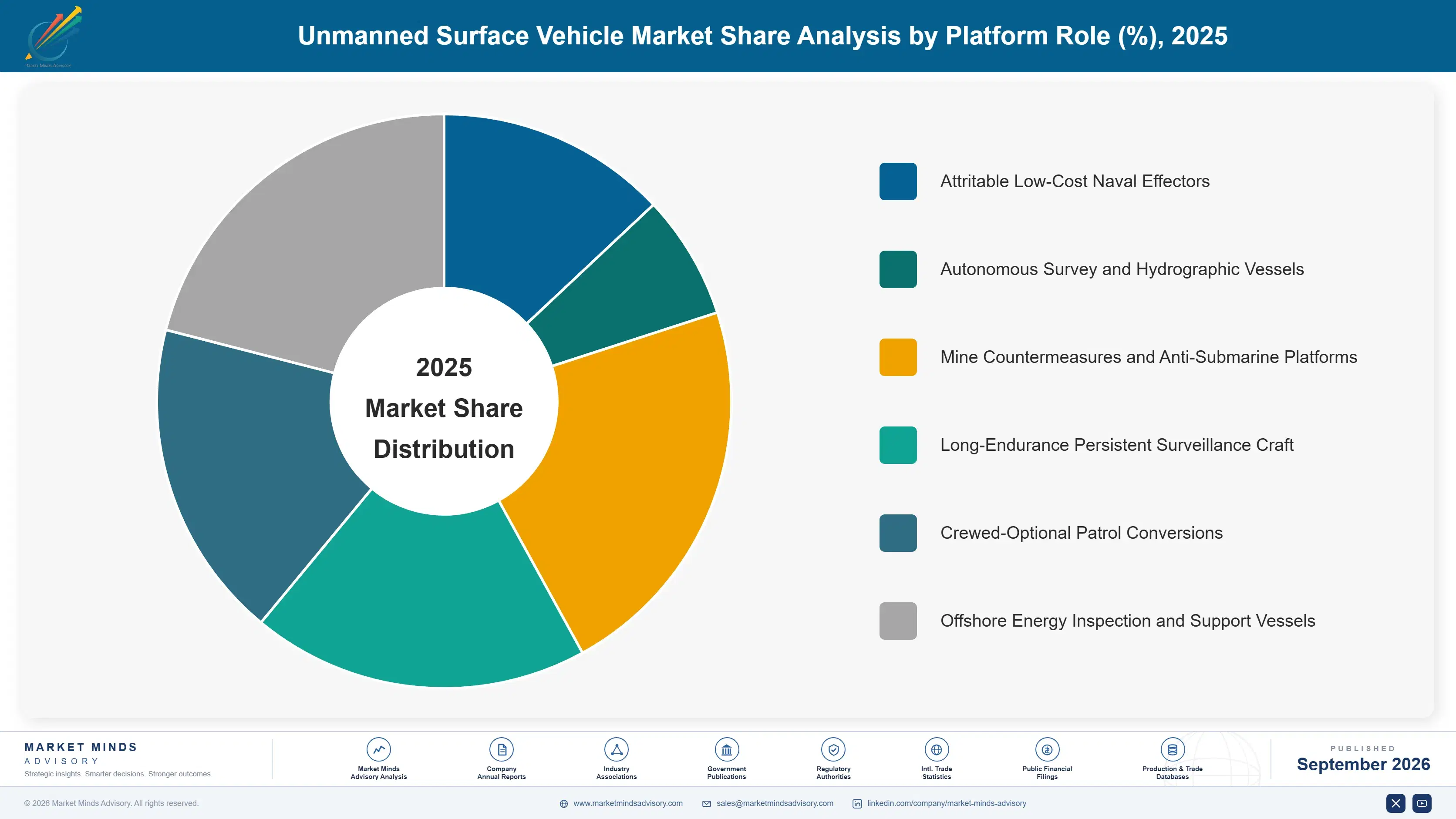
Segmentation follows platform role, the dimension on which endurance, payload capacity, unit cost and regulatory exposure all divide together. Six roles are assessed at programme and platform contract value. Underwater vehicles, crewed vessels without autonomy conversion, port infrastructure and satellite maritime surveillance sit outside the defined scope here. Regulatory approval cuts across all six and constrains several of them.
unmanned-surface-vehicle-market-market-share-analysis-1790025561277

Attritable Low-Cost Naval Effectors

Attritable low-cost naval effectors grow at 14.1%, half again the market rate of 9.4%, because a platform cheap enough to lose can be employed in ways a survivable one cannot be. Operations from 2022 showed vessels costing under a million dollars achieving effects against targets worth several hundred times as much, which reframed procurement from how well a hull survives toward how many can be fielded and replaced. Navies now specify quantity and unit cost in requirements where capability and endurance previously dominated every conversation. Production rate rather than platform sophistication has become the competitive dimension. Bespoke naval suppliers largely lack that manufacturing discipline entirely, which is why volume producers are taking these awards.
CAGR 14.1%

Autonomous Survey And Hydrographic Vessels

Autonomous survey and hydrographic vessels grow at 12.3% on arithmetic that convinced commercial operators years before naval procurement could evaluate it. Removing crew accommodation shrinks the hull, which cuts fuel, victualling, crew cost and day rate together, delivering roughly 62% lower operating cost than a crewed equivalent on comparable work. That saving appears on a single contract rather than across a programme. The binding constraint is regulatory rather than economic, since around 31% of operations still run a crewed chase boat alongside purely to satisfy collision rule lookout requirements. Securing approval in a jurisdiction therefore converts a shared constraint into a genuine commercial differentiator for whoever manages to get there first.
CAGR 12.3%
Full segment breakdown across 6 segments available in the complete report.

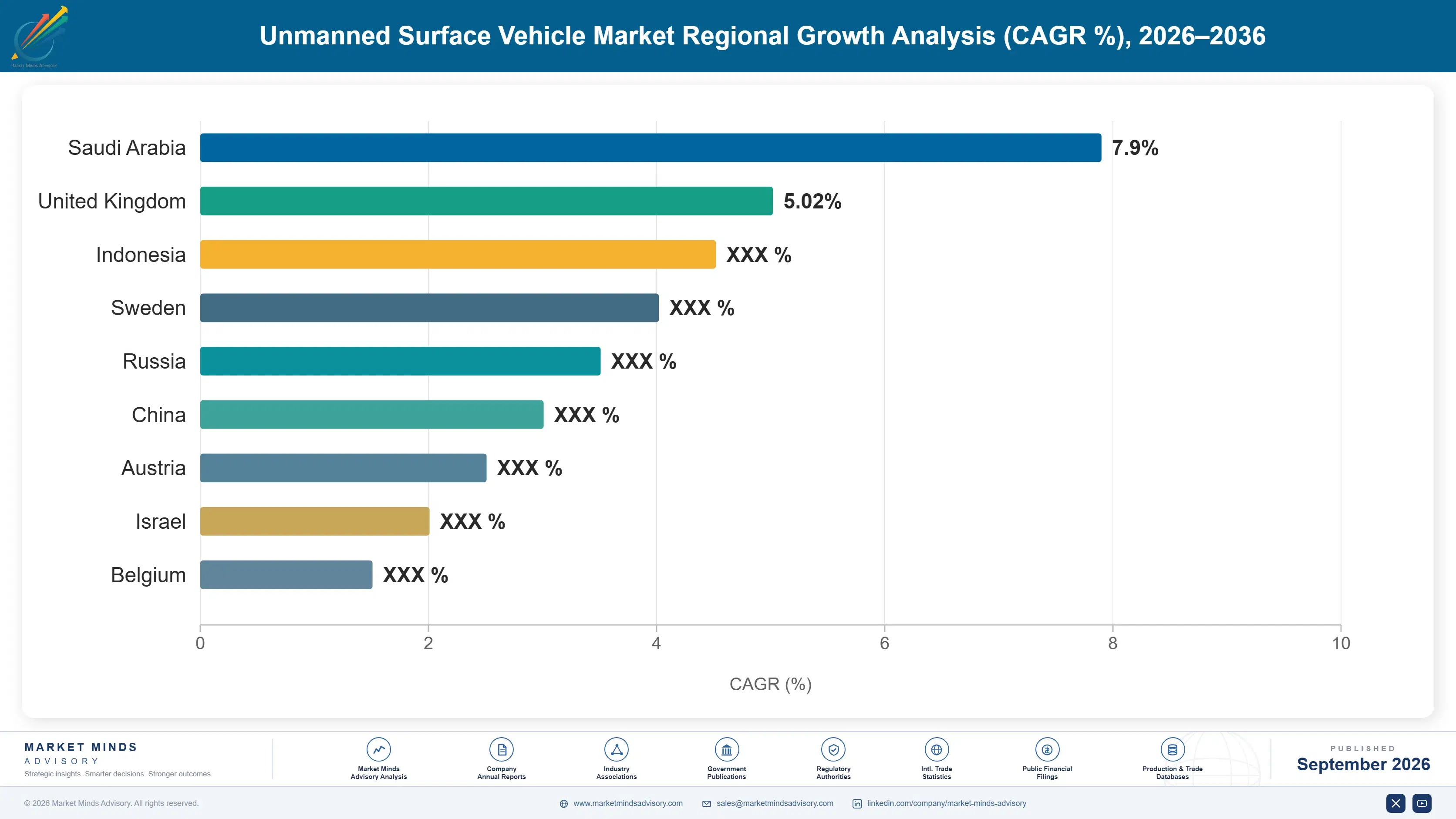
Regional Architecture and Country Demand Map

Shares record where vessels are procured and operated rather than where hulls are built. North America sits above its standard band on naval and survey activity together, and Eastern Europe below on limited maritime autonomy procurement. Both deviations carry a stated reason in the relevant regional paragraph concerned.

North America

At 33% this sits above the standard band because naval experimentation, commercial survey activity and offshore energy inspection all operate here at scale simultaneously. American naval programmes have moved from demonstration into procurement of attritable platforms, while Gulf of Mexico survey and inspection work supports a substantial commercial fleet. Saildrone and Ocean Infinity built positions spanning both. Collision regulation interpretation remains unresolved with national authorities. Growth of 8.8% reflects naval procurement accelerating against a commercial base that adopted earlier. Attritable platform procurement in particular has moved from concept papers into funded programmes with quantities specified, which is a change in how the requirement is written rather than in the technology available.
Share: 33% | CAGR: 8.8% (2026 to 2036)

Western Europe

The 24% position sits inside the standard band and offshore wind inspection drives a larger share of demand here than anywhere, since North Sea installed capacity exceeds every other region. Naval interest has accelerated sharply since 2022 across Baltic and North Sea states concerned with infrastructure protection. European maritime authorities have engaged more constructively with uncrewed navigation compliance than most, though no pathway is settled. Growth of 8.0% is the slowest of the seven regions, reflecting an established commercial base. Undersea cable and pipeline monitoring has become a specific procurement driver across Baltic and North Sea states following infrastructure incidents that crewed patrol could never have prevented economically across that much water.
Share: 24% | CAGR: 8.0% (2026 to 2036)
Regional intelligence for 5 additional markets available in the complete report: East Asia, South Asia and Pacific, Middle East and Africa, Eastern Europe, Latin America. Contact sales@marketmindsadvisory.com.
unmanned-surface-vehicle-market-country-cagr-analysis-1790025561808

Four Moves Worth Making Now

These four address a market where regulation constrains adoption more than technology, where the naval design brief inverted within three years, and where energy density forces a trade no single platform resolves. Each has been executed by at least one participant. Two of the four are regulatory or commercial moves rather than engineering ones at all.

Establish Recognised Uncrewed Navigation Compliance Pathways

Around 31% of commercial operations run a crewed chase boat purely to satisfy collision rule lookout requirements, which removes most of the crew cost saving the technology delivers. Working with national maritime administrations toward recognised compliance costs regulatory engagement rather than product development. Participants who secured approvals report operating cost falling roughly 44% on affected contracts, because the escort vessel disappears from the day rate entirely. Approval also converts a shared constraint into a genuine differentiator, since competitors without it must continue quoting a chase boat into every affected day rate they offer.
Market Impact: Contract operating cost falls by roughly 44% overall

Build Production Rate For Attritable Platform Procurement

Navies buying attritable effectors specify quantity and unit cost where they previously specified capability, which makes production rate the competitive dimension rather than platform sophistication. Building volume manufacturing costs process investment and a different engineering culture from bespoke naval work. Participants who did report unit cost falling roughly 58% at programme quantities, which decides awards where the requirement is written around numbers rather than performance. Naval requirement documents now specify quantity in most cases where they previously specified survivability, which is a change suppliers built around sophisticated designs are still absorbing.
Market Impact: Unit cost falls roughly 58% at programme volume

Offer Mission-Specific Families Not Universal Platforms

Energy density forces a direct trade between endurance and payload, with persistent craft reaching around 180 days at minimal payload and diesel vessels carrying substantial sensors for weeks. Offering a family matched to mission profiles rather than one compromised platform costs range development. Participants who did report win rates rising roughly 2.1 times, because customers stop being asked to accept a vessel that does their mission adequately rather than well. Physics rather than engineering sets that trade, which means no amount of development produces a single vessel serving both profiles properly. Customers increasingly recognise that themselves.
Market Impact: Competition win rates rise roughly 2.1 times higher

Price Offshore Inspection On Weather Window Availability

Crew transfer vessels are grounded by sea states that an uncrewed platform operates through, which means availability rather than day rate is the offshore wind argument. Presenting annual accessible days alongside cost costs an analysis rather than any product change. Participants who framed it that way report conversion among offshore operators rising roughly 2.6 times, because availability determines inspection programme completion where day rate does not. An inspection programme that completes matters more to an offshore operator than a lower rate on a vessel that cannot sail for half the year.
Market Impact: Offshore operator conversion rises roughly 2.6 times higher

Who Controls the Margin Pool

Concentration is very low at 27% held by the top five, measured consistently on programme and platform contract value rather than on hull count, which would overweight small survey craft against substantial naval programmes. The leader to challenger gap is narrow, reflecting a young market where operational demonstration matters more than incumbency and where several participants have built positions within a decade.
Competition runs on three dimensions currently. Demonstrated operational hours decide credibility, since customers in both naval and commercial applications discount claims that have not been proven at sea. Production rate decides attritable naval awards, which is a manufacturing capability rather than a design one. Regulatory approval position decides commercial addressable operating areas, independent of what a platform can technically achieve anywhere.

Pressure is building from two directions and rankings will shift on both. Established naval primes are entering with integration capability and customer relationships that specialist autonomy participants lack, particularly where uncrewed vessels must operate within wider force structures. Meanwhile domestic manufacturers in India, Korea and Turkey are winning national programmes on content policy grounds in markets that international participants had expected to contest openly.
unmanned-surface-vehicle-market-company-positioning-matrix-1790025562347

Competitive Moat and Risk Dimensions

SAILDRONE

Moat: Persistent Endurance Operational Record

Accumulated ocean operating hours on wind and solar powered craft achieving mission durations around 180 days provide demonstrated capability that competitors cannot claim from trials alone, and both naval and scientific customers weight proven endurance heavily over specification. Trials cannot substitute for accumulated sea time.
SAILDRONE

Risk: Payload Capacity Physical Limit

Wind and solar propulsion imposes a payload ceiling that physics rather than engineering sets, which excludes the platform from tactical roles requiring substantial sensors or weapons. Serving those missions requires a different vessel family entirely rather than an evolution of the existing one. Physics sets that ceiling.
ELBIT SYSTEMS

Moat: Naval Integration And Effectors

Combining uncrewed surface platforms with weapons, sensors and command systems the company already supplies lets it deliver an integrated naval capability rather than a vessel, which matters where uncrewed craft must operate inside an existing force structure and communications architecture. Specialist autonomy participants cannot supply the surrounding architecture.
ELBIT SYSTEMS

Risk: Commercial Market Access Limits

A defence-oriented position provides little access to survey, hydrographic and offshore energy applications that represent a majority of unit volume and that adopted autonomy years earlier. Entering commercially requires cost structures and regulatory relationships built for entirely different customers. Commercial buyers evaluate on completely different criteria.

Players Tracked

Prominent Players

Saildrone
Ocean Infinity
L3Harris Technologies
Elbit Systems
Kongsberg Maritime

Other Key Players

Textron Systems
Teledyne Marine
SEA-KIT International
Fugro
Maritime Robotics
Sea Machines Robotics
HavKraft
Zycraft
Marine Advanced Robotics
Aselsan
Havelsan
Hanwha Ocean
Mitsui E and S
Sagar Defence Engineering
Exail Technologies

Recent Developments

MARCH 2025

SEA-KIT International secures uncrewed navigation approval extension

The company obtained an extension of recognised compliance arrangements with a national maritime administration, permitting operations without a crewed escort vessel across additional areas. This was a regulatory approval process with no acquisition, partnership or joint venture behind it. Operations in unapproved jurisdictions continue with escort provision.
Signal: Regulatory approval rather than technology decides the addressable operating area. Whoever secures approval first holds a genuine commercial advantage.
SEPTEMBER 2024

Sagar Defence Engineering delivers Indian coastal surveillance platforms

The domestic manufacturer delivered uncrewed surface vessels into Indian coastguard service, moving from demonstration into operational supply under domestic content procurement policy. This was a contract delivery rather than an acquisition, merger or joint venture arrangement of any kind. International suppliers had previously held equivalent programme positions.
Signal: Domestic capability develops quickly where hulls and software are both local. Content policy closes markets international participants expected to contest.
JUNE 2025

Textron Systems expands attritable platform production capacity

The company added manufacturing capacity configured for volume production of low-cost naval surface effectors rather than bespoke platform build. This was organic capital investment funded internally, with no acquisition, joint venture or licensing arrangement behind the expansion anywhere. Bespoke naval platform production continued on separate lines.
Signal: Production rate is the competitive dimension where quantity is specified. Requirements now specify numbers where they once specified survivability.

What The Vessel Costs

Autonomy and payload dominate while the hull itself is comparatively inexpensive. Autonomy software, navigation and control systems run roughly 26% of platform cost, sensors and mission payload about 31% depending on role, and propulsion and power around 17%. Hull construction takes a further 14%, which is far less than a crewed vessel because no accommodation, safety or habitability provision is required at all.
Marine-grade electronics and sensor component costs rose through 2021 and 2022 alongside broader supply disruption, a movement the US Census Bureau records in component trade data for the period, while satellite communications bandwidth pricing climbed as demand for persistent connectivity grew. Several participants reported programme delays rather than cost increases, since contracts typically price on delivery milestones rather than on component spot markets. Both movements landed inside a single year.

Exposure divides by mission role rather than by company size. Persistent surveillance participants carry limited payload cost but substantial communications expense across long deployments. Attritable platform producers carry the opposite profile, with minimal per-unit autonomy investment amortised across volume. Participants without domestic manufacturing in content-policy markets face exclusion regardless of cost position, which is a commercial exposure rather than an operational one.
unmanned-surface-vehicle-market-cost-volatility-analysis-1790025562545

Secure regulatory approvals ahead of contract bidding

Collision rule compliance determines whether a vessel can operate without a crewed escort, and an operator without approval carries chase boat cost that removes most of the economic argument. Securing approvals before bidding converts a constraint into a differentiator. The work is regulatory engagement with national administrations rather than any product development at all.

Contract satellite communications bandwidth across deployments

Persistent surveillance vessels consume continuous satellite bandwidth across deployments measured in months, and spot pricing has risen as demand for connectivity grew across every maritime sector. Contracting capacity across a deployment stabilises a substantial operating line. The commitment lands before mission revenue is recognised, which smaller operators find difficult to carry. Bandwidth pricing has risen steadily.

Establish local manufacturing in content-policy markets

Several of the fastest-growing markets weight domestic content heavily in procurement, which excludes imported platforms regardless of capability or price. Establishing local hull construction and assembly costs capital and partnership arrangement. The obstacle is that those investments precede programme awards rather than following them, which is a genuine commercial risk. Awards follow the investment rather than preceding it.

Portfolio Architecture for Margin Defence

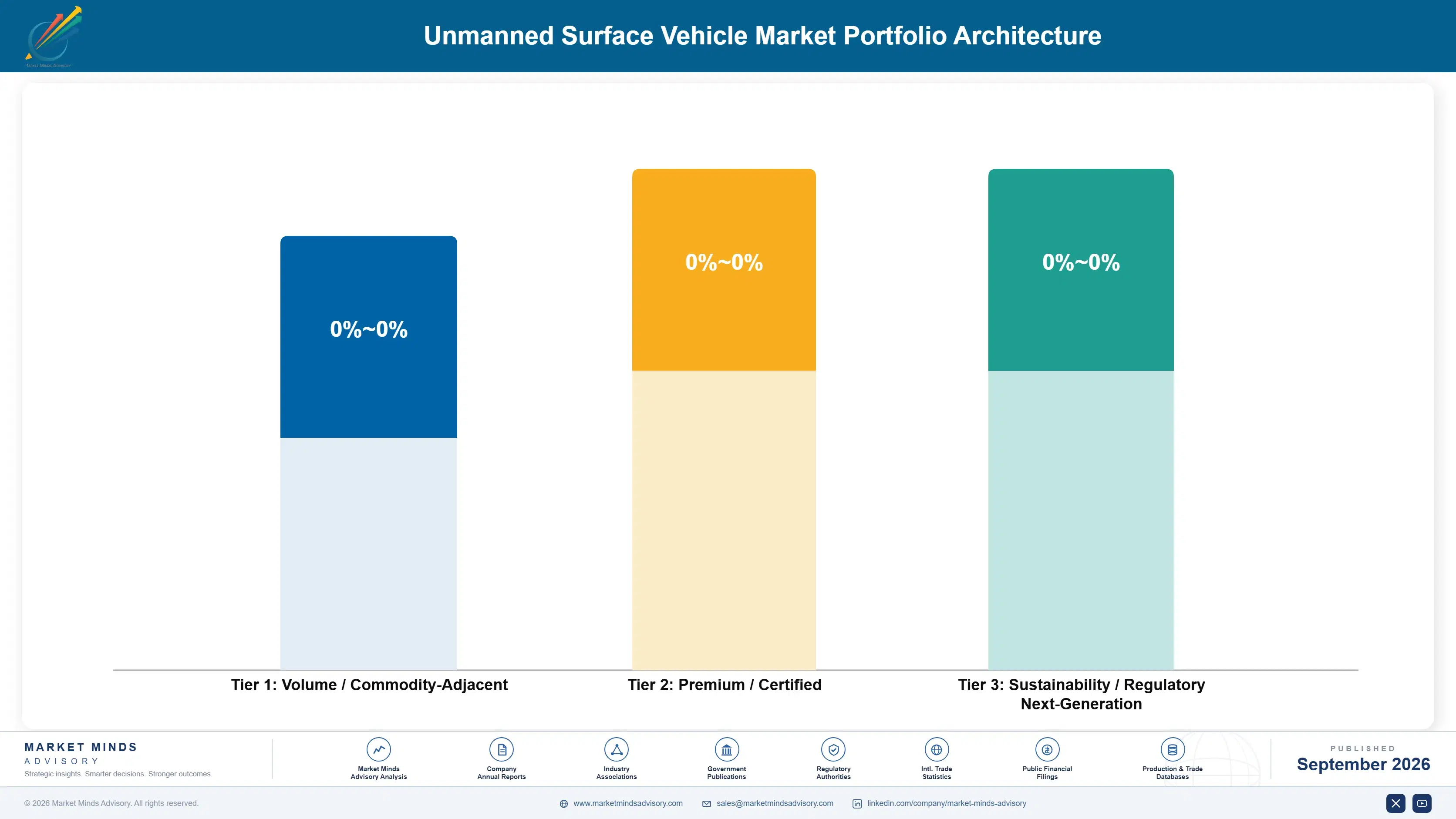
Margin architecture divides by whether the platform is sold or operated, which a price list does not reveal. Crewed-optional patrol conversions run at gross margins in the high teens to high twenties, carrying the cost of a hull built for people while delivering only part of the freedom an uncrewed design provides, which is an awkward commercial position. Nothing about that configuration serves either customer particularly well.
Attritable naval effectors and offshore inspection platforms hold gross margins in the mid twenties to mid thirties. The spread reflects how differently volume naval production and specialist commercial supply carry engineering cost. Attritable platforms earn margin through manufacturing efficiency rather than through price, which is a different discipline from the bespoke naval work most participants came from.

The highest-value pool is persistent surveillance platforms and data-as-a-service survey delivery, at margins in the high thirties to high forties. Persistent craft command premium pricing on demonstrated endurance; service delivery captures the value of the data rather than the vessel. Patrol conversions carry programme presence. They build little that either alternative does not do better. Programme presence is the argument for retaining conversions, and it is a genuinely weak one here.

Volume / Commodity-Adjacent

Crewed-optional patrol conversions carrying the cost of a hull built for people while delivering only part of the freedom an uncrewed design provides. The ten point range reflects differing conversion scopes.
Gross Margin: 18 to 28%

Premium / Certified

Attritable naval effectors and offshore inspection platforms. Attritable production earns margin through manufacturing efficiency rather than price, which is a different discipline from bespoke naval work. Most participants came from exactly that background.
Gross Margin: 25 to 35%

Sustainability / Regulatory / Next-Generation

Persistent surveillance platforms and data-as-a-service survey delivery. Persistent craft command premium pricing on demonstrated endurance; service delivery captures the data value rather than the vessel. Operating rather than selling holds the customer relationship.
Gross Margin: 37 to 48%
unmanned-surface-vehicle-market-portfolio-architecture-1790025563058

High-value Sub-segments and Strategic Watch-out

Attritable Low-Cost Naval Effectors

Fastest growth at 14.1% as expendability replaced survivability in the naval design brief. Production rate rather than platform sophistication decides the awards where quantity and unit cost are both specified. Bespoke naval suppliers largely lack the manufacturing discipline that this actually requires at the present time.
Gross Margin: 26 to 35%

Persistent Surveillance Platforms

Highest value, commanding premium pricing on demonstrated endurance around 180 days. Payload capacity is limited by physics rather than engineering, which excludes the platform from tactical roles entirely. Serving tactical missions requires an entirely different vessel family rather than any evolution of this particular one.
Gross Margin: 38 to 47%

Autonomous Survey And Hydrographic

Volume core delivering roughly 62% lower operating cost than crewed equivalents on comparable work. Collision rule compliance rather than economics determines where this platform can actually be deployed at all. Approval in a given jurisdiction is therefore worth considerably more here than any incremental capability improvement.
Gross Margin: 27 to 36%

Crewed-Optional Patrol Conversions

Strategic watch-out. Growing slowest at 4.2% and carrying the full manned hull cost without any of the uncrewed freedom. The fourteen point range reflects how widely conversion scope varies between the individual programmes. Both of the alternatives serve the underlying operational requirement considerably better than this configuration ever does.
Gross Margin: 16 to 30%

How Adoption Actually Proceeds

Commercial and naval customers arrive at this market from opposite directions and on completely different timescales. A survey operator adopts because the arithmetic works on a single contract and can switch back if it does not. A navy adopts through a programme cycle measured in years and commits to doctrine, training and support alongside the platform. Suppliers serving both are managing two businesses that share hardware and almost nothing else.
Stickiness varies sharply by whether the supplier operates or supplies. Participants delivering data as a service rather than selling vessels hold the customer relationship and the operating knowledge, which makes displacement genuinely difficult. Platform vendors are considerably more exposed, particularly as naval customers develop their own operating capability and as domestic content policy closes markets that were previously open to anybody.

Buyer requirements shifted faster in naval applications than in any market covered here. Three years ago procurement asked how survivable a platform was and how long it could remain on station; now it asks how many can be fielded and what each one costs. Suppliers built around sophisticated survivable designs are competing against a requirement that was rewritten while they were developing.
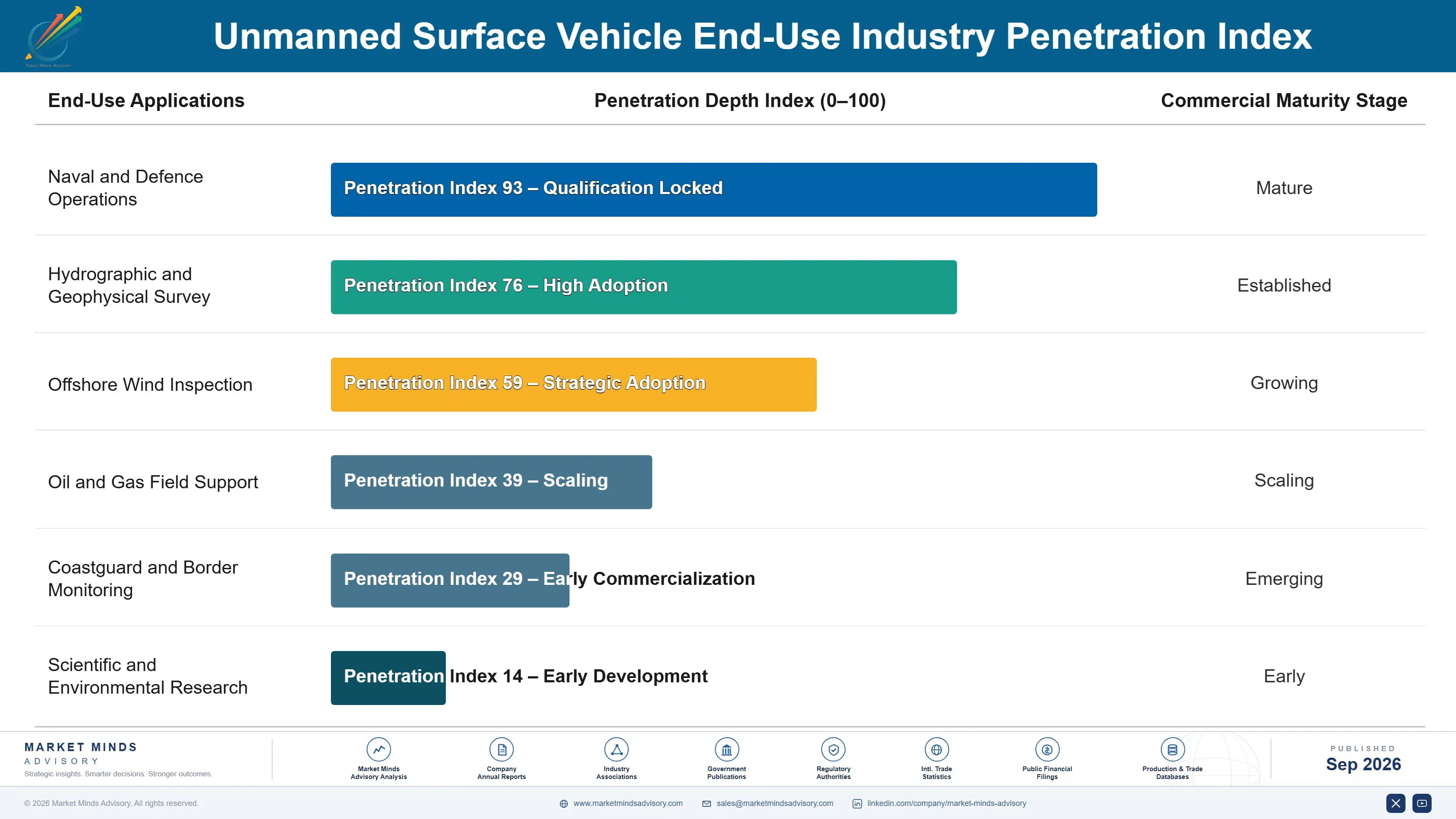
unmanned-surface-vehicle-market-end-use-penetration-index-1790025563574

Where Regulation Decides

These are among the four positions where our research anticipates prominent divergence between winners and laggards over the coming forecast period. Each is grounded in the demand model, the regulatory perimeter, and the announced capacity pipeline.
01 / NAVIGATION COMPLIANCE APPROVAL

Get the approval before the contract

Around 31% of commercial operations still run a crewed chase boat alongside purely to satisfy collision rule lookout requirements written for vessels carrying people, which removes most of the crew cost saving the technology delivers. Working with national maritime administrations toward recognised compliance costs regulatory engagement rather than any product development. Participants who secured approvals report operating cost falling roughly 44% on affected contracts, because the escort disappears from the day rate, while competitors without approval keep quoting escorts into every affected rate.
02 / ATTRITABLE PRODUCTION CAPABILITY

Navies now buy quantity, not survivability

Navies procuring attritable effectors now specify quantity and unit cost where they previously specified capability and endurance instead, which makes production rate the competitive dimension rather than platform sophistication. Building volume manufacturing capability costs process investment and a genuinely different engineering culture from bespoke naval work entirely. Participants who did it report unit cost falling roughly 58% at programme quantities, which decides awards written around numbers rather than performance, since requirement documents now specify quantity in most naval cases examined.
03 / MISSION FAMILY ARCHITECTURE

Stop selling one boat for everything

Energy density forces a direct trade between endurance and payload, with wind and solar craft reaching around 180 days at minimal payload while diesel vessels carry substantial sensors for weeks at most. Offering a family matched to mission profiles rather than one compromised platform costs range development work. Participants who did it report win rates rising roughly 2.1 times, because customers stop being asked to accept a vessel serving their mission only adequately, and physics rather than engineering sets that trade permanently.
04 / AVAILABILITY BASED OFFSHORE PRICING

Sell accessible days, not day rate

Crew transfer vessels are grounded by sea states that an uncrewed platform operates straight through, which means availability rather than day rate is the argument offshore wind operators actually respond to. Presenting annual accessible days alongside cost costs an analysis rather than any product change at all. Participants who framed it that way report conversion among offshore operators rising roughly 2.6 times, because availability determines whether an inspection programme completes at all, and a completed programme beats a cheaper vessel that cannot sail.

Engagement Snapshot From the Field

A live engagement with an industry participant carrying material or product regulatory and market exposure ahead of a defining policy shift, showing how our research translates into a defensible multi-year portfolio strategy.
MARKET MINDS ADVISORY · CLIENT ENGAGEMENT SUMMARY
Unmanned Surface Vehicle Producer Strategic Portfolio Review and Transition Roadmap 2026·Investment Scenario on Unmanned Surface Vehicle Exposure Evaluation 2025-26
CLIENT PROFILE
A maritime autonomy supplier with uncrewed surface vessel revenue near USD 94 million (client-reported, unverified by MMA), weighted approximately 68% to survey platforms and 32% to naval applications. Operations in three of six served jurisdictions required a crewed chase boat. No attritable platform existed and all vessels shared one hull family. Approval status had never been benchmarked.
STRATEGIC CHALLENGE
Survey contract win rates had fallen for two years while competitors quoted lower day rates, and management attributed the position to their lower engineering costs. A price reduction had been approved. Nobody had compared regulatory approval status against competitors, or examined what the chase boat requirement added to the client's own quoted rates.
MMA APPROACH
MMA compared regulatory approval status across the client and eight competitors by jurisdiction. Chase boat cost was isolated within quoted day rates across 26 recent bids. Naval requirement documents were reviewed for shifts in specified criteria, and mission profiles were mapped against the endurance and payload capability of the single hull family.
KEY FINDINGS
  1. Chase boat provision accounted for 39% of the client's quoted day rate in the three affected jurisdictions, and two competitors held approvals removing it entirely.
  2. Lost survey bids concentrated almost entirely in those three jurisdictions, with win rates in approved areas running broadly in line with the market.
  3. Naval requirement documents reviewed since 2023 specified quantity and unit cost in 71% of cases against 22% in the preceding three years examined.
  4. The single hull family met fewer than half of surveyed customer mission profiles adequately, and none of them well, across the endurance and payload range required.
CLIENT PROFILE
A maritime autonomy supplier with uncrewed surface vessel revenue near USD 94 million (client-reported, unverified by MMA), weighted approximately 68% to survey platforms and 32% to naval applications. Operations in three of six served jurisdictions required a crewed chase boat. No attritable platform existed and all vessels shared one hull family. Approval status had never been benchmarked.
STRATEGIC CHALLENGE
Survey contract win rates had fallen for two years while competitors quoted lower day rates, and management attributed the position to their lower engineering costs. A price reduction had been approved. Nobody had compared regulatory approval status against competitors, or examined what the chase boat requirement added to the client's own quoted rates.
MMA APPROACH
MMA compared regulatory approval status across the client and eight competitors by jurisdiction. Chase boat cost was isolated within quoted day rates across 26 recent bids. Naval requirement documents were reviewed for shifts in specified criteria, and mission profiles were mapped against the endurance and payload capability of the single hull family.
KEY FINDINGS
  1. Chase boat provision accounted for 39% of the client's quoted day rate in the three affected jurisdictions, and two competitors held approvals removing it entirely.
  2. Lost survey bids concentrated almost entirely in those three jurisdictions, with win rates in approved areas running broadly in line with the market.
  3. Naval requirement documents reviewed since 2023 specified quantity and unit cost in 71% of cases against 22% in the preceding three years examined.
  4. The single hull family met fewer than half of surveyed customer mission profiles adequately, and none of them well, across the endurance and payload range required.
RECOMMENDED STRATEGY
Phase 1: Phase one: cancel the price reduction and pursue navigation compliance approvals in the three constrained jurisdictions. Two competitors already held them. Phase 2: Phase two: develop an attritable low-cost platform built for volume production rather than adapted from existing hulls. Requirements had already been rewritten. Phase 3: Phase three: split the range into mission-specific families matched to endurance and payload requirements. One hull served none of them well.
OUTCOME
Approval in two of three jurisdictions removed the chase boat from quoted rates within four quarters, and survey win rates recovered to market levels (client-reported, unverified by MMA). The attritable platform reached first naval contract within eighteen months, and mission-specific families improved win rates materially against the previous single hull proposition.

Frequently Asked Questions

Foundational context covering the market sizes, CAGR, scope, country, region and competition that inform every finding below. This section is provided to cover basics and most often pre-purchase conversations, answered from the MMA Primary Research Dataset.

What is the current size of the Unmanned Surface Vehicle Market?

The market was valued at USD 1.6 billion in 2025, rising to USD 1.8 billion in 2026. Sizing is at programme and platform contract value across six platform roles.

How large will the Unmanned Surface Vehicle Market be by 2036?

MMA forecasts USD 4.4 billion by 2036, an increase of USD 2.6 billion over the 2026 base. That represents expansion of 2.44 times across the forecast period.

What is the CAGR for the Unmanned Surface Vehicle Market 2026 to 2036?

The base case CAGR is 9.4%, with a bull case of 10.7% and a bear case of 8.1%. Historical growth between 2020 and 2025 ran at 8.0%.

Which segment is growing fastest?

Attritable low-cost naval effectors grow at 14.1%, half again the market rate, as expendability replaced survivability. Autonomous survey vessels follow at 12.3% and crewed-optional conversions grow slowest at 4.2%.

Who are the major companies in the Unmanned Surface Vehicle Market?

Saildrone, Ocean Infinity, L3Harris, Elbit Systems and Kongsberg Maritime lead on contract value, holding a combined 27%. Concentration is low in a young market where operational demonstration matters more than incumbency.

Which country is growing fastest?

India grows fastest at 15.8%, on extensive coastline surveillance requirements and domestic manufacturing that develops quickly where hulls and software are both local. Coastguard and naval programmes are both expanding.

Report Segmentation Architecture

The full report scope spans multiple orthogonal segmentation dimensions, with cross-tabulated demand data provided for each dimension pair. Coverage extends further to regional breakdowns, trend trajectories, and the competitive detail needed to support segment-level decision-making.

By Platform Role

  • Attritable Low-Cost Naval Effectors
  • Autonomous Survey and Hydrographic Vessels
  • Mine Countermeasures and Anti-Submarine Platforms
  • Long-Endurance Persistent Surveillance Craft
  • Crewed-Optional Patrol Conversions
  • Offshore Energy Inspection and Support Vessels

By End-Use Industry

  • Naval and Defence Operations
  • Hydrographic and Geophysical Survey
  • Offshore Wind Inspection
  • Oil and Gas Field Support
  • Coastguard and Border Monitoring
  • Scientific and Environmental Research

By Commercial Dimension

  • Direct Government Procurement
  • Platform Sale to Operators
  • Data as a Service Delivery
  • Vessel Charter and Leasing
  • Local Manufacturing Partnerships
  • Through-Life Support Contracts

By Region

  • North America
  • Western Europe
  • East Asia
  • South Asia and Pacific
  • Middle East and Africa
  • Eastern Europe
  • Latin America

Scope, Methodology, and Coverage

Every figure in this report is reproducible from documented input assumptions. The scope below maps the historical period, the forecast horizon, the segmentation dimensions, and the countries covered, alongside the underlying primary and qualitative methodology.
Historical Period
2020 to 2025
Forecast Period
2026 to 2036
Base Year
2025 (USD billions; MMA Primary Research Dataset, September 2026)
Market Definition
This market covers uncrewed vessels operating on the water surface and their associated control systems, spanning attritable low-cost naval effectors, autonomous survey and hydrographic vessels, mine countermeasures and anti-submarine platforms, long-endurance persistent surveillance craft, crewed-optional patrol conversions, and offshore energy inspection and support vessels. Sizing is at programme and platform contract value across government procurement, platform sale, data service, charter, local manufacturing and sustainment channels. Underwater vehicles, crewed vessels without autonomy conversion, port and harbour infrastructure, and satellite maritime surveillance are excluded throughout.
Quantitative Units
USD billions at programme and platform contract value; volume in vessels delivered; endurance in days on station.
Segmentation Dimensions
Platform role, end-use industry, commercial dimension, and geographic region.
Regions Covered
North America, Western Europe, East Asia, South Asia and Pacific, Middle East and Africa, Eastern Europe, Latin America
Countries Covered
United States, India, United Kingdom, China, Norway, United Arab Emirates
Key Companies Profiled
Saildrone, Ocean Infinity, L3Harris Technologies, Elbit Systems, Kongsberg Maritime, Textron Systems, Teledyne Marine, SEA-KIT International, Fugro, Maritime Robotics, Sea Machines Robotics, HavKraft, Zycraft, Marine Advanced Robotics, Aselsan, Havelsan, Hanwha Ocean, Mitsui E and S, Sagar Defence Engineering, Exail Technologies
Quantitative Methodology
Primary survey, n=3,800 respondents, Q4 2025, six countries; demand-side model with trade association cross-validation
Qualitative Methodology
47 expert interviews, Q4 2025; applied to validate demand model assumptions, identify emerging dynamics, and assess competitive positioning
Report Format
PDF and XLSX data workbook (Word format preview document)
Publisher
Market Minds Advisory
Report Code
MMA-2026-CON-824
Published
September 2026
Contact
sales@marketmindsadvisory.com | www.marketmindsadvisory.com

Purchase the full Unmanned Surface Vehicle Market Report (2026 to 2036).

The full report sizes the unmanned surface vehicle market across six platform roles, six end-use industries and six commercial dimensions for all seven global regions through 2036. It compares regulatory approval status across participants by jurisdiction, establishing where chase boat requirements still apply and what they cost. Naval requirement documents are reviewed for shifts in specified criteria between survivability and quantity. Mission profiles are mapped against the endurance and payload capability of competing platform families. Competitive assessment covers 20 participants on a consistent contract value basis.
Regulatory approval status compared by participant and jurisdiction
Chase boat cost isolated within quoted commercial day rates
Naval requirement documents reviewed for specification shifts
Mission profiles mapped against endurance and payload capability
Six platform roles sized through 2036
Twenty participants assessed on consistent contract value

Built For The People Who Decide

From boardroom strategy to bench-side execution, this report is read cover-to-cover by leaders shaping the next decade of their industry, turning demand scenarios, market dynamics and valuation benchmarks into decisions.
CXOs/ Presidents/ VPs/ Managers
M&A and Corporate Development
Strategy Teams and R&D Heads
Procurement and Product Directors
Regulatory and Compliance Leaders
Investor Relations and Equity Analysts