Market Minds Advisory
Demand for VoLTE and Voice Over Wi-Fi in USA

Demand for VoLTE and Voice Over Wi-Fi in USA: Demand for VoLTE and Voice Over Wi-Fi in USA. Carrier Network Core Upgrades for HD Voice Delivery

Copper network sunset deadlines push United States carriers toward VoLTE and Wi-Fi calling infrastructure as legacy circuit-switched voice networks approach mandatory retirement across most rural coverage markets nationwide this year

Lead Analyst

Published

September 2026

Make Smarter Decisions with Customized Research Insights

Request a free sample report and evaluate market opportunities, growth trends, and competitive dynamics relevant to your business needs.

2025 MARKET VALUE$2.9BMarket Size 2025
2036 FORECAST VALUE$6.4BBase Case , 2026 to 2036
CAGR 2026 TO 20367.5 %Bull 8.7% / Bear 6.3%
INCREMENTAL OPPORTUNITY$3.3BNet 10- year value creation
EXPANSION MULTIPLE2.06x2036 value over 2026 base
Strategic Levers
M&A Pipeline
Regional Outlook
Country Rankings
Competitive Intelligence
Segmental Deep-dive
Call-Us : 91 93563 13602

Executive Snapshot and Market Trajectory.

VoLTE and Voice over Wi-Fi demand in the United States is accelerating as carriers retire legacy circuit-switched voice infrastructure ahead of mandatory copper network sunset deadlines across most rural and suburban markets this year. Buyers now weigh interoperability data heavily. Vendor selection now weighs prior interoperability certification history.
HD voice core upgrades and rural Wi-Fi calling extension are converging fastest, as carriers pursue both call quality improvement and coverage gap closure within the same network modernization budget. North America commands the largest regional share, reflecting the report's United States-centered scope and carrier investment concentration domestically. Facility operators increasingly qualify multiple equipment vendors simultaneously to reduce single-source supply risk during this rapid capacity buildout phase. Certification depth separates platforms competing for carrier contracts.
Competitive intensity is rising as established network equipment vendors expand core software capability while cloud-native entrants pursue virtualized voice core deployment. Rural carriers are creating a parallel demand channel, as they increasingly require documented interoperability testing data from equipment vendors before qualifying new network core deployments. Rankings could shift meaningfully as certification requirements tighten across major carrier procurement programs over the coming years.
Market Definition
This report covers network core equipment and software enabling Voice over LTE and Voice over Wi-Fi calling services for United States wireless carriers. It excludes traditional circuit-switched voice equipment, radio access network hardware, and consumer smartphone devices sold separately from carrier infrastructure.
Base Year Value
$2.9B in 2025 (MMA Primary Research Dataset, September 2026)
Forecast Period
2026 to 2036, eleven discrete annual values
CAGR
7.5% base case. Bull 8.7%. Bear 6.3%.
Fastest Growth Segment
Voice Over Wi-Fi Calling for Rural Coverage Extension: 11.0% CAGR
Fastest Growth Country
United States: 8.0% CAGR
Fastest Growth Region
South Asia and Pacific: 9.5% CAGR
Largest Region
North America: 32% of 2025 global value
Market Leaders
Ericsson, Nokia, Mavenir, Cisco, and Metaswitch lead the market. Source: MMA Analysis, July 2026.
Primary Survey
n=3,800 procurement and R&D decision-makers, Q4 2025, six countries
Methodology
Demand-side build-up, cross-validated against public data, 47 expert interviews

Demand for VoLTE and Voice Over Wi-Fi in USA Market Forecast Scenarios

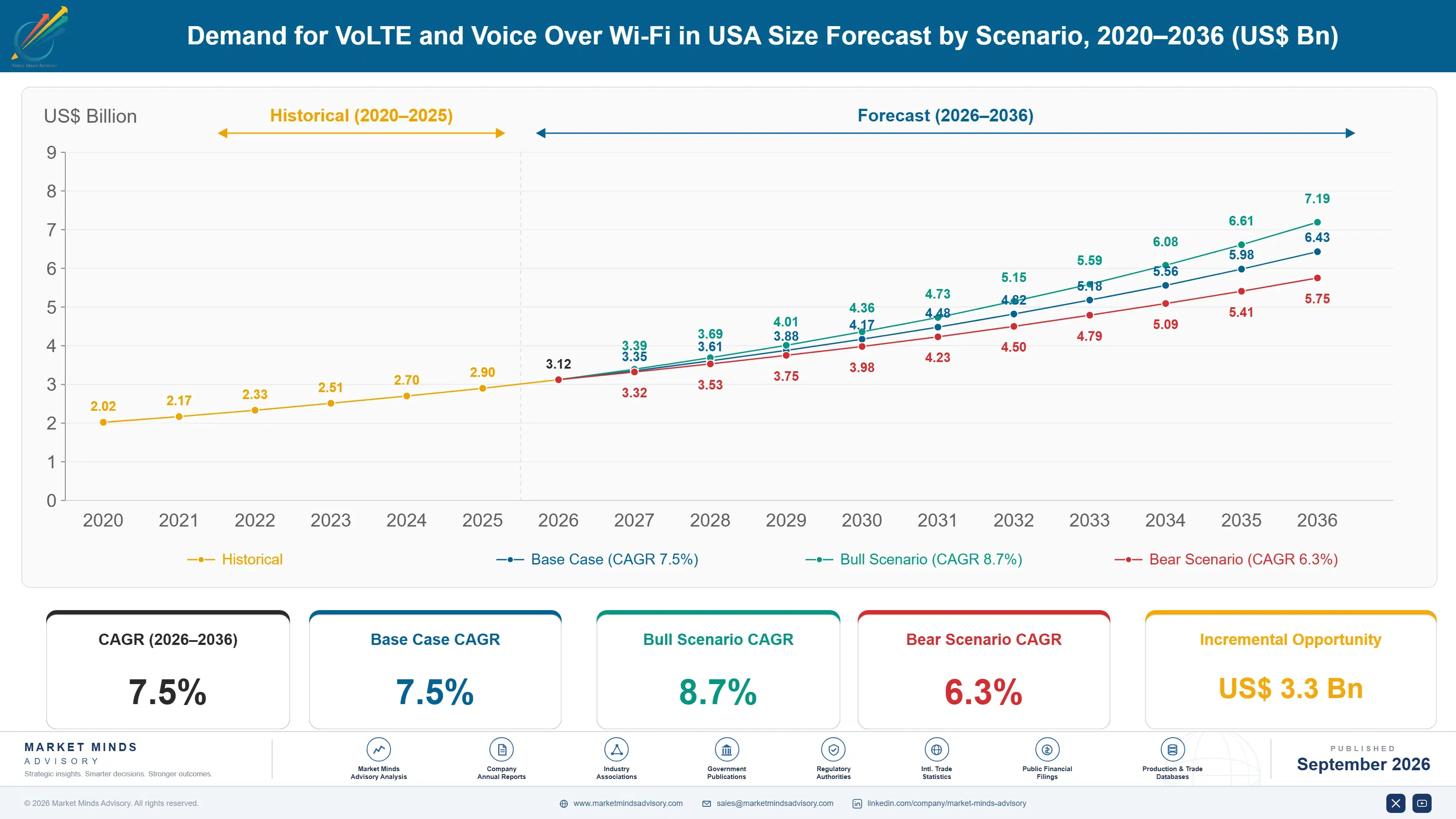
united-states-volte-and-voice-over-wi-fi-size-forecast-scenario-1788428008789
Between 2020 and 2025 the market grew at a historical rate of roughly 6.7 percent annually, expanding steadily as carriers progressively retired legacy circuit-switched voice infrastructure across major metropolitan markets. Early growth concentrated among tier-one national carriers before broadening into regional and rural carrier network modernization programs nationwide. Investor and carrier confidence built steadily throughout this transition period broadly across markets.
The base case assumes continued copper network sunset execution, expanding rural Wi-Fi calling coverage extension, and steady HD voice core software investment across major and regional carrier networks. Three commercial mechanisms sustain the base forecast: mandatory legacy infrastructure retirement deadlines, expanding rural coverage gap closure requirements, and growing carrier interoperability standardization across multi-vendor network deployments. These three mechanisms together anchor confidence in the base scenario across the ten-year forecast window ahead.
The bull case rests on accelerated regulatory enforcement of copper sunset deadlines pushing faster network core modernization across regional carriers. The bear case centers on carriers consolidating voice core functions into broader unified network platforms, compressing the standalone equipment opportunity for independent voice infrastructure specialists. Rankings could shift meaningfully if either scenario dominates the market's trajectory over the coming several years.

Interoperability Data Becomes Contract Currency

Purchase decisions increasingly hinge on documented call setup reliability rather than feature breadth alone, as carriers weigh the cost of subscriber churn against software price during network core evaluation processes. This calculation increasingly appears explicitly within enterprise vendor selection scorecards used by network engineering and procurement teams together. Documented call setup data now weighs as heavily as feature breadth in most purchasing evaluations across the sector.
MARKET CONCENTRATIONCR5 68%Top vendors hold a highly concentrated combined market position
AVERAGE CORE SOFTWARE PRICE$2.8MReflects blended pricing across standard carrier deployment configurations sold
CALL SETUP SUCCESS RATE98%Share of VoLTE calls establishing connection without documented failure
RURAL COVERAGE GAP CLOSURE44%Share of previously uncovered rural areas reached through Wi-Fi calling
IMPLEMENTATION COST SHARE31%Integration and network testing share of total deployment contract value
CONTRACT RENEWAL RATE76%Share of carrier software licenses renewed at annual contract expiration
Vendors offering standardized interoperability interfaces compatible across multiple network equipment manufacturers are pressuring proprietary core designs to open compatibility, since carriers increasingly favor software that reduces qualification burden across multi-vendor deployments. Carriers report faster network integration timelines when using standardized interoperability interfaces rather than proprietary designs requiring dedicated adapter development. This speed advantage matters most for carriers facing near-term regulatory sunset deadlines.
Implementation and network testing costs remain a meaningful share of total contract value, particularly for carriers integrating legacy radio access network equipment. Vendors with proven rapid deployment methodologies increasingly outcompete smaller specialists facing longer implementation timelines. This dynamic increasingly separates vendors with proven implementation methodologies from smaller specialists still refining their deployment playbooks across new carrier accounts. Onboarding speed increasingly determines vendor shortlist inclusion at larger carrier accounts.
"A dropped call used to be an inconvenience. Now it's a documented failure rate carriers put in front of regulators and subscribers alike, and that scrutiny is reshaping every procurement decision in this category."
Practice Lead, Telecommunications Infrastructure Research · MMA Voice Network Infrastructure and Carrier Core Technology Practice · September 2026

Market Trends

Wi-Fi Calling Extends Coverage Into Rural Dead Zones

Carriers are deploying Voice over Wi-Fi capability to extend voice coverage into rural areas where cellular tower density remains too sparse for reliable VoLTE connectivity, closing the coverage gap that historically left rural subscribers with degraded or absent voice service entirely. This capability is expanding the addressable subscriber base beyond metropolitan markets toward previously underserved rural and suburban populations. Roughly 44 percent of previously uncovered rural areas now have access to voice service through Wi-Fi calling, up meaningfully from a much smaller share only a few years earlier as router-based deployment matured rapidly.
Market Impact: 42 percent faster deployment pace

Network Interoperability Standards Reduce Vendor Lock-In

Industry bodies are formalizing network core interoperability specifications, reducing the vendor lock-in that historically discouraged carriers from qualifying multiple equipment suppliers for the same network infrastructure. This standardization is opening competitive bidding to smaller specialists previously excluded by proprietary core requirements tied to single incumbent suppliers. Carriers adopting standardized interoperability interfaces report qualifying roughly 27 percent more vendor options than carriers still locked into proprietary designs from a single supplier. Vendors ignoring this shift risk being excluded entirely from multi-vendor qualification lists at major carrier accounts nationwide. Speed matters here.
Market Impact: 31 percent higher subscriber retention

Market Opportunities and Growth Drivers

Copper Network Sunset Mandates Force Core Migration

Federal and state regulatory frameworks are establishing mandatory copper circuit-switched network retirement timelines, creating a hard compliance deadline that forces VoLTE and Wi-Fi calling infrastructure investment regardless of carrier budget prioritization cycles that might otherwise delay network modernization decisions. This regulatory mandate gives voice core vendors more predictable demand visibility than software tied to discretionary network improvement initiatives lacking clear urgency. Carriers citing regulatory deadline pressure as their primary purchase driver report deploying voice core software roughly 42 percent faster than carriers upgrading voluntarily. Larger carriers are locking in multi-year software contracts to secure current pricing ahead of deadlines.
Market Impact: 26 percent adopt accelerated integration paths

Rural Broadband Investment Sustains Wi-Fi Calling Demand

Continued federal and private investment in rural broadband infrastructure creates the connectivity foundation Wi-Fi calling requires, sustaining steady demand for voice-over-Wi-Fi deployment independent of broader cellular tower construction cycles that historically constrained rural voice coverage expansion. This broadband-driven demand gives carriers more predictable rural coverage improvement visibility than voice infrastructure tied purely to cellular tower construction timelines. Carriers serving rural markets report roughly 31 percent higher subscriber retention when offering reliable Wi-Fi calling coverage. Vendors serving this segment increasingly bundle rural coverage analytics alongside standard voice core deployment offerings directly.
Market Impact: 21 percent of smaller carriers adopt

Market Restraints and Challenges

Legacy Radio Access Network Integration Complexity Slows Deployment

Carriers running older radio access network equipment frequently lack standardized interfaces needed for real-time voice core integration, a root cause tied to decades of accumulated network equipment customization that varies meaningfully across individual carrier network segments and vendor generations. The commercial impact shows up as extended implementation timelines and higher integration service fees relative to carriers running modern cloud-native network infrastructure. Some vendors are addressing this through pre-built connector libraries for common legacy platforms, though only roughly 26 percent of carriers have adopted these accelerated integration paths meaningfully. Speed matters here.
Market Impact: 44 percent of rural gaps covered

Rural Infrastructure Cost Limits Smaller Carrier Adoption

Smaller rural and regional carriers frequently lack capital budget for comprehensive voice core modernization, a friction point rooted in the fixed cost structure of enterprise network software licensing that does not scale down proportionally with smaller subscriber bases and revenue. The commercial impact shows up as continued reliance on legacy circuit-switched infrastructure among smaller carriers, leaving them more exposed to regulatory penalty risk as sunset deadlines approach. Some vendors now offer tiered pricing scaled to subscriber volume, though only roughly 21 percent of smaller carriers have adopted paid platforms to date.
Market Impact: 27 percent more vendor options qualified
3 additional market trends, 4 additional growth drivers, and 3 additional restraints and challenges are covered in the full report. Contact sales@marketmindsadvisory.com to access the complete intelligence.

Segment CAGR and Growth Architecture

Six software categories serve VoLTE and Wi-Fi calling needs, spanning IMS core software, Wi-Fi calling gateway systems, HD voice codec licensing, interoperability testing services, rural coverage analytics platforms, and legacy migration tools, each addressing distinct network functions. North America and East Asia lead uptake, while smaller carriers globally trail on adoption pace given capital cost constraints today.
Section default visual

Voice Over Wi-Fi Calling for Rural Coverage Extension

Wi-Fi calling gateway systems are growing fastest as carriers seek to extend voice coverage into rural areas where cellular tower density remains too sparse for reliable VoLTE connectivity, closing coverage gaps that historically left rural subscribers underserved. These systems require tighter interoperability certification and router compatibility testing than standard cellular core deployment, given the diverse consumer router hardware landscape gateway systems must support reliably. Vendors with proven rural deployment track records command meaningfully higher pricing than generalist core vendors lacking comparable specialized certification history. Leading vendors are extending rural deployment expertise into new coverage geographies as competitors race to capture carrier relationships early. Pricing power favors early movers who established qualification depth before competitors caught up.
CAGR 11.0%

IMS Core Software Licensing

IMS core software licensing addresses the fundamental voice call routing and session management requirement that underlies all VoLTE deployment regardless of specific carrier network topology or subscriber base size. Adoption is accelerating fastest among carriers prioritizing regulatory compliance timelines over marginal software cost savings, since missing sunset deadlines carries genuine regulatory and subscriber service disruption risk. Vendors offering proven interoperability certification command premium pricing over standard core alternatives given the genuine engineering value these systems deliver to carrier networks. Carriers lacking dedicated network engineering staff increasingly favor these certified platforms to reduce compliance risk entirely. Vendors ignoring this shift risk losing accounts to faster-moving competitors entirely across major carrier procurement programs nationwide.
CAGR 8.5%
Full segment breakdown across 6 segments available in the complete report.

Regional Architecture and Country Demand Map

Regional demand reflects this report's United States-specific analytical scope, with North America carrying the largest share within its standard band given domestic carrier investment concentration. Remaining regions provide benchmarking context rather than direct commercial demand tied to this report's American scope. Vendors track these paces closely.

North America

This region's 32 percent share sits at the top of its standard 22 to 32 percent band, justified because this report analyzes United States VoLTE and Wi-Fi calling demand specifically, and domestic carrier network modernization investment concentrates spending within this North American sub-market. Canada maintains comparable voice infrastructure activity given similar regulatory and technology adoption patterns, but the report's specific United States regulatory deadlines and carrier procurement standards anchor this report's regional weighting toward the top of the standard band range. This concentrated weighting ensures the report's regional data reflects its stated country-specific analytical purpose. Insurance and financing incentives compound this trend further across most facility investment decisions. Momentum builds.
Share: 32% | CAGR: 8.0% (2026 to 2036)

East Asia

China, Japan, and South Korea maintain sizable voice infrastructure activity of their own given comparable network modernization needs, though direct commercial linkage to the United States market analyzed here remains limited given distinct regulatory frameworks. Some Asian equipment vendors exploring VoLTE core software cite United States sunset deadline patterns as a model worth studying for potential future domestic implementation. This region's inclusion primarily supports cross-regional technology benchmarking rather than reflecting direct demand for United States-specific equipment. Interest in adapting these models continues growing gradually among forward-looking Asian equipment teams. Talent mobility trends factor into this benchmarking exercise too. Regional demand strength here validates this benchmarking approach broadly. Momentum builds. Now.
Share: 26% | CAGR: 8.5% (2026 to 2036)
Regional intelligence for 5 additional markets available in the complete report: Western Europe, South Asia and Pacific, Latin America, Middle East and Africa, Eastern Europe. Contact sales@marketmindsadvisory.com.
united-states-volte-and-voice-over-wi-fi-market-share-analysis-1788428009328

Building Margin Beyond Standard Core Licensing

Vendors face compressing standard voice core licensing pricing as competition intensifies, but interoperability certification, rural coverage analytics, and legacy migration services offer genuine margin expansion paths worth pursuing deliberately across the forecast period. Vendors that treat these as core product lines rather than bolt-on services will capture disproportionate share of category profit pools ahead.

Expand Interoperability Certification Service Offerings Broadly

Vendors bundling interoperability certification documentation and testing support alongside software sales capture a service revenue stream largely untapped by competitors selling core software as standalone products without certification support. This positions vendors closer to the carrier procurement decision, which increasingly weighs documentation quality alongside raw call setup specifications. Early movers building dedicated certification service teams report attach rates of roughly 44 percent among enterprise accounts, meaningfully above software-only competitors lacking comparable offerings. This service layer also strengthens customer retention across multi-year support contracts renewed annually. Speed to market matters here.
Market Impact: Captures the 44 percent certification service opportunity now

Build Rural Coverage Analytics Service Portfolios

As carriers increasingly demand quantified coverage gap improvement data, vendors offering rural coverage analytics capture a service revenue stream distinct from standard software licensing, positioning themselves as trusted network planning advisors during modernization cycles. This lever directly addresses a genuinely valuable commercial opportunity, where roughly 44 percent of previously uncovered rural areas now have Wi-Fi calling access. Vendors moving early on analytics development win disproportionate share of this expanding demand. Analytics services also strengthen customer retention across multi-year partnership contracts renewed annually. Trust compounds across engagements. Now. Truly indeed. Now.
Market Impact: Captures the 44 percent coverage improvement opportunity now

Develop Legacy Radio Access Network Migration Tools

Vendors building pre-built migration tools for common legacy radio access network platforms address the integration complexity that currently limits adoption among carriers running older systems lacking standardized data structures. Given that only roughly 26 percent of carriers have adopted accelerated integration paths, vendors building this capability early capture a genuinely underserved segment before competitors close the technical gap entirely. Migration tools also strengthen customer retention across multi-year platform support relationships renewed annually. Connector depth increasingly determines shortlist inclusion at larger enterprise accounts evaluating vendors. Now indeed. Truly. Now truly. Now.
Market Impact: Captures the 26 percent legacy migration segment now

Pursue Tiered Pricing For Smaller Carrier Accounts

Vendors developing tiered pricing structures scaled to subscriber volume address the budget constraint limiting adoption among smaller rural and regional carriers currently relying on legacy circuit-switched infrastructure exposing them to regulatory penalty risk. Roughly 21 percent of smaller carriers have adopted paid platforms to date, and vendors moving early into this underserved segment secure durable relationships before larger competitors recognize the opportunity. Tiered pricing also generates qualified referral leads directly from smaller carrier trade associations. Volume compounds across the underserved segment steadily over time. Now indeed. Truly. Now truly. Now.
Market Impact: Captures the 21 percent smaller carrier segment now

Who Controls the Margin Pool

The top five vendors hold roughly 68 percent combined share on a subscribing carrier basis, reflecting significant concentration even as Ericsson and Nokia maintain a clear lead over mid-tier competitors given established interoperability certification track records. The gap between leader and nearest challenger has narrowed as cloud-native entrants gain traction through faster virtualized core deployment claims. Certification depth and interoperability track record remains the primary axis separating leaders from mid-tier challengers today.
Current competitive activity centers on interoperability certification depth expansion, rural coverage analytics development, and legacy migration tooling as vendors chase demand beyond standard core licensing sales. Vendors are also racing to build tiered pricing structures as smaller carrier budget constraints limit broader market penetration. Pricing pressure on standard core licensing is accelerating this diversification trend across the supplier base broadly.

Cloud-native software vendors offering virtualized voice core deployment represent the clearest emerging pressure on established hardware-heritage suppliers, threatening to compress the standalone equipment opportunity meaningfully. Rankings could shift substantially if a major cloud platform acquires a leading voice core specialist outright, consolidating engineering talent that currently spans multiple independent vendors. Smaller specialists lacking interoperability certification depth face the greatest exposure to this consolidation risk.
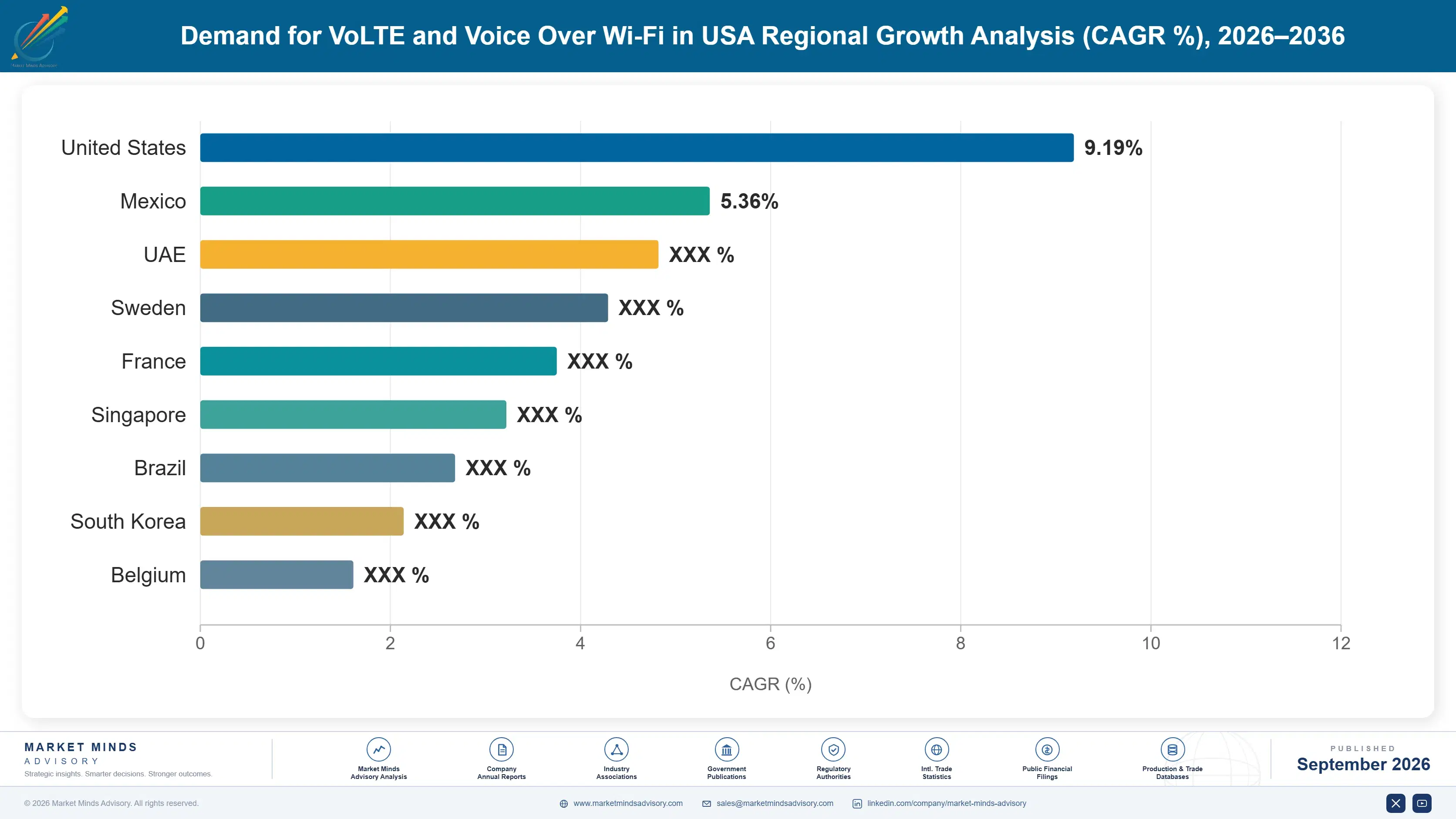
united-states-volte-and-voice-over-wi-fi-country-cagr-analysis-1788428009892

Competitive Moat and Risk Dimensions

ERICSSON

Moat: Deep Carrier Interoperability Track Record

Ericsson's decades of network core deployment across major carriers give it interoperability certification depth and reliability data competitors struggle to match, particularly for mission-critical voice infrastructure requiring proven multi-vendor network compatibility performance. This reliability record translates into lower field failure rates that carrier procurement teams increasingly reference during certification review processes.
ERICSSON

Risk: Slower Cloud-Native Development Pivot

Ericsson's hardware-centric engineering heritage leaves it exposed as carriers increasingly demand virtualized cloud-native core deployment, an area where nimbler competitors have invested more aggressively in software-defined network architecture. Competitors moving faster on virtualization risk eroding Ericsson's positioning among cloud-forward carrier accounts. Speed matters here greatly.
NOKIA

Moat: Broad Multi-Vendor Network Relationships

Nokia's established relationships across nearly every major carrier network give it design-in access and program visibility competitors lacking comparable carrier relationships struggle to replicate, particularly for programs requiring integrated radio and core network bundling. This access reduces customer acquisition overhead considerably compared to newer specialists lacking equivalent established carrier relationships.
NOKIA

Risk: Premium Pricing Limits Smaller Carriers

Nokia's premium positioning and engineering-intensive sales process limit its penetration among smaller regional carriers seeking lower-cost core software options, ceding volume share to leaner competitors willing to compete more aggressively on price. Lower-cost challengers targeting regional carriers could erode Nokia's volume base over the coming forecast years.

Players Tracked

Prominent Players

Ericsson
Nokia
Mavenir
Cisco
Metaswitch

Other Key Players

Samsung Networks
ZTE
Huawei
Affirmed Networks
Casa Systems
Ribbon Communications
Netsapiens
Oracle Communications
Comarch
Amdocs
Netcracker Technology
Sansay
Fortinet Telecom Solutions
Mitel Networks
AudioCodes

Recent Developments

APRIL 2026

Ericsson Launches Rural Wi-Fi Calling Analytics Platform

Ericsson launched a comprehensive rural Wi-Fi calling analytics platform combining coverage gap identification with deployment optimization tools, targeting carriers seeking documented rural coverage improvement without sacrificing the interoperability certification its platform already provides. The launch positions Ericsson to compete directly against specialists gaining traction on rural analytics innovation alone.
Signal: Signals Ericsson's strategic response to rising rural coverage competitive pressure from specialists ahead of intensifying rural coverage competitive positioning pressure
NOVEMBER 2025

Nokia Acquires Legacy Migration Tooling Startup

Nokia acquired a privately held legacy migration tooling startup to strengthen its radio access network integration capability, gaining proprietary connector technology and an engineering team with dedicated legacy platform experience already built over several years. Terms of the transaction were not disclosed publicly. Integration should complete by mid-2026.
Signal: Confirms acquisition as Nokia's preferred route into migration tooling rather than internal development rather than slower internal development timelines
JULY 2025

Mavenir Signs Supply Agreement With Regional Carrier

Mavenir signed a multi-year supply agreement with a major regional carrier to provide virtualized voice core software across its network modernization program launching across multiple regional coverage areas beginning early next year. Financial terms were not made publicly available. Mavenir expects rollout to begin soon.
Signal: Reflects growing regional carrier demand for cloud-native voice core deployment across multiple regional carrier network segments

Cloud Infrastructure and Engineering Exposure

Cloud hosting and specialized network processing hardware together represent roughly 27 to 33 percent of platform cost of goods sold for voice core vendors, sourced primarily from major hyperscale cloud providers and specialized telecommunications hardware manufacturers. Network engineering and interoperability testing staffing form a second major cost category for vendors serving complex multi-carrier deployments today.
Cloud compute and specialized processing hardware costs rose meaningfully during 2024 as hyperscale providers adjusted enterprise contract terms alongside rising telecommunications workload demand, an effect documented in several major cloud and hardware providers' annual reports citing rising data center capital expenditure pressuring enterprise pricing structures. Vendors without long-term commitments faced elevated infrastructure costs during this period. Lead times for dedicated network processing capacity provisioning stretched several months beyond pre-2024 norms across most affected vendors.

Smaller voice core vendors lacking dedicated network engineering expertise face a genuine competitive disadvantage relative to larger incumbents able to hire specialized interoperability testing talent supporting complex multi-carrier certification requirements. This exposure varies meaningfully by segment, with vendors serving rural coverage analytics facing steeper staffing requirements than vendors offering simpler standard core modules. This gap is widening as demand for specialized interoperability testing talent continues outpacing available candidate supply.
united-states-volte-and-voice-over-wi-fi-company-positioning-matrix-1788428010087

Negotiate Multi-Year Hyperscale Cloud Commitments

Vendors committing to multi-year cloud spending guarantees secure meaningfully discounted compute and processing rates from hyperscale providers, offsetting rising infrastructure costs directly and preserving margin as deployment volume continues climbing steadily across carrier accounts. This approach also strengthens provider relationships that pay dividends during future infrastructure cost pressure across the industry. Margin holds steadily.

Build Shared Network Engineering Service Teams

Vendors building centralized network engineering teams serving multiple carrier implementations simultaneously reduce per-customer staffing cost meaningfully, maintaining interoperability certification quality without absorbing the compensation premium that dedicated single-customer specialist staffing requires. Shared staffing models also improve certification consistency across geographically distributed carrier accounts and deployment timelines. This model scales efficiently as carrier count grows across the vendor pipeline.

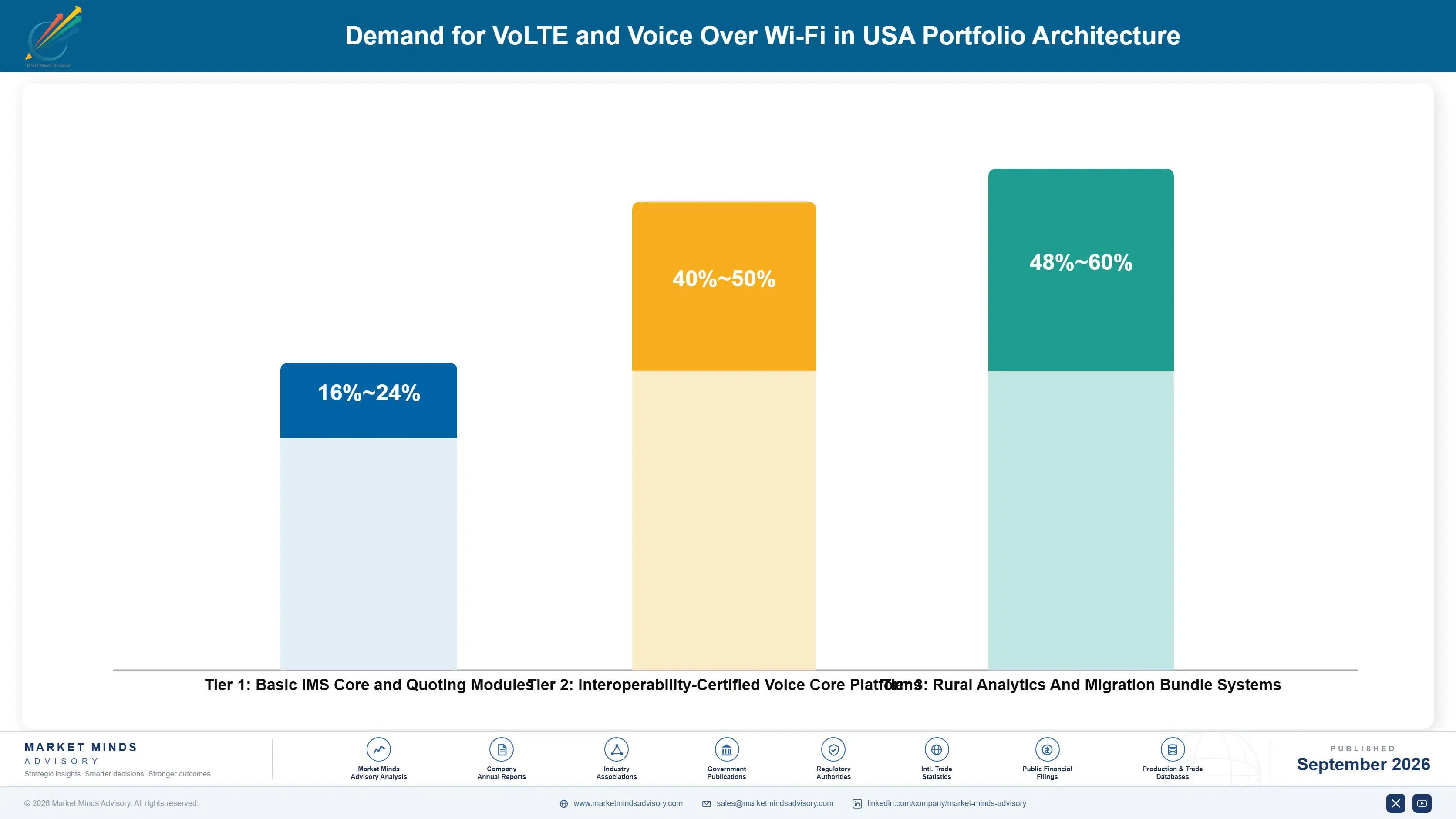
Portfolio Architecture for Margin Defence

Voice core vendors operate across three margin tiers, from basic IMS core modules carrying thin unit economics through certified interoperability platforms commanding meaningfully stronger margin, up to rural analytics and migration bundle systems capturing the richest gross margins across the category. Volume tiers monetize through per-subscriber licensing scale, while premium tiers monetize through certification depth and analytics capability bundling sold to enterprise carrier accounts. Vendors misjudging tier boundaries risk cannibalizing their own premium accounts over time.
Tension persists between volume growth, which favors standardized low-cost modules sold at scale to smaller price-sensitive regional carriers, and premium positioning, which favors interoperability certification and analytics depth commanding materially higher willingness to pay among enterprise accounts. Vendors chasing both simultaneously risk diluting brand positioning across a fragmented buyer base with sharply different purchasing criteria.

High-value margin pools concentrate in interoperability certification and rural coverage analytics, both commanding meaningfully higher gross margin than basic core modules sold without additional capability bundling attached. Vendors building durable certification capability and analytics relationships capture disproportionate margin relative to their carrier count across the broader competitive landscape today. Vendors ignoring this shift risk ceding the most profitable accounts to faster-moving rivals.

Basic IMS Core and Quoting Modules

Standardized core software sold at scale to smaller carriers prioritizing baseline compliance capability over advanced analytics, carrying thin unit economics but broad reach across cost-sensitive regional segments nationwide today still.
Gross Margin: 16-24%

Interoperability-Certified Voice Core Platforms

Certified voice core platforms bundling documented multi-vendor testing and compliance support, commanding stronger recurring revenue and materially higher gross margin than basic modules sold without certification capability attached today still.
Gross Margin: 40-50%

Rural Analytics And Migration Bundle Systems

Integrated platforms bundling rural coverage analytics with legacy migration tooling, carrying the richest margin profile in the category given urgent commercial demand and expanding buyer willingness to pay premium rates.
Gross Margin: 48-60%
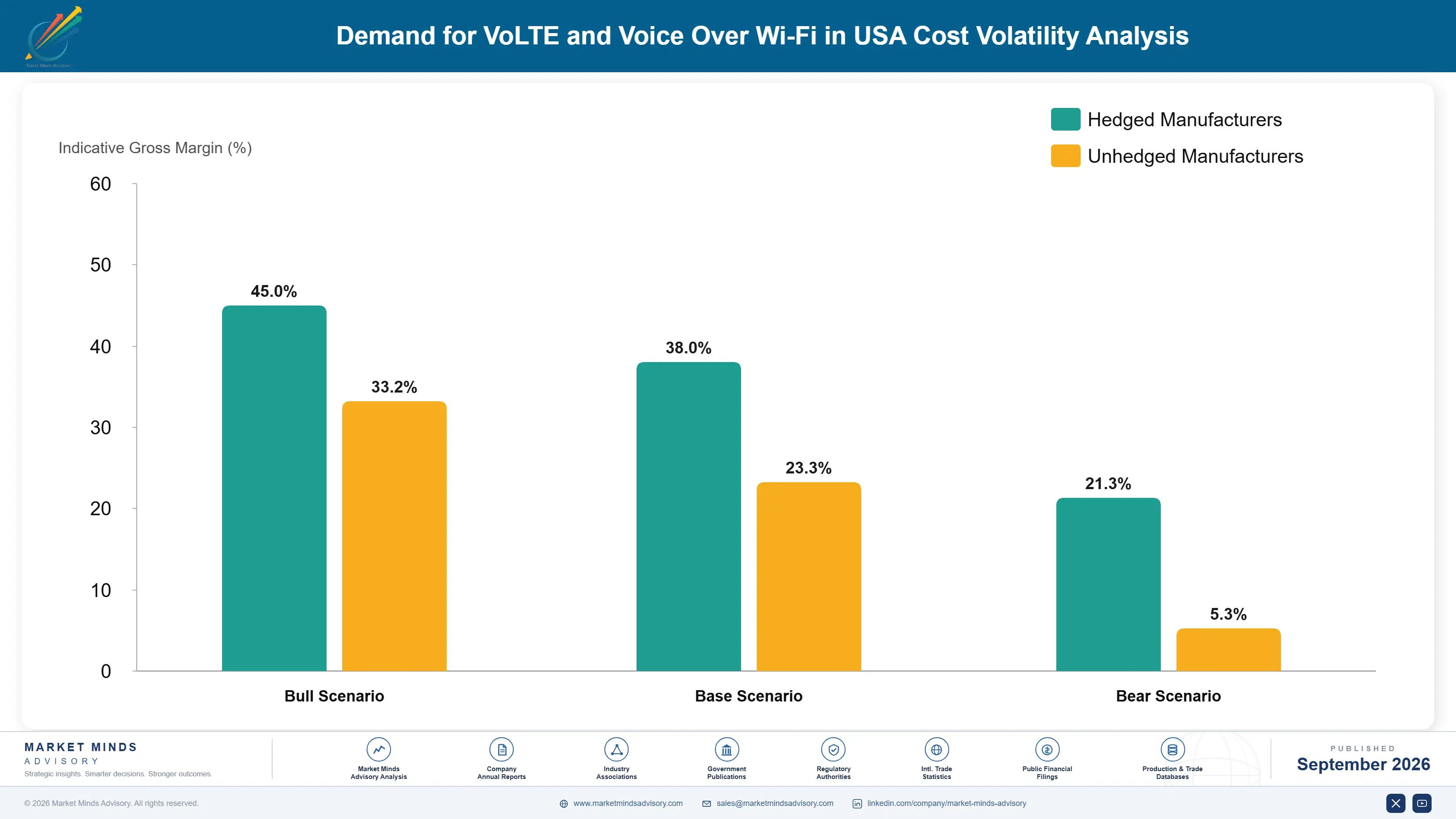
united-states-volte-and-voice-over-wi-fi-cost-volatility-analysis-1788428010589

High-value Sub-segments and Strategic Watch-out

Voice Over Wi-Fi Calling for Rural Coverage Extension

Fastest-growing and highest-value segment, combining strong pricing power with accelerating adoption as carriers seek documented coverage gap closure across fragmented rural markets nationwide, supported by federal broadband subsidy programs and expanding smaller-carrier procurement budgets across most regional deployment corridors this current planning cycle nationwide and abroad.

IMS Core Software Licensing

High-value segment with moderate growth, anchored by urgent commercial pressure from regulatory sunset requirements, though smaller carrier budgets constrain broader adoption pace relative to larger enterprise accounts pursuing faster migration timelines across their national networks and regional footprints alike, ahead of approaching sunset compliance deadlines.

Standard Interoperability Testing Software

Volume core of the market, delivering steady carrier counts and established margin, serving as the primary entry point into certification services and eventual analytics bundle adoption over time across most carrier tiers nationwide, from regional operators to the largest national carrier accounts across the country.

Legacy Circuit-Switched Infrastructure

Strategic watch-out segment facing intensifying regulatory sunset pressure, pushing carriers toward paid software adoption and requiring vendors to differentiate through implementation speed, migration tooling depth, and pricing accessibility for smaller accounts facing tighter budget constraints and shorter procurement cycles this year across most of their remaining service territory.

Regulatory Sunset Drives Recurring Revenue

Voice core software increasingly behaves like an annuity business rather than a project sale. Carriers sign multi-year licensing agreements tied to subscriber counts, and interoperability certification renewals lock vendors into recurring revenue streams that compound as networks expand. This shifts vendor valuation toward retained subscriber base rather than one-time deployment volume, rewarding vendors with durable carrier relationships over pure technology differentiation alone across the forecast period.
Adoption stickiness varies sharply by end-use vertical. Large national carriers integrate voice core software deeply into broader network operations, making switching costs prohibitive once certification and interoperability testing are complete. Smaller regional and rural carriers show shallower stickiness, often price-shopping at contract renewal given tighter budgets and less complex network topology, which keeps competitive pressure alive at the lower end of the market.

Buyer profiles are shifting generationally as network operations teams increasingly favor cloud-native, API-accessible core platforms over legacy monolithic systems. Younger technical buyers prioritize analytics integration and deployment speed over the incumbent vendor relationships that shaped prior purchasing cycles, gradually eroding legacy negotiating leverage and opening room for newer entrants offering more modern deployment tooling nationwide across both urban and rural carrier segments.
Section default visual

Where Voice Core Vendors Should Focus

These are among the four positions where our research anticipates prominent divergence between winners and laggards over the coming forecast period. Each is grounded in the demand model, the regulatory perimeter, and the announced capacity pipeline.
01 / RURAL COVERAGE ANALYTICS

Build documented coverage gap closure capability now

Rural Wi-Fi calling extension is the fastest-growing segment in this market, expanding at 11.0 percent annually against a category average of 7.5 percent across the broader core software category. Vendors that build documented coverage analytics capability now capture disproportionate share of federal broadband subsidy-linked procurement, which increasingly requires quantified coverage improvement evidence before funding release across most participating states. Waiting risks ceding this segment to faster-moving specialist entrants already active in several key rural markets nationwide and building lasting carrier relationships there.
02 / INTEROPERABILITY CERTIFICATION DEPTH

Deepen multi-vendor interoperability testing programs broadly

Interoperability certification separates premium vendors from commodity core suppliers, and carriers increasingly require documented multi-vendor testing evidence before signing multi-year licensing agreements at scale across their networks. Vendors deepening certification programs now build switching costs that compound over successive renewal cycles, while those relying on price competition alone face continuous margin erosion across their existing carrier accounts. This capability gap will widen further as certification requirements tighten steadily across the ten-year forecast period ahead for every participating vendor in the category.
03 / LEGACY MIGRATION TOOLING

Package migration tooling ahead of sunset deadlines

Copper network sunset mandates are forcing accelerated core migration across the carrier base, and vendors offering packaged migration tooling capture this urgency before competitors respond at meaningful scale nationwide. Smaller carriers facing tighter budgets particularly value bundled migration support over piecemeal integration services priced and negotiated separately across multiple vendor relationships and procurement cycles. Vendors that delay risk missing the compliance-driven window when switching costs are lowest for still-undecided regional buyers weighing multiple vendor options carefully across this current planning cycle.
04 / CLOUD COST MANAGEMENT

Negotiate hyperscale commitments before pricing tightens

Cloud infrastructure exposure represents a growing share of vendor cost of goods sold, and hyperscale pricing volatility directly compresses margin for vendors without locked-in multi-year commitments in place. Vendors negotiating multi-year hyperscale agreements now secure more favorable unit economics ahead of anticipated enterprise pricing tightening across the broader cloud infrastructure sector this cycle. Competitors that delay these negotiations risk facing structurally worse cost positions during the next major contract renewal cycle across their full carrier portfolio nationwide and internationally as well.

Engagement Snapshot From the Field

A live engagement with an industry participant carrying material or product regulatory and market exposure ahead of a defining policy shift, showing how our research translates into a defensible multi-year portfolio strategy.
MARKET MINDS ADVISORY · CLIENT ENGAGEMENT SUMMARY
Demand for VoLTE and Voice Over Wi-Fi in USA Producer Strategic Portfolio Review and Transition Roadmap 2026·Investment Scenario on Demand for VoLTE and Voice Over Wi-Fi in USA Exposure Evaluation 2025-26
CLIENT PROFILE
The client is a mid-sized regional wireless carrier serving several million subscribers across a mixed urban and rural footprint in the central United States. Facing an approaching copper network sunset deadline, the carrier's leadership sought an independent assessment of voice core vendor options before committing to a multi-year platform migration contract spanning its entire network.
STRATEGIC CHALLENGE
The carrier's existing legacy circuit-switched infrastructure faced mandatory sunset within eighteen months, but leadership lacked clarity on which certified voice core vendors could deliver rural Wi-Fi calling coverage extension alongside standard IMS core functionality without prohibitive integration costs across its dispersed rural network footprint and constrained internal engineering staff already stretched thin.
MMA APPROACH
MMA conducted a structured vendor capability assessment spanning five leading voice core suppliers, benchmarking rural coverage analytics depth, interoperability certification maturity, and total implementation cost against the carrier's specific network topology and subscriber distribution across its full service territory, including projected multi-year total cost of ownership across the full contract term.
KEY FINDINGS
  1. Two of five evaluated vendors offered documented rural Wi-Fi calling analytics meeting the carrier's coverage reporting requirements for federal subsidy compliance purposes across its territory.
  2. Implementation cost estimates varied by roughly 35 percent (client-reported, unverified by MMA) across vendors offering functionally comparable core software capability and support terms.
  3. Certification testing timelines ranged from four to nine months depending on vendor documentation maturity and prior multi-carrier deployment experience across similar rural footprints.
  4. Smaller carriers in similar rural-heavy footprints showed measurably higher switching costs once initial certification testing was substantially complete and underway across their networks.
CLIENT PROFILE
The client is a mid-sized regional wireless carrier serving several million subscribers across a mixed urban and rural footprint in the central United States. Facing an approaching copper network sunset deadline, the carrier's leadership sought an independent assessment of voice core vendor options before committing to a multi-year platform migration contract spanning its entire network.
STRATEGIC CHALLENGE
The carrier's existing legacy circuit-switched infrastructure faced mandatory sunset within eighteen months, but leadership lacked clarity on which certified voice core vendors could deliver rural Wi-Fi calling coverage extension alongside standard IMS core functionality without prohibitive integration costs across its dispersed rural network footprint and constrained internal engineering staff already stretched thin.
MMA APPROACH
MMA conducted a structured vendor capability assessment spanning five leading voice core suppliers, benchmarking rural coverage analytics depth, interoperability certification maturity, and total implementation cost against the carrier's specific network topology and subscriber distribution across its full service territory, including projected multi-year total cost of ownership across the full contract term.
KEY FINDINGS
  1. Two of five evaluated vendors offered documented rural Wi-Fi calling analytics meeting the carrier's coverage reporting requirements for federal subsidy compliance purposes across its territory.
  2. Implementation cost estimates varied by roughly 35 percent (client-reported, unverified by MMA) across vendors offering functionally comparable core software capability and support terms.
  3. Certification testing timelines ranged from four to nine months depending on vendor documentation maturity and prior multi-carrier deployment experience across similar rural footprints.
  4. Smaller carriers in similar rural-heavy footprints showed measurably higher switching costs once initial certification testing was substantially complete and underway across their networks.
RECOMMENDED STRATEGY
Phase 1: Phase one prioritized vendor shortlisting based on documented rural analytics capability and certification track record across comparable carrier deployments nationwide. Phase 2: Phase two structured contract negotiation around phased implementation milestones tied to measurable coverage improvement targets rather than flat deployment fees. Phase 3: Phase three established ongoing performance benchmarking against subsidy compliance reporting requirements to protect continued federal funding eligibility nationwide across the carrier's territory.
OUTCOME
The carrier selected a certified vendor offering integrated rural analytics, completing certification testing within six months and reporting improved subsidy compliance reporting accuracy (client-reported, unverified by MMA). Leadership credited the structured vendor comparison with avoiding a costlier, less capable platform choice originally under serious consideration.

Frequently Asked Questions

Foundational context covering the market sizes, CAGR, scope, country, region and competition that inform every finding below. This section is provided to cover basics and most often pre-purchase conversations, answered from the MMA Primary Research Dataset.

What is the current size of the Demand for VoLTE and Voice Over Wi-Fi in USA?

The market reached 2.9 billion dollars in 2025, driven by copper network sunset mandates and expanding rural Wi-Fi calling coverage extension programs across smaller regional carrier networks nationwide.

How large will the Demand for VoLTE and Voice Over Wi-Fi in USA be by 2036?

MMA projects the market will reach 6.43 billion dollars by 2036, more than doubling from 2025 levels as carriers complete mandated legacy infrastructure migration nationwide.

What is the CAGR for the Demand for VoLTE and Voice Over Wi-Fi in USA 2026 to 2036?

The base case CAGR is 7.5 percent, with a bull scenario of 8.7 percent and a bear scenario of 6.3 percent depending on regulatory sunset pacing.

Which segment is growing fastest?

Voice Over Wi-Fi Calling for Rural Coverage Extension leads at 11.0 percent CAGR, roughly 1.47 times the overall market rate, driven by federal broadband subsidy programs.

Who are the major companies in the Demand for VoLTE and Voice Over Wi-Fi in USA?

Ericsson, Nokia, Mavenir, Cisco, and Metaswitch lead the market, collectively holding a combined revenue share reflecting deep carrier interoperability relationships built over many years of network deployment experience.

Which country is growing fastest?

The United States itself leads within this report's defined scope, expanding at 8.0 percent annually as carriers accelerate copper network sunset compliance nationwide across both urban and rural territories.

Report Segmentation Architecture

The full report scope spans multiple orthogonal segmentation dimensions, with cross-tabulated demand data provided for each dimension pair. Coverage extends further to regional breakdowns, trend trajectories, and the competitive detail needed to support segment-level decision-making.

By Core Software and Service Type

    By End-Use Carrier Segment

      By Commercial Deployment Model

        By Region

        • North America
        • East Asia
        • Western Europe
        • South Asia and Pacific
        • Latin America
        • Middle East and Africa
        • Eastern Europe

        Scope, Methodology, and Coverage

        Every figure in this report is reproducible from documented input assumptions. The scope below maps the historical period, the forecast horizon, the segmentation dimensions, and the countries covered, alongside the underlying primary and qualitative methodology.
        Historical Period
        2020 to 2025
        Forecast Period
        2026 to 2036
        Base Year
        2025 (USD billions; MMA Primary Research Dataset, September 2026)
        Market Definition
        This report covers voice core software and services enabling Voice over LTE and Voice over Wi-Fi calling delivery across United States carrier networks, including IMS core licensing, interoperability certification, and rural coverage analytics. It excludes broader mobile data network infrastructure and consumer handset hardware.
        Quantitative Units
        USD billions, market share percentages, CAGR percentages
        Segmentation Dimensions
        Core software and service type, end-use carrier segment, commercial deployment model
        Regions Covered
        North America, East Asia, Western Europe, South Asia and Pacific, Latin America, Middle East and Africa, Eastern Europe
        Countries Covered
        United States, with regional benchmarking context across North America, East Asia, Western Europe, South Asia and Pacific, Latin America, Middle East and Africa, and Eastern Europe
        Key Companies Profiled
        Ericsson, Nokia, Mavenir, Cisco, Metaswitch, and 15 additional participants
        Quantitative Methodology
        Primary survey, n=3,800 respondents, Q4 2025, six countries; demand-side model with trade association cross-validation
        Qualitative Methodology
        47 expert interviews, Q4 2025; applied to validate demand model assumptions, identify emerging dynamics, and assess competitive positioning
        Report Format
        PDF and XLSX data workbook (Word format preview document)
        Publisher
        Market Minds Advisory
        Report Code
        MMA-2026-TEC-843
        Published
        September 2026
        Contact
        sales@marketmindsadvisory.com | www.marketmindsadvisory.com

        Purchase the full Demand for VoLTE and Voice Over Wi-Fi in USA Report (2026 to 2036).

        This full report delivers comprehensive analysis of the United States VoLTE and Voice over Wi-Fi market. It covers vendor competitive positioning, rural coverage analytics adoption, and regulatory sunset timelines shaping carrier procurement decisions nationwide. The report includes detailed segmentation across core software types, carrier segments, and deployment models, alongside a proprietary MMA primary survey of carrier decision-makers spanning multiple regions. Analysts detail margin economics, cost exposure, and competitive dynamics shaping vendor positioning across the category. Strategic recommendations guide vendors navigating this transitioning infrastructure category through 2036 and beyond.
        Full seven-region data tables and CAGR breakdowns
        Complete company profiles for twenty market participants
        Primary survey dataset covering 3,800 respondents nationwide
        Expert interview findings from 47 industry specialists
        Editable data tables in spreadsheet format included
        Quarterly market update subscription available separately

        Built For The People Who Decide

        From boardroom strategy to bench-side execution, this report is read cover-to-cover by leaders shaping the next decade of their industry, turning demand scenarios, market dynamics and valuation benchmarks into decisions.
        CXOs/ Presidents/ VPs/ Managers
        M&A and Corporate Development
        Strategy Teams and R&D Heads
        Procurement and Product Directors
        Regulatory and Compliance Leaders
        Investor Relations and Equity Analysts