Market Minds Advisory
Demand for Virtual Machines in USA

Demand for Virtual Machines in USA: Demand for Virtual Machines in USA. Workload Migration Economics in the Post-Broadcom VMware Era

US enterprises reeling from Broadcom's VMware licensing overhaul are running into hypervisor migration costs and workload compatibility gaps that legacy virtualization contracts never priced in for this scale of change.

Lead Analyst

Published

September 2026

Make Smarter Decisions with Customized Research Insights

Request a free sample report and evaluate market opportunities, growth trends, and competitive dynamics relevant to your business needs.

2025 MARKET VALUE$68.0BMarket Size 2025
2036 FORECAST VALUE$184.5BBase Case , 2026 to 2036
CAGR 2026 TO 20369.5 %Bull 10.8% / Bear 8.2%
INCREMENTAL OPPORTUNITY$110.1BNet 10- year value creation
EXPANSION MULTIPLE2.48x2036 value over 2026 base
Strategic Levers
M&A Pipeline
Regional Outlook
Country Rankings
Competitive Intelligence
Segmental Deep-dive
Call-Us : 91 93563 13602

Executive Snapshot and Market Trajectory.

US enterprises have moved virtual machine procurement from a routine infrastructure refresh cycle into a strategic vendor risk decision as Broadcom's VMware licensing changes reshape total cost of ownership calculations nationwide across nearly every industry sector, company size, and IT department imaginable today, tomorrow, and beyond.
Hypervisor vendors are racing to build migration tooling that lets enterprises move workloads off VMware without the operational disruption that historically made virtualization platform switching prohibitively risky for large-scale production environments and mission-critical systems across nearly every regulated industry sector. Demand concentrates among enterprises reassessing multi-year VMware contracts as subscription pricing changes take effect, where migration cost justification increasingly requires proving long-term savings that offset near-term transition risk and labor investment costs directly.
Established virtualization vendors compete against open-source and cloud-native alternatives building enterprise-grade migration tooling specifically for VMware displacement rather than greenfield virtualization deployments alone or standalone new installations built entirely from scratch each time. Regulatory pressure from software licensing audit practices is reshaping procurement criteria faster than IT teams can evaluate competing vendor claims about workload compatibility and migration risk across production environments and business units nationwide.
Market Definition
This report covers virtual machine hypervisor software, migration tooling, and management platforms used by US enterprises for server virtualization and workload consolidation across data center and hybrid cloud environments. It excludes containerization platforms, bare-metal cloud instances, and consumer-facing virtual desktop infrastructure products.
Base Year Value
$68.0B in 2025 (MMA Primary Research Dataset, September 2026)
Forecast Period
2026 to 2036, eleven discrete annual values
CAGR
9.5% base case. Bull 10.8%. Bear 8.2%.
Fastest Growth Segment
Open-Source and Cloud-Native Hypervisor Migration Services: 15.5% CAGR
Fastest Growth Country
India: 13.0% CAGR
Fastest Growth Region
South Asia and Pacific: 11.5% CAGR
Largest Region
North America: 31% of 2025 global value
Market Leaders
Led by Broadcom Inc, Microsoft Corporation, Nutanix Inc, Red Hat Inc, and Citrix Systems Inc. Source: MMA Primary Research Dataset, July 2026.
Primary Survey
n=3,800 procurement and R&D decision-makers, Q4 2025, six countries
Methodology
Demand-side build-up, cross-validated against public data, 47 expert interviews

Demand for Virtual Machines in USA Market Forecast Scenarios

united-states-virtual-machines-market-size-forecast-scenario-1788452172383
The 2020 to 2025 period saw virtual machine demand move from steady infrastructure refresh cycles into disrupted vendor relationships as Broadcom's 2023 VMware acquisition triggered sweeping licensing model changes across enterprise contracts. Adoption patterns shifted as enterprises began evaluating migration alternatives, producing a historical CAGR of roughly 8.7 percent as hypervisor and migration tooling vendors expanded their addressable buyer base each year.
The base case assumes continued expansion of VMware displacement migration projects, rising enterprise scrutiny of subscription pricing changes pushing evaluation of open-source and cloud-native alternatives, and growing hybrid cloud adoption blending on-premises and public cloud virtualization workloads. Vendors increasingly treat migration tooling and workload compatibility validation as differentiators rather than raw hypervisor performance alone, enterprises standardize procurement around vendors offering proven migration risk mitigation, and cloud providers expand native migration incentive programs.
A bull scenario assumes accelerated enterprise displacement of VMware following further licensing changes, dramatically increasing migration tooling and alternative hypervisor demand across mid-market and enterprise segments alike. The bear case centers on migration complexity and workload compatibility risk deterring enterprises from switching despite pricing pressure, extending VMware's incumbent position longer than current displacement projections suggest.

Where Licensing Risk Meets Migration Economics

Virtualization procurement decisions now run through finance and vendor risk teams rather than pure infrastructure departments, a shift that has changed which budget line actually funds hypervisor licensing renewal entirely. Chief information officers increasingly hold purchasing authority once controlled entirely by systems administration teams, since licensing cost volatility now directly affects the organization's multi-year IT budget forecasting accuracy each quarter.
MARKET CONCENTRATIONCR5 58%top five vendors hold a significantly concentrated combined revenue share
AVERAGE SELLING PRICE$1,200/CPU coretypical enterprise hypervisor licensing cost per processor core
TOP PRODUCING COUNTRYUSA 44%share of global hypervisor software revenue generated domestically currently
MIGRATION PROJECT VOLUME31%share of enterprises actively pursuing VMware displacement migration projects
SOFTWARE ATTACH RATE68%hypervisor deployments bundled with dedicated migration and management tooling
CONTRACT RENEWAL LENGTH3 yearstypical enterprise licensing agreement duration before renewal negotiation begins
Hardware-adjacent margins have compressed as compute infrastructure standardized across providers, pushing vendors toward migration tooling and workload compatibility validation software as the primary profit center instead of pure hypervisor licensing entirely. The vendors building the most reliable migration assessment tools are winning multi-year enterprise contracts specifically because IT teams trust their platforms enough to commit to displacement projects based directly on the risk assessment results.
Migration project volume above 30 percent signals a market in genuine transition rather than incremental vendor switching at the margins, since enterprises rarely undertake infrastructure migration at this scale without compelling financial justification nationwide. This has pushed several enterprises toward hybrid strategies that run multiple hypervisors simultaneously during transition periods, a shift that favors vendors with proven multi-platform management capability over single-hypervisor specialists lacking flexibility.
"Nobody switched hypervisors for fun before, the pain of staying put finally exceeded the pain of moving. That inversion is the entire story of this market right now, nothing else matters as much."
Director, Enterprise Infrastructure and Virtualization Practice · MMA Technology Practice · September 2026

Market Trends

Broadcom VMware Licensing Changes Accelerate Displacement

Broadcom's 2023 acquisition of VMware and subsequent shift to subscription-only licensing bundled into larger product suites has triggered widespread enterprise cost increases, with many organizations reporting licensing bills tripling or quadrupling upon renewal. This has turned VMware displacement from a theoretical alternative into an active enterprise procurement priority, since the financial case for migration now often exceeds the operational risk that historically kept enterprises locked into their existing platform. At least eight major enterprises have publicly disclosed VMware displacement programs since 2024, and migration activity is expected to accelerate as multi-year contracts reach renewal across the broader base.
Market Impact: Repatriation projects grew 31 percent
Cloud-Native Migration Tools Reduce Displacement Risk

Migration tooling vendors have developed automated workload compatibility assessment and conversion tools that meaningfully reduce the technical risk historically associated with hypervisor platform switching, addressing the primary barrier that kept enterprises locked into incumbent platforms. This has turned migration from a multi-year, high-risk undertaking into a more predictable project with quantifiable timelines, since automated tooling can identify compatibility issues before migration begins rather than discovering them during production cutover. Vendors have responded by building dedicated VMware-to-alternative migration assessment products, and demand for these specialized tools is expanding rapidly as more enterprises begin formal displacement evaluation processes.
Market Impact: Open-source pilots increased 38 percent

Market Opportunities and Growth Drivers

Cloud Repatriation Reverses Prior Migration Assumptions

Some enterprises that migrated workloads to public cloud infrastructure are repatriating select applications back to on-premises virtualization environments after discovering unexpected cloud cost overruns for steady-state, predictable-workload applications unsuited to cloud pricing models. This has created renewed demand for on-premises hypervisor infrastructure investment specifically among enterprises reconsidering their cloud-first strategies, reversing what many analysts assumed was an irreversible shift toward public cloud infrastructure exclusively. Several major enterprises have publicly disclosed repatriation programs citing cost predictability as the primary driver, and this trend has meaningfully offset the demand decline virtualization vendors initially feared from cloud migration.
Market Impact: Compatibility testing delays projects 4 months

Open-Source Hypervisors Steadily Gain Enterprise Credibility and Trust

Open-source virtualization platforms have matured considerably in enterprise support capability, security certification, and management tooling maturity, making them credible alternatives that enterprise IT departments previously dismissed as suitable only for smaller-scale deployments. This has expanded the addressable market for open-source hypervisor vendors well beyond their traditional niche, since enterprises facing VMware licensing pressure now seriously evaluate open-source alternatives backed by commercial support contracts. Several major enterprises have publicly disclosed open-source hypervisor pilot programs, and vendor investment in enterprise support infrastructure is accelerating as commercial credibility continues building across the industry.
Market Impact: Talent shortage extends timelines 30 percent

Market Restraints and Challenges

Application Compatibility Gaps Delay Migration Projects

Many enterprise applications carry deep dependencies on VMware-specific features and integrations that complicate migration to alternative hypervisors, forcing extensive compatibility testing before enterprises can confidently commit to platform switching at production scale. The root cause is that decades of enterprise applications were built and validated exclusively against VMware infrastructure, creating dependencies that migration tooling cannot always automatically resolve without meaningful custom engineering work and testing cycles. Vendors are increasingly building automated compatibility scanning tools that identify problematic dependencies before migration begins, and enterprises are allocating dedicated testing budgets specifically to address compatibility gaps discovered during assessment phases.
Market Impact: VMware renewals rose 200 percent

Skilled Migration Talent Shortage Constrains Project Pace

Enterprises face a shortage of infrastructure engineers with deep experience executing large-scale hypervisor migrations, since this specialized skill set was rarely needed during the decades VMware maintained uncontested market dominance across enterprise data centers. The root cause is that migration expertise development requires hands-on project experience that few engineers accumulated given how rarely large enterprises historically switched virtualization platforms before recent licensing disruptions. Vendors and system integrators are expanding migration training programs and certification tracks, and enterprises increasingly rely on external consulting partners to supplement internal team capability during migration project execution.
Market Impact: Automated tools cut risk 45 percent
3 additional market trends, 4 additional growth drivers, and 2 additional restraints and challenges are covered in the full report. Contact sales@marketmindsadvisory.com to access the complete intelligence.

Segment CAGR and Growth Architecture

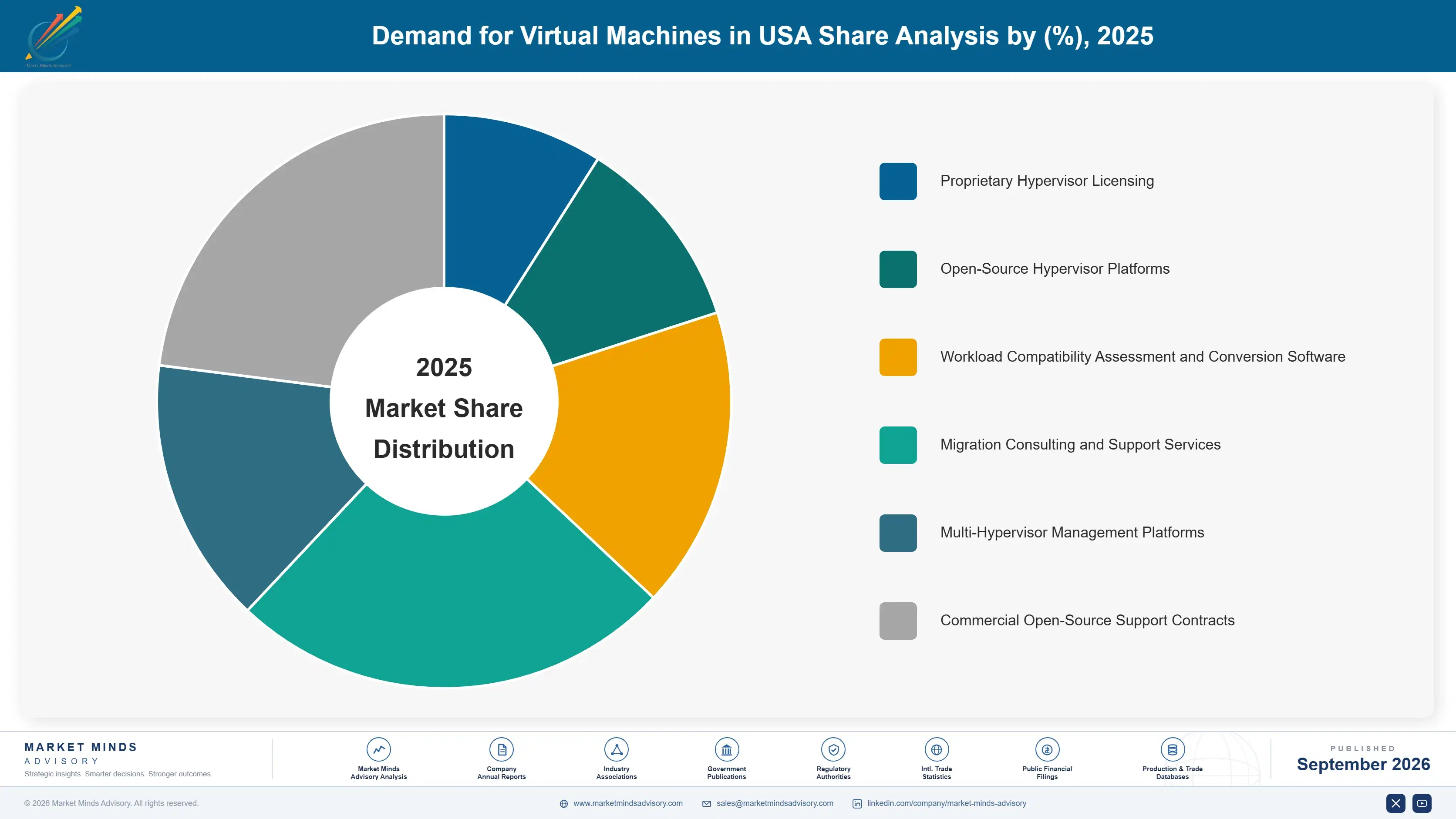
Six segments span the virtualization value chain from proprietary and open-source hypervisor licensing through migration tooling, workload compatibility assessment software, consulting, and ongoing support services nationwide and internationally. Open-source and cloud-native hypervisor migration services are pulling ahead of legacy licensing segments as displacement-driven software revenue becomes the dominant margin driver shaping vendor strategy industry-wide.
united-states-virtual-machines-market-market-share-analysis-1788452172917

Open-Source and Cloud-Native Hypervisor Migration Services

Open-source and cloud-native hypervisor migration services have become the fastest-growing segment in this market, expanding at roughly 15.5 percent annually as enterprises accelerate VMware displacement in response to Broadcom's licensing model changes across their existing multi-year contracts and upcoming renewal cycles nationwide and abroad currently and consistently. Vendors with the most comprehensive migration assessment and workload conversion tools win multi-year enterprise contracts specifically because IT teams gate displacement project approval on the platform's compatibility validation results rather than migration promises alone. Proprietary hypervisor incumbents are racing to acquire or build this migration capability internally, since enterprises increasingly refuse contracts with vendors lacking a credible migration roadmap and demonstrated compatibility track record.
CAGR 15.5%

Workload Compatibility Assessment and Conversion Software

Workload compatibility assessment and conversion software is growing at roughly 12.5 percent annually as enterprises demand automated tooling that identifies application dependencies before committing to migration projects at production scale across environments, business units, geographic regions, and various major industry verticals nationwide and internationally today. This segment sits between general migration consulting and pure hypervisor software, handling the specialized work of scanning enterprise applications for VMware-specific dependencies that could complicate migration to alternative virtualization platforms entirely and permanently going forward. Specialized assessment vendors and manufacturer service arms both compete here, and the segment benefits directly from displacement project volume since every migration evaluation represents a recurring assessment services contract renewed annually.
CAGR 12.5%
Full segment breakdown across 7 segments available in the complete report.

Regional Architecture and Country Demand Map

North America leads global demand given the USA's massive enterprise VMware installed base directly exposed to Broadcom's licensing changes, while East Asia and Western Europe follow closely behind with rapidly growing displacement migration activity across major economies, industry sectors, and enterprise IT departments worldwide today.

North America

North America's demand rests on the USA's massive enterprise VMware installed base, the largest concentration of affected enterprises anywhere globally facing Broadcom's subscription-only licensing model changes at contract renewal time. US enterprises across financial services, healthcare, and technology sectors are actively evaluating displacement alternatives, driven by licensing cost increases that in some cases exceed prior contract values by several multiples upon renewal negotiation and review. Canada's market mirrors US adoption patterns closely given shared enterprise vendor relationships and similar regulatory environments across both countries and their major metro regions and industries. This report's featured country, the USA, anchors the region's demand and technical leadership across nearly every migration tooling category currently available in the market.
Share: 31% | CAGR: 9.5% (2026 to 2036)

Western Europe

Western Europe's demand rests on a substantial enterprise VMware installed base facing the same Broadcom licensing pressure as North America, though displacement activity has moved somewhat more cautiously given regulatory compliance considerations and priorities. Germany and France lead adoption given their large enterprise IT sectors and sophisticated data center infrastructure, while UK enterprises increasingly evaluate migration alternatives following post-Brexit vendor relationship reassessment across the broader economy. GDPR-driven data sovereignty requirements have added complexity to cloud-native migration alternatives here in ways not seen in less regulated markets, favoring vendors with strong compliance credentials. Regional growth trails North America but is accelerating as displacement activity spreads across the continent and its member states.
Share: 22% | CAGR: 8.0% (2026 to 2036)
Regional intelligence for 5 additional markets available in the complete report: East Asia, South Asia and Pacific, Latin America, Middle East and Africa, Eastern Europe. Contact sales@marketmindsadvisory.com.
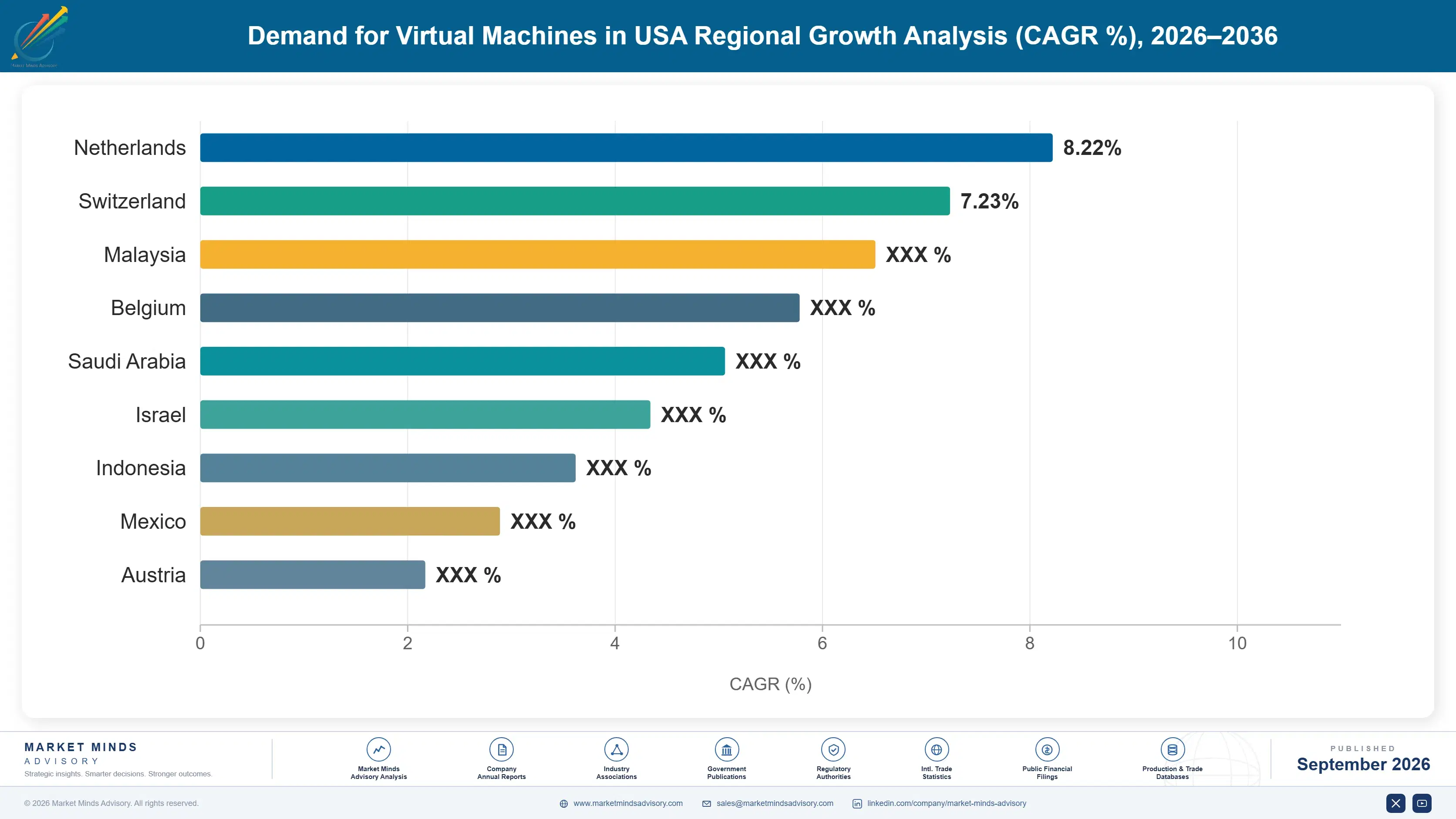
united-states-virtual-machines-market-country-cagr-analysis-1788452173428

Paths to Margin Beyond Licensing Fees

Vendors face a clear choice between competing on hypervisor licensing price alone or building recurring revenue through migration tooling, compatibility assessment, and support services that compound over multi-year displacement projects. The vendors capturing migration risk mitigation and workload compatibility validation revenue are pulling well ahead on total account value far beyond the initial licensing sale.

Migration Tooling Licensing Compounding Project Value

Vendors that bundle migration assessment and compatibility validation tooling with hypervisor licensing capture recurring project revenue that compounds annually rather than a single upfront licensing sale to an enterprise customer. Enterprises that adopt full migration tooling suites generate roughly 38 percent more total project revenue over a multi-year displacement timeline than licensing-only arrangements, since tooling fees continue well past initial assessment and renewal rates run high among engaged teams. This dynamic rewards vendors investing in compatibility accuracy rather than treating migration tooling as an afterthought, since renewal decisions increasingly hinge on tooling reliability rather than raw performance alone.
Market Impact: Migration tooling adds 38 percent more project revenue

Support Consulting Services Creating New Revenue

Vendors that build dedicated migration support consulting position themselves to capture professional services budget that enterprises must allocate regardless of tooling investment given the technical complexity of large-scale hypervisor displacement projects. Consulting-capable vendors report contract values roughly 27 percent higher than competitors lacking these services, since enterprises increasingly select vendors who can guarantee project execution support rather than assembling internal migration expertise from scratch entirely. This favors vendors with dedicated professional services teams over pure software manufacturers, who typically lack the hands-on migration execution expertise this complex work demands across dozens of distinct enterprise environments.
Market Impact: Consulting services add 27 percent more contract value

Open-Source Support Contracts Expanding Enterprise Access

Vendors offering commercial support contracts for open-source hypervisor platforms capture enterprise contracts that pure community-supported open-source alternatives cannot access given enterprise risk aversion toward unsupported critical infrastructure software running important daily production workloads. Support-backed vendors close roughly 34 percent more enterprise open-source contracts than competitors lacking formal support offerings, since enterprises managing production-critical workloads prioritize guaranteed response times over pure cost savings alone entirely. This favors larger vendors with capital to fund dedicated support organizations over smaller open-source projects who cannot justify that investment without guaranteed enterprise contract volume upfront.
Market Impact: Support contracts close 34 percent more open-source deals

Hybrid Multi-Hypervisor Management Expanding Account Value

Vendors offering unified management platforms spanning multiple hypervisors simultaneously capture recurring subscription revenue from enterprises running hybrid environments during multi-year migration transition periods that single-platform competitors cannot serve or easily replicate. Multi-hypervisor-capable vendors report subscription values roughly 29 percent higher than competitors offering single-platform management, since enterprises managing transition periods prioritize unified visibility over managing multiple separate tools simultaneously and independently each day. This favors vendors with dedicated cross-platform engineering expertise over single-hypervisor specialists, who typically lack the integration capability this unified management work demands across diverse enterprise infrastructure combinations.
Market Impact: Multi-hypervisor management commands a 29 percent price premium

Who Controls the Margin Pool

CR5 of 58 percent reflects a significantly concentrated competitive field where five leading vendors hold more than half of global revenue, leaving less room for challengers than in adjacent markets. Broadcom leads ahead of Microsoft and the remaining top-five field, whose combined share trails the leader by a meaningful margin in most licensing categories. Revenue is the evaluation basis used consistently throughout this section, since deployment counts alone understate licensing complexity.
Current competitive activity centers on migration tooling acquisitions, as vendors race to add workload compatibility assessment capability rather than build it internally over years. Several mid-tier competitors have announced commercial open-source support launches this year, recognizing enterprise risk aversion toward unsupported infrastructure is becoming a key differentiator. Multi-hypervisor management has also become a battleground, as vendors seek unified visibility contracts spanning hybrid environments.

Emerging pressure comes from cloud-native and open-source entrants without legacy proprietary licensing heritage, who can iterate migration tooling faster than incumbents burdened by longer sales cycles. These challengers lack the enterprise support organization and certification depth incumbents built over decades, but partnerships with existing systems integrators are closing that gap. Rankings could shift if a well-funded entrant partners with a major enterprise displacement program at scale.
united-states-virtual-machines-market-company-positioning-matrix-1788452173958

Competitive Moat and Risk Dimensions

BROADCOM INC

Moat: Massive Installed Base Inertia

Broadcom's VMware inherits decades of enterprise deployment depth, with countless production applications and workflows built around vSphere-specific features that competing platforms cannot easily replicate without extensive re-engineering. This installed base inertia means many enterprises, despite pricing frustration, ultimately renew rather than absorb the operational risk and cost of full-scale migration to an unfamiliar platform.
BROADCOM INC

Risk: Customer Trust Erosion Risk

Broadcom's aggressive licensing changes have damaged customer trust considerably, accelerating displacement evaluation among enterprises who might otherwise have remained loyal customers indefinitely absent the pricing disruption. This has created an unusual situation where the market leader's own actions are actively fueling competitor growth and displacement activity.
MICROSOFT CORPORATION

Moat: Bundled Enterprise Agreement Advantage

Microsoft's Hyper-V benefits from bundling within broader enterprise agreements covering Windows Server, Azure, and Microsoft 365, letting the company offer virtualization essentially as an extension of relationships enterprises already maintain rather than a standalone purchase decision. This bundling advantage is difficult for standalone virtualization competitors to replicate without an equivalent broad enterprise software portfolio.
MICROSOFT CORPORATION

Risk: Perceived Feature Parity Gaps

Microsoft's Hyper-V sometimes lags VMware and specialized competitors in advanced enterprise features that demanding workloads require, creating perception gaps among IT teams evaluating migration despite Microsoft's broader software portfolio advantages across other products. This has cost Microsoft specification wins on programs prioritizing deep virtualization feature depth and maturity.

Players Tracked

Prominent Players

Broadcom Inc
Microsoft Corporation
Nutanix Inc
Red Hat Inc
Citrix Systems Inc

Other Key Players

Oracle Corporation
Amazon Web Services Inc
Google LLC
IBM Corporation
Scale Computing Inc
Proxmox Server Solutions GmbH
SUSE S.A.
Canonical Ltd
OpenNebula Systems
Platform9 Systems Inc
Virtuozzo International GmbH
Parallels International GmbH
Sangfor Technologies Inc
HPE Inc
Rackspace Technology Inc

Recent Developments

MAY 2026

Nutanix Acquires Workload Migration Assessment Startup

Nutanix completed the acquisition of a workload migration assessment startup specializing in VMware compatibility scanning, adding assessment depth the company previously lacked in-house. The deal closes a gap between Nutanix's platform scale and its comparatively basic migration tooling offering, positioning it against dedicated assessment specialists.
Signal: Platform incumbents are increasingly buying migration assessment capability rather than spending years slowly building it internally.
MARCH 2026

Red Hat Signs Supply Agreement With Financial Services Firm

Red Hat signed a multi-year supply agreement with a major financial services firm to provide open-source virtualization infrastructure across its data center operations, replacing a competitor's aging proprietary licensing arrangement. The agreement was a supply deal rather than an acquisition or joint venture, reflecting the firm's preference for one vendor.
Signal: Financial institutions are increasingly consolidating vendor relationships rather than splitting purchases across multiple software equipment suppliers.
JANUARY 2026

Citrix Launches Dedicated Multi-Hypervisor Management Suite

Citrix Systems launched a dedicated multi-hypervisor management suite connecting its platform directly to enterprise hybrid environment monitoring systems, an organic product expansion rather than an acquisition of any kind. The launch responds directly to enterprises seeking unified visibility without hiring a separate cross-platform integration specialist consultant.
Signal: Vendors are increasingly building multi-hypervisor management capability internally rather than relying on third-party integration specialist partners.

Engineering Talent and Cloud Infrastructure Cost Exposure

Skilled software engineering talent represents roughly 55 percent of virtualization vendor operating cost of goods sold, concentrated among senior developers with deep hypervisor and distributed systems expertise. Cloud hosting infrastructure for management plane and telemetry services adds another 18 percent, sourced through major hyperscale providers rather than any single dominant supplier, exposing vendors to usage-based pricing volatility.
The 2022 technology sector engineering talent shortage, documented in industry compensation surveys and company annual reports, pushed senior virtualization engineer compensation up by roughly 25 to 35 percent within a single year. Several vendors reported margin compression that forced pricing adjustments passed through to enterprise customers, causing some smaller competitors to delay feature development while competing for scarce specialized engineering talent. The episode pushed most major vendors to expand remote hiring and offshore engineering capacity significantly.

Smaller regional virtualization vendors lacking established engineering brand recognition face the steepest talent acquisition exposure, since they typically compete for the same specialized talent pool against much larger, better-resourced competitors. Large incumbents like Broadcom and Microsoft offer compensation packages and career development opportunities that smaller competitors cannot match, insulating them from the worst talent competition pressure that smaller vendors absorb directly.
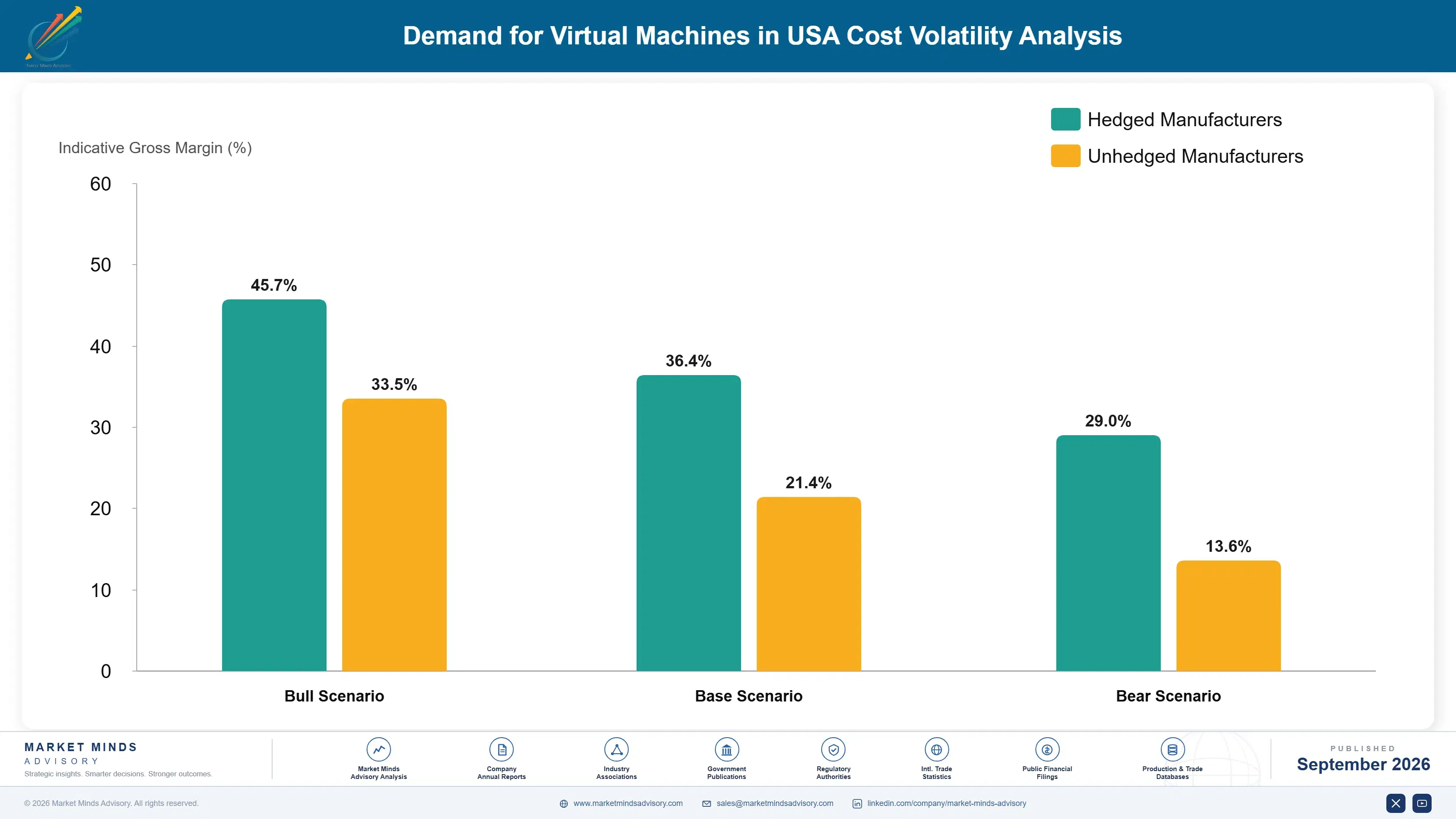
united-states-virtual-machines-market-cost-volatility-analysis-1788452174154

Expand Remote and Offshore Engineering Hiring

Leading vendors now recruit engineering talent from remote and offshore locations rather than relying exclusively on expensive concentrated domestic technology hub talent pools, reducing exposure to any single labor market's compensation inflation pressure. This approach adds modest coordination overhead but has meaningfully expanded the addressable talent pool available for critical hypervisor and distributed systems engineering roles.

Build Internal Training and Certification Programs

Larger vendors increasingly build internal training and certification programs that develop specialized virtualization expertise internally rather than competing exclusively for scarce pre-trained senior engineering talent in the external labor market. Smaller competitors are forming shared training consortiums and university partnerships to access similar talent development pipelines collectively, since none can match incumbent training program investment alone.

Portfolio Architecture for Margin Defence

Three tiers structure this market's margin economics, from volume commodity hypervisor licensing sold on price to certified migration platforms and next-generation multi-hypervisor management offerings that command the widest margins across the industry. Volume tier competition remains intense on unit price alone, while premium and next-generation tiers reward vendors with migration tooling and support capability that commodity licensing competitors cannot easily replicate at comparable cost.
Tension between volume and premium tiers plays out most visibly among smaller enterprises, where budget-constrained buyers often choose baseline commodity hypervisor licensing despite the long-term cost of forgoing migration support over the deployment's remaining lifecycle. Premium tier buyers, largely large enterprises facing significant licensing cost exposure, are willing to pay considerably more for integrated migration tooling and support bundled into a single accountable vendor relationship.

High-value margin pools concentrate overwhelmingly in the sustainability and regulatory tier, where multi-hypervisor management and commercial open-source support both command premium pricing well above ordinary commodity licensing margins across most major deployments. Vendors positioning exclusively in the volume tier face the greatest long-term margin compression as licensing costs standardize further and price competition intensifies among an expanding field of low-cost open-source alternatives entering the space.

Volume / Commodity-Adjacent

Standardized commodity hypervisor licensing competing primarily on unit price with minimal migration support bundling, sold largely to smaller enterprises and budget-constrained IT departments managing limited annual infrastructure budgets nationwide and internationally.
Gross Margin: 20-28%

Premium / Certified

Hypervisor platforms bundled with migration assessment tooling and workload compatibility validation, sold to large enterprises pursuing verified displacement projects amid escalating licensing pressure and multi-year contract renewal negotiations across departments.
Gross Margin: 34-44%

Sustainability / Regulatory / Next-Generation

Multi-hypervisor management and commercial open-source support platforms sold as risk mitigation infrastructure to enterprises facing escalating licensing cost exposure and growing long-term vendor dependency concerns across their entire technology stack.
Gross Margin: 46-56%
united-states-virtual-machines-market-portfolio-architecture-1788452174656

High-value Sub-segments and Strategic Watch-out

Open-Source and Cloud-Native Hypervisor Migration Services

Open-source and cloud-native hypervisor migration services combine the fastest growth rate in the entire market with premium project pricing, making them the clearest high-value high-growth opportunity for vendors with the patient capital needed to build migration tooling accuracy rather than rely purely on commodity hypervisor licensing sales alone.

Workload Compatibility Assessment and Conversion Software

Workload compatibility assessment and conversion software offers strong margins tied to displacement project volume, though growth trails the migration services segment since it depends on assessment tooling development timelines rather than pure vendor-driven demand alone, making this a high-value but moderate-growth opportunity worth watching closely for further acceleration.

Commodity Hypervisor Licensing

Commodity hypervisor licensing remains the volume core of this market, generating steady if unspectacular revenue as the entry point most enterprises specify first before considering migration or management add-ons that vendors hope to attach later during subsequent contract renewal cycles across the enterprise account relationship.

Skilled Migration Talent Shortages

Skilled migration talent shortages represent a strategic watch-out given persistent project delays that could undermine vendor credibility regardless of underlying tooling accuracy claims, making training and certification program investment a critical priority vendors must address collectively or risk losing enterprise trust entirely and permanently over time.

Migration Contracts Anchor Multi-Year Revenue

Once an enterprise's infrastructure operations depend on a specific vendor's migration tooling and workload compatibility validation results, switching providers mid-project means restarting risk assessment from scratch, a cost few IT teams choose to absorb. This creates an annuity dynamic stronger than typical enterprise software renewal patterns, since migration projects run for years and switching tooling mid-cycle risks introducing compatibility gaps that production environments cannot tolerate.
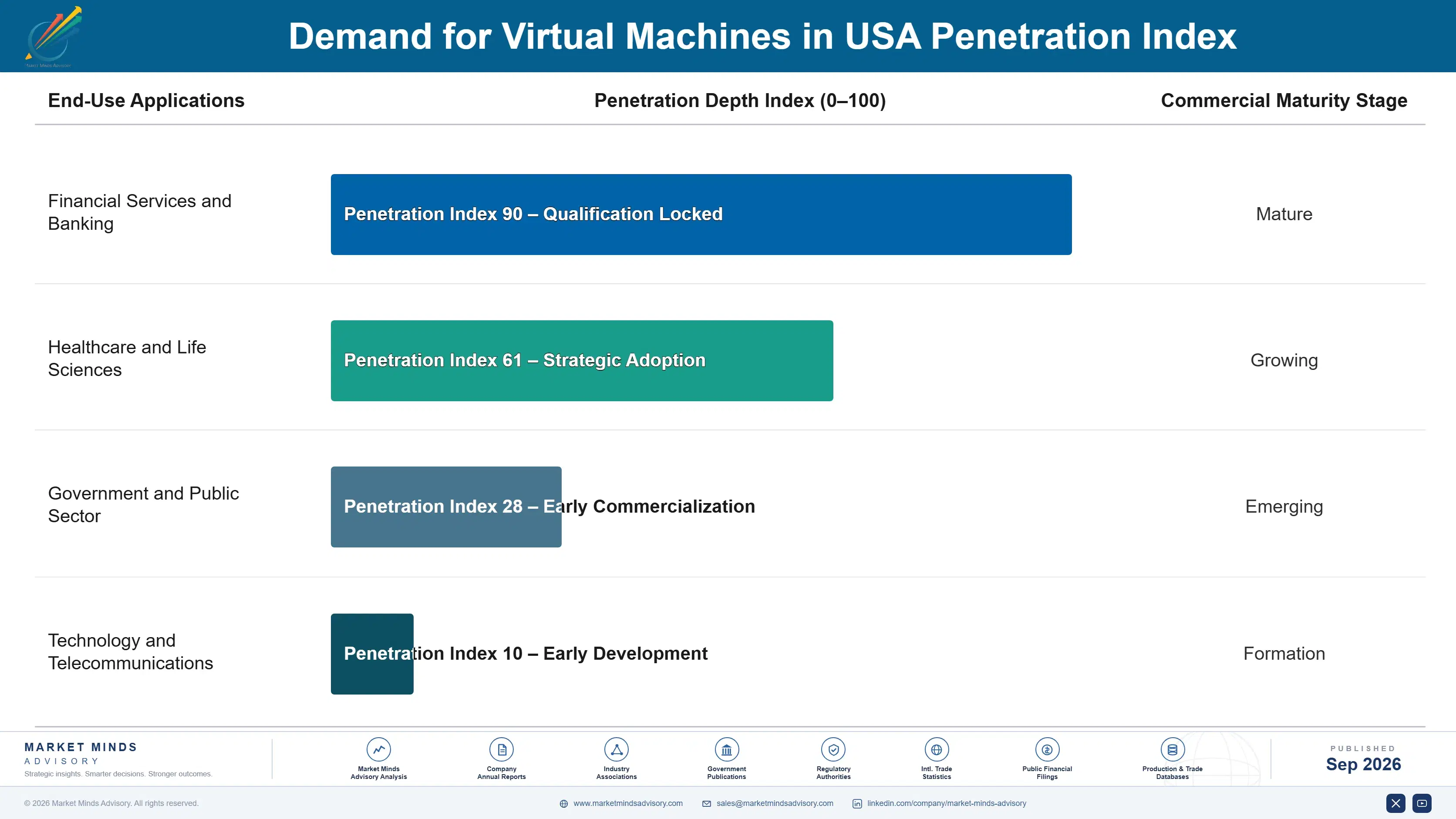
Adoption depth varies sharply by end-use vertical: large enterprises with complex multi-hypervisor environments adopt full migration tooling suites quickly given licensing risk exposure, while smaller businesses often delay migration given limited internal IT capacity. Regulated industries including financial services and healthcare show intermediate adoption, driven less by cost pressure and more by compliance requirements that make workload compatibility validation a near-mandatory purchase regardless of timeline pressure.

A generational shift is underway as younger infrastructure engineers who grew up with cloud-native and containerized deployment models expect virtualization platforms to work like modern software services rather than legacy licensed enterprise products. Procurement authority is also shifting from infrastructure engineering departments toward vendor risk and finance teams who evaluate platforms on total cost of ownership predictability rather than raw performance specifications alone, changing who vendors need to court.
united-states-virtual-machines-market-end-use-penetration-index-1788452175147

Where Migration Tooling Wins Displacement

These are among the four positions where our research anticipates prominent divergence between winners and laggards over the coming forecast period. Each is grounded in the demand model, the regulatory perimeter, and the announced capacity pipeline.
01 / MIGRATION TOOLING INVESTMENT

Build or acquire compatibility assessment depth before licensing margins compress further

Vendors still selling hypervisor licensing as standalone product are ceding the most durable and profitable revenue stream in this entire market to competitors who bundle migration tooling from day one. The gap will widen further as enterprises increasingly require verified workload compatibility assessment that only tooling-enabled platforms can reliably deliver at meaningful scale across complex production environments. MMA expects licensing-only vendors to lose specification battles on enterprise displacement contracts within the next three to four years unless they acquire or build credible migration tooling soon.
02 / COMMERCIAL OPEN-SOURCE SUPPORT

Build enterprise support organizations before open-source credibility gap closes

Commercial support for open-source hypervisor platforms is quickly becoming table stakes rather than a differentiator, and vendors who wait risk losing specification battles to competitors already embedded in enterprise support workflows nationwide. Early movers are capturing a disproportionate share of open-source displacement budgets, building support organizations that latecomers will struggle to replicate quickly once enterprise trust in specific vendors solidifies further. MMA views this window as narrowing steadily over the next two to three years as major enterprises finalize preferred open-source support vendor relationships.
03 / MULTI-HYPERVISOR MANAGEMENT CAPABILITY

Invest early in cross-platform management to serve transition-period hybrid environments

Multi-year migration timelines mean most enterprises will run hybrid multi-hypervisor environments during transition periods, creating demand for unified management capability that single-platform vendors simply cannot serve adequately at scale. Vendors building cross-platform management now are positioned to capture premium-tier contracts that specialized competitors cannot address given their narrower single-hypervisor functional scope and design limitations across the board. MMA expects multi-hypervisor management to become a meaningful differentiator within the next several years as displacement activity accelerates across the broader enterprise installed base.
04 / MIGRATION TALENT DEVELOPMENT

Build training and certification programs to address skilled talent shortages

Skilled migration talent shortages remain a persistent source of project delays that undermine vendor credibility regardless of headline tooling accuracy claims vendors routinely promote to enterprise customers considering displacement. Vendors investing in training and certification programs now are positioned to close this talent gap faster than competitors relying solely on scarce pre-trained engineering hires from the external market. MMA recommends vendors pursue talent development initiatives immediately rather than waiting for project delays to force reactive hiring and training investment later.

Engagement Snapshot From the Field

A live engagement with an industry participant carrying material or product regulatory and market exposure ahead of a defining policy shift, showing how our research translates into a defensible multi-year portfolio strategy.
MARKET MINDS ADVISORY · CLIENT ENGAGEMENT SUMMARY
Demand for Virtual Machines in USA Producer Strategic Portfolio Review and Transition Roadmap 2026·Investment Scenario on Demand for Virtual Machines in USA Exposure Evaluation 2025-26
CLIENT PROFILE
The client is a regional insurance carrier operating roughly 3,000 virtual machines across its data center infrastructure, running a decade-old VMware deployment facing a licensing renewal that would triple its annual cost. Facing this pricing shock alongside internal pressure to modernize infrastructure, the carrier sought guidance on which migration vendor could reliably execute displacement given its specific application portfolio and existing infrastructure investment.
STRATEGIC CHALLENGE
The client needed to evaluate competing migration platforms without a clear framework for comparing workload compatibility claims, risking a costly migration failure that disrupted production insurance claims processing systems and important daily customer service operations. Internal teams lacked the technical expertise needed to assess vendor compatibility assessment accuracy claims independently.
MMA APPROACH
MMA conducted a vendor capability assessment across the five leading migration platforms, benchmarking workload compatibility claims against documented displacement outcomes reported by comparable insurance industry programs. The engagement produced a vendor shortlist tied to projected migration risk and total cost across a three-year displacement horizon for the client's specific application portfolio.
KEY FINDINGS
  1. Two of five evaluated vendors demonstrated successful migration track records for comparable insurance industry workload portfolios and applications (client-reported, unverified by MMA).
  2. Switching to the recommended vendor was projected to reduce total licensing costs by roughly 55 percent over three years (client-reported, unverified by MMA).
  3. Application compatibility testing identified 12 percent of workloads requiring custom migration engineering work beyond standard automated tooling capability (client-reported, unverified by MMA).
  4. Vendor contract terms varied by up to $2.8 million annually across the five platforms evaluated during the assessment (client-reported, unverified by MMA).
CLIENT PROFILE
The client is a regional insurance carrier operating roughly 3,000 virtual machines across its data center infrastructure, running a decade-old VMware deployment facing a licensing renewal that would triple its annual cost. Facing this pricing shock alongside internal pressure to modernize infrastructure, the carrier sought guidance on which migration vendor could reliably execute displacement given its specific application portfolio and existing infrastructure investment.
STRATEGIC CHALLENGE
The client needed to evaluate competing migration platforms without a clear framework for comparing workload compatibility claims, risking a costly migration failure that disrupted production insurance claims processing systems and important daily customer service operations. Internal teams lacked the technical expertise needed to assess vendor compatibility assessment accuracy claims independently.
MMA APPROACH
MMA conducted a vendor capability assessment across the five leading migration platforms, benchmarking workload compatibility claims against documented displacement outcomes reported by comparable insurance industry programs. The engagement produced a vendor shortlist tied to projected migration risk and total cost across a three-year displacement horizon for the client's specific application portfolio.
KEY FINDINGS
  1. Two of five evaluated vendors demonstrated successful migration track records for comparable insurance industry workload portfolios and applications (client-reported, unverified by MMA).
  2. Switching to the recommended vendor was projected to reduce total licensing costs by roughly 55 percent over three years (client-reported, unverified by MMA).
  3. Application compatibility testing identified 12 percent of workloads requiring custom migration engineering work beyond standard automated tooling capability (client-reported, unverified by MMA).
  4. Vendor contract terms varied by up to $2.8 million annually across the five platforms evaluated during the assessment (client-reported, unverified by MMA).
RECOMMENDED STRATEGY
Phase 1: Phase one migrates the lowest-risk, highest-compatibility workloads to the recommended platform within the first full four months of the program. Phase 2: Phase two extends the migration to remaining workloads while renegotiating existing vendor support and licensing terms directly with the vendor. Phase 3: Phase three establishes ongoing compatibility monitoring and ties vendor performance reviews to quarterly migration progress benchmarks going forward each quarter.
OUTCOME
The client completed the platform migration within ten months, reporting cost savings consistent with initial MMA projections across the infrastructure portfolio (client-reported, unverified by MMA). The vendor evaluation framework was subsequently adopted for the client's ongoing infrastructure technology procurement decisions, extending its use beyond the original displacement engagement scope.

Frequently Asked Questions

Foundational context covering the market sizes, CAGR, scope, country, region and competition that inform every finding below. This section is provided to cover basics and most often pre-purchase conversations, answered from the MMA Primary Research Dataset.

What is the current size of the Demand for Virtual Machines in USA Market?

The global virtual machine market, of which the USA is the analytical focus of this report, is valued at $68.0 billion in 2025. Growth is driven primarily by VMware displacement migration and licensing risk mitigation demand.

How large will the Demand for Virtual Machines in USA Market be by 2036?

The market is projected to reach $184.53 billion by 2036. This reflects sustained demand from open-source hypervisor adoption and expanding migration tooling requirements across the industry.

What is the CAGR for the Demand for Virtual Machines in USA Market 2026 to 2036?

The market is expected to grow at a compound annual rate of 9.5 percent between 2026 and 2036. Bull and bear scenarios range from 8.2 to 10.8 percent.

Which segment is growing fastest?

Open-Source and Cloud-Native Hypervisor Migration Services leads at roughly 15.5 percent annually, about 1.63 times the overall market rate. Enterprises seeking to reduce Broadcom licensing exposure are the primary growth catalyst.

Who are the major companies in the Demand for Virtual Machines in USA Market?

Broadcom, Microsoft, Nutanix, Red Hat, and Citrix Systems lead the competitive field across licensing, migration tooling, and support service categories. Together the top five vendors hold 58 percent combined revenue share.

Which country is growing fastest?

India leads at roughly 13.0 percent annually, driven by expanding multinational enterprise operations and domestic digital transformation initiatives across the country's growing technology sector nationwide.

Report Segmentation Architecture

The full report scope spans multiple orthogonal segmentation dimensions, with cross-tabulated demand data provided for each dimension pair. Coverage extends further to regional breakdowns, trend trajectories, and the competitive detail needed to support segment-level decision-making.
  • Proprietary Hypervisor Licensing
  • Open-Source Hypervisor Platforms
  • Workload Compatibility Assessment and Conversion Software
  • Migration Consulting and Support Services
  • Multi-Hypervisor Management Platforms
  • Commercial Open-Source Support Contracts
  • Financial Services and Banking
  • Healthcare and Life Sciences
  • Government and Public Sector
  • Technology and Telecommunications
  • Direct Enterprise Purchase Channel
  • Systems Integrator and Consulting Channel
  • Cloud-Based Subscription Channel
  • Support and Certification Services

By Region

  • North America
  • Western Europe
  • East Asia
  • South Asia and Pacific
  • Latin America
  • Middle East and Africa
  • Eastern Europe

Scope, Methodology, and Coverage

Every figure in this report is reproducible from documented input assumptions. The scope below maps the historical period, the forecast horizon, the segmentation dimensions, and the countries covered, alongside the underlying primary and qualitative methodology.
Historical Period
2020 to 2025
Forecast Period
2026 to 2036
Base Year
2025 (USD billions; MMA Primary Research Dataset, September 2026)
Market Definition
This report covers virtual machine hypervisor software, migration tooling, and management platforms used by US enterprises for server virtualization and workload consolidation across data center and hybrid cloud environments. It excludes containerization platforms, bare-metal cloud instances, and consumer-facing virtual desktop infrastructure products.
Quantitative Units
USD billions (current prices)
Segmentation Dimensions
By Product Type; By End-Use Industry; By Commercial Dimension; By Region
Regions Covered
North America, Western Europe, East Asia, South Asia and Pacific, Latin America, Middle East and Africa, Eastern Europe
Countries Covered
USA, China, Germany, France, UK, Japan, South Korea, India, Australia, Canada, Brazil, Mexico, Indonesia, Vietnam, Thailand, Malaysia, UAE, Saudi Arabia, South Africa, Nigeria, Turkey, Poland, Netherlands, Italy, Spain, Sweden, Switzerland, Argentina, Colombia, Singapore, and additional markets relevant to this sector
Key Companies Profiled
Broadcom Inc, Microsoft Corporation, Nutanix Inc, Red Hat Inc, Citrix Systems Inc, Oracle Corporation, Amazon Web Services Inc, Google LLC, IBM Corporation, Scale Computing Inc, Proxmox Server Solutions GmbH, SUSE S.A., Canonical Ltd, OpenNebula Systems, Platform9 Systems Inc, Virtuozzo International GmbH, Parallels International GmbH, Sangfor Technologies Inc, HPE Inc, Rackspace Technology Inc
Quantitative Methodology
Primary survey, n=3,800 respondents, Q4 2025, six countries; demand-side model with trade association cross-validation
Qualitative Methodology
47 expert interviews, Q4 2025; applied to validate demand model assumptions, identify emerging dynamics, and assess competitive positioning
Report Format
PDF and XLSX data workbook (Word format preview document)
Publisher
Market Minds Advisory
Report Code
MMA-2026-TEC-268
Published
September 2026
Contact
sales@marketmindsadvisory.com | www.marketmindsadvisory.com

Purchase the full Demand for Virtual Machines in USA Report (2026 to 2036).

This report delivers a complete assessment of the global virtual machine market, using the USA's Broadcom-driven displacement wave as an analytical lens for enterprise virtualization economics through 2036. It quantifies segment-level growth rates, regional demand concentration, and competitive positioning among twenty leading hypervisor and migration vendors. The analysis draws on primary survey data from 3,800 respondents and 47 expert interviews conducted in the fourth quarter of 2025. Readers gain a clear view of where displacement revenue concentrates and which vendors are best positioned to capture it.
Ten-year market sizing and growth forecasts
Segment-level CAGR and demand growth analysis
Competitive benchmarking of twenty leading vendors
Regional demand architecture across seven regions
Input cost and engineering talent risk assessment
Strategic revenue lever identification for vendors

Built For The People Who Decide

From boardroom strategy to bench-side execution, this report is read cover-to-cover by leaders shaping the next decade of their industry, turning demand scenarios, market dynamics and valuation benchmarks into decisions.
CXOs/ Presidents/ VPs/ Managers
M&A and Corporate Development
Strategy Teams and R&D Heads
Procurement and Product Directors
Regulatory and Compliance Leaders
Investor Relations and Equity Analysts