Market Minds Advisory
Demand for Humidifier in USA

Demand for Humidifier in USA: Demand for Humidifier in USA: Contractor Channel Economics, Weather Risk and the Industrial Value Nobody Markets

Forced-air heating gave the United States a whole-home humidifier category that exists almost nowhere else, and it is sold by heating contractors at furnace replacement rather than by anybody in retail.

Lead Analyst

Published

September 2026

Make Smarter Decisions with Customized Research Insights

Request a free sample report and evaluate market opportunities, growth trends, and competitive dynamics relevant to your business needs.

2025 MARKET VALUE$3.6BMarket Size 2025
2036 FORECAST VALUE$6.8BBase Case , 2026 to 2036
CAGR 2026 TO 20366.0 %Bull 7.2% / Bear 4.8%
INCREMENTAL OPPORTUNITY$3.0BNet 10- year value creation
EXPANSION MULTIPLE1.79x2036 value over 2026 base
Strategic Levers
M&A Pipeline
Regional Outlook
Country Rankings
Competitive Intelligence
Segmental Deep-dive
Call-Us : 91 93563 13602

Executive Snapshot and Market Trajectory.

American humidifier demand runs on two businesses that share a name and nothing else. One is a seasonal retail gamble on winter weather. The other is an attachment sold by heating contractors at furnace replacement, and it is where the money actually is. Everything else follows from that split.
Roughly 71% of whole-home units reach the customer through a heating contractor rather than a store, at an installed price near USD 480 against a portable unit costing a fraction of that. The attach rate at furnace replacement is only 18%, which is the largest unexploited opportunity in the category. Industrial process humidification grows fastest at 9.0%, half again the market rate of 6.0%. North America takes 38% of global value. Contractors decide this.
Concentration sits near 34% across the top five on measured shipment revenue, and the field splits cleanly rather than competing. Whole-home and portable brands rarely meet industrial humidification suppliers in a tender. Retail portables carry a 12% return rate driven by cleaning complaints, which is a product problem the category has never properly addressed. Nobody has redesigned the product around it. Imported units disappoint the same way for far less.
Market Definition
This market covers equipment that adds controlled moisture to air, spanning portable residential humidifiers, whole-home ducted humidifiers installed with forced-air heating, commercial building comfort humidification, industrial and manufacturing process humidification, healthcare and clinical humidification, and controlled environment agriculture systems. Revenue is measured as equipment shipment value at manufacturer level including attributable installation. Dehumidifiers, air purifiers without humidification, respiratory therapy humidifiers regulated as medical devices, evaporative cooling equipment and replacement filter consumables are excluded.
Base Year Value
$3.6B in 2025 (MMA Primary Research Dataset, September 2026)
Forecast Period
2026 to 2036, eleven discrete annual values
CAGR
6.0% base case. Bull 7.2%. Bear 4.8%.
Fastest Growth Segment
Industrial and Manufacturing Process Humidification: 9.0% CAGR
Fastest Growth Country
India: 10.4% CAGR
Fastest Growth Region
South Asia and Pacific: 8.2% CAGR
Largest Region
North America: 38% of 2025 global value
Market Leaders
Resideo Technologies, Research Products Corporation, Condair Group, Carel Industries and Munters lead on measured humidification equipment shipment revenue. Source: MMA Primary Research Dataset, July 2026.
Primary Survey
n=3,800 procurement and R&D decision-makers, Q4 2025, six countries
Methodology
Demand-side build-up, cross-validated against public data, 47 expert interviews

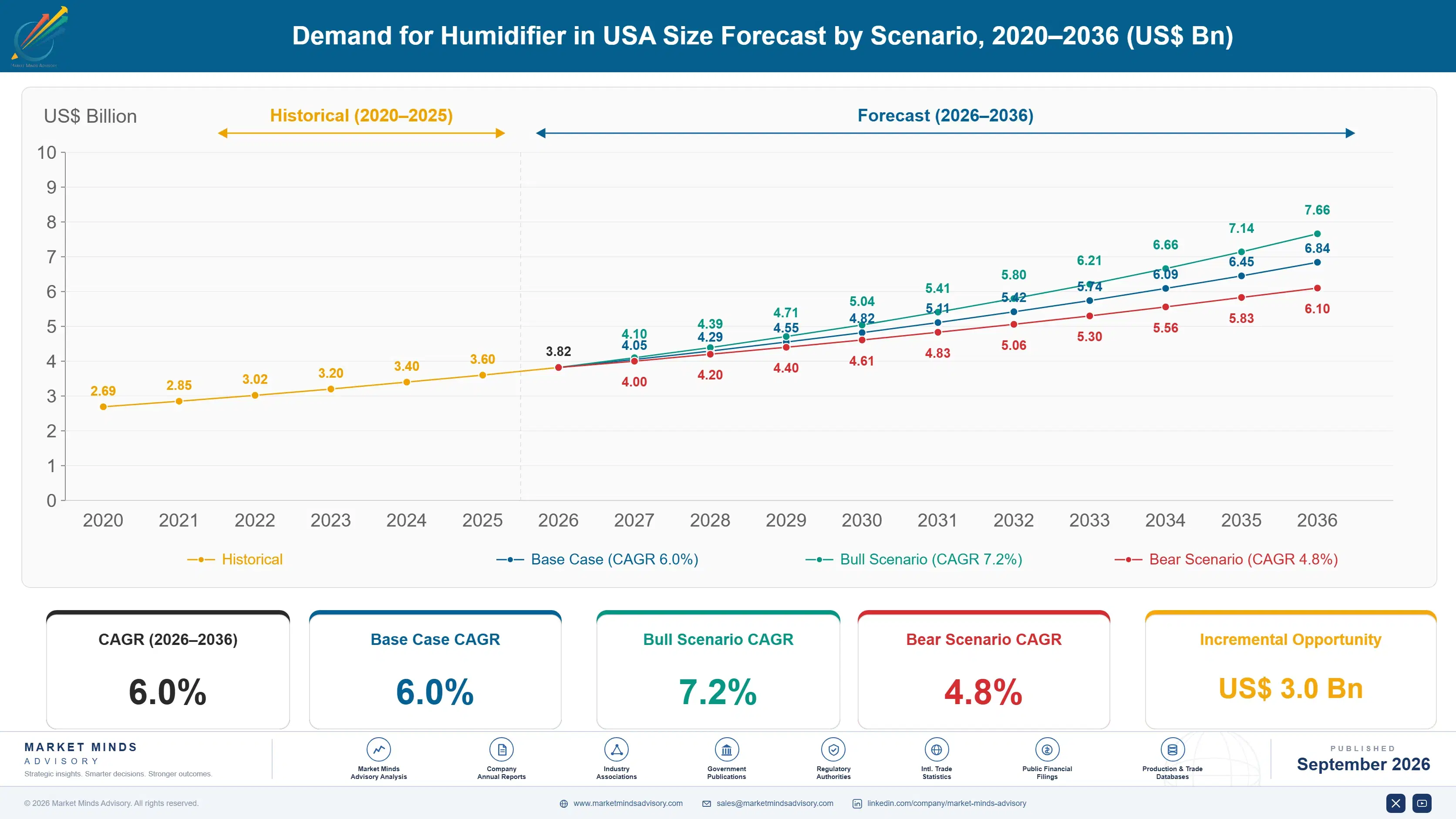
Demand for Humidifier in USA Market Forecast Scenarios

united-states-humidifier-market-size-forecast-scenario-1788419615844
Growth ran at 5.0% from 2020 to 2025 and weather explained more of the variation than anything commercial did. Pandemic conditions lifted portable sales sharply in 2020 and 2021 as households bought comfort and perceived health benefits. The exceptionally mild American winter of 2023 and 2024 then removed a season of sell-through, leaving retailers holding inventory and manufacturers cutting production.
The base case at 6.0% rests on three mechanisms that have nothing to do with winter weather. Whole-home attachment at furnace replacement sits at only 18%, and contractors presenting it consistently convert far better, making this a sales execution opportunity. Industrial process humidification is expanding where humidity is a specification rather than a comfort preference. Third, controlled environment agriculture and data centre applications are adding demand insensitive to household spending entirely.
The bull case at 7.2% assumes contractors adopt humidifier attachment as standard practice at furnace replacement, which would move volume without any change in end demand. The bear case at 4.8% is another mild winter combined with continued weakness in retail portables. Weather remains the largest uncontrolled variable here and nobody has hedged it. Suppliers plan production against a variable they cannot forecast.

Two Businesses Filed Under One Product Name

The United States has a whole-home humidifier category because it heats most of its housing stock with forced air, and a duct is the cheapest place to add moisture. Most of Europe heats with hydronic radiators and never developed the product at all. That difference in heating architecture, rather than climate or preference, is why North America takes 38% of global value on far fewer households.
TOP FIVE CONCENTRATION34%Moderately concentrated across separate residential and industrial fields
CONTRACTOR CHANNEL SHARE71%Whole-home units sold through heating contractors rather than retail
SEASONAL SALES CONCENTRATION63%Portable unit volume shipped across four winter months
RETAIL RETURN RATE12%Portable units returned, mostly over cleaning and noise
WHOLE-HOME ATTACH RATE18%Furnace replacements that include a humidifier at installation
AVERAGE WHOLE-HOME PRICEUSD 480Typical installed price including contractor labour and controls
It also determines who sells the product. Around 71% of whole-home units reach a homeowner through a heating contractor performing a furnace replacement, at an installed price near USD 480 of which a meaningful share is labour the contractor keeps. The manufacturer's customer is a distributor supplying contractors, not a consumer. Brands investing in consumer marketing for a product sold in a basement during an emergency furnace call wasted the money.
The retail portable business operates on entirely different and considerably worse terms. Roughly 63% of volume ships in four months, the season is decided by weather nobody forecasts reliably, and return rates near 12% are driven mostly by cleaning difficulty and noise rather than by failure. Retailers price aggressively against imported alternatives. It generates revenue, occupies shelf space and produces very little profit.
"The whole-home humidifier is one of the last genuinely under-sold attachments in American home comfort. Fewer than one furnace replacement in five includes one, not because homeowners refuse, but because most contractors never mention it while they are standing in the basement."
Director, Building Comfort and Indoor Environment Practice · MMA Construction and Industrial Equipment Practice · September 2026

Market Trends

Industrial Humidity Becomes a Specification Rather Than Comfort

Printing, textiles, electronics assembly, pharmaceutical production, museums and food processing all require controlled humidity for reasons of static, dimensional stability, product quality or preservation, and none of it is about how anybody feels. Data centres have joined that list, where humidity control protects against electrostatic discharge at low levels and condensation at high ones. Industrial process humidification grows at 9.0%, faster than any other part of this market, and the buyer is an engineer specifying to a tolerance rather than a homeowner choosing a product. Price sensitivity falls accordingly. Tolerance rather than budget decides these specifications.
Market Impact: Attaches to 18% of replacements
Cleaning Burden Drives Returns the Industry Has Never Fixed

Portable humidifiers require regular cleaning to avoid mineral scale and microbial growth, and consumers consistently discover this after purchase rather than before. Return rates near 12% are driven mainly by that maintenance burden and by noise, not by product failure. The industry has responded with antimicrobial treatments, dishwasher-safe components and larger tanks rather than by addressing the underlying design requirement. Reviews reflect it, retailers notice it, and it caps what any brand can charge in a category where the alternative costs twenty dollars and disappoints in exactly the same way.
Market Impact: Grows at 7.8% annually

Market Opportunities and Growth Drivers

Furnace Replacement Volume Carries Whole-Home Attachment

Roughly three million residential furnaces are replaced annually across the United States, and each represents a moment when a technician is already in the mechanical room with the ductwork open. Whole-home humidifier attachment currently reaches only 18% of those jobs, which is a sales execution gap rather than a demand ceiling. Contractors who present it as standard practice convert far better than those who wait to be asked. Manufacturers who train and incentivise the contractor channel capture volume that consumer advertising has never delivered for this product. It is channel programme work rather than product development.
Market Impact: Concentrates 63% in 4 months

Controlled Environment Agriculture Adds Non-Seasonal Demand

Indoor produce growing, vertical farms, cannabis cultivation and greenhouse operations all require humidity held within tight bands for plant health and yield, and they run continuously rather than seasonally. Equipment specification is engineering-led, capacities are far larger than any building comfort application, and replacement follows facility economics rather than weather. The segment is small relative to residential volume and grows at 7.8% with far better margins. It also gives suppliers revenue that does not depend on how cold a particular January turns out to be. Facility economics rather than weather governs when equipment gets replaced.
Market Impact: Attach rate stuck at 18%

Market Restraints and Challenges

Weather Decides the Retail Season and Nobody Can Hedge It

Around 63% of portable unit volume ships across four winter months, and how much sells depends on how cold and dry the season turns out to be. The exceptionally mild winter of 2023 and 2024 removed most of a season and left channel inventory that suppressed the following year's orders. The root cause is that dry indoor air is a consequence of heating, so demand tracks heating degree days almost directly. Suppliers mitigate through contract manufacturing flexibility, retailer inventory sharing and building non-seasonal industrial revenue instead. Non-seasonal industrial revenue is the only real defence available.
Market Impact: Fastest segment at 9.0% growth

Attachment Depends on Technicians Not Paid to Sell

Whole-home humidifier sales run through heating technicians whose primary job is replacing a furnace and who often never raise the option, which is why attachment sits at 18%. The root cause is that the technician gains little from the conversation, the homeowner is stressed and focused on restoring heat, and nothing in the workflow prompts it. Manufacturers mitigate through contractor training programmes, spiff payments, bundled pricing in furnace quotations and configuration tools that include humidification by default rather than as an option. Default configuration in quoting tools has moved attachment further than any incentive tested so far.
Market Impact: Drives 12% of units returned
3 additional market trends, 4 additional growth drivers, and 2 additional restraints and challenges are covered in the full report. Contact sales@marketmindsadvisory.com to access the complete intelligence.

Segment CAGR and Growth Architecture

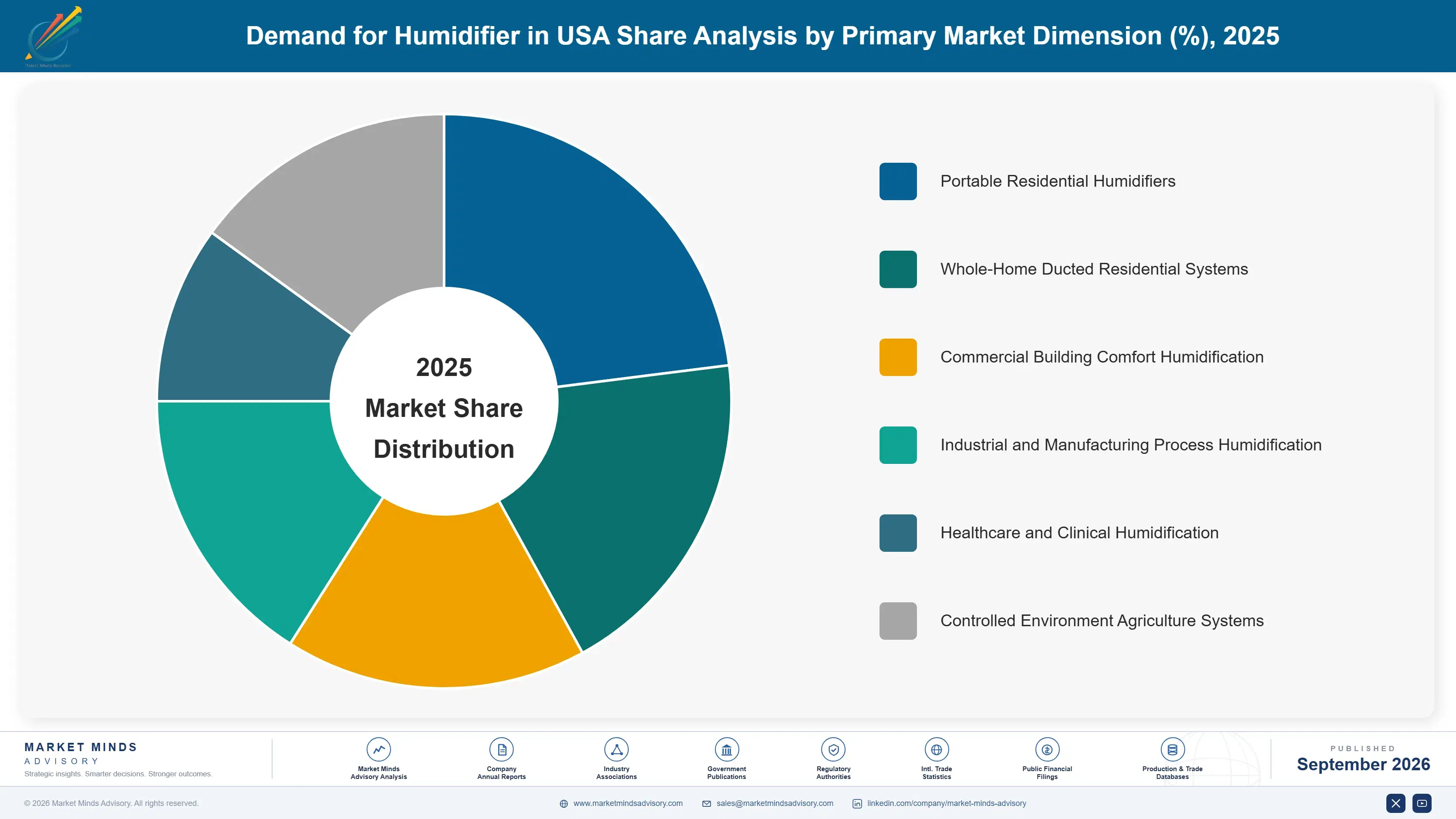
Segmentation follows the application rather than the technology, because the application determines who specifies the equipment, what tolerance it must hold and whether price or performance decides the purchase. Residential comfort and engineered process humidification behave as separate industries, and almost no supplier competes credibly across both of them. Very few suppliers span both.
united-states-humidifier-market-market-share-analysis-1788419616412

Industrial and Manufacturing Process Humidification

Process humidification is the fastest part of this market at 9.0%, half again the market rate of 6.0%, and the one where humidity is an engineering requirement rather than a preference. Printing presses need it to control paper dimensional stability and static, textile mills to prevent yarn breakage, electronics assembly to manage electrostatic discharge, and data centres to hold a band between discharge risk and condensation. Buyers are engineers specifying to a tolerance, which removes most price sensitivity and rewards suppliers who can demonstrate control accuracy and hygiene compliance. System values run into six figures against a few hundred dollars for residential equipment, and service contracts follow the installation for its whole life.
CAGR 9.0%

Healthcare and Clinical Humidification

Healthcare humidification grows at 8.2% on facility standards that specify permitted humidity ranges for operating rooms, sterile processing, compounding pharmacies and certain patient areas, with accreditation surveys examining whether those ranges were maintained. That converts a comfort system into a compliance one, complete with monitoring, alarms and documented records. Consulting engineers specify equipment with redundancy that no commercial building would fund, and steam systems dominate because hygiene requirements rule out several cheaper approaches. Replacement follows renovation and validation cycles rather than failure, which makes demand steadier than any other part of this market and largely indifferent to economic conditions. Validation documentation accompanies every installation, which adds cost the commercial market would never accept and buyers here simply expect.
CAGR 8.2%
Full segment breakdown across 6 segments available in the complete report.

Regional Architecture and Country Demand Map

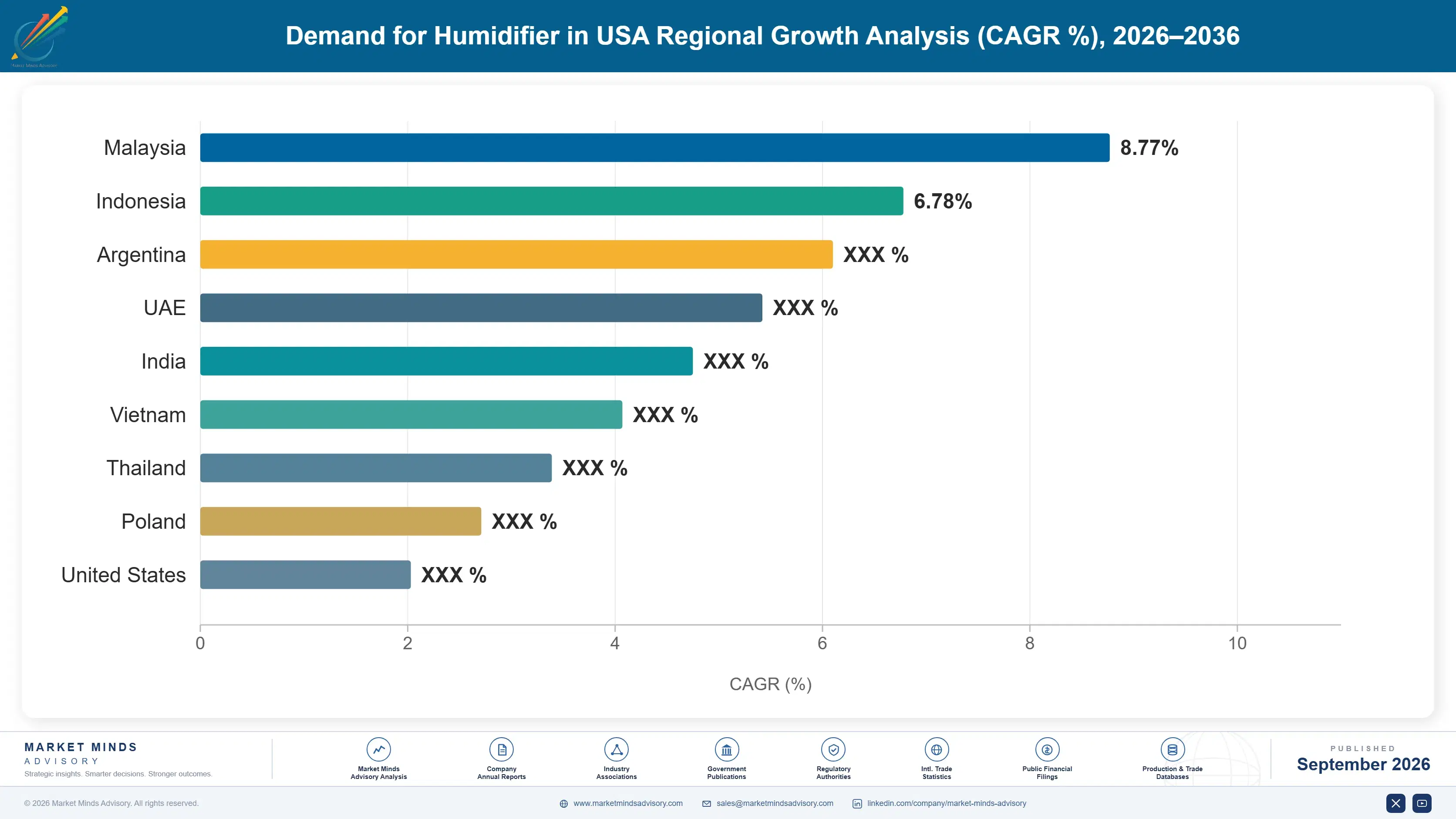
Regional demand is decided by heating architecture more than by climate. Countries heating with forced air developed ducted humidification as a standard attachment, while those using hydronic systems never did, and that difference outweighs temperature and humidity conditions almost everywhere. Climate matters less than plumbing does.

North America

North America holds 38%, above the regional band, on a mechanism that is specific rather than general: most American and Canadian housing is heated with forced air, which makes a ducted humidifier a straightforward attachment that regions using hydronic heating cannot replicate. Roughly three million furnace replacements a year create the sales moment, though attachment reaches only 18% of them. Northern states and the Canadian provinces generate most residential demand, since cold outdoor air heated indoors is what produces the dryness. Industrial demand concentrates in printing, electronics and pharmaceutical manufacturing, and data centre humidification is growing steadily across the region. Regional growth at 5.2% is modest, since attachment rather than new demand is what would move it.
Share: 38% | CAGR: 5.2% (2026 to 2036)

Western Europe

European demand grows at 4.4%, the slowest of the major regions, because hydronic radiator heating dominates the housing stock and offers no duct to humidify through. Residential demand is therefore almost entirely portable units bought seasonally, at lower values than North American installed systems. The commercial and industrial side is far stronger: Swiss, German and Italian suppliers lead global process humidification technology, and European printing, textile, museum and pharmaceutical facilities specify to demanding tolerances. Nordic markets buy heavily relative to size because extreme winter dryness is severe and building airtightness compounds it considerably. Regional growth at 4.4% therefore reflects an industrial market growing steadily against a residential one that has never really existed in installed form.
Share: 22% | CAGR: 4.4% (2026 to 2036)
Regional intelligence for 5 additional markets available in the complete report: East Asia, South Asia and Pacific, Latin America, Middle East and Africa, Eastern Europe. Contact sales@marketmindsadvisory.com.
united-states-humidifier-market-country-cagr-analysis-1788419616971

Where Humidifier Profit Actually Sits

Retail portables are a weather bet with 12% returns and no pricing power, so profit has to come from the contractor attachment nobody is asking for, from engineered process applications where tolerance rather than price decides, and from service revenue on installed industrial systems. The retail shelf is the least valuable place this product can be sold.

Convert the Furnace Replacement Into an Attachment Sale

Around three million American furnaces are replaced annually with a technician already standing at the ductwork, and only 18% of those jobs include a humidifier. Manufacturers that build humidification into contractor quoting tools by default, train technicians on the conversation and fund spiff payments lift attachment toward 35% in participating dealer networks. That is the largest available volume opportunity in this category and it requires no change in consumer demand whatsoever. It is channel programme work rather than product development, which is why it stays undone. Nobody has funded it properly.
Market Impact: Lifts attachment from 18% toward 35% of jobs

Specify Into Engineered Applications Not Consumer Choice

Industrial process humidification grows at 9.0% and healthcare at 8.2%, and in both the buyer is an engineer holding a tolerance rather than a shopper comparing features. System values run into six figures against a few hundred dollars for residential equipment, and gross margins run roughly 24 percentage points higher. Reaching that buyer requires consulting engineer relationships, published performance data and hygiene compliance evidence rather than retail marketing. Suppliers built for consumer channels consistently underestimate how different the selling motion actually is. Consulting engineers decide before any tender is issued.
Market Impact: Holds 24 further points of gross margin overall

Attach Service Contracts to Installed Industrial Systems

Process humidification systems require water treatment, descaling, hygiene verification and control calibration for their entire service life, which typically runs fifteen to twenty years. Suppliers contracting that work rather than leaving it to facilities teams add recurring revenue worth around 40% of original equipment value across the installation life, at margins above the hardware itself. It also keeps the supplier present when replacement is eventually specified. Facilities teams generally welcome the transfer, since hygiene verification is exactly the task they least want to own themselves. Replacement specification usually follows the incumbent service provider.
Market Impact: Adds 40% of equipment value in service revenue

Design Out the Cleaning Burden in Portables

Return rates near 12% on retail portables are driven mainly by cleaning difficulty rather than by failure, and every returned unit costs more than the margin the sale generated. Brands that engineered genuinely simple maintenance, with fewer parts, accessible surfaces and clear scale management, cut returns by roughly half and hold shelf position that price-led competitors lose. The cost is a slightly higher bill of materials in a category obsessed with unit cost. It remains the only durable differentiation available in retail portables. Every returned unit costs more than the sale earned.
Market Impact: Halves the current 12% retail portable return rate

Who Controls the Margin Pool

Concentration sits near 34% across the top five on measured shipment revenue, and the number describes two fields that rarely meet. Residential brands compete on retail shelf position and contractor distribution, while process humidification suppliers compete on control accuracy, hygiene compliance and consulting engineer relationships. The gap within each field is wide, and a leader in one is usually absent from the other.
Competition runs on three dimensions. Distribution access is first: shelf space for portables, wholesale distributor coverage for whole-home units, and specification presence for engineered systems, and none of them transfers. Second is the maintenance and hygiene story, which drives returns in retail and compliance findings in healthcare. Third is service capability across installed industrial systems, where suppliers without technicians near a customer lose the recurring revenue that follows the equipment.

Two pressures are building. Imported portable units have compressed retail pricing to where established brands exit shelf positions rather than defend them. Meanwhile heating equipment manufacturers are bundling humidification into furnace product lines, which reaches the contractor before any specialist brand does. Rankings will move toward engineered application depth and contractor programme investment.
united-states-humidifier-market-company-positioning-matrix-1788419617504

Competitive Moat and Risk Dimensions

RESEARCH PRODUCTS CORPORATION

Moat: Contractor channel depth in humidification

The company holds the deepest position in American whole-home humidification through wholesale distribution and heating contractor relationships built over decades, which is the channel that actually sells this product. Contractor familiarity and installation training create genuine switching friction at the technician level. Its commercial steam business reaches engineered applications through a separate specification-led route.
RESEARCH PRODUCTS CORPORATION

Risk: Attachment rate ceiling dependence

Growth depends heavily on contractors raising humidifier attachment above 18% of furnace replacements, and that requires behaviour change from people the company does not employ or directly control. Heating equipment makers bundling humidification reach the same technician earlier in the quoting process. Demand also tracks furnace replacement volumes driven by housing turnover and weather.
CONDAIR GROUP

Moat: Engineered process humidification breadth

Condair covers the full range of process humidification technologies, from steam to adiabatic and high pressure systems, which lets it specify the right approach rather than the one it happens to manufacture. Consulting engineer relationships and published performance data give it presence in specifications before any tender is issued. Hygiene compliance capability matters decisively where cheaper approaches are not permitted.
CONDAIR GROUP

Risk: Limited residential channel access

The company has little presence in American whole-home residential humidification, which is the largest single volume pool in the market and reached entirely through heating contractor distribution. Building that channel means competing against brands with decades of technician familiarity and wholesale shelf position. Its engineered strength does not transfer, since specification selling has little in common with contractor distribution.

Players Tracked

Prominent Players

Resideo Technologies
Research Products Corporation
Condair Group
Carel Industries
Munters

Other Key Players

Vesync
Dyson
Vornado Air
Crane USA
HoMedics
Guardian Technologies
BONECO
Stadler Form
Neptronic
Armstrong International
STULZ
General Filters
Sharp
Panasonic
Xiaomi

Recent Developments

JANUARY 2025

Mild winter inventory overhang suppresses portable humidifier reorders

Retailers entered the year holding portable humidifier stock accumulated through an unusually warm heating season, which reduced reorder volumes and forced promotional clearance. Manufacturers cut production schedules for the following season rather than carry finished goods inventory into an uncertain year. Sell-through never recovered that season.
Signal: Weather remains the dominant variable in retail humidification and no supplier has found a workable way to hedge it.
AUGUST 2025

Heating equipment makers expand bundled indoor air quality product lines

Several furnace manufacturers extended indoor air quality ranges to include humidification alongside filtration and ventilation, developed internally rather than acquired. The bundling positions humidification within the quoting tools contractors already use during furnace replacement conversations with homeowners. Dealers were given configuration tools treating the bundled option as the default choice.
Signal: Reaching the contractor's quoting tool matters more than brand preference, and specialist suppliers are arriving second.
APRIL 2025

Healthcare facility guidance reinforces humidity range documentation requirements

Updated facility guidance restated permitted humidity ranges for operating rooms, sterile processing and compounding areas, with emphasis on continuous documentation rather than periodic verification. The clarification did not change the ranges themselves, only the evidence expected during accreditation surveys. Continuous records are now expected. Ranges themselves were unchanged.
Signal: Documentation expectations rather than any new specification are what pull monitoring and control content into healthcare systems.

What Humidification Equipment Costs

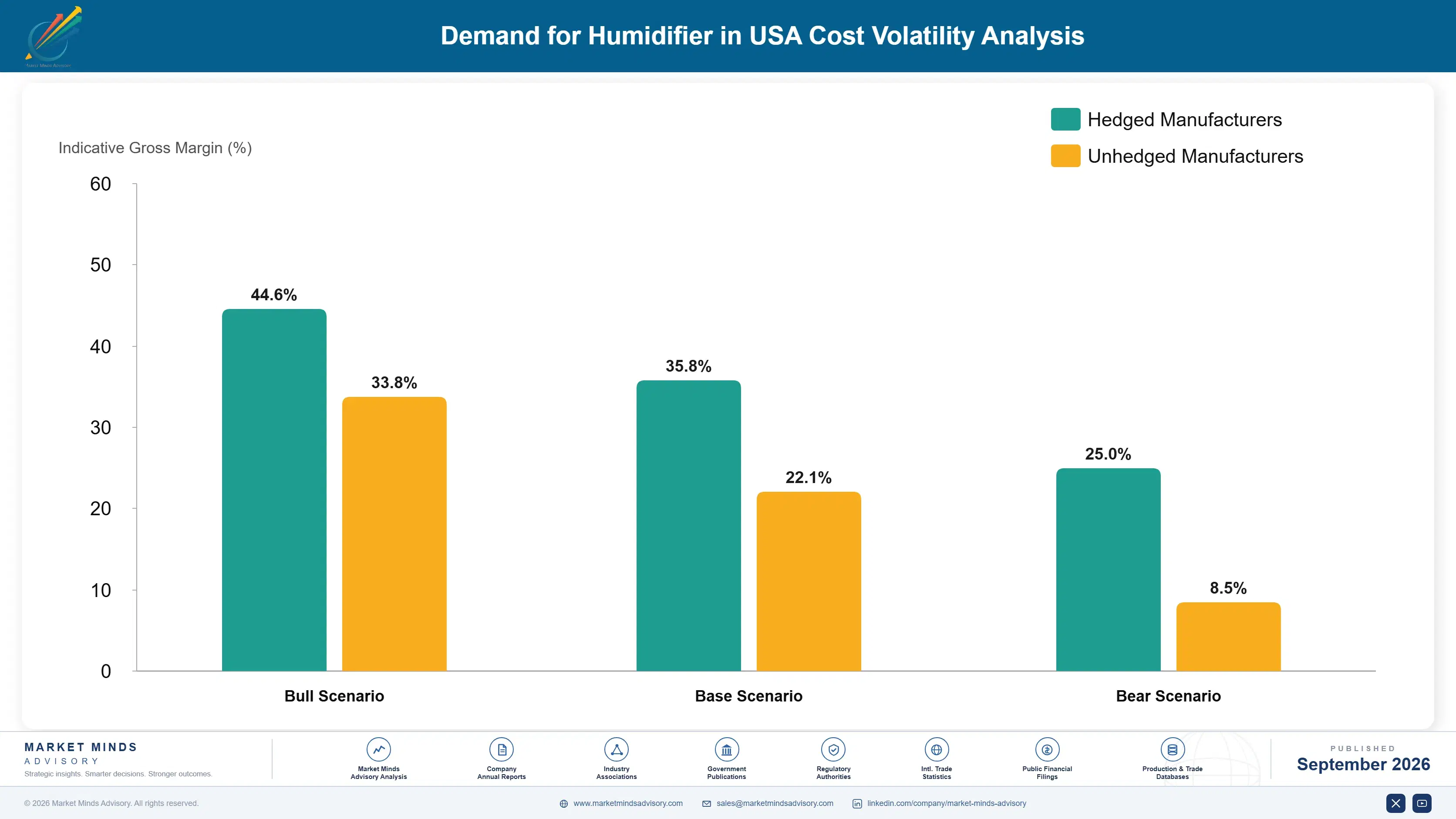
Cost structure diverges sharply between residential and engineered products. Portable units are dominated by moulded plastics, small motors and fans at between 51% and 64% of cost, the range reflecting tank size and ultrasonic against evaporative technology. Whole-home units carry more sheet metal, controls and water valves. Engineered systems are dominated by stainless vessels, control electronics and water treatment, with assembly labour far larger.
Weather rather than materials has been the sharpest recent pressure, because it moves volume and therefore absorption. The exceptionally mild American heating season of 2023 and 2024 cut heating degree days well below normal, and EIA residential energy reporting documents the consumption decline that followed. Manufacturers carrying seasonal inventory absorbed the cost directly. Resideo and Munters both referenced demand and cost conditions in recent annual reporting.

Exposure follows product mix rather than company size. Suppliers weighted toward retail portables carry seasonal inventory, markdown exposure and return handling cost, all arriving together in a bad winter. Those weighted toward engineered systems build against orders and carry none of it. Contractor channel suppliers sit between, since furnace replacement is steadier but still weather-influenced. Small residential brands finance seasonal inventory without the balance sheet to absorb a mild year.
united-states-humidifier-market-cost-volatility-analysis-1788419617699

Build seasonal capacity through contract manufacturing

Owning production capacity sized for a strong winter means carrying it through the mild ones, and mild ones now arrive often enough to matter. Contract manufacturing converts that into variable cost and lets commitments stage against early season sell-through. The trade-off is unit cost and quality control, which matters where returns already run near twelve percent.

Stage retailer commitments against early season data

Committing full season volume before any weather is known transfers the entire risk to whoever holds the inventory, usually the manufacturer. Staged commitments with a base order and options exercised against November and December sell-through split that risk more sensibly. Retailers resist because they want assured supply, so the structure suits differentiated products only.

Shift mix toward engineered and contractor channels

Retail portables carry seasonal inventory, markdown and return exposure simultaneously, while engineered systems are built against confirmed orders and carry none of it. Moving mix toward process, healthcare and contractor channels smooths absorption considerably and improves margin at the same time. It requires selling capability consumer organisations rarely hold, which is why the shift takes years.

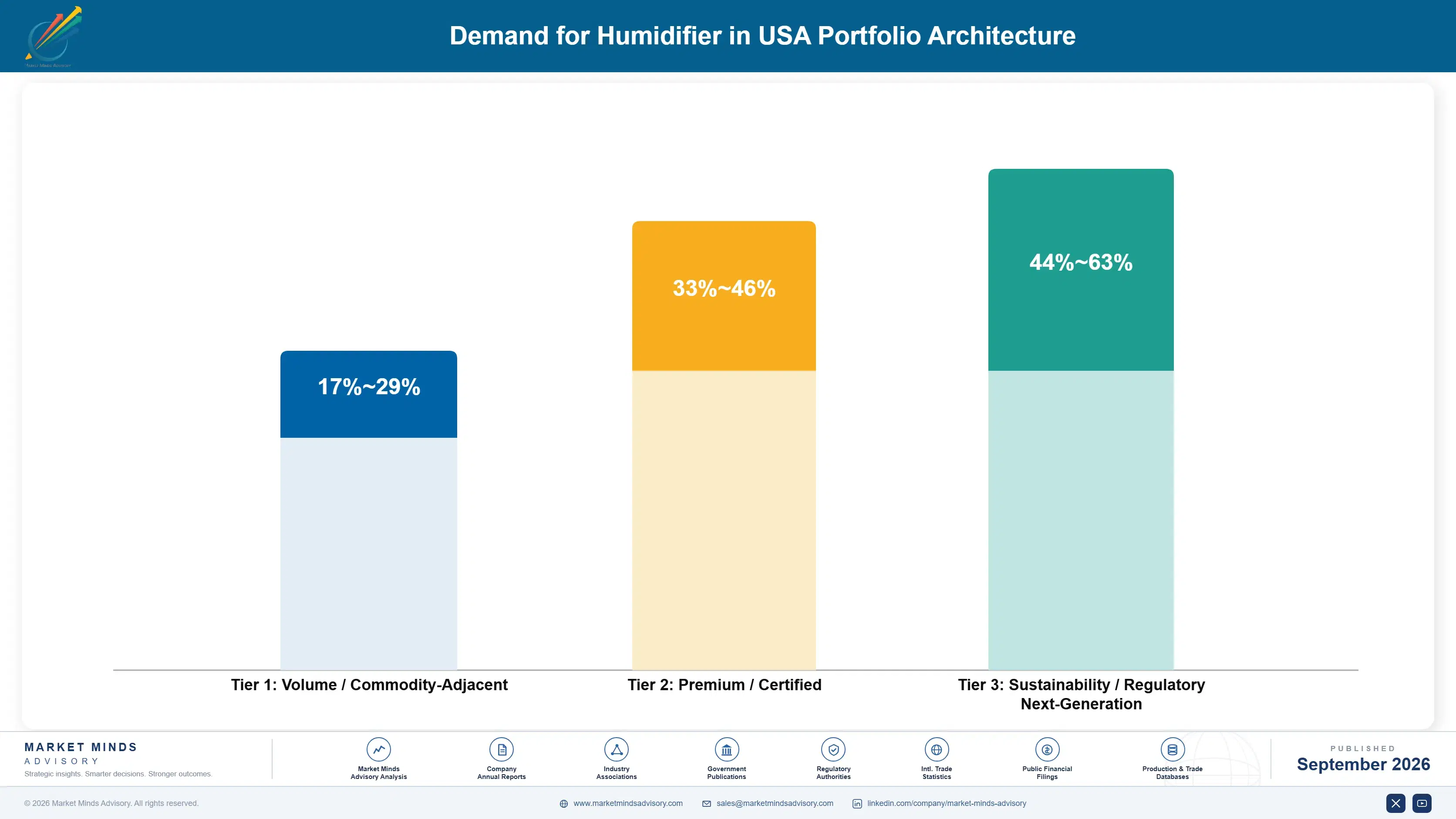
Portfolio Architecture for Margin Defence

Margin architecture in humidification separates on who specifies the product. Retail portables earn thin appliance margins compressed further by imported competition and by return handling that consumes much of what remains. Whole-home units sold through contractors earn better, since the homeowner never compares prices and the contractor values reliability above unit cost. Engineered systems earn best by a wide margin, since a tolerance requirement removes price from the centre of the decision entirely.
The volume tension is between the retail business that fills factories and the engineered business that fills profit. Portables generate the unit volume supporting moulding and assembly scale, arriving in a four-month window governed by weather. Engineered systems build steadily against orders at values hundreds of times higher per unit. Suppliers letting retail volume dictate cost structure have repeatedly been caught with capacity they could not fill.

High-value revenue concentrates in process and healthcare humidification, and in the service contracts that follow those installations for fifteen to twenty years. Both involve a customer whose failure mode is quality loss, a compliance finding or a stoppage rather than discomfort. Retail portables occupy the volume position, generate brand visibility supporting contractor credibility, and produce very little profit.

Volume / Commodity-Adjacent

Retail portable humidifiers sold on shelf price against imported alternatives. The wide range separates brands with differentiated maintenance design from those competing purely on cost. Return handling and seasonal markdown consume a meaningful share of whatever margin the sale generated.
Gross Margin: 17-29%

Premium / Certified

Whole-home ducted humidifiers sold through heating contractor distribution with installation and controls. Margin holds because the homeowner never price-compares and the contractor values installation speed and reliability. Distributor relationships and technician familiarity are what defend the position.
Gross Margin: 33-46%

Sustainability / Regulatory / Next-Generation

Engineered process, healthcare and controlled environment humidification specified to tolerance with monitoring and hygiene compliance. The widest range in the portfolio, since hygiene requirements and control content vary enormously by application. Highest margin and the least sensitive to weather or consumer conditions.
Gross Margin: 44-63%
united-states-humidifier-market-portfolio-architecture-1788419618215

High-value Sub-segments and Strategic Watch-out

Process and Industrial Humidification

High value and high growth together, because humidity is a production specification rather than a comfort preference and failure costs product rather than causing discomfort. The margin range reflects hygiene and control content by application. Buyers are engineers holding a tolerance, which removes price from the decision.
Gross Margin: 48-63%

Installed System Service Contracts

High value with steady growth, covering water treatment, descaling, hygiene verification and calibration across installations lasting fifteen to twenty years. The range reflects site dispersion and verification frequency. Facilities teams welcome the transfer, since hygiene verification is the task they are least willing to own themselves.
Gross Margin: 46-58%

Retail Portable Humidifiers

The volume core of unit shipments and the weakest part commercially, carrying seasonal risk, markdown exposure and 12% returns simultaneously. It supports moulding and assembly scale and provides brand visibility that helps contractor channel credibility. Very few suppliers earn adequately from it in any given year.
Gross Margin: 16-28%

Furnace Maker Bundled Humidification

The strategic watch-out, carried at zero because it displaces specialist brand revenue rather than generating any. Heating equipment manufacturers reach the contractor quoting tool before any specialist does. Brands treating furnace makers as neutral parties are misreading who now controls the moment when attachment is decided.
Gross Margin: 0-0%

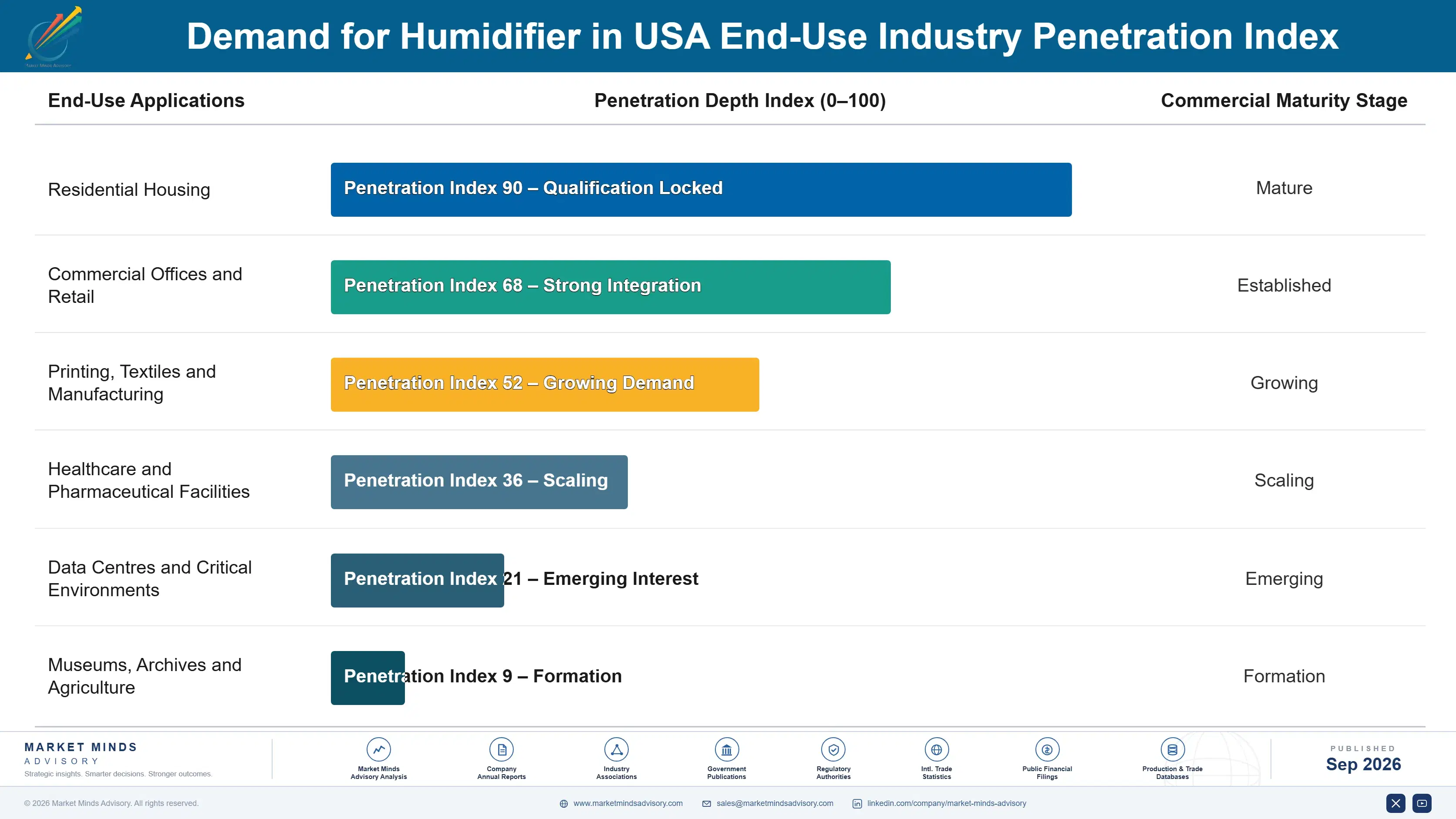
How Humidifier Demand Repeats

Recurrence differs completely by product. Retail portables are replaced every three to five years and often abandoned rather than replaced, generating consumable revenue that often exceeds the original unit margin. Whole-home units last fifteen years and replace with the furnace they were fitted alongside. Engineered systems last twenty and generate service revenue throughout, which is the only genuinely reliable annuity anywhere in this market.
Adoption depth varies sharply by application. Printing, textile and electronics manufacturers run humidification continuously and treat it as production equipment. Healthcare facilities monitor it against standards and document the results. Museums and archives operate it to the tightest tolerances of any user. Residential whole-home systems are installed, forgotten and often left with a blocked pad for years. Retail portable owners use them one season and store them, which weakens replacement demand.

The residential buyer has not really changed, but the person deciding has. A homeowner rarely initiates a whole-home humidifier purchase; a heating contractor either raises it during a furnace replacement or does not, and that single conversation determines 71% of channel volume. Manufacturers advertising whole-home products to consumers address somebody who never decides without a technician prompting them.
united-states-humidifier-market-end-use-penetration-index-1788419618702

Where This Category Pays

These are among the four positions where our research anticipates prominent divergence between winners and laggards over the coming forecast period. Each is grounded in the demand model, the regulatory perimeter, and the announced capacity pipeline.
01 / CONTRACTOR ATTACHMENT PROGRAMMES

Win the furnace replacement conversation, not the shopper

Around three million American furnaces are replaced each year with a technician already at the ductwork, and only 18% of those jobs currently include a humidifier. Manufacturers building humidification into contractor quoting tools by default, training technicians and funding attachment payments lift that toward 35% within participating dealer networks. This is the largest volume opportunity in the category and it requires no change whatever in consumer demand, only sustained channel programme work that nobody in this industry has been willing to fund properly.
02 / ENGINEERED APPLICATION FOCUS

Sell to engineers holding tolerances, not shoppers comparing features

Industrial process humidification grows at 9.0% and healthcare at 8.2%, and both of them are specified by engineers working against a required range rather than chosen by anyone weighing price against features. System values run into six figures, and gross margins run roughly 24 percentage points above comparable residential products. Reaching that particular buyer requires consulting engineer relationships and hygiene compliance evidence rather than any retail marketing, and consumer-oriented suppliers consistently underestimate quite how different that selling motion actually is.
03 / SERVICE ANNUITY CAPTURE

Contract the maintenance that installed systems require anyway

Process and healthcare humidification needs regular water treatment, descaling, hygiene verification and control calibration for fifteen to twenty years, and somebody performs all of that work anyway, regardless of which party is actually being paid for it. Suppliers that contract it add recurring revenue worth around 40% of original equipment value across the installation life, at margins above the hardware itself. Facilities teams generally welcome the transfer, because hygiene verification is precisely the responsibility they are least willing to carry themselves.
04 / MAINTENANCE DESIGN DISCIPLINE

Engineer the cleaning problem out of retail portables

Return rates near 12% on retail portables are driven by cleaning difficulty rather than by any failure, and every returned unit costs considerably more than the margin the original sale produced. Brands that genuinely simplified maintenance through fewer parts and accessible surfaces cut returns roughly in half and hold shelf positions that price-led competitors steadily lose. The cost is a slightly higher bill of materials in a category obsessed with unit cost, and it is the only durable differentiation available there.

Engagement Snapshot From the Field

A live engagement with an industry participant carrying material or product regulatory and market exposure ahead of a defining policy shift, showing how our research translates into a defensible multi-year portfolio strategy.
MARKET MINDS ADVISORY · CLIENT ENGAGEMENT SUMMARY
Demand for Humidifier in USA Producer Strategic Portfolio Review and Transition Roadmap 2026·Investment Scenario on Demand for Humidifier in USA Exposure Evaluation 2025-26
CLIENT PROFILE
A North American heating equipment manufacturer selling roughly 410,000 residential furnaces annually through an independent dealer network of about 2,600 contractors (client-reported, unverified by MMA). Its humidification line was distributed through the same wholesale channel but attached to only 14% of furnace installations, below the industry average and well below internal targets set three years earlier.
STRATEGIC CHALLENGE
Management believed the attachment gap reflected homeowner price resistance and had funded consumer advertising for two consecutive seasons at roughly USD 6 million with no measurable effect (client-reported, unverified by MMA). Dealer feedback was inconsistent, and nobody had established whether technicians were presenting the option at all during furnace replacement visits.
MMA APPROACH
MMA analysed attachment by dealer rather than by region, which the company had never separated, and identified what the highest performing dealers did differently. We interviewed 24 contractors, six distributors and eleven recent homeowners who had replaced a furnace. Quoting tool workflows were reviewed directly to establish where humidification appeared, and whether a technician had to choose to add it.
KEY FINDINGS
  1. Attachment ranged from 2% to 47% across dealers with almost no correlation to regional climate, income or home value, indicating a sales behaviour difference rather than a demand one.
  2. High performing dealers presented humidification as part of the standard quotation, while low performers offered it only if a homeowner mentioned dry air first.
  3. The quoting tool required a technician to actively add humidification from a secondary menu, and eight of twenty-four contractors did not know the option existed.
  4. Only two of eleven homeowners recalled being offered a humidifier, and none of them had refused one on price grounds when it was actually presented.
CLIENT PROFILE
A North American heating equipment manufacturer selling roughly 410,000 residential furnaces annually through an independent dealer network of about 2,600 contractors (client-reported, unverified by MMA). Its humidification line was distributed through the same wholesale channel but attached to only 14% of furnace installations, below the industry average and well below internal targets set three years earlier.
STRATEGIC CHALLENGE
Management believed the attachment gap reflected homeowner price resistance and had funded consumer advertising for two consecutive seasons at roughly USD 6 million with no measurable effect (client-reported, unverified by MMA). Dealer feedback was inconsistent, and nobody had established whether technicians were presenting the option at all during furnace replacement visits.
MMA APPROACH
MMA analysed attachment by dealer rather than by region, which the company had never separated, and identified what the highest performing dealers did differently. We interviewed 24 contractors, six distributors and eleven recent homeowners who had replaced a furnace. Quoting tool workflows were reviewed directly to establish where humidification appeared, and whether a technician had to choose to add it.
KEY FINDINGS
  1. Attachment ranged from 2% to 47% across dealers with almost no correlation to regional climate, income or home value, indicating a sales behaviour difference rather than a demand one.
  2. High performing dealers presented humidification as part of the standard quotation, while low performers offered it only if a homeowner mentioned dry air first.
  3. The quoting tool required a technician to actively add humidification from a secondary menu, and eight of twenty-four contractors did not know the option existed.
  4. Only two of eleven homeowners recalled being offered a humidifier, and none of them had refused one on price grounds when it was actually presented.
RECOMMENDED STRATEGY
Phase 1: Rebuild the quoting tool so humidification appears in the default configuration and must be actively removed rather than actively added by the technician. Phase 2: Redirect consumer advertising spend into dealer training, technician attachment payments and in-home demonstration materials used by technicians during furnace replacement visits. Phase 3: Publish attachment performance back to dealers by name each quarter, since visibility against peers moved behaviour faster than any incentive tested.
OUTCOME
Attachment rose from 14% to 29% across the dealer network within eleven months, adding roughly USD 21 million in annual humidification revenue (client-reported, unverified by MMA). Consumer advertising for the product line was discontinued entirely, and the budget was permanently reallocated into dealer channel programmes.

Frequently Asked Questions

Foundational context covering the market sizes, CAGR, scope, country, region and competition that inform every finding below. This section is provided to cover basics and most often pre-purchase conversations, answered from the MMA Primary Research Dataset.

What is the current size of the Demand for Humidifier in USA?

The global humidification market was worth USD 3.6 billion in 2025 and reaches USD 3.82 billion in 2026, with North America taking 38%. American demand is dominated by whole-home ducted systems sold through heating contractors.

How large will the Demand for Humidifier in USA be by 2036?

MMA forecasts USD 6.84 billion globally by 2036, an expansion of 1.79 times over the forecast period. That represents USD 3.02 billion of incremental annual revenue against 2026.

What is the CAGR for the Demand for Humidifier in USA 2026 to 2036?

The base case is 6.0% compound annual growth, with a bull case at 7.2% and a bear case at 4.8%. Whether contractors adopt humidifier attachment as standard practice separates the scenarios.

Which segment is growing fastest?

Industrial and manufacturing process humidification grows at 9.0%, half again the market rate of 6.0%. Humidity there is a production specification rather than a comfort preference, which removes most price sensitivity.

Who are the major companies in the Demand for Humidifier in USA?

Resideo Technologies, Research Products Corporation, Condair Group, Carel Industries and Munters lead on measured shipment revenue. Together they hold roughly 34% across residential and engineered fields that rarely overlap.

Which country is growing fastest?

India grows fastest at 10.4%, driven by textile manufacturing humidification that prevents yarn breakage and by pharmaceutical production requiring controlled humidity. Residential demand there remains negligible.

Report Segmentation Architecture

The full report scope spans multiple orthogonal segmentation dimensions, with cross-tabulated demand data provided for each dimension pair. Coverage extends further to regional breakdowns, trend trajectories, and the competitive detail needed to support segment-level decision-making.

By Primary Market Dimension

  • Portable Residential Humidifiers
  • Whole-Home Ducted Residential Systems
  • Commercial Building Comfort Humidification
  • Industrial and Manufacturing Process Humidification
  • Healthcare and Clinical Humidification
  • Controlled Environment Agriculture Systems

By End-Use Industry

  • Residential Housing
  • Commercial Offices and Retail
  • Printing, Textiles and Manufacturing
  • Healthcare and Pharmaceutical Facilities
  • Data Centres and Critical Environments
  • Museums, Archives and Agriculture

By Commercial Dimension

  • Heating Contractor Distribution
  • Retail and Online Consumer Sales
  • Consulting Engineer Specification
  • Mechanical Contractor Projects
  • Original Equipment Manufacturer Supply
  • Service and Maintenance Contracts

By Region

  • North America
  • Western Europe
  • East Asia
  • South Asia and Pacific
  • Latin America
  • Middle East and Africa
  • Eastern Europe

Scope, Methodology, and Coverage

Every figure in this report is reproducible from documented input assumptions. The scope below maps the historical period, the forecast horizon, the segmentation dimensions, and the countries covered, alongside the underlying primary and qualitative methodology.
Historical Period
2020 to 2025
Forecast Period
2026 to 2036
Base Year
2025 (USD billions; MMA Primary Research Dataset, September 2026)
Market Definition
This market covers equipment that adds controlled moisture to indoor air, spanning portable residential humidifiers, whole-home ducted humidifiers installed alongside forced-air heating, commercial building comfort humidification, industrial and manufacturing process humidification, healthcare and clinical humidification, and controlled environment agriculture systems. Revenue is measured as equipment shipment value at manufacturer level, including attributable installation and contracted service. Dehumidifiers, air purifiers without humidification capability, respiratory therapy humidifiers regulated as medical devices, evaporative cooling equipment, and replacement filter, wick and pad consumables are excluded.
Quantitative Units
USD billions, equipment shipment and attributable service revenue
Segmentation Dimensions
Application type, end-use industry, commercial channel, region
Regions Covered
North America, Western Europe, East Asia, South Asia and Pacific, Latin America, Middle East and Africa, Eastern Europe
Countries Covered
United States, Canada, Mexico, Brazil, Argentina, Chile, Colombia, Germany, Switzerland, Italy, United Kingdom, France, Netherlands, Sweden, Norway, Poland, Czechia, China, Japan, South Korea, Taiwan, India, Bangladesh, Australia, Singapore, United Arab Emirates, Saudi Arabia, South Africa
Key Companies Profiled
Resideo Technologies, Research Products Corporation, Condair Group, Carel Industries, Munters, Vesync, Dyson, Vornado Air, Crane USA, HoMedics, Guardian Technologies, BONECO, Stadler Form, Neptronic, Armstrong International, STULZ, General Filters, Sharp, Panasonic, Xiaomi
Quantitative Methodology
Primary survey, n=3,800 respondents, Q4 2025, six countries; demand-side model with trade association cross-validation
Qualitative Methodology
47 expert interviews, Q4 2025; applied to validate demand model assumptions, identify emerging dynamics, and assess competitive positioning
Report Format
PDF and XLSX data workbook (Word format preview document)
Publisher
Market Minds Advisory
Report Code
MMA-2026-CON-591
Published
September 2026
Contact
sales@marketmindsadvisory.com | www.marketmindsadvisory.com

Purchase the full Demand for Humidifier in USA Report (2026 to 2036).

The full MMA report explains why American humidifier demand is really two separate businesses, one a seasonal retail gamble and the other a contractor attachment that is barely being sold. It sizes the market to 2036 across six application segments, seven regions and 28 countries, with segment growth rates and regional demand mechanisms set out in full. Competitive analysis covers 20 suppliers assessed on measured shipment revenue, including moat and risk assessment for the two leaders. The report quantifies cost structure by product type, seasonal and weather exposure, and margin architecture across three portfolio tiers. It closes with four strategic verdicts and an anonymised heating manufacturer attachment engagement.
Six application segments sized to 2036
Seven regions with demand mechanism analysis
Twenty suppliers on consistent shipment revenue basis
Contractor attachment and seasonal exposure benchmarks
Margin architecture across three portfolio tiers
Anonymised heating manufacturer attachment strategy engagement

Built For The People Who Decide

From boardroom strategy to bench-side execution, this report is read cover-to-cover by leaders shaping the next decade of their industry, turning demand scenarios, market dynamics and valuation benchmarks into decisions.
CXOs/ Presidents/ VPs/ Managers
M&A and Corporate Development
Strategy Teams and R&D Heads
Procurement and Product Directors
Regulatory and Compliance Leaders
Investor Relations and Equity Analysts