Market Minds Advisory
Demand for Electric Clothes Drying Hanger in USA

Demand for Electric Clothes Drying Hanger in USA: Demand for Electric Clothes Drying Hanger in USA. Compact Living Drives Indoor Drying Innovation

Apartment renters lacking outdoor drying space are pushing electric clothes drying hanger vendors toward faster cycle times, forcing suppliers to balance energy efficiency against rising component and shipping costs nationwide.

Lead Analyst

Published

September 2026

Make Smarter Decisions with Customized Research Insights

Request a free sample report and evaluate market opportunities, growth trends, and competitive dynamics relevant to your business needs.

2025 MARKET VALUE$0.4BMarket Size 2025
2036 FORECAST VALUE$1.9BBase Case , 2026 to 2036
CAGR 2026 TO 203614.6 %Bull 15.9% / Bear 13.3%
INCREMENTAL OPPORTUNITY$1.4BNet 10- year value creation
EXPANSION MULTIPLE3.92x2036 value over 2026 base
Strategic Levers
M&A Pipeline
Regional Outlook
Country Rankings
Competitive Intelligence
Segmental Deep-dive
Call-Us : 91 93563 13602

Executive Snapshot and Market Trajectory.

Rental housing without balconies or in-unit dryer hookups is quietly reshaping demand for electric clothes drying hangers, pulling adoption toward compact, wall-mounted units faster than traditional freestanding racks ever managed on their own merits, especially in dense coastal metro markets. That pressure is now nearly universal in coastal cities.
Smart connected drying hangers are pulling ahead of basic foldable racks as the fastest-growing category, since app-enabled cycle timers and humidity sensing appeal directly to time-pressed urban renters managing small living spaces. Adoption concentrates most heavily in North America, where rental housing density and energy cost awareness both drive purchase decisions, and price competition remains fiercest among mid-tier foldable rack challengers there. Energy costs shape purchasing decisions more than most buyers initially expect.
Competitive character is shifting from generic import-focused hardware sellers toward specialized appliance brands capable of demonstrating energy efficiency certification and smart home integration that renters increasingly expect. Import tariff exposure and component cost volatility both shape which vendors can credibly compete on price, and rankings are shifting fastest among mid-tier smart hanger challengers. Vendors slow to adapt risk losing shelf space within a single retail buying cycle.
Market Definition
This market covers electrically powered clothes drying racks and hangers, including wall-mounted, freestanding, foldable, and smart connected units used for indoor garment drying. It excludes traditional non-electric drying racks and full-size tumble dryers sold as standalone laundry appliances.
Base Year Value
$0.4B in 2025 (MMA Primary Research Dataset, September 2026)
Forecast Period
2026 to 2036, eleven discrete annual values
CAGR
14.6% base case. Bull 15.9%. Bear 13.3%.
Fastest Growth Segment
Smart Connected Drying Hangers: 22.1% CAGR
Fastest Growth Country
South Korea: 18.9% CAGR
Fastest Growth Region
South Asia and Pacific: 16.6% CAGR
Largest Region
North America: 31% of 2025 global value
Market Leaders
LG Electronics, Panasonic Corporation, SALAV Inc, Brabantia BV, Honest Wares Co. Source: MMA Analysis based on company annual reports.
Primary Survey
n=3,800 procurement and R&D decision-makers, Q4 2025, six countries
Methodology
Demand-side build-up, cross-validated against public data, 47 expert interviews

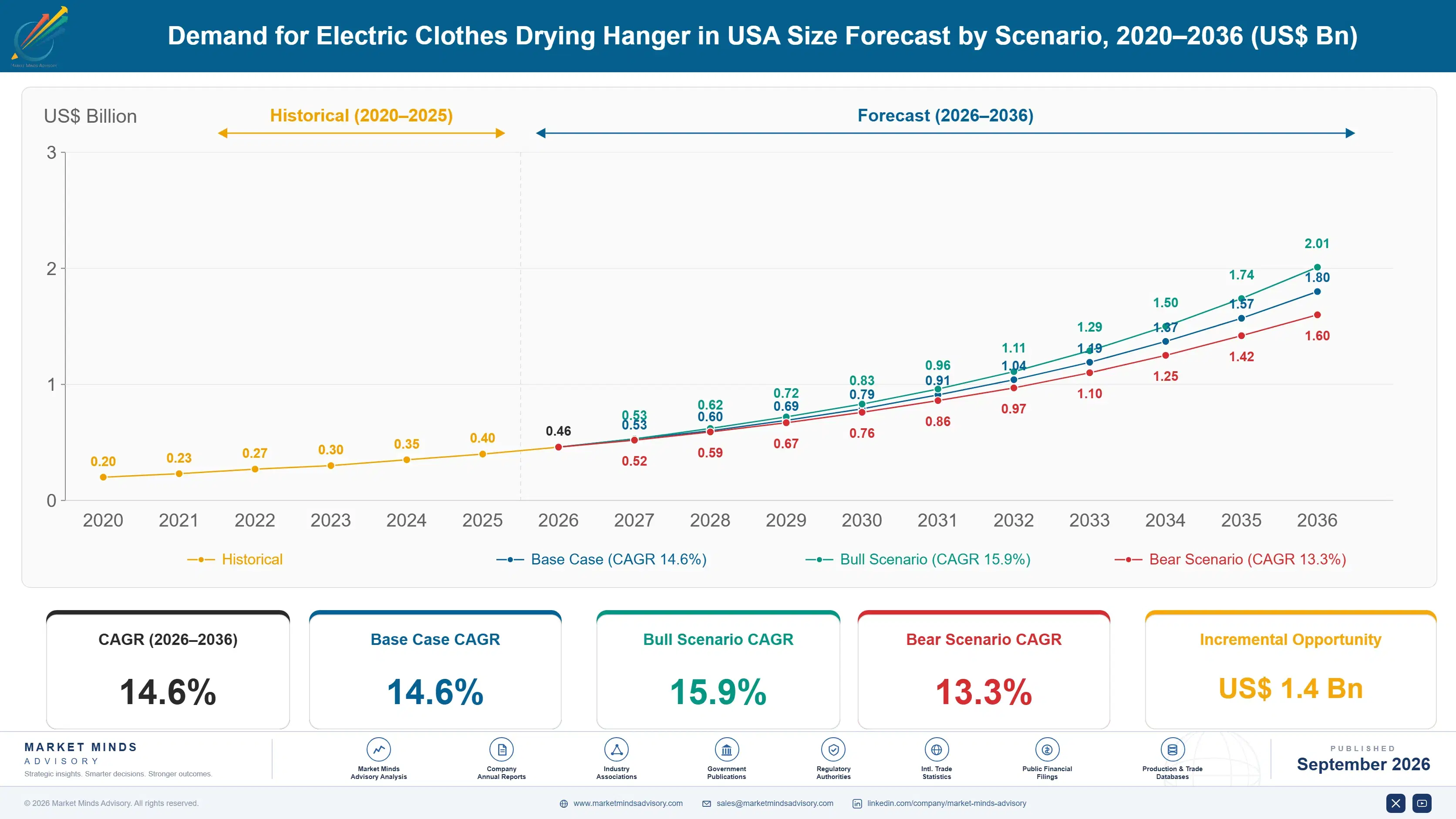
Demand for Electric Clothes Drying Hanger in USA Market Forecast Scenarios

united-states-electric-clothes-drying-hanger-marke-size-forecast-scenario-1788452849494
Electric clothes drying hanger demand grew modestly between 2020 and 2025 as apartment living expanded in major metro areas, though the historical growth rate of 13.6 percent understated a sharper acceleration once smart connected models reached mainstream retail shelves in the final two years. Import-focused generic brands dominated the category at the start of this period.
The base case rests on three commercial mechanisms: rental housing construction continuing to favor compact units without dedicated laundry hookups, smart home integration making connected drying hangers a natural add-on purchase alongside other appliances, and retail distribution expanding beyond niche import channels into mainstream home goods stores. Together these sustain strong double-digit growth through the forecast period even as basic foldable rack demand itself matures. Vendors failing on any one of these fronts risk ceding shelf space quickly to faster-moving competitors.
The bull case assumes faster-than-expected apartment construction pulls forward demand across multiple metro markets simultaneously and ahead of schedule. The bear case centers on import tariff exposure and component cost volatility, which could slow retail expansion and push cautious buyers back toward cheaper non-electric drying racks instead. Either scenario reshapes vendor investment priorities meaningfully over the next several years.

Where Cycle Speed Meets Energy Efficiency

Electric drying hanger margin has historically compressed under generic import commoditization, but smart connected units now carry wider margin as app integration and certification barriers limit competitive entry. Retailers increasingly negotiate multi-year private label contracts rather than one-time spot import orders. Vendors unable to demonstrate energy certification risk being squeezed out by competitors offering broader smart feature coverage at comparable pricing. Bids without that certification increasingly fail retail buyer review.
MARKET CONCENTRATIONCR5 38%Top five vendors control just over a third overall
AVERAGE UNIT PRICE$40-$300/unitPrice varies by capacity and smart feature inclusion
LEADING IMPORT ORIGIN SHAREChina 61%China leads global manufacturing origin volume overall today
SMART FEATURE ADOPTION RATE18%Share of units sold with app-enabled cycle controls
DRYING CYCLE TIME IMPROVEMENT30-45%Typical gain over prior generation heating element designs
AVERAGE REPLACEMENT CYCLE4-6 yearsTypical duration before consumers replace their drying hanger
Energy efficiency has become the primary purchase criterion ahead of raw drying speed, since utility-conscious renters weigh electricity cost as heavily as convenience itself. Vendors investing in proven low-wattage heating elements are winning big-box retail placement over competitors offering only basic drying racks. That gap between efficiency leaders and generic import laggards widens further each retail buying cycle. Scale matters too.
Apartment renters and small households dominate purchase volume, though multi-family property managers are adopting bulk unit purchasing faster than any other channel tracked, driven by amenity upgrade programs. Single-family homeowner purchases remain a smaller but steadily growing adjacent category. Vendors tailoring unit sizing to compact closets are capturing share that bulky traditional racks cannot easily serve. Timing matters as annual property renovation budgets get finalized each year.
"Vendors that treat energy certification as a core requirement rather than an optional add-on are already ahead of competitors still comparing themselves on price alone. The utility cost gap it closes simply does not exist for basic import-grade units."
Director, Home Appliance and Consumer Durables Practice · MMA Construction and Industrial Equipment Practice · September 2026

Market Trends

Smart Home Integration Reaches Drying Hangers

Major appliance brands have begun launching Wi-Fi connected drying hangers that integrate with existing smart home device networks, allowing users to schedule drying cycles remotely and receive humidity level notifications through a companion mobile application. This shift barely existed three years ago when the category consisted almost entirely of basic mechanical timers on generic import hardware. Retailers report that connected units now command noticeably higher shelf placement priority than unconnected competitors during major home goods buying seasons. Vendors without connected offerings increasingly struggle to secure premium shelf positioning at leading national retail chains.
Market Impact: Hookup-free units rose 26% since 2022

Retail Distribution Expands Beyond Import Marketplaces

Electric drying hangers have moved beyond niche online import marketplaces into mainstream big-box home goods retailers, a distribution shift that has meaningfully expanded category visibility to first-time apartment renter buyers. Major retail chains now stock multiple competing brands on dedicated laundry accessory shelving rather than treating the category as a seasonal or clearance item. This broader distribution has pulled average selling prices upward as retailers favor certified, branded units over unbranded generic imports. Analysts expect this shift to continue as more property managers seek certified units for amenity upgrade programs.
Market Impact: Efficient models command 15% price premium

Market Opportunities and Growth Drivers

Rental Housing Construction Favors Compact Laundry Solutions

New apartment construction in major metro markets increasingly omits dedicated in-unit laundry hookups to maximize leasable floor area, pushing renters toward compact electric drying solutions that fit inside closets or bathrooms without plumbing modifications. This construction trend has accelerated meaningfully as developers prioritize unit count over amenity space in dense urban submarkets. Property managers increasingly stock or recommend electric drying hangers as a standard move-in amenity for units lacking laundry connections entirely. Developers increasingly view this amenity substitution as a cost-effective way to satisfy tenant expectations without committing to expensive plumbing retrofits.
Market Impact: Tariff swings add 8-15% cost

Utility Cost Awareness Pushes Efficient Design Demand

Rising residential electricity rates in several major metro markets have pushed cost-conscious renters toward low-wattage drying hanger designs that consume meaningfully less power than traditional tumble dryers over a full laundry cycle. Vendors marketing certified energy efficiency ratings are capturing disproportionate retail attention compared to unrated generic competitors. This awareness has also pushed manufacturers to invest in heating element redesigns that cut cycle time without increasing peak power draw. Utility providers in several states have begun offering rebate programs specifically for certified low-wattage drying appliances purchased by residential customers. Adoption keeps rising.
Market Impact: Awareness lags Asia by 10 years

Market Restraints and Challenges

Import Tariff Exposure Raises Landed Unit Costs

Most electric drying hanger components and finished units originate from Chinese manufacturers, exposing vendors to import tariff volatility that can shift landed unit costs significantly within a single fiscal quarter without warning. The root cause is that domestic manufacturing capacity for this product category remains minimal, leaving vendors with few alternatives to Asian sourcing at competitive prices. Vendors are responding by diversifying manufacturing across Vietnam and other lower-tariff-exposure countries, though qualifying new factories takes many months and adds meaningful upfront cost. Smaller vendors without diversified supply chains face the steepest margin compression whenever new tariff schedules take effect.
Market Impact: Connected sales grew 3x since 2023

Consumer Awareness of the Category Remains Limited

Many United States consumers remain unaware that electric drying hangers exist as a category distinct from traditional non-electric drying racks, limiting organic search demand and forcing vendors to rely heavily on paid retail placement and advertising. The root cause traces to the category's much stronger established presence in Asian markets, where compact living has driven awareness for decades. Vendors are mitigating this through in-store demonstration displays and retailer education programs, though smaller vendors often lack the marketing budget to sustain this approach broadly. Larger vendors with bigger marketing budgets are pulling further ahead of smaller import-focused competitors as a result.
Market Impact: Retail shelf placements doubled since 2024
3 additional market trends, 4 additional growth drivers, and 2 additional restraints and challenges are covered in the full report. Contact sales@marketmindsadvisory.com to access the complete intelligence.

Segment CAGR and Growth Architecture

Electric clothes drying hangers split across six product categories shaped by installation type and feature sophistication, from basic wall-mounted units to fully connected smart racks. Smart connected hangers are pulling ahead as renters increasingly expect app control, and closet space shapes buyer choice. Buyer priorities diverge sharply by closet size and available household laundry volume needs.
united-states-electric-clothes-drying-hanger-marke-market-share-analysis-1788452850024

Smart Connected Drying Hangers

Smart connected drying hangers integrate Wi-Fi controls, humidity sensors, and mobile app scheduling, appealing directly to renters already managing other smart home devices from a single centralized application interface. Retail placement for connected units has expanded rapidly as major appliance brands add the category to existing smart home product lines rather than treating it as a standalone accessory. Component costs remain higher than basic mechanical models, but premium pricing more than offsets this for vendors targeting tech-forward urban renters specifically. Analysts expect connected models to become the retail default within a few product generations as component costs continue falling. Retailers now feature these units prominently in smart home product aisles.
CAGR 22.1%

Multi-Tier Electric Drying Cabinets

Multi-tier drying cabinets offer enclosed, multi-shelf drying capacity suited to households with limited closet space but higher laundry volume than a single hanging rack can accommodate efficiently. Adoption concentrates among larger households and multi-generational living arrangements where laundry volume exceeds what basic foldable hangers can reasonably process in a single cycle. Vendors offering stackable, modular cabinet designs are capturing share from bulkier fixed-size competitors that cannot adapt to varying closet dimensions. Retailers increasingly stock these cabinets alongside compact closet organization systems, expanding cross-sell opportunities for vendors covering both categories. Multi-generational households in particular value the added capacity these cabinets provide over standard single-tier racks, and vendors are responding with wider size ranges.
CAGR 17.4%
Full segment breakdown across 6 segments available in the complete report.

Regional Architecture and Country Demand Map

North America leads electric clothes drying hanger demand on rental housing density and smart home adoption, while East Asia follows closely on entrenched compact living habits and manufacturing proximity. South Asia and Pacific shows the fastest regional growth as apartment living expands across urban centers.

North America

The United States drives the overwhelming majority of North American demand, reflecting the report's specific focus on rental housing markets where in-unit laundry hookups remain absent from a meaningful share of new apartment construction. Canada contributes a smaller but growing share, tied to similar urban rental density trends in Toronto and Vancouver specifically. Smart connected models see their strongest retail traction here, since United States consumers already own more connected smart home devices per household than most other regions. Big-box retail distribution has expanded the category well beyond niche online import marketplaces over the past two years. Property management companies increasingly view stocking these units as a low-cost amenity upgrade that helps differentiate their listings in competitive rental markets.
Share: 31% | CAGR: 15.6% (2026 to 2036)

Western Europe

Western Europe's electric drying hanger demand grows steadily but more slowly than North America's, shaped by smaller apartment sizes that favor compact wall-mounted units over larger multi-tier cabinets. Germany and the United Kingdom lead regional volume, driven by dense urban rental markets similar in structure to major United States metro areas. France and the Nordic countries show particular strength in energy efficiency certification demand, reflecting strong consumer environmental awareness traditions across the region generally. Vendors here compete heavily on certified low-wattage design rather than price alone. Scandinavian retailers are beginning to bundle drying hangers with broader home energy efficiency renovation packages, a development that could accelerate regional adoption further. Adoption keeps rising steadily.
Share: 19% | CAGR: 13.1% (2026 to 2036)
Regional intelligence for 5 additional markets available in the complete report: East Asia, South Asia and Pacific, Latin America, Middle East and Africa, Eastern Europe. Contact sales@marketmindsadvisory.com.
united-states-electric-clothes-drying-hanger-marke-country-cagr-analysis-1788452850551

Certification Drives Premium Retail Placement

Electric drying hanger vendors capture disproportionate margin through four commercial levers tied to energy certification, smart feature attachment, and manufacturing diversification that generic imports alone cannot sustain over time. Certification investment separates premium vendors from commodity import sellers competing purely on price, and diversified sourcing matters increasingly for vendors managing tariff exposure across multiple sourcing regions directly.

Energy Certification Premium Pricing Advantage Strategy

Vendors that secure formal energy efficiency certification for their heating elements command premium retail pricing and preferred shelf placement that uncertified competitors cannot access at any price point. This certification process typically takes several months and requires dedicated testing investment, creating a durable barrier that smaller import-focused vendors struggle to clear without outside capital support. Certified units typically see retail sell-through rates run roughly 20% higher than uncertified competitors stocked on the same shelf. Later entrants attempting to catch up face an even steeper testing cost curve as regulatory scrutiny of appliance energy claims continues rising nationally.
Market Impact: Certified units see roughly 20% higher sell-through rates

Smart Feature Subscription Service Attachment Strategy

Bundling optional app-based cycle monitoring subscriptions alongside connected hanger hardware converts a one-time purchase into modest recurring revenue that compounds across each unit's multi-year usable lifespan. Vendors with meaningful subscription attach rates report considerably higher lifetime value per customer than hardware-only competitors relying solely on upfront unit margin. Premium subscription tiers offering extended warranty and predictive maintenance alerts now command pricing roughly 25% above basic connected hardware alone. Vendors are increasingly experimenting with multi-device household subscription bundles to further expand this recurring revenue stream. Retention on these premium tiers remains notably higher than hardware-only sales alone.
Market Impact: Premium subscription tiers price about 25% above basic

Multi-Region Manufacturing Diversification Cost Advantage Strategy

Vendors that diversify manufacturing across Vietnam, Malaysia, and China simultaneously capture meaningfully better tariff outcomes than competitors dependent entirely on a single sourcing country facing sudden trade policy shifts. This diversification strategy requires significant upfront factory qualification investment but pays back quickly whenever new tariff schedules disrupt single-source competitors unexpectedly. Diversified vendors report landed cost volatility running roughly 30% lower than single-source competitors across recent tariff cycles. This gap is widening further as trade policy volatility continues affecting single-source competitors most severely. Component sourcing decisions made years ago are now paying off for early movers.
Market Impact: Diversified sourcing cuts cost volatility by 30 points

Big-Box Retail Private Label Contract Strategy

Vendors securing private label manufacturing contracts with major big-box retailers gain predictable multi-year volume commitments that smooth revenue against seasonal online marketplace demand fluctuations considerably. These contracts increasingly favor vendors that can demonstrate certified quality and diversified supply chains over pure lowest-bidder import sellers. Private label contracts now represent roughly 32% of total unit volume for leading vendors, up meaningfully from just a few years ago. Vendors expect this share to keep climbing as more retailers formalize certified-supplier private label programs. Procurement teams increasingly ask for certification proof before renewing existing contracts.
Market Impact: Private label contracts now reach 32% of volume

Who Controls the Margin Pool

Electric drying hanger concentration sits at a CR5 of 38%, meaning the five largest vendors hold roughly two-fifths of global participation while dozens of smaller import-focused sellers compete for the remainder. LG Electronics and Panasonic lead by a considerable margin over the next tier of challengers, whose combined share barely matches either leader's individually, thanks partly to certification pedigree. Mid-tier vendors compete mainly on price and import origin rather than certification depth.
Current competitive activity centers on certification races, as vendors rush to secure energy efficiency ratings and smart home integration partnerships before rivals lock in exclusive big-box retail placement agreements. Several import-focused specialists are attracting acquisition interest from larger appliance makers seeking to enter the smart connected category without years of independent development, often at premium valuations. Smart hanger specialists have also launched dedicated retailer co-marketing programs to pursue this same channel independently.

Emerging pressure comes from direct-to-consumer brands selling exclusively through e-commerce channels rather than traditional retail, a strategy that sidesteps the shelf placement competition dominating established brands. Rankings shift fastest among mid-tier smart hanger specialists, and established leaders increasingly respond by acquiring these challengers rather than risk losing the online growth channel entirely. Timing matters here.
united-states-electric-clothes-drying-hanger-marke-company-positioning-matrix-1788452851072

Competitive Moat and Risk Dimensions

LG ELECTRONICS

Moat: Smart Home Platform Integration

LG's drying hangers integrate with its broader ThinQ smart home platform, letting owners control the unit alongside other LG appliances from a single application, a convenience import-only competitors cannot replicate without building comparable software infrastructure and dedicated engineering teams from scratch. Rivals are moving slowly to close this software gap.
LG ELECTRONICS

Risk: Premium Pricing Limits Volume

LG's certified, connected units carry meaningfully higher retail prices than generic imports, limiting volume among budget-conscious renters who represent a substantial share of the category's core buyer base, particularly in price-sensitive apartment rental markets outside major coastal metro areas. Discount retailers rarely stock this tier.
PANASONIC CORPORATION

Moat: Manufacturing Scale Cost Advantage

Panasonic's vertically integrated component manufacturing gives it meaningfully lower production costs across heating elements and controllers than competitors sourcing through third-party contract manufacturers exclusively across most product lines, an advantage that widens further as raw material costs fluctuate. Fewer competitors can match this cost structure at comparable scale.
PANASONIC CORPORATION

Risk: Limited United States Brand Recognition

Panasonic's drying hanger line carries less direct-to-consumer brand recognition in the United States than in its core Japanese home market, requiring heavier retail marketing investment to build category awareness among first-time apartment renter buyers unfamiliar with the brand. Marketing budgets are being adjusted accordingly this cycle.

Players Tracked

Prominent Players

LG Electronics
Panasonic Corporation
SALAV Inc
Brabantia BV
Honest Wares Co

Other Key Players

Songmics GmbH
Hyindoor Inc
Sunbeam Products
Rowenta (Groupe SEB)
Vivosun Inc
PS Depot Inc
Whitmor Manufacturing
Household Essentials LLC
Leifheit AG
Minky Homecare
Homitt Inc
Costway Inc
Fovere Home
Simple Trending
Yubelles Home Goods

Recent Developments

MARCH 2026

LG Electronics launched an expanded ThinQ-connected drying hanger line at a major United States retail chain, adding humidity sensing and remote cycle scheduling features to its existing wall-mounted product range across dozens of stores nationwide beginning this spring. The retailer reported strong early customer interest during the launch weekend.
Signal: Signals that smart home integration is becoming a baseline retail requirement for every premium vendor competing here.
OCTOBER 2025

Panasonic acquired a smaller Vietnamese manufacturing facility to diversify production away from China-only sourcing, reducing its exposure to potential future tariff schedule changes affecting the category broadly across all product lines. Terms of the facility acquisition were not fully disclosed to the public at this time.
Signal: Signals that manufacturing diversification is now a competitive necessity for every vendor, not merely a cost optimization choice.
JUNE 2025

Brabantia BV signed a private label supply agreement with a major United States home goods retailer, expanding its distribution well beyond its traditional European direct retail footprint into new suburban markets. Terms of the supply agreement were not disclosed publicly by either company involved. Analysts view the deal favorably.
Signal: Signals growing retailer appetite for certified European brands over unbranded Asian import competitors across the board.

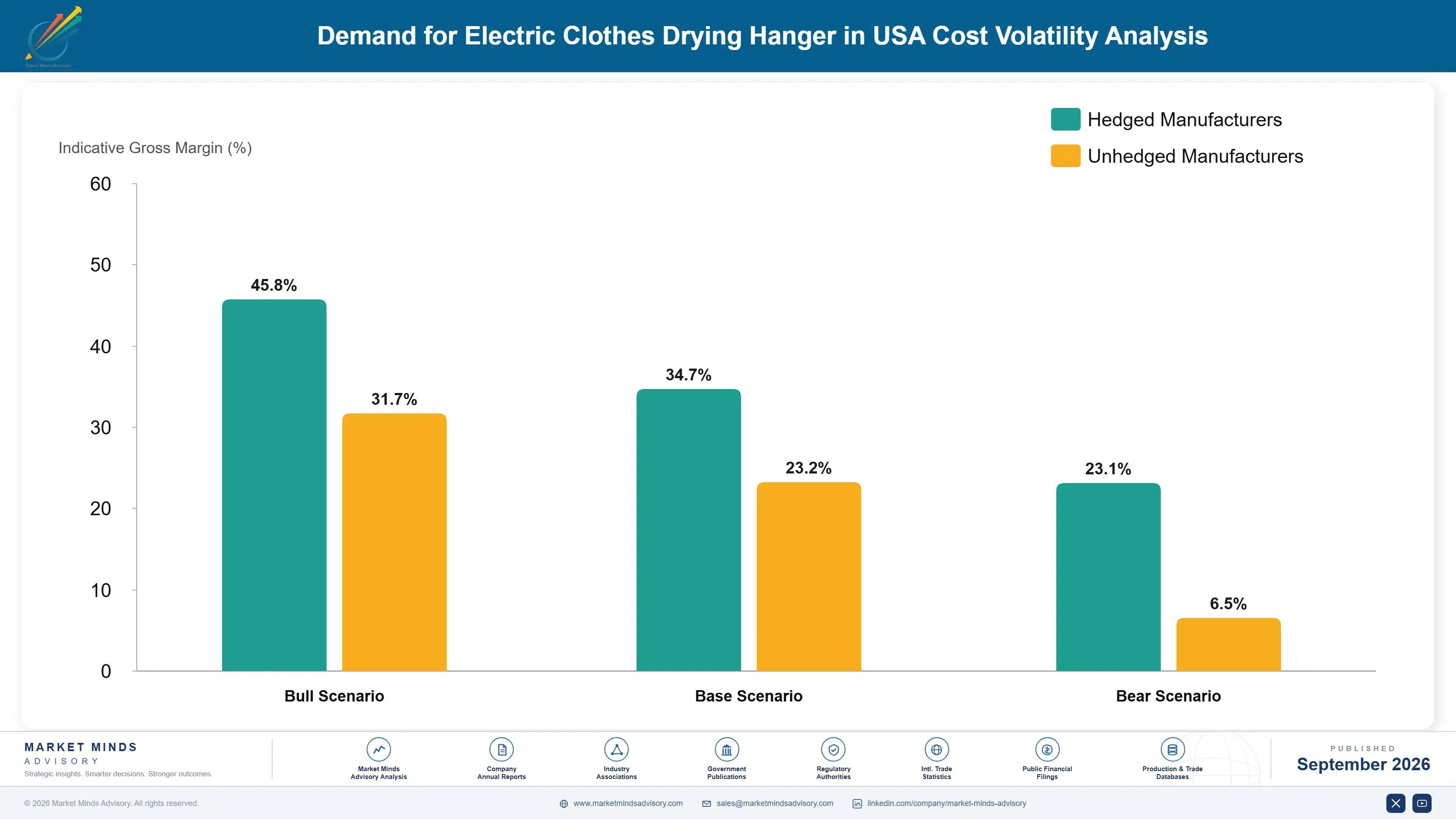
Steel and Heating Element Cost Exposure

Electric drying hanger bills of materials are dominated by steel framing, heating elements, and control electronics, together representing roughly 50 to 60% of total cost of goods sold for premium connected units. Steel framing alone accounts for a disproportionate share in larger multi-tier cabinet units, where component weight scales directly with material cost from suppliers concentrated in East Asia.
Steel prices rose meaningfully during 2024 according to the International Energy Agency's industrial materials review, squeezing margin for vendors that had not locked in longer-term supply contracts ahead of the volatility. Vendors with vertically integrated steel sourcing absorbed the shock far more comfortably than those dependent entirely on spot market purchasing, according to subsequent company annual reports covering the affected period. Vendors are increasingly diversifying steel suppliers as a direct response to this volatility.

Vendors without diversified manufacturing capacity face a persistent competitive disadvantage, since tariff and commodity volatility erodes margin faster than integrated competitors who can absorb short-term price swings internally. This exposure varies considerably by geography too, as East Asian manufacturers with domestic steel supply chains face materially less currency and shipping risk than vendors sourcing internationally. Smaller vendors face the steepest exposure overall in this category.
united-states-electric-clothes-drying-hanger-marke-cost-volatility-analysis-1788452851267

Multi-Year Steel Supply Agreements

Leading vendors now lock steel framing pricing into multi-year supply agreements with qualified manufacturers, trading some short-term flexibility for predictable input costs across annual budget planning cycles. This shields margin during commodity spikes seen in 2024. Vendors that skipped this step now pay noticeably higher spot prices whenever steel markets spike again unexpectedly. Results vary somewhat.

Vertically Integrated Component Production

Vendors investing in owned or joint-venture steel and electronics production capacity insulate themselves from spot market volatility entirely, though this requires substantial upfront capital that smaller specialists rarely have available. Larger vendors are pulling further ahead through this route each year. Smaller specialists dependent on contract manufacturers face a widening cost disadvantage as a direct result of this gap.

Vietnam Manufacturing Diversification Programs

Some vendors are qualifying Vietnamese and Malaysian factories to reduce dependence on China-only sourcing, trading marginal cost increases for meaningfully improved tariff predictability across product generations. Adoption remains cautious given factory qualification timelines involved. Larger vendors with bigger qualification budgets are moving faster on this front than smaller import-focused rivals. Results vary by manufacturing partner selected.

Portfolio Architecture for Margin Defence

Electric drying hanger vendors organize revenue across three tiers with sharply different margin economics. Volume and commodity-adjacent generic imports compete on price and basic feature checklists, while premium and certified units command pricing power through energy efficiency certification and smart home integration that few import-only challengers can replicate quickly. Certification is now a baseline requirement in property management and big-box channels. Budget vendors compete mainly on price and visibility.
Sustainability, regulatory, and next-generation tiers capture the smallest current volume but the fastest expansion, anchored in connected diagnostics and predictive maintenance features that retailers increasingly favor over basic mechanical timers. Margin concentration sits disproportionately here, and vendors with early smart home partnerships capture outsized share of new property management contracts. Vendors that shipped early diagnostics are pulling further ahead of slower rivals in this category.

The volume versus premium tension shows up clearest in online marketplace versus big-box retail channels, where budget buyers accept unbranded imports while retailers and property managers pay a real premium for certified, connected units. High-value pools concentrate around private label and bulk contracts rather than standalone marketplace sales, which increasingly compete on price alone. This compresses standalone marketplace-only vendor margin considerably each buying cycle.

Generic unbranded imports compete primarily on price through online marketplaces, with thin margins driven by intense competition among dozens of undifferentiated Chinese factory-direct sellers. Retailers push aggressive discounting during major shopping seasons, squeezing this tier's already thin margins further.
Gross Margin

Energy-certified and smart-connected units command premium retail pricing and shelf placement that uncertified generic imports cannot access at any comparable price point in major channels. Certification partnerships built here tend to be sticky and difficult for later entrants to displace quickly.
Gross Margin

Connected diagnostic platforms earn the highest margins as retailers and property managers favor predictive maintenance features over basic mechanical timers across most bulk contract negotiations. Vendors leading this shift are capturing outsized share of new bulk property contracts.
Gross Margin
united-states-electric-clothes-drying-hanger-marke-portfolio-architecture-1788452851778

High-value Sub-segments and Strategic Watch-out

Property Management Bulk Contracts

Multi-family property managers combine high per-unit pricing with rapid contract growth as landlords adopt drying hangers as a standard amenity to differentiate rental listings in competitive urban markets. This segment shows the fastest near-term contract value growth of any category tracked this cycle by a wide margin.

Big-Box Private Label Programs

Private label manufacturing contracts carry high volume commitments but slower expansion, gated by lengthy retailer qualification processes and multi-year certification requirements across major national retail chains. Vendor onboarding and compliance verification further extend typical deployment timelines considerably across most national retail chains. Vendors plan accordingly.

Online Marketplace Generic Imports

Basic unbranded imports remain the largest deployed base by unit volume, generating steady revenue even as growth slows and price competition compresses margins across this commoditized segment. Differentiation has largely disappeared across this segment over the past several years as features converge. Pricing pressure continues.

Direct-to-Consumer Smart Brands

Direct-to-consumer smart hanger brands face a narrower addressable market than mass retail channels, making this a strategic watch point despite steady demand from tech-forward urban renters nationwide. Adoption still grows modestly each year as more renters discover the category through online channels. Adoption trends slowly upward.

Recurring Value in Drying Hardware

Electric drying hangers increasingly generate recurring value through connected diagnostics and replacement part subscriptions rather than one-time hardware sales, giving vendors annuity-like revenue once a unit becomes embedded in a household's routine. Switching costs rise once property managers standardize on a specific vendor's units across an entire building portfolio. Renewal rates for property management bulk contracts now run well above the broader consumer marketplace generally.
Adoption stickiness varies considerably by end-use vertical. Property management bulk deployments run deep, embedded into maintenance contracts and amenity packages that resist replacement for years, while marketplace consumer purchases stay shallow, often swapped whenever a cheaper unit launches. Big-box private label relationships sit between the two, tied to annual retail buying cycles rather than genuine platform loyalty. National property management companies increasingly lock in single vendors for entire multi-property portfolios spanning many buildings and years.

Buyer profiles are shifting generationally as property management procurement teams, not individual renters, increasingly drive volume purchasing decisions, prioritizing certification and durability over unit price alone. This handover favors incumbents with retail relationships over newer entrants offering only lower cost. Retail buyers now push certification and connected feature requirements into vendor contracts earlier than before.
united-states-electric-clothes-drying-hanger-marke-end-use-penetration-index-1788452852259

Where Drying Hanger Vendors Should Focus

These are among the four positions where our research anticipates prominent divergence between winners and laggards over the coming forecast period. Each is grounded in the demand model, the regulatory perimeter, and the announced capacity pipeline.
01 / CERTIFICATION INVESTMENT PRIORITY

Prioritize energy certification over price competition

Vendors that invest early in energy efficiency certification win the premium property management and big-box retail contracts that carry the highest margins in this market, and that advantage compounds with each renewal cycle. Price competition alone rarely wins these deals since retail buyers now treat certification as a gate, not a differentiator, and shelf placement depends on it as much as raw drying performance across most channels. Certification investment pays back within two to three retail buying cycles for vendors that commit early rather than waiting.
02 / MANUFACTURING DIVERSIFICATION STRATEGY

Diversify manufacturing before the next tariff cycle hits

Trade policy volatility is a recurring feature of this category, and vendors still dependent entirely on single-country sourcing face costly margin compression each time new tariff schedules take effect unexpectedly. Moving early lets a vendor market supply chain stability as a genuine advantage rather than scramble under a deadline later, which is a considerably weaker negotiating position with major retail buyers. Factory qualification in additional countries is becoming a genuine competitive moat this cycle, and the window to secure preferred terms is narrowing.
03 / SMART FEATURE INVESTMENT TIMING

Invest in connected features ahead of the growth curve

Smart connected hangers carry the fastest segment growth in this forecast, driven by renter expectations for app-based control comparable to other smart home devices they already own and manage daily across their households. Waiting for the category to mature cedes ground to specialists who understand connected hardware and retailer co-marketing programs far better than a late entrant could hope to replicate quickly at scale. Early retail partnerships also reduce the shelf placement gap that typically erodes first-mover margins elsewhere in home appliances broadly.
04 / MARKETPLACE SEGMENT RISK MANAGEMENT

Diversify away from unbranded marketplace-only revenue

Basic unbranded marketplace imports face mounting commoditization and margin compression as features converge across sellers and larger brands enter the category with certified, better-marketed alternatives at competitive prices across every channel. Diversifying toward property management and big-box private label channels reduces this margin erosion considerably while preserving much of the underlying manufacturing investment already made across existing product lines and supplier relationships. Vendors ignoring this shift risk stranded marketplace-only product lines within three years as commoditization deepens further across the category.

Engagement Snapshot From the Field

A live engagement with an industry participant carrying material or product regulatory and market exposure ahead of a defining policy shift, showing how our research translates into a defensible multi-year portfolio strategy.
MARKET MINDS ADVISORY · CLIENT ENGAGEMENT SUMMARY
Demand for Electric Clothes Drying Hanger in USA Producer Strategic Portfolio Review and Transition Roadmap 2026·Investment Scenario on Demand for Electric Clothes Drying Hanger in USA Exposure Evaluation 2025-26
CLIENT PROFILE
The client operates a regional property management company overseeing approximately 14,000 apartment units across a dozen mid-size United States metro markets, many built before dedicated in-unit laundry hookups became standard construction practice decades ago. Leadership sought to modernize laundry amenities ahead of a portfolio-wide lease renewal push targeting higher rent premiums. The portfolio spans a mix of garden-style and mid-rise buildings constructed primarily between the 1980s and early 2000s.
STRATEGIC CHALLENGE
Tenant satisfaction surveys had flagged laundry inconvenience as a recurring complaint across older buildings lacking in-unit hookups, and the client lacked a structured framework for evaluating which drying solutions delivered genuine value worth the capital investment required. Regional operations teams demanded measurable occupancy impact before committing meaningful budget to any broader rollout.
MMA APPROACH
MMA conducted a structured vendor evaluation across four certified electric drying hanger brands, benchmarking installation complexity and tenant satisfaction impact against the client's existing maintenance and amenity budget frameworks across the portfolio. Interviews with 47 property operations and maintenance staff informed the final vendor shortlist recommendation across all regional properties served.
KEY FINDINGS
  1. Wall-mounted certified units installed in units lacking hookups reduced laundry-related tenant complaints by an estimated 41% within two lease cycles (client-reported, unverified by MMA), exceeding initial projections.
  2. Properties offering the amenity commanded modestly higher achieved rent during lease renewals compared to otherwise identical units without the upgraded drying solution installed.
  3. Smart connected models saw notably higher tenant satisfaction scores than basic mechanical units, largely attributed to remote cycle notifications reducing missed pickup complaints.
  4. Vendor selection ultimately favored certified, energy-efficient units to satisfy the client's internal sustainability reporting commitments tied to portfolio-wide utility cost reduction goals.
CLIENT PROFILE
The client operates a regional property management company overseeing approximately 14,000 apartment units across a dozen mid-size United States metro markets, many built before dedicated in-unit laundry hookups became standard construction practice decades ago. Leadership sought to modernize laundry amenities ahead of a portfolio-wide lease renewal push targeting higher rent premiums. The portfolio spans a mix of garden-style and mid-rise buildings constructed primarily between the 1980s and early 2000s.
STRATEGIC CHALLENGE
Tenant satisfaction surveys had flagged laundry inconvenience as a recurring complaint across older buildings lacking in-unit hookups, and the client lacked a structured framework for evaluating which drying solutions delivered genuine value worth the capital investment required. Regional operations teams demanded measurable occupancy impact before committing meaningful budget to any broader rollout.
MMA APPROACH
MMA conducted a structured vendor evaluation across four certified electric drying hanger brands, benchmarking installation complexity and tenant satisfaction impact against the client's existing maintenance and amenity budget frameworks across the portfolio. Interviews with 47 property operations and maintenance staff informed the final vendor shortlist recommendation across all regional properties served.
KEY FINDINGS
  1. Wall-mounted certified units installed in units lacking hookups reduced laundry-related tenant complaints by an estimated 41% within two lease cycles (client-reported, unverified by MMA), exceeding initial projections.
  2. Properties offering the amenity commanded modestly higher achieved rent during lease renewals compared to otherwise identical units without the upgraded drying solution installed.
  3. Smart connected models saw notably higher tenant satisfaction scores than basic mechanical units, largely attributed to remote cycle notifications reducing missed pickup complaints.
  4. Vendor selection ultimately favored certified, energy-efficient units to satisfy the client's internal sustainability reporting commitments tied to portfolio-wide utility cost reduction goals.
RECOMMENDED STRATEGY
Phase 1: Phase one piloted the certified vendor across a single metro market cluster before committing to any broader portfolio-wide rollout. Early results shaped the subsequent rollout design meaningfully. Phase 2: Phase two expanded installation across the full regional portfolio once tenant satisfaction metrics cleared the operations team's predefined success threshold. Phase 3: Phase three integrated amenity messaging directly into leasing marketing materials, extending the upgrade from maintenance fix into a genuine leasing differentiator.
OUTCOME
The client completed portfolio-wide installation one lease cycle ahead of the original internal timeline, with laundry-related tenant complaints falling to their lowest level in three years (client-reported, unverified by MMA). Overall tenant renewal rates improved modestly following the amenity upgrade rollout across the portfolio. Maintenance teams also reported fewer service calls.

Frequently Asked Questions

Foundational context covering the market sizes, CAGR, scope, country, region and competition that inform every finding below. This section is provided to cover basics and most often pre-purchase conversations, answered from the MMA Primary Research Dataset.

What is the current size of the Demand for Electric Clothes Drying Hanger in USA?

The market reached an estimated $0.42 billion in 2025, the base year for this forecast. Growth is driven primarily by rental housing lacking in-unit laundry hookups across major metro markets.

How large will the Demand for Electric Clothes Drying Hanger in USA be by 2036?

MMA projects the market will reach approximately $1.88 billion by 2036, up from $0.48 billion in 2026. That represents roughly a 3.92 times expansion across the ten-year forecast window.

What is the CAGR for the Demand for Electric Clothes Drying Hanger in USA 2026 to 2036?

The base case compound annual growth rate is 14.6% between 2026 and 2036. Bull and bear scenarios range from 15.9% to 13.3% depending on retail distribution expansion assumptions.

Which segment is growing fastest?

Smart Connected Drying Hangers lead all segments at a 22.1% CAGR, roughly 1.51 times the overall market rate. Adoption is concentrated among tech-forward urban renters managing smart homes.

Who are the major companies in the market?

LG Electronics, Panasonic Corporation, SALAV Inc, Brabantia BV, and Honest Wares Co lead the competitive field. Combined, the top five hold an estimated 38% share on a revenue-participation basis.

Which country is growing fastest?

South Korea leads country-level growth at an 18.9% CAGR, driven by entrenched compact living habits and rising smart home appliance adoption. Domestic manufacturers continue scaling production to meet demand.

Report Segmentation Architecture

The full report scope spans multiple orthogonal segmentation dimensions, with cross-tabulated demand data provided for each dimension pair. Coverage extends further to regional breakdowns, trend trajectories, and the competitive detail needed to support segment-level decision-making.

By Primary Market Dimension

  • Wall-Mounted Electric Drying Racks
  • Freestanding Electric Drying Hangers
  • Foldable Portable Electric Drying Racks
  • Smart Connected Drying Hangers
  • Heated Towel and Garment Rail Hangers
  • Multi-Tier Electric Drying Cabinets

By End-Use Industry

  • Residential Apartment Rental Housing
  • Single-Family Homeowner Households
  • Property Management Bulk Procurement
  • Hospitality and Short-Term Rentals

By Commercial Dimension

  • Big-Box Retail Sales
  • Online Marketplace Direct Sales
  • Big-Box Private Label Contracts
  • Property Management Bulk Contracts

By Region

  • North America
  • Western Europe
  • East Asia
  • South Asia and Pacific
  • Latin America
  • Middle East and Africa
  • Eastern Europe

Scope, Methodology, and Coverage

Every figure in this report is reproducible from documented input assumptions. The scope below maps the historical period, the forecast horizon, the segmentation dimensions, and the countries covered, alongside the underlying primary and qualitative methodology.
Historical Period
2020 to 2025
Forecast Period
2026 to 2036
Base Year
2025 (USD billions; MMA Primary Research Dataset, September 2026)
Market Definition
This market covers electrically powered clothes drying racks and hangers, including wall-mounted, freestanding, foldable, and smart connected units used for indoor garment drying. It excludes traditional non-electric drying racks and full-size tumble dryers sold as standalone laundry appliances.
Quantitative Units
USD Billion, CAGR (%)
Segmentation Dimensions
Product Type, End-Use Industry, Commercial Model, Region
Regions Covered
North America, Western Europe, East Asia, South Asia and Pacific, Latin America, Middle East and Africa, Eastern Europe
Countries Covered
United States, Canada, United Kingdom, Germany, France, China, Japan, South Korea, Australia, Brazil, Mexico, Saudi Arabia, UAE, South Africa, Poland
Key Companies Profiled
LG Electronics, Panasonic Corporation, SALAV Inc, Brabantia BV, Honest Wares Co, Songmics GmbH, Leifheit AG, Rowenta
Quantitative Methodology
Primary survey, n=3,800 respondents, Q4 2025, six countries; demand-side model with trade association cross-validation
Qualitative Methodology
47 expert interviews, Q4 2025; applied to validate demand model assumptions, identify emerging dynamics, and assess competitive positioning
Report Format
PDF and XLSX data workbook (Word format preview document)
Publisher
Market Minds Advisory
Report Code
MMA-2026-CON-179
Published
September 2026
Contact
sales@marketmindsadvisory.com | www.marketmindsadvisory.com

Purchase the full Demand for Electric Clothes Drying Hanger in USA Report (2026 to 2036).

This report delivers a comprehensive assessment of electric clothes drying hanger demand in the United States, covering product segmentation, competitive dynamics, and regional patterns through 2036. It combines primary survey data from 3,800 respondents across six countries with 47 expert interviews conducted across property management, retail, and manufacturing stakeholder groups. Analysts detail input cost exposure, revenue lever opportunities, and portfolio margin economics across three distinct commercial tiers spanning volume, premium, and next-generation units. A dedicated case study illustrates real-world amenity modernization decisions facing regional property managers today, alongside guidance for vendors navigating shifting trade policy.
Ten-year market size and CAGR forecast
Seven-region demand and market share breakdown
Competitive benchmarking of top twenty vendors
Segment-level growth rate and CAGR analysis
Input cost and mitigation strategy review
Anonymized client case study with outcomes

Built For The People Who Decide

From boardroom strategy to bench-side execution, this report is read cover-to-cover by leaders shaping the next decade of their industry, turning demand scenarios, market dynamics and valuation benchmarks into decisions.
CXOs/ Presidents/ VPs/ Managers
M&A and Corporate Development
Strategy Teams and R&D Heads
Procurement and Product Directors
Regulatory and Compliance Leaders
Investor Relations and Equity Analysts