

Market Minds Advisory
Demand for Duplication Disc in USA

Demand for Duplication Disc in USA: Demand for Duplication Disc in USA. Physical Media Duplication for Archival, Enterprise, and Niche Distribution

United States enterprises and archives are sustaining optical disc duplication demand for long-term data preservation even as consumer playback shifts entirely to streaming and cloud-based digital distribution channels nationwide today.

Lead Analyst

Published

September 2026

Make Smarter Decisions with Customized Research Insights

Request a free sample report and evaluate market opportunities, growth trends, and competitive dynamics relevant to your business needs.

2025 MARKET VALUE$0.3BMarket Size 2025
2036 FORECAST VALUE$0.5BBase Case , 2026 to 2036
CAGR 2026 TO 20363.8 %Bull 5.0% / Bear 2.6%
INCREMENTAL OPPORTUNITY$0.1BNet 10- year value creation
EXPANSION MULTIPLE1.44x2036 value over 2026 base
Strategic Levers
M&A Pipeline
Regional Outlook
Country Rankings
Competitive Intelligence
Segmental Deep-dive
Call-Us : 91 93563 13602

Executive Snapshot and Market Trajectory.

Optical disc duplication in the United States has settled into a durable niche anchored by archival, enterprise, and specialty distribution buyers rather than consumer entertainment purchasing, which has moved almost entirely to streaming platforms nationwide, prioritizing long-term data durability over convenience. Buyers here value reliability above cost.
Government agencies, healthcare institutions, and corporate legal departments concentrate the heaviest ongoing demand, valuing physical media for regulatory retention requirements and offline data transfer where network transmission carries security or compliance concerns, while independent musicians and film distributors sustain a smaller but stable specialty segment across the country's remaining niche retail and direct-to-fan channels, and regional specialists compete primarily on turnaround speed. over raw unit pricing alone.
Competition centers on a handful of established duplication service providers defending long-standing institutional contracts against smaller regional specialists offering faster turnaround and custom packaging, while archival standards bodies and enterprise data retention policy continue sustaining baseline demand even as broader consumer disc sales decline steadily nationwide. Vendors investing in archival-grade media formulations and long-term data integrity certification are winning renewal contracts even as overall disc volume continues its gradual multi-year decline across most consumer-facing channels.
Market Definition
This report covers commercial CD, DVD, and Blu-ray disc duplication and replication services in the United States, including archival data duplication, enterprise distribution, and specialty audio and video production runs. It excludes streaming media services, digital-only distribution platforms, and consumer at-home disc burning equipment.
Base Year Value
$0.3B in 2025 (MMA Primary Research Dataset, September 2026)
Forecast Period
2026 to 2036, eleven discrete annual values
CAGR
3.8% base case. Bull 5.0%. Bear 2.6%.
Fastest Growth Segment
Blu-ray Archival and Data Duplication Services: 7.5% CAGR
Fastest Growth Country
United States: 5.5% CAGR
Fastest Growth Region
South Asia and Pacific: 5.8% CAGR
Largest Region
North America: 32% of 2025 global value
Market Leaders
Deluxe Entertainment Services, Sony DADC, Technicolor, Iron Mountain, and DiscMakers lead the market. Source: MMA Analysis, July 2026.
Primary Survey
n=3,800 procurement and R&D decision-makers, Q4 2025, six countries
Methodology
Demand-side build-up, cross-validated against public data, 47 expert interviews

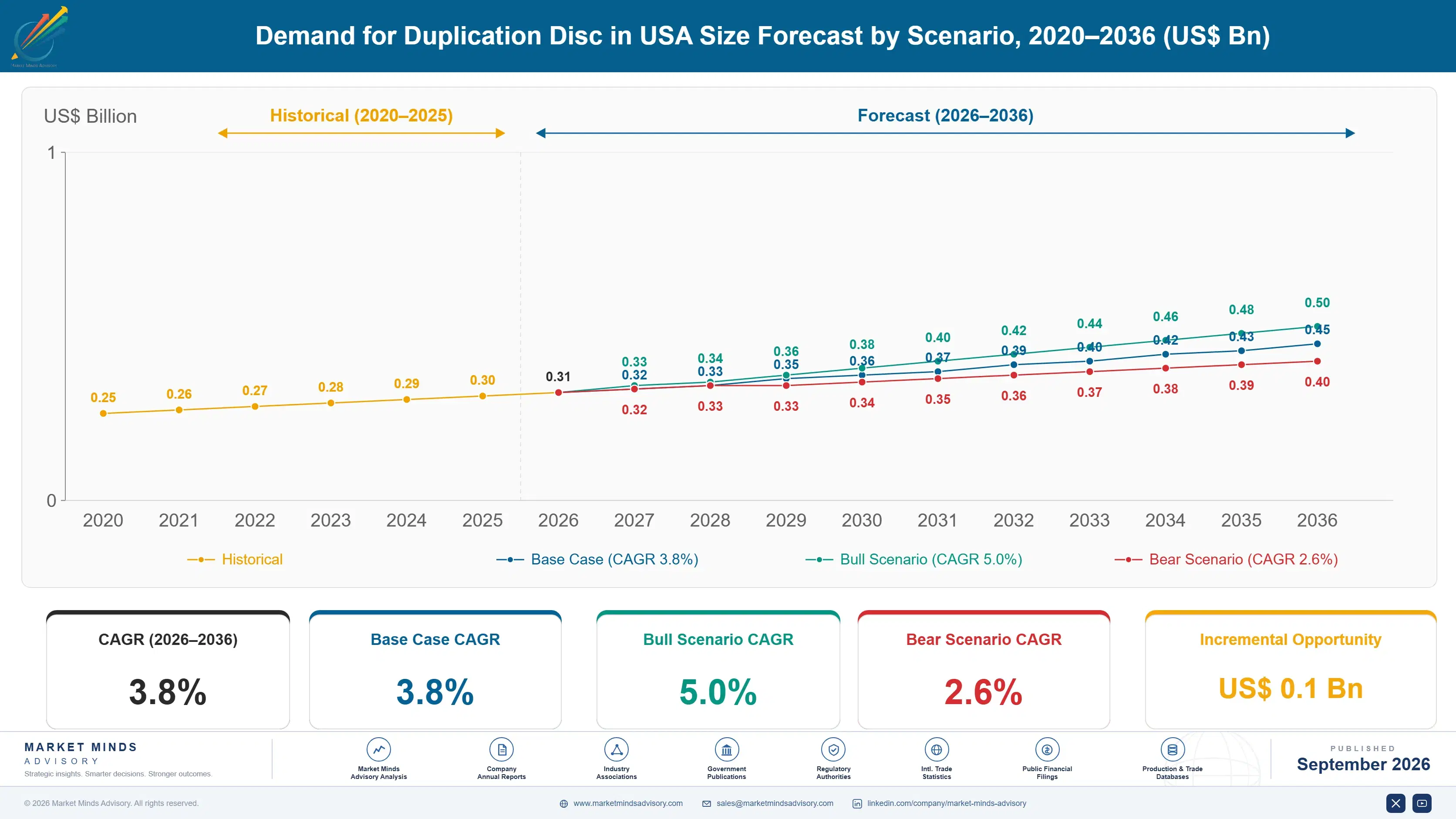
Demand for Duplication Disc in USA Market Forecast Scenarios

united-states-duplication-disc-market-size-forecast-scenario-1788454070212
United States disc duplication volume declined steadily through 2020 to 2025 as consumer entertainment purchasing shifted almost entirely to streaming, though archival, enterprise, and specialty distribution demand held roughly stable, cushioning the overall market's decline relative to pure consumer disc sales trends. Institutional buyers with long-standing compliance requirements largely maintained order volume even as broader consumer retail sales continued their well-documented contraction.
The base case assumes continued gradual consumer volume decline offset by steady archival and enterprise demand growth, sustained regulatory data retention requirements across healthcare and government sectors, and modest specialty distribution growth among independent musicians and filmmakers valuing physical media differentiation. Archival-grade format certification increasingly determines which vendors retain long-term institutional contracts across the forecast window. Vendors without recognized archival certification increasingly struggle to retain large institutional accounts as buyers formalize qualification criteria.
A stronger bull case assumes accelerating enterprise archival adoption pulls duplication demand meaningfully above current projections as data retention regulation tightens further. The bear case assumes faster-than-expected institutional migration toward cloud archival storage displaces physical media demand more quickly than currently anticipated nationwide. Institutional buyer behavior, more than consumer entertainment trends, will determine which scenario actually materializes across the coming decade nationwide.

Institutional Buyers Anchor a Shrinking Consumer Category

United States disc duplication has bifurcated into two distinct commercial realities: a shrinking consumer entertainment category and a stable, even modestly growing, archival and enterprise category anchored by regulatory retention requirements across healthcare, legal, and government sectors nationwide, each pulling the overall market in a different commercial direction simultaneously. Vendors that recognize this bifurcation early reposition sales resources accordingly rather than treating the category as a single homogenous market.
MARKET CONCENTRATIONCR5 42%Top five vendors hold notable but fragmented revenue share
AVERAGE DUPLICATION UNIT PRICE$0.42Per standard duplicated disc excluding custom packaging options
ARCHIVAL SEGMENT SHARE38%Of total revenue from archival and enterprise buyers
CONSUMER VOLUME DECLINE RATE8% annuallyYear over year decline in consumer disc orders
INSTITUTIONAL CONTRACT LENGTH3-5 yearsTypical duration of enterprise duplication service agreements nationwide
CUSTOM PACKAGING ATTACH RATE44%Of orders including custom print and finishing options
Commercial character in this market favors vendors with formal archival certification and long-standing institutional relationships, since large government and healthcare accounts weight compliance documentation heavily over marginal cost differences between competing duplication providers, a dynamic that increasingly separates specialist archival vendors from generalist consumer-facing duplication shops nationwide. Vendors succeeding here typically maintain dedicated compliance and quality assurance teams that generalist competitors have not built out.
Regulatory data retention policy and enterprise archival strategy will shape vendor positioning over the coming decade, alongside consumer entertainment trends that continue pulling overall category volume downward even as institutional demand holds steady, a divergence likely to persist through most of the coming ten-year forecast window nationwide. Vendors positioning around this divergence now capture disproportionate share of the institutional segment that remains commercially durable.
"This category will never grow the way it did in the 1990s, but the buyers still ordering discs today are the ones least likely to ever stop."
Director, Physical Media and Archival Services Practice · MMA Optical Media Duplication and Physical Data Distribution Services Practice · September 2026

Market Trends

Archival Format Certification Becomes Institutional Purchasing Criteria

Government archives, healthcare systems, and financial institutions increasingly require documented archival format certification before awarding duplication contracts, reflecting growing awareness that not all optical media formulations offer equivalent long-term data integrity. Vendors are responding by pursuing formal certification against recognized data longevity standards, differentiating themselves from generalist duplication shops that cannot demonstrate comparable format durability testing. This certification requirement is reshaping vendor selection criteria across institutional buyers who previously evaluated duplication providers primarily on unit price rather than long-term data preservation performance. This shift favors vendors that invested early in formal testing infrastructure.
Market Impact: 27 percent use disc backup

Independent Music and Film Distributors Sustain Niche Demand

Independent musicians and filmmakers continue ordering physical disc runs for direct-to-fan sales, tour merchandise, and film festival distribution, valuing physical media as a tangible product differentiator in an increasingly digital-only entertainment landscape. This niche demand has proven more durable than broader consumer retail disc sales, since these buyers value physical media specifically for its collectible and merchandise appeal rather than as a primary playback format competing directly against streaming services. Vendors offering flexible short-run duplication and custom packaging are capturing disproportionate share of this specialty segment nationwide. This segment remains largely price-insensitive relative to bulk consumer orders.
Market Impact: 24 percent require offline storage

Market Opportunities and Growth Drivers

Healthcare Data Retention Regulation Sustains Archival Demand

Federal and state healthcare data retention requirements mandate long-term preservation of patient records and imaging data, and many institutions continue relying on physical disc archives as an offline backup layer independent of network-connected storage systems vulnerable to cyberattack or system failure. This regulatory foundation gives duplication vendors serving healthcare accounts unusually predictable multi-year demand, insulated from the consumer entertainment decline reshaping the broader category. Vendors with documented compliance expertise specific to healthcare data retention standards are winning renewal contracts against generalist competitors lacking this specialized knowledge. This durability distinguishes healthcare accounts from the broader consumer entertainment segment losing volume steadily.
Market Impact: 16 percent shift toward hybrid

Government Records Retention Mandates Require Offline Media

Government agencies at federal, state, and local levels face records retention mandates requiring offline, non-networked storage for sensitive documents, court records, and classified materials that cannot rely solely on cloud-based archival systems given security and continuity concerns. This mandate structure creates durable institutional demand for physical disc duplication services largely insulated from broader consumer entertainment market trends. Vendors with established government contracting relationships and security clearance capability are capturing disproportionate share of this stable, security-driven demand segment nationwide. This underlying demand base has proven remarkably resistant to broader digital transformation pressure across most agency categories.
Market Impact: 19 percent utilization decline since 2020

Market Restraints and Challenges

Cloud Archival Migration Threatens Institutional Volume

Some institutional buyers are gradually migrating archival workloads to cloud-based storage systems as security and encryption standards improve, threatening the offline compliance rationale that has historically sustained disc duplication demand among healthcare and government accounts. The root cause is that cloud providers now offer air-gapped and encrypted storage options that increasingly satisfy the same regulatory requirements physical media once uniquely addressed. Vendors are responding by positioning disc duplication as a complementary redundancy layer alongside cloud storage rather than a standalone solution, preserving relevance even as pure offline reliance declines gradually.
Market Impact: 31 percent require certification now

Declining Consumer Volume Pressures Vendor Fixed Costs

Consumer entertainment disc volume continues declining steadily, and duplication vendors with fixed manufacturing capacity built during higher-volume years face rising per-unit costs as production runs shrink and equipment utilization drops below historical levels. The root cause is that duplication equipment carries substantial fixed capital costs that do not scale down proportionally with declining order volume. Some vendors are mitigating this through capacity consolidation and equipment sharing arrangements that spread fixed costs across a smaller number of surviving regional facilities nationwide. This consolidation trend accelerated meaningfully following the sharpest volume declines of the past several years.
Market Impact: 14 percent from independent creators
3 additional market trends, 4 additional growth drivers, and 3 additional restraints and challenges are covered in the full report. Contact sales@marketmindsadvisory.com to access the complete intelligence.

Segment CAGR and Growth Architecture

This report segments the market by disc format and duplication technology type, the dimension most directly shaping vendor pricing, institutional buyer certification requirements, and long-term data durability performance across archival, enterprise, and specialty distribution use cases nationwide. This lens also aligns most directly with how institutional buyers structure their own internal procurement and certification decision frameworks.
Section default visual

Blu-ray Archival and Data Duplication Services

Blu-ray archival duplication is the fastest-growing segment, expanding at 7.5 percent annually as institutional buyers migrate away from lower-capacity CD and DVD formats toward Blu-ray's superior data density and documented longevity for large-scale archival applications. Healthcare systems and government archives increasingly specify Blu-ray as their preferred format for imaging data and records requiring decades-long retention, given its stronger resistance to degradation compared to older optical media formats. Vendors offering certified archival-grade Blu-ray media are capturing disproportionate institutional contract renewals nationwide as buyers formalize long-term data integrity requirements. This shift is accelerating as older CD and DVD archives reach the end of their documented reliable storage lifespan nationwide. Vendors slow to build Blu-ray capability risk losing renewal contracts to faster-moving competitors.
CAGR 7.5%

On-Demand Short-Run Digital Duplication Services

On-demand short-run duplication is the second-fastest-growing segment, expanding at 5.5 percent annually as independent musicians, filmmakers, and small enterprise buyers increasingly favor flexible, lower-minimum-order duplication runs over traditional bulk manufacturing commitments. This segment benefits from digital print-on-demand technology that has meaningfully lowered the minimum viable order size for custom disc production, opening the category to buyers who previously found bulk duplication economically impractical. Vendors offering fast turnaround and integrated custom packaging are capturing disproportionate share of this specialty segment nationwide as niche demand proves durable. Standards bodies and archival institutions have taken note, occasionally referencing this format's growing adoption in broader industry guidance documents. Vendors slow to build this flexible capability risk losing emerging accounts to nimbler specialist competitors nationwide.
CAGR 5.5%
Full segment breakdown across 6 segments available in the complete report.

Regional Architecture and Country Demand Map

This report's analytical scope concentrates on the United States disc duplication market specifically, with North America's regional share reflecting the country's outsized weight within it. The other six regions offer benchmarking context. South Asia and Pacific shows the fastest regional growth given expanding institutional archival infrastructure across developing markets nationwide.

North America

This region's 32 percent share sits at the top of its standard 22 to 32 percent band, justified because this report analyzes the United States disc duplication market specifically, and North America's regional figure reflects the country's outsized weight within the broader regional total. United States healthcare, government, and legal institutions sustain the heaviest ongoing archival duplication demand nationwide, anchored by regulatory data retention requirements that show no signs of relaxing. Canadian institutional buyers follow broadly similar compliance-driven purchasing patterns, though at meaningfully smaller absolute volume than their United States counterparts. This advantage compounds further as United States vendors expand dedicated compliance and certification teams serving their largest institutional accounts.
Share: 32% | CAGR: 5.3% (2026 to 2036)

East Asia

Japanese and South Korean optical media manufacturers continue producing substantial disc volume for both domestic institutional archival use and export to duplication service providers worldwide, sustaining meaningful regional production capacity even as consumer entertainment demand declines steadily. Chinese manufacturing facilities supply raw disc media to duplication vendors across multiple regions, giving East Asia outsized influence over global input costs despite comparatively modest direct institutional demand within the region itself. South Korean equipment manufacturers also supply duplication machinery to vendors serving the United States and other institutional markets globally, reinforcing the region's supply chain centrality. These manufacturers increasingly compete on precision archival-grade formulations rather than raw production volume alone. Vendors export both finished media and raw components.
Share: 24% | CAGR: 4.8% (2026 to 2036)
Regional intelligence for 5 additional markets available in the complete report: Western Europe, South Asia and Pacific, Latin America, Middle East and Africa, Eastern Europe. Contact sales@marketmindsadvisory.com.
united-states-duplication-disc-market-market-share-analysis-1788454070741

Building Margin in a Shrinking Consumer Category

Beyond core duplication unit sales, vendors can build durable margin through archival certification services, compliance consulting, and custom packaging that address specific institutional pain points during this bifurcated market period nationwide across healthcare, government, and specialty buyers. Vendors moving early on these fronts build defensible positioning that compounds meaningfully across successive contract renewal cycles.

Expand Archival Certification and Testing Services

Institutional buyers increasingly pay for formal archival format certification and long-term data integrity testing services that validate media durability against recognized standards, a service layer distinct from raw duplication unit sales. Vendors building dedicated certification testing capability, typically priced at 12 to 18 percent of contract value, capture recurring service revenue while strengthening the institutional relationships that support future renewal decisions across successive contract cycles nationwide. Vendors that build this capability early rarely lose accounts to competitors lacking comparable testing infrastructure. This positioning proves especially valuable as institutional buyers formalize testing requirements industry-wide.
Market Impact: Captures a share of the 31 percent certification segment now

Offer Compliance Consulting for Regulated Industries

Healthcare and government buyers navigating complex data retention regulation increasingly value consulting support that helps them design compliant archival duplication programs rather than simply fulfilling unit orders. This consulting layer, typically commanding 15 to 20 percent premium pricing over standard duplication contracts, deepens institutional relationships and positions vendors as trusted compliance partners rather than commodity suppliers competing purely on unit price. Vendors executing this well typically become the default archival partner across a buyer's full institutional footprint. This positioning proves especially valuable as regulatory complexity continues increasing across most institutional sectors.
Market Impact: Captures a share of the 27 percent healthcare segment now

Build Hybrid Cloud and Physical Redundancy Bundles

Vendors bundling physical disc duplication with cloud storage redundancy partnerships address institutional buyers migrating toward hybrid archival strategies, capturing revenue that would otherwise flow entirely to competing cloud storage providers. This bundled offering, typically adding 10 to 15 percent to total contract value, positions duplication vendors as complementary rather than competitive to cloud migration trends reshaping institutional buying behavior nationwide. Vendors offering this flexibility win business from buyers unwilling to fully abandon physical media redundancy. This positioning proves especially valuable during the current period of gradual hybrid storage migration underway.
Market Impact: Captures a share of the 16 percent hybrid-shift segment now

Develop Custom Packaging and Finishing Services

Independent musicians, filmmakers, and specialty distributors increasingly pay premium pricing for custom UV-printed packaging and finishing options that differentiate physical media as a collectible product rather than a purely functional storage format. This service layer, typically representing 20 to 25 percent of specialty segment revenue, generates meaningfully higher margin than standard duplication runs while deepening relationships with this durable niche buyer segment nationwide. Vendors pursuing this strategy build lasting relationships that persist well beyond any single order cycle. This positioning proves especially valuable as buyers increasingly value tangible product differentiation nationwide.
Market Impact: Captures a share of the 14 percent creator segment now

Who Controls the Margin Pool

The United States disc duplication market carries a CR5 of 42 percent, reflecting a comparatively fragmented landscape where five larger vendors hold notable but incomplete share while numerous regional specialists compete for institutional and niche accounts. The gap between leading vendors and mid-tier challengers remains moderate, given the category's low barriers to regional entry. Institutional relationship depth increasingly separates leaders from smaller regional challengers.
Current competitive activity centers on archival format certification, compliance consulting expansion, and hybrid cloud-physical bundling that deepen institutional relationships beyond commodity unit sales. Vendors are also consolidating manufacturing capacity as declining consumer volume makes maintaining multiple regional facilities increasingly uneconomical for smaller players nationwide. Vendors are also expanding compliance consulting teams to capture recurring service revenue ahead of eventual full consumer segment decline nationwide.

Emerging pressure comes from specialty duplication vendors focused entirely on independent creator and archival niches, who are winning accounts where generalist competitors cannot match turnaround flexibility or custom finishing depth. Rankings could shift meaningfully as consolidation continues, particularly if a leading vendor exits the shrinking consumer segment entirely to focus resources elsewhere. Vendors slow to adapt risk permanent share loss as consolidation reshapes the field.
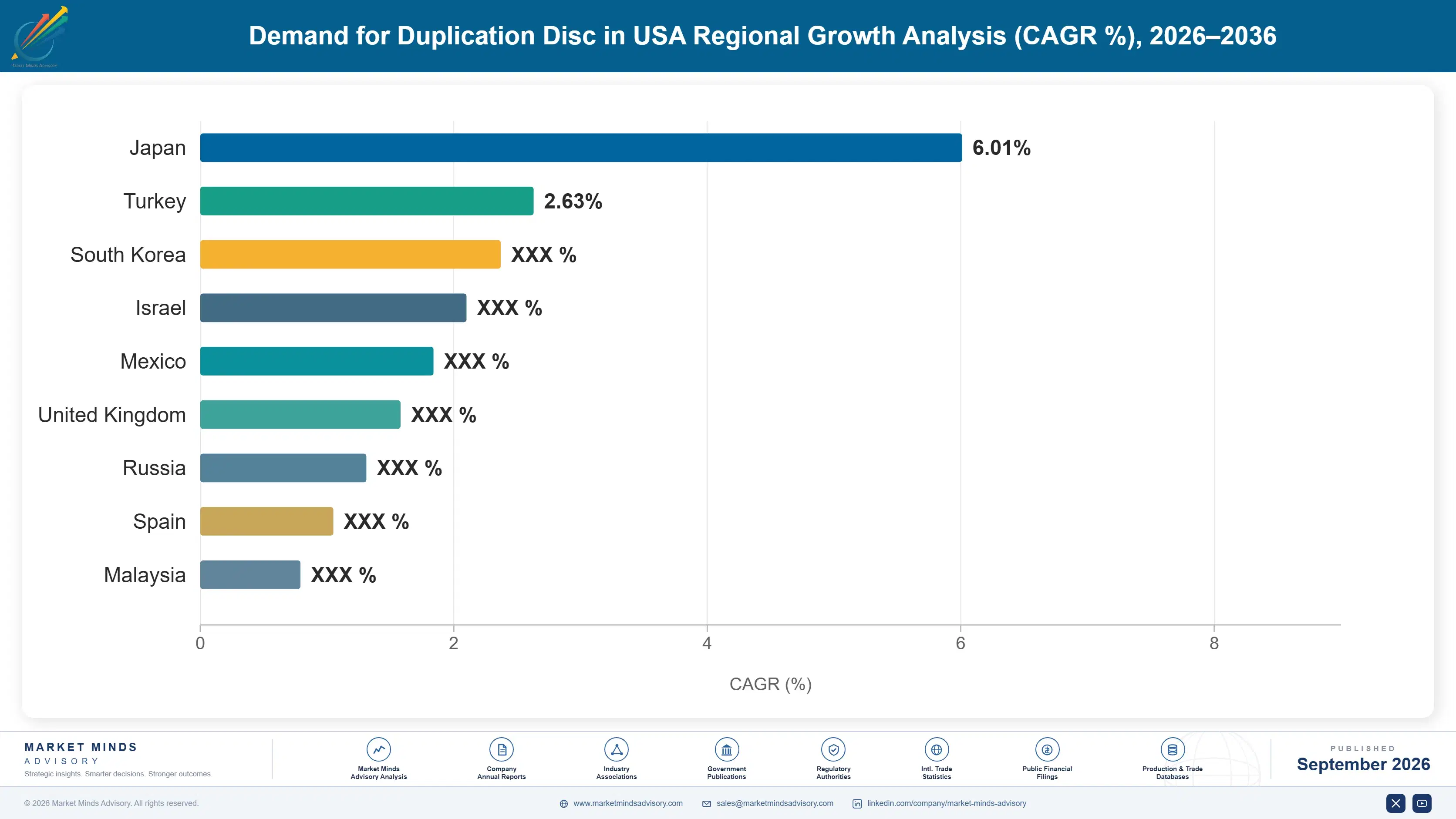
united-states-duplication-disc-market-country-cagr-analysis-1788454071252

Competitive Moat and Risk Dimensions

DELUXE ENTERTAINMENT SERVICES

Moat: Deep Studio and Institutional Relationships

Deluxe benefits from decades of embedded relationships across major entertainment studios and government archives, reinforced by scale advantages and established compliance infrastructure that smaller regional competitors struggle to replicate quickly. This depth of relationship extends well beyond pure manufacturing capacity alone. Few rivals can match this combination.
DELUXE ENTERTAINMENT SERVICES

Risk: Fixed Costs Strain Declining Volume

Deluxe's substantial fixed manufacturing capacity, built during higher-volume years, faces rising per-unit costs as consumer segment orders continue shrinking, pressuring margins unless offset by continued archival segment growth. Younger institutional buyers increasingly weigh this cost structure during vendor selection decisions. This gap widens as archival segment growth fails to offset consumer decline.
IRON MOUNTAIN

Moat: Broad Records Management Integration

Iron Mountain's core records management business gives it deep existing relationships with healthcare and government archival buyers, allowing it to cross-sell disc duplication services into an already-trusted compliance-focused customer relationship. This integration advantage strengthens further as buyers consolidate vendor relationships overall. Few rivals can match this scale.
IRON MOUNTAIN

Risk: Limited Specialty Segment Presence

Iron Mountain's institutional focus leaves it comparatively weak in the independent creator and specialty distribution segment, ceding this smaller but durable niche to more agile regional specialists entirely. This gap widens further as creator-focused buyers seek specialized turnaround capability. This gap widens as niche buyers value flexibility over institutional scale.

Players Tracked

Prominent Players

Deluxe Entertainment Services
Sony DADC
Technicolor
Iron Mountain
DiscMakers

Other Key Players

Nationwide Disc
CD Universe Manufacturing
Rainbo Records
Crystalclear Disc Media
OASIS Disc Manufacturing
Nimbus Manufacturing
United Media Corp
American Digital Media
Sound Performance Duplication
Kunaki
GZ Media
Vervante
Media Distribution Solutions
Digital Media Services USA
Archive Disc Solutions

Recent Developments

JANUARY 2026

Deluxe Launches Certified Archival Blu-ray Program

Deluxe introduced a formally certified archival-grade Blu-ray duplication program targeting healthcare and government institutional buyers, extending its compliance documentation capability to address rising demand for validated long-term data integrity standards across regulated industries. The program launched initially across three major regional production facilities before expanding nationwide later this year.
Signal: Signals accelerating incumbent response to institutional certification requirements tightening across most regulated buyer categories nationwide currently.
AUGUST 2025

Iron Mountain Acquires Regional Duplication Specialist

Iron Mountain acquired a regional disc duplication specialist to expand its physical media capability alongside its core records management business, strengthening its ability to offer bundled archival and duplication services to shared institutional accounts nationwide. Financial terms of the transaction were not publicly disclosed by either participating organization involved.
Signal: Signals consolidation accelerating as records management and duplication services converge commercially across shared institutional accounts nationwide.
APRIL 2025

DiscMakers Signs Distribution Agreement With Streaming Platform

DiscMakers signed a cross-promotional distribution agreement with an independent music streaming platform to bundle physical disc offerings with digital release campaigns, expanding its reach among independent musicians seeking hybrid physical and digital distribution strategies. Financial terms of the partnership were not publicly disclosed by either participating organization involved.
Signal: Signals specialty vendors building hybrid physical-digital positioning to sustain durable independent creator demand nationwide over time.

Polycarbonate and Precision Manufacturing Exposure

Polycarbonate resin, the primary raw material for optical disc substrates, represents roughly 35 percent of cost of goods sold for duplication vendors, with archival-grade formulations commanding a meaningful premium over standard consumer-grade resin. Most polycarbonate supply originates from a concentrated group of global petrochemical manufacturers. This concentration creates meaningful supply chain risk for smaller duplication vendors dependent on a narrow set of qualified resin suppliers nationwide.
Polycarbonate pricing rose noticeably during 2024 and 2025 amid petrochemical feedstock cost volatility, with unit pricing increasing by roughly 14 percent within a single fiscal year according to industry disclosures from major resin manufacturers. Vendors without secured supply contracts absorbed meaningfully compressed margins during this period, particularly smaller regional players. This dynamic reshaped vendor procurement strategy meaningfully during the affected period across most manufacturing facilities.

This cost exposure disadvantages smaller regional duplication vendors most severely, since they typically lack the purchasing scale and multi-year supply contracts that established incumbents negotiate directly with resin manufacturers. Vendors serving archival-grade certification markets face additional exposure given the premium formulations those buyers require for documented long-term data integrity. Vendors sourcing through diversified regional supplier relationships face somewhat different exposure given varying petrochemical policy incentives.
united-states-duplication-disc-market-company-positioning-matrix-1788454071448

Negotiate Multi-Year Resin Supply Contracts

Vendors committing to multi-year polycarbonate purchasing volumes secure more predictable unit pricing from resin manufacturers, insulating margin from short-term feedstock volatility that smaller competitors without similar scale cannot avoid as easily. This approach also strengthens vendor relationships that pay dividends during future feedstock volatility periods. This dynamic favors vendors with established resin manufacturer relationships built over successive years.

Consolidate Manufacturing Across Fewer Facilities

Vendors consolidating production across fewer, higher-utilization manufacturing facilities reduce per-unit fixed costs as overall industry volume declines, though this consolidation requires careful workforce and logistics planning to avoid service disruption. Vendors pursuing this strategy typically build stronger cost resilience against ongoing consumer volume decline. This dynamic favors vendors willing to make difficult consolidation decisions ahead of smaller competitors.

Shift Toward Archival-Grade Premium Formulations

Vendors emphasizing archival-grade formulations command sufficient price premium to offset raw material cost pressure, since institutional buyers value certified data integrity performance over marginal unit cost differences typical of consumer-grade orders. Vendors executing this well maintain healthier margins even as raw material costs continue rising. This dynamic favors vendors already positioned within institutional archival and enterprise buyer segments.

Portfolio Architecture for Margin Defence

Duplication vendors operate across three margin tiers, from basic consumer CD-R duplication carrying thin unit economics through certified archival Blu-ray services commanding meaningfully stronger margin, up to compliance consulting and custom packaging bundle systems capturing the richest gross margins in the category. Volume tiers monetize through bulk unit sales, while premium tiers monetize through certification depth and compliance service bundling.
Tension persists between volume decline management, which favors consolidating fixed manufacturing costs across surviving consumer-facing production runs, and premium positioning, which favors archival certification and compliance consulting commanding materially higher willingness to pay among institutional accounts. Vendors chasing both simultaneously risk diluting brand positioning across a fragmented buyer base. Larger institutional buyers increasingly demand both, forcing vendors to segment portfolios more deliberately by customer tier.

High-value margin pools concentrate in archival certification and compliance consulting, both commanding meaningfully higher gross margin than basic consumer duplication sold without additional capability bundling. Vendors building durable institutional relationships and certification capability capture disproportionate margin relative to their unit volume across the broader competitive landscape today. Vendors ignoring this shift risk ceding the most profitable accounts to faster-moving specialist rivals.

Basic Consumer CD-R Duplication

Standardized CD-R duplication sold at competitive pricing to remaining consumer and small business buyers prioritizing baseline capability over certification, carrying thin unit economics but broad reach nationwide. nationwide, reflecting steady but unremarkable demand growth across most remaining consumer buyer categories.
Gross Margin: 14-22%

Certified Archival Blu-ray Services

Certified archival Blu-ray duplication bundling documented data integrity testing and compliance support, commanding stronger recurring revenue and materially higher gross margin than standard consumer-grade duplication runs. across healthcare and government institutional accounts nationwide.
Gross Margin: 36-46%

Compliance Consulting And Packaging Bundle Systems

Integrated offerings bundling compliance consulting with custom archival packaging and finishing, carrying the richest margin profile in the category given urgent institutional demand and expanding buyer willingness to pay. across institutional and specialty creator accounts nationwide.
Gross Margin: 44-56%
united-states-duplication-disc-market-cost-volatility-analysis-1788454071947

High-value Sub-segments and Strategic Watch-out

Blu-ray Archival and Data Duplication Services

Fastest-growing and highest-value segment, combining strong pricing power with accelerating adoption as institutional buyers migrate away from lower-capacity formats toward superior archival data density nationwide this cycle. Institutional certification requirements further support this segment's continued expansion pace nationwide. across most institutional buyer categories nationwide currently.

On-Demand Short-Run Digital Duplication Services

High-value segment with strong growth, anchored by independent creator demand for flexible low-minimum orders, though larger institutional buyers' budgets remain concentrated in traditional bulk archival contracts nationwide. This segment remains a dependable revenue base even as bulk order volume declines. across most creator and enterprise accounts nationwide overall.

CD-R Audio and Data Duplication Services

Volume core of the market, delivering steady deployment counts and modest margin, serving as the primary entry point into certification services and eventual archival format upgrade adoption nationwide. Vendors use this tier to build trust before upselling into higher-margin offerings. continuously across most remaining consumer channels nationwide.

Mass Disc Replication High-Volume Glass Mastering

Strategic watch-out segment facing steepest consumer volume decline as broader entertainment purchasing shifts away from bulk physical media, requiring vendors to consolidate capacity and pursue niche differentiation. Vendors executing consolidation well preserve profitability even as this segment shrinks further. across most surviving production facilities nationwide overall.

Compliance Contracts Anchor Recurring Vendor Revenue

Institutional disc duplication increasingly behaves like an annuity business rather than a project sale. Healthcare systems and government agencies sign multi-year duplication and compliance consulting contracts tied to ongoing archival requirements, and certification renewals lock vendors into recurring revenue streams that compound as data volumes expand. This shifts vendor valuation toward retained institutional relationships rather than one-time consumer duplication run volume, rewarding vendors with durable compliance expertise over pure manufacturing scale.
Adoption stickiness varies sharply by end-use vertical. Healthcare and government accounts integrate duplication vendors deeply into compliance workflows, making switching costs prohibitive once certification and audit documentation are complete across their institutional programs. Independent creators and consumer buyers show shallower stickiness, often price-shopping between vendors for each individual order given the transactional nature of specialty and consumer duplication purchases, keeping competitive pressure alive at that end of the market.

Buyer profiles are shifting generationally as procurement teams increasingly favor vendors offering integrated compliance consulting over legacy transactional duplication relationships built around pure unit pricing. Younger institutional buyers prioritize documented data integrity and audit-ready certification over the incumbent vendor relationships that shaped prior purchasing cycles, gradually eroding legacy negotiating leverage and opening room for newer entrants offering specialized compliance capability.
Section default visual

Where Duplication Vendors Should Focus Next

These are among the four positions where our research anticipates prominent divergence between winners and laggards over the coming forecast period. Each is grounded in the demand model, the regulatory perimeter, and the announced capacity pipeline.
01 / ARCHIVAL CERTIFICATION CAPABILITY

Build formal archival format certification programs now

Blu-ray archival duplication is the fastest-growing segment in this market, expanding at 7.5 percent annually against a category average of 3.8 percent, roughly 1.97 times the overall rate. Vendors building formal certification capability now capture disproportionate share of institutional contract renewals tied to healthcare and government compliance requirements across the country and its regions. Waiting risks ceding this segment permanently to faster-moving specialists already active nationwide across most institutional accounts and healthcare systems currently expanding rapidly across most regional markets nationwide.
02 / COMPLIANCE CONSULTING SERVICES

Expand compliance consulting depth for regulated buyers

Healthcare and government buyers increasingly value consulting support that helps them design compliant archival duplication programs rather than simply fulfilling routine unit orders across their entire institutional footprint nationwide and abroad. Vendors deepening compliance consulting now build trusted partner relationships that compound as regulatory complexity increases across successive contract renewal cycles nationwide and internationally. This capability gap will widen further as data retention regulation tightens across the forecast period ahead for every participating vendor in the broader category nationwide today.
03 / MANUFACTURING CONSOLIDATION STRATEGY

Consolidate production capacity ahead of further decline

Consumer entertainment disc volume continues declining steadily, and vendors with fixed manufacturing capacity built during higher-volume years face rising per-unit costs as production runs shrink across most remaining facilities nationwide currently and increasingly rapidly. Vendors consolidating capacity now secure more favorable cost positions ahead of continued volume erosion across the broader consumer segment nationwide and internationally. Vendors that delay these decisions risk facing structurally worse margins during the next several fiscal years across their remaining production facilities nationwide and abroad.
04 / HYBRID CLOUD BUNDLING

Bundle physical duplication with cloud redundancy offerings

Institutional buyers migrating toward hybrid archival strategies increasingly value vendors offering bundled physical and cloud storage redundancy rather than standalone physical media services offered alone today across most segments. Vendors building these bundled offerings now position themselves as complementary to cloud migration trends rather than losing ground entirely to competing cloud storage providers nationwide and internationally. Competitors that delay this positioning risk losing institutional accounts to vendors offering more complete archival solutions across the broader category nationwide and abroad today.

Engagement Snapshot From the Field

A live engagement with an industry participant carrying material or product regulatory and market exposure ahead of a defining policy shift, showing how our research translates into a defensible multi-year portfolio strategy.
MARKET MINDS ADVISORY · CLIENT ENGAGEMENT SUMMARY
Demand for Duplication Disc in USA Producer Strategic Portfolio Review and Transition Roadmap 2026·Investment Scenario on Demand for Duplication Disc in USA Exposure Evaluation 2025-26
CLIENT PROFILE
The client is a mid-sized regional healthcare system operating across several hospitals in the southeastern United States, managing extensive patient imaging and records archives under federal data retention regulation. Facing an upcoming vendor contract renewal cycle, the system's IT compliance leadership sought an independent assessment of disc duplication vendor options before committing to a new multi-year agreement.
STRATEGIC CHALLENGE
The health system's existing duplication vendor lacked formal archival certification documentation, raising concerns among compliance staff about whether current media formulations would meet long-term data integrity requirements under evolving federal retention standards across the system's growing imaging archive. Leadership also faced pressure to minimize disruption to ongoing patient imaging and records processing workflows during any vendor transition.
MMA APPROACH
MMA conducted a structured vendor capability assessment spanning five leading duplication suppliers, benchmarking archival certification depth, compliance consulting capability, and total cost of ownership against the health system's specific regulatory requirements, including projected multi-year budget implications across the full contract renewal period. The assessment also incorporated interviews with compliance staff across each participating hospital's records management team.
KEY FINDINGS
  1. Two of five evaluated vendors offered fully documented archival certification meeting the health system's regulatory compliance requirements without exception. This eliminated three vendors from further consideration early in the process.
  2. Total cost of ownership estimates varied by roughly 24 percent (client-reported, unverified by MMA) across vendors offering functionally comparable duplication capability. across vendors offering comparable duplication capability.
  3. Compliance consulting depth varied significantly, with only two vendors offering dedicated healthcare regulatory expertise beyond basic duplication services. This distinction proved decisive for the health system's final selection.
  4. Smaller regional healthcare systems in similar compliance-heavy environments showed measurably higher switching costs once initial vendor relationships were established. This underscored the value of early engagement well ahead of renewal deadlines.
CLIENT PROFILE
The client is a mid-sized regional healthcare system operating across several hospitals in the southeastern United States, managing extensive patient imaging and records archives under federal data retention regulation. Facing an upcoming vendor contract renewal cycle, the system's IT compliance leadership sought an independent assessment of disc duplication vendor options before committing to a new multi-year agreement.
STRATEGIC CHALLENGE
The health system's existing duplication vendor lacked formal archival certification documentation, raising concerns among compliance staff about whether current media formulations would meet long-term data integrity requirements under evolving federal retention standards across the system's growing imaging archive. Leadership also faced pressure to minimize disruption to ongoing patient imaging and records processing workflows during any vendor transition.
MMA APPROACH
MMA conducted a structured vendor capability assessment spanning five leading duplication suppliers, benchmarking archival certification depth, compliance consulting capability, and total cost of ownership against the health system's specific regulatory requirements, including projected multi-year budget implications across the full contract renewal period. The assessment also incorporated interviews with compliance staff across each participating hospital's records management team.
KEY FINDINGS
  1. Two of five evaluated vendors offered fully documented archival certification meeting the health system's regulatory compliance requirements without exception. This eliminated three vendors from further consideration early in the process.
  2. Total cost of ownership estimates varied by roughly 24 percent (client-reported, unverified by MMA) across vendors offering functionally comparable duplication capability. across vendors offering comparable duplication capability.
  3. Compliance consulting depth varied significantly, with only two vendors offering dedicated healthcare regulatory expertise beyond basic duplication services. This distinction proved decisive for the health system's final selection.
  4. Smaller regional healthcare systems in similar compliance-heavy environments showed measurably higher switching costs once initial vendor relationships were established. This underscored the value of early engagement well ahead of renewal deadlines.
RECOMMENDED STRATEGY
Phase 1: Phase one prioritized vendor shortlisting based on documented archival certification and healthcare compliance consulting track record. across the health system's full hospital network. Phase 2: Phase two structured contract negotiation around phased certification verification milestones rather than flat annual service fees alone. tied to documented compliance milestones. Phase 3: Phase three established ongoing performance benchmarking against evolving federal data retention requirements to protect continued regulatory compliance nationwide. across subsequent renewal cycles.
OUTCOME
The health system selected a vendor offering strong archival certification and compliance consulting depth, completing certification verification within three months and reporting improved audit readiness (client-reported, unverified by MMA). Leadership credited the structured vendor comparison with avoiding a costlier, less compliant platform choice originally under serious consideration.

Frequently Asked Questions

Foundational context covering the market sizes, CAGR, scope, country, region and competition that inform every finding below. This section is provided to cover basics and most often pre-purchase conversations, answered from the MMA Primary Research Dataset.

What is the current size of the Demand for Duplication Disc in USA?

The market reached 0.31 billion dollars in 2025, sustained by archival, healthcare, and government demand even as consumer entertainment purchasing shifted almost entirely to streaming nationwide.

How large will the Demand for Duplication Disc in USA be by 2036?

MMA projects the market will reach 0.46 billion dollars by 2036, growing modestly as archival and enterprise demand offsets continued consumer volume decline across most regional markets nationwide.

What is the CAGR for the Demand for Duplication Disc in USA 2026 to 2036?

The base case CAGR is 3.8 percent, with a bull scenario of 5.0 percent and a bear scenario of 2.6 percent depending on institutional archival adoption pacing.

Which segment is growing fastest?

Blu-ray Archival and Data Duplication Services leads at 7.5 percent CAGR, roughly 1.97 times the overall market rate, driven by superior data density and longevity.

Who are the major companies in the Demand for Duplication Disc in USA?

Deluxe Entertainment Services, Sony DADC, Technicolor, Iron Mountain, and DiscMakers lead the market, reflecting deep institutional relationships built over decades of continuous compliance-focused service nationwide.

Which country is growing fastest?

The United States itself leads within this report's defined scope, expanding at 5.5 percent annually as institutional archival demand offsets consumer volume decline across most regional markets nationwide.

Report Segmentation Architecture

The full report scope spans multiple orthogonal segmentation dimensions, with cross-tabulated demand data provided for each dimension pair. Coverage extends further to regional breakdowns, trend trajectories, and the competitive detail needed to support segment-level decision-making.

By Disc Format and Duplication Technology

    By End-Use Buyer Category

      By Commercial Service Model

        By Region

        • North America
        • Western Europe
        • East Asia
        • South Asia and Pacific
        • Latin America
        • Middle East and Africa
        • Eastern Europe

        Scope, Methodology, and Coverage

        Every figure in this report is reproducible from documented input assumptions. The scope below maps the historical period, the forecast horizon, the segmentation dimensions, and the countries covered, alongside the underlying primary and qualitative methodology.
        Historical Period
        2020 to 2025
        Forecast Period
        2026 to 2036
        Base Year
        2025 (USD billions; MMA Primary Research Dataset, September 2026)
        Market Definition
        This report covers commercial CD, DVD, and Blu-ray disc duplication and replication services in the United States, including archival data duplication, enterprise distribution, and specialty audio and video production runs. It excludes streaming media services, digital-only distribution platforms, and consumer at-home disc burning equipment.
        Quantitative Units
        USD billions, market share percentages, CAGR percentages
        Segmentation Dimensions
        Disc format and duplication technology, end-use buyer category, commercial service model
        Regions Covered
        North America, Western Europe, East Asia, South Asia and Pacific, Latin America, Middle East and Africa, Eastern Europe
        Countries Covered
        United States, with regional benchmarking context across North America, East Asia, Western Europe, South Asia and Pacific, Latin America, Middle East and Africa, and Eastern Europe
        Key Companies Profiled
        Deluxe Entertainment Services, Sony DADC, Technicolor, Iron Mountain, DiscMakers, and 15 additional participants
        Quantitative Methodology
        Primary survey, n=3,800 respondents, Q4 2025, six countries; demand-side model with trade association cross-validation
        Qualitative Methodology
        47 expert interviews, Q4 2025; applied to validate demand model assumptions, identify emerging dynamics, and assess competitive positioning
        Report Format
        PDF and XLSX data workbook (Word format preview document)
        Publisher
        Market Minds Advisory
        Report Code
        MMA-2026-TEC-377
        Published
        September 2026
        Contact
        sales@marketmindsadvisory.com | www.marketmindsadvisory.com

        Purchase the full Demand for Duplication Disc in USA Report (2026 to 2036).

        This full report delivers comprehensive analysis of the United States disc duplication market. It covers vendor competitive positioning, archival certification trends, and institutional buyer procurement patterns shaping demand nationwide. The report includes detailed segmentation across disc formats, buyer categories, and service models, alongside a proprietary MMA primary survey of institutional and specialty buyer decision-makers spanning multiple regions. Analysts detail margin economics, cost exposure, and competitive dynamics shaping vendor positioning across the category. Strategic recommendations guide vendors navigating this bifurcated category through 2036 and beyond, with attention to institutional certification economics.
        Full seven-region data tables and CAGR breakdowns
        Complete company profiles for twenty market participants
        Primary survey dataset covering 3,800 respondents nationwide
        Expert interview findings from 47 industry specialists
        Editable data tables in spreadsheet format included
        Quarterly market update subscription available separately

        Built For The People Who Decide

        From boardroom strategy to bench-side execution, this report is read cover-to-cover by leaders shaping the next decade of their industry, turning demand scenarios, market dynamics and valuation benchmarks into decisions.
        CXOs/ Presidents/ VPs/ Managers
        M&A and Corporate Development
        Strategy Teams and R&D Heads
        Procurement and Product Directors
        Regulatory and Compliance Leaders
        Investor Relations and Equity Analysts