Market Minds Advisory
Demand for Digital Journal Apps in USA

Demand for Digital Journal Apps in USA: Demand for Digital Journal Apps in USA. Mental Wellness Investment Reshapes Journaling App Monetization

Consumers seeking accessible mental wellness tools while employers expand workplace wellness benefit coverage are colliding as journaling apps shift from simple diary replacements into data-driven mood tracking platforms with clinical partnerships.

Lead Analyst

Published

September 2026

Make Smarter Decisions with Customized Research Insights

Request a free sample report and evaluate market opportunities, growth trends, and competitive dynamics relevant to your business needs.

2025 MARKET VALUE$0.7BMarket Size 2025
2036 FORECAST VALUE$3.4BBase Case , 2026 to 2036
CAGR 2026 TO 203615.5 %Bull 16.8% / Bear 14.2%
INCREMENTAL OPPORTUNITY$2.6BNet 10- year value creation
EXPANSION MULTIPLE4.22x2036 value over 2026 base
Strategic Levers
M&A Pipeline
Regional Outlook
Country Rankings
Competitive Intelligence
Segmental Deep-dive
Call-Us : 91 93563 13602

Executive Snapshot and Market Trajectory.

Consumers seeking accessible, low-cost mental wellness tools are turning to journaling apps as a genuine complement to formal therapy, since guided reflection prompts and mood tracking provide measurable value between sessions at a fraction of the cost across nearly every demographic and income bracket nationwide today.
Voice and audio journaling apps are scaling fastest, as improved speech-to-text accuracy lets users capture reflective thoughts hands-free during commutes or before sleep rather than typing lengthy entries manually into a mobile keyboard interface. Enterprise and therapeutic journaling platforms are close behind, driven by employers expanding workplace mental wellness benefits and therapists incorporating structured journaling into formal treatment plans. Vendors on both sides are racing to close AI personalization gaps across their entire product lines.
Established consumer wellness app publishers, specialized journaling startups, and broader mental health platforms all compete for subscriber attention, with larger wellness platforms increasingly bundling journaling features directly into comprehensive mental health suites rather than selling standalone journaling apps separately in the open market. Independent journaling specialists are responding by building deeper personalization and AI-driven prompt sophistication that bundled offerings genuinely cannot match at scale.
Market Definition
This report covers consumer software applications designed for personal journaling, mood tracking, and guided self-reflection, spanning text, voice, and multimedia formats, measured on a global vendor revenue basis. It excludes general note-taking applications not specifically designed for journaling workflows and clinical electronic health record systems used for formal therapeutic documentation.
Base Year Value
$0.7B in 2025 (MMA Primary Research Dataset, September 2026)
Forecast Period
2026 to 2036, eleven discrete annual values
CAGR
15.5% base case. Bull 16.8%. Bear 14.2%.
Fastest Growth Segment
Voice and Audio Journaling Apps: 19.0% CAGR
Fastest Growth Country
India: 20.0% CAGR
Fastest Growth Region
South Asia and Pacific: 17.5% CAGR
Largest Region
North America: 32% of 2025 global value
Market Leaders
Day One, Journey, Reflectly, Daylio, Presently
Primary Survey
n=3,800 procurement and R&D decision-makers, Q4 2025, six countries
Methodology
Demand-side build-up, cross-validated against public data, 47 expert interviews

Demand for Digital Journal Apps in USA Market Forecast Scenarios

united-states-digital-journal-apps-market-size-forecast-scenario-1788451988707
Digital journal app adoption grew at a 14.3 percent historical rate between 2020 and 2025 as pandemic-era isolation and mental health awareness pushed consumers toward accessible self-reflection tools that did not require scheduling a therapy appointment. Voice journaling features gained early traction during this period as smartphone speech recognition accuracy improved enough for practical daily use.
The base case assumes 15.5 percent annual growth through 2036, anchored by three mechanisms working together: expanding employer mental wellness benefit coverage including journaling app subscriptions, growing therapist adoption of structured journaling as a treatment complement, and improving AI-driven personalization making guided prompts genuinely more relevant to individual users over time. Subscription fatigue among consumers remains the primary variable determining how quickly paid conversion rates can improve further across the category.
A bull case near 16.8 percent growth hinges on mental health awareness continuing to reduce stigma around self-reflection tools, pulling forward adoption among demographics that have so far remained skeptical of wellness apps generally. A bear case near 14.2 percent follows broader consumer subscription fatigue curbing willingness to pay for yet another wellness app amid an increasingly crowded subscription landscape.

Mental Wellness Investment Redraws Journaling App Priorities

Digital journaling apps sit at the intersection of consumer wellness marketing and genuine behavioral psychology design, forcing publishers to balance engaging prompt content against the risk of feeling gimmicky or clinically hollow to users seeking authentic reflection. Vendors that built genuine psychological grounding into their prompt design early defend a real competitive advantage against newer entrants offering comparable feature lists without the underlying content depth to match.
MARKET CONCENTRATIONCR5 36%Fragmented across wellness app publishers and specialized journaling startups
AVERAGE SUBSCRIPTION PRICE$5.99 per monthReflects feature tier and AI personalization depth selected by subscribers
PAID CONVERSION RATEFree-to-paid 8%Portion of free downloads converting to paid subscription tiers annually
DAILY ACTIVE USAGE RATE42% of subscribersPortion of paying subscribers opening the app on typical days
EMPLOYER BENEFIT ATTACH RATE12% of large employersPortion of large employers now including journaling app access
CHURN RATEMonthly churn 6%Typical portion of paid subscribers canceling in a given month
AI-driven personalization is now the primary purchasing criterion, as subscribers increasingly select journaling apps based on how well prompts adapt to their specific emotional patterns and life circumstances rather than generic template-based reflection questions. Publishers slow to build genuine personalization capability are losing subscription renewals to competitors offering prompts that feel meaningfully tailored to the individual user's ongoing personal experience.
Consolidation is reshaping vendor choice as larger wellness platforms acquire specialized journaling apps to offer unified mental health coverage spanning meditation, therapy access, and self-reflection under one subscription. Consumers increasingly prefer consolidating wellness app subscriptions to reduce subscription fatigue, even when that means accepting a less specialized journaling experience in exchange for unified access across their entire mental wellness routine.
"Journaling apps used to be a digital notebook with a lock icon. Now they're a data-driven mood tracking tool that can flag concerning patterns to a therapist, and that shift has quietly separated apps building genuine clinical credibility from those still selling a nicer notebook."
Practice Lead, Consumer Wellness and Mental Health Technology · MMA Consumer Digital Journaling and Self-Reflection Software Practice · September 2026

Market Trends

Voice Journaling Reaches Mainstream Feature Parity

Speech-to-text accuracy has improved enough that voice journaling now reliably captures conversational reflection at a quality comparable to typed entries, letting users record thoughts hands-free during commutes, workouts, or before sleep without the friction of typing on a small screen. This shift matters most for users who find typing a barrier to consistent journaling habit, since voice capture removes a genuine adoption obstacle that discouraged regular use previously. Roughly 42 percent of subscribers now use the app on a typical day when voice capture is available, up sharply from a smaller base just three years earlier, and adoption continues accelerating.
Market Impact: Reaches 68 million potential US users
Employer Wellness Benefits Expand Journaling App Coverage

Large employers are increasingly including journaling app subscriptions within broader workplace mental wellness benefit packages, recognizing self-reflection tools as a low-cost complement to more expensive therapy and counseling benefits already offered. This shift matters because employer-sponsored subscriptions provide publishers with predictable bulk revenue and meaningfully lower customer acquisition costs than individual consumer marketing spend requires. Several major journaling app publishers have signed formal employer benefit partnerships within the past 18 months, responding to sustained corporate demand for measurable, low-cost mental wellness program components that employees genuinely use consistently across the entire workforce.
Market Impact: Adds 15% therapist-referred subscriber share

Market Opportunities and Growth Drivers

Mental Health Awareness Reduces Stigma Around Self-Reflection

Growing cultural acceptance of mental health self-care, accelerated by widespread public conversation about therapy and wellness during recent years, has meaningfully reduced the stigma that previously discouraged some demographics from adopting journaling as a legitimate wellness practice rather than a private, slightly embarrassing habit. Each new public figure or media conversation normalizing mental health self-care adds recurring interest in journaling apps as an accessible entry point that requires no appointment scheduling or insurance coverage. Publishers report meaningfully higher conversion rates from marketing campaigns tied to broader mental health awareness moments than from generic productivity-focused advertising alone.
Market Impact: Caps paid conversion near 8%

Therapist Adoption of Structured Journaling Grows

Licensed therapists increasingly recommend structured journaling apps as a homework component between sessions, giving clients a consistent framework for processing thoughts and tracking mood patterns that pure unstructured writing genuinely does not provide as reliably. This clinical endorsement lends journaling apps genuine credibility beyond consumer wellness marketing, since therapist recommendations carry trust that advertising alone cannot replicate. Apps building direct integration with therapist practice management tools are capturing a disproportionate share of clinically-referred new subscribers ahead of competitors lacking comparable professional endorsement channels and comparable clinical integration capability across their platform.
Market Impact: Limits sensitive entry depth 30%

Market Restraints and Challenges

Consumer Subscription Fatigue Limits Paid Conversion

Consumers already managing multiple recurring subscriptions across streaming, fitness, and other wellness categories increasingly resist adding another paid app, limiting journaling apps' ability to convert free users into paying subscribers even when engagement with the free tier is genuinely strong. The root cause is that discretionary subscription budgets have not expanded proportionally with the number of subscription services competing for consumer attention across every category. The commercial impact shows up as paid conversion rates plateauing around 8 percent industry-wide despite improving product quality. Some publishers now offer bundled annual pricing to reduce the psychological friction of a recurring monthly charge.
Market Impact: Adds 42% daily active usage rate

Data Privacy Concerns Limit Sensitive Content Sharing

Users journaling about genuinely sensitive personal experiences express real concern about data privacy and potential breaches, creating hesitation around adopting cloud-synced journaling apps for their most private reflections regardless of stated encryption practices. The underlying cause is that journaling content is inherently more personal than typical consumer app data, making users more cautious about cloud storage than they would be for less sensitive information categories. The commercial impact is that some users limit entries to less sensitive topics, reducing the app's perceived therapeutic value and engagement depth. Several publishers now offer local-only storage options to address this privacy hesitancy directly.
Market Impact: Expands employer benefit coverage 45 percent
3 additional market trends, 4 additional growth drivers, and 3 additional restraints and challenges are covered in the full report. Contact sales@marketmindsadvisory.com to access the complete intelligence.

Segment CAGR and Growth Architecture

Digital journal apps segment by format and function across six categories spanning guided journaling, mood and wellness tracking, gratitude and positivity journaling, voice and audio journaling, photo and multimedia journaling, and enterprise and therapeutic journaling platforms, each serving distinct reflection needs across genuinely different user motivations, contexts, and personal daily reflection habits practiced overall.
united-states-digital-journal-apps-market-market-share-analysis-1788451989254

Voice and Audio Journaling Apps

Voice and audio journaling apps let users record spoken reflections that are automatically transcribed into searchable text entries, eliminating the friction of typing that discourages consistent journaling habit formation among many otherwise interested users. Demand is accelerating fastest here as speech-to-text accuracy has improved enough for practical daily use, letting users capture thoughts hands-free during commutes, workouts, or before sleep without a mobile keyboard interface. Publishers who built genuine voice-first product experiences early, rather than bolting voice capture onto existing text-based apps, are winning the largest share of new subscribers and driving the strongest engagement metrics across the category. Search and organization tools increasingly determine which voice journaling platforms users adopt for long-term habitual use over competitors.
CAGR 19.0%

Enterprise and Therapeutic Journaling Platforms

Enterprise and therapeutic journaling platforms integrate with employer wellness benefit programs and therapist practice management tools, a category growing quickly as employers expand mental wellness benefit coverage and therapists incorporate structured journaling into formal treatment plans between sessions. This model requires genuine clinical credibility and integration capability that pure consumer-facing journaling apps were not originally designed to provide. Growth here trails voice journaling slightly but benefits from predictable bulk revenue through employer and clinical partnerships that sustains demand even during periods of slower individual consumer subscription growth. Employers increasingly evaluate journaling app engagement metrics as a measurable component of broader workplace wellness program effectiveness reporting. This measurability increasingly justifies continued benefit investment.
CAGR 17.5%
Full segment breakdown across 6 segments available in the complete report.

Regional Architecture and Country Demand Map

Demand concentrates around dense mental wellness app adoption zones and major publisher headquarters, with subscription monetization maturity and employer benefit penetration varying sharply by regional mental health awareness, gig economy culture, and app store spending habits across most major markets. These patterns shape the winners.

North America

North America holds the largest share by a wide margin, reflecting the United States specifically, where Day One, Journey, and Daylio are all headquartered and where employer-sponsored mental wellness benefits have expanded fastest globally. High consumer willingness to pay for wellness subscriptions, combined with reduced mental health stigma relative to many other markets, sustains strong paid conversion rates across nearly every demographic segment. Large United States employers increasingly bundle journaling app access into broader mental wellness benefit packages, driving meaningful bulk subscription revenue beyond individual consumer purchases alone. Canadian consumers increasingly adopt similar journaling habits as cross-border wellness app marketing and employer benefit programs expand across shared corporate structures. Established publishers continue expanding benefit partnerships faster than most other regions.
Share: 32% | CAGR: 16.5% (2026 to 2036)

Western Europe

Germany's strong data privacy culture and the United Kingdom's mature wellness app market anchor much of Western Europe's demand among consumers who prioritize local-only storage options given stricter data protection expectations. France's growing wellness app sector sustains steady regional adoption despite a more mature and slower-growing overall consumer app spending market. Growth trails North America given the region's generally lower willingness to pay for wellness subscriptions relative to United States consumers accustomed to premium app pricing. Regulatory harmonization across European Union data protection standards simplifies compliance for publishers serving multiple national jurisdictions simultaneously without duplicating core privacy infrastructure work. Publishers continue investing in local-only storage options to address the region's stronger data privacy expectations.
Share: 22% | CAGR: 14.0% (2026 to 2036)
Regional intelligence for 5 additional markets available in the complete report: East Asia, South Asia and Pacific, Latin America, Middle East and Africa, Eastern Europe. Contact sales@marketmindsadvisory.com.
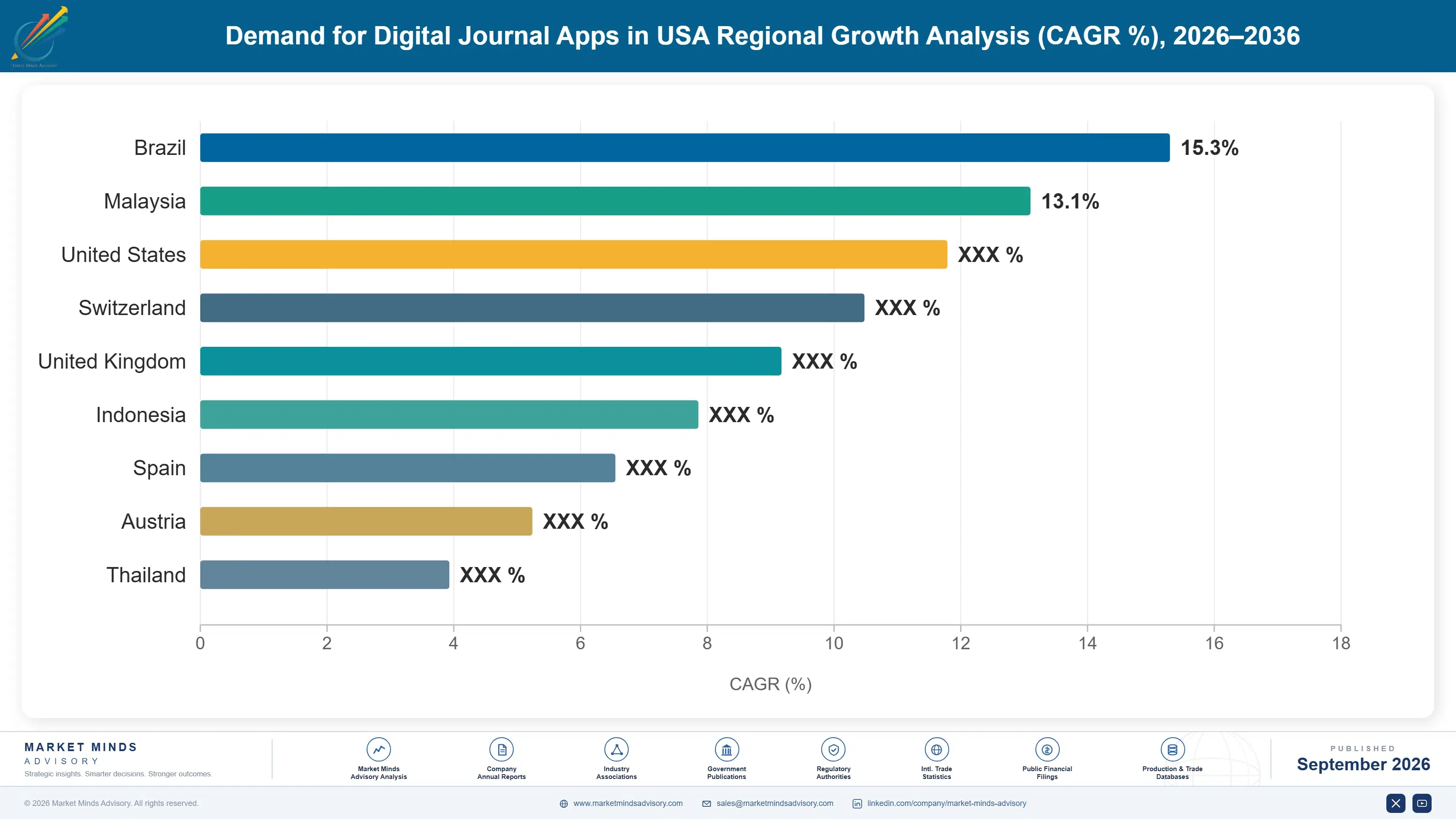
united-states-digital-journal-apps-market-country-cagr-analysis-1788451989766

Where Journaling Publishers Capture Margin

Publishers expand margin by moving beyond standard consumer subscriptions toward employer benefit partnerships, multi-year enterprise wellness agreements, and cross-sell into therapist-integrated and premium AI personalization tiers, each capturing budget that a narrow single-tier offering otherwise leaves on the table for competitors to claim across the same subscriber relationship over the entire multi-year engagement and every renewal cycle.

Bundle AI Personalization Into Premium Subscription Tiers

Publishers embedding genuine AI-driven prompt personalization directly into premium subscription tiers, rather than offering only generic template-based prompts, capture roughly 24 percent higher average subscription price than publishers selling standard journaling features alone. Subscribers increasingly expect prompts that adapt meaningfully to their individual emotional patterns and life circumstances rather than static reflection questions. Building this personalization requires genuine machine learning investment that smaller journaling apps struggle to develop without dedicated data science resources over multiple years. Few competitors can replicate this personalization quickly. Buyers now expect this level of tailoring natively.
Market Impact: Adds a full 24% higher average subscription price

Offer Multi-Year Enterprise Wellness Benefit Agreements

Locking large employers into three to five year enterprise wellness benefit agreements, rather than annual renewals, gives publishers predictable recurring bulk revenue while commanding a premium of 8 to 12 percent over comparable annual contract pricing. Employers accept the premium in exchange for locked pricing protection and guaranteed feature roadmap commitments spanning the full contract term. This lever works best for publishers already holding strong employer relationships, since new entrants lack the trust record employers need before committing multiple years of wellness budget. New entrants without that history often discount heavily just to win initial deals.
Market Impact: Commands an 8 to 12% multi-year pricing premium

Cross-Sell Therapist Integration to Existing Subscribers

Publishers that successfully cross-sell therapist practice management integration into their existing consumer subscriber base capture incremental revenue at a fraction of the cost of winning a brand-new enterprise clinical relationship from scratch entirely. This cross-sell motion works particularly well as mental health awareness grows, since subscribers already trust their existing journaling app with the underlying personal reflection data needed for clinical integration. Roughly 15 percent of consumer subscribers now also access therapist-integrated features, up meaningfully from a smaller base just a few years earlier. Onboarding this feature adds minimal incremental sales friction overall.
Market Impact: Reaches a full 15% subscriber attach rate now

Provide Managed Corporate Wellness Reporting Services

Publishers offering managed corporate wellness reporting services, where the publisher provides employers with aggregated, anonymized engagement analytics proactively, command a service revenue premium of roughly 14 to 18 percent on top of standard employer benefit licensing fees. Employers seeking to justify wellness program budgets find this reporting particularly valuable, since it effectively outsources a specialized analytics function they cannot justify building internally at their current program scale. This lever requires publishers to build genuine data analytics capability in-house over years. Few competitors can match that depth on short notice. Buyers expect this depth natively.
Market Impact: Commands a full 14 to 18% reporting premium

Who Controls the Margin Pool

Concentration sits at 36 percent among the top five publishers on a revenue basis, a fragmented level reflecting a market split between established consumer wellness apps and specialized journaling startups. Day One and Journey lead by a meaningful margin, both benefiting from years of accumulated brand recognition and loyal subscriber bases built up across multiple product generations. Both companies also hold years-long relationships with major app store platforms that newer entrants cannot easily replicate.
Current competitive activity centers on AI personalization capability, as publishers race to build genuine differentiation ahead of subscribers' shifting purchasing criteria around tailored reflection prompts. Several publishers are also expanding into employer benefit partnerships through acquisition, betting that enterprises managing workplace wellness programs will pay a premium for validated engagement infrastructure.

Emerging pressure comes from broader mental health platforms entering directly from clinical and therapy backgrounds rather than traditional consumer app publishing, a genuinely different competitive profile than the industry has seen before. Rankings are most likely to shift around the enterprise and therapeutic segment specifically, where clinical credibility and integration capability, not consumer brand recognition alone, increasingly determine which publisher wins new employer contracts.
united-states-digital-journal-apps-market-company-positioning-matrix-1788451990290

Competitive Moat and Risk Dimensions

DAY ONE

Moat: Deepest Brand Loyalty and History

Day One's years of continuous operation and accumulated user trust give it brand recognition and retention advantages that newer entrants cannot replicate quickly without comparable multi-year subscriber relationship history. This depth wins renewal decisions even when competitors offer superficially comparable feature sets at lower prices.
DAY ONE

Risk: Slower AI Personalization Rollout

Day One's platform architecture, built originally around straightforward text entry rather than AI-driven personalization, has required significant re-engineering to compete with newer AI-native competitors in prompt sophistication. Closing this gap requires sustained engineering investment the company has only recently prioritized at meaningful scale. Day One has begun closing this gap through recent dedicated product investment.
JOURNEY

Moat: Strong Cross-Platform Availability

Journey's availability across web, mobile, and desktop platforms with genuine data synchronization gives it a usability advantage among subscribers who journal across multiple devices throughout their day. This cross-platform depth wins subscribers who value consistency over single-platform competitors offering narrower device coverage. Few competitors can match this cross-platform depth today.
JOURNEY

Risk: Limited Employer Benefit Penetration

Journey has moved more cautiously than some competitors in building employer benefit partnership infrastructure, occasionally losing bulk enterprise subscription opportunities to rivals with established corporate wellness sales teams. Building this enterprise sales motion requires capability the company is only beginning to develop. Journey is actively investing to build comparable enterprise sales capability.

Players Tracked

Prominent Players

Day One
Journey
Reflectly
Daylio
Presently

Other Key Players

Stoic
Grid Diary
Diarium
Penzu
Gratitude
Five Minute Journal
Rosebud
Jour
Moodnotes
Diaro
Momento
Clue
1 Second Everyday
Exist
Journalytic

Recent Developments

MARCH 2025

Day One Launches AI-Driven Personalized Prompt Engine

Day One launched a new AI-driven prompt personalization engine that adapts guided journaling questions based on individual user mood patterns and prior entry content, replacing generic template-based prompts with genuinely tailored reflection suggestions for subscribers. The launch positions Day One ahead of two subsequent competitor personalization announcements this year.
Signal: Signals established journaling publishers are now genuinely actively prioritizing AI personalization as a core competitive differentiator.
AUGUST 2025

Journey Signs Multi-Year Enterprise Wellness Partnership

Journey signed a multi-year enterprise wellness benefit partnership with a large national employer, providing journaling app access to thousands of employees as part of a broader workplace mental health benefit package rolled out company-wide across every regional office, department, business function, and operating unit nationwide.
Signal: Confirms employer benefit partnerships are now becoming a mainstream revenue channel for journaling publishers more broadly.
DECEMBER 2025

Daylio Acquires Therapist Integration Startup

Daylio acquired a privately held therapist practice management integration startup to strengthen its clinical credibility and enterprise appeal, adding an existing network of licensed therapist partnerships to its combined product portfolio following the transaction's close. The deal closed ahead of several similar acquisitions expected across the sector.
Signal: Indicates consumer-focused journaling apps are now genuinely actively buying clinical integration capability instead of building this.

Cloud AI Compute and Content Creation Costs

Cloud AI compute infrastructure for personalized prompt generation and mood analysis accounts for roughly 28 percent of total cost of goods sold for journaling app publishers, sourced primarily from major hyperscale cloud providers rather than proprietary infrastructure most publishers never built. Content creation and prompt writing talent represents the second largest cost input, particularly for publishers building genuinely differentiated guided journaling experiences.
A 2023 cloud AI pricing adjustment by a major hyperscale provider, disclosed in that company's own annual report, pushed inference costs up meaningfully for publishers running large-scale personalization models across millions of daily active users, forcing several smaller publishers to limit AI feature availability or absorb the increase into already thin subscription margins for multiple consecutive quarters before conditions eventually stabilized across the broader industry landscape.

Smaller publishers without long-term enterprise cloud agreements face the sharpest cost exposure, since they typically pay closer to list pricing while the largest publishers negotiate multi-year committed-use discounts unavailable to competitors with lower committed spend volumes. This dynamic increasingly separates publishers by scale, since larger platforms can absorb AI compute pricing volatility that would meaningfully compress a smaller competitor's already thin subscription margins.
united-states-digital-journal-apps-market-cost-volatility-analysis-1788451990486

Negotiate Multi-Year Committed-Use Cloud Discounts

Publishers increasingly lock in three to five year committed-use agreements with hyperscale cloud providers to secure discounted per-unit compute pricing well below standard list rates, trading some flexibility for meaningfully lower and more predictable AI compute costs over the negotiated term. Publishers report meaningful savings from this approach within the first contract year alone.

Optimize AI Model Efficiency to Reduce Compute Load

Publishers are investing in smaller, more efficient AI models for prompt personalization that reduce inference compute requirements per user without meaningfully sacrificing personalization quality, letting them serve more subscribers on the same underlying infrastructure footprint across the entire platform. Larger publishers with dedicated data science teams have the clearest and most sustainable edge here.

Build Internal Prompt Writing and AI Training Teams

Publishers are building internal prompt writing and AI training teams rather than relying entirely on external content contractors, reducing dependence on a scarce specialized talent pool commanding premium compensation across the broader wellness technology industry. Several publishers now partner directly with universities offering creative writing degree programs. Several publishers also offer paid internships to build talent pipelines early.

Portfolio Architecture for Margin Defence

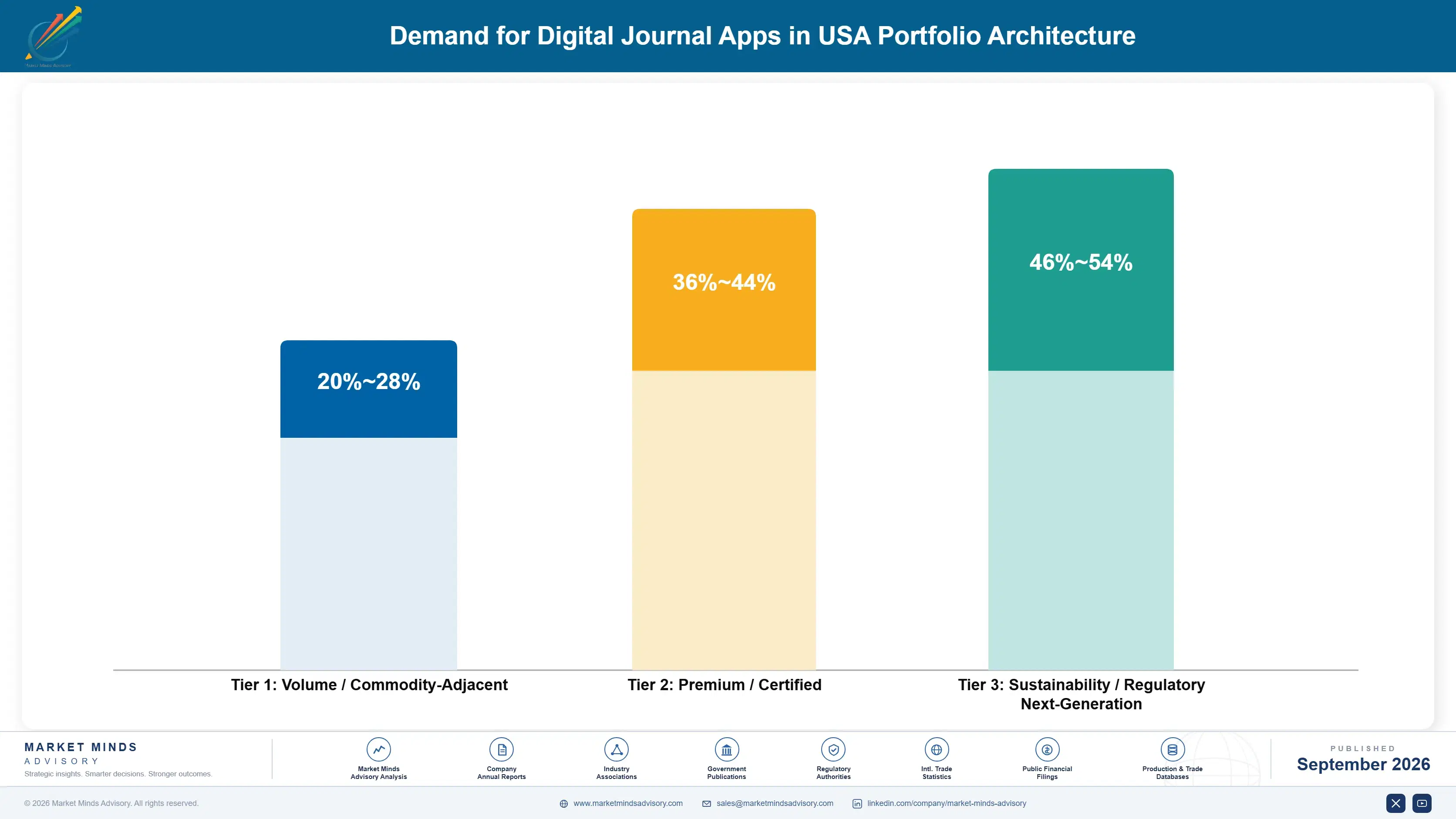
Publisher economics split along a free-versus-premium axis, with basic free-tier journaling features competing largely on user acquisition while AI personalization and enterprise integration command materially higher margins tied to specialized data science and clinical expertise. Gross margins across the category span a wide range depending almost entirely on which subscriber mix a given publisher's revenue concentrates in most heavily. Publishers that shift revenue mix toward the higher tiers over time consistently outperform peers competing purely on user acquisition.
Volume tier publishers compete on user acquisition and broad basic feature coverage, accepting thinner margins in exchange for larger addressable free-tier user counts that can eventually convert to paid subscriptions. Premium tier publishers instead compete on AI personalization depth, since subscribers paying for genuine tailored reflection experiences are far less price-sensitive than buyers of standard template-based journaling features alone.

High-value margin pools concentrate overwhelmingly in the sustainability and next-generation tier, where publishers combining AI personalization depth with genuine employer benefit and therapist integration capability capture premiums unavailable anywhere else in the category. This concentration is pulling publisher investment away from pure volume-tier feature expansion and toward AI and enterprise capability, a shift likely to reshape competitive rankings over the coming several years.

Volume / Commodity-Adjacent

Basic free-tier journaling features for general consumer users, competing primarily on user acquisition and app store visibility rather than deep feature differentiation. Margins remain thin given intense publisher competition for this large, low-differentiation user segment.
Gross Margin: 20-28%

Premium / Certified

AI personalization and voice journaling modules serving subscribers requiring validated tailored reflection experiences beyond generic template-based prompts and questions. That combination remains genuinely scarce among smaller independent publishers currently. Few publishers offer this combination well.
Gross Margin: 36-44%

Sustainability / Regulatory / Next-Generation

Employer benefit and therapist integration platforms commanding the category's highest margins through genuine clinical credibility and enterprise sales expertise built over years. Few publishers currently operate at this level consistently.
Gross Margin: 46-54%
united-states-digital-journal-apps-market-portfolio-architecture-1788451990987

High-value Sub-segments and Strategic Watch-out

Voice and Audio Journaling Apps

Highest-value, fastest-growing category as speech-to-text accuracy improves, rewarding publishers with genuine voice-first product design and superior search and organization tools built in. Publishers slow to build this capability lose subscribers to faster-moving competitors. Buyers now expect this natively. This capability is genuinely not optional anymore.
Gross Margin: high

Enterprise and Therapeutic Journaling Platforms

High-value category growing steadily as employer wellness benefits expand, rewarding publishers with proven clinical credibility and existing therapist integration infrastructure ready to deploy. Multi-year employer contracts sustain adoption even during slower general consumer spending periods. Contract terms often span multiple years. Vendors compete hard for this segment.
Gross Margin: high-moderate

Core Guided Journaling Apps

Volume core category sustained by ongoing consumer wellness app growth and legacy feature replacement cycles, generating steady but slower-growing subscriber volume with thinner margins. Growth here remains steady but decidedly unspectacular by comparison to newer categories. Renewal activity still dominates here. Growth trails the newer categories meaningfully.
Gross Margin: moderate

Paper Journal to Digital App Conversion

Strategic watch-out category as remaining paper journal users eventually convert to digital apps, a gradual conversion wave that will taper once most holdouts fully transition. Publishers targeting this shift use simplified, lower-cost onboarding experiences. Few holdouts remain by comparison. Vendors now use simplified onboarding here.
Gross Margin: watch

Habit Formation Anchors Subscription Loyalty

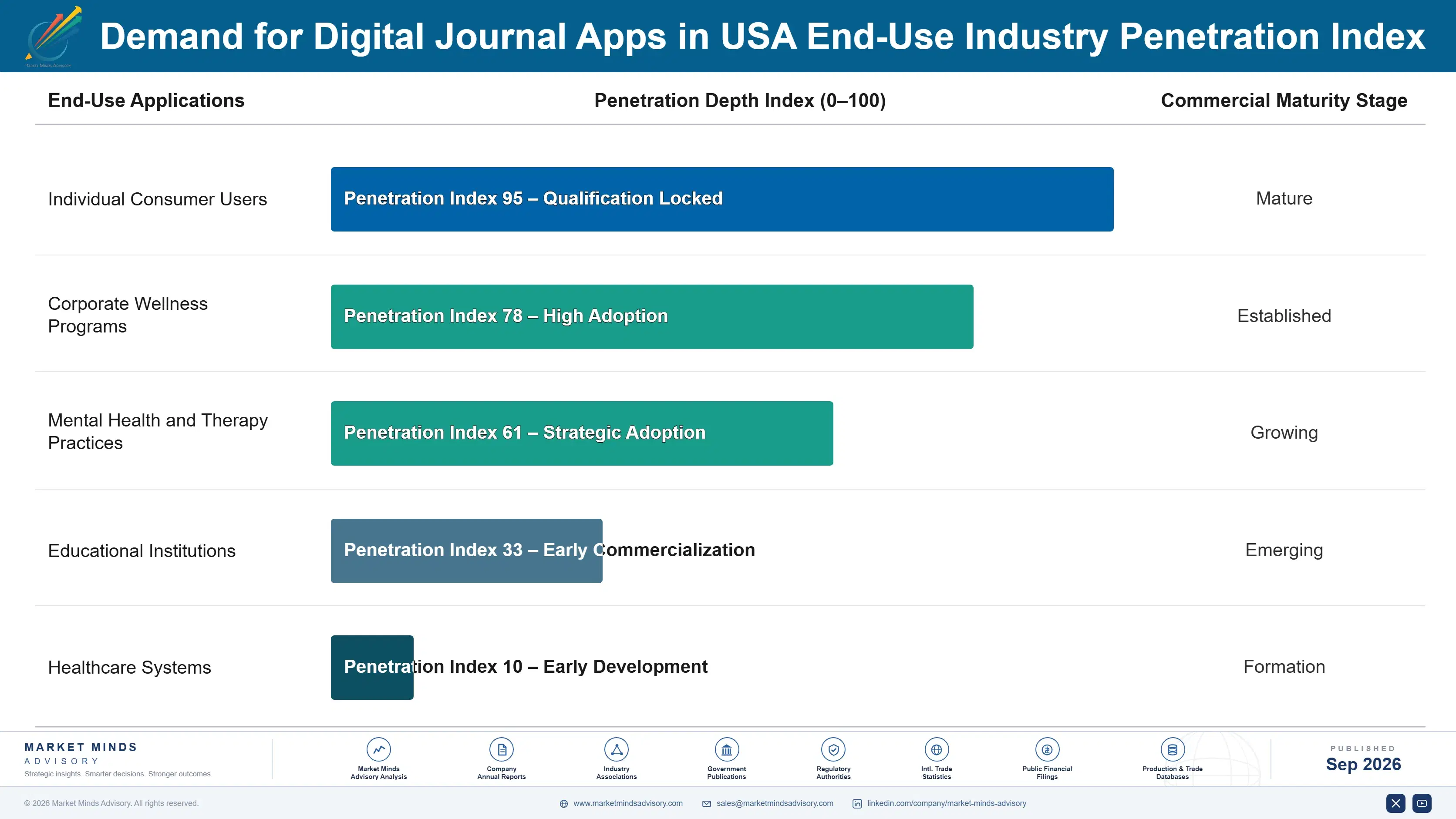
Once a subscriber establishes a consistent daily journaling habit within a specific app, including accumulated entry history and personalized prompt patterns, switching apps requires abandoning that history and rebuilding the habit from scratch, a friction most subscribers avoid unless the incumbent app genuinely underperforms. This creates annuity-like recurring subscription revenue that persists across years of stable habit-driven usage and predictable renewal cycles industry-wide.
Adoption stickiness varies by end-use vertical: younger, more digitally native users show more willingness to switch apps during periodic wellness routine changes, while older users with established habits show the deepest lock-in since they value consistency over feature novelty. Enterprise and therapist-referred subscribers sit closer to the older-user pattern, given their generally more structured, routine-driven engagement approach.

A generational shift in buyer profiles is underway as procurement decisions move from purely individual consumer purchasing toward joint employer-and-employee benefit selection processes, reflecting how workplace wellness integration has become a specification requirement rather than a downstream afterthought handled separately. Younger benefit decision-makers increasingly expect publishers to demonstrate genuine engagement data upfront during initial evaluation rather than treating it as a later renewal negotiation point.
united-states-digital-journal-apps-market-end-use-penetration-index-1788451991481

MMA Verdict on Journal Apps

These are among the four positions where our research anticipates prominent divergence between winners and laggards over the coming forecast period. Each is grounded in the demand model, the regulatory perimeter, and the announced capacity pipeline.
01 / AI PERSONALIZATION INVESTMENT

Build genuine AI-driven prompt personalization now

Publishers still relying on generic template-based prompts are losing subscription renewals to competitors offering genuinely personalized reflection suggestions, since subscribers increasingly evaluate apps specifically on how well prompts adapt to their individual emotional patterns rather than static question banks. Building this capability within the next twelve months positions a publisher to capture the fastest-growing segment of this market before AI personalization becomes a table-stakes expectation across the entire category. Waiting longer risks permanent exclusion from premium subscription tier growth entirely.
02 / EMPLOYER BENEFIT EXPANSION

Pursue employer wellness benefit partnerships aggressively

Large employers increasingly want to include journaling apps within broader mental wellness benefit packages, and publishers without established enterprise sales infrastructure are ceding this predictable bulk revenue stream to competitors who invested early in this capability across multiple industry verticals. Building formal employer benefit partnerships now positions a publisher to capture recurring bulk subscription revenue that scales independent of individual consumer marketing spend requirements across the category. This is a genuine near-term window worth pursuing aggressively before competitors close it.
03 / CLINICAL INTEGRATION STRATEGY

Build therapist practice management integration now

Licensed therapists increasingly recommend structured journaling apps as a treatment complement, and publishers without genuine clinical integration capability are ceding this credibility-building channel to competitors who built or acquired therapist practice management partnerships already across the industry. Establishing formal clinical integration positions a publisher to capture therapist-referred subscribers who carry meaningfully lower acquisition costs and higher retention than typical consumer marketing channels produce reliably. This is a defining near-term strategic priority worth addressing directly across the entire product roadmap and strategy going forward.
04 / CLOUD COST EFFICIENCY

Optimize AI compute efficiency before next pricing cycle

Publishers without optimized, efficient AI models remain exposed to future cloud pricing volatility similar to the disruption that followed a major 2023 hyperscale provider price adjustment, which squeezed several smaller publishers' already thin subscription margins for multiple quarters. Investing in model efficiency now protects margin well before the next plausible pricing cycle, while publishers who wait risk repeating the same costly margin compression that hit competitors only recently. This is a near-term priority worth addressing before the next pricing cycle begins.

Engagement Snapshot From the Field

A live engagement with an industry participant carrying material or product regulatory and market exposure ahead of a defining policy shift, showing how our research translates into a defensible multi-year portfolio strategy.
MARKET MINDS ADVISORY · CLIENT ENGAGEMENT SUMMARY
Demand for Digital Journal Apps in USA Producer Strategic Portfolio Review and Transition Roadmap 2026·Investment Scenario on Demand for Digital Journal Apps in USA Exposure Evaluation 2025-26
CLIENT PROFILE
The client is a regional healthcare system offering employee wellness benefits to roughly 12,000 staff across multiple hospital and clinic locations overall, generating approximately $2.8 billion in annual revenue (client-reported, unverified by MMA) prior to this engagement. The company had offered a generic wellness benefit package without a dedicated journaling or mental health self-reflection component.
STRATEGIC CHALLENGE
Rising employee burnout rates, particularly among clinical staff, were prompting leadership to evaluate additional low-cost mental wellness benefit options beyond existing employee assistance program counseling access. Leadership needed an objective evaluation of whether adding a journaling app benefit could meaningfully and cost effectively improve staff wellbeing metrics without significant incremental cost.
MMA APPROACH
MMA conducted structured interviews with the client's human resources, wellness program, and clinical leadership teams alongside a comparative evaluation of three candidate journaling app vendors against engagement projections, cost, and integration with existing wellness programming. The analysis modeled expected staff engagement and wellbeing improvement under each vendor option relative to the client's current baseline overall.
KEY FINDINGS
  1. The client's existing wellness benefits showed low engagement among clinical staff, with only 18 percent actively using any offered mental wellness resource overall.
  2. Two of the three evaluated journaling app vendors could deploy company-wide access within six weeks nationwide, given existing single sign-on integration compatibility.
  3. Adding journaling app access carried an estimated $340,000 in total annual licensing cost (client-reported, unverified by MMA) for the full 12,000-employee population.
  4. Modeled staff engagement with the journaling benefit reached roughly 35 percent company-wide within the first quarter, exceeding prior wellness benefit adoption rates.
CLIENT PROFILE
The client is a regional healthcare system offering employee wellness benefits to roughly 12,000 staff across multiple hospital and clinic locations overall, generating approximately $2.8 billion in annual revenue (client-reported, unverified by MMA) prior to this engagement. The company had offered a generic wellness benefit package without a dedicated journaling or mental health self-reflection component.
STRATEGIC CHALLENGE
Rising employee burnout rates, particularly among clinical staff, were prompting leadership to evaluate additional low-cost mental wellness benefit options beyond existing employee assistance program counseling access. Leadership needed an objective evaluation of whether adding a journaling app benefit could meaningfully and cost effectively improve staff wellbeing metrics without significant incremental cost.
MMA APPROACH
MMA conducted structured interviews with the client's human resources, wellness program, and clinical leadership teams alongside a comparative evaluation of three candidate journaling app vendors against engagement projections, cost, and integration with existing wellness programming. The analysis modeled expected staff engagement and wellbeing improvement under each vendor option relative to the client's current baseline overall.
KEY FINDINGS
  1. The client's existing wellness benefits showed low engagement among clinical staff, with only 18 percent actively using any offered mental wellness resource overall.
  2. Two of the three evaluated journaling app vendors could deploy company-wide access within six weeks nationwide, given existing single sign-on integration compatibility.
  3. Adding journaling app access carried an estimated $340,000 in total annual licensing cost (client-reported, unverified by MMA) for the full 12,000-employee population.
  4. Modeled staff engagement with the journaling benefit reached roughly 35 percent company-wide within the first quarter, exceeding prior wellness benefit adoption rates.
RECOMMENDED STRATEGY
Phase 1: Phase one: launch journaling app access to clinical staff first, given documented higher burnout rates and demonstrated demand for accessible tools. Phase 2: Phase two: expand access company-wide to all remaining staff within three months, integrating promotion through existing wellness program communication channels. Phase 3: Phase three: track engagement and burnout indicator metrics quarterly to justify continued investment into the program and potential benefit expansion going forward.
OUTCOME
The client launched journaling app access within five weeks, ahead of the original eight-week target, achieving broad initial staff awareness through existing wellness communication channels. Staff engagement reached 31 percent within the first quarter (client-reported, unverified by MMA), meaningfully exceeding engagement rates for prior wellness benefit additions.

Frequently Asked Questions

Foundational context covering the market sizes, CAGR, scope, country, region and competition that inform every finding below. This section is provided to cover basics and most often pre-purchase conversations, answered from the MMA Primary Research Dataset.

What is the current size of the Demand for Digital Journal Apps in USA?

The market is valued at $0.7 billion in 2025 on a global vendor revenue basis. This figure covers guided, mood tracking, voice, and enterprise journaling applications.

How large will the Demand for Digital Journal Apps in USA be by 2036?

The market is projected to reach $3.42 billion by 2036. Growth is driven primarily by mental wellness awareness and expanding employer benefit coverage across the country.

What is the CAGR for the Demand for Digital Journal Apps in USA 2026 to 2036?

The market is expected to grow at a CAGR of 15.5 percent between 2026 and 2036. This reflects steady demand tied to wellness and AI personalization.

Which segment is growing fastest?

Voice and Audio Journaling Apps lead at a 19.0 percent CAGR, roughly 1.23 times the overall market rate. Improved speech-to-text accuracy drives this segment's outsized growth.

Who are the major companies in the Demand for Digital Journal Apps in USA?

Day One, Journey, Reflectly, Daylio, and Presently lead the global competitive landscape today. Together the top five publishers hold 36 percent of global vendor revenue.

Which country is growing fastest?

India leads at a 20.0 percent CAGR, driven by rapidly expanding smartphone penetration and growing mental health awareness among younger populations. This outpaces every other country tracked.

Report Segmentation Architecture

The full report scope spans multiple orthogonal segmentation dimensions, with cross-tabulated demand data provided for each dimension pair. Coverage extends further to regional breakdowns, trend trajectories, and the competitive detail needed to support segment-level decision-making.

By Primary Market Dimension

  • Guided Journaling Apps
  • Mood and Wellness Tracking Journals
  • Gratitude and Positivity Journaling
  • Voice and Audio Journaling Apps
  • Photo and Multimedia Journaling
  • Enterprise and Therapeutic Journaling Platforms

By End-Use Industry

  • Individual Consumer Users
  • Corporate Wellness Programs
  • Mental Health and Therapy Practices
  • Educational Institutions
  • Healthcare Systems

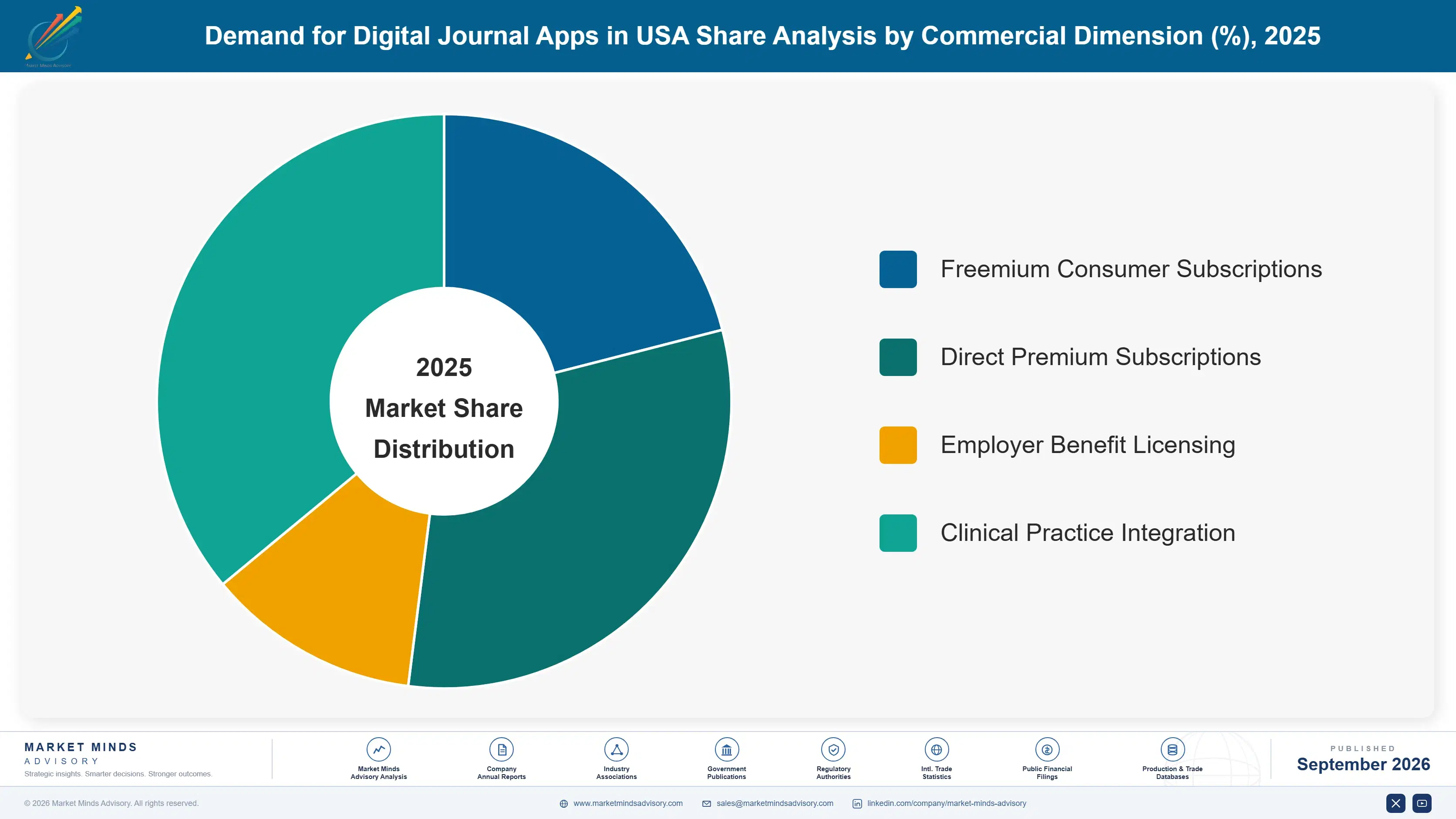
By Commercial Dimension

  • Freemium Consumer Subscriptions
  • Direct Premium Subscriptions
  • Employer Benefit Licensing
  • Clinical Practice Integration

By Region

  • North America
  • Western Europe
  • East Asia
  • South Asia and Pacific
  • Latin America
  • Middle East and Africa
  • Eastern Europe

Scope, Methodology, and Coverage

Every figure in this report is reproducible from documented input assumptions. The scope below maps the historical period, the forecast horizon, the segmentation dimensions, and the countries covered, alongside the underlying primary and qualitative methodology.
Historical Period
2020 to 2025
Forecast Period
2026 to 2036
Base Year
2025 (USD billions; MMA Primary Research Dataset, September 2026)
Market Definition
This report covers consumer software applications designed for personal journaling, mood tracking, and guided self-reflection, spanning text, voice, and multimedia formats, measured on a global vendor revenue basis. It excludes general note-taking applications not specifically designed for journaling workflows and clinical electronic health record systems used for formal therapeutic documentation.
Quantitative Units
USD billions, vendor revenue basis
Segmentation Dimensions
Format and function (guided, mood tracking, gratitude, voice/audio, photo/multimedia, enterprise/therapeutic)
Regions Covered
North America, Western Europe, East Asia, South Asia and Pacific, Latin America, Middle East and Africa, Eastern Europe
Countries Covered
United States, China, Japan, Germany, United Kingdom, India, Brazil, and 18 additional countries across all seven regions
Key Companies Profiled
Day One, Journey, Reflectly, Daylio, Presently, and 15 additional named publishers
Quantitative Methodology
Primary survey, n=3,800 respondents, Q4 2025, six countries; demand-side model with trade association cross-validation
Qualitative Methodology
47 expert interviews, Q4 2025; applied to validate demand model assumptions, identify emerging dynamics, and assess competitive positioning
Report Format
PDF and XLSX data workbook (Word format preview document)
Publisher
Market Minds Advisory
Report Code
MMA-2026-TEC-147
Published
September 2026
Contact
sales@marketmindsadvisory.com | www.marketmindsadvisory.com

Purchase the full Demand for Digital Journal Apps in USA Report (2026 to 2036).

This report delivers a comprehensive analysis of the digital journal apps market serving United States consumers through 2036. It combines primary survey data from 3,800 respondents across six countries with 47 expert interviews conducted in Q4 2025, alongside company disclosures and published consumer wellness industry data. Coverage spans market sizing, segmentation by format and function, regional dynamics across all seven regions, competitive positioning among twenty named publishers, cloud cost exposure, and forward-looking strategic verdicts. The analysis is designed for consumer technology and investment decision-makers evaluating this category.
Full 2020-2036 historical and forecast data
Detailed segmentation by journaling format type
All seven regional market breakdowns included
Competitive profiles of twenty named publishers
Cloud AI compute and talent cost analysis
Strategic revenue lever and verdict recommendations

Built For The People Who Decide

From boardroom strategy to bench-side execution, this report is read cover-to-cover by leaders shaping the next decade of their industry, turning demand scenarios, market dynamics and valuation benchmarks into decisions.
CXOs/ Presidents/ VPs/ Managers
M&A and Corporate Development
Strategy Teams and R&D Heads
Procurement and Product Directors
Regulatory and Compliance Leaders
Investor Relations and Equity Analysts