Market Minds Advisory
Demand for Conversational Commerce in USA

Demand for Conversational Commerce in USA: Demand for Conversational Commerce in USA. AI Chat and Voice-Enabled Transactional Retail Infrastructure

United States retailers are embedding AI chatbots and voice assistants directly into checkout flows as generative AI capability matures, forcing platform vendors and brands to rebuild transactional infrastructure around conversational interfaces nationwide.

Lead Analyst

Published

September 2026

Make Smarter Decisions with Customized Research Insights

Request a free sample report and evaluate market opportunities, growth trends, and competitive dynamics relevant to your business needs.

2025 MARKET VALUE$4.2BMarket Size 2025
2036 FORECAST VALUE$22.5BBase Case , 2026 to 2036
CAGR 2026 TO 203616.5 %Bull 17.8% / Bear 15.2%
INCREMENTAL OPPORTUNITY$17.6BNet 10- year value creation
EXPANSION MULTIPLE4.61x2036 value over 2026 base
Strategic Levers
M&A Pipeline
Regional Outlook
Country Rankings
Competitive Intelligence
Segmental Deep-dive
Call-Us : 91 93563 13602

Executive Snapshot and Market Trajectory.

United States retailers are rebuilding transactional infrastructure around conversational interfaces, moving AI chat and voice capability from customer service adjuncts into primary checkout and discovery channels nationwide. Buyers increasingly expect brands to support natural language product discovery rather than forcing traditional keyword search and category browsing paths.
Fashion, beauty, and consumer electronics retailers concentrate the heaviest near-term platform spending, with major national brands racing to deploy generative AI shopping assistants ahead of the next holiday shopping season as competitors demonstrate measurable conversion improvements across their digital storefronts nationwide. Regional and smaller direct-to-consumer brands follow more gradually, constrained by tighter technology budgets and thinner internal data science capability compared to well-funded national retail accounts overall.
Competition centers on a handful of established messaging and commerce platform vendors defending existing brand relationships against generative AI specialists offering more sophisticated conversational capability, while social platform commerce integration and voice assistant adoption add further momentum to platform investment across the retail industry. Vendors investing in genuinely capable conversational AI, rather than scripted decision trees, are winning brand contracts even as buyers weigh integration complexity against measurable conversion rate improvements.
Market Definition
This report covers software platforms enabling AI chatbot, voice assistant, and messaging-based commerce transactions across retail brands operating in the United States, including product discovery, checkout, and post-purchase support delivered through conversational interfaces. It excludes traditional customer service chatbots without transactional capability and general-purpose AI assistants not commerce-focused.
Base Year Value
$4.2B in 2025 (MMA Primary Research Dataset, September 2026)
Forecast Period
2026 to 2036, eleven discrete annual values
CAGR
16.5% base case. Bull 17.8%. Bear 15.2%.
Fastest Growth Segment
AI Chatbot and Virtual Shopping Assistant Commerce: 24.0% CAGR
Fastest Growth Country
United States: 17.5% CAGR
Fastest Growth Region
South Asia and Pacific: 18.5% CAGR
Largest Region
North America: 30% of 2025 global value
Market Leaders
Salesforce, Meta, Google, Shopify, and LivePerson lead the market. Source: MMA Analysis, July 2026.
Primary Survey
n=3,800 procurement and R&D decision-makers, Q4 2025, six countries
Methodology
Demand-side build-up, cross-validated against public data, 47 expert interviews

Demand for Conversational Commerce in USA Market Forecast Scenarios

united-states-conversational-commerce-market-size-forecast-scenario-1788454054625
United States conversational commerce demand grew steadily through 2020 to 2025 as chatbot-based customer service expanded into transactional territory, though growth accelerated sharply toward the end of that period as generative AI capability matured enough for genuine commerce applications. Early adopter retailers investing during this window built proprietary conversation data that now informs more sophisticated present-day AI shopping assistant deployments.
The base case assumes continued generative AI capability improvement, sustained social platform commerce integration across major messaging apps, and gradual voice assistant adoption as smart speaker ownership expands. Retailers increasingly treat conversational commerce infrastructure as core digital strategy rather than an experimental side channel across the forecast window. Vendors without genuinely capable natural language understanding increasingly struggle to win enterprise brand accounts as retailers formalize evaluation criteria around measurable conversion improvement rather than novelty alone.
A stronger bull case assumes faster consumer adoption of AI shopping assistants pulls forward platform spending well ahead of current projections across leading retail brands. The bear case assumes persistent consumer trust concerns around AI-driven purchasing decisions delay broader adoption, pushing platform vendor revenue growth out by several additional years nationwide. Consumer trust formation will determine which scenario actually materializes across the coming decade nationwide.

Checkout Moves Inside the Conversation Itself

United States retailers are converging on a common conversational commerce thesis: static product pages and traditional checkout flows underperform relative to natural language interfaces that guide shoppers through discovery and purchase decisions. Vendors that fail to demonstrate measurable conversion improvement risk exclusion from brand technology budget entirely. This shift accelerates as consumers grow comfortable delegating routine purchase decisions to capable AI assistants across most product categories.
MARKET CONCENTRATIONCR5 47%Top five vendors hold notable but fragmented platform share
AVERAGE PLATFORM CONTRACT PRICE$95,000Per annual enterprise conversational commerce licensing agreement nationwide
CONVERSION RATE UPLIFT18%Average conversion improvement over traditional checkout flows overall
VOICE COMMERCE PENETRATION22%Of transactions initiated through voice assistant interfaces currently
DEPLOYMENT TIMELINE3-5 monthsTypical duration from contract signing to full launch
MESSAGING PLATFORM ATTACH RATE41%Of brands integrating social messaging commerce channels nationwide
Commercial character in this market favors vendors with genuinely capable natural language understanding and proven conversion improvement track records, since brands weight measurable revenue impact heavily over conversational novelty or interface polish alone. Vendors succeeding here typically maintain dedicated conversion optimization teams that generalist chatbot competitors have not built out. This dynamic increasingly favors vendors with established retail data science relationships over purely feature-driven competitive positioning.
Generative AI capability advancement and social platform commerce integration will shape vendor positioning over the coming decade, alongside evolving consumer trust in AI-driven purchasing recommendations that continues reshaping platform adoption nationwide. Vendors positioning early for these dual pressures capture disproportionate share once broader consumer adoption finally accelerates further. Vendors ignoring these pressures risk losing enterprise brand accounts to faster-moving competitors already building comparable capability.
"The brands winning right now aren't the ones with the flashiest chatbot demo, they're the ones whose assistant actually closes a sale better than a human associate would."
Director, Retail Technology and Commerce Practice · MMA AI-Driven Conversational Retail and Transactional Messaging Platforms Practice · September 2026

Market Trends

Generative AI Shopping Assistants Enter Mainstream Retail Deployment

Retailers are moving beyond scripted decision-tree chatbots toward genuinely generative AI shopping assistants capable of understanding nuanced product questions, comparing options, and completing transactions within a single conversational flow. This capability requires substantially more sophisticated language model infrastructure than earlier rule-based systems, pushing brands toward vendors with proven large language model integration expertise. Vendors building assistants that measurably outperform traditional search and browse experiences on conversion metrics are capturing disproportionate share of enterprise brand contracts across leading national retail categories nationwide. This dynamic rewards vendors with deep large language model infrastructure expertise.
Market Impact: 33 percent deploy before holidays

Social Messaging Platforms Integrate Native Checkout Capability

Major social messaging platforms are integrating native checkout capability directly into chat interfaces, allowing consumers to complete purchases without leaving conversation threads with brands or influencers they already follow. This integration is pulling commerce activity into channels that previously served purely as customer engagement or discovery touchpoints, fundamentally expanding the addressable surface area for conversational commerce. Vendors offering unified integration across multiple messaging platforms simultaneously are capturing disproportionate share of brand technology budget as retailers consolidate vendor relationships nationwide. This dynamic is likely to persist as platforms expand native commerce infrastructure further.
Market Impact: 29 percent of Gen Z

Market Opportunities and Growth Drivers

Holiday Shopping Season Competition Accelerates Adoption Timelines

Retailers view conversational commerce deployment ahead of the critical holiday shopping season as a competitive necessity, given that early data shows measurable conversion improvements over traditional checkout flows during peak demand periods. This seasonal urgency compresses typical enterprise software evaluation and deployment timelines considerably, pushing brands to commit to vendor partnerships faster than usual technology procurement cycles would normally allow. Vendors capable of guaranteeing rapid deployment ahead of seasonal deadlines are capturing disproportionate share of enterprise brand contracts during this compressed decision window nationwide. This urgency shows no signs of easing as competitive pressure intensifies each successive shopping season.
Market Impact: 24 percent avoid AI-driven purchases entirely

Generational Consumer Preference Shifts Toward Conversational Discovery

Younger consumers increasingly prefer conversational product discovery over traditional keyword search and category browsing, reflecting broader generational comfort with AI-driven interfaces across their daily digital interactions beyond shopping alone. This preference shift is pulling retailer investment toward conversational interfaces even in categories where adoption previously lagged, as brands recognize younger shoppers represent a growing share of long-term customer lifetime value. Vendors building conversational experiences tailored to these preferences are capturing disproportionate mindshare among brands targeting younger demographic segments nationwide. Vendors that build this positioning early capture disproportionate influence over how these consumers form lasting brand loyalty.
Market Impact: 19 percent report integration delays annually

Market Restraints and Challenges

Consumer Trust Concerns Limit AI-Driven Purchase Adoption

Many consumers remain hesitant to trust AI-driven purchasing recommendations for higher-consideration or higher-value items, preferring conversational assistants only for routine reorders or low-risk product categories where mistakes carry minimal consequence. The root cause is that generative AI systems occasionally produce inaccurate product information or recommendations, and consumers who encounter these errors early become reluctant to trust the interface for meaningful purchase decisions afterward. Vendors are responding by building transparent recommendation explanations and easy human handoff options that let consumers verify AI suggestions before completing higher-stakes transactions. This trust gap narrows as consumers accumulate positive AI shopping interactions over time.
Market Impact: 38 percent now deploy genAI assistants

Integration Complexity Slows Enterprise Deployment Timelines

Deploying conversational commerce capability across existing e-commerce infrastructure, inventory systems, and payment processing requires substantial integration engineering, particularly for retailers running legacy platforms not originally designed for conversational interface compatibility. The root cause is that most enterprise retail technology stacks were built around traditional page-based navigation rather than natural language interaction patterns. Some vendors are mitigating this through modular integration frameworks and pre-built connectors for common e-commerce platforms that reduce custom engineering requirements considerably for retailers pursuing deployment. This approach lets retailers preserve existing infrastructure investment while gradually building conversational capability incrementally.
Market Impact: 26 percent enable in-chat checkout
3 additional market trends, 4 additional growth drivers, and 3 additional restraints and challenges are covered in the full report. Contact sales@marketmindsadvisory.com to access the complete intelligence.

Segment CAGR and Growth Architecture

This report segments the market by interaction channel and interface type, the dimension most directly shaping vendor development priorities, brand deployment decisions, and consumer adoption patterns across retail categories nationwide. This lens also aligns most directly with how retail technology organizations structure their own internal budget allocation and vendor evaluation frameworks. nationwide today currently.
Section default visual

AI Chatbot and Virtual Shopping Assistant Commerce

AI chatbot and virtual shopping assistant commerce is the fastest-growing segment, expanding at 24.0 percent annually as retailers move beyond scripted customer service tools toward genuinely capable generative AI assistants that complete full transactions within conversation flows. This segment benefits from being the primary battleground where vendors differentiate on measurable conversion improvement rather than novelty or interface polish alone. Vendors building assistants with proven large language model integration and demonstrated conversion outperformance are capturing disproportionate share of enterprise brand contracts across leading national retail categories nationwide this cycle. New York and San Francisco retail technology hubs concentrate the heaviest near-term deployment activity as brands race to validate conversion improvements ahead of expanding competitive pressure.
CAGR 24.0%

Voice-Activated Shopping via Smart Speakers

Voice-activated shopping is the second-fastest-growing segment, expanding at 19.0 percent annually as smart speaker ownership expands and consumers grow comfortable completing routine reorders through voice interfaces without visual product browsing. This segment benefits from strong habitual reorder behavior among consumers who have already built trust with voice assistants for other household tasks beyond shopping. Vendors optimizing voice commerce experiences for frequently reordered consumable categories are capturing disproportionate share of this segment as brands prioritize habitual purchase categories nationwide. Standards bodies increasingly reference specific voice commerce conversion benchmarks during industry guidance updates, giving early movers meaningful influence over how future best practices ultimately take shape. Vendors slow to build this expertise risk losing renewal accounts nationwide.
CAGR 19.0%
Full segment breakdown across 6 segments available in the complete report.

Regional Architecture and Country Demand Map

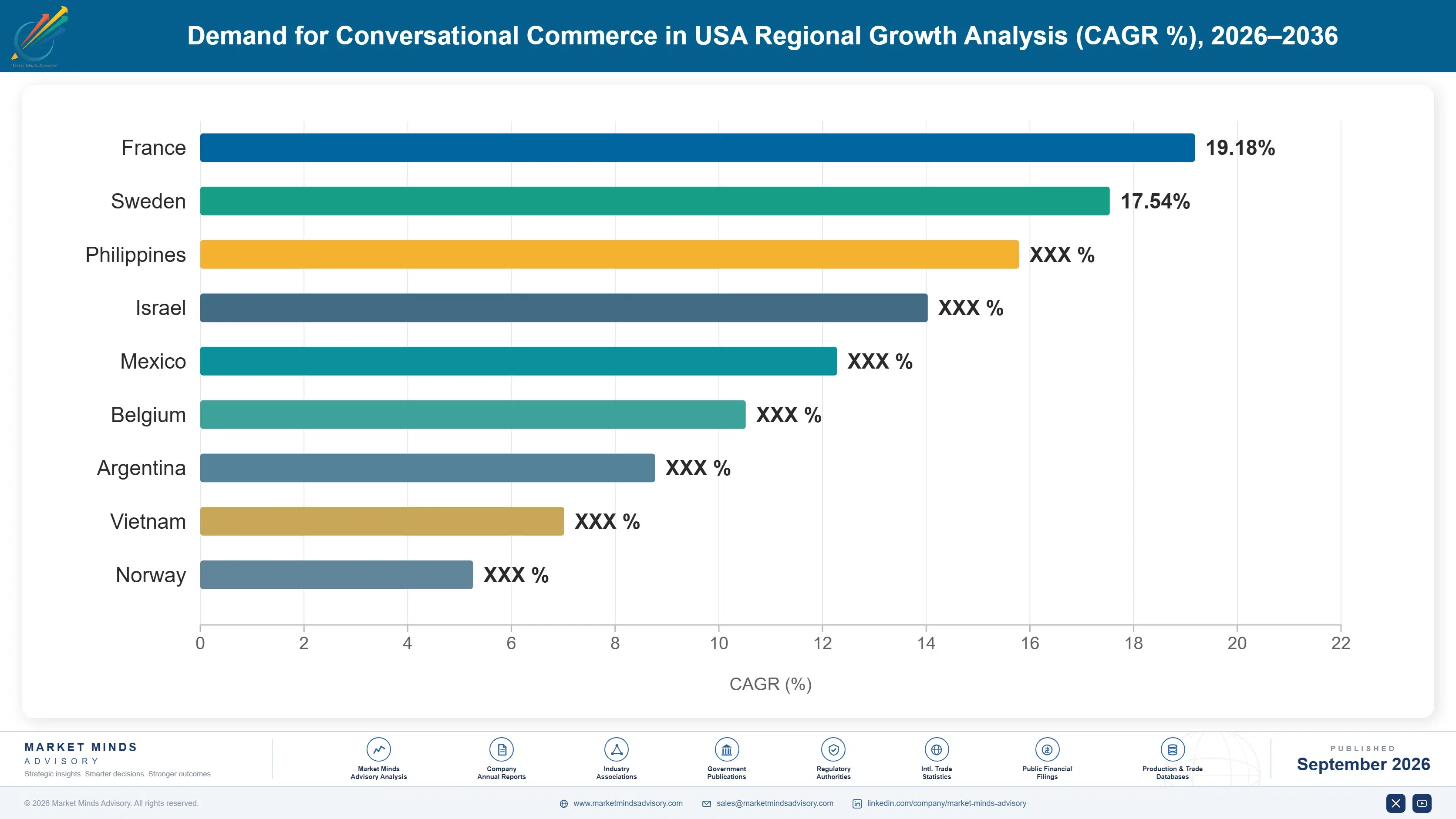
This report's analytical scope concentrates on the United States conversational commerce market specifically, with North America's regional share reflecting the country's outsized weight within it nationwide. The other six regions offer benchmarking context, with South Asia and Pacific showing the fastest regional growth given mobile-first commerce adoption nationwide.

North America

This region's 30 percent share sits at the top of its standard 22 to 32 percent band, justified because this report analyzes the United States conversational commerce market specifically, and North America's regional figure reflects the country's outsized weight within the broader regional total. Major national retail brands concentrate the heaviest platform investment nationwide, anchored by intense holiday season competitive pressure that shows no signs of relaxing. Canadian retailers follow broadly similar adoption patterns, though at meaningfully smaller absolute volume than their United States counterparts. This advantage compounds further as United States platform vendors expand dedicated conversion optimization teams serving their largest enterprise retail accounts. Vendors expand this advantage steadily across successive holiday shopping seasons.
Share: 30% | CAGR: 17.0% (2026 to 2036)

East Asia

Chinese and South Korean retailers have pioneered social messaging commerce integration well ahead of United States adoption timelines, sustaining meaningful regional demand growth given deeply embedded super-app commerce platforms across the region. Japanese retailers follow more cautiously, giving East Asia a mixed adoption picture that nonetheless positions the region as a global bellwether for conversational commerce innovation. South Korean livestream commerce platforms also expand conversational capability as domestic consumer behavior continues shifting toward embedded transactional discovery experiences. These platforms increasingly export proven conversational commerce design patterns to Western vendors seeking inspiration for their own product roadmaps. Vendors monitoring these developments closely adapt proven design patterns for United States market conditions.
Share: 26% | CAGR: 17.5% (2026 to 2036)
Regional intelligence for 5 additional markets available in the complete report: Western Europe, South Asia and Pacific, Latin America, Middle East and Africa, Eastern Europe. Contact sales@marketmindsadvisory.com.
united-states-conversational-commerce-market-market-share-analysis-1788454055170

Monetizing Beyond Standard Platform Licensing

Beyond core platform licensing, vendors can build durable margin through conversion optimization consulting, multi-channel integration services, and analytics add-ons that address specific brand pain points during this rapid adoption period nationwide across leading retail categories. Vendors moving early on these fronts build defensible positioning that compounds meaningfully across successive contract renewal cycles. nationwide today.

Expand Conversion Optimization Consulting Services Broadly

Retail brands increasingly pay for dedicated conversion optimization consulting that helps them tune conversational assistant behavior for measurable revenue impact rather than deploying default configurations. Vendors building specialized optimization teams, typically priced at 12 to 18 percent of contract value, capture recurring service revenue while strengthening the brand relationships that support future platform expansion decisions across successive contract renewal cycles nationwide. Vendors that build this capability early rarely lose accounts to competitors lacking comparable optimization expertise. This positioning proves especially valuable as competing platforms narrow toward eventual convergence. Brands value this considerably.
Market Impact: Captures a share of the 38 percent genAI segment now

Offer Multi-Channel Messaging Integration Bundles Now

Brands seeking unified conversational commerce presence across social messaging, voice, and web channels increasingly pay premium pricing for integrated multi-channel bundles rather than managing separate point solutions individually. This bundled offering, typically commanding 20 to 25 percent premium pricing over single-channel contracts, generates high-margin recurring revenue while deepening account relationships across a brand's full commerce footprint nationwide. Vendors executing this well typically become the default integration partner across a brand's full channel footprint. This positioning proves especially valuable as brands consolidate around fewer preferred channel partners. Brands value this considerably.
Market Impact: Captures a share of the 26 percent in-chat segment now

Provide Consumer Trust and Transparency Consulting

Brands navigating consumer skepticism around AI-driven purchasing recommendations increasingly value consulting support that helps them design transparent recommendation explanations and human handoff pathways rather than managing trust concerns entirely in-house. This consulting layer, typically representing 10 to 15 percent of total contract value, positions vendors as trusted advisory partners rather than commodity software suppliers competing purely on price. Vendors offering this expertise win business from brands unwilling to bear trust risk alone. This positioning proves especially valuable during the current period of consumer trust formation. Brands value this quite considerably.
Market Impact: Captures a share of the 24 percent trust-hesitant segment now

Build Legacy E-Commerce Integration Engineering Services

Retailers facing complex integration challenges connecting conversational commerce to legacy inventory and payment infrastructure increasingly pay for dedicated engineering services that reduce deployment timelines and technical risk across their existing technology stack. This service layer, typically adding 15 to 20 percent to total implementation contract value, differentiates vendors capable of handling complex enterprise integrations from smaller competitors lacking comparable depth. Vendors pursuing this strategy build lasting relationships that persist well beyond any single deployment project. This positioning proves especially valuable as brands finalize remaining integration architecture details. Brands value this considerably.
Market Impact: Captures a share of the 19 percent delayed-deployment segment now

Who Controls the Margin Pool

The United States conversational commerce market carries a CR5 of 47 percent, reflecting a comparatively fragmented landscape where five larger platform vendors hold notable but incomplete share while numerous specialists compete for brand accounts. The gap between leading vendors and mid-tier challengers remains moderate, given the category's relatively low barriers to specialist entry. Conversation quality remains the single biggest differentiator separating leaders from smaller challengers.
Current competitive activity centers on generative AI capability expansion, multi-channel integration depth, and expanding conversion optimization consulting that deepen brand relationships beyond commodity licensing. Vendors are also racing to secure native integration partnerships with major social messaging platforms as brands consolidate vendor relationships across channels. Vendors are also expanding dedicated conversion optimization teams to capture recurring service revenue ahead of eventual full generative AI convergence nationwide.

Emerging pressure comes from generative AI specialists unencumbered by legacy chatbot product lines, who are winning brand accounts where conversational sophistication matters more than installed-base familiarity. Rankings could shift meaningfully as these specialists successfully convert early wins into larger enterprise brand contracts, particularly if a leading vendor falls behind on genuine language understanding capability. Vendors slow to adapt risk permanent share loss as generative AI specialists reshape the field.
united-states-conversational-commerce-market-country-cagr-analysis-1788454055699

Competitive Moat and Risk Dimensions

SALESFORCE

Moat: Deep Enterprise CRM Integration

Salesforce benefits from its broad customer relationship management platform footprint, giving it natural integration advantages when brands already run their marketing and sales operations on its infrastructure, reinforcing switching costs that competitors struggle to replicate quickly. This depth of relationship extends well beyond pure conversational capability alone.
SALESFORCE

Risk: Slower Generative AI Sophistication

Salesforce's conversational AI capability trails pure-play generative AI specialists focused exclusively on next-generation language understanding, risking gradual share erosion in accounts prioritizing conversational sophistication over broad platform integration. Younger brand technology buyers increasingly weigh this sophistication gap during vendor selection decisions. This gap could accelerate share loss.
META

Moat: Broad Social Messaging Platform Reach

Meta benefits from owning the dominant social messaging platforms where consumers already spend significant time, giving brands direct access to embedded commerce touchpoints that competitors without comparable platform reach cannot easily replicate. This access advantage strengthens further as brands consolidate around fewer preferred channel partners.
META

Risk: Limited Enterprise Consulting Depth

Meta's platform-first approach leaves it comparatively weak in dedicated conversion optimization consulting, ceding this higher-margin service layer to more specialized competitors offering deeper brand-specific customization support. This gap widens further as brands increasingly prioritize measurable conversion outcomes over reach. This gap could accelerate share loss.

Players Tracked

Prominent Players

Salesforce
Meta
Google
Shopify
LivePerson

Other Key Players

Yellow.ai
Ada Support
Drift
Intercom
Sendbird
Haptik
Verloop.io
Gupshup
Kore.ai
Freshworks
Zendesk
Bold Metrics
Manychat
Attentive Mobile
Klaviyo

Recent Developments

MARCH 2026

Salesforce Launches Generative AI Shopping Assistant Suite

Salesforce introduced a new generative AI shopping assistant suite integrated directly with its commerce cloud platform, targeting enterprise retail brands seeking measurable conversion improvement over traditional checkout flows across multiple product categories. The suite launched initially across three major retail vertical categories before expanding availability nationwide later this year.
Signal: Signals accelerating incumbent response to generative AI specialist pressure, requiring measurable conversion data across enterprise contracts.
OCTOBER 2025

Meta Acquires Conversational Commerce Analytics Startup

Meta acquired a specialist conversational commerce analytics startup to strengthen its brand performance measurement capability, extending its software differentiation beyond core messaging infrastructure into conversion-focused analytics tooling for enterprise retail customers. Financial terms of the transaction were not publicly disclosed by either participating organization involved.
Signal: Signals growing vendor emphasis on measurable conversion analytics, determining which vendors gain preferred procurement status nationwide.
MAY 2025

LivePerson Signs Multi-Year Agreement With Major Retailer

LivePerson signed a multi-year enterprise licensing agreement with a leading national retail brand to deploy conversational commerce infrastructure across its digital storefront, expanding its footprint among major national accounts seeking proven deployment scale. Financial terms of the agreement were not publicly disclosed by either participating organization involved.
Signal: Signals established vendors successfully defending enterprise accounts through proven deployment scale against generative AI challenger pressure.

Large Language Model Compute and API Exposure

Large language model inference compute and third-party API licensing represent the largest cost input for conversational commerce vendors, typically accounting for roughly 38 percent of cost of goods sold across enterprise deployments. Most inference compute concentrates among a small group of major AI infrastructure providers. This concentration creates meaningful supply chain risk for smaller conversational commerce vendors dependent on a narrow set of qualified compute providers nationwide.
AI inference compute pricing rose noticeably during 2024 and 2025 amid surging enterprise demand for generative AI capability, with unit pricing increasing by roughly 15 percent within a single fiscal year according to major cloud provider disclosures. Vendors without negotiated enterprise pricing agreements absorbed meaningfully compressed margins during this period. Smaller specialist vendors lacking negotiating scale absorbed the sharpest margin compression during this volatile pricing period.

This cost exposure disadvantages smaller specialist vendors most severely, since they typically lack the purchasing scale and multi-year compute commitments that established incumbents negotiate directly with AI infrastructure providers. Vendors serving high-volume enterprise brand accounts face additional exposure given the inference volume those deployments require. Vendors sourcing through diversified compute provider relationships face somewhat different exposure given varying enterprise pricing terms across leading providers.
united-states-conversational-commerce-market-company-positioning-matrix-1788454055894

Negotiate Multi-Year AI Compute Commitments

Vendors committing to multi-year inference compute purchasing volumes secure more predictable unit pricing from major AI infrastructure providers, insulating margin from short-term pricing volatility that smaller competitors without similar scale cannot avoid as easily. This approach also strengthens vendor relationships that pay dividends during future pricing negotiation cycles. This dynamic favors vendors with established compute relationships built over successive years.

Optimize Model Efficiency For Common Queries

Vendors building smaller, fine-tuned models for common shopping queries rather than routing every interaction through the largest available model reduce per-transaction inference costs considerably, though this approach requires ongoing model maintenance investment. Vendors pursuing this strategy typically build stronger cost efficiency against expanding transaction volume. This dynamic favors vendors willing to invest early in dedicated model optimization engineering.

Build Hybrid On-Premises Inference Infrastructure

Vendors deploying hybrid infrastructure that handles routine queries on owned hardware while routing complex requests to cloud providers reduce total inference cost exposure, though this approach requires substantial upfront capital investment few smaller vendors can commit. Vendors executing this well reduce total inference cost meaningfully across successive deployment scales. This dynamic favors vendors already positioned within high-volume enterprise brand accounts.

Portfolio Architecture for Margin Defence

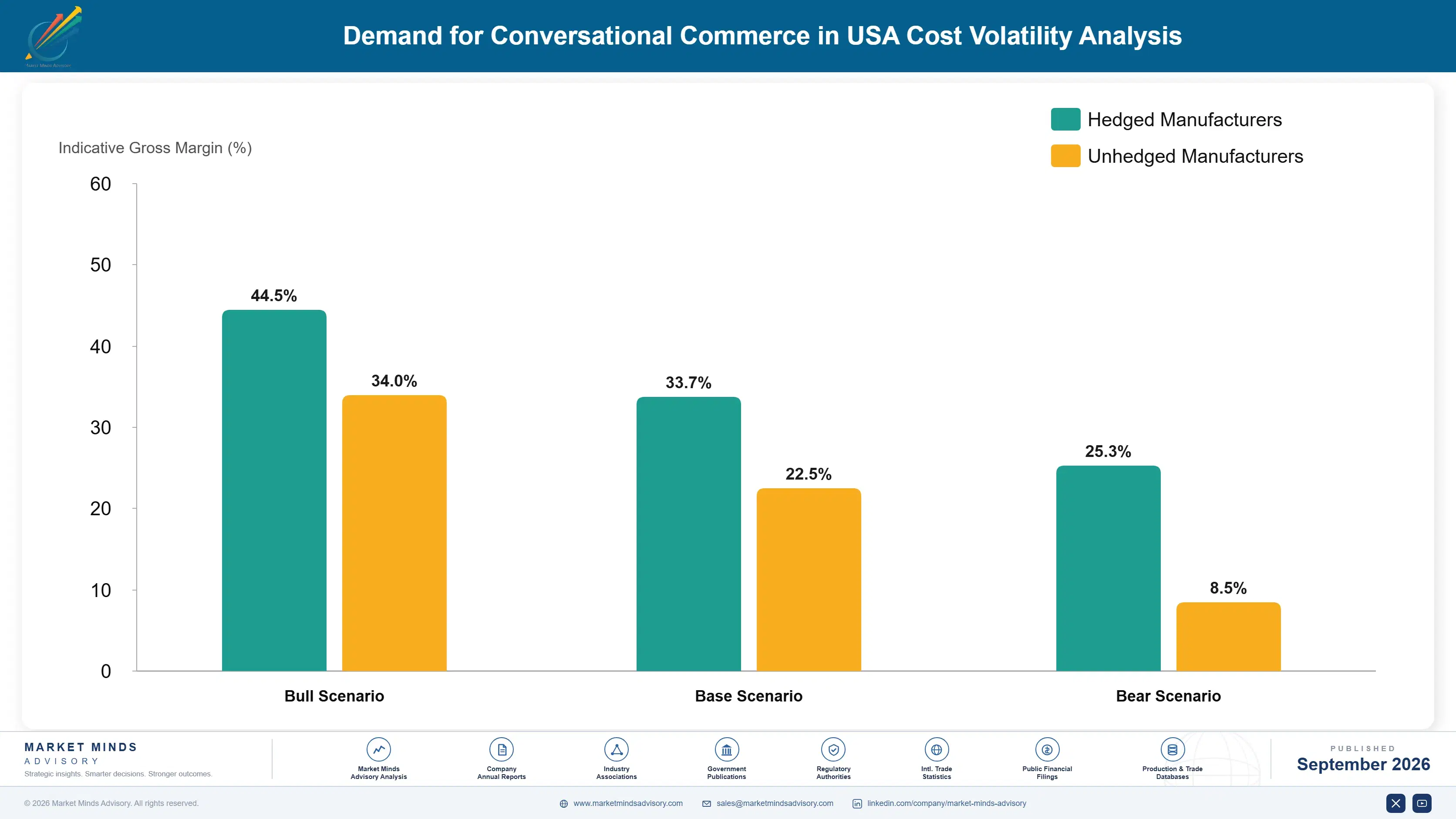
Conversational commerce vendors operate across three margin tiers, from basic scripted chatbot modules carrying thin unit economics through certified generative AI shopping assistants commanding meaningfully stronger margin, up to conversion optimization and multi-channel bundle systems capturing the richest gross margins in the category. Volume tiers monetize through per-seat licensing scale, while premium tiers monetize through conversation quality and analytics capability bundling.
Tension persists between volume growth, which favors standardized modules sold at competitive pricing to smaller direct-to-consumer brands, and premium positioning, which favors generative AI sophistication and multi-channel integration commanding materially higher willingness to pay among large national retail accounts. Vendors chasing both simultaneously risk diluting brand positioning across a fragmented buyer base. Larger national accounts increasingly demand both, forcing vendors to segment portfolios more deliberately by customer tier and budget profile.

High-value margin pools concentrate in conversion optimization consulting and multi-channel integration, both commanding meaningfully higher gross margin than basic chatbot modules sold without additional capability bundling. Vendors building durable brand relationships and analytics capability capture disproportionate margin relative to their account count across the broader competitive landscape today. Vendors ignoring this shift risk ceding the most profitable accounts to faster-moving specialist rivals over the coming standardization cycle.

Basic Scripted Chatbot Modules

Standardized scripted chatbot modules sold at accessible pricing to smaller direct-to-consumer brands prioritizing baseline capability over generative sophistication, carrying thin unit economics but broad reach nationwide. reflecting steady but unremarkable demand growth across most budget-constrained buyer categories nationwide.
Gross Margin: 16-24%

Certified Generative AI Shopping Assistants

Certified generative AI assistants bundling proven conversion improvement and large language model integration, commanding stronger recurring revenue and materially higher gross margin than scripted modules sold without this sophistication. across national retail and direct-to-consumer accounts nationwide.
Gross Margin: 36-46%

Conversion Optimization And Multi-Channel Bundle Systems

Integrated platforms bundling conversion optimization consulting with multi-channel commerce integration, carrying the richest margin profile in the category given urgent commercial demand and expanding buyer willingness to pay. across national retail brand accounts nationwide currently.
Gross Margin: 44-56%
united-states-conversational-commerce-market-cost-volatility-analysis-1788454056397

High-value Sub-segments and Strategic Watch-out

AI Chatbot and Virtual Shopping Assistant Commerce

Fastest-growing and highest-value segment, combining strong pricing power with accelerating adoption as brands seek documented conversion improvement across leading national retail categories nationwide this cycle. Consumer trust momentum further supports this segment's continued rapid expansion pace nationwide. across most retail categories nationwide and abroad currently overall.

Voice-Activated Shopping via Smart Speakers

High-value segment with strong growth, anchored by habitual reorder behavior among consumers, though smaller direct-to-consumer brand budgets constrain broader adoption pace relative to national retail accounts across most enterprise buyer categories. This segment remains a dependable revenue base even as text-based channels gradually mature. across most enterprise buyer categories.

Social Messaging Platform Commerce

Volume core of the market, delivering steady deployment counts and established margin, serving as the primary entry point into multi-channel integration services and eventual generative AI upgrade adoption over time. Vendors use this tier to build trust before upselling into higher-margin offerings later. continuously across most remaining brand buyer segments.

SMS and RCS Commerce Messaging

Strategic watch-out segment facing moderate relative growth as brands prioritize richer conversational interfaces over discretionary text messaging features, requiring vendors to differentiate through cost efficiency and integration depth. Vendors offering cost-efficient bundled solutions capture a meaningful share of this segment nationwide. across most surviving vendor product lines overall.

Conversation Contracts Anchor Recurring Revenue

Conversational commerce platforms increasingly behave like an annuity business rather than a one-time deployment. Brands sign multi-year licensing agreements tied to transaction volume, and conversion optimization consulting renewals lock vendors into recurring revenue streams that compound as conversation volume expands. This shifts vendor valuation toward retained brand relationships rather than one-time implementation project fees, rewarding vendors with durable conversion track records over pure chat interface polish alone.
Adoption stickiness varies sharply by end-use vertical. Large national retail brands integrate conversational commerce deeply into their broader digital commerce infrastructure, making switching costs prohibitive once integration and conversion tuning are complete across their storefronts. Smaller direct-to-consumer brands show shallower stickiness, often price-shopping between vendors at contract renewal given tighter budgets and simpler deployment requirements, which keeps competitive pressure alive at that end of the market.

Buyer profiles are shifting generationally as retail technology teams increasingly favor generative AI-forward platforms over legacy scripted chatbot systems built around rigid decision trees. Younger technical buyers prioritize conversational sophistication and measurable conversion impact over the incumbent vendor relationships that shaped prior purchasing cycles, gradually eroding legacy negotiating leverage and opening room for newer entrants offering more capable platforms.
Section default visual

Where Commerce Vendors Should Focus Next

These are among the four positions where our research anticipates prominent divergence between winners and laggards over the coming forecast period. Each is grounded in the demand model, the regulatory perimeter, and the announced capacity pipeline.
01 / GENERATIVE AI SOPHISTICATION

Build genuinely capable generative AI assistants now

AI chatbot and virtual shopping assistant commerce forms the fastest-growing segment in this market, expanding at 24.0 percent annually against a category average of 16.5 percent, roughly 1.45 times the overall rate. Vendors building genuinely capable, non-scripted assistants now capture disproportionate share of enterprise brand renewal decisions as buyers prioritize measurable, quantified conversion outcomes across their digital storefronts. Waiting risks ceding this segment permanently to faster-moving specialists already active nationwide across most retail categories and brand accounts currently expanding rapidly.
02 / CONVERSION OPTIMIZATION SERVICES

Expand conversion optimization consulting for brand accounts

Retail brands increasingly value consulting support that helps them tune conversational assistant behavior for measurable revenue impact rather than deploying default vendor configurations without any customization at all. Vendors deepening conversion optimization capability now build trusted partner relationships that compound as brands consolidate around fewer preferred vendors across successive contract renewal cycles nationwide. This capability gap will widen further as generative AI adoption accelerates across the forecast period ahead for every participating vendor in the broader competitive category worldwide today.
03 / MULTI-CHANNEL INTEGRATION DEPTH

Build unified multi-channel commerce integration now

Brands seeking unified conversational presence across social messaging, voice, and web channels increasingly value vendors offering integrated multi-channel bundles rather than managing disconnected, standalone point solutions individually across their broader technology infrastructure. Vendors building these integrations now capture disproportionate share of brand technology budget ahead of competitors still relying entirely on single-channel deployment models and processes. Vendors that delay risk losing ground to faster-moving unified platform challengers already active nationwide across most brand categories and channel types nationwide and abroad.
04 / CONSUMER TRUST BUILDING

Build transparent AI recommendation and handoff systems

Many consumers remain hesitant to trust AI-driven purchasing recommendations for higher-consideration items, and vendors building transparent recommendation explanations capture this considerable trust-building opportunity before competitors respond at meaningful scale nationwide currently and consistently. Vendors offering easy human handoff pathways now reduce customer risk perception considerably, differentiating from vendors offering only opaque, unsupported, fully automated AI-only interaction models. Vendors that delay these investments risk losing trust-sensitive brand accounts to better-prepared competitors across the broader competitive category nationwide and internationally over time.

Engagement Snapshot From the Field

A live engagement with an industry participant carrying material or product regulatory and market exposure ahead of a defining policy shift, showing how our research translates into a defensible multi-year portfolio strategy.
MARKET MINDS ADVISORY · CLIENT ENGAGEMENT SUMMARY
Demand for Conversational Commerce in USA Producer Strategic Portfolio Review and Transition Roadmap 2026·Investment Scenario on Demand for Conversational Commerce in USA Exposure Evaluation 2025-26
CLIENT PROFILE
The client is a mid-sized national fashion retailer operating both physical stores and e-commerce channels across the United States, targeting younger demographic segments increasingly comfortable with conversational shopping. Facing an upcoming holiday shopping season, the retailer's digital leadership sought an independent assessment of conversational commerce vendor options before committing to a multi-year platform contract. nationwide.
STRATEGIC CHALLENGE
The retailer needed a genuinely capable AI shopping assistant to differentiate against larger competitors already deploying conversational commerce, but digital leadership lacked clarity on which vendors offered genuine conversion improvement versus impressive demos that underperformed once deployed at scale. Leadership also faced pressure to justify technology spending ahead of imminent board-level budget review discussions.
MMA APPROACH
MMA conducted a structured vendor capability assessment spanning five leading conversational commerce suppliers, benchmarking conversion improvement track records, integration complexity, and total cost of ownership against the retailer's specific holiday season deployment timeline, including projected multi-year budget implications. The assessment also incorporated interviews with digital marketing staff across each participating channel team.
KEY FINDINGS
  1. Two of five evaluated vendors offered documented conversion improvement data meeting the retailer's minimum performance threshold requirements. This eliminated three vendors from further consideration early in the process.
  2. Total cost of ownership estimates varied by roughly 27 percent (client-reported, unverified by MMA) across vendors offering functionally comparable platform capability. across vendors offering comparable platform capability.
  3. Deployment timeline estimates varied significantly, with only two vendors capable of guaranteeing full launch before the holiday shopping season. This distinction proved decisive for the retailer's final selection.
  4. Smaller retailers in similar compressed timeline situations showed measurably higher switching costs once initial platform integration was substantially complete. This underscored the value of early engagement well ahead of season deadlines.
CLIENT PROFILE
The client is a mid-sized national fashion retailer operating both physical stores and e-commerce channels across the United States, targeting younger demographic segments increasingly comfortable with conversational shopping. Facing an upcoming holiday shopping season, the retailer's digital leadership sought an independent assessment of conversational commerce vendor options before committing to a multi-year platform contract. nationwide.
STRATEGIC CHALLENGE
The retailer needed a genuinely capable AI shopping assistant to differentiate against larger competitors already deploying conversational commerce, but digital leadership lacked clarity on which vendors offered genuine conversion improvement versus impressive demos that underperformed once deployed at scale. Leadership also faced pressure to justify technology spending ahead of imminent board-level budget review discussions.
MMA APPROACH
MMA conducted a structured vendor capability assessment spanning five leading conversational commerce suppliers, benchmarking conversion improvement track records, integration complexity, and total cost of ownership against the retailer's specific holiday season deployment timeline, including projected multi-year budget implications. The assessment also incorporated interviews with digital marketing staff across each participating channel team.
KEY FINDINGS
  1. Two of five evaluated vendors offered documented conversion improvement data meeting the retailer's minimum performance threshold requirements. This eliminated three vendors from further consideration early in the process.
  2. Total cost of ownership estimates varied by roughly 27 percent (client-reported, unverified by MMA) across vendors offering functionally comparable platform capability. across vendors offering comparable platform capability.
  3. Deployment timeline estimates varied significantly, with only two vendors capable of guaranteeing full launch before the holiday shopping season. This distinction proved decisive for the retailer's final selection.
  4. Smaller retailers in similar compressed timeline situations showed measurably higher switching costs once initial platform integration was substantially complete. This underscored the value of early engagement well ahead of season deadlines.
RECOMMENDED STRATEGY
Phase 1: Phase one prioritized vendor shortlisting based on documented conversion improvement track record and holiday deployment guarantee capability. across the retailer's full channel footprint. Phase 2: Phase two structured contract negotiation around phased deployment milestones tied to measurable conversion testing rather than flat licensing fees. tied to documented performance milestones. Phase 3: Phase three established ongoing performance benchmarking against holiday season conversion targets to protect continued platform investment nationwide. across subsequent shopping seasons.
OUTCOME
The retailer selected a vendor offering strong conversion track record and guaranteed holiday timeline, completing deployment within ten weeks and reporting improved seasonal conversion rates (client-reported, unverified by MMA). Leadership credited the structured comparison with avoiding a costlier, underperforming platform choice originally under serious consideration.

Frequently Asked Questions

Foundational context covering the market sizes, CAGR, scope, country, region and competition that inform every finding below. This section is provided to cover basics and most often pre-purchase conversations, answered from the MMA Primary Research Dataset.

What is the current size of the Demand for Conversational Commerce in USA?

The market reached 4.2 billion dollars in 2025, driven by generative AI capability maturation and retailer competition ahead of the holiday shopping season across most major retail categories nationwide.

How large will the Demand for Conversational Commerce in USA be by 2036?

MMA projects the market will reach 22.52 billion dollars by 2036, more than quadrupling from 2025 levels as consumer adoption accelerates across most retail categories.

What is the CAGR for the Demand for Conversational Commerce in USA 2026 to 2036?

The base case CAGR is 16.5 percent, with a bull scenario of 17.8 percent and a bear scenario of 15.2 percent depending on consumer trust formation pacing.

Which segment is growing fastest?

AI Chatbot and Virtual Shopping Assistant Commerce leads at 24.0 percent CAGR, roughly 1.45 times the overall market rate, driven by generative AI capability advancement nationwide.

Who are the major companies in the Demand for Conversational Commerce in USA?

Salesforce, Meta, Google, Shopify, and LivePerson lead the market, reflecting deep brand relationships and platform reach built over many years of continuous retail technology service.

Which country is growing fastest?

The United States itself leads within this report's defined scope, expanding at 17.5 percent annually as brands accelerate generative AI shopping assistant adoption across most national retail categories nationwide.

Report Segmentation Architecture

The full report scope spans multiple orthogonal segmentation dimensions, with cross-tabulated demand data provided for each dimension pair. Coverage extends further to regional breakdowns, trend trajectories, and the competitive detail needed to support segment-level decision-making.

By Interaction Channel and Interface Type

    By End-Use Retail Category

      By Commercial Deployment Model

        By Region

        • North America
        • Western Europe
        • East Asia
        • South Asia and Pacific
        • Latin America
        • Middle East and Africa
        • Eastern Europe

        Scope, Methodology, and Coverage

        Every figure in this report is reproducible from documented input assumptions. The scope below maps the historical period, the forecast horizon, the segmentation dimensions, and the countries covered, alongside the underlying primary and qualitative methodology.
        Historical Period
        2020 to 2025
        Forecast Period
        2026 to 2036
        Base Year
        2025 (USD billions; MMA Primary Research Dataset, September 2026)
        Market Definition
        This report covers software platforms enabling AI chatbot, voice assistant, and messaging-based commerce transactions across retail brands operating in the United States, including product discovery, checkout, and post-purchase support delivered through conversational interfaces. It excludes traditional customer service chatbots without transactional capability and general-purpose AI assistants not commerce-focused.
        Quantitative Units
        USD billions, market share percentages, CAGR percentages
        Segmentation Dimensions
        Interaction channel and interface type, end-use retail category, commercial deployment model
        Regions Covered
        North America, Western Europe, East Asia, South Asia and Pacific, Latin America, Middle East and Africa, Eastern Europe
        Countries Covered
        United States, with regional benchmarking context across North America, East Asia, Western Europe, South Asia and Pacific, Latin America, Middle East and Africa, and Eastern Europe
        Key Companies Profiled
        Salesforce, Meta, Google, Shopify, LivePerson, and 15 additional participants
        Quantitative Methodology
        Primary survey, n=3,800 respondents, Q4 2025, six countries; demand-side model with trade association cross-validation
        Qualitative Methodology
        47 expert interviews, Q4 2025; applied to validate demand model assumptions, identify emerging dynamics, and assess competitive positioning
        Report Format
        PDF and XLSX data workbook (Word format preview document)
        Publisher
        Market Minds Advisory
        Report Code
        MMA-2026-TEC-534
        Published
        September 2026
        Contact
        sales@marketmindsadvisory.com | www.marketmindsadvisory.com

        Purchase the full Demand for Conversational Commerce in USA Report (2026 to 2036).

        This full report delivers comprehensive analysis of the United States conversational commerce market. It covers vendor competitive positioning, generative AI adoption trends, and consumer trust dynamics shaping platform investment nationwide. The report includes detailed segmentation across interaction channels, retail categories, and deployment models, alongside a proprietary MMA primary survey of retail technology decision-makers spanning multiple regions. Analysts detail margin economics, cost exposure, and competitive dynamics shaping vendor positioning across the category. Strategic recommendations guide vendors navigating this rapidly transitioning platform category through 2036 and beyond.
        Full seven-region data tables and CAGR breakdowns
        Complete company profiles for twenty market participants
        Primary survey dataset covering 3,800 respondents nationwide
        Expert interview findings from 47 industry specialists
        Editable data tables in spreadsheet format included
        Quarterly market update subscription available separately

        Built For The People Who Decide

        From boardroom strategy to bench-side execution, this report is read cover-to-cover by leaders shaping the next decade of their industry, turning demand scenarios, market dynamics and valuation benchmarks into decisions.
        CXOs/ Presidents/ VPs/ Managers
        M&A and Corporate Development
        Strategy Teams and R&D Heads
        Procurement and Product Directors
        Regulatory and Compliance Leaders
        Investor Relations and Equity Analysts