Market Minds Advisory
United States Concierge Medicine Market

United States Concierge Medicine Market: United States Concierge Medicine: Selling Time by Not Seeing People

The product is a physician's attention, and the only way to manufacture more of it is to shed patients, which means every conversion removes capacity from a system already short of it.

Lead Analyst

Alice Ballenger

Published

September 2026

Make Smarter Decisions with Customized Research Insights

Request a free sample report and evaluate market opportunities, growth trends, and competitive dynamics relevant to your business needs.

2025 MARKET VALUE$8.4BMarket Size 2025
2036 FORECAST VALUE$25.4BBase Case , 2026 to 2036
CAGR 2026 TO 203610.6 %Bull 11.8% / Bear 9.4%
INCREMENTAL OPPORTUNITY$16.1BNet 10- year value creation
EXPANSION MULTIPLE2.74x2036 value over 2026 base
Strategic Levers
M&A Pipeline
Regional Outlook
Country Rankings
Competitive Intelligence
Segmental Deep-dive
Call-Us : 91 93563 13602

Executive Snapshot and Market Trajectory.

Membership medicine sells a physician's time, and time cannot be manufactured. A converting practice sheds roughly 76% of its panel to create appointments running about 3.2 times longer than a conventional visit, which is arithmetic rather than service philosophy. Nothing else produces the same result.
That makes the growth of this market inseparable from a capacity question elsewhere. Every conversion returns well over a thousand patients to a primary care system already short of physicians, and no amount of demand creates supply. The ceiling on this market is the number of primary care doctors willing to work inside it rather than the number of patients prepared to pay. Nothing in a demand forecast changes that. Supply decides this market.
The buyer meanwhile changed without much notice. Around 31% of memberships are now purchased by employers rather than by individuals, which turns a consumer product into a benefits product. Direct primary care grows at 15.9%, half again the market rate of 10.6%, because dropping insurance billing removes roughly 18% of practice revenue consumed by administration. Contracted volume goes to whoever learned to sell a benefits line item.
Market Definition
Membership and retainer based primary and specialty medical practice in the United States, covering traditional concierge retainer practices, direct primary care practices, employer sponsored membership care, hybrid concierge models, executive health programmes, and concierge specialty practices. Measured at practice revenue from membership fees and directly contracted care. Excludes conventional insurance reimbursed practice revenue, health insurance products, hospital services, and telehealth sold without a membership relationship.
Base Year Value
$8.4B in 2025 (MMA Primary Research Dataset, August 2026)
Forecast Period
2026 to 2036, eleven discrete annual values
CAGR
10.6% base case. Bull 11.8%. Bear 9.4%.
Fastest Growth Segment
Direct Primary Care Practices: 15.9% CAGR
Fastest Growth Country
Texas: 13.8% CAGR
Fastest Growth Region
South Asia and Pacific: 12.4% CAGR
Largest Region
North America: 92% of 2025 global value
Market Leaders
MDVIP, Crossover Health, One Medical, Signature MD, Specialdocs Consultants. Source: MMA Primary Research Dataset, July 2026.
Primary Survey
n=3,800 procurement and R&D decision-makers, Q4 2025, six countries
Methodology
Demand-side build-up, cross-validated against public data, 47 expert interviews

United States Concierge Medicine Market Forecast Scenarios

united-states-concierge-medicine-market-size-forecast-scenario-1787641025262
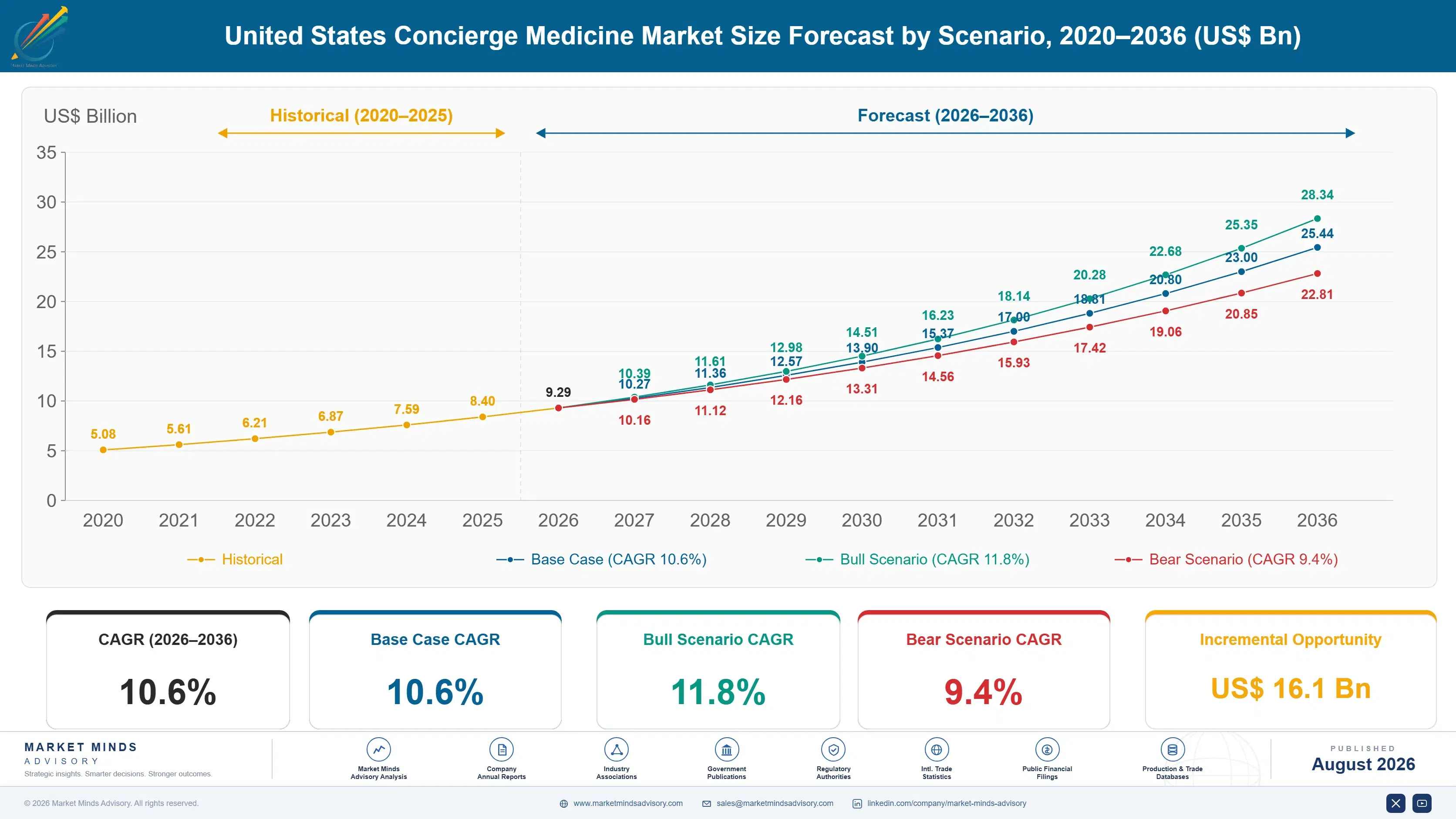
Growth ran near 9.0% between 2020 and 2025 as physician dissatisfaction with panel size and administrative burden pushed conversions steadily upward. Direct primary care expanded faster than traditional concierge throughout, since dropping insurance entirely removes billing infrastructure rather than adding a retainer on top of it. Employer purchasing emerged during the period and changed both the price point and the sales cycle considerably.
Base case 10.6% rests on three mechanisms. Direct primary care grows at 15.9% because removing insurance billing takes roughly 18% of revenue straight back into the practice. Employer sponsored membership grows at 13.2% as self-insured employers buy access directly. And Texas grows fastest of any state at 13.8%, where population growth, employer concentration and a permissive regulatory position on direct contracting all coincide. None depends on patient demand rising. Recruitment is the only real variable.
The bull case at 11.8% assumes employer adoption accelerating among mid-sized self-insured firms, which would convert individual purchasing into contracted volume at considerably lower acquisition cost per member. The bear case at 9.4% is primary care physician supply tightening further, since this market scales by recruiting doctors rather than by adding patients and every competitor is recruiting from the same shrinking pool.

Arithmetic, Not Philosophy

What this market sells is straightforward and rarely stated plainly. A conventional primary care physician carries a panel of a couple of thousand patients and sees each for a quarter of an hour. A membership practice reduces that panel by around 76% and produces consultations running roughly 3.2 times longer. The service quality follows arithmetically from the panel decision, and no amount of process improvement produces the same result at conventional panel size.
TOP FIVE CONCENTRATION34%Network operators compete against independent practices and employer clinics
PANEL SIZE REDUCTION76%Patients a physician sheds when converting to membership practice
ANNUAL RETAINER LEVEL2400 USDTypical yearly membership fee charged per adult patient
BILLING OVERHEAD REMOVED18%Practice revenue otherwise consumed by insurance claims administration
EMPLOYER PURCHASED SHARE31%Memberships bought by employers rather than by individuals
VISIT DURATION MULTIPLE3.2xConsultation length against a conventional primary care appointment
The corollary is uncomfortable and worth naming rather than avoiding. Each conversion returns well over a thousand patients to a primary care system already short of physicians, and those patients redistribute onto colleagues whose panels are already full. The market therefore grows by reallocating a constrained resource rather than by creating one, which is a fact about supply rather than a judgement about anybody's choices.
The commercially interesting change is who now pays. Around 31% of memberships are purchased by employers rather than individuals, principally self-insured firms contracting directly for employee primary care because they carry the downstream claims cost themselves. That converts a consumer subscription into a benefits line item, with a different sales cycle and volume arriving in blocks.
"You cannot scale this by signing more patients. You scale it by finding more doctors, and there are not more doctors. Everybody in this market is recruiting from the same pool and telling investors about demand."
Director, Healthcare Delivery and Primary Care Practice · MMA Healthcare and Life Sciences Practice · August 2026

Market Trends

Employers replacing individuals as the paying customer

Around 31% of memberships are now bought by employers rather than households, principally self-insured firms that carry downstream claims cost and see primary care access as a way to reduce it. That changes the price point, the sales cycle and the acquisition economics entirely, since volume arrives in employer sized blocks. Practices organised around individual consumer marketing are competing for households while contracted volume goes elsewhere. Benefits procurement is a slower sale with a longer cycle, and a considerably cheaper member once it closes. Consumer marketing reaches nobody there. Blocks arrive whole.
Market Impact: Texas growing fastest at 13.8%
Direct primary care removing the billing apparatus entirely

Dropping insurance billing takes roughly 18% of practice revenue out of administration and back into the practice, which allows a considerably lower membership fee than traditional concierge retainers while producing similar physician economics. Direct primary care grows at 15.9% on that structural difference. The trade is that patients still need insurance for everything outside primary care, which practices must explain repeatedly and frequently explain badly. Employer contracting has become the dominant growth route within the model rather than individual household enrolment. Explaining it badly is common. Insurance is still required.
Market Impact: Panels shrink by around 76%

Market Opportunities and Growth Drivers

Population growth and employer concentration arriving together

Texas grows fastest of any state at 13.8% because population growth, employer concentration and a permissive regulatory position on direct contracting all coincide in the same place. Each alone would support growth and together they compound considerably. Operators organised around traditional affluent coastal markets are covering populations where physician supply is tightest and employer purchasing is least developed, which is an awkward combination. Regulatory positions on direct contracting differ considerably between states, which matters more to expansion planning than population data does. Coastal markets look worst on both. State rules matter most.
Market Impact: Each conversion sheds 76% of panel

Physician dissatisfaction supplying most of the conversions

Conversions are driven by physicians leaving conventional practice rather than by patients seeking membership, and administrative burden and panel size are the reasons they give. A practice converting sheds around 76% of its panel and gains consultations running roughly 3.2 times longer, which is what the physician wanted rather than what any patient demanded. Recruitment therefore depends on how unpleasant conventional practice remains. Recruitment therefore depends on how unpleasant conventional practice remains, which is an uncomfortable thing to build a growth forecast on. Patients did not request this. Physicians drove all of it.
Market Impact: Fees average about 2400 dollars

Market Restraints and Challenges

Physician supply capping growth regardless of demand

This market scales by recruiting primary care physicians rather than by adding patients, and primary care physician supply is constrained and worsening across most of the country. The root cause is training pipeline economics rather than anything in this market. Commercially it means demand growth cannot be converted beyond what recruitment allows. Nurse practitioner models, physician equity participation and hybrid panels are the responses operators are actually deploying. Every competitor is recruiting from the same shrinking pool at the same time. Nurse practitioner models extend capacity only if the panel structure is designed deliberately.
Market Impact: Employers buy 31% of memberships

Membership excluding everything outside primary care

A membership covers primary care access and nothing else, so patients still require insurance for hospital care, specialists and medicines, which many prospective members misunderstand until it is explained. The root cause is that the product is an access arrangement rather than coverage. Commercially it complicates every sales conversation and generates cancellations. Clear positioning, wrap-around insurance partnerships and employer bundling are the practical mitigations available. Members who assumed the fee replaced insurance discover otherwise at the worst possible moment. Wrap-around insurance partnerships help considerably. Employer bundling avoids the problem entirely.
Market Impact: Removes 18% billing overhead
4 additional market trends, 3 additional growth drivers, and 2 additional restraints and challenges are covered in the full report. Contact sales@marketmindsadvisory.com to access the complete intelligence.

Segment CAGR and Growth Architecture

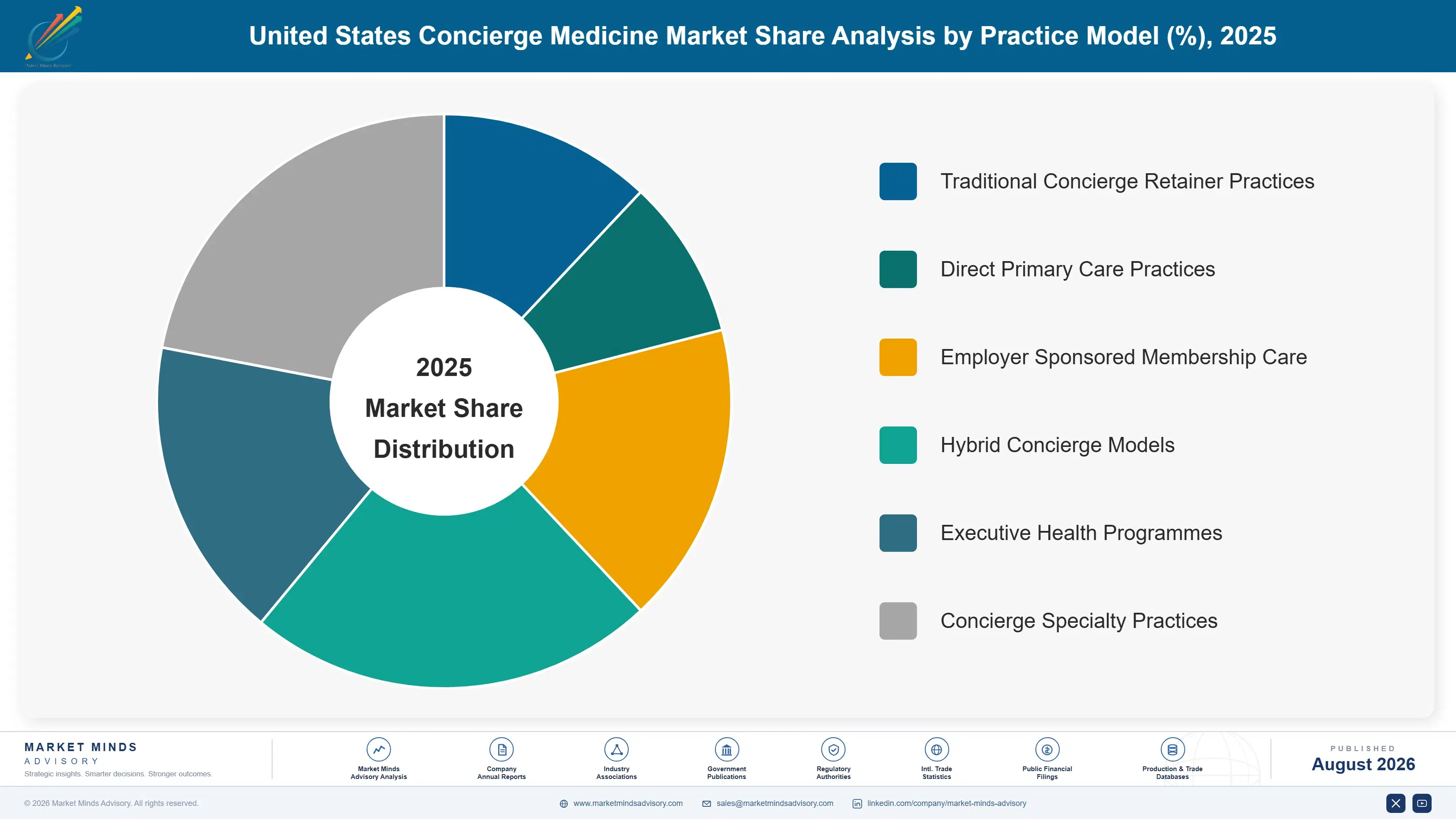
Six segments split by practice model, because model determines who pays, whether insurance billing remains in the practice, the fee level sustainable and the physician economics achieved. Specialty and panel variants sit inside each model. Payer arrangement and channel dimensions are handled separately within the framework. Model decides the payer and the economics together. Payer type follows directly.
united-states-concierge-medicine-market-market-share-analysis-1787641025861

Direct Primary Care Practices

Growing at 15.9%, half again the market rate of 10.6%, direct primary care drops insurance billing altogether, which returns roughly 18% of practice revenue from administration into the practice and allows a monthly fee well below traditional retainer levels while producing comparable physician economics. Patients still require insurance for everything beyond primary care, a distinction practices must explain constantly. Employer contracting has become the dominant growth route rather than individual household enrolment. Physician economics land in comparable territory despite a much lower fee, which is what makes the model competitive rather than merely cheaper for the member. Explaining the boundary is the recurring operational difficulty rather than delivering the care itself.
CAGR 15.9%

Employer Sponsored Membership Care

At 13.2% employer sponsored membership converts a consumer subscription into a benefits line item bought by self-insured firms carrying downstream claims cost themselves. Volume arrives in blocks rather than households, acquisition cost per member falls sharply and the sales cycle lengthens into a benefits procurement process. Around 31% of all memberships now arrive this way, and practices organised around consumer marketing are competing for individuals while the contracted volume goes elsewhere entirely. Staffing a contracted clinic becomes the operator's obligation rather than an option, which turns physician recruitment into a contractual exposure rather than a growth constraint. Practices organised around consumer marketing are competing for individuals while contracted volume goes elsewhere entirely.
CAGR 13.2%
Full segment breakdown across 6 segments available in the complete report.

Regional Architecture and Country Demand Map

North America holds 92% of value because the market is defined as United States practice, with the small residual reflecting cross-border membership arrangements and expatriate programmes rather than any domestic activity elsewhere. South Asia and Pacific grows fastest of the seven regions covered here. Scope confines everything else.

North America

This region holds 92% of value, far above the usual band, because the market is defined as United States practice and essentially all of it occurs here. Texas grows fastest of any state at 13.8% on population growth, employer concentration and permissive direct contracting rules together. Physician supply constrains growth more tightly than demand does everywhere. Employer purchasing has become the dominant growth mechanism across most metropolitan markets. Individual household enrolment remains substantial though its acquisition economics compare poorly with block contracting on almost every measure. Physician supply constrains growth more tightly than demand does in every metropolitan market examined. Employer purchasing has become the dominant growth mechanism almost everywhere in the country.
Share: 92% | CAGR: 10.4% (2026 to 2036)

Western Europe

This region holds 2%, far below the usual band, and represents cross-border arrangements rather than domestic activity, principally United States operators serving expatriate members and internationally mobile executives. Public systems and existing private insurance leave little room for a retainer model built around escaping panel constraints. Some executive health programmes serve multinational employers from European bases. Regional growth of 9.4% is the slowest anywhere on a residual and largely static base. Executive health programmes serving multinational employers from European bases account for most of what activity exists within the defined scope. Public systems and existing private insurance leave little room for a retainer model built around escaping panel constraints. Growth is residual.
Share: 2% | CAGR: 9.4% (2026 to 2036)
Regional intelligence for 5 additional markets available in the complete report: East Asia, South Asia and Pacific, Latin America, Middle East and Africa, Eastern Europe. Contact sales@marketmindsadvisory.com.
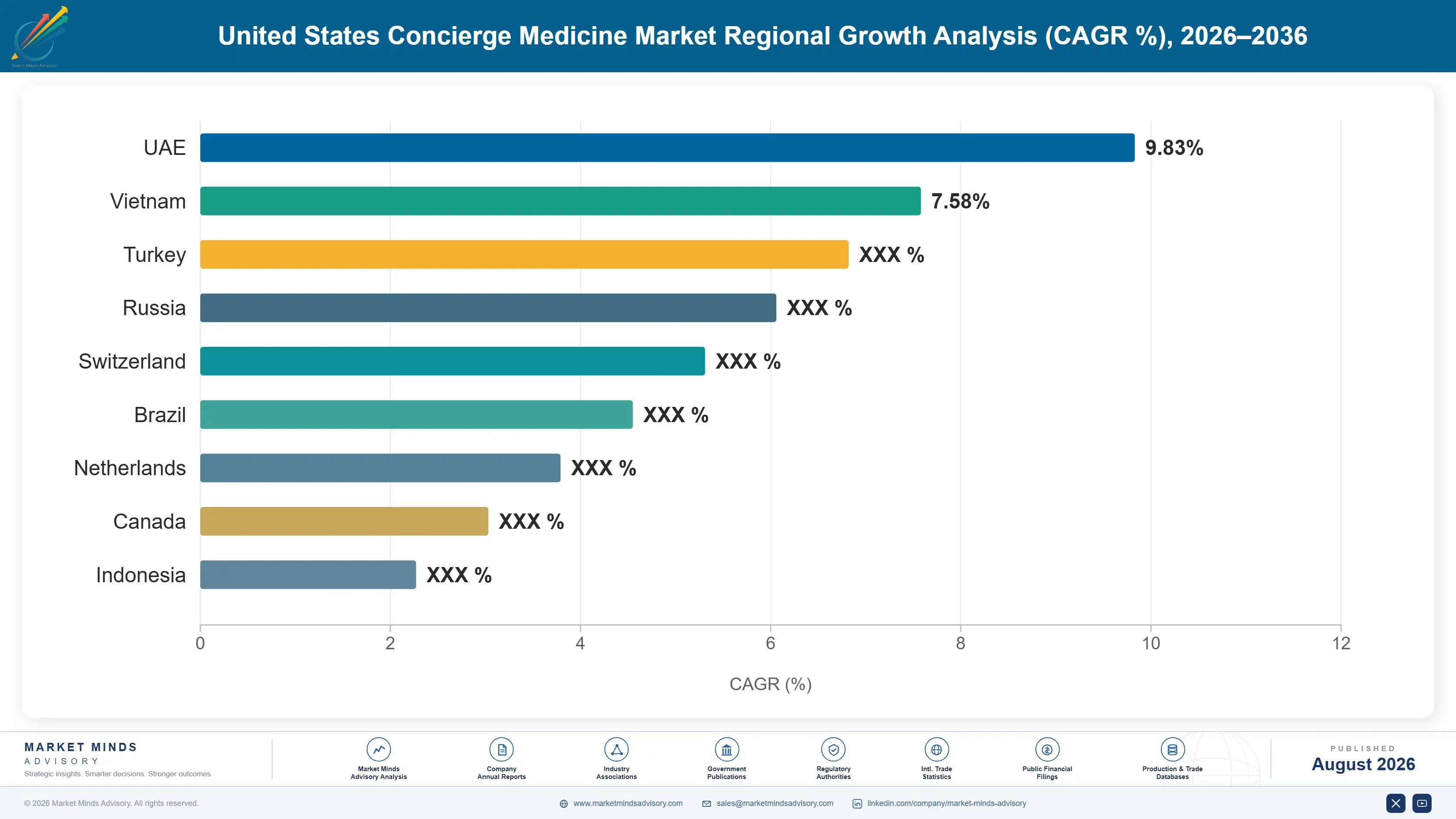
united-states-concierge-medicine-market-country-cagr-analysis-1787641026387

Four Moves Against a Doctor Shortage

Nothing in this market scales with demand, because the constraint is a physician who has already decided to see fewer people. What remains available is recruiting better, selling to employers rather than households, and being honest about what a membership does not include. Hiring is the whole business. Nothing else scales at all. Doctors are finite.

Recruit physicians rather than market to patients

Conversions happen because physicians want out of conventional practice, not because patients demand membership, and a converting practice sheds around 76% of its panel to get consultations running roughly 3.2 times longer. Growth is therefore a recruitment problem wearing a marketing costume. Operators investing in physician acquisition, equity participation and practice transition support are addressing the actual constraint rather than the one that appears in a demand forecast. Demand forecasts describe a market that hiring capacity cannot reach. Recruitment is the product. Marketing spend cannot manufacture a physician who does not exist.
Market Impact: Each recruit sheds 76% of their own panel

Sell to self-insured employers, not to households

Around 31% of memberships are now purchased by employers carrying downstream claims cost themselves, which delivers volume in blocks at far lower acquisition cost per member than household by household enrolment ever achieves. Employer sponsored membership grows at 13.2%. Practices marketing to affluent individuals are competing expensively for one member at a time while contracted volume goes to operators who learned to sell a benefits line item. Benefits teams evaluate on downstream claims rather than convenience. Blocks beat households. Benefits procurement rewards patience. Acquisition cost per member falls sharply once contracted volume replaces household enrolment.
Market Impact: Employers now buy 31% of every single membership

Drop the billing apparatus where the model allows

Insurance claims administration consumes roughly 18% of practice revenue, and direct primary care removes it entirely rather than layering a retainer on top of it. That supports a monthly fee well below traditional concierge levels at comparable physician economics, which is why direct primary care grows at 15.9%. Practices keeping billing infrastructure and adding a retainer are carrying a cost their competitors have simply deleted. Direct primary care grows at 15.9% on exactly that structural difference rather than on any service advantage anybody can demonstrate. Deleting a cost beats managing it.
Market Impact: Removes the whole 18% share of billing overhead

Explain the coverage gap before somebody else does

A membership buys primary care access and nothing else, so members still need insurance for hospitals, specialists and medicines, at fees averaging around 2400 dollars a year on top of whatever that insurance costs. Misunderstanding this generates cancellations and complaints that damage acquisition. Practices explaining it clearly at enrolment convert fewer prospects and retain considerably more of them, which is the better trade by a wide margin. Fewer conversions and far better retention is the correct trade. Cancellations start at enrolment rather than in the care subsequently delivered, which is where the fix belongs.
Market Impact: Fees average around 2400 dollars every single year

Who Controls the Margin Pool

Participation is measured on annual revenue from membership fees and directly contracted care, and the top five hold 34%. Concentration is low because most membership practice remains independent, with network operators providing conversion support and brand rather than employing the physicians directly in many arrangements. The gap to challengers is conversion support on one side and employer contracting on the other, which are entirely different capabilities to build.
Competition runs on three fronts. Physician recruitment decides capacity, which is the binding constraint on everybody simultaneously. Employer relationships decide contracted volume, awarded through benefits procurement. And conversion support decides which network an independent physician chooses when leaving conventional practice. Each front rewards a different capability, and very few participants hold more than one of them properly.

Pressure ahead comes from employer purchasing displacing household enrolment and from physician supply tightening further. Expect operators with employer contracting capability to gain against consumer marketing models. Rankings shift on whoever recruits physicians most effectively. Concentration should rise as employer contracting scales. Operators dependent on household enrolment look most exposed, since employer contracting delivers the same member at a small fraction of the acquisition cost.
united-states-concierge-medicine-market-company-positioning-matrix-1787641026919

Competitive Moat and Risk Dimensions

MDVIP

Moat: Conversion support and physician network

Practice conversion support covering panel transition, member enrolment and administrative setup addresses the moment a physician is most uncertain about leaving conventional practice, which is when the network relationship is actually decided. That accumulated conversion expertise across thousands of practices is difficult to replicate and matters more to a converting physician than any brand consideration does.
MDVIP

Risk: Household enrolment cost pressure

Individual member acquisition is expensive and slow compared with employer contracting, which now accounts for around 31% of memberships and arrives in blocks. A model built around household enrolment carries acquisition costs that employer focused competitors simply do not, and closing that gap requires a benefits selling capability quite different from consumer marketing.
CROSSOVER HEALTH

Moat: Employer contracting and clinic operation

Direct employer contracting with on-site and near-site clinic operation delivers membership volume in blocks and positions the business inside a benefits procurement conversation rather than a consumer marketing one. Self-insured employers carrying downstream claims cost evaluate primary care access on total cost rather than on price, which is a far stronger argument than convenience.
CROSSOVER HEALTH

Risk: Physician recruitment constraint

Employer contracts commit to serving populations that require physicians the business must recruit from a constrained national pool, and failing to staff a contracted clinic is considerably worse commercially than declining the contract. Growth is therefore limited by hiring rather than by selling, which reverses the usual relationship between demand and capacity.

Players Tracked

Prominent Players

MDVIP
Crossover Health
One Medical
Signature MD
Specialdocs Consultants

Other Key Players

PartnerMD
Castle Connolly Private Health Partners
Nextera Healthcare
Marathon Health
Premise Health
apree health
Hint Health
Sollis Health
Parsley Health
Galileo Health
Privia Health
ChenMed
VillageMD
Concierge Choice Physicians
Curative

Recent Developments

MARCH 2026

Self-insured employer contracts direct primary care for workforce

A self-insured employer contracted direct primary care for its entire workforce after modelling downstream claims against improved access, treating primary care as a cost reduction measure rather than an employee benefit enhancement. Access improvement was the mechanism rather than the objective. Employee satisfaction was treated as incidental.
Signal: Employers who carry the claims cost themselves evaluate access on total spend, and never on convenience
SEPTEMBER 2025

Practice conversion returns fifteen hundred patients to local system

A primary care practice converting to membership returned a substantial panel to surrounding practices already operating at capacity, illustrating that this market reallocates constrained physician time rather than creating any additional supply. Surrounding practices absorbed the panel unwillingly. Waiting times lengthened across the area. Nobody had planned for it.
Signal: Growth here simply redistributes a fixed resource rather than adding any new capacity anywhere at all
JANUARY 2026

Operator cites physician recruitment as binding growth constraint

A membership care operator reported physician recruitment rather than member demand as the constraint on its expansion, having declined employer contracts it could not staff from a national primary care pool that keeps tightening. Investors had been shown demand projections. Recruitment capacity had not been modelled at all.
Signal: Demand forecasts describe a market that hiring capacity simply cannot ever reach in any actual practice

Physicians, Premises and Administration

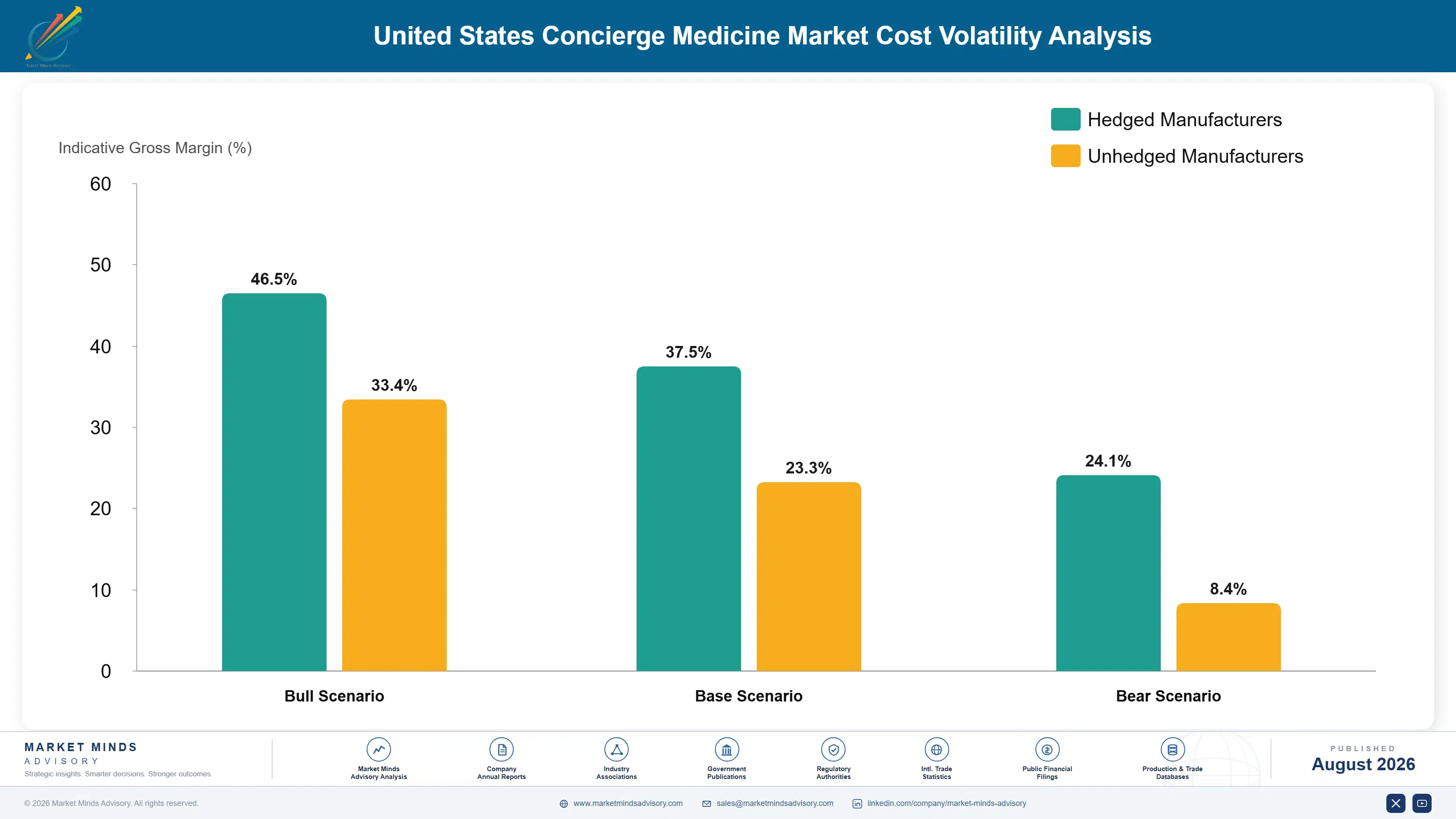
Physician compensation carries around 54% of practice cost, which is the defining feature of an economic model built on buying back a doctor's time. Clinical support staff absorb roughly 16%, lower than conventional practice because smaller panels need less throughput handling. Premises and equipment take about 12%. Technology, insurance, member services and network fees account for the balance across most models.
Primary care physician compensation rose steadily across recent years as shortage intensified, per Bureau of Labor Statistics occupational wage data and published physician compensation reporting. Practices absorbed most of that, since membership fees are set annually and members resist increases far more strongly than employers negotiating a benefits contract typically do. Employer contracts negotiated on multi-year cycles left operators absorbing annual compensation increases inside fixed terms, which several are now addressing through escalation clauses.

Exposure divides on payer rather than on model. An individual membership practice carries physician cost against fees it can raise only annually and only within what households will tolerate. An employer contracted operator negotiates rates against a benefits budget with different tolerances. A direct primary care practice carries lower administrative cost throughout, which is precisely the structural advantage its lower fee depends on.
united-states-concierge-medicine-market-cost-volatility-analysis-1787641027116

Offer physician equity rather than compensation alone

Recruitment is the binding constraint and every operator is drawing from the same shrinking pool of primary care physicians, so competing on salary alone escalates cost without securing anybody durably. Equity participation and practice ownership address why physicians left conventional employment in the first place, which is a considerably more durable proposition than a higher number.

Contract employer rates against multi-year benefit cycles

Employer benefits procurement runs on multi-year cycles while physician compensation resets annually and upward, which leaves operators absorbing increases inside contracted terms. Building escalation into employer agreements matches the actual cost shape, and benefits teams accustomed to indexed medical trend generally accept the mechanism once it is presented in familiar language. Medical trend indexation is familiar.

Extend panels using advanced practice clinicians carefully

Physician supply caps growth absolutely, and nurse practitioner and physician associate models extend what a practice can serve without diluting the access proposition if the panel structure is designed deliberately. Done carelessly it recreates exactly the throughput pressure members paid to escape, which loses both the member and the physician who joined to avoid it.

Portfolio Architecture for Margin Defence

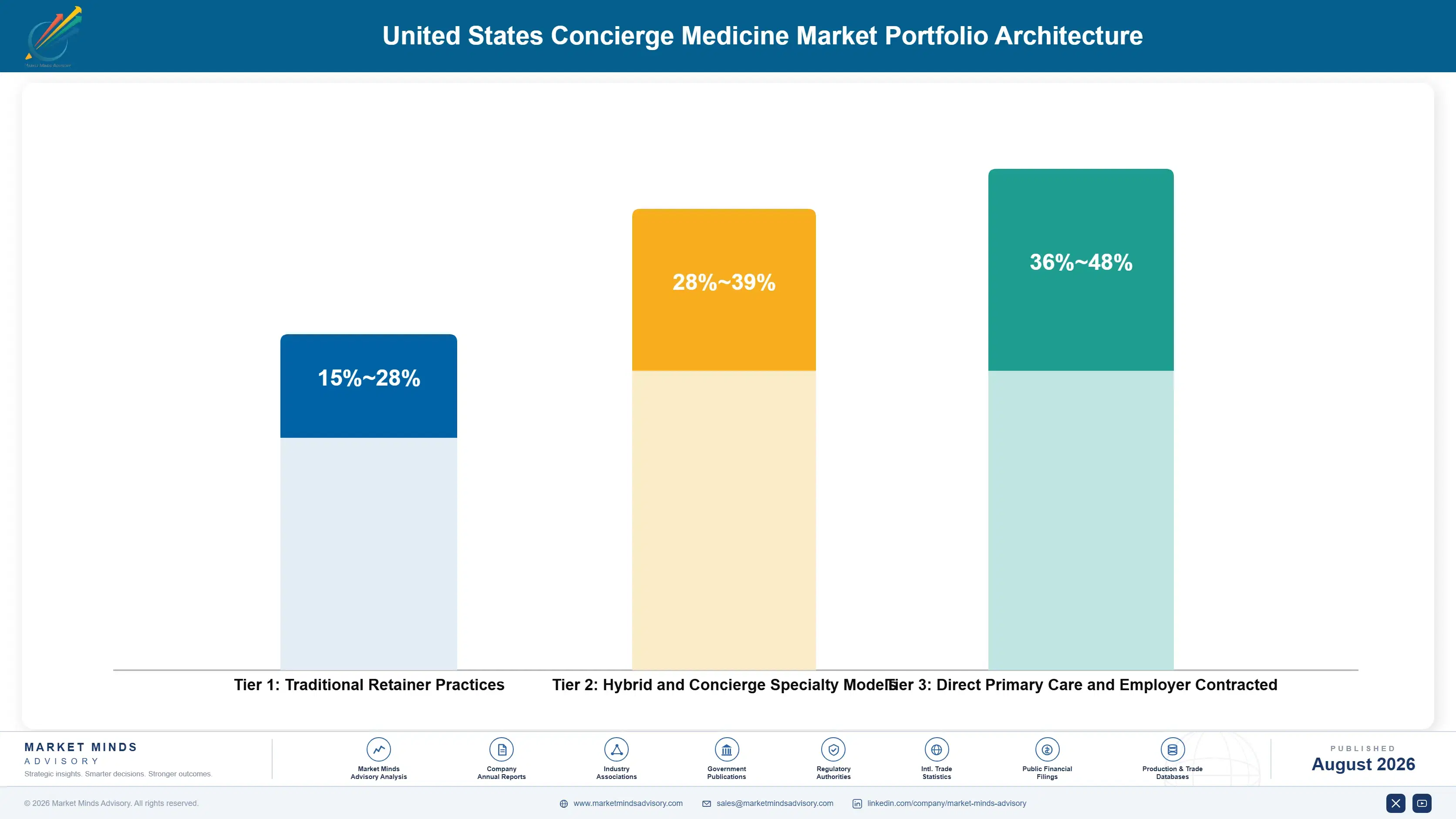
Margin here follows payer type and administrative structure rather than service level, because the physician cost is broadly fixed whichever model surrounds it. Traditional retainer practices retaining insurance billing earn margins in the mid teens to high twenties, carrying both a claims apparatus and a membership operation at the same time. Carrying both systems at once is the defining inefficiency of the traditional model.
Hybrid models and concierge specialty practices do better in the high twenties to high thirties, because a partial conversion retains conventional revenue while adding retainer income from a subset of patients. Operating two revenue streams inside one practice is harder than either alone.

Direct primary care and employer contracted models hold the strongest position, reaching into the high forties, where billing infrastructure is absent and member acquisition arrives in employer sized blocks rather than one household at a time. Those margins depend entirely on physician recruitment keeping pace with contracted commitments, and an unstaffed clinic converts a strong position into a contractual problem very quickly. An unstaffed contracted clinic converts a strong commercial position into a contractual problem very quickly indeed.

Traditional Retainer Practices

Practices carrying both insurance billing and a membership operation simultaneously. The thirteen point range reflects panel size discipline and fee level rather than any difference in the care provided. Both systems run simultaneously.
Gross Margin: 15-28%

Hybrid and Concierge Specialty Models

Partial conversions retaining conventional revenue alongside retainer income from selected patients. The eleven point range reflects the conversion proportion and how well the two revenue streams coexist operationally. Coexistence is operationally awkward.
Gross Margin: 28-39%

Direct Primary Care and Employer Contracted

Models operating without billing infrastructure and acquiring members in employer blocks. The twelve point range reflects contract scale and how reliably physician recruitment keeps pace with commitments. Staffing is the binding risk.
Gross Margin: 36-48%
united-states-concierge-medicine-market-portfolio-architecture-1787641027612

High-value Sub-segments and Strategic Watch-out

Direct Primary Care Practices

High value and the fastest growth at 15.9%, removing roughly 18% of revenue previously consumed by claims administration. Members still need insurance for everything else, which practices explain badly. Explaining the boundary properly at enrolment costs conversion and saves retention. Honesty converts fewer. Retention repays it.
Gross Margin: 36-48%

Employer Sponsored Membership Care

High value and growing at 13.2% as self-insured employers contract directly for workforce primary care. Volume arrives in blocks and staffing a contracted clinic becomes the operator's obligation. Failing to staff a contracted clinic is worse commercially than declining the contract outright. Staffing risk is real.
Gross Margin: 34-46%

Traditional Retainer Practices

The volume core, carrying both a claims apparatus and a membership operation while acquiring members household by household. Acquisition cost sits well above what employer contracting achieves. Retention nonetheless runs high enough that acquisition cost amortises over many years. Physicians hold the relationship. Loyalty follows the doctor.
Gross Margin: 15-28%

Physician Recruitment Exposure

The strategic watch-out. Growth depends entirely on hiring from a constrained national pool, and the range reflects whether an operator offers equity and ownership or competes purely on compensation. Salary competition escalates cost without securing anybody durably at all. Ownership addresses the reason they left.
Gross Margin: 0-45%

Annual Fee, Long Relationship

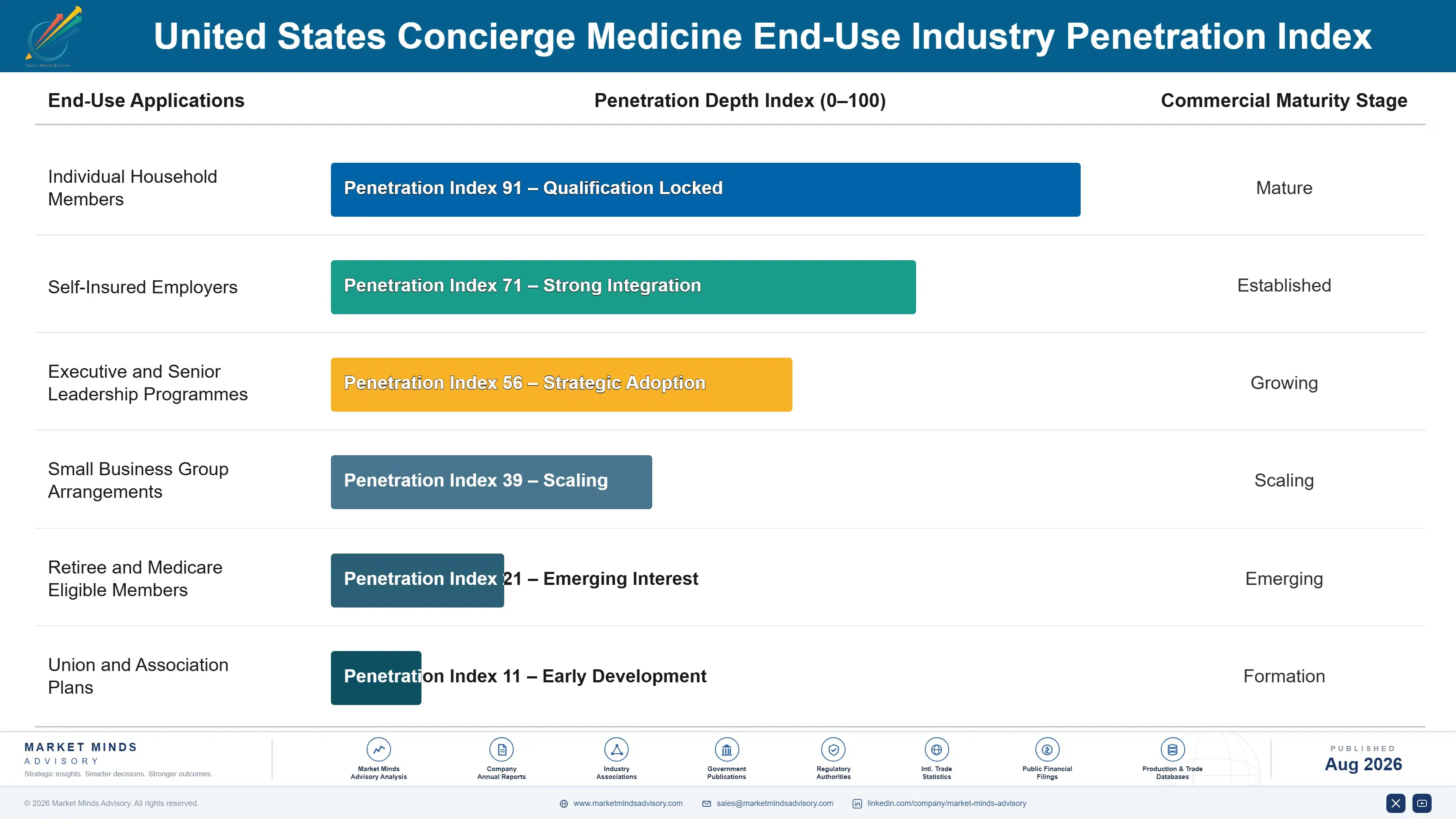
Demand here is subscription shaped and unusually durable once established, because a member who values access to a particular physician renews for years and frequently for decades. Retention runs high enough that acquisition cost amortises comfortably, which is what makes household enrolment viable at all despite being slow and expensive compared with employer contracting. Retention is what makes the model work.
Stickiness attaches to the individual physician rather than to the practice or the network, which is unusual and commercially awkward. A physician leaving takes a meaningful share of the panel, and members frequently follow rather than accept a replacement. Employer contracted membership behaves differently, since the relationship sits with the benefits team and renews on a procurement cycle instead.

The buyer has genuinely changed rather than merely broadened. Individual enrolment came from affluent households choosing to spend on access. Employer purchasing comes from a benefits team modelling downstream claims cost, which evaluates the same service on entirely different grounds and at a considerably lower price per member. Practices selling one proposition to both audiences convince neither of them properly. One proposition cannot serve both.
united-states-concierge-medicine-market-end-use-penetration-index-1787641028105

Where We Would Put Effort

These are among the four positions where our research anticipates prominent divergence between winners and laggards over the coming forecast period. Each is grounded in the demand model, the regulatory perimeter, and the announced capacity pipeline.
01 / PHYSICIAN RECRUITMENT FOCUS

Demand is not the constraint here

Conversions happen because physicians want out of conventional practice rather than because patients are demanding membership, and a converting practice sheds around 76% of its existing panel to produce consultations running roughly 3.2 times longer. Growth in this market is therefore a recruitment problem wearing a marketing costume, and nothing more than that. Operators investing seriously in physician acquisition, equity participation and practice transition support are addressing the actual constraint rather than the one that appears in a demand forecast.
02 / EMPLOYER CHANNEL PRIORITY

Households are the expensive way in

Around 31% of all memberships are now purchased by self-insured employers who carry the downstream claims cost themselves, which delivers volume in employer sized blocks at far lower acquisition cost per member than household enrolment ever manages. Employer sponsored membership care grows at 13.2% accordingly, and the gap keeps widening. Practices still marketing to affluent individuals are competing expensively for one member at a time while the contracted volume goes to operators who learned how to sell a benefits line item.
03 / BILLING STRUCTURE CHOICE

Your competitor deleted that cost

Insurance claims administration consumes roughly 18% of total practice revenue, and direct primary care removes that entirely rather than layering a retainer fee on top of the existing apparatus. That supports a monthly membership fee well below traditional concierge levels at broadly comparable physician economics, which is exactly why direct primary care practices are growing at 15.9% a year. Practices that keep their billing infrastructure and add a retainer on top are carrying a cost their competitors have simply deleted altogether.
04 / COVERAGE EXPECTATION SETTING

Explain it before the hospital does

A membership buys primary care access and nothing else at all, so members still require full insurance for hospital care, specialists and medicines, at membership fees averaging around 2400 dollars annually sitting on top of that insurance. Misunderstanding this reliably generates cancellations and complaints that go on to damage subsequent acquisition considerably. Practices that explain that boundary clearly at enrolment convert fewer prospects and go on to retain far more of them, which is the better trade by a considerable distance.

Engagement Snapshot From the Field

A live engagement with an industry participant carrying material or product regulatory and market exposure ahead of a defining policy shift, showing how our research translates into a defensible multi-year portfolio strategy.
MARKET MINDS ADVISORY · CLIENT ENGAGEMENT SUMMARY
United States Concierge Medicine Producer Strategic Portfolio Review and Transition Roadmap 2026·Investment Scenario on United States Concierge Medicine Exposure Evaluation 2025-26
CLIENT PROFILE
A membership care operator supporting converted primary care practices across several United States regions, at annual revenue near 210 million dollars (client-reported, unverified by MMA). Member acquisition ran through consumer marketing and employer contracting capability was largely absent. Physician recruitment was treated as an operational function rather than a growth constraint. Coverage was consumer led.
STRATEGIC CHALLENGE
Member acquisition cost had risen for three consecutive years while employer contracted competitors were adding members in blocks. Management wanted to understand whether the consumer model remained viable or whether the business needed a different route to market entirely. Growth planning had been built on demand rather than hiring throughout.
MMA APPROACH
MMA compared acquisition cost and retention across household and employer enrolled members, quantified physician recruitment capacity against expansion plans, assessed billing overhead across model types, and traced cancellation reasons through member exit interviews. Interviews with 47 experts covered primary care practice, benefits procurement, physician recruitment and practice management. Recruitment capacity was modelled separately.
KEY FINDINGS
  1. Employer enrolled members cost a small fraction of household acquisition to obtain and retained comparably well, which the client had not measured because it had almost none.
  2. Physician recruitment rather than member demand limited every expansion scenario modelled, and the client had been forecasting growth against demand throughout its planning.
  3. Cancellations concentrated among members who had misunderstood what the fee covered, a problem originating at enrolment rather than in the service subsequently delivered.
  4. Practices retaining insurance billing alongside membership carried an administrative cost their direct primary care competitors had removed entirely from the model. Nobody had compared the two.
CLIENT PROFILE
A membership care operator supporting converted primary care practices across several United States regions, at annual revenue near 210 million dollars (client-reported, unverified by MMA). Member acquisition ran through consumer marketing and employer contracting capability was largely absent. Physician recruitment was treated as an operational function rather than a growth constraint. Coverage was consumer led.
STRATEGIC CHALLENGE
Member acquisition cost had risen for three consecutive years while employer contracted competitors were adding members in blocks. Management wanted to understand whether the consumer model remained viable or whether the business needed a different route to market entirely. Growth planning had been built on demand rather than hiring throughout.
MMA APPROACH
MMA compared acquisition cost and retention across household and employer enrolled members, quantified physician recruitment capacity against expansion plans, assessed billing overhead across model types, and traced cancellation reasons through member exit interviews. Interviews with 47 experts covered primary care practice, benefits procurement, physician recruitment and practice management. Recruitment capacity was modelled separately.
KEY FINDINGS
  1. Employer enrolled members cost a small fraction of household acquisition to obtain and retained comparably well, which the client had not measured because it had almost none.
  2. Physician recruitment rather than member demand limited every expansion scenario modelled, and the client had been forecasting growth against demand throughout its planning.
  3. Cancellations concentrated among members who had misunderstood what the fee covered, a problem originating at enrolment rather than in the service subsequently delivered.
  4. Practices retaining insurance billing alongside membership carried an administrative cost their direct primary care competitors had removed entirely from the model. Nobody had compared the two.
RECOMMENDED STRATEGY
Phase 1: Phase one: build employer contracting capability, since block enrolment costs a fraction of household acquisition and retains just as well. Phase 2: Phase two: reframe growth planning around physician recruitment capacity rather than member demand, because hiring is the binding constraint. Demand exceeds capacity already. Phase 3: Phase three: rebuild enrolment materials to state plainly what membership does not cover, since cancellations start there. Honest enrolment retains better.
OUTCOME
The operator established employer contracting during 2026 and acquisition cost per member fell substantially across new enrolments (client-reported, unverified by MMA). Growth planning was rebased on recruitment capacity, and enrolment cancellations declined after materials were revised. Consumer marketing spend was reduced substantially across every region served.

Frequently Asked Questions

Foundational context covering the market sizes, CAGR, scope, country, region and competition that inform every finding below. This section is provided to cover basics and most often pre-purchase conversations, answered from the MMA Primary Research Dataset.

What is the current size of the United States Concierge Medicine Market?

MMA sizes it at USD 8.4 billion in 2025, rising to USD 9.29 billion in 2026. The figure covers membership and retainer based practice revenue in the United States.

How large will the United States Concierge Medicine Market be by 2036?

USD 25.44 billion by 2036, an incremental USD 16.15 billion over the 2026 base and an expansion multiple of 2.74 times. Direct primary care carries most of that gain.

What is the CAGR for the United States Concierge Medicine Market 2026 to 2036?

10.6% in the base case, with a bull case at 11.8% and a bear case at 9.4%. Primary care physician supply drives most of the spread between them.

Which segment is growing fastest?

Direct primary care practices at 15.9%, half again the market rate of 10.6%. Dropping insurance billing returns roughly 18% of revenue from administration to the practice.

Who are the major companies in the United States Concierge Medicine Market?

MDVIP, Crossover Health, One Medical, Signature MD and Specialdocs Consultants lead on membership revenue. Fifteen further participants are profiled in the full report on the same consistent basis.

Which country is growing fastest?

The market is defined as United States practice, and Texas grows fastest of any state at 13.8% on population growth, employer concentration and permissive direct contracting rules.

Report Segmentation Architecture

The full report scope spans multiple orthogonal segmentation dimensions, with cross-tabulated demand data provided for each dimension pair. Coverage extends further to regional breakdowns, trend trajectories, and the competitive detail needed to support segment-level decision-making.

By Practice Model

  • Traditional Concierge Retainer Practices
  • Direct Primary Care Practices
  • Employer Sponsored Membership Care
  • Hybrid Concierge Models
  • Executive Health Programmes
  • Concierge Specialty Practices

By End-Use Industry

  • Individual Household Members
  • Self-Insured Employers
  • Executive and Senior Leadership Programmes
  • Small Business Group Arrangements
  • Retiree and Medicare Eligible Members
  • Union and Association Plans

By Commercial Dimension

  • Direct Household Enrolment
  • Employer Benefits Contracts
  • Network Affiliation Agreements
  • Broker and Benefits Consultant Channels
  • Practice Conversion Services
  • Technology Platform Subscriptions

By Region

  • North America
  • Western Europe
  • East Asia
  • South Asia and Pacific
  • Latin America
  • Middle East and Africa
  • Eastern Europe

Scope, Methodology, and Coverage

Every figure in this report is reproducible from documented input assumptions. The scope below maps the historical period, the forecast horizon, the segmentation dimensions, and the countries covered, alongside the underlying primary and qualitative methodology.
Historical Period
2020 to 2025
Forecast Period
2026 to 2036
Base Year
2025 (USD billions; MMA Primary Research Dataset, August 2026)
Market Definition
Membership and retainer based primary and specialty medical practice in the United States, covering traditional concierge retainer practices, direct primary care practices, employer sponsored membership care, hybrid concierge models, executive health programmes, and concierge specialty practices. Measured at practice revenue from membership fees and directly contracted care. Conventional insurance reimbursed practice revenue, health insurance products, hospital services, and telehealth sold without a membership relationship are excluded from scope.
Quantitative Units
USD billions (current prices); members enrolled; USD per member year by practice model
Segmentation Dimensions
Practice model; end-use industry; commercial dimension; region
Regions Covered
North America, Western Europe, East Asia, South Asia and Pacific, Latin America, Middle East and Africa, Eastern Europe
Countries Covered
United States, Canada, Mexico, United Kingdom, Germany, Switzerland, Netherlands, Ireland, Japan, Hong Kong, Singapore, South Korea, India, Australia, New Zealand, Brazil, Panama, United Arab Emirates, Saudi Arabia, Poland
Key Companies Profiled
MDVIP, Crossover Health, One Medical, Signature MD, Specialdocs Consultants, PartnerMD, Castle Connolly Private Health Partners, Nextera Healthcare, Marathon Health, Premise Health, apree health, Hint Health, Sollis Health, Parsley Health, Galileo Health, Privia Health, ChenMed, VillageMD, Concierge Choice Physicians, Curative
Quantitative Methodology
Primary survey, n=3,800 respondents, Q4 2025, six countries; demand-side model with trade association cross-validation
Qualitative Methodology
47 expert interviews, Q4 2025; applied to validate demand model assumptions, identify emerging dynamics, and assess competitive positioning
Report Format
PDF and XLSX data workbook (Word format preview document)
Publisher
Market Minds Advisory
Report Code
MMA-2026-HLT-140
Published
August 2026
Contact
sales@marketmindsadvisory.com | www.marketmindsadvisory.com

Purchase the full United States Concierge Medicine Market Report (2026 to 2036).

The full report treats membership medicine as a business built on subtracting patients rather than adding them, which makes physician supply the ceiling and demand largely irrelevant to forecasting. It sizes all six practice models independently through 2036, quantifies acquisition cost and retention across household and employer channels, and models recruitment capacity against expansion plans. Regional chapters cover all seven regions with the scope confined to United States practice throughout. Competitive profiling covers 20 participants on one consistent revenue basis. Recruitment capacity is modelled against contracted commitments throughout.
Six practice models sized independently through 2036
Acquisition cost and retention compared across household and employer channels
Physician recruitment capacity modelled against stated expansion plans
Panel reallocation quantified against surrounding primary care capacity
Billing overhead measured across retainer and direct contracting models
Twenty participants profiled on one consistent revenue basis

Built For The People Who Decide

From boardroom strategy to bench-side execution, this report is read cover-to-cover by leaders shaping the next decade of their industry, turning demand scenarios, market dynamics and valuation benchmarks into decisions.
CXOs/ Presidents/ VPs/ Managers
M&A and Corporate Development
Strategy Teams and R&D Heads
Procurement and Product Directors
Regulatory and Compliance Leaders
Investor Relations and Equity Analysts