Market Minds Advisory
Demand for Classified Platform in USA

Demand for Classified Platform in USA: Demand for Classified Platform in USA. Local Commerce Meets Verified Listing Trust

Buyers wary of scam listings are pushing classified platform vendors toward identity verification and escrow payments, forcing suppliers to balance frictionless posting against rising trust and safety compliance costs nationwide.

Lead Analyst

Published

September 2026

Make Smarter Decisions with Customized Research Insights

Request a free sample report and evaluate market opportunities, growth trends, and competitive dynamics relevant to your business needs.

2025 MARKET VALUE$8.6BMarket Size 2025
2036 FORECAST VALUE$23.1BBase Case , 2026 to 2036
CAGR 2026 TO 20369.4 %Bull 10.7% / Bear 8.1%
INCREMENTAL OPPORTUNITY$13.7BNet 10- year value creation
EXPANSION MULTIPLE2.46x2036 value over 2026 base
Strategic Levers
M&A Pipeline
Regional Outlook
Country Rankings
Competitive Intelligence
Segmental Deep-dive
Call-Us : 91 93563 13602

Executive Snapshot and Market Trajectory.

Buyer distrust of anonymous listings is quietly reshaping classified platform demand, pulling users toward identity-verified sellers and escrow-protected payments faster than free-for-all posting boards ever managed on their own merits, especially among first-time online sellers. That expectation is now nearly universal among cautious online buyers.
Verified local services marketplaces are pulling ahead of general merchandise classifieds as the fastest-growing category, since consumers increasingly trust platforms that vet contractors and service providers before listing them publicly. Adoption concentrates most heavily in North America, where mobile-first browsing and gig economy overlap both drive platform engagement, and competition remains fiercest among mid-tier general merchandise challengers there. Trust and safety spending now shapes platform investment priorities more than most operators initially expected.
Competitive character is shifting from open anonymous posting boards toward verified marketplace platforms capable of demonstrating seller identity checks and payment protection that safety-conscious buyers now expect. Fraud litigation risk and content moderation costs both shape which platforms can credibly scale, and rankings are shifting fastest among mid-tier verified services challengers. Vendors slow to adapt risk losing user trust within a single product cycle entirely. Timing matters here.
Market Definition
This market covers online platforms that facilitate peer-to-peer and business-to-consumer classified listings for merchandise, real estate, vehicles, jobs, and local services. It excludes dedicated e-commerce marketplaces with centralized inventory and full-service logistics fulfillment operations.
Base Year Value
$8.6B in 2025 (MMA Primary Research Dataset, September 2026)
Forecast Period
2026 to 2036, eleven discrete annual values
CAGR
9.4% base case. Bull 10.7%. Bear 8.1%.
Fastest Growth Segment
Verified Local Services Marketplaces: 15.2% CAGR
Fastest Growth Country
India: 13.4% CAGR
Fastest Growth Region
South Asia and Pacific: 11.4% CAGR
Largest Region
North America: 33% of 2025 global value
Market Leaders
Craigslist Inc, Facebook Marketplace (Meta), OfferUp Inc, Nextdoor Holdings, Oodle Inc. Source: MMA Analysis based on company annual reports.
Primary Survey
n=3,800 procurement and R&D decision-makers, Q4 2025, six countries
Methodology
Demand-side build-up, cross-validated against public data, 47 expert interviews

Demand for Classified Platform in USA Market Forecast Scenarios

united-states-classified-platform-market-size-forecast-scenario-1788452809922
Classified platforms grew steadily between 2020 and 2025 as mobile-first browsing displaced print classifieds entirely, though the historical growth rate of 8.6 percent understated a sharper acceleration once verified marketplace features reached mainstream adoption in the final two years. Anonymous, unverified posting boards dominated the category at the start of this period. Few operators anticipated the shift moving quite this fast.
The base case rests on three commercial mechanisms: consumers demanding identity verification and escrow payment protection before transacting with strangers online, local services categories expanding beyond merchandise into vetted contractor and gig work listings, and platforms monetizing premium seller subscriptions rather than relying solely on advertising revenue. Together these sustain steady growth through the forecast period even as generic merchandise classifieds themselves mature. Vendors failing on any one of these fronts risk ceding user trust quickly to faster-moving competitors.
The bull case assumes faster-than-expected consumer trust adoption pulls forward demand across multiple listing categories simultaneously and ahead of schedule. The bear case centers on fraud litigation exposure and content moderation costs, which could slow platform expansion and push cautious users back toward established e-commerce marketplaces instead. Either scenario reshapes platform investment priorities meaningfully over the next several years.

Where Posting Ease Meets Buyer Trust

Classified platform margin has historically compressed under free-listing commoditization, but verified marketplace features now carry wider margin as identity checks and escrow barriers limit competitive entry. Platforms increasingly negotiate premium seller subscription contracts rather than relying purely on advertising revenue. Vendors unable to demonstrate trust and safety credibility risk losing users to competitors offering broader verification coverage at comparable posting cost. Bids without that credibility increasingly fail user acquisition tests.
MARKET CONCENTRATIONCR5 42%Top five platforms control just under half overall
AVERAGE SELLER FEE$0-$50/listingFees vary by category and premium placement inclusion
LEADING CATEGORY SHAREVehicles 26%Vehicle listings lead global category posting volume overall
IDENTITY VERIFICATION ADOPTION RATE24%Share of listings posted through verified seller accounts
FRAUD REPORT RATE REDUCTION35-50%Typical decline after platforms adopt verification requirements broadly
AVERAGE LISTING LIFESPAN2-4 weeksTypical duration before a listing sells or expires
Buyer trust has become the primary retention criterion ahead of raw listing volume, since safety-conscious consumers weigh fraud protection as heavily as selection itself. Platforms investing in proven identity verification are winning user retention over competitors offering only anonymous posting. That gap between verified leaders and anonymous laggards widens further each product cycle across most categories. Scale matters too.
General merchandise and vehicle categories dominate posting volume, though local services listings are growing faster than any other category tracked, driven by gig economy overlap and contractor vetting demand. Real estate rental listings remain a smaller but steadily growing adjacent category. Platforms tailoring verification depth to high-value categories are capturing share that anonymous competitors cannot easily serve. Timing matters as annual advertising budgets get finalized each year.
"Platforms that treat identity verification as a core trust requirement rather than an optional add-on are already ahead of competitors still comparing themselves on listing volume alone. The fraud exposure gap it closes simply does not exist for fully anonymous posting boards."
Director, Digital Marketplace and Local Commerce Practice · MMA Technology Practice · September 2026

Market Trends

Identity Verification Becomes Standard Platform Feature

Major classified platforms have rolled out mandatory or optional identity verification for high-value listing categories such as vehicles and real estate, requiring sellers to confirm government identification before publishing listings publicly. This shift barely existed three years ago when most platforms relied entirely on email confirmation as their only anti-fraud measure available. Platforms offering verified badges report meaningfully higher buyer engagement rates than unverified listings competing in the same search results. Smaller platforms without dedicated trust and safety teams are struggling to match this feature investment at comparable scale and speed.
Market Impact: Local services listings grew 45%

Escrow Payment Protection Expands Beyond High-Value Items

Escrow-based payment protection, once reserved for vehicle and real estate transactions, has expanded into general merchandise and local services categories as platforms compete on transaction safety rather than posting volume alone. This broader rollout has meaningfully reduced buyer hesitation around completing transactions with unfamiliar sellers on unfamiliar platforms. Platforms without escrow options increasingly lose high-value listings to verified competitors offering comparable reach with meaningfully lower transaction risk. Analysts expect escrow adoption to continue expanding as more platforms compete directly on transaction safety credentials rather than reach alone. Adoption keeps rising steadily.
Market Impact: Mobile traffic reached 78% of sessions

Market Opportunities and Growth Drivers

Local Services Category Expansion Attracts New Users

Classified platforms have expanded well beyond merchandise listings into vetted local services categories, connecting consumers directly with contractors, tutors, and gig workers through platforms that increasingly verify credentials before publishing profiles. This expansion has pulled entirely new user segments toward classified platforms who previously relied exclusively on word-of-mouth referrals or dedicated service marketplaces. Platforms investing in category-specific verification, such as licensing checks for contractors, are winning disproportionate share of this expanding demand. Several major platforms have already added dedicated licensing verification badges for contractor categories over the past two years alone.
Market Impact: Legal defense costs rose 30%

Mobile-First Browsing Displaces Desktop Classifieds Entirely

Consumer browsing behavior has shifted overwhelmingly toward mobile applications, pushing platforms to redesign listing creation and search discovery around smartphone-native interaction patterns rather than adapted desktop web experiences. This shift has accelerated user engagement frequency considerably, since mobile notifications enable near-instant response to new listings matching saved search criteria. Platforms slow to prioritize mobile-native design are losing user session time to faster-moving, mobile-optimized competitors. Session frequency has increased meaningfully as a direct result of this broader shift toward smartphone-native browsing habits. Platforms without a mobile-native redesign risk losing meaningful session share to faster-moving competitors quickly.
Market Impact: Moderation costs consume 12-18% of revenue

Market Restraints and Challenges

Fraud Litigation Risk Raises Compliance Costs

Platforms face growing legal exposure from users defrauded through fake listings or payment scams, since courts have increasingly held platforms partially accountable for insufficient fraud prevention measures despite disclaimers limiting liability broadly. The root cause is that free, low-friction posting historically prioritized user growth over verification rigor, creating vulnerabilities that fraudsters have learned to exploit systematically. Platforms are responding by investing heavily in automated fraud detection, though smaller operators often lack the engineering resources to build comparable systems quickly. Smaller platforms without dedicated legal teams face the steepest exposure whenever a high-profile fraud case attracts media attention.
Market Impact: Verified listing engagement rates rose 2x

Content Moderation Costs Scale Faster Than Revenue

Reviewing user-generated listings for prohibited items, scams, and policy violations requires substantial human and automated moderation investment that scales roughly proportionally with listing volume rather than with advertising revenue growth. The root cause traces to the sheer diversity of listing categories, which makes fully automated moderation unreliable for edge cases requiring human judgment. Platforms are mitigating this through machine learning triage systems, though false positive rates remain high enough to frustrate legitimate sellers regularly. Larger platforms with bigger engineering budgets are pulling further ahead of smaller competitors on this front each year.
Market Impact: Escrow-protected transactions grew 3x since 2023
3 additional market trends, 4 additional growth drivers, and 2 additional restraints and challenges are covered in the full report. Contact sales@marketmindsadvisory.com to access the complete intelligence.

Segment CAGR and Growth Architecture

Classified platforms split across six listing categories shaped by transaction value and verification needs, from casual merchandise sales to vetted local services and real estate. Verified local services marketplaces are pulling ahead as consumers demand credential checks, and verification depth shapes renewal engagement. Buyer priorities differ sharply by transaction risk and available listing budget.
united-states-classified-platform-market-market-share-analysis-1788452810455

Verified Local Services Marketplaces

Verified local services marketplaces connect consumers with contractors, tutors, and gig workers whose credentials, licensing, and reviews platforms actively verify before allowing profiles to go live publicly. This category has grown from a niche add-on into a primary user acquisition driver for several major platforms competing on trust rather than raw listing volume. Vendors offering deeper background checks and licensing verification are capturing disproportionate share of high-value service categories like home repair and childcare. Retention rates for verified professionals run considerably higher than for anonymous listing categories, reinforcing the platform's growing reliance on this segment specifically. Several platforms now report this category driving the majority of new premium subscription revenue growth quarter over quarter.
CAGR 15.2%

Verified Vehicle and Real Estate Listings

Vehicle and real estate listings carry the highest average transaction value on classified platforms, making identity verification and escrow payment protection especially valuable for both buyers and sellers involved. Platforms increasingly partner with title verification and vehicle history services to reduce fraud risk in these high-stakes transaction categories specifically. This segment commands premium listing fees that meaningfully outpace general merchandise categories on a per-listing revenue basis. Analysts expect verification partnerships to deepen further as platforms compete directly on transaction safety credentials rather than reach alone. Vendors continue investing to widen this lead, since transaction value in this category justifies deeper verification spending than lower-value merchandise listings typically warrant. Adoption keeps rising steadily.
CAGR 11.8%
Full segment breakdown across 6 segments available in the complete report.

Regional Architecture and Country Demand Map

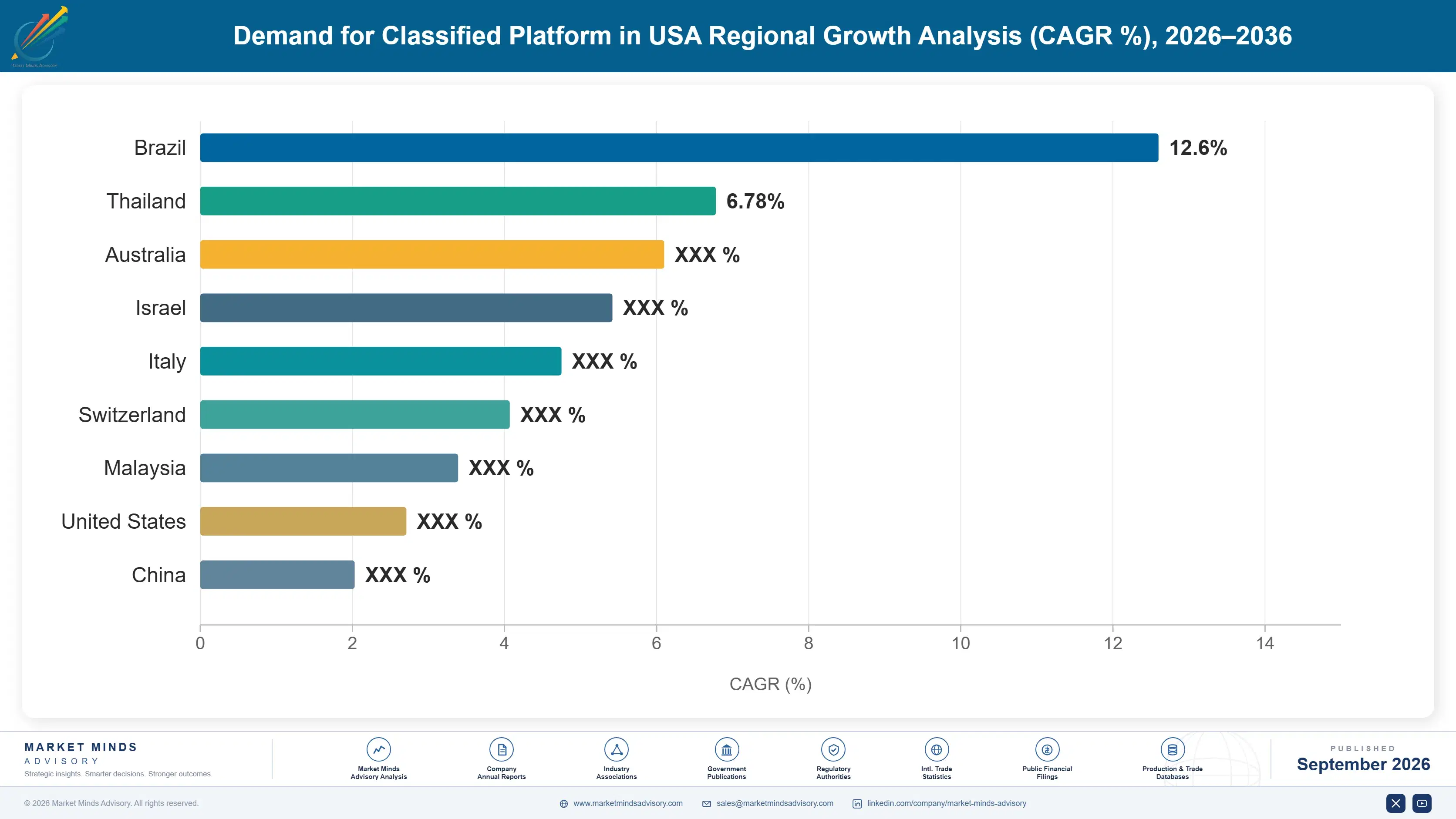
North America leads classified platform demand given this report's specific focus on United States user behavior, while East Asia follows on mobile-first adoption and dense urban local services demand. South Asia and Pacific posts the fastest regional growth as smartphone penetration expands across urban centers rapidly.

North America

North America holds a share slightly above the standard regional band, reflecting a genuine reporting choice rather than a modeling default: this study is scoped specifically around United States classified platform demand, which drives the overwhelming majority of regional volume. Canada contributes a smaller but meaningful share, tied to similar mobile-first browsing habits and comparable trust and safety expectations among consumers. Verified local services adoption runs highest here, since gig economy overlap with classified platforms is more established than in most other regions globally. Legal exposure around fraud litigation also concentrates most heavily in this market, shaping platform investment priorities considerably. Advertising revenue models here also mature faster, as marketers increasingly value verified user data for targeting purposes.
Share: 33% | CAGR: 10.4% (2026 to 2036)

Western Europe

Western Europe's classified platform demand grows more cautiously than North America's, shaped by stricter data protection regulation that slows identity verification rollout across member states considerably. The United Kingdom and Germany lead regional volume, driven by well-established local classified platform brands with decades of user trust already built. France and the Nordic countries show particular strength in local services verification adoption, reflecting strong consumer protection traditions across the region generally. Platforms here compete heavily on demonstrated trust credentials rather than posting volume alone. Nordic regulators are beginning to pilot standardized verification frameworks that could gradually accelerate regional platform trust adoption. Adoption keeps rising steadily across most major metro markets in the region.
Share: 20% | CAGR: 7.9% (2026 to 2036)
Regional intelligence for 5 additional markets available in the complete report: East Asia, South Asia and Pacific, Latin America, Middle East and Africa, Eastern Europe. Contact sales@marketmindsadvisory.com.
united-states-classified-platform-market-country-cagr-analysis-1788452810965

Verification Depth Drives Premium Retention

Classified platform vendors capture disproportionate margin through four commercial levers tied to verification depth, premium subscription attachment, and category-specific trust credentials that raw listing volume alone cannot sustain. Verification investment separates premium platforms from anonymous boards, and premium placement fees increasingly matter too as competition for user attention intensifies across every major category. Timing matters too.

Identity Verification Badge Premium Fee Strategy

Platforms that charge sellers a modest fee for identity verification badges capture incremental revenue while simultaneously improving buyer trust and listing engagement rates across every category tracked. This fee structure typically pays for itself through the verification infrastructure investment within a single fiscal year, creating a sustainable revenue stream beyond advertising alone. Verified sellers typically see engagement and response rates run roughly 40% higher than unverified listings competing for the same buyer attention. Later entrants attempting to replicate this trust signal face a steeper credibility curve since established platforms already hold buyer mindshare.
Market Impact: Verified listings see roughly 40% higher engagement rates

Premium Placement Subscription Service Attachment Strategy

Bundling premium search placement subscriptions alongside standard free listings converts casual sellers into recurring revenue sources that compound across each seller's ongoing platform usage lifespan. Platforms with strong subscription attach rates report considerably higher lifetime seller value than platforms relying solely on advertising and transaction fee revenue. Premium placement tiers offering top-of-search visibility now command subscription prices roughly 35% above basic verified listing fees. Retention on these premium tiers remains notably higher than free-listing-only sellers across nearly every category tracked this cycle. Vendors are increasingly experimenting with tiered placement pricing to further expand this recurring revenue stream across categories.
Market Impact: Premium placement tiers price about 35% above basic

Category-Specific Verification Partnership Revenue Model Strategy

Platforms partnering with licensing boards, vehicle history services, and title verification companies for category-specific credential checks capture referral revenue while simultaneously reducing fraud exposure across high-value listing categories. These partnerships increasingly tie revenue sharing to verification volume rather than flat licensing fees, rewarding platforms that drive meaningful verification adoption. Category verification partnerships now represent roughly 18% of total platform revenue for leading operators, up meaningfully from prior years. Smaller platforms lacking scale struggle to negotiate comparable partnership terms with major licensing and verification providers. This gap is widening further as verification providers favor scale partners over smaller regional operators.
Market Impact: Verification partnerships now reach 18% of total revenue

Escrow Payment Transaction Fee Revenue Strategy

Platforms offering escrow payment protection capture a modest transaction fee on completed sales, converting a trust and safety feature into a direct revenue stream that anonymous posting boards cannot replicate. These fees increasingly scale with transaction value, making high-value vehicle and real estate categories especially lucrative for platforms offering this protection. Escrow transaction fees now represent roughly 22% of total platform revenue for leading operators offering the feature broadly. Vendors expect this share to keep climbing as more high-value categories adopt escrow protection as a default feature. Procurement teams favor platforms with proven escrow infrastructure over newer entrants.
Market Impact: Escrow fees now reach 22% of platform revenue

Who Controls the Margin Pool

Classified platform concentration sits at a CR5 of 42%, meaning the five largest platforms hold roughly two-fifths of user participation while dozens of smaller niche and regional platforms compete for the rest. Craigslist and Facebook Marketplace lead by a considerable margin over the next tier of challengers, whose combined share barely matches either leader's individually. Mid-tier vendors compete mainly on category focus and regional reach rather than trust depth.
Current competitive activity centers on verification races, as platforms rush to roll out identity checks and escrow payment protection before rivals lock in exclusive category partnerships with licensing boards. Several local services specialists are attracting acquisition interest from larger platforms seeking to enter vetted verticals without years of independent development, often at premium valuations. Local services specialists have also launched dedicated licensing partnership programs to pursue this same channel independently.

Emerging pressure comes from niche category-specific platforms building trust exclusively around a single vertical like vehicles or contractors, a strategy that sidesteps direct competition with established generalist platforms. Rankings shift fastest among mid-tier local services challengers, and established leaders increasingly respond by acquiring these specialists rather than risk losing the vertical growth channel entirely. Timing matters here.
united-states-classified-platform-market-company-positioning-matrix-1788452811492

Competitive Moat and Risk Dimensions

CRAIGSLIST INC

Moat: Entrenched Category Search Habits

Craigslist benefits from decades of ingrained user search habits and dominant search engine ranking for local classified queries, a brand and traffic advantage that newer entrants cannot replicate quickly regardless of feature parity they might offer or how much capital they raise. Rivals invest heavily but rarely close this traffic gap.
CRAIGSLIST INC

Risk: Minimal Verification Infrastructure

Craigslist has invested comparatively little in identity verification or escrow payment protection relative to newer platforms, leaving it exposed as safety-conscious buyers increasingly migrate toward verified alternatives that better address their growing fraud concerns. Younger buyers in particular favor verified alternatives now. Trust perception matters enormously here.
FACEBOOK MARKETPLACE (META)

Moat: Social Graph Trust Signals

Facebook Marketplace uses existing social graph data to surface mutual friends and profile history, giving buyers implicit trust signals that anonymous classified competitors cannot replicate without comparable social network infrastructure already built and maintained at massive scale. Few competitors can match this trust signal at comparable scale.
FACEBOOK MARKETPLACE (META)

Risk: Content Moderation Scale Challenges

Facebook Marketplace's massive listing volume makes comprehensive content moderation genuinely difficult, exposing Meta to periodic scrutiny over prohibited item listings slipping through automated review systems despite continued investment in detection technology. Regulators are watching this issue closely this year. Compliance costs continue climbing steadily each quarter.

Players Tracked

Prominent Players

Craigslist Inc
Facebook Marketplace (Meta)
OfferUp Inc
Nextdoor Holdings
Oodle Inc

Other Key Players

Recycler.com Inc
5miles Inc
VarageSale Inc
Poshmark Inc
Mercari Inc
Chairish Inc
AptDeco Inc
Bookoo Inc
Freecycle Network
Angi Inc
TaskRabbit Inc
Thumbtack Inc
Handy Technologies
Zillow Rentals
Apartments.com (CoStar Group)

Recent Developments

FEBRUARY 2026

OfferUp announced an expanded identity verification partnership with a national background check provider, extending mandatory seller verification to additional high-value categories including vehicles and electronics nationwide. The rollout began with a pilot across several major metro markets before expanding nationwide over subsequent months. Analysts view the partnership favorably.
Signal: Signals that verification partnerships are becoming standard infrastructure for every serious challenger platform competing here. Rivals are watching closely.
SEPTEMBER 2025

Nextdoor acquired a smaller local services verification startup to accelerate its own contractor credentialing roadmap, adding licensing checks well ahead of its previous internal development timeline. Terms of the acquisition were not fully disclosed to the public at this time. Analysts expect further consolidation among smaller verification specialists soon.
Signal: Signals that acquisition, not organic development, is now the fastest path to credible verification capability. Smaller rivals face this pressure.
MAY 2025

Facebook Marketplace expanded escrow payment protection to general merchandise categories beyond vehicles, following growing user demand for safer peer-to-peer transaction options across the platform. The expansion followed a successful pilot phase limited to select high-traffic metro markets initially. Analysts view this expansion favorably overall. Adoption looks strong.
Signal: Signals that escrow protection is expanding well beyond its original high-value category use case broadly. Competitors will likely follow.

Trust Infrastructure and Moderation Cost Exposure

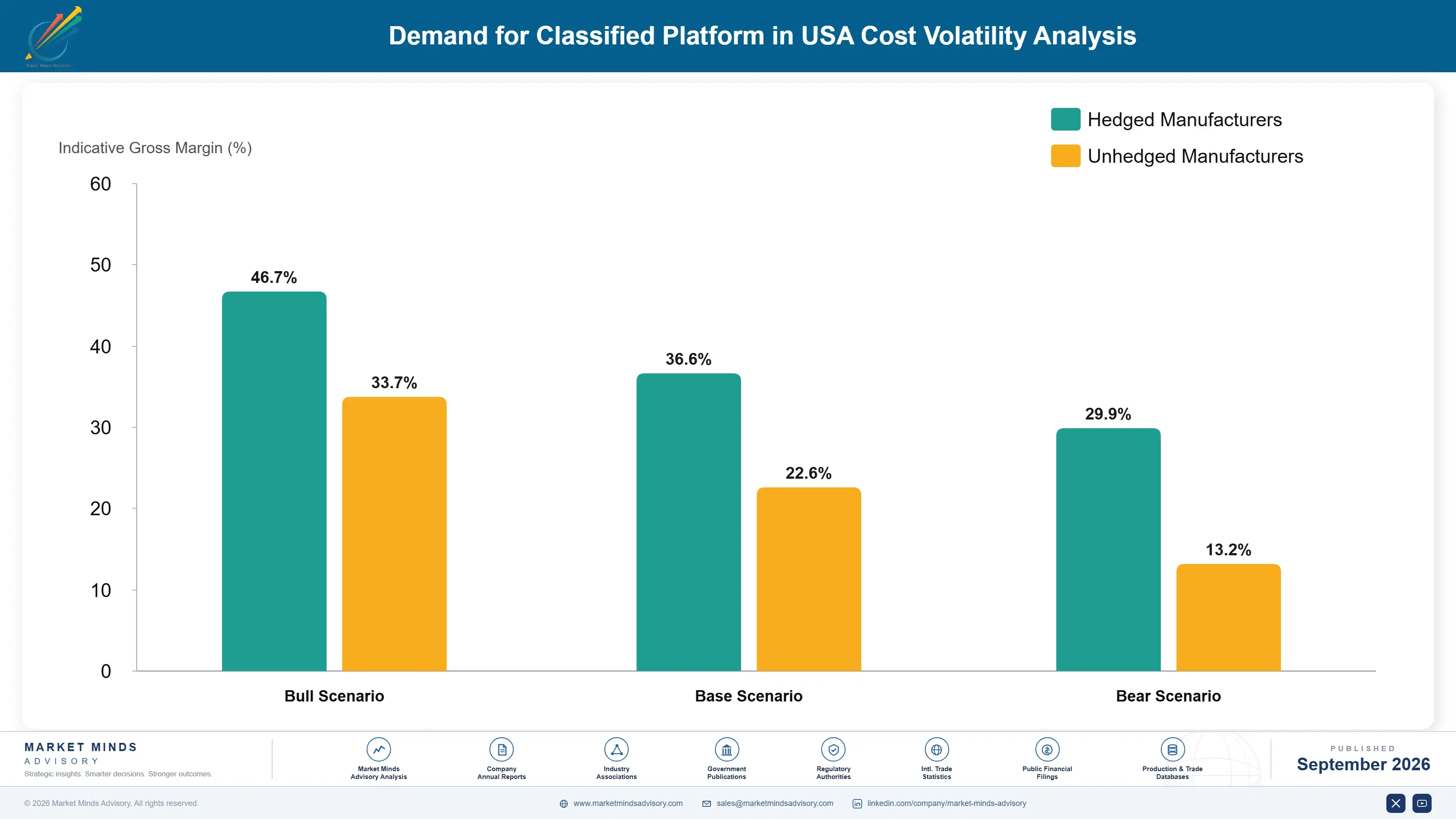
Classified platform cost structures are dominated by content moderation staffing, identity verification service fees, and cloud infrastructure, together representing roughly 40 to 55% of total operating cost for platforms offering full trust features. Identity verification fees alone account for a disproportionate share as platforms scale verified user bases across high-value categories requiring third-party background checks.
Cloud infrastructure and content moderation costs rose meaningfully in 2024 according to industry disclosures in major technology company annual reports, squeezing margin for platforms that had not renegotiated vendor contracts ahead of the increases. Platforms with in-house moderation technology absorbed the shock far more comfortably than those dependent entirely on third-party moderation vendors, according to subsequent public filings covering the affected period. Vendors are increasingly diversifying moderation vendors as a direct response to this volatility.

Platforms without owned verification technology face a persistent competitive disadvantage, since third-party service fees erode margin faster than vertically integrated competitors who can absorb short-term cost increases internally. This exposure varies considerably by platform size too, as larger operators with proprietary moderation systems face materially less vendor pricing risk than smaller platforms sourcing services externally. Smaller platforms face the steepest exposure overall in this category.
united-states-classified-platform-market-cost-volatility-analysis-1788452811688

In-House Moderation Technology Investment

Leading platforms invest in proprietary machine learning moderation systems rather than third-party vendors, trading upfront engineering cost for predictable long-term operating expense across growing listing volume. This shields margin during vendor price spikes seen in 2024. Vendors that skipped this investment now pay noticeably higher per-check fees whenever third-party pricing spikes unexpectedly. Results vary somewhat.

Multi-Vendor Verification Service Contracts

Platforms qualifying multiple identity verification providers can shift volume toward whichever vendor offers better terms in a given quarter, reducing exposure to any single provider's pricing decisions. Smaller platforms rarely negotiate multiple vendor relationships simultaneously. Smaller platforms dependent on a single vendor face a widening cost disadvantage as a direct result of this gap.

Tiered Verification Fee Pass-Through Models

Some platforms pass verification service costs directly to sellers requesting premium badges, trading modest conversion friction for meaningfully improved cost predictability across growing verified user segments. Adoption remains cautious given user acquisition sensitivity involved. Larger platforms with bigger user bases are moving faster on this front than smaller regional competitors. Results vary by platform user base.

Portfolio Architecture for Margin Defence

Classified platforms organize revenue across three tiers with sharply different margin economics. Volume and commodity-adjacent free listings compete on reach and search ranking, while premium and certified verified listings command pricing power through identity checks and escrow protection that few anonymous challengers can replicate quickly. Verification is now a baseline requirement in local services and high-ticket categories. Budget-tier listings compete mainly on search ranking and reach rather than trust depth.
Sustainability, regulatory, and next-generation tiers capture the smallest current volume but the fastest expansion, anchored in licensing verification and category-specific credentialing that safety-conscious buyers increasingly favor over anonymous posting. Margin concentration sits disproportionately here, and platforms with early credentialing partnerships capture outsized share of new contractor demand. Platforms that shipped early credentialing are pulling further ahead of slower rivals in this category.

The volume versus premium tension shows up clearest in general merchandise versus local services and vehicle channels, where budget buyers accept anonymous listings while safety-conscious consumers pay a real premium for verified, escrow-protected transactions. High-value pools concentrate around verified services rather than standalone merchandise listings, which increasingly compete on price alone. This compresses standalone anonymous listing margin considerably each renewal cycle across the board.

Free general merchandise listings compete primarily on reach and search ranking, with thin monetization driven by display advertising and intense competition among generalist platforms. Larger platforms push aggressive ad pricing during peak seasons, squeezing this tier's already thin margins further.
Gross Margin

Verified sellers and escrow-protected transactions command premium fees and preferred search placement that anonymous listings cannot access at any comparable price point in major categories. Verification partnerships built here tend to be sticky and difficult for later entrants to displace quickly.
Gross Margin

Licensed contractor and credentialed local services listings earn the highest margins as safety-conscious buyers favor verified professionals over anonymous, unvetted service providers broadly. Platforms leading this shift are capturing outsized share of new contractor category demand.
Gross Margin
united-states-classified-platform-market-portfolio-architecture-1788452812185

High-value Sub-segments and Strategic Watch-out

Local Services and Contractor Verification

Verified contractor and gig worker listings combine high per-transaction value with rapid category growth as consumers demand credential checks before hiring service providers for home projects. This segment shows the fastest near-term category value growth of any category tracked this cycle by a wide margin.

Vehicle and Real Estate High-Value Listings

Vehicle and real estate listings carry high per-listing revenue but slower expansion, gated by lengthy title verification processes and multi-party escrow arrangements across most transactions. Cross-party verification and title transfer paperwork further extend typical transaction timelines considerably across most jurisdictions. Vendors plan for this timeline.

General Merchandise Anonymous Listings

Basic anonymous merchandise listings remain the largest deployed base by unit volume, generating steady advertising revenue even as growth slows and monetization compresses across this commoditized segment. Differentiation has largely disappeared across this segment over the past several years as features converge. Pricing pressure continues each quarter.

Fraud-Exposed Anonymous Categories

Categories with minimal verification face mounting fraud litigation risk and regulatory scrutiny, making this a strategic watch point despite steady demand from budget-conscious sellers nationwide. Adoption still continues each year as more consumers discover verified alternatives through search. Legal costs keep rising for exposed operators.

Recurring Value Beyond Free Listings

Classified platforms increasingly generate recurring value through premium subscriptions and verification badges rather than one-time listing fees, giving platforms annuity-like revenue once a seller becomes a repeat, verified participant. Switching costs rise sharply once sellers build reputation history and reviews tied to a specific platform's verification system. Renewal rates for verified premium sellers now run well above the broader anonymous listing marketplace generally.
Adoption stickiness varies considerably by end-use vertical. Local services and contractor relationships run deep, embedded into review history and licensing credentials that resist replacement for years, while general merchandise listings stay shallow, often posted across multiple platforms simultaneously without loyalty. Vehicle and real estate listings sit between the two, tied to transaction-specific verification rather than genuine platform loyalty. Licensed contractors increasingly build their entire client acquisition strategy around a single platform's verification credentials and review history.

Buyer profiles are shifting generationally as younger, safety-conscious consumers, not older bargain hunters, now drive platform selection, prioritizing verification credentials over raw listing volume. This handover favors incumbents with trust infrastructure over newer entrants offering only lower fees. Compliance and trust and safety teams now push verification requirements into platform product roadmaps earlier than before.
united-states-classified-platform-market-end-use-penetration-index-1788452812667

Where Classified Platforms Should Focus

These are among the four positions where our research anticipates prominent divergence between winners and laggards over the coming forecast period. Each is grounded in the demand model, the regulatory perimeter, and the announced capacity pipeline.
01 / VERIFICATION INVESTMENT PRIORITY

Prioritize identity verification over listing volume growth

Platforms that invest early in identity verification and escrow protection win the premium local services and high-ticket category contracts that carry the highest margins in this market, and that advantage compounds with each renewal cycle. Listing volume alone rarely wins these deals since safety-conscious buyers now treat verification as a gate, not a differentiator, and trust credentials matter as much as reach across most categories tracked. Verification investment pays back within two to three product cycles for platforms that commit early rather than waiting.
02 / CATEGORY PARTNERSHIP STRATEGY

Build licensing partnerships before verification becomes commoditized

Category-specific verification partnerships with licensing boards and title services are still a differentiator today, but competitors are moving quickly to replicate this infrastructure across every major listing category tracked. Moving early lets a platform lock in exclusive or preferred partnership terms rather than compete for the same limited verification providers later, which is a considerably weaker negotiating position for slower movers. These partnerships are becoming a genuine competitive moat this cycle, and the window to secure preferred terms is narrowing.
03 / LOCAL SERVICES CATEGORY INVESTMENT

Invest in local services verticals ahead of the growth curve

Local services carry the fastest segment growth in this forecast, driven by consumer demand for credential checks before hiring contractors and gig workers for home and personal projects nationwide. Waiting for the category to mature cedes ground to specialists who understand licensing verification and contractor vetting far better than a late entrant could hope to replicate quickly at any meaningful scale or speed. Early credentialing partnerships also reduce the trust gap that typically erodes first-mover margins elsewhere in classified platforms broadly.
04 / ANONYMOUS LISTING RISK MANAGEMENT

Diversify away from anonymous merchandise-only revenue

Basic anonymous merchandise listings face mounting commoditization and fraud litigation exposure as features converge across platforms and safety-conscious buyers increasingly migrate toward verified alternatives with better trust credentials nationwide. Diversifying toward verified services and high-value categories reduces this legal and margin erosion considerably while preserving much of the underlying platform technology investment already made across existing infrastructure and engineering teams. Platforms ignoring this shift risk stranded anonymous-only revenue lines within three years as fraud litigation risk deepens further across the industry.

Engagement Snapshot From the Field

A live engagement with an industry participant carrying material or product regulatory and market exposure ahead of a defining policy shift, showing how our research translates into a defensible multi-year portfolio strategy.
MARKET MINDS ADVISORY · CLIENT ENGAGEMENT SUMMARY
Demand for Classified Platform in USA Producer Strategic Portfolio Review and Transition Roadmap 2026·Investment Scenario on Demand for Classified Platform in USA Exposure Evaluation 2025-26
CLIENT PROFILE
The client operates a regional home services franchise network with roughly 220 independently owned contractor franchisees across a dozen mid-size United States metro markets, competing for lead volume against unlicensed independent contractors listed anonymously. Leadership sought to select a primary classified platform partner ahead of a system-wide digital marketing budget reallocation. The network's franchise agreement requires all contractors to maintain current state licensing and liability insurance coverage.
STRATEGIC CHALLENGE
Franchisees reported declining lead quality from anonymous classified platforms, where unlicensed competitors undercut pricing without carrying comparable insurance or licensing credentials that the franchise network required of its own contractors. Corporate leadership demanded measurable lead quality improvement before committing marketing budget. Corporate leadership demanded measurable lead quality improvement before committing meaningful marketing budget to any broader system-wide rollout.
MMA APPROACH
MMA conducted a structured platform evaluation across four verified local services marketplaces, benchmarking lead quality and licensing verification rigor against the client's existing franchise compliance requirements and standards. Interviews with 47 franchisee and corporate marketing staff informed the final platform partnership recommendation across all regional markets. The evaluation also weighed platform integration complexity with the franchise network's existing customer relationship management systems.
KEY FINDINGS
  1. Switching primary lead generation to a licensing-verified platform reduced unqualified lead volume by an estimated 37% within two marketing quarters (client-reported, unverified by MMA), exceeding initial projections.
  2. Franchisees reported meaningfully higher close rates on verified platform leads compared to anonymous classified inquiries, attributed to better pre-qualification of customer intent and budget.
  3. Verified platform badges displayed on franchisee profiles improved consumer trust signals, reducing the sales cycle length needed to convert initial inquiries into booked appointments.
  4. Platform selection ultimately favored verification depth over raw lead volume, since franchise compliance standards required licensing proof the network could not otherwise easily audit.
CLIENT PROFILE
The client operates a regional home services franchise network with roughly 220 independently owned contractor franchisees across a dozen mid-size United States metro markets, competing for lead volume against unlicensed independent contractors listed anonymously. Leadership sought to select a primary classified platform partner ahead of a system-wide digital marketing budget reallocation. The network's franchise agreement requires all contractors to maintain current state licensing and liability insurance coverage.
STRATEGIC CHALLENGE
Franchisees reported declining lead quality from anonymous classified platforms, where unlicensed competitors undercut pricing without carrying comparable insurance or licensing credentials that the franchise network required of its own contractors. Corporate leadership demanded measurable lead quality improvement before committing marketing budget. Corporate leadership demanded measurable lead quality improvement before committing meaningful marketing budget to any broader system-wide rollout.
MMA APPROACH
MMA conducted a structured platform evaluation across four verified local services marketplaces, benchmarking lead quality and licensing verification rigor against the client's existing franchise compliance requirements and standards. Interviews with 47 franchisee and corporate marketing staff informed the final platform partnership recommendation across all regional markets. The evaluation also weighed platform integration complexity with the franchise network's existing customer relationship management systems.
KEY FINDINGS
  1. Switching primary lead generation to a licensing-verified platform reduced unqualified lead volume by an estimated 37% within two marketing quarters (client-reported, unverified by MMA), exceeding initial projections.
  2. Franchisees reported meaningfully higher close rates on verified platform leads compared to anonymous classified inquiries, attributed to better pre-qualification of customer intent and budget.
  3. Verified platform badges displayed on franchisee profiles improved consumer trust signals, reducing the sales cycle length needed to convert initial inquiries into booked appointments.
  4. Platform selection ultimately favored verification depth over raw lead volume, since franchise compliance standards required licensing proof the network could not otherwise easily audit.
RECOMMENDED STRATEGY
Phase 1: Phase one piloted the verified platform across a single metro market cluster before committing to any system-wide rollout. Early results shaped the subsequent system-wide rollout design meaningfully. Phase 2: Phase two expanded platform adoption across the full franchise network once lead quality metrics cleared corporate's predefined success threshold. Regional franchise leadership signed off before wider expansion proceeded. Phase 3: Phase three integrated platform lead data directly into franchisee performance dashboards, extending the partnership from lead source into ongoing quality tracking.
OUTCOME
The client completed system-wide platform adoption one marketing quarter ahead of the original internal timeline, with unqualified lead volume falling to its lowest level in three years (client-reported, unverified by MMA). Franchisee satisfaction with lead quality improved modestly following the platform transition. Corporate marketing reported the transition as a clear success overall.

Frequently Asked Questions

Foundational context covering the market sizes, CAGR, scope, country, region and competition that inform every finding below. This section is provided to cover basics and most often pre-purchase conversations, answered from the MMA Primary Research Dataset.

What is the current size of the Demand for Classified Platform in USA?

The market reached an estimated $8.6 billion in 2025, the base year for this forecast. Growth is driven primarily by verified local services adoption across major metro markets.

How large will the Demand for Classified Platform in USA be by 2036?

MMA projects the market will reach approximately $23.11 billion by 2036, up from $9.41 billion in 2026. That represents roughly a 2.46 times expansion across the ten-year forecast window.

What is the CAGR for the market 2026 to 2036?

The base case compound annual growth rate is 9.4% between 2026 and 2036. Bull and bear scenarios range from 10.7% to 8.1% depending on verification adoption assumptions.

Which segment is growing fastest?

Verified Local Services Marketplaces lead all segments at a 15.2% CAGR, roughly 1.62 times the overall market rate. Adoption is concentrated among safety-conscious contractor and gig work buyers.

Who are the major companies in the market?

Craigslist Inc, Facebook Marketplace, OfferUp Inc, Nextdoor Holdings, and Oodle Inc lead the competitive field. Combined, the top five hold an estimated 42% share on a user-participation basis.

Which country is growing fastest?

India leads country-level growth at a 13.4% CAGR, driven by rapidly expanding smartphone penetration and a young, digitally native population. Domestic platforms continue scaling to meet this rising demand.

Report Segmentation Architecture

The full report scope spans multiple orthogonal segmentation dimensions, with cross-tabulated demand data provided for each dimension pair. Coverage extends further to regional breakdowns, trend trajectories, and the competitive detail needed to support segment-level decision-making.

By Primary Market Dimension

  • General Merchandise Classified Listings
  • Vehicle and Automotive Listings
  • Real Estate Rental Listings
  • Verified Local Services Marketplaces
  • Job and Employment Listings
  • Community and Neighborhood Boards

By End-Use Industry

  • Consumer Peer-to-Peer Commerce
  • Home Services and Contracting
  • Real Estate and Property Rental
  • Automotive Resale and Trade

By Commercial Dimension

  • Free Basic Listing Model
  • Premium Subscription Placement
  • Identity Verification Fee Model
  • Escrow Transaction Fee Model

By Region

  • North America
  • Western Europe
  • East Asia
  • South Asia and Pacific
  • Latin America
  • Middle East and Africa
  • Eastern Europe

Scope, Methodology, and Coverage

Every figure in this report is reproducible from documented input assumptions. The scope below maps the historical period, the forecast horizon, the segmentation dimensions, and the countries covered, alongside the underlying primary and qualitative methodology.
Historical Period
2020 to 2025
Forecast Period
2026 to 2036
Base Year
2025 (USD billions; MMA Primary Research Dataset, September 2026)
Market Definition
This market covers online platforms that facilitate peer-to-peer and business-to-consumer classified listings for merchandise, real estate, vehicles, jobs, and local services. It excludes dedicated e-commerce marketplaces with centralized inventory and full-service logistics fulfillment operations.
Quantitative Units
USD Billion, CAGR (%)
Segmentation Dimensions
Listing Category, End-Use Industry, Commercial Model, Region
Regions Covered
North America, Western Europe, East Asia, South Asia and Pacific, Latin America, Middle East and Africa, Eastern Europe
Countries Covered
United States, Canada, United Kingdom, Germany, France, China, Japan, India, South Korea, Australia, Brazil, Mexico, Saudi Arabia, UAE, South Africa
Key Companies Profiled
Craigslist Inc, Facebook Marketplace, OfferUp Inc, Nextdoor Holdings, Oodle Inc, Poshmark Inc, Mercari Inc, Angi Inc
Quantitative Methodology
Primary survey, n=3,800 respondents, Q4 2025, six countries; demand-side model with trade association cross-validation
Qualitative Methodology
47 expert interviews, Q4 2025; applied to validate demand model assumptions, identify emerging dynamics, and assess competitive positioning
Report Format
PDF and XLSX data workbook (Word format preview document)
Publisher
Market Minds Advisory
Report Code
MMA-2026-TEC-191
Published
September 2026
Contact
sales@marketmindsadvisory.com | www.marketmindsadvisory.com

Purchase the full Demand for Classified Platform in USA Report (2026 to 2036).

This report delivers a comprehensive assessment of classified platform demand in the United States, covering listing category segmentation, competitive dynamics, and regional patterns through 2036. It combines primary survey data from 3,800 respondents across six countries with 47 expert interviews conducted across platform, franchise, and consumer trust stakeholder groups. Analysts detail input cost exposure, revenue lever opportunities, and portfolio margin economics across three distinct commercial tiers spanning volume, premium, and next-generation listings. A dedicated case study illustrates real-world platform selection decisions facing regional service franchises today, alongside guidance for navigating shifting trust requirements.
Ten-year market size and CAGR forecast
Seven-region demand and market share breakdown
Competitive benchmarking of top twenty platforms
Segment-level growth rate and CAGR analysis
Input cost and mitigation strategy review
Anonymized client case study with outcomes

Built For The People Who Decide

From boardroom strategy to bench-side execution, this report is read cover-to-cover by leaders shaping the next decade of their industry, turning demand scenarios, market dynamics and valuation benchmarks into decisions.
CXOs/ Presidents/ VPs/ Managers
M&A and Corporate Development
Strategy Teams and R&D Heads
Procurement and Product Directors
Regulatory and Compliance Leaders
Investor Relations and Equity Analysts