Market Minds Advisory
Demand for Capacitive Proximity Sensor in USA

Demand for Capacitive Proximity Sensor in USA: Demand for Capacitive Proximity Sensor in USA. Trends and Forecast 2026 to 2036

Manufacturers of touchless interfaces and industrial automation equipment are shifting from mechanical limit switches toward capacitive proximity sensors, forcing established suppliers to justify premium pricing against integrated semiconductor sensing solutions gaining traction across applications.

Lead Analyst

Published

September 2026

Make Smarter Decisions with Customized Research Insights

Request a free sample report and evaluate market opportunities, growth trends, and competitive dynamics relevant to your business needs.

2025 MARKET VALUE$1.4BMarket Size 2025
2036 FORECAST VALUE$3.1BBase Case , 2026 to 2036
CAGR 2026 TO 20368.0 %Bull 9.2% / Bear 6.8%
INCREMENTAL OPPORTUNITY$1.7BNet 10- year value creation
EXPANSION MULTIPLE2.16x2036 value over 2026 base
Strategic Levers
M&A Pipeline
Regional Outlook
Country Rankings
Competitive Intelligence
Segmental Deep-dive
Call-Us : 91 93563 13602

Executive Snapshot and Market Trajectory.

Capacitive proximity sensor demand is accelerating as manufacturers across robotics, consumer electronics, and industrial automation increasingly replace mechanical limit switches and inductive sensors with solid-state capacitive alternatives offering longer service life and detection through non-metallic materials that competing sensing technologies cannot reliably penetrate at comparable cost, reliability, or precision.
Robotics and collaborative automation applications represent the fastest-growing segment as manufacturers increasingly deploy capacitive sensors for human presence detection and collision avoidance in shared workspace environments where safety regulation increasingly mandates redundant sensing layers across most facility types. Semiconductor integration continues compressing sensor module size and cost simultaneously, opening new application categories in consumer electronics and wearable devices that discrete sensor designs could never economically address at comparable price points nationwide.
Competitive dynamics remain fragmented as established industrial sensor manufacturers compete against semiconductor companies increasingly integrating capacitive sensing directly into microcontroller packages, blurring the boundary between discrete sensor components and embedded sensing functionality across most device categories and applications nationwide. Price competition intensifies in commodity industrial applications even as premium safety-certified and automotive-grade segments maintain considerably healthier margins for specialized suppliers serving these demanding technical requirements.
Market Definition
The Demand for Capacitive Proximity Sensor Market covers standalone and embedded capacitive sensing devices used for object, human presence, and liquid level detection across industrial, consumer electronics, robotics, and automotive applications, measured by unit shipment and sensor revenue. It excludes inductive, optical, and ultrasonic proximity sensors sold as competing technologies, and general-purpose microcontrollers not specifically marketed as sensing components.
Base Year Value
$1.4B in 2025 (MMA Primary Research Dataset, September 2026)
Forecast Period
2026 to 2036, eleven discrete annual values
CAGR
8.0% base case. Bull 9.2%. Bear 6.8%.
Fastest Growth Segment
Robotics and Collaborative Automation Sensors: 13.0% CAGR
Fastest Growth Country
China: 11.0% CAGR
Fastest Growth Region
South Asia and Pacific: 10.0% CAGR
Largest Region
North America: 31% of 2025 global value
Market Leaders
Leading participants include Texas Instruments, Microchip Technology, STMicroelectronics, Rockwell Automation, and Balluff GmbH. Source: MMA Primary Research Dataset, July 2026.
Primary Survey
n=3,800 procurement and R&D decision-makers, Q4 2025, six countries
Methodology
Demand-side build-up, cross-validated against public data, 47 expert interviews

Demand for Capacitive Proximity Sensor in USA Market Forecast Scenarios

united-states-capacitive-proximity-sensor-market-size-forecast-scenario-1788452725649
The capacitive proximity sensor category grew steadily between 2020 and 2025, expanding at roughly 7.0 percent annually as industrial automation adoption spread beyond traditional manufacturing into logistics, warehousing, and food processing applications requiring reliable non-contact detection. Consumer electronics integration accelerated meaningfully during this period as touchless interface demand grew following widespread hygiene awareness shifts across public-facing device categories.
MMA's base case projects 8.0 percent annual growth through 2036, driven by three reinforcing commercial mechanisms. First, collaborative robotics adoption increasingly requires redundant human presence sensing layers that safety regulation mandates rather than treats as optional equipment. Second, semiconductor integration continues compressing sensor cost and size, opening consumer electronics and wearable device applications that discrete sensor designs previously could not economically address. Third, non-metallic material detection capability increasingly differentiates capacitive sensing from competing inductive and optical technologies across food processing and liquid level monitoring applications.
A genuine bull catalyst would be accelerated collaborative robotics deployment across manufacturing facilities nationwide, pulling forward sensor demand considerably faster than current baseline automation adoption rates would otherwise suggest. The primary bear risk is continued semiconductor integration eroding discrete sensor unit volume as sensing functionality increasingly moves directly into microcontroller packages sold by competing chip manufacturers.

Where Sensing Moves Inside the Chip

Capacitive proximity sensing has moved from a specialized industrial component into a genuinely mainstream detection technology, as designers across robotics, consumer electronics, and food processing increasingly specify capacitive sensors for their unique ability to detect non-metallic materials and liquids that inductive and mechanical alternatives cannot reliably sense. Suppliers increasingly compete on integration flexibility and application-specific calibration support rather than raw detection range specifications alone, since most commercial applications already exceed the detection distances customers genuinely require.
MARKET CONCENTRATION48% CR5 basisTop five suppliers hold a moderately consolidated position
AVERAGE SENSOR UNIT PRICE$4.50 per industrial sensor unitPrices vary widely by application complexity and certification
TOP ADOPTING INDUSTRY SHARE31% industrial automation and roboticsIndustrial automation buyers drive the largest deployment volume
ROBOTICS SEGMENT GROWTH RATE13% year over yearCollaborative robotics adoption accelerates human presence detection demand
SEMICONDUCTOR INTEGRATION SHARE36% of total unit shipmentsSensing functionality increasingly moves directly into chip packages
AVERAGE SENSOR SERVICE LIFE8 to 10 years typicalSolid-state design extends operating lifespan beyond mechanical alternatives
Semiconductor integration continues reshaping the competitive landscape considerably, as chip manufacturers increasingly embed capacitive sensing directly into microcontroller packages rather than requiring separate discrete sensor components entirely. This shift compresses total system cost for equipment manufacturers while simultaneously threatening the addressable market for standalone sensor suppliers unable to match integrated pricing.
Collaborative robotics adoption represents the category's most reliable growth engine, as safety regulation increasingly mandates redundant human presence detection layers in shared workspace environments rather than relying on a single sensing technology alone. MMA expects this regulatory-driven demand to remain resilient even during broader industrial capital spending slowdowns, since safety compliance requirements persist regardless of near-term manufacturing investment cycles.
"The sensor itself is becoming the least interesting part of the product. What matters now is whether it fits inside a chip nobody sees."
Senior Analyst, Industrial Sensors and Automation Components Practice · MMA Technology Practice · September 2026

Market Trends

Semiconductor Integration Blurs Discrete Sensor Boundaries

Chip manufacturers increasingly embed capacitive sensing functionality directly into microcontroller packages rather than requiring equipment designers to source separate discrete sensor components from specialized suppliers. This integration trend compresses total bill of materials cost for equipment manufacturers, since a single integrated chip can replace what previously required a microcontroller plus a separate sensor component purchased from a different vendor entirely. Discrete sensor suppliers increasingly respond by moving upmarket into specialized, high-performance applications requiring detection capability beyond what generic integrated sensing can reliably deliver, ceding commodity volume to semiconductor competitors while defending premium application segments.
Market Impact: Regulation-driven sensor demand grew 26 percent
Collaborative Robotics Mandate Redundant Presence Detection

Safety standards governing collaborative robotics increasingly require redundant human presence detection layers rather than relying on a single sensing technology, since regulators recognize that any individual sensing approach carries failure modes that redundant, dissimilar technologies can catch. Capacitive sensors increasingly serve as one layer within these redundant safety architectures, valued specifically for detection characteristics that differ meaningfully from the optical and ultrasonic sensors typically deployed alongside them. Manufacturers of collaborative robots increasingly specify capacitive sensing as a standard safety component rather than an optional upgrade, creating durable, regulation-driven demand independent of broader automation capital spending cycles.
Market Impact: Touchless interface specifications increased 20 percent

Market Opportunities and Growth Drivers

Safety Regulation Mandates Redundant Human Presence Sensing

Occupational safety regulation governing collaborative robotics and shared human-machine workspaces increasingly requires redundant sensing layers rather than treating any single detection technology as sufficient protection against collision or entanglement risk. This regulatory mandate directly converts capacitive sensing from an optional design enhancement into a required safety component that equipment manufacturers must specify regardless of cost pressure elsewhere in their product design. Manufacturers increasingly view this regulatory-driven demand as more durable than purely commercial adoption, since safety compliance requirements persist even during periods of broader capital spending contraction across the manufacturing sector, providing sensor suppliers a genuinely resilient revenue base.
Market Impact: Discrete sensor volume declined 15%

Touchless Interface Demand Persists in Public Devices

Public-facing devices including elevators, kiosks, and payment terminals increasingly specify touchless capacitive interfaces following sustained consumer and institutional preference shifts toward reduced physical contact in shared spaces that emerged during the pandemic era and has persisted well beyond it. Equipment manufacturers increasingly treat touchless interface capability as a standard specification rather than a premium feature reserved for high-end installations, broadening the addressable market considerably beyond early adopter customer segments. This sustained preference shift provides capacitive sensor suppliers a durable demand base independent of the broader industrial automation capital spending cycles that drive other application categories.
Market Impact: False triggers limited adoption 12%

Market Restraints and Challenges

Semiconductor Integration Erodes Discrete Sensor Unit Volume

Chip manufacturers increasingly embed capacitive sensing capability directly into general-purpose microcontroller packages, eliminating the need for equipment designers to purchase separate discrete sensor components for many standard detection applications. The root cause traces to genuine semiconductor manufacturing economics, where adding sensing circuitry to an existing chip design costs considerably less than maintaining separate discrete component production lines. This integration trend directly erodes unit volume for discrete sensor suppliers serving commodity applications, forcing many to consolidate or exit rather than compete on price against integrated alternatives. Leading discrete suppliers increasingly move upmarket into specialized applications requiring performance beyond generic integration.
Market Impact: Integrated sensing adoption rose 30%

Electromagnetic Interference Limits Reliable Industrial Deployment

Capacitive sensors remain genuinely susceptible to electromagnetic interference from nearby motors, variable frequency drives, and other industrial equipment common in manufacturing environments, occasionally causing false detection triggers that erode operator confidence. The root cause lies in the fundamental physics of capacitive sensing technology, which detects changes in electrical field characteristics that electromagnetic noise can inadvertently mimic under certain conditions. This reliability concern slows adoption in electrically noisy industrial environments where operators have experienced false trigger incidents previously, pushing some facilities toward alternative sensing technologies despite capacitive sensing's other genuine advantages. Manufacturers increasingly develop improved shielding to address this limitation directly.
Market Impact: Redundant safety sensing grew 24%
2 additional market trends, 4 additional growth drivers, and 3 additional restraints and challenges are covered in the full report. Contact sales@marketmindsadvisory.com to access the complete intelligence.

Segment CAGR and Growth Architecture

MMA identifies six primary application categories within the capacitive proximity sensor market, segmented by end-use application rather than by underlying sensor packaging, output signal type, mounting configuration, or communication protocol used. Robotics and collaborative automation sensors lead category growth given expanding safety regulation, followed by consumer electronics sensors benefiting from sustained touchless interface demand.
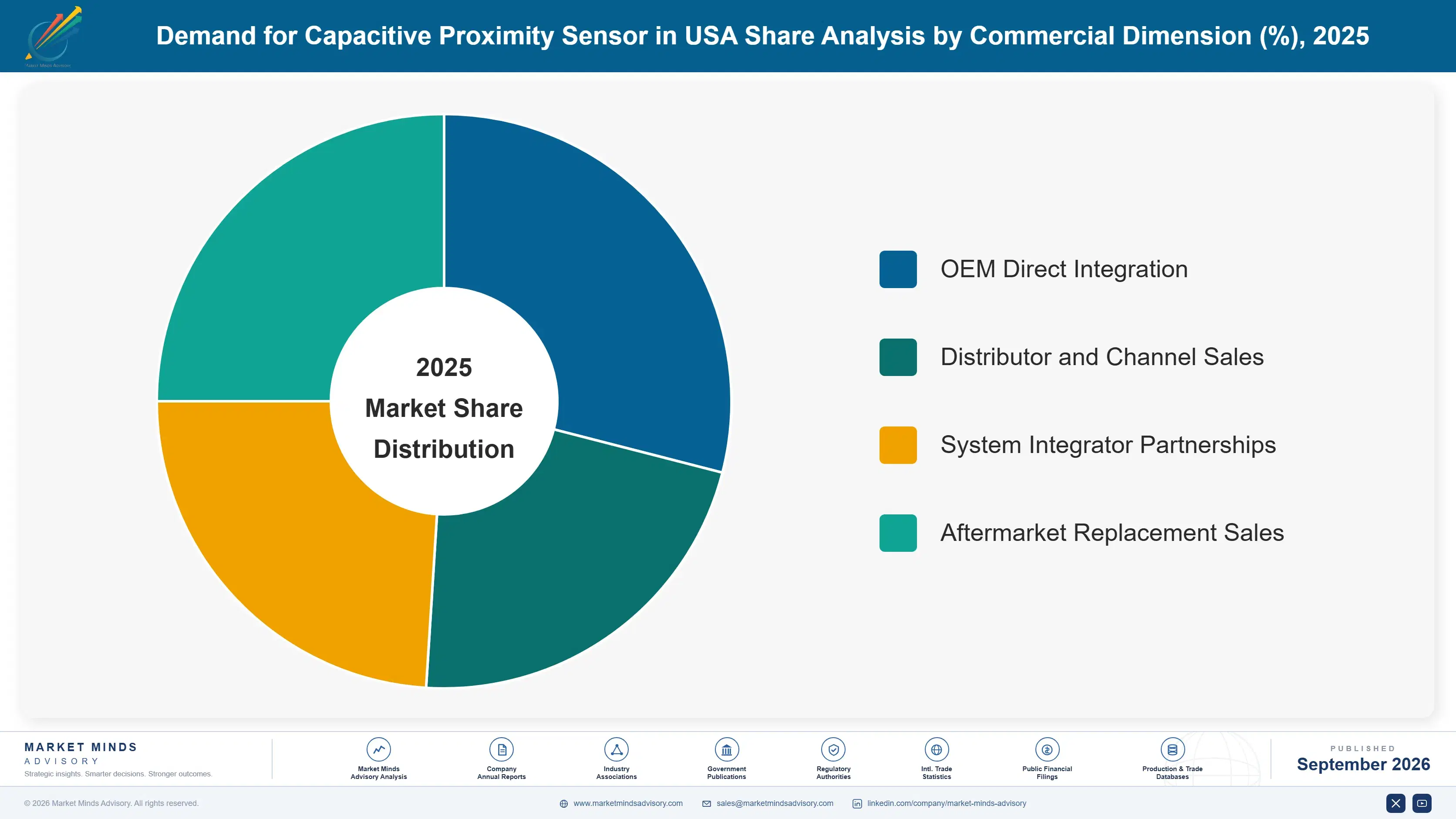
united-states-capacitive-proximity-sensor-market-market-share-analysis-1788452726184

Robotics and Collaborative Automation Sensors

Robotics and collaborative automation sensors lead category growth by a meaningful margin, driven overwhelmingly by expanding safety regulation that increasingly mandates redundant human presence detection layers in shared workspace environments where robots and human operators work in close physical proximity. Manufacturers of collaborative robots increasingly specify capacitive sensing as a standard safety component rather than an optional upgrade, since regulators recognize that dissimilar sensing technologies deployed together catch failure modes that any single approach might miss entirely. Vendors competing here differentiate primarily on certification credentials and reliability documentation rather than raw detection range specifications alone, since safety-critical applications weigh documented reliability considerably above cost. MMA estimates this segment will represent well over a quarter of total category revenue by 2036.
CAGR 13.0%

Consumer Electronics and Touchless Interface Sensors

Consumer electronics and touchless interface sensors represent the second fastest-growing segment, anchored by sustained preference shifts toward reduced physical contact in shared public spaces that emerged during the pandemic era and has persisted well beyond it into mainstream product design expectations across nearly every category. Equipment manufacturers increasingly treat touchless interface capability as a standard specification for elevators, kiosks, and payment terminals rather than a premium feature reserved for high-end installations, broadening the addressable market considerably beyond early adopter segments. Semiconductor integration increasingly compresses sensor cost and size for this segment specifically, opening wearable device and smartphone applications that discrete sensor designs previously could not economically address at comparable price points.
CAGR 10.0%
Full segment breakdown across 6 segments available in the complete report.

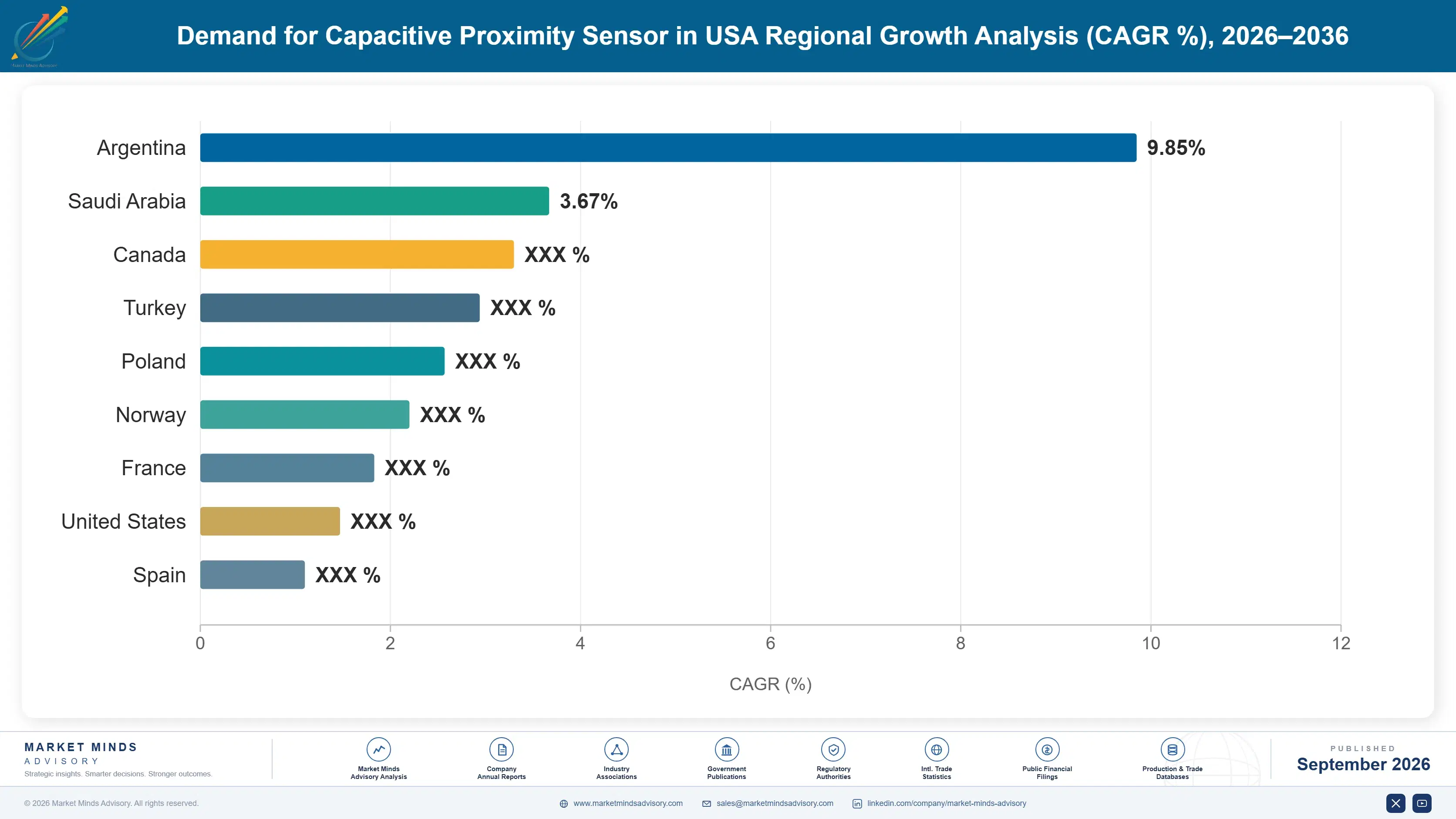
Regional Architecture and Country Demand Map

North America anchors global capacitive proximity sensor demand given concentrated robotics, consumer electronics, and industrial automation purchasing power, while East Asia builds substantial parallel scale through domestic manufacturing capacity and export volume, and South Asia Pacific delivers the fastest regional growth of any market covered.

North America

United States manufacturers and equipment integrators drive the largest share of category demand, reflecting concentrated robotics, consumer electronics, and industrial automation purchasing power across the world's largest automation capital spending market by a considerable margin over every other region and territory. Texas Instruments and Microchip Technology maintain primary product development and headquarters operations domestically, giving American equipment designers early access to next-generation sensing chip capability ahead of most global competitors. Occupational Safety and Health Administration guidance increasingly shapes collaborative robotics safety sensing requirements for domestic manufacturers pursuing automation investment. Canada contributes a smaller but meaningfully growing share through similar industrial automation and robotics adoption patterns nationwide and across its manufacturing base.
Share: 31% | CAGR: 9.0% (2026 to 2036)

Western Europe

Western Europe's capacitive proximity sensor demand follows a compliance-driven pattern distinct from North America, with German industrial automation manufacturers driving substantial demand for safety-certified sensing components meeting stringent European machinery safety directive requirements and standards across most jurisdictions and industries alike and overall today and tomorrow. France and the United Kingdom contribute steady demand through their consumer electronics and automotive manufacturing sectors respectively and across related supply chains and vendor networks. The region's stronger occupational safety regulation increasingly shapes sensor selection criteria, favoring certified, redundant sensing architectures over cost-minimized single-sensor designs. Nordic countries show above-average collaborative robotics adoption relative to regional manufacturing scale, reflecting genuine automation investment priority and strategic emphasis.
Share: 20% | CAGR: 6.5% (2026 to 2036)
Regional intelligence for 5 additional markets available in the complete report: East Asia, South Asia and Pacific, Latin America, Middle East and Africa, Eastern Europe. Contact sales@marketmindsadvisory.com.
united-states-capacitive-proximity-sensor-market-country-cagr-analysis-1788452726698

How Sensor Suppliers Expand Contract Value

Sensor suppliers capturing outsized returns increasingly move beyond bare component sales toward safety certification bundling, application-specific calibration consulting, redundant sensing system design, and algorithm licensing, all of which measurably deepen customer relationships and lift average account value across multi-year procurement and deployment cycles considerably across industrial and consumer accounts nationwide and internationally as well.

Bundle Safety Certification Documentation with Core Sensors

Suppliers that provide documented safety certification testing alongside core sensor sales typically capture 20 to 30 percent higher contract values than those selling uncertified components alone. Equipment manufacturers building collaborative robotics and safety-critical applications increasingly require this certification documentation as a standard procurement criterion, making certification bundling a genuine differentiator rather than a marginal service add-on during vendor evaluation. Suppliers that achieve recognized certification status find sales cycles shorten meaningfully, since procurement teams no longer need to independently validate safety compliance before finalizing multi-year component agreements across most applications and industries.
Market Impact: Certification bundling lifts contract values 20 to 30 percent

Offer Application-Specific Sensor Calibration Consulting Services

Suppliers that provide calibration consulting for specific detection challenges, such as distinguishing target materials from background interference, typically command 15 to 25 percent premium pricing over generic component sales. Equipment designers increasingly lack deep internal expertise in capacitive sensing physics, making this consulting capability a genuine differentiator rather than a marginal service offered after the sale. Suppliers building this consulting capability internally gain a durable advantage over competitors treating calibration purely as a technical afterthought rather than a commercial relationship deepening opportunity across multiple product generations, applications, and customer segments.
Market Impact: Calibration consulting commands 15 to 25 percent premium

Expand into Redundant Sensing System Design

Suppliers that design complete redundant sensing architectures combining capacitive sensors with complementary optical or ultrasonic technologies typically add 10 to 18 percent incremental revenue per enterprise account by cross-selling into existing collaborative robotics customer relationships. This expansion strategy applies established trust and integration infrastructure rather than requiring costly new customer acquisition, since existing customers already understand the supplier's sensing methodology and reliability standards. Suppliers pursuing this strategy retain customers longer, since a broader system design portfolio raises the switching cost of migrating to a competing sensing architecture entirely and permanently.
Market Impact: Redundant system design adds 10 to 18 percent revenue

License Detection Algorithms to Chip Manufacturers

Sensor suppliers that develop proprietary signal processing and false-trigger rejection algorithms can license this technology to semiconductor manufacturers integrating sensing capability directly into microcontroller packages, typically generating 8 to 15 percent incremental revenue without directly cannibalizing core sensor sales volume. This licensing approach monetizes algorithm development investment that would otherwise benefit only the supplier's own discrete component sales, extracting additional value from accumulated signal processing expertise across a broader customer base. Leading suppliers increasingly treat algorithm licensing as a distinct commercial revenue stream separate from core sensor manufacturing operations entirely.
Market Impact: Algorithm licensing adds 8 to 15 percent revenue

Who Controls the Margin Pool

Concentration in capacitive proximity sensing remains moderate, with the top five participants controlling an estimated 48 percent of category revenue on a revenue basis. Texas Instruments holds the clearest leadership position given its dominant semiconductor integration capability, while Rockwell Automation commands strong positions in safety-certified industrial applications through decades of automation engineering heritage. Microchip Technology and STMicroelectronics compete from strong positions in specific niches. The gap between semiconductor-native competitors and traditional discrete manufacturers has widened as integration trends reshape positioning.
Current competitive activity centers on semiconductor integration and safety certification, with suppliers racing to secure collaborative robotics design wins rather than competing on commodity industrial sensor volume alone. Partnership announcements between chip manufacturers and industrial automation integrators have become increasingly common, replacing the purely transactional component sourcing relationships common in earlier sensor generations. Pricing competition remains intense within commodity industrial segments, where suppliers weigh volume retention over unit margin.

Emerging pressure comes from semiconductor manufacturers embedding sensing capability directly into general-purpose microcontroller packages, threatening the addressable market for discrete sensor specialists serving commodity applications. Rankings could shift meaningfully if collaborative robotics adoption accelerates faster than expected, a scenario several safety-certified sensor suppliers are positioning aggressively to capture.
united-states-capacitive-proximity-sensor-market-company-positioning-matrix-1788452727218

Competitive Moat and Risk Dimensions

TEXAS INSTRUMENTS

Moat: Semiconductor Integration Leadership

Texas Instruments benefits from its dominant position embedding capacitive sensing capability directly into widely deployed microcontroller product lines, giving it privileged access to design wins across countless equipment categories that never require a separate discrete sensor purchase. This integration advantage compounds as the company's chip portfolio breadth grows further across adjacent product categories.
TEXAS INSTRUMENTS

Risk: Limited Safety Certification Depth

Texas Instruments' integrated sensing solutions generally lack the extensive safety certification track record that specialized industrial sensor manufacturers have built over decades, limiting its penetration into safety-critical collaborative robotics applications where documented certification history genuinely matters to risk-averse equipment manufacturers and regulators evaluating vendor qualifications.
ROCKWELL AUTOMATION

Moat: Decades of Industrial Automation Heritage

Rockwell Automation benefits from decades of accumulated industrial automation engineering credibility and extensive safety certification documentation that newer semiconductor entrants cannot easily replicate, giving it privileged access to the highest-margin safety-critical collaborative robotics contracts where documented reliability matters more than raw component cost considerations alone.
ROCKWELL AUTOMATION

Risk: Premium Pricing Limits Commodity Volume

Rockwell Automation's premium positioning and higher unit pricing limit its competitiveness in commodity industrial sensing applications where cost-sensitive customers increasingly favor cheaper semiconductor-integrated alternatives, potentially constraining volume growth if broader industrial capital spending shifts meaningfully toward cost minimization over safety differentiation across most customer segments.

Players Tracked

Prominent Players

Texas Instruments
Microchip Technology
STMicroelectronics
Rockwell Automation
Balluff GmbH

Other Key Players

Omron Corporation
Panasonic Corporation
Honeywell International
Sick AG
Pepperl+Fuchs
ifm electronic
Turck Inc.
Schneider Electric
Siemens AG
Infineon Technologies
NXP Semiconductors
Analog Devices
Cypress Semiconductor
Renesas Electronics
Broadcom

Recent Developments

OCTOBER 2025

Texas Instruments launched an updated capacitive sensing microcontroller family in October 2025 featuring improved electromagnetic interference rejection specifically targeting industrial automation applications, addressing a longstanding reliability concern that had previously limited semiconductor-integrated sensing adoption in electrically noisy manufacturing environments compared to discrete component alternatives and designs.
Signal: Signals semiconductor vendors increasingly addressing longstanding industrial reliability concerns to accelerate broader integration adoption further overall
JANUARY 2026

Rockwell Automation acquired a specialized collaborative robotics safety sensor startup in January 2026 to strengthen its redundant sensing system design capability, expanding beyond its traditional discrete component portfolio into complete safety architecture solutions for manufacturers deploying human-collaborative automation equipment across multiple industrial sectors and applications.
Signal: Signals established automation vendors increasingly moving toward complete safety system design capability overall today and beyond
APRIL 2026

Balluff GmbH signed a distribution partnership with a major North American industrial automation integrator in April 2026 to expand its collaborative robotics sensing product availability across the United States market, strengthening its competitive position against domestic incumbents in the fastest-growing application segment and broader region.
Signal: Signals European sensor manufacturers increasingly expanding North American distribution reach to capture robotics growth opportunities directly

Semiconductor Die and Housing Costs

Semiconductor die and specialized enclosure materials represent the largest cost inputs for capacitive proximity sensor manufacturers, typically comprising 30 to 40 percent of cost of goods sold depending on application complexity and certification requirements. Taiwan Semiconductor Manufacturing Company and a small number of specialized foundries fabricate the underlying sensing chips regardless of which brand ultimately markets the finished sensor product.
Taiwan Semiconductor Manufacturing Company's 2025 annual report disclosed mature process node capacity increasingly reallocated toward higher-margin advanced chip customers, extending lead times for sensor manufacturers relying on older, cost-optimized process nodes typically used for simple sensing chips. Sensor manufacturers without long-term foundry relationships faced meaningfully longer delivery timelines during this period, forcing some to raise prices or delay new product introductions until capacity availability improved.

Smaller sensor manufacturers lacking long-term foundry relationships pay meaningfully higher effective chip costs than scale leaders like Texas Instruments and Microchip Technology, which negotiate substantial capacity commitments unavailable to smaller competitors across most product categories. This cost disadvantage compounds for manufacturers serving safety-certified industrial segments, since certified components typically require dedicated production lines carrying higher per-unit qualification and testing costs.
united-states-capacitive-proximity-sensor-market-cost-volatility-analysis-1788452727414

Long-Term Foundry Relationships Secure Chip Supply

Manufacturers increasingly negotiate long-term capacity agreements with mature process node foundries rather than relying on spot purchasing, securing more predictable delivery timelines regardless of broader semiconductor demand cycles affecting advanced node customers. This approach requires meaningful advance commitment and demand forecasting accuracy, but reduces exposure to the allocation delays that spot market purchasers experience during periods of peak demand.

Design Simplification Reduces Component Count Requirements

Some manufacturers now simplify sensor circuit design to reduce the number of discrete components required per unit, lowering overall bill of materials cost without sacrificing core detection performance for standard applications. This approach requires meaningful engineering investment upfront, but reduces exposure to component-level price volatility across the many individual parts a more complex design would otherwise require.

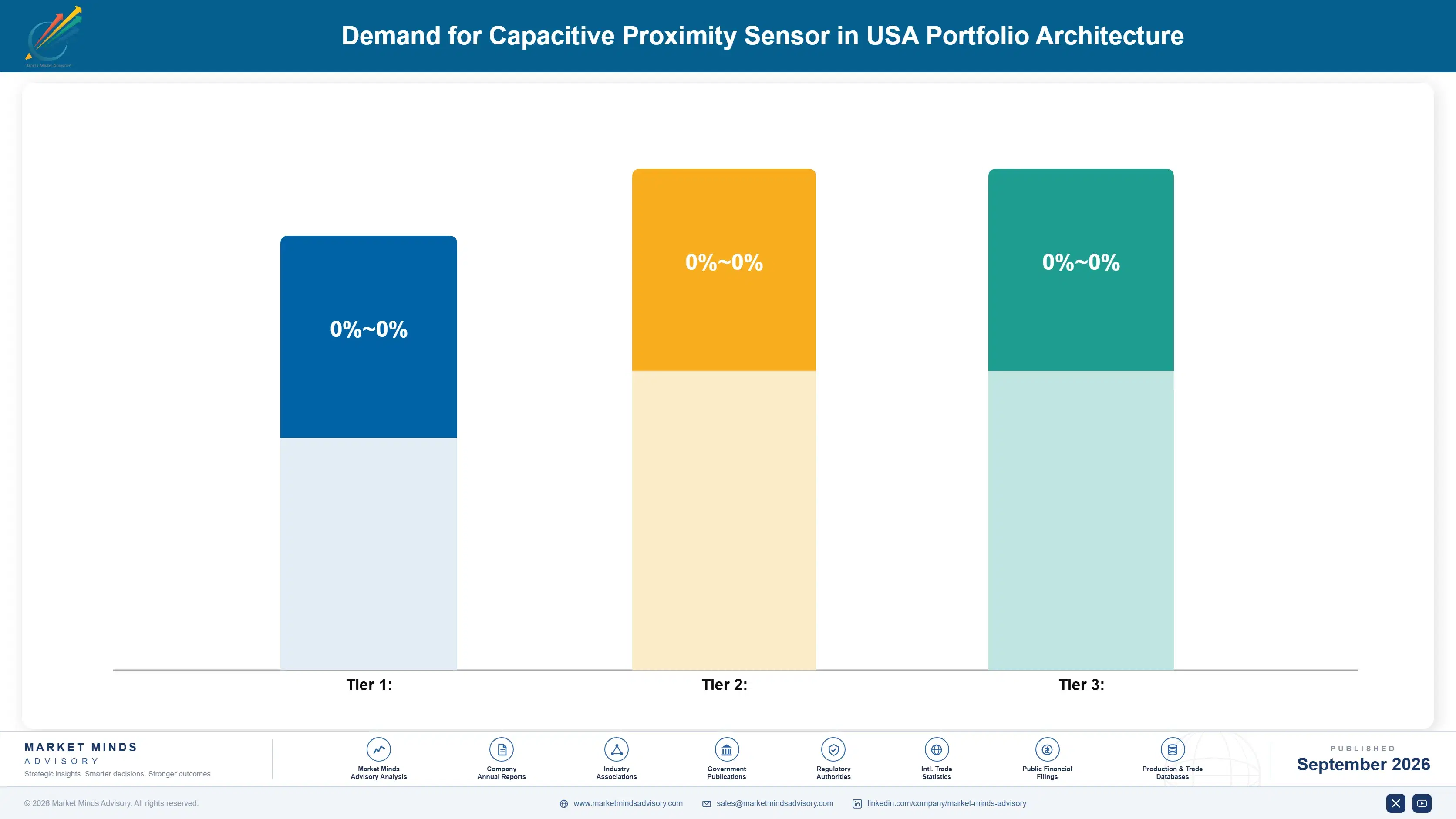
Portfolio Architecture for Margin Defence

Capacitive proximity sensor suppliers organize commercial strategy around three tiers separated by certification requirements and margin profile rather than by sensor packaging alone. Volume tier products, largely general industrial automation sensors, carry gross margins in the 25 to 35 percent range typical of mature, commoditized manufacturing. Premium certified tier offerings, built around safety-certified robotics and automotive-grade sensors, command materially higher margins given certification barriers and multi-year design-win relationships that discourage customer migration.
Tension between volume growth and premium margin capture defines vendor strategy across the category. Pursuing broad general industrial volume dilutes average selling price and invites aggressive price competition from semiconductor-integrated alternatives, while premium safety-certified focus limits addressable customer count but sustains materially healthier unit economics and deeper robotics relationship retention over multi-year contract cycles industry wide.

High-value revenue pools concentrate overwhelmingly in safety-certified robotics and consumer electronics touchless interface sensors, where certification and integration engineering create durable barriers smaller volume-tier competitors cannot easily cross. Vendors positioned in these premium pools increasingly command design-win retention rates exceeding 78 percent annually, reflecting genuine technical switching cost depth rather than simple customer inertia alone across most accounts.

General industrial automation sensors licensed at competitive price points across established manufacturing categories, with gross margins around 25 to 35 percent reflecting decades of manufacturing scale and intense global vendor price competition.
Gross Margin

Safety-certified robotics and automotive-grade sensors serving customers requiring documented reliability and redundant sensing architecture, commanding gross margins around 40 to 50 percent given certification barriers and multi-year design-win relationships across major accounts.
Gross Margin

Next-generation semiconductor-integrated and AI-enhanced sensing solutions purpose-built for emerging application categories, currently commanding premium pricing while broader industry standardization and integration economics remain in early, evolving stages worldwide and across regions.
Gross Margin
united-states-capacitive-proximity-sensor-market-portfolio-architecture-1788452727909

High-value Sub-segments and Strategic Watch-out

Robotics and Collaborative Automation Sensors

Robotics and collaborative automation sensors combine the fastest segment growth rate in the category with premium certified-tier margins, making it the single most attractive investment target for suppliers and investors alike. MMA expects this segment's revenue share to expand meaningfully faster than any other through 2036, driven by safety regulation.

Consumer Electronics and Touchless Interface Sensors

Consumer electronics and touchless interface sensors deliver strong premium-tier margins with moderately slower growth than robotics sensors, anchored by sustained preference shifts toward reduced physical contact in shared spaces. Suppliers serving this segment benefit from semiconductor integration trends that expand addressable applications considerably faster than discrete sensor volume alone.

General Industrial Automation Sensors

General industrial automation sensors remain the largest single revenue base by installed unit count, though margins run considerably lower than premium segments given intense price competition and established vendor substitutability across commodity applications. This segment anchors overall category volume even as its share of total revenue gradually declines over time.

Liquid Level Monitoring Sensors

Liquid level monitoring sensors have grown well below overall category average as demand concentrates among a narrow set of food processing and chemical handling applications rather than broadening across additional industrial categories as initially anticipated. Suppliers concentrated here risk share erosion unless they diversify into adjacent sensing application segments.

Why Sensor Design Wins Persist

Capacitive sensor relationships increasingly behave like annuity businesses rather than one-time component sales, since equipment manufacturers that qualify a specific sensor for their product line rarely switch mid-cycle given the extensive validation and calibration work involved. Design win retention rates for safety-certified robotics sensors now regularly exceed 78 percent across full product generations, reflecting genuine technical dependency rather than simple contractual inertia.
Stickiness varies considerably by end-use vertical. Robotics and industrial automation customers embed sensor specifications deeply into safety certification documentation, making supplier switching costly and operationally risky once regulatory approval depends on a specific vendor's exact detection characteristics. Consumer electronics customers show shallower stickiness, since annual product refresh cycles create more frequent opportunities to switch suppliers based purely on price and integration convenience.

Buyer profiles are shifting as procurement decisions move from pure component sourcing teams toward integrated safety engineering teams who evaluate sensors based on total system reliability rather than bare component specifications alone. Younger automation engineering talent increasingly expects redundant, dissimilar sensing architecture as a baseline safety expectation, accelerating the industry's shift toward system-level rather than component-level competition among suppliers and integrators.
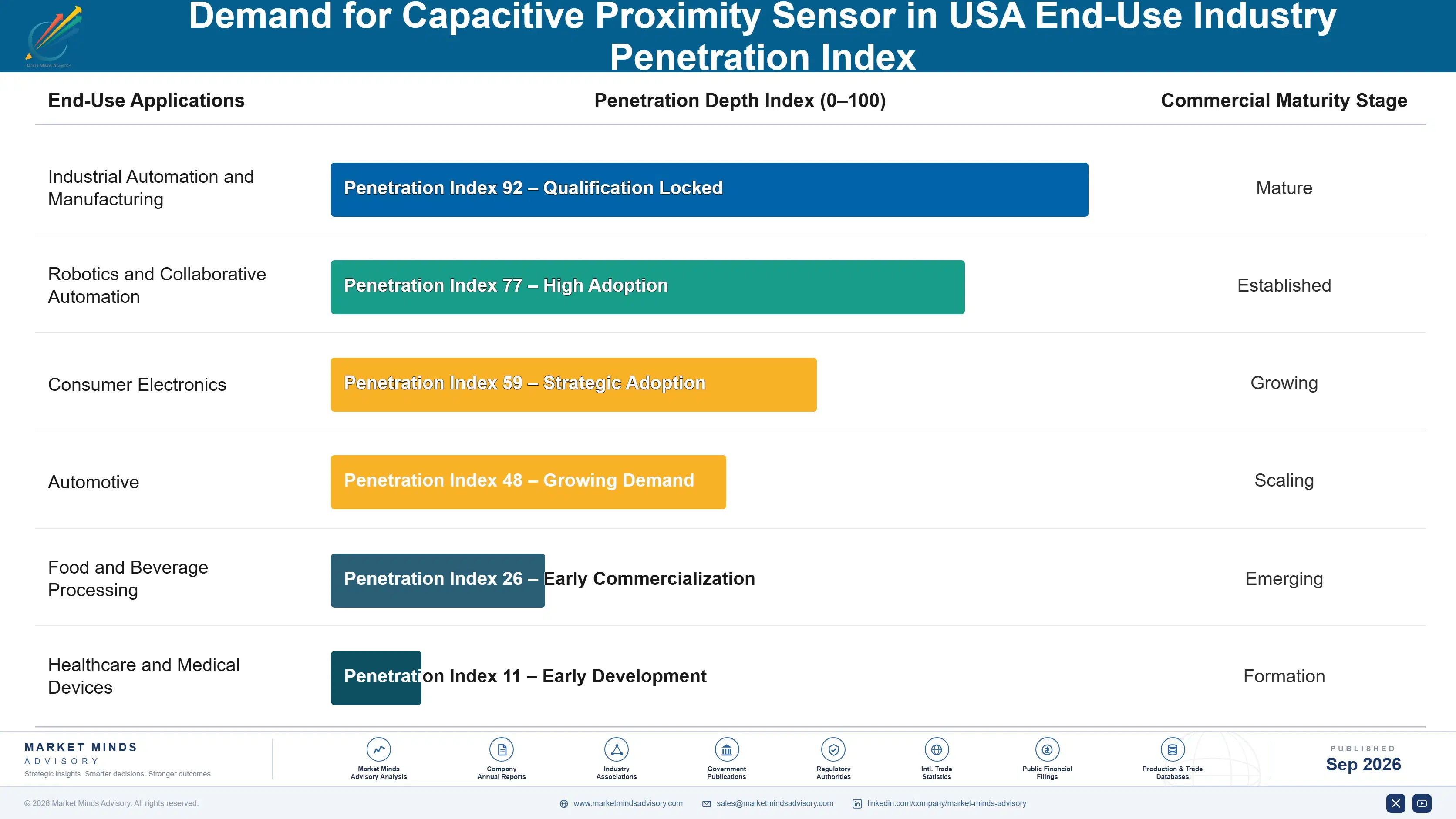
united-states-capacitive-proximity-sensor-market-end-use-penetration-index-1788452728390

Where Sensor Investment Pays Off

These are among the four positions where our research anticipates prominent divergence between winners and laggards over the coming forecast period. Each is grounded in the demand model, the regulatory perimeter, and the announced capacity pipeline.
01 / ROBOTICS DESIGN WIN STRATEGY

Prioritize collaborative robotics design wins over commodity industrial volume

Collaborative robotics design wins carry meaningfully higher per-unit value and considerably longer relationship duration than commodity industrial contracts, given safety certification requirements that persist regardless of near-term automation capital spending volatility across broader economic cycles and shifting conditions. Suppliers spreading resources evenly across both customer types dilute their ability to build the safety-specific reliability and certification capability that robotics manufacturers genuinely require before committing to a multi-year design relationship. MMA recommends prioritizing robotics qualification investment over incremental commodity volume expansion.
02 / SAFETY CERTIFICATION INVESTMENT

Build documented safety certification credentials ahead of regulatory mandates

Safety regulation increasingly mandates redundant sensing layers before equipment manufacturers will finalize collaborative robotics procurement decisions, and suppliers lacking documented certification already report losing competitive evaluations to better-positioned rivals across most major accounts and market segments nationwide and abroad. Building this certification infrastructure retroactively under competitive pressure costs considerably more than proactive compliance investment pursued well ahead of formal procurement deadlines across major customer segments nationwide. MMA recommends treating safety certification as core strategic infrastructure rather than a deferrable compliance afterthought.
03 / SEMICONDUCTOR INTEGRATION RESPONSE

Move upmarket into specialized applications beyond generic chip integration

Semiconductor manufacturers increasingly embed generic sensing capability directly into microcontroller packages, eroding unit volume for discrete sensor suppliers serving standard commodity applications across most industrial and consumer categories worldwide and across most regions. Suppliers that fail to differentiate through specialized performance beyond generic integration risk losing meaningful share to lower-cost integrated alternatives regardless of their historical brand reputation and manufacturing scale advantages built over decades. MMA recommends moving upmarket into specialized applications requiring performance beyond what generic integration can reliably deliver.
04 / INTERFERENCE RELIABILITY ENGINEERING

Invest in shielding technology to resolve electromagnetic interference concerns

Electromagnetic interference concerns continue to limit capacitive sensor adoption in electrically noisy industrial environments, and suppliers that resolve this reliability limitation gain a meaningful competitive advantage over rivals still experiencing customer complaints about false detection triggers and reliability issues. Investing in improved shielding and signal filtering technology addresses a genuine and persistent adoption barrier rather than a purely theoretical concern that customers have already experienced directly in real deployment conditions. MMA recommends prioritizing interference resilience engineering investment now rather than later.

Engagement Snapshot From the Field

A live engagement with an industry participant carrying material or product regulatory and market exposure ahead of a defining policy shift, showing how our research translates into a defensible multi-year portfolio strategy.
MARKET MINDS ADVISORY · CLIENT ENGAGEMENT SUMMARY
Demand for Capacitive Proximity Sensor in USA Producer Strategic Portfolio Review and Transition Roadmap 2026·Investment Scenario on Demand for Capacitive Proximity Sensor in USA Exposure Evaluation 2025-26
CLIENT PROFILE
The client is a major United States collaborative robotics manufacturer developing a next-generation robot arm platform requiring enhanced human presence detection capability to meet expanding customer deployment across shared manufacturing workspaces nationwide. Facing increasing competitive pressure from rivals offering more sophisticated safety sensing, leadership sought an independent sensor supplier evaluation before finalizing platform design decisions.
STRATEGIC CHALLENGE
The manufacturer's existing safety sensing approach relied on a single optical detection technology adequate for basic collision avoidance but potentially insufficient for the redundant, multi-technology sensing architecture that emerging safety standards increasingly favored for collaborative applications. Leadership needed to evaluate whether adding capacitive proximity sensing justified the integration cost and design complexity involved.
MMA APPROACH
MMA conducted a structured supplier evaluation combining expert interviews with the manufacturer's safety engineering leadership, competitive benchmarking across five leading sensor suppliers, and analysis of documented reliability outcomes from peer robotics manufacturers that had already deployed comparable redundant sensing architectures. The engagement produced a phased integration framework prioritizing highest-risk collision scenarios first.
KEY FINDINGS
  1. Peer robotics manufacturers using redundant capacitive and optical sensing reported safety incident rates declining by approximately 28 percent (client-reported, unverified by MMA), primarily by catching detection scenarios optical sensing alone occasionally missed.
  2. Vendor pricing models varied considerably, with certified safety-grade capacitive sensors costing meaningfully more than industrial-grade alternatives, though certification documentation simplified the manufacturer's own regulatory approval process considerably.
  3. Reliability testing data from peer manufacturers showed capacitive sensors performing reliably across most manufacturing environments, though several facilities with heavy electromagnetic interference required additional shielding modifications.
  4. Integration with the manufacturer's existing robot control software proved more technically complex than most vendors initially represented during sales evaluation, extending the typical implementation timeline by several additional months.
CLIENT PROFILE
The client is a major United States collaborative robotics manufacturer developing a next-generation robot arm platform requiring enhanced human presence detection capability to meet expanding customer deployment across shared manufacturing workspaces nationwide. Facing increasing competitive pressure from rivals offering more sophisticated safety sensing, leadership sought an independent sensor supplier evaluation before finalizing platform design decisions.
STRATEGIC CHALLENGE
The manufacturer's existing safety sensing approach relied on a single optical detection technology adequate for basic collision avoidance but potentially insufficient for the redundant, multi-technology sensing architecture that emerging safety standards increasingly favored for collaborative applications. Leadership needed to evaluate whether adding capacitive proximity sensing justified the integration cost and design complexity involved.
MMA APPROACH
MMA conducted a structured supplier evaluation combining expert interviews with the manufacturer's safety engineering leadership, competitive benchmarking across five leading sensor suppliers, and analysis of documented reliability outcomes from peer robotics manufacturers that had already deployed comparable redundant sensing architectures. The engagement produced a phased integration framework prioritizing highest-risk collision scenarios first.
KEY FINDINGS
  1. Peer robotics manufacturers using redundant capacitive and optical sensing reported safety incident rates declining by approximately 28 percent (client-reported, unverified by MMA), primarily by catching detection scenarios optical sensing alone occasionally missed.
  2. Vendor pricing models varied considerably, with certified safety-grade capacitive sensors costing meaningfully more than industrial-grade alternatives, though certification documentation simplified the manufacturer's own regulatory approval process considerably.
  3. Reliability testing data from peer manufacturers showed capacitive sensors performing reliably across most manufacturing environments, though several facilities with heavy electromagnetic interference required additional shielding modifications.
  4. Integration with the manufacturer's existing robot control software proved more technically complex than most vendors initially represented during sales evaluation, extending the typical implementation timeline by several additional months.
RECOMMENDED STRATEGY
Phase 1: Pilot redundant capacitive and optical sensing within the highest-risk collision scenarios first, measuring documented safety incident rates over one full deployment cycle. Phase 2: Expand redundant sensing deployment across the full product line following successful pilot validation, negotiating certified component pricing once volume commitments become clearer. Phase 3: Integrate sensor reliability data directly into the manufacturer's ongoing safety certification and product liability documentation systems, creating a permanent capability.
OUTCOME
(Client-reported, unverified by MMA) The pilot program reduced safety incident rates by an estimated 24 percent within the highest-risk collision scenarios while maintaining comparable robot cycle time performance against the previous single-sensor configuration. Leadership subsequently approved expanded redundant sensing deployment across the full product line beginning the following product generation.

Frequently Asked Questions

Foundational context covering the market sizes, CAGR, scope, country, region and competition that inform every finding below. This section is provided to cover basics and most often pre-purchase conversations, answered from the MMA Primary Research Dataset.

What is the current size of the Demand for Capacitive Proximity Sensor in USA?

The Demand for Capacitive Proximity Sensor market reached an estimated $1.35 billion in 2025, reflecting steady industrial automation and consumer electronics adoption of solid-state, non-contact detection technology.

How large will the Demand for Capacitive Proximity Sensor in USA be by 2036?

MMA projects the market will reach approximately $3.15 billion by 2036, driven by collaborative robotics safety regulation and continued semiconductor integration into mainstream sensing applications.

What is the CAGR for the Demand for Capacitive Proximity Sensor in USA 2026 to 2036?

The market is expected to grow at a compound annual growth rate of 8.0 percent between 2026 and 2036, reflecting sustained industrial automation and touchless interface demand.

Which segment is growing fastest?

Robotics and collaborative automation sensors are the fastest-growing segment, expanding at approximately 13.0 percent annually, roughly 1.62 times the overall market growth rate given safety regulation.

Who are the major companies in the Demand for Capacitive Proximity Sensor in USA?

Leading participants include Texas Instruments, Microchip Technology, STMicroelectronics, Rockwell Automation, and Balluff GmbH, together holding an estimated 48 percent of category revenue on a consistent revenue basis.

Which country is growing fastest?

China shows the fastest national growth trajectory at approximately 11.0 percent annually, driven by massive domestic electronics assembly and rapidly expanding industrial automation capacity nationwide.

Report Segmentation Architecture

The full report scope spans multiple orthogonal segmentation dimensions, with cross-tabulated demand data provided for each dimension pair. Coverage extends further to regional breakdowns, trend trajectories, and the competitive detail needed to support segment-level decision-making.

By Primary Market Dimension

  • Robotics and Collaborative Automation Sensors
  • Consumer Electronics and Touchless Interface Sensors
  • Food and Beverage Processing Sensors
  • Automotive Proximity Sensors
  • General Industrial Automation Sensors
  • Liquid Level Monitoring Sensors

By End-Use Industry

  • Industrial Automation and Manufacturing
  • Robotics and Collaborative Automation
  • Consumer Electronics
  • Automotive
  • Food and Beverage Processing
  • Healthcare and Medical Devices

By Commercial Dimension

  • OEM Direct Integration
  • Distributor and Channel Sales
  • System Integrator Partnerships
  • Aftermarket Replacement Sales

By Region

  • North America
  • Western Europe
  • East Asia
  • South Asia and Pacific
  • Latin America
  • Middle East and Africa
  • Eastern Europe

Scope, Methodology, and Coverage

Every figure in this report is reproducible from documented input assumptions. The scope below maps the historical period, the forecast horizon, the segmentation dimensions, and the countries covered, alongside the underlying primary and qualitative methodology.
Historical Period
2020 to 2025
Forecast Period
2026 to 2036
Base Year
2025 (USD billions; MMA Primary Research Dataset, September 2026)
Market Definition
The Demand for Capacitive Proximity Sensor Market covers standalone and embedded capacitive sensing devices used for object, human presence, and liquid level detection across industrial, consumer electronics, robotics, and automotive applications, measured by unit shipment and sensor revenue. It excludes inductive, optical, and ultrasonic proximity sensors sold as competing technologies, and general-purpose microcontrollers not specifically marketed as sensing components.
Quantitative Units
USD billions, market share percentage, CAGR percentage
Segmentation Dimensions
By Primary Market Dimension, By End-Use Industry, By Commercial Dimension, By Region
Regions Covered
North America, Western Europe, East Asia, South Asia and Pacific, Latin America, Middle East and Africa, Eastern Europe
Countries Covered
United States, Canada, China, Japan, South Korea, Germany, France, United Kingdom, India, Australia, Vietnam, Malaysia, Brazil, Mexico, United Arab Emirates, Saudi Arabia, South Africa, Poland
Key Companies Profiled
Texas Instruments, Microchip Technology, STMicroelectronics, Rockwell Automation, Balluff GmbH, Omron Corporation, Panasonic Corporation, Honeywell International, Sick AG, Pepperl+Fuchs, ifm electronic, Turck Inc., Schneider Electric, Siemens AG, Infineon Technologies, NXP Semiconductors, Analog Devices, Cypress Semiconductor, Renesas Electronics, Broadcom
Quantitative Methodology
Primary survey, n=3,800 respondents, Q4 2025, six countries; demand-side model with trade association cross-validation
Qualitative Methodology
47 expert interviews, Q4 2025; applied to validate demand model assumptions, identify emerging dynamics, and assess competitive positioning
Report Format
PDF and XLSX data workbook (Word format preview document)
Publisher
Market Minds Advisory
Report Code
MMA-2026-TEC-646
Published
September 2026
Contact
sales@marketmindsadvisory.com | www.marketmindsadvisory.com

Purchase the full Demand for Capacitive Proximity Sensor in USA Report (2026 to 2036).

The full report provides comprehensive market sizing, ten-year forecasts, competitive benchmarking, and regional analysis for capacitive proximity sensor demand across industrial and consumer applications, drawing on primary survey data and expert interviews across major industrial and consumer electronics markets. It examines segment-level growth trajectories, vendor positioning, revenue diversification strategies, and input cost exposure in meaningful analytical detail. Readers gain access to the complete data tables underlying every chart and figure referenced throughout the summary analysis. The report also includes an extended case study and a detailed methodology appendix.
Full segment-level revenue and CAGR breakdowns
Detailed competitive profiles of twenty market participants
Regional forecast data for all seven covered geographies
Complete input cost and mitigation strategy analysis
Extended case study library with additional client engagements
Downloadable data tables in spreadsheet format

Built For The People Who Decide

From boardroom strategy to bench-side execution, this report is read cover-to-cover by leaders shaping the next decade of their industry, turning demand scenarios, market dynamics and valuation benchmarks into decisions.
CXOs/ Presidents/ VPs/ Managers
M&A and Corporate Development
Strategy Teams and R&D Heads
Procurement and Product Directors
Regulatory and Compliance Leaders
Investor Relations and Equity Analysts