Market Minds Advisory
Demand for Camera Technology in USA

Demand for Camera Technology in USA: Demand for Camera Technology in USA. Computational Imaging Reshapes Consumer and Enterprise Capture

US consumers and enterprises are shifting spend toward AI-enhanced computational imaging and multi-sensor camera modules, pushing smartphone, security, and industrial vision hardware well beyond traditional single-lens capture capability across nearly every use case nationwide.

Lead Analyst

Published

September 2026

Make Smarter Decisions with Customized Research Insights

Request a free sample report and evaluate market opportunities, growth trends, and competitive dynamics relevant to your business needs.

2025 MARKET VALUE$12.4BMarket Size 2025
2036 FORECAST VALUE$33.6BBase Case , 2026 to 2036
CAGR 2026 TO 20369.5 %Bull 10.8% / Bear 8.2%
INCREMENTAL OPPORTUNITY$20.1BNet 10- year value creation
EXPANSION MULTIPLE2.48x2036 value over 2026 base
Strategic Levers
M&A Pipeline
Regional Outlook
Country Rankings
Competitive Intelligence
Segmental Deep-dive
Call-Us : 91 93563 13602

Executive Snapshot and Market Trajectory.

US camera technology demand is shifting decisively toward AI-enhanced computational imaging as smartphone, security, and industrial vision applications converge on multi-sensor capture architectures that extract far more value from raw pixel data than legacy single-lens designs ever reliably could deliver across comparable price points and every product category today.
Smartphone camera modules remain the largest revenue category, but security and surveillance imaging is expanding quickly as AI-driven analytics demand higher resolution sensors capable of supporting real-time object detection at the network edge without cloud dependency or added latency delays. Enterprise machine vision adoption in manufacturing and logistics is accelerating as computer vision models mature enough for reliable automated quality inspection across production lines nationwide and beyond every facility type.
Competitive intensity is rising as established sensor manufacturers compete against computational imaging software specialists building AI processing pipelines that extract more value from existing hardware investments already deployed across every facility and application category served today. Supply chain concentration in semiconductor image sensor fabrication remains a persistent vulnerability that domestic manufacturing incentive programs are only beginning to address meaningfully across the broader industry and supply base.
Market Definition
This market covers camera hardware, image sensors, and computational imaging software sold for consumer, security, and industrial vision applications in the United States. It excludes standalone video conferencing software and camera hardware embedded in non-imaging primary-use devices sold without dedicated imaging value proposition.
Base Year Value
$12.4B in 2025 (MMA Primary Research Dataset, September 2026)
Forecast Period
2026 to 2036, eleven discrete annual values
CAGR
9.5% base case. Bull 10.8%. Bear 8.2%.
Fastest Growth Segment
AI-Enhanced Computational Imaging Modules: 15.5% CAGR
Fastest Growth Country
India: 14.0% CAGR
Fastest Growth Region
South Asia and Pacific: 11.5% CAGR
Largest Region
North America: 32% of 2025 global value
Market Leaders
Sony Semiconductor, Qualcomm, Ambarella, Axis Communications, Cognex
Primary Survey
n=3,800 procurement and R&D decision-makers, Q4 2025, six countries
Methodology
Demand-side build-up, cross-validated against public data, 47 expert interviews

Demand for Camera Technology in USA Market Forecast Scenarios

united-states-camera-technology-market-size-forecast-scenario-1788502907840
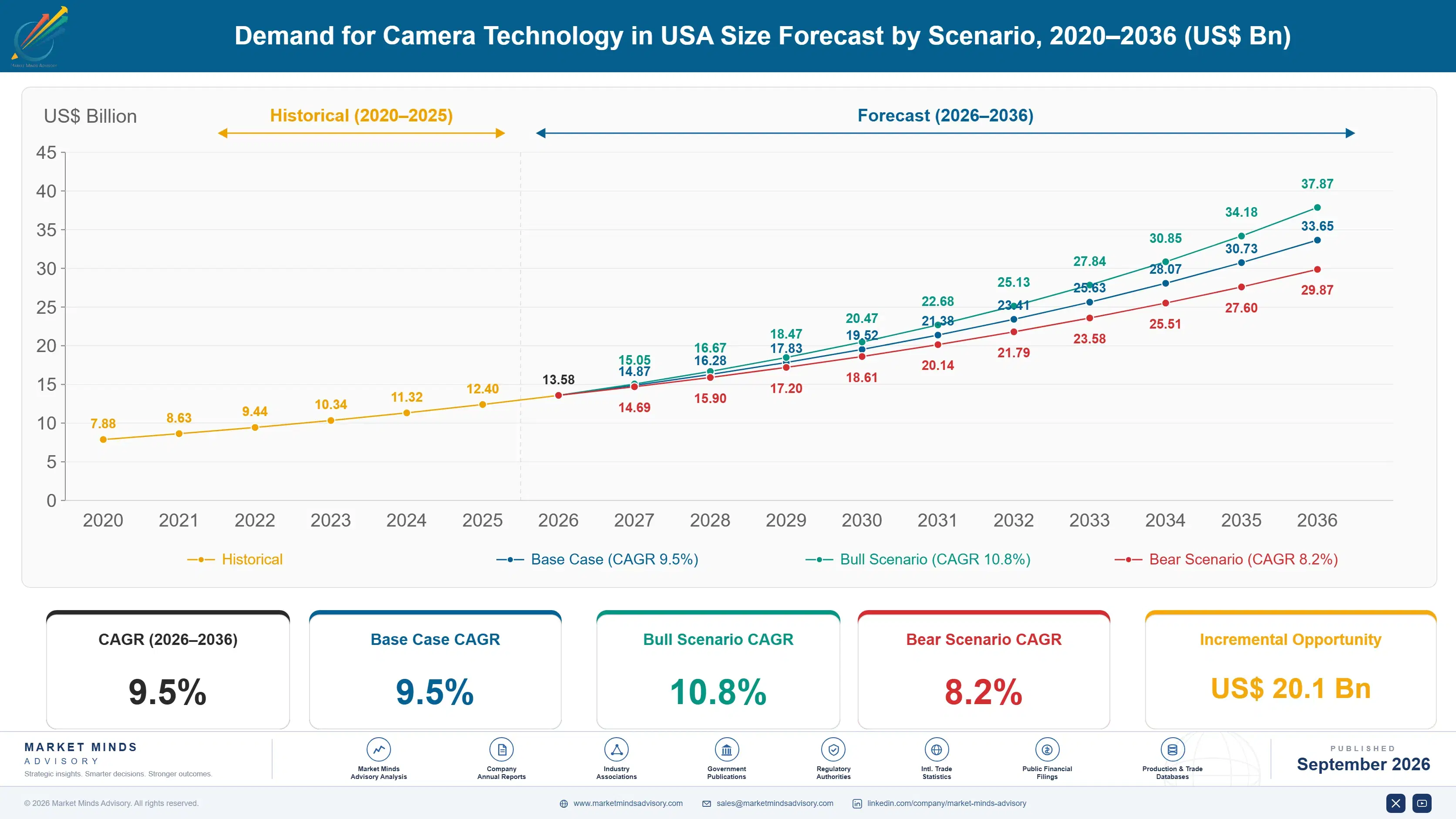
Between 2020 and 2025 US camera technology demand grew steadily as smartphone manufacturers added multi-lens systems and security operators upgraded to networked IP cameras across every major metropolitan market, with computational imaging capability accelerating meaningfully after 2023 as AI processing chips matured enough for real-time on-device image enhancement across every major consumer and enterprise category nationwide.
The base case assumes continued smartphone camera module sophistication driving average selling price growth across every price tier and device category nationwide and abroad, sustained enterprise machine vision investment across manufacturing and logistics automation projects nationwide, and expanding security camera deployment incorporating AI-driven analytics capability at scale, three commercial mechanisms reinforcing steady growth across the entire forecast window through 2036 across every major imaging application category and industry vertical nationwide.
The bull case centers on generative AI dramatically accelerating computational imaging capability, letting cameras extract meaningfully more usable detail from smaller, cheaper sensor hardware than currently modeled across every price segment. The bear risk is semiconductor supply chain disruption constraining image sensor availability meaningfully across the industry, delaying the premium camera module revenue growth vendors have already priced into current product roadmap investment plans.

Computational Imaging Redefines Sensor Value

US camera technology is transitioning from a hardware-centric category into one where computational processing determines final image quality as much as sensor specifications themselves ever did before across every price segment and product tier available today. Smartphone manufacturers increasingly compete on AI-driven image enhancement algorithms rather than raw megapixel counts alone, reshaping how buyers evaluate new devices and upgrade cycles going forward.
AVERAGE SENSOR RESOLUTION108MPTypical flagship smartphone primary sensor resolution currently offered
MULTI-CAMERA MODULE SHARE78%Portion of smartphones shipped with multiple rear cameras today
AI PROCESSING ATTACH RATE64%Portion of new camera modules including dedicated AI processing
SECURITY CAMERA REPLACEMENT CYCLE5.5 yearsTypical enterprise security camera replacement interval across facilities
DOMESTIC SENSOR PRODUCTION SHARE12%Portion of image sensors manufactured domestically rather than imported
MACHINE VISION ADOPTION RATE38%Share of manufacturing facilities using automated visual inspection currently
Security and surveillance imaging is expanding rapidly beyond simple video recording toward AI-driven analytics capable of real-time object detection and behavioral pattern recognition at the network edge without cloud dependency or added latency delays anywhere nationwide. This shift is pushing enterprise buyers to evaluate camera systems on processing capability rather than resolution specifications alone, reshaping procurement criteria across every facility type and industry vertical.
Domestic image sensor manufacturing capacity remains limited relative to overall US demand, leaving the category exposed to semiconductor supply chain concentration risk that recent incentive programs are only beginning to meaningfully address across the broader industry landscape and entire supply base nationwide today. This exposure shapes procurement strategy across both consumer and enterprise buyer segments nationwide and abroad consistently.
"The sensor used to be the whole story, now it is just the input. What actually differentiates a camera today is the silicon and software deciding what to do with that input in real time."
Head of Imaging Technology Practice · MMA Imaging Sensor and Camera Module Hardware and Software Practice · September 2026

Market Trends

AI Processing Chips Become Standard Camera Module Content

Camera module manufacturers are increasingly embedding dedicated AI processing silicon directly into sensor packages, letting devices perform real-time image enhancement and object detection without relying entirely on separate application processor compute resources. This integration reflects genuine demand for lower latency and reduced power consumption compared to routing raw sensor data through a device's main processor for every captured frame. Roughly 64 percent of new camera modules shipped in 2025 included dedicated AI processing capability, up considerably from a much smaller share just a few years earlier as chip manufacturers proved reliability at commercial scale across every major application segment.
Market Impact: Reaches 38% manufacturing machine vision adoption

Multi-Camera Smartphone Configurations Approach Market Saturation

Smartphone manufacturers have standardized on multi-camera rear configurations combining wide, ultra-wide, and telephoto sensors to deliver versatile capture capability that single-lens systems cannot match across varied shooting conditions and subject distances. This design approach has become the default expectation among consumers who now consider multiple rear cameras a baseline feature rather than a premium differentiator reserved for flagship devices alone. Roughly 78 percent of smartphones shipped now include multiple rear cameras, a figure that has climbed steadily as component costs declined enough to extend multi-camera configurations into mid-range and budget device tiers previously limited to single sensors.
Market Impact: Shortens replacement cycle to 5.5 years

Market Opportunities and Growth Drivers

Enterprise Machine Vision Adoption Accelerates Rapidly

Manufacturing and logistics facilities are deploying machine vision systems at an accelerating pace as computer vision models mature enough for reliable automated quality inspection without the false positive rates that once limited practical deployment. This capability jump is letting facilities automate visual inspection tasks previously requiring dedicated human quality control staff working full shifts. Roughly 38 percent of manufacturing facilities now use automated visual inspection systems, a figure that has climbed steadily as vision model accuracy improved enough to satisfy quality assurance requirements across increasingly demanding production environments and regulatory compliance standards.
Market Impact: Limits domestic production to 12% share

Security Camera Networks Expand Analytics Capability

Security operators are upgrading legacy camera networks to support AI-driven analytics capable of real-time object detection, facial recognition, and behavioral pattern analysis that basic video recording systems cannot provide reliably. This upgrade cycle is driven by genuine demand for proactive threat detection rather than purely reactive video review after incidents have already occurred at the facility. Enterprise security camera replacement cycles now average roughly 5.5 years, considerably shorter than the historical decade-long replacement pace, as analytics capability advances quickly enough to make older camera hardware genuinely obsolete for modern security operations centers.
Market Impact: Restricts deployment to 60% of market

Market Restraints and Challenges

Domestic Sensor Manufacturing Capacity Remains Constrained

US demand for image sensors substantially exceeds domestic manufacturing capacity, leaving the category exposed to semiconductor supply chain concentration in East Asian fabrication facilities that dominate global production. The root cause traces to decades of manufacturing investment concentrating in overseas foundries offering lower production costs than domestic alternatives could historically match. Commercial impact shows up as extended lead times and pricing volatility during periods of global chip demand surges affecting multiple industries simultaneously. Vendors mitigate this by pursuing long-term supply agreements and supporting domestic fabrication incentive programs still in early development stages.
Market Impact: Reaches 64% AI processing attach rate

Privacy Regulation Constrains Facial Recognition Deployment

Growing privacy regulation at the state level is constraining facial recognition and biometric analytics deployment within security camera systems, limiting the commercial appeal of the category's most advanced analytics capability in regulated jurisdictions. The root cause is genuine public concern over surveillance overreach that has prompted several states to enact restrictive biometric data collection legislation affecting commercial deployment. Commercial impact limits advanced analytics deployment to roughly 60 percent of the addressable enterprise security market currently. Vendors mitigate this by offering configurable analytics packages that can disable facial recognition features where required by local law.
Market Impact: Reaches 78% multi-camera smartphone shipment share
3 additional market trends, 4 additional growth drivers, and 3 additional restraints and challenges are covered in the full report. Contact sales@marketmindsadvisory.com to access the complete intelligence.

Segment CAGR and Growth Architecture

The market breaks into six application-based categories spanning smartphone camera modules, security and surveillance cameras, industrial machine vision systems, automotive camera systems, action and consumer cameras, and computational imaging software. Each category increasingly integrates AI-driven processing rather than relying solely on optical and sensor specifications, with adoption depth varying by application and buyer sophistication.
united-states-camera-technology-market-market-share-analysis-1788502908423

AI-Enhanced Computational Imaging Modules

This segment covers camera modules embedding dedicated AI processing silicon that performs real-time image enhancement, object detection, and scene recognition directly within the sensor package rather than relying on separate application processor compute resources entirely for every capture task performed by the device. Adoption is accelerating as chip manufacturers prove reliability at commercial scale across smartphone, security, and industrial vision categories serving every major application segment. Growth here outpaces every other segment as buyers increasingly evaluate camera hardware on processing capability rather than raw sensor specifications alone, and as vendors race to embed proprietary AI algorithms before losing accounts to competitors offering demonstrably superior image quality at comparable hardware cost.
CAGR 15.5%

Enterprise Machine Vision Systems

Enterprise machine vision systems cover camera hardware and software deployed for automated visual inspection, quality control, and process monitoring across manufacturing and logistics facilities nationwide and beyond every industry boundary and geography served today across the entire country. This segment benefits from computer vision model accuracy improvements that finally satisfy quality assurance requirements demanding extremely low false positive and false negative rates in production environments. Enterprise buyers increasingly evaluate vendors on inspection accuracy and integration depth with existing production line control systems rather than raw camera resolution alone, pushing vendors to invest in specialized lighting and optics engineering that improves detection accuracy across every manufacturing environment and lighting condition encountered.
CAGR 12.0%
Full segment breakdown across 6 segments available in the complete report.

Regional Architecture and Country Demand Map

North America leads given Qualcomm, Ambarella, and Axis Communications headquarters concentration alongside the region's explicit USA market scoping and deep enterprise security camera investment, while South Asia and Pacific post the fastest regional growth as smartphone camera sophistication and manufacturing automation expand rapidly across newer facilities.

North America

US enterprises and consumers drive the region's dominant share, with Qualcomm, Ambarella, and Axis Communications all headquartered here alongside the deepest concentration of security camera analytics investment and smartphone camera module innovation in the world. Given this market's explicit USA scoping, North America carries the largest justified share, reflecting genuine headquarters concentration and consumer spending depth rather than a reflexive default assumption applied without underlying market evidence. Domestic semiconductor manufacturing incentive programs are also beginning to address the region's persistent image sensor supply chain concentration risk. Venture-backed computational imaging startups also concentrate here, sustaining rapid product innovation ahead of competitors elsewhere. This funding depth compounds over time, letting domestic vendors sustain a genuine technology lead over most global competitors.
Share: 32% | CAGR: 9.5% (2026 to 2036)

Western Europe

European consumers and enterprises pursue camera technology adoption steadily, shaped by stricter data protection rules under GDPR that constrain how facial recognition and behavioral analytics can process biometric data across national borders. Axis Communications maintains its European headquarters here, reflecting genuine vendor concentration in security camera hardware manufacturing. Growth trails North America given somewhat slower AI analytics regulatory approval timelines across member states, though enterprise machine vision investment continues expanding steadily across manufacturing sectors. Regional data protection authorities continue shaping how aggressively vendors can deploy biometric analytics features commercially. This regulatory pressure is shaping product roadmaps across every vendor serving the continent's largest enterprise accounts. Enterprise buyers here favor established vendors with proven compliance track records.
Share: 20% | CAGR: 8.0% (2026 to 2036)
Regional intelligence for 5 additional markets available in the complete report: East Asia, South Asia and Pacific, Latin America, Middle East and Africa, Eastern Europe. Contact sales@marketmindsadvisory.com.
united-states-camera-technology-market-country-cagr-analysis-1788502908948

Where Camera Vendors Capture Margin

Vendors expand margin by moving well beyond commodity sensor pricing into AI processing licensing, managed analytics services, and multi-camera integration engineering, each capturing budget that a single-sensor offering otherwise leaves entirely for a competitor to claim across that same long-term device or facility relationship over its full multi-year product lifecycle and its entire history.

License Proprietary AI Image Processing Algorithms

Vendors licensing proprietary AI image enhancement algorithms alongside sensor hardware capture roughly 30 percent higher average selling price than vendors selling raw sensor hardware without accompanying processing software to comparable device manufacturers across every price tier and product category served nationwide and abroad. Device manufacturers increasingly refuse to differentiate on hardware specifications alone when competitors offer demonstrably superior image output through proprietary processing pipelines. Building this software capability requires sustained machine learning investment that smaller sensor manufacturers struggle to fund without dedicated research teams working across multiple product generations and years.
Market Impact: Adds a 30% AI processing software premium overall

Offer Managed Security Analytics Subscription Services

Vendors offering managed analytics subscription services layered atop security camera hardware sales capture a recurring revenue premium of roughly 25 percent over one-time hardware sales alone charged to comparable enterprise accounts of similar deployment scale and complexity. Enterprise security buyers value this service since it effectively outsources specialized analytics tuning and monitoring they would otherwise need to develop internally with dedicated technical staff and continuous investment. This lever requires vendors to build genuine analytics expertise that takes years to develop credibly and sustain across a growing base of enterprise client relationships.
Market Impact: Adds a 25% recurring analytics revenue premium now

Provide Full Multi-Camera System Integration Engineering

Vendors that successfully integrate multiple camera sensors and lenses into unified capture systems capture meaningfully more revenue per device than vendors selling individual sensor components separately to comparable device manufacturers of similar production scale, complexity, and technical sophistication across every category. This integration motion works particularly well for smartphone and automotive applications requiring precisely calibrated multi-sensor fusion that individual component vendors cannot deliver alone without significant additional engineering coordination. Roughly 42 percent of premium device manufacturers now purchase fully integrated multi-camera systems rather than individual components sourced separately from multiple suppliers.
Market Impact: Reaches a 42% integrated system adoption rate now

Deliver Custom Sensor Calibration And Support Services

Vendors offering custom sensor calibration and ongoing technical support services command a service revenue premium of roughly 18 percent on top of standard hardware pricing charged to enterprise and industrial vision clients requiring precise measurement accuracy across every application, use case, and deployment scenario encountered. Clients value this service since it effectively outsources a specialized calibration function they cannot justify building internally at their current operating scale or annual budget. This lever requires vendors to build genuine calibration expertise over multiple years of sustained investment and dedicated staff training programs.
Market Impact: Commands an 18% calibration service premium right now

Who Controls the Margin Pool

The US camera technology market carries moderate concentration, with a CR5 near 44 percent split between sensor semiconductor manufacturers and computational imaging software specialists. Qualcomm and Ambarella lead through processing chip integration reach, while a gap separates them from mid-tier challengers still building comparable AI capability. Revenue basis: global camera technology contracted and unit shipment revenue, per company annual reports and investor disclosures.
Current activity centers on AI processing integration and multi-camera fusion engineering, since buyers increasingly evaluate vendors on computational capability rather than raw sensor specifications alone. Vendors are racing to embed proprietary image enhancement algorithms while building managed analytics services for enterprise security clients. Partnership activity between sensor manufacturers and AI chip designers has intensified as vendors seek deeper integration than component-level sales alone provide.

Rankings shift meaningfully wherever a vendor proves superior AI image processing quality through independent benchmark testing and reviews rather than marketing claims alone. Companies without legacy sensor manufacturing infrastructure are winning share from established vendors slower to modernize processing architecture around modern machine learning techniques. Expect consolidation pressure to intensify as mid-tier vendors lacking scale struggle to fund the AI engineering investment leading players now treat as a baseline cost of doing business.
united-states-camera-technology-market-company-positioning-matrix-1788502909483

Competitive Moat and Risk Dimensions

QUALCOMM

Moat: Dominant Mobile Chip Platform Reach

Qualcomm's dominant position in mobile application processors gives it default integration advantage for camera AI processing, since smartphone manufacturers already building on Qualcomm platforms find embedded imaging capability more attractive than sourcing separate components. This platform reach makes it the default choice for flagship device manufacturers.
QUALCOMM

Risk: Limited Enterprise Security Presence

Qualcomm's mobile processor focus leaves it less established in enterprise security and industrial machine vision applications where specialized vendors with deeper domain expertise compete more effectively across every segment. This leaves an opening for focused competitors to win the most demanding enterprise accounts requiring specialized analytics capability.
AMBARELLA

Moat: Deep Computer Vision Chip Expertise

Ambarella built its business specifically around computer vision processing chips for security and automotive camera applications, giving it deeper domain expertise than generalist mobile chip vendors entering the space more recently. This specialization commands premium pricing among enterprise buyers requiring genuine analytics sophistication and reliability.
AMBARELLA

Risk: Smaller Scale Than Diversified Rivals

Ambarella's narrower focus on vision processing chips leaves it with considerably smaller overall scale than diversified competitors able to cross-subsidize research investment from broader semiconductor product portfolios spanning multiple categories and markets. This scale disadvantage limits its ability to compete on price against larger, better-capitalized rivals.

Players Tracked

Prominent Players

Sony Semiconductor
Qualcomm
Ambarella
Axis Communications
Cognex

Other Key Players

OmniVision Technologies
onsemi
STMicroelectronics
Samsung Electronics
Canon
Nikon
GoPro
Hikvision
Dahua Technology
Bosch Security Systems
Keyence
Basler
FLIR Systems
Lumentum
II-VI Incorporated

Recent Developments

MARCH 2026

Qualcomm Launches Next-Generation Camera AI Chip

Qualcomm launched a next-generation mobile application processor featuring substantially upgraded camera AI processing capability, enabling real-time computational photography features previously requiring cloud processing to run entirely on-device without any noticeable delay. The launch targets flagship smartphone manufacturers seeking differentiated imaging capability ahead of competing platforms.
Signal: Signals accelerating chip vendor investment in on-device computational imaging processing power across every major consumer market.
NOVEMBER 2025

Ambarella Expands Automotive Vision Chip Portfolio

Ambarella announced an expanded automotive vision processing chip portfolio supporting advanced driver assistance systems requiring real-time multi-camera object detection and lane recognition capability across every vehicle class and price segment. The expansion targets automotive manufacturers integrating increasingly sophisticated camera-based safety systems into new vehicle platforms nationwide.
Signal: Confirms automotive applications are becoming a meaningful growth vector for vision processing vendors across the industry.
JUNE 2026

Axis Communications Partners With Analytics Software Vendor

Axis Communications entered a technology partnership with a specialized analytics software vendor to deliver enhanced behavioral pattern recognition capability within its enterprise security camera product line across every deployment. The partnership targets enterprise accounts seeking advanced analytics without switching camera hardware vendors entirely or incurring migration costs.
Signal: Reflects growing hardware vendor investment in analytics software partnerships across the entire global security industry landscape.

Image Sensor Fabrication Cost Exposure

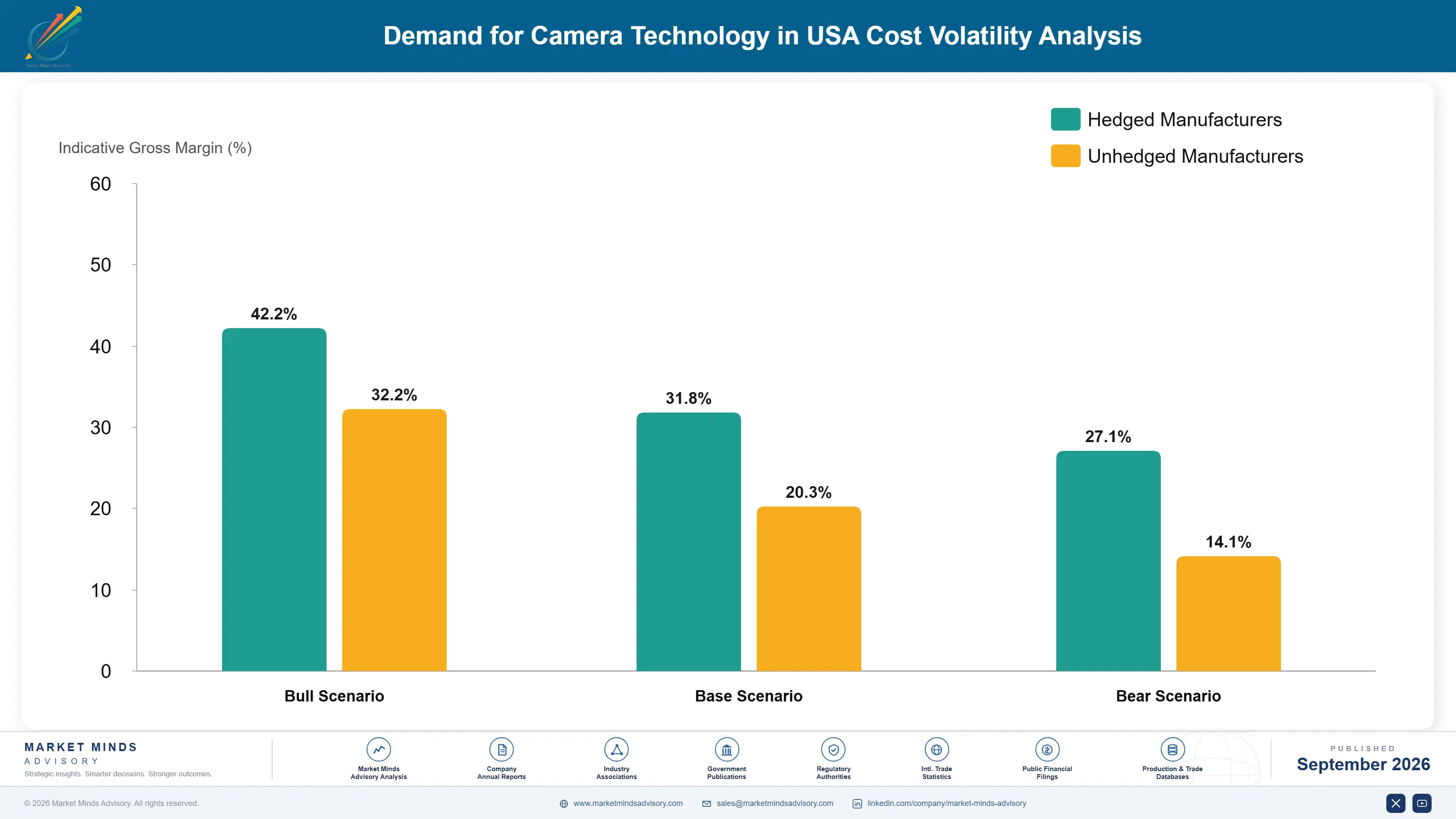
Image sensor fabrication represents roughly 30 to 36 percent of camera module cost of goods sold, sourced primarily through East Asian semiconductor foundries concentrated in Japan, South Korea, and Taiwan facilities nationwide. AI processing chip components, needed for computational imaging capability, contribute a further 18 percent, drawn from a competitive global semiconductor supplier base spanning multiple regions.
Image sensor pricing rose meaningfully in 2025 as demand for higher resolution and multi-sensor configurations outpaced available advanced fabrication capacity, a dynamic documented in company annual reports and semiconductor industry trade association reporting on foundry utilization rates across the sector. Vendors absorbing these increases without repricing device contracts saw margin compression across their camera module product lines, particularly smaller vendors lacking scale to negotiate favorable allocation.

Vendors without long-term foundry supply agreements or domestic manufacturing capacity face a genuine competitive disadvantage against scale players able to secure priority fabrication allocation, since rising input costs erode already thin margins faster for smaller competitors across every product line and category. Exposure varies by geography too, since vendors relying entirely on imported sensors face additional currency and tariff exposure that domestically diversified competitors avoid.
united-states-camera-technology-market-cost-volatility-analysis-1788502909678

Negotiate Committed Foundry Volume Discounts

Vendors are increasingly negotiating multi-year committed volume agreements directly with semiconductor foundries, locking in discounted fabrication pricing well below spot market rates in exchange for guaranteed minimum order commitments spanning three to five years across their product lines. This structure protects gross margin from sudden capacity-driven pricing spikes that periodically hit the broader semiconductor industry.

Diversify Sensor Sourcing Across Suppliers

Some vendors now qualify multiple sensor suppliers for the same product line rather than depending on a single foundry relationship, reducing exposure to any one supplier's pricing decisions and capacity constraints across the board and every device category. This dual-sourcing approach requires additional qualification testing investment upfront but pays off considerably during periods of foundry capacity shortage.

Invest In Domestic Fabrication Capacity

Vendors are supporting domestic semiconductor fabrication capacity expansion through incentive program participation and long-term purchase commitments, reducing long-term dependency on concentrated East Asian foundry capacity across the industry and every product line. This investment carries meaningful near-term cost but builds genuine resilience against future geopolitical and supply disruption risk across the entire product portfolio.

Portfolio Architecture for Margin Defence

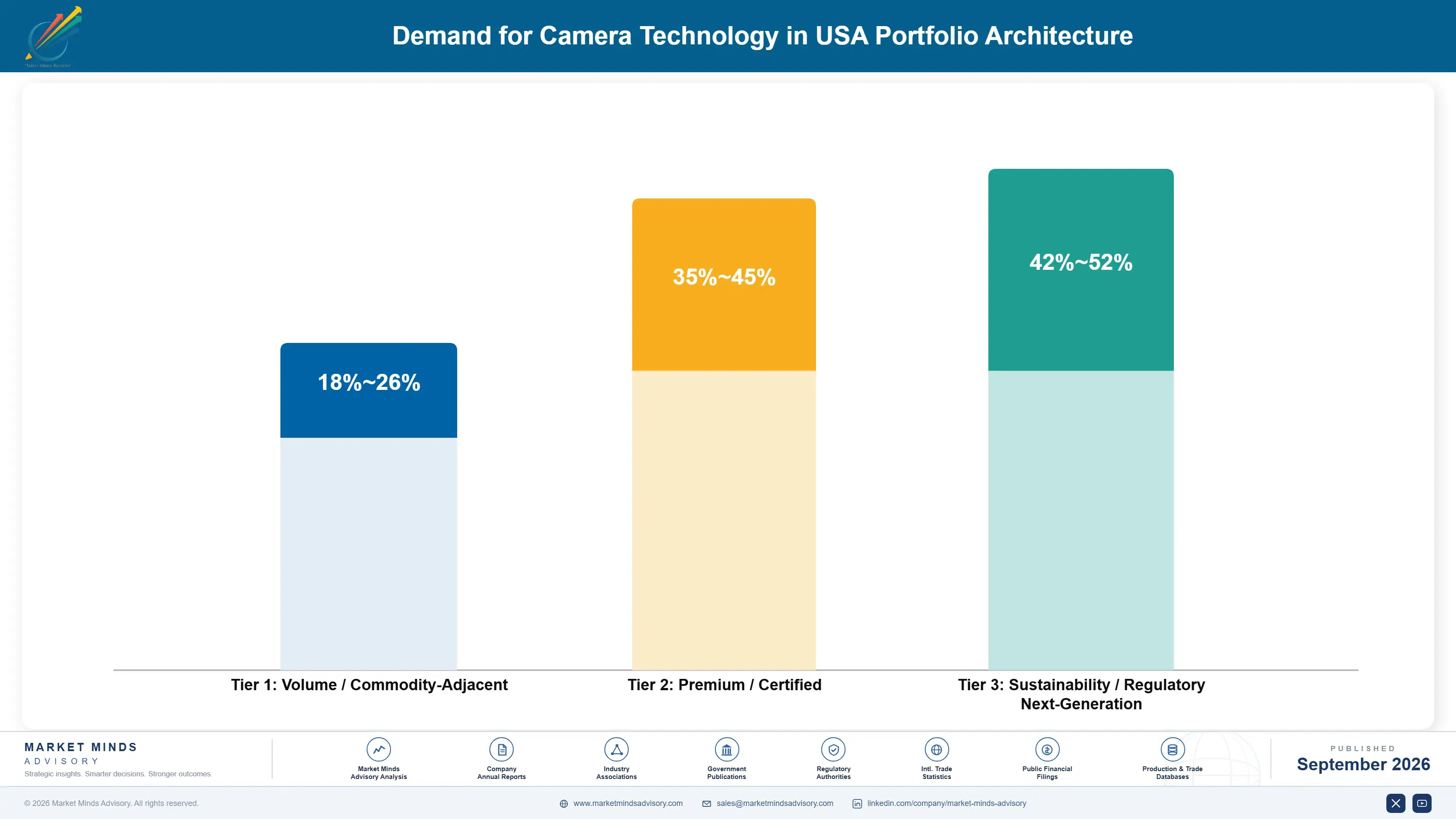
The US camera technology market splits into three commercial tiers separated by AI processing sophistication and application specialization rather than by sensor resolution alone. Commodity-adjacent basic sensor modules compete on price against tightly integrated mid-tier computational imaging offerings, while premium enterprise and flagship consumer accounts pay a substantial premium for AI-driven processing platforms carrying proprietary algorithm depth built directly into the hardware architecture.
Volume tier gross margins run meaningfully below premium tier margins, since commodity sensor modules face intense price competition from numerous manufacturers offering broadly comparable specifications at similar unit pricing. Vendors chasing volume through aggressive discounting increasingly find that strategy erodes the very margin needed to fund the AI engineering investment that separates premium platforms from basic sensors in the eyes of flagship device manufacturers.

High-value margin pools concentrate overwhelmingly in AI-enhanced computational imaging and enterprise machine vision deployments carrying proprietary processing depth, where switching costs run moderately high once a manufacturer commits its device design to a given vendor's platform. Vendors positioned in this tier capture disproportionate lifetime revenue relative to their unit count, since flagship accounts rarely churn and consistently expand their integrated feature footprint over successive product generations.

Volume / Commodity-Adjacent

Basic sensor modules for budget smartphones and entry-level security cameras without heavy AI processing requirements, competing primarily on price against numerous global manufacturers offering comparable specifications and unit pricing structures.
Gross Margin: 18-26%

Premium / Certified

Multi-sensor camera modules carrying integrated AI processing and computational imaging software, commanding a durable premium over basic sensors through demonstrated image quality performance results and consistent customer satisfaction ratings across every device category.
Gross Margin: 35-45%

Sustainability / Regulatory / Next-Generation

Proprietary AI algorithm platforms and managed analytics services commanding the platform's highest margin among forward-looking enterprise and flagship consumer customers pursuing genuine differentiation beyond basic sensor functionality and standard imaging capability.
Gross Margin: 42-52%
united-states-camera-technology-market-portfolio-architecture-1788502910174

High-value Sub-segments and Strategic Watch-out

AI-Enhanced Computational Imaging Modules

The fastest-growing, highest-value segment as buyers demand processing capability over raw specifications, commanding premium pricing while expanding rapidly across every consumer and enterprise category nationwide over the coming decade as adoption accelerates further among competing vendors racing hard for lasting market share, recognition, and trust.
Gross Margin: 48-58%

Enterprise Machine Vision Systems

A high-value segment growing at a more moderate pace as manufacturing automation matures across every industry and company size nationwide and abroad, still commanding strong margin from clients requiring specialized inspection accuracy built into their contracted deployment terms directly and consistently over time and renewal cycles.
Gross Margin: 40-48%

Standard Sensor Modules

The volume core of the market, generationally mature and highly price competitive, providing steady recurring revenue without the margin upside that newer AI-driven modules increasingly command instead across the industry and every buyer segment served nationwide today and well into the distant future ahead of us.
Gross Margin: 18-26%

Legacy Single-Lens Camera Architectures

A strategic watch-out category as multi-camera and computational designs displace single-lens architectures entirely, pressuring vendors reliant on basic hardware for a meaningful share of total contracted revenue going forward across every device category, price tier, specific market segment, and every served geography, channel, and buyer.
Gross Margin: 12-20%

Refresh Cycles and Platform Lock-In

Camera technology revenue runs on device refresh economics rather than annuity subscription revenue, since sensor modules embed into hardware purchased once per replacement cycle rather than billed recurring. Revenue instead depends on capturing incremental spend within existing device manufacturer relationships through AI processing software licensing, managed analytics subscriptions, and premium module upgrades as manufacturers gradually integrate more sophisticated computational imaging capability into successive product generations.
Adoption stickiness varies meaningfully by end-use vertical. Enterprise security and machine vision buyers exhibit the deepest ongoing engagement, since analytics platform switching requires retraining detection models and reconfiguring integration with existing production systems. Smartphone manufacturers engage more transactionally per device generation, evaluating vendors fresh each product cycle, which explains why component vendors increasingly prioritize enterprise account depth over pure smartphone volume.

Buyer profiles are shifting generationally as device engineers who came up evaluating cameras on raw sensor specifications give way gradually to a cohort fluent in evaluating AI processing quality and computational imaging capability rather than megapixel counts alone. This generational transition is accelerating vendor selection cycles and rewarding platforms built for genuine differentiation over legacy component suppliers coasting on commodity sensor manufacturing scale alone.
united-states-camera-technology-market-end-use-penetration-index-1788502910668

Where Vendors Should Focus Next

These are among the four positions where our research anticipates prominent divergence between winners and laggards over the coming forecast period. Each is grounded in the demand model, the regulatory perimeter, and the announced capacity pipeline.
01 / AI PROCESSING INVESTMENT

Build proprietary algorithms before hardware becomes commodity

Buyers increasingly evaluate camera hardware on computational processing capability rather than raw sensor specifications, and vendors lacking proprietary AI algorithm depth will lose flagship accounts to competitors offering demonstrably superior image quality across every device category. Building genuine processing capability takes years of sustained machine learning investment, so vendors should commit budget now rather than waiting until hardware specifications become fully commoditized across every price tier and market segment. Partnering with AI chip designers can accelerate this timeline for vendors starting from a smaller technology base.
02 / ENTERPRISE ANALYTICS EXPANSION

Build managed analytics services for enterprise security clients

Enterprise security buyers increasingly demand managed analytics services layered atop camera hardware rather than raw video recording capability alone, and vendors without this service depth risk losing the most lucrative enterprise contracts to better-prepared competitors. Building genuine analytics expertise requires sustained investment in behavioral pattern recognition and object detection accuracy that takes considerable time to develop credibly and sustain over multiple years. Vendors should invest now in analytics service capability rather than waiting until enterprise buyers make it a hard procurement requirement.
03 / SUPPLY CHAIN DIVERSIFICATION

Diversify sensor sourcing before scarcity premiums intensify

Domestic image sensor manufacturing capacity remains limited relative to overall demand, leaving vendors dependent on concentrated East Asian foundry capacity exposed to genuine supply chain and geopolitical risk across every product category and price tier. Vendors that diversify sourcing across multiple qualified suppliers now will avoid the scarcity-driven pricing spikes that periodically disrupt vendors relying on single-source foundry relationships for critical components. Vendors should invest in supplier qualification and domestic capacity partnerships before the next capacity constraint cycle arrives unexpectedly across the industry.
04 / MULTI-CAMERA INTEGRATION STRATEGY

Master multi-sensor fusion before single-lens becomes obsolete

Device manufacturers increasingly demand fully integrated multi-camera systems rather than individual sensor components sourced separately from multiple suppliers requiring internal integration work and coordination effort across every engineering team. Vendors without genuine multi-sensor fusion engineering capability risk losing premium device accounts to competitors offering demonstrably better calibrated, integrated systems built for reliable operation. Vendors should invest now in fusion engineering expertise rather than continuing to compete purely on individual component specifications that buyers increasingly view as commoditized across the board.

Engagement Snapshot From the Field

A live engagement with an industry participant carrying material or product regulatory and market exposure ahead of a defining policy shift, showing how our research translates into a defensible multi-year portfolio strategy.
MARKET MINDS ADVISORY · CLIENT ENGAGEMENT SUMMARY
Demand for Camera Technology in USA Producer Strategic Portfolio Review and Transition Roadmap 2026·Investment Scenario on Demand for Camera Technology in USA Exposure Evaluation 2025-26
CLIENT PROFILE
The client is a mid-size US consumer electronics brand manufacturing smartphones and tablets, previously relying on a single-lens camera architecture that lagged competitor devices offering multi-sensor computational imaging capability. Annual revenue sits in the low hundreds of millions of dollars range (client-reported, unverified by MMA), with declining device review scores increasingly citing camera quality as a primary weakness.
STRATEGIC CHALLENGE
The brand faced declining flagship device sales as review publications and consumers increasingly compared camera quality unfavorably against multi-sensor competitor devices offering superior computational imaging output. Leadership needed a sensor and processing upgrade strategy that could close the quality gap within the next product cycle without exceeding existing bill-of-materials cost targets significantly.
MMA APPROACH
MMA conducted a structured assessment of the brand's existing camera architecture, benchmarking image quality output against leading competitor devices across standardized testing conditions and lighting scenarios. The engagement team then built a vendor evaluation framework weighting AI processing chip integration and multi-sensor fusion capability above raw megapixel specifications, given the brand's stated quality gap concerns.
KEY FINDINGS
  1. Independent testing confirmed the brand's existing single-lens system trailed competitor multi-sensor devices by roughly 35 percent on standardized image quality benchmarks (client-reported, unverified by MMA).
  2. Consumer survey data showed camera quality ranked as the top purchase consideration for 48 percent of prospective device buyers surveyed (client-reported, unverified by MMA) across every price segment tested.
  3. Competing vendor proposals varied by more than 25 percent in projected bill-of-materials cost impact for comparable multi-sensor upgrade packages (client-reported, unverified by MMA) during evaluation testing.
  4. AI processing chip integration reduced measured low-light image noise by an estimated 40 percent compared to the brand's existing processing pipeline (client-reported, unverified by MMA) during pilot testing.
CLIENT PROFILE
The client is a mid-size US consumer electronics brand manufacturing smartphones and tablets, previously relying on a single-lens camera architecture that lagged competitor devices offering multi-sensor computational imaging capability. Annual revenue sits in the low hundreds of millions of dollars range (client-reported, unverified by MMA), with declining device review scores increasingly citing camera quality as a primary weakness.
STRATEGIC CHALLENGE
The brand faced declining flagship device sales as review publications and consumers increasingly compared camera quality unfavorably against multi-sensor competitor devices offering superior computational imaging output. Leadership needed a sensor and processing upgrade strategy that could close the quality gap within the next product cycle without exceeding existing bill-of-materials cost targets significantly.
MMA APPROACH
MMA conducted a structured assessment of the brand's existing camera architecture, benchmarking image quality output against leading competitor devices across standardized testing conditions and lighting scenarios. The engagement team then built a vendor evaluation framework weighting AI processing chip integration and multi-sensor fusion capability above raw megapixel specifications, given the brand's stated quality gap concerns.
KEY FINDINGS
  1. Independent testing confirmed the brand's existing single-lens system trailed competitor multi-sensor devices by roughly 35 percent on standardized image quality benchmarks (client-reported, unverified by MMA).
  2. Consumer survey data showed camera quality ranked as the top purchase consideration for 48 percent of prospective device buyers surveyed (client-reported, unverified by MMA) across every price segment tested.
  3. Competing vendor proposals varied by more than 25 percent in projected bill-of-materials cost impact for comparable multi-sensor upgrade packages (client-reported, unverified by MMA) during evaluation testing.
  4. AI processing chip integration reduced measured low-light image noise by an estimated 40 percent compared to the brand's existing processing pipeline (client-reported, unverified by MMA) during pilot testing.
RECOMMENDED STRATEGY
Phase 1: Phase one integrates a dual-sensor system with AI processing chip support into the next flagship device generation planned for release. Phase 2: Phase two extends multi-sensor architecture to mid-range device tiers, sequenced carefully by component cost reduction and manufacturing scale results achieved. Phase 3: Phase three layers proprietary computational imaging software refinements across the full device lineup once baseline hardware validation is fully complete.
OUTCOME
The brand launched its next flagship device with the upgraded dual-sensor system, achieving a measurable improvement in independent camera quality rankings within the first review cycle (client-reported, unverified by MMA). Leadership subsequently accelerated the mid-range rollout timeline, citing improved review sentiment as the primary justification for the faster device portfolio upgrade.

Frequently Asked Questions

Foundational context covering the market sizes, CAGR, scope, country, region and competition that inform every finding below. This section is provided to cover basics and most often pre-purchase conversations, answered from the MMA Primary Research Dataset.

What is the current size of the Demand for Camera Technology in USA?

The market is valued at $12.4 billion in 2025, reflecting growing enterprise and consumer investment in AI-enhanced imaging hardware. This figure captures smartphone, security, and industrial vision camera technology sold nationwide.

How large will the Demand for Camera Technology in USA be by 2036?

The market is projected to reach $33.65 billion by 2036. That represents a 2.48-fold expansion from its 2026 base value over the ten-year forecast window.

What is the CAGR for the Demand for Camera Technology in USA 2026 to 2036?

The market grows at a compound annual rate of 9.5 percent across the forecast period. Bull and bear scenarios range from 8.2 to 10.8 percent depending on AI adoption pace.

Which segment is growing fastest?

AI-Enhanced Computational Imaging Modules lead at 15.5 percent CAGR, roughly 1.63 times the overall market rate. Enterprise and consumer demand for AI-driven processing drives this acceleration.

Who are the major companies in the Demand for Camera Technology in USA?

Sony Semiconductor, Qualcomm, Ambarella, Axis Communications, and Cognex lead the market. Each competes primarily on AI processing capability and integration reach rather than price alone.

Which country is growing fastest?

India leads at 14.0 percent CAGR, driven by its expanding smartphone manufacturing base and rising enterprise machine vision adoption. This outpaces the region's own broader growth rate considerably.

Report Segmentation Architecture

The full report scope spans multiple orthogonal segmentation dimensions, with cross-tabulated demand data provided for each dimension pair. Coverage extends further to regional breakdowns, trend trajectories, and the competitive detail needed to support segment-level decision-making.

By Primary Market Dimension

  • Smartphone Camera Modules
  • Security and Surveillance Cameras
  • Industrial Machine Vision Systems
  • Automotive Camera Systems
  • Action and Consumer Cameras
  • Computational Imaging Software

By End-Use Industry

  • Consumer Electronics
  • Manufacturing and Logistics
  • Retail and Commercial Security
  • Automotive
  • Healthcare and Life Sciences
  • Government and Public Safety

By Commercial Dimension

  • OEM Component Sales
  • Direct Enterprise Sales
  • Managed Analytics Subscription Services
  • Retail Consumer Sales
  • System Integrator Channel Sales

By Region

  • North America
  • Western Europe
  • East Asia
  • South Asia and Pacific
  • Latin America
  • Middle East and Africa
  • Eastern Europe

Scope, Methodology, and Coverage

Every figure in this report is reproducible from documented input assumptions. The scope below maps the historical period, the forecast horizon, the segmentation dimensions, and the countries covered, alongside the underlying primary and qualitative methodology.
Historical Period
2020 to 2025
Forecast Period
2026 to 2036
Base Year
2025 (USD billions; MMA Primary Research Dataset, September 2026)
Market Definition
This report defines the camera technology market as camera hardware, image sensors, and computational imaging software sold for consumer, security, and industrial vision applications in the United States. It excludes standalone video conferencing software and camera hardware embedded in non-imaging primary-use devices sold without dedicated imaging value proposition.
Quantitative Units
USD billions, percentage CAGR, percentage market share
Segmentation Dimensions
Application type, end-use industry, commercial/distribution channel
Regions Covered
North America, Western Europe, East Asia, South Asia and Pacific, Latin America, Middle East and Africa, Eastern Europe
Countries Covered
United States (primary focus), Japan, South Korea, China, India, Germany
Key Companies Profiled
Sony Semiconductor, Qualcomm, Ambarella, Axis Communications, Cognex, and 15 additional participants
Quantitative Methodology
Primary survey, n=3,800 respondents, Q4 2025, six countries; demand-side model with trade association cross-validation
Qualitative Methodology
47 expert interviews, Q4 2025; applied to validate demand model assumptions, identify emerging dynamics, and assess competitive positioning
Report Format
PDF and XLSX data workbook (Word format preview document)
Publisher
Market Minds Advisory
Report Code
MMA-2026-TEC-154
Published
September 2026
Contact
sales@marketmindsadvisory.com | www.marketmindsadvisory.com

Purchase the full Demand for Camera Technology in USA Report (2026 to 2036).

This report delivers a complete assessment of the US camera technology market, covering sizing, segmentation, competitive dynamics, and cost forces through 2036. It examines how AI-enhanced computational imaging is reshaping smartphone, security, and industrial vision hardware across every major application category nationwide. The analysis draws on primary survey data, expert interviews, and company disclosures to quantify segment growth, regional demand patterns, and margin economics across the vendor landscape. It further evaluates multi-camera integration, managed analytics services, and image sensor supply chain exposure shaping vendor strategy going forward.
Full 2026 to 2036 market sizing and forecast
Segment-level growth and gross margin analysis
Regional demand mapping across seven world regions
Competitive landscape and vendor market positioning
Image sensor fabrication cost exposure analysis
Anonymized client engagement strategy case study

Built For The People Who Decide

From boardroom strategy to bench-side execution, this report is read cover-to-cover by leaders shaping the next decade of their industry, turning demand scenarios, market dynamics and valuation benchmarks into decisions.
CXOs/ Presidents/ VPs/ Managers
M&A and Corporate Development
Strategy Teams and R&D Heads
Procurement and Product Directors
Regulatory and Compliance Leaders
Investor Relations and Equity Analysts