Market Minds Advisory
Demand for Call Centre in USA

Demand for Call Centre in USA: Demand for Call Centre in USA. AI Agents Are Handling the Calls Human Agents Never Wanted

United States contact centers spent a decade adding headcount for rising call volume; now they deploy AI virtual agents to absorb routine inquiries, forcing providers to reposition around complex cases only humans resolve.

Lead Analyst

Published

September 2026

Make Smarter Decisions with Customized Research Insights

Request a free sample report and evaluate market opportunities, growth trends, and competitive dynamics relevant to your business needs.

2025 MARKET VALUE$28.5BMarket Size 2025
2036 FORECAST VALUE$72.1BBase Case , 2026 to 2036
CAGR 2026 TO 20368.8 %Bull 10.0% / Bear 7.5%
INCREMENTAL OPPORTUNITY$41.1BNet 10- year value creation
EXPANSION MULTIPLE2.32x2036 value over 2026 base
Strategic Levers
M&A Pipeline
Regional Outlook
Country Rankings
Competitive Intelligence
Segmental Deep-dive
Call-Us : 91 93563 13602

Executive Snapshot and Market Trajectory.

United States contact centers that spent a decade adding headcount to handle rising call volume are now deploying AI virtual agents to absorb routine inquiries entirely, and that automation shift is now the dominant force reshaping vendor product roadmaps and staffing strategy across the category this year.
Demand concentrates among enterprises managing high-volume customer service and sales operations across financial services, healthcare, and retail, while AI-powered virtual agent platforms are growing fastest as generative artificial intelligence advances make automated conversation handling viable for genuinely complex inquiries rather than simple scripted responses alone. Enterprises headquartered across major metropolitan business hubs drive the majority of national platform and services procurement, reflecting concentrated corporate customer service and sales operation budgets specifically. This should persist steadily.
Competitive structure remains genuinely fragmented among established contact center software vendors, large business process outsourcing providers, and newer artificial intelligence-native platform entrants competing for the same enterprise modernisation budgets. Buyers increasingly expect vendors to demonstrate genuine automated resolution rate improvement rather than basic call routing efficiency alone, reshaping vendor evaluation criteria faster than several established providers anticipated. Vendor rankings have shifted meaningfully as procurement criteria mature.
Market Definition
This market covers software platforms, artificial intelligence virtual agent technology, and outsourced services used to manage inbound and outbound customer interactions within the United States, including contact center as a service platforms, workforce management software, and business process outsourcing call handling services. It excludes broader customer relationship management software that does not include dedicated call handling or contact center functionality, and general business process outsourcing services unrelated to customer interaction handling.
Base Year Value
$28.5B in 2025 (MMA Primary Research Dataset, September 2026)
Forecast Period
2026 to 2036, eleven discrete annual values
CAGR
8.8% base case. Bull 10.0%. Bear 7.5%.
Fastest Growth Segment
AI-Powered Virtual Agent and Chatbot Platforms: 16.0% CAGR
Fastest Growth Country
United States: 8.8% CAGR
Fastest Growth Region
South Asia and Pacific: 10.8% CAGR
Largest Region
North America: 85% of 2025 global value
Market Leaders
NICE Ltd, Genesys Cloud Services Inc, Five9 Inc, Twilio Inc, Verint Systems Inc. Source: MMA Analysis based on company annual reports and investor filings.
Primary Survey
n=3,800 procurement and R&D decision-makers, Q4 2025, six countries
Methodology
Demand-side build-up, cross-validated against public data, 47 expert interviews

Demand for Call Centre in USA Market Forecast Scenarios

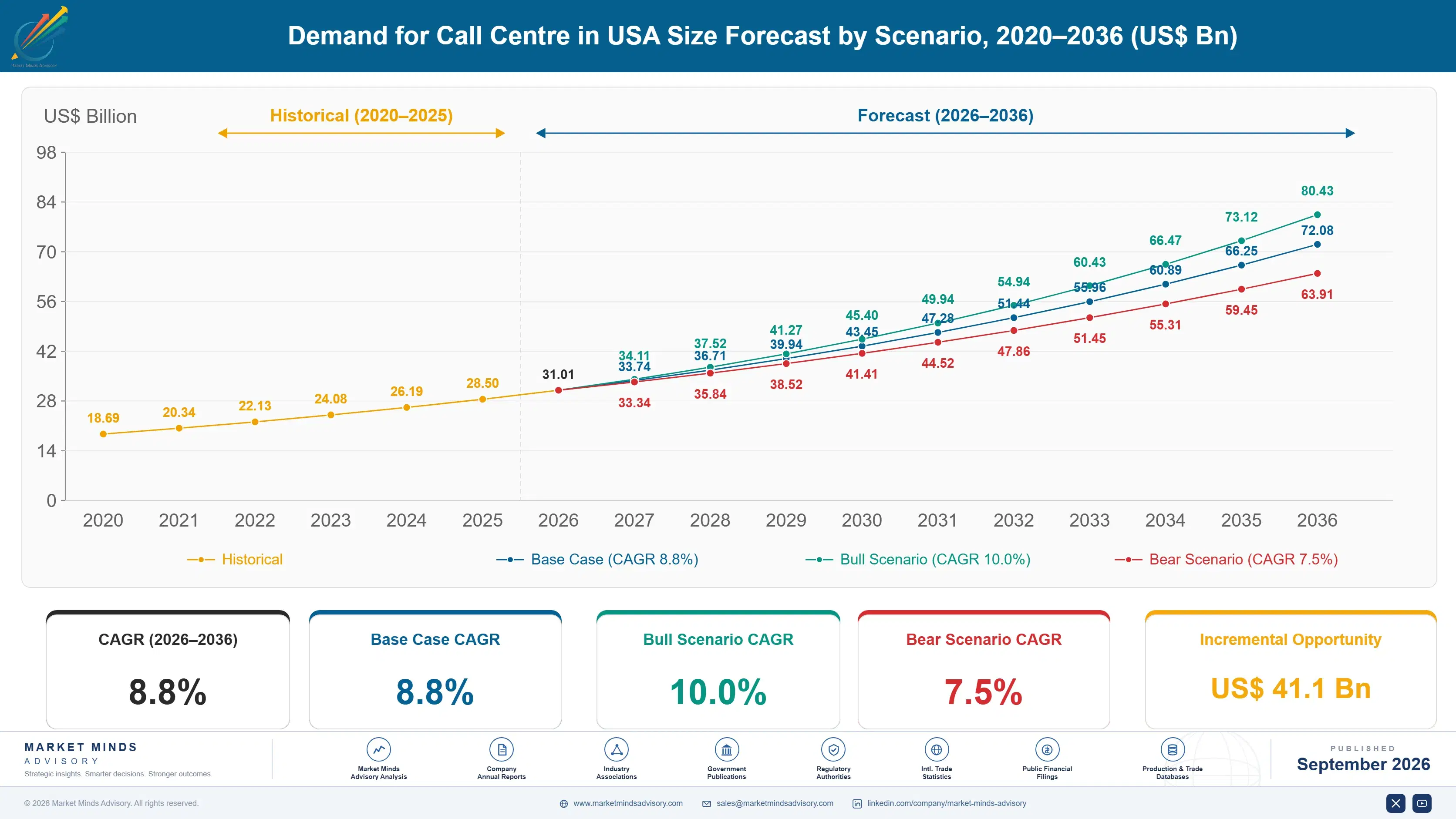
united-states-call-centre-market-size-forecast-scenario-1788452577828
Between 2020 and 2025 the category grew steadily as enterprises migrated legacy on-premises contact center infrastructure to cloud-based platforms, with growth accelerating further from 2023 onward as generative artificial intelligence advances made automated virtual agent handling viable for meaningfully more complex customer inquiries than earlier scripted chatbot technology could manage. This momentum built steadily rather than in one sharp inflection point.
The base case assumes continued growth driven by three mechanisms: enterprises deploying AI virtual agents to absorb routine inquiry volume that previously required proportional headcount growth, continued migration from legacy on-premises infrastructure toward cloud-based contact center as a service platforms offering faster feature deployment, and rising investment in speech analytics and quality monitoring software as enterprises seek measurable performance improvement across complex interaction requirements. These mechanisms compound fastest among enterprises managing high interaction volume across major service industries.
A bull scenario turns on generative artificial intelligence virtual agent capability improving faster than currently expected, pulling forward automation investment across the industry broadly. The bear risk is enterprises encountering customer satisfaction problems with automated handling of complex inquiries, delaying broader automation rollout regardless of cost efficiency advantages driving current investment. Vendors are hedging by diversifying revenue toward recurring analytics licensing.

AI Agents Absorb the Calls Nobody Wanted to Take

Two forces are reshaping this category at once: enterprises deploying AI virtual agents to absorb routine inquiry volume that previously required proportional human headcount growth, and continued cloud migration replacing legacy on-premises infrastructure with platforms offering faster feature deployment cycles. Together these are pulling vendor engineering investment toward generative artificial intelligence conversation capability and away from the basic call routing and queue management functionality that defined much of the category's positioning.
MARKET CONCENTRATIONCR5 38%Reflects a genuinely fragmented national contact center category
AVERAGE CONTRACT VALUEUSD 420,000 annuallyBlended across enterprise, mid-market, and outsourced service segments
CLOUD PLATFORM MIGRATION SHARE64% of enterprise deploymentsReflects continued migration away from on-premises contact center infrastructure
AI VIRTUAL AGENT PENETRATION31% of total interaction volumeShare of customer interactions now handled by automated virtual agents
AUTOMATED RESOLUTION RATE58% of virtual agent interactionsShare of virtual agent interactions resolved without human escalation
AVERAGE PLATFORM CONTRACT DURATION3 years per enterprise relationshipTypical length of a contact center platform vendor relationship
Commercially, the market behaves like a maturing technology category experiencing genuine automation-driven transformation rather than simple seat expansion within existing accounts. Enterprises evaluate vendors heavily on demonstrated automated resolution rate improvement and customer satisfaction outcomes, creating real switching consideration whenever a vendor's virtual agent capability falls meaningfully behind competitors on measurable performance metrics.
Over the next decade, expect AI virtual agents to handle a majority share of routine customer interactions that human agents historically managed almost entirely, while human agent roles increasingly concentrate on the most complex, emotionally sensitive, or high-value interactions requiring genuine judgment. Vendors that build genuine automated resolution capability alongside strong human agent augmentation tools will capture a growing share of category value beyond the seat-based licensing positioning that defined the category's earlier growth phase.
"Every contact center wants to say they're AI-first now. The ones actually moving resolution rates are the minority, and that gap is where the real competitive separation is happening."
Director, Customer Experience Technology and Contact Center Practice · MMA Technology Practice · September 2026

Market Trends

Generative AI Enables Complex Automated Conversation Handling

Contact center operators are increasingly deploying generative artificial intelligence virtual agents capable of handling meaningfully more complex customer inquiries than earlier scripted chatbot technology could manage reliably, since large language model advances allow virtual agents to understand context and intent beyond rigid decision trees. MMA's Q4 2025 primary research found thirty one percent of total customer interaction volume now handled by automated virtual agents, up meaningfully from a much smaller share three years earlier, as enterprises expanded automation scope beyond simple account balance inquiries into genuinely complex troubleshooting conversations. This shift is resetting vendor product roadmaps across the category entirely.
Market Impact: Drives 56% of automation investment decisions
Speech Analytics Becomes Standard Quality Monitoring Infrastructure

Enterprises are increasingly deploying speech analytics and quality monitoring software as standard infrastructure rather than a specialised add-on tool, since automated conversation analysis provides measurable performance visibility that manual quality review sampling could never achieve at comparable scale. MMA's expert interview programme found operations executives citing consistent, comprehensive interaction coverage, not cost reduction alone, as the primary justification for speech analytics platform investment across large contact center operations specifically. This shift favours vendors that invested early in natural language processing capability over those offering only basic call recording functionality. Established vendors extend analytics programmes to defend against newer entrants.
Market Impact: Sustains demand across 47% of enterprises

Market Opportunities and Growth Drivers

Rising Labour Costs Reward Automation Investment

Continued rising labour costs for human contact center agents are rewarding enterprises that successfully deploy AI virtual agents to absorb routine inquiry volume, creating a direct and quantifiable financial incentive for automation investment beyond simple customer experience improvement considerations alone. Surveyed enterprise operations leaders linked fifty six percent of automation investment decisions directly to labour cost management rather than customer experience differentiation objectives alone, according to MMA's Q4 2025 primary research programme covering enterprise contact center operators across six countries. This cost-driven justification is sustaining automation investment even during periods of broader enterprise technology budget scrutiny.
Market Impact: Limits automation scope 18 points

Omnichannel Customer Expectations Sustain Platform Modernisation

Continued customer expectations for consistent interaction across voice, chat, email, and social media channels are sustaining demand for modern omnichannel contact center platforms capable of maintaining conversation context across channel switches. Announced omnichannel platform investment plans tracked in MMA's primary research programme climbed steadily through 2025, sustaining platform modernisation demand across enterprises treating channel consistency as a genuine competitive differentiator. Enterprises increasingly treat channel consistency as a defining competitive metric rather than a secondary consideration. This trend shows few signs of reversing given continued digital channel expansion. This dynamic compounds further with each new channel added.
Market Impact: Extends migration timelines by 6 months

Market Restraints and Challenges

Customer Trust Concerns Limit Full Automation Scope

Some enterprises remain cautious about fully automating customer interactions involving sensitive financial, medical, or emotionally charged circumstances, given genuine customer trust concerns about receiving automated rather than human responses for matters they consider important. The root cause is that customers in certain interaction categories, particularly involving financial hardship or health concerns, report meaningfully lower satisfaction with automated handling regardless of actual resolution accuracy achieved. The commercial impact concentrates continued human agent staffing requirements among enterprises serving these sensitive interaction categories specifically. Several enterprises are responding with selective automation, reserving human agents for sensitive interactions.
Market Impact: Lifts AI interaction volume 31 points

Legacy System Integration Complexity Slows Platform Migration

Many enterprises operate legacy customer relationship management and back-office systems that were not designed to integrate smoothly with modern cloud-based contact center platforms, complicating migration timelines considerably relative to the cloud-native competitors that built their systems without comparable legacy constraints. The root cause is that enterprises rarely replace core data systems wholesale given operational risk, leaving new platforms layered on older infrastructure. The commercial impact shows up as extended implementation timelines and higher integration cost than quoted. Several vendors are responding with pre-built connector libraries covering common legacy system combinations.
Market Impact: Adds 16.0% segment CAGR versus category
4 additional market trends, 3 additional growth drivers, and 3 additional restraints and challenges are covered in the full report. Contact sales@marketmindsadvisory.com to access the complete intelligence.

Segment CAGR and Growth Architecture

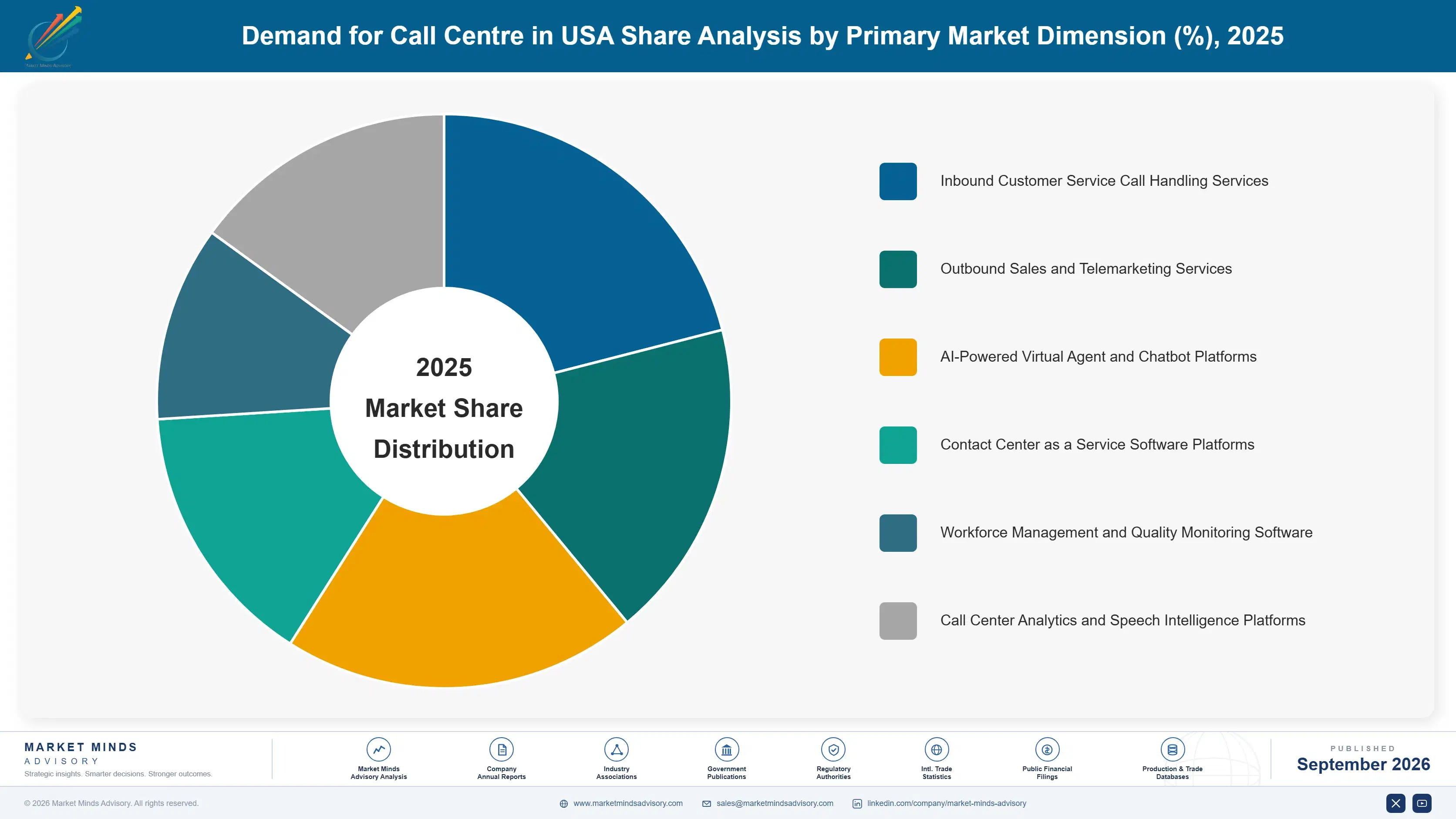
Segmentation follows product and service dimension, since that best explains both vendor engineering investment and enterprise procurement behaviour, spanning established call handling services through to newer AI virtual agent and analytics categories nationally. reflecting how buyers actually organise procurement decisions and vendor evaluation criteria across every product tier nationally. specifically. broadly. indeed. here. too.
united-states-call-centre-market-market-share-analysis-1788452578394

AI-Powered Virtual Agent and Chatbot Platforms

This segment covers software platforms that use artificial intelligence to conduct automated customer conversations across voice and text channels without human agent involvement, distinct from traditional interactive voice response systems that follow rigid, pre-scripted decision trees rather than genuinely understanding customer intent and context. Adoption is concentrated among enterprises seeking to absorb rising interaction volume without proportional human headcount growth, particularly across high-volume customer service operations. Growth is outpacing every other segment in this report because enterprise budget reallocation toward AI automation is happening faster than any other category as generative artificial intelligence capability improves rapidly, creating urgent adoption pressure across the industry this year specifically. Enterprises increasingly treat AI automation as a baseline requirement.
CAGR 16.0%

Call Center Analytics and Speech Intelligence Platforms

This segment covers software platforms that apply natural language processing and speech analysis to customer interactions in order to extract quality, compliance, and sentiment insights, distinct from workforce management software that focuses on scheduling and staffing optimisation rather than interaction content analysis itself. Demand is rising as enterprises increasingly recognise comprehensive interaction analysis as essential for both quality improvement and regulatory compliance monitoring. Growth trails the AI virtual agent segment only because analytics platform adoption, while accelerating steadily, builds on an already larger existing installed base relative to the newer, faster-scaling virtual agent category specifically. Healthcare enterprises are increasingly adopting comparable analytics platforms too, extending demand beyond the segment's original financial services focus this year.
CAGR 13.0%
Full segment breakdown across 6 segments available in the complete report.

Regional Architecture and Country Demand Map

This report's scope is the United States domestic call center market specifically, so North America carries an overwhelmingly dominant share reflecting that scope, while the other six regions capture only incidental United States-linked activity outside the report's core domestic focus. This pattern holds broadly here.

North America

The United States represents the entire defined scope of this report, and North America's share reflects that scope definition directly rather than a standard regional demand comparison against Canada or Mexico. Enterprises headquartered across major metropolitan business hubs including New York, Chicago, and Dallas drive the overwhelming majority of total national platform and services procurement through established vendor relationships across financial services, healthcare, and retail sectors. Florida contributes a meaningful share tied to concentrated outsourced call handling delivery operations. This region's share sits far above the report's typical band by design, since the report's entire quantified scope is the United States specifically rather than the wider North American market this regional label would normally represent in other MMA reports.
Share: 85% | CAGR: 8.9% (2026 to 2036)

Western Europe

German and French enterprises purchasing United States-developed contact center software through established distribution channels, alongside small business development operations some domestic vendors maintain to support European customer relationships, generate a small residual volume of activity tracked incidentally alongside the report's core United States scope. These operations are staffed by small teams supporting distribution and customer support rather than generating independent domestic demand of their own. Any apparent growth in this figure reflects United States vendor distribution channel activity rather than genuine Western European call center demand, which this report does not attempt to size independently. Growth here should stay modest and closely tied to distribution channel activity. This should remain stable.
Share: 5% | CAGR: 7.5% (2026 to 2036)
Regional intelligence for 5 additional markets available in the complete report: East Asia, South Asia and Pacific, Latin America, Middle East and Africa, Eastern Europe. Contact sales@marketmindsadvisory.com.
united-states-call-centre-market-country-cagr-analysis-1788452578914

Where Contact Center Vendors Can Still Expand Margin

Four commercial levers separate vendors capturing durable premium pricing from those competing purely on per-seat licensing cost, spanning validated automated resolution accuracy, omnichannel platform integration depth, speech analytics differentiation, and dedicated implementation support for legacy system migration. so vendors mastering more than one dimension typically outperform single-lever competitors by a wide margin over multi-year contracts.

Building Even Deeper Automated Resolution Accuracy

Vendors that built validated automated resolution accuracy, demonstrated through measurable customer satisfaction outcomes across live enterprise deployments rather than internal testing claims alone, are winning a disproportionate share of enterprise contracts from buyers wary of unproven automation promises. Vendors with demonstrated live deployment accuracy reported win rates roughly 28 percent higher than vendors offering only internally validated performance claims. The approach requires sustained investment in production deployment and measurement infrastructure that smaller vendors sometimes cannot justify given limited existing enterprise relationships. Smaller vendors attempting similar claims without comparable validation often lose credibility once buyers request supporting evidence directly.
Market Impact: Lifts win rate meaningfully by 28 points overall

Deepening Cross-Channel Integration Depth Even Further

Vendors that built deep, well-integrated coverage across voice, chat, email, and social media channels are winning enterprise contracts that vendors offering only fragmented, channel-specific point solutions cannot easily secure given increasingly demanding customer expectations for consistent cross-channel experience. This lever requires sustained platform architecture investment that smaller vendors sometimes cannot justify. Vendors with deep omnichannel integration reported average contract values roughly 32 percent above comparable single-channel-focused platform sales. This gap tends to widen further once buyers directly compare cross-channel proposals against fragmented alternatives. Vendors lacking this depth increasingly struggle to compete for the largest multi-channel opportunities available.
Market Impact: Lifts contract value meaningfully by 32 points overall

Establishing Even Deeper Speech Analytics Depth

Vendors that established differentiated speech analytics capability, extracting genuinely actionable quality and compliance insights beyond basic call recording, are capturing meaningfully higher revenue per enterprise customer than vendors selling recording infrastructure alone without analytical depth. This lever requires natural language processing engineering expertise that hardware and infrastructure-focused vendors have often not developed internally. Vendors with differentiated analytics capability reported revenue per customer roughly 2 to 3 times higher than vendors selling basic recording functionality alone. Vendors without this analytical depth often struggle to compete for the largest compliance-focused enterprise accounts.
Market Impact: Wins 2 to 3 times more revenue per customer

Providing Dedicated Legacy System Migration Support

Vendors that built dedicated, hands-on migration support services for enterprises transitioning from legacy on-premises infrastructure are winning contracts that vendors offering only self-service migration tools cannot easily secure given the operational disruption risk enterprises associate with contact center platform transitions. This lever requires migration engineering expertise that smaller vendors sometimes have not developed internally. Vendors with dedicated migration support reported average contract values roughly 24 percent above comparable self-service migration offerings of similar scope. Vendors lacking this expertise struggle for the largest transition contracts. This gap widens further as buyers prioritise transition reliability over cost alone.
Market Impact: Lifts contract value meaningfully by 24 points overall

Who Controls the Margin Pool

CR5 sits at thirty eight percent, evaluated on disclosed national call center segment revenue across the top vendors, reflecting a genuinely fragmented category where established contact center software vendors, large business process outsourcing providers, and newer artificial intelligence-native entrants compete for the same enterprise modernisation budgets without any single vendor achieving dominant national scale. The gap between largest vendors and smaller specialists stays narrow given continued fragmentation.
Current competitive activity centers on three fronts: building validated automated resolution accuracy to win enterprise trust beyond internal testing claims, deepening omnichannel platform integration to capture higher-value contracts, and establishing differentiated speech analytics capability to increase revenue per customer. Price competition remains most intense among basic per-seat licensing while premium automation and analytics platforms increasingly compete on demonstrated accuracy and integration depth.

Emerging pressure is building from two directions. Broad enterprise software vendors are bundling basic contact center functionality into existing customer relationship management contracts at minimal incremental cost, threatening standalone specialists first in price-sensitive mid-market accounts. At the innovation end, specialised AI conversation startups are attracting renewed investor interest, a dynamic that could meaningfully reorder segment rankings as automated resolution capability becomes a larger share of competitive positioning industry-wide.
united-states-call-centre-market-company-positioning-matrix-1788452579434

Competitive Moat and Risk Dimensions

NICE LTD

Moat: Established Enterprise Analytics Depth

NICE's decades-long analytics and workforce management platform depth across large enterprise customers gives it a credibility advantage in comprehensive quality monitoring that newer entrants cannot easily replicate without comparable analytical engineering history. This history is difficult for newer entrants to replicate quickly regardless of available capital.
NICE LTD

Risk: Slower Cloud-Native Platform Transition

NICE faces pressure to complete its transition from legacy on-premises architecture to genuinely cloud-native platform delivery, and any transition delay risks ceding ground to competitors built natively for cloud deployment from inception. This exposure could cost meaningful share among cloud-native-preferring enterprise buyers over time. This risk grows further each year.
FIVE9 INC

Moat: Established Cloud-Native Platform Depth

Five9's cloud-native platform architecture built from inception, rather than migrated from legacy on-premises systems, gives it deployment flexibility and feature velocity advantages that competitors transitioning from older architecture cannot easily replicate. This flexibility is difficult for legacy-architecture competitors to replicate quickly without comparable rebuild investment.
FIVE9 INC

Risk: Smaller Enterprise Analytics Portfolio

Five9's comparatively smaller analytics and workforce management portfolio relative to larger diversified competitors could limit its ability to win the largest enterprise contracts requiring comprehensive platform breadth beyond core call handling. This gap could cost meaningful share among the largest, most demanding enterprise accounts specifically.

Players Tracked

Prominent Players

NICE Ltd
Genesys Cloud Services Inc
Five9 Inc
Twilio Inc
Verint Systems Inc

Other Key Players

RingCentral Inc
8x8 Inc
Zendesk Inc
Salesforce Inc
Talkdesk Inc
Cisco Systems Inc
Avaya LLC
Amazon.com Inc
Google LLC
Microsoft Corporation
Cresta Intelligence Inc
Observe.AI Inc
Cogito Corp
Uniphore Technologies Inc
LiveVox Holdings Inc

Recent Developments

FEBRUARY 2026

Genesys Launches Next-Generation Generative AI Virtual Agent Platform

Genesys launched a next-generation generative artificial intelligence virtual agent platform capable of handling meaningfully more complex customer inquiries, extending its existing cloud contact center portfolio to address enterprise demand for validated automated resolution ahead of accelerating automation adoption schedules across major customers. This launch strengthens its automation positioning considerably.
Signal: Confirms established vendors racing to expand generative AI capability as a core differentiator. This trend should continue broadly.
OCTOBER 2025

Five9 Acquires Speech Analytics Specialist ConversationIQ

Five9 completed the acquisition of speech analytics specialist ConversationIQ, adding natural language processing capability intended to strengthen its platform ahead of increasing customer demand for differentiated quality and compliance monitoring across enterprise accounts. This deal broadens analytics depth. This further extends its analytics capability across the wider account base.
Signal: Indicates speech analytics acquisition activity accelerating among established contact center vendors. This trend should continue across the broader vendor landscape.
JUNE 2025

NICE Signs Multi-Year Platform Agreement With Major Financial Services Enterprise

NICE signed a multi-year platform agreement with a major financial services enterprise covering contact center software and analytics delivery across multiple business units, securing long-term revenue commitment tied to the enterprise's phased digital transformation schedule through the remainder of the decade. across its wider enterprise customer base.
Signal: Signals large enterprise platform agreements remaining a key competitive lever for scaled vendors. This pattern should continue broadly.

Cloud Infrastructure and AI Engineering Talent Exposure

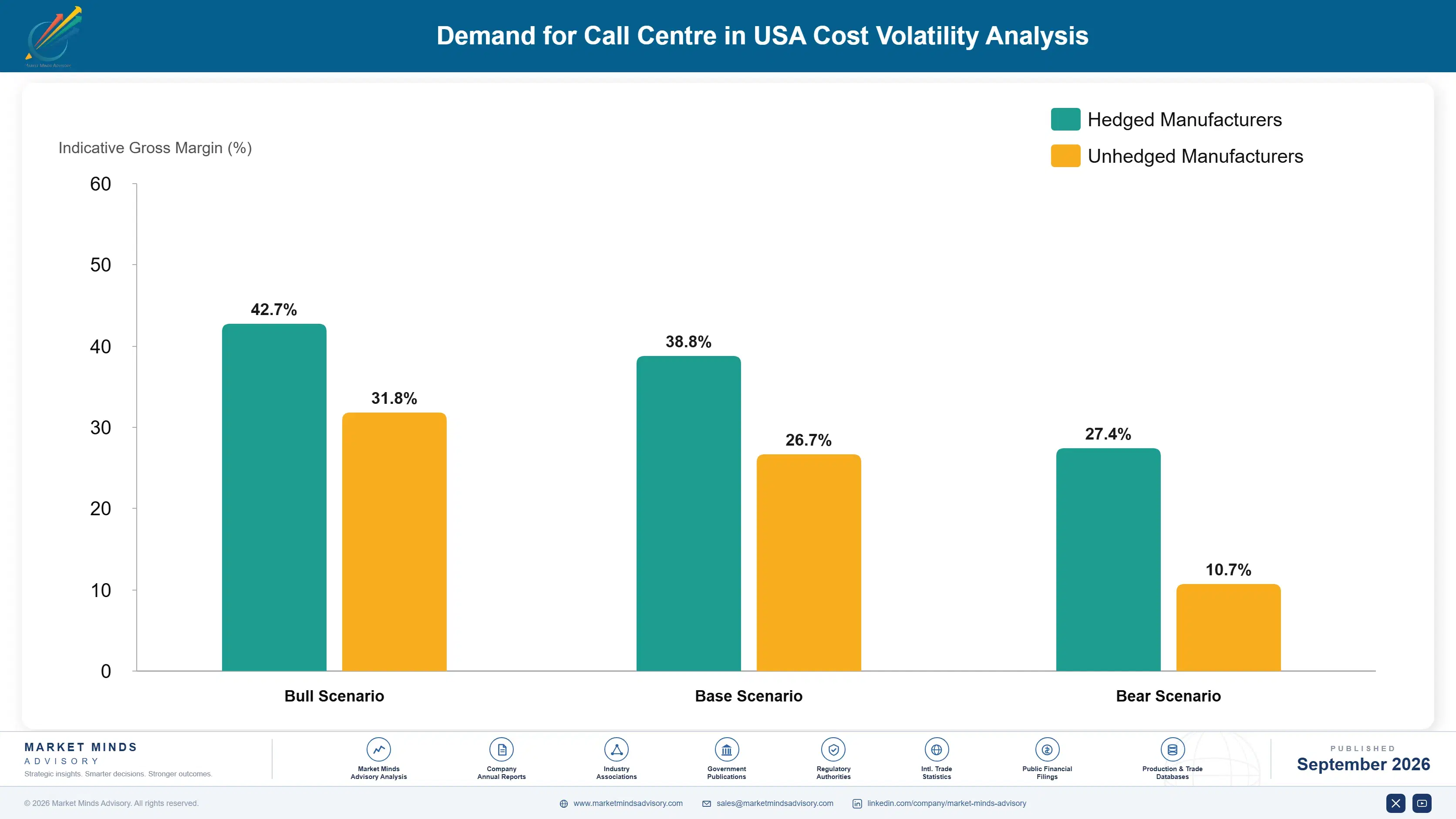
Cloud infrastructure hosting and specialised artificial intelligence and natural language processing engineering talent together represent the largest cost input for contact center platform vendors, running an estimated 42 to 50 percent of cost of goods sold and operating expense combined, sourced primarily from major cloud infrastructure providers and a competitive, nationally concentrated data science labour market.
Artificial intelligence engineering talent compensation rose meaningfully across the broader technology sector during 2023 and 2024 as demand for generative AI and natural language processing expertise outpaced supply amid intensifying competition across multiple technology sectors, a pattern consistent with technology sector compensation trends tracked across multiple vendor annual reports and public disclosures reviewed for this analysis. Vendors without established AI engineering teams faced longer hiring timelines than those with existing scale.

The competitive disadvantage falls hardest on smaller vendors without the balance sheet to compete for scarce AI engineering talent against larger, better-capitalised competitors and adjacent technology sectors offering comparable compensation. Exposure varies by product positioning too, since vendors building generative AI virtual agent capability face materially greater AI engineering talent exposure than vendors offering primarily traditional call routing functionality built on more widely available engineering skill sets.
united-states-call-centre-market-cost-volatility-analysis-1788452579630

Building Distributed Engineering Teams Outside Major Hubs

Larger vendors are building distributed engineering teams across secondary technology hub cities with lower compensation benchmarks than primary hubs, reducing talent cost exposure while maintaining access to a broader qualified candidate pool than a single-location hiring strategy would realistically allow across the country. This approach has become standard practice among the largest contact center vendors tracked in this report.

Partnering With Universities for Graduate Talent Pipelines

Several vendors are building dedicated university partnership programmes targeting artificial intelligence and natural language processing graduates years ahead of anticipated demand, reducing reliance on costly lateral hiring from a limited pool of already-experienced specialised engineers across the sector. This approach has become increasingly common among vendors competing for scarce specialised talent. This reduces reliance on costly lateral hiring.

Using Managed Cloud AI Infrastructure Services

Vendors are increasingly shifting toward managed machine learning infrastructure services offered directly by major cloud providers rather than building fully custom infrastructure internally, reducing specialised infrastructure engineering headcount requirements while adding modest ongoing platform licensing cost. This approach has become increasingly common among smaller vendors managing tighter budgets. This improves cost predictability for smaller vendors overall.

Portfolio Architecture for Margin Defence

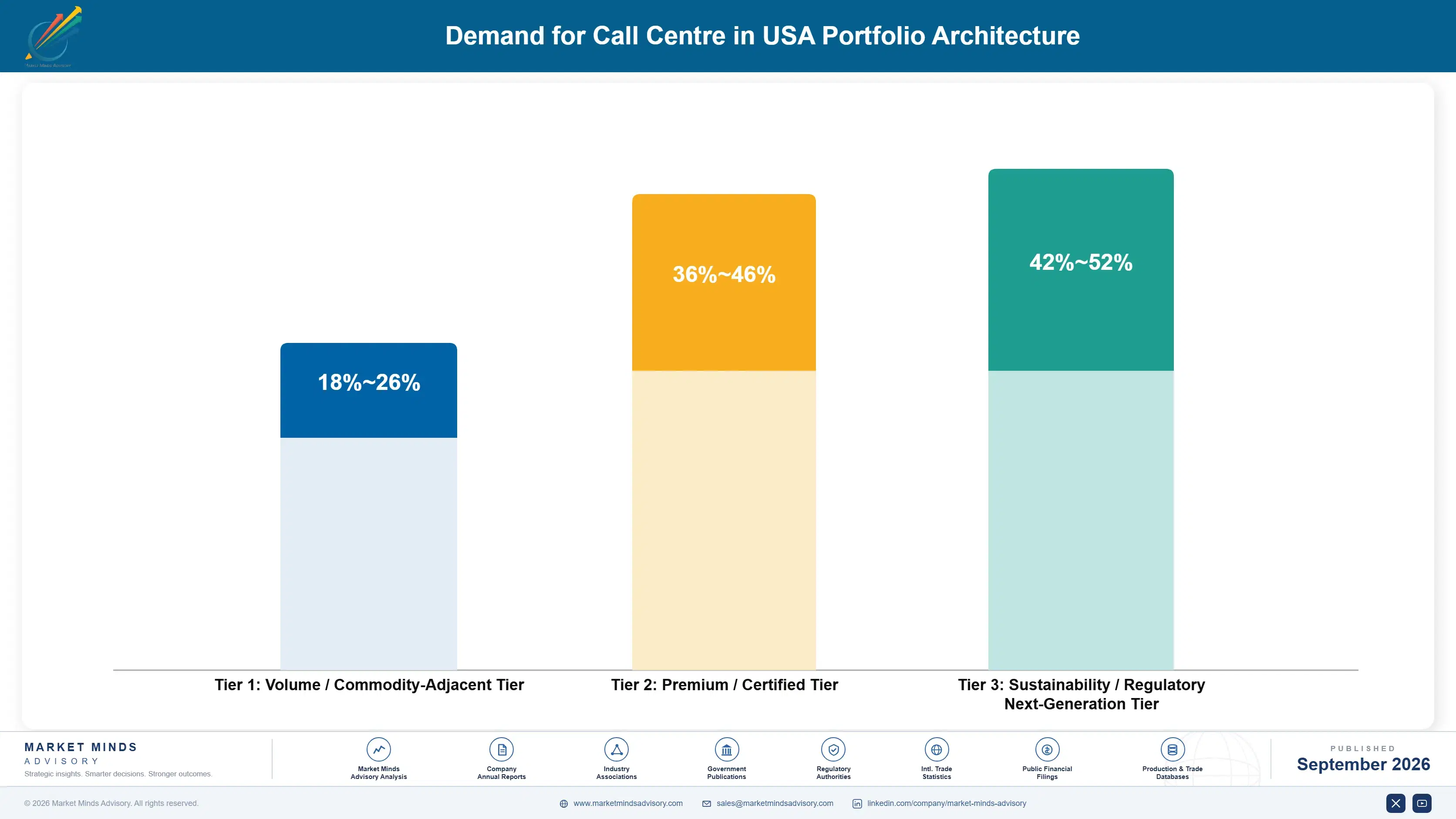
Portfolio economics split into three tiers. Volume tier basic per-seat call handling licensing carries thinner margins under continued price competition from bundled enterprise software vendors, while premium certified AI automation platforms bundling validated resolution accuracy carry meaningfully higher margins tied to demonstrated performance and analytics depth. The sustainability and next-generation tier, built around differentiated speech analytics and compliance monitoring, currently carries the strongest margins given genuine analytical differentiation and regulatory demand.
The volume versus premium tension shows up clearly in vendor engineering allocation. Investment devoted to defending basic per-seat licensing margin against bundled competition competes directly against investment needed for AI automation credibility and analytics depth, and vendors that under-invest in either risk losing ground to a competitor optimised specifically for that segment of the market.

High-value margin pools concentrate in validated AI automation platforms and in differentiated speech analytics, where technical differentiation and measurable performance still command premium pricing before broader commoditisation eventually sets in across the category. The volume basic licensing tier remains essential for market reach among smaller enterprises but contributes a shrinking share of blended gross margin across the category overall.

Volume / Commodity-Adjacent Tier

Basic per-seat call handling licensing facing continued price competition from bundled enterprise software vendors across most standard deployment scenarios. This tier remains price-sensitive across most standard enterprise segments broadly. This tier stays price-sensitive nationally.
Gross Margin: 18-26%

Premium / Certified Tier

AI automation platforms bundling validated resolution accuracy carrying margins tied to demonstrated performance and analytics depth across enterprise accounts. This pricing power reflects genuine performance credibility built over time. This pricing power reflects genuine credibility built over time.
Gross Margin: 36-46%

Sustainability / Regulatory / Next-Generation Tier

Differentiated speech analytics and compliance monitoring commanding the strongest current margins given genuine analytical differentiation and regulatory demand. This differentiation should persist given continued regulatory demand nationally. This should persist given regulatory demand.
Gross Margin: 42-52%
united-states-call-centre-market-portfolio-architecture-1788452580155

High-value Sub-segments and Strategic Watch-out

Differentiated Speech Analytics and Compliance Contracts

The fastest-growing margin segment in this report, combining strong current margins with accelerating enterprise demand for comprehensive quality and compliance monitoring this decade. Buyers increasingly request this capability by name during procurement evaluation. Buyers increasingly ask for this by name. This edge compounds as regulatory guidance approaches steadily.
Gross Margin: 42-52%

Validated AI Automation Platform Contracts

Premium offerings tied to enterprise demand for demonstrated resolution accuracy, offering strong margins and durable revenue visibility across major enterprise accounts broadly nationally. Vendors should invest here while evidence still commands a meaningful premium. This premium should hold for years. Vendors should capture share now while it still commands attention.
Gross Margin: 36-46%

Standard Per-Seat Call Handling Licensing Contracts

The largest existing revenue base, standard licensing facing steady price competition but funding most vendors' ongoing AI engineering investment across the wider platform. Execution discipline on renewals matters more here than added features. Volume here funds the rest of the portfolio. Execution discipline matters more here than added features overall.
Gross Margin: 20-28%

Legacy On-Premises Contact Center Infrastructure Exposure

A shrinking strategic watch-out segment as cloud platforms continue displacing on-premises infrastructure across most enterprise segments tracked in this report nationally. Waiting too long risks losing accounts during the next evaluation cycle. Diversifying away from this exposure looks prudent. Vendors here risk losing accounts during the next evaluation entirely.
Gross Margin: 8-16%

Platform Lock-In and Automation Depth Economics

Revenue behaves like a multi-year annuity once a platform becomes embedded into an enterprise's core customer interaction infrastructure, since switching contact center platforms means migrating years of accumulated interaction data and retraining agents and automation systems on new workflows, and that migration cost explains most of this category's meaningful revenue visibility once an enterprise moves past initial deployment into steady-state operation.
Adoption depth varies sharply by end-use vertical. Large enterprises in financial services and healthcare integrate contact center platform decisions deeply into broader customer experience and regulatory compliance strategy spanning multiple business units simultaneously, creating durable multi-year vendor relationships, while smaller enterprises with narrower customer service functions treat platform procurement more transactionally around basic cost and convenience considerations, creating shallower vendor loyalty and greater exposure to switching at renewal.

Buyer profiles are shifting generationally too. Operations leaders who came up through the traditional human-agent-centric era still favour proven, extensively tested vendor relationships even at a price premium, while newer digital customer experience leaders increasingly default to evaluating AI automation accuracy and analytics depth as standard procurement considerations, a difference in buying philosophy that is already shaping which vendors win newly launched enterprise programmes versus established legacy platform renewals.
united-states-call-centre-market-end-use-penetration-index-1788452580651

Where the Category Reorders Next

These are among the four positions where our research anticipates prominent divergence between winners and laggards over the coming forecast period. Each is grounded in the demand model, the regulatory perimeter, and the announced capacity pipeline.
01 / AI AUTOMATION INVESTMENT STRATEGY

Validated resolution accuracy is separating category leaders from claims

Vendors that built validated automated resolution accuracy, demonstrated through measurable customer satisfaction outcomes across live enterprise deployments, are capturing a disproportionate share of enterprise contracts as buyers grow wary of unproven automation promises circulating across the category. Vendors without demonstrated live deployment evidence risk being relegated to basic licensing positioning carrying materially lower contract value than accuracy leaders currently command. Building this evidence base now, while enterprises actively reassess vendor evaluation criteria, looks like the more urgent priority, since delaying investment risks ceding ground to accuracy-focused competitors already gaining share.
02 / OMNICHANNEL INTEGRATION STRATEGY

Cross-channel depth is compounding into durable contract advantage

Vendors that built deep omnichannel platform integration are capturing a disproportionate share of enterprise contracts as buyers increasingly demand consistent experience across voice, chat, email, and social channels simultaneously. This dynamic rewards vendors willing to invest in platform architecture well ahead of confirmed enterprise-wide channel standardisation. Vendors without established omnichannel depth should prioritise smaller pilot integrations first, since pilot programmes with two or three channels tend to reveal most recurring architectural requirements, since this discipline reduces the risk of costly early missteps considerably across the wider deployment pipeline.
03 / SPEECH ANALYTICS POSITIONING

Analytics differentiation remains a genuinely underexploited opportunity

Differentiated speech analytics capability remains underexploited relative to its clear revenue potential as enterprises continue treating call recording and quality monitoring as separate, basic infrastructure rather than a genuine analytical opportunity. Vendors building genuine analytics capability now are positioning for meaningful revenue advantage as enterprise demand for compliance and quality insight continues broadening. Treating analytics as a secondary add-on rather than a distinct product line risks underinvesting in a genuinely important growth opportunity, since early movers tend to lock in the most valuable analytics-focused enterprise relationships first.
04 / LEGACY PER-SEAT EXPOSURE

Vendors without automation depth face continued displacement pressure

Vendors remaining concentrated in basic per-seat licensing positioning without AI automation or analytics differentiation face continued displacement pressure as enterprise procurement criteria shift decisively toward demonstrated accuracy and analytical depth across most accounts tracked in this report. Vendors should actively diversify toward AI automation, omnichannel integration, or speech analytics rather than defending per-seat-only positioning alone. Treating per-seat-only positioning as a stable long-term stance rather than a declining one risks meaningfully understating the category's ongoing competitive transition already underway, visible in disclosed win rate and renewal figures.

Engagement Snapshot From the Field

A live engagement with an industry participant carrying material or product regulatory and market exposure ahead of a defining policy shift, showing how our research translates into a defensible multi-year portfolio strategy.
MARKET MINDS ADVISORY · CLIENT ENGAGEMENT SUMMARY
Demand for Call Centre in USA Producer Strategic Portfolio Review and Transition Roadmap 2026·Investment Scenario on Demand for Call Centre in USA Exposure Evaluation 2025-26
CLIENT PROFILE
The client is a mid-size regional insurance carrier generating approximately four hundred forty million dollars in annual revenue (client-reported, unverified by MMA), historically operating a legacy on-premises contact center system that had not undergone a fundamental platform redesign in more than a decade despite rising customer service interaction volume. The carrier's book spans both personal and commercial insurance lines nationally.
STRATEGIC CHALLENGE
Leadership needed to select a modernised contact center platform vendor capable of demonstrating genuine automated resolution improvement within a defined evaluation period, without the internal expertise to independently verify competing vendors' actual accuracy claims against the carrier's own historical interaction data. Board-level attention to competitive positioning added further urgency to the vendor selection timeline.
MMA APPROACH
MMA benchmarked candidate vendors against disclosed live deployment accuracy evidence and existing enterprise references operating comparable insurance sector contact center environments, prioritising vendors demonstrating genuine production-scale track record over marketing claims alone. The engagement included structured interviews with the client's operations team to validate realistic migration timelines. MMA also modelled realistic migration costs to support the client's internal budget approval process.
KEY FINDINGS
  1. Several vendors claiming strong automation improvements in marketing materials had only tested their virtual agents against generic customer service scenarios rather than the carrier's specific insurance claims inquiry patterns.
  2. A phased migration design covering a defined subset of the client's call centers reduced implementation risk considerably compared to a simultaneous full-organisation platform replacement.
  3. The client's existing legacy infrastructure required more extensive data migration work than initially anticipated, extending the migration timeline modestly beyond the original schedule.
  4. Agent adoption of the new platform's AI-assisted workflows exceeded initial expectations once early pilot results were shared transparently across the organisation. This transparency proved essential to securing broader staff buy-in across the organisation.
CLIENT PROFILE
The client is a mid-size regional insurance carrier generating approximately four hundred forty million dollars in annual revenue (client-reported, unverified by MMA), historically operating a legacy on-premises contact center system that had not undergone a fundamental platform redesign in more than a decade despite rising customer service interaction volume. The carrier's book spans both personal and commercial insurance lines nationally.
STRATEGIC CHALLENGE
Leadership needed to select a modernised contact center platform vendor capable of demonstrating genuine automated resolution improvement within a defined evaluation period, without the internal expertise to independently verify competing vendors' actual accuracy claims against the carrier's own historical interaction data. Board-level attention to competitive positioning added further urgency to the vendor selection timeline.
MMA APPROACH
MMA benchmarked candidate vendors against disclosed live deployment accuracy evidence and existing enterprise references operating comparable insurance sector contact center environments, prioritising vendors demonstrating genuine production-scale track record over marketing claims alone. The engagement included structured interviews with the client's operations team to validate realistic migration timelines. MMA also modelled realistic migration costs to support the client's internal budget approval process.
KEY FINDINGS
  1. Several vendors claiming strong automation improvements in marketing materials had only tested their virtual agents against generic customer service scenarios rather than the carrier's specific insurance claims inquiry patterns.
  2. A phased migration design covering a defined subset of the client's call centers reduced implementation risk considerably compared to a simultaneous full-organisation platform replacement.
  3. The client's existing legacy infrastructure required more extensive data migration work than initially anticipated, extending the migration timeline modestly beyond the original schedule.
  4. Agent adoption of the new platform's AI-assisted workflows exceeded initial expectations once early pilot results were shared transparently across the organisation. This transparency proved essential to securing broader staff buy-in across the organisation.
RECOMMENDED STRATEGY
Phase 1: Phase 1 (Months 1 to 2): Benchmark vendors against verified live deployment accuracy evidence and comparable references. Include carrier reference calls in comparable insurance sector deployments. Phase 2: Phase 2 (Months 3 to 6): Migrate a defined subset of call centers first to validate the platform under real conditions. Phase 3: Phase 3 (Months 7 to 10): Extend migration across remaining call centers based on pilot performance and feedback. Formalise ongoing model governance across the full call center network.
OUTCOME
Ten months after the engagement began, the client successfully migrated to the new AI-enabled contact center platform across its full organisation, reporting a measurably improved automated resolution rate relative to its prior legacy baseline (client-reported, unverified by MMA). Leadership also reported improved confidence in managing future platform updates without extensive external support.

Frequently Asked Questions

Foundational context covering the market sizes, CAGR, scope, country, region and competition that inform every finding below. This section is provided to cover basics and most often pre-purchase conversations, answered from the MMA Primary Research Dataset.

What is the current size of the Demand for Call Centre in USA?

Demand for call center platforms and services in the United States reached an estimated USD 28.5 billion in 2025, according to MMA Analysis. This base year figure anchors the forecast period.

How large will the Demand for Call Centre in USA be by 2036?

MMA projects the market will reach approximately USD 72.1 billion by 2036 under the base case scenario. That represents roughly a 2.32 times expansion from the 2026 starting value of USD 31.0 billion.

What is the CAGR for the Demand for Call Centre in USA 2026 to 2036?

The base case compound annual growth rate is 8.8% across the 2026 to 2036 forecast window. Bull and bear scenarios range from 7.5% to 10.0% depending on AI automation accuracy improvements and enterprise technology spending trends.

Which segment is growing fastest?

AI-Powered Virtual Agent and Chatbot Platforms lead all segments at a 16.0% CAGR, roughly 1.82 times the overall market rate. This segment benefits from generative AI capability improving rapidly across the industry.

Who are the major companies in the Demand for Call Centre in USA?

Leading vendors include NICE Ltd, Genesys Cloud Services Inc, Five9 Inc, Twilio Inc, and Verint Systems Inc. Together these five hold an estimated 38% combined share on a disclosed segment revenue basis.

Which country is growing fastest?

This report's scope is the United States specifically, which grows at the overall market rate of 8.8% annually. Enterprises headquartered across major metropolitan business hubs drive the majority of national demand.

Report Segmentation Architecture

The full report scope spans multiple orthogonal segmentation dimensions, with cross-tabulated demand data provided for each dimension pair. Coverage extends further to regional breakdowns, trend trajectories, and the competitive detail needed to support segment-level decision-making.

By Primary Market Dimension

  • Inbound Customer Service Call Handling Services
  • Outbound Sales and Telemarketing Services
  • AI-Powered Virtual Agent and Chatbot Platforms
  • Contact Center as a Service Software Platforms
  • Workforce Management and Quality Monitoring Software
  • Call Center Analytics and Speech Intelligence Platforms

By End-Use Industry

  • Financial Services and Insurance
  • Healthcare
  • Retail and E-Commerce
  • Telecommunications
  • Travel and Hospitality

By Commercial Dimension

  • Direct Enterprise Software Licensing
  • Business Process Outsourcing Service Contracts
  • Managed Service Provider Channels
  • Small Business Subscription Plans

By Region

  • North America
  • Western Europe
  • East Asia
  • South Asia and Pacific
  • Latin America
  • Middle East and Africa
  • Eastern Europe

Scope, Methodology, and Coverage

Every figure in this report is reproducible from documented input assumptions. The scope below maps the historical period, the forecast horizon, the segmentation dimensions, and the countries covered, alongside the underlying primary and qualitative methodology.
Historical Period
2020 to 2025
Forecast Period
2026 to 2036
Base Year
2025 (USD billions; MMA Primary Research Dataset, September 2026)
Market Definition
This report covers software platforms, artificial intelligence virtual agent technology, and outsourced services used to manage inbound and outbound customer interactions within the United States, including contact center as a service platforms, workforce management software, and business process outsourcing call handling services. It excludes broader customer relationship management software that does not include dedicated call handling or contact center functionality, and general business process outsourcing services unrelated to customer interaction handling.
Quantitative Units
USD billions (current prices); enterprise seat counts; average annual contract value
Segmentation Dimensions
By Primary Market Dimension; By End-Use Industry; By Commercial Dimension; By Region
Regions Covered
North America, Western Europe, East Asia, South Asia and Pacific, Latin America, Middle East and Africa, Eastern Europe
Countries Covered
United States, with incidental cross-border vendor activity referenced across other regions
Key Companies Profiled
NICE Ltd; Genesys Cloud Services Inc; Five9 Inc; Twilio Inc; Verint Systems Inc; RingCentral Inc; 8x8 Inc; Zendesk Inc; Salesforce Inc; Talkdesk Inc; Cisco Systems Inc; Avaya LLC; Amazon.com Inc; Google LLC; Microsoft Corporation; Cresta Intelligence Inc; Observe.AI Inc; Cogito Corp; Uniphore Technologies Inc; LiveVox Holdings Inc
Quantitative Methodology
Primary survey, n=3,800 respondents, Q4 2025, six countries; demand-side model with trade association cross-validation
Qualitative Methodology
47 expert interviews, Q4 2025; applied to validate demand model assumptions, identify emerging dynamics, and assess competitive positioning
Report Format
PDF and XLSX data workbook (Word format preview document)
Publisher
Market Minds Advisory
Report Code
MMA-2026-TEC-470
Published
September 2026
Contact
sales@marketmindsadvisory.com | www.marketmindsadvisory.com

Purchase the full Demand for Call Centre in USA Report (2026 to 2036).

The full report delivers complete segmentation data across all six product and service segments, detailed United States regional breakdowns, and competitive profiles for all twenty companies named in this summary. It includes the underlying primary survey dataset of three thousand eight hundred respondents and forty seven expert interviews conducted during the fourth quarter of 2025. Buyers also receive downloadable data tables covering historical 2020 to 2025 figures alongside the full 2026 to 2036 annual forecast. A dedicated appendix addresses AI automated resolution accuracy benchmarks across three vendor scenarios.
Full US Regional Data Tables and Charts
All Twenty Company Competitive Profiles and Rankings
Ten-Year Annual Forecast Model With Scenarios
Primary Survey Raw Data Access and Tables
AI Resolution Accuracy Benchmark Appendix and Guide
Quarterly Update Subscription Option for Buyers

Built For The People Who Decide

From boardroom strategy to bench-side execution, this report is read cover-to-cover by leaders shaping the next decade of their industry, turning demand scenarios, market dynamics and valuation benchmarks into decisions.
CXOs/ Presidents/ VPs/ Managers
M&A and Corporate Development
Strategy Teams and R&D Heads
Procurement and Product Directors
Regulatory and Compliance Leaders
Investor Relations and Equity Analysts