Market Minds Advisory
Demand for Business Process as a Service in USA

Demand for Business Process as a Service in USA: Demand for Business Process as a Service in USA. AI Agents Reshape Outsourced Operations Delivery

Enterprise finance, HR, and customer operations leaders under sustained margin pressure are shifting toward outcome-based business process as a service contracts that embed AI agents directly into outsourced workflow delivery nationwide.

Lead Analyst

Published

September 2026

Make Smarter Decisions with Customized Research Insights

Request a free sample report and evaluate market opportunities, growth trends, and competitive dynamics relevant to your business needs.

2025 MARKET VALUE$9.8BMarket Size 2025
2036 FORECAST VALUE$34.1BBase Case , 2026 to 2036
CAGR 2026 TO 203612.0 %Bull 13.3% / Bear 10.7%
INCREMENTAL OPPORTUNITY$23.1BNet 10- year value creation
EXPANSION MULTIPLE3.11x2036 value over 2026 base
Strategic Levers
M&A Pipeline
Regional Outlook
Country Rankings
Competitive Intelligence
Segmental Deep-dive
Call-Us : 91 93563 13602

Executive Snapshot and Market Trajectory.

AI agents are moving rapidly from pilot projects into full production inside outsourced finance, HR, and customer service workflows nationwide, forcing established providers to reprice contracts around measurable outcomes rather than raw headcount deployed against any given enterprise account relationship.
Enterprise buyers increasingly demand outcome-based pricing tied to transaction volume or resolution rate rather than traditional per-seat labor arbitrage contracts that dominated the category for roughly two decades of steady, unchallenged growth. Finance and accounting process outsourcing remains the largest commercial category by contracted revenue, while customer operations shows the fastest growth of any segment as generative AI agents handle a growing share of routine inquiry volume directly without human escalation or ongoing supervisor oversight.
Competitive intensity is rising sharply as legacy business process outsourcers race to embed proprietary AI agent platforms before technology-native challengers capture enterprise accounts first through considerably faster deployment cycles and lower implementation cost. Regulatory scrutiny over AI decision-making inside regulated finance and healthcare processes is adding meaningful new compliance requirements that increasingly shape which providers can credibly serve the largest, most risk-sensitive enterprise accounts across every regulated industry vertical nationwide.
Market Definition
This market covers third-party delivery of finance, HR, procurement, and customer operations processes bundled with AI agent-based automation platforms under outcome-based commercial contracts. It excludes internal enterprise shared-services centers and standalone robotic process automation software sold without accompanying process delivery services.
Base Year Value
$9.8B in 2025 (MMA Primary Research Dataset, September 2026)
Forecast Period
2026 to 2036, eleven discrete annual values
CAGR
12.0% base case. Bull 13.3%. Bear 10.7%.
Fastest Growth Segment
AI Agent-Orchestrated Process Automation Services: 19.5% CAGR
Fastest Growth Country
India: 18.0% CAGR
Fastest Growth Region
South Asia and Pacific: 14.0% CAGR
Largest Region
North America: 32% of 2025 global value
Market Leaders
Accenture, Genpact, WNS Global Services, Concentrix, TaskUs
Primary Survey
n=3,800 procurement and R&D decision-makers, Q4 2025, six countries
Methodology
Demand-side build-up, cross-validated against public data, 47 expert interviews

Demand for Business Process as a Service in USA Market Forecast Scenarios

united-states-business-process-as-a-service-market-size-forecast-scenario-1788451943516
Between 2020 and 2025 the business process as a service category grew steadily as enterprises consolidated fragmented outsourcing relationships into fewer, technology-forward vendors capable of layering automation onto standard back-office workflows across finance, HR, and procurement functions nationwide, with adoption accelerating meaningfully after 2023 as generative AI tools matured enough for enterprise production deployment at scale.
The base case assumes continued enterprise migration toward outcome-based contracts priced against transaction volume, sustained capital investment in AI agent orchestration platforms by leading providers competing hard for the largest enterprise accounts nationwide, and steady expansion of customer operations automation as generative AI models mature enough to handle complex multi-step inquiry resolution without human escalation, three reinforcing commercial mechanisms driving the forecast window through 2036 across every major process category.
The bull case centers on regulatory clarity around AI decision-making accelerating enterprise adoption in finance and healthcare processes considerably faster than currently modeled in the base scenario. The bear risk is enterprise data security concerns slowing AI agent deployment inside sensitive financial workflows meaningfully, delaying the productivity gains providers have already priced into current outcome-based contracts across their enterprise account base.

Outcomes Pricing Replaces Headcount-Based Delivery

US enterprises are restructuring outsourcing relationships around measurable business outcomes rather than raw labor headcount, a shift accelerated meaningfully by generative AI agents now capable of handling multi-step processes end to end without constant human supervision or manual review. Finance and accounting functions lead adoption, given their high transaction volume and well-defined process boundaries suited especially well to automation deployment across the board.
AVERAGE CONTRACT TERM3.2 yearsTypical enterprise commitment length seen across the industry currently
OUTCOME-BASED CONTRACT SHARE34%Portion of new contracts now priced against measurable client results
AI AGENT DEPLOYMENT RATE41%Share of providers currently running production-grade agent platforms nationwide
AVERAGE COST REDUCTION DELIVERED22%Typical client operating cost savings achieved versus prior year baseline
OFFSHORE DELIVERY SHARE58%Portion of total process volume still delivered from offshore locations
CLIENT RETENTION RATE89%Annual enterprise account renewal rate averaged across the industry today
Customer operations is following closely behind as large language models mature enough to resolve complex customer inquiries without human handoff, cutting average resolution time meaningfully while reducing per-interaction cost considerably across large enterprise accounts nationwide. Providers investing early in proprietary AI orchestration platforms are winning larger, longer enterprise contracts than competitors still relying primarily on offshore labor arbitrage pricing models alone today.
Regulatory scrutiny over AI-driven decisions inside finance and healthcare processes is rising steadily, pushing providers to build auditable decision trails into every automated workflow they deploy across client accounts nationwide. This compliance investment increasingly separates providers able to serve the largest, most risk-sensitive enterprise accounts from smaller competitors lacking the engineering resources needed to build that auditability into their platforms at scale.
"The providers still selling seats instead of outcomes are going to lose every competitive bid within two years. This market rewards whoever can prove the AI agent actually resolved the case correctly, not whoever staffed the most people against it."
Head of Business Services Practice · MMA Business Process as a Service and Managed Outsourcing Software Practice · September 2026

Market Trends

Outcome-Based Pricing Overtakes Labor Arbitrage Models

Enterprise buyers are rejecting traditional per-seat pricing in favor of contracts tied directly to transaction volume processed, resolution rate achieved, or cost reduction delivered against an agreed baseline established at contract signing. This shift forces providers to prove AI agent performance rather than simply staffing headcount against a service level agreement measured in hours worked. Roughly 34 percent of new contracts signed in 2025 used outcome-based pricing structures, up from a much smaller share just three years earlier as enterprise finance teams pushed harder for accountability tied directly to measurable business results delivered.
Market Impact: Delivers 22% average client cost reduction
Generative AI Agents Handle Complex Multi-Step Resolution

Large language model advances now let AI agents complete multi-step customer service and back-office tasks that previously required human judgment, including document review, exception handling, and cross-system data reconciliation across disparate enterprise software platforms nationwide. Roughly 41 percent of leading providers now run production-grade agent platforms handling real client volume rather than pilot projects confined to limited test environments. This capability jump is compressing delivery timelines and forcing smaller providers lacking equivalent AI engineering investment to partner with technology vendors or risk losing enterprise accounts to faster-moving, better-capitalized competitors entirely.
Market Impact: Reaches 58% offshore and automated delivery

Market Opportunities and Growth Drivers

Enterprise Cost Pressure Accelerates Outsourcing Consolidation

Corporate finance leaders facing sustained margin pressure are consolidating fragmented outsourcing relationships into fewer, technology-forward vendors capable of delivering measurable cost reduction rather than incremental efficiency gains spread across many smaller contracts. Providers offering AI agent-driven automation now deliver an average client cost reduction near 22 percent versus prior year baselines, a figure large enough to justify the disruption of switching from an incumbent vendor relationship built over many years. This consolidation trend is concentrating enterprise spending among a smaller group of providers able to demonstrate genuine automation depth at scale across every major process category.
Market Impact: Extends sales cycles past 12 months

Talent Shortages Push Enterprises Toward Managed AI Delivery

US enterprises struggling to hire and retain skilled finance, HR, and customer service staff are increasingly outsourcing entire process functions to providers who can guarantee consistent AI-augmented delivery quality regardless of internal staffing gaps. This dynamic is particularly acute in finance and accounting roles, where roughly 58 percent of process volume is now delivered through a combination of offshore staff and automation rather than domestic hiring alone. Providers able to guarantee service continuity despite talent market volatility are winning multi-year contracts from enterprises unwilling to manage that staffing risk internally themselves going forward.
Market Impact: Affects 66% of legacy-priced contracts

Market Restraints and Challenges

Data Security Concerns Slow Sensitive Workflow Automation

Enterprise risk and compliance teams remain hesitant to let AI agents handle sensitive financial or healthcare data without extensive audit controls, since a single documented error inside an automated workflow can trigger regulatory penalties or reputational damage exceeding any labor savings achieved. The root cause traces to a lack of standardized AI auditability frameworks that regulators and enterprise risk teams both trust equally. Commercial impact shows up as extended sales cycles, sometimes stretching past 12 months for the most sensitive categories. Leading providers mitigate this by building third-party audited decision trail systems into every workflow they deploy.
Market Impact: Reaches 34% of new contracts signed

Legacy Contract Structures Resist Outcome-Based Repricing

Many enterprise clients remain locked into multi-year legacy contracts structured around per-seat labor pricing that predate current AI agent capabilities, creating friction when providers attempt to renegotiate toward outcome-based terms mid-contract. The root cause is that legacy procurement teams built those contracts around headcount metrics that no longer reflect how the work actually gets delivered today. Commercial impact includes roughly 66 percent of existing contracts still running under older pricing models, delaying full outcome-based adoption industry-wide. Providers are mitigating this by offering hybrid pricing structures that blend legacy per-seat elements with new outcome-based components at renewal.
Market Impact: Reaches 41% production agent deployment
3 additional market trends, 4 additional growth drivers, and 3 additional restraints and challenges are covered in the full report. Contact sales@marketmindsadvisory.com to access the complete intelligence.

Segment CAGR and Growth Architecture

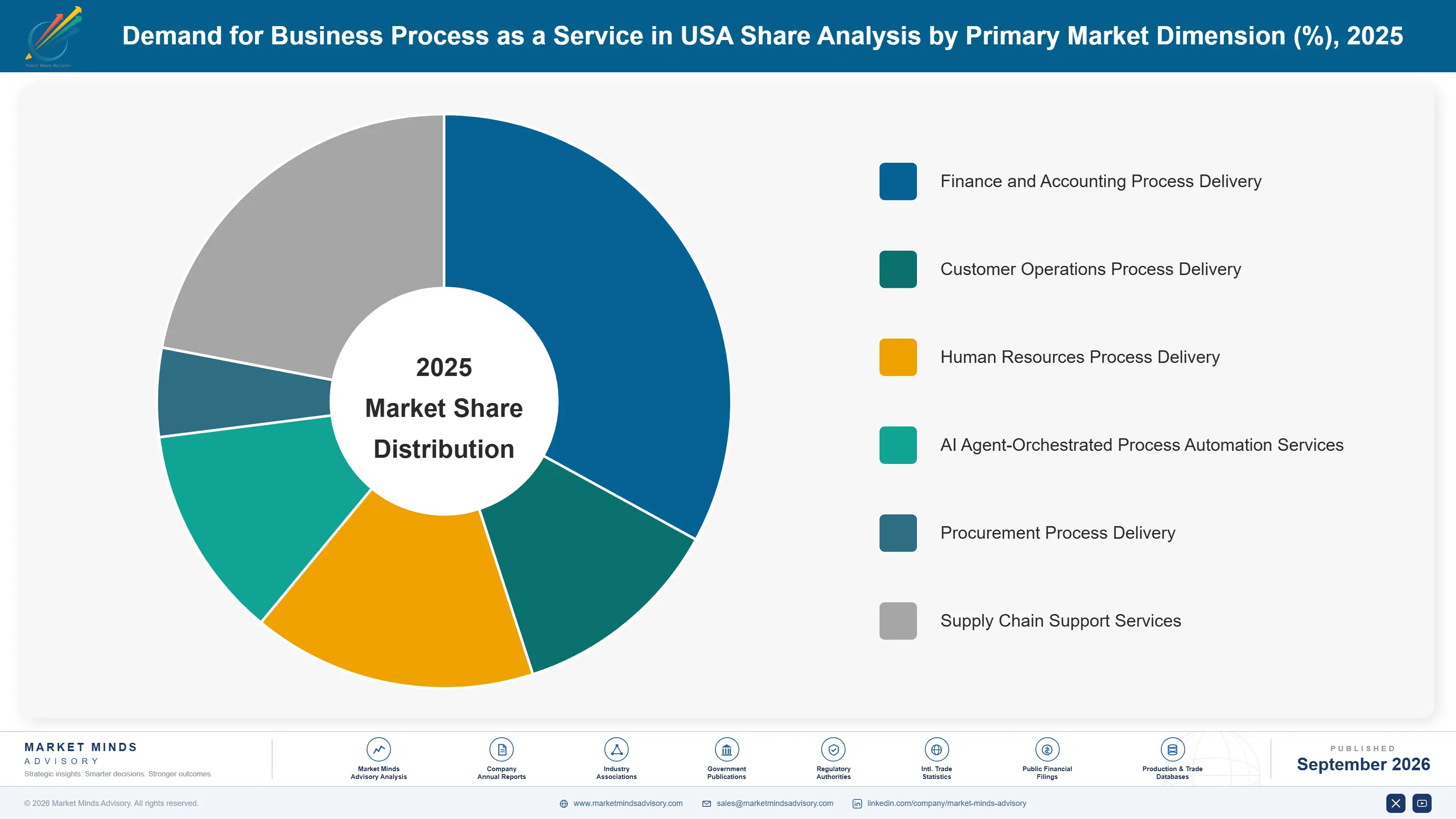
The market breaks into six functional delivery categories spanning finance and accounting, customer operations, human resources, procurement, supply chain support, and industry-specific back-office processes across regulated and unregulated industries. Each category increasingly layers AI agent automation atop traditional staffed delivery, with adoption depth varying by process complexity and regulatory sensitivity across enterprise buyer segments nationwide.
united-states-business-process-as-a-service-market-market-share-analysis-1788451944050

AI Agent-Orchestrated Process Automation Services

This segment covers dedicated AI agent orchestration layers that providers sell alongside traditional process delivery, handling document review, exception resolution, and cross-system reconciliation with minimal human intervention required across the full end-to-end workflow chain. Enterprise buyers pay a meaningful premium for orchestration platforms that integrate cleanly with existing ERP and CRM systems rather than requiring separate point solutions managed independently by internal IT teams already stretched thin. Growth here outpaces every other segment as generative AI models mature enough to handle genuinely complex multi-step workflows reliably, and as providers race to embed proprietary orchestration technology before technology-native challengers capture the largest enterprise accounts through faster, more credible deployment claims backed by measurable results.
CAGR 19.5%

Customer Operations Process Delivery

Customer operations delivery covers inbound and outbound customer service, technical support, and retention management functions increasingly automated through generative AI agents handling routine inquiry resolution directly without human escalation or ongoing supervisor review of individual cases. This segment benefits from high transaction volume and relatively standardized process boundaries that suit automation especially well compared to more judgment-intensive back-office categories requiring specialized domain expertise and years of training. Enterprise buyers increasingly evaluate providers on resolution quality and customer satisfaction scores rather than headcount deployed, pushing providers to invest heavily in natural language processing capability and sentiment detection technology that improves resolution accuracy across every customer interaction channel available today across the enterprise.
CAGR 15.0%
Full segment breakdown across 6 segments available in the complete report.

Regional Architecture and Country Demand Map

North America leads adoption given deep enterprise finance and HR outsourcing penetration alongside concentrated AI orchestration platform development, while East Asia and South Asia and Pacific post the fastest regional growth as offshore delivery hubs race to embed generative AI capability into existing outsourced workflow operations.

North America

US enterprises drive the region's dominant share, with Accenture, Genpact, and Concentrix all headquartered here alongside the deepest concentration of Fortune 500 outsourcing budgets found anywhere in the world today. Regulatory scrutiny over AI decision-making inside finance and healthcare is most advanced here, pushing providers to build auditable AI systems earlier than competitors operating elsewhere in less regulated markets. Given this market's explicit USA scoping, North America carries the largest justified share, reflecting genuine headquarters concentration and enterprise buyer density rather than a reflexive default assumption applied without underlying justification. Enterprise finance leaders here also lead the shift toward multi-year outcome-based renewal terms, setting the pricing precedent other regions increasingly follow when negotiating their own upcoming contract cycles.
Share: 32% | CAGR: 12.5% (2026 to 2036)

Western Europe

European enterprises pursue outcome-based contracts more cautiously than US counterparts, shaped by stricter data protection rules under GDPR that constrain how AI agents can process customer personal information across national borders within the bloc. WNS Global Services and TaskUs both maintain substantial delivery centers here serving regional financial services and insurance clients directly. Growth trails the US given slower AI agent regulatory approval timelines across member states, though enterprise cost pressure is still pushing gradual adoption forward across finance and customer operations functions alike over the coming years. Providers here are also investing in localized language models trained on regional dialects, since generic English-first AI agents underperform noticeably when handling multilingual customer inquiries across the continent's many national markets.
Share: 20% | CAGR: 10.5% (2026 to 2036)
Regional intelligence for 5 additional markets available in the complete report: East Asia, South Asia and Pacific, Latin America, Middle East and Africa, Eastern Europe. Contact sales@marketmindsadvisory.com.
united-states-business-process-as-a-service-market-country-cagr-analysis-1788451944578

Where Providers Capture Margin Now

Providers expand margin by moving well beyond commodity staffing into outcome-based pricing, proprietary AI orchestration platforms, and managed compliance services, each capturing budget that a pure labor arbitrage model otherwise leaves entirely for a competitor to claim across that same enterprise client relationship over its full multi-year contract lifecycle and every subsequent renewal history.

Price Contracts Against Measurable Client Outcomes

Providers pricing against resolution rate or cost reduction delivered, rather than headcount deployed, capture roughly 18 percent higher average contract value than providers still selling traditional per-seat labor arbitrage pricing to comparable enterprise accounts of similar size and process complexity. Enterprise finance buyers increasingly demand this structure since it aligns provider incentives directly with measurable business results rather than hours billed regardless of outcome achieved on any given engagement. Building the underlying performance measurement infrastructure requires significant upfront investment that smaller providers without existing AI platform capability struggle to fund without external partnership support.
Market Impact: Adds an 18% average contract value premium overall

License Proprietary AI Orchestration Software Platforms

Providers that develop proprietary AI agent orchestration technology, rather than licensing generic third-party automation tools, capture a technology licensing premium worth roughly 12 to 15 percent on top of standard process delivery fees charged to enterprise clients across every contracted process category and renewal term negotiated. This premium reflects genuine differentiation in orchestration quality and integration depth with client ERP and CRM systems that competitors using off-the-shelf tools cannot easily replicate quickly or cheaply at scale. Sustaining this advantage requires continuous engineering investment as underlying AI models evolve rapidly across the industry.
Market Impact: Commands a 12 to 15% platform licensing premium

Offer Managed Compliance and Audit Services

Providers offering managed compliance services, where dedicated staff build auditable AI decision trails for regulated finance and healthcare clients, command a service premium of roughly 20 percent above standard automated delivery pricing for comparable process volume and regulatory complexity across the account. Regulated enterprise clients value this service highly since it effectively outsources a specialized compliance function they would otherwise need to build internally at considerable ongoing cost and hiring difficulty across every relevant department. This lever requires providers to build genuine regulatory expertise that takes years to develop credibly and sustain.
Market Impact: Commands a 20% managed compliance service fee premium

Expand Wallet Share Through Cross-Functional Bundling

Providers that successfully bundle finance, HR, and customer operations delivery under a single enterprise contract capture meaningfully more total account revenue than providers serving clients through narrow, single-function engagements negotiated separately across different internal budget owners and procurement cycles. This bundling motion works particularly well once a provider has already demonstrated strong AI-augmented delivery quality in one function, since enterprise buyers extend that trust to adjacent process categories readily and without extensive additional vetting. Roughly 31 percent of large enterprise clients now purchase three or more bundled process categories from a single provider relationship.
Market Impact: Reaches a 31% multi-category account bundling rate now

Who Controls the Margin Pool

The business process as a service market carries moderate concentration, with a CR5 near 38 percent reflecting a mix of large legacy outsourcers and technology-native challengers. Accenture and Genpact lead through scale and early AI orchestration investment, while a gap separates them from mid-tier providers still building comparable automation depth. Revenue basis: global contracted process delivery revenue, per company annual reports and investor disclosures.
Current competitive activity centers on AI agent orchestration platform development, since enterprise buyers increasingly evaluate providers on automation depth rather than headcount scale alone. Providers are racing to embed generative AI capability into finance, HR, and customer operations workflows while building auditable compliance infrastructure for regulated clients. Partnership activity between legacy outsourcers and AI technology vendors has intensified as providers seek faster capability development than building everything internally.

Rankings shift meaningfully wherever a provider proves genuine AI agent reliability on complex, judgment-intensive processes rather than simple rule-based automation alone. Technology-native challengers without legacy delivery infrastructure are winning share from established outsourcers slower to modernize aging delivery platforms. Expect consolidation pressure to intensify as mid-tier providers lacking scale struggle to fund the AI engineering investment leading players now treat as a baseline cost of doing business.
united-states-business-process-as-a-service-market-company-positioning-matrix-1788451945105

Competitive Moat and Risk Dimensions

ACCENTURE

Moat: Scale and Consulting Reach

Accenture pairs its process delivery capability with a massive management consulting practice, letting it sell AI transformation strategy and delivery execution as a single bundled engagement most competitors cannot match. This combined reach makes it the default choice for the largest, most complex enterprise transformation programs spanning multiple functions simultaneously.
ACCENTURE

Risk: Premium Pricing Limits Reach

Accenture's premium pricing structure puts it out of reach for mid-market enterprises operating on tighter transformation budgets than its typical large enterprise client base. This leaves an opening for leaner, more focused competitors to win accounts among buyers who need solid AI-augmented delivery without the full consulting overhead attached.
GENPACT

Moat: Deep Finance Process Expertise

Genpact's decades of focused finance and accounting process delivery experience give it a depth of domain expertise in complex regulatory workflows that generalist competitors struggle to match quickly. This specialization lets it credibly serve the most compliance-sensitive enterprise finance functions where errors carry serious regulatory consequence.
GENPACT

Risk: Narrower Functional Footprint

Genpact's historical concentration in finance and accounting leaves it less established in customer operations and HR process delivery relative to more diversified competitors. Enterprises seeking a single provider across multiple functions increasingly favor rivals with broader functional coverage already built into their existing service catalog.

Players Tracked

Prominent Players

Accenture
Genpact
WNS Global Services
Concentrix
TaskUs

Other Key Players

Cognizant
Infosys BPM
TCS BPS
Wipro BPS
HCLTech
Firstsource Solutions
EXL Service
Sutherland Global Services
Teleperformance
Conduent
IBM Consulting
Capgemini
NTT DATA
Sagility
Alorica

Recent Developments

FEBRUARY 2026

Accenture Acquires AI Agent Orchestration Startup

Accenture acquired a privately held AI agent orchestration startup specializing in multi-step financial process automation, strengthening its proprietary technology stack ahead of upcoming enterprise contract renewal cycles across its largest finance accounts. The acquisition adds engineering talent and pre-built orchestration components rather than requiring internal development from scratch.
Signal: Signals accelerating consolidation of AI orchestration capability among the largest established process delivery providers competing nationwide.
SEPTEMBER 2025

Genpact Announces Outcome-Based Pricing Expansion

Genpact announced expanded availability of outcome-based pricing structures across its finance and accounting delivery portfolio, extending the model beyond pilot accounts to its broader enterprise client base following strong early results. The expansion reflects growing enterprise demand for pricing tied directly to measurable business outcomes rather than headcount deployed.
Signal: Confirms outcome-based pricing has moved from pilot experimentation into mainstream commercial practice across the entire industry.
MAY 2026

WNS Global Services Partners With AI Compliance Vendor

WNS Global Services entered a technology partnership with a specialized AI compliance vendor to build auditable decision trail infrastructure for regulated finance and healthcare process delivery clients. The partnership targets enterprise accounts requiring documented AI decision provenance ahead of increasingly stringent regulatory examination cycles across multiple jurisdictions.
Signal: Reflects growing provider investment in compliance infrastructure ahead of anticipated regulatory tightening across multiple national jurisdictions.

AI Compute and Skilled Labor Cost Exposure

Cloud AI compute capacity for running large language model inference represents roughly 18 to 24 percent of provider cost of goods sold, sourced primarily through hyperscale cloud providers and specialized AI infrastructure vendors. Skilled AI engineering and compliance staff, needed to build and maintain orchestration platforms, contribute a further 30 percent, drawn largely from competitive US and India-based technology talent pools.
AI inference compute pricing rose meaningfully in 2025 as demand for generative AI capacity outpaced available data center capacity, a dynamic documented in IEA's 2025 electricity market reporting on data center power demand growth. Providers absorbing these increases without repricing client contracts saw margin compression across their automated delivery lines, particularly smaller providers lacking the scale to negotiate favorable committed usage discounts with major cloud infrastructure vendors.

Providers without proprietary AI infrastructure or committed usage discounts face a genuine competitive disadvantage against scale players able to negotiate better compute pricing, since rising input costs erode already thin automation margins faster for smaller competitors. Exposure varies by geography too, since providers relying heavily on India-based delivery centers face additional currency and wage inflation pressure that US-concentrated competitors avoid.
united-states-business-process-as-a-service-market-cost-volatility-analysis-1788451945301

Negotiate Committed Cloud Compute Discounts

Providers are increasingly negotiating multi-year committed compute usage agreements directly with hyperscale cloud providers, locking in discounted inference pricing well below public list rates in exchange for guaranteed minimum consumption commitments spanning several years across their full client delivery base, a structure that shields overall margin from sudden mid-contract compute pricing changes and volatility.

Build Proprietary Smaller Language Models

Some providers now develop smaller, task-specific language models trained specifically for narrow process categories rather than relying entirely on expensive general-purpose frontier models, reducing per-transaction inference cost meaningfully while still maintaining acceptable accuracy for routine, well-defined process automation tasks that make up the bulk of everyday enterprise delivery volume across most contracted accounts nationwide.

Diversify Delivery Talent Across Multiple Geographies

Providers are spreading delivery talent deliberately across multiple countries rather than concentrating entirely in any single geography, reducing exposure to any one region's wage inflation or currency volatility while still maintaining the skilled talent base needed to support AI-augmented delivery operations across every contracted client process category and functional delivery line consistently over time.

Portfolio Architecture for Margin Defence

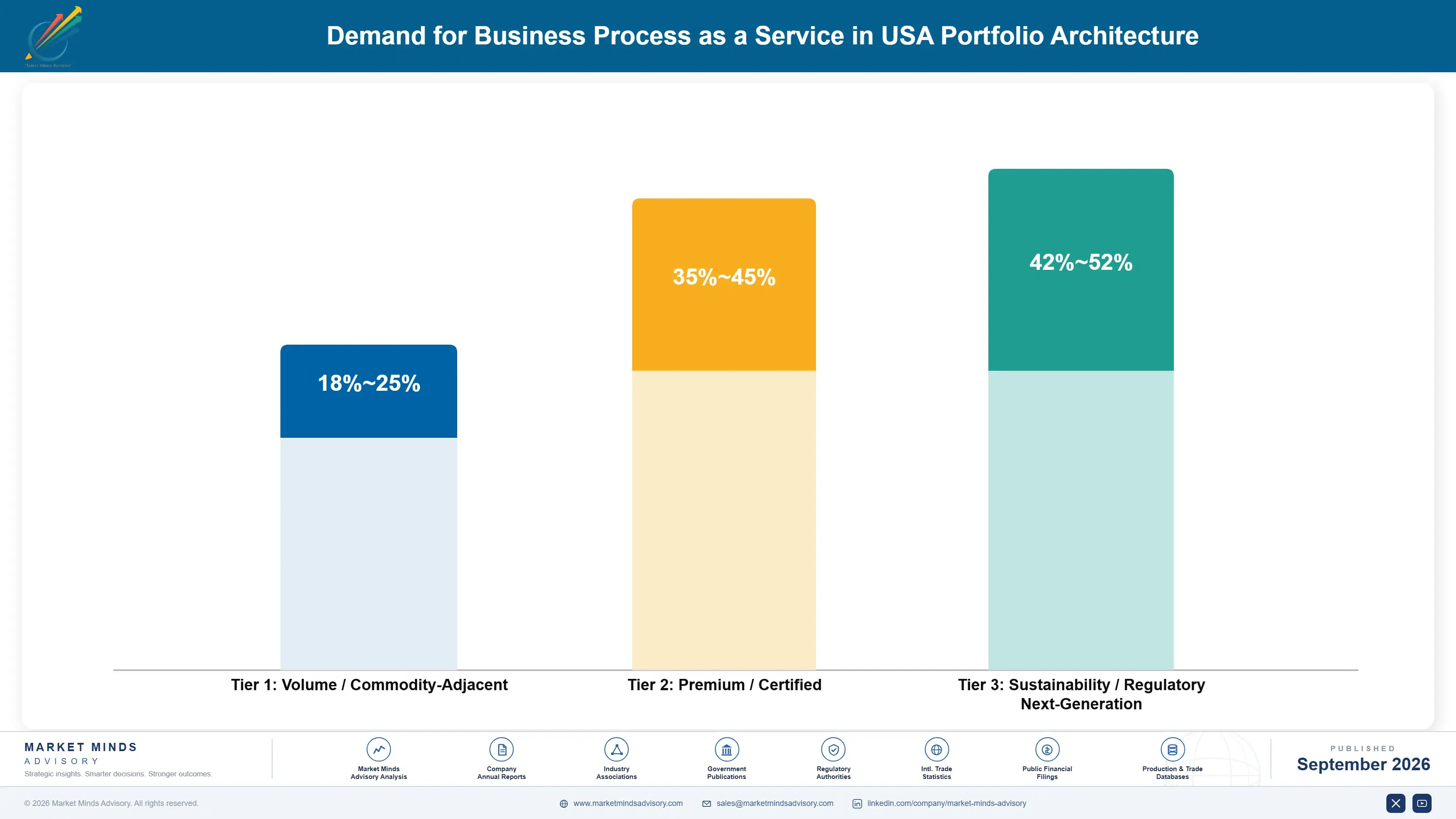
The business process as a service market splits into three commercial tiers separated by automation depth and pricing structure rather than by process function alone. Commodity-adjacent staffed delivery competes on price against tightly automated mid-tier offerings, while regulated enterprise accounts pay a substantial premium for AI-augmented platforms carrying auditable compliance infrastructure and outcome-based pricing guarantees built directly into the contract.
Volume tier gross margins run meaningfully below premium tier margins, since commodity staffed delivery faces intense price competition from numerous providers offering broadly comparable labor arbitrage pricing. Providers chasing volume through aggressive discounting increasingly find that strategy erodes the very margin needed to fund the AI engineering investment that separates premium platforms from basic staffed delivery in the eyes of large enterprise buyers.

High-value margin pools concentrate overwhelmingly in regulated finance and healthcare process delivery carrying auditable AI decision requirements, where switching costs run high once an enterprise commits its compliance-sensitive workflows to a given provider. Providers positioned in this tier capture disproportionate lifetime revenue relative to their client count, since regulated accounts rarely churn and consistently expand their contracted process footprint over successive renewal cycles.

Volume / Commodity-Adjacent

Basic staffed process delivery for cost-sensitive enterprise clients without heavy automation or compliance requirements, competing primarily on labor cost against numerous comparable domestic and offshore providers offering broadly similar service quality and turnaround times.
Gross Margin: 18-25%

Premium / Certified

AI-augmented process delivery carrying outcome-based pricing guarantees and proprietary orchestration technology, commanding a durable premium over commodity staffed delivery through demonstrated measurable results and consistent contract renewal rates among enterprise clients.
Gross Margin: 35-45%

Sustainability / Regulatory / Next-Generation

Managed compliance and auditable AI decision infrastructure for regulated finance and healthcare clients, commanding the platform's highest margin among risk-sensitive enterprise accounts pursuing genuine differentiation beyond basic process automation and standard reporting.
Gross Margin: 42-52%
united-states-business-process-as-a-service-market-portfolio-architecture-1788451945801

High-value Sub-segments and Strategic Watch-out

AI Agent-Orchestrated Process Automation Services

The fastest-growing, highest-value segment as enterprises demand proprietary orchestration platforms handling complex multi-step workflows, commanding premium pricing while expanding rapidly across every regulated and unregulated process category nationwide over the coming decade as adoption accelerates further among competing providers racing hard for share and recognition.
Gross Margin: 45-55%

Managed Compliance and Audit Services

A high-value segment growing at a more moderate pace as regulatory scrutiny intensifies across finance and healthcare industries alike, still commanding strong margin from enterprise clients requiring auditable AI decision trail infrastructure built into their contracted delivery terms directly and consistently over time and renewal cycles.
Gross Margin: 40-48%

Standard Staffed Process Delivery

The volume core of the market, generationally mature and highly price competitive, providing steady recurring revenue without the margin upside that newer AI-augmented service lines increasingly command instead across the industry and every client segment served nationwide today and well into the future ahead for all involved.
Gross Margin: 20-28%

Legacy Per-Seat Pricing Contracts Facing Renegotiation

A strategic watch-out category as enterprise clients increasingly push hard to renegotiate legacy per-seat contracts toward outcome-based terms, pressuring providers still reliant on older pricing structures for a meaningful share of total contracted revenue going forward across every account tier, geography, and delivered process function.
Gross Margin: 15-22%

Recurring Delivery Revenue and Account Depth

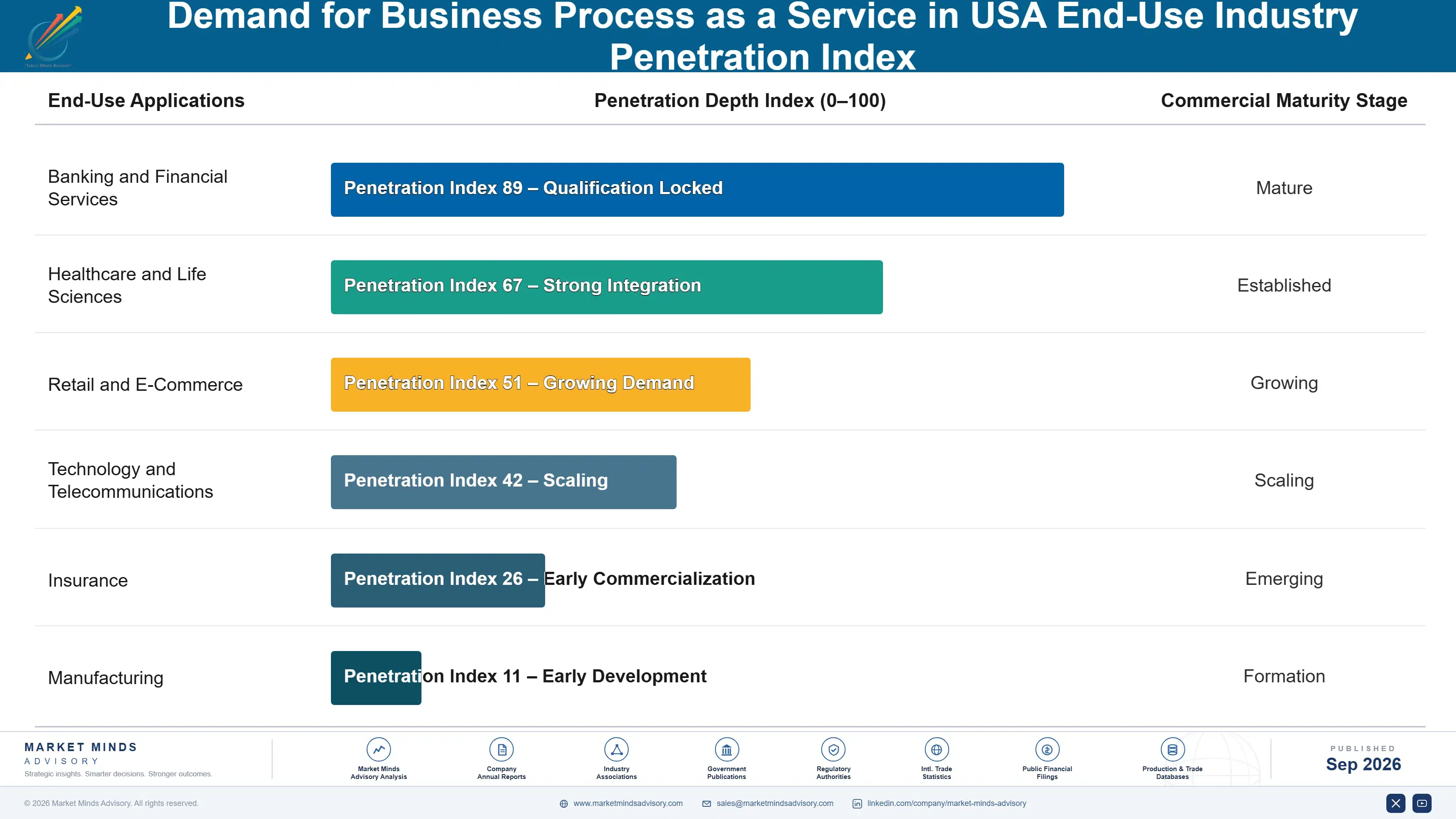
Business process as a service runs almost entirely on annuity economics, since multi-year enterprise contracts with embedded automation infrastructure cannot be swapped out quickly without significant transition cost and operational disruption. Subscription-style delivery revenue dominates provider income statements, with expanded process scope inside existing accounts contributing more incremental revenue than net-new client acquisition across most established provider portfolios today.
Adoption stickiness varies meaningfully by end-use vertical. Regulated finance and healthcare accounts exhibit the deepest lock-in, since switching providers requires rebuilding auditable AI decision trail infrastructure that took years to certify with internal compliance teams. Retail and technology sector clients switch more readily, lacking equivalent compliance burden, which explains why leading providers increasingly prioritize regulated account depth over volume expansion into less sticky verticals.

Buyer profiles are shifting generationally as procurement leaders who came up managing labor arbitrage vendor relationships give way gradually to a cohort fluent in evaluating AI capability and outcome-based contract structures rather than headcount pricing alone. This generational transition is accelerating vendor selection cycles and rewarding providers built for measurable automation results over legacy providers coasting on longstanding incumbency and relationship history alone.
united-states-business-process-as-a-service-market-end-use-penetration-index-1788451946317

Where Providers Should Focus Next

These are among the four positions where our research anticipates prominent divergence between winners and laggards over the coming forecast period. Each is grounded in the demand model, the regulatory perimeter, and the announced capacity pipeline.
01 / AI ORCHESTRATION INVESTMENT

Build proprietary orchestration before renewal cycles hit

Enterprise buyers increasingly evaluate providers on orchestration depth rather than headcount scale, and providers lacking proprietary technology will lose renewal bids to competitors offering demonstrably better automation results across every process category. Building genuine orchestration capability takes years of sustained engineering investment, so providers should commit budget now rather than waiting until the next major enterprise contract renewal cycle arrives unexpectedly. Partnering with AI technology vendors can accelerate this timeline considerably for providers starting from a smaller existing technology base and talent pool.
02 / OUTCOME-BASED PRICING TRANSITION

Shift pricing models before competitors force the change

Enterprise finance buyers are increasingly demanding outcome-based pricing tied to measurable results rather than traditional per-seat labor arbitrage contracts that dominated the category for decades of steady, largely unchallenged growth. Providers that delay this transition risk losing accounts to competitors already comfortable pricing against resolution rate or cost reduction delivered against an agreed baseline. The transition requires investment in performance measurement infrastructure, so providers should build this capability well before enterprise buyers make it a hard procurement requirement across every contract negotiation and renewal.
03 / REGULATORY COMPLIANCE READINESS

Build auditable AI infrastructure ahead of enforcement

Regulatory scrutiny over AI decision-making inside finance and healthcare processes is intensifying steadily, and providers without auditable decision trail infrastructure will struggle to win the largest, most risk-sensitive enterprise accounts going forward across every regulated vertical. Building this compliance capability requires specialized regulatory expertise that takes considerable time to develop credibly across an organization and its delivery teams. Providers should invest now rather than scrambling to build compliance infrastructure reactively once stricter enforcement actions begin affecting competitors across the industry broadly.
04 / CROSS-FUNCTIONAL ACCOUNT EXPANSION

Bundle adjacent process categories into existing accounts

Providers that successfully bundle finance, HR, and customer operations delivery under a single enterprise contract capture meaningfully more account revenue than those serving narrow, single-function engagements negotiated separately across different budget owners. This expansion motion works best once a provider has already demonstrated strong AI-augmented delivery quality in one function, since enterprise buyers extend that trust to adjacent categories readily and without extensive vetting. Providers should prioritize this cross-sell motion over chasing entirely new client logos wherever existing account trust already exists.

Engagement Snapshot From the Field

A live engagement with an industry participant carrying material or product regulatory and market exposure ahead of a defining policy shift, showing how our research translates into a defensible multi-year portfolio strategy.
MARKET MINDS ADVISORY · CLIENT ENGAGEMENT SUMMARY
Demand for Business Process as a Service in USA Producer Strategic Portfolio Review and Transition Roadmap 2026·Investment Scenario on Demand for Business Process as a Service in USA Exposure Evaluation 2025-26
CLIENT PROFILE
The client is a mid-size US regional bank operating consumer and commercial banking divisions across several states, previously relying on a traditional per-seat outsourcing contract for its finance and accounting back-office processing. Annual revenue sits in the low billions of dollars range (client-reported, unverified by MMA), with finance operations spending concentrated heavily on manual reconciliation and exception handling across multiple legacy core banking systems currently in use.
STRATEGIC CHALLENGE
The bank faced rising operating costs from its incumbent outsourcing provider while competitors adopted AI-augmented delivery models offering measurably lower cost per transaction. Leadership needed a modernization path that would not disrupt regulatory reporting timelines, while still delivering cost reduction sufficient to justify the disruption of switching providers after a decade-long incumbent relationship already in place.
MMA APPROACH
MMA conducted a structured assessment of the bank's existing finance operations workflow, mapping which reconciliation and exception handling tasks carried the highest automation potential given current AI agent capability. The engagement team then built a vendor evaluation framework weighting outcome-based pricing commitment and auditable compliance infrastructure above raw cost reduction claims alone, given the bank's regulatory reporting obligations.
KEY FINDINGS
  1. Roughly 45 percent of the bank's manual reconciliation volume qualified as suitable for AI agent automation without requiring human review (client-reported, unverified by MMA), exceeding initial internal estimates considerably.
  2. The incumbent provider's per-seat pricing model cost approximately 30 percent more than comparable outcome-based alternatives evaluated during the vendor selection process (client-reported, unverified by MMA) for equivalent process volume.
  3. Staff turnover at the incumbent provider's delivery center had risen sharply over the prior two years (client-reported, unverified by MMA), contributing directly to declining service quality metrics tracked internally.
  4. Competing vendor proposals varied by more than 25 percent in projected implementation timeline (client-reported, unverified by MMA), reinforcing the value of evaluating compliance readiness rather than price alone.
CLIENT PROFILE
The client is a mid-size US regional bank operating consumer and commercial banking divisions across several states, previously relying on a traditional per-seat outsourcing contract for its finance and accounting back-office processing. Annual revenue sits in the low billions of dollars range (client-reported, unverified by MMA), with finance operations spending concentrated heavily on manual reconciliation and exception handling across multiple legacy core banking systems currently in use.
STRATEGIC CHALLENGE
The bank faced rising operating costs from its incumbent outsourcing provider while competitors adopted AI-augmented delivery models offering measurably lower cost per transaction. Leadership needed a modernization path that would not disrupt regulatory reporting timelines, while still delivering cost reduction sufficient to justify the disruption of switching providers after a decade-long incumbent relationship already in place.
MMA APPROACH
MMA conducted a structured assessment of the bank's existing finance operations workflow, mapping which reconciliation and exception handling tasks carried the highest automation potential given current AI agent capability. The engagement team then built a vendor evaluation framework weighting outcome-based pricing commitment and auditable compliance infrastructure above raw cost reduction claims alone, given the bank's regulatory reporting obligations.
KEY FINDINGS
  1. Roughly 45 percent of the bank's manual reconciliation volume qualified as suitable for AI agent automation without requiring human review (client-reported, unverified by MMA), exceeding initial internal estimates considerably.
  2. The incumbent provider's per-seat pricing model cost approximately 30 percent more than comparable outcome-based alternatives evaluated during the vendor selection process (client-reported, unverified by MMA) for equivalent process volume.
  3. Staff turnover at the incumbent provider's delivery center had risen sharply over the prior two years (client-reported, unverified by MMA), contributing directly to declining service quality metrics tracked internally.
  4. Competing vendor proposals varied by more than 25 percent in projected implementation timeline (client-reported, unverified by MMA), reinforcing the value of evaluating compliance readiness rather than price alone.
RECOMMENDED STRATEGY
Phase 1: Phase one migrates the highest-volume reconciliation workflows first, prioritizing outcome-based pricing structures to demonstrate measurable cost reduction within two full fiscal quarters. Phase 2: Phase two extends AI agent automation to exception handling processes, sequenced carefully by regulatory sensitivity and internal staff readiness levels across each division. Phase 3: Phase three layers auditable compliance infrastructure across all migrated workflows to satisfy regulatory reporting requirements ahead of the next examination cycle.
OUTCOME
The bank completed phase one migration within the targeted two-quarter window, achieving a 24 percent reduction in reconciliation processing cost (client-reported, unverified by MMA). Leadership subsequently accelerated phases two and three, citing measurable improvements in exception handling turnaround time as the primary justification for the faster rollout timeline across remaining workflow categories.

Frequently Asked Questions

Foundational context covering the market sizes, CAGR, scope, country, region and competition that inform every finding below. This section is provided to cover basics and most often pre-purchase conversations, answered from the MMA Primary Research Dataset.

What is the current size of the Demand for Business Process as a Service in USA?

The market is valued at $9.8 billion in 2025, reflecting growing enterprise adoption of AI-augmented outsourced process delivery. This figure captures finance, HR, and customer operations contracts embedding automation nationwide.

How large will the Demand for Business Process as a Service in USA be by 2036?

The market is projected to reach $34.1 billion by 2036. That represents a 3.11-fold expansion from its 2026 base value over the ten-year forecast window.

What is the CAGR for the Demand for Business Process as a Service in USA 2026 to 2036?

The market grows at a compound annual rate of 12.0 percent across the forecast period. Bull and bear scenarios range from 10.7 to 13.3 percent depending on AI adoption pace.

Which segment is growing fastest?

AI Agent-Orchestrated Process Automation Services leads at 19.5 percent CAGR, roughly 1.62 times the overall market rate. Enterprise demand for measurable automation outcomes drives this acceleration considerably.

Who are the major companies in the Demand for Business Process as a Service in USA?

Accenture, Genpact, WNS Global Services, Concentrix, and TaskUs lead the market. Each competes primarily on AI orchestration depth and outcome-based pricing capability rather than headcount scale.

Which country is growing fastest?

India leads at 18.0 percent CAGR, driven by its massive existing delivery infrastructure and rapidly improving AI talent pool. This outpaces the region's own broader growth rate considerably.

Report Segmentation Architecture

The full report scope spans multiple orthogonal segmentation dimensions, with cross-tabulated demand data provided for each dimension pair. Coverage extends further to regional breakdowns, trend trajectories, and the competitive detail needed to support segment-level decision-making.

By Primary Market Dimension

  • Finance and Accounting Process Delivery
  • Customer Operations Process Delivery
  • Human Resources Process Delivery
  • AI Agent-Orchestrated Process Automation Services
  • Procurement Process Delivery
  • Supply Chain Support Services

By End-Use Industry

  • Banking and Financial Services
  • Healthcare and Life Sciences
  • Retail and E-Commerce
  • Technology and Telecommunications
  • Insurance
  • Manufacturing

By Commercial Dimension

  • Outcome-Based Pricing Contracts
  • Per-Seat Labor Arbitrage Contracts
  • Managed Compliance Service Agreements
  • Direct Enterprise Sales
  • Technology Partnership Channel Sales

By Region

  • North America
  • Western Europe
  • East Asia
  • South Asia and Pacific
  • Latin America
  • Middle East and Africa
  • Eastern Europe

Scope, Methodology, and Coverage

Every figure in this report is reproducible from documented input assumptions. The scope below maps the historical period, the forecast horizon, the segmentation dimensions, and the countries covered, alongside the underlying primary and qualitative methodology.
Historical Period
2020 to 2025
Forecast Period
2026 to 2036
Base Year
2025 (USD billions; MMA Primary Research Dataset, September 2026)
Market Definition
This report defines the business process as a service market as third-party delivery of finance, HR, procurement, and customer operations processes bundled with AI agent-based automation platforms under enterprise commercial contracts. It excludes internal enterprise shared-services centers and standalone robotic process automation software sold without accompanying process delivery services.
Quantitative Units
USD billions, percentage CAGR, percentage market share
Segmentation Dimensions
Process/function type, end-use industry, commercial/pricing model
Regions Covered
North America, Western Europe, East Asia, South Asia and Pacific, Latin America, Middle East and Africa, Eastern Europe
Countries Covered
United States (primary focus), India, Philippines, United Kingdom, China, Mexico
Key Companies Profiled
Accenture, Genpact, WNS Global Services, Concentrix, TaskUs, and 15 additional participants
Quantitative Methodology
Primary survey, n=3,800 respondents, Q4 2025, six countries; demand-side model with trade association cross-validation
Qualitative Methodology
47 expert interviews, Q4 2025; applied to validate demand model assumptions, identify emerging dynamics, and assess competitive positioning
Report Format
PDF and XLSX data workbook (Word format preview document)
Publisher
Market Minds Advisory
Report Code
MMA-2026-TEC-149
Published
September 2026
Contact
sales@marketmindsadvisory.com | www.marketmindsadvisory.com

Purchase the full Demand for Business Process as a Service in USA Report (2026 to 2036).

This report delivers a complete assessment of the US business process as a service market, covering sizing, segmentation, competitive dynamics, and regulatory forces through 2036. It examines how generative AI agents are reshaping outsourced finance, HR, and customer operations delivery across every major enterprise buyer segment nationwide. The analysis draws on primary survey data, expert interviews, and company disclosures to quantify segment growth, regional demand patterns, and margin economics across the provider landscape. It further evaluates outcome-based pricing adoption, compliance infrastructure investment, and input cost exposure shaping provider strategy going forward.
Full 2026 to 2036 market sizing and forecast
Segment-level growth and gross margin analysis
Regional demand mapping across seven world regions
Competitive landscape and provider market positioning
AI compute and skilled labor cost exposure
Anonymized client engagement strategy case study

Built For The People Who Decide

From boardroom strategy to bench-side execution, this report is read cover-to-cover by leaders shaping the next decade of their industry, turning demand scenarios, market dynamics and valuation benchmarks into decisions.
CXOs/ Presidents/ VPs/ Managers
M&A and Corporate Development
Strategy Teams and R&D Heads
Procurement and Product Directors
Regulatory and Compliance Leaders
Investor Relations and Equity Analysts