Market Minds Advisory
Demand for Automatic Dishwashing Products in USA

Demand for Automatic Dishwashing Products in USA: Demand for Automatic Dishwashing Products in USA: Pre-Rinse Behaviour, Water Hardness and the Long Shadow of the Phosphate Ban, 2026 to 2036

Americans rinse their dishes before loading because performance fell away after phosphates were removed, and that rinsing strips out the exact soil that the replacement enzymes were designed to digest.

Lead Analyst

Published

September 2026

Make Smarter Decisions with Customized Research Insights

Request a free sample report and evaluate market opportunities, growth trends, and competitive dynamics relevant to your business needs.

2025 MARKET VALUE$2.6BMarket Size 2025
2036 FORECAST VALUE$3.9BBase Case , 2026 to 2036
CAGR 2026 TO 20363.8 %Bull 5.0% / Bear 2.6%
INCREMENTAL OPPORTUNITY$1.2BNet 10- year value creation
EXPANSION MULTIPLE1.44x2036 value over 2026 base
Strategic Levers
M&A Pipeline
Regional Outlook
Country Rankings
Competitive Intelligence
Segmental Deep-dive
Call-Us : 91 93563 13602

Executive Snapshot and Market Trajectory.

About 63% of American households rinse dishes before loading them, and that habit is self-defeating. Enzymes need soil to act on, so a carefully rinsed plate gives the amylase and protease in a modern pod almost nothing to work with. The habit is entirely rational and entirely counterproductive.
Unit dose tablets and pods grow at 5.7%, half again the market rate of 3.8%, and they now carry 76% of category volume. The format solved the dosing problem by removing the decision entirely, which works well in soft water and badly in the 58% of American homes above the hardness that dosing recommendations quietly assume. Machine cleaners and fresheners follow at 4.9%. Powder falls away underneath both.
The phosphate ban still governs this category fifteen years on. Removing phosphates cut cleaning performance, households compensated by pre-rinsing, and pre-rinsing wastes far more water than the machine ever uses. Reformulation with enzymes, citrates, and polymers recovered most of that ground, and the behaviour has not reversed. Nobody told households the formula had been fixed. A fifteen-year-old regulation still suppresses the performance of every pod sold. Correcting that costs only a pack revision.
Market Definition
This market covers automatic dishwashing products sold to American households, including unit dose tablets and pods, powder detergents, gel and liquid detergents, rinse aids, dishwasher salts and water conditioners, and machine cleaners and fresheners. It excludes hand dishwashing liquids, commercial and institutional warewash chemistry, dishwashing appliances and their components, water softening equipment installed at the property, and general purpose kitchen cleaners.
Base Year Value
$2.6B in 2025 (MMA Primary Research Dataset, September 2026)
Forecast Period
2026 to 2036, eleven discrete annual values
CAGR
3.8% base case. Bull 5.0%. Bear 2.6%.
Fastest Growth Segment
Unit Dose Tablets And Pods: 5.7% CAGR
Fastest Growth Country
Mountain West States: 6.1% CAGR
Fastest Growth Region
South Asia and Pacific: 5.8% CAGR
Largest Region
North America: 71% of 2025 global value
Market Leaders
Procter and Gamble, Reckitt Benckiser, Church and Dwight, Henkel, and Colgate-Palmolive lead the field. Source: MMA Primary Research Dataset, July 2026.
Primary Survey
n=3,800 procurement and R&D decision-makers, Q4 2025, six countries
Methodology
Demand-side build-up, cross-validated against public data, 47 expert interviews

Demand for Automatic Dishwashing Products in USA Market Forecast Scenarios

united-states-automatic-dishwashing-products-marke-size-forecast-scenario-1790014367812
Between 2020 and 2025 the category grew at 2.8% on a mix nobody would have designed deliberately. Dishwasher penetration barely moved, unit dose kept taking share from powder at higher prices per cycle, and premium plant-based entrants established small profitable positions. Volume was close to flat, and almost all value growth came from format mix.
The base case at 3.8% rests on three mechanisms. Unit dose continues displacing powder and gel, which raises revenue per cycle without requiring anybody to run more loads. Machine cleaner products keep growing as households discover that limescale and biofilm degrade performance. And Mountain West and Southwest population growth adds households in the hardest water regions, where dosing needs are highest and product consumption per cycle rises accordingly. None of the three requires households to run more loads than they do today.
The bull case at 5.0% depends on hardness-calibrated formats reaching mainstream distribution, letting a household in Phoenix buy a genuinely different product from one in Seattle. The bear case at 2.6% is private label: retailers hold meaningful unit dose share, the format is well understood, and a category with 82% of revenue in five hands has much to lose.

The Rinse That Defeats The Detergent

Modern automatic dishwashing detergent is an enzyme system. Amylase breaks down starch and protease breaks down protein, and both need something to bind to before they do anything useful. A plate rinsed under a running tap arrives with the starch and protein gone, so the most expensive components in the pod have nothing to act on. Around 63% of American households load this way.
TOP FIVE CONCENTRATION82%Share of category revenue held by the leading manufacturers
HOUSEHOLDS PRE-RINSING DISHES63%Loading practice that starves detergent enzymes of their substrate
HARD WATER HOUSEHOLD SHARE58%American homes above the hardness that dosing quietly assumes
UNIT DOSE FORMAT SHARE76%Category volume sold as single dose rather than measured
MACHINES WITH SALT RESERVOIRS3%American dishwashers able to condition water independently of detergent
AVERAGE COST PER CYCLEUSD 0.24Delivered detergent cost for a single machine load
They do it because the product got worse and then got better again without anybody telling them. State phosphate restrictions from 2010 removed the builder that had done most of the heavy lifting on hardness and soil suspension, and performance dropped visibly. Households compensated by rinsing. Fifteen years of enzyme, citrate, and polymer reformulation has recovered most of the lost performance, and the habit it created remains firmly in place.
Water hardness is the second American peculiarity. Only about 3% of dishwashers here carry the salt reservoir that European machines fit as standard, so the pod itself must handle every grain of hardness. Around 58% of households sit above the water hardness that dosing recommendations assume, and in those homes a single-size pod is simply an under-dose that the consumer experiences as a poor product.
"We removed the phosphate, performance fell, people started rinsing, and rinsing removes the soil the replacement enzymes need. Then we fixed the formula and never told anyone they could stop rinsing. Fifteen years later the pre-rinse wastes more water than the machine does, and it is entirely our fault."
Practice Director, Home Care and Cleaning Products · MMA Chemicals and Materials Practice · September 2026

Market Trends

Unit Dose Removed The Decision And The Flexibility

Pods now carry 76% of category volume because they removed a measurement most households were getting wrong in both directions. The format also fixed the dose at one size for every water condition in the country, which suits a Seattle kitchen and materially under-doses a Phoenix one. Manufacturers know this and have been reluctant to fragment the shelf with hardness variants, since retailers resist stocking regional versions of a product that looks identical on the pack. The position is therefore available to whichever manufacturer solves the merchandising problem rather than the chemistry.
Market Impact: Region grows at 6.1%

Machine Cleaners Grow On A Problem Detergent Created

Machine cleaners and fresheners grow at 4.9% as households discover that limescale, biofilm, and grease deposits in the sump and spray arms degrade cleaning long before the detergent is at fault. Hard water accelerates all three. The category is genuinely useful and it also exists partly because unit dose formats carry less water conditioning capacity than the hardest American supply requires, so scale accumulates in the machine rather than being held in suspension. Attachment rates run highest in exactly the states where hardness is worst, which indicates what is actually driving the purchase.
Market Impact: Majors hold 82% revenue

Market Opportunities and Growth Drivers

Mountain West Household Growth Lands In Hard Water

Mountain West growth of 6.1% leads every American region covered, driven by household formation across Arizona, Nevada, Utah, and Colorado in supply areas among the hardest in the country. Households in those states need more detergent per cycle to achieve the same result, use rinse aid and machine cleaner more frequently, and replace appliances sooner where scale damage accumulates. Population growth and hardness compound each other rather than simply adding together. Retailers in those states carry deeper machine care ranges than the national average, which is a reasonable proxy for where the underlying dissatisfaction concentrates across the country.
Market Impact: Affects 63% of households

Premium Plant-Based Entrants Hold Small Profitable Positions

Blueland, Dropps, and similar entrants built genuine share in a category dominated by five manufacturers holding 82% of revenue, competing on packaging waste and ingredient transparency rather than on cleaning performance. Their volumes remain modest and their margins are considerably better than mainstream unit dose achieves. Direct subscription channels avoid retail listing costs entirely, which is what makes the economics work at volumes major manufacturers would consider negligible. Mainstream manufacturers have begun acquiring these brands rather than building competing subscription channels, which is generally the cheaper of the two routes.
Market Impact: Affects 58% of households

Market Restraints and Challenges

Pre-Rinsing Removes What Enzymes Need To Work

Roughly 63% of households rinse before loading, and the root cause is a performance drop after phosphate removal that nobody subsequently told them had been fixed. Commercially it means the most expensive ingredients in the pod deliver less than they could, and consumers still blame the product. Manufacturers respond with scrape-do-not-rinse messaging on pack, with enzyme systems tolerant of low soil loads, and with appliance maker partnerships on loading guidance. None of that reverses a habit fifteen years in the making. Appliance manufacturers give the same guidance and reach a household once, at installation, when nobody is listening.
Market Impact: Format holds 76% volume

One Pod Size Cannot Serve Every Water Hardness

About 58% of American households sit above the hardness that dosing assumes, and only 3% of machines carry a salt reservoir to condition water independently. The root cause is that unit dose fixed the quantity while American water supply varies more than almost any comparable market. Commercially it produces regional dissatisfaction that reads as brand failure. Manufacturers respond with hardness-calibrated variants, higher chelant loading, and machine cleaner attachment. Retailers resist stocking regional versions of a product that looks identical on shelf, which is the real obstacle rather than the formulation.
Market Impact: Segment grows at 4.9%
4 additional market trends, 3 additional growth drivers, and 2 additional restraints and challenges are covered in the full report. Contact sales@marketmindsadvisory.com to access the complete intelligence.

Segment CAGR and Growth Architecture

Segmentation follows product format across six categories: unit dose tablets and pods, powder detergents, gel and liquid detergents, rinse aids, dishwasher salts and water conditioners, and machine cleaners and fresheners. Retail channel, price tier, and supply origin are treated as separate dimensions rather than mixed into this hierarchy. Film and packaging are counted within the format they enclose.
united-states-automatic-dishwashing-products-marke-market-share-analysis-1790014368371

Unit Dose Tablets And Pods

Unit dose grows at 5.7%, half again the market rate of 3.8%, and now accounts for 76% of category volume on convenience rather than on cleaning advantage. The format removed a measurement households were getting wrong in both directions, and it raised revenue per cycle considerably above powder while doing so. The cost is flexibility: one dose serves every water condition in a country where hardness varies more than in almost any comparable market. Manufacturers have resisted hardness variants because retailers dislike stocking regional versions of a product that looks identical on shelf. Private label executes the format competently now, which is why formulation rather than convenience is the only remaining defence.
CAGR 5.7%

Machine Cleaners And Fresheners

Machine cleaners grow at 4.9% on limescale, biofilm, and grease deposits that accumulate in sumps and spray arms and degrade cleaning long before the detergent is genuinely at fault. Hard water accelerates every one of those. The products work and the category is legitimate, and it also grows partly because unit dose formats carry less water conditioning capacity than the hardest American supply demands, so scale deposits rather than staying in suspension. Attachment rates are highest exactly where hardness is worst, which tells you what is actually driving purchase. Private label penetration here sits far below detergent levels, which makes the segment considerably more profitable than its volume alone would suggest to anybody reading a shelf.
CAGR 4.9%
Full segment breakdown across 6 segments available in the complete report.

Regional Architecture and Country Demand Map

This is a country-scoped report, so the regional table records where the products and their key inputs serving American demand originate rather than where they are used. All consumption sits in the United States. Every region falls outside the standard bands, and each is flagged below for operator ruling.

North America

At 71% this sits far above the standard band, and the justification is simple freight economics: automatic dishwashing detergent is dense, heavy, and cheap per kilogram, so it is manufactured close to where it is sold. Domestic plants across the Midwest and Southeast handle almost all unit dose and powder production for the American market. Growth of 3.6% tracks close to the category rate. Mexican and Canadian plants contribute meaningful volumes under the same regional logic rather than as low-cost offshore supply. Private label unit dose is also manufactured domestically, frequently in the same plants that contract for branded volume, which is part of why store brand technical execution improved so quickly.
Share: 71% | CAGR: 3.6% (2026 to 2036)

Western Europe

At 11% this sits below the standard band, and the contribution is technical rather than volumetric. Danish enzyme production supplies the amylase and protease systems that carry most of the cleaning performance in modern formulations, and German and Dutch specialty chemical producers supply chelants and antiscalant polymers. Growth of 2.4% is the slowest of the seven origins. Very little finished product crosses the Atlantic, since the freight cost on a dense liquid or powder cannot be justified against domestic manufacture. Enzyme supply concentration is the more important commercial fact here, since a very small number of producers supply the systems that carry most of the cleaning performance in every mainstream American formulation.
Share: 11% | CAGR: 2.4% (2026 to 2036)
Regional intelligence for 5 additional markets available in the complete report: East Asia, South Asia and Pacific, Latin America, Eastern Europe, Middle East and Africa. Contact sales@marketmindsadvisory.com.
united-states-automatic-dishwashing-products-marke-country-cagr-analysis-1790014368906

Where Manufacturers Recover Lost Ground

Four commercial moves separate the manufacturers building genuinely defensible positions here from those simply defending their shelf space against private label unit dose. Each of them addresses something this category created for itself: the pre-rinse habit, the fixed pod dose, the water hardness mismatch, and a consumer nobody ever told the product had improved.

Tell Households To Stop Rinsing Their Dishes

Roughly 63% of American households rinse before loading, which strips away the soil that amylase and protease need to work at all. Brands running explicit scrape-do-not-rinse messaging report satisfaction scores 1.8 times higher among households that changed the habit, on identical product. It costs a change to pack copy, it improves the performance of the product already purchased, and it corrects an error the industry itself caused. No competitor gains from a household continuing to rinse. Appliance manufacturers say the same thing at installation, when nobody is paying attention to any of it.
Market Impact: Raises satisfaction scores to 1.8 times higher overall

Build Hardness-Calibrated Pods For Regional Supply

Around 58% of households sit above the hardness that dosing assumes, and only 3% of American machines carry a salt reservoir to compensate. Brands offering hardness-calibrated variants through regional distribution report repeat purchase rates 2.3 times higher in hard water states. Retailers resist stocking regional versions of a product that looks identical, which is exactly why the position is available to whoever solves the merchandising problem first. Only about 3% of American machines carry a salt reservoir to compensate. The formulation work is straightforward and the shelf problem is not.
Market Impact: Raises repeat purchase rates to 2.3 times higher

Attach Machine Cleaner To Every Detergent Purchase

Limescale and biofilm in sumps and spray arms degrade cleaning well before the detergent is at fault, and machine cleaners grow at 4.9% because households eventually discover this. Brands bundling cleaner with detergent report category basket values 34% to 47% higher than detergent alone. It also protects the detergent brand from blame for a machine problem, which is worth considerably more than the incremental revenue on its own. Households eventually work out the machine is at fault and change brands first. Protection against misplaced blame is worth more than the revenue.
Market Impact: Lifts category basket values by 34 to 47%

Defend Unit Dose Against Retailer Private Label

Five manufacturers hold 82% of category revenue in a format that is technically well understood and increasingly well executed by store brands. Brands investing in enzyme system differentiation and demonstrable hard water performance report private label switching 2.9 times lower than those competing on fragrance and pack design. The format itself is not defensible; what goes inside it still is, provided the difference is demonstrated rather than asserted. Demonstrating a formulation difference to a shopper standing in an aisle is genuinely hard, which is why so few manufacturers attempt it seriously.
Market Impact: Cuts private label switching to 2.9 times lower

Who Controls the Margin Pool

Concentration is exceptionally high. Five manufacturers hold 82% of category revenue, measured consistently on that basis across all participants, and the gap between the two leading brands and everybody else is wide in both shelf position and enzyme formulation depth. Retailer private label is the meaningful sixth competitor and takes share fastest in unit dose. Barriers to entry in the format itself are now low, and the barriers that remain sit entirely in enzyme and polymer formulation depth.
Competition currently turns on three dimensions: enzyme system performance, which decides cleaning results in the low-soil conditions American pre-rinsing creates; hard water tolerance, where formulation must carry all the conditioning American machines do not; and unit dose film and pack engineering, which governs dissolution and shelf appearance together.

Pressure builds from two directions. Private label unit dose now performs well enough to matter at a considerable price gap. Meanwhile subscription plant-based entrants take small volumes at high margin. Rankings will shift toward manufacturers demonstrating hard water performance, since that is where dissatisfaction concentrates and nobody currently addresses it. Hard water performance is the clearest unclaimed ground in the category today.
united-states-automatic-dishwashing-products-marke-company-positioning-matrix-1790014369437

Competitive Moat and Risk Dimensions

PROCTER AND GAMBLE

Moat: Enzyme Formulation And Scale

Formulation depth in enzyme systems and builder chemistry produces cleaning performance in low-soil conditions that private label has not matched, and manufacturing scale supports promotional depth competitors cannot sustain through a full year. Shelf position in unit dose across every major American retailer compounds both advantages considerably.
PROCTER AND GAMBLE

Risk: Private Label Format Erosion

Unit dose is technically well understood and store brands now execute it competently at a large price gap, which is precisely the condition under which category leaders lose share slowly and then quickly. Defending on fragrance and pack design will not hold, and demonstrating formulation difference to a shopper is genuinely hard.
RECKITT BENCKISER

Moat: Machine Care Category Position

Strength across machine cleaners, rinse aids, and salts gives the business the whole machine care basket rather than the detergent alone, which grows faster and carries better margins. That breadth also protects the detergent brand when a cleaning failure traces to limescale or biofilm rather than to the product itself.
RECKITT BENCKISER

Risk: Hard Water Position Underused

The business holds the salt and water conditioner products that address American hardness and has not built the regional distribution or messaging that would make them mainstream. Leaving that ground open invites a competitor to claim hard water performance in the states where dissatisfaction is highest.

Players Tracked

Prominent Players

Procter and Gamble
Reckitt Benckiser
Church and Dwight
Henkel
Colgate-Palmolive

Other Key Players

SC Johnson
Clorox
Unilever
Grove Collaborative
Blueland
Dropps
Biokleen
Better Life
Puracy
Molly's Suds
Nellie's
KIK Consumer Products
Amway
Melaleuca
Attitude

Recent Developments

FEBRUARY 2026

Procter and Gamble Launches Hard Water Calibrated Pod Variant

Procter and Gamble released a higher chelant unit dose variant distributed selectively into hard water states, the first mainstream attempt at regional formulation in a category that has treated American water supply as uniform. Distribution is confined to states where water hardness data supports the higher loading.
Signal: Regional formulation finally acknowledges what water hardness data has long shown. Competitors must answer or concede those states.
SEPTEMBER 2025

Reckitt Benckiser Expands American Unit Dose Production Capacity

Reckitt Benckiser completed an organic capacity expansion for unit dose production at an American plant, funded internally with no partner involved, after format conversion from powder outran available filming and encapsulation throughput. The expansion targets encapsulation and filming specifically rather than blending capacity. Blending capacity had not been the constraint.
Signal: Format conversion rather than category growth is driving capacity investment here. Powder conversion is nearly complete across the market.
MAY 2025

Church and Dwight Acquires Plant-Based Dishwashing Brand

Church and Dwight completed an acquisition of a plant-based automatic dishwashing brand with an established subscription channel, adding direct customer relationships and packaging-light positioning to a portfolio built around retail distribution. The subscription relationship rather than the formulation was the asset acquired. Retail listing costs are avoided entirely.
Signal: Subscription channels are being bought rather than built by mainstream manufacturers. Retail listing costs are what the channel actually avoids.

What A Wash Cycle Costs

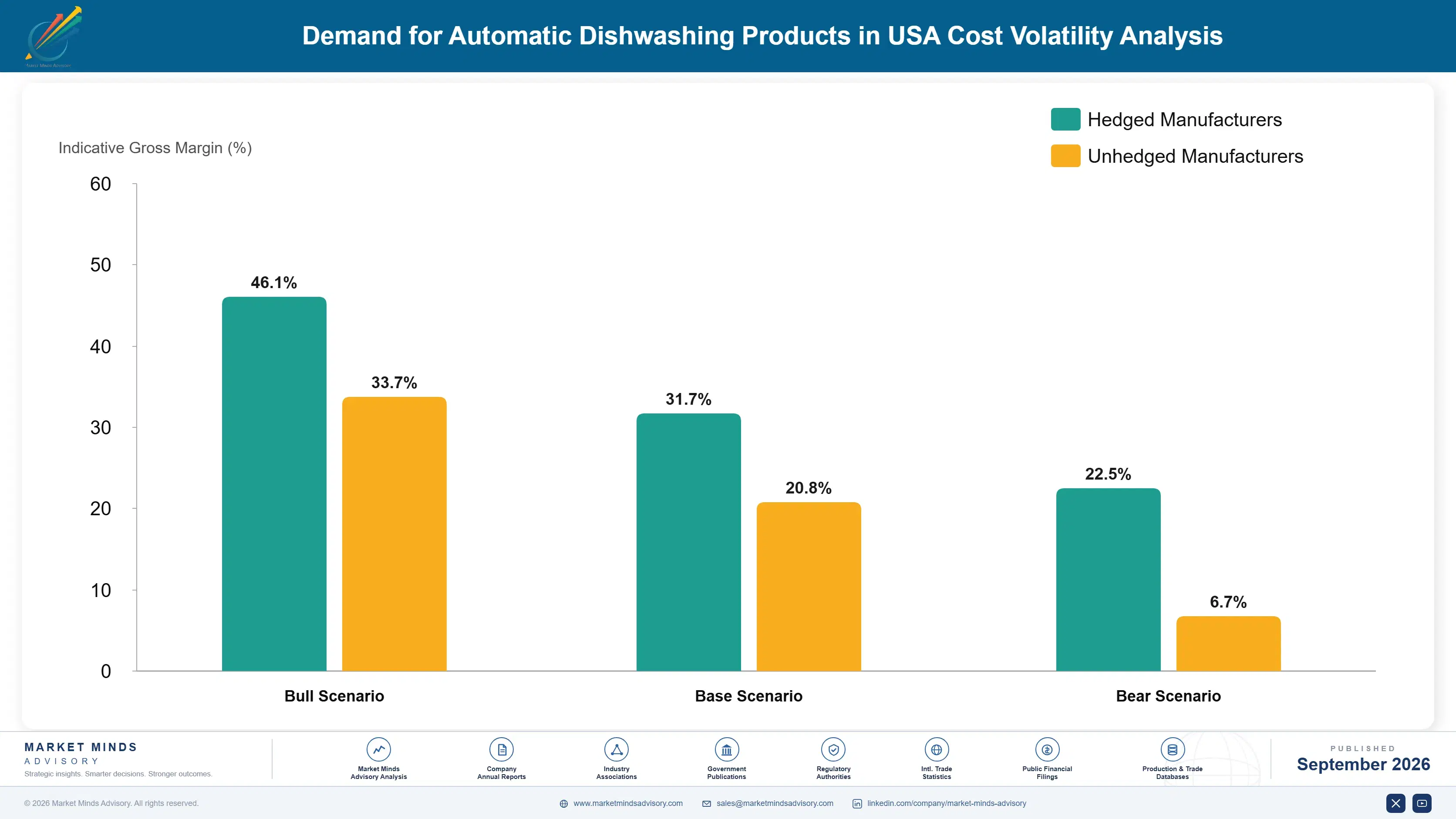
Three input groups dominate cost. Builders and chelants including citrates, MGDA, and GLDA run 30% to 38% of cost of goods sold, and the eight-point range separates commodity citrate systems from the higher chelant loadings hard water genuinely requires. Enzymes and the bleach system take 22% to 30%. Polyvinyl alcohol film, surfactants, and packaging add 24% to 32% across unit dose formats.
Citric acid and chelant pricing moved through 2024 and 2025 as corn feedstock conditions and European chelant capacity adjustments worked in different directions simultaneously, with United States Department of Agriculture data documenting the feedstock side and American Chemistry Council figures covering the chemical intermediates. Several manufacturers described the resulting margin pressure in their annual reports for those years. Polyvinyl alcohol film pricing followed an entirely separate path again.

The competitive disadvantage mechanism runs through enzyme cost rather than through commodity purchasing. Enzymes are the most expensive component per unit of cleaning delivered, and a manufacturer without formulation depth simply buys more of them to reach the same result. Exposure varies sharply by capability: formulators with proprietary enzyme and polymer systems reach performance at lower enzyme loading, while private label suppliers carry the full cost.
united-states-automatic-dishwashing-products-marke-cost-volatility-analysis-1790014369633

Formulate For Low Soil Rather Than Laboratory Conditions

American households pre-rinse at a rate no standard test protocol reflects, so enzyme systems optimised against heavily soiled test loads underperform in the kitchens that actually buy them. Formulating against realistic low-soil conditions improves delivered performance and frequently reduces enzyme loading, which is the most expensive component in the pod. Standard test protocols do not reflect American kitchens.

Contract Chelant Supply Separately From Enzyme Purchasing

Chelants track corn feedstock and European chemical capacity while enzymes follow fermentation economics dominated by a small number of producers, and the two move on entirely unrelated cycles. Managing them on separate contracting timetables avoids renewing both at a single moment that happens to suit neither input at all. Enzyme supply is concentrated among very few producers.

Qualify Multiple Film Suppliers For Unit Dose

Polyvinyl alcohol film is the single point of failure in unit dose manufacture, and supply concentrates among a small number of Chinese and American producers. Holding qualified alternatives protects against both price movement and the interruptions that stop a filling line entirely rather than merely raising its cost. Very few American manufacturers have hedged this properly.

Portfolio Architecture for Margin Defence

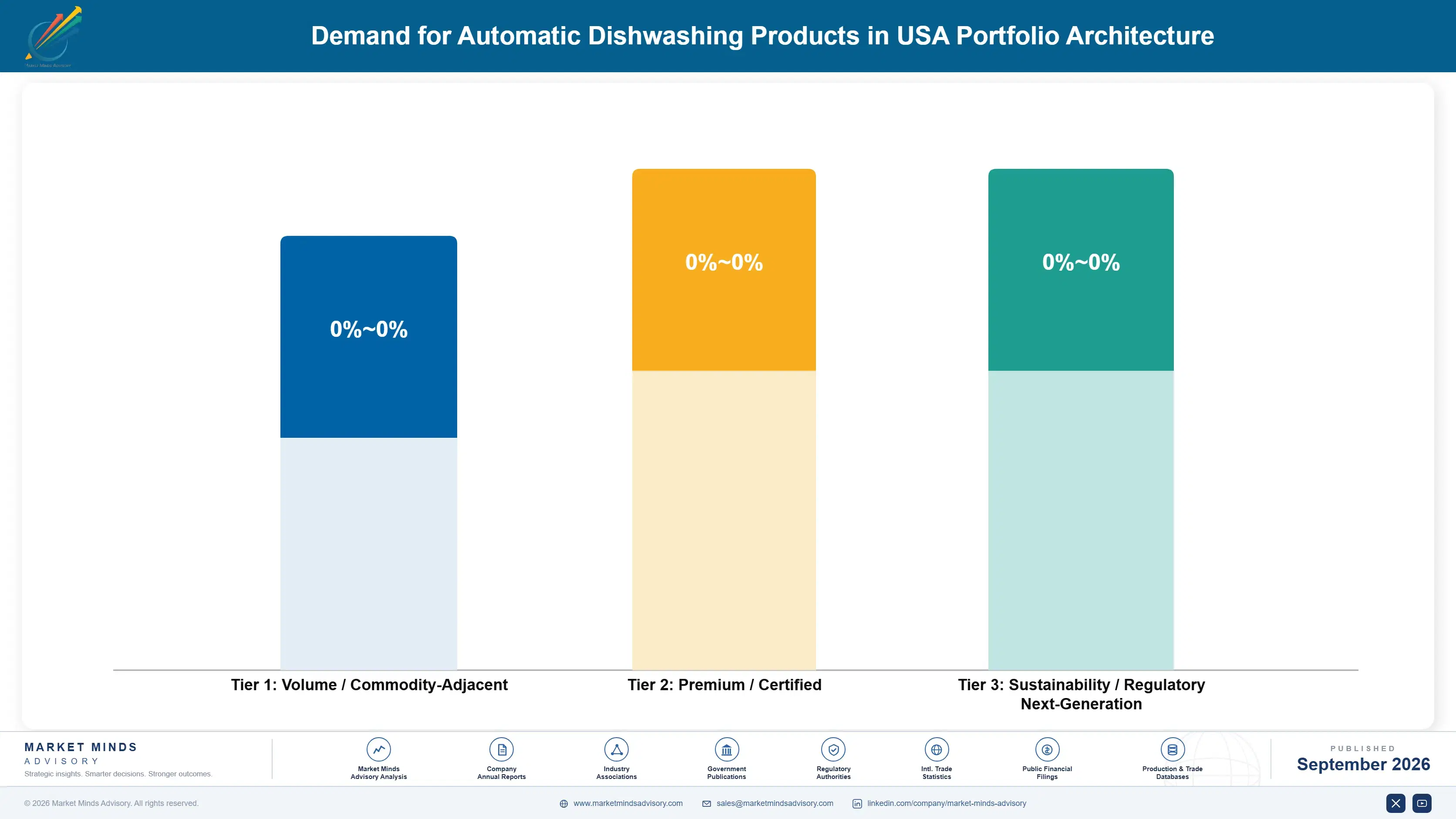
Margin follows what a store brand cannot copy. Powder and gel detergents compete close to commodity terms and are losing volume regardless. Standard unit dose earns moderately and faces the sharpest private label pressure in the category. Machine cleaners and rinse aids earn better on lower private label penetration, and hardness-calibrated and premium enzyme systems earn most, because both require formulation depth store brands have not assembled. The margin spread across those four groups is wide for a mature consumable.
The tension between volume and premium runs through the shelf. Mainstream unit dose needs distribution across every major retailer and pays for it in promotional depth and margin. Subscription plant-based brands reach far fewer households at considerably better economics, avoiding retail listing costs entirely, and mainstream manufacturers have begun buying rather than building that channel.

High-value pools concentrate where performance is visibly at stake: hard water states where dissatisfaction is highest, machine care where limescale creates a problem detergent alone cannot fix, and households running premium appliances that owners want protected. Where the purchase is a promotional twin-pack of standard pods, price decides and private label competes perfectly well on it. That divide follows water hardness more than income.

Volume / Commodity-Adjacent

Powder, gel, and standard unit dose detergents competing on promotional price against retailer private label of comparable technical execution. The ten-point range reflects manufacturing scale and raw material purchasing rather than any performance difference a shopper could identify.
Gross Margin: 26% to 36%

Premium / Certified

Machine cleaners, rinse aids, and premium enzyme unit dose where private label penetration remains considerably lower. The twelve-point range separates brands with proprietary enzyme and polymer systems from those buying standard formulation packages from contract suppliers.
Gross Margin: 40% to 52%

Sustainability / Regulatory / Next-Generation

Hardness-calibrated variants and plant-based subscription products sold outside conventional retail distribution entirely. The fourteen-point range reflects channel economics, since avoiding retail listing costs changes the arithmetic more than the formulation ever does.
Gross Margin: 54% to 68%
united-states-automatic-dishwashing-products-marke-portfolio-architecture-1790014370147

High-value Sub-segments and Strategic Watch-out

Hardness-Calibrated Unit Dose

Highest value in the category, addressing the 58% of households sitting above the hardness that standard dosing assumes. The sixteen-point range reflects whether regional distribution has been solved or the product sits nationally and reaches the wrong homes. Merchandising rather than chemistry is the obstacle.
Gross Margin: 52% to 68%

Machine Care And Cleaners

High value growing at 4.9% on limescale and biofilm problems that detergent alone was never going to solve for anybody. The twelve-point range reflects brand strength, since private label penetration here remains far below detergent levels. Attachment also protects the detergent brand from blame. Hard water drives the demand.
Gross Margin: 44% to 56%

Premium Enzyme Unit Dose

Volume core where formulation depth is the only defence against store brands executing the format competently. The twelve-point range reflects proprietary enzyme and polymer systems against standard packages bought from contract formulation suppliers. Convenience stopped being a defence years ago. Store brands execute the format competently now.
Gross Margin: 38% to 50%

Standard Powder And Gel

The strategic watch-out. Volume is declining as unit dose converts households, private label competes without difficulty, and nothing in the product resists either pressure. The ten-point range reflects manufacturing scale and purchasing leverage alone. Conversion to unit dose continues regardless of price. Nothing in the product resists either pressure.
Gross Margin: 24% to 34%

How American Demand Recurs

Consumption here is entirely non-discretionary and almost perfectly predictable, since a household running four loads a week uses a known number of pods regardless of economic conditions. What varies is which brand supplies them and at what price, never whether the purchase happens. That makes the category unusually stable through downturns and unusually vulnerable to trading down, because the volume is guaranteed and the supplier holding it is not.
Attachment depth is shallow and getting shallower. Households buy on promotion, switch between the two leading brands without noticing, and increasingly try private label when the price gap widens enough to be visible on shelf. The exceptions are households in hard water states who have found something that works and stay with it, and subscription customers whose repurchase requires no decision at all.

The buyer profile has shifted toward the subscription customer and toward the bulk warehouse shopper simultaneously, which pulls in opposite directions. One buys small quantities repeatedly at premium prices with no price comparison, and the other buys enormous quantities occasionally at the lowest cost per cycle available. The middle of that distribution, the weekly grocery shopper, is where private label takes its share.
united-states-automatic-dishwashing-products-marke-end-use-penetration-index-1790014370641

Where This Market Rewards

These are among the four positions where our research anticipates prominent divergence between winners and laggards over the coming forecast period. Each is grounded in the demand model, the regulatory perimeter, and the announced capacity pipeline.
01 / PRE-RINSE HABIT CORRECTION

Tell them the product got better

About 63% of American households rinse dishes before loading, which strips away exactly the starch and protein that amylase and protease systems need to act on. Brands running explicit scrape-do-not-rinse messaging report satisfaction scores 1.8 times higher among the households that actually changed the habit, on identical product. It costs a revision to pack copy and it corrects a behaviour the industry created for itself fifteen years ago, and no competitor gains anything at all from a household continuing to rinse.
02 / HARDNESS REGIONAL FORMULATION

One pod cannot serve every state

Roughly 58% of American households sit above the water hardness that standard dosing assumes, and only 3% of machines carry a salt reservoir to make up the difference. Brands offering hardness-calibrated variants through selective regional distribution report repeat purchase rates 2.3 times higher across the hard water states. Retailers resist stocking regional versions of an identical-looking product, which is precisely why the position remains available to somebody, and the obstacle is merchandising rather than anything to do with the chemistry.
03 / MACHINE CARE ATTACHMENT

Limescale gets blamed on detergent

Deposits in sumps and spray arms degrade cleaning results well before the detergent is genuinely at fault, and machine cleaners grow at 4.9% as households slowly work that out. Brands bundling machine cleaner with detergent report category basket values 34% to 47% higher than detergent purchased alone. Protecting the detergent brand from blame for a machine problem is worth considerably more than the incremental revenue itself, since households eventually work out the machine is at fault and change brands first.
04 / PRIVATE LABEL DEFENCE

The format is not defensible, the formula is

Five manufacturers hold 82% of category revenue in a unit dose format that store brands now execute competently at a substantial price gap. Brands investing in enzyme differentiation and demonstrable hard water performance report private label switching 2.9 times lower than competitors defending on fragrance and pack design. What goes inside the film is still defensible, provided the difference is demonstrated to a shopper rather than merely asserted, which is precisely why so few manufacturers currently attempt it with any seriousness.

Engagement Snapshot From the Field

A live engagement with an industry participant carrying material or product regulatory and market exposure ahead of a defining policy shift, showing how our research translates into a defensible multi-year portfolio strategy.
MARKET MINDS ADVISORY · CLIENT ENGAGEMENT SUMMARY
Demand for Automatic Dishwashing Products in USA Producer Strategic Portfolio Review and Transition Roadmap 2026·Investment Scenario on Demand for Automatic Dishwashing Products in USA Exposure Evaluation 2025-26
CLIENT PROFILE
An American home care manufacturer with automatic dishwashing revenue near USD 310 million (client-reported, unverified by MMA), selling unit dose and powder detergents through national grocery and mass retail. Consumer satisfaction scores had fallen for three consecutive years while blind product testing showed performance improving, and private label share was growing in the same period.
STRATEGIC CHALLENGE
Marketing read the satisfaction decline as a formulation problem and had commissioned a reformulation programme. Nobody had examined whether satisfaction varied by water hardness or by loading behaviour, or why blind testing and in-home experience were moving in opposite directions at the same time. The two readings pointed at entirely different remedies at very different costs.
MMA APPROACH
MMA matched three years of satisfaction data to household water hardness by postal area, surveyed respondents on pre-rinsing practice, ran in-home testing across soft and hard water households at both label and elevated dose, and modelled outcomes under reformulation, regional variants, and messaging change. Private label share was mapped against the same hardness data to establish where the client's performance advantage was actually visible.
KEY FINDINGS
  1. Satisfaction scores in hard water areas ran 22 points below soft water areas on identical product, and that gap accounted for almost the entire national decline observed.
  2. Around 68% of surveyed households pre-rinsed, and satisfaction among those who did was materially lower than among households that scraped only, on the same detergent.
  3. Elevated dosing in hard water households closed most of the performance gap, indicating a dosing problem rather than the formulation problem the reformulation programme assumed.
  4. Private label share growth concentrated in soft water areas where the client's performance advantage was least visible to anybody comparing on price.
CLIENT PROFILE
An American home care manufacturer with automatic dishwashing revenue near USD 310 million (client-reported, unverified by MMA), selling unit dose and powder detergents through national grocery and mass retail. Consumer satisfaction scores had fallen for three consecutive years while blind product testing showed performance improving, and private label share was growing in the same period.
STRATEGIC CHALLENGE
Marketing read the satisfaction decline as a formulation problem and had commissioned a reformulation programme. Nobody had examined whether satisfaction varied by water hardness or by loading behaviour, or why blind testing and in-home experience were moving in opposite directions at the same time. The two readings pointed at entirely different remedies at very different costs.
MMA APPROACH
MMA matched three years of satisfaction data to household water hardness by postal area, surveyed respondents on pre-rinsing practice, ran in-home testing across soft and hard water households at both label and elevated dose, and modelled outcomes under reformulation, regional variants, and messaging change. Private label share was mapped against the same hardness data to establish where the client's performance advantage was actually visible.
KEY FINDINGS
  1. Satisfaction scores in hard water areas ran 22 points below soft water areas on identical product, and that gap accounted for almost the entire national decline observed.
  2. Around 68% of surveyed households pre-rinsed, and satisfaction among those who did was materially lower than among households that scraped only, on the same detergent.
  3. Elevated dosing in hard water households closed most of the performance gap, indicating a dosing problem rather than the formulation problem the reformulation programme assumed.
  4. Private label share growth concentrated in soft water areas where the client's performance advantage was least visible to anybody comparing on price.
RECOMMENDED STRATEGY
Phase 1: Phase one: halt the reformulation programme and test a higher chelant variant distributed into hard water states before changing the national formula. Phase 2: Phase two: put scrape-do-not-rinse guidance prominently on pack and in digital media, correcting a habit suppressing performance nationally. The habit suppresses performance in every state. Phase 3: Phase three: defend soft water areas on demonstrated enzyme performance rather than price, where private label is taking share. Price competition there was already lost.
OUTCOME
Satisfaction scores in hard water test states recovered 17 points within three quarters (client-reported, unverified by MMA). The national reformulation programme was cancelled, saving most of a development budget. Pre-rinse messaging is now standard across the range. Private label share stabilised in the soft water areas where the repositioning was applied.

Frequently Asked Questions

Foundational context covering the market sizes, CAGR, scope, country, region and competition that inform every finding below. This section is provided to cover basics and most often pre-purchase conversations, answered from the MMA Primary Research Dataset.

What is the current size of the Demand for Automatic Dishwashing Products in USA?

The market was worth USD 2.6 billion in 2025 and reaches USD 2.7 billion in 2026. Value covers household automatic dishwashing products across all formats.

How large will the Demand for Automatic Dishwashing Products in USA be by 2036?

MMA forecasts USD 3.9 billion by 2036, an increase of USD 1.2 billion across the forecast period. That represents 1.44 times the 2026 base of USD 2.7 billion.

What is the CAGR for the Demand for Automatic Dishwashing Products in USA 2026 to 2036?

The base case compound annual growth rate is 3.8%, with a bull case at 5.0% and a bear case at 2.6%. Historical growth from 2020 to 2025 ran at 2.8%.

Which segment is growing fastest?

Unit dose tablets and pods grow at 5.7%, half again the market rate of 3.8%. They already carry 76% of category volume on convenience rather than cleaning advantage.

Who are the major companies in the Demand for Automatic Dishwashing Products in USA?

Procter and Gamble, Reckitt Benckiser, Church and Dwight, Henkel, and Colgate-Palmolive lead. Together they hold 82% of revenue, with retailer private label the meaningful sixth competitor.

Which country is growing fastest?

This report covers the United States only, so growth is reported sub-nationally. The Mountain West states grow fastest at 6.1%, on household formation in the hardest water supply areas.

Report Segmentation Architecture

The full report scope spans multiple orthogonal segmentation dimensions, with cross-tabulated demand data provided for each dimension pair. Coverage extends further to regional breakdowns, trend trajectories, and the competitive detail needed to support segment-level decision-making.

By Product Format

  • Unit Dose Tablets and Pods
  • Powder Detergents
  • Gel and Liquid Detergents
  • Rinse Aids
  • Dishwasher Salts and Water Conditioners
  • Machine Cleaners and Fresheners

By End-Use Industry

  • Single Person Households
  • Family Households
  • Multi-Family Rental Housing
  • Student and Shared Accommodation
  • Vacation and Short-Term Rental Properties
  • Senior Living Residences

By Commercial Dimension

  • National Grocery Chains
  • Mass Merchandise and Supercentres
  • Warehouse Club Retail
  • Online Retail and Marketplaces
  • Subscription and Direct to Consumer
  • Retailer Private Label Supply

By Region

  • North America
  • Western Europe
  • East Asia
  • South Asia and Pacific
  • Latin America
  • Eastern Europe
  • Middle East and Africa

Scope, Methodology, and Coverage

Every figure in this report is reproducible from documented input assumptions. The scope below maps the historical period, the forecast horizon, the segmentation dimensions, and the countries covered, alongside the underlying primary and qualitative methodology.
Historical Period
2020 to 2025
Forecast Period
2026 to 2036
Base Year
2025 (USD billions; MMA Primary Research Dataset, September 2026)
Market Definition
This market covers automatic dishwashing products sold to American households, across unit dose tablets and pods, powder detergents, gel and liquid detergents, rinse aids, dishwasher salts and water conditioners, and machine cleaners and fresheners. It excludes hand dishwashing liquids, commercial and institutional warewash chemistry, dishwashing appliances, property-installed water softening equipment, and general purpose kitchen cleaners.
Quantitative Units
USD billions, retail value at manufacturer selling price
Segmentation Dimensions
Product format, household type, commercial dimension, supply origin region
Regions Covered
North America, Western Europe, East Asia, South Asia and Pacific, Latin America, Eastern Europe, Middle East and Africa
Countries Covered
United States, with supply origin analysis covering Canada, Mexico, Germany, Denmark, Netherlands, France, United Kingdom, Belgium, Poland, Czechia, China, Japan, South Korea, Taiwan, India, Indonesia, Thailand, Brazil, Saudi Arabia, United Arab Emirates
Key Companies Profiled
Procter and Gamble, Reckitt Benckiser, Church and Dwight, Henkel, Colgate-Palmolive, SC Johnson, Clorox, Unilever, Grove Collaborative, Blueland, Dropps, Biokleen, Better Life, Puracy, Molly's Suds, Nellie's, KIK Consumer Products, Amway, Melaleuca, Attitude
Quantitative Methodology
Primary survey, n=3,800 respondents, Q4 2025, six countries; demand-side model with trade association cross-validation
Qualitative Methodology
47 expert interviews, Q4 2025; applied to validate demand model assumptions, identify emerging dynamics, and assess competitive positioning
Report Format
PDF and XLSX data workbook (Word format preview document)
Publisher
Market Minds Advisory
Report Code
MMA-2026-CHM-281
Published
September 2026
Contact
sales@marketmindsadvisory.com | www.marketmindsadvisory.com

Purchase the full Demand for Automatic Dishwashing Products in USA Report (2026 to 2036).

The full report sizes American automatic dishwashing demand across six product formats, three commercial dimensions, and seven supply origin regions, with forecasts to 2036 under base, bull, and bear cases. It traces how phosphate removal produced the pre-rinse habit that now suppresses enzyme performance, maps water hardness against satisfaction by region, and quantifies the dosing gap that a single pod size creates across American water supply. Competitive analysis covers twenty participants evaluated consistently on category revenue, with detailed treatment of private label progress in unit dose. Cost structure, enzyme loading economics, and channel margin architecture are analysed throughout. Primary research includes 3,800 survey responses and 47 expert interviews.
Six product formats sized and forecast separately
Twenty participants evaluated on category revenue consistently
Water hardness mapped against satisfaction and dosing adequacy
Pre-rinse behaviour quantified against enzyme system performance
Private label progress tracked by format and price tier
Supply origin mapped across seven regions with input analysis

Built For The People Who Decide

From boardroom strategy to bench-side execution, this report is read cover-to-cover by leaders shaping the next decade of their industry, turning demand scenarios, market dynamics and valuation benchmarks into decisions.
CXOs/ Presidents/ VPs/ Managers
M&A and Corporate Development
Strategy Teams and R&D Heads
Procurement and Product Directors
Regulatory and Compliance Leaders
Investor Relations and Equity Analysts