Market Minds Advisory
Demand for 3D Motion Capture in USA

Demand for 3D Motion Capture in USA: Demand for 3D Motion Capture in USA. AI Training Data Demand Is Pulling a Film Industry Tool Into Robotics

Robotics companies that never touched a motion capture volume five years ago now buy studio time using systems built to generate training data for humanoid movement models. This new customer type now shapes vendor roadmaps.

Lead Analyst

Published

September 2026

Make Smarter Decisions with Customized Research Insights

Request a free sample report and evaluate market opportunities, growth trends, and competitive dynamics relevant to your business needs.

2025 MARKET VALUE$0.8BMarket Size 2025
2036 FORECAST VALUE$2.5BBase Case , 2026 to 2036
CAGR 2026 TO 203610.8 %Bull 12.0% / Bear 9.5%
INCREMENTAL OPPORTUNITY$1.6BNet 10- year value creation
EXPANSION MULTIPLE2.79x2036 value over 2026 base
Strategic Levers
M&A Pipeline
Regional Outlook
Country Rankings
Competitive Intelligence
Segmental Deep-dive
Call-Us : 91 93563 13602

Executive Snapshot and Market Trajectory.

Robotics companies that never touched a motion capture volume five years ago are now among the largest buyers of United States capture studio time, and that new buyer category is now the dominant force reshaping vendor product roadmaps and studio capacity planning across the industry this year.
Demand concentrates among film and game production studios alongside a rapidly growing robotics and artificial intelligence customer base capturing human movement data to train humanoid locomotion models, while markerless optical systems are growing fastest as computer vision advances eliminate the marker suit preparation time that historically slowed capture sessions. California's concentrated entertainment and robotics technology cluster drives the majority of domestic demand, reflecting the state's established position as the country's dominant capture technology hub specifically.
Competitive structure remains moderately concentrated among a handful of established capture hardware vendors defending long-standing relationships with major studios, alongside newer markerless and artificial intelligence-native entrants competing for the same expanding robotics training data budgets. Buyers increasingly expect vendors to demonstrate genuine markerless tracking accuracy and rapid data export pipelines rather than traditional marker-based capture precision alone, reshaping vendor evaluation criteria faster than several established vendors anticipated.
Market Definition
This market covers hardware systems, software platforms, and integration services used to digitally capture three-dimensional human and object movement within the United States, including optical marker-based, markerless, and inertial sensor technologies. It excludes two-dimensional video tracking systems without three-dimensional spatial reconstruction capability, and broader animation software that does not include dedicated motion capture data ingestion functionality.
Base Year Value
$0.8B in 2025 (MMA Primary Research Dataset, September 2026)
Forecast Period
2026 to 2036, eleven discrete annual values
CAGR
10.8% base case. Bull 12.0%. Bear 9.5%.
Fastest Growth Segment
Markerless Optical Motion Capture Systems: 16.0% CAGR
Fastest Growth Country
United States: 10.8% CAGR
Fastest Growth Region
South Asia and Pacific: 12.8% CAGR
Largest Region
North America: 82% of 2025 global value
Market Leaders
Vicon Motion Systems Ltd, NaturalPoint Inc, Movella Inc, Rokoko ApS, Qualisys AB. Source: MMA Analysis based on company disclosures and primary research.
Primary Survey
n=3,800 procurement and R&D decision-makers, Q4 2025, six countries
Methodology
Demand-side build-up, cross-validated against public data, 47 expert interviews

Demand for 3D Motion Capture in USA Market Forecast Scenarios

united-states-3d-motion-capture-market-size-forecast-scenario-1788452536455
Between 2020 and 2025 the category grew steadily as film and game production demand recovered from pandemic-era production slowdowns, with growth accelerating sharply from 2023 onward as robotics and artificial intelligence companies began purchasing capture studio time to generate humanoid movement training datasets at a pace entertainment customers never approached. This momentum built quickly rather than gradually across the period.
The base case assumes continued solid growth driven by three mechanisms: robotics and artificial intelligence companies scaling movement training data collection to support humanoid locomotion model development, virtual production adoption expanding real-time capture integration demand across film and game studios beyond traditional post-production workflows, and markerless system accuracy improvements removing the preparation time barrier that historically limited capture session throughput. These three mechanisms compound fastest among customers requiring high-volume, rapid-turnaround capture sessions across both entertainment and robotics applications.
A bull scenario turns on robotics training data demand accelerating faster than currently expected, pulling forward capture studio capacity investment across the industry broadly. The bear risk is a broader entertainment industry production slowdown reducing traditional film and game studio capture demand, delaying overall category growth regardless of the underlying robotics-driven demand expansion occurring simultaneously.

Robotics Training Data Pulls a Film Tool Into New Markets

Two forces are reshaping this category at once: robotics and artificial intelligence companies entering as a genuinely new buyer category purchasing capture studio time at a volume traditional entertainment customers never approached, and markerless system accuracy improvements removing the marker suit preparation time that historically constrained how many sessions a studio could complete per day. Together these are pulling vendor engineering investment toward rapid data export pipelines and away from the marker-based precision optimisation that defined competitive positioning.
MARKET CONCENTRATIONCR5 44%Reflects a moderately concentrated national capture technology category
AVERAGE SESSION COSTUSD 3,200 per capture dayBlended across marker-based, markerless, and inertial system sessions
ROBOTICS CUSTOMER SHARE29% of national session volumeReflects rapidly growing demand from robotics and artificial intelligence buyers
MARKERLESS SYSTEM PENETRATION37% of new system purchasesShare of new purchases specifying markerless rather than marker-based systems
AVERAGE STUDIO UTILISATION RATE71% of available capture daysTypical share of studio capacity booked across a given month
DATA EXPORT TURNAROUND TIME4 hours for processed capture dataTypical time from capture session completion to usable dataset delivery
Commercially, the market behaves like a maturing capture technology category experiencing genuine demand diversification beyond its traditional entertainment customer base rather than simple organic growth within existing use cases. Buyers evaluate vendors heavily on data export speed and markerless tracking accuracy at scale, creating real switching consideration whenever a system cannot keep pace.
Over the next decade, expect robotics and artificial intelligence training data collection to become a customer segment comparable in scale to traditional entertainment production, while markerless systems increasingly displace marker-based capture across applications where rapid session throughput matters more than marginal precision gains. Vendors that build genuine markerless accuracy alongside high-volume data pipeline infrastructure will capture a growing share of category value beyond the entertainment-only positioning that defined it.
"Five years ago every capture studio pitch was about the next blockbuster. Now half the calls are robotics companies asking how fast you can turn around a terabyte of movement data."
Director, Motion Capture and Spatial Computing Technology Practice · MMA Technology Practice · September 2026

Market Trends

Robotics Training Data Collection Emerges as a Major Buyer Category

Robotics and artificial intelligence companies are rapidly scaling capture studio bookings specifically to generate human movement training datasets for humanoid locomotion and manipulation models, a use case that barely existed in the category three years earlier. MMA's Q4 2025 primary research found robotics customers now representing twenty nine percent of national capture session volume, up meaningfully from a negligible share three years earlier, as leading robotics companies established dedicated capture programmes to support rapid model training iteration. This shift is resetting vendor product roadmaps across the category entirely. Robotics companies increasingly treat this data volume as a strategic asset.
Market Impact: Drives 61% of new studio bookings

Markerless Systems Eliminate Preparation Time Bottlenecks

Markerless optical capture systems are increasingly displacing traditional marker-based systems specifically because they eliminate the lengthy marker suit preparation time that historically limited how many sessions a studio could complete within a working day. MMA's expert interview programme found studio operators citing session throughput, not marginal accuracy differences, as the primary factor driving markerless system adoption for high-volume robotics and production customers specifically. This shift favours vendors that invested early in computer vision-based tracking rather than incremental marker-based hardware improvements. This throughput advantage compounds further as robotics customer volumes continue scaling.
Market Impact: Sustains demand across 33% of studios

Market Opportunities and Growth Drivers

Humanoid Robotics Development Expands Training Data Demand

Continued investment in humanoid robotics development is expanding demand for large-scale human movement training datasets, since training reliable locomotion and manipulation models requires substantially more captured movement variety than any single film or game production has historically generated. Surveyed robotics companies linked sixty one percent of new capture studio bookings directly to training data collection for locomotion and manipulation models rather than any entertainment or biomechanical research application, according to MMA's Q4 2025 primary research programme covering national capture studio customers. This training-driven demand is sustaining category growth even as traditional entertainment production budgets face periodic scrutiny.
Market Impact: Limits markerless adoption by 14 percent

Virtual Production Adoption Sustains Real-Time Capture Demand

Continued virtual production adoption across film and game studios is sustaining demand for real-time motion capture integration, since virtual production workflows require immediate on-set visualisation of captured performance rather than the traditional post-production capture pipeline entertainment customers previously relied upon exclusively. Announced virtual production stage investment tracked in MMA's primary research programme climbed steadily through 2025, sustaining real-time capture integration demand across studios adopting these workflows as standard production infrastructure. Studios increasingly treat this as standard infrastructure. Studios increasingly treat real-time visualisation as core infrastructure rather than an optional add-on to traditional workflows.
Market Impact: Extends lead times 5 weeks

Market Restraints and Challenges

Markerless Accuracy Gaps Persist for Fine Motion Capture

Markerless optical systems still exhibit measurable accuracy gaps relative to marker-based systems specifically for fine hand and finger motion capture, limiting markerless adoption among customers requiring the highest precision for detailed manipulation training or close-up entertainment production work. The root cause is that computer vision-based tracking genuinely struggles more with small, fast-moving, and frequently occluded body parts than marker-based systems that place trackable points on each joint. The commercial impact concentrates marker-based demand among customers with the most demanding fine capture requirements. Several vendors are responding with hybrid systems combining markerless body tracking with supplementary marker-based hand tracking.
Market Impact: Lifts robotics session share 29 points

Studio Capacity Constraints Limit Rapid Demand Absorption

Existing capture studio physical capacity has not scaled proportionally with rapidly rising robotics customer demand, creating booking backlogs at established studios during periods of peak demand from both entertainment and robotics customers simultaneously. The root cause is that building new capture studio space requires substantial capital investment and lead time that cannot be compressed to match the pace of recent robotics customer demand growth. The commercial impact shows up as extended booking lead times and pricing power shifting toward established studios with available capacity. Studio operators are responding by expanding physical capacity and extending operating hours to absorb rising demand.
Market Impact: Adds 16.0% segment CAGR versus category
4 additional market trends, 3 additional growth drivers, and 3 additional restraints and challenges are covered in the full report. Contact sales@marketmindsadvisory.com to access the complete intelligence.

Segment CAGR and Growth Architecture

Segmentation follows product and technology dimension, since that best explains both vendor engineering investment and buyer procurement behaviour, spanning established marker-based systems through to newer markerless and inertial sensor categories nationally. This applies consistently across every vendor and buyer segment evaluated in this analysis. specifically. thoroughly across every product tier evaluated. nationally. widely. fully.
united-states-3d-motion-capture-market-market-share-analysis-1788452536994

Markerless Optical Motion Capture Systems

This segment covers optical capture systems that use computer vision algorithms to track human movement without requiring physical markers attached to the subject, distinct from traditional marker-based optical systems that require dedicated suit preparation and marker placement before every capture session. Adoption is concentrated among high-volume customers, particularly robotics companies, where session throughput and rapid turnaround matter more than the marginal precision advantage marker-based systems retain for the most demanding applications. Growth is outpacing every other segment in this report because markerless systems are scaling rapidly from a smaller base as computer vision accuracy improvements make the technology viable for an expanding range of applications this year specifically. Robotics customers increasingly treat markerless capability as a baseline requirement.
CAGR 16.0%

Virtual Production and Real-Time Rendering Integration Services

This segment covers services and software that integrate motion capture data directly into real-time rendering engines for on-set virtual production visualisation, distinct from traditional post-production capture pipelines that process captured data separately after the physical filming session concludes entirely. Demand is rising as film and game studios increasingly adopt virtual production workflows requiring immediate visual feedback during filming rather than waiting for post-production processing. Growth trails the markerless segment only because virtual production integration, while accelerating steadily, builds on an already larger existing installed base relative to the newer, faster-scaling markerless capture category specifically. Sports broadcasting production teams are increasingly adopting comparable real-time integration too, extending demand beyond the segment's original film and game focus.
CAGR 14.0%
Full segment breakdown across 6 segments available in the complete report.

Regional Architecture and Country Demand Map

This report's scope is the United States domestic 3D motion capture market specifically, so North America carries an overwhelmingly dominant share reflecting that scope, while the other six regions capture only incidental United States-linked activity outside the report's core domestic focus. across nearly every institutional relationship type tracked here.

North America

The United States represents the entire defined scope of this report, and North America's share reflects that scope definition directly rather than a standard regional demand comparison against Canada or Mexico. California's concentrated entertainment and robotics technology cluster, spanning Los Angeles production studios and the broader Bay Area robotics industry, drives the majority of total national session volume through established vendor relationships with both customer segments.Texas contributes a smaller but growing share tied to expanding robotics presence. This region's share sits far above the report's typical band by design, since the report's entire quantified scope is the United States specifically rather than the wider North American market this regional label would normally represent in other MMA reports.
Share: 82% | CAGR: 10.9% (2026 to 2036)

Western Europe

United Kingdom and German film production studios and robotics research institutions purchasing capture equipment through United States vendor export channels, alongside small business development operations some domestic vendors maintain to support European customer relationships, generate a small residual volume of activity tracked incidentally alongside the report's core United States scope. These operations are staffed by small teams supporting export sales and customer support rather than generating independent domestic demand of their own. Any apparent growth in this figure reflects United States vendor export channel activity rather than genuine Western European motion capture demand, which this report does not attempt to size independently. Growth here should stay modest and closely tied to export channel activity.
Share: 6% | CAGR: 9.5% (2026 to 2036)
Regional intelligence for 5 additional markets available in the complete report: East Asia, South Asia and Pacific, Latin America, Middle East and Africa, Eastern Europe. Contact sales@marketmindsadvisory.com.
united-states-3d-motion-capture-market-country-cagr-analysis-1788452537505

Where Capture Vendors Can Still Expand Margin

Four commercial levers separate vendors capturing durable premium pricing from those competing purely on hardware unit cost, spanning markerless tracking accuracy depth, rapid data export pipeline engineering, robotics-specific dataset packaging, and dedicated studio capacity partnership arrangements for high-volume customers. so vendors that master more than one dimension typically outperform single-lever competitors by a wide margin over multi-year contracts.

Building Proven Markerless Tracking Accuracy Depth

Vendors that built proven markerless tracking accuracy, validated across demanding high-volume robotics customer deployments, are winning a disproportionate share of new customer relationships from buyers seeking session throughput without sacrificing usable data quality. Vendors with demonstrated markerless accuracy reported win rates roughly 32 percent higher than vendors offering only conventional marker-based systems for comparable applications. The approach requires sustained computer vision engineering investment that smaller vendors sometimes cannot justify given the associated research cost. Smaller vendors attempting similar claims without comparable engineering investment often lose credibility once buyers request supporting evidence.
Market Impact: Lifts win rate meaningfully by 32 points overall

Engineering Rapid Data Export Pipeline Infrastructure

Vendors that engineered rapid data export pipelines capable of delivering usable training datasets within hours rather than days are winning robotics customer contracts that vendors with slower processing pipelines cannot credibly compete for given the iteration speed robotics model training requires. This lever requires sustained software infrastructure investment that hardware-focused vendors have often not prioritised historically. Vendors with rapid export pipelines reported average contract values roughly 27 percent above comparable slower-turnaround competitors of similar underlying capture quality. This gap tends to widen further once buyers directly compare processing speed across competing vendor proposals.
Market Impact: Lifts contract value meaningfully by 27 points overall

Packaging Robotics-Specific Training Dataset Products Further

Vendors that developed pre-packaged, robotics-specific training dataset products are capturing meaningfully higher revenue per session than vendors selling raw capture data requiring extensive additional processing before robotics customers can use it for model training. This lever requires domain expertise in robotics training data requirements that entertainment-focused vendors have often not developed internally. Vendors with packaged dataset products reported revenue per session roughly 2 to 3 times higher than vendors selling unprocessed raw capture data alone. Vendors lacking this expertise struggle to command comparable revenue. This gap widens further as robotics customer volumes continue expanding.
Market Impact: Wins 2 to 3 times more revenue per session

Establishing Dedicated High-Volume Studio Capacity Partnerships

Vendors that established dedicated capacity partnership arrangements with high-volume robotics customers are securing predictable, recurring studio booking revenue that vendors relying entirely on spot-market session bookings cannot match given ongoing capacity availability uncertainty. This lever requires long-term capital commitment and customer relationship investment that smaller studios sometimes cannot justify without confirmed demand visibility. Vendors with dedicated partnerships reported studio utilisation rates roughly 24 percent higher than studios relying on spot-market bookings alone. Vendors without partnerships struggle for the largest recurring accounts. This gap widens further as capacity constraints tighten industry-wide.
Market Impact: Lifts studio utilisation meaningfully by 24 points overall

Who Controls the Margin Pool

CR5 sits at forty four percent, evaluated on disclosed national motion capture segment revenue across the top vendors, reflecting a moderately concentrated category where established capture hardware vendors compete alongside newer markerless and artificial intelligence-native entrants for both traditional entertainment and rapidly expanding robotics customer budgets. The gap between largest vendors and smaller challengers reflects accumulated entertainment industry relationship history and emerging robotics customer traction.
Current competitive activity centers on three fronts: building proven markerless tracking accuracy to win high-volume robotics customer relationships, engineering rapid data export pipeline infrastructure to meet robotics iteration speed requirements, and packaging robotics-specific training dataset products to capture higher revenue per session. Price competition remains most intense among conventional marker-based hardware while markerless and packaged dataset offerings increasingly compete on accuracy depth and processing speed.

Emerging pressure is building from two directions. Robotics companies are developing internal capture capability directly, threatening established studio vendors first in the highest-volume, most cost-sensitive training data collection programmes. At the innovation end, specialised artificial intelligence-native markerless startups are attracting renewed investor interest, a dynamic that could meaningfully reorder segment rankings as robotics customer demand continues expanding across the category.
united-states-3d-motion-capture-market-company-positioning-matrix-1788452538028

Competitive Moat and Risk Dimensions

VICON MOTION SYSTEMS LTD

Moat: Established Entertainment Industry Depth

Vicon's decades-long relationships with major film and game studios and its accumulated marker-based precision engineering expertise give it a credibility advantage with demanding entertainment customers that newer markerless-only entrants cannot easily replicate without comparable production track record. This history is difficult for newer entrants to replicate quickly regardless of available capital.
VICON MOTION SYSTEMS LTD

Risk: Slower Robotics Segment Adaptation

Vicon faces pressure to adapt its traditionally marker-based, entertainment-focused product portfolio to the rapid data export and markerless tracking requirements robotics customers increasingly demand, and slow adaptation risks ceding this fast-growing segment to newer competitors. This friction could cost meaningful share among the fastest-growing robotics accounts specifically.
MOVELLA INC

Moat: Broad Inertial Sensor Platform Depth

Movella's established inertial sensor technology platform, usable without dedicated studio infrastructure, gives it a portability advantage for robotics field data collection that studio-dependent optical vendors cannot easily replicate without comparable sensor engineering investment history. This portability advantage compounds further for field-based robotics data collection programmes.
MOVELLA INC

Risk: Lower Precision Than Optical Systems

Movella's inertial sensor technology offers meaningfully lower positional precision than optical capture systems, limiting its competitiveness for applications requiring the highest spatial accuracy that entertainment and precision robotics customers sometimes specifically require. This limitation could constrain its addressable market relative to optical competitors over time.

Players Tracked

Prominent Players

Vicon Motion Systems Ltd
NaturalPoint Inc
Movella Inc
Rokoko ApS
Qualisys AB

Other Key Players

Motion Analysis Corporation
Noitom Ltd
StretchSense Ltd
Faceware Technologies Inc
Reallusion Inc
Simi Reality Motion Systems GmbH
PhaseSpace Inc
Advanced Realtime Tracking GmbH
Charnwood Dynamics Ltd
Northern Digital Inc
Manus VR B.V.
Antilatency Inc
Move.ai Ltd
Theia Markerless Inc
Wrnch Inc

Recent Developments

FEBRUARY 2026

NaturalPoint Launches Robotics-Optimised Rapid Export Platform

NaturalPoint launched a rapid data export platform optimised specifically for robotics training data collection, extending its existing optical capture portfolio to address customer demand for hours-not-days dataset turnaround ahead of accelerating robotics customer procurement schedules. This launch strengthens its robotics positioning considerably. across most robotics customer accounts.
Signal: Confirms established vendors racing to build robotics-optimised infrastructure as a core differentiator. This trend should continue broadly across the industry.
OCTOBER 2025

Vicon Acquires Markerless Computer Vision Startup TrackSense AI

Vicon completed the acquisition of markerless computer vision startup TrackSense AI, adding computer vision-based tracking capability intended to strengthen its portfolio ahead of increasing customer demand for markerless capture options across both entertainment and robotics segments. This deal broadens markerless capability. This further extends its markerless product line.
Signal: Indicates markerless computer vision acquisition activity accelerating among established capture vendors. This trend should continue across the broader vendor landscape.
JUNE 2025

Rokoko Signs Multi-Year Data Supply Agreement With Major Robotics Company

Rokoko signed a multi-year data supply agreement with a major robotics company covering ongoing movement training dataset delivery across multiple humanoid platform development programmes, securing long-term revenue commitment tied to the company's phased model training schedule through the remainder of the decade. across its wider robotics customer base.
Signal: Signals large data supply agreements remaining a key competitive lever for scaled vendors. This pattern should continue broadly.

Camera Sensor and Computing Hardware Exposure

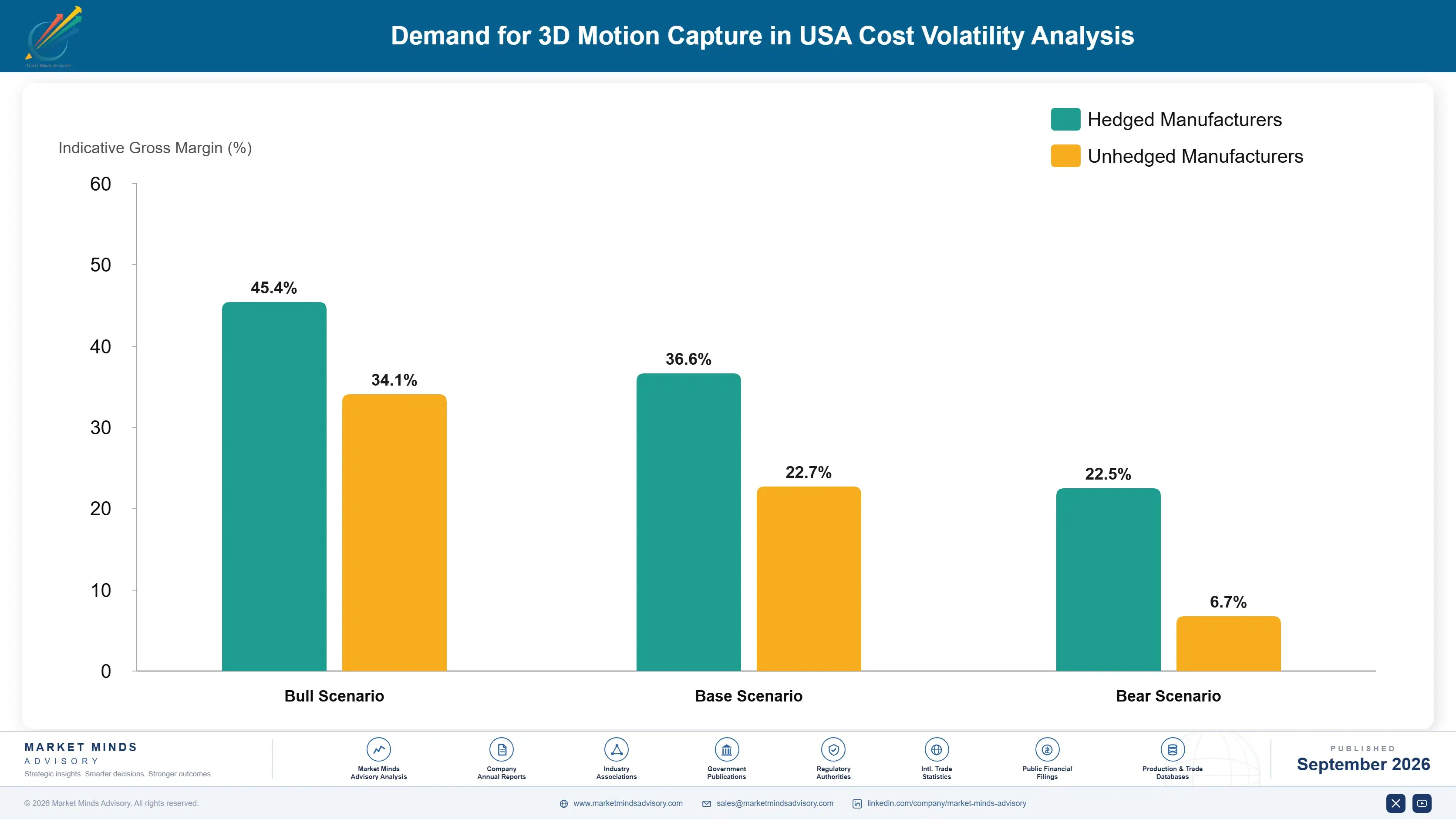
High-resolution camera sensors and specialised real-time computing hardware together represent the largest cost input for capture system manufacturers, running an estimated 44 to 52 percent of cost of goods sold, sourced primarily from specialised camera sensor manufacturers and graphics processing hardware suppliers facing broader industry-wide demand. Assembly and testing costs add a smaller but meaningful share across most manufacturer operations.
Camera sensor and graphics processing hardware pricing rose meaningfully across the broader technology hardware sector during 2023 and 2024 as demand for high-performance computing components outpaced available supply amid competing demand from artificial intelligence infrastructure buyers, a pattern consistent with technology hardware sector supply trends tracked across multiple manufacturer annual reports and public disclosures reviewed for this analysis. Manufacturers without long-term component agreements faced greater cost volatility than those with hedged supplier positions.

The competitive disadvantage falls hardest on smaller manufacturers without the purchasing scale to secure favourable component pricing during periods of constrained supply, forcing some to pass through cost increases faster than larger competitors with established supplier relationships. Exposure varies by system type too, since manufacturers producing markerless systems requiring extensive computer vision processing hardware face materially greater component cost exposure than manufacturers offering simpler marker-based systems.
united-states-3d-motion-capture-market-cost-volatility-analysis-1788452538223

Securing Long-Term Component Supply Agreements

Larger manufacturers are negotiating multi-year fixed-volume component supply agreements directly with camera sensor and computing hardware suppliers to secure priority allocation ahead of demand growth, protecting production schedules from short-notice allocation changes during periods of constrained industry-wide component supply. This approach has become standard practice among the largest capture system manufacturers tracked in this report.

Standardising Hardware Designs Across Product Lines

Several manufacturers are standardising camera sensor and computing hardware designs across multiple product lines to simplify sourcing and negotiate better volume pricing terms, accepting somewhat reduced product differentiation in exchange for more predictable component availability and cost. This approach has become common among manufacturers competing on predictability. This reduces reliance on costly lateral hiring considerably.

Using Cloud-Based Processing to Reduce Hardware Needs

Several manufacturers are shifting some data processing workloads to cloud-based computing infrastructure rather than requiring fully custom on-premises processing hardware, reducing specialised component procurement requirements while adding modest ongoing cloud service cost. This approach has become increasingly common among smaller manufacturers managing tighter capital budgets. This also improves cost predictability for smaller manufacturers overall.

Portfolio Architecture for Margin Defence

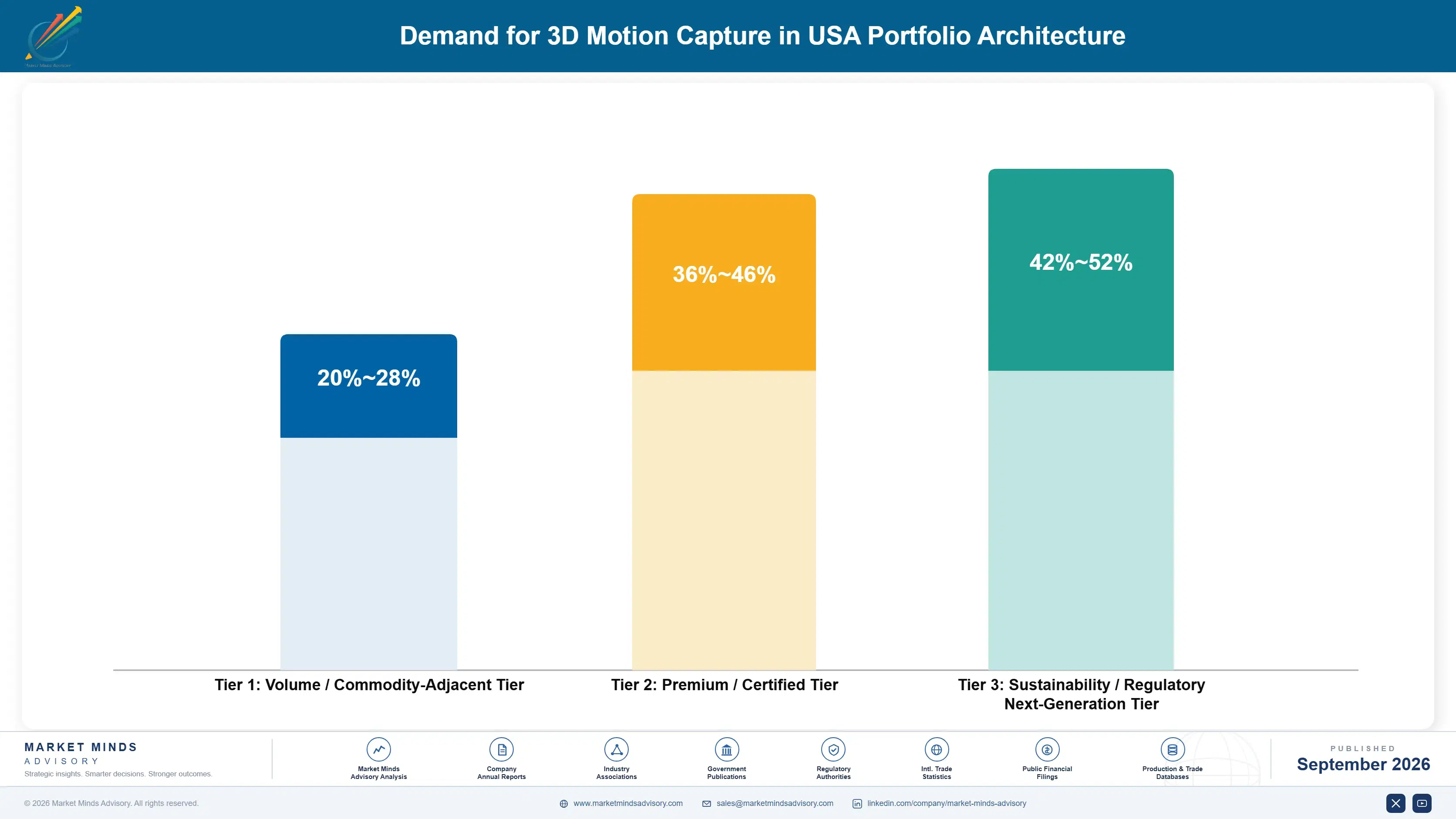
Portfolio economics split into three tiers. Volume tier conventional marker-based hardware carries thinner margins under continued price competition from markerless alternatives and lower-cost regional manufacturers, while premium certified markerless systems bundling rapid data pipelines carry meaningfully higher margins tied to accuracy depth and processing speed differentiation. The sustainability and next-generation tier, built around packaged robotics training dataset products, currently carries the strongest margins given genuine domain expertise differentiation and acute customer demand.
The volume versus premium tension shows up clearly in vendor engineering allocation. Investment devoted to defending conventional hardware margin against markerless price competition competes directly against investment needed for markerless accuracy depth and dataset packaging expertise, and vendors that under-invest in either risk losing ground to a competitor optimised specifically for that segment of the market.

High-value margin pools concentrate in packaged robotics training datasets and in rapid data export pipeline infrastructure, where technical differentiation and processing speed still command premium pricing before broader commoditisation eventually sets in across the category. The volume conventional hardware tier remains essential for market reach among traditional entertainment customers but contributes a shrinking share of blended gross margin across the category overall.

Volume / Commodity-Adjacent Tier

Conventional marker-based hardware facing continued price competition from markerless alternatives and lower-cost regional manufacturers across most standard applications. This tier remains price-sensitive across most standard applications and buyer types broadly.
Gross Margin: 20-28%

Premium / Certified Tier

Markerless systems bundling rapid data pipelines carrying margins tied to accuracy depth and processing speed differentiation across robotics and entertainment accounts. This pricing power reflects genuine engineering credibility built over multiple product generations.
Gross Margin: 36-46%

Sustainability / Regulatory / Next-Generation Tier

Packaged robotics training dataset products commanding the strongest current margins given genuine domain expertise differentiation and acute customer demand. This differentiation should persist as long as domain expertise remains scarce.
Gross Margin: 42-52%
united-states-3d-motion-capture-market-portfolio-architecture-1788452538728

High-value Sub-segments and Strategic Watch-out

Packaged Robotics Training Dataset Products

The fastest-growing margin segment in this report, combining strong current margins with accelerating robotics customer demand for ready-to-use movement training data this decade. Buyers increasingly request this capability by name during vendor evaluation. This edge compounds as robotics demand accelerates further. Buyers increasingly ask for this by name.
Gross Margin: 42-52%

Markerless Rapid Data Pipeline Contracts

Premium engineered offerings tied to customer demand for fast dataset turnaround, offering strong margins and durable revenue visibility across major robotics accounts broadly. Vendors should invest here while differentiation still commands a meaningful premium. This premium should hold for several more years. This should hold for several more years.
Gross Margin: 36-46%

Standard Studio Capture Session Contracts

The largest existing revenue base, standard sessions facing steady price competition but funding most vendors' ongoing engineering investment across the wider platform. Execution discipline on delivery timelines matters more here than added features. Volume here funds ongoing engineering investment broadly. Volume here funds the rest of the portfolio.
Gross Margin: 22-30%

Legacy Marker-Based Entertainment-Only Exposure

A shrinking strategic watch-out segment as markerless systems continue displacing marker-based capture across most standard applications tracked in this report. Waiting too long risks losing accounts during the next evaluation cycle. Diversifying away from this exposure looks increasingly prudent. Diversifying away from this exposure looks prudent.
Gross Margin: 10-18%

Customer Lock-In and Data Pipeline Economics

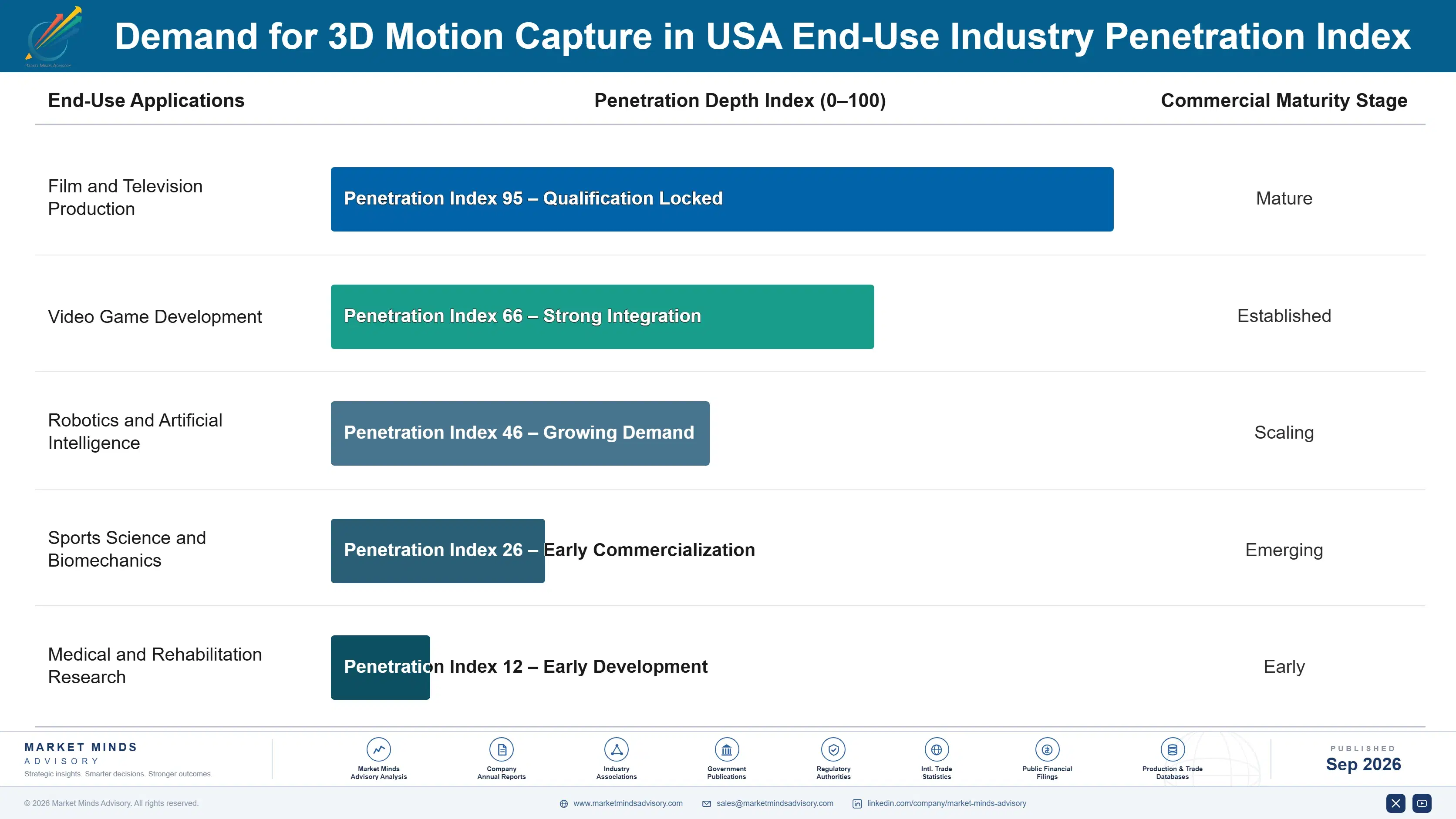
Revenue behaves like a multi-year annuity once a vendor becomes embedded into a customer's ongoing production or training data pipeline, since switching capture vendors mid-programme means re-establishing data format compatibility and retraining internal workflows around a new system, and that switching cost explains most of this category's revenue visibility.
Adoption depth varies sharply by end-use vertical. Robotics companies running continuous training data collection programmes integrate capture vendor relationships deeply into ongoing model development roadmaps spanning multiple simultaneous training initiatives, creating durable multi-year vendor relationships, while individual film and game productions with project-specific capture needs treat procurement more transactionally around each production cycle, creating shallower vendor loyalty and greater exposure to competitive switching at each new project decision.

Buyer profiles are shifting generationally too. Entertainment production supervisors who came up through the marker-based capture era still favour proven, extensively tested conventional systems even at a price premium, while newer robotics and artificial intelligence technical leaders increasingly default to evaluating markerless accuracy and data pipeline speed as standard procurement considerations, a difference in buying philosophy that is already shaping which vendors win newly launched robotics programmes versus established legacy entertainment contract renewals broadly.
united-states-3d-motion-capture-market-end-use-penetration-index-1788452539219

Where the Category Reorders Next

These are among the four positions where our research anticipates prominent divergence between winners and laggards over the coming forecast period. Each is grounded in the demand model, the regulatory perimeter, and the announced capacity pipeline.
01 / MARKERLESS ACCURACY INVESTMENT STRATEGY

Computer vision depth is separating category leaders from legacy vendors

Vendors that built proven markerless tracking accuracy are capturing a disproportionate share of new customer relationships as robotics buyers increasingly demand session throughput without sacrificing usable data quality. Vendors without demonstrated markerless expertise risk being relegated to conventional marker-based positioning carrying materially lower growth potential than markerless leaders currently command. Building this capability now, while robotics customers actively evaluate vendors for expanding training programmes, looks like the more urgent investment priority for most vendors in this category, since this window will not stay open indefinitely.
02 / DATA PIPELINE INFRASTRUCTURE STRATEGY

Rapid export speed is compounding into durable robotics contract advantage

Vendors that engineered rapid data export pipelines are capturing a disproportionate share of robotics customer contracts as buyers increasingly evaluate vendors on iteration speed rather than raw capture precision alone. This dynamic rewards vendors willing to invest in software infrastructure well ahead of confirmed robotics-wide demand standardisation. Vendors without rapid pipeline infrastructure should prioritise smaller pilot programmes to build credibility, since pilot deployments with two or three robotics customers tend to reveal most recurring technical requirements and reduce early missteps.
03 / DATASET PACKAGING POSITIONING

Packaged training products remain a genuinely underexploited opportunity

Pre-packaged, robotics-specific training dataset products remain underexploited relative to their clear revenue potential as robotics customers continue processing raw capture data through their own internal pipelines rather than purchasing ready-to-use packaged alternatives. Vendors building genuine packaging capability now are positioning for meaningful revenue advantage as robotics customer demand continues expanding across the category. Treating packaging as a secondary service offering rather than a distinct product line risks underinvesting in a genuinely important growth opportunity, since early movers tend to lock in the most valuable dataset licensing relationships first.
04 / LEGACY MARKER-BASED EXPOSURE

Vendors without markerless depth face continued displacement pressure

Vendors remaining concentrated in conventional marker-based positioning without markerless or dataset packaging differentiation face continued displacement pressure as customer procurement criteria shift decisively toward throughput and processing speed across most accounts tracked in this report. Vendors should actively diversify toward markerless accuracy, rapid data pipelines, or dataset packaging rather than defending marker-based-only positioning alone. Treating marker-based-only positioning as a stable long-term stance rather than a declining one risks meaningfully understating the category's ongoing competitive transition, a shift visible in disclosed session volume and contract renewal patterns.

Engagement Snapshot From the Field

A live engagement with an industry participant carrying material or product regulatory and market exposure ahead of a defining policy shift, showing how our research translates into a defensible multi-year portfolio strategy.
MARKET MINDS ADVISORY · CLIENT ENGAGEMENT SUMMARY
Demand for 3D Motion Capture in USA Producer Strategic Portfolio Review and Transition Roadmap 2026·Investment Scenario on Demand for 3D Motion Capture in USA Exposure Evaluation 2025-26
CLIENT PROFILE
The client is an emerging humanoid robotics company that had recently raised significant venture funding (client-reported, unverified by MMA), facing an urgent need to establish a large-scale human movement training data collection programme within an aggressive model development timeline set by its board and investors. The company's engineering team had prior experience with smaller-scale internal data collection efforts.
STRATEGIC CHALLENGE
Leadership needed to select a capture vendor capable of delivering high-volume, rapid-turnaround training datasets at a scale the company's internal team had never previously managed, without the expertise to independently assess competing vendors' actual data pipeline throughput claims. Board-level attention to development timeline added further urgency to the vendor selection process. This urgency shaped nearly every vendor evaluation decision.
MMA APPROACH
MMA benchmarked candidate vendors against disclosed data export turnaround performance and existing client references for comparable high-volume robotics training programmes, prioritising vendors demonstrating genuine sustained throughput over marketing capability claims alone. The engagement included structured interviews with the client's machine learning team to validate realistic data format and volume requirements.
KEY FINDINGS
  1. Several vendors claiming rapid turnaround capability in marketing materials had only demonstrated that performance for small pilot volumes rather than the sustained high-volume throughput the client's programme required.
  2. A phased ramp-up sequence starting with a smaller weekly capture volume reduced integration risk considerably compared to committing to full programme scale immediately.
  3. Combining markerless capture for bulk locomotion data with supplementary marker-based capture for fine hand manipulation data achieved better overall training data quality than either approach alone.
  4. Machine learning team adoption of the vendor's data format and delivery pipeline proceeded faster than initial expectations once early pilot batches were validated successfully.
CLIENT PROFILE
The client is an emerging humanoid robotics company that had recently raised significant venture funding (client-reported, unverified by MMA), facing an urgent need to establish a large-scale human movement training data collection programme within an aggressive model development timeline set by its board and investors. The company's engineering team had prior experience with smaller-scale internal data collection efforts.
STRATEGIC CHALLENGE
Leadership needed to select a capture vendor capable of delivering high-volume, rapid-turnaround training datasets at a scale the company's internal team had never previously managed, without the expertise to independently assess competing vendors' actual data pipeline throughput claims. Board-level attention to development timeline added further urgency to the vendor selection process. This urgency shaped nearly every vendor evaluation decision.
MMA APPROACH
MMA benchmarked candidate vendors against disclosed data export turnaround performance and existing client references for comparable high-volume robotics training programmes, prioritising vendors demonstrating genuine sustained throughput over marketing capability claims alone. The engagement included structured interviews with the client's machine learning team to validate realistic data format and volume requirements.
KEY FINDINGS
  1. Several vendors claiming rapid turnaround capability in marketing materials had only demonstrated that performance for small pilot volumes rather than the sustained high-volume throughput the client's programme required.
  2. A phased ramp-up sequence starting with a smaller weekly capture volume reduced integration risk considerably compared to committing to full programme scale immediately.
  3. Combining markerless capture for bulk locomotion data with supplementary marker-based capture for fine hand manipulation data achieved better overall training data quality than either approach alone.
  4. Machine learning team adoption of the vendor's data format and delivery pipeline proceeded faster than initial expectations once early pilot batches were validated successfully.
RECOMMENDED STRATEGY
Phase 1: Phase 1 (Months 1 to 2): Benchmark vendors against verified data export throughput and comparable client references. Include reference calls in comparable robotics training programmes. Validate throughput claims directly. Phase 2: Phase 2 (Months 3 to 5): Ramp up capture volume gradually starting with a smaller weekly commitment. Document lessons learned before committing to full programme scale. Track quality metrics closely. Phase 3: Phase 3 (Months 6 to 9): Scale to full programme volume based on validated pipeline performance. Formalise ongoing data quality governance across the full programme. Confirm sustained pipeline reliability.
OUTCOME
Nine months after the engagement began, the client successfully scaled its training data collection programme to full planned volume, reporting measurably faster model training iteration cycles relative to its original internal data collection approach (client-reported, unverified by MMA). Leadership also reported improved confidence in managing future data collection scaling independently.

Frequently Asked Questions

Foundational context covering the market sizes, CAGR, scope, country, region and competition that inform every finding below. This section is provided to cover basics and most often pre-purchase conversations, answered from the MMA Primary Research Dataset.

What is the current size of the Demand for 3D Motion Capture in USA?

Demand for 3D motion capture in the United States reached an estimated USD 0.82 billion in 2025, according to MMA Analysis based on primary research and company disclosures. This base year figure anchors the forecast period beginning in 2026.

How large will the Demand for 3D Motion Capture in USA be by 2036?

MMA projects the market will reach approximately USD 2.54 billion by 2036 under the base case scenario. That represents roughly a 2.79 times expansion from the 2026 starting value of USD 0.91 billion.

What is the CAGR for the Demand for 3D Motion Capture in USA 2026 to 2036?

The base case compound annual growth rate is 10.8% across the 2026 to 2036 forecast window. Bull and bear scenarios range from 9.5% to 12.0% depending on robotics training data demand and entertainment production activity.

Which segment is growing fastest?

Markerless Optical Motion Capture Systems lead all segments at a 16.0% CAGR, roughly 1.48 times the overall market rate. This segment benefits from robotics customers prioritising session throughput over marginal precision gains.

Who are the major companies in the Demand for 3D Motion Capture in USA?

Leading vendors include Vicon Motion Systems, NaturalPoint, Movella, Rokoko, and Qualisys. Together these five hold an estimated 44% combined share on a disclosed segment revenue basis.

Which country is growing fastest?

This report's scope is the United States specifically, which grows at the overall market rate of 10.8% annually. California's concentrated entertainment and robotics technology cluster drives the majority of national demand.

Report Segmentation Architecture

The full report scope spans multiple orthogonal segmentation dimensions, with cross-tabulated demand data provided for each dimension pair. Coverage extends further to regional breakdowns, trend trajectories, and the competitive detail needed to support segment-level decision-making.

By Primary Market Dimension

  • Optical Marker-Based Motion Capture Systems
  • Markerless Optical Motion Capture Systems
  • Inertial Motion Capture Systems
  • Motion Capture Software and Data Processing Platforms
  • Motion Capture Suits and Wearable Sensor Hardware
  • Virtual Production and Real-Time Rendering Integration Services

By End-Use Industry

  • Film and Television Production
  • Video Game Development
  • Robotics and Artificial Intelligence
  • Sports Science and Biomechanics
  • Medical and Rehabilitation Research

By Commercial Dimension

  • Direct Studio Hardware Sales
  • Capture Studio Session Booking Services
  • Robotics Training Dataset Licensing
  • Software Platform Subscription Contracts

By Region

  • North America
  • Western Europe
  • East Asia
  • South Asia and Pacific
  • Latin America
  • Middle East and Africa
  • Eastern Europe

Scope, Methodology, and Coverage

Every figure in this report is reproducible from documented input assumptions. The scope below maps the historical period, the forecast horizon, the segmentation dimensions, and the countries covered, alongside the underlying primary and qualitative methodology.
Historical Period
2020 to 2025
Forecast Period
2026 to 2036
Base Year
2025 (USD billions; MMA Primary Research Dataset, September 2026)
Market Definition
This report covers hardware systems, software platforms, and integration services used to digitally capture three-dimensional human and object movement within the United States, including optical marker-based, markerless, and inertial sensor technologies. It excludes two-dimensional video tracking systems without three-dimensional spatial reconstruction capability, and broader animation software that does not include dedicated motion capture data ingestion functionality.
Quantitative Units
USD billions (current prices); capture session counts; average cost per capture day
Segmentation Dimensions
By Primary Market Dimension; By End-Use Industry; By Commercial Dimension; By Region
Regions Covered
North America, Western Europe, East Asia, South Asia and Pacific, Latin America, Middle East and Africa, Eastern Europe
Countries Covered
United States, with incidental cross-border vendor activity referenced across other regions
Key Companies Profiled
Vicon Motion Systems Ltd; NaturalPoint Inc; Movella Inc; Rokoko ApS; Qualisys AB; Motion Analysis Corporation; Noitom Ltd; StretchSense Ltd; Faceware Technologies Inc; Reallusion Inc; Simi Reality Motion Systems GmbH; PhaseSpace Inc; Advanced Realtime Tracking GmbH; Charnwood Dynamics Ltd; Northern Digital Inc; Manus VR B.V.; Antilatency Inc; Move.ai Ltd; Theia Markerless Inc; Wrnch Inc
Quantitative Methodology
Primary survey, n=3,800 respondents, Q4 2025, six countries; demand-side model with trade association cross-validation
Qualitative Methodology
47 expert interviews, Q4 2025; applied to validate demand model assumptions, identify emerging dynamics, and assess competitive positioning
Report Format
PDF and XLSX data workbook (Word format preview document)
Publisher
Market Minds Advisory
Report Code
MMA-2026-TEC-465
Published
September 2026
Contact
sales@marketmindsadvisory.com | www.marketmindsadvisory.com

Purchase the full Demand for 3D Motion Capture in USA Report (2026 to 2036).

The full report delivers complete segmentation data across all six product and technology segments, detailed United States regional breakdowns, and competitive profiles for all twenty companies named in this summary. It includes the underlying primary survey dataset of three thousand eight hundred respondents and forty seven expert interviews conducted during the fourth quarter of 2025. Buyers also receive downloadable data tables covering historical 2020 to 2025 figures alongside the full 2026 to 2036 annual forecast. A dedicated appendix addresses markerless tracking accuracy benchmarks against marker-based systems.
Full US Regional Data Tables and Charts
All Twenty Company Competitive Profiles and Rankings
Ten-Year Annual Forecast Model With Scenarios
Primary Survey Raw Data Access and Tables
Markerless Tracking Accuracy Benchmark Appendix and Guide
Quarterly Update Subscription Option for Buyers

Built For The People Who Decide

From boardroom strategy to bench-side execution, this report is read cover-to-cover by leaders shaping the next decade of their industry, turning demand scenarios, market dynamics and valuation benchmarks into decisions.
CXOs/ Presidents/ VPs/ Managers
M&A and Corporate Development
Strategy Teams and R&D Heads
Procurement and Product Directors
Regulatory and Compliance Leaders
Investor Relations and Equity Analysts