Market Minds Advisory
United Kingdom Defense Market

United Kingdom Defense Market: Sovereign In Three Areas, Hollow In Most, Constrained By People

The largest sustained spending increase since the Cold War, committed to an industrial base that is genuinely world-class in three narrow areas and cannot recruit the welders it needs anywhere else.

Lead Analyst

Published

September 2026

Make Smarter Decisions with Customized Research Insights

Request a free sample report and evaluate market opportunities, growth trends, and competitive dynamics relevant to your business needs.

2025 MARKET VALUE$38.5BMarket Size 2025
2036 FORECAST VALUE$79.4BBase Case , 2026 to 2036
CAGR 2026 TO 20366.8 %Bull 8.0% / Bear 5.6%
INCREMENTAL OPPORTUNITY$38.3BNet 10- year value creation
EXPANSION MULTIPLE1.93x2036 value over 2026 base
Strategic Levers
M&A Pipeline
Regional Outlook
Country Rankings
Competitive Intelligence
Segmental Deep-dive
Call-Us : 91 93563 13602

Executive Snapshot and Market Trajectory

Britain has committed to spending on a scale it has not attempted since the Cold War, and the binding constraint is not money. It is nuclear-qualified welders, cleared software engineers and submarine designers, none of which can be appropriated by anybody at all.
The British industrial base is sovereign in just three areas and thin almost everywhere else. Submarines and the deterrent, complex weapons, and combat air are genuinely designed and built here, and together they absorb the majority of what is spent domestically. Land systems, transport aircraft and much digital capability are either bought abroad or assembled under foreign design, which is a choice made repeatedly across four decades rather than any kind of accident at all.
Single source contracting shapes the commercial reality more than competition does. Roughly 52% of award value goes out without competitive tender, because in most of these areas only one British supplier exists, and margins are set by regulation near 8.2% rather than negotiated. Digital, space and cyber grows fastest at 10.2%, and it is the one area where a genuinely new entrant can compete at all. That is unusual here.
Market Definition
United Kingdom Ministry of Defence spending on equipment procurement, research and development, and equipment support, awarded to domestic and foreign suppliers across all capability areas. Excludes service personnel costs and pensions, civilian staff costs, estate and infrastructure spending unrelated to equipment, and overseas security assistance funded outside the defence budget.
Base Year Value
$38.5B in 2025 (MMA Primary Research Dataset, August 2026)
Forecast Period
2026 to 2036, eleven discrete annual values
CAGR
6.8% base case. Bull 8.0%. Bear 5.6%.
Fastest Growth Segment
Digital, Space and Cyber: 10.2% CAGR
Fastest Growth Country
Australia: 8.8% CAGR
Fastest Growth Region
South Asia and Pacific: 8.8% CAGR
Largest Region
Western Europe: 83% of 2025 global value
Market Leaders
BAE Systems, Rolls-Royce, Babcock International, Leonardo UK and MBDA UK lead on Ministry of Defence contract award value. Source: company annual reports and MMA Primary Research Dataset, July 2026.
Primary Survey
n=3,800 procurement and R&D decision-makers, Q4 2025, six countries
Methodology
Demand-side build-up, cross-validated against public data, 47 expert interviews

United Kingdom Defense Market Forecast Scenarios

united-kingdom-defense-market-size-forecast-scenario-1787982950931
The 2020 to 2025 period ended very differently from how it began. Budgets were tight through 2020 and 2021 with an equipment plan repeatedly judged unaffordable, then Ukraine changed the political arithmetic entirely and successive commitments raised the trajectory sharply. A defence review published during 2025 set out submarine, warhead and munitions ambitions on a scale nobody had costed five years earlier. Spending compounded near 5.6%.
Three mechanisms carry the base case. Alliance commitments agreed during 2025 extend spending growth across a decade rather than a parliament, which changes what suppliers will invest against. Munitions production capacity is being rebuilt from a base that Ukraine support exposed as inadequate. And the submarine enterprise expands under trilateral arrangements that bring Australian funding directly into British industrial capacity rather than merely into British order books rather than anywhere else.
The bull catalyst is export success on frigates and combat air, since overseas orders spread fixed cost across production runs that domestic requirements alone cannot fill economically. The bear risk is workforce: if the industrial base cannot recruit and clear the specialist engineers and tradespeople the programmes assume, appropriated money either goes unspent or buys foreign equipment instead.

Money Appropriated Faster Than People Can Be Cleared

Roughly 52% of Ministry of Defence award value is placed without competition, and the reason is not procurement laziness. In submarine construction, nuclear propulsion, complex weapons and several other areas there is exactly one British supplier capable of the work, so competition is a fiction nobody benefits from maintaining. Margins on that business are therefore set by regulation near a baseline of 8.2% rather than discovered through any tender.
MARKET CONCENTRATION CR547%Share of contract award value held by leading suppliers
SINGLE SOURCE SHARE52%Contract value awarded without competitive tender each year
BASELINE PROFIT RATE8.2%Regulated margin applied to non competitive defence contracts
NUCLEAR ENTERPRISE SHARE24%Procurement value committed to the deterrent and submarines
SKILLED VACANCY RATE11%Unfilled specialist engineering posts across the industrial base
EXPORT CONTENT SHARE31%Sector revenue earned from customers outside the country
Nuclear absorbs roughly 24% of procurement value and is growing, covering submarine construction, propulsion, warhead replacement and the infrastructure supporting all three. It is the deepest sovereign capability Britain holds, since no ally builds these things on another country's behalf. It is also the most exposed to workforce constraint, because a nuclear-qualified welder takes years to train and cannot be recruited from an adjacent industry.
Everything outside the sovereign areas is a different market entirely. Land systems, transport aircraft, helicopters and large parts of digital capability are bought from foreign suppliers or assembled domestically under foreign design, and the argument for changing that has lost repeatedly since the 1980s. Export content near 31% of sector revenue is what keeps the sovereign areas viable, because domestic requirements would not fill their capacity.
"Westminster solved the budget question in about eighteen months. Barrow-in-Furness cannot recruit nuclear welders in eighteen months, and no amount of political will shortens that particular training pipeline."
Director, European Defence Programmes Practice · MMA Aerospace and Defence Programmes Practice · August 2026

Market Trends

Munitions Capacity Rebuilt From Deliberately Minimal Holdings

Support to Ukraine exposed how thin British munitions production and stockpiles had become after decades of ordering to peacetime consumption rates. The response commits substantial capital to new energetics and munitions facilities alongside longer-term production agreements intended to keep lines running rather than starting and stopping them. Building energetics capacity is slow, heavily regulated and constrained by a small number of specialist sites. The commitment is genuine and the capacity arrives years after the money does, which is the pattern across most of this buildup. The pattern repeats across this whole buildup.
Market Impact: Targets 3.5% output by 2035

Trilateral Submarine Arrangements Import Foreign Capital

Australian funding is flowing directly into British submarine industrial capacity rather than merely into British order books, including substantial investment in propulsion manufacture. That is an unusual arrangement: a foreign government paying to expand another country's sovereign industrial base because it needs that base to deliver its own boats. The commercial effect is that capacity gets built which domestic requirements alone would not have justified, and the resulting production run supports two navies rather than one across several decades. Very few precedents exist for that arrangement anywhere in defence industrial history.
Market Impact: Grows digital capability 10.2% annually

Market Opportunities and Growth Drivers

Alliance Commitments Extend Growth Beyond One Parliament

Spending commitments agreed with allies during 2025 set a trajectory toward substantially higher defence-related expenditure by the middle of the next decade, split between core defence and broader resilience. That matters industrially rather than politically, because a company will not build production capacity against a single spending review. A decade-long trajectory changes what boards will approve. Suppliers across munitions, submarines and complex weapons are finally committing capital rather than merely bidding for the work available. Boards approve capacity against a decade and refuse it against a single spending review alone.
Market Impact: Leaves 11% of posts unfilled

Digital And Cyber Requirements Admit Genuinely New Suppliers

Space, cyber and digital capability grows at 10.2% and is the only area of this market where a supplier without decades of programme heritage can realistically compete. Requirements turn over in months, capital intensity is low, and the binding constraint is cleared personnel rather than facilities or tooling. Commercial technology companies have won operational contracts that traditional primes assumed were protected. The Ministry has encouraged that deliberately, because delivery cadence in this area matters more than industrial continuity does. Procurement structures designed for platforms fit that work badly, and everybody involved knows it.
Market Impact: Sets margins near 8.2% baseline

Market Restraints and Challenges

Specialist Workforce Cannot Be Recruited At Programme Speed

Nuclear-qualified welders, reactor engineers, submarine designers and cleared software developers all take years to train or clear, and specialist vacancy rates near 11% across the industrial base understate the difficulty because unfilled posts get quietly removed from plans. The root cause is decades of low and uncertain order volumes that gave nobody a reason to train ahead of demand. Mitigation runs through apprenticeship expansion, transferring skills from adjacent industries, foreign partner secondments and accepting slower delivery rather than pretending otherwise. No amount of political will shortens a nuclear welding qualification pipeline.
Market Impact: Commits GBP 1.5 billion facilities

Single Source Regulation Caps Return On Invested Capital

Margins on non-competitive contracts are set by regulation near a baseline of 8.2%, which was calibrated for suppliers delivering against existing capacity rather than building new capacity. The root cause is a framework designed to prevent excess profit on work with no competitive discipline, applied now to a period requiring substantial capital investment. Boards compare that return against commercial alternatives and hesitate. Mitigation runs through capital-related adjustments within the framework, government-funded facilities and longer contract terms that improve return over the asset life. The framework was not written for a buildup.
Market Impact: Adds GBP 2.4 billion investment
3 additional market trends, 4 additional growth drivers, and 2 additional restraints and challenges are covered in the full report. Contact sales@marketmindsadvisory.com to access the complete intelligence.

Segment CAGR and Growth Architecture

Segmentation follows capability area, since that determines whether British industry designs the equipment, assembles somebody else's design, or simply buys it complete from abroad. Six capability areas describe the market entirely, from the nuclear enterprise where sovereignty is absolute through to the land systems where it has been repeatedly abandoned in practice over four decades.
united-kingdom-defense-market-market-share-analysis-1787982951488

Digital, Space and Cyber

The fastest capability area grows at 10.2%, half again the market rate of 6.8%, and it is the only part of this market genuinely open to new suppliers. Requirements turn over in months rather than decades, capital intensity is low, and what constrains delivery is cleared personnel rather than facilities, tooling or industrial heritage. Commercial technology companies have won operational contracts that established primes assumed were protected by classification and relationship, and the Ministry has encouraged that deliberately because delivery cadence matters more here than industrial continuity. Procurement structures designed for platform programmes fit this work badly, which is a problem the department acknowledges openly and has not yet solved at all.
CAGR 10.2%

Complex Weapons and Munitions

Complex weapons and munitions grow at 9.0%, driven by stockpile rebuilding that Ukraine support exposed as necessary and by an explicit commitment to keep production lines running rather than starting and stopping them. Britain retains genuine sovereign capability here through a long-standing partnership arrangement covering guided weapons, and that capability is one of the three areas where domestic design genuinely exists. Energetics production is the constraint rather than assembly, since it depends on a small number of heavily regulated specialist sites that take years to expand. Capital has been committed and the capacity arrives considerably later than the announcement did. Announcements arrive years before the energetics capacity that makes them real.
CAGR 9.0%
Full segment breakdown across 6 segments available in the complete report.

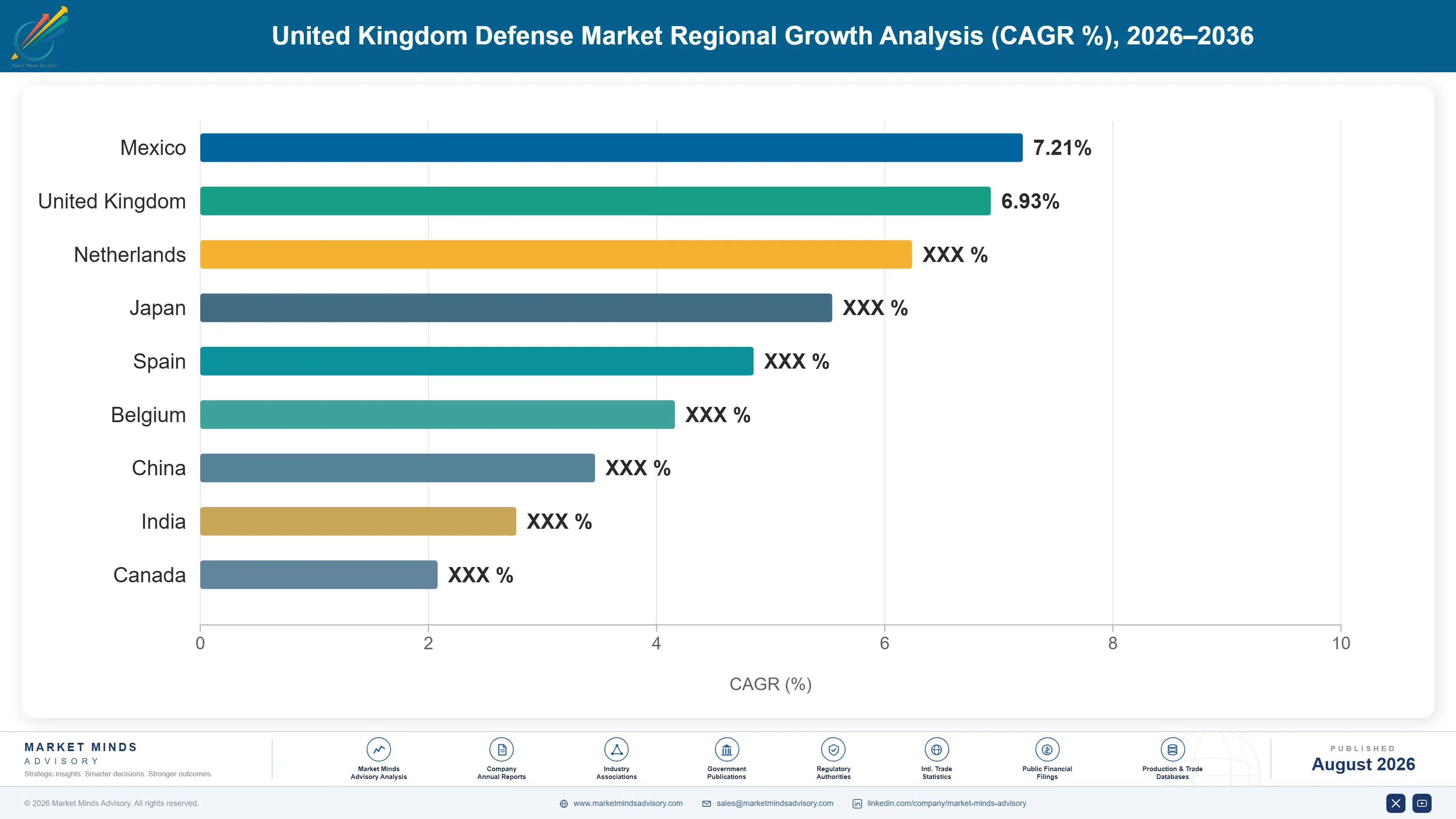
Regional Architecture and Country Demand Map

This is a United Kingdom market and effectively all spending is appropriated and awarded domestically. Other regions appear as equipment suppliers, co-development partners and, increasingly, as customers funding British industrial capacity directly, none of which represent Ministry of Defence spending counted anywhere within this scope.

North America

Share sits below the standard band because this report measures British Ministry of Defence spending, though American suppliers hold the largest non-domestic position by a wide distance. Combat aircraft, maritime patrol, transport, helicopters and a substantial share of missiles are bought from United States sources, and interoperability requirements shape British architectural choices well beyond what is actually purchased. Nuclear propulsion cooperation runs on arrangements dating to the 1950s that no other ally holds. Canadian frigate programmes have separately adopted a British design under licence, which flows revenue the other way. The relationship is asymmetric in every direction except nuclear propulsion, where the cooperation runs deeper than anything Britain holds with anybody else.
Share: 8% | CAGR: 6.4% (2026 to 2036)

Western Europe

Effectively the whole market sits here, far above the standard band, for the definitional reason that this report measures spending appropriated and awarded in Britain. BAE Systems, Rolls-Royce, Babcock, Leonardo UK and MBDA UK hold around 47% of award value between them, and around 52% of that value is placed without competition because in most sovereign areas only one capable British supplier exists. European partnership matters most in complex weapons and combat air, where cross-border industrial arrangements have delivered capability no single European nation could fund alone. Competition inside this region is largely a fiction where sovereignty is asserted, and entirely real where successive governments decided sovereignty was not worth paying for.
Share: 83% | CAGR: 5.6% (2026 to 2036)
Regional intelligence for 5 additional markets available in the complete report: East Asia, South Asia and Pacific, Latin America, Middle East and Africa, Eastern Europe. Contact sales@marketmindsadvisory.com.
united-kingdom-defense-market-country-cagr-analysis-1787982952010

Where British Defence Margin Sits Now

Four levers work on workforce, contract structure, export access and entry route rather than on technology, which British suppliers hold in genuine depth across their sovereign areas. Skills pipeline investment, capital adjustment negotiation, export programme participation and digital entry each address something a supplier controls under the current arrangements. Technology is not the binding constraint here.

Fund The Skills Pipeline Before Programmes Need It

Specialist vacancy rates near 11% will decide delivery schedules regardless of what any contract says, and nuclear welders, reactor engineers and cleared developers all take years to produce. Suppliers funding apprenticeships and clearance sponsorship ahead of programme need report schedule performance 14% to 20% better than those recruiting reactively against a market where every competitor wants the same people. The investment is modest against programme value. It is also the only constraint in this market that cannot be resolved by anybody at any speed once a programme has already started.
Market Impact: Improves overall programme schedule performance by around 17%

Negotiate Capital Adjustments Within The Single Source Rules

Regulated margins near an 8.2% baseline were calibrated for suppliers delivering from existing capacity, not building new capacity, and boards compare that return against commercial alternatives and hesitate. The framework permits adjustments recognising capital employed, and suppliers negotiating those properly achieve effective returns 200 to 350 basis points above the headline baseline. Most treat the baseline as fixed and never make the argument. The negotiation is technical, evidence-based and entirely available to anybody willing to prepare the case for it. Nobody in this market is prevented from asking for it.
Market Impact: Adds around 275 basis points to the return

Position On Programmes With Committed Export Customers

Export content near 31% of sector revenue is what makes several sovereign capabilities viable, because British requirements alone cannot fill the production capacity those capabilities need. Frigate designs adopted by Australia and Canada, and combat air partnered with Japan and Italy, spread fixed cost across runs two or three times the domestic order. Suppliers positioned on exportable programmes earn materially better returns whether or not they lead them. Those confined to domestic-only capability carry fixed cost against volumes that were never sufficient. Domestic volume alone was never going to be enough.
Market Impact: Spreads fixed cost across 3 times the volume

Enter Through Digital Where Heritage Counts For Little

Digital, space and cyber grows at 10.2% against a market rate of 6.8%, and it is the only capability area where a supplier without decades of programme history can genuinely compete. Requirements turn over in months, capital intensity is low, and the department has deliberately encouraged commercial entrants because delivery cadence matters more than industrial continuity here. Procurement structures still fit the work badly, which favours suppliers willing to work within an imperfect process rather than waiting for the department to fix it first. Waiting for a better process wastes the window.
Market Impact: Opens a 10.2% growth area to new entrants

Who Controls the Margin Pool

Concentration is moderate at around 47% across the five largest suppliers, and it understates the position considerably. Within each sovereign area a single supplier frequently holds the whole requirement, which is why 52% of award value avoids competition. BAE Systems spans submarines, combat air and land systems; Rolls-Royce holds naval propulsion alone; Babcock dominates maritime support. Foreign primes hold large positions wherever domestic capability lapsed.
Competition runs on three dimensions, and on much of the market it does not run at all. Workforce capacity is first and increasingly decisive, since a supplier that cannot staff a programme loses it. Export position is second, since overseas customers carry economics domestic-only programmes cannot match. Delivery cadence is third, deciding the digital and cyber work where competition actually exists.

Pressure is arriving from commercial technology suppliers rather than from other defence companies. Software firms with no programme heritage win operational contracts in digital and cyber, encouraged deliberately by a department valuing delivery speed over industrial continuity there. Workforce constraint meanwhile affects everybody and rewards whoever invested in apprenticeships earliest. Rankings shift against suppliers holding neither export participation nor a funded skills pipeline.
united-kingdom-defense-market-company-positioning-matrix-1787982952533

Competitive Moat and Risk Dimensions

BAE SYSTEMS

Moat: Sovereign breadth across three areas

BAE Systems holds submarine construction, combat air design and complex weapons participation simultaneously, which no other British supplier approaches and no foreign entrant could replicate without decades of clearance, facilities and workforce investment. Those areas are precisely where sovereignty is treated as non-negotiable. Export positions on frigates and combat aircraft spread fixed cost across runs domestic orders could never fill.
BAE SYSTEMS

Risk: Workforce constraint across every programme

The same specialist workforce shortage affects submarine construction, combat air and munitions concurrently, so competing programmes inside one company draw on overlapping talent pools that cannot expand at programme speed. Schedule risk therefore correlates across the portfolio rather than diversifying. Apprenticeship investment helps considerably and delivers qualified people on a timescale programme milestones were never set against.
ROLLS-ROYCE

Moat: Naval nuclear propulsion monopoly

Rolls-Royce is the sole supplier of naval nuclear propulsion in Britain, holding facilities, approvals and a workforce no competitor could assemble at realistic cost. Australian funding has expanded that capacity directly, extending the production run across two navies. The position is as close to unassailable as anything in this market, and for regulatory and workforce reasons rather than technical ones.
ROLLS-ROYCE

Risk: Single programme concentration exposure

Naval propulsion revenue depends on a small number of very long programmes whose schedules move for political and workforce reasons the company does not control, and a deferred boat moves years of results. There is no alternative customer for the capability at any price. Diversification within nuclear is limited by the specialist nature of the approvals the business actually holds.

Players Tracked

Prominent Players

BAE Systems
Rolls-Royce
Babcock International
Leonardo UK
MBDA UK

Other Key Players

QinetiQ
Thales UK
Lockheed Martin UK
RTX UK
Boeing Defence UK
General Dynamics UK
Airbus Defence and Space UK
Serco
Chemring Group
Cobham
Marshall Aerospace
Supacat
Roke
Sheffield Forgemasters
Ultra Electronics

Recent Developments

JUNE 2025

Defence review set out submarine and munitions ambitions

A strategic defence review published during 2025 committed to an expanded attack submarine fleet, warhead programme investment and substantial new munitions and energetics manufacturing capacity. This was a government policy publication rather than any commercial transaction, and it set industrial requirements considerably beyond existing production capability.
Signal: Ambition was set against an industrial base whose workforce constraints the review itself acknowledged quite plainly.
MARCH 2024

Australia funded expansion of British propulsion manufacture

Australia committed substantial investment directly into British naval nuclear propulsion manufacturing capacity under trilateral submarine arrangements, funding facility expansion rather than simply placing orders. This was a government to government funding arrangement rather than any merger, acquisition or joint venture between any of the companies involved.
Signal: A foreign government paying to expand another country's sovereign industrial base has very few precedents anywhere.
JUNE 2025

Alliance members agreed a higher long-term spending trajectory

Members of the principal Western alliance agreed at a summit during 2025 to raise defence-related spending substantially by the middle of the next decade, split between core defence and wider resilience categories. This was a multilateral political commitment rather than any commercial arrangement between suppliers or governments.
Signal: A decade-long trajectory changes what boards will approve, which annual spending reviews never managed to do.

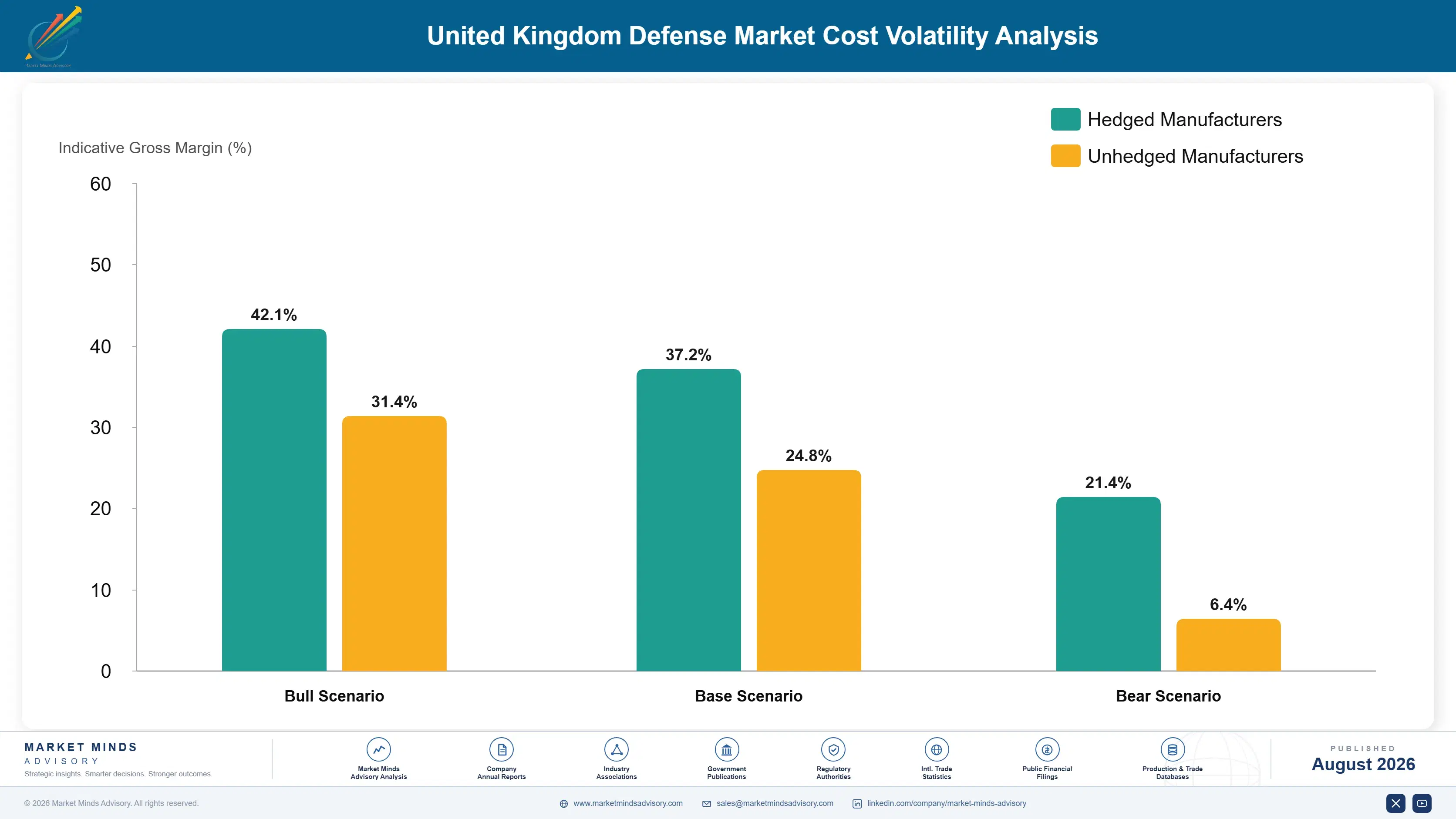
What British Defence Production Costs

Programme cost divides into four components that behave very differently under expansion. Specialist labour absorbs roughly 36% of production cost and is constrained by training and clearance pipelines rather than by wage rates. Materials and purchased components run near 28%, facilities and capital equipment near 21%, and regulatory compliance with safety case work accounts for the remaining 15% on a typical sovereign programme.
Energy and materials inflation through 2022 and 2023 demonstrated how exposed long-duration programmes are to conditions nobody priced. Contracts signed years earlier on fixed assumptions absorbed input increases that regulated margins near 8.2% could not accommodate, and several suppliers reported compressed programme profitability as a result. BAE Systems and Babcock both discussed inflation and supply chain pressure across that period in their annual reporting. Contract indexation arrangements varied considerably and determined who absorbed what.

Exposure varies by capability area and by contract framework. Nuclear suppliers carry the heaviest regulatory burden alongside the tightest workforce constraint. Digital and cyber suppliers carry almost none of it, which is why entry there is possible. Suppliers on single source contracts carry regulated margins against capital they must find themselves, while competitive work at least prices the risk being taken.
united-kingdom-defense-market-cost-volatility-analysis-1787982952727

Apprenticeship and clearance sponsorship ahead of demand

Specialist people take years to train and clear, so recruiting reactively against a market where every competitor wants the same individuals guarantees schedule slippage. Suppliers funding pipelines ahead of programme need report materially better schedule performance. The investment is modest against programme value and cannot be accelerated once a programme has already started slipping.

Capital related adjustments within the regulated framework

The single source framework permits adjustments recognising capital employed above the headline baseline profit rate, and suppliers preparing that case properly achieve effective returns meaningfully above it. Most treat the baseline as fixed and never make the argument at all. The negotiation is technical and evidence-based rather than adversarial in any real sense at all.

Contract indexation matched to actual input exposure

Long duration programmes signed on fixed assumptions absorbed input inflation that regulated margins could not accommodate, and indexation arrangements varied enormously between otherwise similar contracts. Matching indexation to genuine input exposure rather than to a general measure protects programme profitability directly. Suppliers who negotiated this before 2022 fared considerably better than those who did not.

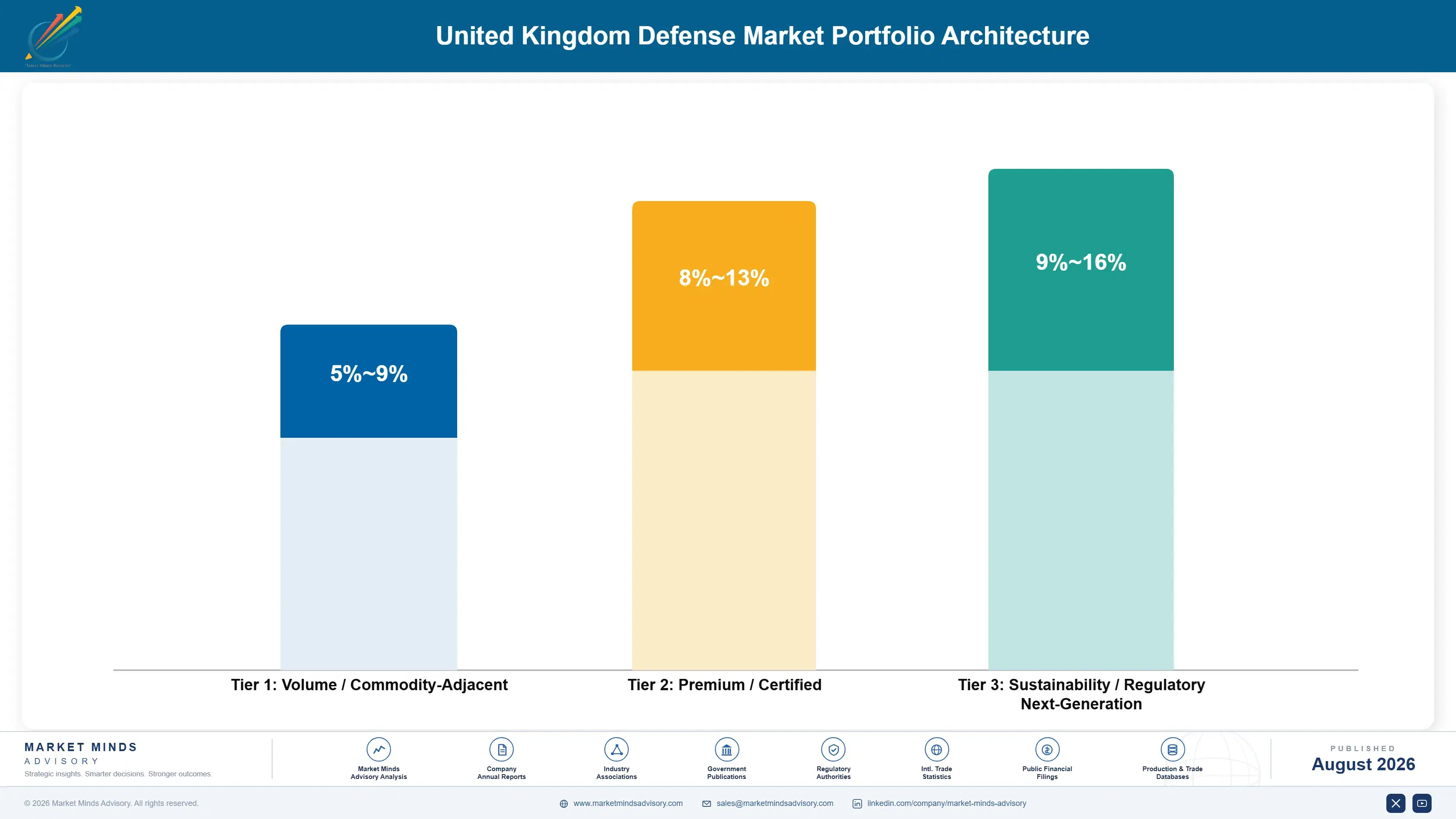
Portfolio Architecture for Margin Defence

The portfolio separates by whether Britain designs the equipment or merely operates it. Support, sustainment and land systems form the volume layer: substantial spending, competitive award in many cases, and margins compressed by the fact that the underlying designs frequently belong to somebody else. Suppliers hold this work because it carries scale and because availability contracting produces revenue that lasts decades regardless of who designed the platform.
Margin concentrates in the sovereign areas, and it concentrates for regulatory reasons rather than commercial ones. Submarines, propulsion, complex weapons and combat air are placed without competition because only one capable supplier exists, and the regulated margin near 8.2% is what a supplier gets in exchange for that position. The tension is that this arrangement caps return precisely where capital investment is now most needed.

The best returns sit in digital, space and cyber, where regulated single source rules apply least, capital intensity is lowest and delivery cadence rather than heritage decides outcomes. It is also the only area a new entrant can reach, which makes it simultaneously the most attractive and the most contested part of this market.

Volume / Commodity-Adjacent

Equipment support, sustainment and land systems assembled under foreign design. Range spans four points because availability contracting and competitive award produce quite different returns on otherwise broadly comparable work packages.
Gross Margin: 5-9%

Premium / Certified

Maritime platforms, combat air and complex weapons placed largely without competition. Range spans five points because capital related adjustments within the regulated framework are negotiated well by some suppliers and never attempted by others.
Gross Margin: 8-13%

Sustainability / Regulatory / Next-Generation

Nuclear enterprise alongside digital, space and cyber capability. Range spans seven points because nuclear carries heavy regulated cost while digital work escapes most of it and prices on delivery instead.
Gross Margin: 9-16%
united-kingdom-defense-market-portfolio-architecture-1787982953228

High-value Sub-segments and Strategic Watch-out

Digital, Space and Cyber

High value and high growth at 10.2%, the only capability area genuinely open to suppliers without programme heritage. The five point range separates commercial entrants pricing on delivery from primes applying platform programme cost structures. Procurement structures here still fit that particular work quite badly.
Gross Margin: 11-16%

Complex Weapons and Munitions

High value with moderate growth at 9.0%, rebuilding from stockpiles that Ukraine support exposed as inadequate. The five point range reflects whether a supplier holds energetics capacity or merely assembles what somebody else produces. Energetics capacity rather than assembly work is the real constraint here.
Gross Margin: 9-14%

Maritime Surface and Subsurface

The volume core of sovereign construction and the area where export adoption matters most. Australian and Canadian frigate programmes spread fixed cost across runs that domestic orders alone could never have filled economically. Export adoption alone decides whether any of these economics work at all.
Gross Margin: 8-12%

Land Systems and Vehicles

The strategic watch-out rather than a growth pool. Repeated programme difficulty and cancellation across two decades has left capability thin, designs largely foreign, and any argument for rebuilding sovereignty here consistently defeated on cost. That same argument keeps losing on cost grounds every single time.
Gross Margin: Variable

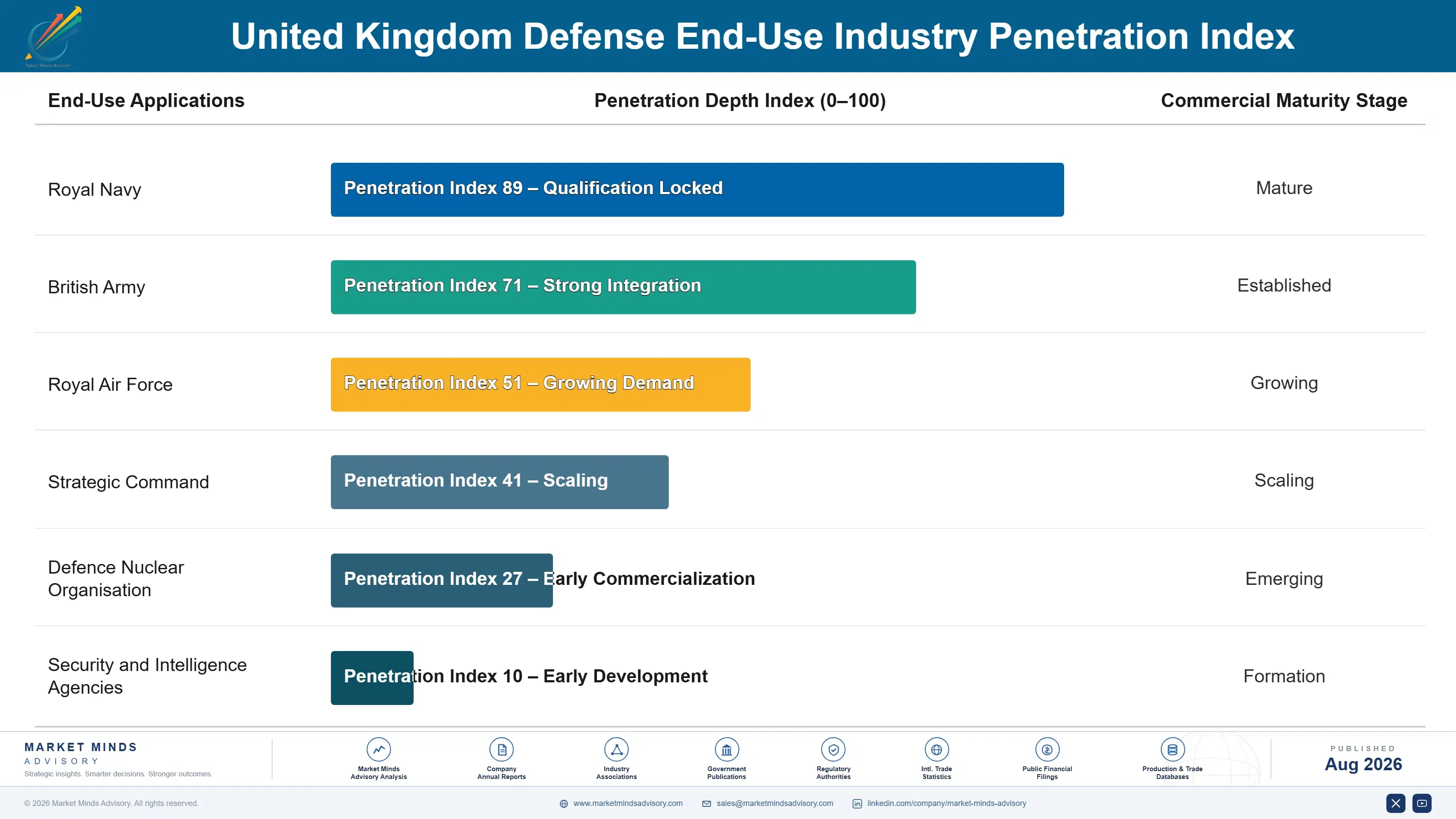
Why Programmes Outlast Governments

Sovereign programmes generate annuity economics through the absence of alternatives rather than through any contractual mechanism. A supplier holding the only British capability in submarine construction or nuclear propulsion supplies it for as long as the capability is required, which is measured in decades and survives changes of government, defence review and minister. Competition is a fiction in those areas, and both parties understand that the relationship is permanent rather than periodically contested.
Depth varies enormously by capability area. Nuclear and complex weapons relationships are effectively unbreakable, since rebuilding the capability elsewhere would take longer than any programme timescale allows. Maritime and combat air are similar though marginally more contestable through international partnership. Digital and cyber changes hands readily, which is precisely why the department encouraged competition there rather than in areas where competition cannot meaningfully exist.

The customer is changing in ways suppliers have not fully absorbed. A department accustomed to managing affordability by deferring programmes is now managing delivery against a growing budget, which requires different behaviour from everybody. Programme offices that spent fifteen years negotiating scope reductions are now negotiating schedule acceleration, and the industrial base is telling them it cannot recruit fast enough to deliver it.
united-kingdom-defense-market-end-use-penetration-index-1787982953714

Where British Suppliers Should Commit

These are among the four positions where our research anticipates prominent divergence between winners and laggards over the coming forecast period. Each is grounded in the demand model, the regulatory perimeter, and the announced capacity pipeline.
01 / SKILLS PIPELINE INVESTMENT

People are the only constraint money cannot shorten

Specialist vacancy rates near 11% will decide delivery schedules regardless of what any contract says, and nuclear welders, reactor engineers and cleared developers all take years to produce or clear properly. Suppliers funding apprenticeships and clearance sponsorship ahead of programme need report schedule performance 14% to 20% better than those recruiting reactively into a market where every competitor wants exactly the same individuals. The investment is modest against total programme value and useless once a programme has already started slipping.
02 / REGULATED RETURN NEGOTIATION

The baseline profit rate is not actually the ceiling

Regulated margins near an 8.2% baseline were calibrated for suppliers delivering from existing capacity rather than building new capacity, and boards comparing that return against commercial alternatives quite reasonably hesitate before committing anything. The framework permits adjustments recognising capital employed, and suppliers preparing that case properly achieve effective returns 200 to 350 basis points above the headline figure. Most treat the baseline as fixed and never make the argument, which is a preparation failure rather than a policy one entirely.
03 / EXPORT PROGRAMME POSITIONING

Domestic orders alone never filled the capacity

Export content near 31% of total sector revenue is what makes several sovereign capabilities viable at all, because British requirements alone cannot fill the production capacity those capabilities actually require to operate. Frigate designs already adopted by Australia and Canada, and combat air partnered with Japan and Italy, spread fixed cost across production runs two or three times the domestic order size alone. Suppliers positioned on those exportable programmes earn materially better returns whether or not they happen to lead them.
04 / DIGITAL ENTRY ROUTE

Heritage counts for little in the fastest area

Digital, space and cyber grows at 10.2%, half again the market rate of 6.8%, and it is the only capability area where a supplier without decades of programme history can genuinely compete for real operational work. Requirements turn over in months, capital intensity is genuinely low, and the department has deliberately encouraged commercial entrants because delivery cadence matters more than industrial continuity here. Procurement structures still fit that work badly, which favours whoever will work inside an imperfect process anyway.

Engagement Snapshot From the Field

A live engagement with an industry participant carrying material or product regulatory and market exposure ahead of a defining policy shift, showing how our research translates into a defensible multi-year portfolio strategy.
MARKET MINDS ADVISORY · CLIENT ENGAGEMENT SUMMARY
United Kingdom Defense Producer Strategic Portfolio Review and Transition Roadmap 2026·Investment Scenario on United Kingdom Defense Exposure Evaluation 2025-26
CLIENT PROFILE
A British defence supplier delivering subsystems and support across maritime, complex weapons and land programmes, holding several single source positions where no alternative domestic capability exists. Order intake had risen sharply following successive spending commitments while delivery performance deteriorated, and management attributed the deterioration to customer schedule pressure rather than to anything within its own control.
STRATEGIC CHALLENGE
The board needed to understand whether its delivery problems were customer-driven or workforce-driven, and whether committing capital to expand capacity made sense at a regulated margin its finance function regarded as inadequate. It had never attempted a capital related adjustment under the single source framework, having treated the baseline profit rate as a fixed statutory figure rather than a starting position.
MMA APPROACH
MMA decomposed schedule variance across eleven programmes, separating customer-driven change from internal resource constraint, and modelled return on invested capital for capacity expansion under baseline and adjusted profit assumptions. Expert interviews with the regulator, comparable suppliers and clearance sponsors established what adjustments were genuinely obtainable and what the clearance pipeline could realistically deliver.
KEY FINDINGS
  1. Internal resource constraint rather than customer change accounted for 68% of schedule variance across the eleven programmes examined, contradicting the explanation management had given the board.
  2. Specialist vacancies stood at 14% against a market pattern nearer 11%, and no apprenticeship or clearance sponsorship programme had been funded in the preceding four years at all.
  3. Capital related adjustments under the single source framework would have raised effective returns by an estimated 240 basis points on three contracts, and none had ever been requested.
  4. Two programmes carried fixed price assumptions without input indexation, and both had absorbed material inflation that regulated margins could not accommodate anywhere.
CLIENT PROFILE
A British defence supplier delivering subsystems and support across maritime, complex weapons and land programmes, holding several single source positions where no alternative domestic capability exists. Order intake had risen sharply following successive spending commitments while delivery performance deteriorated, and management attributed the deterioration to customer schedule pressure rather than to anything within its own control.
STRATEGIC CHALLENGE
The board needed to understand whether its delivery problems were customer-driven or workforce-driven, and whether committing capital to expand capacity made sense at a regulated margin its finance function regarded as inadequate. It had never attempted a capital related adjustment under the single source framework, having treated the baseline profit rate as a fixed statutory figure rather than a starting position.
MMA APPROACH
MMA decomposed schedule variance across eleven programmes, separating customer-driven change from internal resource constraint, and modelled return on invested capital for capacity expansion under baseline and adjusted profit assumptions. Expert interviews with the regulator, comparable suppliers and clearance sponsors established what adjustments were genuinely obtainable and what the clearance pipeline could realistically deliver.
KEY FINDINGS
  1. Internal resource constraint rather than customer change accounted for 68% of schedule variance across the eleven programmes examined, contradicting the explanation management had given the board.
  2. Specialist vacancies stood at 14% against a market pattern nearer 11%, and no apprenticeship or clearance sponsorship programme had been funded in the preceding four years at all.
  3. Capital related adjustments under the single source framework would have raised effective returns by an estimated 240 basis points on three contracts, and none had ever been requested.
  4. Two programmes carried fixed price assumptions without input indexation, and both had absorbed material inflation that regulated margins could not accommodate anywhere.
RECOMMENDED STRATEGY
Phase 1: Phase one: fund apprenticeship intake and clearance sponsorship immediately, accepting that the first qualified people arrive some years after the spending starts. Phase 2: Phase two: prepare and submit capital related adjustment cases on the three contracts where capacity investment is genuinely required to deliver. Phase 3: Phase three: renegotiate indexation on the two unprotected fixed price programmes and adopt matched indexation as standard on all future awards.
OUTCOME
The client reported schedule variance falling 31% within six quarters (client-reported, unverified by MMA), with most improvement following resource rather than process changes. Two capital related adjustments were agreed, raising effective returns by roughly 210 basis points. Apprenticeship intake trebled, though the first qualified cohort remained several years from completion.

Frequently Asked Questions

Foundational context covering the market sizes, CAGR, scope, country, region and competition that inform every finding below. This section is provided to cover basics and most often pre-purchase conversations, answered from the MMA Primary Research Dataset.

What is the current size of the United Kingdom Defense Market?

The market is valued at USD 38.5 billion in 2025, measured as Ministry of Defence spending on equipment procurement, research and development, and equipment support.

How large will the United Kingdom Defense Market be by 2036?

MMA forecasts USD 79.39 billion by 2036, up from USD 41.12 billion in 2026. That represents incremental spending of USD 38.27 billion and an expansion multiple of 1.93 times.

What is the CAGR for the United Kingdom Defense Market 2026 to 2036?

The base case CAGR is 6.8%, with a bull case of 8.0% and a bear case of 5.6%. Alliance spending commitments and submarine enterprise expansion supply most of that growth.

Which segment is growing fastest?

Digital, space and cyber grows at 10.2%, half again the market rate of 6.8%. It is also the only capability area genuinely open to suppliers without programme heritage.

Who are the major companies in the United Kingdom Defense Market?

BAE Systems, Rolls-Royce, Babcock International, Leonardo UK and MBDA UK lead on contract award value, holding around 47% between them right across the whole market.

Which country is growing fastest?

Australia grows fastest at 8.8%, funding British submarine industrial capacity directly under trilateral arrangements rather than simply placing orders with the existing British production lines.

Report Segmentation Architecture

The full report scope spans multiple orthogonal segmentation dimensions, with cross-tabulated demand data provided for each dimension pair. Coverage extends further to regional breakdowns, trend trajectories, and the competitive detail needed to support segment-level decision-making.

By Capability Area

  • Nuclear Enterprise
  • Complex Weapons and Munitions
  • Combat Air
  • Maritime Surface and Subsurface
  • Land Systems and Vehicles
  • Digital, Space and Cyber

By End-Use Industry

  • Royal Navy
  • British Army
  • Royal Air Force
  • Strategic Command
  • Defence Nuclear Organisation
  • Security and Intelligence Agencies

By Commercial Dimension

  • Single Source Prime Contracting
  • Competitive Prime Contracting
  • Foreign Military Sales
  • International Co-Development
  • Subsystem and Component Supply
  • Support and Availability Contracting

By Region

  • North America
  • Western Europe
  • East Asia
  • South Asia and Pacific
  • Latin America
  • Middle East and Africa
  • Eastern Europe

Scope, Methodology, and Coverage

Every figure in this report is reproducible from documented input assumptions. The scope below maps the historical period, the forecast horizon, the segmentation dimensions, and the countries covered, alongside the underlying primary and qualitative methodology.
Historical Period
2020 to 2025
Forecast Period
2026 to 2036
Base Year
2025 (USD billions; MMA Primary Research Dataset, August 2026)
Market Definition
United Kingdom Ministry of Defence spending on equipment procurement, research and development, and equipment support, spanning the nuclear enterprise, complex weapons and munitions, combat air, maritime surface and subsurface, land systems and vehicles, and digital, space and cyber capability. Single source and competitive prime contracting, foreign military sales, international co-development, subsystem supply and availability contracting are all included. Service personnel costs and pensions, civilian staff costs, non-equipment estate spending and overseas security assistance funded outside the defence budget are excluded.
Quantitative Units
USD billions, contract award value
Segmentation Dimensions
Capability area, end-use service command, commercial contracting dimension, region
Regions Covered
North America, Western Europe, East Asia, South Asia and Pacific, Latin America, Middle East and Africa, Eastern Europe
Countries Covered
United Kingdom, with supplier, partner and export exposure across the United States, Italy, Japan, Australia, Canada and the Gulf
Key Companies Profiled
BAE Systems, Rolls-Royce, Babcock International, Leonardo UK, MBDA UK, QinetiQ, Thales UK, Lockheed Martin UK, General Dynamics UK, Chemring Group
Quantitative Methodology
Primary survey, n=3,800 respondents, Q4 2025, six countries; demand-side model with trade association cross-validation
Qualitative Methodology
47 expert interviews, Q4 2025; applied to validate demand model assumptions, identify emerging dynamics, and assess competitive positioning
Report Format
PDF and XLSX data workbook (Word format preview document)
Publisher
Market Minds Advisory
Report Code
MMA-2026-CON-231
Published
August 2026
Contact
sales@marketmindsadvisory.com | www.marketmindsadvisory.com

Purchase the full United Kingdom Defense Market Report (2026 to 2036).

The full report treats British defence as a workforce problem rather than a budget one, and shows where that constraint actually binds. It quantifies specialist vacancy exposure by capability area, models return on invested capital under baseline and adjusted single source profit rules, and traces how export content sustains sovereign capabilities that domestic requirements alone could never fill. Segment analysis covers all six capability areas, with particular attention to digital and cyber as the only route genuinely open to suppliers without programme heritage. Competitive assessment ranks twenty participants on Ministry of Defence contract award value across domestic and foreign suppliers.
Six capability area segmentation with growth rates
Specialist vacancy exposure mapped by programme
Twenty supplier assessment on contract award value
Regulated return modelling under capital adjustments
Export content sustaining sovereign capability quantified
Single source share analysed by capability area

Built For The People Who Decide

From boardroom strategy to bench-side execution, this report is read cover-to-cover by leaders shaping the next decade of their industry, turning demand scenarios, market dynamics and valuation benchmarks into decisions.
CXOs/ Presidents/ VPs/ Managers
M&A and Corporate Development
Strategy Teams and R&D Heads
Procurement and Product Directors
Regulatory and Compliance Leaders
Investor Relations and Equity Analysts