Market Minds Advisory
United Kingdom Auto Loan Market

United Kingdom Auto Loan Market: Electric Vehicle Financing and Digital Origination Growth

Rising electric vehicle adoption, expanding personal contract purchase penetration, and accelerating digital loan origination are jointly reshaping how United Kingdom dealers and lenders structure vehicle financing nationwide across every borrower segment.

Lead Analyst

Published

September 2026

Make Smarter Decisions with Customized Research Insights

Request a free sample report and evaluate market opportunities, growth trends, and competitive dynamics relevant to your business needs.

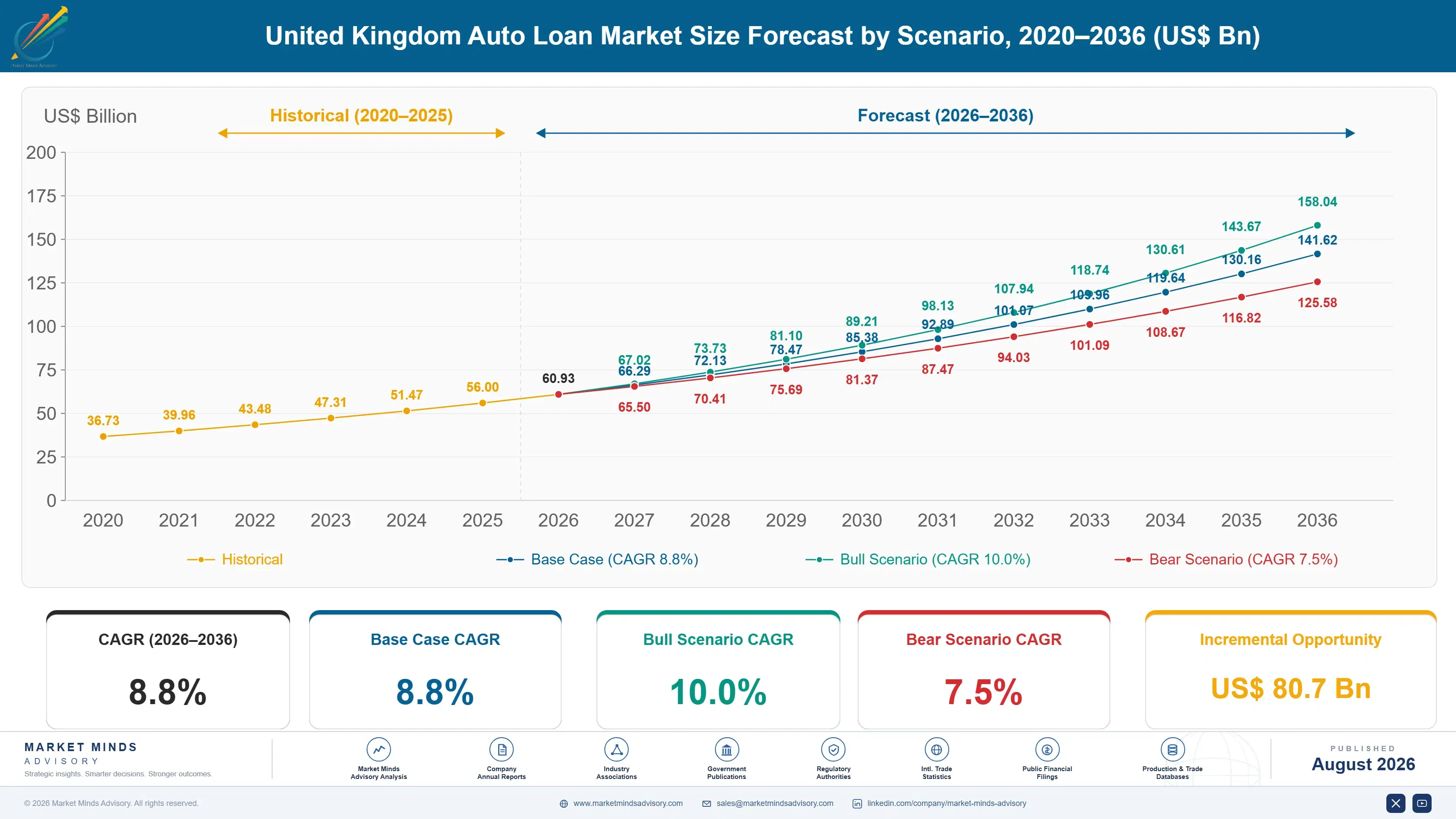
2025 MARKET VALUE$56.0BMarket Size 2025
2036 FORECAST VALUE$141.6BBase Case , 2026 to 2036
CAGR 2026 TO 20368.8 %Bull 10.0% / Bear 7.5%
INCREMENTAL OPPORTUNITY$80.7BNet 10- year value creation
EXPANSION MULTIPLE2.32x2036 value over 2026 base
Strategic Levers
M&A Pipeline
Regional Outlook
Country Rankings
Competitive Intelligence
Segmental Deep-dive
Call-Us : 91 93563 13602

Executive Snapshot and Market Trajectory

United Kingdom auto lenders are restructuring product lines around electric vehicle financing as the 2030 combustion engine sales ban approaches, pushing captive finance arms to redesign residual value assumptions built for combustion vehicles that no longer reliably hold across most model ranges.
Personal contract purchase remains the dominant structure for new vehicle financing, but electric vehicle-specific products are expanding fastest as manufacturers subsidize financing rates to accelerate adoption. Demand concentrates heavily among company car and fleet buyers responding to favorable benefit-in-kind tax treatment for electric vehicles relative to petrol and diesel alternatives. Manufacturer-subsidized rates are compressing net interest margin for captive lenders even as unit volume climbs steadily across most brands.
Captive finance arms tied to major manufacturers retain substantial combined share, but independent and digital-first lenders are winning share among used vehicle buyers underserved by manufacturer-aligned products. Tightening affordability assessment rules from the Financial Conduct Authority continue reshaping which lenders can profitably serve marginal credit segments. Consolidation among smaller independent lenders looks increasingly likely as compliance cost keeps climbing under expanded regulatory scrutiny of commission structures. Broker commission scrutiny is reshaping deal structuring practices industry-wide.
Market Definition
This report covers loan and lease financing products secured against passenger vehicle purchases for United Kingdom consumers and small businesses, including hire purchase, personal contract purchase, and personal contract hire structures. It excludes commercial fleet financing above light vehicle classifications and unsecured personal loans used for vehicle purchase.
Base Year Value
$56.0B in 2025 (MMA Primary Research Dataset, August 2026)
Forecast Period
2026 to 2036, eleven discrete annual values
CAGR
8.8% base case. Bull 10.0%. Bear 7.5%.
Fastest Growth Segment
Electric Vehicle Financing Products: 16.8% CAGR
Fastest Growth Country
Vietnam: 14.8% CAGR
Fastest Growth Region
South Asia and Pacific: 10.8% CAGR
Largest Region
Western Europe: 26% of 2025 global value
Market Leaders
Black Horse, Santander Consumer Finance UK, MotoNovo Finance, Close Brothers Motor Finance, VW Financial Services UK. Source: MMA Analysis based on company annual reports.
Primary Survey
n=3,800 procurement and R&D decision-makers, Q4 2025, six countries
Methodology
Demand-side build-up, cross-validated against public data, 47 expert interviews

United Kingdom Auto Loan Market Forecast Scenarios

united-kingdom-auto-loan-market-size-forecast-scenario-1787918047648
Auto lending grew steadily between 2020 and 2025 despite a pandemic-driven new vehicle supply shortage in 2021 and 2022, followed by renewed volume as production normalized and electric vehicle model availability expanded considerably across most manufacturer lineups. Used vehicle financing led much of the early recovery as new vehicle waiting lists stretched past a year for popular models.
The base case assumes continued growth driven by three commercial mechanisms: accelerating electric vehicle adoption ahead of the 2030 combustion ban expanding financed vehicle values, growing personal contract purchase penetration among younger buyers preferring lower monthly payments over ownership, and broader lender adoption of digital origination that shortens approval cycles considerably across the market. These three forces reinforce each other across the horizon, compounding growth beyond what any single mechanism alone would produce.
The bull case hinges on electric vehicle financing costs falling enough to match combustion equivalents, pulling forward adoption meaningfully. The bear case centers on a sustained cost-of-living squeeze that suppresses new vehicle purchasing and pushes buyers toward the used market, slowing overall loan value growth across the industry. Either scenario would meaningfully reshape which lenders hold pricing power over the coming decade.

Electric Vehicle Transition Reshapes Financing Structures

United Kingdom auto lending sits at the intersection of an accelerating electric vehicle transition, tightening affordability regulation, and a maturing digital application infrastructure that has compressed approval timelines considerably across most lender segments over the past several years. Lenders that invested early in automated affordability assessment and open banking income verification are now capturing disproportionate share of new applications across most dealer networks nationwide, particularly for used vehicle transactions.
TOP 5 CONCENTRATION41%Combined origination share held by the largest lenders
AVERAGE APR NEW VEHICLES7.4%Typical annual percentage rate charged on new financing
PCP PENETRATION RATE82%Share of new financed vehicles using contract purchase structures
DIGITAL ORIGINATION SHARE36%New applications processed entirely through fully digital channels
AVERAGE LOAN TERM48 monthsTypical repayment period selected across financed vehicle purchases
DEFAULT RATE1.2%Share of accounts running more than ninety days past due
The market's commercial character reflects a bifurcated lender base: manufacturer captive finance arms offering subsidized electric vehicle rates to drive unit sales, and independent lenders competing on flexibility for used vehicle buyers and borrowers outside standard credit criteria. This bifurcation is intensifying as captive lenders push further into used vehicle territory once ceded entirely to independent competitors, narrowing the differentiation gap that smaller lenders depended on for volume growth.
Regulatory scrutiny of commission structures, combined with the approaching 2030 combustion sales ban, will define the competitive landscape over the coming decade as lenders balance electric vehicle volume ambitions against prudential underwriting standards. Consolidation pressure on smaller independent lenders is building steadily, and electric vehicle residual value uncertainty could reshape which institutions command pricing power over the fastest-growing segments.
"Financing used to follow the car. Now the car increasingly follows the financing, since manufacturers are subsidizing electric vehicle loan rates aggressively enough to change which model a buyer actually chooses."
Practice Lead, Automotive Finance and Consumer Lending Intelligence · MMA Automotive Finance and Consumer Lending Practice · August 2026

Market Trends

Manufacturer-Subsidized Electric Vehicle Rates Reshape Demand

Automakers are subsidizing electric vehicle financing rates well below market benchmarks to accelerate adoption ahead of the 2030 combustion sales ban, effectively using captive finance arms as a demand-generation tool rather than a standalone profit center. Volkswagen Financial Services UK and Alphera Financial Services have both expanded subsidized electric vehicle rate programs covering a growing share of new financing volume. This approach compresses captive lender margins meaningfully in the near term, but manufacturers view the trade-off as necessary to hit mandated electric vehicle sales targets under the zero emission vehicle mandate.
Market Impact: Lifts fleet electric share 19 points

Open Banking Verification Compresses Approval Timelines

Lenders increasingly use open banking data feeds to verify income and existing debt obligations in real time, converting what was once a multi-day manual document review process into near-instant automated decisions for qualified borrowers. MotoNovo Finance and Zopa have both expanded proprietary open banking underwriting tools covering a growing share of new applications. This shift is compressing origination cost meaningfully across the industry, favoring lenders with strong technical integration capability over those still dependent on manual payslip verification. Smaller independent lenders without comparable engineering budgets increasingly license third-party open banking tools to remain competitive on approval speed and borrower experience.
Market Impact: Raises PCP share to 82%

Market Opportunities and Growth Drivers

Benefit-in-Kind Tax Advantage Accelerates Fleet Electric Adoption

Favorable benefit-in-kind tax treatment for electric company cars, set meaningfully lower than petrol and diesel equivalents, continues driving fleet buyers toward electric vehicle financing at a pace outpacing private consumer adoption. Close Brothers Motor Finance and Alphera Financial Services have both reported higher electric vehicle financing volume within fleet channels as a direct consequence of this tax policy. Every fleet renewal cycle now defaults toward electric options given the multi-year tax savings available to company car drivers across most income brackets nationwide. Manufacturer marketing budgets have shifted accordingly, emphasizing fleet-specific electric vehicle offers over private buyer campaigns.
Market Impact: Adds 340 million pounds in provisions

Personal Contract Purchase Preference Grows Among Younger Buyers

Younger buyers increasingly prefer personal contract purchase structures over traditional hire purchase or outright ownership, valuing lower monthly payments and the flexibility to change vehicles every few years without committing to long-term ownership. Black Horse and Santander Consumer Finance UK have both expanded dedicated personal contract purchase product lines tied directly to this demographic shift over the past several years. This preference shift is expected to persist as vehicle prices continue outpacing wage growth across most income segments nationwide. Dealers report PCP now anchors nearly every new vehicle sales conversation regardless of manufacturer or price segment.
Market Impact: Raises EV residual risk premium 4%

Market Restraints and Challenges

Commission Structure Investigation Raises Compliance Cost

The Financial Conduct Authority's investigation into discretionary commission arrangements has forced lenders to overhaul dealer commission structures industry-wide, creating meaningful compliance cost and legal exposure tied to historical lending practices dating back over a decade. The root cause is discretionary commission models that incentivized dealers to inflate interest rates without adequate customer disclosure requirements. Lenders are mitigating exposure by moving toward flat commission structures and enhanced disclosure protocols, but legacy claims processing continues consuming meaningful compliance resources across most major lenders nationwide. Smaller lenders without dedicated legal teams face disproportionate resource strain relative to their overall book size.
Market Impact: Cuts EV rates 180 basis points

Electric Vehicle Residual Value Uncertainty Weighs on Pricing

Rapid electric vehicle technology change and battery degradation concerns create genuine uncertainty around residual values that captive lenders must price into monthly payment structures, sometimes conservatively enough to make electric financing less competitive than expected. The root cause is limited historical data on long-term battery performance and a fast-moving competitive landscape that risks obsoleting current models quickly. Lenders are mitigating this by partnering with battery health certification providers, but residual value risk remains meaningfully higher than for comparable combustion vehicles. Third-party residual value guarantee products are emerging to help lenders manage this exposure more confidently.
Market Impact: Cuts approval time under 24 hours
3 additional market trends, 3 additional growth drivers, and 4 additional restraints and challenges are covered in the full report. Contact sales@marketmindsadvisory.com to access the complete intelligence.

Segment CAGR and Growth Architecture

United Kingdom auto lending segments across six mutually exclusive product structures, ranging from traditional hire purchase through fast-growing electric vehicle financing and digital-only lending platforms that increasingly determine which providers capture new borrower volume across the lending industry in most recent annual reporting periods measured nationwide. These distinctions matter increasingly for lenders setting long-term technology and underwriting investment priorities.
united-kingdom-auto-loan-market-market-share-analysis-1787918048225

Electric Vehicle Financing Products

Electric vehicle financing products bundle manufacturer-subsidized interest rates, battery health guarantees, and residual value protection into structures tailored specifically to electric vehicle purchases, distinguishing them from standard combustion financing offers available across most dealer networks. Volkswagen Financial Services UK and Alphera Financial Services have both scaled dedicated electric vehicle product lines covering an increasing share of fleet and private buyer demand nationwide. Growth here consistently outpaces every other segment because manufacturers are subsidizing rates aggressively to hit mandated sales targets, and benefit-in-kind tax treatment continues pulling fleet buyers toward electric options at an accelerating pace across most income brackets. Regulatory support for the zero emission vehicle mandate should further accelerate this trend over the coming several years.
CAGR 16.8%

Digital-Only Direct Lending Platforms

Digital-only direct lending platforms bypass traditional dealer finance desks entirely, allowing borrowers to secure pre-approved financing before ever visiting a showroom, then apply that approval toward any qualifying vehicle purchase nationwide. Zopa and Oodle Car Finance have both built proprietary digital platforms that process applications and disburse funds without requiring in-person dealer interaction at any stage. Demand is accelerating as borrowers increasingly research and compare financing options online before committing to a specific dealer relationship, and digital platforms consistently offer faster decisions than traditional point-of-sale financing processes. This segment also appeals to used vehicle buyers who value price transparency and want to avoid dealer negotiation, a growing preference among younger borrowers researching financing terms independently before shopping.
CAGR 13.2%
Full segment breakdown across 6 segments available in the complete report.

Regional Architecture and Country Demand Map

United Kingdom auto lending assets concentrate within Western Europe given the market's national scope, while faster-growing vehicle financing markets abroad expand from smaller installed bases across rising vehicle ownership rates and newly digitizing lending infrastructure worldwide. Regulatory frameworks shape how quickly each region absorbs new financing structures.

North America

United States and Canadian auto lending, while outside this report's United Kingdom focus, provides useful comparative context for financing structure innovation given the region's larger absolute scale and longer history of subscription-based vehicle access models. Captive finance arms tied to American and Japanese manufacturers dominate origination volume across most metropolitan markets. Digital-first lenders continue winning share from traditional dealer finance desks, a trend United Kingdom lenders are actively studying and adapting for their own market. Lenders here also pioneered residual value guarantee products that United Kingdom captive arms are now adapting for electric vehicle financing structures. Manufacturer captive arms here also carry meaningfully larger loan books given the region's higher average vehicle price points.
Share: 25% | CAGR: 8.4% (2026 to 2036)

Western Europe

The United Kingdom anchors this region's assets as the report's named market, with the Financial Conduct Authority's commission structure reforms setting a regulatory template other European markets are now watching closely. Germany and France maintain comparably large auto lending markets shaped by strong domestic manufacturer captive finance arms including Volkswagen Financial Services and Stellantis Financial Services. Electric vehicle financing incentives vary considerably by country, creating a fragmented but rapidly evolving regional product landscape. Cross-border lender expansion remains limited given differing national consumer protection frameworks across the European Union's member states. Consumer advocacy groups continue monitoring commission transparency closely as reforms spread beyond the United Kingdom's borders. Adoption pace varies notably by country.
Share: 26% | CAGR: 7.2% (2026 to 2036)
Regional intelligence for 5 additional markets available in the complete report: East Asia, South Asia and Pacific, Latin America, Middle East and Africa, Eastern Europe. Contact sales@marketmindsadvisory.com.
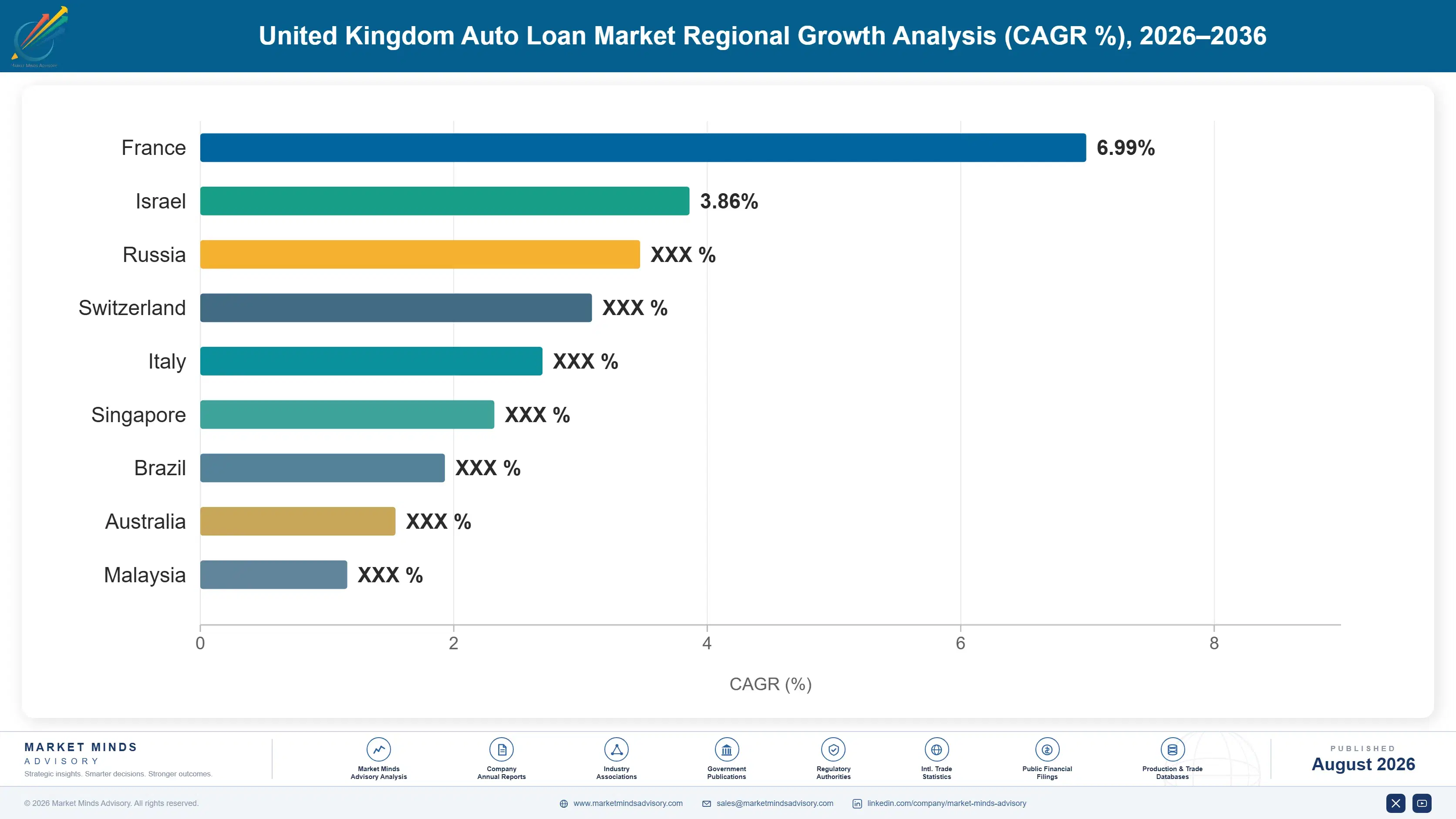
united-kingdom-auto-loan-market-country-cagr-analysis-1787918048742

Where Lenders Can Capture Additional Margin

Beyond standard interest rate spreads, auto lenders are building adjacent revenue streams that monetize electric vehicle transition demand, digital origination scale, and residual value protection without depending further on rate-based competition alone across the core lending business. a shift reshaping technology investment priorities across the industry over the coming several years as core lending margins face compression.

Expand Battery Health Certification Partnership Coverage

Lenders partnering with battery health certification providers can price electric vehicle residual value more confidently, reducing the conservative pricing buffer currently applied to most electric financing offers and improving competitiveness against combustion equivalents. Volkswagen Financial Services UK has scaled certification partnerships that now cover a meaningfully higher share of its electric vehicle loan book than 2 years ago. This capability generates modest direct fee revenue while meaningfully de-risking the larger electric vehicle lending portfolio against unexpected battery degradation claims. Early data suggests certified vehicles retain 4 to 6 percent higher resale value than uncertified comparables, supporting more competitive payment structures.
Market Impact: Cuts residual buffer by 2 to 3 points

Build Direct-to-Consumer Digital Pre-Approval Program Channels

Offering pre-approved financing before a borrower visits a dealership captures the customer relationship earlier in the purchase journey, reducing dependence on dealer referral commissions that regulatory scrutiny is compressing meaningfully. Zopa and Oodle Car Finance have both scaled direct-to-consumer channels that now generate a growing share of total originations outside traditional dealer finance desks. This channel also improves loan performance, since pre-approved borrowers tend to select vehicles within their confirmed budget more consistently than dealer-influenced buyers. Early data shows pre-approved borrowers close financing 3 to 4 days faster on average than dealer-originated applications, reducing abandonment meaningfully.
Market Impact: Cuts dealer commission cost by 15 to 20%

Monetize Underwriting Infrastructure Through External Licensing

Large lenders that built proprietary open banking underwriting platforms are increasingly licensing this technology to smaller independent lenders lacking comparable engineering budgets, converting a cost center into a standalone revenue line. MotoNovo Finance has begun exploring platform licensing arrangements with several smaller lender partners seeking faster approval capability without full internal build costs. This approach generates high-margin recurring software revenue that partially offsets rising compliance and technology investment elsewhere in the business. Early licensing pilots suggest this channel could generate 6 to 10 percent incremental platform revenue within 3 years of launch across smaller lender partners.
Market Impact: Generates 6 to 10% platform revenue by 2029

Cross-Sell Insurance and Extended Warranty Products

Lenders increasingly bundle gap insurance and extended warranty referrals into the vehicle financing process, capturing commission revenue from an engaged borrower at the exact moment they are making major financial decisions about vehicle protection. Black Horse and Close Brothers Motor Finance have both expanded referral programs tied directly to financing relationships, generating meaningful incremental fee income per funded loan. This cross-selling motion also strengthens borrower retention, since customers with multiple bundled products are demonstrably less likely to switch lenders at renewal. Borrowers holding 2 or more bundled products show lower renewal churn, reinforcing relationship value across the portfolio.
Market Impact: Adds 8 to 12% fee revenue per loan

Who Controls the Margin Pool

Top 5 concentration sits at 41 percent of United Kingdom auto loan origination volume, meaningful given the market's fragmentation across captive and independent lenders. Black Horse and Santander Consumer Finance UK lead the pack, with a notable gap separating them from the third-ranked competitor across most origination metrics. This gap reflects differences in parent company scale that smaller regional players struggle to close quickly.
Current competitive activity centers on electric vehicle rate subsidization, digital pre-approval channel investment, and battery health certification partnerships rather than aggressive rate-based price competition alone. Lenders are racing to expand product breadth and shorten approval timelines, since these capabilities increasingly determine which institutions win borrowers who would otherwise shop multiple lenders before committing to a specific financing structure. Marketing spend has shifted toward electric vehicle rate messaging over headline rate positioning.

Emerging pressure is coming from digital-first entrants like Zopa and Oodle Car Finance that target borrowers underserved by traditional dealer finance desks. Rankings could shift meaningfully if a mid-tier lender successfully combines direct-to-consumer distribution with existing captive manufacturer relationships, a combination none of the current top five players has fully executed yet. Continued fintech funding suggests this pressure will intensify rather than fade.
united-kingdom-auto-loan-market-company-positioning-matrix-1787918049266

Competitive Moat and Risk Dimensions

BLACK HORSE

Moat: Lloyds Banking Group Scale

Black Horse benefits from Lloyds Banking Group's enormous balance sheet and dealer network relationships, giving it funding cost and distribution advantages that smaller independent lenders cannot match without comparable parent company backing. This scale compounds because existing banking relationships create natural cross-sell opportunities into vehicle financing, generating a steady origination pipeline across most dealer partnerships nationwide.
BLACK HORSE

Risk: Legacy System Modernization Lag

Black Horse's scale advantage is partially offset by legacy core banking infrastructure that slows digital pre-approval rollout relative to nimbler fintech competitors building on modern technology stacks from inception. Continued investment is required to close this gap, and any visible delay risks ceding fast-growing digitally native borrower segments to more agile competitors.
SANTANDER CONSUMER FINANCE UK

Moat: Multi-Brand Dealer Relationships

Santander's captive finance arrangements span multiple manufacturer brands rather than a single automaker, giving it dealer network breadth that single-brand captive lenders cannot replicate. This diversification reduces exposure to any single manufacturer's sales performance and lets Santander maintain consistent origination volume even when individual brands experience temporary demand softness.
SANTANDER CONSUMER FINANCE UK

Risk: Multi-Brand Coordination Complexity

Managing financing terms and technology integration across multiple manufacturer relationships creates coordination complexity that single-brand captive lenders avoid entirely, occasionally slowing product rollout timing relative to more focused competitors. This complexity could become a meaningful disadvantage as electric vehicle financing innovation accelerates across the industry.

Players Tracked

Prominent Players

Black Horse
Santander Consumer Finance UK
MotoNovo Finance
Close Brothers Motor Finance
VW Financial Services UK

Other Key Players

BMW Financial Services UK
Alphera Financial Services
Toyota Financial Services UK
Ford Credit UK
PSA Finance UK
Mercedes-Benz Finance UK
Hyundai Capital UK
RCI Bank UK
Blue Motor Finance
Startline Motor Finance
Moneybarn
First Response Finance
Oodle Car Finance
Zopa
CarFinance 247

Recent Developments

FEBRUARY 2025

MotoNovo Finance Launches Battery Health Certification Partnership

MotoNovo Finance partnered with a battery health certification provider to offer more confident residual value pricing on electric vehicle financing products. The partnership covers the majority of new electric vehicle financing applications processed through MotoNovo's dealer network, reducing conservative pricing buffers meaningfully across most electric model ranges.
Signal: Signals residual value confidence becoming a key competitive differentiator industry-wide. Competitors are expected to pursue similar partnerships soon.
JUNE 2025

Santander Consumer Finance UK Expands Digital Pre-Approval Platform

Santander Consumer Finance UK expanded its digital pre-approval platform to cover used vehicle financing, previously limited to new vehicle purchases only. The expansion followed strong customer demand feedback from the initial new vehicle rollout, which processed a meaningfully higher application volume than expected in its first two quarters.
Signal: Signals direct-to-consumer distribution becoming a core competitive battleground broadly. Used vehicle digital adoption should accelerate across competing lenders.

Funding and Residual Value Risk Pressure

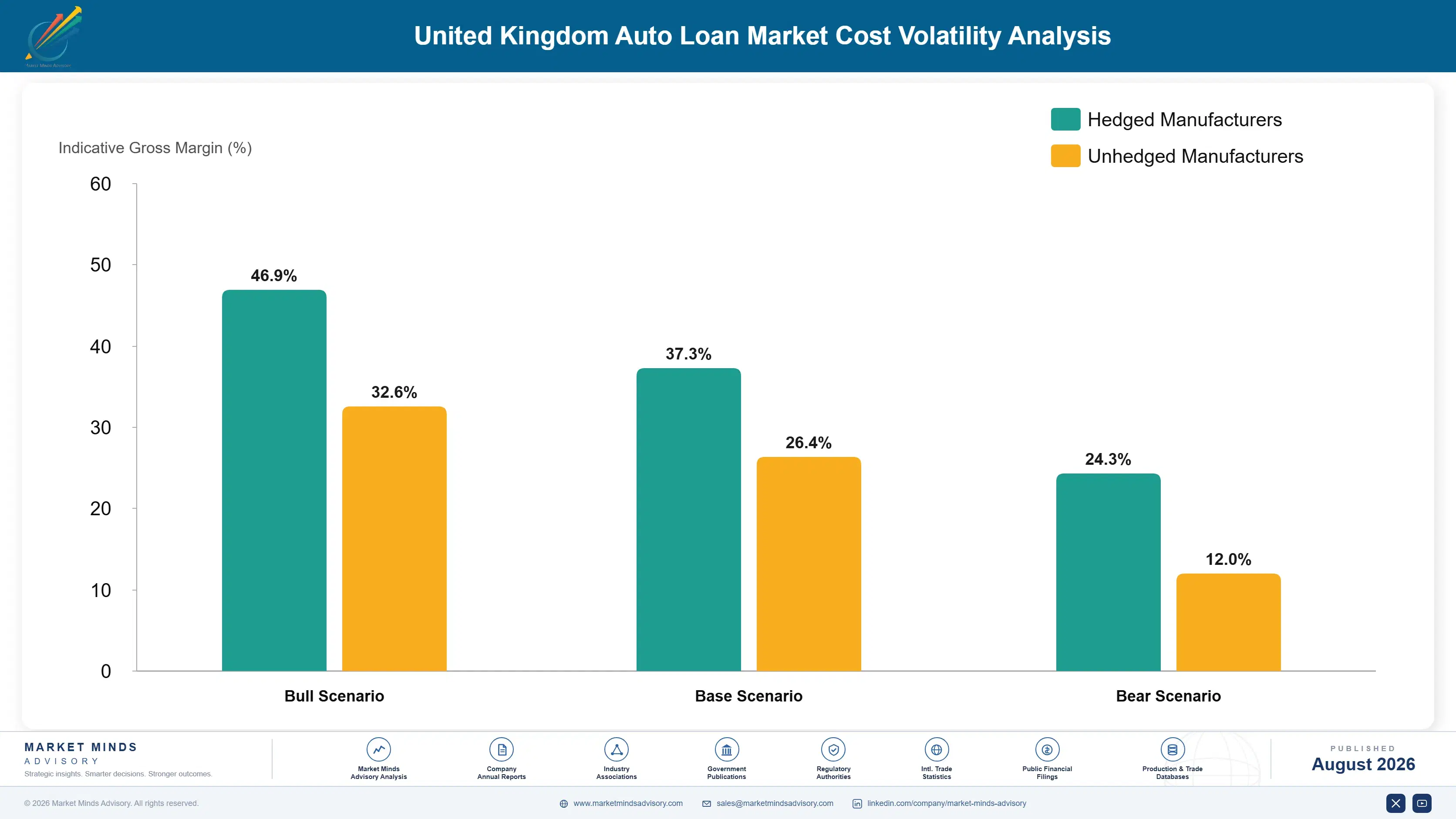
Wholesale funding cost represents roughly 48 percent of total operating cost for United Kingdom auto lenders, with regulatory compliance and dealer commission oversight accounting for a further 15 percent tied to Financial Conduct Authority requirements. Residual value risk provisioning makes up most of the remainder, increasingly weighted toward electric vehicle uncertainty relative to combustion equivalents.
The Financial Conduct Authority's 2024 commission structure ruling, documented in FCA supervisory publications, pushed several lenders to set aside substantial legal provisions for historical discretionary commission arrangements. Close Brothers Group's 2024 annual report noted meaningful provisioning against potential commission-related claims, a cost pressure that persisted well into the following fiscal year across most major lenders. Several smaller independent lenders faced disproportionately larger provisioning relative to loan book size given fixed legal review costs.

Smaller independent lenders face proportionally higher compliance cost per loan than the largest five lenders, since fixed regulatory and legal infrastructure investment does not scale down with loan book size. This creates a durable cost disadvantage for sub-scale providers, pushing many toward partnership with larger institutions or exit from price-sensitive borrower segments entirely as compliance cost keeps climbing faster than fee revenue growth.
united-kingdom-auto-loan-market-cost-volatility-analysis-1787918049460

Diversified Wholesale Funding Sources

Independent lenders increasingly diversify funding across securitization channels and institutional credit facilities, reducing dependence on any single wholesale source and narrowing the cost gap against deposit-funded bank competitors over time considerably. Several mid-sized lenders have also begun pooling securitization issuance to achieve better pricing terms than any single institution could negotiate independently on its own.

Battery Health Certification for Residual Risk

Partnering with battery health certification providers allows lenders to price electric vehicle residual value more confidently, reducing the conservative pricing buffer applied to most electric financing offers and improving overall portfolio profitability. Early data suggests certified vehicles command meaningfully stronger resale performance, directly supporting more competitive monthly payment structures for borrowers choosing electric options.

Shared Compliance Infrastructure Across Lenders

Smaller independent lenders increasingly pool regulatory compliance and legal infrastructure investment through industry associations, spreading fixed cost across a larger participant base and narrowing the per-loan cost gap against the largest five lenders. Industry consortiums have begun standardizing shared audit frameworks, lowering onboarding cost for new lenders entering the regulated market. This coordination benefits the entire market.

Portfolio Architecture for Margin Defence

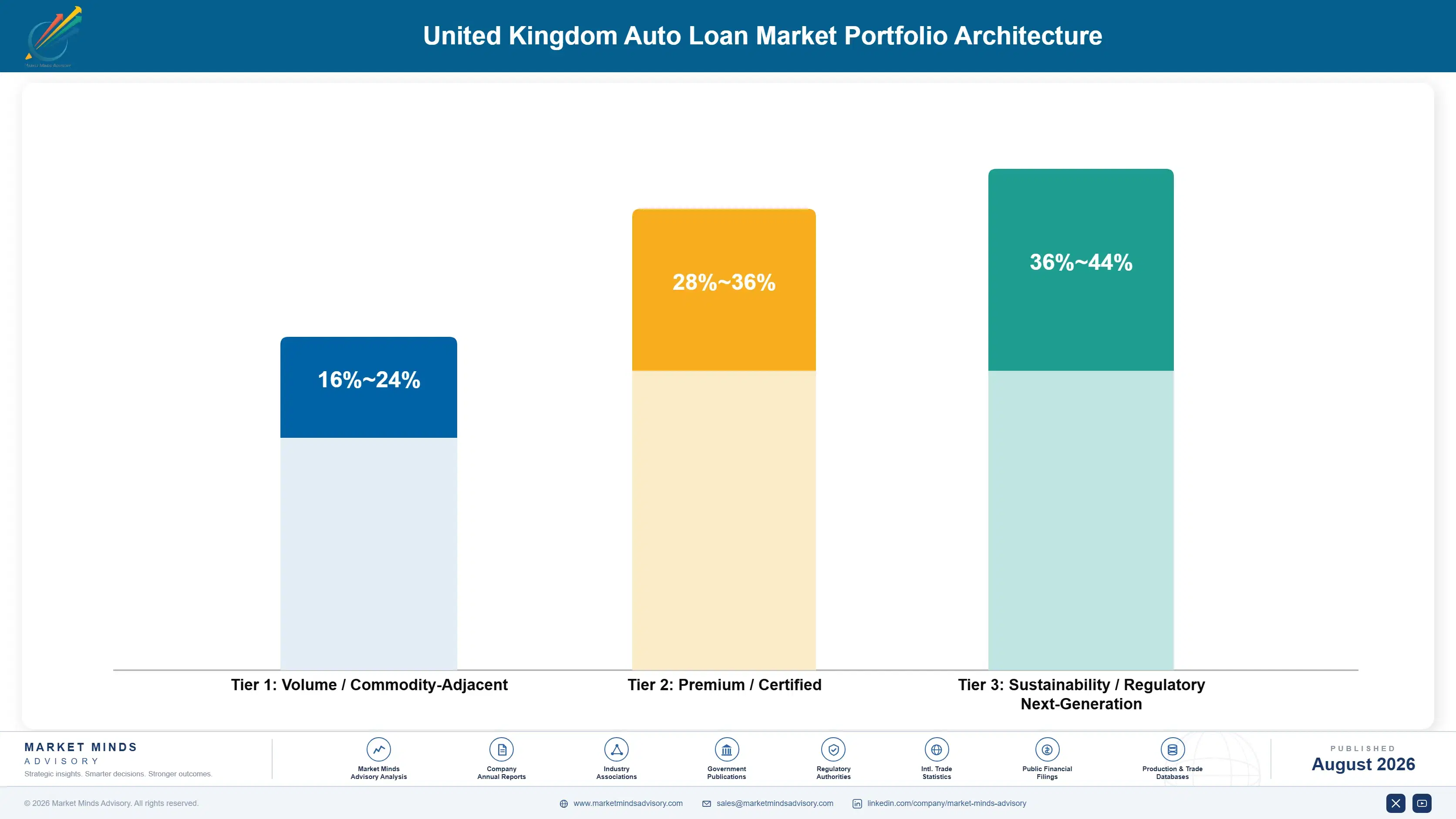
United Kingdom auto lending economics split across three tiers with meaningfully different margin profiles. Volume-oriented standard hire purchase and used vehicle financing compete almost entirely on rate and approval speed, generating thin net interest margins relative to more differentiated product structures across the industry. Only the largest five lenders sustain acceptable returns at this pricing level given fixed technology and compliance overhead spread across enormous origination volume nationwide.
Certified electric vehicle and fleet-specific products command premium pricing tied to manufacturer subsidy arrangements and service depth. Digital-only direct lending platforms carry the highest margins but remain a comparatively small share of total origination volume today, reflecting their early stage of mainstream adoption across most lender segments nationwide. Early movers in this tier are capturing disproportionate share of borrowers seeking transparent pricing without dealer negotiation friction.

The volume versus premium tension defines competitive strategy across every major lender: captive arms defend core electric vehicle margins through manufacturer subsidy, while independent lenders concentrate on higher-value digital direct and used vehicle segments where differentiation still commands real pricing power. Smaller lenders without scaled electric vehicle infrastructure increasingly partner with certification providers rather than build comparable capability independently.

Volume / Commodity-Adjacent

Standard hire purchase and used vehicle financing competing primarily on interest rate and approval speed for broad, price-sensitive borrower segments nationwide across most dealer networks. Margin here has compressed steadily over the past several years as digital comparison tools increase rate transparency for borrowers.
Gross Margin: 16-24%

Premium / Certified

Electric vehicle and fleet-specific financing bundling manufacturer subsidy arrangements and faster approval cycles for borrowers with specific vehicle and timeline requirements. Retention rates run notably higher among electric vehicle borrowers relative to standard hire purchase accounts on comparable lending platforms.
Gross Margin: 28-36%

Sustainability / Regulatory / Next-Generation

Digital-only direct lending platforms and battery health certified structures serving borrowers seeking transparent pricing without dealer negotiation friction or opaque financing terms. Adoption remains concentrated among the largest and most sophisticated fintech entrants currently building out this capability.
Gross Margin: 36-44%
united-kingdom-auto-loan-market-portfolio-architecture-1787918049963

High-value Sub-segments and Strategic Watch-out

Electric Vehicle Financing Products

Manufacturer-subsidized structures bringing lower-cost capital access to electric vehicle buyers represent the fastest-growing, highest-margin opportunity in auto lending today, with adoption accelerating steadily across all segments. Provider selection increasingly shapes borrower decisions across dealer networks. Digital comparison tools accelerate this shift further. Awareness keeps building steadily.
Gross Margin: 36-44%

Digital-Only Direct Lending Platforms

Direct-to-consumer digital financing commands premium fees and strong borrower retention, though growth trails the fastest electric vehicle segment as adoption remains concentrated among younger buyers currently. This trend should strengthen as digital comparison tools proliferate further. Younger buyers drive most of this segment's growth. Adoption keeps building nationwide.
Gross Margin: 28-36%

Standard Hire Purchase Origination

The volume backbone of the industry, generating predictable but thin origination margins across the vast majority of total financed vehicle balances nationwide under continuous rate pressure. Consolidation pressure continues building steadily among smaller sub-scale lenders. Scale remains the primary driver of profitability here. Competition here remains intense.
Gross Margin: 16-24%

Legacy Combustion Vehicle Financing

A shrinking segment as the 2030 combustion sales ban approaches, pushing lenders to wind down long-term combustion vehicle product development in favor of electric alternatives. Wind-down timelines vary considerably by manufacturer commitment to the 2030 deadline. Specialized lenders focused on transition products are watching closely.
Gross Margin: 14-20%

How Financing Relationships Renew Over Time

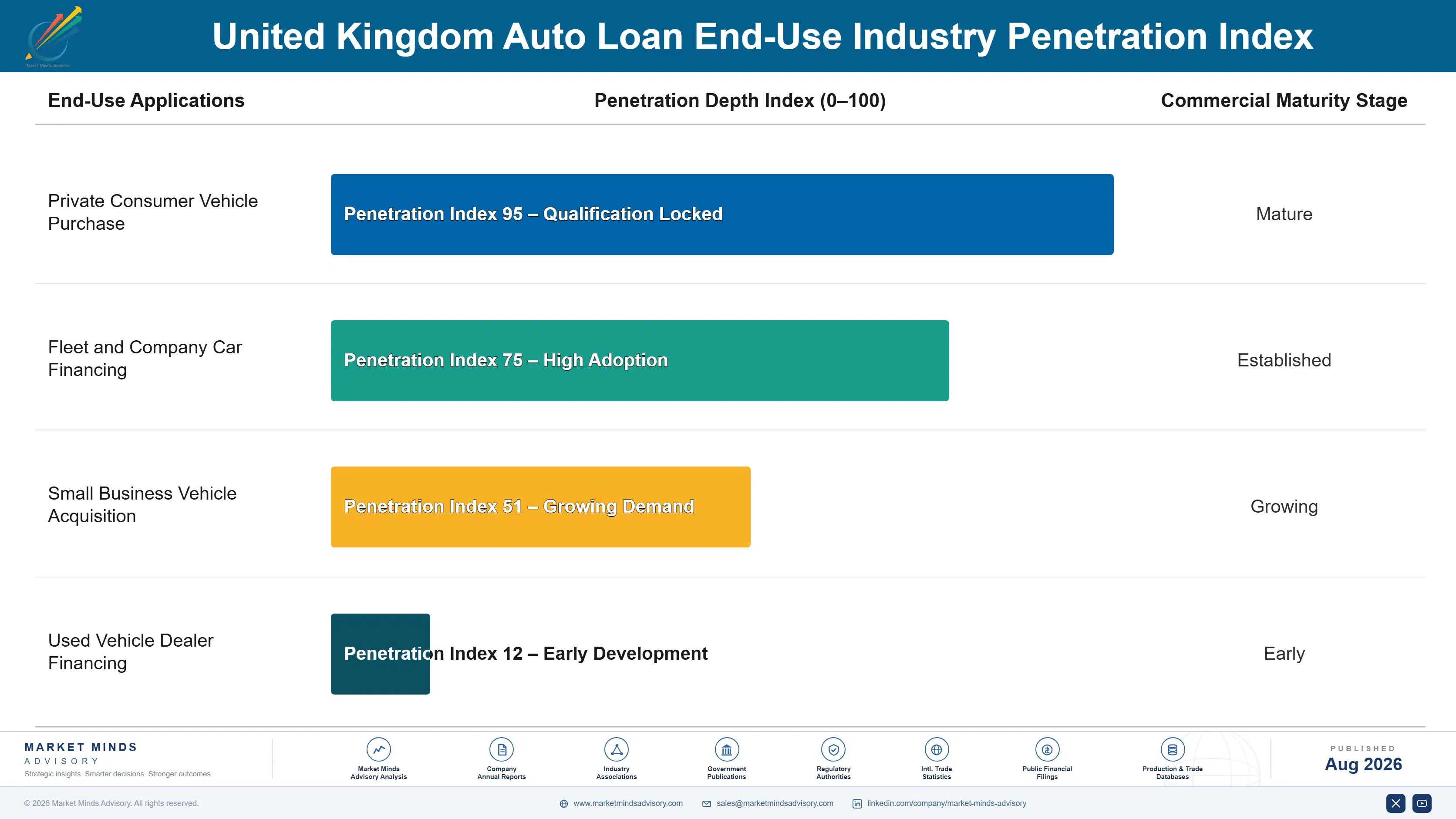
Auto loan relationships behave like recurring subscriptions once established. Most borrowers replace their financed vehicle every three to four years under personal contract purchase structures, and lenders that retain the relationship at renewal capture another multi-year revenue stream without needing to acquire an entirely new customer. Attrition happens almost exclusively through vehicle sale or a rare voluntary refinancing decision rather than active provider switching mid-agreement.
Adoption stickiness varies meaningfully by borrower vertical. Fleet and company car buyers exhibit the deepest stickiness, often maintaining the same captive lender relationship across multiple vehicle cycles, while private used vehicle buyers show comparatively higher churn as digital-first lenders undercut legacy dealer finance desks on speed and pricing transparency. Financial services and technology-sector borrowers show the shallowest stickiness of any major borrower vertical measured.

Buyer profiles are shifting generationally as younger borrowers, more comfortable evaluating financing options online before visiting a dealership, replace older buyers who historically accepted whatever financing terms a dealer presented at the point of sale. This generational transition is gradually eroding the switching-cost advantage that dealer-aligned lenders relied on for decades. Lenders slow to modernize digital pre-approval capability risk losing renewals to challengers after years of service.
united-kingdom-auto-loan-market-end-use-penetration-index-1787918050451

MMA Analyst Assessment and Recommendations

These are among the four positions where our research anticipates prominent divergence between winners and laggards over the coming forecast period. Each is grounded in the demand model, the regulatory perimeter, and the announced capacity pipeline.
01 / PRODUCT INNOVATION STRATEGY

Build electric vehicle residual value confidence before competitors do

Battery health certification remains a meaningfully underdeveloped capability outside a small handful of specialized lenders, and early movers are already capturing disproportionate share of electric vehicle financing demand. Lenders that wait risk ceding a fast-growing, high-margin segment to more prepared competitors permanently. The window for establishing real residual value confidence here is closing steadily, and every additional quarter of delay makes catching up meaningfully harder for lenders entering the category late, compounding risk exposure across the entire electric vehicle loan book rather than just newly originated agreements.
02 / DISTRIBUTION AND CHANNELS

Expand direct-to-consumer digital pre-approval capability now

Digital-first origination is growing faster than dealer-referred lending, and the lenders capturing this growth are the ones investing early in pre-approval channels that capture borrowers before they visit a showroom. Providers still dependent primarily on dealer finance desks are ceding this segment to more digitally integrated competitors. This is not a marginal opportunity, it is one of the largest sources of net-new origination volume available over the next several years, and waiting another cycle risks losing an entire generation of digitally native buyers permanently to more responsive challengers.
03 / REGULATORY COMPLIANCE POSTURE

Treat commission reform as a permanent industry shift

The Financial Conduct Authority's commission structure reforms show no sign of reversing, and lenders that fully embrace flat commission models now will avoid the legal exposure still accumulating for competitors clinging to legacy discretionary arrangements. Treating this as a temporary regulatory phase rather than a permanent shift risks continued provisioning drag on profitability. Lenders that get this positioning wrong will keep absorbing avoidable legal and compliance cost for years to come, compounding exposure and eroding trust with dealer partners already navigating meaningful transition friction.
04 / FUNDING AND CAPITAL STRATEGY

Diversify wholesale funding before rate volatility returns again

Independent lenders remain disproportionately exposed to wholesale funding cost volatility, and providers that diversify funding sources now will be better positioned when the next rate cycle inevitably arrives. Waiting until volatility hits again leaves little time to build the securitization relationships and institutional credit lines that take years to establish credibly. Lenders that treat funding diversification as optional rather than urgent risk margin compression precisely when better-prepared competitors gain share, an exposure that compounds with every passing rate cycle that catches unprepared lenders without adequate funding diversity.

Engagement Snapshot From the Field

A live engagement with an industry participant carrying material or product regulatory and market exposure ahead of a defining policy shift, showing how our research translates into a defensible multi-year portfolio strategy.
MARKET MINDS ADVISORY · CLIENT ENGAGEMENT SUMMARY
United Kingdom Auto Loan Producer Strategic Portfolio Review and Transition Roadmap 2026·Investment Scenario on United Kingdom Auto Loan Exposure Evaluation 2025-26
CLIENT PROFILE
The client, a mid-sized independent auto lender operating primarily in the South East and Midlands, originated roughly 180 million pounds in annual financing volume through traditional hire purchase products distributed via a network of used car dealers. Leadership sought to evaluate whether launching an electric vehicle financing product would meaningfully expand their addressable market. The client operated primarily through independent used car dealers rather than direct-to-consumer channels.
STRATEGIC CHALLENGE
The client lacked internal data on electric vehicle residual value trends and was uncertain whether existing dealer relationships could effectively sell financing for a category still unfamiliar to many used car buyers. Leadership also worried that entering electric vehicle financing without a battery health certification partnership would expose the book to unacceptable residual value risk.
MMA APPROACH
MMA conducted a structured market sizing exercise for used electric vehicle financing demand within the client's existing dealer footprint, benchmarking competitor residual value assumptions and certification partnership economics. The engagement included structured interviews with the client's top-producing dealers to gauge realistic near-term sales capacity for electric vehicle financing. Findings were benchmarked against comparable independent lenders already operating certified electric vehicle programs.
KEY FINDINGS
  1. Dealer interviews revealed meaningful latent demand among buyers seeking affordable used electric vehicles who had previously been steered toward combustion alternatives by unfamiliar financing terms.
  2. Competitor certified electric vehicle financing carried meaningfully wider margins than the client's existing hire purchase book, even after accounting for certification partnership cost.
  3. Dealer education requirements were more substantial than leadership initially assumed, requiring a dedicated training program before meaningful volume could reasonably be expected.
  4. Battery health certification partnership terms varied considerably between providers, creating meaningful near-term selection risk worth evaluating carefully before committing. MMA recommended a structured evaluation process before finalizing a partner selection.
CLIENT PROFILE
The client, a mid-sized independent auto lender operating primarily in the South East and Midlands, originated roughly 180 million pounds in annual financing volume through traditional hire purchase products distributed via a network of used car dealers. Leadership sought to evaluate whether launching an electric vehicle financing product would meaningfully expand their addressable market. The client operated primarily through independent used car dealers rather than direct-to-consumer channels.
STRATEGIC CHALLENGE
The client lacked internal data on electric vehicle residual value trends and was uncertain whether existing dealer relationships could effectively sell financing for a category still unfamiliar to many used car buyers. Leadership also worried that entering electric vehicle financing without a battery health certification partnership would expose the book to unacceptable residual value risk.
MMA APPROACH
MMA conducted a structured market sizing exercise for used electric vehicle financing demand within the client's existing dealer footprint, benchmarking competitor residual value assumptions and certification partnership economics. The engagement included structured interviews with the client's top-producing dealers to gauge realistic near-term sales capacity for electric vehicle financing. Findings were benchmarked against comparable independent lenders already operating certified electric vehicle programs.
KEY FINDINGS
  1. Dealer interviews revealed meaningful latent demand among buyers seeking affordable used electric vehicles who had previously been steered toward combustion alternatives by unfamiliar financing terms.
  2. Competitor certified electric vehicle financing carried meaningfully wider margins than the client's existing hire purchase book, even after accounting for certification partnership cost.
  3. Dealer education requirements were more substantial than leadership initially assumed, requiring a dedicated training program before meaningful volume could reasonably be expected.
  4. Battery health certification partnership terms varied considerably between providers, creating meaningful near-term selection risk worth evaluating carefully before committing. MMA recommended a structured evaluation process before finalizing a partner selection.
RECOMMENDED STRATEGY
Phase 1: Phase 1 (Pilot): Launch a limited used electric vehicle financing product with a single certification partner across a small group of trained dealers. Phase 2: Phase 2 (Scale): Expand dealer training and certification partnership coverage based on pilot performance data, extending distribution regionally. during this scaling phase. Phase 3: Phase 3 (Optimize): Refine pricing and eligibility criteria using accumulated performance data, then evaluate expansion into additional regions. where dealer readiness supports it.
OUTCOME
The client launched its used electric vehicle financing pilot across its South East dealer network, generating meaningful new origination volume from buyers who would not have previously considered electric options (client-reported, unverified by MMA). Dealer adoption exceeded initial expectations, and the client began planning regional expansion within the first year.

Frequently Asked Questions

Foundational context covering the market sizes, CAGR, scope, country, region and competition that inform every finding below. This section is provided to cover basics and most often pre-purchase conversations, answered from the MMA Primary Research Dataset.

What is the current size of the United Kingdom Auto Loan Market?

The United Kingdom Auto Loan Market reached $56.0 billion in outstanding balances in 2025. This figure reflects hire purchase, personal contract purchase, and personal contract hire products financed for UK vehicle buyers.

How large will the United Kingdom Auto Loan Market be by 2036?

MMA projects the market will reach $141.61 billion by 2036, roughly 2.32 times its 2026 value. Growth is driven primarily by electric vehicle adoption and expanding personal contract purchase penetration.

What is the CAGR for the United Kingdom Auto Loan Market 2026 to 2036?

The market is projected to grow at an 8.8 percent compound annual growth rate between 2026 and 2036. This compares to a historical CAGR of roughly 7.7 percent recorded across the preceding 2020 to 2025 period.

Which segment is growing fastest?

Electric vehicle financing products are growing fastest at a 16.8 percent CAGR, nearly double the overall market rate. This reflects manufacturer rate subsidies and accelerating adoption ahead of the 2030 combustion sales ban.

Who are the major companies in the United Kingdom Auto Loan Market?

Black Horse, Santander Consumer Finance UK, MotoNovo Finance, Close Brothers Motor Finance, and VW Financial Services UK lead by origination volume. Together these five lenders hold roughly 41 percent combined concentration.

Which country is growing fastest?

Vietnam is the fastest-growing auto lending market at a 14.8 percent CAGR, driven by rising middle-class incomes and improving road infrastructure. First-time vehicle ownership is expanding rapidly across the country's urban centers.

Report Segmentation Architecture

The full report scope spans multiple orthogonal segmentation dimensions, with cross-tabulated demand data provided for each dimension pair. Coverage extends further to regional breakdowns, trend trajectories, and the competitive detail needed to support segment-level decision-making.

By Product Structure

  • Hire Purchase Agreements
  • Personal Contract Purchase
  • Personal Contract Hire
  • Electric Vehicle Financing Products
  • Digital-Only Direct Lending Platforms
  • Used Vehicle Financing

By End-Use Industry

  • Private Consumer Vehicle Purchase
  • Fleet and Company Car Financing
  • Small Business Vehicle Acquisition
  • Used Vehicle Dealer Financing

By Commercial Dimension

  • Dealer Point-of-Sale Distribution
  • Direct-to-Consumer Digital Channel
  • Manufacturer Captive Finance Arm
  • Independent Broker Network

By Region

  • North America
  • Western Europe
  • East Asia
  • South Asia and Pacific
  • Latin America
  • Middle East and Africa
  • Eastern Europe

Scope, Methodology, and Coverage

Every figure in this report is reproducible from documented input assumptions. The scope below maps the historical period, the forecast horizon, the segmentation dimensions, and the countries covered, alongside the underlying primary and qualitative methodology.
Historical Period
2020 to 2025
Forecast Period
2026 to 2036
Base Year
2025 (USD billions; MMA Primary Research Dataset, August 2026)
Market Definition
This report covers loan and lease financing products secured against passenger vehicle purchases for United Kingdom consumers and small businesses, including hire purchase, personal contract purchase, and personal contract hire structures. It excludes commercial fleet financing above light vehicle classifications and unsecured personal loans used for vehicle purchase.
Quantitative Units
USD billions (current prices); GBP billions where noted
Segmentation Dimensions
By Product Structure; By End-Use Industry; By Commercial Dimension; By Region
Regions Covered
North America, Western Europe, East Asia, South Asia and Pacific, Latin America, Middle East and Africa, Eastern Europe
Countries Covered
USA, China, Germany, France, UK, Japan, South Korea, India, Australia, Canada, Brazil, Mexico, Indonesia, Vietnam, Thailand, Malaysia, UAE, Saudi Arabia, South Africa, Nigeria, Turkey, Poland, Netherlands, Italy, Spain, Sweden, Switzerland, Argentina, Colombia, Singapore, and additional markets relevant to this sector
Key Companies Profiled
Black Horse, Santander Consumer Finance UK, MotoNovo Finance, Close Brothers Motor Finance, VW Financial Services UK, BMW Financial Services UK, Alphera Financial Services, Toyota Financial Services UK, Ford Credit UK, PSA Finance UK, Mercedes-Benz Finance UK, Hyundai Capital UK, RCI Bank UK, Blue Motor Finance, Startline Motor Finance, Moneybarn, First Response Finance, Oodle Car Finance, Zopa, CarFinance 247
Quantitative Methodology
Primary survey, n=3,800 respondents, Q4 2025, six countries; demand-side model with trade association cross-validation
Qualitative Methodology
47 expert interviews, Q4 2025; applied to validate demand model assumptions, identify emerging dynamics, and assess competitive positioning
Report Format
PDF and XLSX data workbook (Word format preview document)
Publisher
Market Minds Advisory
Report Code
MMA-2026-AUT-244
Published
August 2026
Contact
sales@marketmindsadvisory.com | www.marketmindsadvisory.com

Purchase the full United Kingdom Auto Loan Market Report (2026 to 2036).

This report provides comprehensive coverage of the United Kingdom Auto Loan Market, including detailed sizing, segmentation, and regional analysis through 2036. It examines competitive dynamics among the leading captive and independent lenders, covering their strategic positioning, moats, and vulnerabilities. The analysis also addresses regulatory drivers, funding cost pressure, and emerging electric vehicle financing trends reshaping lending economics. Readers gain access to primary survey data, expert interview insights, and MMA's proprietary forecasting methodology. The report is designed for lending strategy executives, fintech product teams, and institutional auto finance investors evaluating positioning decisions, product launch priorities, or capital allocation across the auto lending value chain.
Ten-year market sizing and forecast model
Six-segment MECE product structure segmentation model
Seven-region demand, share, and growth analysis
Competitive landscape with moat and risk profiles
Primary survey data from 3,800 respondents
Forty-seven expert interviews across lender types

Built For The People Who Decide

From boardroom strategy to bench-side execution, this report is read cover-to-cover by leaders shaping the next decade of their industry, turning demand scenarios, market dynamics and valuation benchmarks into decisions.
CXOs/ Presidents/ VPs/ Managers
M&A and Corporate Development
Strategy Teams and R&D Heads
Procurement and Product Directors
Regulatory and Compliance Leaders
Investor Relations and Equity Analysts