

Market Minds Advisory
Unit Dose Manufacturing Market

Unit Dose Manufacturing Market: Hospitals Became Manufacturers by Default

Bedside scanning demanded a machine-readable dose that manufacturers never supplied for a third of the hospital formulary, so pharmacy departments started repackaging medicines themselves in basements nobody had ever licensed.

Lead Analyst

Alice Ballenger

Published

September 2026

Make Smarter Decisions with Customized Research Insights

Request a free sample report and evaluate market opportunities, growth trends, and competitive dynamics relevant to your business needs.

2025 MARKET VALUE$3.6BMarket Size 2025
2036 FORECAST VALUE$8.2BBase Case , 2026 to 2036
CAGR 2026 TO 20367.8 %Bull 9.0% / Bear 6.6%
INCREMENTAL OPPORTUNITY$4.3BNet 10- year value creation
EXPANSION MULTIPLE2.12x2036 value over 2026 base
Strategic Levers
M&A Pipeline
Regional Outlook
Country Rankings
Competitive Intelligence
Segmental Deep-dive
Call-Us : 91 93563 13602

Executive Snapshot and Market Trajectory

The product here is not really the dose. It is a machine-readable identity at the bedside, which cuts administration errors by around 51% where scanning is in place. Dividing the medicine is incidental to putting a barcode on something a nurse can scan before giving it.
Manufacturers supplied that for the products where it paid and left roughly 34% of a hospital formulary without any scannable presentation at all. Pharmacies filled the gap themselves, and around 41% of doses administered are now repackaged in-house, which is pharmaceutical manufacturing performed in a hospital basement by people whose job description says something else entirely. The medicines missing from manufacturer coverage skew toward low volume and high risk. Necessity built it, not planning.
The cost of doing it that way is hidden in expiry. Once a medicine leaves its original container the manufacturer's stability data no longer applies, so a conservative beyond-use date cuts remaining shelf life by around 78%. Bar-coded repackaging services grow at 11.7%, half again the market rate of 7.8%, on exactly that arithmetic. Providers holding their own validated stability data avoid the reduction entirely. That is the argument.
Market Definition
Manufacture and packaging of pharmaceuticals into single-dose and single-administration presentations, covering oral solid unit dose blisters, unit dose liquids and oral syringes, bar-coded repackaging services, unit dose vials and ampoules, adherence and pouch packaging, and prefilled syringe unit presentations. Measured at manufacturer and service provider selling value. Excludes bulk pharmaceutical manufacture, active ingredient production, retail multi-dose containers, and packaging machinery sold as capital equipment.
Base Year Value
$3.6B in 2025 (MMA Primary Research Dataset, August 2026)
Forecast Period
2026 to 2036, eleven discrete annual values
CAGR
7.8% base case. Bull 9.0%. Bear 6.6%.
Fastest Growth Segment
Bar-Coded Repackaging Services: 11.7% CAGR
Fastest Growth Country
Japan: 13.4% CAGR
Fastest Growth Region
South Asia and Pacific: 9.8% CAGR
Largest Region
North America: 32% of 2025 global value
Market Leaders
Cencora, Catalent, PCI Pharma Services, Safecor Health, Sharp Services. Source: MMA Primary Research Dataset, July 2026.
Primary Survey
n=3,800 procurement and R&D decision-makers, Q4 2025, six countries
Methodology
Demand-side build-up, cross-validated against public data, 47 expert interviews

Unit Dose Manufacturing Market Forecast Scenarios

unit-dose-manufacturing-market-size-forecast-scenario-1787641005698
Growth ran near 6.2% between 2020 and 2025 as barcode medication administration spread through hospital systems and exposed how much of the formulary arrived in presentations nobody could scan. Long-term care adherence packaging expanded alongside it on a quite separate demographic driver. Outsourced repackaging grew faster than either, because hospitals discovered what doing it themselves actually cost them in expiry and staff time.
Base case 7.8% rests on three mechanisms. Bar-coded repackaging services grow at 11.7% as hospitals outsource work they were never equipped to perform. Adherence and pouch packaging grows at 10.2% on ageing populations and polypharmacy in community settings. And Japan grows fastest of any country at 13.4%, where pharmacy pouch packaging practice is more developed than anywhere and the population is the oldest in the world. None depends on prescribing volume rising.
The bull case at 9.0% assumes barcode administration extending into community and long-term care settings, which would demand scannable presentations across a formulary those settings currently handle manually. The bear case at 6.6% is manufacturers extending unit dose coverage across the long tail themselves, which would remove the repackaging demand that currently drives the fastest growing part of the market.

A Barcode With a Tablet Attached

It is worth being precise about what this market actually sells. A hospital adopting barcode medication administration needs every dose to carry a machine-readable identity that can be checked against the patient, the prescription and the time before anybody swallows anything. Administration errors fall by around 51% where that works. The division into single doses is a side effect of needing something scannable in a nurse's hand at the bedside.
TOP FIVE CONCENTRATION38%Repackaging service providers compete against contract packaging organisations
FORMULARY COVERAGE GAP34%Hospital medicines with no scannable unit dose presentation
BEYOND-USE DATE REDUCTION78%Shelf life lost when a hospital repackages a medicine itself
IN-HOUSE REPACKAGING SHARE41%Hospital doses repackaged by pharmacy rather than by manufacturers
ERROR REDUCTION FROM SCANNING51%Fall in administration errors where barcode verification is used
BEDSIDE VERIFICATION RATE92%Doses verified electronically before administration in fully equipped hospitals
Manufacturers provided that for high volume products where the packaging economics worked and left roughly 34% of a typical hospital formulary without any scannable presentation. The medicines missing skew toward low volume and high risk. Hospital pharmacies responded by repackaging themselves, and around 41% of administered doses now pass through a hospital repackaging operation.
That solution carries a cost almost nobody quantifies. Once a tablet leaves the container the manufacturer tested it in, the original stability data no longer applies and a conservative beyond-use date takes over, cutting remaining shelf life by around 78%. A medicine with two years left becomes one with a few months, and the resulting waste sits in a pharmacy budget while the safety benefit sits in a quality report nobody reconciles against it.
"A teaching hospital is running an unlicensed packaging line in a basement because the software needs a barcode and the manufacturer did not supply one. Nobody set out to build that and everybody now depends on it."
Director, Pharmaceutical Packaging and Hospital Services Practice · MMA Packaging and Pharmaceutical Services Practice · August 2026

Market Trends

Hospitals outsourcing repackaging they were never equipped for

Around 41% of administered doses pass through a hospital repackaging operation performed by pharmacy staff whose training and facility were designed for dispensing rather than manufacture. Outsourced bar-coded repackaging grows at 11.7% as institutions calculate what in-house work costs in expiry, labour and regulatory exposure. The gap being filled is roughly 34% of the formulary, concentrated in exactly the low volume products manufacturers had no packaging economics to justify. Institutions calculating what in-house work costs in expiry, labour and regulatory exposure reach the same conclusion with unusual consistency. Consistency is unusual here.
Market Impact: Japan growing fastest at 13.4%
Beyond-use dating turning repackaging into quiet waste

Removing a medicine from its validated container voids the manufacturer's stability data and imposes a conservative beyond-use date that cuts remaining shelf life by around 78%. A product with two years left becomes one with months. Hospitals rarely account for that waste against the repackaging decision, and outsourced providers holding validated stability data for their own presentations avoid the reduction entirely, which is a commercial argument few of them make well. A medicine with two years of shelf life left becomes one with a few months, and the waste sits in a pharmacy budget nobody reconciles against safety reporting.
Market Impact: Scanning cuts errors by 51%

Market Opportunities and Growth Drivers

Ageing populations driving adherence packaging in community care

Japan grows fastest of any country at 13.4% because pharmacy pouch packaging practice is more developed there than anywhere and the population is the oldest in the world, which combines a demographic driver with an established professional workflow. Adherence and pouch packaging grows at 10.2% on polypharmacy in community and long-term care settings. The unit here is an administration time rather than a dose, which is a different product entirely. Demand tracks population age structure far more closely than any clinical policy decision taken by a health system. Demography rather than policy.
Market Impact: Roughly 34% of formulary uncovered

Barcode administration spreading beyond acute hospital settings

Administration errors fall by around 51% where bedside scanning operates, and long-term care and community settings that currently administer manually are the obvious next adopters. Those settings handle a formulary largely unavailable in scannable presentation and have no pharmacy capable of repackaging it themselves. That combination points demand toward outsourced providers rather than toward the in-house solution acute hospitals improvised for themselves. Those settings handle a formulary largely unavailable in scannable presentation and have no pharmacy able to repackage anything, which points demand entirely toward outsourced supply. Outsourcing is the only route.
Market Impact: Around 41% repackaged in-house

Market Restraints and Challenges

Long tail economics leaving high risk medicines uncovered

Manufacturers unit dose the products where packaging volume justifies the line and leave roughly 34% of the formulary uncovered, concentrated in low volume medicines that frequently carry the highest administration risk. The root cause is that packaging economics and clinical risk point in opposite directions. Commercially it creates the repackaging demand the market runs on. Contract packaging for low volume products and formulary level agreements are the working responses available. Clinical risk is highest in exactly the products packaging economics rejected. Formulary level agreements are the practical answer to a problem that individual product quoting cannot solve.
Market Impact: Repackaging covers 41% of doses

Regulatory ambiguity around hospital repackaging operations

A pharmacy repackaging at scale is performing an activity that resembles manufacture without holding a manufacturing authorisation, and regulators have addressed this inconsistently between jurisdictions and sometimes within them. The root cause is that the practice grew from clinical necessity rather than from any regulatory design. Commercially it leaves hospitals exposed and outsourcing attractive. Clearer guidance and licensed outsourcing facilities are the routes actually being pursued. Licensed outsourcing facilities remove the activity from the institution entirely rather than merely documenting it better. Regulators are arriving late. Guidance is emerging unevenly.
Market Impact: Shelf life falls by about 78%
4 additional market trends, 3 additional growth drivers, and 2 additional restraints and challenges are covered in the full report. Contact sales@marketmindsadvisory.com to access the complete intelligence.

Segment CAGR and Growth Architecture

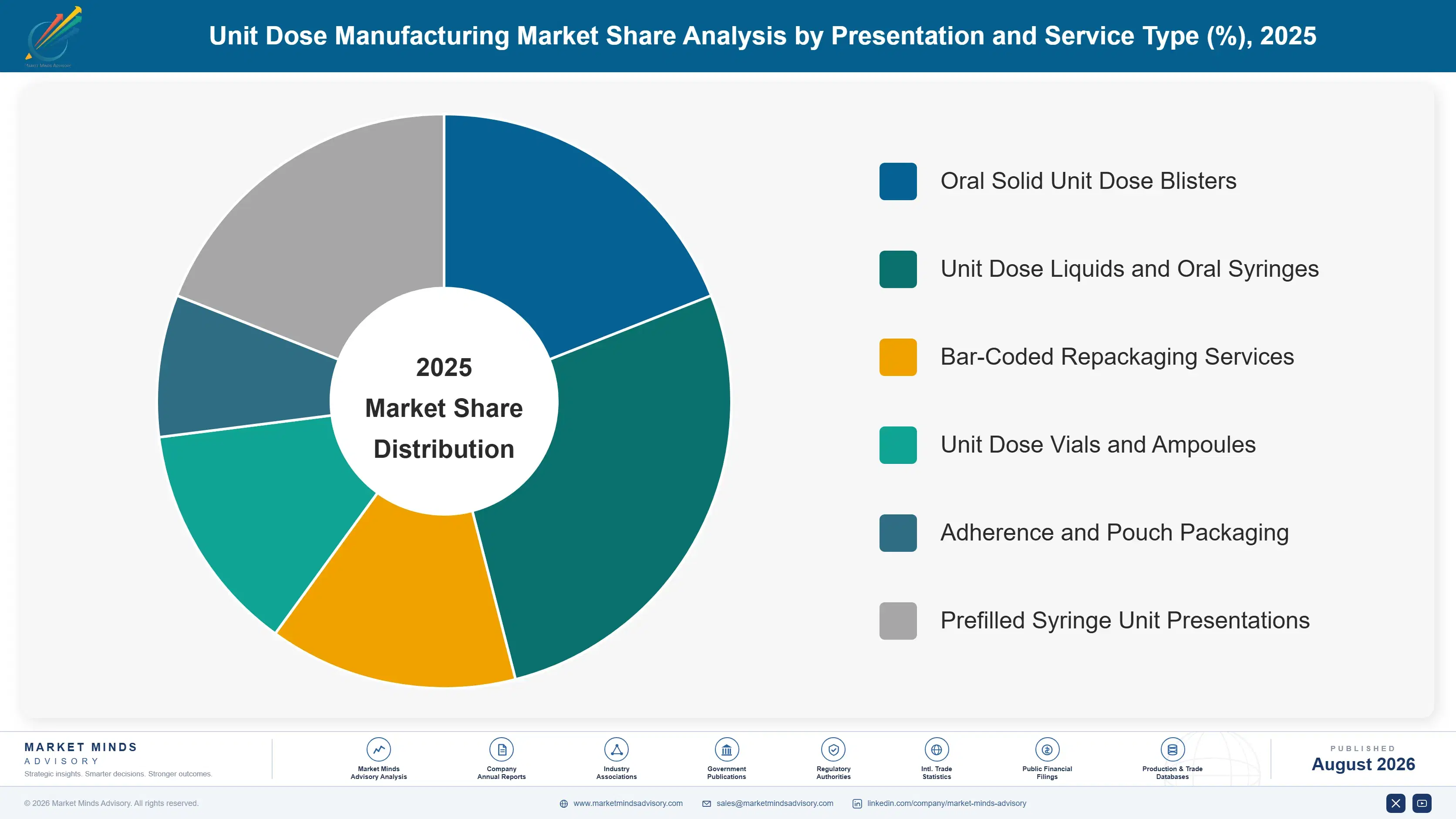
Six segments split by presentation and service type, because each determines what is actually being purchased, whether a manufacturer or a service provider supplies it, the regulatory basis it operates under and the price per dose it carries. Format and volume variants sit inside each. Care setting and channel dimensions are handled separately within the framework.
unit-dose-manufacturing-market-market-share-analysis-1787641006251

Bar-Coded Repackaging Services

Growing at 11.7%, half again the market rate of 7.8%, outsourced repackaging fills roughly 34% of a hospital formulary that arrives without any scannable presentation, using licensed facilities holding their own stability data. That avoids the beyond-use date reduction of around 78% that in-house repackaging imposes, and it removes an activity resembling manufacture from institutions holding no manufacturing authorisation. Hospitals rarely calculate either consequence, which is why the commercial argument is usually made badly. Hospitals treat their own labour and facility as costs already incurred, so the service competes against something that appears free at the point of decision and is not. Persuasion is the whole difficulty here. Regulatory standing is decisive.
CAGR 11.7%

Adherence and Pouch Packaging

At 10.2% adherence packaging organises multiple medicines by administration time rather than by product, which suits polypharmacy in community and long-term care settings where the difficulty is remembering rather than identifying. The unit is a moment in a day rather than a dose of anything, which makes it a fundamentally different product from hospital unit dose despite sharing equipment and materials. Demand tracks population age structure more closely than any clinical policy decision. Equipment and materials are shared with hospital unit dose, which disguises how different the buyer, the workflow and the growth driver actually are across the two segments. Automation depth rather than packaging capability separates providers in this segment considerably.
CAGR 10.2%
Full segment breakdown across 6 segments available in the complete report.

Regional Architecture and Country Demand Map

North America holds 32% of value on barcode medication administration penetration and established outsourced repackaging. East Asia follows at 26% on ageing populations and highly developed pharmacy packaging practice. South Asia and Pacific grows fastest of the seven regions covered here. Scanning penetration drives both.

North America

Barcode medication administration is more widely implemented here than anywhere, which created both the demand for scannable presentations and the formulary gap that hospitals filled themselves. Outsourced repackaging facilities operating under specific regulatory frameworks are well established as a result. Long-term care adherence packaging is a substantial separate market. Growth at 6.6% reflects a mature acute hospital base with outsourcing displacing in-house work rather than adding volume. Outsourced facilities operating under specific regulatory frameworks are well established, which is why displacement rather than expansion drives most of the volume. Long-term care adherence packaging is a substantial separate market with quite different buyers and economics behind it. Displacement rather than expansion drives it.
Share: 32% | CAGR: 6.6% (2026 to 2036)

Western Europe

Hospital pharmacy practice is highly professionalised and repackaging is common, though barcode administration penetration varies considerably between national systems and within them. Regulatory positions on hospital repackaging differ across jurisdictions, which complicates any pan-European service offering considerably. Community adherence packaging is well developed in several markets. Regional growth of 6.2% is the slowest anywhere on fragmented regulation and uneven scanning adoption. Community adherence packaging is well developed in several markets and follows a demographic driver entirely separate from anything happening inside hospitals. Regulatory positions on hospital repackaging differ across jurisdictions, which complicates any pan-European service offering considerably. Hospital pharmacy practice is highly professionalised and repackaging is common across most national systems here.
Share: 22% | CAGR: 6.2% (2026 to 2036)
Regional intelligence for 5 additional markets available in the complete report: East Asia, South Asia and Pacific, Latin America, Middle East and Africa, Eastern Europe. Contact sales@marketmindsadvisory.com.
unit-dose-manufacturing-market-country-cagr-analysis-1787641006790

Four Moves Into the Formulary Gap

Hospitals are performing manufacture they never intended to perform, absorbing waste nobody measures, to satisfy software that needed a barcode. What remains available is quantifying that cost properly, covering the medicines manufacturers skipped, and reaching the settings that scan nothing at all yet. The buyer already does this for nothing. Free is a hard price to beat.

Quantify the beyond-use waste hospitals never count

In-house repackaging cuts remaining shelf life by around 78% because the manufacturer's stability data no longer applies once a tablet leaves its container. Hospitals almost never account for that waste against the decision to repackage internally. Outsourced providers holding their own validated stability data avoid the reduction entirely, and presenting the waste arithmetic converts a service that looks expensive per dose into one that is demonstrably cheaper overall. The comparison is against free labour and uncounted waste, which is a persuasion problem rather than a pricing one. Counting changes everything.
Market Impact: Recovers the 78% of shelf life currently lost

Cover the medicines manufacturers had no reason to package

Roughly 34% of a hospital formulary arrives without any scannable presentation, concentrated in low volume products where packaging economics never justified a line and clinical risk is frequently highest. Contract packaging at low volume is the only route to closing that gap. Suppliers offering formulary level coverage rather than product by product quotes address the problem a pharmacy director actually has rather than the one procurement asked about. Exception pricing on the long tail answers procurement rather than the pharmacy director who owns the problem. Breadth beats exceptions. Directors want coverage.
Market Impact: Closes the whole 34% formulary coverage gap entirely

Follow scanning into settings that never had a pharmacy

Barcode administration cuts errors by around 51% and long-term care and community settings are the obvious next adopters, having no pharmacy capable of repackaging anything themselves. That points demand entirely toward outsourced supply rather than the in-house improvisation acute hospitals fell into. Suppliers organised around acute hospital contracts are covering the settings that already solved this, rather than those about to face it. Nobody has approached them yet. Long-term care and community settings administer manually from bulk containers today, and none of them has a pharmacy able to change that internally.
Market Impact: Delivers the whole 51% administration error reduction gain

Sell against demography where the unit is a time

Adherence packaging organises medicines by administration moment rather than by product, and it grows at 10.2% on polypharmacy in ageing populations rather than on any clinical policy. Japan grows fastest at 13.4% where demography and established pharmacy workflow coincide. Suppliers treating this as an extension of hospital unit dose are misreading a different product with different buyers, different economics and an entirely different growth driver. Community pharmacy rather than hospital pharmacy is the customer, and the equipment relationship differs completely from anything a hospital contract involves. Misreading it costs share.
Market Impact: Adherence packaging growing at 10.2% every single year

Who Controls the Margin Pool

Participation is measured on annual revenue from unit dose manufacture and repackaging services, and the top five hold 38%. Concentration is moderate because pharmaceutical distributors with repackaging operations compete against contract packaging organisations and against hospitals doing the work themselves at no external cost. The gap to challengers is regulatory standing rather than packaging capability, and hospitals performing the work themselves need neither.
Competition runs on three fronts. Regulatory standing decides who can repackage at scale legitimately, which varies considerably by jurisdiction. Formulary breadth decides whether a provider solves a pharmacy director's problem or part of it. And distribution integration decides whether the service arrives alongside the medicine or separately. Each front rewards a different capability, and very few participants hold all three of them properly.

Pressure ahead comes from scanning spreading into community settings and from regulators clarifying hospital repackaging. Expect licensed outsourced providers with formulary breadth to gain against in-house operations. Rankings shift on whoever quantifies the waste hospitals currently ignore. Concentration should rise as regulation clarifies. Providers without regulatory standing or formulary breadth look most exposed, since neither hospitals nor regulators have much reason to prefer them.
unit-dose-manufacturing-market-company-positioning-matrix-1787641007321

Competitive Moat and Risk Dimensions

CENCORA

Moat: Distribution integration and formulary breadth

Repackaging operations sitting inside pharmaceutical distribution let unit dose presentations arrive alongside the medicines a hospital already buys, which removes a separate procurement decision and a separate delivery. Formulary breadth across thousands of products also addresses the coverage gap comprehensively rather than product by product, which is what a pharmacy director actually needs solved.
CENCORA

Risk: In-house repackaging as free competition

Hospitals performing repackaging themselves treat their own labour and facility as costs already incurred, so outsourced services compete against something that appears free at the point of decision. Overcoming that requires quantifying beyond-use waste and regulatory exposure the institution has never measured, which is a considerably harder sale than a price comparison.
CATALENT

Moat: Contract packaging scale and validation

Established contract packaging capability with validated stability programmes allows unit dose presentations to carry full shelf life rather than a conservative beyond-use date, which is a genuine product difference rather than a service convenience. That validation infrastructure took years to build and applies across many products rather than requiring rebuilding for each one.
CATALENT

Risk: Low volume packaging economics

The formulary gap concentrates in products whose volumes never justified a packaging line, which is precisely why the gap exists in the first place. Serving it requires either flexible short run capability or pricing that hospitals resist, and the same economics that deterred original manufacturers apply to any contract packager approaching the same products.

Players Tracked

Prominent Players

Cencora
Catalent
PCI Pharma Services
Safecor Health
Sharp Services

Other Key Players

Fresenius Kabi
Baxter International
Becton Dickinson
Omnicell
Yuyama
Takazono
Uhlmann Pac-Systeme
Körber
IMA Group
Marchesini Group
Romaco
Tjoapack
Bilcare
Constantia Flexibles
Amcor

Recent Developments

MARCH 2026

Health system outsources repackaging after waste audit

A health system moved its repackaging to a licensed outsourced facility after auditing how much medicine was discarded under conservative beyond-use dating, finding the waste exceeded the entire cost of the outsourced service comfortably. Staff time released was treated as a separate benefit entirely. Nobody had costed either before.
Signal: Nobody there had ever counted the expiry waste against the repackaging decision at any point beforehand
SEPTEMBER 2025

Long-term care network implements bedside barcode scanning

A long-term care network implemented bedside barcode administration across its facilities and immediately faced a formulary largely unavailable in scannable presentation, with no pharmacy capable of repackaging anything on site. Outsourced supply was the only available route. Bulk containers could not be scanned. Every dose needed a barcode.
Signal: Settings without any pharmacy at all have no in-house option available and must therefore outsource everything
DECEMBER 2025

Regulator issues guidance on hospital repackaging scale

A regulator issued guidance distinguishing dispensing activity from repackaging at manufacturing scale, clarifying an ambiguity many hospital pharmacies had been operating inside for years without any settled position. Several hospitals suspended internal repackaging pending review. Outsourced enquiries rose immediately afterwards. Ambiguity had persisted for years.
Signal: The practice grew entirely from clinical necessity and the regulation is only now arriving considerably afterwards

Materials, Validation and Labour

Packaging materials including blister film, foil, pouch stock and labels carry around 27% of unit dose cost, which is high relative to the medicine in low value products. Line labour and changeover absorb roughly 31%, since short runs across many products mean frequent changeovers rather than long campaigns. Validation, stability testing and serialisation account for about 16%. Facility, quality release and distribution take the balance.
Aluminium foil and polymer film pricing both moved across recent years, per published packaging materials market reporting and Amcor annual reporting for 2025 on input cost commentary. Providers passed movements through more readily in contract packaging, where agreements are shorter, than in hospital service contracts running multiple years at agreed per dose rates. Short run providers absorbed the most of it. Changeover dominates short run economics.

Exposure divides on run length rather than on scale. A high volume unit dose manufacturer carries material cost across long campaigns with minimal changeover burden. A repackaging service provider carries changeover labour across hundreds of short runs, which is the defining cost of serving a formulary gap. A hospital doing the work itself carries staff time it does not measure and waste it does not count.
unit-dose-manufacturing-market-cost-volatility-analysis-1787641007517

Design line flexibility for short run formulary coverage

The formulary gap concentrates in low volume products where changeover rather than material cost dominates, so line flexibility matters far more than throughput. Quick changeover tooling and batch scheduling across many products convert an uneconomic proposition into a viable one, which is the whole basis for serving the coverage gap profitably at all. Throughput matters far less.

Hold validated stability data across the packaged portfolio

Presentations backed by the provider's own stability programme carry full shelf life rather than a conservative beyond-use date, which is a genuine product difference worth more than any per dose price advantage. Building that data across a portfolio takes years and applies to every subsequent customer rather than requiring repetition for each one. Shelf life is the real product.

Index packaging material exposure into multi-year contracts

Hospital service agreements run for years at agreed per dose rates while foil and film costs reset far more often, which leaves providers absorbing movement they never agreed to carry. Indexation matched to contract duration addresses that, and health systems accustomed to indexed pricing elsewhere generally accept it once presented clearly. Duration matching is the point.

Portfolio Architecture for Margin Defence

Margin here follows regulatory standing and validation rather than packaging capability, because anybody can put a tablet in a blister and very few can attach full shelf life to it afterwards. High volume manufacturer unit dose earns margins in the low teens to high twenties, where packaging is treated as a cost of goods within a pharmaceutical business rather than a service anybody pays separately for. Nobody pays separately for it at that level.
Adherence and pouch packaging does better in the high twenties to low forties, because the equipment, the workflow and the community pharmacy relationship all differ from hospital supply entirely. Community pharmacy relationships take years to build and rarely transfer.

Bar-coded repackaging services hold the strongest position, reaching into the high forties, where the provider carries regulatory standing the hospital lacks and validated stability data that avoids a beyond-use reduction of around 78%. Those margins depend on hospitals valuing what they currently do free, which is a persuasion problem rather than a product one and remains the central commercial difficulty. Persuasion rather than product capability is the central commercial difficulty at this level and it has been for years.

High Volume Manufacturer Unit Dose

Presentations produced inside pharmaceutical manufacture where packaging is a cost of goods. The fourteen point range reflects line utilisation and volume rather than any service difference between suppliers. Volume decides the economics entirely.
Gross Margin: 13-27%

Adherence and Pouch Packaging

Products organised by administration time for community and long-term care settings. The fourteen point range reflects automation depth and how integrated the pharmacy workflow relationship actually is. Demography rather than policy drives it.
Gross Margin: 27-41%

Licensed Bar-Coded Repackaging Services

Services carrying regulatory standing and validated stability the hospital cannot provide itself. The fourteen point range reflects formulary breadth and whether distribution integration accompanies the service. Standing rather than equipment matters.
Gross Margin: 34-48%
unit-dose-manufacturing-market-portfolio-architecture-1787641008021

High-value Sub-segments and Strategic Watch-out

Bar-Coded Repackaging Services

High value and the fastest growth at 11.7%, filling a formulary gap of roughly 34% while avoiding the beyond-use reduction in-house work imposes. Competing against something hospitals treat as free. Persuasion rather than product is the difficulty, and most providers make the argument badly. Standing matters most.
Gross Margin: 34-48%

Adherence and Pouch Packaging

High value and growing at 10.2% on polypharmacy in ageing populations rather than on any clinical policy. The unit is an administration time rather than a dose, which changes the buyer entirely. Community pharmacy rather than hospital pharmacy is the customer, which changes everything commercially.
Gross Margin: 27-41%

High Volume Manufacturer Unit Dose

The volume core, produced inside pharmaceutical manufacture for products whose packaging economics justify a dedicated line. Nothing about it addresses the formulary gap that generates most demand. Packaging is a cost of goods inside a pharmaceutical business rather than a service anybody buys. It addresses none of the gap.
Gross Margin: 13-27%

In-House Repackaging Competition

The strategic watch-out. Around 41% of doses are repackaged by hospitals treating their own labour as free, and the range reflects whether a provider quantifies the hidden waste convincingly. Regulatory clarification would change the position faster than any commercial argument could. Clarification would help enormously.
Gross Margin: 0-45%

Every Dose, Every Day, Forever

Demand here is about as repeating as anything in healthcare gets, because every administered dose consumes a presentation and hospitals administer continuously. Consumption tracks bed occupancy and prescribing rather than any purchasing cycle, which makes it unusually predictable. A formulary agreement therefore represents years of daily consumption rather than a contract to be renegotiated on volume each year. Very little in healthcare repeats this reliably.
Stickiness follows integration into pharmacy workflow rather than any commercial relationship. A presentation loaded into automated dispensing cabinets, referenced in electronic prescribing and familiar to nursing staff is genuinely difficult to displace, because changing it touches software, training and cabinet configuration simultaneously. Contract packaging for a manufacturer reopens far more readily, since the packer is interchangeable to the customer.

The deciding party is the pharmacy director, who owns the repackaging operation, the waste, the regulatory exposure and the outsourcing budget at once. That concentration is unusual and helpful, because a single person can weigh the whole trade rather than each department defending its own line. Suppliers reaching procurement alone are talking to somebody who sees only the price per dose. One person weighs the whole trade.
unit-dose-manufacturing-market-end-use-penetration-index-1787641008522

Where We Would Put Effort

These are among the four positions where our research anticipates prominent divergence between winners and laggards over the coming forecast period. Each is grounded in the demand model, the regulatory perimeter, and the announced capacity pipeline.
01 / WASTE ARITHMETIC PRESENTATION

Free in-house work is not free

Repackaging inside a hospital pharmacy cuts remaining shelf life by around 78%, because the manufacturer's stability data stops applying the moment a tablet leaves the container it was validated in. Hospitals almost never account for that waste against their decision to keep the work in-house at all. Outsourced providers holding their own validated stability programmes avoid that reduction entirely, and and presenting the full arithmetic converts a service that looks expensive per dose into one that is demonstrably cheaper overall.
02 / FORMULARY LEVEL COVERAGE

Solve the gap, not a product

Roughly 34% of a hospital formulary arrives with no scannable presentation, concentrated in the low volume products where packaging economics never justified a line and where clinical risk is frequently highest of all. Product by product quoting simply answers a question that nobody in the pharmacy actually asked. Offering formulary level coverage addresses what a pharmacy director actually has to solve, and it is the only route by which the long tail ever becomes economically serviceable for anybody at all.
03 / NON-ACUTE SETTING ENTRY

They have no pharmacy to improvise with

Barcode administration cuts errors by around 51%, and long-term care and community settings are by some distance the obvious next adopters, since they have no on-site pharmacy capable of repackaging anything for themselves at all. That points the demand entirely toward outsourced supply rather than toward the in-house improvisation that acute hospitals originally fell into for themselves years ago. Suppliers still organised around acute hospital contracts are covering exactly the institutions that already solved this problem for themselves years ago.
04 / DEMOGRAPHIC PRODUCT SEPARATION

Adherence packaging is a different business

Adherence packaging organises medicines by administration moment rather than by individual product, and it grows at 10.2% on polypharmacy across ageing populations rather than on any clinical safety policy whatsoever. Japan grows fastest of any country covered here at 13.4%, where demography and a long established pharmacy workflow happen to coincide neatly. Suppliers treating this segment as an extension of hospital unit dose are misreading a genuinely different product with different buyers, different economics and a different growth driver entirely.

Engagement Snapshot From the Field

A live engagement with an industry participant carrying material or product regulatory and market exposure ahead of a defining policy shift, showing how our research translates into a defensible multi-year portfolio strategy.
MARKET MINDS ADVISORY · CLIENT ENGAGEMENT SUMMARY
Unit Dose Manufacturing Producer Strategic Portfolio Review and Transition Roadmap 2026·Investment Scenario on Unit Dose Manufacturing Exposure Evaluation 2025-26
CLIENT PROFILE
A pharmaceutical packaging provider offering contract unit dose and repackaging services to hospital systems across European and North American markets, at annual revenue near 240 million dollars (client-reported, unverified by MMA). Selling ran through procurement and formulary breadth was limited to higher volume products. Pharmacy directors had never been engaged directly at any account. Coverage was tender based.
STRATEGIC CHALLENGE
Hospitals were declining outsourced repackaging on cost grounds while continuing to perform it internally at scale, and the products they most needed covered were exactly the ones the client priced highest. Management wanted a way through both objections. Volume was flat while the underlying activity kept expanding inside hospitals. Something had to change.
MMA APPROACH
MMA quantified beyond-use waste at customer institutions performing in-house repackaging, measured formulary coverage gaps against scannable presentation availability, assessed short run packaging economics against changeover cost, and mapped who inside a hospital actually decided outsourcing. Interviews with 47 experts covered hospital pharmacy, contract packaging, regulatory affairs and long-term care operations.
KEY FINDINGS
  1. Beyond-use waste at institutions performing in-house repackaging exceeded the full cost of outsourcing at every site examined, and none of them had ever measured it.
  2. The formulary gap concentrated in low volume high risk products, which the client had been pricing as exceptions rather than covering as part of any comprehensive offer.
  3. Pharmacy directors rather than procurement owned the waste, the regulatory exposure and the outsourcing budget together, and the client had been selling to procurement throughout.
  4. Long-term care networks implementing barcode administration had no in-house repackaging option at all, and none had been approached by the client or by any competitor.
CLIENT PROFILE
A pharmaceutical packaging provider offering contract unit dose and repackaging services to hospital systems across European and North American markets, at annual revenue near 240 million dollars (client-reported, unverified by MMA). Selling ran through procurement and formulary breadth was limited to higher volume products. Pharmacy directors had never been engaged directly at any account. Coverage was tender based.
STRATEGIC CHALLENGE
Hospitals were declining outsourced repackaging on cost grounds while continuing to perform it internally at scale, and the products they most needed covered were exactly the ones the client priced highest. Management wanted a way through both objections. Volume was flat while the underlying activity kept expanding inside hospitals. Something had to change.
MMA APPROACH
MMA quantified beyond-use waste at customer institutions performing in-house repackaging, measured formulary coverage gaps against scannable presentation availability, assessed short run packaging economics against changeover cost, and mapped who inside a hospital actually decided outsourcing. Interviews with 47 experts covered hospital pharmacy, contract packaging, regulatory affairs and long-term care operations.
KEY FINDINGS
  1. Beyond-use waste at institutions performing in-house repackaging exceeded the full cost of outsourcing at every site examined, and none of them had ever measured it.
  2. The formulary gap concentrated in low volume high risk products, which the client had been pricing as exceptions rather than covering as part of any comprehensive offer.
  3. Pharmacy directors rather than procurement owned the waste, the regulatory exposure and the outsourcing budget together, and the client had been selling to procurement throughout.
  4. Long-term care networks implementing barcode administration had no in-house repackaging option at all, and none had been approached by the client or by any competitor.
RECOMMENDED STRATEGY
Phase 1: Phase one: build and present beyond-use waste quantification at each account, since hospitals treat in-house work as free until somebody counts it. Phase 2: Phase two: offer formulary level coverage including the long tail rather than quoting individual products at exception pricing. Exception pricing loses every time. Phase 3: Phase three: approach long-term care networks adopting barcode administration, which have no in-house alternative available to them. Nobody else has approached them.
OUTCOME
The provider introduced waste quantification into its account approach during 2026 and converted two health systems that had previously declined on price (client-reported, unverified by MMA). Formulary level pricing was adopted, and long-term care engagement began the following quarter. Procurement led selling was reduced across the European accounts entirely.

Frequently Asked Questions

Foundational context covering the market sizes, CAGR, scope, country, region and competition that inform every finding below. This section is provided to cover basics and most often pre-purchase conversations, answered from the MMA Primary Research Dataset.

What is the current size of the Unit Dose Manufacturing Market?

MMA sizes it at USD 3.6 billion in 2025, rising to USD 3.88 billion in 2026. The figure covers single-dose presentation manufacture and repackaging at provider selling value.

How large will the Unit Dose Manufacturing Market be by 2036?

USD 8.22 billion by 2036, an incremental USD 4.34 billion over the 2026 base and an expansion multiple of 2.12 times. Repackaging services carry most of that gain.

What is the CAGR for the Unit Dose Manufacturing Market 2026 to 2036?

7.8% in the base case, with a bull case at 9.0% and a bear case at 6.6%. Barcode administration spreading beyond acute hospitals drives most of the spread.

Which segment is growing fastest?

Bar-coded repackaging services at 11.7%, half again the market rate of 7.8%. They fill roughly 34% of a hospital formulary that arrives without any scannable presentation.

Who are the major companies in the Unit Dose Manufacturing Market?

Cencora, Catalent, PCI Pharma Services, Safecor Health and Sharp Services lead on unit dose revenue. Fifteen further participants are profiled in the full report on the same consistent basis.

Which country is growing fastest?

Japan at 13.4%, where community pharmacy pouch packaging practice is more developed than anywhere else and the population is the oldest in the world by a considerable margin.

Report Segmentation Architecture

The full report scope spans multiple orthogonal segmentation dimensions, with cross-tabulated demand data provided for each dimension pair. Coverage extends further to regional breakdowns, trend trajectories, and the competitive detail needed to support segment-level decision-making.

By Presentation and Service Type

  • Oral Solid Unit Dose Blisters
  • Unit Dose Liquids and Oral Syringes
  • Bar-Coded Repackaging Services
  • Unit Dose Vials and Ampoules
  • Adherence and Pouch Packaging
  • Prefilled Syringe Unit Presentations

By End-Use Industry

  • Acute Hospital Pharmacy
  • Long-Term Care Facilities
  • Community and Retail Pharmacy
  • Pharmaceutical Manufacturers
  • Clinical Trial Supply
  • Home and Domiciliary Care

By Commercial Dimension

  • Health System Service Contracts
  • Contract Packaging Agreements
  • Distributor Bundled Supply
  • Group Purchasing Organisation Contracts
  • Community Pharmacy Supply
  • Clinical Trial Packaging Services

By Region

  • North America
  • Western Europe
  • East Asia
  • South Asia and Pacific
  • Latin America
  • Middle East and Africa
  • Eastern Europe

Scope, Methodology, and Coverage

Every figure in this report is reproducible from documented input assumptions. The scope below maps the historical period, the forecast horizon, the segmentation dimensions, and the countries covered, alongside the underlying primary and qualitative methodology.
Historical Period
2020 to 2025
Forecast Period
2026 to 2036
Base Year
2025 (USD billions; MMA Primary Research Dataset, August 2026)
Market Definition
Manufacture and packaging of pharmaceuticals into single-dose and single-administration presentations, covering oral solid unit dose blisters, unit dose liquids and oral syringes, bar-coded repackaging services, unit dose vials and ampoules, adherence and pouch packaging, and prefilled syringe unit presentations. Measured at manufacturer and service provider selling value. Bulk pharmaceutical manufacture, active ingredient production, retail multi-dose containers, and packaging machinery sold as capital equipment are excluded from scope.
Quantitative Units
USD billions (current prices); doses packaged; USD per dose by presentation type
Segmentation Dimensions
Presentation and service type; end-use industry; commercial dimension; region
Regions Covered
North America, Western Europe, East Asia, South Asia and Pacific, Latin America, Middle East and Africa, Eastern Europe
Countries Covered
United States, Canada, Mexico, Germany, United Kingdom, France, Netherlands, Italy, Japan, South Korea, China, Taiwan, India, Australia, Singapore, Brazil, Argentina, Saudi Arabia, South Africa, Poland
Key Companies Profiled
Cencora, Catalent, PCI Pharma Services, Safecor Health, Sharp Services, Fresenius Kabi, Baxter International, Becton Dickinson, Omnicell, Yuyama, Takazono, Uhlmann Pac-Systeme, Körber, IMA Group, Marchesini Group, Romaco, Tjoapack, Bilcare, Constantia Flexibles, Amcor
Quantitative Methodology
Primary survey, n=3,800 respondents, Q4 2025, six countries; demand-side model with trade association cross-validation
Qualitative Methodology
47 expert interviews, Q4 2025; applied to validate demand model assumptions, identify emerging dynamics, and assess competitive positioning
Report Format
PDF and XLSX data workbook (Word format preview document)
Publisher
Market Minds Advisory
Report Code
MMA-2026-PAC-101
Published
August 2026
Contact
sales@marketmindsadvisory.com | www.marketmindsadvisory.com

Purchase the full Unit Dose Manufacturing Market Report (2026 to 2036).

The full report treats unit dose as a market created by bedside scanning software rather than by pharmacology, which is why hospitals ended up manufacturing medicines they never intended to manufacture. It sizes all six presentation and service types independently through 2036, quantifies beyond-use waste from in-house repackaging, and measures formulary coverage gaps against scannable presentation availability. Regional chapters cover all seven regions with scanning penetration assessed separately from hospital volume. Competitive profiling covers 20 participants on one consistent revenue basis. Waste arithmetic is modelled by institution type throughout.
Six presentation and service types sized independently through 2036
Beyond-use waste quantified across in-house hospital repackaging operations
Formulary coverage gaps measured against scannable presentation availability
Scanning penetration assessed separately from hospital volume by region
Decision ownership mapped across pharmacy, procurement and quality functions
Twenty participants profiled on one consistent revenue basis

Built For The People Who Decide

From boardroom strategy to bench-side execution, this report is read cover-to-cover by leaders shaping the next decade of their industry, turning demand scenarios, market dynamics and valuation benchmarks into decisions.
CXOs/ Presidents/ VPs/ Managers
M&A and Corporate Development
Strategy Teams and R&D Heads
Procurement and Product Directors
Regulatory and Compliance Leaders
Investor Relations and Equity Analysts