

Market Minds Advisory
Unilateral Biportal Endoscopy Market

Unilateral Biportal Endoscopy Market: Spreading Because It Needs Almost Nothing New

The technique took hold because a surgeon can start with the arthroscope already in the hospital and the spinal instruments already on the tray. That is also why the device market beneath it stays small.

Lead Analyst

Alice Ballenger

Published

September 2026

Make Smarter Decisions with Customized Research Insights

Request a free sample report and evaluate market opportunities, growth trends, and competitive dynamics relevant to your business needs.

2025 MARKET VALUE$0.6BMarket Size 2025
2036 FORECAST VALUE$2.7BBase Case , 2026 to 2036
CAGR 2026 TO 203614.2 %Bull 15.4% / Bear 13.0%
INCREMENTAL OPPORTUNITY$2.0BNet 10- year value creation
EXPANSION MULTIPLE3.76x2036 value over 2026 base
Strategic Levers
M&A Pipeline
Regional Outlook
Country Rankings
Competitive Intelligence
Segmental Deep-dive
Call-Us : 91 93563 13602

Executive Snapshot and Market Trajectory

Two small portals on one side of the spine: one holds a standard arthroscope, the other holds conventional spinal instruments. Around 61% of what a surgeon needs is already sitting in the hospital, and the dedicated capital beyond that runs near 38,000 dollars. Cheap entry explains everything here.
Growth runs at 14.2% on procedure conversion from tubular and open decompression rather than on any new clinical indication being opened up anywhere. Irrigation pumps and fluid management grow fastest at 21.3%, exactly 1.50 times the market rate, because nine litres of saline pass through the working space in every single case. Radiofrequency and bipolar haemostasis probes follow at 18.6% on single-use consumption in every procedure.
Concentration reaches 34% across the top five measured on annual revenue from systems and instruments used in biportal procedures, moderate and split awkwardly between arthroscopy, endoscopy, and spine implant suppliers who barely compete with each other at all. East Asia holds 38%, above its framework band, because the technique originated in Korea and Korean training programmes still set the global standard for it. China grows fastest at 17.6% on rapid adoption.
Market Definition
This market covers devices, instruments, and consumables used in unilateral biportal endoscopic spine surgery, measured at manufacturer realised prices, spanning endoscopic visualisation systems and optics, dedicated biportal instrument sets, irrigation pumps and fluid management, radiofrequency and bipolar haemostasis probes, burrs, drills and bone removal devices, and interbody fusion implants placed biportally. Uniportal full-endoscopic systems, tubular retractor platforms, open spinal instrumentation, imaging equipment, and surgeon training fees fall outside scope.
Base Year Value
$0.6B in 2025 (MMA Primary Research Dataset, August 2026)
Forecast Period
2026 to 2036, eleven discrete annual values
CAGR
14.2% base case. Bull 15.4%. Bear 13.0%.
Fastest Growth Segment
Irrigation Pumps and Fluid Management: 21.3% CAGR
Fastest Growth Country
China: 17.6% CAGR
Fastest Growth Region
South Asia and Pacific: 16.4% CAGR
Largest Region
East Asia: 38% of 2025 global value
Market Leaders
Arthrex, Richard Wolf, joimax, Stryker, Elliquence. Source: MMA Analysis based on company annual reports.
Primary Survey
n=3,800 procurement and R&D decision-makers, Q4 2025, six countries
Methodology
Demand-side build-up, cross-validated against public data, 47 expert interviews

Unilateral Biportal Endoscopy Market Forecast Scenarios

unilateral-biportal-endoscopy-market-size-forecast-scenario-1787299883110
The 2020 to 2025 period ran at 12.8% and adoption spread outward from a single origin. Korean spine surgeons developed and refined the technique, published the early series, and taught it through cadaveric courses drawing surgeons from across Asia and later Europe. Chinese adoption accelerated sharply from 2022. Western uptake lagged, held back by established tubular practice and by reimbursement coding that had not caught up.
Three mechanisms carry the 14.2% base case. Low capital entry is the largest, since a hospital with an arthroscopy tower needs roughly 38,000 dollars of additional equipment rather than a full endoscopic platform. Training capacity is the second, running near 3,100 surgeons a year across all programmes and rising. And Chinese procedure volume is the third, growing at 17.6% as domestic device manufacture brings the entry cost down further still.
The 15.4% bull case rests on Western reimbursement coding recognising endoscopic decompression distinctly, which would remove the payment ambiguity that currently makes hospital adoption a financial question rather than a clinical one. The 13.0% bear case is a serious fluid management complication series reaching the literature, since nine litres of pressurised saline per case is managed by convention rather than instrumentation.

Why Cheap Entry Caps the Revenue

The technique is elegantly cheap to start and that fact governs everything commercial about it. A surgeon makes two portals on one side of the spine, puts a standard arthroscope down one and conventional rongeurs, curettes, and osteotomes down the other, and works under continuous saline irrigation. Roughly 61% of the required set already sits in a hospital that does knee arthroscopy, so dedicated capital runs near 38,000 dollars rather than the several hundred thousand a uniportal endoscopic pl
TOP FIVE CONCENTRATION34%Moderate across arthroscopy, endoscopy, and spine implant suppliers
LEARNING CURVE CASE COUNT42 casesBefore complication rates converge with established tubular techniques
REUSED EQUIPMENT SHARE61%Of the instrument set already present in most hospitals
DEDICATED CAPITAL REQUIRED38,000 dollarsBeyond arthroscopy equipment a hospital already owns outright
IRRIGATION VOLUME PER CASE9 litresOf saline circulated through the working space during decompression
TRAINING COURSE CAPACITY3,100 surgeonsTrained annually across all cadaveric and observation programmes
That is why the technique spread and why the device market underneath it grows more slowly than the procedure count. A supplier cannot sell a platform to a hospital that already owns most of one. Revenue concentrates in what gets consumed rather than installed: single-use probes, burrs, tubing sets, and the instruments no arthroscopy tray provides.
The genuine constraint is surgical rather than commercial. Complication rates converge with tubular technique around 42 cases, and dural tears, incomplete decompression, and epidural haematoma cluster before that point. Training capacity sits near 3,100 surgeons a year across every cadaveric and observation programme worldwide, which is the number that actually limits how fast this grows.
"Every device company I speak to about this technique wants to know what platform to sell. There isn't one. The hospital already owns the camera, and what you can actually sell is the tubing, the probes, and the six instruments that make the difference between a good day and a dural tear."
Director, Spine Surgery and Endoscopic Systems Practice · MMA Medical Devices an

Market Trends

Fluid Management Is The Underserved Risk And Opportunity

Nine litres of saline circulate through the epidural working space during a typical decompression, under pressure sufficient to keep the field clear, and raised epidural pressure has been linked to neck pain, seizure, and retroperitoneal fluid collection in reported cases. Most surgeons manage this by convention: gravity bags, an assistant watching outflow, and experience. Dedicated pumps with pressure control and outflow monitoring grow at 21.3% against 14.2% for the market, and they address the one complication category the field currently handles without instrumentation. Nothing else in this technique carries comparable unaddressed risk.
Market Impact: Only 38,000 dollars additional capital

Korean Training Networks Set The Global Standard

The technique was developed and refined by Korean spine surgeons who published the early series and then taught it systematically through cadaveric courses, observation fellowships, and proctoring arrangements that drew surgeons from across Asia and later from Europe and the Americas. That origin gives Korea influence over technique convention, instrument preference, and what a trained surgeon expects on the tray. Around 3,100 surgeons complete formal training annually, and a disproportionate share of those programmes still run through Korean centres or Korean-trained faculty. Instrument preference formed in those programmes persists for the rest of a surgeon's career.
Market Impact: China grows at 17.6% annually

Market Opportunities and Growth Drivers

A Hospital Already Owns Most Of What Is Needed

Any hospital doing knee arthroscopy holds the camera, light source, tower, and shaver that biportal spine work requires, which means roughly 61% of the set is already paid for and sitting in the building. Dedicated additional capital runs near 38,000 dollars against several hundred thousand for a uniportal endoscopic platform. That difference is what lets a single interested surgeon start without a capital committee, which is how almost every early adopter in this technique actually began doing it. No capital committee is involved, which is how almost every adopter began.
Market Impact: Complications cluster before 42 cases

Chinese Adoption Is Moving Faster Than Anywhere Else

Chinese spine surgeons adopted biportal technique rapidly from 2022 onward, helped by proximity to Korean training centres, by very large spinal degenerative disease volumes, and by domestic manufacturers producing instrument sets at a fraction of imported pricing. China contributes the fastest national growth rate in this forecast at 17.6%. Domestic device supply lowers the entry cost further, which accelerates adoption while compressing what any supplier realises per procedure performed in that market. Proximity to Korean training centres shortened the learning period considerably, and very large spinal degenerative disease volumes gave surgeons the case numbers to move through it quickly.
Market Impact: No distinct code in 4 systems

Market Restraints and Challenges

Forty-Two Cases Before The Complication Rate Settles

Complication rates converge with established tubular technique somewhere around 42 cases, and dural tears, incomplete decompression, and postoperative epidural haematoma cluster heavily in the period before that. The root cause is bimanual coordination under irrigation with a scope that is not fixed to the working channel, which is genuinely harder than working down a tube. Commercial impact is that adoption moves at the pace of training rather than of device supply. Proctoring, simulation, and cadaveric course capacity are the mitigations, and all three are constrained. Course places are the genuine bottleneck here.
Market Impact: Growing at 21.3% annually

Reimbursement Coding Has Not Caught Up In The West

Several Western health systems have no distinct payment code for endoscopic spinal decompression, so hospitals bill it under existing decompression codes that were priced around open or tubular technique. The root cause is that coding review cycles run years behind clinical practice. Commercial impact is that a hospital adopting the technique may absorb consumable cost without additional payment, which turns a clinical decision into a financial one. Societies are pursuing coding recognition, and progress is slow and jurisdiction by jurisdiction. Ambulatory centres feel this most, since they carry the consumable cost directly.
Market Impact: Around 3,100 surgeons trained annually
3 additional market trends, 4 additional growth drivers, and 2 additional restraints and challenges are covered in the full report. Contact sales@marketmindsadvisory.com to access the complete intelligence.

Segment CAGR and Growth Architecture

Segmentation follows the device category consumed per procedure, because that determines whether revenue is capital or recurring, whether a hospital already owns the item, which supplier type competes for it, and how much a manufacturer realises per case performed. Spinal level and pathology both cut across every category rather than separating them cleanly here.
unilateral-biportal-endoscopy-market-market-share-analysis-1787299883689

Irrigation Pumps And Fluid Management

The fastest category at 21.3%, exactly 1.50 times the market rate, and the only one addressing a risk the field currently manages by habit rather than by equipment. Around nine litres of saline pass through the epidural working space each case, and raised pressure has been associated with neck pain, seizure, and retroperitoneal fluid collection in reported series. Pumps with pressure regulation, outflow monitoring, and automatic shutoff are displacing gravity bags and assistant judgment. Single-use tubing sets attached to those pumps produce recurring revenue per case, which almost nothing else in this technique reliably does. Nothing else in the technique recurs quite so reliably per case. Gravity bags and judgment are what it displaces.
CAGR 21.3%

Radiofrequency And Bipolar Haemostasis Probes

Second fastest at 18.6%, and the most reliable per-case consumable in the technique because bleeding into a saline-filled working space obscures the view immediately and completely. Flexible bipolar probes shaped to reach around the dural sac and into the lateral recess are used in essentially every case, and they are single use. That combination of universal necessity and disposability makes this the segment where suppliers earn per procedure rather than per hospital. Probe geometry preference varies considerably between surgeons trained in different programmes, which fragments the market more than the technology alone would. Surgeons trained in different programmes want different probe geometry, which fragments purchasing considerably. That is a genuine fragmentation problem for suppliers.
CAGR 18.6%
Full segment breakdown across 6 segments available in the complete report.

Regional Architecture and Country Demand Map

This technique has an origin rather than merely a largest market, and the two coincide. East Asia sits above its framework band because Korean surgeons developed it, Korean programmes still train much of the world, and Chinese adoption has since produced the largest procedure volume anywhere.

East Asia

Thirty-eight percent, above the framework band, and the justification is origin as much as volume: Korean spine surgeons developed and refined this technique, published the early series that established it, and built the cadaveric and observation programmes through which most of the world learned it. Korean practice remains the reference for instrument preference and technique convention. Chinese adoption since 2022 has produced the largest procedure volume anywhere, at realised device prices well below Korean or Japanese levels because domestic manufacturers supply most of the instrument sets. Growth at 15.0% runs above the global rate on Chinese volume rather than Korean maturity. Japanese uptake has been slower and more selective throughout.
Share: 38% | CAGR: 15.0% (2026 to 2036)

North America

Twenty-two percent, within the framework band, and adoption here has been surgeon-led rather than institution-led because the low capital entry lets an individual start without a capital approval process. Reimbursement is the obstacle rather than clinical acceptance, since several payers have no distinct code for endoscopic decompression and price it against tubular technique. Ambulatory surgery centres have adopted fastest, given that shorter stay and reduced blood loss matter most where the facility carries the cost. Growth at 15.2% runs above the global rate, the highest of any developed region, on a base that started late. Ambulatory surgery centres carry consumable cost directly, which makes coding recognition matter more to them than to any hospital operator in the region.
Share: 22% | CAGR: 15.2% (2026 to 2036)
Regional intelligence for 5 additional markets available in the complete report: Western Europe, South Asia and Pacific, Latin America, Middle East and Africa, Eastern Europe. Contact sales@marketmindsadvisory.com.
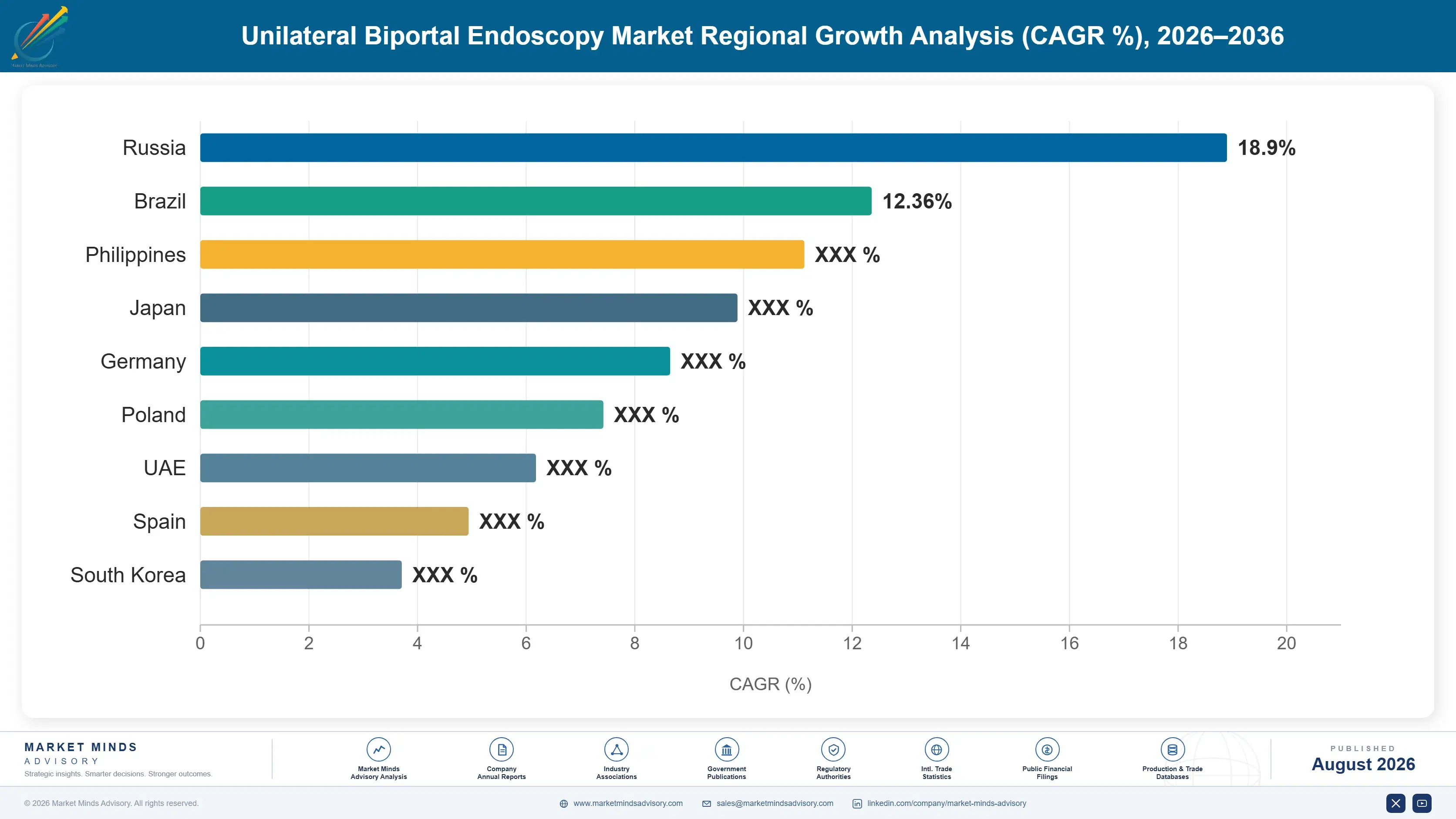
unilateral-biportal-endoscopy-market-country-cagr-analysis-1787299884207

Selling Into A Technique That Needs Nothing

Roughly 61% of the required set is already sitting in the hospital and dedicated capital runs near 38,000 dollars, so platform selling simply does not work here at all. Value comes from per-case consumables, from owning fluid management before a complication series forces it, from funding training capacity, and from pursuing distinct reimbursement coding.

Earn Per Case Rather Than Per Hospital

A hospital doing knee arthroscopy already owns the camera, tower, and light source, so there is no platform sale to make and the capital opportunity is roughly 38,000 dollars once. What recurs is single-use radiofrequency probes, burrs, and irrigation tubing consumed in every procedure, which across a surgeon doing 120 cases a year is worth several times the capital. Suppliers organised around capital equipment sales are pursuing the smaller number, and most of them have not noticed because their commercial structure was built for a different technique. Nobody has redesigned around it yet.
Market Impact: Consumables exceed capital within roughly 12 months each

Own Fluid Management Before Somebody Publishes

Nine litres of pressurised saline pass through the epidural space per case and the field manages that with gravity bags and an assistant's judgment. Raised epidural pressure has already been linked to neck pain, seizure, and retroperitoneal collection in reported cases, and one substantial complication series would make pressure-regulated pumping a standard of care overnight. Building that capability costs perhaps 4 million dollars in development and clinical evidence. The category already grows at 21.3% without any such publication forcing the issue. A single published series would change that overnight. Whoever holds the category first takes the resulting volume.
Market Impact: Pump development costs around 4 million dollars overall

Fund Training Capacity Because It Caps The Market

Around 3,100 surgeons complete formal training each year and complication rates only settle after roughly 42 cases, which means training throughput rather than device availability determines how fast this technique grows. A supplier funding cadaveric courses, proctoring, and simulation costs around 2.2 million dollars annually across a major region and directly expands its own addressable procedure count. It also shapes instrument preference during the period when surgeons form habits that persist for the rest of their careers. Preference formed there is essentially permanent afterward. No later marketing spend displaces a habit built around a specific working sheath.
Market Impact: Training programme costs 2.2 million dollars a year

Pursue Distinct Reimbursement Coding As A Programme

Several Western systems price endoscopic decompression against codes written around open or tubular surgery, so a hospital adopting the technique absorbs consumable cost without additional payment and treats a clinical choice as a financial one. Supporting society coding submissions with procedure cost and outcome data costs perhaps 1.5 million dollars per system and removes the single largest barrier to Western adoption. Manufacturers have largely left this work to surgical societies, which have neither the resources nor the cost data to make the case efficiently. Nobody else will fund the work.
Market Impact: Coding submission costs 1.5 million dollars per system

Who Controls the Margin Pool

Concentration reaches 34% across the top five measured on annual revenue from systems and instruments used in biportal procedures, and the composition is unusual because arthroscopy companies, endoscopy specialists, and spine implant manufacturers all appear on the same list while selling into different parts of the same case. An arthroscopy supplier owns the camera the hospital already had; a spine company sells the instruments and implants. The leaderboard reflects how the case is assembled ra
Competitive activity runs on three fronts. Per-case consumable position is the first, since capital opportunity is limited and probes, burrs, and tubing recur in every procedure. Training influence is the second, because instrument preference forms during the learning curve and persists for decades. Fluid management capability is the third, and it is the one place where a genuine technology gap remains open.

Pressure comes from two directions. Domestic Chinese manufacturers supply instrument sets at a fraction of imported pricing in the largest procedure market, and geometry is not difficult to copy once convention settles. And uniportal full-endoscopic suppliers compete for exactly the same surgeons with a platform sale carrying far more capital revenue attached to it.
unilateral-biportal-endoscopy-market-company-positioning-matrix-1787299884728

Competitive Moat and Risk Dimensions

ARTHREX

Moat: Arthroscopy tower already installed

The camera, light source, and shaver console a biportal case runs on are frequently already in the hospital and frequently already this supplier's, which places the company inside the theatre before any spine-specific conversation begins. That installed position was built through knee and shoulder work entirely unrelated to spine. Competitors have to displace equipment nobody is planning to replace.
ARTHREX

Risk: Spine relationships sit elsewhere

Owning the arthroscopy tower does not mean owning the spine surgeon, who has established relationships with implant and instrument suppliers built over years of open and tubular practice. The consumables that recur per case sit closer to those relationships than to the camera. An installed base in a different specialty is a starting position rather than a commercial one.
RICHARD WOLF

Moat: Endoscopic spine optics depth

Long specialisation in endoscopic spine optics and instrumentation means the angled scopes, working sheaths, and purpose-shaped instruments that separate a comfortable biportal case from an awkward one come from a company that has designed for the spine specifically. Surgeons trained on those instruments request them by name afterward. That preference forms during the learning curve and rarely changes.
RICHARD WOLF

Risk: Cheap Asian instrument competition

Chinese and Korean manufacturers supply biportal instrument sets at a fraction of European pricing, and in the largest procedure market they hold most of the volume already. Instrument geometry is not difficult to copy once a convention has settled. Design leadership matters most during technique development and least once every supplier makes something adequate.

Players Tracked

Prominent Players

Arthrex
Richard Wolf
joimax
Stryker
Elliquence

Other Key Players

Karl Storz
Medtronic
Zimmer Biomet
Globus Medical
Spineart
RIWOspine
Endovision
Genoss
L&K Biomed
Solco Biomedical
Curexo
Maxmore Spine
Shanghai Kinetic Medical
Hangzhou Kangji Medical
Sunmedix

Recent Developments

MARCH 2025

Manufacturer launches pressure-regulated irrigation pump for spinal endoscopy

A device manufacturer introduced an irrigation pump with epidural pressure regulation, outflow monitoring, and automatic shutoff, aimed at replacing gravity bag and assistant judgment in biportal spinal procedures. The launch was a product introduction rather than any joint venture, acquisition, or licensing arrangement with an endoscopy company.
Signal: Instrumenting the one complication category the field manages by habit is where the open technology gap sits
JUNE 2025

Korean society expands international biportal training fellowship programme

A Korean spine surgery society expanded its cadaveric course and observation fellowship capacity for international surgeons, increasing annual places and adding proctoring support for the first fifty cases. The expansion was society programme development rather than any commercial arrangement, sponsorship agreement, or partnership with a device manufacturer.
Signal: Training throughput rather than any device availability determines how quickly this technique can realistically grow anywhere
SEPTEMBER 2025

Chinese manufacturer expands biportal instrument set production

A Chinese medical device manufacturer expanded production of biportal endoscopic spine instrument sets for the domestic market, where procedure volumes have grown rapidly since 2022. The expansion was organic capital investment rather than any joint venture, technology licensing arrangement, or acquisition of foreign instrument capability.
Signal: Domestic supply lowers entry cost further and compresses what any supplier realises for each procedure performed

What These Instruments Cost

Precision machining of stainless instruments dominates dedicated instrument sets at roughly 37% of cost of goods, with surgical grade steel and titanium supply concentrated in Europe, Japan, and Korea. Optical components in scopes carry around 24% where a supplier makes its own. Single-use radiofrequency electrodes and irrigation tubing sets run near 18% on polymer and electrode materials, with sterilisation, packaging, and quality release taking the remainder.
Korean medical device manufacturing cost movement matters disproportionately here given where the instrument convention was set. Statistics Korea reporting on medical device manufacturing output and input costs documented sustained increases across precision machining and materials through recent years, and suppliers producing to Korean surgeon preference carried those increases. Instrument geometry established during technique development is difficult to change afterward, so manufacturers absorbed cost rather than simplifying learned designs.

The competitive disadvantage mechanism runs through revenue model rather than through purchasing. A supplier whose position is capital equipment carries machining and optics cost against a one-off sale of roughly 38,000 dollars per hospital. A supplier positioned on single-use probes and tubing carries lower unit cost against revenue that repeats in every case. Exposure follows position in the procedure rather than purchasing.
unilateral-biportal-endoscopy-market-cost-volatility-analysis-1787299884926

Shift the revenue model toward per-case consumables

Capital opportunity here is limited to roughly 38,000 dollars per hospital and does not repeat, while probes, burrs, and tubing recur in every single procedure performed afterward. A supplier weighted toward consumables absorbs input cost movement across far more revenue than one selling sets once. This is a commercial model decision rather than a procurement one.

Qualify a second precision machining source outside one region

Instrument geometry set during technique development is difficult to change once surgeons have learned it, which leaves manufacturers exposed to whatever their machining source charges. Qualifying capacity in a second country removes the single point of dependence without altering any design the surgeon sees. The qualification work is straightforward and takes months that nobody has once supply tightens.

Standardise instrument platforms across scope and set ranges

Maintaining several distinct handle, shaft, and sheath geometries across a product range multiplies machining setups, splits purchasing volume, and lengthens every lead time involved. Consolidating onto shared platforms concentrates buying power on fewer part numbers while leaving working tip geometry, which is what surgeons actually notice, entirely untouched. The saving applies permanently across every set produced afterward.

Portfolio Architecture for Margin Defence

Three tiers describe this business and the spread is set by whether an item recurs. Capital visualisation equipment sits at the bottom in commercial value terms, because most hospitals already own it and the incremental sale is small and non-repeating. Dedicated instrument sets sit higher on surgeon preference formed during training. Single-use consumables occupy a third tier where revenue arrives with every case rather than with every hospital.
The tension is that capital placement still determines consumable access. A hospital running an arthroscopy tower from one supplier tends to buy compatible tubing, shavers, and accessories from the same source, so the low-value capital position gates the high-value recurring one. Suppliers who ignored capital because the sale looked small found the consumable business flowing to whoever had installed the tower years earlier for entirely unrelated reasons.

High-value pools concentrate where a supplier reaches the surgeon during the learning curve. Instrument and probe preferences formed across the first 42 cases persist for decades, and no later marketing displaces them, which makes training presence worth considerably more than any subsequent commercial activity. A supplier absent during training is buying attention later at several times the price and getting considerably less for it.

Volume / Commodity-Adjacent Tier

Endoscopic visualisation systems, towers, and optics that most adopting hospitals already own from arthroscopy practice. Small non-repeating incremental sale, but the installed position that gates access to compatible consumables afterward across every case performed.
Gross Margin: 42-46%

Premium / Certified Tier

Dedicated biportal instrument sets with purpose-shaped sheaths, angled tips, and retractors that no arthroscopy tray provides. Margin reflects surgeon preference formed during training and geometry that separates a comfortable case from an awkward one entirely.
Gross Margin: 55-60%

Sustainability / Regulatory / Next-Generation Tier

Single-use radiofrequency probes, burrs, and pressure-regulated irrigation tubing consumed in every procedure. Best margin and the only genuinely recurring revenue here, growing fastest because fluid management remains the field's least instrumented risk.
Gross Margin: 64-70%
unilateral-biportal-endoscopy-market-portfolio-architecture-1787299885419

High-value Sub-segments and Strategic Watch-out

Irrigation And Fluid Management

Fastest growth at 21.3%, exactly 1.50 times the market rate, addressing nine litres of pressurised saline per case that the field currently manages with gravity bags and judgment. Single-use tubing attached to a regulated pump produces recurring revenue in every procedure. No supplier owns the category yet.
Gross Margin: 64-70%

Single-Use Haemostasis Probes

Strong margin and 18.6% growth, used in essentially every case because bleeding into a saline-filled space obscures the view instantly and completely. Universal necessity plus disposability makes this where suppliers earn per procedure rather than per hospital. Probe geometry preference fragments purchasing more than the technology alone would.
Gross Margin: 64-70%

Visualisation Capital Equipment

The low-value tier commercially, since most adopting hospitals already own an arthroscopy tower and the incremental sale is small and non-repeating. It nonetheless gates access to compatible consumables, which is where every durable revenue stream here actually sits. Ignoring it hands the recurring business away.
Gross Margin: 42-46%

Imported Instrument Set Positions

The strategic watch-out here, since Chinese and Korean manufacturers now supply comparable instrument sets at a fraction of European pricing and already hold most of the volume in the largest procedure market anywhere. Geometry is straightforward enough to copy once technique convention has finally settled.
Gross Margin: 55-60%

How Case Volume Builds

Demand builds surgeon by surgeon rather than hospital by hospital, which is unusual for spine devices and follows directly from the low capital entry. One trained surgeon starts, works through roughly 42 cases while complication rates settle, and then typically performs 80 to 150 procedures a year for the rest of a career, consuming probes, burrs, and tubing in every one. The adoption unit is a person rather than an institution, and that changes where commercial effort should go entirely.
Stickiness forms during the learning curve and then barely moves. Instrument geometry, probe shape, and irrigation setup preferences established across the first fifty cases persist for decades, because a surgeon who has built muscle memory around a specific working sheath does not experiment during a technically demanding procedure. Capital equipment sticks through replacement cycles measured in seven to ten years. Consumables stick to whoever trained the surgeon far more reliably than to whoever quotes lowest.

Buyer profiles are unusually simple. The surgeon decides almost everything, procurement negotiates afterward, and hospital administration is involved mainly where reimbursement coding makes the consumable cost visible. That makes the commercial task unusually direct, and a supplier absent during training competes at a permanent disadvantage.
unilateral-biportal-endoscopy-market-end-use-penetration-index-1787299885907

What We Would Tell a Board

These are among the four positions where our research anticipates prominent divergence between winners and laggards over the coming forecast period. Each is grounded in the demand model, the regulatory perimeter, and the announced capacity pipeline.
01 / PER-CASE REVENUE DESIGN

There is no platform sale to make here at all

A hospital doing knee arthroscopy already owns the camera, tower, and light source, so the dedicated capital opportunity is roughly 38,000 dollars once and never again from that institution. What actually recurs is probes, burrs, and irrigation tubing consumed in every case, which across a surgeon performing 120 procedures a year exceeds the capital within twelve months. Suppliers organised around capital equipment are chasing the smaller number, mostly because the commercial structure they built was designed for a different technique entirely.
02 / FLUID MANAGEMENT POSITION

Nine litres a case and nobody is instrumenting it

Pressurised saline circulating through the epidural working space has already been linked to neck pain, seizure, and retroperitoneal collection in reported cases, and the field manages it with gravity bags and an assistant watching outflow. One substantial complication series would make pressure-regulated pumping a standard of care almost overnight across every adopting centre. Building that capability costs around 4 million dollars in development and clinical evidence, and the category already grows at 21.3% without any such publication forcing the issue at all.
03 / TRAINING CAPACITY FUNDING

Three thousand surgeons a year is your ceiling

Around 3,100 surgeons complete formal training annually and complication rates only settle after roughly 42 cases, so training throughput rather than any device supply constraint determines how quickly this technique can possibly grow. A manufacturer funding cadaveric courses, proctoring, and simulation spends around 2.2 million dollars every year across a major region and directly expands its own addressable procedure count. It also shapes instrument preference during exactly the period when surgeons are forming purchasing habits that then last for decades afterward.
04 / CODING RECOGNITION ADVOCACY

Western hospitals are paid for the wrong operation

Several Western systems price endoscopic spinal decompression against codes written around open or tubular surgery, so a hospital adopting this technique absorbs consumable cost with no additional payment attached. That converts a clinical decision into a financial one and is the single largest brake on Western adoption at present. Supporting society coding submissions with procedure cost and outcome data costs perhaps 1.5 million dollars per system, and manufacturers have largely left that work to societies without the resources to do it.

Engagement Snapshot From the Field

A live engagement with an industry participant carrying material or product regulatory and market exposure ahead of a defining policy shift, showing how our research translates into a defensible multi-year portfolio strategy.
MARKET MINDS ADVISORY · CLIENT ENGAGEMENT SUMMARY
Unilateral Biportal Endoscopy Producer Strategic Portfolio Review and Transition Roadmap 2026·Investment Scenario on Unilateral Biportal Endoscopy Exposure Evaluation 2025-26
CLIENT PROFILE
An endoscopic device manufacturer with approximately 118 million dollars in annual spine revenue (client-reported, unverified by MMA), supplying visualisation systems and instrument sets across Europe and selected Asian markets. The commercial organisation was structured around capital equipment sales, held a limited single-use consumable range, and funded no surgeon training or proctoring activity of any kind anywhere.
STRATEGIC CHALLENGE
Biportal procedure volumes in the client's territories had grown strongly while its own revenue had barely moved, and management attributed the gap to competitive pricing on instrument sets. A proposal to cut set pricing was under board consideration. The board wanted an independent read on where the revenue in this technique actually sits before approving a margin reduction.
MMA APPROACH
We reconstructed device revenue per procedure across capital, instruments, and consumables at thirty centres performing biportal surgery. Surgeon instrument preferences were traced back to where each had trained. Consumable purchasing was mapped against installed tower ownership, and the client's territory procedure growth was compared against its own revenue growth by category.
KEY FINDINGS
  1. Consumables accounted for the majority of device revenue per procedure across the thirty centres, while the client held less than a fifth of its territory consumable volume.
  2. Instrument preference correlated almost entirely with where a surgeon had trained rather than with price, and the client had sponsored no training programme anywhere.
  3. Capital sales averaged roughly 38,000 dollars per adopting hospital and did not repeat, which explained why territory procedure growth had not reached the client's revenue at all.
  4. Fluid management was handled with gravity bags at twenty-six of the thirty centres, and no supplier had offered any of them a regulated pumping alternative.
CLIENT PROFILE
An endoscopic device manufacturer with approximately 118 million dollars in annual spine revenue (client-reported, unverified by MMA), supplying visualisation systems and instrument sets across Europe and selected Asian markets. The commercial organisation was structured around capital equipment sales, held a limited single-use consumable range, and funded no surgeon training or proctoring activity of any kind anywhere.
STRATEGIC CHALLENGE
Biportal procedure volumes in the client's territories had grown strongly while its own revenue had barely moved, and management attributed the gap to competitive pricing on instrument sets. A proposal to cut set pricing was under board consideration. The board wanted an independent read on where the revenue in this technique actually sits before approving a margin reduction.
MMA APPROACH
We reconstructed device revenue per procedure across capital, instruments, and consumables at thirty centres performing biportal surgery. Surgeon instrument preferences were traced back to where each had trained. Consumable purchasing was mapped against installed tower ownership, and the client's territory procedure growth was compared against its own revenue growth by category.
KEY FINDINGS
  1. Consumables accounted for the majority of device revenue per procedure across the thirty centres, while the client held less than a fifth of its territory consumable volume.
  2. Instrument preference correlated almost entirely with where a surgeon had trained rather than with price, and the client had sponsored no training programme anywhere.
  3. Capital sales averaged roughly 38,000 dollars per adopting hospital and did not repeat, which explained why territory procedure growth had not reached the client's revenue at all.
  4. Fluid management was handled with gravity bags at twenty-six of the thirty centres, and no supplier had offered any of them a regulated pumping alternative.
RECOMMENDED STRATEGY
Phase 1: Phase 1 (months one to nine): cancel the instrument price reduction and build a single-use probe, burr, and tubing range for per-case revenue. Phase 2: Phase 2 (months nine to twenty-four): fund cadaveric training and proctoring across the largest territories to shape preference during the learning curve. Phase 3: Phase 3 (months twenty-four to forty): develop pressure-regulated irrigation with outflow monitoring and clinical evidence. Nobody currently owns that category anywhere.
OUTCOME
The price reduction was cancelled. Consumable revenue per procedure roughly tripled in territories where the training programme ran, instrument preference among newly trained surgeons shifted measurably, and a regulated irrigation programme entered development (client-reported, unverified by MMA). Capital sales were deliberately deprioritised across every territory served.

Frequently Asked Questions

Foundational context covering the market sizes, CAGR, scope, country, region and competition that inform every finding below. This section is provided to cover basics and most often pre-purchase conversations, answered from the MMA Primary Research Dataset.

What is the current size of the Unilateral Biportal Endoscopy Market?

The market is valued at USD 0.62 billion in 2025, rising to USD 0.71 billion in 2026. Scope covers devices, instruments, and consumables rather than the procedures themselves.

How large will the Unilateral Biportal Endoscopy Market be by 2036?

MMA forecasts USD 2.67 billion by 2036, an increase of USD 1.96 billion over the 2026 base. That represents an expansion multiple of 3.76 times across the forecast period.

What is the CAGR for the Unilateral Biportal Endoscopy Market 2026 to 2036?

The base case CAGR is 14.2%, with a bull case of 15.4% and a bear case of 13.0%. The historical rate from 2020 to 2025 was 12.8%, so growth is accelerating.

Which segment is growing fastest?

Irrigation pumps and fluid management at 21.3%, exactly 1.50 times the market rate. Nine litres of pressurised saline pass through the epidural working space in a typical case.

Who are the major companies in the Unilateral Biportal Endoscopy Market?

Arthrex, Richard Wolf, joimax, Stryker, and Elliquence lead on annual revenue from systems and instruments used biportally. The top five hold 34%, split across three different supplier types.

Which country is growing fastest?

China at 17.6%, driven by rapid surgeon adoption since 2022, proximity to Korean training centres, and domestic manufacture that lowers the entry cost further still.

Report Segmentation Architecture

The full report scope spans multiple orthogonal segmentation dimensions, with cross-tabulated demand data provided for each dimension pair. Coverage extends further to regional breakdowns, trend trajectories, and the competitive detail needed to support segment-level decision-making.

By Device Category

  • Endoscopic Visualisation Systems And Optics
  • Dedicated Biportal Instrument Sets
  • Irrigation Pumps And Fluid Management
  • Radiofrequency And Bipolar Haemostasis Probes
  • Burrs, Drills And Bone Removal Devices
  • Interbody Fusion Implants Placed Biportally

By Care Setting

  • Academic And Teaching Hospital Spine Units
  • Private Hospital Spine Centres
  • Ambulatory Surgery Centres
  • Public General Hospital Orthopaedic Departments
  • Specialist Spine And Orthopaedic Clinics

By Purchasing Channel

  • Direct Manufacturer Sales To Hospital
  • Surgeon-Specified Instrument Requisition
  • Distributor And Agent Supply
  • Group Purchasing Organisation Tender
  • Consignment And Loan Set Arrangements

By Region

  • East Asia
  • North America
  • Western Europe
  • South Asia and Pacific
  • Latin America
  • Middle East and Africa
  • Eastern Europe

Scope, Methodology, and Coverage

Every figure in this report is reproducible from documented input assumptions. The scope below maps the historical period, the forecast horizon, the segmentation dimensions, and the countries covered, alongside the underlying primary and qualitative methodology.
Historical Period
2020 to 2025
Forecast Period
2026 to 2036
Base Year
2025 (USD billions; MMA Primary Research Dataset, August 2026)
Market Definition
This market comprises devices, instruments, and consumables used in unilateral biportal endoscopic spine surgery, measured at manufacturer realised prices across all purchasing channels. Category coverage spans endoscopic visualisation systems and optics used in biportal procedures, dedicated biportal instrument sets including working sheaths and purpose-shaped retractors, irrigation pumps and fluid management including single-use tubing, radiofrequency and bipolar haemostasis probes, burrs, drills and bone removal devices, and interbody fusion implants placed through a biportal approach. Uniportal full-endoscopic systems and working-channel scopes, tubular retractor platforms, open spinal instrumentation, intraoperative imaging and navigation equipment, surgeon training fees, and hospital procedure revenue fall outside scope.
Quantitative Units
USD billions (current prices); procedures performed annually; device revenue per procedure; trained surgeons per year
Segmentation Dimensions
By Device Category; By Care Setting; By Purchasing Channel; By Region
Regions Covered
East Asia, North America, Western Europe, South Asia and Pacific, Latin America, Middle East and Africa, Eastern Europe
Countries Covered
South Korea, China, Japan, Taiwan, India, Vietnam, Thailand, Singapore, Indonesia, Australia, USA, Canada, Germany, Switzerland, Austria, Italy, Spain, France, UK, Netherlands, Poland, Czechia, Turkey, Brazil, Mexico, Colombia, Argentina, Saudi Arabia, UAE, Israel, South Africa, and additional markets relevant to this sector
Key Companies Profiled
Arthrex, Richard Wolf, joimax, Stryker, Elliquence, Karl Storz, Medtronic, Zimmer Biomet, Globus Medical, Spineart, RIWOspine, Endovision, Genoss, L&K Biomed, Solco Biomedical, Curexo, Maxmore Spine, Shanghai Kinetic Medical, Hangzhou Kangji Medical, Sunmedix
Quantitative Methodology
Primary survey, n=3,800 respondents, Q4 2025, six countries; demand-side model with trade association cross-validation
Qualitative Methodology
47 expert interviews, Q4 2025; applied to validate demand model assumptions, identify emerging dynamics, and assess competitive positioning
Report Format
PDF and XLSX data workbook (Word format preview document)
Publisher
Market Minds Advisory
Report Code
MMA-2026-MED-469
Published
August 2026
Contact
sales@marketmindsadvisory.com | www.marketmindsadvisory.com

Purchase the full Unilateral Biportal Endoscopy Market Report (2026 to 2036).

The full report sizes unilateral biportal endoscopy across six device categories, five care settings, five purchasing channels, and seven regions, with country detail for the thirty largest markets. Device revenue per procedure is modelled by category to separate the limited one-off capital opportunity from consumables recurring in every case. Surgeon training throughput is quantified by programme and region, since it rather than device supply caps adoption. Competitive profiling covers twenty companies on annual revenue from biportal systems and instruments. Reimbursement coding status is tracked by health system alongside its effect on hospital adoption.
Device revenue per procedure modelled by category
Surgeon training throughput quantified by programme and region
Reimbursement coding status tracked across major health systems
Learning curve complication patterns compiled from published series
Instrument preference traced against surgeon training origin
Fluid management practice benchmarked across adopting centres

Built For The People Who Decide

From boardroom strategy to bench-side execution, this report is read cover-to-cover by leaders shaping the next decade of their industry, turning demand scenarios, market dynamics and valuation benchmarks into decisions.
CXOs/ Presidents/ VPs/ Managers
M&A and Corporate Development
Strategy Teams and R&D Heads
Procurement and Product Directors
Regulatory and Compliance Leaders
Investor Relations and Equity Analysts