Market Minds Advisory
Unified Endpoint Management Market

Unified Endpoint Management Market: Unified Endpoint Management Market. Device Sprawl Forces Console Consolidation

Enterprises are consolidating fragmented device management tools into single unified endpoint management platforms as hybrid work expands device diversity, since IT security teams need one console covering laptops, mobile devices, and IoT hardware.

Lead Analyst

Published

September 2026

Make Smarter Decisions with Customized Research Insights

Request a free sample report and evaluate market opportunities, growth trends, and competitive dynamics relevant to your business needs.

2025 MARKET VALUE$8.5BMarket Size 2025
2036 FORECAST VALUE$28.2BBase Case , 2026 to 2036
CAGR 2026 TO 203611.5 %Bull 12.7% / Bear 10.3%
INCREMENTAL OPPORTUNITY$18.7BNet 10- year value creation
EXPANSION MULTIPLE2.97x2036 value over 2026 base
Strategic Levers
M&A Pipeline
Regional Outlook
Country Rankings
Competitive Intelligence
Segmental Deep-dive
Call-Us : 91 93563 13602

Executive Snapshot and Market Trajectory.

Unified endpoint management has moved from a nice-to-have consolidation project to a genuine security mandate, as IT teams can no longer separately patch, monitor, and secure the laptops, phones, and IoT devices hybrid work has scattered everywhere across the organization and its entire global supply chain today and tomorrow.
Enterprise adoption is accelerating fastest where security compliance requirements force consolidation, since regulators increasingly expect a single auditable device inventory rather than fragmented tool sprawl scattered across departments, business units, remote offices, and every contractor-owned device connecting daily and continuously across the corporate network. North America and Western Europe lead deployment, while managed service providers bundle UEM with broader cybersecurity offerings to capture displaced point-tool spend flowing through the reseller channel.
A handful of established platform vendors dominate through existing enterprise software relationships and channel depth, while specialized mobile device management vendors defend niche share in tightly regulated industries with strict compliance and audit requirements imposed by regulators worldwide. AI-assisted threat detection and zero-trust security integration continue to reshape which vendors can realistically compete for large enterprise renewal contracts across every industry vertical and company size today.
Market Definition
The unified endpoint management market covers software platforms that centrally manage, secure, and monitor laptops, desktops, mobile devices, and IoT hardware from a single console. It excludes standalone antivirus software and network infrastructure monitoring tools lacking device-level management functionality.
Base Year Value
$8.5B in 2025 (MMA Primary Research Dataset, September 2026)
Forecast Period
2026 to 2036, eleven discrete annual values
CAGR
11.5% base case. Bull 12.7%. Bear 10.3%.
Fastest Growth Segment
AI-Assisted Endpoint Security Analytics Modules: 16.5% CAGR
Fastest Growth Country
India: 16.0% CAGR
Fastest Growth Region
South Asia and Pacific: 13.5% CAGR
Largest Region
North America: 32% of 2025 global value
Market Leaders
Microsoft, Ivanti, VMware, IBM, Citrix
Primary Survey
n=3,800 procurement and R&D decision-makers, Q4 2025, six countries
Methodology
Demand-side build-up, cross-validated against public data, 47 expert interviews

Unified Endpoint Management Market Forecast Scenarios

unified-endpoint-management-market-size-forecast-scenario-1789984358224
Unified endpoint management demand grew steadily between 2020 and 2025 as remote work forced enterprises to manage a rapidly expanding fleet of personal and corporate devices simultaneously across every department, with security incidents involving unmanaged devices accelerating budget approval well beyond pre-pandemic modernization timelines. Historical growth reflected pandemic-driven urgency more than steady baseline platform replacement demand patterns.
Base-case growth through 2036 reflects three commercial mechanisms operating together: continued consolidation of fragmented point tools into single UEM platforms as IT budgets tighten and demand vendor rationalization across every enterprise, expanding AI-assisted threat detection feature adoption embedded directly into core platform tiers rather than sold separately, and rising IoT device management requirements as operational technology increasingly connects to corporate networks. Vendors are also expanding zero-trust security integration partnerships with major cybersecurity providers.
The bull case centers on accelerated zero-trust security mandate adoption pulling premium security module upgrades well beyond current forecast assumptions already built into the base case. The bear case centers on prolonged enterprise IT budget tightening delaying planned platform consolidation projects, which would push migration timelines out by a year or more across affected mid-market customers.

Where Device Sprawl Meets Zero-Trust Security Mandates

Unified endpoint management sits at the intersection of IT operations and cybersecurity budgets, a positioning that increasingly determines which department controls purchasing authority and how vendors pitch platform value to buying committees across the organization overall today. Security-led buying decisions now dominate over pure IT efficiency arguments that drove earlier consolidation waves industry-wide and across every company size.
MARKET CONCENTRATIONCR5 46%Share held by top five platform vendors globally
AVERAGE REVENUE PER DEVICE$4.50 per monthTypical monthly subscription price charged per managed device
TOP ADOPTING COUNTRY SHAREUSA 32%Share of global managed device deployment volume today
CLOUD DEPLOYMENT PENETRATION72%Share of platforms deployed as cloud-hosted subscriptions today
CHANNEL SALES INTENSITY58%Share of new contracts sold through reseller partners
PLATFORM REPLACEMENT CYCLE4 to 5 yearsTypical interval before customers reevaluate platform vendor choice
Vendors compete primarily on breadth of device type coverage and depth of security feature integration, since enterprises increasingly want one platform managing laptops, mobile devices, and IoT hardware rather than separate tools for each device category across the organization and every remote location. Channel partner relationships remain decisive for reaching mid-market customers directly, since most mid-sized enterprises still buy security software through a trusted local reseller relationship.
Zero-trust security architecture adoption continues to reshape platform requirements, favoring vendors who can demonstrate continuous device compliance verification over those offering only periodic inventory snapshots taken at fixed intervals throughout the calendar year. This shift favors established security-focused vendors with existing zero-trust integration partnerships over pure device management specialists lacking that depth and the capital required to build it quickly.
"Every enterprise says it wants one pane of glass. Most are still paying for six, and the sixth one is always the one nobody remembers approving."
Senior Analyst, Enterprise IT Infrastructure Practice · MMA Unified Endpoint Management Software Platforms Practice · September 2026

Market Trends

AI-Assisted Threat Detection Becoming Standard Platform Feature

Platform vendors are embedding AI-assisted anomaly detection and automated remediation directly into standard unified endpoint management tiers rather than selling them as separate security add-ons, since customers increasingly expect these capabilities bundled at no extra charge whatsoever today across every tier. Microsoft and VMware have both expanded native AI threat detection across their core platform tiers specifically to differentiate against competitors still charging separately for comparable functionality today. Vendors lacking AI detection capability increasingly lose competitive evaluations against rivals offering it as a standard included feature at no additional cost.
Market Impact: Affects renewal decisions at 70 percent
Bring Your Own Device Policies Expanding Management Scope

Enterprises are extending unified endpoint management coverage to personally owned devices under expanding bring your own device policies, requiring platforms to support containerized work profiles that separate corporate data from personal content without requiring full device control that employees typically resist and often refuse. This expansion has meaningfully increased the addressable device count per enterprise customer, since managed device counts now include contractor and personal devices previously excluded from IT oversight entirely and by design. Ivanti and Citrix have both expanded containerization capability specifically to capture this growing coverage requirement.
Market Impact: IoT endpoints add 25 percent count

Market Opportunities and Growth Drivers

Cybersecurity Insurance Requirements Mandating Device Visibility

Cybersecurity insurance underwriters increasingly require enterprises to demonstrate complete device inventory visibility and automated patching compliance before issuing or renewing coverage, turning unified endpoint management from an IT efficiency tool into an outright insurance eligibility requirement across most industries. This underwriting pressure represents a meaningfully durable driver, since insurance renewal cycles occur annually and non-compliant enterprises face either coverage denial or substantially higher premiums until remediation occurs across the affected policy. Vendors positioned to demonstrate compliance reporting hold a real competitive advantage in renewal conversations with insurers and customers alike.
Market Impact: Cuts enrollment rates by 20 percent

IoT Device Proliferation Expanding Manageable Endpoint Count

Operational technology and IoT devices, including smart building sensors, connected manufacturing equipment, and point-of-sale terminals, are increasingly connecting to corporate networks and requiring the same security oversight traditional laptops and phones already receive under existing enterprise IT policy and audit standards today. This proliferation has meaningfully expanded the addressable endpoint count per enterprise customer well beyond traditional computing devices, creating a genuinely new growth vector platform vendors previously did not serve at all. Vendors with native IoT protocol support hold a durable advantage over pure endpoint specialists lacking that capability.
Market Impact: Adds 4 to 8 months

Market Restraints and Challenges

Employee Privacy Concerns Slowing BYOD Enrollment Rates

Employees remain genuinely reluctant to enroll personal devices into corporate management platforms, a friction point rooted in legitimate concern that IT administrators can access personal photos, messages, and location data even when containerization technically separates corporate from personal content on the same physical device they carry everywhere daily. This reluctance meaningfully slows BYOD program enrollment rates below what enterprises budget for, since voluntary enrollment programs cannot compel participation the way corporate-owned device policies can. Several vendors now offer transparent privacy dashboards showing employees exactly what IT can and cannot see.
Market Impact: AI detection now standard across 55

Legacy System Integration Complexity Extending Deployment Timelines

Enterprises running older operating systems, industry-specific legacy software, and outdated network infrastructure face genuinely fragmented integration requirements when deploying modern unified endpoint management platforms, a friction point rooted in the reality that many mission-critical legacy applications were never designed with centralized device management in mind from the very outset at all. This integration complexity extends deployment timelines well beyond vendor-quoted estimates and raises implementation cost substantially for enterprises carrying meaningful legacy technical debt across multiple connected systems. Several vendors now offer dedicated legacy system integration consulting services to shorten this delay.
Market Impact: BYOD devices exceed 35 percent
3 additional market trends, 4 additional growth drivers, and 2 additional restraints and challenges are covered in the full report. Contact sales@marketmindsadvisory.com to access the complete intelligence.

Segment CAGR and Growth Architecture

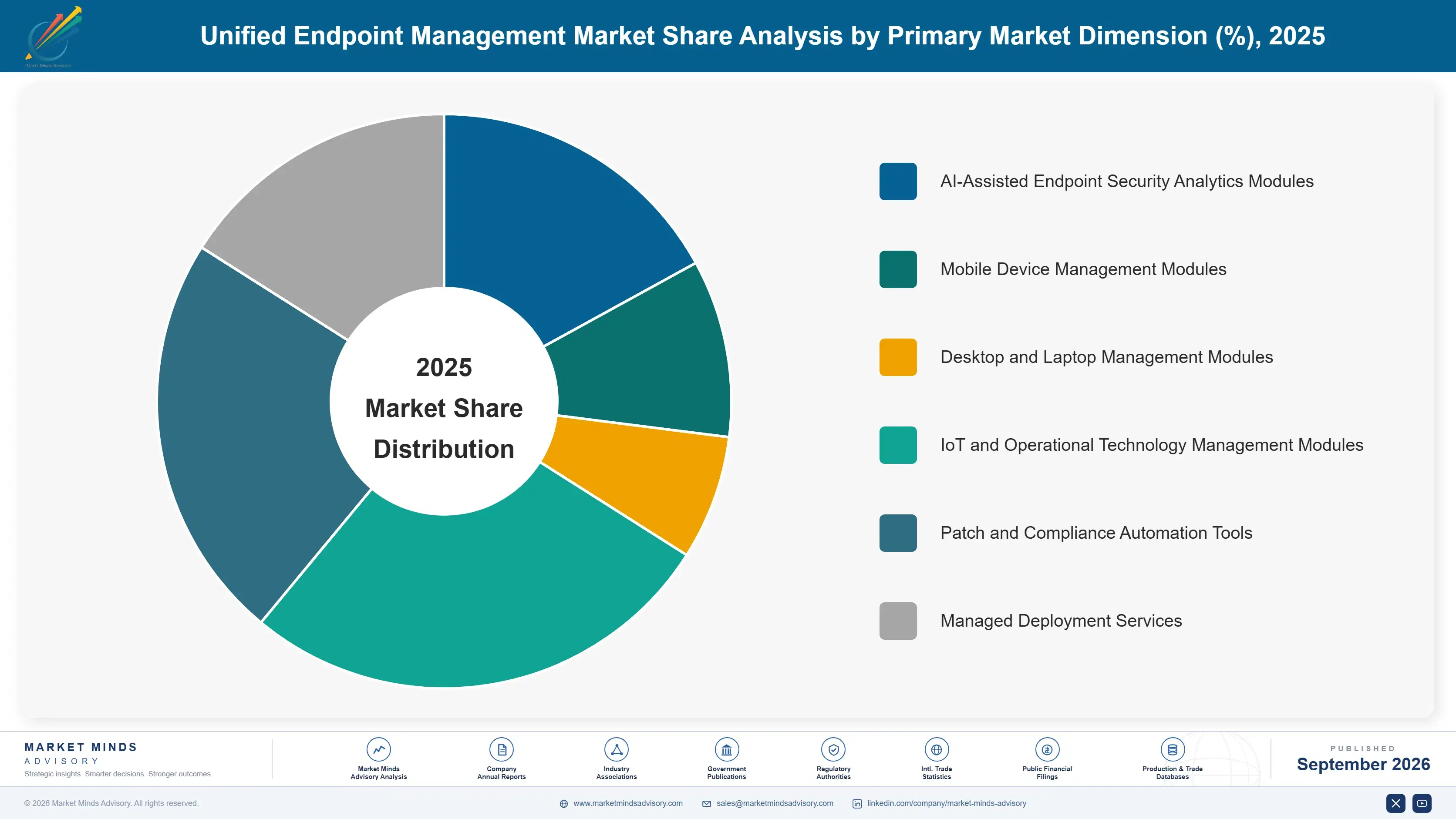
Unified endpoint management segments by functional layer and device coverage scope, spanning AI-assisted endpoint security analytics modules, mobile device management modules, desktop and laptop management modules, IoT and operational technology management modules, patch and compliance automation tools, and managed deployment services, each serving a genuinely distinct enterprise procurement need within the overall IT security budget.
unified-endpoint-management-market-market-share-analysis-1789984358835

AI-Assisted Endpoint Security Analytics Modules

AI-assisted endpoint security analytics modules apply machine learning to device telemetry data, detecting anomalous behavior patterns and automating remediation actions that manual security operations teams cannot match at comparable speed or scale across a large and growing enterprise device fleet spanning multiple office locations worldwide today and tomorrow. Growth reflects rapid displacement of manual security monitoring as enterprises face growing device counts and shrinking security staff availability relative to the scale of infrastructure they must protect around the clock and across every time zone. Microsoft and CrowdStrike have both expanded native analytics capability specifically to capture this fast-growing demand across enterprise customer segments worldwide and across every industry vertical served today.
CAGR 16.5%

IoT and Operational Technology Management Modules

IoT and operational technology management modules extend traditional endpoint management coverage to smart building sensors, connected manufacturing equipment, and point-of-sale terminals, enabling centralized visibility and patching for device categories that legacy platforms were never architected to support natively or at meaningful scale across large industrial deployments nationwide and well beyond that. Growth reflects rising enterprise investment in operational technology security as regulators and insurers increasingly require the same oversight for industrial devices that traditional computing endpoints already receive under existing policy and audit requirements today. Armis and Claroty have both expanded partnerships with major UEM vendors specifically to capture this fast-growing adjacent demand across enterprise customers worldwide and internationally today.
CAGR 14.5%
Full segment breakdown across 6 segments available in the complete report.

Regional Architecture and Country Demand Map

Unified endpoint management adoption tracks enterprise cybersecurity budget maturity and regulatory compliance pressure by region, with vendor headquarters concentration and insurance underwriting requirements driving fastest deployment where security spend already commands the largest share of overall IT budgets across every industry vertical and company size today.

North America

North America holds the largest regional share, anchored by Microsoft, Ivanti, VMware, IBM, and Citrix all maintaining primary product development and go-to-market headquarters in the region, giving domestic enterprises earliest access to new platform features and the deepest channel partner network of any market worldwide by a wide and consistently growing margin over international rivals and challengers alike each year. Cybersecurity insurance underwriting requirements are also most mature here, with major carriers explicitly requiring device inventory documentation before issuing or renewing coverage each policy year without exception. Managed security service providers have built substantial UEM deployment practices specifically targeting mid-market customers across every industry vertical and company size consistently today.
Share: 32% | CAGR: 12.5% (2026 to 2036)

Western Europe

Western Europe's substantial share reflects strict data protection regulation under GDPR requiring enterprises to demonstrate device-level data access controls and audit trails, making unified endpoint management a compliance necessity rather than an optional IT efficiency purchase for most organizations operating across the region and beyond its borders today, tomorrow, and beyond. Germany, UK, and France lead regional deployment among enterprises with the largest device fleets and the strictest internal audit requirements imposed by national and EU regulators alike consistently. Fragmented national telecom and privacy regulation across European Union member states somewhat slows multi-country rollout compared with the more unified North American market consistently and reliably today, tomorrow, and beyond that.
Share: 22% | CAGR: 10.0% (2026 to 2036)
Regional intelligence for 5 additional markets available in the complete report: East Asia, South Asia and Pacific, Latin America, Middle East and Africa, Eastern Europe. Contact sales@marketmindsadvisory.com.
unified-endpoint-management-market-country-cagr-analysis-1789984359359

Turning Device Counts Into Recurring Security Revenue

Platform vendors are extending revenue beyond baseline per-device subscription pricing into premium AI security tiers, IoT device add-ons, and managed deployment services, capturing more value per customer account as the enterprise migration wave from fragmented point tools continues expanding across every device category, business unit, department, remote office, and physical location worldwide and continuously.

Premium AI Security Tiers Above Baseline Subscriptions

Vendors including Microsoft and VMware have introduced premium subscription tiers bundling AI-assisted anomaly detection and automated remediation above the baseline device management subscription price, capturing incremental revenue from customers who previously purchased only basic inventory and patching functionality at a considerably lower rate each and every single month. These premium tiers now generate roughly 18 to 22 percent higher average revenue per device than baseline subscriptions among customers who upgrade to the newer tier. Adoption has grown steadily as security teams demand faster incident response times and reduced dwell time.
Market Impact: Premium tiers add 18 to 22 percent revenue

IoT Device Coverage Add-On Pricing Modules

Vendors increasingly charge a separate per-device add-on fee for extending management coverage to IoT and operational technology devices beyond traditional laptops and phones, since these device categories require specialized protocol support that baseline pricing tiers were never originally designed to include or accommodate from initial launch. This add-on pricing has generated meaningful incremental revenue per enterprise customer, with some vendors reporting IoT coverage revenue equal to roughly 15 to 20 percent of the core subscription value at renewal. Customers value the unified visibility this coverage extension delivers across their operations.
Market Impact: IoT coverage adds 15 to 20 percent revenue

Managed Deployment Services Attached To New Contracts

Vendors and channel partners increasingly bundle managed deployment services, including device enrollment, policy configuration, and phased rollout management, directly into new platform contracts rather than leaving customers to self-manage the deployment entirely on their own without any support whatsoever throughout the entire process. This managed services attach has generated meaningful incremental revenue per new customer account, with some partners reporting deployment service revenue equal to roughly 20 to 25 percent of the first-year subscription value at signing. Customers value the reduced internal IT burden this delivers throughout the rollout period.
Market Impact: Raises deployment revenue 20 to 25 percent overall

Multi-Year Contract Discounts Locking In Retention

Vendors are increasingly offering meaningful multi-year contract discounts, typically 12 to 18 percent off standard annual pricing, to lock enterprise customers into longer commitment terms and reduce the churn risk that shorter contracts carry in an increasingly competitive vendor landscape overall today, tomorrow, and beyond. This approach trades near-term revenue discount for greater customer lifetime value certainty, since a multi-year commitment substantially reduces the probability a customer evaluates competing vendors before their contract naturally expires and comes up for renewal. Larger enterprise accounts have proven most receptive to this trade-off.
Market Impact: Multi-year discounts reach 12 to 18 percent overall

Who Controls the Margin Pool

The unified endpoint management market is moderately concentrated on a revenue basis, with the top five vendors holding an estimated 46 percent combined share while dozens of specialized security vendors compete for the remainder. Microsoft and Ivanti lead on installed device base, but the gap to third-place VMware and fourth-place IBM has narrowed as AI feature parity across platforms increases.
Current competitive activity centers on AI security depth and IoT protocol coverage, with vendors racing to demonstrate native threat detection that matches or exceeds standalone security vendor functionality. Citrix has expanded its device management capability specifically to compete against Microsoft and VMware in the mid-market segment, while IBM continues investing in operational technology integration to capture manufacturing customers before larger rivals establish reference accounts.

Emerging pressure comes from specialized cybersecurity vendors extending into device management adjacent to their core threat detection products, several of which have already displaced generalist UEM vendors in discrete enterprise security deals despite lacking broad platform breadth. Rankings are most likely to shift in IoT device management, where security-native challengers can compete on comparable footing against established incumbents carrying legacy architecture.
unified-endpoint-management-market-company-positioning-matrix-1789984359882

Competitive Moat and Risk Dimensions

MICROSOFT

Moat: Native 365 Bundling

Microsoft's ability to bundle Intune device management directly into existing Microsoft 365 enterprise licensing agreements gives it a durable cost advantage that standalone UEM vendors cannot easily replicate, since customers already budgeting for Microsoft 365 view device management as a marginal incremental cost rather than a brand new procurement line item.
MICROSOFT

Risk: Limited Cross-Platform Depth

Microsoft's platform historically favored Windows device management over comparable Apple and Android support, leaving it exposed to competitors offering genuinely equal cross-platform feature parity for enterprises with diverse device fleets spanning multiple operating systems, manufacturers, hardware generations, and legacy configurations still in active use today.
IVANTI

Moat: Deep Channel Relationships

Ivanti built one of the industry's deepest reseller and managed service provider channel networks over more than a decade through a series of acquisitions, giving it reach into mid-market and government customers that direct sales teams alone would struggle to serve efficiently across every geography and vertical.
IVANTI

Risk: Integration Complexity From Acquisitions

Ivanti's growth-through-acquisition strategy has left it managing multiple legacy product codebases that require ongoing integration work, creating a technical debt burden that pure-play competitors built on a single unified architecture from the outset do not carry into new feature development cycles or customer support operations.

Players Tracked

Prominent Players

Microsoft
Ivanti
VMware
IBM
Citrix

Other Key Players

Jamf
SOTI
ManageEngine
BlackBerry
Kandji
Hexnode
Scalefusion
42Gears
Baramundi Software
Matrix42
NinjaOne
Kaseya
Addigy
SimpleMDM
Miradore

Recent Developments

FEBRUARY 2026

Microsoft Launches AI-Native Device Compliance Engine

Microsoft launched an AI-native device compliance engine within Intune, automating policy remediation across Windows, macOS, iOS, and Android devices simultaneously without requiring separate configuration profiles for each individual operating system version. The launch targets enterprises managing increasingly diverse device fleets across hybrid and remote work arrangements.
Signal: Signals platform vendors are steadily consolidating their cross-platform compliance capability into one single unified automation engine.
OCTOBER 2025

VMware Acquires IoT Security Startup

VMware acquired a privately held IoT security startup specializing in operational technology device fingerprinting, adding engineering talent and intellectual property to accelerate its own IoT management product roadmap. The acquired team brings an established reference deployment with a mid-sized North American manufacturing customer already using the technology.
Signal: Shows platform vendors are increasingly buying IoT capability rather than building it internally from the ground up.
MAY 2025

IBM And CrowdStrike Announce Integration Partnership

IBM announced a deepened integration partnership with CrowdStrike, connecting device management telemetry directly with CrowdStrike's threat detection platform to give joint customers a unified security dashboard spanning both device compliance and active threat monitoring capability. The partnership targets large enterprise customers running both platforms simultaneously.
Signal: Indicates device management and threat detection platforms are steadily converging into a single unified security category.

Cloud Infrastructure and Security Talent Costs

Cloud infrastructure hosting and specialized security engineering talent together account for an estimated 42 to 52 percent of platform vendor cost of goods sold, with infrastructure sourced primarily from major hyperscale cloud providers including AWS, Microsoft Azure, and Google Cloud globally. Threat intelligence data licensing fees add further meaningful cost exposure to the underlying detection engine.
Hyperscale cloud infrastructure pricing rose meaningfully during 2023 and 2024 as compute demand from AI workloads competed directly against security platform hosting for the same underlying data center capacity, according to company annual reports and investor filings from major platform vendors. Several vendors disclosed infrastructure cost pressure of 9 to 14 percent within earnings disclosures covering this period, compressing gross margins on existing customer contracts signed before the increase.

Smaller platform vendors lacking negotiated volume discounts with hyperscale cloud providers face meaningfully higher infrastructure costs per device than scale incumbents who commit to multi-year capacity reservations in advance, creating a persistent cost disadvantage that compounds as customer bases grow. Geographic exposure also varies, with vendors dependent on a single cloud region facing greater latency and redundancy cost than those operating multi-region infrastructure.
unified-endpoint-management-market-cost-volatility-analysis-1789984360081

Multi-Cloud Infrastructure Strategies Reducing Vendor Dependency

Several vendors have diversified hosting across multiple hyperscale cloud providers rather than relying on a single vendor entirely, reducing pricing leverage any single provider holds while also improving redundancy and reducing latency for customers located far from a primary hosting region or data center across every served market, geography, and time zone worldwide today.

Threat Intelligence Sharing Consortiums Reducing Licensing Cost

Vendors have joined industry threat intelligence sharing consortiums that pool detection signature data across member organizations, reducing dependency on expensive proprietary threat feed licensing while maintaining comparable detection coverage breadth across the shared network of participating vendors and their combined telemetry streams collected globally each and every single day without any exception whatsoever today.

Automated Support Tooling Reducing Engineering Headcount Needs

Vendors are increasingly investing in automated diagnostic and self-service support tooling that reduces the specialized security engineering headcount required to maintain service quality, lowering per-customer support cost quite meaningfully while maintaining comparable service level agreement performance across the entire installed customer base worldwide and across every deployment tier, plan, and contract type currently available.

Portfolio Architecture for Margin Defence

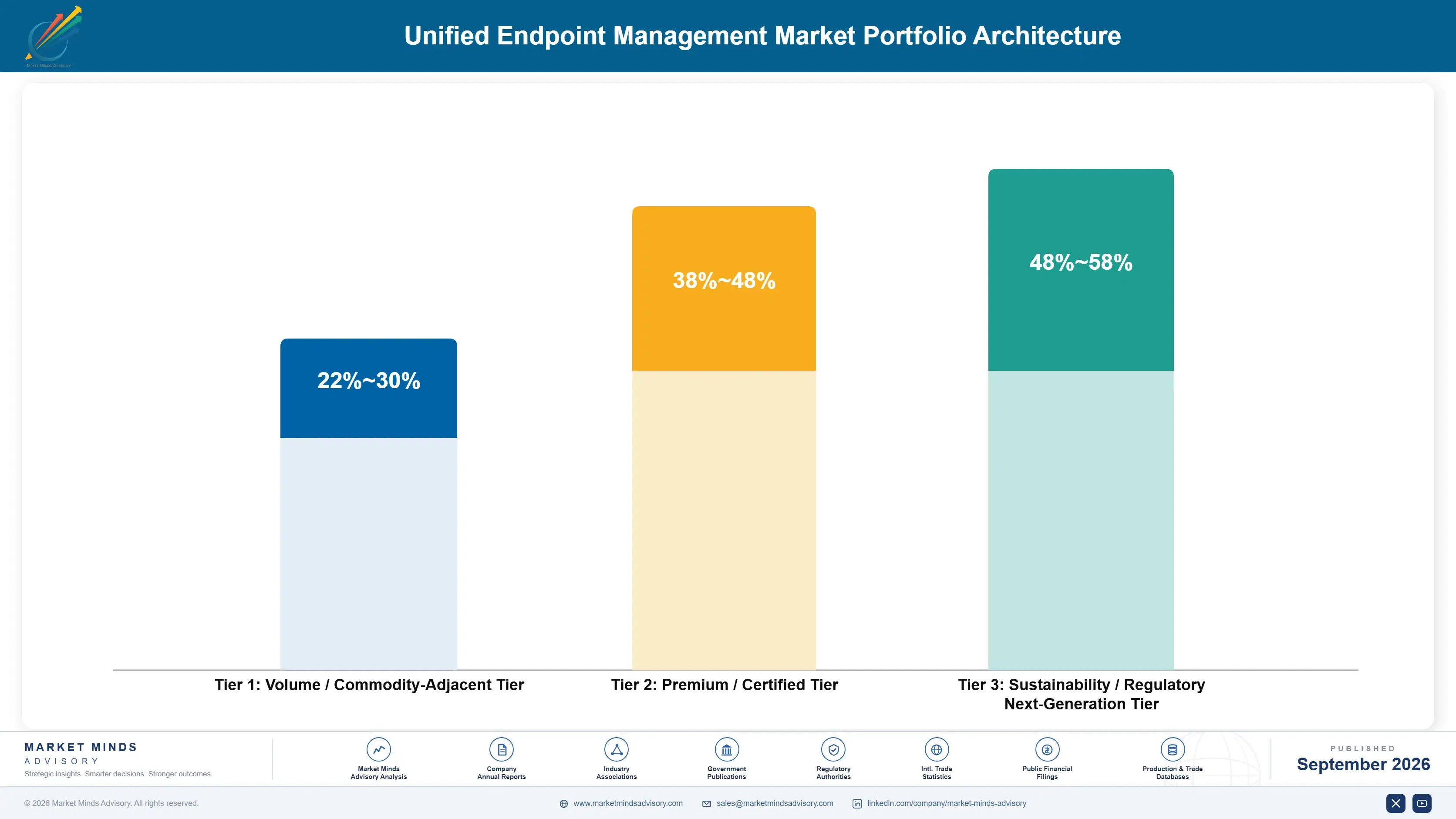
Unified endpoint management follows a three-tier portfolio architecture ranging from basic mobile device management at the low end through full unified platforms to next-generation AI-assisted security integrated suites, with gross margins expanding meaningfully at each successive tier as security depth, integration breadth, and switching costs increase together over time and rising scale industrywide.
Volume tier products compete primarily on price against increasingly capable open-source and bundled alternatives, compressing margins for vendors unable to differentiate on security depth or channel support quality across a broad small business customer base spanning multiple geographies and industries alike and consistently over time. Full unified platforms carry materially higher margins, since enterprise customers value integration breadth and vendor accountability enough to pay a substantial premium over comparable point solutions still on the open market today.

High-value margin pools concentrate overwhelmingly in AI-assisted security integration and premium unified platform tiers, where analytics sophistication and threat detection depth command premium pricing that basic device inventory tools simply cannot match given their comparatively narrow feature set relative to what enterprise customers increasingly require at scale and complexity across every industry vertical served today.

Volume / Commodity-Adjacent Tier

Basic mobile device management and inventory tracking tools serving small business and price-sensitive customers, priced primarily on cost with thin differentiation beyond baseline reliability and device enrollment speed for smaller regional accounts.
Gross Margin: 22-30%

Premium / Certified Tier

Full unified endpoint platforms bundling device, mobile, and IoT management with deep security software integration, commanding premium pricing through proven reliability and channel support built over multiple successive product generations and customer relationships.
Gross Margin: 38-48%

Sustainability / Regulatory / Next-Generation Tier

AI-assisted security integrated platforms addressing next-generation zero-trust and threat detection requirements, commanding the highest margins given scarce AI engineering talent and genuine technical differentiation versus legacy device management alternatives still widely deployed.
Gross Margin: 48-58%
unified-endpoint-management-market-portfolio-architecture-1789984360591

High-value Sub-segments and Strategic Watch-out

AI-Assisted Endpoint Security Analytics Modules

The fastest-growing and highest-margin segment, combining premium pricing with strong unit economics as enterprises replace manual security monitoring with AI-native platforms across every device category and remote worker seat nationwide, backed by sustained IT budget investment and executive-level prioritization across most large accounts today and tomorrow.
Gross Margin: 46-54%

IoT and Operational Technology Management Modules

Strong growth and healthy margins driven by expanding operational technology security investment, though competitive intensity from specialized IoT security vendors keeps pricing power somewhat below the leading endpoint security segment at comparable deployment scale and geography across most enterprise customer accounts and industries served today.
Gross Margin: 42-50%

Mobile Device Management Modules

The volume core of the market, generating steady but thinning margins as bundled alternatives mature and commoditize baseline mobile management functionality that most small business customers no longer view as sufficiently differentiated today or worth paying any real or meaningful premium price for at all.
Gross Margin: 24-32%

Desktop and Laptop Management Modules

A strategic watch-out segment facing gradual displacement as unified platforms supersede standalone desktop management tools across enterprise customers, requiring vendors to migrate customers before legacy revenue erodes faster than replacement revenue can realistically offset it across the entire affected customer base worldwide today and tomorrow.
Gross Margin: 22-30%

Why UEM Contracts Rarely Churn

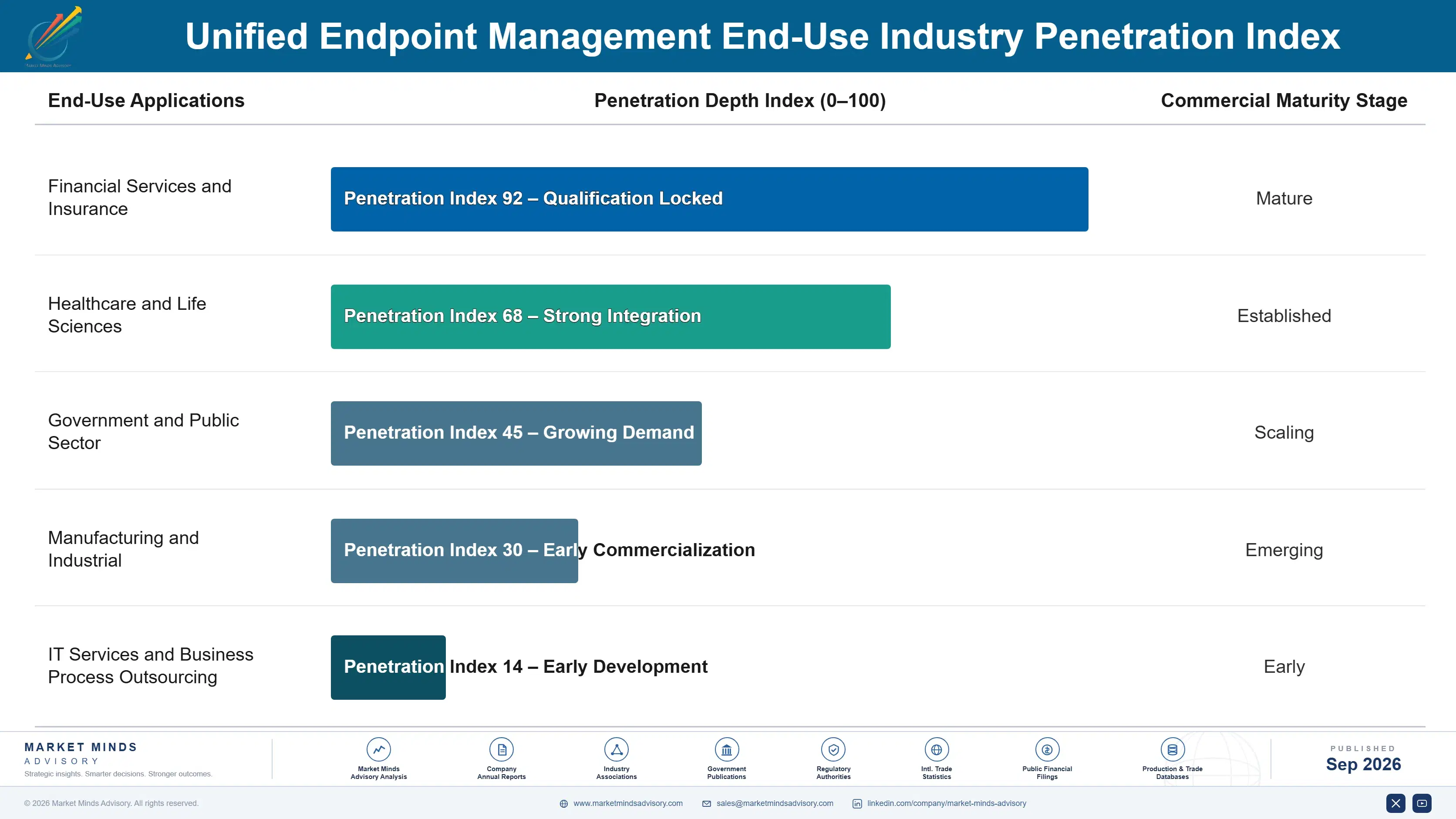
Unified endpoint management contracts function as multi-year annuities once deployed across an enterprise, since switching platforms requires re-enrolling every managed device, rebuilding security policy configurations, and retraining IT staff on a new console that most departments avoid absent a genuinely compelling technical or commercial reason to switch suppliers. Renewal rates consistently exceed 85 percent across successive contract terms industry-wide and across nearly every customer segment.
Adoption stickiness varies by end-use vertical: large enterprises exhibit the deepest lock-in given the scale and complexity of their integrated device fleets and the disruption risk any migration carries across departments and business units, while small businesses switch providers considerably more readily since their deployments involve fewer devices and correspondingly lower switching cost and disruption risk overall. Mid-market customers sit somewhere between these two extremes on switching cost.

Buyer profiles are shifting generationally as IT security teams increasingly prioritize AI-assisted threat detection depth over pure device inventory feature comparison, changing evaluation criteria away from the enrollment simplicity benchmarks that dominated purchasing decisions a decade ago toward security integration depth and analytics sophistication, a shift vendors ignore at real competitive risk over the coming forecast period.
unified-endpoint-management-market-end-use-penetration-index-1789984361113

Where UEM Vendors Should Focus Next

These are among the four positions where our research anticipates prominent divergence between winners and laggards over the coming forecast period. Each is grounded in the demand model, the regulatory perimeter, and the announced capacity pipeline.
01 / SECURITY INTEGRATION STRATEGY

Embed AI Threat Detection As Standard Not Add-On

Vendors still charging separately for AI-assisted threat detection face a widening competitive gap against rivals bundling it as a standard platform feature at no extra cost whatsoever. Standalone device inventory functionality alone no longer wins enterprise evaluations, since IT security teams increasingly weight detection depth above pure device management breadth in their vendor scoring criteria and procurement checklists. Embedding AI capability into core tiers now secures qualification in evaluations that would otherwise eliminate vendors before pricing discussions even begin in earnest.
02 / IOT COVERAGE STRATEGY

Build Native IoT Protocol Support Ahead Of Rivals

IoT and operational technology device management represents a rare multi-year expansion opportunity, since most legacy platforms were never architected to support these device categories natively and now face costly retrofitting to compete effectively at scale. Vendors building genuine IoT protocol support now, ahead of broader industry recognition of this requirement, capture disproportionate share of a fast-growing adjacent market before competitors fully mobilize comparable capability of their own. Waiting until IoT security mandates become universal leaves considerably less differentiated share to win.
03 / INSURANCE COMPLIANCE STRATEGY

Build Dedicated Cyber Insurance Compliance Reporting Tools

Cybersecurity insurance underwriting requirements are rapidly becoming a durable purchase driver independent of general security posture improvement, and vendors who build dedicated compliance reporting tools tailored to insurer documentation requirements will capture renewal-driven purchase decisions competitors miss entirely and consistently over time. This positioning requires relatively modest engineering investment relative to the recurring revenue opportunity annual insurance renewal cycles create for platforms that address it directly. Vendors ignoring this specific requirement risk losing deals to competitors who address it directly.
04 / GEOGRAPHIC EXPANSION STRATEGY

Deepen India Presence Ahead Of IT Outsourcing Growth

India's IT services and business process outsourcing sector represents a genuinely underserved growth opportunity, since most vendors have concentrated channel investment in North America and Western Europe rather than this rapidly expanding corporate customer base and its steadily growing IT security budgets overall. Vendors without established regional support presence risk losing this growing segment to domestic providers building comparable platforms at considerably lower cost. Early investment in local partnerships now determines competitive position for years beyond the current growth cycle.

Engagement Snapshot From the Field

A live engagement with an industry participant carrying material or product regulatory and market exposure ahead of a defining policy shift, showing how our research translates into a defensible multi-year portfolio strategy.
MARKET MINDS ADVISORY · CLIENT ENGAGEMENT SUMMARY
Unified Endpoint Management Producer Strategic Portfolio Review and Transition Roadmap 2026·Investment Scenario on Unified Endpoint Management Exposure Evaluation 2025-26
CLIENT PROFILE
The client is a tier-one North American financial services firm operating across dozens of regional offices, generating annual revenue exceeding 15 billion dollars (client-reported, unverified by MMA). The firm was running five separate device management tools accumulated through prior acquisitions, creating security visibility gaps that internal audit and regulatory compliance teams flagged as an unacceptable risk requiring urgent remediation before the next examination cycle.
STRATEGIC CHALLENGE
Fragmented device management tooling across five separate platforms prevented the firm from maintaining a single auditable device inventory, since each acquired business unit had standardized on a different legacy tool with incompatible reporting formats. Compliance leadership needed an independent assessment of which single unified endpoint management platform could realistically consolidate all five legacy environments within a twelve-month regulatory deadline without disrupting existing operations.
MMA APPROACH
MMA conducted a structured vendor evaluation spanning technical architecture review, reference customer interviews with three comparable financial services firms, and total cost of ownership modeling across a five-year horizon for the top four candidate platforms. The assessment weighted regulatory compliance reporting depth, existing integration with the firm's identity management infrastructure, and vendor implementation support capacity as the most decisive selection criteria.
KEY FINDINGS
  1. Two of the five incumbent legacy platforms lacked adequate regulatory compliance reporting depth despite marketing claims, requiring substantial custom reporting development regardless of which platform the firm ultimately selected as its consolidation target.
  2. The firm's identity management infrastructure created meaningful switching cost asymmetry, favoring platform vendors with existing certified integration over vendors requiring new certification work built entirely from scratch.
  3. Reference customers reported average consolidation timelines of 14 months rather than the 12 months initially budgeted, indicating the firm's internal timeline expectations required meaningful revision before proceeding further.
  4. Total cost of ownership modeling showed the recommended platform would save approximately 18 percent over five years compared with maintaining the five-platform arrangement the firm had inherited through acquisitions.
CLIENT PROFILE
The client is a tier-one North American financial services firm operating across dozens of regional offices, generating annual revenue exceeding 15 billion dollars (client-reported, unverified by MMA). The firm was running five separate device management tools accumulated through prior acquisitions, creating security visibility gaps that internal audit and regulatory compliance teams flagged as an unacceptable risk requiring urgent remediation before the next examination cycle.
STRATEGIC CHALLENGE
Fragmented device management tooling across five separate platforms prevented the firm from maintaining a single auditable device inventory, since each acquired business unit had standardized on a different legacy tool with incompatible reporting formats. Compliance leadership needed an independent assessment of which single unified endpoint management platform could realistically consolidate all five legacy environments within a twelve-month regulatory deadline without disrupting existing operations.
MMA APPROACH
MMA conducted a structured vendor evaluation spanning technical architecture review, reference customer interviews with three comparable financial services firms, and total cost of ownership modeling across a five-year horizon for the top four candidate platforms. The assessment weighted regulatory compliance reporting depth, existing integration with the firm's identity management infrastructure, and vendor implementation support capacity as the most decisive selection criteria.
KEY FINDINGS
  1. Two of the five incumbent legacy platforms lacked adequate regulatory compliance reporting depth despite marketing claims, requiring substantial custom reporting development regardless of which platform the firm ultimately selected as its consolidation target.
  2. The firm's identity management infrastructure created meaningful switching cost asymmetry, favoring platform vendors with existing certified integration over vendors requiring new certification work built entirely from scratch.
  3. Reference customers reported average consolidation timelines of 14 months rather than the 12 months initially budgeted, indicating the firm's internal timeline expectations required meaningful revision before proceeding further.
  4. Total cost of ownership modeling showed the recommended platform would save approximately 18 percent over five years compared with maintaining the five-platform arrangement the firm had inherited through acquisitions.
RECOMMENDED STRATEGY
Phase 1: Phase 1 (Months 1 to 3): Complete a structured vendor evaluation incorporating reference customer interviews and compliance reporting depth assessment. Phase 2: Phase 2 (Months 4 to 11): Execute phased migration beginning with the highest-risk business units flagged by internal audit findings. Phase 3: Phase 3 (Months 12 to 14): Complete full platform consolidation, decommission all remaining legacy tools, and finalize regulatory compliance documentation.
OUTCOME
The firm selected a single unified endpoint management platform and completed consolidation within 13 months, closely matching MMA's revised timeline rather than its original internal estimate. Reported annual licensing cost savings reached approximately 16 percent against the prior five-platform arrangement (client-reported, unverified by MMA), and compliance leadership credited the structured evaluation with avoiding a weaker vendor choice.

Frequently Asked Questions

Foundational context covering the market sizes, CAGR, scope, country, region and competition that inform every finding below. This section is provided to cover basics and most often pre-purchase conversations, answered from the MMA Primary Research Dataset.

What is the current size of the Unified Endpoint Management Market?

The global unified endpoint management market reached 8.5 billion dollars in 2025. Growth is driven primarily by cybersecurity insurance requirements and expanding IoT device management needs across enterprise networks worldwide.

How large will the Unified Endpoint Management Market be by 2036?

The market is projected to reach 28.16 billion dollars by 2036, roughly a 2.97-fold expansion from the 2026 base. This reflects sustained AI security integration and device fleet expansion across every industry vertical.

What is the CAGR for the Unified Endpoint Management Market 2026 to 2036?

The market is projected to grow at an 11.5 percent compound annual growth rate between 2026 and 2036. Bull and bear scenarios range from 10.3 to 12.7 percent depending on regulatory compliance pace.

Which segment is growing fastest?

AI-assisted endpoint security analytics modules lead at a 16.5 percent CAGR, roughly 1.43 times the overall market rate. This reflects enterprises replacing manual security monitoring with AI-native detection platforms across their device fleets.

Who are the major companies in the Unified Endpoint Management Market?

Microsoft, Ivanti, VMware, IBM, and Citrix lead the market on a revenue basis, together holding an estimated 46 percent combined share. Dozens of specialized security vendors compete for the remaining share.

Which country is growing fastest?

India leads country-level growth at a 16.0 percent CAGR, driven by its IT services and business process outsourcing sector rapidly adopting unified endpoint management. This secures globally distributed teams accessing client systems.

Report Segmentation Architecture

The full report scope spans multiple orthogonal segmentation dimensions, with cross-tabulated demand data provided for each dimension pair. Coverage extends further to regional breakdowns, trend trajectories, and the competitive detail needed to support segment-level decision-making.

By Primary Market Dimension

  • AI-Assisted Endpoint Security Analytics Modules
  • Mobile Device Management Modules
  • Desktop and Laptop Management Modules
  • IoT and Operational Technology Management Modules
  • Patch and Compliance Automation Tools
  • Managed Deployment Services

By End-Use Industry

  • Financial Services and Insurance
  • Healthcare and Life Sciences
  • Government and Public Sector
  • Manufacturing and Industrial
  • IT Services and Business Process Outsourcing

By Commercial Dimension

  • Direct Software Licensing
  • Managed Security Service Providers
  • System Integrator Channel
  • Consumption-Based Subscription

By Region

  • North America
  • Western Europe
  • East Asia
  • South Asia and Pacific
  • Latin America
  • Middle East and Africa
  • Eastern Europe

Scope, Methodology, and Coverage

Every figure in this report is reproducible from documented input assumptions. The scope below maps the historical period, the forecast horizon, the segmentation dimensions, and the countries covered, alongside the underlying primary and qualitative methodology.
Historical Period
2020 to 2025
Forecast Period
2026 to 2036
Base Year
2025 (USD billions; MMA Primary Research Dataset, September 2026)
Market Definition
The unified endpoint management market comprises software platforms that centrally manage, secure, and monitor laptops, desktops, mobile devices, and IoT hardware from a single console. It excludes standalone antivirus software and network infrastructure monitoring tools lacking device-level management functionality.
Quantitative Units
USD billions (current prices); CAGR in percent
Segmentation Dimensions
By Primary Market Dimension; By End-Use Industry; By Commercial Dimension; By Region
Regions Covered
North America, Western Europe, East Asia, South Asia and Pacific, Latin America, Middle East and Africa, Eastern Europe
Countries Covered
USA, China, Germany, France, UK, Japan, South Korea, India, Australia, Canada, Brazil, Mexico, Indonesia, Vietnam, Thailand, Malaysia, UAE, Saudi Arabia, South Africa, Nigeria, Turkey, Poland, Netherlands, Italy, Spain, Sweden, Switzerland, Argentina, Colombia, Singapore, and additional markets relevant to this sector
Key Companies Profiled
Microsoft, Ivanti, VMware, IBM, Citrix, Jamf, SOTI, ManageEngine, BlackBerry, Kandji, Hexnode, Scalefusion, 42Gears, Baramundi Software, Matrix42, NinjaOne, Kaseya, Addigy, SimpleMDM, Miradore
Quantitative Methodology
Primary survey, n=3,800 respondents, Q4 2025, six countries; demand-side model with trade association cross-validation
Qualitative Methodology
47 expert interviews, Q4 2025; applied to validate demand model assumptions, identify emerging dynamics, and assess competitive positioning
Report Format
PDF and XLSX data workbook (Word format preview document)
Publisher
Market Minds Advisory
Report Code
MMA-2026-TEC-180
Published
September 2026
Contact
sales@marketmindsadvisory.com | www.marketmindsadvisory.com

Purchase the full Unified Endpoint Management Market Report (2026 to 2036).

This report delivers a comprehensive assessment of the global unified endpoint management market across all seven world regions and the full ten-year forecast period running through the end of 2036. It profiles twenty leading vendors on a revenue basis, examines segment-level growth across six primary technology categories, and details the commercial mechanisms driving recurring security revenue expansion industry-wide. Regional analysis covers regulatory compliance pressure and vendor headquarters concentration effects on adoption pace. The report also includes an anonymized client case study illustrating real-world platform consolidation decision-making.
Seven-region market sizing and ten-year forecast
Twenty-company competitive benchmarking on a revenue basis
Segment-level CAGR and market share breakdown
Revenue lever and premium security tier analysis
Input cost exposure and cloud infrastructure assessment
Anonymized client engagement case study with outcomes

Built For The People Who Decide

From boardroom strategy to bench-side execution, this report is read cover-to-cover by leaders shaping the next decade of their industry, turning demand scenarios, market dynamics and valuation benchmarks into decisions.
CXOs/ Presidents/ VPs/ Managers
M&A and Corporate Development
Strategy Teams and R&D Heads
Procurement and Product Directors
Regulatory and Compliance Leaders
Investor Relations and Equity Analysts