Market Minds Advisory
Underwater Welding Consumable Market

Underwater Welding Consumable Market: Qualification Economics in a Dual Oil-and-Gas, Offshore Wind Cycle

Offshore wind foundation repair and deepwater pipeline tie-ins are pulling underwater welding consumable demand toward hyperbaric dry processes and corrosion-resistant duplex alloys, even as most subsea repair work relies on cheaper, lower-quality wet welding electrodes.

Lead Analyst

David Horsley

Published

August 2026

Make Smarter Decisions with Customized Research Insights

Request a free sample report and evaluate market opportunities, growth trends, and competitive dynamics relevant to your business needs.

2025 MARKET VALUE$0.8BMarket Size 2025
2036 FORECAST VALUE$1.7BBase Case , 2026 to 2036
CAGR 2026 TO 20366.4 %Bull 7.5% / Bear 5.3%
INCREMENTAL OPPORTUNITY$0.8BNet 10- year value creation
EXPANSION MULTIPLE1.86x2036 value over 2026 base
Strategic Levers
M&A Pipeline
Regional Outlook
Country Rankings
Competitive Intelligence
Segmental Deep-dive
Call-Us : 91 93563 13602

Executive Snapshot and Market Trajectory

Offshore wind installation and repair work is reshaping a niche, historically slow-moving consumables category, pushing buyers toward hyperbaric dry welding wires that produce stronger, more consistent welds than traditional wet electrodes ever could, even where wet processes remain cheaper and far more widely qualified across every contractor's existing procedure book.
Deepwater pipeline and riser repair is pulling the fastest growth, since duplex stainless and nickel-based alloy consumables are now specified on nearly every new subsea tie-back project to meet corrosion standards older carbon steel welds cannot satisfy. East Asia's shipbuilding and offshore wind fabrication base, concentrated in China, South Korea, and Japan, anchors the largest share of demand, while Gulf of Mexico and North Sea operators drive steady replacement demand on aging platforms.
Competitive advantage here rests on welder procedure qualification records more than brand recognition, since offshore operators will not approve a consumable for critical welds without extensive DNV or API testing history behind it. Lincoln Electric and ESAB dominate that depth, but offshore wind growth is drawing Korean and Chinese entrants investing heavily to build comparable certification portfolios, narrowing a gap that once looked insurmountable.
Market Definition
The underwater welding consumables market covers filler metals, electrodes, wires, and welding-specific coatings and fluxes used in wet and hyperbaric dry underwater welding for offshore oil and gas, shipbuilding and repair, subsea pipelines, and marine infrastructure. It excludes welding equipment, power sources, diving life support systems, and general topside welding consumables not qualified for underwater use.
Base Year Value
$0.8B in 2025 (MMA Primary Research Dataset, August 2026)
Forecast Period
2026 to 2036, eleven discrete annual values
CAGR
6.4% base case. Bull 7.5%. Bear 5.3%.
Fastest Growth Segment
Nickel-Based and Duplex Alloy Consumables: 9.0% CAGR
Fastest Growth Country
South Korea: 8.1% CAGR
Fastest Growth Region
South Asia and Pacific: 8.4% CAGR
Largest Region
East Asia: 30% of 2025 global value
Market Leaders
Lincoln Electric Holdings, Inc., ESAB Corporation, voestalpine Böhler Welding, Illinois Tool Works Inc., Kobe Steel, Ltd. Source: MMA Analysis based on company annual reports.
Primary Survey
n=3,800 procurement and R&D decision-makers, Q4 2025, six countries
Methodology
Demand-side build-up, cross-validated against public data, 47 expert interviews

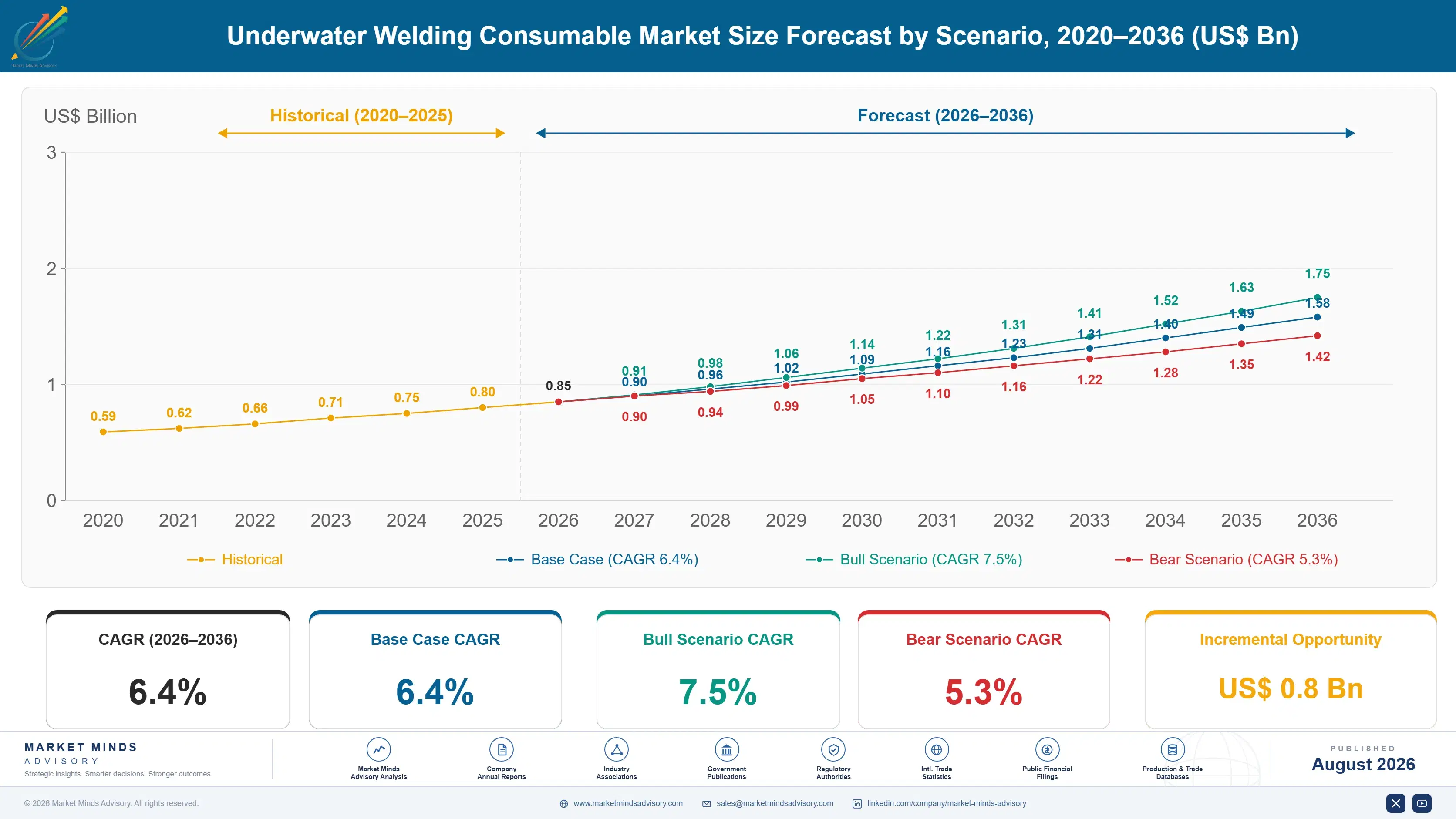
Underwater Welding Consumable Market Forecast Scenarios

underwater-welding-consumable-market-size-forecast-scenario-1787300756206
Between 2020 and 2025 the market expanded at an estimated 5.7% CAGR, held back early by pandemic-driven delays to offshore maintenance campaigns and newbuild activity. Growth resumed once deferred subsea inspection and repair work returned in 2022, and it accelerated further as offshore wind foundation installation scaled across the North Sea and, increasingly, East Asian waters.
The base case assumes 6.4% CAGR through 2036, driven by three mechanisms: expanding offshore wind foundation and cable repair work requiring qualified hyperbaric welders and matched consumables, deepwater pipeline tie-back projects specifying duplex and nickel alloys under DNV and API standards, and aging Gulf of Mexico and North Sea platforms generating steady wet-welding repair volume even as new installation shifts toward dry hyperbaric methods. Together these mechanisms diversify demand beyond the oil and gas cycle that once dominated this category almost entirely.
The bull case, 7.5% CAGR, assumes faster offshore wind build-out across East Asia pulls hyperbaric consumable demand forward faster than currently planned. The bear case, 5.3% CAGR, reflects the risk that a prolonged oil price downturn delays deepwater pipeline sanctioning, since operators typically cut subsea maintenance and tie-back budgets first when capital discipline tightens across the industry.

Qualification Depth and Offshore Project Cycles

Underwater welding consumables sit in an unusual spot for an industrial materials category: volume is small by chemicals-industry standards, but qualification barriers behave more like those in aerospace fasteners than general welding supply. A consumable that has not cleared full DNV or API certification testing simply cannot be specified for critical offshore welds, regardless of price, which insulates qualified suppliers from most price-only competition.
MARKET CONCENTRATION (CR5)34%Moderate concentration among a handful of globally qualified suppliers
AVERAGE SELLING PRICE$18/kgSpecialty alloy consumables trade well above standard electrode pricing
TOP PRODUCING COUNTRY SHARESouth Korea, 19%reflects concentrated shipyard and offshore fabrication consumable output
CAPACITY UTILIZATION74%Specialist hyperbaric wire lines run below full nameplate capacity
TRADE INTENSITY63% cross-borderMost volume moves internationally to reach offshore project sites
FEEDSTOCK COST SHARE52%Nickel and specialty metal inputs dominate finished consumable cost
Commercially, the category tracks two very different investment cycles simultaneously. Wet welding electrode demand follows oil and gas maintenance capital spending, which remains cyclical and somewhat unpredictable, while hyperbaric dry wire demand increasingly tracks offshore wind capital deployment, a comparatively steadier, policy-anchored spending pattern across most major markets. Suppliers exposed to both cycles report smoother overall revenue than those concentrated in either alone.
The next decade favors specialists who can certify alloy consumables against the newest subsea pipeline and floating wind mooring standards fastest, since qualification timelines of twelve to eighteen months create a real first-mover advantage on each new project type, one that is difficult for a late entrant to close quickly no matter how competitive their base material pricing looks on paper.
"Everyone assumes this market lives and dies with oil prices, but offshore wind has quietly become the more reliable growth engine. The suppliers who saw that shift early are the ones now winning the hyperbaric wire contracts."
Director, Industrial and Energy Infrastructure Practice · MMA Construction and I

Market Trends

Offshore Wind Foundation Repair Drives Hyperbaric Demand

Offshore wind foundations installed during the first major build-out wave are now reaching an age where welded joint inspection and repair work is becoming routine, and operators increasingly specify hyperbaric dry welding over wet processes for these repairs because dry welds test more consistently under the cyclic loading foundations experience. The UK, Germany, and China have the largest installed offshore wind base requiring this maintenance, and repair specification requirements are pulling hyperbaric wire demand well ahead of overall market growth as more turbines cross the decade-old mark that typically triggers structural weld inspection programs.
Market Impact: Sustains $210 million annual repair demand
Duplex Alloy Specification Standard on New Tie-Backs

Nearly every new deepwater pipeline tie-back project now specifies duplex stainless or nickel-based alloy consumables for subsea welds, since corrosion performance requirements under API and DNV standards have tightened following several high-profile carbon steel weld failures in sour service environments. This shift is reshaping supplier qualification priorities: consumable makers without a certified duplex or nickel alloy line are increasingly locked out of new tie-back bidding entirely, regardless of how competitive their pricing is on legacy carbon steel electrode lines that once represented most of their offshore revenue base only a few years ago.
Market Impact: Lifts East Asian volume 11 percent

Market Opportunities and Growth Drivers

Aging Platform Fleets Require Ongoing Repair Welding

More than half of Gulf of Mexico and North Sea production platforms are now beyond their original design life, and regulators in both regions require documented structural integrity inspection and repair programs before life extension approval is granted. This generates predictable, recurring wet welding electrode demand independent of new project sanctioning, since repair welding on an aging platform cannot be deferred indefinitely without risking a forced shutdown. Operators increasingly bundle multi-year consumable supply agreements with underwater inspection contractors to guarantee qualified material availability during tightly scheduled maintenance windows that leave little room for supply delays.
Market Impact: Limits project throughput by 15 percent

Shipbuilding Volume Concentration Supports Consumable Demand

China, South Korea, and Japan together account for the overwhelming majority of global commercial shipbuilding tonnage, and hull repair, ballast tank welding, and underwater cleaning-adjacent repair work at these yards consumes a steady, high volume of wet welding consumables. Rising newbuild order books through 2025, driven by tanker and container ship replacement cycles, are pulling shipyard consumable demand higher even before accounting for in-service fleet repair work. Korean shipyards in particular have begun standardizing on higher-specification consumables to reduce warranty claims, a shift that is lifting average selling prices across the region's procurement volume.
Market Impact: Qualification costs exceed $1.2 million

Market Restraints and Challenges

Diver-Welder Shortage Constrains Wet Welding Capacity

Certified commercial diver-welders capable of performing qualified wet or hyperbaric welds remain in short supply, since the certification pathway requires years of combined diving and welding experience that few training programs can compress. The root cause is that diving school output has not scaled with offshore project growth, and the physically demanding, hazardous nature of the work limits the pool of candidates willing to pursue it long-term. This constrains how quickly contractors can absorb rising consumable demand. Some contractors are mitigating the shortage by investing in remotely operated hyperbaric welding systems that require fewer in-water diver-welders per project.
Market Impact: Adds $60 million hyperbaric wire demand

Qualification Costs Limit New Entrant Participation

Achieving DNV or API welding procedure qualification for a new consumable line costs well into seven figures once testing, documentation, and third-party verification are included, a barrier that keeps the category concentrated among established suppliers even as demand diversifies into offshore wind. The cause is the destructive, statistically intensive testing regime offshore operators require before trusting a consumable on a critical weld. This locks smaller manufacturers out of premium alloy segments even when their base chemistry is comparable to qualified incumbents. Some mitigate this by licensing qualified formulations from established players rather than pursuing independent certification.
Market Impact: Alloy consumable share up 14 points
3 additional market trends, 2 additional growth drivers, and 2 additional restraints and challenges are covered in the full report. Contact sales@marketmindsadvisory.com to access the complete intelligence.

Segment CAGR and Growth Architecture

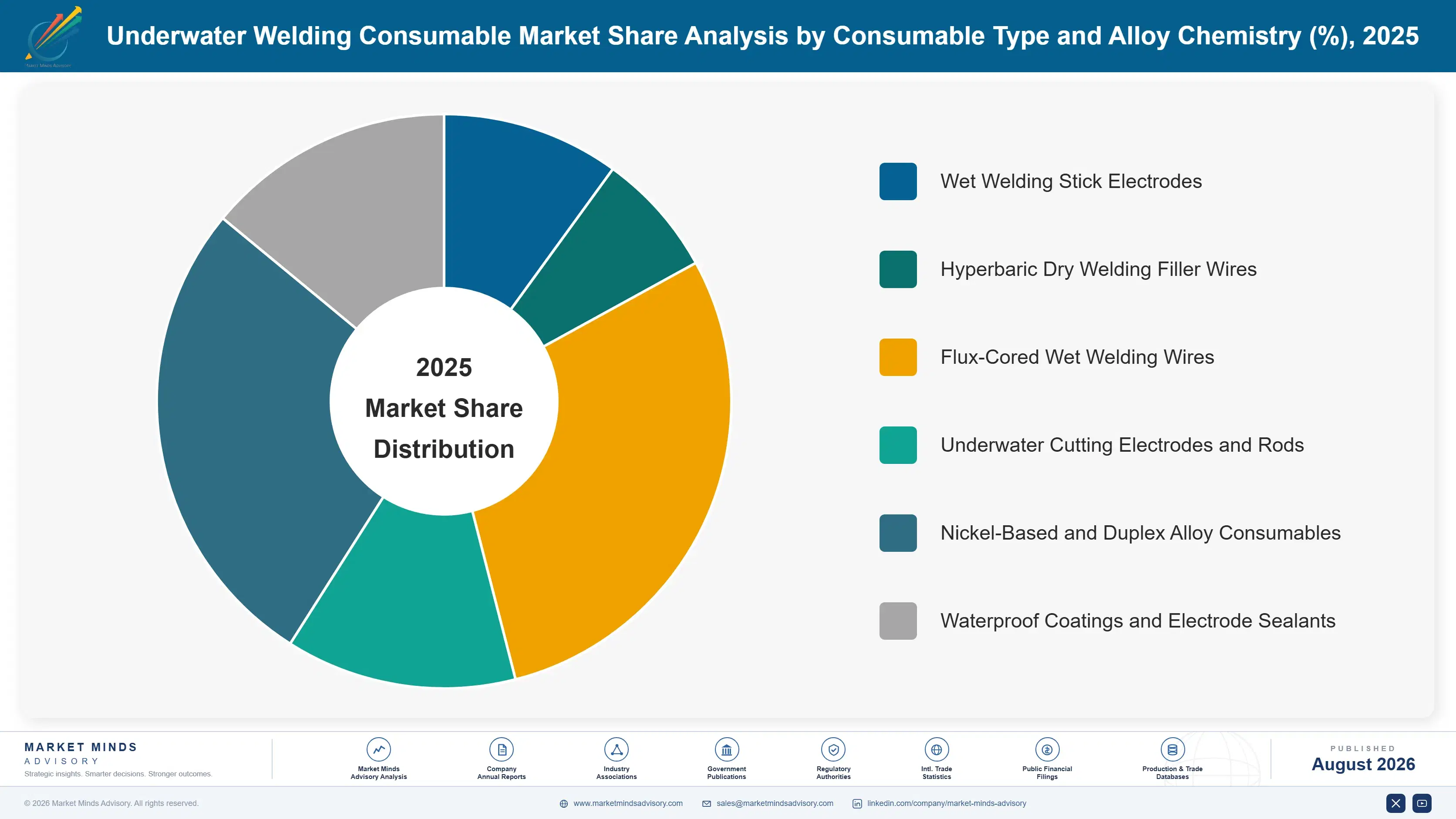
MMA segments the underwater welding consumables market by product and alloy chemistry type, the dimension that determines qualification pathway, certification cost, and buyer specification behavior. This framing separates commodity wet-welding electrodes from specialty hyperbaric wires and corrosion-resistant alloy consumables, categories that compete for entirely different offshore project budgets, timelines, and classification society approval processes.
underwater-welding-consumable-market-market-share-analysis-1787300756755

Nickel-Based and Duplex Alloy Consumables

Nickel-based and duplex stainless alloy consumables are growing fastest as deepwater pipeline and riser projects increasingly specify corrosion-resistant welds capable of withstanding sour service conditions that standard carbon steel cannot reliably handle. Qualification for this segment is the most demanding in the category, often requiring twelve to eighteen months of destructive testing against API and DNV standards before a supplier can bid on a project, which keeps the supplier base narrow and margins meaningfully higher than commodity electrode lines. Offshore wind floating mooring systems are emerging as a secondary demand driver, since mooring chain and connector welds increasingly specify similar alloy chemistry. Lincoln Electric, ESAB, and voestalpine Böhler Welding hold the deepest qualification portfolios in this segment currently.
CAGR 9.0%

Hyperbaric Dry Welding Filler Wires

Hyperbaric dry welding filler wires form the second-fastest-growing segment, pulled by offshore wind foundation repair work and by operator preference for dry welds that test more consistently than wet electrode welds under cyclic structural loading. Dry hyperbaric welding requires a sealed habitat around the weld site, which raises project cost but produces welds closer to topside quality, an increasingly important consideration as foundations age and inspection standards tighten. Korean and Japanese shipyards have begun specifying hyperbaric wire even for some newbuild subsea work traditionally handled with wet electrodes, a shift suppliers expect to continue as offshore wind and deepwater pipeline standards gradually converge toward dry-process preference across most major markets over the next decade.
CAGR 8.0%
Full segment breakdown across 6 segments available in the complete report.

Regional Architecture and Country Demand Map

Underwater welding consumable demand concentrates where offshore fabrication and shipbuilding volume are highest. East Asia leads on shipyard and offshore wind fabrication scale, North America and Western Europe follow on aging platform maintenance and North Sea offshore wind repair work, and Gulf state operators anchor Middle Eastern demand.

North America

North America's demand rests heavily on Gulf of Mexico platform maintenance, where a large share of installed platforms now exceed their original design life and require documented structural repair programs to maintain operating permits. US shipyards, though smaller in tonnage than their East Asian counterparts, generate steady naval and commercial hull repair consumable demand, particularly for wet welding electrodes used in dry-dock and pierside repair work. Offshore wind installation off the US East Coast remains at an early stage compared to Europe, but foundation fabrication and installation activity is beginning to pull hyperbaric wire demand into the region for the first time. Regulatory permitting delays have slowed offshore wind buildout somewhat, tempering near-term growth relative to Europe and East Asia.
Share: 24% | CAGR: 6.1% (2026 to 2036)

Western Europe

Western Europe anchors global demand for hyperbaric dry welding wire because the North Sea hosts the world's largest concentration of aging offshore wind foundations now reaching the age where structural weld inspection and repair becomes routine. UK, German, and Danish offshore wind operators increasingly specify dry hyperbaric welding over wet processes for this repair work, since consistent weld quality directly affects turbine foundation warranty and insurance terms. North Sea oil and gas platforms, many decades old, add further wet and dry welding repair demand on top of the wind-driven volume. European welding consumable makers, including voestalpine Böhler Welding, maintain deep qualification portfolios built specifically around North Sea operator specifications and classification society requirements.
Share: 20% | CAGR: 4.9% (2026 to 2036)
Regional intelligence for 5 additional markets available in the complete report: East Asia, South Asia and Pacific, Latin America, Middle East and Africa, Eastern Europe. Contact sales@marketmindsadvisory.com.
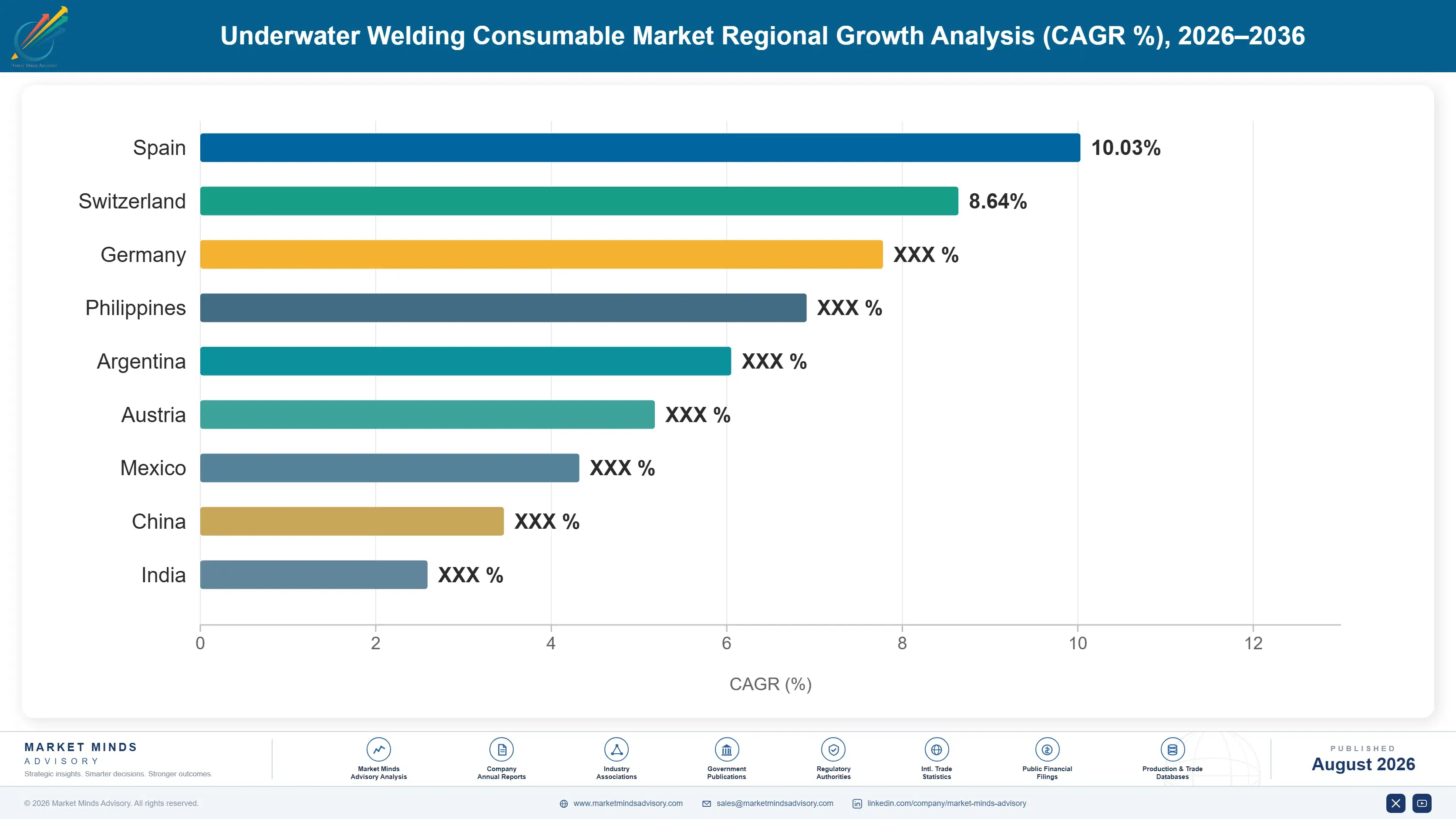
underwater-welding-consumable-market-country-cagr-analysis-1787300757277

Building Qualification Depth Across New Alloys

Suppliers are moving beyond commodity electrode sales toward qualification-led commercial models: bundled certification support for new alloy lines, long-term consumable supply agreements tied to offshore wind maintenance contracts, premium pricing for pre-qualified alloys, and training partnerships that build lasting brand preference among newly certified diver-welders entering the offshore workforce in growing numbers each year.

Bundled Certification Support for New Alloy Lines

Suppliers increasingly bundle qualification testing support, procedure documentation, and third-party verification coordination with new alloy consumable sales, recognizing that a contractor's twelve to eighteen month qualification timeline is itself a bottleneck operators want solved rather than managed independently. This shifts supplier value beyond the material itself toward accelerating a customer's time to first qualified weld, worth more to a contractor racing a tie-back deadline than a modest per-kilogram price difference. Early evidence suggests bundled support can cut qualification timelines by roughly 4 months compared to contractors managing the process alone, a meaningful advantage on time-sensitive offshore projects.
Market Impact: Cuts qualification timelines by roughly 4 full months

Long-Term Supply Agreements Tied to Maintenance Contracts

Suppliers are increasingly signing multi-year consumable supply agreements directly tied to offshore wind operation-and-maintenance contracts, guaranteeing qualified material availability for scheduled foundation inspection and repair campaigns years in advance. This model converts episodic, project-by-project consumable sales into recurring revenue resembling a service contract more than a materials transaction, and it locks in customer relationships well before competing suppliers can bid for the work. Early adopters report these agreements now cover roughly 25 percent of hyperbaric wire volume sold into European offshore wind maintenance programs, up meaningfully from a negligible share only three years earlier.
Market Impact: Covers roughly 25 percent of European wire volume

Premium Pricing for Pre-Qualified Floating Wind Alloys

As floating offshore wind moves from pilot projects toward early commercial deployment, suppliers who pre-qualify mooring chain and connector welding consumables ahead of demand are positioning to capture premium pricing before competitors catch up, since qualification lead times mean late movers simply cannot bid on early projects regardless of price. Consumables pre-qualified for floating wind mooring applications command premiums of 30 to 45 percent over standard duplex alloy pricing, reflecting both the specialized testing investment involved and the currently narrow supplier base capable of meeting classification society requirements for these still-developing floating platform designs.
Market Impact: Commands a 30 to 45 percent price premium

Training Partnerships With Commercial Diving Schools

Facing a persistent diver-welder shortage that constrains how much consumable volume the market can actually absorb, several suppliers have begun funding training partnerships with commercial diving schools, embedding their own welding procedures and consumables into certification curricula. This builds long-term brand preference among newly certified diver-welders while directly addressing a capacity constraint that limits supplier growth regardless of how much material they can produce. Participating suppliers report that graduates trained on their specific consumable systems show measurably higher first-pass weld quality scores, roughly 12 percent higher, than divers trained generically before entering the workforce.
Market Impact: Improves graduate first-pass weld quality by 12 points

Who Controls the Margin Pool

CR5 sits at 34 percent, reflecting a category where qualification depth rather than manufacturing scale determines competitive position. Lincoln Electric and ESAB lead on breadth of certified alloy lines, and the gap to mid-tier challengers is real but narrower than the concentration figure implies, since several Korean and Japanese suppliers have built comparable certification portfolios within their home shipbuilding and offshore wind markets specifically.
Current activity centers on three fronts: qualification of duplex and nickel alloy lines against tightening deepwater pipeline standards, expansion of hyperbaric wire manufacturing capacity to meet offshore wind foundation repair demand, and geographic footprint expansion into East Asian offshore fabrication hubs where several established Western suppliers previously had limited direct presence.

Emerging pressure comes from Korean and Japanese suppliers extending their shipyard-honed manufacturing scale into offshore wind and deepwater alloy segments previously dominated by Western incumbents, undercutting on price while closing the certification gap faster than expected. Expect ranking shifts as these challengers win qualification on major East Asian offshore wind projects, gradually pushing established Western leaders to compete harder on service and bundled qualification support rather than certification breadth alone.
underwater-welding-consumable-market-company-positioning-matrix-1787300757798

Competitive Moat and Risk Dimensions

LINCOLN ELECTRIC HOLDINGS, INC.

Moat: Global Alloy Certification Portfolio

Lincoln Electric holds one of the broadest DNV- and API-qualified consumable portfolios in the category, spanning wet electrodes through nickel-based alloy wires, built through decades of certification investment competitors cannot easily replicate. This breadth lets it bid on nearly any offshore project without qualification gaps.
LINCOLN ELECTRIC HOLDINGS, INC.

Risk: Thin Hyperbaric Specialization Focus

Lincoln Electric's broad industrial welding portfolio means hyperbaric and subsea consumables represent a small fraction of overall revenue, which can mean less dedicated R&D investment relative to specialist competitors focused entirely on underwater applications. Competitors argue this occasionally shows in slower response to niche subsea customer requests compared to smaller, more focused rivals.
ESAB CORPORATION

Moat: Deepwater Alloy Standards Leadership

ESAB's duplex stainless and nickel alloy consumable lines are widely specified on deepwater pipeline and riser projects, reflecting deep, sustained investment in the destructive testing programs required for sour-service corrosion qualification. This positions ESAB favorably as tie-back project activity accelerates and alloy specification requirements continue tightening across major offshore basins worldwide.
ESAB CORPORATION

Risk: Post-Spin-Off Organizational Transition

ESAB's 2022 separation from Colfax Corporation into a standalone public company required disentangling shared services and rebuilding some corporate functions independently, creating transitional overhead that has periodically slowed decision-making. Competitors see openings to win contracts with customers frustrated by any residual friction during ESAB's ongoing standalone transition.

Key Players

Lincoln Electric Holdings, Inc.
ESAB Corporation
voestalpine Böhler Welding
Illinois Tool Works Inc.
Kobe Steel, Ltd.

Others

Hyundai Welding Co., Ltd.
Kiswel Ltd.
Nippon Steel Welding and Engineering Co., Ltd.
Air Liquide Welding
Broco Inc.
A-1 Alloys Ltd.
Ador Welding Limited
Panasonic Welding Systems Co., Ltd.
Fronius International GmbH
Special Metals Corporation
Magnatech LLC
Stoody Company
Elgin National Industries
J.W. Harris Co., Inc.
Certanium Alloys and Research Co.

Recent Developments

JUNE 2025

Kobe Steel Expands Hyperbaric Wire Production in Japan

Kobe Steel completed an organic capacity expansion at its domestic welding consumables plant dedicated to hyperbaric-grade filler wire, adding production lines aimed at meeting rising demand from Japanese and South Korean offshore wind foundation fabricators facing lengthening order backlogs for qualified dry-process welding material this year.
Signal: Signals Japanese suppliers positioning early for the offshore wind foundation repair wave now reaching the region.
NOVEMBER 2025

ESAB Signs Multi-Year Supply Agreement With Offshore Wind Fabricator

ESAB signed a multi-year supply agreement with a major European offshore wind foundation fabricator to provide duplex stainless welding consumables across multiple upcoming projects, reflecting fabricators' growing preference for locked-in qualified material supply over spot purchasing as project pipelines continue to lengthen across the industry.
Signal: Shows fabricators prioritizing supply certainty over price competition as offshore wind project pipelines extend further out.
FEBRUARY 2026

Lincoln Electric Acquires Specialist Hyperbaric Consumables Manufacturer

Lincoln Electric acquired a specialist hyperbaric welding consumables manufacturer with an established qualification portfolio serving North Sea offshore wind operators, expanding its dry-process wire capability and adding certified formulations it previously lacked in-house across its existing global consumables product range, distribution network, and regional service footprint.
Signal: Extends Lincoln Electric's hyperbaric capability precisely where independent specialists had built a meaningful qualification lead over time.

Alloy Metal Sourcing and Price Risk

Nickel, chromium, and molybdenum alloy inputs account for an estimated 52 percent of production cost for specialty duplex and nickel-based welding consumables, with the remainder split between flux and coating materials, base wire steel, and manufacturing labor. Nickel sourcing concentrates in Indonesia, the Philippines, and Russia, while ferrochrome supply concentrates in South Africa and Kazakhstan, exposing this category to a narrower set of mining regions than most industrial materials.
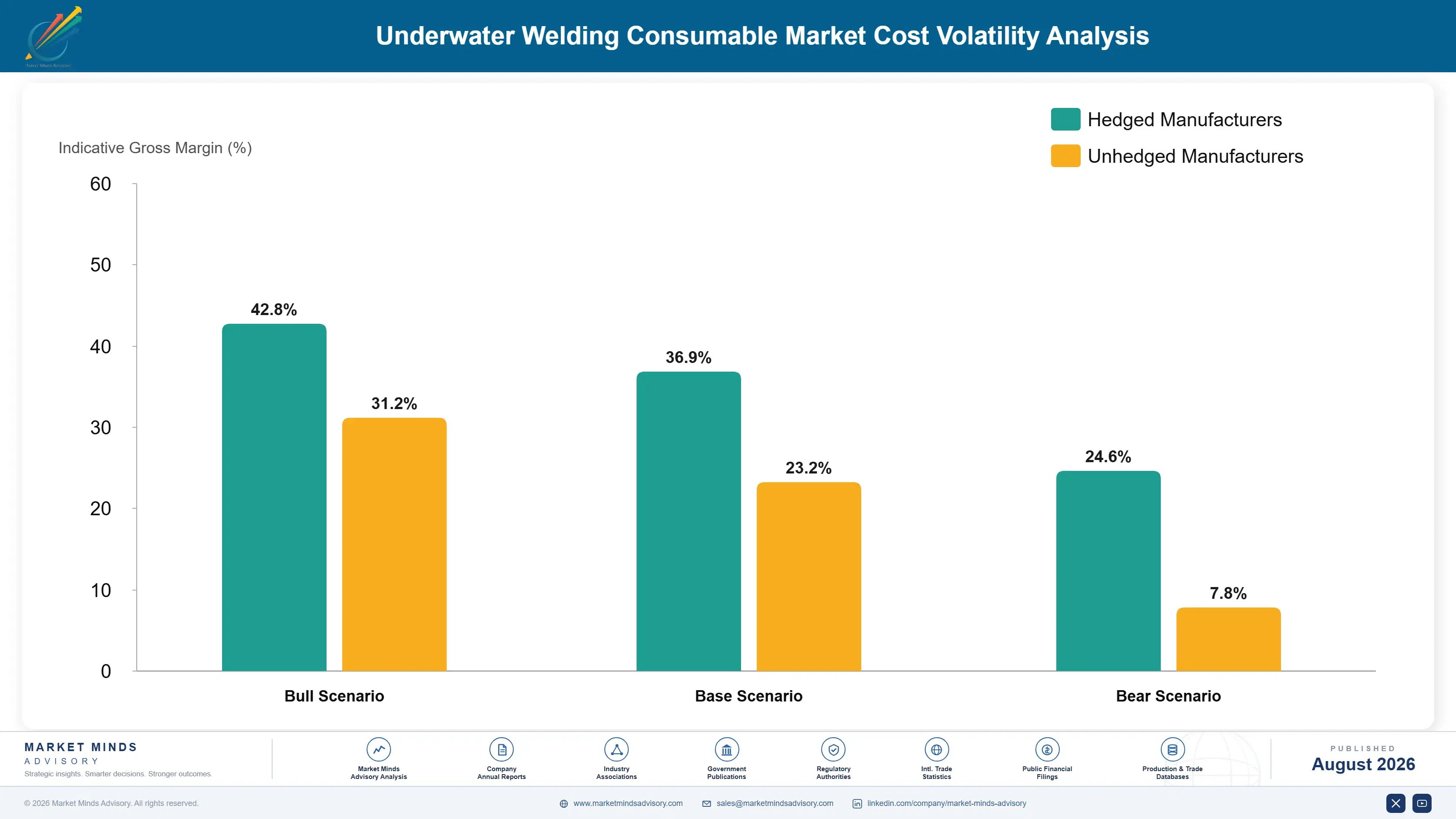
Nickel prices spiked sharply in 2022 following supply disruption linked to the war in Ukraine and subsequent exchange volatility, according to IEA metals market reporting, and prices have remained elevated since, complicating cost forecasting for manufacturers. Suppliers without hedging programs or long-term nickel supply contracts absorbed the volatility directly into thinning margins, while larger manufacturers with metal hedging desks smoothed the impact considerably across their alloy consumable lines.

Exposure varies by player type: diversified manufacturers with dedicated metals procurement and hedging capability absorbed nickel volatility better than smaller specialist alloy consumable makers buying feedstock on shorter-term contracts. Geographic exposure also differs, since European manufacturers faced steeper energy cost pass-through than Asian competitors with access to comparatively cheaper regional power for energy-intensive alloy wire drawing and coating processes.
underwater-welding-consumable-market-cost-volatility-analysis-1787300757992

Long-Term Nickel Supply Contracts With Miners

Larger consumable manufacturers are signing multi-year nickel and ferrochrome supply contracts directly with mining companies, bypassing volatile spot metal markets for the volumes they can reasonably forecast. This smooths input costs materially, though it requires committing to minimum purchase volumes that smaller specialist manufacturers often cannot absorb given their comparatively limited balance sheets and offshore project order visibility.

Metal Price Hedging Through Futures Contracts

Several larger suppliers now hedge a portion of forecasted nickel and chromium requirements through exchange-traded futures contracts, smoothing cost volatility even though this requires treasury capability most smaller specialist manufacturers lack entirely. This has become a meaningful differentiator during recent metal price swings, letting hedged suppliers hold pricing steadier for customers than unhedged competitors forced into frequent price list revisions.

Alloy Substitution Research for Lower-Nickel Formulations

Several manufacturers are researching lower-nickel duplex formulations that maintain required corrosion performance while reducing exposure to the most volatile alloy input, though qualification testing for any reformulated consumable takes years given offshore operators' understandable caution around structural weld integrity. Early formulations show promise in laboratory testing but remain years from commercial qualification and broad offshore project acceptance.

Portfolio Architecture for Margin Defence

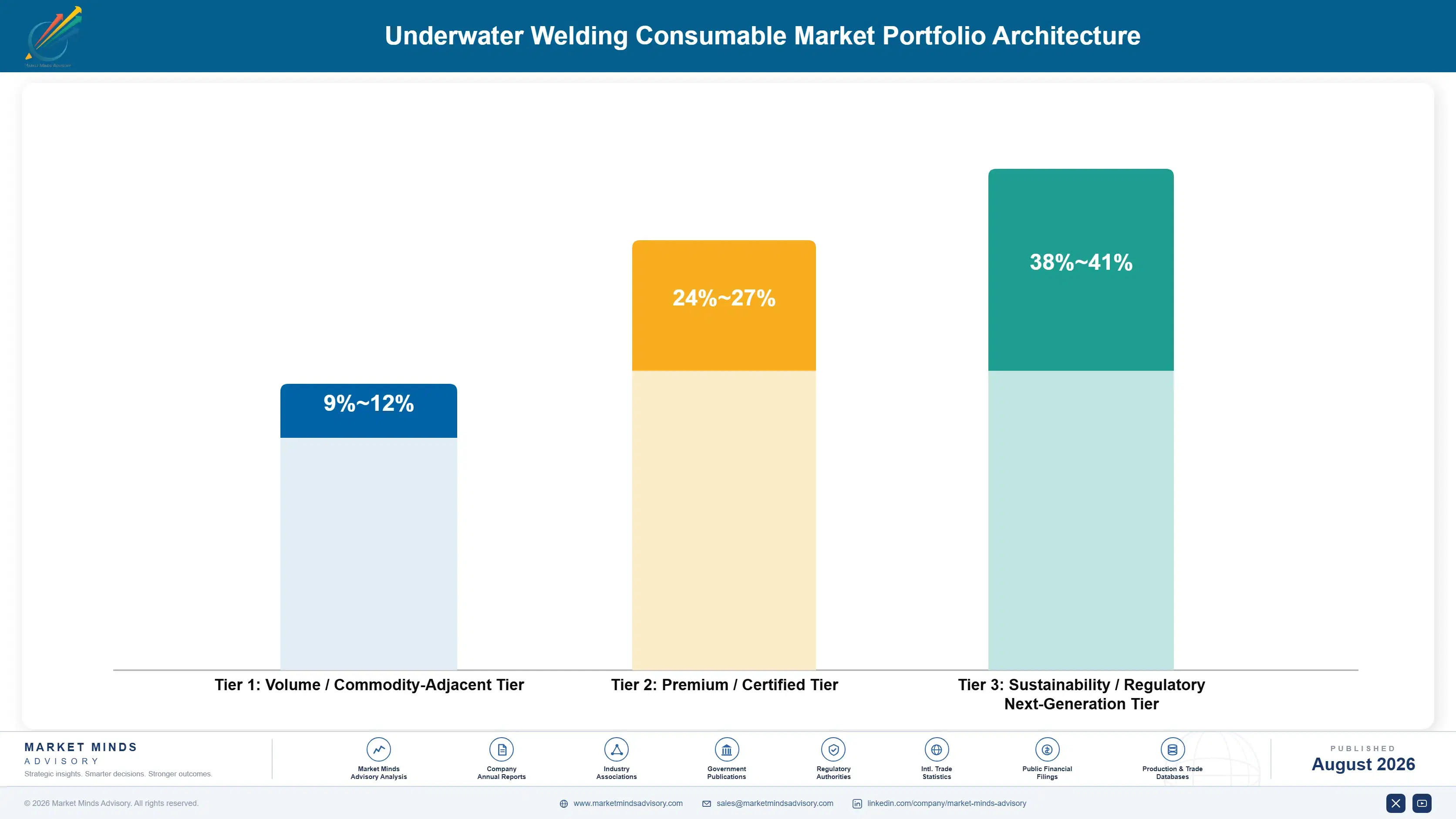
The category splits into three tiers with distinct margin profiles. Commodity wet welding electrodes, sold largely on price and availability for routine platform and shipyard repair, generate the thinnest margins in the category. Premium certified consumables, including qualified hyperbaric wires and mid-tier alloy lines, command materially better margins tied to certification investment rather than raw material cost. The sustainability and next-generation tier, covering floating wind mooring al
Volume and premium tiers pull suppliers toward different investments. Commodity electrode volume rewards manufacturing scale and distribution reach, favoring diversified players like Lincoln Electric who can spread fixed costs across a huge product range. Premium alloy and hyperbaric tiers reward sustained certification investment, favoring focused specialists who commit years of R&D to a narrow set of qualified formulations rather than chasing broad product breadth.

High-value pools concentrate in duplex and nickel alloy consumables for deepwater pipeline and floating wind projects, where qualification scarcity, not manufacturing cost, sets pricing power. Suppliers positioned in these segments capture disproportionate margin relative to volume share, a pattern MMA expects to persist while qualification timelines remain the binding constraint on entry.

Volume / Commodity-Adjacent Tier

Standard wet welding stick electrodes and basic flux-cored wires sold on price for routine shipyard hull repair and aging platform maintenance where qualification requirements are minimal and availability matters most.
Gross Margin: 9-12%

Premium / Certified Tier

DNV- and API-qualified hyperbaric dry welding wires and mid-tier duplex alloy consumables sold into offshore wind foundation repair and standard deepwater pipeline projects requiring documented, third-party-verified procedure qualification records before award.
Gross Margin: 24-27%

Sustainability / Regulatory / Next-Generation Tier

Floating wind mooring alloy consumables and emerging lower-nickel reformulated duplex lines developed to meet next-generation classification society standards while reducing exposure to volatile alloy metal input costs across the supply chain over time.
Gross Margin: 38-41%
underwater-welding-consumable-market-portfolio-architecture-1787300758490

High-value Sub-segments and Strategic Watch-out

Floating Wind Mooring Alloy Consumables

Floating offshore wind mooring and connector welds require alloy consumables qualified for constant cyclic loading in deep water, a narrow, still-emerging specification that commands the category's highest margins. Supplier base remains extremely limited today, but qualification investment underway suggests meaningful capacity additions within the next three to four years.
Gross Margin: 40-46%

Duplex Pipeline Tie-Back Alloys

Duplex stainless consumables for standard deepwater pipeline tie-backs carry strong, stable margins tied to established qualification rather than scarcity, growing steadily alongside global deepwater project sanctioning activity worldwide. Growth is more moderate than floating wind alloys since the supplier base is comparatively less constrained today.
Gross Margin: 26-29%

Wet Welding Repair Electrodes

This segment anchors category volume across aging platform maintenance and shipyard hull repair, delivering thin but dependable margins on high, recurring order volumes tied to regulatory inspection cycles worldwide. Growth tracks platform aging and shipyard tonnage rather than any single project catalyst or new field sanctioning decision.
Gross Margin: 10-13%

Single-Metal Nickel-Dependent Manufacturers

Manufacturers without hedging programs or diversified alloy sourcing face repeated margin compression whenever nickel prices spike, a vulnerability that has worsened as geopolitical disruption increasingly affects key nickel-producing and trading regions worldwide, from Indonesia to eastern Russia and beyond, with no easy near-term fix in sight.
Gross Margin: 5-8%

Qualification-Locked Procurement Relationships

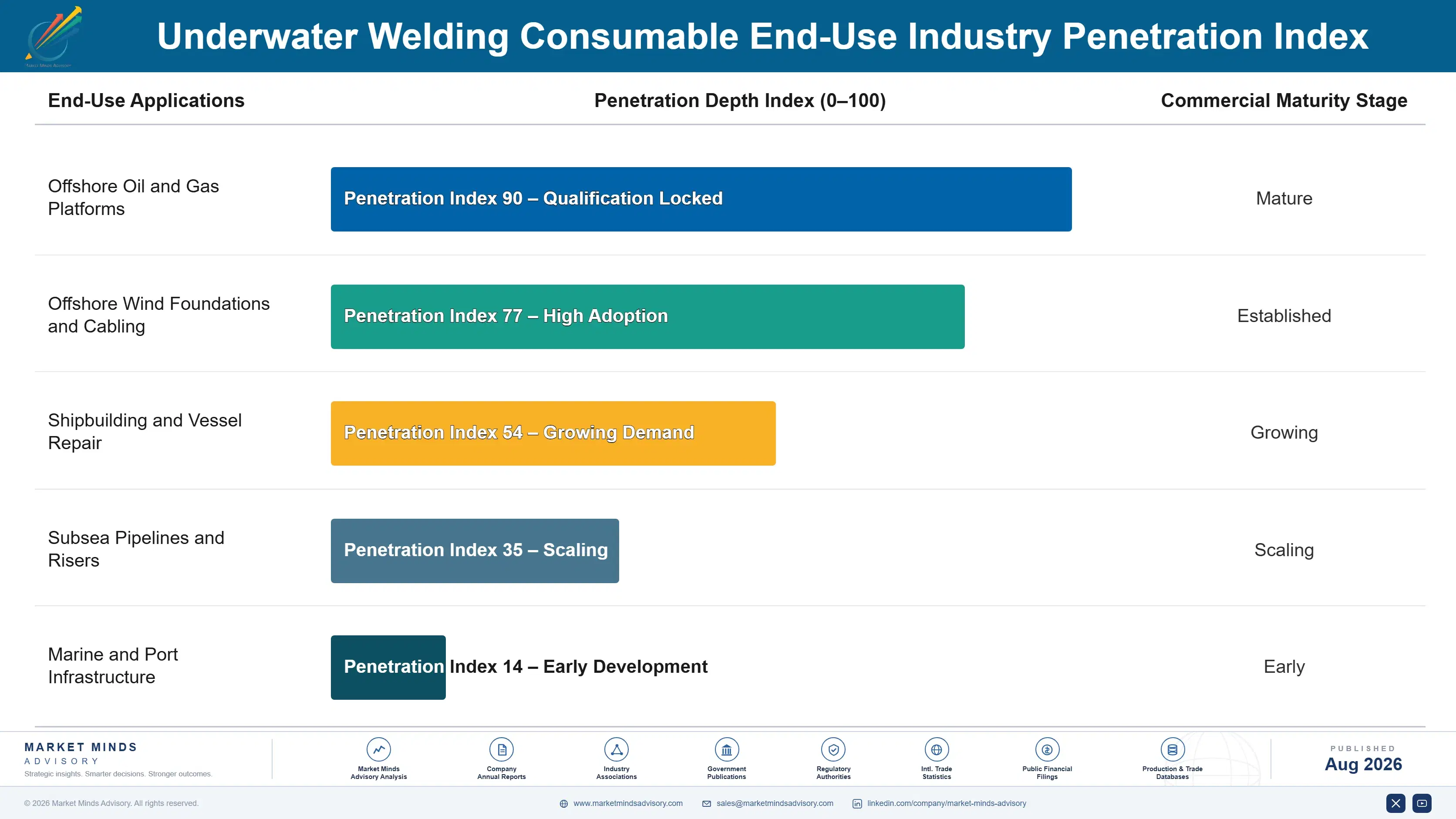
Once a consumable clears an operator's welding procedure qualification for a project type, contractors rarely requalify an alternative supplier mid-project, since requalification testing costs real time and money neither party wants to spend without a compelling reason. This gives suppliers who win the initial qualification durable, multi-year revenue across a project's full lifecycle, difficult for competitors to dislodge without a clear price or performance advantage.
Adoption depth varies sharply by end-use vertical. Offshore wind operators have moved fastest toward hyperbaric dry welding for foundation repair, since consistent weld quality directly affects turbine warranty terms and insurance underwriting. Oil and gas platform operators adopt more selectively, often maintaining wet welding for routine repair while reserving alloy consumables specifically for new pipeline tie-backs, since wholesale conversion would require costly requalification of long-standing, already-approved maintenance procedures across their existing installed asset base.

Buyer profiles are shifting generationally as offshore wind operators, many newly formed entities without decades of oil and gas procurement history, build supplier relationships from scratch rather than inheriting them. This opens real doors for suppliers who can demonstrate strong wind-specific qualification credentials, even against incumbents with deep legacy relationships that carry comparatively less weight with these newer buyers.
underwater-welding-consumable-market-end-use-penetration-index-1787300758978

Where Qualification Investment Pays Off

These are among the four positions where our research anticipates prominent divergence between winners and laggards over the coming forecast period. Each is grounded in the demand model, the regulatory perimeter, and the announced capacity pipeline.
01 / ALLOY CERTIFICATION INVESTMENT

Certify duplex and nickel alloys before rivals close the gap

Deepwater tie-back projects increasingly will not consider a supplier without a fully qualified duplex or nickel alloy line, and qualification timelines of twelve to eighteen months mean suppliers starting today will not be bid-ready until well into 2027. Korean and Japanese manufacturers are closing the certification gap faster than Western incumbents expected, drawing on shipyard-honed manufacturing discipline to fund parallel qualification programs across multiple alloy chemistries simultaneously. MMA expects suppliers who delay alloy certification investment now to find themselves locked out of the fastest-growing, highest-margin segment of this category.
02 / OFFSHORE WIND REPAIR POSITIONING

Hyperbaric wire demand will outrun wet electrode growth for years

The first wave of offshore wind foundations installed a decade ago is now reaching the age where structural weld inspection and repair becomes routine across the UK, Germany, and Denmark's North Sea installations. Suppliers with established hyperbaric wire qualification are positioned to capture this repair wave before wet-welding-focused competitors can requalify equivalent dry-process consumables of their own. MMA views hyperbaric capability as the single highest-leverage capital investment available to mid-tier suppliers seeking to outgrow the broader category average over the next five years.
03 / DIVER-WELDER CAPACITY CONSTRAINT

Training partnerships solve a bottleneck material availability alone cannot

A persistent shortage of certified commercial diver-welders increasingly caps how much consumable volume the market can actually absorb, regardless of how much material manufacturers are capable of producing at current facility utilization levels. Suppliers funding training partnerships with commercial diving schools are building brand preference among the newly certified welders entering a genuinely constrained labor pool years before those relationships translate into measurable purchasing decisions. MMA expects this labor bottleneck to persist through at least 2030, making early training investment a durable, difficult-to-replicate competitive advantage.
04 / NICKEL PRICE HEDGING DISCIPLINE

Hedge nickel exposure now or absorb the next price spike

Nickel price volatility since 2022 has repeatedly compressed margins for alloy consumable manufacturers without hedging programs or long-term mining supply contracts already in place before each price spike began. Larger suppliers with dedicated metals procurement desks weathered the disruption considerably better than smaller specialists forced to buy feedstock on short-term contracts at the worst possible moments. MMA expects the margin gap between hedged and unhedged alloy consumable manufacturers to widen further as nickel markets remain exposed to geopolitical and mining-region disruption risk.

Engagement Snapshot From the Field

A live engagement with an industry participant carrying material or product regulatory and market exposure ahead of a defining policy shift, showing how our research translates into a defensible multi-year portfolio strategy.
MARKET MINDS ADVISORY · CLIENT ENGAGEMENT SUMMARY
Underwater Welding Consumable Producer Strategic Portfolio Review and Transition Roadmap 2026·Investment Scenario on Underwater Welding Consumable Exposure Evaluation 2025-26
CLIENT PROFILE
The client is a European offshore wind operations and maintenance contractor managing foundation inspection and repair across several North Sea wind farms, with contracted annual maintenance revenue in the low hundreds of millions of dollars (client-reported, unverified by MMA). The company had historically subcontracted underwater welding work without standardizing consumable specifications, resulting in inconsistent weld quality documentation across its contractor network and growing scrutiny from insurance underwriters.
STRATEGIC CHALLENGE
Facing tightening insurer requirements for documented weld quality consistency across its foundation repair program, the client needed to standardize hyperbaric welding consumable specifications across twelve subcontracted dive teams within a single maintenance season. Existing subcontractors used varying consumable brands and grades, and initial quality audits found meaningful variation in weld test results between teams using different, inconsistently qualified consumable systems.
MMA APPROACH
MMA conducted a comparative qualification and performance assessment across four major hyperbaric wire suppliers, benchmarking documented weld test consistency, delivery reliability, and diver-welder training support. The engagement produced a standardized consumable specification and a phased subcontractor transition plan, sequencing dive teams by contract renewal date to avoid disrupting active maintenance schedules mid-season while still meeting the insurer's documentation deadline.
KEY FINDINGS
  1. Weld test consistency varied by as much as 18 percent across subcontractor teams using different consumable brands, far more than material specification alone would predict.
  2. Supplier-provided diver-welder training measurably reduced weld defect rates, with trained teams showing meaningfully fewer rework incidents than teams using generic certification alone.
  3. Delivery reliability to remote North Sea vessel staging points varied significantly between suppliers, occasionally forcing costly schedule delays during narrow weather-dependent maintenance windows.
  4. Standardizing on a single qualified consumable system simplified insurer documentation requirements considerably, reducing audit preparation time across the client's full maintenance program.
CLIENT PROFILE
The client is a European offshore wind operations and maintenance contractor managing foundation inspection and repair across several North Sea wind farms, with contracted annual maintenance revenue in the low hundreds of millions of dollars (client-reported, unverified by MMA). The company had historically subcontracted underwater welding work without standardizing consumable specifications, resulting in inconsistent weld quality documentation across its contractor network and growing scrutiny from insurance underwriters.
STRATEGIC CHALLENGE
Facing tightening insurer requirements for documented weld quality consistency across its foundation repair program, the client needed to standardize hyperbaric welding consumable specifications across twelve subcontracted dive teams within a single maintenance season. Existing subcontractors used varying consumable brands and grades, and initial quality audits found meaningful variation in weld test results between teams using different, inconsistently qualified consumable systems.
MMA APPROACH
MMA conducted a comparative qualification and performance assessment across four major hyperbaric wire suppliers, benchmarking documented weld test consistency, delivery reliability, and diver-welder training support. The engagement produced a standardized consumable specification and a phased subcontractor transition plan, sequencing dive teams by contract renewal date to avoid disrupting active maintenance schedules mid-season while still meeting the insurer's documentation deadline.
KEY FINDINGS
  1. Weld test consistency varied by as much as 18 percent across subcontractor teams using different consumable brands, far more than material specification alone would predict.
  2. Supplier-provided diver-welder training measurably reduced weld defect rates, with trained teams showing meaningfully fewer rework incidents than teams using generic certification alone.
  3. Delivery reliability to remote North Sea vessel staging points varied significantly between suppliers, occasionally forcing costly schedule delays during narrow weather-dependent maintenance windows.
  4. Standardizing on a single qualified consumable system simplified insurer documentation requirements considerably, reducing audit preparation time across the client's full maintenance program.
RECOMMENDED STRATEGY
Phase 1: Phase 1 (Months 1-2): Benchmark four hyperbaric wire suppliers on weld test consistency, training support, and delivery reliability to remote North Sea staging locations. Phase 2: Phase 2 (Months 3-5): Standardize consumable specification across all twelve subcontracted dive teams, prioritizing teams nearest contract renewal to minimize schedule disruption. Phase 3: Phase 3 (Months 6-8): Complete subcontractor transition, finalize insurer documentation package, and establish ongoing weld quality audit protocols across the full maintenance program.
OUTCOME
The client completed consumable standardization across all twelve subcontracted dive teams within the single maintenance season, satisfying insurer documentation requirements ahead of the renewal deadline (client-reported, unverified by MMA). Weld defect rates reportedly declined by roughly 20 percent following standardization and supplier-provided training, and audit preparation time fell measurably across the maintenance program (client-reported, unverified by MMA).

Frequently Asked Questions

Foundational context covering the market sizes, CAGR, scope, country, region and competition that inform every finding below. This section is provided to cover basics and most often pre-purchase conversations, answered from the MMA Primary Research Dataset.

What is the current size of the Underwater Welding Consumable Market?

The global underwater welding consumable market is valued at $0.85 billion in 2025. It is forecast to reach $0.9 billion in 2026 as offshore wind repair activity accelerates.

How large will the Underwater Welding Consumable Market be by 2036?

MMA forecasts the market will reach $1.67 billion by 2036, nearly double its 2026 value. Offshore wind and deepwater pipeline demand both contribute meaningfully to that growth.

What is the CAGR for the Underwater Welding Consumable Market 2026 to 2036?

The base case CAGR is 6.4 percent across the 2026 to 2036 forecast period. Bull and bear scenarios range from 5.3 to 7.5 percent depending on offshore project timing.

Which segment is growing fastest?

Nickel-based and duplex alloy consumables are growing fastest at a 9.0 percent CAGR, driven by deepwater pipeline demand. That is roughly 1.41 times the overall market growth rate.

Who are the major companies in the Underwater Welding Consumable Market?

Leading suppliers include Lincoln Electric, ESAB, voestalpine Böhler Welding, Illinois Tool Works, and Kobe Steel. Together they hold an estimated 34 percent of a moderately concentrated global market.

Which country is growing fastest?

South Korea is the fastest-growing major market, expanding at an estimated 8.1 percent CAGR. Growth is driven by offshore wind fabrication and shipyard consumable upgrades.

Report Segmentation Architecture

The full report scope spans multiple orthogonal segmentation dimensions, with cross-tabulated demand data provided for each dimension pair. Coverage extends further to regional breakdowns, trend trajectories, and the competitive detail needed to support segment-level decision-making.

By Consumable Type and Alloy Chemistry

  • Wet Welding Stick Electrodes
  • Hyperbaric Dry Welding Filler Wires
  • Flux-Cored Wet Welding Wires
  • Underwater Cutting Electrodes and Rods
  • Nickel-Based and Duplex Alloy Consumables
  • Waterproof Coatings and Electrode Sealants

By End-Use Industry

  • Offshore Oil and Gas Platforms
  • Offshore Wind Foundations and Cabling
  • Shipbuilding and Vessel Repair
  • Subsea Pipelines and Risers
  • Marine and Port Infrastructure

By Commercial Dimension

  • Direct Offshore Operator Contracts
  • Marine Contractor Distribution
  • Shipyard Procurement Programs
  • Government and Naval Contracts

By Region

  • North America
  • Western Europe
  • East Asia
  • South Asia and Pacific
  • Latin America
  • Middle East and Africa
  • Eastern Europe

Scope, Methodology, and Coverage

Every figure in this report is reproducible from documented input assumptions. The scope below maps the historical period, the forecast horizon, the segmentation dimensions, and the countries covered, alongside the underlying primary and qualitative methodology.
Historical Period
2020 to 2025
Forecast Period
2026 to 2036
Base Year
2025 (USD billions; MMA Primary Research Dataset, August 2026)
Market Definition
This report defines the underwater welding consumables market as filler metals, electrodes, wires, fluxes, and welding-specific coatings formulated for wet and hyperbaric dry underwater welding applications. It excludes welding power sources and equipment, diving life support systems, and general topside welding consumables not qualified for underwater structural use.
Quantitative Units
USD billions (current prices); metric tons of consumable volume where applicable
Segmentation Dimensions
By Consumable Type and Alloy Chemistry; By End-Use Industry; By Commercial Dimension; By Region
Regions Covered
North America, Western Europe, East Asia, South Asia and Pacific, Latin America, Middle East and Africa, Eastern Europe
Countries Covered
USA, China, Germany, France, UK, Japan, South Korea, India, Australia, Canada, Brazil, Mexico, Indonesia, Vietnam, Thailand, Malaysia, UAE, Saudi Arabia, South Africa, Nigeria, Turkey, Poland, Netherlands, Italy, Spain, Sweden, Switzerland, Argentina, Colombia, Singapore, and additional markets relevant to this sector
Key Companies Profiled
Lincoln Electric Holdings, Inc., ESAB Corporation, voestalpine Böhler Welding, Illinois Tool Works Inc., Kobe Steel, Ltd., Hyundai Welding Co., Ltd., Kiswel Ltd., Nippon Steel Welding and Engineering Co., Ltd., Air Liquide Welding, Broco Inc., A-1 Alloys Ltd., Ador Welding Limited, Panasonic Welding Systems Co., Ltd., Fronius International GmbH, Special Metals Corporation, Magnatech LLC, Stoody Company, Elgin National Industries, J.W. Harris Co., Inc., Certanium Alloys and Research Co.
Quantitative Methodology
Primary survey, n=3,800 respondents, Q4 2025, six countries; demand-side model with trade association cross-validation
Qualitative Methodology
47 expert interviews, Q4 2025; applied to validate demand model assumptions, identify emerging dynamics, and assess competitive positioning
Report Format
PDF and XLSX data workbook (Word format preview document)
Publisher
Market Minds Advisory
Report Code
MMA-2026-CON-102
Published
August 2026
Contact
sales@marketmindsadvisory.com | www.marketmindsadvisory.com

Purchase the full Underwater Welding Consumable Market Report (2026 to 2036).

The full report provides a comprehensive assessment of the global underwater welding consumables market, including detailed sizing and ten-year forecasts across all seven regions and six consumable type segments. It profiles twenty leading suppliers, benchmarking alloy certification portfolios, hyperbaric wire capacity, and qualification timelines across the five largest players in particular. The analysis includes primary research drawn from MMA's Q4 2025 survey of 3,800 offshore and marine industry respondents across six countries and 47 expert interviews with procurement and welding engineering leaders. Regional sections cover offshore project pipelines, alloy metal sourcing risk, and competitive dynamics specific to each market, supported by a standalone input cost and mitigation framework.
Ten-year market sizing and growth forecasts
Profiles of twenty leading consumable suppliers
Regional offshore project pipeline and demand analysis
Alloy metal sourcing risk and mitigation framework
Primary survey data from 3,800 industry respondents
Forty-seven expert interviews with procurement and engineering leaders

Built For The People Who Decide

From boardroom strategy to bench-side execution, this report is read cover-to-cover by leaders shaping the next decade of their industry, turning demand scenarios, market dynamics and valuation benchmarks into decisions.
CXOs/ Presidents/ VPs/ Managers
M&A and Corporate Development
Strategy Teams and R&D Heads
Procurement and Product Directors
Regulatory and Compliance Leaders
Investor Relations and Equity Analysts