Market Minds Advisory
Underground Mining Equipment Market

Underground Mining Equipment Market: Electrification and the New Depth Frontier

Underground mine operators are retrofitting diesel fleets with battery-electric loaders to meet ventilation pressure and safety rules, while critical mineral deposits push mines deeper and force equipment makers to engineer for narrower, hotter, automated stopes.

Lead Analyst

David Horsley

Published

September 2026

Make Smarter Decisions with Customized Research Insights

Request a free sample report and evaluate market opportunities, growth trends, and competitive dynamics relevant to your business needs.

2025 MARKET VALUE$6.9BMarket Size 2025
2036 FORECAST VALUE$14.2BBase Case , 2026 to 2036
CAGR 2026 TO 20366.8 %Bull 8.0% / Bear 5.6%
INCREMENTAL OPPORTUNITY$6.9BNet 10- year value creation
EXPANSION MULTIPLE1.93x2036 value over 2026 base
Strategic Levers
M&A Pipeline
Regional Outlook
Country Rankings
Competitive Intelligence
Segmental Deep-dive
Call-Us : 91 93563 13602

Executive Snapshot and Market Trajectory

Battery-electric loaders and haulers are moving from pilot fleets to standard procurement as mines weigh diesel particulate ventilation costs against equipment premiums, and that calculus now favors electrification on a growing share of new underground development projects, particularly across copper and lithium projects entering production this decade.
Underground loaders and haulers are growing fastest at roughly 1.25 times the market average as battery-electric platforms displace diesel fleets across new mine builds, while ventilation and gas monitoring systems follow closely on tightening safety regulation. East Asia holds the largest share of global spending because China operates the largest underground coal mining fleet in the world, and its domestic equipment manufacturers are scaling rapidly to serve both home demand and export markets.
Five manufacturers, Sandvik, Epiroc, Caterpillar, Komatsu, and Liebherr, hold more than half of global equipment revenue, and the leaders increasingly compete on automation and remote operation software rather than raw machine horsepower. Mine safety regulators in Australia, Canada, and South Africa are tightening diesel particulate exposure limits, and several jurisdictions are phasing in autonomous haulage requirements that favor suppliers with proven remote-operation fleets already running in production mines.
Market Definition
The underground mining equipment market covers loaders and haulers, continuous miners and roadheaders, longwall systems, underground drilling and bolting rigs, ventilation and gas monitoring systems, and hoisting and material handling equipment used in underground hard rock and coal mining. It excludes surface and open-pit mining equipment, mineral processing plant machinery, and exploration drilling rigs.
Base Year Value
$6.9B in 2025 (MMA Primary Research Dataset, August 2026)
Forecast Period
2026 to 2036, eleven discrete annual values
CAGR
6.8% base case. Bull 8.0%. Bear 5.6%.
Fastest Growth Segment
Underground Loaders and Haulers: 8.5% CAGR
Fastest Growth Country
Democratic Republic of Congo: 14.2% CAGR
Fastest Growth Region
South Asia and Pacific: 8.8% CAGR
Largest Region
East Asia: 30% of 2025 global value
Market Leaders
Sandvik, Epiroc, Caterpillar, Komatsu, Liebherr. Source: MMA Analysis based on company annual reports.
Primary Survey
n=3,800 procurement and R&D decision-makers, Q4 2025, six countries
Methodology
Demand-side build-up, cross-validated against public data, 47 expert interviews

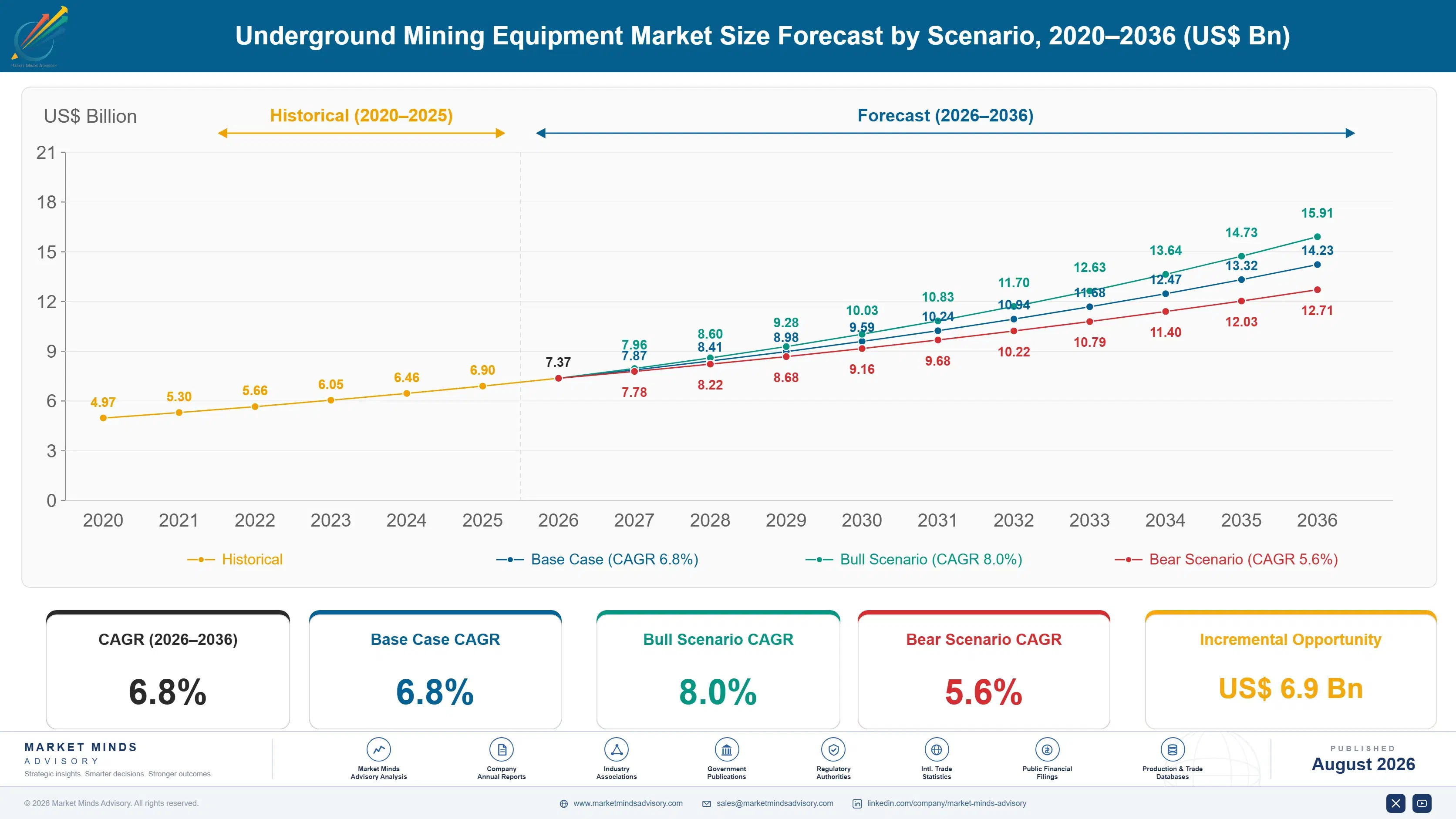
Underground Mining Equipment Market Forecast Scenarios

underground-mining-equipment-market-size-forecast-scenario-1787300304178
The market dipped in 2020 as mine operators deferred capital projects during the demand shock, then recovered through 2021 and 2022 as metal prices rebounded and copper and lithium projects moved onto development schedules. Coal-linked longwall demand stayed weak while battery-electric loader orders accelerated from a small base. The result was a 5.8 percent historical CAGR, weighted toward critical minerals.
The base case rests on three mechanisms. First, copper, lithium, and nickel projects are pushing underground development deeper and into narrower ore bodies, requiring more specialized drilling and haulage equipment. Second, diesel particulate exposure regulation in major mining jurisdictions is accelerating battery-electric fleet conversion ahead of schedule. Third, autonomous haulage and remote operation software are lifting average equipment selling prices where unit volumes stay flat, since operators pay for productivity gains rather than raw tonnage.
The bull case turns on a sustained critical minerals investment cycle if copper and lithium prices stay elevated enough to sanction new underground mines in Chile, the Democratic Republic of Congo, and Indonesia. The bear case centers on a metals price correction that delays underground development industry-wide, pushing operators to extend the working life of existing diesel fleets rather than commit to new battery-electric purchases.

Electrification Redraws the Equipment Replacement Cycle

Underground mining equipment sits at the crossing point of two forces: mines going deeper and narrower to chase critical mineral grades, and regulators tightening diesel particulate exposure limits that make battery-electric fleets a compliance question rather than a cost option. Together these forces are compressing equipment replacement cycles well below their historical norm, and manufacturers that once competed mainly on machine durability now compete on electrification readiness.
CR5 CONCENTRATION58%Top five OEMs hold majority of equipment revenue
AVERAGE FLEET AGE9.5 yearsAging diesel fleets approach replacement decision points now
TOP PRODUCING COUNTRY SHARE29%China leads global underground mining equipment manufacturing output
BATTERY-ELECTRIC PENETRATION22% of new unitsElectric loaders displace diesel fastest in developed markets
TRADE INTENSITY37% of output exportedCross-border equipment shipments rise with new mine builds
INPUT COST SHARE34% of COGSSteel castings and power electronics dominate manufacturing cost base
Commercially, OEMs increasingly sell equipment bundled with remote operation software, telematics, and maintenance contracts rather than machines alone, turning capital equipment sales into multi-year service relationships worth considerably more over a fleet's life. Independent mid-tier miners still buy mostly on price and delivery lead time, while major diversified miners like BHP and Rio Tinto negotiate global framework agreements that lock in fleet standardization across dozens of sites for years at a time.
Over the next decade, autonomous haulage will keep expanding beyond its current base in Australian and Canadian hard rock mines into coal and Latin American copper operations, and OEMs that cannot offer proven remote-operation platforms will struggle to compete for new mine development contracts. Diesel particulate regulation will keep tightening across most major mining jurisdictions through the decade.
"Battery-electric isn't a sustainability story anymore, it is a ventilation capital expenditure story. Mines that run the diesel math honestly are electrifying faster than their public statements suggest."
Director, Mining and Industrial Equipment Practice · MMA Construction and Indust

Market Trends

Battery-Electric Loaders Displace Diesel Across New Mine Builds

New underground mine developments in Canada, Australia, and Scandinavia are increasingly specifying battery-electric loaders and haulers from first production rather than retrofitting diesel fleets later. Newmont's Borden mine in Ontario and several Boliden operations in Sweden now run fully electric underground fleets, cutting ventilation infrastructure costs by a meaningful share since less fresh air volume is needed to dilute diesel particulate matter. Battery-electric penetration among new equipment orders has reached roughly 22 percent globally, up from single digits five years ago, and OEMs report order backlogs for electric platforms extending well beyond diesel equivalents.
Market Impact: Adds narrow-vein equipment demand 18 percent
Autonomous Haulage Expands Beyond Pilot Programs

Autonomous haulage trucks and loaders, once confined to a handful of flagship Australian iron ore and nickel operations, are now spreading into Canadian and Chilean underground copper mines as remote operation software matures. Rio Tinto and Glencore have both expanded autonomous underground haulage fleets since 2023, citing reduced labor exposure to unstable ground conditions as the primary driver rather than headcount reduction alone. Equipment makers that offer proven autonomous platforms increasingly win contracts on productivity guarantees rather than sticker price, reshaping how mines evaluate competing bids, particularly across deep, hot operations where ground conditions carry elevated risk.
Market Impact: Accelerates electric fleet orders 30 percent

Market Opportunities and Growth Drivers

Critical Mineral Demand Pushes Mines Deeper and Narrower

Global copper demand tied to electrification and grid buildout is pushing miners toward deeper, narrower ore bodies that surface pits can no longer reach economically, and underground development capital expenditure is projected to grow briskly through 2030 according to IEA critical minerals tracking. Chile's El Teniente and Zaldivar expansions, along with new Democratic Republic of Congo copper-cobalt underground projects, require specialized narrow-vein drilling and haulage equipment that surface-oriented fleets cannot handle. That shift is lifting average equipment order values per mine even where total unit counts stay flat, a pattern equipment makers are only beginning to price into long-term contracts.
Market Impact: Battery costs add 12 percent

Diesel Particulate Regulation Accelerates Fleet Replacement

Regulators in Australia, Canada, and the European Union have tightened underground diesel particulate exposure limits over the past three years, and several jurisdictions are moving toward effective diesel phase-outs in new underground developments by the early 2030s. Compliance now requires either expensive ventilation upgrades or a shift to battery-electric equipment, and operators increasingly find electrification the lower lifecycle cost path once ventilation capital and energy costs are included. Sandvik and Epiroc both report battery-electric order books growing faster than diesel equivalents across every region with active regulation, a gap that is widening each reporting quarter.
Market Impact: Delays conversion by 3 years

Market Restraints and Challenges

Battery and Power Electronics Costs Squeeze Equipment Margins

Battery packs and power electronics account for a growing share of battery-electric equipment bill of materials, and lithium-ion cell pricing remains sensitive to raw material swings in lithium, nickel, and cobalt markets that OEMs do not control directly. When cell prices rose sharply in 2022, equipment makers absorbed much of the increase to stay price-competitive with diesel alternatives, compressing margins on electric platforms specifically. Sandvik and Epiroc have both begun qualifying multiple battery cell suppliers and investing in battery-as-a-service leasing models to shift cost volatility onto financing partners rather than equipment margins.
Market Impact: Lifts electric penetration to 22 percent

Underground Infrastructure Limits Constrain Fast Fleet Conversion

Many existing underground mines were engineered decades ago around diesel refueling infrastructure and ventilation designed for combustion exhaust, and retrofitting for battery charging and thermal management requires significant capital investment beyond the equipment purchase itself. The root cause is that mine infrastructure has a much longer replacement cycle than the equipment operating within it, so operators often cannot electrify even when they want to. Some mines are addressing this through phased conversion, electrifying production areas first while retaining diesel fleets in older sections still awaiting infrastructure upgrades, a sequencing approach that spreads capital outlay across several budget cycles.
Market Impact: Cuts labor exposure incidents 15 percent
3 additional market trends, 3 additional growth drivers, and 3 additional restraints and challenges are covered in the full report. Contact sales@marketmindsadvisory.com to access the complete intelligence.

Segment CAGR and Growth Architecture

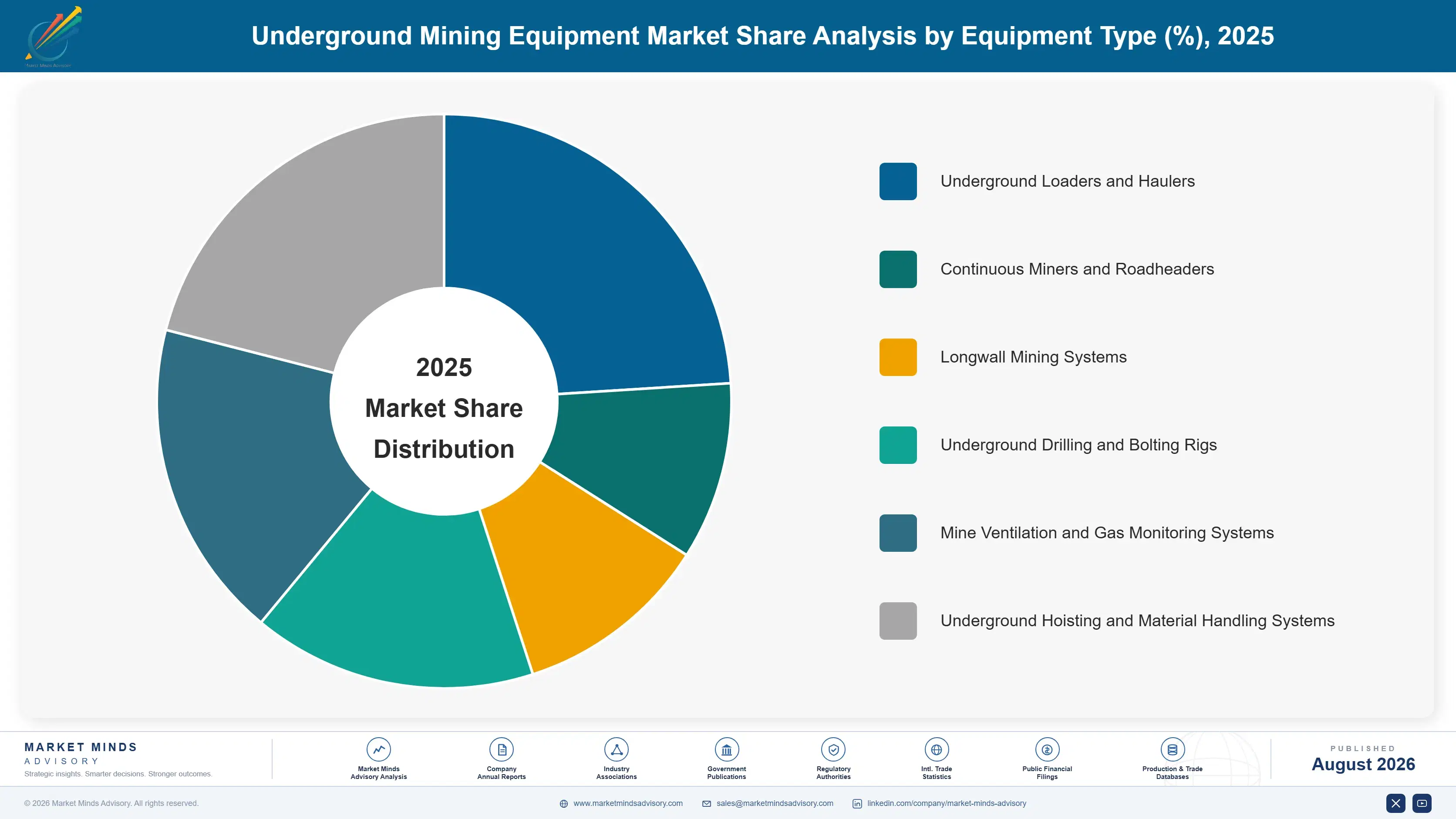
Segmentation follows equipment type rather than mine commodity or depth, since a single underground operation typically deploys machinery across every category simultaneously. Six categories span the underground fleet from loading and haulage through cutting, drilling, ventilation, and hoisting, reflecting how mines budget and procure each discipline as a distinct capital line each budget cycle.
underground-mining-equipment-market-market-share-analysis-1787300304712

Underground Loaders and Haulers

Underground loaders and haulers, principally LHDs and articulated dump trucks, are converting to battery-electric platforms faster than any other equipment category as mines weigh ventilation capital against machine price premiums. Sandvik's Toro and Epiroc's Scooptram electric families lead unit placements in Canada, Scandinavia, and Australia, while Chinese manufacturers such as XCMG and Sany are qualifying competing electric platforms for domestic copper and coal operations. Battery-as-a-service leasing models are spreading quickly in this category specifically, since loaders and haulers cycle through more duty hours per shift than drilling or ventilation equipment, making total cost of ownership calculations especially sensitive to battery performance and charging infrastructure availability, a variable that differs meaningfully between remote sites and grid-connected operations.
CAGR 8.5%

Mine Ventilation and Gas Monitoring Systems

Ventilation and gas monitoring systems are growing quickly as mines pursue two parallel goals: reducing fresh air volume requirements as diesel fleets electrify, and tightening real-time gas detection following high-profile safety incidents in coal and hard rock operations alike. Digital sensor networks now feed continuous methane, carbon monoxide, and particulate data to surface control rooms, replacing periodic manual monitoring with always-on visibility. Howden and Sandvik's ventilation divisions are both expanding smart ventilation-on-demand systems that throttle fan output to actual underground conditions rather than running at constant maximum capacity, cutting energy costs meaningfully while regulators increasingly treat continuous monitoring as a baseline compliance requirement rather than a premium feature, particularly following recent high-profile underground safety incidents.
CAGR 7.8%
Full segment breakdown across 6 segments available in the complete report.

Regional Architecture and Country Demand Map

Demand concentrates where new underground development is most active. East Asia leads on China's underground coal mining fleet and domestic manufacturing base, North America and Western Europe lead on battery-electric adoption intensity, while Middle East and Africa gain share fastest on new copper-cobalt underground projects.

East Asia

China's underground coal sector remains the largest in the world by fleet count, and that scale alone anchors East Asia's leading share of global equipment spending. Domestic manufacturers including XCMG, Sany, and Zhengzhou Coal Mining Machinery have captured the majority of new domestic orders as import substitution policy favors local suppliers over Western OEMs for standard equipment categories. Indonesia's nickel sector and growing underground gold operations in the Philippines add a second demand layer outside China proper, while Japan and South Korea contribute limited direct mining activity but host component and electronics suppliers feeding equipment manufacturers across the region. Battery-electric adoption in China's underground fleet still trails Western markets, leaving a substantial conversion opportunity ahead.
Share: 30% | CAGR: 8.0% (2026 to 2036)

North America

United States and Canadian underground copper, gold, and potash operations are electrifying fleets faster than almost any other region, led by projects such as Newmont's Borden mine and several Nevada Gold Mines operations converting loader fleets to battery power. Regulatory pressure from provincial and state mine safety authorities on diesel particulate exposure is the direct mechanism behind that pace, not a general sustainability preference. Canada's deep nickel and copper mines in Sudbury and northern Quebec are also adopting autonomous haulage at a faster rate than peers elsewhere, since remote operation reduces labor exposure to increasingly deep, hot working conditions. Mexico's silver and zinc underground sector contributes a smaller, more price-sensitive layer of conventional diesel equipment demand.
Share: 24% | CAGR: 7.3% (2026 to 2036)
Regional intelligence for 5 additional markets available in the complete report: Western Europe, South Asia and Pacific, Latin America, Middle East and Africa, Eastern Europe. Contact sales@marketmindsadvisory.com.
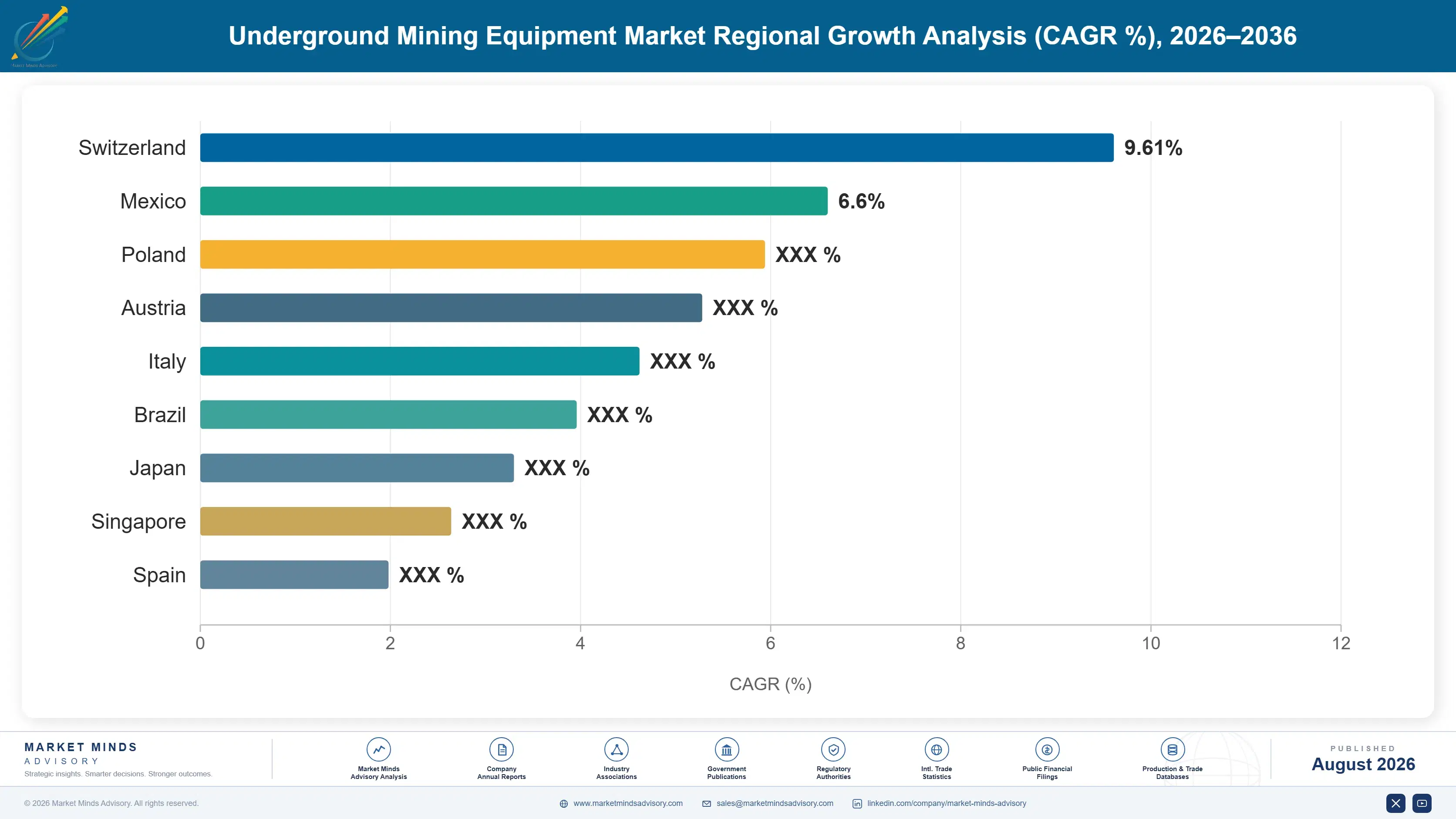
underground-mining-equipment-market-country-cagr-analysis-1787300305226

Where Equipment Makers Can Grow Margin

Unit sales alone will not sustain margins as diesel-to-electric conversion slows equipment replacement cycles in the near term. The more durable path runs through service and telematics contracts, battery-as-a-service financing, and autonomous software licensing, each of which carries pricing power that standalone hardware sales increasingly lack in a maturing market where volume growth alone no longer guarantees margin expansion.

Converting Equipment Sales Into Telematics Service Contracts

Bundling fleet telematics, predictive maintenance, and remote diagnostics with equipment sales turns a one-time capital purchase into a recurring service relationship billed annually per machine. Sandvik and Epiroc both report service and aftermarket revenue now approaching 45 percent of total mining equipment segment revenue, considerably higher margin than new equipment sales alone. Miners increasingly prefer this model because it shifts uptime risk onto the OEM, and multi-year service contracts also give equipment makers better forecasting visibility into future replacement demand across their installed base, often spanning contracts of five to seven years.
Market Impact: Lifts service revenue toward 45 percent of total

Expanding Battery-as-a-Service Leasing Models Across Regional Fleets

Battery-as-a-service leasing separates equipment ownership from battery ownership, letting mines pay a per-hour usage fee that covers battery degradation and eventual replacement rather than bearing that cost and risk directly. This model lowers the upfront capital barrier to electrification meaningfully, and OEMs capture ongoing leasing revenue plus valuable degradation data that improves next-generation battery chemistry and warranty pricing. Epiroc's expansion of battery leasing programs across Canadian and Scandinavian operations since 2023 has measurably shortened the sales cycle for electric loader conversions among cost-conscious mid-tier miners, several of which had previously delayed electrification decisions for multiple budget cycles.
Market Impact: Cuts electrification upfront capital needs by 30 percent

Licensing Autonomous Haulage Software Separately From Hardware

Autonomous haulage and remote operation software increasingly generates its own licensing revenue stream, sold and priced independently of the underlying vehicle hardware and upgradeable across a mine's existing fleet as capability improves. This decouples software margin from cyclical equipment order volume, giving OEMs a steadier revenue base during downturns in new equipment purchases. Rio Tinto's autonomous haulage deployments increasingly run third-party software licensed onto multiple equipment brands, a model that rewards OEMs with the strongest software rather than simply the most installed hardware, a shift OEMs estimate could reprice roughly 10 percent of total fleet value.
Market Impact: Autonomous licensing adds roughly 8 percent margin uplift

Building Regional Manufacturing to Serve Domestic Content Rules

Local content requirements in China, India, and increasingly Chile and the Democratic Republic of Congo are pushing miners to specify domestically assembled equipment over imported alternatives on a growing share of new tenders. OEMs that establish regional assembly and component sourcing avoid tariff exposure and qualify faster for state-linked mining contracts that weight domestic content in scoring criteria. XCMG and Sany have captured an estimated 20 percent larger share of new domestic Chinese orders since expanding local battery and electronics assembly, a trend Western OEMs are now replicating through joint ventures in Chile and India.
Market Impact: Local assembly wins roughly 20 percent more tenders

Who Controls the Margin Pool

Five manufacturers, Sandvik, Epiroc, Caterpillar, Komatsu, and Liebherr, hold more than half of global underground equipment revenue on a company-reported basis, and the gap between the top two Swedish-origin leaders and the rest of the field is substantial. Sandvik and Epiroc both run global service networks and proven autonomous platforms that smaller regional manufacturers cannot match quickly.
Current competitive activity centers on three fronts. Suppliers are racing to expand battery-electric product lines across every equipment category, since electrification increasingly determines which OEMs get shortlisted for new mine development tenders. They are also building out autonomous haulage software platforms and battery-as-a-service financing arms to capture recurring revenue. Chinese manufacturers are qualifying competing electric and conventional equipment specifically to displace Western suppliers inside domestic and Belt and Road-linked mining programs.

Emerging pressure comes from two directions. Chinese suppliers led by XCMG and Sany are exporting increasingly credible underground equipment into Africa and Southeast Asia at prices Western OEMs struggle to match. Independent autonomous software specialists are also entering by partnering with smaller equipment manufacturers, threatening to unbundle the software and hardware layers that leading OEMs currently sell together as an integrated premium.
underground-mining-equipment-market-company-positioning-matrix-1787300305748

Competitive Moat and Risk Dimensions

SANDVIK

Moat: Global Service and Autonomy Network

Sandvik operates the broadest global network of underground equipment service centers and proven autonomous haulage deployments, letting it support mines across every major mining region with local parts and technical staff. That combination of scale and field-proven automation is difficult for smaller regional manufacturers to replicate without years of deployment history and capital investment.
SANDVIK

Risk: Chinese Manufacturers Narrowing Gap

Chinese manufacturers are qualifying competing electric and conventional equipment at substantially lower price points, and as their technology gap narrows on core categories like loaders and haulers, Sandvik's premium pricing faces growing pressure in China and export markets where price sensitivity runs higher. That pressure is likely to intensify as Chinese suppliers expand export ambitions.
EPIROC

Moat: Deep Scandinavian Electrification Leadership

Epiroc's early and sustained investment in battery-electric platforms gives it the most field-proven electric fleet track record in the industry, built through years of deployment across Scandinavian and Canadian mines that other OEMs are only now beginning to match at comparable scale. That head start reinforces customer trust in electric platform reliability.
EPIROC

Risk: Coal Segment Exposure Declining

Epiroc's legacy exposure to coal-linked longwall and continuous mining equipment remains larger than some peers, and as coal-linked underground investment stays persistently weak across most regions, that legacy exposure drags on overall segment growth even as its electric and copper-focused product lines outperform, a mix shift that will take years to fully work through reported segment results.

Key Players

Sandvik
Epiroc
Caterpillar
Komatsu
Liebherr

Others

XCMG
Sany Heavy Industry
Zhengzhou Coal Mining Machinery Group
J.H. Fletcher & Co.
Normet Group
RCT Global
MacLean Engineering
GHH Group
Howden Group
Terex Corporation
Eimco Elecon
Boart Longyear
Master Drilling Group
TAKRAF Group
Joy Global

Recent Developments

FEBRUARY 2025

Epiroc Expands Battery-as-a-Service Program to Canada

Epiroc extended its battery-as-a-service leasing program to three Canadian underground copper and nickel operations, letting mines pay per operating hour rather than purchase batteries outright. The program builds on Epiroc's existing Scandinavian battery leasing base and is expected to accelerate electric loader adoption among mid-tier Canadian miners evaluating conversion economics.
Signal: Signals battery-as-a-service financing becoming a standard commercial tool for accelerating electrification among cost-conscious mid-tier operators worldwide.
JUNE 2025

Sandvik Acquires Underground Automation Software Specialist

Sandvik acquired a privately held underground automation software specialist to strengthen its autonomous haulage and fleet management platform ahead of expanding remote-operation contracts in Australia and Chile. The acquisition adds proprietary collision-avoidance and fleet coordination technology to Sandvik's existing AutoMine platform, deepening its software capability ahead of several large tenders.
Signal: Signals consolidation in autonomous mining software as OEMs bring core automation capability in-house rather than partnering externally.
OCTOBER 2024

XCMG Opens New Underground Electric Loader Manufacturing Plant

XCMG opened a new manufacturing facility in Xuzhou dedicated to battery-electric underground loader production, expanding domestic capacity to serve China's growing copper and coal electrification push. The facility doubles XCMG's annual electric loader output and supports export ambitions into Southeast Asia and Africa over the next several years.
Signal: Signals accelerating Chinese domestic electric equipment capacity as manufacturers target both home demand and emerging export markets.

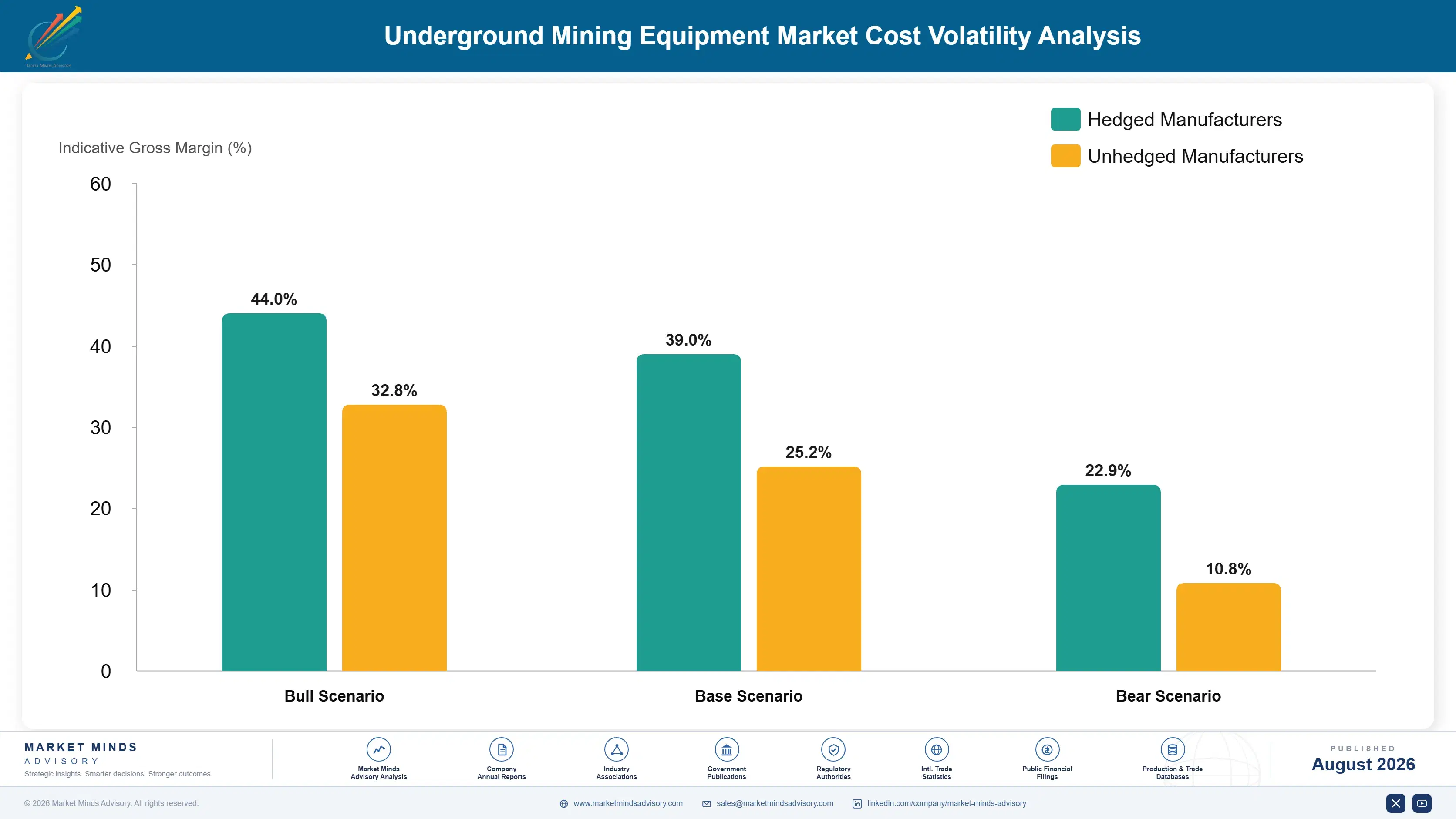
Steel, Battery, and Electronics Exposure

Steel castings, battery cells, and power electronics account for 34 percent of underground mining equipment cost of goods sold, with battery cell pricing concentrated among a small number of Asian cell manufacturers and steel sourced from mills across Europe, China, and North America. Battery cell exposure is the greater risk, since equipment makers depend on suppliers whose pricing tracks volatile lithium, nickel, and cobalt markets.
Lithium carbonate prices swung sharply between 2022 and 2024, rising more than threefold before falling back by roughly 80 percent from their peak, according to IEA critical minerals price tracking. Epiroc's 2024 annual report cited battery cell cost volatility as a factor compressing electric equipment segment margins during the price spike, and several equipment makers passed a portion of the increase through to customers via surcharges rather than absorbing it.

The disadvantage falls hardest on smaller manufacturers without long-term battery cell supply contracts. Sandvik and Epiroc, with scale to negotiate multi-year cell agreements and qualify multiple suppliers, absorb volatility more smoothly than regional manufacturers buying components on the spot market. That gap widens for manufacturers based outside China, who face price exposure and potential export licensing delays on rare earth magnets used in electric drivetrains.
underground-mining-equipment-market-cost-volatility-analysis-1787300305943

Diversifying Battery Cell Sourcing Across Suppliers

Leading OEMs are qualifying multiple battery cell suppliers across South Korea, Japan, and China rather than relying on a single source, reducing exposure to any one supplier's pricing or availability disruption. Sandvik and Epiroc have both expanded qualified supplier lists since 2023, and several are exploring long-term offtake agreements with lithium and nickel producers.

Hedging Steel Purchases Through Forward Contracts

Several manufacturers have moved to twelve-month forward purchase agreements for steel castings and structural components, locking in pricing ahead of production runs rather than buying on the spot market. This reduces margin volatility quarter to quarter, though it also means manufacturers occasionally pay above prevailing spot prices when steel costs fall unexpectedly during the contract term.

Investing in Battery Recycling and Second-Life Programs

A handful of OEMs are investing in battery recycling and second-life energy storage programs to recover valuable cell materials and reduce dependence on virgin lithium, nickel, and cobalt supply. These programs remain small relative to total input needs today, but several manufacturers expect recycled material to supply a meaningful share of new battery production within the next decade.

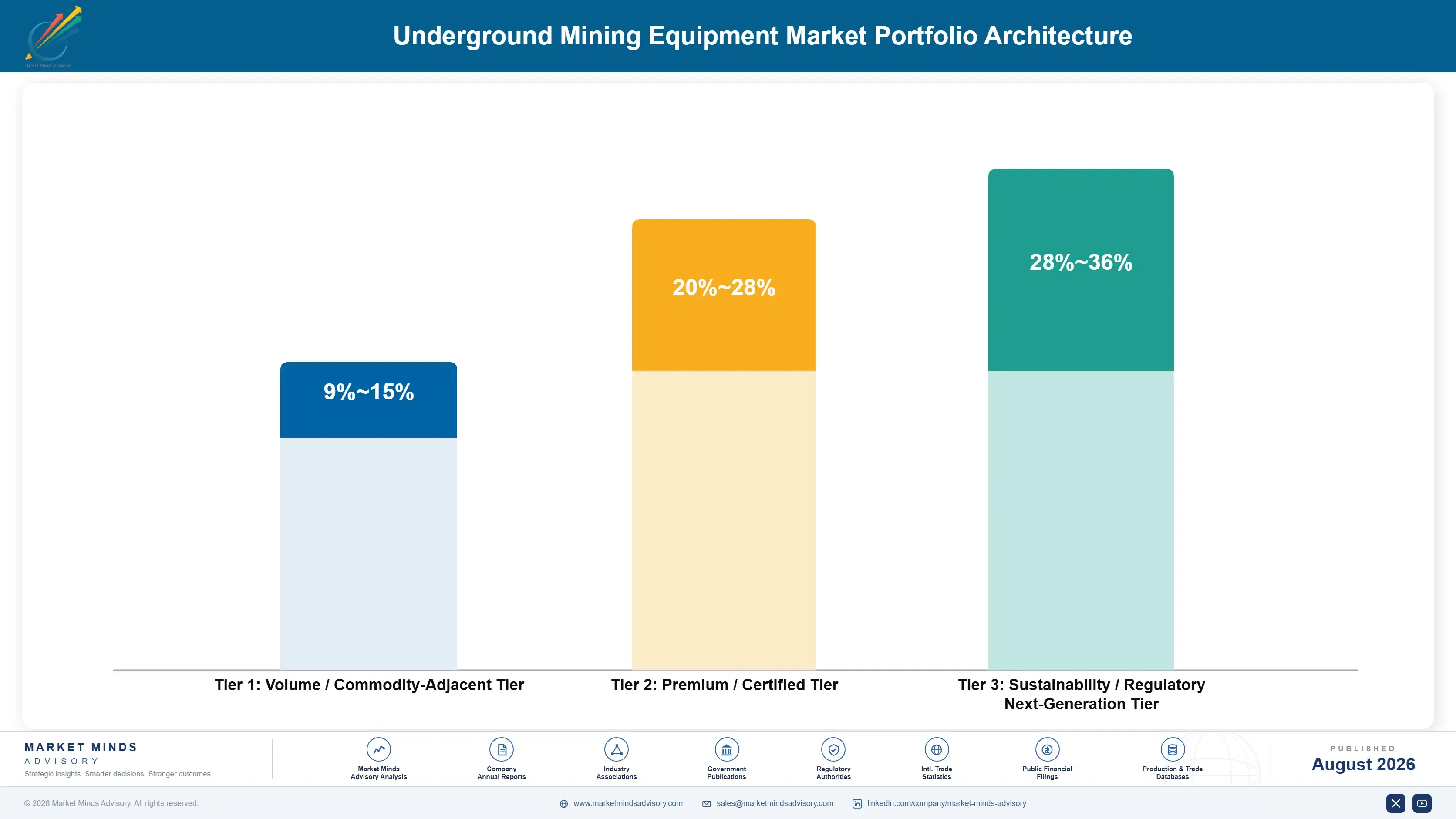
Portfolio Architecture for Margin Defence

The portfolio splits into three tiers. Standard diesel loaders, haulers, and drilling rigs sit at the volume base with thin margins, competing mainly on price and lead time. Premium battery-electric and automation-ready equipment occupies the middle tier, commanding stronger margins through electrification. Autonomous, next-generation electric platforms with integrated software sit at the top, where margins run richest and competition stays thinnest across the industry.
The tension between volume and premium runs through how OEMs allocate capital. Conventional diesel manufacturing requires steady throughput to cover fixed costs, pulling suppliers toward volume even as that segment's growth slows, while electric and autonomous lines demand sustained engineering investment that only pays off once adoption scales. Manufacturers that lean too far toward either extreme risk losing either the cash generation volume provides or the margin growth premium platforms deliver.

High-value margin pools concentrate in battery-electric equipment bundled with service and software licensing, where technology barriers keep competition thin and mines pay premium prices for proven reliability under extreme underground conditions. That concentration is likely to deepen as more capital flows into deep, narrow critical mineral deposits relative to mature coal operations.

Volume / Commodity-Adjacent Tier

Standard diesel loaders, haulers, conventional drilling rigs, and basic ventilation fans sold primarily on price and delivery lead time to a broad base of coal and conventional hard rock mines worldwide.
Gross Margin: 9%-15%

Premium / Certified Tier

Battery-electric loaders and haulers, automation-ready drilling and bolting rigs, and smart ventilation-on-demand systems qualified for regulated jurisdictions, sold with service contracts and telematics bundling, priced to reflect the qualification testing and reliability track record regulated buyers require.
Gross Margin: 20%-28%

Sustainability / Regulatory / Next-Generation Tier

Fully autonomous electric fleets with integrated fleet management software, battery-as-a-service financing, and zero-emission ventilation systems built for the deepest, most emissions-sensitive underground mines, where qualification barriers keep the competitive field narrow and pricing power strongest.
Gross Margin: 28%-36%
underground-mining-equipment-market-portfolio-architecture-1787300306443

High-value Sub-segments and Strategic Watch-out

Battery-Electric Loaders in Deep Copper and Lithium Mines

Deep, narrow copper and lithium underground developments in Chile and the Democratic Republic of Congo increasingly specify electric fleets from first production, avoiding costly diesel ventilation retrofits later. Qualification barriers and battery supply constraints keep competition thin, and volume is expanding faster than almost any other category.
Gross Margin: 30%-38%

Autonomous Haulage Software Licensing

Recurring software licensing attached to autonomous haulage hardware grows steadily as mines standardize on remote operation platforms. Growth is moderate compared with electric hardware but margins are among the richest in the portfolio once the underlying platform investment is made, and renewal rates run consistently high.
Gross Margin: 35%-45%

Standard Diesel Loaders and Conventional Drilling Rigs

The largest revenue base by unit volume, sold into coal and conventional hard rock mines worldwide on price and availability. Growth tracks global mine capital spending closely and margins stay thin, but the segment funds electric platform development across the portfolio, making it strategically indispensable despite its low relative margins.
Gross Margin: 9%-15%

Chinese Underground Equipment Exports

Chinese manufacturers led by XCMG and Sany are exporting increasingly credible underground equipment at prices well below Western equivalents, initially into Africa and Southeast Asia. If qualification gaps close further, this segment could pressure premium pricing industry-wide within the decade, particularly in conventional loader categories where differentiation is already thin.
Gross Margin: 14%-24%

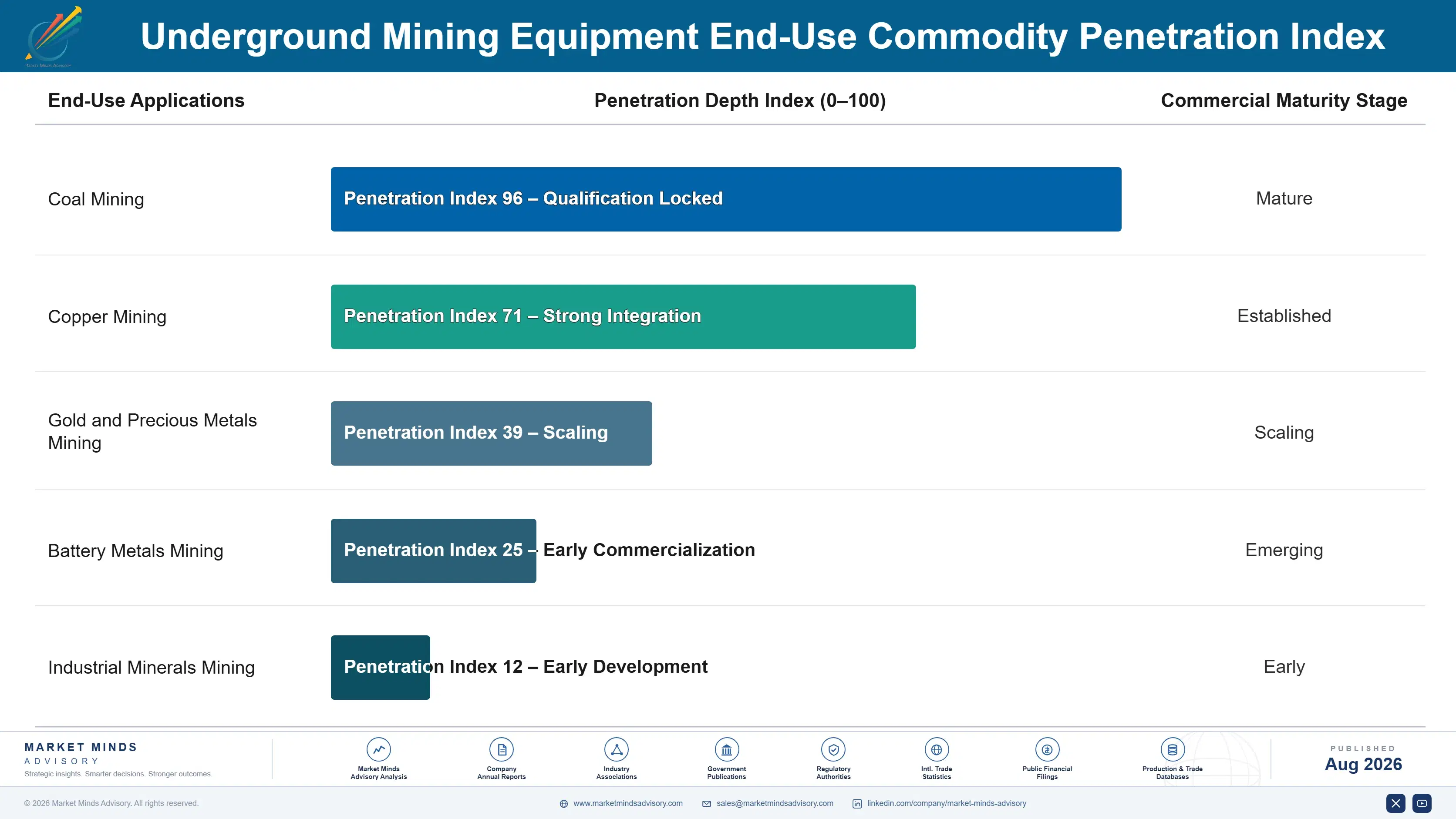
Recurring Revenue Inside Every Fleet

Underground mining equipment generates revenue closer to an annuity than a one-time sale once service contracts, telematics, and battery leasing models are included, since every operating mine consumes another cycle of maintenance, parts, software updates, and battery replacement. That repeat-purchase dynamic gives OEMs more predictable revenue than the headline volatility of new equipment orders alone would suggest, provided their installed base stays utilized.
Adoption depth varies sharply by mine type. Major diversified miners like BHP, Rio Tinto, and Glencore sign global framework agreements that lock in preferred OEMs across dozens of sites for years, creating high switching costs once a supplier is standardized into a fleet. Independent and mid-tier miners behave differently, rebidding equipment more frequently on a mine-by-mine basis, which keeps competition sharper but limits how much recurring revenue any single OEM can count on.

A generational shift in buyer profiles is underway as digitally native mine engineers who trained on remote operation centers replace an older generation accustomed to manual supervision. That shift favors OEMs with strong automation and software platforms over those competing purely on mechanical durability, and it is reshaping which suppliers get invited to bid on new projects.
underground-mining-equipment-market-end-use-penetration-index-1787300306932

Where MMA Sees the Opportunity

These are among the four positions where our research anticipates prominent divergence between winners and laggards over the coming forecast period. Each is grounded in the demand model, the regulatory perimeter, and the announced capacity pipeline.
01 / ELECTRIFICATION PRIORITY INVESTMENT

Prioritize battery-electric platform investment across every equipment category

Battery-electric penetration among new underground equipment orders has reached roughly 22 percent globally and is climbing fastest in jurisdictions tightening diesel particulate exposure limits, including Australia, Canada, and the European Union. Manufacturers that have not yet built proven electric platforms across loaders, haulers, and drilling equipment are increasingly excluded from tenders where electrification is now a compliance requirement rather than an optional upgrade. MMA recommends prioritizing electric platform investment over incremental improvements to diesel equipment lines that face a shrinking addressable market.
02 / BATTERY LEASING EXPANSION

Expand battery-as-a-service leasing to lower electrification's capital barrier

Battery-as-a-service leasing has measurably shortened the sales cycle for electric loader conversions among cost-conscious mid-tier miners who cannot justify the upfront capital premium of outright battery ownership. OEMs without a leasing arm are ceding this fast-growing financing layer to competitors like Epiroc, which has expanded battery leasing programs across Canadian and Scandinavian operations since 2023. MMA recommends building or partnering into battery leasing capability rather than relying solely on traditional equipment sales financing models that no longer match how cost-conscious buyers want to pay.
03 / AUTONOMOUS SOFTWARE DEFENSE

Defend proprietary automation software against third-party unbundling

Independent autonomous software specialists are beginning to partner with smaller equipment manufacturers, threatening to separate the software and hardware layers that leading OEMs currently sell together as an integrated premium package. If that unbundling gains traction, equipment makers without strong proprietary automation software risk being reduced to commodity hardware vendors while software specialists capture the more profitable licensing layer. MMA recommends investing in proprietary fleet management platforms now, before smaller competitors establish independent footholds with major mining customers across every region where automation adoption is accelerating.
04 / CRITICAL MINERALS POSITIONING

Position narrow-vein equipment lines for deepening copper and lithium mines

Copper, lithium, and cobalt projects in Chile, the Democratic Republic of Congo, and Indonesia are pushing underground development deeper and into narrower ore bodies that require specialized drilling, bolting, and haulage equipment surface-oriented fleets cannot handle. Manufacturers without dedicated narrow-vein product lines risk losing share in the fastest-growing segment of underground development as critical minerals investment continues outpacing coal-linked demand. MMA recommends accelerating narrow-vein equipment development ahead of broader fleet electrification investment given the scale of upcoming capital expenditure across these specific geographies.

Engagement Snapshot From the Field

A live engagement with an industry participant carrying material or product regulatory and market exposure ahead of a defining policy shift, showing how our research translates into a defensible multi-year portfolio strategy.
MARKET MINDS ADVISORY · CLIENT ENGAGEMENT SUMMARY
Underground Mining Equipment Producer Strategic Portfolio Review and Transition Roadmap 2026·Investment Scenario on Underground Mining Equipment Exposure Evaluation 2025-26
CLIENT PROFILE
The client is a mid-tier copper mining company operating two underground mines in Chile and Peru, reporting approximately 850 million dollars in annual underground development and equipment capital expenditure (client-reported, unverified by MMA). The company had historically operated an all-diesel underground fleet and was evaluating whether battery-electric conversion was justified given rising ventilation costs and tightening Chilean mine safety regulation on diesel particulate exposure limits.
STRATEGIC CHALLENGE
Leadership needed to determine whether converting its underground loader and hauler fleet to battery-electric platforms would pay back the capital premium through reduced ventilation infrastructure costs and lower diesel fuel and maintenance expense, or whether the technology premium exceeded realistic savings given the mines' remote power grid access and the multi-year capital planning cycle mining companies typically follow.
MMA APPROACH
MMA benchmarked total cost of ownership across comparable Chilean and Peruvian underground copper operations, comparing ventilation capital expenditure, energy costs, and maintenance spend between diesel and battery-electric fleets. The engagement combined primary interviews with three equipment OEM account teams and secondary analysis of regional electrification case studies to model site-specific conversion economics for the client's two mines.
KEY FINDINGS
  1. Ventilation capital expenditure for the client's planned mine expansion would run approximately 40 percent lower under a battery-electric fleet scenario compared with maintaining diesel equipment (client-reported, unverified by MMA).
  2. Battery-electric loaders carried an 18 percent upfront price premium over diesel equivalents, but total cost of ownership favored electric within four years once ventilation and fuel savings were included (client-reported, unverified by MMA).
  3. Remote grid power access at the Peru site required a dedicated power infrastructure investment, adding meaningfully to the electrification timeline compared with the client's Chilean operation (client-reported, unverified by MMA).
  4. Peer operators that had already electrified reported measurable reductions in underground ambient temperature and improved worker comfort, an unbudgeted secondary benefit beyond the original ventilation cost case.
CLIENT PROFILE
The client is a mid-tier copper mining company operating two underground mines in Chile and Peru, reporting approximately 850 million dollars in annual underground development and equipment capital expenditure (client-reported, unverified by MMA). The company had historically operated an all-diesel underground fleet and was evaluating whether battery-electric conversion was justified given rising ventilation costs and tightening Chilean mine safety regulation on diesel particulate exposure limits.
STRATEGIC CHALLENGE
Leadership needed to determine whether converting its underground loader and hauler fleet to battery-electric platforms would pay back the capital premium through reduced ventilation infrastructure costs and lower diesel fuel and maintenance expense, or whether the technology premium exceeded realistic savings given the mines' remote power grid access and the multi-year capital planning cycle mining companies typically follow.
MMA APPROACH
MMA benchmarked total cost of ownership across comparable Chilean and Peruvian underground copper operations, comparing ventilation capital expenditure, energy costs, and maintenance spend between diesel and battery-electric fleets. The engagement combined primary interviews with three equipment OEM account teams and secondary analysis of regional electrification case studies to model site-specific conversion economics for the client's two mines.
KEY FINDINGS
  1. Ventilation capital expenditure for the client's planned mine expansion would run approximately 40 percent lower under a battery-electric fleet scenario compared with maintaining diesel equipment (client-reported, unverified by MMA).
  2. Battery-electric loaders carried an 18 percent upfront price premium over diesel equivalents, but total cost of ownership favored electric within four years once ventilation and fuel savings were included (client-reported, unverified by MMA).
  3. Remote grid power access at the Peru site required a dedicated power infrastructure investment, adding meaningfully to the electrification timeline compared with the client's Chilean operation (client-reported, unverified by MMA).
  4. Peer operators that had already electrified reported measurable reductions in underground ambient temperature and improved worker comfort, an unbudgeted secondary benefit beyond the original ventilation cost case.
RECOMMENDED STRATEGY
Phase 1: Phase 1 (Months 1 to 6): Convert the Chilean mine's loader and hauler fleet to battery-electric platforms first, given existing grid access and near-term ventilation upgrade needs. Phase 2: Phase 2 (Months 7 to 18): Invest in dedicated power infrastructure at the Peru site to enable phased electrification of that mine's underground fleet. Phase 3: Phase 3 (Months 19 to 30): Standardize battery-electric equipment as default across both sites, retaining diesel units only for legacy sections awaiting upgrades.
OUTCOME
Within the first year of Chilean fleet conversion, the client reported ventilation capital expenditure savings worth an estimated 35 million dollars against its original mine expansion budget, alongside improved underground working conditions (client-reported, unverified by MMA). The company has since committed to full Peru site electrification on an accelerated timeline following the Chilean results.

Frequently Asked Questions

Foundational context covering the market sizes, CAGR, scope, country, region and competition that inform every finding below. This section is provided to cover basics and most often pre-purchase conversations, answered from the MMA Primary Research Dataset.

What is the current size of the Underground Mining Equipment Market?

The global underground mining equipment market was valued at approximately 6.9 billion dollars in 2025. Growth is driven primarily by critical minerals development and diesel-to-electric fleet conversion.

How large will the Underground Mining Equipment Market be by 2036?

MMA forecasts the market reaching approximately 14.2 billion dollars by 2036, roughly 1.93 times its 2026 value. Battery-electric and autonomous equipment account for most of that growth.

What is the CAGR for the Underground Mining Equipment Market 2026 to 2036?

The market is projected to grow at a 6.8 percent compound annual rate over the forecast period. Bull and bear scenarios range from 5.6 to 8.0 percent depending on critical minerals investment cycles.

Which segment is growing fastest?

Underground loaders and haulers are the fastest-growing segment, expanding at roughly 1.25 times the overall market rate. Battery-electric conversion in new mine builds is the primary driver.

Who are the major companies in the Underground Mining Equipment Market?

Sandvik, Epiroc, Caterpillar, Komatsu, and Liebherr lead the market on a revenue basis. Together they hold more than half of global equipment revenue, with Sandvik and Epiroc holding the largest individual shares.

Which country is growing fastest?

The Democratic Republic of Congo is the fastest-growing country, driven by rapid copper-cobalt underground expansion. Surface reserve depletion is pushing miners deeper at an accelerating pace.

Report Segmentation Architecture

The full report scope spans multiple orthogonal segmentation dimensions, with cross-tabulated demand data provided for each dimension pair. Coverage extends further to regional breakdowns, trend trajectories, and the competitive detail needed to support segment-level decision-making.

By Equipment Type

  • Underground Loaders and Haulers
  • Continuous Miners and Roadheaders
  • Longwall Mining Systems
  • Underground Drilling and Bolting Rigs
  • Mine Ventilation and Gas Monitoring Systems
  • Underground Hoisting and Material Handling Systems

By End-Use Commodity

  • Coal Mining
  • Copper Mining
  • Gold and Precious Metals Mining
  • Battery Metals Mining
  • Industrial Minerals Mining

By Commercial Model

  • Outright Sale
  • Battery-as-a-Service Leasing
  • Telematics and Service Contract
  • Autonomous Software Licensing

By Region

  • North America
  • Western Europe
  • East Asia
  • South Asia and Pacific
  • Latin America
  • Middle East and Africa
  • Eastern Europe

Scope, Methodology, and Coverage

Every figure in this report is reproducible from documented input assumptions. The scope below maps the historical period, the forecast horizon, the segmentation dimensions, and the countries covered, alongside the underlying primary and qualitative methodology.
Historical Period
2020 to 2025
Forecast Period
2026 to 2036
Base Year
2025 (USD billions; MMA Primary Research Dataset, August 2026)
Market Definition
The underground mining equipment market covers loaders and haulers, continuous miners and roadheaders, longwall systems, underground drilling and bolting rigs, ventilation and gas monitoring systems, and hoisting and material handling equipment used in underground hard rock and coal mining. It excludes surface and open-pit mining equipment, mineral processing plant machinery, and exploration drilling rigs.
Quantitative Units
USD billions (current prices); unit shipments and installed fleet base where applicable
Segmentation Dimensions
By Equipment Type; By End-Use Commodity; By Commercial Model; By Region
Regions Covered
North America, Western Europe, East Asia, South Asia and Pacific, Latin America, Middle East and Africa, Eastern Europe
Countries Covered
USA, China, Germany, France, UK, Japan, South Korea, India, Australia, Canada, Brazil, Mexico, Indonesia, Vietnam, Thailand, Malaysia, UAE, Saudi Arabia, South Africa, Nigeria, Turkey, Poland, Netherlands, Italy, Spain, Sweden, Switzerland, Argentina, Colombia, Singapore, and additional markets relevant to this sector
Key Companies Profiled
Sandvik, Epiroc, Caterpillar, Komatsu, Liebherr, XCMG, Sany Heavy Industry, Zhengzhou Coal Mining Machinery Group, J.H. Fletcher & Co., Normet Group, RCT Global, MacLean Engineering, GHH Group, Howden Group, Terex Corporation, Eimco Elecon, Boart Longyear, Master Drilling Group, TAKRAF Group, Joy Global
Quantitative Methodology
Primary survey, n=3,800 respondents, Q4 2025, six countries; demand-side model with trade association cross-validation
Qualitative Methodology
47 expert interviews, Q4 2025; applied to validate demand model assumptions, identify emerging dynamics, and assess competitive positioning
Report Format
PDF and XLSX data workbook (Word format preview document)
Publisher
Market Minds Advisory
Report Code
MMA-2026-CON-102
Published
August 2026
Contact
sales@marketmindsadvisory.com | www.marketmindsadvisory.com

Purchase the full Underground Mining Equipment Market Report (2026 to 2036).

The full report provides detailed sizing and ten-year forecasts for each of the six underground mining equipment categories tracked in this analysis, alongside country-level detail across thirty markets. It includes a complete competitive benchmarking of the top twenty manufacturers on a revenue basis, with moat and risk analysis for the two market leaders. The report also contains a dedicated input cost and battery supply chain risk assessment, plus scenario modeling across bull, base, and bear cases through 2036. Buyers receive access to the underlying primary survey and expert interview datasets referenced throughout the analysis.
Ten-year forecasts across all six equipment categories
Competitive benchmarking of twenty profiled equipment manufacturers
Battery cell and power electronics supply chain analysis
Bull, base, and bear scenario modeling through 2036
Country-level sizing across thirty tracked national markets
Access to underlying primary survey and interview data

Built For The People Who Decide

From boardroom strategy to bench-side execution, this report is read cover-to-cover by leaders shaping the next decade of their industry, turning demand scenarios, market dynamics and valuation benchmarks into decisions.
CXOs/ Presidents/ VPs/ Managers
M&A and Corporate Development
Strategy Teams and R&D Heads
Procurement and Product Directors
Regulatory and Compliance Leaders
Investor Relations and Equity Analysts