

Market Minds Advisory
Ultra-Fine Medical Wire Market

Ultra-Fine Medical Wire Market: The Defect Was Made Before Drawing Started

A particle twelve microns across, invisible in the original melt and harmless in bar stock, snaps the wire on the fortieth drawing pass and destroys an entire production run at once.

Lead Analyst

Alice Ballenger

Published

September 2026

Make Smarter Decisions with Customized Research Insights

Request a free sample report and evaluate market opportunities, growth trends, and competitive dynamics relevant to your business needs.

2025 MARKET VALUE$1.1BMarket Size 2025
2036 FORECAST VALUE$2.5BBase Case , 2026 to 2036
CAGR 2026 TO 20368.2 %Bull 9.4% / Bear 7.0%
INCREMENTAL OPPORTUNITY$1.4BNet 10- year value creation
EXPANSION MULTIPLE2.20x2036 value over 2026 base
Strategic Levers
M&A Pipeline
Regional Outlook
Country Rankings
Competitive Intelligence
Segmental Deep-dive
Call-Us : 91 93563 13602

Executive Snapshot and Market Trajectory

Ultra-fine wire is not manufactured so much as survived. Around 42 drawing passes separate rod stock from finished diameter, and an inclusion of roughly 12 microns, entirely harmless in the bar, breaks the wire near the end and takes the whole run with it.
Which means quality is decided in a melt shop that never sees the product. The mill supplying the rod determines whether the wire can be drawn at all, and the drawer discovers the answer weeks later after most of the value has already been added. Yield at the finest diameters runs near 38%, and yield rather than metal cost is what sets price. Metal price explains remarkably little of what a fine spool actually costs.
Composite drawn-filled-tube wire grows at 12.3%, half again the market rate of 8.2%, because a platinum core inside a nitinol shell gives fluoroscopic visibility and superelasticity together where either metal alone forces a choice. The radiopaque core takes roughly 30% of the cross-section, and the rest of the wire has to be drawn around it without either metal separating. Very few drawers hold that capability at the diameters now requested.
Market Definition
Precision drawn metallic wire below one hundred microns supplied for medical device manufacture, covering stainless steel fine wire, nitinol fine wire, composite drawn-filled-tube wire, platinum and radiopaque alloy wire, cobalt-chromium and MP35N wire, and coated and insulated fine wire. Measured at wire supplier selling value. Excludes finished guidewires and catheters, hypotube and cannula, suture and needle products, and non-medical precision wire.
Base Year Value
$1.1B in 2025 (MMA Primary Research Dataset, August 2026)
Forecast Period
2026 to 2036, eleven discrete annual values
CAGR
8.2% base case. Bull 9.4%. Bear 7.0%.
Fastest Growth Segment
Composite Drawn-Filled-Tube Wire: 12.3% CAGR
Fastest Growth Country
Costa Rica: 15.2% CAGR
Fastest Growth Region
South Asia and Pacific: 10.2% CAGR
Largest Region
North America: 30% of 2025 global value
Market Leaders
Fort Wayne Metals, Heraeus Medical Components, Alleima, Johnson Matthey, Nippon Seisen. Source: MMA Primary Research Dataset, July 2026.
Primary Survey
n=3,800 procurement and R&D decision-makers, Q4 2025, six countries
Methodology
Demand-side build-up, cross-validated against public data, 47 expert interviews

Ultra-Fine Medical Wire Market Forecast Scenarios

ultra-fine-medical-wire-market-size-forecast-scenario-1787640949319
Growth ran near 6.8% between 2020 and 2025 on device complexity rather than on device volume. Neurovascular and structural heart procedures demanded wire that was simultaneously visible under fluoroscopy, superelastic and fatigue resistant, which no single alloy delivers. Composite constructions moved from specialist use into mainstream guidewire and implant design across the period, and diameters kept falling as access routes narrowed.
Base case 8.2% rests on three mechanisms. Composite drawn-filled-tube wire grows at 12.3% as device designers stop accepting the visibility and elasticity trade-off. Platinum and radiopaque alloy wire grows at 10.4% on marker bands and electrode applications in neuromodulation. And Costa Rica grows fastest of any country at 15.2% as medical device manufacturing continues relocating there at a pace no other market matches. None depends on procedure volume rising. Wire content per device is what actually moves.
The bull case at 9.4% assumes neuromodulation and structural heart programmes scaling faster than expected, since both consume fine wire in quantities per device that older interventional platforms never approached. The bear case at 7.0% is device manufacturers moving qualification toward fewer wire suppliers, since a requalification cycle running about 22 months makes consolidation slow but essentially permanent once it happens.

Forty Passes and One Particle

Drawing wire to fifty microns and below is an exercise in accumulated risk rather than a manufacturing process in the ordinary sense. Roughly 42 successive passes through diamond dies, with annealing between them, take rod stock to finished diameter. An inclusion of around 12 microns sits harmlessly in the bar and becomes a guaranteed fracture point once the surrounding metal is thinner than the particle.
TOP FIVE CONCENTRATION56%Very few drawers hold capability at the finest diameters
DRAWING PASSES REQUIRED42 passesReduction steps between rod stock and finished wire diameter
YIELD AT FINEST DIAMETER38%Portion of input material surviving to saleable finished wire
INCLUSION FAILURE THRESHOLD12 micronsParticle size that breaks the wire during final drawing
REQUALIFICATION TIMELINE22 monthsWork required to change wire supplier on an implant
RADIOPAQUE CORE FRACTION30%Share of composite cross-section given to the visible metal
That places the decisive quality variable hundreds of steps upstream, in a melt shop that never sees a finished device and has no commercial relationship with the surgeon who eventually depends on the result. The drawer discovers it near the end, after most of the labour has been spent. Yield at the finest diameters runs near 38%, which is why price tracks drawability rather than the metal price anybody quotes.
Composite construction has become the interesting part of the market because it resolves a trade-off device designers previously had to accept. Platinum shows under fluoroscopy and is soft; nitinol is superelastic and nearly invisible. A drawn-filled-tube wire places a platinum core taking roughly 30% of the cross-section inside a nitinol shell, and both metals must draw together through every remaining pass without separating anywhere.
"The wire breaks at forty microns because of something that went into a furnace two continents away eight months earlier. Everybody argues about drawing technique and the answer was settled before the first die."
Director, Medical Materials and Precision Components Practice · MMA Medical Devices and Diagnostics Practice · August 2026

Market Trends

Composite constructions ending the visibility and elasticity trade-off

Device designers previously chose between platinum that shows under fluoroscopy and nitinol that recovers its shape, because no single alloy offers both. Drawn-filled-tube wire places a radiopaque core taking roughly 30% of the cross-section inside a superelastic shell, and composite wire grows at 12.3% as that becomes the default rather than the exception. Drawing two metals together through every remaining pass without separation is where the manufacturing difficulty concentrates. Designers increasingly specify the construction during concept work, before establishing which suppliers can actually deliver it at diameter. Capability decides who supplies.
Market Impact: Costa Rica growing at 15.2%

Melt quality becoming the contracted variable rather than drawability

An inclusion of around 12 microns breaks the wire near the end of about 42 drawing passes, which means rod stock cleanliness rather than drawing skill decides whether a run completes. Drawers increasingly specify melt practice, remelting and inclusion rating directly with the mill rather than accepting standard bar. That moves the commercial conversation upstream to a supplier the device manufacturer has never heard of and does not audit. Standard bar specifications say nothing useful about particles at that scale, which is precisely why they keep passing inspection and failing later.
Market Impact: Radiopaque wire growing 10.4% annually

Market Opportunities and Growth Drivers

Device manufacturing relocating toward established medtech clusters

Costa Rica grows fastest of any country at 15.2% as medical device manufacturing continues concentrating there, and fine wire is consumed at the assembly plant rather than in the market where the device is eventually implanted. Suppliers organised around historic device geography are covering plants that are steadily transferring production elsewhere. Cluster investment announcements run years ahead of production and predict wire demand considerably better than procedure volumes do. Qualification decisions nonetheless stay with design teams elsewhere, which splits where the wire is bought from where it is chosen. Coverage rarely reflects it.
Market Impact: Yield falls to about 38%

Neuromodulation and structural heart raising wire content per device

Neurostimulation leads carry multiple insulated conductors and structural heart devices use fine wire frames in quantities that older interventional platforms never approached, which raises wire content per device rather than device count. Platinum and radiopaque alloy wire grows at 10.4% on electrode and marker applications specifically. Growth therefore comes from what goes inside each device, which makes design engagement more valuable than any share of procedure volume. Design engagement is therefore worth considerably more than any share of a procedure market anybody can measure. Content per device is the variable.
Market Impact: Requalification takes about 22 months

Market Restraints and Challenges

Yield collapse at the finest diameters setting the price curve

Yield runs near 38% at the finest diameters because every one of about 42 passes adds fracture opportunity to material that is already close to its limit. The root cause is accumulated defect exposure rather than any inefficiency in the drawing operation. Commercially it means a kilogram of the same alloy costs several times more at twenty five microns than at one hundred. Melt specification, cleaner remelting practice and inline defect detection are the working mitigations. Metal price explains remarkably little of the finished cost. Yield sets the price curve.
Market Impact: Composite wire growing at 12.3%

Requalification cost freezing supplier positions for years

Changing wire supplier on an implantable device takes around 22 months of fatigue, corrosion and biocompatibility testing plus design history file amendment, which no manufacturer undertakes without serious cause. The root cause is regulatory documentation rather than any technical difficulty in matching a specification. Commercially it locks positions for the device lifetime and shuts newer suppliers out entirely. Second sourcing during development is the only practical route in. Suppliers arriving after a design history file has closed are quoting against a decision nobody intends to revisit for a decade. Development is the only door.
Market Impact: Failures start at 12 microns
4 additional market trends, 3 additional growth drivers, and 2 additional restraints and challenges are covered in the full report. Contact sales@marketmindsadvisory.com to access the complete intelligence.

Segment CAGR and Growth Architecture

Six segments split by material and construction, because construction determines the mechanical and imaging properties delivered, the drawing difficulty involved, the yield achieved at fine diameters and the price the wire commands. Diameter and coating variants sit inside each construction. Application and channel dimensions are handled separately within the framework. Construction determines the qualified field.
ultra-fine-medical-wire-market-market-share-analysis-1787640949860

Composite Drawn-Filled-Tube Wire

Growing at 12.3%, half again the market rate of 8.2%, composite wire places a radiopaque core taking roughly 30% of the cross-section inside a superelastic or high strength shell, delivering fluoroscopic visibility and mechanical recovery in a single strand where either metal alone forces a compromise. Drawing two metals through every remaining pass without separation, differential work hardening or delamination is where capability separates suppliers, and very few drawers hold it reliably at the finest diameters device designers now request. Requalification takes around 22 months should a customer ever consider moving, which makes a composite position won during development unusually durable once it has been established. Capability rather than price decides it.
CAGR 12.3%

Platinum and Radiopaque Alloy Wire

At 10.4% platinum, platinum-iridium and other radiopaque alloys serve marker bands, electrodes and neurostimulation conductors where visibility under imaging or electrical performance matters more than mechanical recovery. Material cost is high enough that scrap recovery becomes a genuine commercial variable rather than an accounting detail, particularly at yields near 38%. Neuromodulation is the growth application, since each lead carries multiple conductors and device volumes have been rising faster than most interventional platforms. Each neurostimulation lead carries multiple conductors, so wire content per device rises even where the number of devices implanted grows only modestly across a given year. Scrap recovery matters commercially here. Device volumes have risen faster than most interventional platforms managed.
CAGR 10.4%
Full segment breakdown across 6 segments available in the complete report.

Regional Architecture and Country Demand Map

North America holds 30% of value on medical device manufacturing scale and design authority that no other region matches. Western Europe follows at 24% on Irish, German and Swiss device production clusters. South Asia and Pacific grows fastest of the seven regions covered here. Assembly location drives both.

North America

Device design authority sits here even where assembly has moved offshore, and wire qualification decisions are taken by engineering teams in the United States regardless of which plant eventually draws down the spool. Fine wire drawing capability is concentrated in a small number of specialists with decades of accumulated process knowledge. Neuromodulation and structural heart programmes are headquartered here. Growth at 7.0% reflects design intensity rather than any expansion in assembly volume. Qualification decisions taken here therefore govern purchasing in plants on other continents entirely, which is a separation most wire suppliers organise around badly. Fine drawing capability is concentrated in very few specialists with decades of accumulated process knowledge behind them.
Share: 30% | CAGR: 7.0% (2026 to 2036)

Western Europe

Irish, German and Swiss device manufacturing clusters consume substantial wire volume, and Irish plants in particular assemble guidewires and catheters at scale for global markets. European drawing capability is strong, with several suppliers holding melt relationships going back decades. Regulatory documentation expectations are the most demanding anywhere. Regional growth of 6.6% is the slowest anywhere on mature manufacturing volumes and limited new cluster investment. Irish plants in particular assemble guidewires and catheters at scale for markets worldwide, which concentrates a great deal of consumption in a very small geography. Regulatory documentation expectations here are the most demanding anywhere, which raises the qualification barrier further for newer suppliers. Several suppliers hold melt relationships going back decades.
Share: 24% | CAGR: 6.6% (2026 to 2036)
Regional intelligence for 5 additional markets available in the complete report: East Asia, South Asia and Pacific, Latin America, Middle East and Africa, Eastern Europe. Contact sales@marketmindsadvisory.com.
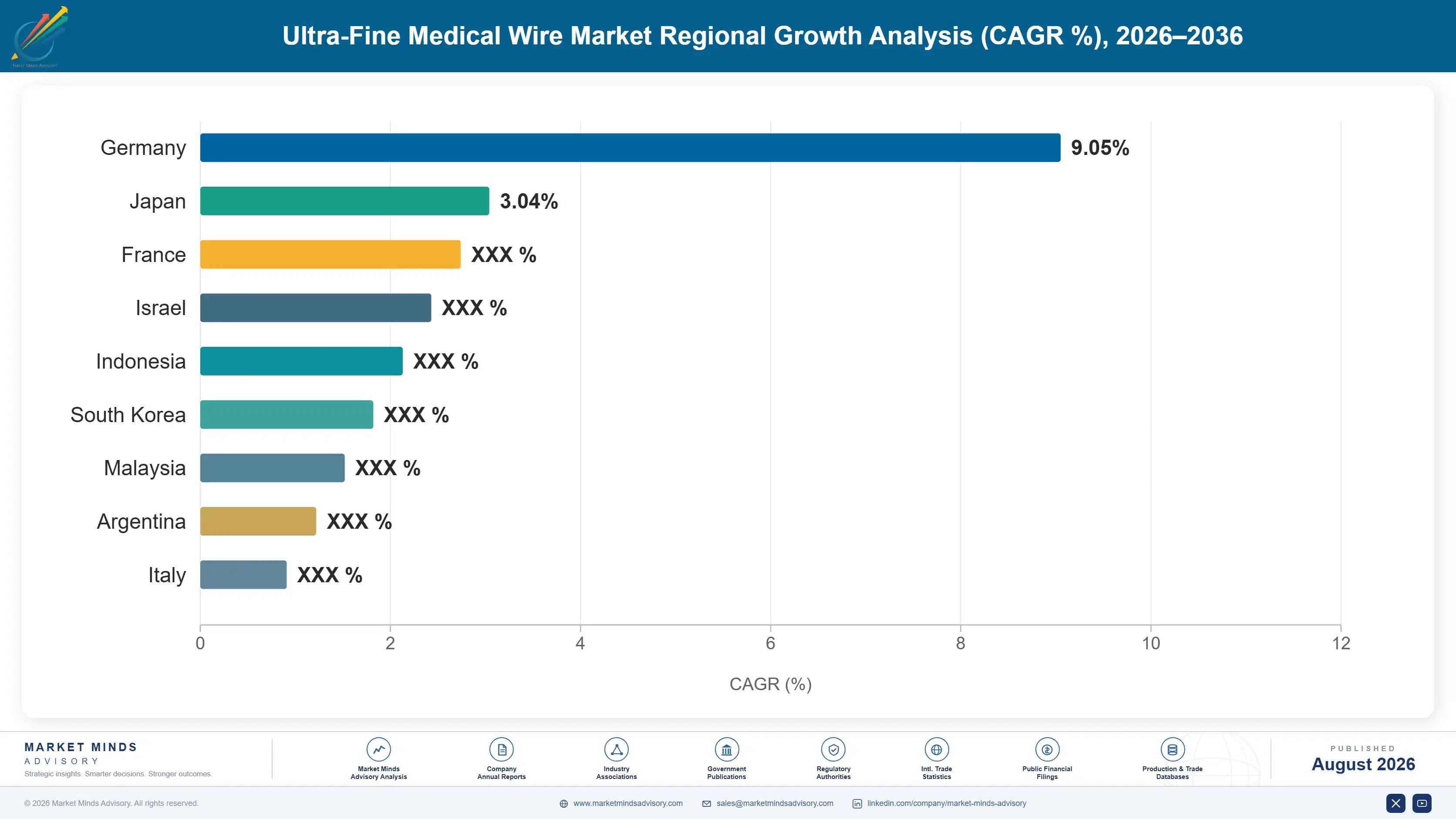
ultra-fine-medical-wire-market-country-cagr-analysis-1787640950385

Four Moves Between Melt and Die

The wire fails because of something decided upstream and the customer locks the supplier for a device lifetime. What remains available is contracting melt quality directly, entering at design rather than at purchase, and pricing yield honestly instead of pretending the metal explains the cost. All four sit outside the purchase order entirely. Design engineering decides.

Contract melt cleanliness rather than accept standard bar

An inclusion of around 12 microns breaks the wire near the end of about 42 drawing passes, and the mill supplying rod stock has no visibility of that consequence at all. Drawers specifying melt practice, remelting route and inclusion rating with the mill convert a yield problem into a purchasing specification. Standard bar buys a lottery ticket on every run, and the cost of losing shows up after all the value has been added. Yields near 38% at the finest diameters make every avoidable break expensive. Melt route is contractible.
Market Impact: Prevents the failures that start at 12 microns

Qualify during device development, never afterwards

Changing wire supplier on an implantable device takes around 22 months of fatigue, corrosion and biocompatibility testing plus file amendment, which no manufacturer does without serious cause. That means a position won during development holds for the device lifetime, and a position not won then is effectively unavailable. Suppliers calling on purchasing are quoting against a design history file that closed years earlier and nobody intends to reopen. Engineers choose wire while establishing whether a device concept is feasible at all, frequently working alongside a drawer to find out. Timing decides everything.
Market Impact: Beats the whole 22 month requalification lock-in period

Price the yield curve rather than the alloy

Yield falls to around 38% at the finest diameters, so a kilogram of identical alloy costs several times more at twenty five microns than at one hundred, and the difference is drawing loss rather than metal. Suppliers quoting from metal price plus a conversion margin misprice the fine end badly in both directions. Explaining the yield curve to design engineers also shifts diameter decisions toward what can actually be made economically. Diameter decisions taken without that information produce specifications nobody can make economically. Metal quotes mislead badly. Engineers respond well to it.
Market Impact: Reflects the 38% yield at the finest diameters

Sell composite capability, not composite product

Drawing a radiopaque core at roughly 30% of cross-section inside a superelastic shell through forty odd passes without separation or delamination is capability very few suppliers hold. Composite wire grows at 12.3% and designers increasingly specify it before knowing who can make it. Suppliers demonstrating the process to design teams shape what gets specified, while those quoting finished composite are answering a requirement somebody else helped write. Requalification then holds the position for the device lifetime. Composite wire grows at 12.3% and the qualified field remains very narrow, which makes early demonstration unusually valuable to a drawer holding the process.
Market Impact: Composite wire growing at 12.3% each single year

Who Controls the Margin Pool

Participation is measured on annual revenue from medical grade fine wire supply, and the top five hold 56%. Concentration is high because capability at the finest diameters takes decades of accumulated process knowledge to build and cannot be purchased with equipment alone, which keeps the qualified field genuinely narrow. The gap to challengers is accumulated process knowledge rather than equipment, and no amount of capital shortens the time it takes to acquire.
Competition runs on three fronts. Melt relationships decide whether runs complete, since rod cleanliness determines drawability. Design engagement decides qualification, which then holds for the device lifetime. And composite capability decides access to the segment where growth actually concentrates. Each front rewards a different capability, and very few participants hold all three of them properly.

Pressure ahead comes from composite constructions becoming standard and from device assembly relocating geographically. Expect suppliers with melt integration and composite capability to gain. Rankings shift on whoever is specified during development rather than quoted afterwards. Concentration should hold given how slowly capability builds. Drawers without composite capability look most exposed, since designs lost to it are lost for the whole device lifetime rather than a contract cycle.
ultra-fine-medical-wire-market-company-positioning-matrix-1787640950909

Competitive Moat and Risk Dimensions

FORT WAYNE METALS

Moat: Composite drawing and design engagement

Drawn-filled-tube capability across many core and shell combinations gives the business a position in the segment growing fastest, and design engineers specifying composite constructions frequently develop them with the drawer rather than sourcing them afterwards. That engagement converts into qualification that then holds for the device lifetime without further competition.
FORT WAYNE METALS

Risk: Melt supply outside direct control

Rod cleanliness decides whether a run survives about 42 drawing passes, and the melt shops supplying it operate on metallurgical priorities set by much larger customers in unrelated industries. Specification helps but does not confer control, and a mill changing practice for its own reasons can degrade yields with no warning reaching the drawer beforehand.
HERAEUS MEDICAL COMPONENTS

Moat: Precious metal integration and electrodes

Integration into platinum and precious metal refining upstream of drawing secures both material and scrap recovery economics that matter greatly when yields run near 38% on expensive alloys. Electrode and neuromodulation component capability alongside the wire also positions the business where wire content per device is rising fastest rather than where device counts are.
HERAEUS MEDICAL COMPONENTS

Risk: Precious metal price exposure

Platinum and iridium pricing moves on drivers entirely unrelated to medical demand, and low yields multiply the exposure since scrapped material carries full metal value. Recovery mitigates but never eliminates it, and customers accustomed to stable component pricing resist indexation more firmly than industrial buyers of the same metals do.

Players Tracked

Prominent Players

Fort Wayne Metals
Heraeus Medical Components
Alleima
Johnson Matthey
Nippon Seisen

Other Key Players

Furukawa Electric
Elgiloy Specialty Metals
Confluent Medical Technologies
Deringer-Ney
California Fine Wire
Luvata
Zapp Precision Metals
Kobe Steel
Tokusen Kogyo
Bekaert
Sumitomo Electric
Ulbrich Stainless Steels
Materion
Carpenter Technology
ATI

Recent Developments

FEBRUARY 2026

Drawer contracts melt practice directly with rod supplier

A fine wire drawer negotiated melt practice, remelting route and inclusion rating directly into its rod supply agreement after tracing repeated late stage breakages to particle contamination that standard bar specifications did not address at all. Drawing parameters had never been the problem. Yield variability fell sharply afterwards.
Signal: Drawability is decided inside a melt shop that never once sees the finished wire at all
SEPTEMBER 2025

Device programme specifies composite wire before sourcing it

A neurovascular device programme specified drawn-filled-tube construction during design on visibility and elasticity grounds, then discovered that very few suppliers could actually draw the combination reliably at the diameter required. Two suppliers were qualified in the end. The programme timeline slipped by several months. Capability was the constraint.
Signal: Designers now specify the composite construction well before ever establishing who can actually make it reliably
JANUARY 2026

Manufacturer abandons wire supplier change over requalification cost

An implant manufacturer abandoned a planned wire supplier change after scoping fatigue, corrosion and biocompatibility testing plus design history file amendment, concluding that the cost far exceeded any procurement saving available. The incumbent retained the position without competing for it. Procurement had no route to reopen it.
Signal: Positions won during device development quietly hold for the entire product lifetime afterwards, and go unchallenged

Rod, Dies and Annealing

Rod stock carries around 44% of finished wire cost across common alloys and considerably more in platinum grades, purchased from specialty melt operations with limited qualified alternatives. Diamond die consumption and replacement absorb roughly 12%, rising sharply at the finest diameters. Annealing energy across about 42 passes accounts for about 17%. Inspection, cleaning, spooling, documentation and quality release take the balance.
Nickel, cobalt and platinum group metal pricing all moved sharply across recent years, per London Metal Exchange reporting and Heraeus annual reporting for 2025 on precious metal cost commentary. Drawers passed movements through readily on precious metal grades where indexation is established, and considerably less readily on stainless and nitinol where customers expect component pricing to hold across an annual agreement. Composite grades carry both exposures at once.

Exposure divides on alloy and yield together rather than on scale. A platinum wire drawer carries metal value multiplied by yields near 38%, so scrapped material carries full metal cost and recovery economics become decisive. A stainless drawer carries lower metal exposure against thinner margins. A composite specialist carries both metals plus the risk that a run separating at pass thirty destroys two expensive materials at once.
ultra-fine-medical-wire-market-cost-volatility-analysis-1787640951104

Specify melt practice and inclusion rating in rod contracts

Rod cleanliness rather than drawing technique decides whether a run survives to finished diameter, and standard bar specifications say nothing useful about particles at the twelve micron scale. Writing melt route, remelting and inclusion rating into supply agreements converts an unpredictable yield loss into a purchasing requirement the mill can actually be held to.

Build precious metal recovery into the drawing operation

At yields near 38%, scrapped platinum grade material carries full metal value and represents a substantial share of total cost rather than a rounding error. Integrated or contracted recovery converts that loss back into input, which matters far more in this market than in any industrial wire operation working with commodity metals. Recovery economics decide profitability.

Index precious metal exposure into customer agreements

Platinum and iridium move on drivers unrelated to medical demand and low yields multiply the exposure considerably. Indexation shifts that to where it originates, though device customers accustomed to fixed component pricing across annual agreements resist it more firmly than industrial buyers of identical metals do. Low yields multiply the exposure considerably. Device buyers resist it firmly.

Portfolio Architecture for Margin Defence

Margin here follows drawing difficulty rather than alloy value, because a common stainless wire at one hundred microns can be made by many suppliers while the same alloy at twenty five cannot. Coarse stainless and standard alloy wire earns margins in the high teens to low thirties, where several drawers qualify and buyers compare on delivered cost. Technical difference between qualified suppliers at that diameter is genuinely small.
Nitinol, cobalt-chromium and coated fine wire do better in the low thirties to high forties, because drawing behaviour is less forgiving and the qualified supplier field narrows accordingly at every reduction in diameter. Coating and insulation add a further qualification barrier that most drawers never attempt.

Composite drawn-filled-tube and platinum grades hold the strongest position, reaching into the high fifties, where very few suppliers can draw the construction reliably and requalification takes about 22 months should a customer ever consider moving. Those margins depend on yield holding, since scrapped composite destroys two expensive materials simultaneously and a bad campaign can remove an entire quarter of contribution. A bad composite campaign can remove an entire quarter of contribution, which makes yield discipline the whole business at this level.

Coarse Stainless and Standard Alloy Wire

Diameters and alloys many drawers can supply where buyers compare on delivered cost. The thirteen point range reflects drawing scale and rod sourcing rather than any capability difference between qualified suppliers.
Gross Margin: 18-31%

Nitinol, Cobalt-Chromium and Coated Wire

Alloys whose drawing behaviour narrows the qualified field at every diameter reduction. The sixteen point range reflects process capability and how fine the customer specification actually goes in practice. Capability narrows with diameter.
Gross Margin: 31-47%

Composite and Platinum Grade Wire

Constructions very few suppliers can draw reliably at the diameters designers request. The sixteen point range reflects yield achieved and whether precious metal recovery is integrated into the operation. Recovery decides the economics.
Gross Margin: 42-58%
ultra-fine-medical-wire-market-portfolio-architecture-1787640951642

High-value Sub-segments and Strategic Watch-out

Composite Drawn-Filled-Tube Wire

High value and the fastest growth at 12.3%, delivering visibility and elasticity together where either metal alone forces a compromise. Separation during drawing destroys two expensive materials at once. Requalification takes around 22 months, which makes a composite position won during development unusually durable. Entry is genuinely hard.
Gross Margin: 44-58%

Platinum and Radiopaque Alloy Wire

High value and growing at 10.4% on electrode and marker applications where imaging visibility decides everything. Scrap recovery is a genuine commercial variable rather than an accounting detail here. Neuromodulation is the growth application, since each lead carries multiple conductors rather than one. Metal exposure runs high.
Gross Margin: 42-56%

Stainless Steel Fine Wire

The volume core, supplied by several qualified drawers at diameters that do not test capability. Buyers compare on delivered cost because the technical difference between suppliers is genuinely small. Rod sourcing and drawing scale rather than capability decide who wins these orders on price. Differentiation is minimal.
Gross Margin: 18-31%

Melt Supply Exposure

The strategic watch-out. A particle near 12 microns destroys a run after all value has been added, and the range reflects whether a drawer contracts melt practice or accepts standard bar stock. Melt specification converts an unpredictable loss into a purchasing requirement the mill can be held to.
Gross Margin: 0-50%

Won Once, Held for a Decade

Demand here is unusually durable once secured, because a wire written into an implantable device design history file stays there for the product's commercial life. Changing it takes around 22 months of fatigue, corrosion and biocompatibility work that no manufacturer undertakes to save procurement money. A qualification won during development therefore represents a decade of supply rather than an annual contract. Very little else in components behaves that way.
Stickiness varies sharply by device class. Implantable devices are effectively frozen once filed. Single use interventional products reopen more readily, though even there the validation burden deters routine switching. Non-implantable and non-critical wire moves on price like any other component, which is why drawers with only that business face quite different economics from those holding implant positions.

The deciding function is device design engineering rather than purchasing, and the decision is taken years before commercial volume appears. Engineers select wire while working out whether a device concept is feasible at all, frequently in collaboration with a drawer. Suppliers organised around procurement relationships are quoting against a file closed long before they arrived and nobody has any intention of reopening.
ultra-fine-medical-wire-market-end-use-penetration-index-1787640952177

Where We Would Put Effort

These are among the four positions where our research anticipates prominent divergence between winners and laggards over the coming forecast period. Each is grounded in the demand model, the regulatory perimeter, and the announced capacity pipeline.
01 / MELT SPECIFICATION CONTROL

Standard bar is a lottery ticket

An inclusion of around 12 microns breaks the wire near the end of about 42 drawing passes, and the mill supplying rod stock has no visibility of that consequence whatsoever. Drawers who specify melt practice, remelting route and inclusion rating directly with the mill convert an unpredictable yield loss into a purchasing requirement instead. Accepting standard bar simply buys a lottery ticket on every single campaign, and the losing ticket arrives only after all the value has already been added.
02 / DEVELOPMENT STAGE QUALIFICATION

The file closed before you called

Changing wire supplier on an implantable device takes around 22 months of fatigue, corrosion and biocompatibility testing plus design history file amendment, which no manufacturer ever undertakes without genuinely serious cause behind it. A position won during development therefore holds for the whole device lifetime, and a position not won then is effectively unavailable to anybody afterwards. Suppliers still calling on purchasing are quoting against a design history file that closed years earlier and nobody has any intention of reopening.
03 / YIELD CURVE PRICING

The metal is not the cost

Yield falls to around 38% at the finest diameters, so a kilogram of identical alloy costs several times more at twenty five microns than the same alloy does at one hundred, and the entire difference is drawing loss rather than metal value. Suppliers quoting from metal price plus a standard conversion margin misprice the fine end badly in both directions at once. Explaining that yield curve to design engineers also moves diameter decisions toward what can genuinely be manufactured economically at volume.
04 / COMPOSITE CAPABILITY DEMONSTRATION

Designers specify before they source

Drawing a radiopaque core at roughly 30% of cross-section inside a superelastic shell through forty odd passes, without separation or delamination anywhere, is capability that very few suppliers actually hold. Composite wire grows at 12.3% and designers increasingly specify the construction during concept work, before establishing who can actually make it. Suppliers demonstrating the process directly to design teams shape what gets written down, while those quoting finished composite are answering a requirement that somebody else already helped to write.

Engagement Snapshot From the Field

A live engagement with an industry participant carrying material or product regulatory and market exposure ahead of a defining policy shift, showing how our research translates into a defensible multi-year portfolio strategy.
MARKET MINDS ADVISORY · CLIENT ENGAGEMENT SUMMARY
Ultra-Fine Medical Wire Producer Strategic Portfolio Review and Transition Roadmap 2026·Investment Scenario on Ultra-Fine Medical Wire Exposure Evaluation 2025-26
CLIENT PROFILE
A precision wire drawer supplying stainless, nitinol and cobalt-chromium fine wire to medical device manufacturers across European and North American markets, at annual revenue near 190 million dollars (client-reported, unverified by MMA). Composite capability was limited and rod stock was purchased to standard bar specifications. Commercial coverage ran almost entirely through procurement contacts at customer plants.
STRATEGIC CHALLENGE
Yields at the finest diameters were erratic in a way the drawing operation could not explain, and design engineers were increasingly specifying composite constructions the business could not supply. Management wanted to know which problem to address first and whether they were connected. Design wins had been slipping without anybody tracking why.
MMA APPROACH
MMA traced late stage breakage events back through rod stock provenance and melt practice, quantified yield against diameter across alloy families, mapped where wire qualification decisions were actually taken across customer programmes, and assessed composite capability investment against the segment's growth. Interviews with 47 experts covered wire drawing, device design engineering, metallurgy and medical device regulation.
KEY FINDINGS
  1. Erratic yields correlated with rod stock provenance rather than with any drawing parameter, and the affected material had all been purchased to identical standard bar specifications.
  2. Qualification decisions were taken by design engineers years before commercial volume, and the client's commercial organisation had been calling almost exclusively on procurement.
  3. Composite constructions were being specified on programmes the client had historically supplied, which meant losing designs it would previously have won on relationship alone.
  4. Requalification burden meant every design lost was lost for the device lifetime, making the composite gap considerably more damaging than its current revenue share suggested.
CLIENT PROFILE
A precision wire drawer supplying stainless, nitinol and cobalt-chromium fine wire to medical device manufacturers across European and North American markets, at annual revenue near 190 million dollars (client-reported, unverified by MMA). Composite capability was limited and rod stock was purchased to standard bar specifications. Commercial coverage ran almost entirely through procurement contacts at customer plants.
STRATEGIC CHALLENGE
Yields at the finest diameters were erratic in a way the drawing operation could not explain, and design engineers were increasingly specifying composite constructions the business could not supply. Management wanted to know which problem to address first and whether they were connected. Design wins had been slipping without anybody tracking why.
MMA APPROACH
MMA traced late stage breakage events back through rod stock provenance and melt practice, quantified yield against diameter across alloy families, mapped where wire qualification decisions were actually taken across customer programmes, and assessed composite capability investment against the segment's growth. Interviews with 47 experts covered wire drawing, device design engineering, metallurgy and medical device regulation.
KEY FINDINGS
  1. Erratic yields correlated with rod stock provenance rather than with any drawing parameter, and the affected material had all been purchased to identical standard bar specifications.
  2. Qualification decisions were taken by design engineers years before commercial volume, and the client's commercial organisation had been calling almost exclusively on procurement.
  3. Composite constructions were being specified on programmes the client had historically supplied, which meant losing designs it would previously have won on relationship alone.
  4. Requalification burden meant every design lost was lost for the device lifetime, making the composite gap considerably more damaging than its current revenue share suggested.
RECOMMENDED STRATEGY
Phase 1: Phase one: write melt practice and inclusion rating into rod supply agreements, since drawability is decided upstream rather than on the drawing bench. Phase 2: Phase two: redirect commercial coverage from purchasing toward device design engineering, because qualification is taken years before any purchase order exists. Phase 3: Phase three: invest in composite drawing capability, since designs lost to it are lost for the whole device lifetime. The gap compounds every year.
OUTCOME
The drawer renegotiated rod supply against melt specification during 2026 and yield variability at fine diameters fell substantially (client-reported, unverified by MMA). Design engineering coverage was established, and composite capability investment was approved for the following year. Procurement led coverage was reduced in favour of design engineering engagement.

Frequently Asked Questions

Foundational context covering the market sizes, CAGR, scope, country, region and competition that inform every finding below. This section is provided to cover basics and most often pre-purchase conversations, answered from the MMA Primary Research Dataset.

What is the current size of the Ultra-Fine Medical Wire Market?

MMA sizes it at USD 1.05 billion in 2025, rising to USD 1.14 billion in 2026. The figure covers precision drawn medical grade wire below one hundred microns at supplier selling value.

How large will the Ultra-Fine Medical Wire Market be by 2036?

USD 2.51 billion by 2036, an incremental USD 1.37 billion over the 2026 base and an expansion multiple of 2.20 times. Composite constructions carry most of that gain.

What is the CAGR for the Ultra-Fine Medical Wire Market 2026 to 2036?

8.2% in the base case, with a bull case at 9.4% and a bear case at 7.0%. Neuromodulation and structural heart programme scaling drives most of the spread.

Which segment is growing fastest?

Composite drawn-filled-tube wire at 12.3%, half again the market rate of 8.2%. It delivers fluoroscopic visibility and superelasticity together where either metal alone forces a compromise.

Who are the major companies in the Ultra-Fine Medical Wire Market?

Fort Wayne Metals, Heraeus Medical Components, Alleima, Johnson Matthey and Nippon Seisen lead on medical fine wire revenue. Fifteen further participants are profiled in the report.

Which country is growing fastest?

Costa Rica at 15.2%, as medical device manufacturing continues concentrating there at a pace no other market currently matches, drawing catheter, guidewire and implant assembly together.

Report Segmentation Architecture

The full report scope spans multiple orthogonal segmentation dimensions, with cross-tabulated demand data provided for each dimension pair. Coverage extends further to regional breakdowns, trend trajectories, and the competitive detail needed to support segment-level decision-making.

By Material and Construction

  • Stainless Steel Fine Wire
  • Nitinol Fine Wire
  • Composite Drawn-Filled-Tube Wire
  • Platinum and Radiopaque Alloy Wire
  • Cobalt-Chromium and MP35N Wire
  • Coated and Insulated Fine Wire

By End-Use Industry

  • Guidewires and Interventional Access
  • Cardiac Rhythm and Neuromodulation Leads
  • Structural Heart and Vascular Implants
  • Catheter Reinforcement Braiding
  • Orthodontic and Dental Devices
  • Diagnostic Sensors and Electrodes

By Commercial Dimension

  • Design Specified Supply Agreements
  • Contract Manufacturer Purchase
  • Distributor and Stockist Channels
  • Development Partnership Arrangements
  • Toll Drawing Services
  • Spot and Prototype Supply

By Region

  • North America
  • Western Europe
  • East Asia
  • South Asia and Pacific
  • Latin America
  • Middle East and Africa
  • Eastern Europe

Scope, Methodology, and Coverage

Every figure in this report is reproducible from documented input assumptions. The scope below maps the historical period, the forecast horizon, the segmentation dimensions, and the countries covered, alongside the underlying primary and qualitative methodology.
Historical Period
2020 to 2025
Forecast Period
2026 to 2036
Base Year
2025 (USD billions; MMA Primary Research Dataset, August 2026)
Market Definition
Precision drawn metallic wire below one hundred microns supplied for medical device manufacture, covering stainless steel fine wire, nitinol fine wire, composite drawn-filled-tube wire, platinum and radiopaque alloy wire, cobalt-chromium and MP35N wire, and coated and insulated fine wire. Measured at wire supplier selling value. Finished guidewires and catheters, hypotube and cannula, suture and needle products, and non-medical precision wire are excluded from scope.
Quantitative Units
USD billions (current prices); kilometres and kilograms shipped; USD per kilogram by construction
Segmentation Dimensions
Material and construction; end-use industry; commercial dimension; region
Regions Covered
North America, Western Europe, East Asia, South Asia and Pacific, Latin America, Middle East and Africa, Eastern Europe
Countries Covered
United States, Canada, Mexico, Ireland, Germany, Switzerland, France, United Kingdom, Japan, China, South Korea, Taiwan, India, Malaysia, Singapore, Costa Rica, Brazil, Israel, South Africa, Poland
Key Companies Profiled
Fort Wayne Metals, Heraeus Medical Components, Alleima, Johnson Matthey, Nippon Seisen, Furukawa Electric, Elgiloy Specialty Metals, Confluent Medical Technologies, Deringer-Ney, California Fine Wire, Luvata, Zapp Precision Metals, Kobe Steel, Tokusen Kogyo, Bekaert, Sumitomo Electric, Ulbrich Stainless Steels, Materion, Carpenter Technology, ATI
Quantitative Methodology
Primary survey, n=3,800 respondents, Q4 2025, six countries; demand-side model with trade association cross-validation
Qualitative Methodology
47 expert interviews, Q4 2025; applied to validate demand model assumptions, identify emerging dynamics, and assess competitive positioning
Report Format
PDF and XLSX data workbook (Word format preview document)
Publisher
Market Minds Advisory
Report Code
MMA-2026-MED-124
Published
August 2026
Contact
sales@marketmindsadvisory.com | www.marketmindsadvisory.com

Purchase the full Ultra-Fine Medical Wire Market Report (2026 to 2036).

The full report treats ultra-fine medical wire as a business where the decisive quality variable sits hundreds of steps upstream in a melt shop that never sees the product. It sizes all six constructions independently through 2036, quantifies yield against diameter across alloy families, and maps where qualification decisions are actually taken within device programmes. Regional chapters cover all seven regions with device assembly location tracked separately from design authority. Competitive profiling covers 20 participants on one consistent revenue basis. Melt provenance is traced against breakage incidence throughout the analysis.
Six wire constructions sized independently through 2036
Yield quantified against diameter across every alloy family
Qualification decision points mapped across device development programmes
Device assembly location tracked separately from design authority regionally
Melt practice specification assessed against late stage breakage incidence
Twenty participants profiled on one consistent revenue basis

Built For The People Who Decide

From boardroom strategy to bench-side execution, this report is read cover-to-cover by leaders shaping the next decade of their industry, turning demand scenarios, market dynamics and valuation benchmarks into decisions.
CXOs/ Presidents/ VPs/ Managers
M&A and Corporate Development
Strategy Teams and R&D Heads
Procurement and Product Directors
Regulatory and Compliance Leaders
Investor Relations and Equity Analysts