Market Minds Advisory
Ulcerated Necrobiosis Lipoidica Management Market

Ulcerated Necrobiosis Lipoidica Management Market: The First-Line Treatment Causes the Complication

Topical steroids calm the plaque and thin the skin, and thinned skin over the shin is exactly what breaks open, which makes the standard first-line therapy a contributor to the ulcer it precedes.

Lead Analyst

Alice Ballenger

Published

September 2026

Make Smarter Decisions with Customized Research Insights

Request a free sample report and evaluate market opportunities, growth trends, and competitive dynamics relevant to your business needs.

2025 MARKET VALUE$0.1BMarket Size 2025
2036 FORECAST VALUE$0.5BBase Case , 2026 to 2036
CAGR 2026 TO 203611.8 %Bull 13.0% / Bear 10.6%
INCREMENTAL OPPORTUNITY$0.3BNet 10- year value creation
EXPANSION MULTIPLE3.06x2036 value over 2026 base
Strategic Levers
M&A Pipeline
Regional Outlook
Country Rankings
Competitive Intelligence
Segmental Deep-dive
Call-Us : 91 93563 13602

Executive Snapshot and Market Trajectory

Around 33% of necrobiosis lipoidica plaques eventually break open, and the treatment given to prevent that outcome contributes to it. Prolonged topical corticosteroid use causes skin thinning in roughly 41% of patients, and thinned skin over the shin is precisely what ulcerates.
Nothing here is approved. Every therapy in use, from calcineurin inhibitors to tumour necrosis factor and Janus kinase inhibitors, is prescribed outside any product label for this indication, which means no reimbursement pathway is keyed to the disease and no price anchor exists. Systemic targeted immunomodulators grow at 17.7%, half again the market rate of 11.8%, on clinician conviction rather than on evidence anybody has been paid to generate.
Diagnosis is presumptive because confirming it is dangerous. Biopsy of a shin lesion in a patient with diabetes fails to close in around 18% of cases, so clinicians avoid it, and the average patient waits about 26 months before anybody names the condition correctly. Most spend that interval being managed as a venous ulcer or pyoderma gangrenosum, which changes what is prescribed, who prescribes it and whether systemic therapy is ever considered at all.
Market Definition
Therapies and products used to manage ulcerated necrobiosis lipoidica, covering topical and intralesional corticosteroids, topical calcineurin inhibitors, systemic biologic and targeted immunomodulators, advanced wound dressings and skin substitutes, compression and adjunctive vascular therapy, and procedural and light-based therapies. Measured at manufacturer selling value attributable to this indication. Excludes general diabetic foot ulcer care, venous leg ulcer management, pyoderma gangrenosum treatment, and diabetes therapy itself.
Base Year Value
$0.1B in 2025 (MMA Primary Research Dataset, August 2026)
Forecast Period
2026 to 2036, eleven discrete annual values
CAGR
11.8% base case. Bull 13.0%. Bear 10.6%.
Fastest Growth Segment
Systemic Biologic and Targeted Immunomodulators: 17.7% CAGR
Fastest Growth Country
Saudi Arabia: 20.4% CAGR
Fastest Growth Region
South Asia and Pacific: 13.8% CAGR
Largest Region
North America: 32% of 2025 global value
Market Leaders
AbbVie, Johnson and Johnson, Pfizer, Smith and Nephew, Mölnlycke Health Care. Source: MMA Primary Research Dataset, July 2026.
Primary Survey
n=3,800 procurement and R&D decision-makers, Q4 2025, six countries
Methodology
Demand-side build-up, cross-validated against public data, 47 expert interviews

Ulcerated Necrobiosis Lipoidica Management Market Forecast Scenarios

ulcerated-necrobiosis-lipoidica-management-market-size-forecast-scenario-1787640931016
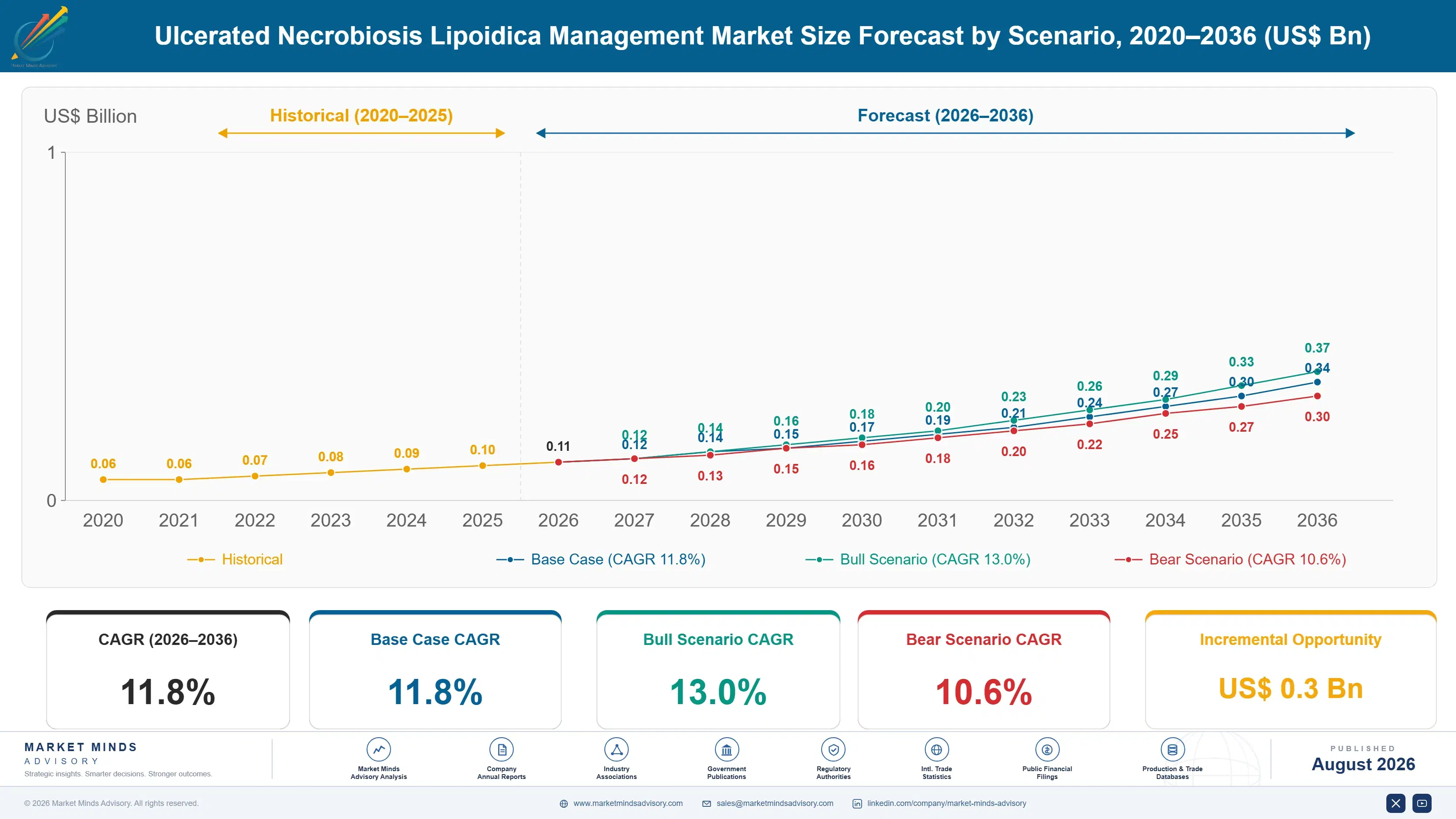
Growth ran near 9.4% between 2020 and 2025, driven almost entirely by systemic agents moving from case reports into routine specialist practice. Janus kinase inhibitors approved for other dermatological indications were adopted here without any trial in this condition, on the strength of published series and clinician judgement. Advanced dressing use rose alongside, though rarely under this diagnosis.
Base case 11.8% rests on three mechanisms. Systemic biologic and targeted immunomodulators grow at 17.7% as specialists extend agents licensed elsewhere into a condition with nothing of its own. Advanced dressings and skin substitutes grow at 13.4% because these ulcers heal poorly and slowly. And Saudi Arabia grows fastest of any country at 20.4%, where very high diabetes prevalence meets well funded dermatology and unusually broad biologic access. Incidence moves slowly.
The bull case at 13.0% assumes a controlled trial reading out positively in this indication, which would create the first label, the first reimbursement pathway and the first genuine price anchor the condition has ever had. The bear case at 10.6% is payers tightening off-label scrutiny, since every agent used here is prescribed outside its label and none is protected by an approval anybody can point to.

A Disease With No Approved Drug

The central difficulty in this condition is that its standard first-line therapy works against the outcome everybody is trying to avoid. Potent topical and intralesional corticosteroids reduce the granulomatous inflammation in a necrobiosis lipoidica plaque, and they also cause dermal atrophy in around 41% of patients on prolonged use. Shin skin is already thin and poorly vascularised, and roughly 33% of plaques ulcerate.
TOP FIVE CONCENTRATION46%Dermatology and wound care suppliers occupy quite separate positions
LESIONS THAT ULCERATE33%Share of plaques eventually progressing to open painful ulceration
OFF-LABEL PRESCRIBING SHARE100%Portion of treatment given outside any approved product label
DIAGNOSTIC DELAY26 monthsInterval from lesion appearance to a correct clinical diagnosis
BIOPSY NON-HEALING RISK18%Diagnostic samples that fail to close in affected patients
STEROID ATROPHY RATE41%Patients developing skin thinning from prolonged topical corticosteroid use
No product anywhere carries an approval for this indication, which shapes the commercial picture more than any clinical factor does. Calcineurin inhibitors, tumour necrosis factor inhibitors, Janus kinase inhibitors, fumarates and hyperbaric oxygen are all used, and every one of them is prescribed outside its label. There is consequently no reimbursement pathway keyed to the disease, no health technology assessment, and no price that anybody has ever had to defend for treating it.
Diagnosis is largely presumptive because confirming it carries a real risk. Punch biopsy of a shin lesion in a patient with diabetes fails to heal in roughly 18% of cases, so dermatologists frequently decline to take one, and the average patient waits about 26 months before the condition is named correctly. Most are managed as venous ulcers in the interval.
"You are asked to prove a therapy works in a disease that has no approved comparator, no registry, no endpoint anybody agreed on, and a diagnosis most clinicians will not confirm because confirming it can open another wound. Very little about this is ordinary."
Director, Dermatology and Rare Disease Therapeutics Practice · MMA Healthcare and Life Sciences Practice · August 2026

Market Trends

Targeted immunomodulators arriving without any trial in the indication

Janus kinase and tumour necrosis factor inhibitors approved for other dermatological and rheumatological conditions have moved into routine specialist use here on published case series and clinical judgement alone. Systemic targeted agents grow at 17.7% on that basis, faster than anything else in the condition. No sponsor has run a controlled trial, because the population is small, the endpoint is unsettled and no approval would follow the expense anyway. Payers have begun declining authorisations on exactly that basis, which makes the growth considerably less secure than the rate suggests. Nothing protects it.
Market Impact: Saudi Arabia growing at 20.4%

Corticosteroid atrophy recognised as an ulceration contributor

Prolonged potent topical corticosteroid use causes dermal atrophy in around 41% of patients, and atrophic shin skin is exactly the tissue that breaks down. Specialist practice has begun moving toward calcineurin inhibitors and steroid sparing approaches for maintenance, keeping steroids for short inflammatory bursts only. That shift is clinically sensible and commercially significant, since it moves treatment toward agents costing many times more per course. Calcineurin inhibitors and steroid sparing maintenance cost many times more per course than the generic they replace, which is the commercial consequence of a sensible clinical correction.
Market Impact: Advanced dressings growing 13.4% annually

Market Opportunities and Growth Drivers

High diabetes prevalence meeting broad specialist access

Saudi Arabia grows fastest of any country at 20.4% because diabetes prevalence there is among the highest anywhere and dermatology access, biologic availability and willingness to fund off-label therapy all coincide. Prevalence alone produces patients rather than treatment, so the combination matters far more than burden does on its own. Suppliers mapping opportunity against diabetes statistics are identifying populations that will never reach a specialist prescriber. Diabetes statistics identify populations rather than treated patients, and the two diverge enormously across markets with similar disease burden. Access rather than burden decides treated volume here.
Market Impact: All treatment is 100% off-label

Poor healing pushing ulcers toward advanced dressing use

These ulcers heal slowly, painfully and frequently not at all, which pushes management toward advanced dressings and skin substitutes rather than conventional wound care. That segment grows at 13.4% accordingly. Because the underlying lesion is inflammatory rather than ischaemic or venous, dressings alone rarely close the wound without systemic disease control, which makes the two segments complementary rather than competing for the same treatment decision. Wound services managing these ulcers without the inflammatory diagnosis rarely achieve closure, which produces poor outcomes attributed to the dressing rather than to the missing diagnosis.
Market Impact: Around 18% of biopsies fail

Market Restraints and Challenges

Absent approval leaving no reimbursement pathway anywhere

Every therapy in use is prescribed outside its product label, so no payer has a coverage policy keyed to this indication and each prescription is argued case by case by an individual clinician. The root cause is that no sponsor has run a trial in a population this small with an endpoint nobody has agreed. Commercially it caps access severely. Investigator led studies and registry building are the routes participants are actually pursuing. A single controlled study would change that position more than any accumulation of case series ever will.
Market Impact: Systemic agents growing at 17.7%

Biopsy risk keeping diagnosis presumptive and delayed

Punch biopsy of a shin lesion in a patient with diabetes fails to close in around 18% of cases, so clinicians avoid the confirmatory test that would establish the diagnosis. The root cause is the same poor healing that defines the disease. Commercially it leaves patients treated as venous ulcers for about 26 months on average. Dermoscopy, clinical criteria and non-invasive imaging are the alternatives currently being developed. Misclassification as venous disease is the usual result, and it routes the patient away from dermatology entirely. Non-invasive imaging may eventually help.
Market Impact: Atrophy affects about 41% treated
4 additional market trends, 3 additional growth drivers, and 2 additional restraints and challenges are covered in the full report. Contact sales@marketmindsadvisory.com to access the complete intelligence.

Segment CAGR and Growth Architecture

Six segments split by treatment modality, because modality determines whether the underlying inflammation or the open wound is being addressed, the specialty prescribing it, the reimbursement argument required and the cost per treated patient. Formulation and dosing variants sit inside each modality. Care setting and channel dimensions are handled separately within the framework. Modality decides the prescriber.
ulcerated-necrobiosis-lipoidica-management-market-market-share-analysis-1787640931546

Systemic Biologic and Targeted Immunomodulators

Growing at 17.7%, half again the market rate of 11.8%, tumour necrosis factor and Janus kinase inhibitors address the granulomatous inflammation driving the lesion rather than dressing the wound it produces, which is why they close ulcers that topical therapy and advanced dressings alone leave open indefinitely. Every one of them is used entirely off-label. Cost per patient runs many times any other modality, and each prescription is argued individually with a payer holding no policy on the indication at all. Payers have begun declining authorisations that previously succeeded, which makes this the fastest growing and least secure position in the whole condition. A controlled study would change that immediately.
CAGR 17.7%

Advanced Wound Dressings and Skin Substitutes

At 13.4% advanced dressings and skin substitutes manage an ulcer that heals slowly, painfully and often not at all, and they reach patients through wound care services rather than dermatology. Because the lesion is inflammatory rather than venous or ischaemic, the wound rarely closes without systemic disease control alongside, which makes this segment complementary to systemic therapy rather than an alternative to it. Coding under general chronic wound categories obscures how much of this volume the indication actually generates. Around 33% of plaques ulcerate and the resulting wounds persist for months or years, which makes each identified patient a long consumption stream that nobody currently counts under this diagnosis at all.
CAGR 13.4%
Full segment breakdown across 6 segments available in the complete report.

Regional Architecture and Country Demand Map

North America holds 32% of value on off-label biologic access and drug pricing that no other region approaches. Western Europe follows at 24% on specialist dermatology density and established wound care services. South Asia and Pacific grows fastest of the seven regions covered here. Specialist access drives both.

North America

Off-label biologic and Janus kinase inhibitor use is more readily funded here than anywhere, though it still requires individual prior authorisation arguments rather than any coverage policy for the indication. Drug pricing gives this region its leading share on a patient population no larger than several others. Dermatology and wound care services operate separately, which frequently splits management of the same patient. Growth at 10.4% reflects access breadth rather than any rising incidence. Patients frequently move between wound care and dermatology without either service holding the whole picture, which lengthens the interval before systemic therapy is considered. Prior authorisation succeeds more often here than anywhere, though it still has to be argued afresh with every single patient.
Share: 32% | CAGR: 10.4% (2026 to 2036)

Western Europe

Specialist dermatology density is high and referral pathways are reasonably short, which shortens the diagnostic delay compared with most regions though it remains substantial. National reimbursement systems assess off-label use case by case and outcomes vary considerably between countries. Advanced wound care services are well established and frequently manage these ulcers without dermatology involvement at all. Regional growth of 10.0% is the slowest anywhere on cautious off-label funding. Dermatology societies here have been most active in advising against prolonged potent corticosteroid use, which is beginning to shift maintenance prescribing toward steroid sparing agents. Advanced wound services frequently manage these ulcers without dermatology involvement at all, which delays the diagnosis considerably.
Share: 24% | CAGR: 10.0% (2026 to 2036)
Regional intelligence for 5 additional markets available in the complete report: East Asia, South Asia and Pacific, Latin America, Middle East and Africa, Eastern Europe. Contact sales@marketmindsadvisory.com.
ulcerated-necrobiosis-lipoidica-management-market-country-cagr-analysis-1787640932068

Four Moves Without a Label

This condition has no approval, no coverage policy and no agreed endpoint, so nothing here can be sold the way an approved therapy is sold. What remains available is building the evidence nobody has funded, reaching the specialty that actually diagnoses it, and separating this ulcer from the wound categories hiding it. All four sit outside promotion.

Fund the evidence nobody has generated

Every agent used here is prescribed off-label, so no payer holds a coverage policy and each prescription is argued individually by a clinician with published case series and little else. A sponsor generating even modest controlled evidence would create the first reimbursement argument the condition has ever had. Investigator led studies cost a fraction of a registration programme and reach the same clinical audience that currently prescribes on conviction alone. Around 33% of plaques ulcerate, which is a population large enough to study and small enough to study affordably. Somebody has to go first.
Market Impact: Addresses the whole 100% share of off-label prescribing

Reach dermatology before the wound service does

Patients wait around 26 months for a correct diagnosis and spend much of that interval in wound care services managing what is assumed to be a venous ulcer. The inflammatory diagnosis determines whether systemic therapy is ever considered, and wound services rarely make it. Suppliers reaching dermatology referral pathways influence the point at which the condition is identified rather than the point at which a dressing is chosen. Referral routing is decided early and almost never revisited afterwards. Wound services rarely make the inflammatory diagnosis, and dermatology rarely sees the patient early enough to make it either.
Market Impact: Shortens the whole 26 month diagnostic delay considerably

Move maintenance therapy off potent corticosteroids

Prolonged potent topical steroid use causes dermal atrophy in around 41% of patients, and atrophic shin skin is what ulcerates in the first place. Calcineurin inhibitors and steroid sparing approaches address maintenance without that consequence, at considerably higher cost per course. Presenting the atrophy data to prescribers reframes a cheap first-line therapy as a contributor to the complication everybody is trying to prevent. Prescribers reach for steroids by default rather than by decision, which is exactly the habit the atrophy evidence is capable of interrupting. Habit is the target here.
Market Impact: Avoids the atrophy currently affecting 41% of patients

Separate this ulcer from general chronic wound coding

These wounds are recorded under general chronic ulcer categories, which hides how much dressing and skin substitute volume the indication actually generates and prevents anybody sizing it properly. Around 33% of plaques ulcerate, and the population is identifiable if anybody looks. Registry participation and coding advocacy make the volume visible, which is the precondition for any payer ever writing a policy on it. Visibility precedes policy in every payer system, and nobody writes coverage for a population they have never seen counted. Counting has to happen first. Registries make it possible.
Market Impact: Reveals the volume from 33% of ulcerating plaques

Who Controls the Margin Pool

Participation is measured on annual revenue attributable to this indication, and the top five hold 46%. Concentration is moderate and unusually shaped, because pharmaceutical companies supplying systemic agents and wound care companies supplying dressings serve the same patient without competing with one another at all. The gap to challengers is immunology portfolio breadth on one side and wound contract reach on the other, which are entirely unrelated sources of position.
Competition runs on three fronts. Off-label acceptance decides which systemic agents specialists reach for, driven by published series rather than promotion. Wound care contract position decides dressing volume, awarded on general chronic wound tenders. And dermatology relationships decide whether the inflammatory diagnosis is made at all. Each front rewards a different capability, and no participant currently holds more than one of them properly.

Pressure ahead comes from steroid sparing practice and from any controlled evidence that emerges. Expect suppliers with published case series and dermatology reach to gain. Rankings shift on whoever funds the first trial anybody can cite. Concentration should stay moderate given the split. Wound care suppliers without any systemic position look most exposed, since dressings alone rarely close a wound driven by inflammation nobody has treated.
ulcerated-necrobiosis-lipoidica-management-market-company-positioning-matrix-1787640932591

Competitive Moat and Risk Dimensions

ABBVIE

Moat: Immunology breadth and dermatology reach

Holding both tumour necrosis factor and Janus kinase inhibitors across dermatological indications gives the business established relationships with exactly the specialists who reach for these agents off-label, and familiarity with a product in a licensed indication is what drives its adoption in an unlicensed one. That reach was built for other diseases and transfers here at no additional cost.
ABBVIE

Risk: Off-label scrutiny from payers

All use in this condition sits outside the product label, which leaves volume dependent on individual prior authorisation decisions that payers can tighten at any point without any regulatory process. No approval protects it, and a sponsor cannot promote the use it depends on, which makes the position genuinely fragile despite its clinical logic.
SMITH AND NEPHEW

Moat: Wound care contract reach

Advanced dressing and skin substitute positions across hospital and community wound services reach these ulcers wherever they are managed, which is frequently before any dermatologist sees the patient. Those contracts are awarded on general chronic wound categories, so the volume arrives without the business needing to argue anything about this specific indication at all.
SMITH AND NEPHEW

Risk: Wounds that dressings cannot close

The lesion is inflammatory rather than venous or ischaemic, so dressings rarely achieve closure without systemic disease control alongside. That produces poor outcomes attributed to the dressing rather than to the missing diagnosis, and it caps how much value wound care can claim in a condition it cannot resolve on its own.

Players Tracked

Prominent Players

AbbVie
Johnson and Johnson
Pfizer
Smith and Nephew
Mölnlycke Health Care

Other Key Players

Leo Pharma
Astellas Pharma
Novartis
Eli Lilly
Incyte
UCB
Convatec
Coloplast
3M
Integra LifeSciences
Organogenesis
MiMedx
Essity
Paul Hartmann
Sanofi

Recent Developments

MARCH 2026

Case series reports ulcer closure with Janus kinase inhibition

A multicentre case series reported ulcer closure in a majority of treated patients using a Janus kinase inhibitor licensed for other dermatological conditions, adding to evidence that has accumulated entirely outside any controlled trial programme. No controlled comparison accompanied it. Prescribing rose in the following quarters regardless.
Signal: Published case series rather than controlled trials are what actually drive the prescribing in this condition
SEPTEMBER 2025

Dermatology guidance advises against prolonged potent steroid use

A dermatology society statement advised against prolonged potent topical corticosteroid use in necrobiosis lipoidica, citing atrophy risk in skin already predisposed to breakdown and recommending steroid sparing maintenance approaches instead. Maintenance prescribing began shifting toward calcineurin inhibitors immediately. Cost per course rose several times over.
Signal: The cheapest available first-line therapy was formally recognised as a contributor to the ulcer complication itself
JANUARY 2026

Payer declines off-label systemic therapy citing absent evidence

A payer declined coverage for off-label systemic therapy in this indication on the grounds that no controlled evidence exists, illustrating how completely access depends on individual argument rather than on any established policy. The clinician appealed unsuccessfully across two rounds. No policy existed either way.
Signal: Absence of any controlled trial at all leaves every single prescription being argued from scratch, individually

Biologics, Dressings and Argument

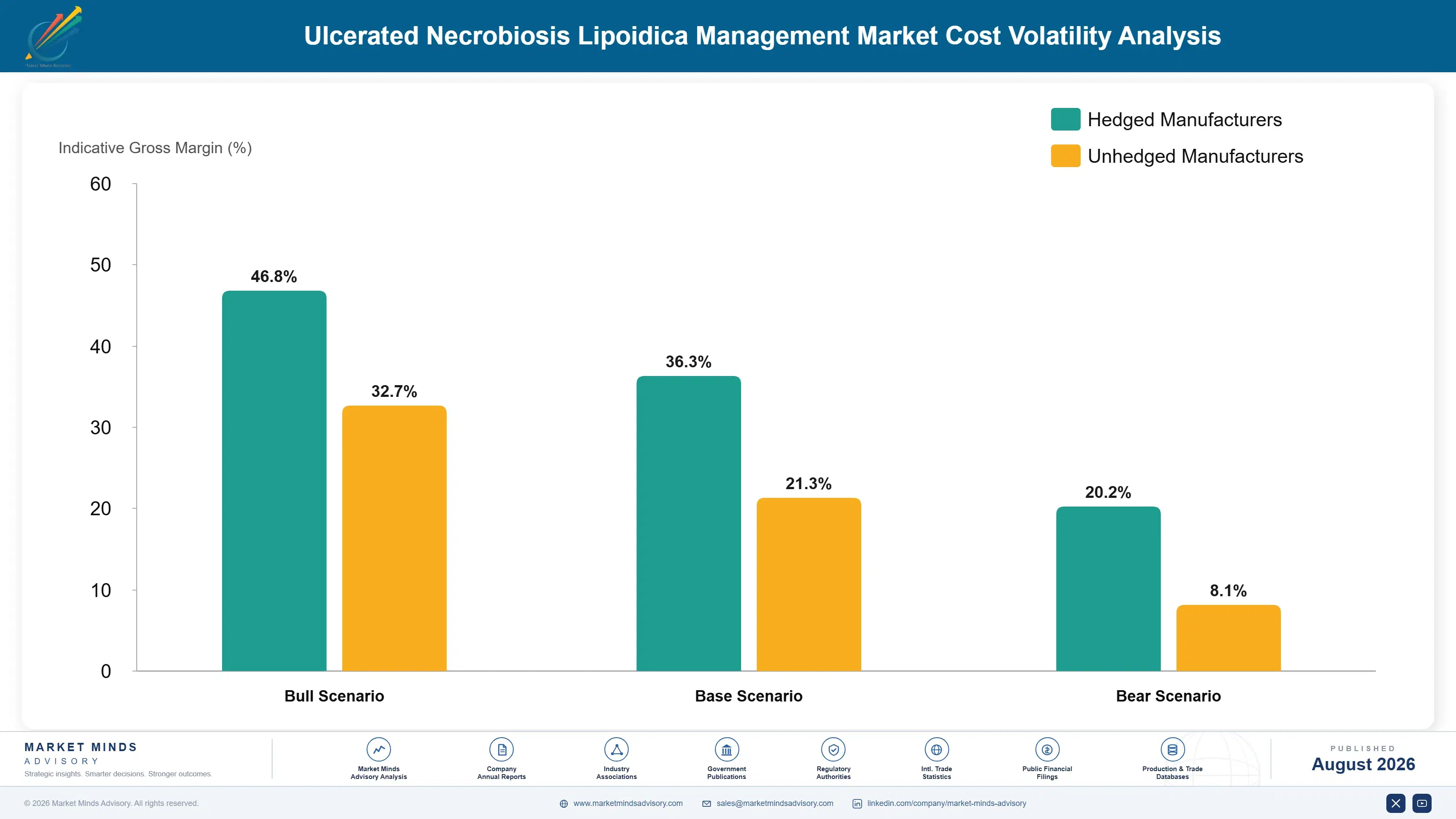
Biologic and small molecule manufacturing carries around 21% of systemic therapy cost, with the balance in development recovery allocated from the licensed indications these agents were approved for. Advanced dressing materials and skin substitute processing absorb roughly 34% of wound product cost. Specialist consultation and prior authorisation administration account for about 14% of total episode cost, which is unusually high.
Biologic list prices held broadly stable across recent years while biosimilar entry reduced effective costs in several agents, per AbbVie annual reporting for 2025 on pricing commentary and published biosimilar market analyses. That reduced the cost of the therapies most likely to close these ulcers, though access remained governed by prior authorisation rather than by price at any point. Price was never the binding constraint on access here.

Exposure divides on whether a supplier depends on this indication or merely serves it. A pharmaceutical company selling into it carries no incremental cost at all, since the products were developed for licensed diseases elsewhere. A wound care supplier carries material and processing cost against general chronic wound tender pricing. A specialist clinic carries the administrative burden of arguing every prescription individually, which nobody reimburses.
ulcerated-necrobiosis-lipoidica-management-market-cost-volatility-analysis-1787640932787

Fund investigator led studies rather than registration programmes

A full registration programme cannot be justified against a population this small, but investigator led controlled studies cost a fraction and reach the specialists who already prescribe on published series. Evidence generated that way creates the reimbursement argument the condition entirely lacks, without committing a sponsor to a regulatory pathway that may never pay for itself.

Support prior authorisation with structured clinical documentation

Every prescription is argued individually and specialist administrative burden runs high enough to deter prescribing altogether in busy clinics. Structured documentation templates and evidence summaries reduce that burden considerably, which increases the number of appropriate prescriptions written rather than abandoned partway through an appeal nobody has time to complete. Appeals abandoned partway through are lost volume nobody records anywhere.

Build coding visibility for this ulcer category

These wounds sit inside general chronic ulcer coding, which hides the volume and prevents any payer or sponsor sizing the population properly. Registry participation and coding advocacy make it visible, and visibility is the precondition for both coverage policy and any commercial case for generating evidence in the first place. Sizing follows counting, and neither has happened.

Portfolio Architecture for Margin Defence

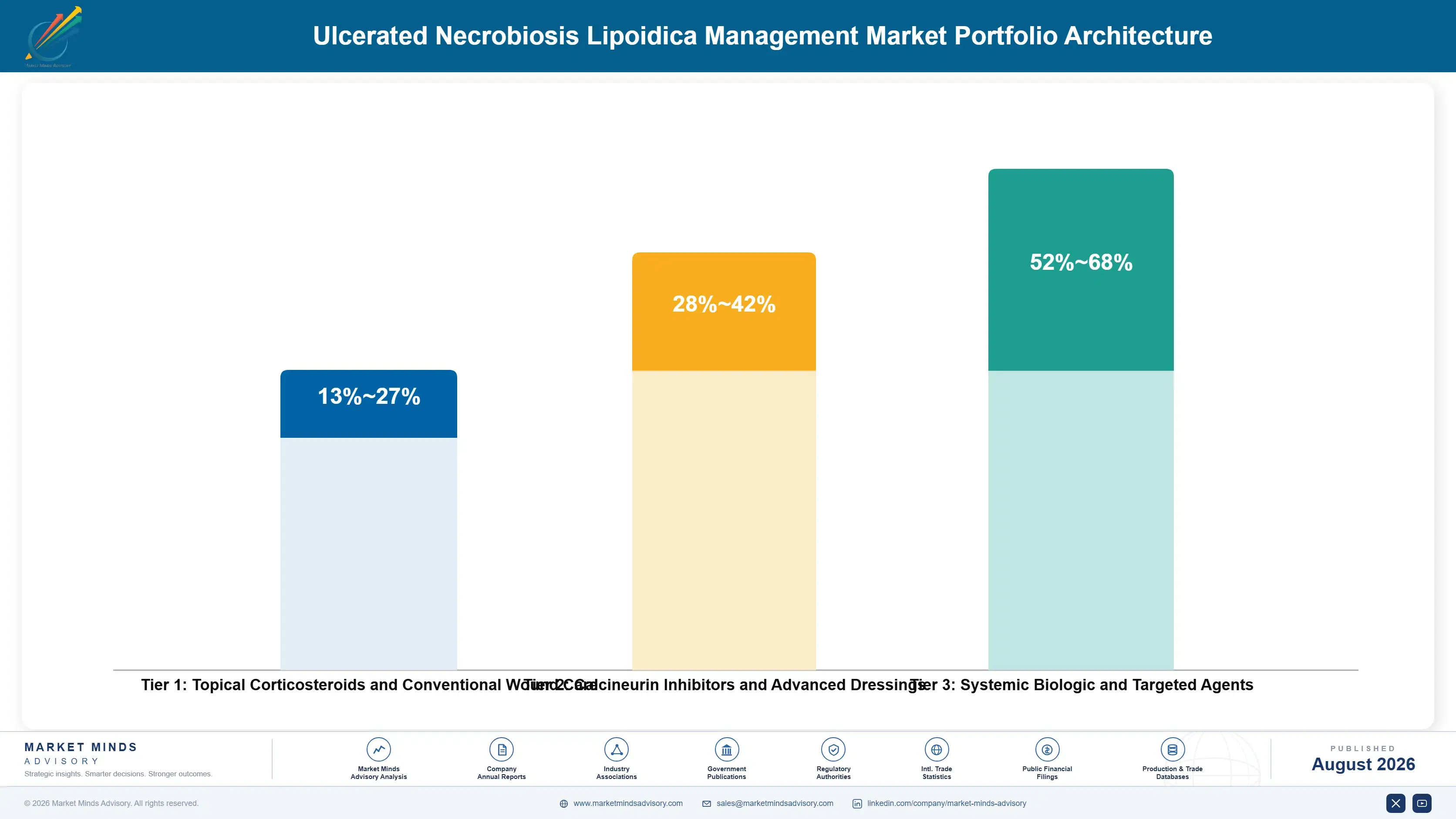
Margin here follows what a product was approved to do elsewhere, because nothing carries an approval for this condition and every supplier is serving it with something developed for another disease. Topical corticosteroids and conventional wound care earn margins in the low teens to high twenties, generic, inexpensive and prescribed without any argument at all. Nobody argues about a generic steroid, which is precisely why it remains the default.
Calcineurin inhibitors and advanced dressings do better in the high twenties to low forties, because both carry formulation or material differentiation and both are chosen deliberately rather than reached for by default. Which of those two decides depends entirely on where the patient was routed at the start.

Systemic biologic and targeted agents hold the strongest position, reaching into the high sixties, where the price was set by licensed indications elsewhere and this use carries no incremental development cost whatever. Those margins depend entirely on prior authorisation continuing to succeed, and they would vanish rather than compress if payers applied off-label scrutiny more consistently across the board. Prior authorisation success rather than any clinical argument decides whether the revenue exists in a given market at all.

Topical Corticosteroids and Conventional Wound Care

Generic products prescribed by default without argument or authorisation. The fourteen point range reflects manufacturing scale and tender position rather than any therapeutic difference between the available suppliers. Default prescribing carries the volume.
Gross Margin: 13-27%

Calcineurin Inhibitors and Advanced Dressings

Products chosen deliberately for formulation or material properties rather than by default. The fourteen point range reflects differentiation depth and whether the choice is dermatology led or wound service led.
Gross Margin: 28-42%

Systemic Biologic and Targeted Agents

Agents priced by licensed indications elsewhere and used here at no incremental development cost. The sixteen point range reflects biosimilar exposure and how reliably prior authorisation succeeds by market. Authorisation success decides everything.
Gross Margin: 52-68%
ulcerated-necrobiosis-lipoidica-management-market-portfolio-architecture-1787640933283

High-value Sub-segments and Strategic Watch-out

Systemic Biologic and Targeted Immunomodulators

High value and the fastest growth at 17.7%, addressing the inflammation driving the lesion rather than dressing the wound. Access depends entirely on prior authorisation arguments no policy currently supports. Payer declines have begun rising, which makes the fastest growing segment simultaneously the least secure one available.
Gross Margin: 52-68%

Advanced Wound Dressings and Skin Substitutes

High value and growing at 13.4% on ulcers that heal slowly and painfully. Closure rarely happens without systemic disease control, which limits what dressings alone can be credited with achieving. Coding under general chronic wound categories hides how much of this volume the indication actually generates.
Gross Margin: 28-42%

Topical Corticosteroids

The volume core, generic, cheap and prescribed by default in nearly every case. Prolonged use causes atrophy in around 41% of patients, which is the complication the treatment was meant to prevent. Prescribed by default rather than by decision, which makes the habit hard to interrupt.
Gross Margin: 13-27%

Off-Label Access Exposure

The strategic watch-out. Every therapy here sits outside its label, and the range reflects whether a participant is funding evidence toward a coverage argument or relying on individual authorisations continuing. Nothing protects the position if payers apply off-label scrutiny consistently across the board. Evidence is the only defence.
Gross Margin: 0-60%

Chronic, Relapsing and Uncounted

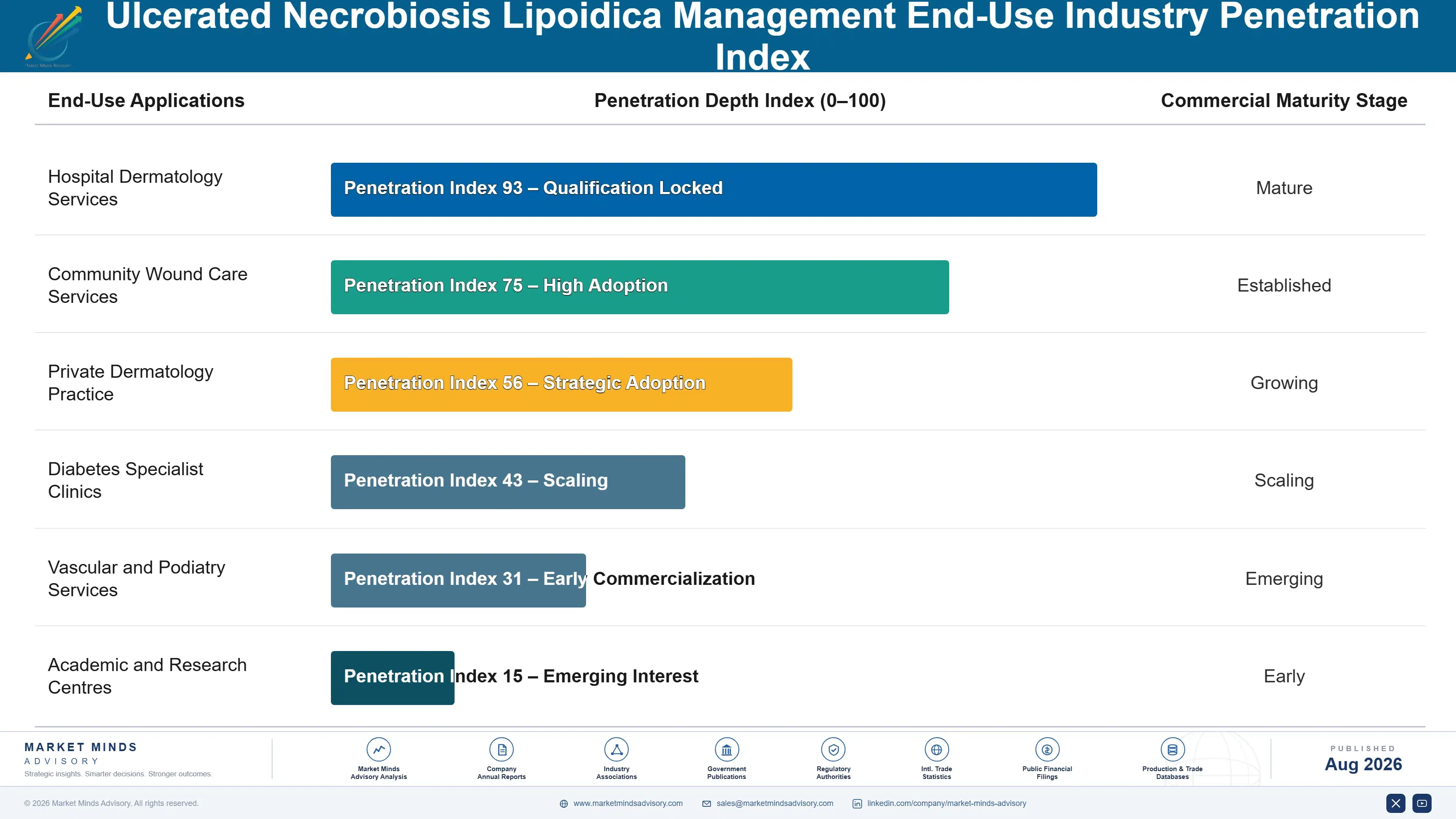
Demand here is genuinely chronic, because necrobiosis lipoidica persists for years and ulcerated lesions relapse repeatedly once they have broken down. A patient who responds to systemic therapy typically requires continued treatment rather than a course, and a patient managed with dressings alone consumes them indefinitely. Each identified patient therefore represents years of consumption, which is exactly why the diagnostic delay matters commercially. Each year of delay is a year of consumption nobody captured.
Stickiness follows whichever specialty holds the patient rather than any product preference. A patient managed in a wound care service continues receiving dressings and rarely reaches systemic therapy at all. A patient reaching dermatology gets the inflammatory diagnosis and, frequently, a systemic agent. Which of those happens is determined by referral routing early on and almost never revisited afterwards.

The deciding party is therefore the clinician who first sees the lesion, usually in primary care, and who decides whether this is a wound problem or a skin disease. That judgement is made with limited information about a condition most general practitioners see perhaps once in a career. Suppliers engaging only with specialists are reaching people the patient may take two years to arrive in front of.
ulcerated-necrobiosis-lipoidica-management-market-end-use-penetration-index-1787640933777

Where We Would Put Effort

These are among the four positions where our research anticipates prominent divergence between winners and laggards over the coming forecast period. Each is grounded in the demand model, the regulatory perimeter, and the announced capacity pipeline.
01 / EVIDENCE GENERATION FUNDING

Somebody has to run the trial

Every agent used in this condition is prescribed outside its label, so no payer anywhere holds a coverage policy and each prescription is argued individually by a clinician armed with published case series and very little else. A sponsor generating even modest controlled evidence would create the first genuine reimbursement argument this disease has ever had anywhere. Investigator led studies cost a fraction of any registration programme and reach exactly the specialist audience that already prescribes here on conviction alone.
02 / REFERRAL ROUTE INFLUENCE

Wound service or dermatology decides everything

Patients wait around 26 months on average for a correct diagnosis, and spend much of that long interval inside wound services managing what everybody involved assumes is a venous ulcer. Whether the inflammatory diagnosis is ever made determines whether systemic therapy gets considered at all, and wound services very rarely make that diagnosis themselves. Suppliers who influence those referral pathways affect the point at which this condition gets identified at all, rather than merely deciding which dressing gets chosen afterwards.
03 / STEROID SPARING POSITIONING

First-line therapy feeds the complication

Prolonged use of potent topical corticosteroids causes dermal atrophy in around 41% of treated patients, and atrophic skin over the anterior shin is precisely the tissue that goes on to ulcerate in the first place. Calcineurin inhibitors and steroid sparing maintenance approaches avoid that consequence entirely, at considerably higher cost per treatment course. Presenting the atrophy data directly to prescribers reframes what looks like a cheap default therapy as a contributor to the very outcome everybody involved is trying to prevent.
04 / CODING VISIBILITY ADVOCACY

Nobody counted this population properly

These ulcers are recorded under general chronic wound categories, which hides how much dressing and systemic therapy volume this indication actually generates and prevents any payer or sponsor from sizing it reliably at all. Around 33% of plaques go on to ulcerate, and the population is entirely identifiable if anybody chooses to look for it. Registry participation and coding advocacy work together to make that volume visible, which is the precondition for any coverage policy in this indication ever being written.

Engagement Snapshot From the Field

A live engagement with an industry participant carrying material or product regulatory and market exposure ahead of a defining policy shift, showing how our research translates into a defensible multi-year portfolio strategy.
MARKET MINDS ADVISORY · CLIENT ENGAGEMENT SUMMARY
Ulcerated Necrobiosis Lipoidica Management Producer Strategic Portfolio Review and Transition Roadmap 2026·Investment Scenario on Ulcerated Necrobiosis Lipoidica Management Exposure Evaluation 2025-26
CLIENT PROFILE
A specialty dermatology company marketing topical and systemic immunomodulators across European and North American markets, at annual revenue near 480 million dollars (client-reported, unverified by MMA). Off-label use in this condition was substantial, unmeasured and entirely unsupported by any evidence programme. Commercial planning relied on claims data that recorded none of this volume at all.
STRATEGIC CHALLENGE
Prescribing in the indication was growing without the company understanding its size, and payers had begun declining authorisations that had previously succeeded. Management wanted to know whether to invest in evidence or accept that the volume would erode as scrutiny tightened. No internal dataset showed how large the exposure actually was.
MMA APPROACH
MMA sized off-label use through prescriber survey and specialist interview rather than claims data, traced diagnostic pathways from lesion appearance to correct identification, modelled investigator led study designs against payer evidence requirements, and assessed how wound care coding obscured the population. Interviews with 47 experts covered dermatology, wound care, payer assessment and clinical research.
KEY FINDINGS
  1. Off-label volume in this indication was considerably larger than the company had assumed, and none of it appeared in any dataset the commercial team had ever examined.
  2. Payer declines were rising because no controlled evidence existed, and no amount of case series accumulation was going to change that position on its own.
  3. Most patients spent around two years in wound care services before any dermatologist saw them, by which point the ulcer had frequently become established and difficult.
  4. An investigator led controlled study was affordable at a fraction of registration cost and would produce the evidence payers had explicitly said they required.
CLIENT PROFILE
A specialty dermatology company marketing topical and systemic immunomodulators across European and North American markets, at annual revenue near 480 million dollars (client-reported, unverified by MMA). Off-label use in this condition was substantial, unmeasured and entirely unsupported by any evidence programme. Commercial planning relied on claims data that recorded none of this volume at all.
STRATEGIC CHALLENGE
Prescribing in the indication was growing without the company understanding its size, and payers had begun declining authorisations that had previously succeeded. Management wanted to know whether to invest in evidence or accept that the volume would erode as scrutiny tightened. No internal dataset showed how large the exposure actually was.
MMA APPROACH
MMA sized off-label use through prescriber survey and specialist interview rather than claims data, traced diagnostic pathways from lesion appearance to correct identification, modelled investigator led study designs against payer evidence requirements, and assessed how wound care coding obscured the population. Interviews with 47 experts covered dermatology, wound care, payer assessment and clinical research.
KEY FINDINGS
  1. Off-label volume in this indication was considerably larger than the company had assumed, and none of it appeared in any dataset the commercial team had ever examined.
  2. Payer declines were rising because no controlled evidence existed, and no amount of case series accumulation was going to change that position on its own.
  3. Most patients spent around two years in wound care services before any dermatologist saw them, by which point the ulcer had frequently become established and difficult.
  4. An investigator led controlled study was affordable at a fraction of registration cost and would produce the evidence payers had explicitly said they required.
RECOMMENDED STRATEGY
Phase 1: Phase one: commission an investigator led controlled study, since payers have stated plainly what they need and nobody has yet provided it. Phase 2: Phase two: build dermatology referral education so the inflammatory diagnosis is made before two years of wound care elapse. Two years is a long time. Phase 3: Phase three: support registry and coding work that makes the population visible to payers and to internal planning alike. Counting precedes any coverage.
OUTCOME
The company commissioned an investigator led study during 2026 and payer engagement improved once a protocol existed to point to (client-reported, unverified by MMA). Referral education began with dermatology societies, and registry participation was funded for three years. Claims based sizing was abandoned in favour of prescriber survey entirely.

Frequently Asked Questions

Foundational context covering the market sizes, CAGR, scope, country, region and competition that inform every finding below. This section is provided to cover basics and most often pre-purchase conversations, answered from the MMA Primary Research Dataset.

What is the current size of the Ulcerated Necrobiosis Lipoidica Management Market?

MMA sizes it at USD 0.14 billion in 2025, rising to USD 0.16 billion in 2026. The figure covers therapy attributable to this indication at manufacturer selling value.

How large will the Ulcerated Necrobiosis Lipoidica Management Market be by 2036?

USD 0.49 billion by 2036, an incremental USD 0.33 billion over the 2026 base and an expansion multiple of 3.06 times. Systemic agents carry most of that gain.

What is the CAGR for the Ulcerated Necrobiosis Lipoidica Management Market 2026 to 2036?

11.8% in the base case, with a bull case at 13.0% and a bear case at 10.6%. Whether controlled evidence emerges drives most of the spread between them.

Which segment is growing fastest?

Systemic biologic and targeted immunomodulators at 17.7%, half again the market rate of 11.8%. They address the inflammation driving the lesion rather than dressing the wound.

Who are the major companies in the Ulcerated Necrobiosis Lipoidica Management Market?

AbbVie, Johnson and Johnson, Pfizer, Smith and Nephew and Mölnlycke Health Care lead on attributable revenue. Fifteen further participants are profiled in the full report.

Which country is growing fastest?

Saudi Arabia at 20.4%, where very high diabetes prevalence meets well funded dermatology, broad biologic availability and willingness to fund off-label therapy in a way most regions do not.

Report Segmentation Architecture

The full report scope spans multiple orthogonal segmentation dimensions, with cross-tabulated demand data provided for each dimension pair. Coverage extends further to regional breakdowns, trend trajectories, and the competitive detail needed to support segment-level decision-making.

By Treatment Modality

  • Topical and Intralesional Corticosteroids
  • Topical Calcineurin Inhibitors
  • Systemic Biologic and Targeted Immunomodulators
  • Advanced Wound Dressings and Skin Substitutes
  • Compression and Adjunctive Vascular Therapy
  • Procedural and Light-Based Therapies

By End-Use Industry

  • Hospital Dermatology Services
  • Community Wound Care Services
  • Private Dermatology Practice
  • Diabetes Specialist Clinics
  • Vascular and Podiatry Services
  • Academic and Research Centres

By Commercial Dimension

  • Prior Authorisation Reimbursed Supply
  • Hospital Formulary Supply
  • Wound Care Tender Contracts
  • Retail and Specialty Pharmacy
  • Self-Pay and Private Treatment
  • Clinical Study and Registry Supply

By Region

  • North America
  • Western Europe
  • East Asia
  • South Asia and Pacific
  • Latin America
  • Middle East and Africa
  • Eastern Europe

Scope, Methodology, and Coverage

Every figure in this report is reproducible from documented input assumptions. The scope below maps the historical period, the forecast horizon, the segmentation dimensions, and the countries covered, alongside the underlying primary and qualitative methodology.
Historical Period
2020 to 2025
Forecast Period
2026 to 2036
Base Year
2025 (USD billions; MMA Primary Research Dataset, August 2026)
Market Definition
Therapies and products used to manage ulcerated necrobiosis lipoidica, covering topical and intralesional corticosteroids, topical calcineurin inhibitors, systemic biologic and targeted immunomodulators, advanced wound dressings and skin substitutes, compression and adjunctive vascular therapy, and procedural and light-based therapies. Measured at manufacturer selling value attributable to this indication. General diabetic foot ulcer care, venous leg ulcer management, pyoderma gangrenosum treatment, and diabetes therapy itself are excluded from scope.
Quantitative Units
USD billions (current prices); treated patients; USD per treated patient year by modality
Segmentation Dimensions
Treatment modality; end-use industry; commercial dimension; region
Regions Covered
North America, Western Europe, East Asia, South Asia and Pacific, Latin America, Middle East and Africa, Eastern Europe
Countries Covered
United States, Canada, Mexico, Germany, United Kingdom, France, Netherlands, Italy, China, Japan, South Korea, Taiwan, India, Australia, Singapore, Brazil, Argentina, Saudi Arabia, United Arab Emirates, Poland
Key Companies Profiled
AbbVie, Johnson and Johnson, Pfizer, Smith and Nephew, Mölnlycke Health Care, Leo Pharma, Astellas Pharma, Novartis, Eli Lilly, Incyte, UCB, Convatec, Coloplast, 3M, Integra LifeSciences, Organogenesis, MiMedx, Essity, Paul Hartmann, Sanofi
Quantitative Methodology
Primary survey, n=3,800 respondents, Q4 2025, six countries; demand-side model with trade association cross-validation
Qualitative Methodology
47 expert interviews, Q4 2025; applied to validate demand model assumptions, identify emerging dynamics, and assess competitive positioning
Report Format
PDF and XLSX data workbook (Word format preview document)
Publisher
Market Minds Advisory
Report Code
MMA-2026-HLT-139
Published
August 2026
Contact
sales@marketmindsadvisory.com | www.marketmindsadvisory.com

Purchase the full Ulcerated Necrobiosis Lipoidica Management Market Report (2026 to 2036).

The full report treats ulcerated necrobiosis lipoidica as a condition with no approved therapy, no coverage policy and no agreed endpoint, where the cheapest first-line treatment contributes to the complication it precedes. It sizes all six treatment modalities independently through 2036, quantifies diagnostic delay against referral routing, and models off-label access against payer authorisation behaviour. Regional chapters cover all seven regions with specialist access assessed separately from diabetes prevalence. Competitive profiling covers 20 participants on one consistent attributable revenue basis. Referral routing is traced from lesion appearance throughout the analysis.
Six treatment modalities sized independently through 2036
Diagnostic delay quantified against referral routing by care setting
Off-label access modelled against payer prior authorisation behaviour
Specialist access assessed separately from diabetes prevalence by region
Corticosteroid atrophy risk measured against subsequent ulceration incidence
Twenty participants profiled on one consistent attributable revenue basis

Built For The People Who Decide

From boardroom strategy to bench-side execution, this report is read cover-to-cover by leaders shaping the next decade of their industry, turning demand scenarios, market dynamics and valuation benchmarks into decisions.
CXOs/ Presidents/ VPs/ Managers
M&A and Corporate Development
Strategy Teams and R&D Heads
Procurement and Product Directors
Regulatory and Compliance Leaders
Investor Relations and Equity Analysts