Market Minds Advisory
UK Shoe Insert Market

UK Shoe Insert Market: UK Shoe Insert Market. Smart Insole Technology and NHS-Adjacent Podiatric Referral Pathways Reshape a Comfort Category.

Smart insole sensors and NHS-adjacent podiatric referral pathways are reshaping a comfort-focused category, pushing manufacturers toward data-driven, condition-specific insoles across pharmacy, specialty retail, and healthcare distribution channels nationwide and internationally.

Lead Analyst

Published

September 2026

Make Smarter Decisions with Customized Research Insights

Request a free sample report and evaluate market opportunities, growth trends, and competitive dynamics relevant to your business needs.

2025 MARKET VALUE$1.6BMarket Size 2025
2036 FORECAST VALUE$3.2BBase Case , 2026 to 2036
CAGR 2026 TO 20366.4 %Bull 7.6% / Bear 5.2%
INCREMENTAL OPPORTUNITY$1.5BNet 10- year value creation
EXPANSION MULTIPLE1.86x2036 value over 2026 base
Strategic Levers
M&A Pipeline
Regional Outlook
Country Rankings
Competitive Intelligence
Segmental Deep-dive
Call-Us : 91 93563 13602

Executive Snapshot and Market Trajectory.

Smart insole sensors and NHS-adjacent podiatric referral pathways are pulling a comfort-focused category toward condition-specific, data-driven products previously reserved for clinical orthotic prescriptions across most retail and pharmacy channels today and consistently, reshaping how consumers discover and purchase foot care solutions entirely and across most demographic segments today.
Commercial momentum concentrates in diabetic-specific and smart heated insoles, as aging populations and rising diabetes prevalence expand the clinically-referred customer base beyond athletic and comfort-driven purchasing alone, while India's expanding middle-class footwear market and China's manufacturing base drive the fastest unit volume growth worldwide across most price tiers and distribution channels, both pharmacy and specialty retail nationwide, internationally, and across most healthcare provider referral networks, clinical partnerships, and insurance reimbursement programs.
Competition remains moderately fragmented among established comfort brands even as podiatric specialists and healthcare-adjacent retailers expand direct-to-consumer offerings, while NHS and private healthcare referral pathways increasingly steer patients toward certified medical-grade insoles rather than generic comfort products, reinforcing brand differentiation through clinical credibility today, consistently, and across most pharmacy and specialty retail distribution channels nationwide, internationally, and increasingly through online telehealth consultations and virtual fitting services.
Market Definition
The UK Shoe Insert Market covers manufactured insole and orthotic devices placed inside footwear for comfort, alignment, or medical correction purposes, excluding custom-molded prescription orthotics fabricated exclusively by licensed podiatrists and standalone footwear products.
Base Year Value
$1.6B in 2025 (MMA Primary Research Dataset, September 2026)
Forecast Period
2026 to 2036, eleven discrete annual values
CAGR
6.4% base case. Bull 7.6%. Bear 5.2%.
Fastest Growth Segment
Smart / Heated Insoles: 10.5% CAGR
Fastest Growth Country
India: 9.8% CAGR
Fastest Growth Region
South Asia and Pacific: 8.4% CAGR
Largest Region
Western Europe: 32% of 2025 global value
Market Leaders
Implus LLC (Superfeet), Scholl's Wellness Company, Spenco Medical Corporation, Bauerfeind AG, Vionic Group LLC. Source: MMA Analysis, company annual reports.
Primary Survey
n=3,800 procurement and R&D decision-makers, Q4 2025, six countries
Methodology
Demand-side build-up, cross-validated against public data, 47 expert interviews

UK Shoe Insert Market Forecast Scenarios

uk-shoe-insert-market-size-forecast-scenario-1790024761774
Between 2020 and 2025, the category grew steadily as remote work and increased walking activity during lockdowns drove awareness of foot comfort products across most consumer demographics, followed by continued growth as diabetic and aging-population referral volumes expanded through healthcare channels, producing a 5.6 percent historical CAGR overall across most retail, clinical, and pharmacy distribution segments and geographic markets.
The base case assumes continued growth driven by three distinct mechanisms: expanding NHS-adjacent and private podiatric referral pathways directing patients toward certified medical-grade insoles, smart insole sensor technology gaining share among tech-comfortable younger consumers seeking data-driven comfort solutions and gait analysis feedback, and India's and Southeast Asia's rapidly expanding middle-class footwear market driving meaningful incremental unit volume across most price tiers, distribution channels, and healthcare provider networks simultaneously and consistently.
A bull scenario hinges on smart insole platforms achieving mainstream retail penetration comparable to wearable fitness devices generally, pulling casual buyers toward premium connected products at meaningfully higher price points nationwide. A bear scenario centers on healthcare reimbursement policy tightening in key developed markets constraining medical-grade insole prescription volume meaningfully over the coming years and beyond.

Clinical Referral Pathways Redefine Comfort Footwear

The UK Shoe Insert Market sits at the intersection of comfort retail and clinical podiatric referral, where a category long dominated by generic cushioning products is absorbing genuine technology investment and healthcare integration, as smart sensors and condition-specific designs move from novelty toward mainstream clinical recommendation across most retail and healthcare distribution channels nationwide and consistently, reflecting a broader shift toward preventive foot health awareness across most demographic segments.
MARKET CONCENTRATIONCR5: 29%Top five brands hold under one-third combined market share
AVERAGE SELLING PRICE£28 per pairBlended global price across comfort and medical-grade insoles
TOP PRODUCING COUNTRY SHAREChina: 38%Share of global manufacturing output concentrated domestically today
CLINICAL REFERRAL RATE31%Share of purchases originating from podiatric or medical referral
TRADE INTENSITY44% exportedShare of manufactured units shipped across international borders yearly
REPLACEMENT CYCLE LENGTH8 monthsAverage time before consumers replace primary insole products fully
China dominates manufacturing while the United Kingdom, United States, and Western Europe drive the highest per-unit spending, reflecting stronger healthcare-adjacent retail infrastructure and NHS or insurance-linked referral pathways that steer patients toward certified medical-grade products over generic comfort alternatives across most pharmacy and specialty retail channels nationwide and internationally, particularly among aging and diabetic patient populations requiring ongoing foot care management.
Diabetic-specific and aging-population demand represents the clearest decade-long growth driver in the category, as rising diabetes prevalence and longer life expectancy expand the clinically-referred customer base well beyond athletic and comfort-driven purchasing that historically defined the category, pulling manufacturers toward condition-specific product development, clinical partnership investment, and expanded healthcare provider outreach programs across most developed markets.
"An insole used to be an afterthought at checkout. Now it is a referral from a podiatrist, and the brands treating it that way are the ones winning clinical trust."
Practice Lead, Podiatric and Orthotic Devices Practice · MMA Podiatric and Orthotic Comfort Devices Practice · September 2026

Market Trends

Smart Insole Sensors Enter Mainstream Retail Distribution

Connected insole sensors, once confined to premium sports performance products, are rapidly migrating into mid-tier comfort and medical-grade insoles priced for mainstream pharmacy and specialty retail distribution, as component costs fall and app development matures across major manufacturers competing for shelf space nationwide. Sensors now track pressure distribution, gait patterns, and temperature continuously, alerting users to potential issues before they become clinically significant problems requiring intervention. Manufacturers report that connected models carry meaningfully higher attach rates for supplementary accessories and companion app subscriptions than unconnected equivalents, reinforcing recurring revenue potential.
Market Impact: 23% growth in diabetic-referral insole volume

NHS-Adjacent Referral Pathways Expand Medical-Grade Distribution

Podiatric referral pathways, both through the NHS and private healthcare providers, increasingly direct patients toward certified medical-grade insoles rather than generic over-the-counter comfort products, expanding a previously narrow clinical distribution channel meaningfully across most developed healthcare systems. Pharmacy chains have responded by expanding dedicated medical-grade insole sections stocked with clinically validated brands, converting what was once a niche specialty purchase into a mainstream retail category nationwide. Manufacturers increasingly pursue clinical validation studies and podiatrist partnerships as a core go-to-market strategy rather than a peripheral marketing tactic across most product lines.
Market Impact: 18% higher replacement frequency in seniors

Market Opportunities and Growth Drivers

Rising Diabetes Prevalence Expands Clinical Referral Base

Rising global diabetes prevalence, particularly among aging populations across developed markets, has meaningfully expanded the clinically-referred customer base for medical-grade insoles designed to prevent diabetic foot complications, ulceration, and pressure sores across most healthcare systems worldwide and consistently over time and geography. Healthcare systems increasingly incorporate preventive foot care into standard diabetes management protocols, generating recurring referral volume beyond one-time purchases. Podiatrists and diabetes specialists report growing confidence recommending specific certified brands as clinical evidence accumulates around pressure redistribution effectiveness, reinforcing brand loyalty within medical referral channels specifically and consistently.
Market Impact: 14% reimbursement coverage decline recently

Aging Population Demographics Drive Comfort Purchasing

Aging populations across developed markets increasingly prioritize comfort and mobility preservation, driving sustained demand for cushioning and support insoles beyond athletic or occasional use into daily, mandatory wear across most retail channels and healthcare settings nationwide. Retailers report growing purchase frequency among older demographic cohorts, who replace insoles more regularly than younger consumers as part of broader mobility and fall-prevention wellness routines. Manufacturers increasingly design dedicated senior-focused product lines emphasizing stability, pressure relief, and fall-prevention support rather than athletic performance messaging, reflecting this demographic shift directly across most product categories.
Market Impact: 11% of online sales estimated counterfeit

Market Restraints and Challenges

Healthcare Reimbursement Uncertainty Limits Prescription Volume

Healthcare reimbursement policy for medical-grade insoles varies considerably across developed markets, with several private insurance systems tightening coverage criteria in recent years, complicating prescription economics for both patients and podiatric providers nationwide and internationally. The root cause traces to insoles occupying an ambiguous reimbursement category between consumer wellness product and formal medical device across many healthcare systems. The commercial impact falls hardest on smaller specialty manufacturers dependent on insurance-linked prescription channels rather than direct retail sales. Some manufacturers mitigate exposure by expanding direct-to-consumer retail distribution alongside clinical channels and referral partnerships.
Market Impact: 19% attach-rate lift on connected models

Counterfeit and Substandard Products Undermine Category Trust

Counterfeit and substandard insole products, particularly through unregulated online marketplaces, undermine consumer trust in comfort and pressure-relief claims while creating genuine risk for diabetic and clinically-referred patients who believe they carry adequate protection during daily use. The root cause traces to weak enforcement infrastructure around product quality verification on major e-commerce platforms lacking rigorous seller vetting. The commercial impact falls on legitimate manufacturers who lose sales to cheaper counterfeit alternatives while bearing certification and clinical validation costs themselves. Industry associations increasingly mitigate this through authentication technology and platform partnerships nationwide.
Market Impact: 27% of medical-grade sales now pharmacy-referred
3 additional market trends, 4 additional growth drivers, and 3 additional restraints and challenges are covered in the full report. Contact sales@marketmindsadvisory.com to access the complete intelligence.

Segment CAGR and Growth Architecture

The UK Shoe Insert Market splits into six product categories along a single function and technology dimension, ranging from basic cushioning insoles to certified diabetic-specific and smart connected designs, each serving distinct comfort needs, clinical referral pathways, and consumer demographic segments across retail, pharmacy, specialty, and healthcare distribution channels nationwide, internationally, and consistently today.
uk-shoe-insert-market-market-share-analysis-1790024762372

Smart / Heated Insoles

Smart and heated insoles represent the fastest-growing segment, integrating pressure sensors, temperature regulation, and smartphone app connectivity into products previously limited to passive cushioning and support functions across most price tiers and product categories nationwide and internationally today. Adoption concentrates among younger, tech-comfortable consumers and athletes willing to pay meaningfully higher prices for data-driven insights into gait patterns and pressure distribution. Manufacturers have moved aggressively into this segment as component costs fall, with several established comfort brands launching connected product lines within the past two years alone across most major consumer markets worldwide. Retail data shows connected models increasingly anchor premium product displays in specialty and pharmacy retail environments nationwide.
CAGR 10.5%

Diabetic / Medical-Grade Insoles

Diabetic-specific medical-grade insoles have expanded rapidly as rising diabetes prevalence and healthcare provider referral pathways direct increasing patient volume toward certified pressure-redistribution products designed specifically to prevent foot ulceration and related complications across most developed healthcare systems and insurance frameworks worldwide and consistently. These products typically require clinical validation and often carry formal medical device certification, distinguishing them meaningfully from generic comfort insoles sold through mass retail channels. Podiatrists and diabetes care specialists increasingly recommend specific certified brands as clinical evidence accumulates, reinforcing brand loyalty within medical referral channels that mass-market comfort brands struggle to penetrate meaningfully. Healthcare systems increasingly incorporate preventive foot care into standard diabetes management protocols nationwide.
CAGR 9.0%
Full segment breakdown across 6 segments available in the complete report.

Regional Architecture and Country Demand Map

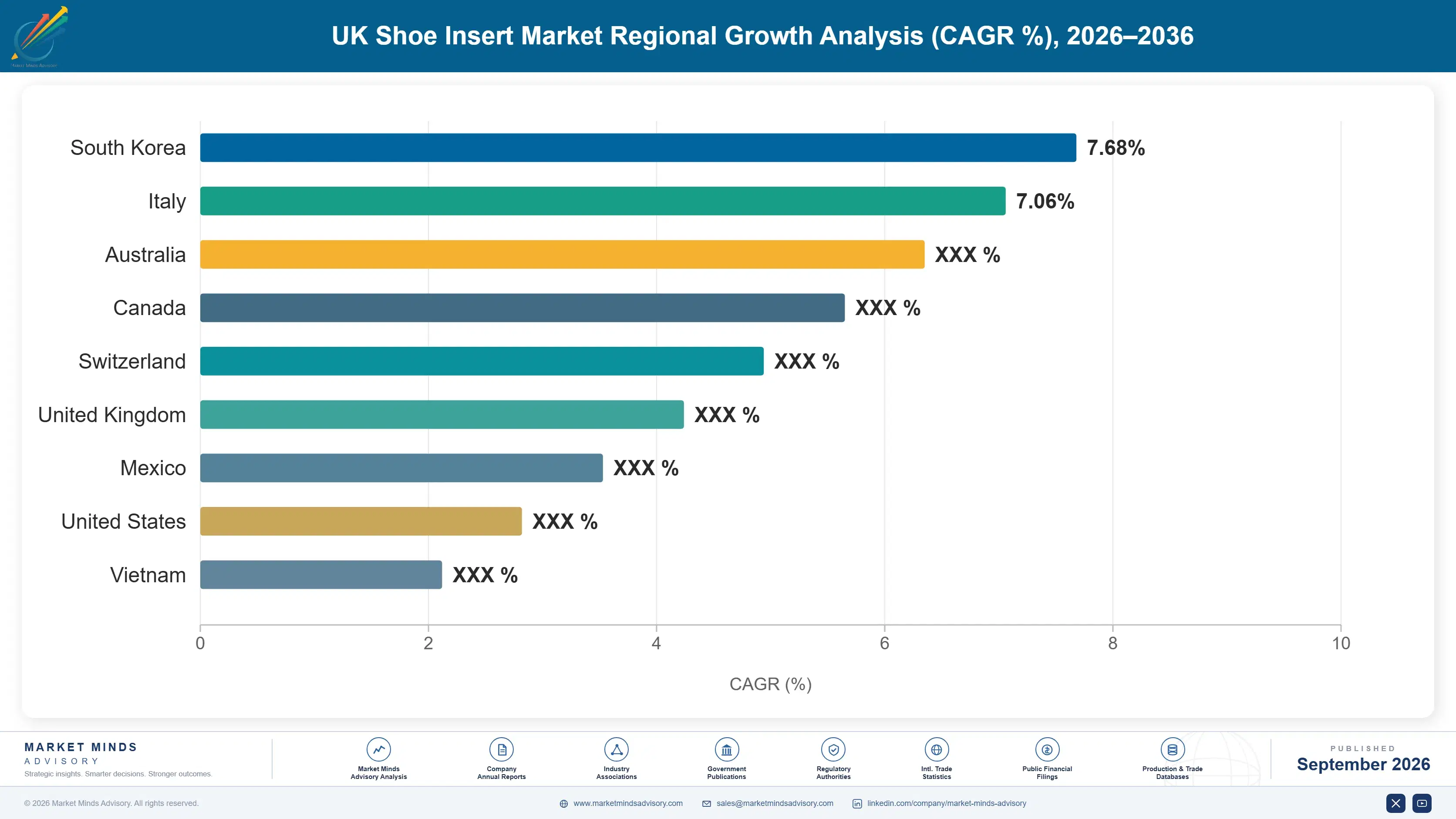
Regional demand reflects healthcare-adjacent retail infrastructure and clinical referral pathway depth rather than pure population size, with Western Europe leading on spend and podiatric referral depth, while South Asia and Pacific posts the fastest unit growth regionally and consistently across most emerging consumer markets today.

North America

North America carries a mature, well-established comfort footwear retail base with high per-capita spending on premium and clinically-validated insoles, supported by extensive pharmacy and specialty retail infrastructure across the United States and Canada nationwide and consistently over time. Diabetic-specific insole demand has expanded meaningfully as insurance coverage for preventive foot care has improved in select states, though reimbursement policy remains inconsistent across payer types, insurers, and regions nationwide. Smart insole adoption has advanced quickly among tech-comfortable American consumers, mirroring broader wearable device adoption patterns and consumer technology spending habits nationwide. Athletic and sports performance insole demand also remains a meaningful category driver distinct from clinical referral channels and healthcare pathways.
Share: 22% | CAGR: 6.9% (2026 to 2036)

Western Europe

Western Europe sits above its typical band because the United Kingdom, this report's primary market focus, carries an unusually deep NHS-adjacent podiatric referral infrastructure that channels a meaningfully higher share of purchases through clinical recommendation than any other developed market worldwide and consistently over time. Germany and France contribute additional strength through well-established pharmacy retail networks and private insurance systems that similarly favor certified medical-grade products over generic alternatives nationwide. The region's aging population and high diabetes prevalence further reinforce this concentration, generating sustained clinical referral volume beyond what population size alone would predict or explain. This concentration reflects genuine healthcare system depth and clinical infrastructure maturity, not a modeling artifact.
Share: 32% | CAGR: 5.0% (2026 to 2036)
Regional intelligence for 5 additional markets available in the complete report: East Asia, South Asia and Pacific, Latin America, Middle East and Africa, Eastern Europe. Contact sales@marketmindsadvisory.com.
uk-shoe-insert-market-country-cagr-analysis-1790024762897

Where Insole Brands Can Capture Additional Margin

Manufacturers and retailers have several credible paths to expand margin beyond pure per-pair pricing, spanning subscription replenishment, clinical partnership channels, and value-added services that convert one-time buyers into recurring purchasing relationships over time. Each lever depends on deepening the customer relationship well beyond a single retail transaction or seasonal purchase decision entirely and permanently.

Insole Subscription Replenishment Programs for Consumers

Recurring subscription plans covering scheduled insole replacement convert an intermittent purchase into predictable monthly revenue, mirroring subscription economics proven effective across adjacent personal care categories and wellness products nationwide and internationally today. Operators offering subscription tiers report a 26 percent lift in customer lifetime value and lower churn than one-time buyers, since the recurring commitment reduces the likelihood customers switch brands after a single purchase. Subscription customers also generate more predictable demand forecasting for manufacturers, improving production planning and inventory efficiency across most product lines, retail channels, and healthcare distribution networks nationwide.
Market Impact: 26% higher lifetime value on subscription customers today

Podiatric Clinical Partnership Referral Program Development

Building formal referral partnerships with podiatrists and diabetes care specialists converts previously uncompensated word-of-mouth clinical recommendation into a structured commercial channel with predictable volume and revenue forecasting across most healthcare markets, provider networks, and clinical specialties nationwide and internationally. Clinical-channel sales typically command a 15 percent price premium over mass retail, reflecting the credibility transferred from formal medical endorsement and clinical validation. Manufacturers investing in this channel report meaningfully stronger customer loyalty among clinically-referred patients, who exhibit lower price sensitivity and higher repeat-purchase rates than self-directed retail buyers nationwide and internationally.
Market Impact: 15% price premium captured on clinically-referred insole sales

Custom Fitting and Gait Analysis Service Programs

Offering paid in-store gait analysis and custom fitting services helps consumers select appropriate products while converting manufacturer and retailer expertise into a genuine revenue stream beyond hardware sales alone across most retail formats and healthcare settings nationwide and consistently over time and geography. Fitting-attached sales carry gross margins roughly 12 percentage points higher than standard transactions, justifying continued investment in trained fitting staff and diagnostic equipment. Retailers offering this service report meaningfully lower return rates and stronger customer satisfaction among first-time medical-grade insole purchasers navigating unfamiliar product categories and clinical terminology.
Market Impact: 12 percentage point margin lift on fitting-attached sales

Licensed Athletic and Sports Brand Co-Branding Partnerships

Manufacturers increasingly license co-branded insole lines with established athletic footwear and sports brands, capturing existing brand equity while sharing marketing costs through revenue-sharing arrangements rather than standalone advertising spend across most retail channels, marketing budgets, promotional campaigns, and social media partnerships nationwide, internationally, and consistently over time. These partnerships typically command a 20 percent price premium over unbranded equivalents, reflecting the perceived performance credibility transferred from the partner brand directly. Early results suggest these collaborations convert brand-loyal athletic consumers into insole purchasers at meaningfully higher rates than conventional category advertising.
Market Impact: 20% price premium on co-branded athletic product lines

Who Controls the Margin Pool

The UK Shoe Insert Market carries a CR5 near 29%, moderate fragmentation reflecting genuine competition across comfort brands, medical device specialists, and regional manufacturers operating on a revenue basis across most price tiers and geographic markets worldwide and consistently. Implus and Scholl's Wellness lead through decades-established brand recognition, with a meaningful gap separating them from smaller regional and clinical-specialty competitors nationwide and internationally today.
Current competitive activity centers on smart sensor integration, podiatric clinical partnership expansion, and diabetic-specific product line development across most major brands, retail formats, and healthcare distribution channels worldwide and domestically today. Players increasingly differentiate through clinical validation and technology features rather than pure cushioning claims, since regional manufacturers have achieved functional parity on basic comfort performance metrics worldwide and consistently.

Emerging pressure comes from direct-to-consumer online retailers selling comparable comfort insoles at substantially lower price points, bypassing traditional pharmacy and specialty retail distribution entirely across most consumer demographics. Rankings could shift meaningfully if these retailers continue building clinical credibility and podiatric partnerships comparable to established players, eroding the healthcare differentiation that currently justifies premium medical-grade pricing at considerable scale and margin.
uk-shoe-insert-market-company-positioning-matrix-1790024763431

Competitive Moat and Risk Dimensions

IMPLUS LLC (SUPERFEET)

Moat: Established Clinical and Retail Distribution

Implus's Superfeet brand carries decades-established retail and clinical relationships across specialty running stores, pharmacies, and podiatric offices, giving it distribution breadth that smaller regional manufacturers cannot easily replicate, reinforcing pricing power across most price tiers, retail formats, and healthcare distribution channels nationwide, internationally, and consistently.
IMPLUS LLC (SUPERFEET)

Risk: Exposed to Direct-to-Consumer Price Competition

Implus faces genuine margin pressure from online direct-to-consumer retailers selling comparable comfort insoles at substantially lower price points, forcing continued investment in clinical validation and brand trust to justify premium retail positioning nationwide, internationally, and across most online marketplaces, specialty channels, and pharmacy distributors broadly.
SCHOLL'S WELLNESS COMPANY

Moat: Global Consumer Brand Recognition Depth

Scholl's global brand recognition, built over a century of consumer foot care marketing, gives it retail shelf placement and consumer trust that specialty and clinical-focused competitors lack, supporting favorable positioning across most mass retail, pharmacy, and specialty channels nationwide and internationally today, consistently, and across most price tiers.
SCHOLL'S WELLNESS COMPANY

Risk: Slower Smart Technology Product Development

Scholl's more mass-market, comfort-focused brand positioning, while a genuine strength in retail distribution, has moved more slowly into connected insole technology than specialized competitors, potentially ceding early positioning in the fastest-growing premium segment to smaller, more focused manufacturers entering the category aggressively nationwide and internationally.

Players Tracked

Prominent Players

Implus LLC (Superfeet)
Scholl's Wellness Company
Spenco Medical Corporation
Bauerfeind AG
Vionic Group LLC

Other Key Players

Dr. Comfort (Anodyne Health Corp)
PowerStep LLC
Sof Sole (Implus)
Currex GmbH
New Balance Insoles Division
Aetrex Worldwide Inc
FootBalance System Ltd
Pedag GmbH
Birkenstock Orthopadie GmbH
Orthofeet Inc
Sidas SAS
Tuli's Heavy Duty (Medi-Dyne Health Products)
Physix Gear Sport
ProFoot Inc
Fulton Group NA

Recent Developments

FEBRUARY 2026

Implus Launches App-Connected Superfeet Sensor Line

Implus introduced a new app-connected pressure sensor insole line under its Superfeet brand, targeting fitness-conscious consumers previously unable to afford connected gait tracking technology, supported by a broad retail rollout across major specialty running and pharmacy chains nationwide, internationally, and across expanding e-commerce and direct-to-consumer subscription channels.
Signal: Signals accelerating democratization of smart insole technology into mainstream retail price tiers nationwide, internationally, and across most channels.
OCTOBER 2025

Scholl's Expands Podiatric Referral Partnership Program

Scholl's Wellness Company announced an expanded referral partnership program with independent podiatric clinics across the United Kingdom, adding dedicated clinical education resources and training materials to support diabetic and medical-grade insole recommendation across participating healthcare practices nationwide, regionally, and across most primary care physician networks.
Signal: Signals continued investment in clinical channel development beyond Scholl's traditional mass retail distribution base and marketing approach.
MAY 2026

Vionic Group Opens New European Distribution Center

Vionic Group commissioned a new European distribution center dedicated to serving expanding pharmacy and specialty retail demand across the United Kingdom and continental Europe, reducing shipping lead times and improving inventory availability for medical-grade product lines, clinical partners, specialty retail accounts, and pharmacy distribution networks.
Signal: Signals manufacturers investing directly in regional distribution infrastructure to support growing European demand and clinical partnerships.

Foam and Sensor Components Drive Costs

EVA foam, polyurethane cushioning, and embedded sensor electronics together represent roughly 48 percent of finished-product cost of goods sold across most manufacturers in this category, with EVA and polyurethane sourced predominantly from Asian petrochemical-linked producers and sensor electronics increasingly dependent on semiconductor components subject to broader global supply fluctuations, pricing pressure, shipping cost volatility, and regional export policies.
Polyurethane feedstock prices rose sharply during 2022 as crude oil price volatility affected petrochemical input costs broadly across most manufacturing sectors and downstream converters, a disruption the International Energy Agency linked directly to constrained refining capacity and elevated crude oil pricing that year, compressing manufacturer margins across the cushioning insole segment for roughly a year before gradual normalization took hold across most affected regional markets and contract renewal cycles.

Smaller regional manufacturers carry disproportionate exposure since they lack the long-term supply contracts and vertical integration that larger brands maintain with foam and electronics suppliers, leaving them more dependent on spot-market purchasing during price spikes, a disadvantage that widens further whenever component shortages persist across export-reliant manufacturing regions, smaller-scale operations, independent retail brands, and private-label manufacturers broadly and consistently.
uk-shoe-insert-market-cost-volatility-analysis-1790024763632

Multi-Source Foam Material Contracts

Leading manufacturers increasingly diversify EVA and polyurethane sourcing across multiple Asian suppliers under multi-year fixed-volume contracts, reducing exposure to any single regional feedstock disruption while preserving negotiating leverage on price during renewal cycles across the broader footwear accessory category, export markets, domestic retail supply chains, specialty pharmacy distribution partners, and clinical procurement channels worldwide.

Component Standardization Across Product Tiers

Several manufacturers now standardize sensor electronics components across multiple product tiers, reducing per-unit procurement complexity and enabling bulk purchasing leverage that smaller competitors offering fully customized electronics cannot easily match at comparable manufacturing scale, cost efficiency, component sourcing flexibility, or quality control consistency across most production facilities, regional assembly operations, and export hubs nationwide.

Regional Assembly Closer to End Markets

Larger manufacturers increasingly locate final assembly operations closer to major consumer markets, importing raw foam material and components while completing final fabrication domestically, reducing finished-goods shipping costs and tariff exposure compared with fully manufactured imports shipped directly to pharmacy and retail distribution centers across most major consumer regions, metropolitan markets, and secondary cities nationwide.

Portfolio Architecture for Margin Defence

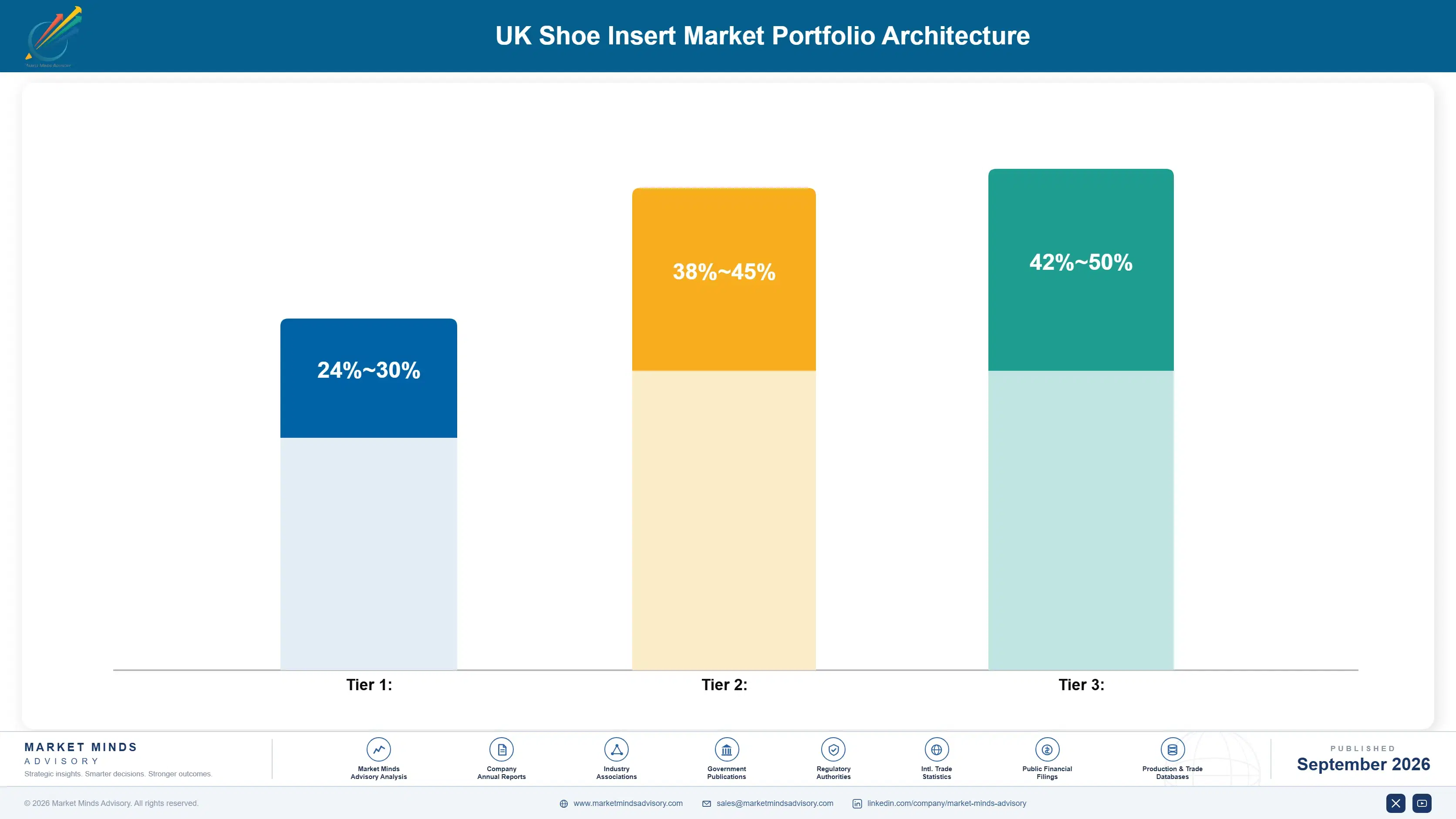
The UK Shoe Insert Market splits into three commercial tiers with distinctly different margin economics: volume commodity-adjacent products competing largely on price and mass retail shelf presence, premium certified products commanding brand loyalty through clinical validation and comfort engineering, and sustainability or next-generation formats capturing early-adopter willingness to pay for smart sensor features and condition-specific design across most demographic segments nationwide and internationally today.
Volume and premium tiers pull in genuinely different directions commercially: regional manufacturers compress volume-tier pricing continuously through direct e-commerce channels, while premium brands defend margin through clinical validation, podiatric partnerships, and smart sensor innovation that raise switching costs for loyal repeat customers across most retail and healthcare channels nationwide, a tension showing no sign of easing as regional quality keeps improving steadily and consistently.

High-value margin pools concentrate disproportionately in smart sensor and diabetic-specific medical-grade formats, where clinical credibility and brand trust matter more than raw cushioning specifications, leaving traditional comfort insoles increasingly commoditized across most price-sensitive retail channels and private-label competitive segments broadly today, a divergence manufacturers increasingly design entire product development roadmaps and marketing budgets around deliberately and consistently.

Mass-market comfort insoles sold through supermarkets, pharmacy chains, and discount retailers nationwide and internationally, competing chiefly on unit price with heavy private-label penetration continuing to intensify across most channels and consumer demographics.
Gross Margin: 24-30%

Clinically validated, podiatrist-recommended, and dermatologist-tested products carrying established brand names, sold through pharmacy and specialty retail channels at meaningfully higher price points nationwide and internationally across comparable healthcare markets and clinical settings.
Gross Margin: 38-45%

Smart sensor and diabetic-specific medical-grade insoles targeting technology-forward and clinically-referred consumers willing to pay a premium for data-driven insight, validated pressure redistribution performance, and long-term foot health outcomes across most demographic segments.
Gross Margin: 42-50%
uk-shoe-insert-market-portfolio-architecture-1790024764135

High-value Sub-segments and Strategic Watch-out

Smart / Heated Insoles

The fastest-growing, highest-value segment, driven by demand for data-driven gait tracking and temperature regulation among tech-comfortable consumers, commanding premium pricing across most retail channels, geographic markets, distribution formats, demographic cohorts, and price tiers nationwide, internationally, and across most emerging and developed consumer markets today and consistently.
Gross Margin: 42-48%

Diabetic / Medical-Grade Insoles

A high-value, high-growth segment appealing to clinically-referred patients requiring pressure-redistribution products, particularly across healthcare systems where podiatric referral pathways drive procurement decisions and reimbursement eligibility, insurance coverage, long-term treatment planning, and preventive care protocols across most developed and emerging healthcare markets today, consistently, and increasingly.
Gross Margin: 40-46%

Standard Cushioning Insoles

The volume core of the category, sold predominantly through mass retail and pharmacy channels at established price points, facing continuous margin compression from private-label competition, slower unit growth than premium formats, and increasingly price-sensitive repeat purchasing behavior across most geographic markets and demographic segments today.
Gross Margin: 22-28%

Sport-Specific Performance Insoles

A strategic watch-out segment as athletic footwear brands increasingly bundle performance insoles directly into shoe purchases, threatening standalone retail presence even as it remains a meaningful contributor across specialty sporting goods channels and dedicated athletic retail formats nationwide, internationally, and across most price tiers and demographic segments.
Gross Margin: 30-36%

Clinical Referral Anchors Repeat Purchasing

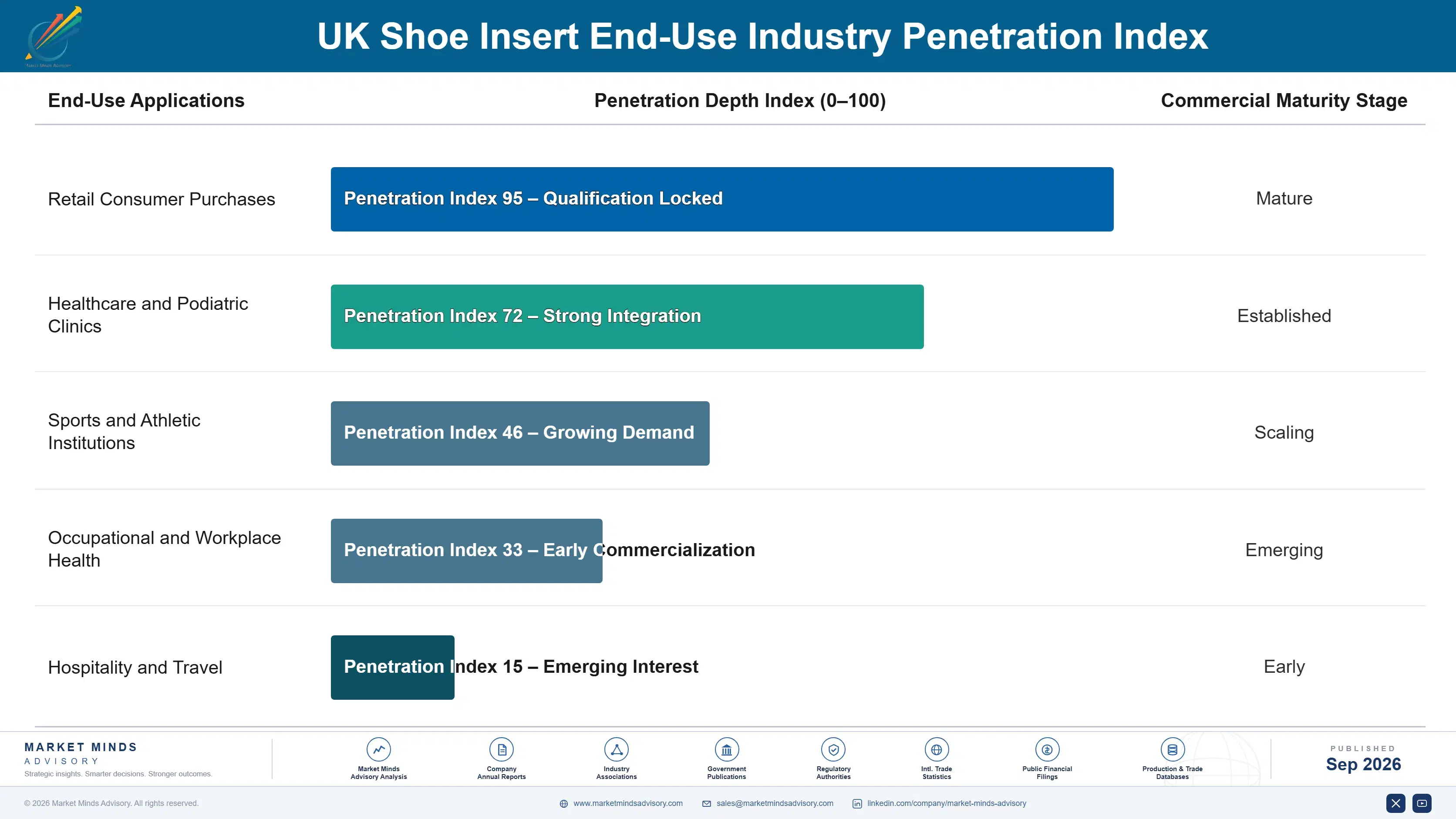
Insoles function economically as a recurring, semi-consumable product once a consumer or patient adopts a preferred brand: replacement purchasing repeats every six to twelve months for years, sometimes decades, generating predictable revenue far more valuable to manufacturers than any single transaction, and clinical referral relationships lock in this cadence formally through podiatric follow-up appointments, scheduled reassessments, and ongoing clinical treatment plans.
Adoption stickiness varies meaningfully by end-use vertical: athletic and casual comfort buyers churn brands more frequently as fashion and marketing trends shift and new products enter the market, while diabetic and clinically-referred patients under ongoing podiatric care show far stronger brand loyalty once satisfied with fit and pressure relief, making the clinical-referral segment disproportionately valuable despite representing a smaller unit share overall and consistently.

Buyer profiles are shifting generationally as younger consumers, exposed to wearable technology and data-driven wellness marketing throughout their lives, increasingly expect smart features from insoles previously judged purely on cushioning and support, a shift retailers increasingly reflect by relocating insoles from clinical shelving toward general wellness and technology retail sections nationwide, internationally, and across most price tiers and retail formats.
uk-shoe-insert-market-end-use-penetration-index-1790024764632

MMA Category Investment Verdict

These are among the four positions where our research anticipates prominent divergence between winners and laggards over the coming forecast period. Each is grounded in the demand model, the regulatory perimeter, and the announced capacity pipeline.
01 / CLINICAL CHANNEL INVESTMENT PRIORITY

Fund podiatric referral partnerships before competitors close the gap

Manufacturers should accelerate investment in formal podiatric and healthcare referral partnerships now, since clinical credibility increasingly drives purchasing decisions among the highest-value diabetic and aging-population customer segments across most developed healthcare markets, insurance frameworks, and reimbursement systems worldwide. Waiting risks ceding referral relationships entirely to manufacturers already building clinical validation studies and provider partnerships at meaningfully lower cost per acquired patient. Clinical differentiation currently justifies premium pricing that pure comfort claims increasingly cannot support alone across most retail channels nationwide.
02 / SMART TECHNOLOGY INVESTMENT TIMING

Launch connected insole products before component costs stabilize higher

Brands should accelerate smart sensor product development now, while component costs remain favorable and before mainstream retail penetration inflates competitive intensity and marketing costs across the category meaningfully and permanently across most price tiers and retail formats. Early movers building genuine data-driven differentiation rather than superficial connectivity features gain durable technology credibility that pure marketing spend cannot replicate at comparable cost. Competitors entering this channel late will face steeper development costs and fewer differentiated positioning opportunities remaining across most price tiers.
03 / GEOGRAPHIC EXPANSION SEQUENCING

Prioritize India and Southeast Asia distribution investment now

South Asia and Pacific's fastest regional growth reflects genuine rising disposable income and expanding healthcare infrastructure that will persist for at least a decade, making it the clearest priority for expanded distribution and localized clinical partnership investment among global manufacturers competing for regional market share and enterprise contracts. India in particular combines the fastest-growing national demand with modernizing pharmacy retail infrastructure, reducing execution risk relative to slower-growing developed markets. Later entrants will face steeper competitive entry costs and weaker distribution positioning nationwide.
04 / DIRECT-TO-CONSUMER DEFENSE TIMING

Build subscription and clinical moats before online retailers close the gap

Established brands should strengthen subscription replenishment and clinical partnership channels now, before online direct-to-consumer retailers build comparable clinical credibility and brand recognition at meaningfully lower price points across most digital marketing channels, social platforms, and e-commerce platforms worldwide and consistently. Manufacturers that establish credible subscription relationships now, ahead of intensifying online competition, gain both pricing power and customer retention advantage over competitors forced into reactive discounting later. Waiting risks ceding price-sensitive segments entirely to faster-moving digital-first competitors and regional challengers.

Engagement Snapshot From the Field

A live engagement with an industry participant carrying material or product regulatory and market exposure ahead of a defining policy shift, showing how our research translates into a defensible multi-year portfolio strategy.
MARKET MINDS ADVISORY · CLIENT ENGAGEMENT SUMMARY
UK Shoe Insert Producer Strategic Portfolio Review and Transition Roadmap 2026·Investment Scenario on UK Shoe Insert Exposure Evaluation 2025-26
CLIENT PROFILE
A mid-sized regional pharmacy chain operator with roughly 210 retail locations across the English Midlands approached MMA seeking guidance on expanding its shoe insert category footprint amid rising customer inquiries for diabetic and medical-grade foot care products the chain's existing supplier relationships did not adequately serve across its full regional store network and category merchandising strategy overall.
STRATEGIC CHALLENGE
The client's shoe insert category was positioned entirely within generic comfort shelving, generating declining foot traffic and unit sales despite client-reported growth in national category demand, and management could not determine whether the shortfall reflected weak supplier assortment, poor shelf placement, or genuine local demand softness across its regional footprint.
MMA APPROACH
MMA combined primary survey data across the client's Midlands regional footprint with confidential store-level sales data to isolate assortment and placement effects from underlying demand trends, supplementing the analysis with expert interviews among category managers, podiatric clinic partners, and two competing regional pharmacy chains to benchmark medical-grade merchandising practices and referral programs.
KEY FINDINGS
  1. Store-level sales data showed 27 percent higher unit velocity when insoles were merchandised near diabetic care products rather than general footwear aisles.
  2. Patients aged 55 and older consistently represented 34 percent of total category purchasers, a segment the client's existing assortment barely addressed adequately or consistently.
  3. Competing pharmacy chains carrying established podiatric referral partnerships consistently reported 19 percent higher category revenue per square foot of shelf space on average.
  4. Diabetic-specific insole penetration in the client's stores consistently lagged the regional average by 14 percentage points, indicating a meaningful unrealized margin opportunity worth capturing.
CLIENT PROFILE
A mid-sized regional pharmacy chain operator with roughly 210 retail locations across the English Midlands approached MMA seeking guidance on expanding its shoe insert category footprint amid rising customer inquiries for diabetic and medical-grade foot care products the chain's existing supplier relationships did not adequately serve across its full regional store network and category merchandising strategy overall.
STRATEGIC CHALLENGE
The client's shoe insert category was positioned entirely within generic comfort shelving, generating declining foot traffic and unit sales despite client-reported growth in national category demand, and management could not determine whether the shortfall reflected weak supplier assortment, poor shelf placement, or genuine local demand softness across its regional footprint.
MMA APPROACH
MMA combined primary survey data across the client's Midlands regional footprint with confidential store-level sales data to isolate assortment and placement effects from underlying demand trends, supplementing the analysis with expert interviews among category managers, podiatric clinic partners, and two competing regional pharmacy chains to benchmark medical-grade merchandising practices and referral programs.
KEY FINDINGS
  1. Store-level sales data showed 27 percent higher unit velocity when insoles were merchandised near diabetic care products rather than general footwear aisles.
  2. Patients aged 55 and older consistently represented 34 percent of total category purchasers, a segment the client's existing assortment barely addressed adequately or consistently.
  3. Competing pharmacy chains carrying established podiatric referral partnerships consistently reported 19 percent higher category revenue per square foot of shelf space on average.
  4. Diabetic-specific insole penetration in the client's stores consistently lagged the regional average by 14 percentage points, indicating a meaningful unrealized margin opportunity worth capturing.
RECOMMENDED STRATEGY
Phase 1: Phase one: relocate diabetic and medical-grade insoles adjacent to diabetes care products across all 210 stores within one fiscal quarter. Phase 2: Phase two: establish formal referral partnerships with three regional podiatric clinic networks within the first four full calendar months nationwide. Phase 3: Phase three: pilot a subscription replenishment program at 25 flagship stores before considering a broader, data-informed, chain-wide rollout decision nationwide.
OUTCOME
Within nine months of implementing phase one and two recommendations, the client reported (client-reported, unverified by MMA) a 23 percent increase in category unit sales and a 14 percent improvement in category gross margin, attributing the shift primarily to merchandising relocation and expanded podiatric referral partnerships reaching previously underserved diabetic patients.

Frequently Asked Questions

Foundational context covering the market sizes, CAGR, scope, country, region and competition that inform every finding below. This section is provided to cover basics and most often pre-purchase conversations, answered from the MMA Primary Research Dataset.

What is the current size of the UK Shoe Insert Market?

The UK Shoe Insert Market reached an estimated 1.6 billion dollars in 2025, reflecting steady demand from clinical referral pathways and aging populations across major consumer markets worldwide.

How large will the UK Shoe Insert Market be by 2036?

MMA projects the market will reach approximately 3.2 billion dollars by 2036, driven by smart insole adoption, expanding diabetic referral volume, and rising healthcare integration.

What is the CAGR for the UK Shoe Insert Market 2026 to 2036?

The market is projected to grow at a 6.4 percent compound annual growth rate between 2026 and 2036, supported by clinical referral expansion and smart insole technology adoption.

Which segment is growing fastest?

Smart and Heated Insoles lead segment growth at a 10.5 percent CAGR, roughly 1.64 times the overall market rate, driven by demand for data-driven gait tracking and comfort insights.

Who are the major companies in the UK Shoe Insert Market?

Implus and Scholl's Wellness Company lead the category, followed by Spenco Medical Corporation, Bauerfeind AG, and Vionic Group LLC, together holding roughly 29 percent combined market concentration.

Which country is growing fastest?

India leads national growth at a 9.8 percent CAGR, reflecting rising disposable income, expanding pharmacy retail infrastructure, and growing diabetes awareness campaigns across most major urban markets.

Report Segmentation Architecture

The full report scope spans multiple orthogonal segmentation dimensions, with cross-tabulated demand data provided for each dimension pair. Coverage extends further to regional breakdowns, trend trajectories, and the competitive detail needed to support segment-level decision-making.

By Primary Market Dimension

  • Smart / Heated Insoles
  • Diabetic / Medical-Grade Insoles
  • Standard Cushioning Insoles
  • Sport-Specific Performance Insoles
  • Odor-Control and Antimicrobial Insoles
  • Custom Orthotic Insoles

By End-Use Industry

  • Retail Consumer Purchases
  • Healthcare and Podiatric Clinics
  • Sports and Athletic Institutions
  • Occupational and Workplace Health
  • Hospitality and Travel

By Commercial Dimension

  • Pharmacy and Specialty Retail
  • Mass Retail Channels
  • E-Commerce and Direct-to-Consumer
  • Podiatric Clinical Referral Channels
  • Subscription Replenishment Programs

By Region

  • North America
  • Western Europe
  • East Asia
  • South Asia and Pacific
  • Latin America
  • Middle East and Africa
  • Eastern Europe

Scope, Methodology, and Coverage

Every figure in this report is reproducible from documented input assumptions. The scope below maps the historical period, the forecast horizon, the segmentation dimensions, and the countries covered, alongside the underlying primary and qualitative methodology.
Historical Period
2020 to 2025
Forecast Period
2026 to 2036
Base Year
2025 (USD billions; MMA Primary Research Dataset, September 2026)
Market Definition
The UK Shoe Insert Market covers manufactured insole and orthotic devices placed inside footwear for comfort, alignment, or medical correction purposes, excluding custom-molded prescription orthotics fabricated exclusively by licensed podiatrists and standalone footwear products.
Quantitative Units
USD billions, unit volume in millions of pairs
Segmentation Dimensions
Function and technology type, end-use industry, distribution channel
Regions Covered
North America, Western Europe, East Asia, South Asia and Pacific, Latin America, Middle East and Africa, Eastern Europe
Countries Covered
35+ countries across seven global regions
Key Companies Profiled
Implus LLC (Superfeet), Scholl's Wellness Company, Spenco Medical Corporation, Bauerfeind AG, Vionic Group LLC, and 15 additional participants
Quantitative Methodology
Primary survey, n=3,800 respondents, Q4 2025, six countries; demand-side model with trade association cross-validation
Qualitative Methodology
47 expert interviews, Q4 2025; applied to validate demand model assumptions, identify emerging dynamics, and assess competitive positioning
Report Format
PDF and XLSX data workbook (Word format preview document)
Publisher
Market Minds Advisory
Report Code
MMA-2026-MED-213
Published
September 2026
Contact
sales@marketmindsadvisory.com | www.marketmindsadvisory.com

Purchase the full UK Shoe Insert Market Report (2026 to 2036).

The full UK Shoe Insert Market report delivers a complete forecast model spanning 2026 through 2036. Granular segmentation spans function, end-use industry, and distribution channel. It includes detailed competitive profiles for all twenty tracked participants, regional demand analysis across seven geographies, and input cost exposure modeling grounded in primary survey and expert interview data. The report further examines portfolio margin economics, revenue lever strategies, demand architecture, and a fully anonymized client engagement case study illustrating practical application of the underlying research findings across comparable markets.
Full regional breakdown across all seven global markets
Company-level competitive benchmarking with moat and risk assessment
Segment-by-segment growth rate forecasts through 2036
Input cost exposure analysis and mitigation pathway detail
Portfolio tiering framework with margin economics detail
Primary survey data collected across six countries

Built For The People Who Decide

From boardroom strategy to bench-side execution, this report is read cover-to-cover by leaders shaping the next decade of their industry, turning demand scenarios, market dynamics and valuation benchmarks into decisions.
CXOs/ Presidents/ VPs/ Managers
M&A and Corporate Development
Strategy Teams and R&D Heads
Procurement and Product Directors
Regulatory and Compliance Leaders
Investor Relations and Equity Analysts