Market Minds Advisory
UK Compostable Toothbrush Market

UK Compostable Toothbrush Market: UK Compostable Toothbrush Market: The Bristle Problem, Kerbside Reality and What Bamboo Actually Composts

The handle composts and the bristles do not, which means almost every bamboo toothbrush sold in Britain asks a customer to pull out nylon with a pair of pliers before disposal.

Lead Analyst

Published

September 2026

Make Smarter Decisions with Customized Research Insights

Request a free sample report and evaluate market opportunities, growth trends, and competitive dynamics relevant to your business needs.

2025 MARKET VALUE$0.0BMarket Size 2025
2036 FORECAST VALUE$0.1BBase Case , 2026 to 2036
CAGR 2026 TO 20369.2 %Bull 10.5% / Bear 7.9%
INCREMENTAL OPPORTUNITY$0.1BNet 10- year value creation
EXPANSION MULTIPLE2.45x2036 value over 2026 base
Strategic Levers
M&A Pipeline
Regional Outlook
Country Rankings
Competitive Intelligence
Segmental Deep-dive
Call-Us : 91 93563 13602

Executive Snapshot and Market Trajectory.

A bamboo toothbrush is a compostable handle attached to nylon bristles that are not compostable at all. The instruction on most packs is to remove the bristles with pliers before composting the handle, and almost nobody does. Around 81% of the category is built this way and nothing says so.
Fully compostable bristle systems grow at 13.8%, half again the market rate of 9.2%, because castor oil and pig bristle alternatives finally perform well enough to sell without an apology. Bamboo handle with nylon bristle follows at 9.8%. Replaceable head systems grow slowest at 4.1%, solving a different problem and confusing buyers entirely. The cost gap between the bristle materials is the contest.
Nothing here composts at kerbside. UK local authority food waste collections accept nothing that is not food, and industrial composting facilities reject items that will not break down inside their cycle time. A compostable toothbrush composts in a home heap over months. Concentration is moderate at 44% and Scotland grows fastest at 11.6%. A home heap is the only genuine route, and most grocery buyers do not have access to one of those anywhere.
Market Definition
This market covers manual toothbrushes sold in the United Kingdom with compostable or biodegradable handle materials, spanning bamboo handle with nylon bristle, fully compostable bristle systems, bioplastic handle brushes, replaceable head systems, children's compostable brushes, and wooden and alternative fibre handles. Sizing is at retail sales value. Electric toothbrushes, conventional plastic manual brushes, interdental products, and toothpaste or oral rinse are excluded from scope.
Base Year Value
$0.0B in 2025 (MMA Primary Research Dataset, September 2026)
Forecast Period
2026 to 2036, eleven discrete annual values
CAGR
9.2% base case. Bull 10.5%. Bear 7.9%.
Fastest Growth Segment
Fully Compostable Bristle Systems: 13.8% CAGR
Fastest Growth Country
Scotland: 11.6% CAGR
Fastest Growth Region
South Asia and Pacific: 11.4% CAGR
Largest Region
East Asia: 63% of 2025 global value
Market Leaders
Colgate-Palmolive, Humble Brush, Georganics, The Humble Co, Brushd. Source: MMA Primary Research Dataset, July 2026.
Primary Survey
n=3,800 procurement and R&D decision-makers, Q4 2025, six countries
Methodology
Demand-side build-up, cross-validated against public data, 47 expert interviews

UK Compostable Toothbrush Market Forecast Scenarios

uk-compostable-toothbrush-market-size-forecast-scenario-1790024524661
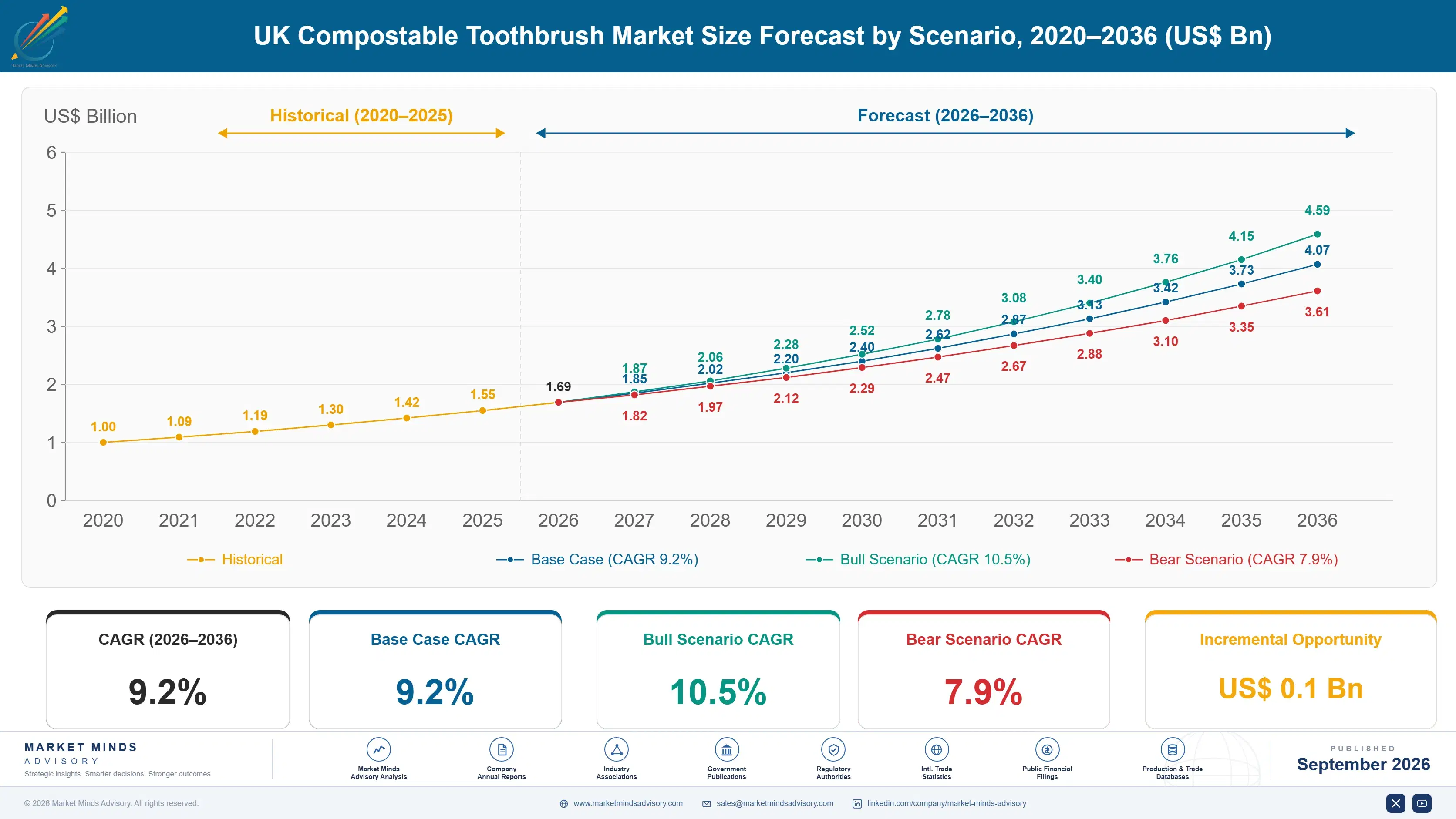
Growth of 8.0% between 2020 and 2025 came from grocery listings rather than from consumer discovery. The category moved from health food shops and online subscription into mainstream supermarket oral care aisles across the period, which multiplied availability far faster than awareness grew. Price fell as volume rose, and a bamboo brush now costs a supermarket shopper a small premium over conventional plastic rather than a considerable one.
Three mechanisms carry the base case. Fully compostable bristle systems grow at 13.8% as castor-derived and natural bristle options reach acceptable stiffness and durability. Scottish demand expands at 11.6% under devolved environmental policy that is ahead of Westminster. Dental professional endorsement is shifting as bristle performance closes, which matters more in this category than any other consumer signal because dentists are asked directly. All three are visible in retail scan data already.
The bull case is a bristle standard. If a certification scheme distinguished fully compostable brushes from bamboo-handle-with-nylon at point of sale, the premium tier would separate on evidence rather than on packaging design. The bear case is disposal reality becoming widely understood. A category sold on compostability that mostly ends in general waste is vulnerable to one well-read article.

What Actually Breaks Down

The product does not do the thing it is bought for, and almost nobody realises. Roughly 81% of compostable handle brushes still use nylon filaments, which do not break down under any composting condition, and the standard instruction is to extract them with pliers before disposing of the handle. Compliance with that instruction is close to nil. What ends in a home compost heap is therefore usually a whole brush that will not finish composting. Nothing at shelf connects the handle to the filaments.
TOP FIVE CONCENTRATION44%Combined retail value share held by the five largest brands
NYLON BRISTLE SHARE81%Portion of compostable handle brushes still using nylon filaments
AVERAGE RETAIL PRICEGBP 4Weighted shelf price for a single adult manual brush
GROCERY CHANNEL SHARE57%Share of units sold through supermarket rather than specialist channels
HOME COMPOST DURATION14 monthsTypical time for a bamboo handle to break down domestically
CATEGORY PENETRATION9%Share of UK manual toothbrush units that are compostable handled
Kerbside collection does not help either. UK local authority food waste services accept food only, and industrial composting facilities reject items that will not break down within their process cycle, which for bamboo runs far longer than they operate. A bamboo handle in a domestic heap takes roughly 14 months. That is genuinely compostable and it is also not what a consumer imagines when a supermarket pack says compostable.
Penetration sits around 9% of UK manual brush units, which is far higher than most sustainable substitutes achieve, because the price gap against conventional plastic has narrowed to pennies. That price convergence did more for adoption than any messaging.
"This category asks people to dismantle a toothbrush with pliers and then sells itself on the assumption that they will. The brands that solved the bristle are competing against a shelf full of products that quietly did not."
Director, Sustainable Consumer Products Practice · MMA Personal Care and Sustainable Packaging Practice · September 2026

Market Trends

Castor Bristles Finally Reach Acceptable Stiffness

Fully compostable bristle systems grow at 13.8% against 9.2% for the category, because castor oil derived filaments and boar bristle alternatives have closed most of the performance gap that made earlier versions unsellable. Stiffness retention through a three month use period was the specific failure, and bristles that softened within weeks gave the whole idea a poor reputation among dentists. Current generation filaments hold shape acceptably. They cost considerably more than nylon and that gap is the remaining barrier to volume. The gap narrows each year as filament volumes rise and specialist producers scale.
Market Impact: Scotland grows at 11.6% annually
Grocery Listings Outpace Consumer Understanding Substantially

Supermarket oral care aisles now carry compostable handle brushes as standard rather than as a specialist line, and grocery supplies around 57% of units. That availability arrived considerably faster than any understanding of what the product does or does not compost. A shopper reaching for a bamboo brush in a mainstream aisle is making a low-consideration substitution rather than a researched purchase, which means packaging claims do almost all the work and very few of them are precise. Very few packs distinguish a compostable handle from a compostable brush, and the shopper has no reason to look for the difference.
Market Impact: Penetration reaches 9% of units

Market Opportunities and Growth Drivers

Scottish Environmental Policy Runs Ahead Of Westminster

Scotland grows fastest of the four UK nations at 11.6%, supported by devolved environmental policy that has consistently moved earlier than Westminster on single-use plastics and on producer responsibility. Retailers operating across the UK frequently pilot sustainable ranges in Scottish stores first because the regulatory direction is clearer there. Consumer receptiveness is also measurably higher, which compounds the effect. Scottish Government waste strategy documents have set targets that pull retailer behaviour ahead of statutory requirement. English and Welsh demand follows behind at rates closer to the national average, with Northern Ireland smaller again.
Market Impact: Some 81% still use nylon

Price Gap To Conventional Plastic Has Nearly Closed

A bamboo handle brush now sells at a small premium over a conventional plastic one in UK grocery rather than at the multiple it commanded five years ago, because volume has pulled manufacturing cost down and retailers have accepted thinner margins to build the category. Penetration at around 9% of manual brush units is far above what most sustainable substitutes achieve, and price is most of the reason. Removing a price barrier converts intention into purchase more reliably than any messaging does. Penetration at this level is genuinely unusual for a sustainable substitute anywhere in personal care.
Market Impact: Only 1 disposal route genuinely works

Market Restraints and Challenges

Nylon Bristles Make Most Handles Uncompostable In Practice

Around 81% of compostable handle brushes use nylon filaments that break down under no composting condition, and the standard instruction to remove them with pliers is followed by almost nobody. The root cause is cost and performance: nylon is cheap and holds stiffness, while compostable filaments cost several times more and took years to reach acceptable durability. Commercially it leaves the category exposed to a credibility failure. Participants addressing it have moved to castor-derived filaments and say so prominently. The premium they charge for it is holding, which suggests buyers do care once told.
Market Impact: Compostable bristles grow 4.6 points faster

No UK Collection Route Accepts These Products

Local authority food waste collections accept food only and industrial composting facilities reject items that will not break down within process cycle times, which leaves home composting as the sole genuine route. The root cause is infrastructure rather than product design, since a bamboo handle taking 14 months does not fit any municipal process. Commercially it means the disposal promise depends entirely on the customer owning a compost heap. Mitigation runs to take-back schemes and honest disposal labelling. A collection point in a pharmacy is the only mechanism anybody has made work at scale so far.
Market Impact: Grocery supplies 57% of units
3 additional market trends, 4 additional growth drivers, and 2 additional restraints and challenges are covered in the full report. Contact sales@marketmindsadvisory.com to access the complete intelligence.

Segment CAGR and Growth Architecture

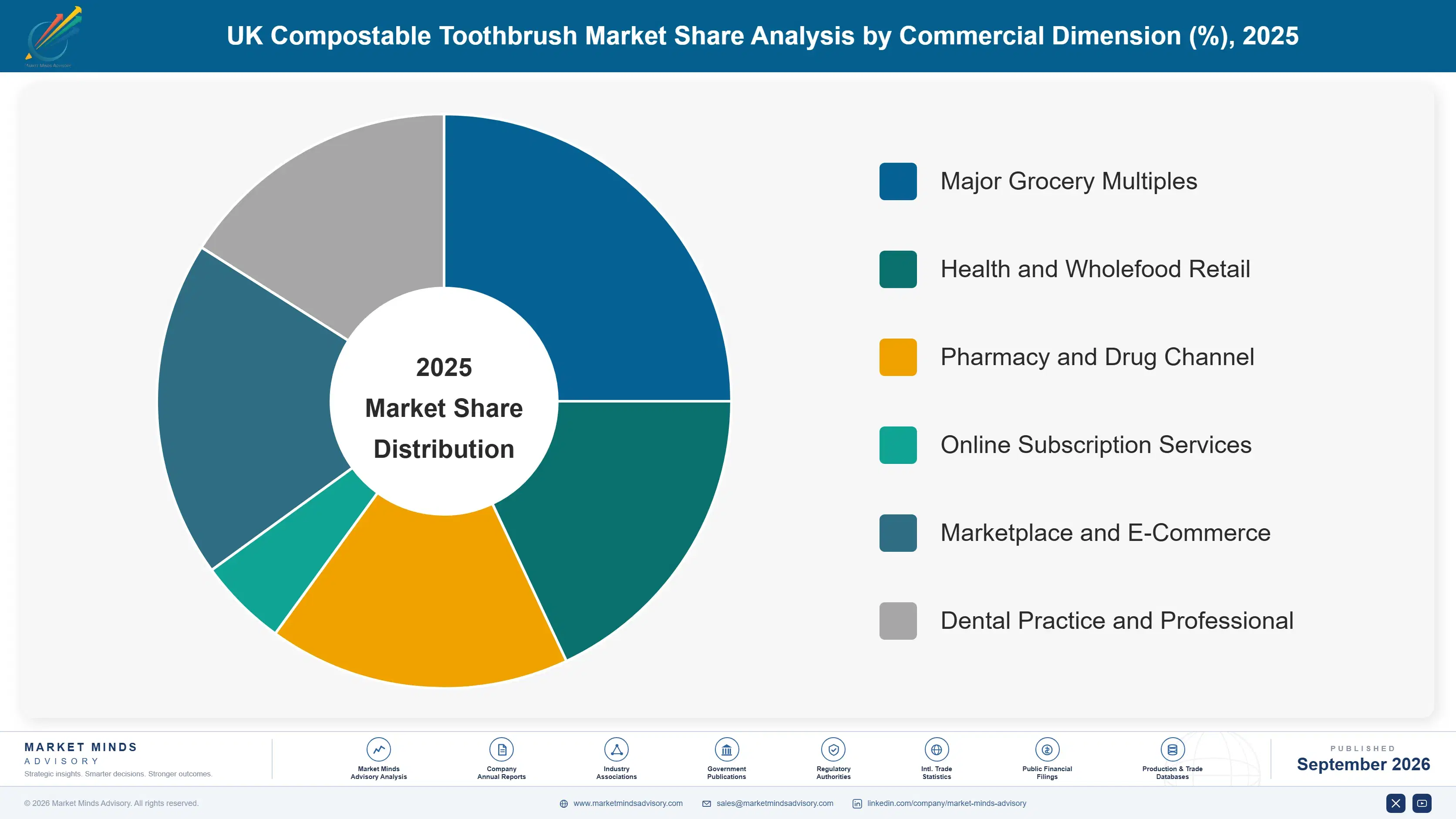
Segmentation follows brush construction, the dimension on which compostability, cost, performance and disposal route all divide together. Six constructions are assessed at retail sales value. Electric toothbrushes, conventional plastic manual brushes, interdental products, and toothpaste or oral rinse sit outside the defined scope throughout this report. Bristle material rather than handle material separates them commercially.
uk-compostable-toothbrush-market-market-share-analysis-1790024525275

Fully Compostable Bristle Systems

Fully compostable bristle systems grow at 13.8%, half again the market rate of 9.2%, and they are the only construction in this market that does what the category name claims. Castor oil derived filaments and boar bristle alternatives have closed most of the stiffness gap that made earlier attempts unsellable, and current generation product holds shape acceptably through a three month use period. The premium over nylon-bristled bamboo remains substantial, since compostable filament costs several times more per kilogram. That gap is the only real barrier, and it narrows each year as filament volumes rise. Dental objections have largely fallen away as stiffness retention has improved across current generation product.
CAGR 13.8%

Bamboo Handle With Nylon Bristle

Bamboo handle with nylon bristle grows at 9.8% and accounts for the overwhelming majority of what actually sells, at around 81% of compostable handle brushes. It is the format that made the category affordable and available, and it is also the one that does not compost without a customer removing filaments with pliers first. The construction works commercially because the handle is what a shopper sees and the bristles are what they use, and nothing at shelf connects the two. As fully compostable filaments come down in cost, this segment's argument weakens considerably. Nothing at shelf connects the handle a shopper sees to the bristles they will actually use for three months.
CAGR 9.8%
Full segment breakdown across 6 segments available in the complete report.

Regional Architecture and Country Demand Map

This report covers the United Kingdom only. The regional table therefore records where the brushes sold in Britain are manufactured, and shares fall well outside standard bands as a direct consequence of that scoping choice. Each deviation carries a stated reason in the paragraph concerned.

East Asia

At 63% this sits far above any standard band because Chinese manufacturing supplies the overwhelming majority of bamboo toothbrushes sold in Britain, and the bamboo itself grows there. Moso bamboo cultivation across Zhejiang, Fujian and Hunan feeds handle production in facilities that also make conventional plastic brushes, which is why the price gap narrowed so quickly. Nylon filament comes from the same supply base. Growth of 9.9% tracks UK demand directly, since almost nothing in this category is made anywhere else at comparable cost. Facilities making bamboo handles frequently make conventional plastic brushes on adjacent lines, which is much of why manufacturing cost fell quickly once volume arrived. Castor filament capability has developed more slowly here than in South Asia.
Share: 63% | CAGR: 9.9% (2026 to 2036)

South Asia and Pacific

The 14% position is the fastest-growing origin at 11.4% and reflects Indian and Vietnamese manufacturers entering with castor-derived filament capability that Chinese suppliers have been slower to commercialise. India has a genuine castor oil industry, which gives domestic filament producers an input advantage on exactly the material the fastest UK segment requires. Vietnamese bamboo processing has expanded as buyers diversify sourcing away from single-country dependence. Both origins are moving up the value tiers rather than competing purely on handle cost. Indian filament producers are supplying UK brands directly rather than only through Chinese assembly, which shortens the chain and gives smaller brands access to fully compostable construction without the scale that previously required.
Share: 14% | CAGR: 11.4% (2026 to 2036)
Regional intelligence for 5 additional markets available in the complete report: Western Europe, Eastern Europe, North America, Latin America, Middle East and Africa. Contact sales@marketmindsadvisory.com.
uk-compostable-toothbrush-market-country-cagr-analysis-1790024525807

Four Moves Worth Making Now

These four address a category where the product does not compost as sold, the disposal route does not exist at kerbside, and a shopper in a supermarket aisle is making a low-consideration substitution rather than an informed choice. Each has been executed by at least one UK participant. Two of the four cost an artwork revision rather than any capital.

Move The Whole Range To Compostable Filaments

Around 81% of compostable handle brushes still use nylon, which makes the compostability claim conditional on a customer removing bristles with pliers. Castor-derived filaments now hold stiffness acceptably through a three month use period and cost several times nylon per kilogram, which adds roughly 40 pence to a four pound product. Participants who converted fully report price realisation around 1.7 times nylon-bristled equivalents, because the claim finally survives a customer actually reading it. Dental objections on stiffness have largely fallen away, which removes the professional barrier that held earlier versions back entirely.
Market Impact: Price realisation reaches roughly 1.7 times nylon equivalents

State The Disposal Route Honestly On Pack

No UK local authority collection accepts these products and industrial composting rejects them on cycle time, leaving a home heap as the only genuine route. Most packs imply otherwise by omission. Stating home composting explicitly, with the 14 month timescale, costs an artwork revision and pre-empts the credibility failure the category is exposed to. Participants who labelled honestly report no measurable sales loss and materially higher repeat purchase, because the buyer who was going to be disappointed never is. A shopper who expected council collection and discovers otherwise does not buy again.
Market Impact: States the honest 14 month composting timescale clearly

Run Retail Take-Back For Used Brushes

A customer with no compost heap has no disposal route at all, which is most customers buying through grocery. Collection points at pharmacy and grocery allow brushes to reach industrial composting or filament recovery through a controlled stream rather than general waste. Participants operating take-back report roughly 31% of their sold units returning, which is high for any voluntary scheme, and the collection point itself generates repeat footfall that the category otherwise never sees. Most grocery buyers have no compost heap at all, which makes this the only disposal route available to the majority of the category's customers.
Market Impact: Around 31% of all sold units are returned

Win Dental Professional Endorsement On Bristle Performance

Dentists are asked about toothbrush choice directly and more often than about almost any other consumer product, and their historic objection to compostable bristles was stiffness loss within weeks. Current filaments hold shape through a full three month replacement cycle. Supplying practices with samples and independent stiffness retention data costs a sampling programme. Participants who pursued it report recommendation rates rising roughly 3.2 times among practices that received the data directly. No other consumer signal carries comparable weight in oral care, and the data now supports the claim rather than merely asserting it.
Market Impact: Dental recommendation rises roughly 3.2 times higher overall

Who Controls the Margin Pool

Concentration is moderate at 44% held by the top five, measured consistently on retail sales value rather than unit volume, which would overweight multipack bamboo brushes sold at very low prices through grocery. The leader to challenger gap rests on grocery listings rather than on product, because shelf access in UK supermarket oral care is the single hardest thing to obtain and the easiest thing to lose.
Competition runs on three dimensions currently. Grocery listings decide volume entirely, since 57% of units move through supermarkets and the purchase is a low-consideration substitution. Bristle credibility decides the premium tier and is becoming the main point of genuine product difference. Price decides the value end, where bamboo handles from the same Chinese facilities are close to interchangeable between brands.

Pressure is building from two directions and positions will shift on both. Multinational oral care brands have entered with bamboo ranges that carry grocery relationships specialists spent years building, and they compete on shelf access rather than on compostability credentials. Meanwhile Indian and Vietnamese manufacturers with castor filament capability are giving smaller UK brands access to fully compostable construction at prices that previously required scale nobody had.
uk-compostable-toothbrush-market-company-positioning-matrix-1790024526346

Competitive Moat and Risk Dimensions

COLGATE-PALMOLIVE

Moat: Grocery Shelf Access Position

Existing oral care listings across every major UK grocer place a bamboo range on shelf immediately where specialist brands spent years negotiating entry, and in a category where 57% of units move through supermarkets, that access decides volume more than product specification does. Listings are the scarce asset here.
COLGATE-PALMOLIVE

Risk: Nylon Bristle Credibility Exposure

A bamboo range using conventional nylon filaments carries exactly the credibility problem the category is exposed to, and a large brand attracts more scrutiny than a small one. Converting to compostable filaments across volume ranges is a far larger cost commitment than it is for specialists.
THE HUMBLE CO

Moat: Category Origin And Purpose

Building the proposition around dental charity funding rather than around product features gives a reason to choose the brand that a multinational competitor cannot straightforwardly replicate, and it sustains loyalty in a category where the physical product is close to interchangeable. The physical brush is close to interchangeable.
THE HUMBLE CO

Risk: Grocery Listing Dependency Risk

Volume depends on supermarket listings that are negotiated annually and contested by multinational brands carrying far greater category weight across their whole oral care portfolio. Losing a single major grocer removes a disproportionate share of revenue with very little warning or recourse. Subscription channels mitigate that only partly.

Players Tracked

Prominent Players

Colgate-Palmolive
Humble Brush
Georganics
The Humble Co
Brushd

Other Key Players

Truthbrush
Bamboo India
Hydrophil
Bambaw
WooBamboo
Brush with Bamboo
Boie
Wild
Grin Natural
Ecovibe
Save Some Green
Bamboozle
Nudge Toothbrush
Bambooth
Piksters Bamboo

Recent Developments

MARCH 2025

Georganics converts full range to castor-derived filaments

The brand replaced nylon bristles across its entire compostable handle range with castor oil derived filaments holding stiffness through a three month cycle. This was an organic reformulation funded internally, with no acquisition, licensing arrangement or joint venture behind the change. Pricing rose modestly to reflect filament cost.
Signal: The bristle problem is solvable and the cost gap is bearable. Whoever converts first takes the credible position.
SEPTEMBER 2024

Colgate-Palmolive extends bamboo range across UK grocery

The company widened distribution of its bamboo handle toothbrush range across major UK supermarket accounts using existing oral care listings. This was organic commercial expansion through established retail relationships rather than an acquisition, merger or joint venture of any kind. Bristle specification remained conventional nylon throughout the range.
Signal: Shelf access is entering the category faster than compostable credentials are. Specialists spent years earning the listings this arrived with.
JUNE 2025

Brushd launches retail take-back collection across pharmacy

The brand established collection points in pharmacy accounts allowing customers to return used brushes for controlled processing rather than disposing of them in general household waste. This was an internally funded programme with no partnership, acquisition or local authority arrangement. Returned brushes route to controlled composting rather than landfill.
Signal: Somebody finally addressed the disposal route rather than assuming one existed. Collection points also generate repeat footfall the category lacked.

What The Brush Costs

Materials divide sharply by bristle choice and that single decision moves everything. Bamboo handle material and turning run roughly 22% of manufacturing cost. Nylon filament adds about 14%, while castor-derived filament on the same brush runs nearer 38% and changes the whole economics. Packaging takes around 11%, since a compostable product presented in plastic film defeats its own argument. Freight from Asia absorbs most of the remainder.
Moso bamboo prices rose through 2021 and 2022 alongside broader Chinese agricultural and processing cost inflation, while sea freight from Asian ports to UK ports climbed steeply in the same window, a movement visible in UK Office for National Statistics import price data for the period. Brands holding fixed grocery pricing absorbed both. Several smaller UK brands reduced pack counts rather than raising shelf prices during that year.

Exposure divides by bristle specification rather than by brand size. Nylon-bristled participants carry petrochemical filament exposure that is volatile but small as a share. Castor-filament participants carry an agricultural input concentrated in India and Brazil, priced on harvests rather than on demand from oral care. Brands sourcing entirely from China carry a single-country freight and policy exposure that Vietnamese and Indian sourcing now genuinely mitigates.
uk-compostable-toothbrush-market-cost-volatility-analysis-1790024526543

Diversify handle sourcing beyond single-country supply

Chinese facilities supply the overwhelming majority of bamboo handles reaching Britain, which concentrates freight, tariff and policy exposure in one origin. Vietnamese and Indian bamboo processing has expanded enough to serve as genuine second sources. Qualification takes a production cycle and the cost difference is small, but very few UK brands have started the process at all.

Contract castor filament supply ahead of the harvest

Castor-derived filament is an agricultural input priced on Indian and Brazilian harvests rather than on oral care demand, and it already costs several times nylon per kilogram. Contracting ahead of harvest stabilises the single largest cost in a fully compostable brush. Smaller brands lack the volume to secure terms worth having from filament producers.

Move packaging to fibre before a retailer requires it

Presenting a compostable toothbrush in plastic film undermines the entire proposition and grocery buyers have begun raising it in listing reviews. Moulded fibre and paperboard alternatives cost slightly more and run on existing lines. The constraint is shelf presentation, since fibre packs show the product less clearly than film and buyers notice that difference.

Portfolio Architecture for Margin Defence

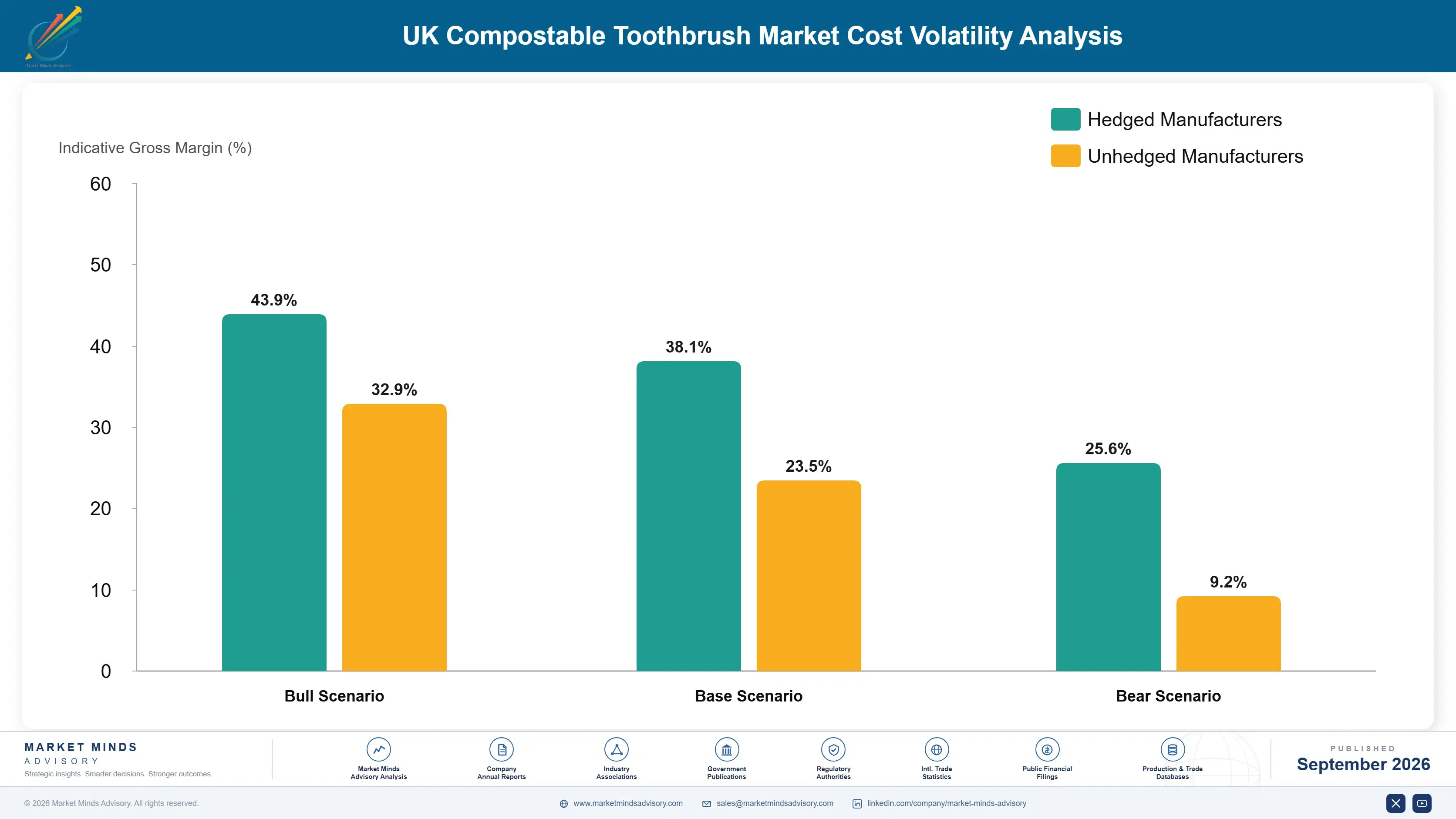
Margin architecture divides by whether the bristles compost, which is not what a shelf price suggests. Nylon-bristled bamboo multipacks sold through grocery run at gross margins in the low twenties to low thirties, competing against near-identical product from the same Chinese facilities where the only variables a shopper sees are brand and price per brush. Nothing on the pack tells a shopper which bristles they are buying.
Bioplastic handle brushes and children's ranges hold gross margins in the low thirties to low forties. The spread reflects how differently grocery and specialist channels carry listing and distribution cost. Children's product commands a premium that adult brushes do not, because a parent buying a compostable brush for a child is making a considered purchase rather than a substitution.

The highest-value pool is fully compostable bristle systems and premium wooden handle brushes, at margins in the low forties to low fifties. Those buyers understood the bristle problem and chose a product that answers it. Nylon-bristled multipacks carry the unit volume and the grocery listings. They defend nothing against a multinational with the same handle supplier. Listings and unit volume are the argument for keeping that tier.

Volume / Commodity-Adjacent

Nylon-bristled bamboo multipacks through grocery, competing against near-identical product from the same Chinese facilities. The ten point range reflects how differently listing terms are negotiated between brands. Only brand and price per brush distinguish them at shelf.
Gross Margin: 22 to 32%

Premium / Certified

Bioplastic handle brushes and children's ranges. Children's product commands a premium adult brushes do not, because a parent buying for a child makes a considered purchase rather than a substitution.
Gross Margin: 32 to 42%

Sustainability / Regulatory / Next-Generation

Fully compostable bristle systems and premium wooden handle brushes. These buyers understood the bristle problem and chose the product that actually answers it rather than the one that implies an answer.
Gross Margin: 42 to 52%
uk-compostable-toothbrush-market-portfolio-architecture-1790024527040

High-value Sub-segments and Strategic Watch-out

Fully Compostable Bristle Systems

High value and fastest growth at 13.8%. It is the only construction that does what the category name claims, and filament cost is the sole remaining barrier as castor-derived volumes rise each year. Dental objections on stiffness retention have largely fallen away over recent years.
Gross Margin: 44 to 52%

Children's Compostable Brushes

High value and strong growth. A parent buying a compostable brush for a child makes a considered rather than substituted purchase, which supports a premium the adult category has never managed to hold. Parents also replace on schedule considerably more reliably than adults do for themselves.
Gross Margin: 38 to 47%

Bamboo Handle With Nylon Bristle

Volume core at roughly 81% of compostable handle brushes, and the construction that made the category affordable and available. Its compostability claim depends on a customer using pliers, which almost none do. Multinational entrants source handles from the same facilities on considerably better commercial terms.
Gross Margin: 22 to 31%

Replaceable Head Systems

Strategic watch-out. Growing slowest at 4.1% and solving a materials reduction problem rather than a composting one. The eighteen point range reflects how differently subscription and retail models price the same hardware. Buyers also confuse it with the composting proposition rather than reading it separately.
Gross Margin: 26 to 44%

How Replacement Actually Works

Replacement here runs on a clinical schedule that almost nobody follows. Dental guidance puts brush replacement at three months, which would give four purchases a year, and observed UK behaviour sits closer to two. That gap is the largest volume opportunity in the category and it is a behaviour problem rather than a product one, which is why subscription has taken a disproportionate share of valuable customers.
Stickiness varies sharply by how the first purchase happened. A shopper who substituted in a grocery aisle has no attachment and switches on price or availability without noticing. A customer who researched the bristle question and chose a fully compostable brush returns deliberately, because they know most of the shelf fails the standard they applied. Subscription customers are the steadiest of all.

Buyer profiles have shifted as the category moved into grocery. The early adopter who sought the product out is now outnumbered by the mainstream shopper who picked it up because it cost a few pence more. That second group knows very little about what composts and is exactly the group a credibility failure would lose. The brands solving the bristle are, in effect, insuring against that.
uk-compostable-toothbrush-market-end-use-penetration-index-1790024527536

Where Credibility Decides Value

These are among the four positions where our research anticipates prominent divergence between winners and laggards over the coming forecast period. Each is grounded in the demand model, the regulatory perimeter, and the announced capacity pipeline.
01 / BRISTLE MATERIAL CONVERSION

Solve the part that does not compost

Around 81% of compostable handle brushes still use nylon filaments, which makes the entire compostability claim conditional on a customer extracting bristles with pliers before disposal. Castor-derived filaments now hold their stiffness through a full three month cycle and add roughly 40 pence to a four pound product. Participants who converted fully report price realisation around 1.7 times nylon-bristled equivalents, because the claim finally survives a customer reading it properly, and dental objections on stiffness have largely fallen away since.
02 / DISPOSAL LABELLING HONESTY

Say home compost and say fourteen months

No UK local authority collection accepts these products at all, and industrial composting rejects them on process cycle time, which leaves a domestic compost heap as the only genuine disposal route available. Most packs imply otherwise through omission rather than through any actually false statement. Stating home composting explicitly with its 14 month timescale costs only an artwork revision and pre-empts the credibility failure this category is plainly exposed to, since a shopper who expected council collection does not buy twice.
03 / RETAIL TAKE-BACK OPERATION

Give customers somewhere to put it

A customer without a compost heap has no disposal route at all, and that describes most of the people buying through grocery rather than through specialist channels. Collection points in pharmacy and grocery route used brushes into controlled processing instead of general household waste. Participants operating take-back report roughly 31% of sold units returning, which is high for any voluntary scheme of this kind, and the collection point itself generates repeat footfall besides, which the category has never otherwise managed to generate anywhere.
04 / DENTAL ENDORSEMENT PROGRAMME

Take the stiffness data to practices

Dentists are asked about brush choice more directly and more often than about almost any other consumer product, and their historic objection to compostable bristles was stiffness loss within weeks of use. Current generation filaments now hold their shape through a full three month replacement cycle. Participants supplying practices with samples and independent stiffness retention data report recommendation rates rising roughly 3.2 times among the practices that received it, because the data now supports the claim rather than merely asserting it.

Engagement Snapshot From the Field

A live engagement with an industry participant carrying material or product regulatory and market exposure ahead of a defining policy shift, showing how our research translates into a defensible multi-year portfolio strategy.
MARKET MINDS ADVISORY · CLIENT ENGAGEMENT SUMMARY
UK Compostable Toothbrush Producer Strategic Portfolio Review and Transition Roadmap 2026·Investment Scenario on UK Compostable Toothbrush Exposure Evaluation 2025-26
CLIENT PROFILE
A UK compostable oral care brand with retail sales value near GBP 7 million (client-reported, unverified by MMA), weighted approximately 88% to bamboo handle with nylon bristle and 12% to bioplastic handles. Distribution ran through three major grocers and an online subscription. Packaging used plastic film and disposal instructions were printed on the reverse in small type.
STRATEGIC CHALLENGE
Grocery volume had grown for three years while repeat purchase fell steadily, and management read the volume as evidence the proposition was working. A promotional multipack had been approved to defend listings. Nobody had asked customers what they did with used brushes or tested whether the disposal instruction was ever followed.
MMA APPROACH
MMA surveyed 1,100 UK purchasers on actual disposal behaviour rather than stated intention, and tested pack comprehension against what the labelling implied. Castor filament cost was modelled against the existing bill of materials. Repeat purchase was analysed by acquisition channel across 24 months of subscription and retail data. Findings were reconciled against retail scan data.
KEY FINDINGS
  1. Some 4% of surveyed purchasers had ever removed bristles before disposal, and 71% placed the whole brush in general household waste rather than any compost route.
  2. Pack comprehension testing showed 63% believed the product could go in a council food waste bin, which no UK authority accepts from any brand.
  3. Castor filament conversion added 38 pence per unit against a shelf price of GBP 4, and modelled realisable price uplift exceeded that by more than four times over.
  4. Subscription customers replaced brushes 3.4 times annually against 1.9 for grocery buyers, and represented 12% of units but 29% of gross profit.
CLIENT PROFILE
A UK compostable oral care brand with retail sales value near GBP 7 million (client-reported, unverified by MMA), weighted approximately 88% to bamboo handle with nylon bristle and 12% to bioplastic handles. Distribution ran through three major grocers and an online subscription. Packaging used plastic film and disposal instructions were printed on the reverse in small type.
STRATEGIC CHALLENGE
Grocery volume had grown for three years while repeat purchase fell steadily, and management read the volume as evidence the proposition was working. A promotional multipack had been approved to defend listings. Nobody had asked customers what they did with used brushes or tested whether the disposal instruction was ever followed.
MMA APPROACH
MMA surveyed 1,100 UK purchasers on actual disposal behaviour rather than stated intention, and tested pack comprehension against what the labelling implied. Castor filament cost was modelled against the existing bill of materials. Repeat purchase was analysed by acquisition channel across 24 months of subscription and retail data. Findings were reconciled against retail scan data.
KEY FINDINGS
  1. Some 4% of surveyed purchasers had ever removed bristles before disposal, and 71% placed the whole brush in general household waste rather than any compost route.
  2. Pack comprehension testing showed 63% believed the product could go in a council food waste bin, which no UK authority accepts from any brand.
  3. Castor filament conversion added 38 pence per unit against a shelf price of GBP 4, and modelled realisable price uplift exceeded that by more than four times over.
  4. Subscription customers replaced brushes 3.4 times annually against 1.9 for grocery buyers, and represented 12% of units but 29% of gross profit.
RECOMMENDED STRATEGY
Phase 1: Phase one: cancel the promotional multipack and convert the full range to castor-derived compostable filaments. Modelled uplift exceeded the added cost fourfold. Phase 2: Phase two: rewrite disposal labelling to state home composting and the fourteen month timescale explicitly. Small type on the reverse was insufficient. Phase 3: Phase three: move packaging to moulded fibre and build subscription share through the grocery customer base. Subscription customers replace far more often.
OUTCOME
Gross margin improved by six points across four quarters despite the higher filament cost, because realised price rose further (client-reported, unverified by MMA). Repeat purchase recovered to prior levels within three quarters, and subscription reached 21% of units at the highest margin in the portfolio.

Frequently Asked Questions

Foundational context covering the market sizes, CAGR, scope, country, region and competition that inform every finding below. This section is provided to cover basics and most often pre-purchase conversations, answered from the MMA Primary Research Dataset.

What is the current size of the UK Compostable Toothbrush Market?

The market was valued at USD 0.048 billion in 2025, rising to USD 0.053 billion in 2026. Sizing is at retail sales value across six brush constructions.

How large will the UK Compostable Toothbrush Market be by 2036?

MMA forecasts USD 0.13 billion by 2036, an increase of USD 0.077 billion over the 2026 base. That represents expansion of 2.45 times across the forecast period.

What is the CAGR for the UK Compostable Toothbrush Market 2026 to 2036?

The base case CAGR is 9.2%, with a bull case of 10.5% and a bear case of 7.9%. Historical growth between 2020 and 2025 ran at 8.0%.

Which segment is growing fastest?

Fully compostable bristle systems grow at 13.8%, half again the market rate, as castor-derived filaments reach acceptable stiffness. Bamboo handle with nylon bristle follows at 9.8%.

Who are the major companies in the UK Compostable Toothbrush Market?

Colgate-Palmolive, Humble Brush, Georganics, The Humble Co and Brushd lead on retail sales value, holding a combined 44%. Grocery shelf access rather than product decides volume.

Which country is growing fastest?

This report covers the United Kingdom only. Within it, Scotland grows fastest at 11.6% under devolved environmental policy that has consistently moved ahead of Westminster.

Report Segmentation Architecture

The full report scope spans multiple orthogonal segmentation dimensions, with cross-tabulated demand data provided for each dimension pair. Coverage extends further to regional breakdowns, trend trajectories, and the competitive detail needed to support segment-level decision-making.

By Brush Construction

  • Bamboo Handle with Nylon Bristle
  • Fully Compostable Bristle Systems
  • Bioplastic Handle Brushes
  • Replaceable Head Systems
  • Children's Compostable Brushes
  • Wooden and Alternative Fibre Handles

By End-Use Group

  • Adult Everyday Use
  • Children and Family Use
  • Sensitive and Gum Care
  • Travel and Single Occasion
  • Dental Practice Distribution
  • Hospitality and Institutional Supply

By Commercial Dimension

  • Major Grocery Multiples
  • Health and Wholefood Retail
  • Pharmacy and Drug Channel
  • Online Subscription Services
  • Marketplace and E-Commerce
  • Dental Practice and Professional

By Region

  • East Asia
  • South Asia and Pacific
  • Western Europe
  • Eastern Europe
  • North America
  • Latin America
  • Middle East and Africa

Scope, Methodology, and Coverage

Every figure in this report is reproducible from documented input assumptions. The scope below maps the historical period, the forecast horizon, the segmentation dimensions, and the countries covered, alongside the underlying primary and qualitative methodology.
Historical Period
2020 to 2025
Forecast Period
2026 to 2036
Base Year
2025 (USD billions; MMA Primary Research Dataset, September 2026)
Market Definition
This market covers manual toothbrushes sold in the United Kingdom with compostable or biodegradable handle materials, spanning bamboo handle with nylon bristle, fully compostable bristle systems, bioplastic handle brushes, replaceable head systems, children's compostable brushes, and wooden and alternative fibre handles. Sizing is at retail sales value across grocery, wholefood, pharmacy, subscription, marketplace and dental professional channels. Electric toothbrushes, conventional plastic manual brushes, interdental products, and toothpaste or oral rinse are excluded from scope throughout this report.
Quantitative Units
USD billions at retail sales value; volume in millions of units sold; compostability in months to breakdown.
Segmentation Dimensions
Brush construction, end-use group, commercial dimension, and manufacturing origin region.
Regions Covered
East Asia, South Asia and Pacific, Western Europe, Eastern Europe, North America, Latin America, Middle East and Africa
Countries Covered
United Kingdom (England, Scotland, Wales and Northern Ireland)
Key Companies Profiled
Colgate-Palmolive, Humble Brush, Georganics, The Humble Co, Brushd, Truthbrush, Bamboo India, Hydrophil, Bambaw, WooBamboo, Brush with Bamboo, Boie, Wild, Grin Natural, Ecovibe, Save Some Green, Bamboozle, Nudge Toothbrush, Bambooth, Piksters Bamboo
Quantitative Methodology
Primary survey, n=3,800 respondents, Q4 2025, six countries; demand-side model with trade association cross-validation
Qualitative Methodology
47 expert interviews, Q4 2025; applied to validate demand model assumptions, identify emerging dynamics, and assess competitive positioning
Report Format
PDF and XLSX data workbook (Word format preview document)
Publisher
Market Minds Advisory
Report Code
MMA-2026-PAC-803
Published
September 2026
Contact
sales@marketmindsadvisory.com | www.marketmindsadvisory.com

Purchase the full UK Compostable Toothbrush Market Report (2026 to 2036).

The full report sizes the UK compostable toothbrush market across six brush constructions, six end-use groups and six commercial dimensions through 2036. It surveys actual disposal behaviour rather than stated intention, establishing what proportion of purchasers ever remove bristles or reach a composting route at all. Pack comprehension is tested against what labelling implies about council collection acceptance. Castor filament conversion cost is modelled against realisable price uplift on existing bills of material. Competitive assessment covers 20 participants on a consistent retail sales value basis.
Actual disposal behaviour surveyed rather than stated intention
Pack comprehension tested against implied collection acceptance
Castor filament conversion modelled against realisable price uplift
Repeat purchase analysed by acquisition channel
Six brush constructions sized through 2036
Twenty participants assessed on retail sales value

Built For The People Who Decide

From boardroom strategy to bench-side execution, this report is read cover-to-cover by leaders shaping the next decade of their industry, turning demand scenarios, market dynamics and valuation benchmarks into decisions.
CXOs/ Presidents/ VPs/ Managers
M&A and Corporate Development
Strategy Teams and R&D Heads
Procurement and Product Directors
Regulatory and Compliance Leaders
Investor Relations and Equity Analysts