Market Minds Advisory
UAV Satellite Communication Market

UAV Satellite Communication Market: UAV Satellite Communication Market: Beyond Line of Sight Economics, Terminal Weight and Spectrum Access 2026 to 2036

An aircraft flying beyond radio horizon needs a satellite link or it needs a pilot who can see it. Every commercial argument in this category comes back to which of those two costs less.

Lead Analyst

Published

September 2026

Make Smarter Decisions with Customized Research Insights

Request a free sample report and evaluate market opportunities, growth trends, and competitive dynamics relevant to your business needs.

2025 MARKET VALUE$2.7BMarket Size 2025
2036 FORECAST VALUE$10.3BBase Case , 2026 to 2036
CAGR 2026 TO 203612.7 %Bull 14.0% / Bear 11.4%
INCREMENTAL OPPORTUNITY$7.2BNet 10- year value creation
EXPANSION MULTIPLE3.32x2036 value over 2026 base
Strategic Levers
M&A Pipeline
Regional Outlook
Country Rankings
Competitive Intelligence
Segmental Deep-dive
Call-Us : 91 93563 13602

Executive Snapshot and Market Trajectory.

An uncrewed aircraft flying past the radio horizon needs either a satellite link or somebody watching it from the ground. Every commercial argument in this category eventually reduces to which of those two options costs less across a given mission profile, and the answer keeps moving.
The market reaches USD 3.1 billion in 2026 and USD 10.3 billion by 2036, a 3.32 times expansion at 12.7% annually. Low earth orbit flat panel terminals grow at 19.1%, half again the market rate of 12.7%, because reduced latency and lower terminal mass together open aircraft classes that geostationary links never could. Middle East and Africa holds 19% of spending, well above the usual band, and Saudi Arabia compounds fastest at 20.4%.
Five suppliers hold 56% of terminal and service revenue, and that concentration sits with firms that certified airborne hardware rather than with the satellite operators providing the capacity. Honeywell Aerospace, Viasat, Cobham Satcom, Gilat Satellite Networks and Hughes Network Systems lead the field. Airworthiness approval on a certified airframe takes years to complete, which protects incumbent suppliers considerably more effectively than any commercial agreement ever does.
Market Definition
This report covers satellite communication systems for uncrewed aerial vehicles by system class: low earth orbit flat panel terminals, geostationary mechanically steered terminals, geostationary electronically steered terminals, airborne modems and network management units, satellite airtime and capacity services for uncrewed platforms, and ground segment and mission control gateways. It excludes the uncrewed aircraft themselves, terrestrial radio control links, payload sensors and cameras, satellite manufacturing and launch, and flight control or autopilot systems.
Base Year Value
$2.7B in 2025 (MMA Primary Research Dataset, September 2026)
Forecast Period
2026 to 2036, eleven discrete annual values
CAGR
12.7% base case. Bull 14.0%. Bear 11.4%.
Fastest Growth Segment
Low Earth Orbit Flat Panel Terminals: 19.1% CAGR
Fastest Growth Country
Saudi Arabia: 20.4% CAGR
Fastest Growth Region
South Asia and Pacific: 14.8% CAGR
Largest Region
North America: 27% of 2025 global value
Market Leaders
Honeywell Aerospace, Viasat, Cobham Satcom, Gilat Satellite Networks and Hughes Network Systems lead on uncrewed platform satellite terminal and service revenue. Source: MMA Analysis.
Primary Survey
n=3,800 procurement and R&D decision-makers, Q4 2025, six countries
Methodology
Demand-side build-up, cross-validated against public data, 47 expert interviews

UAV Satellite Communication Market Forecast Scenarios

uav-satellite-communication-market-size-forecast-scenario-1789995082020
Between 2020 and 2025 the category compounded at 11.4%, driven mostly by defence programmes that had budget for satellite links regardless of what they cost. Commercial adoption stayed limited because a geostationary terminal weighed more than many aircraft could carry and airtime priced beyond what a survey flight could justify. Low orbit constellations reaching service changed both constraints, though certification lagged the capability.
The base case holds 12.7% on three mechanisms working together. Low earth orbit terminals keep getting lighter and cheaper, which brings aircraft classes into range that could never carry a steered geostationary antenna. Regulators across several jurisdictions are approving beyond visual line of sight operations on defined routes, which converts a demonstration into a commercial service. And infrastructure inspection, maritime patrol and border surveillance keep expanding as missions where connectivity is a legal condition.
The bull case at 14.0% assumes beyond visual line of sight approvals broaden faster than published, since each approval converts a fleet of grounded aircraft into paying satellite subscribers. The bear case at 11.4% is terrestrial substitution: cellular network coverage keeps extending, and an operator who can fly a mission inside cellular coverage will not pay satellite airtime rates to do it.

Past The Horizon Or Not

Everything in this market turns on one operational fact. An aircraft flying beyond the radio horizon cannot be controlled from the ground without a relay, and the only relay that works anywhere is a satellite. That makes the link a requirement rather than a feature, a strong commercial position, but it also means the addressable market is defined by how many aircraft may legally fly out there.
TOP FIVE CONCENTRATION56%Held by firms certifying airborne hardware rather than satellite operators
FLAT PANEL TERMINAL MASS3.4 kilogramsTypical installed weight against considerably heavier steered alternatives
AIRWORTHINESS APPROVAL PERIOD31 monthsFrom submission to approved installation on a certified airframe
ROUND TRIP LATENCY48 millisecondsAcross low orbit paths against far longer geostationary equivalents
AIRTIME COST SHARE37%Satellite service within total operating cost per flight hour
APPROVED ROUTE COUNT140 corridorsWhere beyond visual line of sight operation is formally permitted
Weight was the binding constraint for longer than most suppliers admit. A mechanically steered geostationary antenna is too heavy and too large for the medium aircraft that make up most commercial fleets, so those platforms simply did not fly beyond line of sight. Flat panel terminals at around 3.4 kilograms changed that arithmetic, and the aircraft classes it opened are why this segment grows at 19.1% against 12.7% for the market.
The gate on all of it is regulatory rather than technical. Roughly 140 corridors worldwide now permit beyond visual line of sight operation, and every additional approval converts grounded aircraft into paying subscribers at once. Airworthiness certification of the terminal runs around 31 months, which is why the supplier list has changed so little despite new entrants arriving with genuinely better hardware.
"People pitch this market as a satellite story. It isn't. It's an aviation certification story with a satellite attached, and the companies winning are the ones who understood that first. Better hardware loses to approved hardware every single time, and it will keep doing so."
Director, Uncrewed Systems and Airborne Connectivity Practice · MMA Technology Practice · September 2026

Market Trends

Low Orbit Terminals Open Previously Excluded Aircraft Classes

A mechanically steered geostationary antenna is too heavy and too large for the medium platforms that make up most commercial uncrewed fleets, which kept those aircraft inside line of sight regardless of what operators wanted. Flat panel terminals at around 3.4 kilograms brought them into range, and round trip latency near 48 milliseconds makes active control practical rather than merely possible. Low earth orbit flat panel terminals grow at 19.1% against 12.7% for the market, and essentially all of that growth comes from aircraft classes that were never candidates for the technology before.
Market Impact: Airtime takes 37% of cost
Route Approvals Convert Grounded Fleets Into Subscribers

Roughly 140 corridors worldwide now permit beyond visual line of sight operation, and each new approval turns a fleet that was legally confined into aircraft needing satellite connectivity on every single flight. That makes regulatory affairs the most reliable leading indicator of demand anywhere in this category, well ahead of any technology roadmap or aircraft fleet forecast. Operators here frequently buy terminals well in anticipation of an approval they expect to receive shortly, which produces order patterns that track regulatory dockets rather than any fleet expansion or aircraft replacement cycle.
Market Impact: Saudi Arabia compounds at 20.4%

Market Opportunities and Growth Drivers

Infrastructure Inspection Requires Continuous Command Connectivity

Pipeline, transmission line and rail corridor inspection flights run far beyond radio horizon by definition, and the operating approvals that permit them require continuous command and control connectivity rather than treating it as good practice. That makes the satellite link a legal condition of the flight rather than an operator preference, which removes it from any cost comparison. Airtime accounts for roughly 37% of operating cost per flight hour on these missions, and operators pay it without argument because the only alternative available to them is not flying the mission at all.
Market Impact: Approval consumes 31 months

Gulf Programmes Fund Uncrewed Surveillance At Scale

Saudi Arabia compounds at 20.4%, faster than any other market measured, on border surveillance, infrastructure monitoring and defence programmes funded as national capability rather than as commercial ventures with payback periods. Emirati and Qatari programmes follow broadly similar patterns across a comparable set of missions. Those buyers procure complete systems including terminals, airtime and ground segment together rather than assembling components separately, and they specify against capability targets rather than a payback period. That changes both what actually wins the tender and which suppliers are even invited to bid for it.
Market Impact: Airtime costs 37% per hour

Market Restraints and Challenges

Certification Timelines Delay Genuinely Better Hardware

Airworthiness approval for an airborne terminal runs around 31 months from submission to approved installation, so a supplier arriving with materially better hardware still waits years before anybody can legally fly it. The root cause is that anything mounted on a certified airframe must be shown not to compromise airworthiness, which is a documentation process rather than an engineering one. Commercially this protects the incumbent suppliers very heavily indeed. Mitigation runs through supplemental type certificates covering common airframes, and through smaller uncertified platforms where the approval burden does not apply at all.
Market Impact: Terminals now weigh 3.4 kilograms

Cellular Coverage Removes Missions From The Category

An operator who can complete a mission inside terrestrial cellular coverage will not pay satellite airtime rates to do the same work, and cellular coverage keeps extending into areas that previously had none. The root cause is straightforward economics: satellite airtime runs roughly 37% of operating cost per flight hour where cellular connectivity costs a small fraction of that. Commercially this steadily erodes the addressable mission set from below rather than above. Mitigation runs through hybrid terminals using cellular connectivity where it is available and satellite only where genuinely required.
Market Impact: About 140 corridors now approved
3 additional market trends, 4 additional growth drivers, and 2 additional restraints and challenges are covered in the full report. Contact sales@marketmindsadvisory.com to access the complete intelligence.

Segment CAGR and Growth Architecture

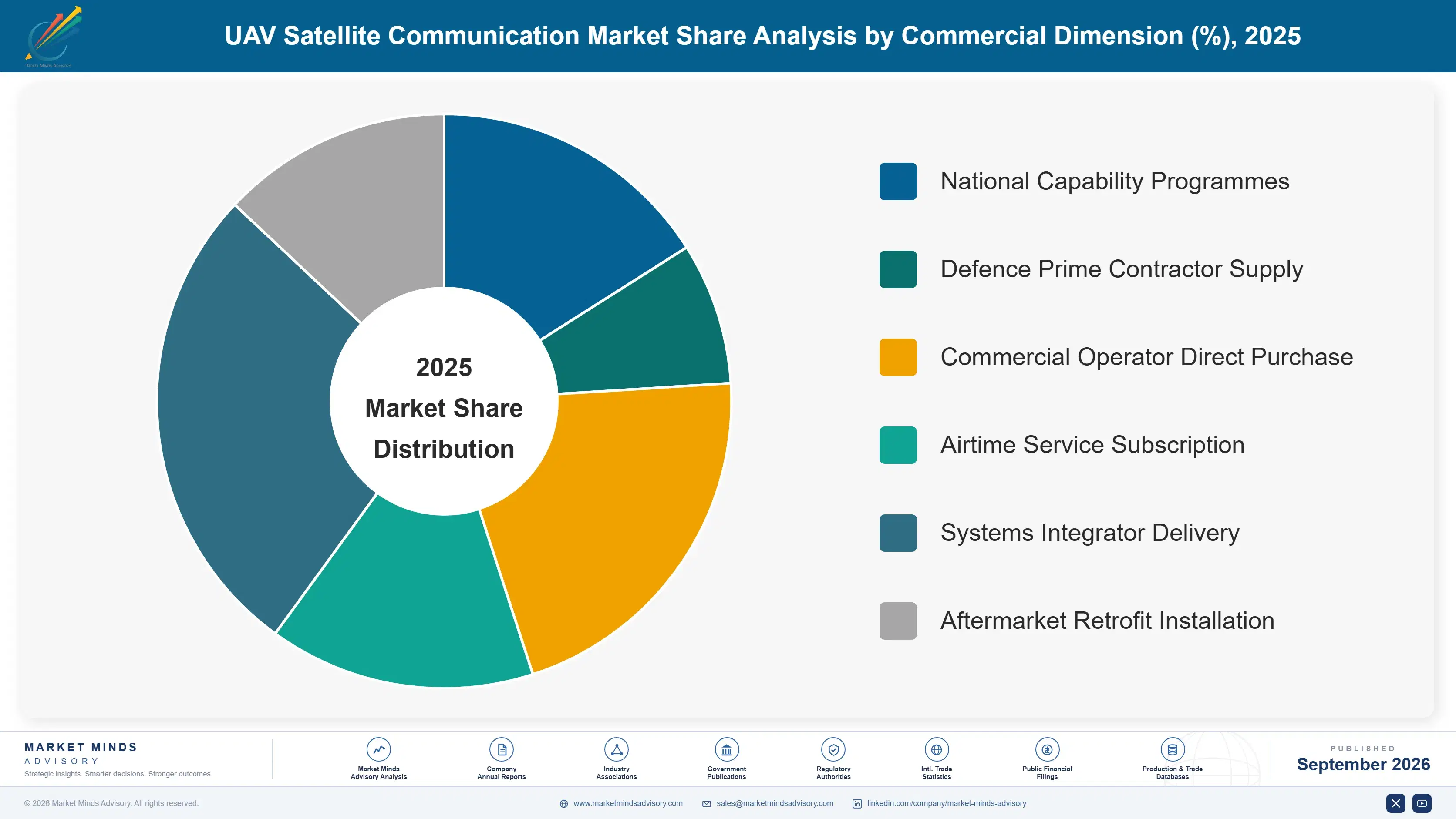
Segmentation follows system class, since orbit choice and antenna technology together determine terminal mass, latency, airtime pricing and which aircraft can carry the equipment at all. Six classes cover the market, spanning low orbit flat panels, geostationary steered terminals, airborne modems, airtime services and ground segment gateways. Mission type and procurement route are separate dimensions handled elsewhere.
uav-satellite-communication-market-market-share-analysis-1789995082583

Low Earth Orbit Flat Panel Terminals

Low earth orbit flat panel terminals grow at 19.1%, half again the market rate of 12.7%, because they removed the two constraints that had kept most uncrewed aircraft inside line of sight. Terminal mass near 3.4 kilograms fits the medium platforms that could never carry a mechanically steered geostationary antenna at all, and round trip latency around 48 milliseconds makes active flight control practical rather than theoretically possible. The commercial catch here is airworthiness certification running roughly 31 months from submission onwards, which means the aircraft classes opening up are reached by whoever completed that process rather than by whoever happens to have the best current hardware available on the market.
CAGR 19.1%

Satellite Airtime And Capacity Services

Satellite airtime and capacity services for uncrewed platforms compound at 15.8% because every terminal installed generates recurring consumption across the entire operating life of the aircraft carrying it. Airtime runs roughly 37% of total operating cost per flight hour on typical inspection missions, which makes it the largest single variable an operator manages and also the one most exposed to competitive pressure. Low earth orbit capacity has changed pricing considerably, though airtime contracts are frequently written alongside terminal supply and simply inherit that supplier relationship. The commercial risk here is hybrid operation: an operator switching to cellular wherever coverage exists reduces satellite consumption considerably without changing any hardware at all.
CAGR 15.8%
Full segment breakdown across 6 segments available in the complete report.

Regional Architecture and Country Demand Map

North America holds 27% of category spending, on defence programmes and the largest count of approved corridors found anywhere in the world. Middle East and Africa follows at 19%, far above the usual band ceiling, on Gulf surveillance and infrastructure programmes funded as national capability.

Middle East and Africa

Middle East and Africa takes 19% of category spending, far above the 6% band ceiling, because Gulf states are funding uncrewed surveillance and infrastructure monitoring as national capability rather than as commercial ventures with payback periods. Saudi Arabia compounds at 20.4%, faster than any market measured, on border surveillance and pipeline monitoring programmes running across enormous geography where no terrestrial alternative exists at all. Emirati and Qatari programmes follow comparable patterns. African wildlife protection and mineral exploration flights add smaller further volume across similarly unserved terrain where nothing terrestrial exists. These buyers procure terminals, airtime and ground segment together as complete capability rather than assembling components from separate suppliers themselves.
Share: 19% | CAGR: 13.2% (2026 to 2036)

North America

Twenty-seven percent of spending reaches North America, where defence programmes and the largest count of approved beyond line of sight corridors both concentrate. Pipeline and transmission line inspection operates at genuine commercial scale here in a way that it does not elsewhere, and those approvals require continuous command connectivity as a legal condition. Honeywell Aerospace, Viasat and Hughes Network Systems all hold substantial positions across defence and commercial buyers. Airworthiness certification capability is concentrated here as well, which shapes which suppliers can realistically compete for anything. Growth at 12.4% sits marginally below the global rate on the comparative maturity of both the fleet and the approval framework already in place.
Share: 27% | CAGR: 12.4% (2026 to 2036)
Regional intelligence for 5 additional markets available in the complete report: Western Europe, East Asia, South Asia and Pacific, Latin America, Eastern Europe. Contact sales@marketmindsadvisory.com.
uav-satellite-communication-market-country-cagr-analysis-1789995083114

Where These Programmes Are Won

Airworthiness approval takes years and protects whoever completed it first, regulatory corridor approvals rather than any amount of fleet growth determine where the demand actually appears, and steadily extending cellular coverage keeps removing missions from the bottom of the category. The four levers below follow those conditions rather than any argument about link performance.

Certify Early And Defend The Approval

Airworthiness approval for an airborne terminal runs around 31 months from initial submission to approved installation, so a competitor arriving with materially better hardware still waits years before anybody at all can legally fly it. That delay is comfortably the single most durable competitive position available anywhere in this category, and it was earned by starting the paperwork early rather than by any engineering achievement. Suppliers treating certification as a routine cost of doing business are underinvesting badly in the one thing that actually protects their revenue for years afterwards.
Market Impact: Certification alone delays every competitor a full 31 months

Track Regulatory Dockets Rather Than Fleet Growth

Roughly 140 corridors now permit beyond line of sight operation, and each new approval converts a legally confined fleet into aircraft that require satellite connectivity on every single flight. Operators frequently order terminals well in anticipation of an approval they expect, so demand tracks regulatory proceedings rather than any fleet expansion. Suppliers forecasting from aircraft delivery numbers alone consistently misread both the timing and the location of this demand. Those following the approval dockets closely know which operators will need equipment well before the operators themselves have finished deciding anything at all.
Market Impact: Roughly 140 corridors have now been formally approved

Offer Hybrid Operation Before Cellular Takes Missions

Satellite airtime runs roughly 37% of operating cost per flight hour while cellular connectivity costs a small fraction of that, and cellular coverage keeps extending into areas that previously had none. An operator who can complete a mission entirely inside that coverage will simply not pay satellite rates for it. Terminals that use cellular where available and satellite only where genuinely required keep the customer relationship while conceding the marginal traffic. Suppliers refusing to build hybrid capability at all are defending airtime revenue that they are going to lose anyway.
Market Impact: Airtime carries fully 37% of every hourly cost

Sell Complete Systems To National Programmes

Gulf and Indian national programmes procure terminals, airtime and ground segment together as complete national capability rather than assembling components from several separate suppliers. Saudi Arabia compounds at 20.4% annually, and those buyers specify against national capability targets rather than against any payback calculation at all. Suppliers who can offer only one element of the whole system end up as subcontractors in those tenders rather than principals, which is a materially worse commercial position, and one that gets progressively harder to change with every single programme awarded to somebody else instead.
Market Impact: Saudi Arabia alone compounds at fully 20.4% annually

Who Controls the Margin Pool

Five suppliers hold 56% of uncrewed platform satellite terminal and service revenue, and the concentration sits with firms that certified airborne hardware rather than with the satellite operators providing capacity. Honeywell Aerospace, Viasat, Cobham Satcom, Gilat Satellite Networks and Hughes Network Systems lead. All participants here are assessed consistently on terminal and service revenue drawn from uncrewed platforms rather than on any broader satellite communications business.
Competition runs on certification status and system integration far more than on link performance, because an uncertified terminal cannot legally be installed regardless of how well it works. The second dimension is whether a supplier can offer terminals, airtime and ground segment together, since national programmes and larger commercial operators increasingly buy complete capability rather than assembling it themselves from several separate suppliers.

Pressure is emerging from low earth orbit constellation operators reaching aircraft operators directly with considerably cheaper capacity, which attacks the airtime revenue that terminal suppliers had previously bundled into their offer. Rankings shift wherever corridor approvals open genuinely new mission sets, particularly across the Gulf, India and Australia rather than in any of the established markets.
uav-satellite-communication-market-company-positioning-matrix-1789995083644

Competitive Moat and Risk Dimensions

HONEYWELL AEROSPACE

Moat: Airworthiness Certification Depth

Honeywell holds certification across a wide range of airframes and the internal capability to run approval programmes taking around 31 months each. That is a documentation and process capability rather than an engineering one, and no competitor arriving with better hardware can shorten it. The position accumulated across decades of aviation work and transfers directly into uncrewed platforms.
HONEYWELL AEROSPACE

Risk: Uncertified Platform Exposure

Smaller uncrewed platforms operating outside certified airframe rules face no approval burden at all, and that segment is growing faster than the certified one. Certification depth protects nothing where certification is not required in the first place. Competing there means winning on hardware and price, which is a different contest entirely from the one this position was built for.
VIASAT

Moat: Capacity And Terminal Combination

Viasat supplies satellite capacity alongside airborne terminals, which lets an operator buy connectivity as one arrangement rather than contracting hardware and airtime separately and hoping they work together. National programmes buying complete capability find that considerably easier to procure. Assembling comparable coverage requires both an orbital asset position and certified airborne hardware, which very few organisations hold together.
VIASAT

Risk: Constellation Capacity Competition

Low earth orbit constellation operators are reaching aircraft operators directly with cheaper capacity, which attacks the airtime side of the combined offer. Airtime runs roughly 37% of operating cost per flight hour, so operators have a real incentive to unbundle it. Defending the combination requires the terminal position to stand on its own certification merits.

Players Tracked

Prominent Players

Honeywell Aerospace
Viasat
Cobham Satcom
Gilat Satellite Networks
Hughes Network Systems

Other Key Players

Iridium Communications
Inmarsat Government
Kymeta
Get SAT
Orbit Communication Systems
Satcube
ThinKom Solutions
CesiumAstro
Ball Aerospace
L3Harris Technologies
Thales Alenia Space
Airbus Defence and Space
Intellian Technologies
Rohde and Schwarz
Comtech Telecommunications

Recent Developments

APRIL 2025

Gulf Programmes Procure Complete Uncrewed Connectivity Capability

Saudi and Emirati national programmes procured uncrewed platform connectivity as complete capability including terminals, airtime and ground segment together, capability development rather than any corporate transaction. Those buyers specify against national capability targets rather than any payback period, which changes what wins the tender entirely.
Signal: Complete capability tenders turn component suppliers into subcontractors rather than principals right across the whole procurement.
NOVEMBER 2024

Additional Beyond Line Of Sight Corridors Receive Approval

Aviation authorities across several jurisdictions approved additional corridors for beyond visual line of sight uncrewed operation, a regulatory development rather than any commercial transaction. Each approval converts a legally confined fleet into aircraft requiring continuous satellite connectivity, which makes regulatory proceedings the leading demand indicator in this category.
Signal: Demand here tracks regulatory approval dockets far more reliably than it tracks any fleet delivery figure.
AUGUST 2025

Flat Panel Terminal Mass Falls Further Across Product Ranges

Terminal suppliers reduced flat panel antenna mass across product ranges serving medium uncrewed platforms, an engineering development rather than any merger or acquisition. Mass near 3.4 kilograms brings aircraft classes into range that could never carry a mechanically steered geostationary antenna, opening mission sets that were previously inaccessible entirely.
Signal: Every single kilogram removed from the terminal adds another whole aircraft class to the addressable market.

What Airborne Terminals Cost

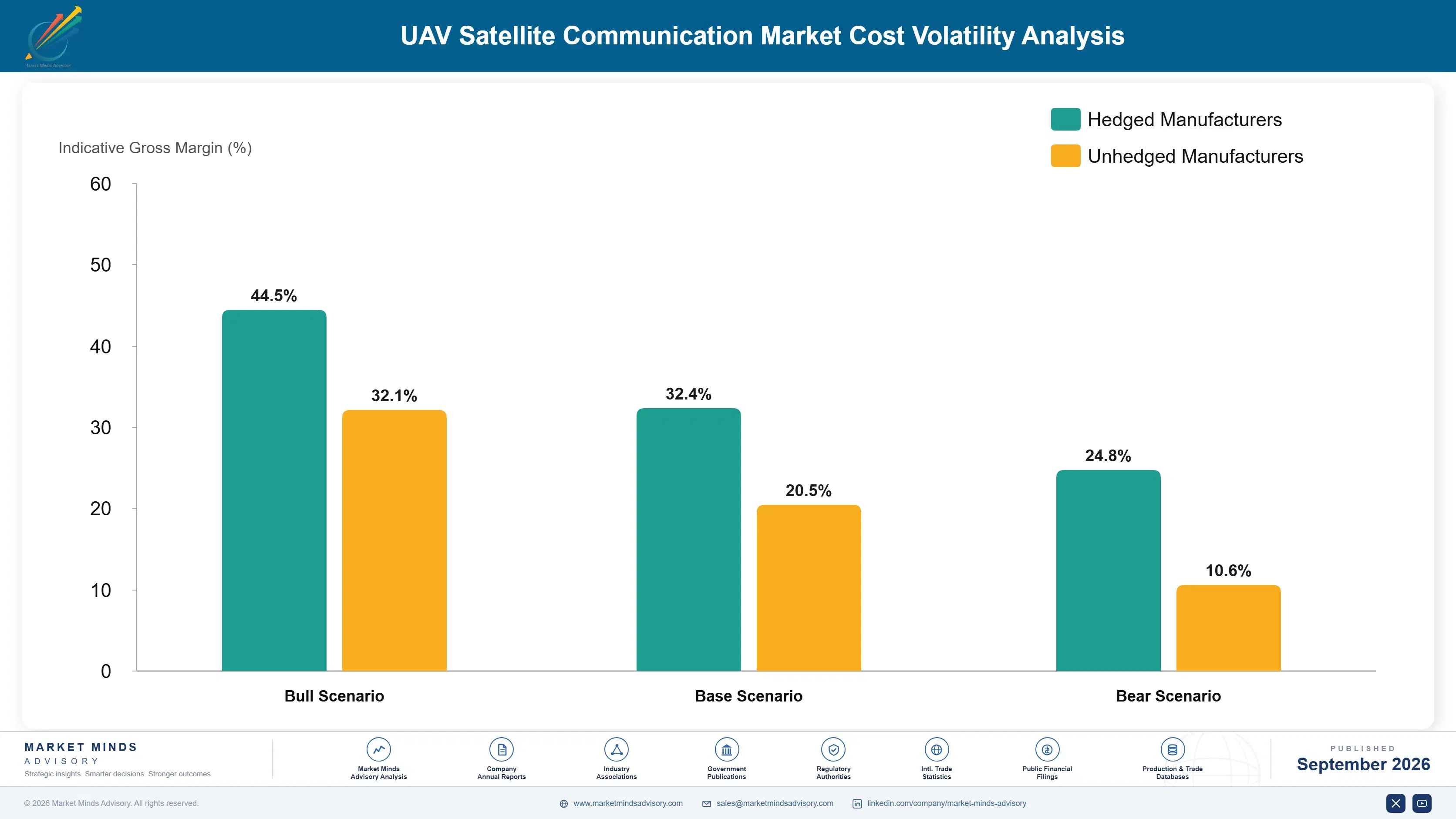
Phased array antenna elements and beamforming silicon account for roughly 41% of flat panel terminal cost, sourced from a small group of specialist radio frequency semiconductor suppliers. Certification and qualification amortisation absorbs around 19% across expected production volumes. Mechanical housing, thermal management and vibration isolation take about 16%, and airborne modem electronics absorb most of the remaining balance.
Radio frequency semiconductor supply tightened significantly through 2022 and 2023 as defence and commercial demand rose together against limited specialist foundry capacity, extending terminal lead times well beyond a year. Honeywell Annual Report 2023 and Viasat Annual Report 2023 both record component availability as a constraint on delivery during that period. Suppliers holding committed multi-year allocation delivered considerably better through that period than those buying capacity against demand as it arrived.

The competitive disadvantage mechanism is certification amortisation rather than component price. A supplier spreading roughly 31 months of approval work across large production volume carries a far lower cost per unit than one amortising the same effort across a handful of installations. Exposure concentrates among smaller entrants, whose certification burden is identical while their volume is not, which is a barrier unrelated to hardware quality.
uav-satellite-communication-market-cost-volatility-analysis-1789995083841

Amortise Certification Across Multiple Airframe Approvals

Approval work runs around 31 months per programme and absorbs roughly 19% of terminal cost when spread across expected volume. Structuring the campaign so one qualification effort supports several airframe approvals spreads that cost considerably further. The discipline is programme planning rather than engineering capability, and smaller entrants frequently certify one airframe at a time without considering the alternative.

Secure Radio Frequency Semiconductor Allocation Early

Phased array elements and beamforming silicon run roughly 41% of flat panel terminal cost and come from a small group of specialist suppliers serving defence and commercial demand together. Multi-year allocation lets a supplier quote delivery dates operators can plan flight programmes around. Buying against demand means being unable to commit, which loses tenders on schedule.

Design Terminals For Mass Rather Than Peak Performance

Terminal mass near 3.4 kilograms determines which aircraft classes can carry the equipment, and every kilogram removed adds another class to the addressable market. Engineering effort directed at mass reduction opens more revenue than the same effort spent improving link margin. Suppliers optimising for peak throughput are improving a specification that most mission profiles do not actually need.

Portfolio Architecture for Margin Defence

Margin architecture separates on certification burden and recurrence. Ground segment gateways and mission control equipment earn least, since they sit on the ground where no airworthiness approval applies and several suppliers compete. Airborne modems sit above on integration content. Certified flat panel terminals and airtime services earn most, because one carries a 31 month approval barrier and the other recurs for the aircraft's operating life.
The volume versus premium tension runs between hardware and airtime, and the two are increasingly being unbundled by customers. Terminal sales are episodic and certification-protected. Airtime recurs continuously and is exposed to constellation operators selling capacity directly at lower prices. Suppliers depending on bundled airtime margin are defending revenue that operators have both the incentive and the means to separate out.

High-value pools concentrate in certified terminals and in complete system supply to national programmes, and neither is reached through hardware capability alone. Certification requires aviation process depth accumulated over years. Complete system supply requires holding terminals, airtime and ground segment together, which very few organisations do. Both explain why the supplier list has changed so little despite considerable technology movement underneath it.

Volume / Commodity-Adjacent

Ground segment gateways, mission control equipment and standard cabling, sitting on the ground where no airworthiness approval applies and several capable suppliers compete. The ten point spread separates suppliers holding service attachment from those selling equipment purely transactionally.
Gross Margin: 22% to 32%

Premium / Certified

Airborne modems, network management units and geostationary steered terminals, where integration content and installed base familiarity determine selection. The twelve point spread tracks how much certification work a supplier has already amortised against how much remains ahead of it.
Gross Margin: 36% to 48%

Sustainability / Regulatory / Next-Generation

Certified flat panel terminals and satellite airtime services, protected respectively by a 31 month approval barrier and by recurring consumption across the aircraft's whole operating life. The eighteen point spread reflects certification breadth and airtime contract structure together.
Gross Margin: 52% to 70%
uav-satellite-communication-market-portfolio-architecture-1789995084340

High-value Sub-segments and Strategic Watch-out

Low Earth Orbit Flat Panel Terminals

Grows at 19.1% by removing the mass and latency constraints that had kept most uncrewed aircraft inside visual line of sight. The eighteen point spread here reflects overall certification breadth. Approval runs roughly 31 months, which protects whoever completed it rather than whoever builds best.
Gross Margin: 52% to 70%

Satellite Airtime And Capacity Services

Grows at 15.8% because every installed terminal generates recurring consumption across the whole operating life of the aircraft carrying it. The eighteen point spread here reflects airtime contract structure. Airtime runs 37% of operating cost per hour, which gives operators every incentive to unbundle it.
Gross Margin: 52% to 70%

Geostationary Electronically Steered Terminals

Grows at only 10.4% on larger platforms where established geostationary capacity contracts and coverage predictability still outweigh any concerns about latency. The twelve point spread here reflects already amortised certification work. Defence programmes holding existing capacity arrangements sustain the large majority of this remaining demand.
Gross Margin: 36% to 48%

Ground Segment And Mission Control Gateways

Grows at only 8.9% alongside general fleet expansion, carrying no airworthiness burden at all and several capable suppliers competing on price and integration. The ten point spread here reflects service and support attachment. Nothing here carries any of the certification protection that airborne equipment enjoys.
Gross Margin: 22% to 32%

Why Terminal Choices Endure

The annuity here is the approval rather than the agreement. A terminal certified onto an airframe stays there for the aircraft's operating life, because changing it means repeating an approval process running around 31 months for no operational benefit. Airtime consumption then recurs on every flight for years afterwards. The supplier completing certification first holds a position no commercial negotiation reaches.
Depth varies by whether certification applies at all. A terminal on a certified airframe is effectively fixed for the platform's life. A terminal on a smaller uncrewed platform outside certified airframe rules is barely fixed at all, and operators change suppliers on price without any regulatory consequence. Airtime sits between the two, contractually committed but increasingly exposed to constellation operators selling capacity directly at lower rates.

The buyer profile has moved from defence programme offices toward commercial flight operations and regulatory affairs. A programme office evaluated capability against a specification. A flight operations manager evaluates airtime cost per flight hour, where satellite runs roughly 37%. A regulatory affairs function determines which corridors the fleet can legally use at all. Suppliers still selling only to programme offices address one of three parties who now decide.
uav-satellite-communication-market-end-use-penetration-index-1789995084830

What Decides Terminal Selection

These are among the four positions where our research anticipates prominent divergence between winners and laggards over the coming forecast period. Each is grounded in the demand model, the regulatory perimeter, and the announced capacity pipeline.
01 / CERTIFICATION POSITION DEFENCE

Approval Beats Better Hardware Every Time

Airworthiness approval for an airborne terminal runs around 31 months from submission through to approved installation, so a competitor arriving with materially superior hardware still waits years before any operator can legally fly it on a certified airframe. That delay is the single most durable competitive position available in this whole category. It was earned by starting the paperwork early rather than by any engineering achievement, and suppliers treating certification as simple overhead are underinvesting badly in their own protection.
02 / REGULATORY DEMAND TRACKING

Follow Approval Dockets, Not Fleet Numbers

Roughly 140 separate corridors now formally permit beyond visual line of sight operation, and each new approval converts a previously confined fleet into aircraft requiring continuous satellite connectivity on every single flight that they make. Operators here frequently order terminals well in anticipation of an approval they are expecting, so demand here tracks regulatory proceedings rather than any fleet expansion or replacement cycle. Suppliers forecasting from aircraft delivery numbers alone consistently misread both when and where this demand will actually arrive.
03 / HYBRID CONNECTIVITY DESIGN

Concede Cellular Traffic To Keep The Customer

Satellite airtime runs roughly 37% of total operating cost per flight hour while terrestrial cellular connectivity costs a small fraction of that, and terrestrial cellular coverage keeps extending steadily into areas that previously had none at all. An operator able to complete a mission inside coverage will simply not pay satellite rates to do it. Terminals using cellular where it is available and satellite only where genuinely required keep the customer relationship while conceding marginal traffic that was leaving anyway.
04 / COMPLETE CAPABILITY SUPPLY

Bid As Principal On National Programmes

Gulf and Indian national programmes procure terminals, airtime and ground segment together as one complete capability rather than assembling components from several separate suppliers themselves. Saudi Arabia compounds at 20.4% annually, and those buyers specify against national capability targets rather than against any commercial payback calculation. Suppliers able to offer only one element of the whole system become subcontractors in those tenders rather than principals, which is a materially worse position and one that keeps getting harder to recover from.

Engagement Snapshot From the Field

A live engagement with an industry participant carrying material or product regulatory and market exposure ahead of a defining policy shift, showing how our research translates into a defensible multi-year portfolio strategy.
MARKET MINDS ADVISORY · CLIENT ENGAGEMENT SUMMARY
UAV Satellite Communication Producer Strategic Portfolio Review and Transition Roadmap 2026·Investment Scenario on UAV Satellite Communication Exposure Evaluation 2025-26
CLIENT PROFILE
An infrastructure inspection operator flying pipeline and transmission line surveys across three countries, with a mixed fleet carrying two different satellite terminal types and airtime contracted separately from hardware. Operating cost per flight hour had risen for two consecutive years and nobody had separated how much of that increase was airtime rather than anything else.
STRATEGIC CHALLENGE
Operations wanted to standardise on a single terminal across the fleet to cut spares and training cost. Finance wanted airtime renegotiated, believing it was being overcharged. Neither had established what proportion of missions actually flew beyond terrestrial cellular coverage, which turned out to determine whether either proposal made any sense.
MMA APPROACH
MMA analysed flight tracks against terrestrial cellular coverage maps to establish what share of mission time genuinely required satellite connectivity. We separated airtime from other operating cost per flight hour across both terminal types, and assessed the certification status of alternative terminals against the client's airframes. Work drew on 47 expert interviews conducted in Q4 2025 with operators and suppliers.
KEY FINDINGS
  1. Around 4 in 10 mission minutes flew inside terrestrial cellular coverage, yet the aircraft used satellite connectivity throughout because no hybrid capability existed on either terminal.
  2. Airtime accounted for roughly 39% of operating cost per flight hour, close to the industry pattern and higher than finance had assumed before the analysis.
  3. Standardising on the preferred terminal would have required a fresh airworthiness approval on two airframes, adding delay nobody had budgeted (client-reported, unverified by MMA).
  4. Two forthcoming corridor approvals would extend the operator's addressable work considerably, and no existing procurement plan accounted for the resulting terminal demand at all.
CLIENT PROFILE
An infrastructure inspection operator flying pipeline and transmission line surveys across three countries, with a mixed fleet carrying two different satellite terminal types and airtime contracted separately from hardware. Operating cost per flight hour had risen for two consecutive years and nobody had separated how much of that increase was airtime rather than anything else.
STRATEGIC CHALLENGE
Operations wanted to standardise on a single terminal across the fleet to cut spares and training cost. Finance wanted airtime renegotiated, believing it was being overcharged. Neither had established what proportion of missions actually flew beyond terrestrial cellular coverage, which turned out to determine whether either proposal made any sense.
MMA APPROACH
MMA analysed flight tracks against terrestrial cellular coverage maps to establish what share of mission time genuinely required satellite connectivity. We separated airtime from other operating cost per flight hour across both terminal types, and assessed the certification status of alternative terminals against the client's airframes. Work drew on 47 expert interviews conducted in Q4 2025 with operators and suppliers.
KEY FINDINGS
  1. Around 4 in 10 mission minutes flew inside terrestrial cellular coverage, yet the aircraft used satellite connectivity throughout because no hybrid capability existed on either terminal.
  2. Airtime accounted for roughly 39% of operating cost per flight hour, close to the industry pattern and higher than finance had assumed before the analysis.
  3. Standardising on the preferred terminal would have required a fresh airworthiness approval on two airframes, adding delay nobody had budgeted (client-reported, unverified by MMA).
  4. Two forthcoming corridor approvals would extend the operator's addressable work considerably, and no existing procurement plan accounted for the resulting terminal demand at all.
RECOMMENDED STRATEGY
Phase 1: Phase one: specify hybrid terminals on all future acquisitions, since around four in ten mission minutes could use cellular connectivity at a fraction of the cost. Phase 2: Phase two: abandon fleet standardisation on the two airframes requiring fresh approval, since the certification delay exceeded any spares saving available. Phase 3: Phase three: plan terminal procurement against the forthcoming corridor approvals rather than against current fleet size alone, which understated the requirement.
OUTCOME
The operator adopted hybrid terminals on new acquisitions and dropped standardisation where certification would have been required (client-reported, unverified by MMA). Airtime cost per flight hour fell measurably within two quarters. Procurement is now planned against regulatory approval dockets rather than fleet size, which is the change that outlasted the engagement.

Frequently Asked Questions

Foundational context covering the market sizes, CAGR, scope, country, region and competition that inform every finding below. This section is provided to cover basics and most often pre-purchase conversations, answered from the MMA Primary Research Dataset.

What is the current size of the UAV Satellite Communication Market?

Global value reaches USD 3.1 billion in 2026, measured as terminal and service revenue for uncrewed platforms across six system classes. The 2025 base is USD 2.7 billion.

How large will the UAV Satellite Communication Market be by 2036?

The market reaches USD 10.3 billion by 2036, an increase of USD 7.2 billion across the forecast period. That represents 3.32 times expansion from the 2026 base.

What is the CAGR for the UAV Satellite Communication Market 2026 to 2036?

The base case runs at 12.7% annually, with a bull case at 14.0% if corridor approvals broaden faster than published and a bear case at 11.4% if extending cellular coverage removes missions from the category.

Which segment is growing fastest?

Low earth orbit flat panel terminals grow at 19.1%, half again the market rate of 12.7%. Reduced mass and latency together open aircraft classes that geostationary links never could.

Who are the major companies in the UAV Satellite Communication Market?

Honeywell Aerospace, Viasat, Cobham Satcom, Gilat Satellite Networks and Hughes Network Systems lead on terminal and service revenue, holding 56%. Kymeta and ThinKom Solutions hold smaller positions.

Which country is growing fastest?

Saudi Arabia leads at 20.4%, on border surveillance and pipeline monitoring programmes funded as national capability rather than as commercial ventures. India and Australia follow behind.

Report Segmentation Architecture

The full report scope spans multiple orthogonal segmentation dimensions, with cross-tabulated demand data provided for each dimension pair. Coverage extends further to regional breakdowns, trend trajectories, and the competitive detail needed to support segment-level decision-making.

By System Class

  • Low Earth Orbit Flat Panel Terminals
  • Satellite Airtime And Capacity Services
  • Geostationary Electronically Steered Terminals
  • Geostationary Mechanically Steered Terminals
  • Airborne Modems And Network Management Units
  • Ground Segment And Mission Control Gateways

By End-Use Industry

  • Defence And Military Surveillance
  • Pipeline And Energy Infrastructure Inspection
  • Border And Maritime Patrol
  • Agriculture And Environmental Monitoring
  • Mining And Resource Survey
  • Emergency Response And Disaster Assessment

By Commercial Dimension

  • National Capability Programmes
  • Defence Prime Contractor Supply
  • Commercial Operator Direct Purchase
  • Airtime Service Subscription
  • Systems Integrator Delivery
  • Aftermarket Retrofit Installation

By Region

  • North America
  • Western Europe
  • East Asia
  • South Asia and Pacific
  • Latin America
  • Middle East and Africa
  • Eastern Europe

Scope, Methodology, and Coverage

Every figure in this report is reproducible from documented input assumptions. The scope below maps the historical period, the forecast horizon, the segmentation dimensions, and the countries covered, alongside the underlying primary and qualitative methodology.
Historical Period
2020 to 2025
Forecast Period
2026 to 2036
Base Year
2025 (USD billions; MMA Primary Research Dataset, September 2026)
Market Definition
This report covers satellite communication systems for uncrewed aerial vehicles by system class: low earth orbit flat panel terminals, geostationary mechanically steered terminals, geostationary electronically steered terminals, airborne modems and network management units, satellite airtime and capacity services for uncrewed platforms, and ground segment and mission control gateways. It excludes the uncrewed aircraft themselves, terrestrial radio control links, payload sensors, satellite manufacturing and launch, and flight control systems.
Quantitative Units
USD millions, terminal and service revenue basis; installed terminals; terminal mass in kilograms; round trip latency in milliseconds; airtime as a share of operating cost per flight hour; certification periods in months.
Segmentation Dimensions
System class; mission and end-use type; commercial procurement route; geography across seven regions.
Regions Covered
North America, Western Europe, East Asia, South Asia and Pacific, Latin America, Middle East and Africa, Eastern Europe
Countries Covered
United States, Canada, Saudi Arabia, United Arab Emirates, Qatar, Israel, United Kingdom, France, Germany, Italy, Norway, Poland, Romania, China, Japan, South Korea, India, Australia, Brazil, Colombia.
Key Companies Profiled
Honeywell Aerospace, Viasat, Cobham Satcom, Gilat Satellite Networks, Hughes Network Systems, Iridium Communications, Kymeta, Get SAT, Orbit Communication Systems, ThinKom Solutions, CesiumAstro, L3Harris Technologies, Thales Alenia Space, Airbus Defence and Space, Intellian Technologies.
Quantitative Methodology
Primary survey, n=3,800 respondents, Q4 2025, six countries; demand-side model with trade association cross-validation
Qualitative Methodology
47 expert interviews, Q4 2025; applied to validate demand model assumptions, identify emerging dynamics, and assess competitive positioning
Report Format
PDF and XLSX data workbook (Word format preview document)
Publisher
Market Minds Advisory
Report Code
MMA-2026-TEC-721
Published
September 2026
Contact
sales@marketmindsadvisory.com | www.marketmindsadvisory.com

Purchase the full UAV Satellite Communication Market Report (2026 to 2036).

This report sizes the global UAV satellite communication market from 2026 to 2036 across six system classes, six mission types and seven regions. It explains why airworthiness certification running around 31 months protects incumbents more effectively than any technology position, and why demand tracks regulatory corridor approvals rather than aircraft deliveries. Terminal mass near 3.4 kilograms is analysed as the constraint that determined which aircraft classes could fly beyond line of sight at all. Cost composition is sourced to company annual reports. Regional analysis explains why Middle East and Africa holds 19% of spending.
Six system classes sized through to 2036
Certification timelines quantified as a competitive barrier
Corridor approval counts mapped against addressable demand
Twenty named suppliers assessed on terminal revenue
Four revenue levers with quantified commercial impact
Anonymised inspection operator connectivity engagement documented in full

Built For The People Who Decide

From boardroom strategy to bench-side execution, this report is read cover-to-cover by leaders shaping the next decade of their industry, turning demand scenarios, market dynamics and valuation benchmarks into decisions.
CXOs/ Presidents/ VPs/ Managers
M&A and Corporate Development
Strategy Teams and R&D Heads
Procurement and Product Directors
Regulatory and Compliance Leaders
Investor Relations and Equity Analysts