

Market Minds Advisory
Two-Wheeler Lubricants Market

Two-Wheeler Lubricants Market: One Litre Doing Three Different Jobs

A motorcycle sump holds about a litre and lubricates the engine, the clutch and the gearbox from it, which is why the cheaper car oil on the next shelf ruins the machine.

Lead Analyst

Bilal Shaikh

Published

September 2026

Make Smarter Decisions with Customized Research Insights

Request a free sample report and evaluate market opportunities, growth trends, and competitive dynamics relevant to your business needs.

2025 MARKET VALUE$8.6BMarket Size 2025
2036 FORECAST VALUE$13.5BBase Case , 2026 to 2036
CAGR 2026 TO 20364.2 %Bull 5.4% / Bear 3.0%
INCREMENTAL OPPORTUNITY$4.6BNet 10- year value creation
EXPANSION MULTIPLE1.51x2036 value over 2026 base
Strategic Levers
M&A Pipeline
Regional Outlook
Country Rankings
Competitive Intelligence
Segmental Deep-dive
Call-Us : 91 93563 13602

Executive Snapshot and Market Trajectory

A motorcycle asks more of its oil than a car does and gives it far less to work with. Roughly one litre lubricates the engine, the wet clutch and the gearbox together, and it gets drained again after about 3,000 kilometres. Nothing about that resembles a car.
That shared duty is why passenger car oil cannot be substituted despite looking identical on the shelf. Friction modifiers that improve fuel economy in a car cause the wet clutch to slip, which is the entire reason a separate motorcycle specification exists at all. Riders buying the cheaper bottle discover this some weeks later. It is a delayed feedback loop nobody can explain at a counter.
Counterfeit product is the other quiet problem, running near 22% of volume in the largest markets. Packaging is cheap to copy, the buyer cannot tell by looking, and the failure shows up months afterwards as engine wear that nobody traces back to the bottle it came from. The mechanic takes around 34% of the bottle price and chooses the product. Workshop economics rather than rider preference decides what goes in. Nobody checks afterwards.
Market Definition
Lubricants and functional fluids for motorcycles, scooters and mopeds, covering four-stroke engine oils, two-stroke engine oils, synthetic and semi-synthetic premium oils, chain lubricants and sprays, brake fluids and coolants, and gear and fork oils. Measured at supplier selling value. Excludes passenger car and commercial vehicle lubricants, industrial greases, fuel additives sold separately, and workshop service labour.
Base Year Value
$8.6B in 2025 (MMA Primary Research Dataset, August 2026)
Forecast Period
2026 to 2036, eleven discrete annual values
CAGR
4.2% base case. Bull 5.4%. Bear 3.0%.
Fastest Growth Segment
Synthetic and Semi-Synthetic Premium Oils: 6.3% CAGR
Fastest Growth Country
Vietnam: 7.8% CAGR
Fastest Growth Region
South Asia and Pacific: 6.2% CAGR
Largest Region
South Asia and Pacific: 34% of 2025 global value
Market Leaders
Shell, Castrol, TotalEnergies, Indian Oil Corporation, Motul. Source: MMA Primary Research Dataset, July 2026.
Primary Survey
n=3,800 procurement and R&D decision-makers, Q4 2025, six countries
Methodology
Demand-side build-up, cross-validated against public data, 47 expert interviews

Two-Wheeler Lubricants Market Forecast Scenarios

two-wheeler-lubricants-market-trends-size-forecast-scenario-1787640273106
Growth ran near 3.6% between 2020 and 2025 with premiumisation doing more work than volume. Two-stroke oil declined steadily as older machines left the parc across every major market. Synthetic and semi-synthetic grades gained share as riders in Asian markets traded up alongside rising incomes. Electric two-wheeler sales grew quickly in China without yet reducing lubricant demand meaningfully anywhere else.
Base case 4.2% rests on three mechanisms. Synthetic and semi-synthetic grades grow at 6.3% as premiumisation continues across large Asian parcs. Chain lubricants grow at 5.4% because electric machines still need them while needing no engine oil at all. And Vietnam grows fastest of any country at 7.8% on an enormous parc trading up toward premium grades at the same time. None of the three depends on parc expansion, which has largely finished across the major Asian markets.
The bull case at 5.4% assumes premiumisation accelerating across Indian and Southeast Asian markets, which would lift value considerably without any change in the number of machines on the road. The bear case at 3.0% is electrification advancing faster than expected in urban Asia, since an electric machine removes roughly 76% of the lubricant spend a combustion equivalent generates.

Small Sump, Hard Life

The engineering problem here is genuinely harder than the one a car oil solves. About a litre of oil lubricates the engine, the wet clutch and the gearbox from a single sump, at higher revolutions and higher operating temperature, and it is drained again after roughly 3,000 kilometres. The same fluid must protect gear teeth, allow a clutch to grip and keep an engine cool, which are not compatible requirements.
TOP FIVE CONCENTRATION42%International majors and national oil companies both hold strong positions
TYPICAL SUMP CAPACITY1 litreVolume serving engine, clutch and gearbox all at once
DRAIN INTERVAL3000 kmDistance between oil changes on a typical machine
COUNTERFEIT SHARE OF VOLUME22%Portion of product sold that is not genuine
WORKSHOP MARGIN SHARE34%Cut the fitting mechanic takes on each bottle sold
VALUE REMOVED BY ELECTRIFICATION76%Share of product spend an electric machine no longer needs
That is why passenger car oil is not a cheaper alternative despite appearing identical on a shelf. The friction modifiers that improve fuel economy in a car make a wet clutch slip, and the separate motorcycle specification exists precisely to prevent that. A rider who saves money on the bottle discovers the consequence some weeks later, which is a delayed feedback loop that undermines every attempt to educate buyers on the difference.
Two commercial features shape the market more than product quality does. Counterfeit product runs near 22% of volume in the largest markets, because packaging is cheap to copy and failure appears months later as wear nobody traces back. And the mechanic takes around 34% of the bottle price, which means workshop economics decides what goes in.
"The rider thinks they are buying oil and the mechanic is deciding what goes in the bike. Brand advertising reaches one of those two people, and it is consistently the one without the funnel in their hand."
Director, Automotive Fluids and Aftermarket Practice · MMA Automotive and Mobility Practice · August 2026

Market Trends

Premiumisation lifting value without adding any machines

Synthetic and semi-synthetic grades grow at 6.3% as riders across large Asian parcs trade up alongside rising incomes, which lifts value per drain without a single additional motorcycle appearing on the road. Drain intervals extend somewhat with better oils, though not enough to offset the price difference. That makes premiumisation the main growth mechanism available in markets where parc expansion has already largely finished. Workshop recommendation converts most of that trading up, since riders rarely specify a grade themselves at any point. Value per drain does the work. Machines are not added.
Market Impact: Vietnam growing fastest at 7.8%
Electrification removing engine oil but not everything else

An electric two-wheeler needs no engine oil, which removes roughly 76% of the lubricant spend a combustion equivalent generates, yet it still needs chain lubricant, brake fluid and coolant, and many need gear oil. Chain lubricants grow at 5.4% partly on that basis. Electrification therefore reshapes the product mix toward low value items rather than removing the market, which is a different problem from disappearance. Suppliers whose portfolios are almost entirely engine oil face losing most of their volume rather than all of it. Mix reshapes rather than vanishing. Disappearance is a different problem.
Market Impact: Mechanics take 34% of price

Market Opportunities and Growth Drivers

Large parcs trading up toward premium specifications

Vietnam grows fastest of any country at 7.8% on an enormous two-wheeler parc trading toward premium grades as incomes rise, and value per drain rather than drain frequency carries that growth. Machines are used intensively as primary transport rather than recreationally, which keeps drain frequency high regardless of income. Suppliers organised around mature western markets are covering parcs that stopped growing several decades ago. Premiumisation in large Asian and Latin American parcs is where value growth remains genuinely available without any additional machines. Machine numbers barely move. Income growth carries it.
Market Impact: Counterfeit near 22% of volume

Workshop economics deciding what goes into the machine

The fitting mechanic takes around 34% of the bottle price and chooses the product in most high volume markets, since riders rarely specify a brand and cannot easily verify what was poured. Brand advertising reaches the rider while the decision sits with the workshop. Suppliers building mechanic loyalty through margin, training and tooling reach the person actually making the choice at the point it is made. Margin structures, training and tooling reach the person holding the funnel at the moment the choice is being made. Rider advertising misses entirely. Loyalty is built at the bench.
Market Impact: Substitution damages 1 litre sumps

Market Restraints and Challenges

Counterfeit product taking a large share of volume

Counterfeit lubricant runs near 22% of volume in the largest markets, because packaging is cheap to reproduce, buyers cannot verify contents and engine damage appears months later as wear nobody attributes to the oil. The root cause is delayed and untraceable failure rather than any lack of enforcement. Commercially it removes volume and damages brands blamed for damage they did not cause. Tamper evident packaging, authentication codes and workshop verification are the practical responses. Strong brands are counterfeited most, which makes the exposure worst for the businesses that invested most in reputation.
Market Impact: Premium grades growing at 6.3%

Passenger car oil substitution damaging clutches invisibly

Friction modifiers in passenger car oil make wet clutches slip, and riders substituting on price discover this weeks later when clutch performance deteriorates. The root cause is that the two products look identical and cost differently. Commercially it loses volume to a product that was never suitable and generates complaints against motorcycle oil brands. Specification labelling, mechanic education and clear point of sale differentiation are what actually work. The friction modifiers that improve car fuel economy are precisely what makes a wet clutch slip. Two products look identical on a shelf.
Market Impact: Electrification removes 76% of spend
4 additional market trends, 3 additional growth drivers, and 2 additional restraints and challenges are covered in the full report. Contact sales@marketmindsadvisory.com to access the complete intelligence.

Segment CAGR and Growth Architecture

Six segments split by product type, because product determines the function performed, whether an electric machine still needs it, the purchase frequency involved and the price it commands. Viscosity and packaging variants sit inside each product type. Vehicle and channel dimensions are handled separately within the framework. Product type decides whether an electric machine still needs it.
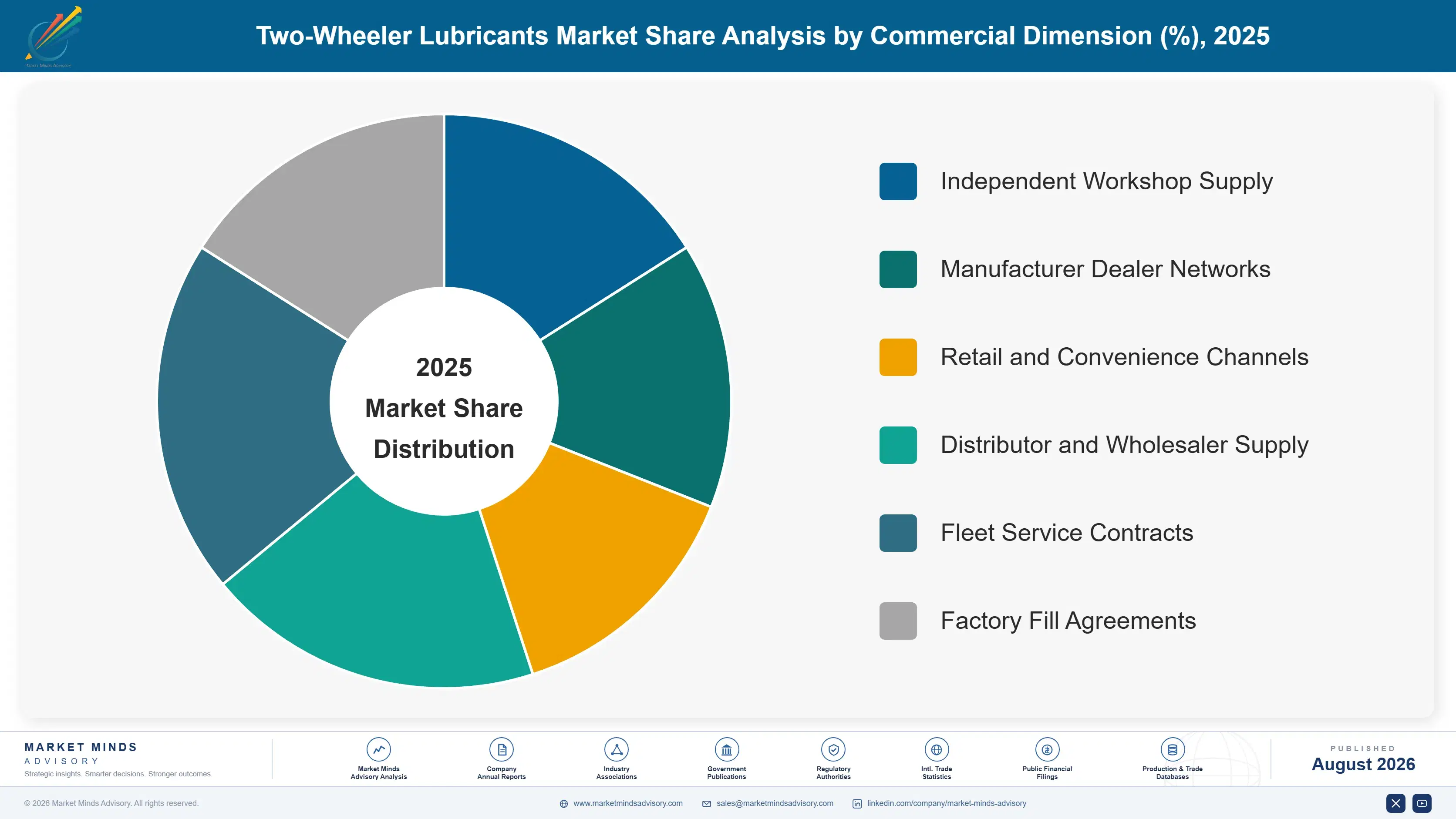
two-wheeler-lubricants-market-trends-market-share-analysis-1787640273675

Synthetic and Semi-Synthetic Premium Oils

Growing at 6.3%, half again the market rate of 4.2%, premium grades handle the shared engine, clutch and gearbox duty more consistently across a drain interval and allow somewhat longer intervals than mineral oils manage. Growth comes from riders in large Asian parcs trading up rather than from any increase in machines, which makes it a value mechanism rather than a volume one. Workshop recommendation carries most of that conversion, since riders rarely specify grade themselves. Base oil carries most of the cost in economy grades while brand and specification carry the pricing here, which is why the margin difference between tiers is so wide across every market covered. Grade is chosen at the workshop.
CAGR 6.3%

Chain Lubricants and Sprays

At 5.4% chain lubricants survive electrification entirely, since an electric machine still drives through a chain and still needs it lubricated at similar intervals. Value per application is small and purchase frequency is high, which makes distribution reach matter more than product differentiation. As electric two-wheelers displace combustion machines in urban Asia, this segment becomes a larger share of a smaller total, which is an uncomfortable kind of growth. Distribution reach matters more than formulation because unit values are small and purchase frequency is high, which favours suppliers with dense workshop and retail coverage over those with better products. Electric machines still drive through chains and still need them lubricated at broadly similar intervals throughout.
CAGR 5.4%
Full segment breakdown across 6 segments available in the complete report.

Regional Architecture and Country Demand Map

South Asia and Pacific holds 34% of value because the two-wheeler parc concentrates there overwhelmingly, well above the usual regional band. East Asia follows at 24% on Chinese parc scale and manufacturing. South Asia and Pacific grows fastest of the seven regions covered here. Parc scale drives both.

North America

Share sits at 8%, well below the usual regional band, because motorcycles here are largely recreational rather than primary transport and annual mileage per machine is correspondingly low. Premium grades carry a high share of a small volume, since owners of leisure machines buy on brand rather than price. Dealer servicing dominates over independent workshops. Growth at 3.4% reflects a stable parc with premium mix doing most of the work. Annual mileage per machine is a fraction of what commuter parcs in Asia accumulate, which limits drain frequency correspondingly. Dealer servicing dominates over independent workshops, which puts the recommendation with a franchised network rather than a roadside mechanic. Leisure owners buy on brand.
Share: 8% | CAGR: 3.4% (2026 to 2036)

Western Europe

Share of 12% sits below the usual band for similar reasons, with motorcycles used recreationally in most countries and scooters providing urban transport in southern markets. Premium and synthetic grades hold a very high share, and specification compliance is well understood by owners. Counterfeit product is rare. Regional growth of 2.6% is the slowest anywhere on a declining parc and mileage that keeps falling. Scooters provide urban transport across southern markets, though the parc overall has been declining for years and mileage keeps falling. Specification compliance is well understood by owners here and counterfeit product is rare, which makes it the least troubled market in the category. Synthetic share is very high.
Share: 12% | CAGR: 2.6% (2026 to 2036)
Regional intelligence for 5 additional markets available in the complete report: East Asia, South Asia and Pacific, Latin America, Middle East and Africa, Eastern Europe. Contact sales@marketmindsadvisory.com.
two-wheeler-lubricants-market-trends-country-cagr-analysis-1787640274242

Four Moves at the Workshop Counter

The rider buys the machine and the mechanic chooses the oil, which is where most of this industry's advertising misses entirely. What remains available is winning the workshop, making counterfeit product identifiable, and preparing a mix that survives electrification. The rider sees the advertising and the mechanic makes the choice. Very few have closed that gap properly.

Win the mechanic rather than the rider

The fitting mechanic takes around 34% of the bottle price and chooses the product in most high volume markets, since riders rarely specify a brand and cannot verify what was poured. Advertising reaching riders addresses somebody who is not making the decision. Margin structures, training, tooling and workshop programmes reach the person holding the funnel at the moment the choice is actually being made. Riders cannot verify afterwards. Riders rarely name a brand at all, and even where they do the mechanic frequently pours something else entirely. Funnels beat billboards.
Market Impact: Reaches the 34% margin holding fitting mechanic directly

Make counterfeit product identifiable at the counter

Counterfeit lubricant runs near 22% of volume in the largest markets and damages brands blamed for engine wear they did not cause. Tamper evident packaging and authentication codes let a mechanic or rider verify product before it is poured, which converts an invisible problem into a visible one. Brands absorbing counterfeit damage without any verification mechanism are paying for somebody else's product twice over. Strong brands are counterfeited most, so the businesses that invested most in reputation carry the largest exposure to it. Tracing is impossible months later. Verification changes that.
Market Impact: Addresses the whole 22% counterfeit share of volume

Build the mix that survives an electric parc

An electric two-wheeler removes roughly 76% of lubricant spend by eliminating engine oil, while chain lubricant, brake fluid, coolant and gear oil all survive intact. Chain lubricants grow at 5.4% partly on that. Suppliers whose portfolios are almost entirely engine oil face a transition that removes most of their volume, while those holding the surviving products keep a smaller position that does not disappear. A smaller position that survives beats a larger one that disappears. Chain lubricant, brake fluid, coolant and gear oil all survive the transition intact, which makes portfolio breadth the whole question.
Market Impact: Retains the 24% of spend that survives electrification

Follow parcs that are still trading up

Vietnam grows fastest at 7.8% as an enormous parc moves toward premium grades with rising incomes, and value per drain rather than machine numbers carries it. Suppliers organised around western markets are covering parcs that stopped growing decades ago and are now shrinking. Premiumisation in large Asian and Latin American parcs is where value growth remains available without needing a single extra motorcycle. Western parcs stopped growing decades ago and have since begun shrinking, which makes coverage built around them progressively less useful. Income growth does the work. Coverage has not followed.
Market Impact: Follows the 7.8% Vietnamese premiumisation driven growth rate

Who Controls the Margin Pool

Participation is measured on annual revenue from two-wheeler lubricants and functional fluids, and the top five hold 42%. Concentration is moderate because international majors compete against national oil companies with strong domestic distribution and against motorcycle manufacturer branded oils sold through dealer networks. The gap to challengers is distribution density rather than formulation, and it took decades to build across fragmented workshop networks.
Competition runs on three fronts. Workshop relationships decide independent aftermarket volume, which is most of the market in Asia. Manufacturer partnerships decide dealer network supply and factory fill. And distribution reach decides whether a brand is available where a machine happens to break down. Each front rewards a different capability, and very few participants hold all three of them properly.

Pressure ahead comes from electrification reshaping product mix and from premiumisation lifting value in large parcs. Expect suppliers with workshop programmes and surviving product ranges to gain. Rankings shift on whoever reaches the mechanic rather than the rider. Concentration should stay moderate given national oil company positions. Suppliers weighted almost entirely toward engine oil look most exposed as electrification advances through the urban Asian parcs first.
two-wheeler-lubricants-market-trends-company-positioning-matrix-1787640274771

Competitive Moat and Risk Dimensions

SHELL

Moat: Distribution reach and workshop programmes

Distribution into independent workshops across large Asian and Latin American markets reaches the people who actually choose the product, and workshop training and margin programmes build loyalty that rider advertising cannot. That reach took decades to establish across fragmented networks and is difficult for any entrant to replicate at comparable density.
SHELL

Risk: Engine oil portfolio concentration

An electric two-wheeler removes roughly 76% of lubricant spend by eliminating engine oil, and portfolios weighted heavily toward it face a transition that removes most of the volume. Chain lubricant and brake fluid survive but carry far lower value per machine, so the remaining position is considerably smaller than the one being displaced.
CASTROL

Moat: Brand recognition and manufacturer partnerships

Strong rider level brand recognition combined with motorcycle manufacturer partnerships supports both dealer network supply and the recommendation a mechanic makes when a customer names a brand. Those partnerships also secure factory fill positions that carry through into the servicing recommendation for the machine's early life.
CASTROL

Risk: Counterfeit product brand damage

Counterfeit lubricant runs near 22% of volume in the largest markets and strong brands are counterfeited most, which means engine damage caused by fake product attaches to the genuine name. Verification mechanisms help but require distribution wide implementation, and the damage occurs months after purchase when tracing is effectively impossible.

Players Tracked

Prominent Players

Shell
Castrol
TotalEnergies
Indian Oil Corporation
Motul

Other Key Players

ExxonMobil
Idemitsu Kosan
Petronas Lubricants International
Pertamina Lubricants
Bharat Petroleum
Hindustan Petroleum
Gulf Oil International
Valvoline
Repsol
Eni
ENEOS
Liqui Moly
Sinopec Lubricant
Chevron
Fuchs

Recent Developments

MARCH 2026

Brand rolls out authentication codes across workshop distribution

A lubricant brand rolled out pack level authentication codes across its independent workshop distribution, allowing mechanics and riders to verify product before pouring in markets where counterfeit penetration had been damaging its reputation. Complaint volumes attributed to the brand fell within two quarters. Genuine product share recovered.
Signal: Verification turned an invisible counterfeit problem into a visible one right at the workshop counter itself
SEPTEMBER 2025

Electric two-wheeler sales pass combustion in major cities

Electric two-wheeler sales exceeded combustion machines across several large Asian cities, beginning a transition that removes engine oil demand while leaving chain lubricant, brake fluid and coolant requirements entirely unchanged. Chain lubricant demand from those machines was entirely unaffected. Engine oil volume fell sharply. Nobody had modelled the split.
Signal: Electrification reshapes the whole product mix rather than simply removing the market outright at all here
JANUARY 2026

Workshop programme shifts recommendation toward premium grades

A supplier workshop programme combining margin structure with mechanic training shifted product recommendation toward premium grades measurably, confirming that the fitting mechanic rather than the rider decides what goes into the machine. Rider advertising had achieved nothing comparable. Mechanics simply had not been asked before.
Signal: The person who is actually holding the funnel decides it, and rider advertising never reaches them

Base Oil, Additives and Packaging

Base oil carries around 58% of finished lubricant cost, priced from refinery streams and synthetic production that no blender controls. Additive packages absorb roughly 22%, supplied by a very concentrated group of specialty chemical producers. Packaging accounts for about 11%, which is unusually high because two-wheeler oil sells in one litre bottles rather than in bulk. Blending, distribution and quality release take the balance.
Base oil pricing moved sharply with crude and refinery margins across recent years, per International Energy Agency reporting on oil markets and Shell annual reporting for 2025 on lubricant input cost commentary. Blenders passed movements through unevenly, since premium grades sustained pricing on brand and specification while economy grades faced immediate substitution toward cheaper and sometimes counterfeit alternatives. Counterfeit product caps how far economy pricing can move.

Exposure divides on portfolio position rather than on scale. An economy grade blender carries base oil across most of cost against buyers who substitute instantly on price. A premium brand carries the same input cost supported by specification and brand pricing. A national oil company with refinery integration carries base oil internally, which is the most sheltered position of the three by a considerable margin.
two-wheeler-lubricants-market-trends-cost-volatility-analysis-1787640274971

Index base oil exposure into distributor supply agreements

Base oil carries well over half of finished cost and moves with crude and refinery margins that no blender influences at all. Indexation shifts that exposure toward distribution, though it requires distributor agreements structured for it, and workshop channels accustomed to fixed pricing resist the mechanism more firmly than organised retail does. Workshops resist indexation firmly.

Shift mix toward premium and specification grades

Economy grades face immediate substitution when prices rise, including toward counterfeit product that costs the brand twice. Premium and specification compliant grades sustain pricing on brand and on the genuine performance difference a wet clutch requires, which reduces base oil exposure per unit of revenue while improving margin. Wet clutch requirements are genuine. Substitution stops there.

Reduce packaging cost through refill and bulk workshop supply

Packaging carries around a ninth of finished cost because product sells in one litre bottles rather than bulk. Workshop bulk supply with measured dispensing reduces that considerably, though it removes the pack level authentication that protects against counterfeit, which makes the trade genuinely difficult in affected markets. The trade is genuinely difficult. Authentication is lost with bulk.

Portfolio Architecture for Margin Defence

Margin here follows brand and specification rather than formulation cost, because the buyer usually cannot verify what went into the engine and relies on whoever poured it. Economy mineral engine oils earn margins in the low to high teens, where base oil cost dominates and buyers substitute instantly on price, sometimes toward counterfeit product. Counterfeit product competes directly at that level and wins on price every time.
Chain lubricants, brake fluids and coolants do better in the low twenties to mid thirties, because purchase frequency is high, unit values are small enough that price sensitivity falls away and distribution reach matters more than formulation. Purchase frequency rather than unit value carries the economics in this tier.

Synthetic and semi-synthetic premium oils hold the strongest position, reaching into the low forties, where specification compliance and brand recognition both support pricing that economy grades cannot approach. Those margins depend on the workshop recommending them, since riders rarely specify grade themselves, which makes mechanic relationships rather than consumer advertising the thing that actually protects them. Mechanic relationships rather than consumer advertising are what actually protect these margins over time.

Economy Mineral Engine Oils

Products where base oil cost dominates and buyers substitute instantly on price. The seven point range reflects base oil sourcing and blending scale rather than any performance difference between suppliers.
Gross Margin: 12-19%

Chain Lubricants, Brake Fluids and Coolants

Small unit value products bought frequently where distribution reach matters most. The fourteen point range reflects channel coverage and packaging cost rather than formulation capability across suppliers. Frequency carries the economics.
Gross Margin: 21-35%

Synthetic and Semi-Synthetic Premium Oils

Specification compliant grades supported by brand recognition and workshop recommendation. The twelve point range reflects brand strength and how deeply the workshop programme reaches independent mechanics. Mechanics decide the recommendation.
Gross Margin: 30-42%
two-wheeler-lubricants-market-trends-portfolio-architecture-1787640275478

High-value Sub-segments and Strategic Watch-out

Synthetic and Semi-Synthetic Premium Oils

High value and the fastest growth at 6.3%, driven by riders in large Asian parcs trading up rather than by any increase in machines. Workshop recommendation converts most of it. Riders rarely specify grade, which makes the mechanic relationship the thing that actually protects these margins.
Gross Margin: 30-42%

Chain Lubricants and Sprays

High value and growing at 5.4%, surviving electrification entirely since electric machines still drive through chains. Becomes a larger share of a smaller total as combustion machines leave the parc. Unit values are small and purchase frequency high, which makes distribution reach matter considerably more than formulation.
Gross Margin: 22-34%

Economy Mineral Engine Oils

The volume core, where base oil cost dominates and buyers substitute instantly, sometimes toward counterfeit product carrying the same apparent branding. Price is the only variable that decides. Counterfeit product competes directly here and wins on price, which caps how far economy pricing can move.
Gross Margin: 12-19%

Electrification Mix Exposure

The strategic watch-out. An electric machine removes roughly 76% of lubricant spend, and the range reflects whether a supplier holds the surviving products or depends almost entirely on engine oil. Portfolio breadth rather than engine oil strength decides who survives the transition with a business intact.
Gross Margin: 0-40%

Every Three Thousand Kilometres

Demand here repeats with unusual reliability, because a machine used as primary transport reaches its drain interval every few weeks and the oil must be changed whether or not anybody feels like spending the money. Around 3,000 kilometres between changes on a one litre sump produces frequent, small, predictable purchases across an enormous installed base of machines. Nothing else in automotive aftermarket repeats this reliably.
Stickiness sits with the workshop rather than with the rider, which most brand strategy in this category has never fully accepted. A mechanic stocking a brand continues pouring it because the margin, the relationship and the packaging are all familiar. Riders switch effortlessly because they mostly do not know what was used last time and have no way of checking afterwards.

The deciding party is therefore the person the advertising does not reach. Riders see brand campaigns and mechanics make the choice, taking around 34% of the bottle price for doing so. Manufacturer dealer networks are the exception, where factory fill and service schedules carry the recommendation, though that influence fades once a machine leaves warranty. That influence fades after warranty.
two-wheeler-lubricants-market-trends-end-use-penetration-index-1787640275978

Where We Would Put Effort

These are among the four positions where our research anticipates prominent divergence between winners and laggards over the coming forecast period. Each is grounded in the demand model, the regulatory perimeter, and the announced capacity pipeline.
01 / WORKSHOP CHANNEL PRIORITY

Advertising reaches the wrong person entirely

The fitting mechanic takes around 34% of the bottle price and chooses the product outright in most high volume markets, because riders rarely specify any brand at all and cannot verify afterwards what was actually poured into the machine. Advertising aimed at riders is addressing somebody who is not actually making the decision at any point. Margin structures, training, tooling and dedicated workshop programmes all reach the person actually holding the funnel at the precise moment the choice gets made.
02 / COUNTERFEIT VERIFICATION SYSTEMS

You are paying for somebody else's product

Counterfeit lubricant runs near 22% of total volume across the largest markets, and the strongest brands are the ones counterfeited most, which means engine damage caused by fake product attaches itself to the genuine name months afterwards. Tamper evident packaging and pack level authentication codes let either a mechanic or a rider verify the product before it ever goes in. Brands that absorb that damage without any verification mechanism in place are effectively paying for somebody else's product twice over.
03 / ELECTRIFICATION MIX PREPARATION

Not disappearance, but severe shrinkage

An electric two-wheeler removes roughly 76% of the lubricant spend that a combustion equivalent generates, simply by eliminating engine oil, while chain lubricant, brake fluid, coolant and gear oil all survive that transition completely intact. Suppliers whose portfolios are almost entirely engine oil therefore face losing most of their volume rather than all of it. Those already holding the surviving products keep a considerably smaller position that does not vanish entirely, which is a materially different outcome from losing everything.
04 / PREMIUMISATION GEOGRAPHY COVERAGE

Value grows without more machines

Vietnam grows fastest of any country covered here at 7.8% as an enormous parc trades toward premium grades on rising incomes, and value per drain rather than any increase in machine numbers carries that growth entirely. Suppliers who are still organised around the western markets are covering parcs that stopped growing decades ago and have since begun shrinking outright. Premiumisation across the large Asian and Latin American parcs is now the only place where genuine value growth remains available at all.

Engagement Snapshot From the Field

A live engagement with an industry participant carrying material or product regulatory and market exposure ahead of a defining policy shift, showing how our research translates into a defensible multi-year portfolio strategy.
MARKET MINDS ADVISORY · CLIENT ENGAGEMENT SUMMARY
Two-Wheeler Lubricants Producer Strategic Portfolio Review and Transition Roadmap 2026·Investment Scenario on Two-Wheeler Lubricants Exposure Evaluation 2025-26
CLIENT PROFILE
A lubricant blender supplying two-wheeler engine oils and functional fluids across Southeast Asian and African markets through distributors and independent workshops, at annual revenue near 340 million dollars (client-reported, unverified by MMA). Marketing spend ran almost entirely through rider facing advertising. Workshop programmes were minimal and functional fluid ranges were narrow throughout. Coverage was distributor led.
STRATEGIC CHALLENGE
Volumes were flat despite substantial brand spending, counterfeit product was damaging the name in two key markets, and the portfolio was almost entirely engine oil facing electrification. Management wanted priorities across three problems that seemed unrelated. Board patience with brand spending was running out. Three problems looked unrelated but were not.
MMA APPROACH
MMA traced purchase decisions at workshop level to establish who actually chose the product, quantified counterfeit penetration against reported engine damage complaints, modelled portfolio exposure to electrification by product line, and mapped premiumisation opportunity across the client's parc coverage. Interviews with 47 experts covered workshop operations, distribution, motorcycle servicing and lubricant blending.
KEY FINDINGS
  1. Mechanics selected the product in the overwhelming majority of observed transactions, and riders named a brand in only a small minority of cases at any workshop.
  2. Counterfeit product carrying the client's branding was widespread in two markets, and the resulting engine damage complaints were being recorded against the genuine brand.
  3. Engine oil accounted for nearly all portfolio value, leaving the business heavily exposed to an electrification transition already visible in the client's urban markets.
  4. Premiumisation opportunity in the client's existing parcs exceeded what any realistic volume growth could deliver, and workshop recommendation was the route to capturing it.
CLIENT PROFILE
A lubricant blender supplying two-wheeler engine oils and functional fluids across Southeast Asian and African markets through distributors and independent workshops, at annual revenue near 340 million dollars (client-reported, unverified by MMA). Marketing spend ran almost entirely through rider facing advertising. Workshop programmes were minimal and functional fluid ranges were narrow throughout. Coverage was distributor led.
STRATEGIC CHALLENGE
Volumes were flat despite substantial brand spending, counterfeit product was damaging the name in two key markets, and the portfolio was almost entirely engine oil facing electrification. Management wanted priorities across three problems that seemed unrelated. Board patience with brand spending was running out. Three problems looked unrelated but were not.
MMA APPROACH
MMA traced purchase decisions at workshop level to establish who actually chose the product, quantified counterfeit penetration against reported engine damage complaints, modelled portfolio exposure to electrification by product line, and mapped premiumisation opportunity across the client's parc coverage. Interviews with 47 experts covered workshop operations, distribution, motorcycle servicing and lubricant blending.
KEY FINDINGS
  1. Mechanics selected the product in the overwhelming majority of observed transactions, and riders named a brand in only a small minority of cases at any workshop.
  2. Counterfeit product carrying the client's branding was widespread in two markets, and the resulting engine damage complaints were being recorded against the genuine brand.
  3. Engine oil accounted for nearly all portfolio value, leaving the business heavily exposed to an electrification transition already visible in the client's urban markets.
  4. Premiumisation opportunity in the client's existing parcs exceeded what any realistic volume growth could deliver, and workshop recommendation was the route to capturing it.
RECOMMENDED STRATEGY
Phase 1: Phase one: redirect marketing spend from rider advertising toward workshop margin, training and tooling programmes, since mechanics make the actual decision. Phase 2: Phase two: introduce pack level authentication in the two affected markets, because counterfeit damage attaches to the genuine brand regardless. Phase 3: Phase three: build chain lubricant, brake fluid and coolant positions that survive electrification of the combustion parc. Engine oil concentration is the exposure.
OUTCOME
The blender redirected marketing toward workshop programmes during 2026 and premium grade recommendation rose measurably (client-reported, unverified by MMA). Pack authentication was introduced in both affected markets, and functional fluid ranges were expanded. Rider facing advertising was reduced substantially across every market the client serves.

Frequently Asked Questions

Foundational context covering the market sizes, CAGR, scope, country, region and competition that inform every finding below. This section is provided to cover basics and most often pre-purchase conversations, answered from the MMA Primary Research Dataset.

What is the current size of the Two-Wheeler Lubricants Market?

MMA sizes it at USD 8.6 billion in 2025, rising to USD 8.96 billion in 2026. The figure covers lubricants and functional fluids for motorcycles and scooters at supplier selling value.

How large will the Two-Wheeler Lubricants Market be by 2036?

USD 13.52 billion by 2036, an incremental USD 4.56 billion over the 2026 base and an expansion multiple of 1.51 times. Premium grades carry most of that gain.

What is the CAGR for the Two-Wheeler Lubricants Market 2026 to 2036?

4.2% in the base case, with a bull case at 5.4% and a bear case at 3.0%. Electrification pace in urban Asia drives most of the spread between them.

Which segment is growing fastest?

Synthetic and semi-synthetic premium oils at 6.3%, half again the market rate of 4.2%. Riders in large Asian parcs are trading up as incomes rise.

Who are the major companies in the Two-Wheeler Lubricants Market?

Shell, Castrol, TotalEnergies, Indian Oil Corporation and Motul lead on two-wheeler lubricant revenue. Fifteen further participants are profiled in the full report on the same consistent basis.

Which country is growing fastest?

Vietnam at 7.8%, where an enormous two-wheeler parc is trading toward premium grades as incomes rise across a population that uses these machines as primary daily transport.

Report Segmentation Architecture

The full report scope spans multiple orthogonal segmentation dimensions, with cross-tabulated demand data provided for each dimension pair. Coverage extends further to regional breakdowns, trend trajectories, and the competitive detail needed to support segment-level decision-making.

By Product Type

  • Four-Stroke Engine Oils
  • Two-Stroke Engine Oils
  • Synthetic and Semi-Synthetic Premium Oils
  • Chain Lubricants and Sprays
  • Brake Fluids and Coolants
  • Gear and Fork Oils

By End-Use Industry

  • Commuter Motorcycles
  • Scooters and Mopeds
  • Delivery and Commercial Fleets
  • Premium and Touring Motorcycles
  • Electric Two-Wheelers
  • Off-Road and Recreational Machines

By Commercial Dimension

  • Independent Workshop Supply
  • Manufacturer Dealer Networks
  • Retail and Convenience Channels
  • Distributor and Wholesaler Supply
  • Fleet Service Contracts
  • Factory Fill Agreements

By Region

  • North America
  • Western Europe
  • East Asia
  • South Asia and Pacific
  • Latin America
  • Middle East and Africa
  • Eastern Europe

Scope, Methodology, and Coverage

Every figure in this report is reproducible from documented input assumptions. The scope below maps the historical period, the forecast horizon, the segmentation dimensions, and the countries covered, alongside the underlying primary and qualitative methodology.
Historical Period
2020 to 2025
Forecast Period
2026 to 2036
Base Year
2025 (USD billions; MMA Primary Research Dataset, August 2026)
Market Definition
Lubricants and functional fluids for motorcycles, scooters and mopeds, covering four-stroke engine oils, two-stroke engine oils, synthetic and semi-synthetic premium oils, chain lubricants and sprays, brake fluids and coolants, and gear and fork oils. Measured at supplier selling value. Passenger car and commercial vehicle lubricants, industrial greases, fuel additives sold separately, and workshop service labour are excluded from scope.
Quantitative Units
USD billions (current prices); litres shipped; USD per litre by product type
Segmentation Dimensions
Product type; end-use industry; commercial dimension; region
Regions Covered
North America, Western Europe, East Asia, South Asia and Pacific, Latin America, Middle East and Africa, Eastern Europe
Countries Covered
United States, Canada, Mexico, Italy, Spain, France, Germany, United Kingdom, China, Japan, Taiwan, South Korea, India, Indonesia, Vietnam, Thailand, Brazil, Colombia, Nigeria, Poland
Key Companies Profiled
Shell, Castrol, TotalEnergies, Indian Oil Corporation, Motul, ExxonMobil, Idemitsu Kosan, Petronas Lubricants International, Pertamina Lubricants, Bharat Petroleum, Hindustan Petroleum, Gulf Oil International, Valvoline, Repsol, Eni, ENEOS, Liqui Moly, Sinopec Lubricant, Chevron, Fuchs
Quantitative Methodology
Primary survey, n=3,800 respondents, Q4 2025, six countries; demand-side model with trade association cross-validation
Qualitative Methodology
47 expert interviews, Q4 2025; applied to validate demand model assumptions, identify emerging dynamics, and assess competitive positioning
Report Format
PDF and XLSX data workbook (Word format preview document)
Publisher
Market Minds Advisory
Report Code
MMA-2026-AUT-101
Published
August 2026
Contact
sales@marketmindsadvisory.com | www.marketmindsadvisory.com

Purchase the full Two-Wheeler Lubricants Market Report (2026 to 2036).

The full report treats two-wheeler lubricants as a category where the buyer and the decision maker are different people, and where a litre of oil does three jobs a car engine splits between separate systems. It sizes all six product types independently through 2036, quantifies counterfeit penetration by market, and models electrification exposure across every product line. Regional chapters cover all seven regions with parc scale assessed separately from income level. Competitive profiling covers 20 participants on one consistent revenue basis. Workshop decision influence is measured against rider brand preference throughout.
Six product types sized independently through 2036
Counterfeit penetration quantified by market and distribution channel
Electrification exposure modelled across each individual product line
Parc scale assessed separately from income level by region
Workshop decision influence measured against rider brand preference
Twenty participants profiled on one consistent revenue basis

Built For The People Who Decide

From boardroom strategy to bench-side execution, this report is read cover-to-cover by leaders shaping the next decade of their industry, turning demand scenarios, market dynamics and valuation benchmarks into decisions.
CXOs/ Presidents/ VPs/ Managers
M&A and Corporate Development
Strategy Teams and R&D Heads
Procurement and Product Directors
Regulatory and Compliance Leaders
Investor Relations and Equity Analysts