

Market Minds Advisory
TV White Space Spectrum Market

TV White Space Spectrum Market: Rural Broadband and IoT Connectivity Through Licensed-Exempt Spectrum.

Idle broadcast television frequencies are becoming licensed exempt broadband spectrum as regulators expand database coordinated access, letting rural operators and IoT deployers reach geographies where fiber and cellular buildout remain economically unjustified.

Lead Analyst

Published

September 2026

Make Smarter Decisions with Customized Research Insights

Request a free sample report and evaluate market opportunities, growth trends, and competitive dynamics relevant to your business needs.

2025 MARKET VALUE$0.6BMarket Size 2025
2036 FORECAST VALUE$3.1BBase Case , 2026 to 2036
CAGR 2026 TO 203616.0 %Bull 17.3% / Bear 14.7%
INCREMENTAL OPPORTUNITY$2.4BNet 10- year value creation
EXPANSION MULTIPLE4.41x2036 value over 2026 base
Strategic Levers
M&A Pipeline
Regional Outlook
Country Rankings
Competitive Intelligence
Segmental Deep-dive
Call-Us : 91 93563 13602

Executive Snapshot and Market Trajectory.

Television white space technology is shifting from pilot programs to commercial deployment as national regulators finalize geolocation database rules, giving wireless internet service providers a lower-cost, non-line-of-sight alternative to fiber and cellular towers across sparsely populated regions where terrain and population density make conventional broadband economics unworkable for incumbent carriers.
Rural broadband initiatives and Internet of Things connectivity for agriculture and utility monitoring are absorbing the largest share of new deployments, with Internet of Things and machine-to-machine networks growing fastest as sensor density rises across farms, pipelines, and remote infrastructure. East Asia and North America concentrate the bulk of commercial rollout, reflecting early spectrum-database licensing and government-backed digital-inclusion funding that favors non-line-of-sight wireless over new fiber trenching in low-density geographies.
Competitive intensity remains moderate: device vendors compete on radio range and spectral efficiency rather than price, while spectrum-database operators hold durable gatekeeper positions over channel allocation approvals. Regulatory expansion beyond the United States, Britain, and a handful of pilot countries into Sub-Saharan Africa and South Asia is reshaping which vendors scale fastest, since certification and database interoperability requirements differ by jurisdiction and favor incumbents already licensed.
Market Definition
The market covers hardware, software, and spectrum-database management services enabling wireless data transmission over unused broadcast television channels within the 470 to 698 megahertz band. It excludes licensed cellular spectrum, satellite broadband, and conventional Wi-Fi equipment operating in unlicensed industrial, scientific, and medical bands.
Base Year Value
$0.6B in 2025 (MMA Primary Research Dataset, September 2026)
Forecast Period
2026 to 2036, eleven discrete annual values
CAGR
16.0% base case. Bull 17.3%. Bear 14.7%.
Fastest Growth Segment
IoT and Machine-to-Machine Connectivity Networks: 19.0% CAGR
Fastest Growth Country
India: 18.5% CAGR
Fastest Growth Region
South Asia and Pacific: 18.0% CAGR
Largest Region
North America: 26% of 2025 global value
Market Leaders
Microsoft, Adaptrum, Carlson Wireless Technologies, 6Harmonics, Redline Communications. Source: MMA Analysis based on company disclosures and spectrum-database registry filings.
Primary Survey
n=3,800 procurement and R&D decision-makers, Q4 2025, six countries
Methodology
Demand-side build-up, cross-validated against public data, 47 expert interviews

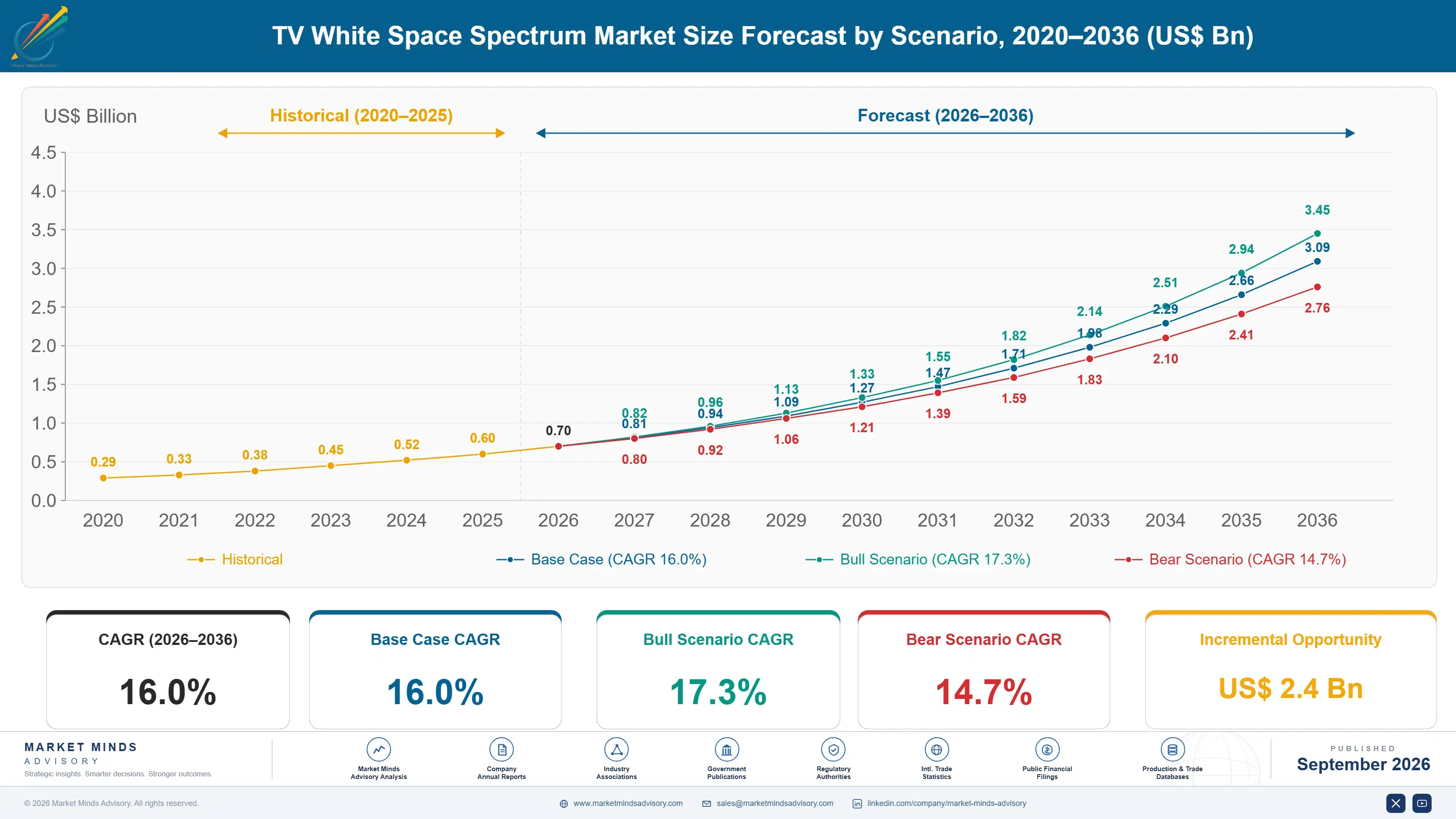
TV White Space Spectrum Market Forecast Scenarios

tv-white-space-spectrum-market-size-forecast-scenario-1790001867808
Between 2020 and 2025 television white space adoption stayed largely confined to donor-funded pilot programs and university-led rural trials, expanding at an estimated 15.0% historical annual rate as only a handful of countries finalized spectrum-database rules. Commercial device volumes stayed modest, held back by fragmented regulatory approval and vendor uncertainty over long-term channel availability guarantees.
The base case assumes steady acceleration through 2036 as three mechanisms compound: expanding geolocation database coverage into additional jurisdictions, falling radio module costs as chipset volumes scale past initial prototype runs, and growing government subsidy programs targeting last-mile rural connectivity gaps. Microsoft's Airband-style public-private partnerships and India's rural broadband push both illustrate how procurement commitments convert pilot deployments into recurring equipment and managed-service revenue, supporting a sustained double-digit expansion rate through the forecast window without requiring a single dominant application to carry growth.
The bull case centers on the United States Federal Communications Commission expanding permitted transmit power and channel counts, enabling materially longer-range links that pull more internet service providers into the category. The bear case hinges on network operators bypassing white space entirely in favor of low-earth-orbit satellite broadband, whose falling terminal costs increasingly overlap the same underserved rural geographies this market targets.

Spectrum Economics and Rural Connectivity Dynamics

Television white space sits at the intersection of spectrum policy and rural infrastructure economics, converting frequencies once reserved as broadcast interference buffers into licensed-exempt broadband capacity. Regulatory momentum outside early-mover markets like the United States and Britain is now the primary swing factor, since every additional country that finalizes geolocation database rules effectively adds addressable territory without requiring a single new technology breakthrough from device manufacturers already shipping certified radios.
MARKET CONCENTRATION (CR5)38%Reflects a fragmented, still-consolidating device and service vendor base
AVERAGE DEVICE PRICE$450Radio module hardware cost per rural access point
TOP DEPLOYING COUNTRY SHAREIndiaSingle country dominates current pilot-to-commercial rural deployment volume
SPECTRUM DATABASE COVERAGE62 countriesNations with finalized geolocation database licensing rules today
DEVICE CERTIFICATION BACKLOG9 monthsAverage regulatory approval wait facing new radio vendors
COGS HARDWARE COST SHARE48%Radio and antenna components as share of unit cost
Commercial character today skews toward wireless internet service providers and public-sector connectivity programs rather than consumer retail channels, since deployment still requires site-specific spectrum clearance and a trained installer rather than shelf purchase. Enterprise buyers in agriculture, utilities, and logistics increasingly evaluate white space alongside cellular Internet of Things modules for monitoring applications spanning large, low-density land areas where tower density economics simply do not work.
Over the next decade, expect standardization pressure to consolidate today's fragmented device landscape as certification bodies harmonize requirements across jurisdictions, while satellite broadband's falling cost curve forces white space vendors to differentiate on total installed cost per served household rather than raw link range alone, particularly as rural fiber subsidy programs in wealthier markets narrow the addressable footprint from the other direction.
"The vendors who win here are not the ones with the longest range demo. They're the ones who can get a spectrum-database approval processed in weeks instead of months, because permitting speed is the real bottleneck now."
Director, Connectivity and Spectrum Practice · MMA Technology / Wireless Connectivity Infrastructure Practice · September 2026

Market Trends

FCC Rulemaking Expands Permitted Channel Power

The United States Federal Communications Commission finalized rules in 2024 raising maximum permitted transmit power for fixed white space devices and expanding the number of usable channels per market, directly extending achievable link range for rural wireless internet service providers. Similar regulatory expansions are advancing in Canada, Kenya, and the Philippines as regulators study the American framework before adopting comparable rules domestically. Device vendors have responded by certifying new higher-power radio models within eighteen months of the rule change, compressing what was historically a multi-year product cycle into a much faster commercial response.
Market Impact: Adds subsidy funding across 40 countries

Satellite Broadband Convergence Reshapes Rural Bundling

Low-earth-orbit satellite broadband operators are increasingly partnering with white space equipment vendors rather than competing outright, bundling satellite backhaul with white space last-mile distribution to individual households and farm buildings across a village or service area. This hybrid architecture lets internet service providers serve a wider radius from a single satellite ground terminal, spreading the terminal's fixed cost across dozens of connected structures instead of one. Early deployments in East Africa and parts of South Asia report meaningfully lower blended cost per connected household than either technology achieves standing alone, encouraging further bundled procurement.
Market Impact: Reduces per-sensor connectivity cost 65%

Market Opportunities and Growth Drivers

Government Rural Connectivity Subsidy Programs Expand

India's Digital Bharat Nidhi fund and the United States Affordable Connectivity successor programs are directing subsidy dollars specifically toward last-mile technologies capable of covering large geographic areas per dollar spent, a category where white space radios compete favorably against new fiber trenching in low-density terrain. Kenya's Universal Service Fund has similarly begun financing pilot-to-commercial white space rollouts through licensed wireless internet service providers rather than incumbent telecom operators alone. These programs typically require multi-year service commitments, converting what would otherwise be one-time equipment sales into recurring managed-service contracts worth considerably more over their full term.
Market Impact: Delays financing approval 6 months

Precision Agriculture Sensor Deployment Accelerates Demand

Farm operations across North America, Brazil, and Eastern Europe are adding soil-moisture, irrigation, and livestock-tracking sensors at a pace that outstrips cellular data plan economics once device counts exceed roughly two hundred per farm, since per-device cellular subscription fees compound quickly at that scale. White space networks let a single base station backhaul thousands of low-bandwidth sensor readings across an entire farm or ranch without per-device recurring carrier charges, a cost structure particularly attractive to large-acreage row-crop and cattle operations. Equipment vendors report expanding order backlogs specifically from precision agriculture integrators rather than telecom carriers this cycle.
Market Impact: Keeps unit costs 3 times higher

Market Restraints and Challenges

Channel Availability Uncertainty Deters Long-Term Investment

Available white space channels vary by location and change whenever a new digital broadcaster launches nearby, creating uncertainty for operators planning multi-year infrastructure investment. The root cause: white space spectrum is licensed-exempt and secondary to broadcast use by design, so database systems must continuously reallocate channels as broadcast conditions shift rather than granting fixed, exclusive rights the way cellular licenses do. This unpredictability raises effective cost of capital for larger deployments and discourages some lenders from financing equipment purchases. Vendors mitigate the exposure by shipping multi-channel radios that automatically reconnect on an alternate frequency when a primary channel becomes unavailable.
Market Impact: Extends viable link range 40%

Limited Chipset Volume Keeps Unit Costs High

White space radios cost several times more per unit than comparable Wi-Fi or cellular customer-premises equipment, because production volumes remain a fraction of mainstream wireless categories. The root cause traces to fragmented, country-specific certification requirements that prevent chipset vendors from running one reference design across every target market, forcing smaller production batches and higher per-unit tooling amortization. This cost gap slows the total-cost-of-ownership advantage that should otherwise favor white space over new fiber trenching in the lowest-density service areas. Leading vendors mitigate the problem by pooling certification costs through industry consortia and standardizing on shared reference hardware platforms across jurisdictions.
Market Impact: Cuts blended household cost 30%
3 additional market trends, 3 additional growth drivers, and 3 additional restraints and challenges are covered in the full report. Contact sales@marketmindsadvisory.com to access the complete intelligence.

Segment CAGR and Growth Architecture

Television white space is segmented by end-use application rather than by device type or spectrum band, since buyer purchasing decisions center on the connectivity problem solved rather than underlying radio technology. This lens separates rural broadband access from Internet of Things monitoring, public safety, and community network use cases that share hardware but serve distinct commercial buyers and procurement cycles.
tv-white-space-spectrum-market-market-share-analysis-1790001868372

IoT and Machine-to-Machine Connectivity Networks

Internet of Things and machine-to-machine connectivity is the fastest-growing application as utilities, pipeline operators, and logistics firms deploy dense sensor networks across geographies too sparse for cost-effective cellular data plans. A single white space base station can backhaul readings from thousands of low-bandwidth endpoints spread across tens of kilometers, avoiding the recurring per-device subscription fees that make cellular Internet of Things connectivity uneconomical at that density. Water utilities monitoring remote pipeline segments, railroads tracking trackside sensors, and pipeline operators monitoring pressure and flow along hundreds of miles of infrastructure increasingly favor this architecture. Equipment vendors report order backlogs concentrated among industrial integrators rather than traditional telecom carriers, and several utilities have signed multi-year managed-service contracts covering their full territory.
CAGR 19.0%

Smart Agriculture Connectivity Networks

Smart agriculture connectivity is the second-fastest-growing segment as row-crop and livestock operations scale sensor deployment across acreages where cellular coverage remains patchy or expensive per connected device. Soil-moisture probes, irrigation controllers, grain-bin monitors, and livestock location trackers generate small, infrequent data payloads well suited to white space's wide-area, lower-bandwidth radio characteristics. Large farm operations in the American Midwest, Brazil's Cerrado region, and parts of Eastern Europe increasingly deploy a single base station covering an entire farm or cooperative rather than negotiating per-device cellular data plans for each sensor individually. Agricultural equipment manufacturers have begun bundling white space connectivity modules directly into irrigation and harvesting equipment, converting what was a standalone connectivity purchase into an embedded feature of the equipment sale.
CAGR 17.5%
Full segment breakdown across 6 segments available in the complete report.

Regional Architecture and Country Demand Map

Deployment concentrates where regulators finalized geolocation database rules earliest and where rural population density creates the strongest fiber-avoidance economics, spanning developed markets like the United States and Britain alongside emerging agricultural and community connectivity programs across Africa, Latin America, and South Asia. Africa's momentum is expanding fastest.

North America

The United States leads global commercial deployment on the strength of the Federal Communications Commission's early and repeatedly expanded white space rules, giving device vendors regulatory certainty that other jurisdictions still lack. Rural wireless internet service providers across the Great Plains, Appalachia, and the Mountain West deploy white space specifically where fiber trenching costs exceed feasible household revenue, often blending it with fixed wireless access spectrum for capacity. Microsoft's Airband Initiative has anchored much of the demonstration and procurement activity, working with regional carriers rather than deploying networks directly itself. Canada is following the American regulatory framework closely, with its own pilot programs now advancing toward commercial licensing for remote northern communities currently unserved by fiber or cellular infrastructure.
Share: 26% | CAGR: 15.5% (2026 to 2036)

Western Europe

The United Kingdom pioneered white space regulation in Europe through Ofcom's early database trials, and it remains the region's most active commercial market alongside growing activity in Germany and France. European deployment skews toward community network projects and agricultural monitoring rather than large-scale rural broadband, reflecting the region's already-dense fiber and fixed broadband coverage relative to North America or parts of Asia. Regulatory harmonization across the European Union remains incomplete, with individual member states still finalizing national geolocation database rules at different paces, which continues to fragment vendor certification requirements and slow pan-European equipment standardization efforts industry-wide. Regulatory advocacy groups continue pressing Brussels to issue harmonized guidance so vendors can certify one design rather than negotiate separate national approvals.
Share: 20% | CAGR: 14.5% (2026 to 2036)
Regional intelligence for 5 additional markets available in the complete report: East Asia, South Asia and Pacific, Latin America, Middle East and Africa, Eastern Europe. Contact sales@marketmindsadvisory.com.
tv-white-space-spectrum-market-country-cagr-analysis-1790001868896

Where Vendors Can Capture More Value

Beyond hardware sales, vendors are building recurring revenue through managed connectivity services, spectrum-database subscriptions, satellite-bundled partnerships, and rural financing programs that convert operators from one-time equipment buyers into multi-year service customers with steadier income and materially higher aggregate contract value over time, a shift that mirrors how mature telecom and managed-IT services businesses monetize installed infrastructure well after initial sale.

Managed Connectivity Service Contract Revenue Growth

Vendors increasingly bundle installation, spectrum-database subscription access, and remote network monitoring into multi-year managed-service contracts rather than selling radios as standalone hardware. This shift converts unpredictable one-time equipment revenue into recurring subscription income that better matches rural operators' own utility-style billing models and cash flow patterns. Carlson Wireless and Redline Communications both report managed-service contract values exceeding their equivalent hardware-only sales within the first 24 months of a deployment, since ongoing database compliance and firmware updates require continuous vendor involvement rather than a single transaction. This also improves retention, since switching mid-contract forces a costly database re-certification most operators avoid.
Market Impact: Lifts recurring managed-service revenue share to 45% overall

Bundled Satellite Backhaul Partnership Deal Structures

Equipment vendors are partnering with low-earth-orbit satellite operators to offer combined backhaul-plus-last-mile packages, capturing integration revenue that neither technology earns selling standalone. This approach lets a single satellite ground terminal serve an entire village or farm cooperative through white space distribution, spreading the terminal's fixed cost across dozens of connected structures and improving blended unit economics for both partners simultaneously. Vendors offering certified bundled packages report win rates exceeding 50% higher than vendors pitching white space alone against satellite-only competitors. Early movers securing preferred satellite terms now should defend that advantage for years, since operators favor few certified regional partners.
Market Impact: Improves bundled satellite partnership deal win rate 50%

Spectrum Database Subscription Revenue Growth Stream

Database operators such as Nominet and Key Bridge Global charge network operators recurring per-device or per-site fees for continuous channel availability lookups, a revenue stream entirely separate from hardware sales that scales directly with the installed base rather than new equipment shipments. As installed device counts compound year over year, database subscription revenue grows even in years when new hardware sales soften, providing a more resilient, less cyclical income stream than equipment sales alone for operators positioned early in this layer of the value chain. Subscription revenue per device stays stable even when equipment shipments swing 20% year over year.
Market Impact: Adds stable subscription revenue per 10,000 active devices

Rural Equipment Financing and Leasing Program Growth

Equipment vendors are launching direct leasing and financing programs for smaller rural internet service providers who lack access to conventional infrastructure lending, removing a major adoption barrier tied to upfront capital cost rather than ongoing operating economics. These programs typically carry higher effective yields than vendor hardware margins alone, since financing charges compound over multi-year terms while the underlying equipment continues generating usage-based service fees. Early leasing programs report default rates below 4%, suggesting the underlying rural connectivity business case is more creditworthy than lenders historically assumed. Vendors extending financing gain visibility into expansion plans, anticipating orders before formal procurement.
Market Impact: Expands addressable rural customer base by roughly 35%

Who Controls the Margin Pool

Concentration remains moderate at a CR5 of 38%, with Microsoft's platform and certification influence outweighing its direct hardware revenue and creating a meaningful gap between the five leading vendors and a long tail of smaller regional device makers. No single company dominates manufacturing the way established cellular equipment vendors do in mature wireless categories.
Current competitive activity centers on three fronts: certifying higher-power radios following the 2024 Federal Communications Commission rule changes, expanding spectrum-database coverage into new jurisdictions ahead of rivals, and forming bundled partnerships with satellite backhaul operators to defend against substitution. Vendors increasingly compete on total installed cost per served household rather than raw technical specifications alone, reflecting rural operators' own procurement priorities. Bundled financing is also becoming a differentiator among smaller vendors.

Emerging pressure comes from adjacent fixed-wireless-access vendors extending cellular-band equipment down into rural use cases traditionally served by white space, alongside satellite broadband's falling terminal costs. Rankings could shift meaningfully over the next several years if a major cellular equipment maker enters white space directly, or if database consolidation concentrates spectrum-management revenue among fewer surviving platform operators than compete for it today.
tv-white-space-spectrum-market-company-positioning-matrix-1790001869436

Competitive Moat and Risk Dimensions

MICROSOFT

Moat: Platform and Policy Influence

Microsoft's Airband Initiative gives it outsized influence over regulatory advocacy and pilot-program design across dozens of countries, shaping the rules every hardware vendor must eventually certify against. Its cloud and software relationships with rural carriers also create cross-selling opportunities unavailable to pure hardware competitors, reinforcing its position well beyond direct radio sales.
MICROSOFT

Risk: Limited Direct Hardware Revenue

Microsoft does not manufacture white space radios itself, meaning its commercial upside depends on partner vendors' hardware sales rather than a direct revenue line. A slowdown in partner shipments limits Microsoft's ability to capture value proportional to its platform-building and advocacy investment across dozens of countries in this category.
ADAPTRUM

Moat: Early Certification Track Record

Adaptrum holds some of the industry's longest-standing regulatory certifications across multiple jurisdictions, giving it a head start winning tenders in newly regulated markets where certification lead time matters more than brand recognition. Its established relationships with spectrum-database operators further speed new market entry for its radio product lines.
ADAPTRUM

Risk: Small Manufacturing Scale

As a relatively small, specialized manufacturer, Adaptrum lacks the production scale of larger telecom equipment makers, leaving it exposed if a well-capitalized entrant undercuts pricing once chipset volumes justify mass production economics that Adaptrum's current order volumes cannot match alone. A larger competitor entering aggressively could pressure margins before Adaptrum's certification advantage fully compounds into durable market share.

Players Tracked

Prominent Players

Microsoft
Adaptrum
Carlson Wireless Technologies
6Harmonics
Redline Communications

Other Key Players

Federated Wireless
Nominet
Key Bridge Global
Comsearch
Huawei
Qualcomm
Cambium Networks
Ubiquiti Networks
Tarana Wireless
Google
Meta Platforms
BT Group
KT Corporation
Broadcom
Airspan Networks

Recent Developments

MARCH 2025

FCC Finalizes Higher-Power Transmit Rules

The United States Federal Communications Commission finalized rules permitting higher maximum transmit power for fixed white space devices, extending achievable link range for rural wireless internet service providers. The decision followed several years of vendor petitions and field-trial data submissions demonstrating minimal interference risk to licensed broadcasters.
Signal: Regulatory clarity in the largest single national market accelerates vendor certification and rural carrier procurement decisions industry-wide.
SEPTEMBER 2025

Microsoft Expands Airband Africa Partnerships

Microsoft announced expanded Airband Initiative partnerships with wireless internet service providers across Kenya, Ghana, and South Africa, providing technical support and spectrum-database access rather than direct capital investment. The expansion builds on earlier pilot programs that demonstrated commercial viability across varied rural terrain conditions. Regulators expedited licensing reviews.
Signal: Sub-Saharan Africa emerges as a genuine commercial market rather than a purely development-funded pilot geography going forward.
JANUARY 2026

Adaptrum and Federated Wireless Form Database Interoperability Agreement

Adaptrum and Federated Wireless agreed to a technical interoperability arrangement allowing Adaptrum radios to query multiple certified spectrum-database providers rather than a single exclusive database relationship. The agreement reduces vendor lock-in risk for network operators deploying Adaptrum hardware across jurisdictions. Both firms expect reduced integration costs for shared customers.
Signal: Database interoperability reduces switching costs and could accelerate multi-country vendor consolidation over the coming several years.

Radio Component and Certification Cost Exposure

Radio frequency components including power amplifiers, filters, and antenna assemblies together represent roughly 48% of unit cost of goods sold, sourced predominantly from specialized radio frequency semiconductor suppliers concentrated in Taiwan, the United States, and increasingly mainland China as domestic chip capacity expands there. Baseband processing chips add a further, smaller cost layer sourced from a narrower set of specialized suppliers.
Radio frequency semiconductor pricing spiked meaningfully during the 2021 through 2022 global chip shortage, with the International Energy Agency and multiple company annual reports documenting extended lead times across specialized analog and radio frequency component categories that hit low-volume niche device makers disproportionately hard relative to high-volume consumer electronics buyers with far greater supplier leverage and standing purchase agreements already in place. Vendors without pre-existing supplier relationships waited considerably longer than those with standing contracts.

Smaller vendors carry disproportionately higher exposure since they lack the purchase volume to negotiate long-term supply agreements the way Microsoft's hardware partners or larger telecom equipment makers can. This dynamic compounds during any renewed component shortage, since low-volume niche buyers sit at the back of allocation queues behind larger consumer electronics and automotive semiconductor customers with standing contracts.
tv-white-space-spectrum-market-cost-volatility-analysis-1790001869634

Multi-Source Component Qualification

Leading vendors qualify radio frequency components from at least two independent suppliers per critical part, reducing exposure to any single supplier's capacity constraints or pricing decisions during periods of tight semiconductor market conditions, particularly for power amplifiers and filters that carry the longest replacement lead times. Some vendors now maintain formal dual-sourcing agreements written directly into their annual procurement contracts.

Shared Reference Design Consortia

Industry consortia pool certification and component qualification costs across multiple smaller vendors, allowing participants to access better component pricing tiers than any single small manufacturer could negotiate independently on its own, while also sharing the fixed cost of maintaining multi-jurisdiction certification documentation. This pooled approach has become especially valuable for vendors entering newly regulated markets for the first time.

Long-Term Component Supply Agreements

Larger vendors increasingly sign multi-year volume commitments with radio frequency semiconductor suppliers, trading pricing flexibility for guaranteed allocation priority during future shortage conditions industry-wide, a trade-off smaller manufacturers often cannot afford to make given their thinner order books. These agreements typically span three to five years and include negotiated price ceilings tied to underlying commodity indices.

Portfolio Architecture for Margin Defence

The market organizes into three tiers reflecting deployment scale and service complexity. Volume-tier hardware sold to smaller regional operators carries thinner margins driven by price competition among several similarly capable vendors, while premium certified equipment bundled with managed connectivity services commands materially better economics. Volume-tier competition among several similarly capable vendors keeps pricing pressure persistent across standard fixed and mobile radio product lines.
Tension between volume hardware sales and premium managed-service bundles defines vendor strategy today, as pure hardware vendors face continuous margin pressure while those successfully converting customers to multi-year service contracts build more durable, recurring revenue streams that better absorb component cost volatility. Vendors that successfully make this transition report considerably steadier quarter-to-quarter revenue than those still dependent on lumpy, one-time hardware orders.

High-value pools concentrate in managed connectivity services bundled with spectrum-database subscriptions and financing programs, where vendors capture recurring revenue well beyond the initial hardware transaction. Next-generation regulatory-compliance and interoperability services targeting operators expanding across multiple jurisdictions simultaneously represent the newest and fastest-growing high-margin pool. Financing and leasing programs targeting smaller rural operators represent an additional, still-underexploited high-value pool within this broader portfolio architecture.

Volume / Commodity-Adjacent Tier

Standard fixed and mobile white space radios sold primarily on price to smaller regional wireless internet service providers with limited service bundling and thin post-sale support commitments attached. Replacement cycles run roughly five to seven years.
Gross Margin: 22%-30%

Premium / Certified Tier

Higher-power certified radios bundled with installation and multi-year managed connectivity service contracts sold to larger rural carrier customers seeking predictable, subscription-style billing rather than one-time capital purchases. Contract renewal rates here run notably higher than volume-tier hardware-only relationships.
Gross Margin: 38%-46%

Sustainability / Regulatory / Next-Generation Tier

Spectrum-database subscription services, cross-jurisdiction compliance support, and satellite-bundled hybrid connectivity offerings for multi-country operators expanding across several regulatory regimes at once, requiring continuous vendor-provided compliance monitoring. Margins here benefit from limited direct competition.
Gross Margin: 52%-60%
tv-white-space-spectrum-market-portfolio-architecture-1790001870143

High-value Sub-segments and Strategic Watch-out

Managed Connectivity Service Bundles

Recurring installation, monitoring, and database-subscription bundles growing fastest as operators shift from equipment purchases toward multi-year managed service contracts that better match rural utility-style budgeting cycles, predictable cash flow expectations, and meaningfully lower customer churn than comparable hardware-only vendor relationships typically show. Source: MMA Estimate, July 2026.
Gross Margin: 50%-58%

Satellite-Backhaul Hybrid Packages

Combined satellite backhaul and white space last-mile packages growing steadily as terminal costs fall and bundled procurement becomes standard practice among internet service providers serving the most remote, lowest-density service territories where a single satellite terminal now supports many households. Source: MMA Estimate, July 2026.
Gross Margin: 40%-48%

Standard Fixed Rural Broadband Radios

The volume core of the market, sold primarily to rural wireless internet service providers replacing or expanding existing coverage footprints nationwide, where price competition among several similarly capable vendors keeps margins comparatively thin and vendor count remains the highest of any tier in this market.
Gross Margin: 24%-30%

Community and Public-Sector Network Equipment

Donor and government-funded community network deployments facing budget uncertainty as pilot funding cycles end and commercial procurement models remain unproven, leaving vendors exposed to sudden funding gaps between grant cycles that can stall equipment orders for a full budget year. Source: MMA Estimate, July 2026.
Gross Margin: 18%-26%

Recurring Service Ties Behind Hardware Sales

Demand increasingly behaves like an annuity rather than a one-time equipment sale, since spectrum-database compliance requires continuous connectivity between deployed radios and certified database providers for the life of the installation. This ongoing dependency locks operators into a given vendor's platform more durably than a simple hardware purchase would suggest on its face. Vendors that fail to maintain this compliance relationship risk losing the customer at the next renewal.
Adoption depth varies meaningfully by end-use vertical: agricultural and utility deployments tend toward full-farm or full-territory coverage once an operator commits, while community network and public-sector pilots often stall at partial coverage pending uncertain follow-on government funding cycles that frequently slip by a year or more. Public-sector buyers, by contrast, often require multi-year competitive tender cycles that slow procurement regardless of the underlying technology's readiness.

Buyer profiles are shifting generationally as agricultural cooperatives and utility engineering teams, rather than telecom specialists, increasingly lead procurement decisions, favoring vendors who can explain connectivity in terms of crop yield or pipeline monitoring outcomes rather than pure radio frequency specification sheets that telecom buyers historically prioritized. This shift favors vendors who speak credibly to operational outcomes rather than only radio frequency specifications.
tv-white-space-spectrum-market-end-use-penetration-index-1790001870636

Where MMA Sees the Real Opportunity

These are among the four positions where our research anticipates prominent divergence between winners and laggards over the coming forecast period. Each is grounded in the demand model, the regulatory perimeter, and the announced capacity pipeline.
01 / REGULATORY MARKET POSITIONING

Prioritize markets nearing database rule finalization

Vendors should concentrate near-term sales investment in jurisdictions actively finalizing geolocation database rules rather than spreading effort evenly across every potential market. Regulatory finalization is the single clearest leading indicator of commercial demand materializing within twelve to eighteen months of a rule formally taking effect nationwide. Waiting for rules to finalize before investing risks ceding first-mover advantage to competitors already positioned with local certification and distribution relationships firmly in place well ahead of the formal commercial opening in that specific jurisdiction.
02 / SERVICE MODEL SHIFT

Build managed-service capability ahead of hardware scale

The vendors capturing the most durable revenue are those converting hardware buyers into managed-service subscribers rather than those simply shipping the most radios each quarter. Building installation, monitoring, and database-subscription capability now positions vendors to capture recurring revenue as the installed base compounds year after year across an expanding footprint. Pure hardware vendors risk commoditization as production volumes eventually scale and price competition intensifies across a widening set of certified suppliers competing for the same shrinking pool of undifferentiated hardware-only buyers.
03 / SATELLITE PARTNERSHIP STRATEGY

Pursue satellite bundling before competitors close the gap

Combined satellite-backhaul and white space last-mile bundles currently offer differentiated positioning that few vendors have fully captured, but the window is narrowing as more satellite operators actively seek terrestrial distribution partners of their own. Vendors that establish exclusive or preferred bundling relationships now will hold a durable cost advantage over late entrants forced to negotiate less favorable terms later. Satellite operators typically prefer working with a small number of proven terrestrial partners rather than many smaller, competing regional relationships spread thin.
04 / VERTICAL MARKET SPECIALIZATION

Deepen agricultural and utility vertical expertise

Generic rural connectivity positioning increasingly loses tenders to vendors who understand sector-specific requirements like pipeline monitoring intervals or livestock tracking battery life constraints in the field. Building genuine vertical expertise in agriculture and utilities, rather than treating every customer as an undifferentiated rural broadband buyer, should let vendors command meaningfully premium pricing on long-term service contracts. This depth also helps vendors win larger multi-year managed-service contracts against generalist competitors lacking comparable domain knowledge and hands-on field experience in these verticals.

Engagement Snapshot From the Field

A live engagement with an industry participant carrying material or product regulatory and market exposure ahead of a defining policy shift, showing how our research translates into a defensible multi-year portfolio strategy.
MARKET MINDS ADVISORY · CLIENT ENGAGEMENT SUMMARY
TV White Space Spectrum Producer Strategic Portfolio Review and Transition Roadmap 2026·Investment Scenario on TV White Space Spectrum Exposure Evaluation 2025-26
CLIENT PROFILE
The client is a mid-sized rural electric and water utility cooperative serving a sparsely populated multi-county service territory across the American Midwest, with roughly 45,000 connected accounts spread across low-density agricultural land where fiber backbone investment had never proven commercially justifiable to prior operators or regional carriers. The cooperative's board had deferred connectivity modernization for several years given the high perceived cost of extending fiber to its most remote members.
STRATEGIC CHALLENGE
The cooperative needed continuous remote monitoring across thousands of distribution transformers, water pump stations, and pipeline pressure sensors spread across a territory too sparse for cost-effective cellular data plans, but its existing radio infrastructure could not reliably reach the most remote quarter of its service territory during adverse weather conditions.
MMA APPROACH
MMA's team assessed white space, licensed private cellular, and satellite backhaul options against the cooperative's specific density and terrain profile, ultimately recommending a hybrid white space and satellite architecture. MMA modeled total cost of ownership across a ten-year horizon and benchmarked vendor certification timelines against the cooperative's board-approved capital deployment schedule.
KEY FINDINGS
  1. Deploying white space base stations was projected to reduce per-device connectivity cost by approximately 60% (client-reported, unverified by MMA) relative to expanding cellular data plans across the full territory.
  2. Existing coverage gaps affected roughly 22% of the cooperative's most remote distribution assets, concentrated almost entirely in the territory's southern and western agricultural sections.
  3. A hybrid satellite-backhaul architecture was expected to extend reliable coverage to the full service territory within eighteen months of initial deployment approval.
  4. Board members initially underestimated how quickly a single base station could pay back its installation cost once dozens of previously unmonitored assets came online simultaneously.
CLIENT PROFILE
The client is a mid-sized rural electric and water utility cooperative serving a sparsely populated multi-county service territory across the American Midwest, with roughly 45,000 connected accounts spread across low-density agricultural land where fiber backbone investment had never proven commercially justifiable to prior operators or regional carriers. The cooperative's board had deferred connectivity modernization for several years given the high perceived cost of extending fiber to its most remote members.
STRATEGIC CHALLENGE
The cooperative needed continuous remote monitoring across thousands of distribution transformers, water pump stations, and pipeline pressure sensors spread across a territory too sparse for cost-effective cellular data plans, but its existing radio infrastructure could not reliably reach the most remote quarter of its service territory during adverse weather conditions.
MMA APPROACH
MMA's team assessed white space, licensed private cellular, and satellite backhaul options against the cooperative's specific density and terrain profile, ultimately recommending a hybrid white space and satellite architecture. MMA modeled total cost of ownership across a ten-year horizon and benchmarked vendor certification timelines against the cooperative's board-approved capital deployment schedule.
KEY FINDINGS
  1. Deploying white space base stations was projected to reduce per-device connectivity cost by approximately 60% (client-reported, unverified by MMA) relative to expanding cellular data plans across the full territory.
  2. Existing coverage gaps affected roughly 22% of the cooperative's most remote distribution assets, concentrated almost entirely in the territory's southern and western agricultural sections.
  3. A hybrid satellite-backhaul architecture was expected to extend reliable coverage to the full service territory within eighteen months of initial deployment approval.
  4. Board members initially underestimated how quickly a single base station could pay back its installation cost once dozens of previously unmonitored assets came online simultaneously.
RECOMMENDED STRATEGY
Phase 1: Phase 1 (Months 1-4): Deploy pilot base stations covering the highest-priority unmonitored distribution transformer clusters identified through outage frequency analysis. Phase 2: Phase 2 (Months 5-10): Expand coverage territory-wide using the hybrid satellite-backhaul architecture, prioritizing the most remote pump stations and pipeline segments. Phase 3: Phase 3 (Months 11-18): Transition to a managed-service contract covering ongoing database compliance, firmware updates, remote monitoring, and periodic vendor performance reviews.
OUTCOME
The cooperative approved the phased deployment plan and began Phase 1 installation in the fourth quarter of 2025, with full territory coverage targeted for completion by early 2027 (client-reported, unverified by MMA). Projected annual connectivity cost savings were estimated at approximately $380,000 (client-reported, unverified by MMA) once the full hybrid network reaches operational status.

Frequently Asked Questions

Foundational context covering the market sizes, CAGR, scope, country, region and competition that inform every finding below. This section is provided to cover basics and most often pre-purchase conversations, answered from the MMA Primary Research Dataset.

What is the current size of the TV White Space Spectrum Market?

The global TV White Space Spectrum Market was valued at approximately $0.6 billion in 2025. This reflects still-early commercial deployment concentrated in a handful of regulatory-mature countries.

How large will the TV White Space Spectrum Market be by 2036?

MMA projects the market will reach approximately $3.09 billion by 2036, up from roughly $0.70 billion in 2026. Growth reflects expanding geolocation database licensing across additional jurisdictions worldwide over the forecast period.

What is the CAGR for the TV White Space Spectrum Market 2026 to 2036?

The market is projected to grow at a 16.0% compound annual growth rate over the forecast period. This places it within the nascent, early-stage technology growth band.

Which segment is growing fastest?

IoT and Machine-to-Machine Connectivity Networks lead growth at a 19.0% CAGR, roughly 1.19 times the overall market growth rate. Utility and pipeline monitoring applications drive most of this segment's expansion.

Who are the major companies in the TV White Space Spectrum Market?

Leading companies include Microsoft, Adaptrum, Carlson Wireless Technologies, 6Harmonics, and Redline Communications. Together these five hold an estimated 38% combined market presence measured on a device-shipment and platform-influence basis.

Which region is growing fastest globally?

India leads global growth at an estimated 18.5% CAGR, ahead of every other tracked country in this market. Government rural connectivity subsidy programs are the primary driver behind this pace of expansion.

Report Segmentation Architecture

The full report scope spans multiple orthogonal segmentation dimensions, with cross-tabulated demand data provided for each dimension pair. Coverage extends further to regional breakdowns, trend trajectories, and the competitive detail needed to support segment-level decision-making.

By Application Type

  • Rural Broadband Access Networks
  • IoT and Machine-to-Machine Connectivity Networks
  • Smart Agriculture Connectivity Networks
  • Public Safety and Emergency Communications Networks
  • Educational and Community Wireless Networks
  • Industrial and Utility Monitoring Networks

By End-Use Industry

  • Telecommunications and Internet Service Providers
  • Agriculture and Agribusiness
  • Utilities and Energy
  • Government and Public Sector
  • Education

By Commercial Dimension

  • Hardware Sales
  • Managed Connectivity Services
  • Spectrum Database Subscription Services
  • Financing and Leasing Programs

By Region

  • North America
  • Western Europe
  • East Asia
  • South Asia and Pacific
  • Latin America
  • Middle East and Africa
  • Eastern Europe

Scope, Methodology, and Coverage

Every figure in this report is reproducible from documented input assumptions. The scope below maps the historical period, the forecast horizon, the segmentation dimensions, and the countries covered, alongside the underlying primary and qualitative methodology.
Historical Period
2020 to 2025
Forecast Period
2026 to 2036
Base Year
2025 (USD billions; MMA Primary Research Dataset, September 2026)
Market Definition
The market covers hardware, software, and spectrum-database management services enabling wireless data transmission over unused broadcast television channels within the 470 to 698 megahertz band. It excludes licensed cellular spectrum, satellite broadband, and conventional Wi-Fi equipment operating in unlicensed industrial, scientific, and medical bands.
Quantitative Units
USD billions (current prices); device unit shipments; spectrum-database subscription counts
Segmentation Dimensions
By Application Type; By End-Use Industry; By Commercial Dimension; By Region
Regions Covered
North America, Western Europe, East Asia, South Asia and Pacific, Latin America, Middle East and Africa, Eastern Europe
Countries Covered
USA, China, Germany, France, UK, Japan, South Korea, India, Australia, Canada, Brazil, Mexico, Indonesia, Vietnam, Thailand, Malaysia, UAE, Saudi Arabia, South Africa, Nigeria, Turkey, Poland, Netherlands, Italy, Spain, Sweden, Switzerland, Argentina, Colombia, Singapore, and additional markets relevant to this sector
Key Companies Profiled
Microsoft, Adaptrum, Carlson Wireless Technologies, 6Harmonics, Redline Communications, Federated Wireless, Nominet, Key Bridge Global, Comsearch, Huawei, Qualcomm, Cambium Networks, Ubiquiti Networks, Tarana Wireless, Google, Meta Platforms, BT Group, KT Corporation, Broadcom, Airspan Networks
Quantitative Methodology
Primary survey, n=3,800 respondents, Q4 2025, six countries; demand-side model with trade association cross-validation
Qualitative Methodology
47 expert interviews, Q4 2025; applied to validate demand model assumptions, identify emerging dynamics, and assess competitive positioning
Report Format
PDF and XLSX data workbook (Word format preview document)
Publisher
Market Minds Advisory
Report Code
MMA-2026-TEC-230
Published
September 2026
Contact
sales@marketmindsadvisory.com | www.marketmindsadvisory.com

Purchase the full TV White Space Spectrum Market Report (2026 to 2036).

The full report provides detailed market sizing, ten-year forecasts, and competitive benchmarking across the television white space spectrum category worldwide. It includes country-level regulatory tracking, vendor certification timelines, and segment-level growth analysis across rural broadband, agricultural, and industrial monitoring applications spanning every major regulatory jurisdiction. Buyers receive access to MMA's proprietary spectrum-database coverage tracker, updated quarterly throughout the subscription period. The report also includes detailed input-cost and supply-chain risk analysis for radio frequency component sourcing across the entire vendor landscape. Subscribers can request a customized briefing call to discuss findings relevant to their specific investment or procurement decisions.
Country-level regulatory tracking dashboard with quarterly updates
Vendor certification timeline database covering all major markets
Segment-level ten-year growth forecasts by application
Competitive benchmarking scorecards covering every profiled vendor
Input-cost and supply-chain risk analysis by component
Quarterly spectrum-database coverage tracker with country detail

Built For The People Who Decide

From boardroom strategy to bench-side execution, this report is read cover-to-cover by leaders shaping the next decade of their industry, turning demand scenarios, market dynamics and valuation benchmarks into decisions.
CXOs/ Presidents/ VPs/ Managers
M&A and Corporate Development
Strategy Teams and R&D Heads
Procurement and Product Directors
Regulatory and Compliance Leaders
Investor Relations and Equity Analysts