Market Minds Advisory
Tuberculous Meningitis Treatment Market

Tuberculous Meningitis Treatment Market: A Lung Regimen Borrowed for the Brain

The standard regimen was designed for lung disease and its principal drug reaches the infected brain at a small fraction of blood levels, which is where a quarter of treated patients still die.

Lead Analyst

Alice Ballenger

Published

September 2026

Make Smarter Decisions with Customized Research Insights

Request a free sample report and evaluate market opportunities, growth trends, and competitive dynamics relevant to your business needs.

2025 MARKET VALUE$0.2BMarket Size 2025
2036 FORECAST VALUE$0.3BBase Case , 2026 to 2036
CAGR 2026 TO 20365.8 %Bull 7.0% / Bear 4.6%
INCREMENTAL OPPORTUNITY$0.1BNet 10- year value creation
EXPANSION MULTIPLE1.74x2036 value over 2026 base
Strategic Levers
M&A Pipeline
Regional Outlook
Country Rankings
Competitive Intelligence
Segmental Deep-dive
Call-Us : 91 93563 13602

Executive Snapshot and Market Trajectory

The regimen used against tuberculous meningitis was developed for lungs. Rifampicin reaches cerebrospinal fluid at roughly 8% of plasma concentration, so standard oral dosing delivers very little drug to the site where the disease actually kills people. Nothing in the regimen was optimised for the brain.
High-dose and intravenous rifamycin regimens grow at 8.7%, half again the market rate of 5.8%, on the straightforward proposition that more drug should reach the brain. Trial results have been mixed enough to slow guideline change, but around 27% of treated patients still die, which keeps the question open rather than settled. Intravenous administration needs inpatient capacity that the settings carrying most of the burden frequently do not have. Sterile capacity is scarce.
Timing carries as much weight as dosing. Culture takes about 21 days to confirm or exclude the diagnosis, so roughly 71% of treatment is begun empirically on clinical suspicion alone. Demand therefore follows how readily clinicians act on suspicion rather than how many cases are eventually confirmed by a laboratory. Confirmed case data is therefore a poor forecasting basis. Suppliers planning against confirmed notifications understate real consumption.
Market Definition
Pharmacological treatment of tuberculous meningitis, covering first-line oral anti-tubercular agents, high-dose and intravenous rifamycin regimens, adjunctive corticosteroids, fluoroquinolone and linezolid regimens, newer anti-tubercular agents, and paediatric formulations and dispersible forms. Measured at manufacturer selling value. Excludes diagnostic testing, neurosurgical procedures including shunt placement, general supportive and intensive care, and treatment of pulmonary tuberculosis.
Base Year Value
$0.2B in 2025 (MMA Primary Research Dataset, August 2026)
Forecast Period
2026 to 2036, eleven discrete annual values
CAGR
5.8% base case. Bull 7.0%. Bear 4.6%.
Fastest Growth Segment
High-Dose and Intravenous Rifamycin Regimens: 8.7% CAGR
Fastest Growth Country
Indonesia: 9.4% CAGR
Fastest Growth Region
South Asia and Pacific: 7.8% CAGR
Largest Region
South Asia and Pacific: 30% of 2025 global value
Market Leaders
Sandoz, Lupin, Macleods Pharmaceuticals, Cipla, Sanofi. Source: MMA Primary Research Dataset, July 2026.
Primary Survey
n=3,800 procurement and R&D decision-makers, Q4 2025, six countries
Methodology
Demand-side build-up, cross-validated against public data, 47 expert interviews

Tuberculous Meningitis Treatment Market Forecast Scenarios

tuberculous-meningitis-treatment-market-size-forecast-scenario-1787640249516
Growth ran near 4.4% between 2020 and 2025 with case detection rather than treatment innovation setting the pace. Molecular testing widened access to earlier diagnosis in higher burden settings, which increased confirmed cases without changing the regimen much. Interest in higher rifampicin dosing grew steadily through the period as trial data accumulated, though guidelines moved considerably more slowly than clinical opinion did.
Base case 5.8% rests on three mechanisms. High-dose and intravenous rifamycin regimens grow at 8.7% as clinicians act on penetration evidence ahead of formal guideline change. Fluoroquinolone and linezolid regimens grow at 7.4% on better central nervous system exposure in resistant disease. And Indonesia grows fastest of any country at 9.4% on case detection and insurance coverage widening at the same time. None depends on prevalence rising, which has been stable for decades.
The bull case at 7.0% assumes guidelines adopting higher rifamycin dosing formally, which would move a large share of treated patients onto a more expensive regimen immediately. The bear case at 4.6% is case detection improving more slowly than expected, since roughly 71% of treatment begins empirically and diagnostic access rather than drug availability sets how many people are treated at all.

Where the Drug Does Not Reach

Tuberculous meningitis is treated with a regimen designed for a different organ. The four drug combination developed against pulmonary tuberculosis is used largely unchanged, and rifampicin, the agent that does most of the work, reaches cerebrospinal fluid at roughly 8% of plasma concentration. The drug most relied upon therefore arrives at the infected site in quantities that would be considered inadequate anywhere else in medicine.
TOP FIVE CONCENTRATION44%Generic manufacturers supply most of the treatment volume worldwide
RIFAMPICIN FLUID PENETRATION8%Share of plasma concentration reaching the infection site
TREATED CASE MORTALITY27%Patients who die despite receiving appropriate standard treatment
EMPIRICAL TREATMENT START71%Cases begun on suspicion before any laboratory confirmation arrives
STANDARD COURSE COST42 USDPrice of a complete standard treatment course per patient
CULTURE CONFIRMATION DELAY21 daysTime before culture confirms or excludes the presumed diagnosis
That mismatch shows in outcomes. Around 27% of treated patients die and a substantial proportion of survivors carry lasting neurological damage, which is worse than almost any other form of treated tuberculosis. High-dose and intravenous rifamycin regimens grow at 8.7% on the straightforward proposition that more drug reaching the brain ought to help. Trial evidence has been mixed enough to slow formal guideline change while leaving many clinicians unwilling to wait.
The commercial shape of the market is set by timing rather than by confirmation. Culture takes about 21 days to confirm or exclude the diagnosis and cerebrospinal fluid microscopy is insensitive, so roughly 71% of treatment starts empirically on clinical suspicion. Drug demand therefore tracks how readily clinicians initiate against uncertainty rather than confirmed cases.
"We are treating a brain infection with a regimen worked out for lungs, using a drug that barely gets past the blood brain barrier. That is not a criticism of anybody; it is simply where the evidence stopped being generated."
Director, Infectious Disease and Global Health Therapeutics Practice · MMA Healthcare and Life Sciences Practice · August 2026

Market Trends

Higher rifamycin dosing advancing ahead of formal guidance

Rifampicin reaches cerebrospinal fluid at roughly 8% of plasma concentration, and higher intravenous dosing raises exposure substantially at the infected site. Trial results have been mixed enough that guidelines have moved slowly, while many clinicians treating a condition with 27% mortality have proved unwilling to wait for consensus. High-dose and intravenous regimens grow at 8.7% on that clinical judgement rather than on any settled recommendation. Manufacturers supplying only standard oral strengths are serving a practice that is shifting steadily underneath them. Availability is what limits how far the practice actually spreads.
Market Impact: Indonesia growing fastest at 9.4%
Resistant disease exposing gaps in newer agent penetration

The agents that transformed survival in drug resistant pulmonary tuberculosis penetrate the central nervous system poorly, which means resistant meningitis has benefited far less from the same advances. Fluoroquinolone and linezolid regimens grow at 7.4% because both achieve useful exposure where newer agents do not. That gap has attracted comparatively little development attention, since the affected population is small and almost entirely in low income settings. Linezolid toxicity limits treatment duration and requires monitoring that many high burden settings cannot readily provide at all. Nobody is currently developing anything to close that gap.
Market Impact: Around 71% started empirically

Market Opportunities and Growth Drivers

Case detection and insurance coverage widening simultaneously

Indonesia grows fastest of any country at 9.4% as tuberculosis case detection improves and national health insurance coverage widens across a very large population at the same time. Treatment demand follows detection rather than underlying prevalence, which has been high and comparatively stable for decades. Programme funding and diagnostic access decisions therefore determine treated volume considerably more than any epidemiological change does. Suppliers planning against burden estimates are targeting patients who never reach a diagnosis in the first place. Programme funding and diagnostic rollout timetables predict treated volume considerably better than any burden estimate does.
Market Impact: Full course costs about 42 dollars

Empirical initiation driving demand ahead of confirmation

Culture takes about 21 days and cerebrospinal fluid microscopy is insensitive, so roughly 71% of treatment begins on clinical suspicion before anything is confirmed. Delay costs lives in a condition where outcomes deteriorate sharply with time to treatment. Drug demand consequently tracks clinical willingness to initiate against uncertainty, which varies considerably between health systems and depends heavily on clinician experience with the condition. Supply planned against confirmed notifications consequently understates real consumption by a considerable margin. Clinician experience with the condition varies enormously, and so does the readiness to start treatment early.
Market Impact: Confirmation takes about 21 days

Market Restraints and Challenges

Regimen cost leaving no commercial pull for development

A complete standard course costs around 42 dollars and the burden sits overwhelmingly in low income settings, so no commercial return supports developing an agent designed for central nervous system penetration. The root cause is the mismatch between disease severity and market value rather than any scientific obstacle. Commercially it leaves innovation dependent on public and philanthropic funding, which is how the current trial programme is financed. Publicly funded trials are carrying the work that commercial development would carry in almost any other condition. Severity and market value are badly mismatched here.
Market Impact: Penetration sits near 8% of plasma

Diagnostic delay limiting how many patients reach treatment

Culture confirmation takes about 21 days while the disease progresses within days, and microscopy detects only a minority of cases, so many patients are treated late or never identified at all. The root cause is the low bacterial load in cerebrospinal fluid rather than any laboratory failure. Commercially it caps treated volume below true incidence. Molecular testing, larger sample volumes and clinical scoring tools are the mitigations in use. Treated volume follows detection capability rather than epidemiology, which makes prevalence a poor planning basis. Molecular testing has narrowed the gap in better resourced settings.
Market Impact: Regimens growing at 7.4% annually
4 additional market trends, 3 additional growth drivers, and 2 additional restraints and challenges are covered in the full report. Contact sales@marketmindsadvisory.com to access the complete intelligence.

Segment CAGR and Growth Architecture

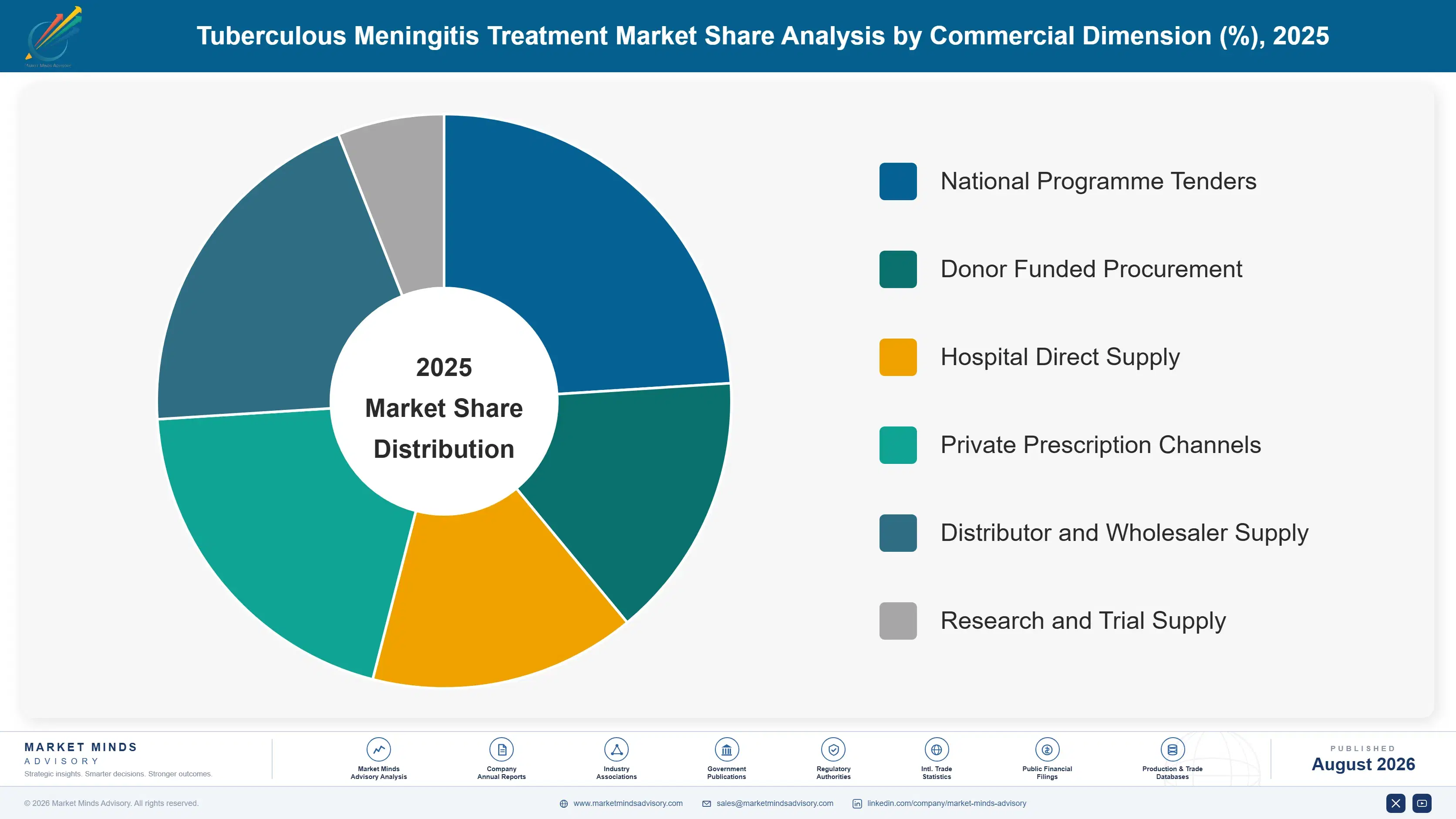
Six segments split by therapy class, because class determines the exposure achieved at the infected site, the resistance pattern it addresses, the administration route required and the setting treatment can occur in. Formulation and dosing variants sit inside each class. Patient group and channel dimensions are handled separately within the framework. Presentation capability determines supply.
tuberculous-meningitis-treatment-market-market-share-analysis-1787640250053

High-Dose and Intravenous Rifamycin Regimens

Growing at 8.7%, half again the market rate of 5.8%, higher dose and intravenous rifamycin regimens raise exposure at a site where standard oral dosing delivers roughly 8% of plasma concentration. Adoption runs ahead of formal guideline change because clinicians treating a condition with around 27% mortality have been unwilling to wait for consensus that trial evidence has not yet produced. Intravenous administration requires inpatient capacity, which limits use in the settings carrying most of the burden. Manufacturers holding only oral solid dose capability cannot serve the segment at all, whatever their scale or cost position happens to be. Guideline committees continue deliberating while clinical practice moves ahead of them steadily.
CAGR 8.7%

Fluoroquinolone and Linezolid Regimens

At 7.4% these agents achieve useful central nervous system exposure where several newer anti-tubercular drugs do not, which matters greatly in resistant disease that has benefited far less from recent advances than pulmonary tuberculosis has. Linezolid toxicity limits duration and requires monitoring that many high burden settings cannot readily provide. The population is small and concentrated in low income countries, which is why the gap has attracted so little development attention. Reliable supply with the monitoring support that toxicity demands is inconsistently available, which leaves a genuine clinical need largely unserved across the highest burden settings. Newer agents that transformed pulmonary outcomes reach the brain poorly, which is why these older classes still carry resistant disease.
CAGR 7.4%
Full segment breakdown across 6 segments available in the complete report.

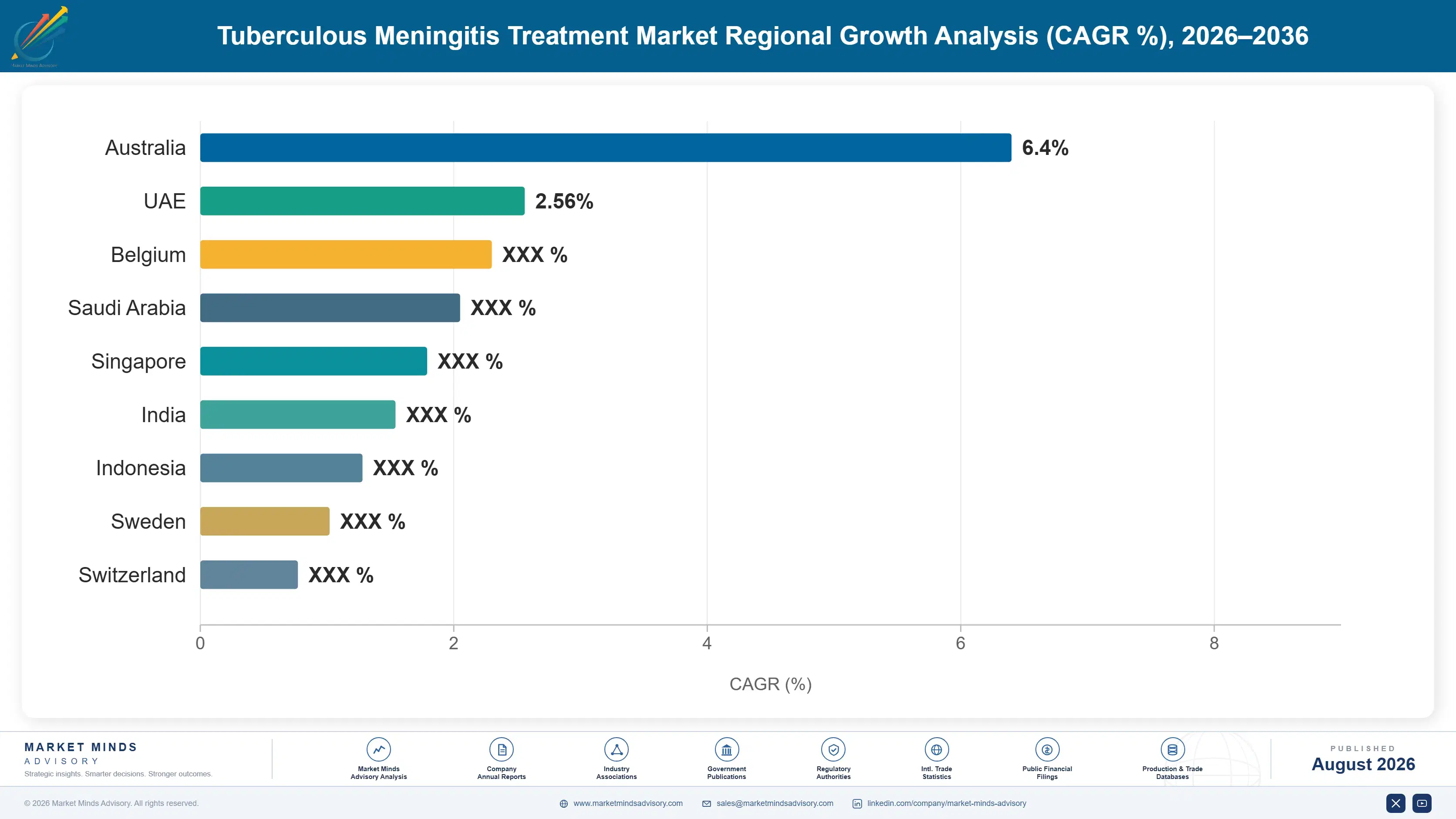
Regional Architecture and Country Demand Map

South Asia and Pacific holds 30% of value because tuberculosis burden concentrates there overwhelmingly. East Asia and Middle East and Africa follow at 20% each on case burden rather than on any pricing advantage. South Asia and Pacific grows fastest of the seven regions covered here.

North America

Share sits at 10%, below the usual regional band, because tuberculosis incidence here is among the lowest anywhere and cases concentrate in migrant and immunocompromised populations. Treatment occurs in well resourced settings with intravenous capacity available, so higher dose regimens are used more readily than in higher burden regions. Drug pricing is higher though volumes are small. Growth at 4.8% reflects a stable and low case base. Cases are managed individually rather than through programme procurement, which makes commercial engagement quite different from the high burden regions. Incidence is among the lowest anywhere, and cases concentrate in migrant and immunocompromised populations rather than being broadly distributed. Drug pricing is higher though volumes are small.
Share: 10% | CAGR: 4.8% (2026 to 2036)

Western Europe

Share of 10% sits below the usual band for the same reason, since incidence is low and cases concentrate among migrant populations and people with immunosuppression. Clinical capability is strong and intravenous rifamycin regimens are used where clinicians judge the evidence sufficient. Several national research groups lead the trial programme addressing central nervous system exposure. Regional growth of 4.2% is the slowest anywhere on a small and stable case base. Publicly funded research groups here carry much of the trial work addressing central nervous system exposure, since commercial returns would never support it. Clinical capability is strong and intravenous regimens are used wherever clinicians judge the available evidence sufficient to act on.
Share: 10% | CAGR: 4.2% (2026 to 2036)
Regional intelligence for 5 additional markets available in the complete report: East Asia, South Asia and Pacific, Latin America, Middle East and Africa, Eastern Europe. Contact sales@marketmindsadvisory.com.
tuberculous-meningitis-treatment-market-country-cagr-analysis-1787640250581

Four Moves Around a Borrowed Regimen

Almost everything here is generic and inexpensive, which removes the usual commercial levers entirely. What remains is supplying the dosing forms clinicians are moving toward, reaching empirical initiation rather than confirmed diagnosis, and serving a resistant population that newer agents have largely bypassed. All four are supply and planning questions rather than commercial ones.

Supply the dosing forms clinicians are already adopting

Higher dose and intravenous rifamycin regimens grow at 8.7% because clinicians treating around 27% mortality have moved ahead of formal guidance on penetration evidence. Manufacturers supplying only standard oral strengths are serving a practice that is shifting underneath them. Intravenous presentations and higher strength forms address adoption that is already happening, and availability rather than persuasion is what currently limits how far it spreads. Sterile capability is the constraint. Oral solid dose experience does not provide sterile manufacturing capability, and clinicians are adopting the regimens regardless of who supplies them.
Market Impact: Raises exposure above the 8% penetration figure achieved

Reach empirical initiation rather than confirmed diagnosis

Culture takes about 21 days while roughly 71% of treatment begins on clinical suspicion, so demand forecasting built on confirmed cases understates real volume considerably. Supply planning against confirmed notifications produces shortages in exactly the settings where empirical initiation is most common. Aligning distribution with clinical presentation patterns rather than laboratory confirmation matches supply to where treatment actually starts. Treatment then continues for nine to twelve months, so each initiated patient represents a substantial and predictable course of consumption regardless of what confirmation eventually shows. Presentation patterns predict it. Courses run months.
Market Impact: Covers the 71% of all courses begun empirically

Serve resistant disease that newer agents bypassed

Agents that transformed drug resistant pulmonary tuberculosis penetrate the central nervous system poorly, leaving resistant meningitis with fluoroquinolone and linezolid regimens growing at 7.4% and little else. The population is small and concentrated in low income settings, which is precisely why it has been neglected. Supplying reliable linezolid presentations with the monitoring support that toxicity demands addresses a genuine and largely unserved clinical need. Nobody else is serving it. Linezolid toxicity requires monitoring that many high burden settings cannot readily provide, which is part of why supply has stayed inconsistent.
Market Impact: Regimens growing at 7.4% every single year now

Follow detection programmes rather than disease prevalence

Indonesia grows fastest at 9.4% as case detection and insurance coverage widen together, while prevalence has been high and stable for decades. Treated volume follows detection capability rather than epidemiology, so suppliers planning against burden estimates are targeting patients who never reach a diagnosis. Programme funding and diagnostic rollout timetables are published in advance and predict treated volume considerably better than prevalence does. Prevalence has been stable for decades. Detection capability rather than epidemiology decides how many patients are ever treated at all. Burden estimates mislead badly here. Timetables are published well ahead.
Market Impact: Follows the 9.4% Indonesian detection driven growth rate

Who Controls the Margin Pool

Participation is measured on annual revenue from anti-tubercular products used in meningitis treatment, and the top five hold 44%. Concentration is moderate and unusually shaped, because generic manufacturers serving global tuberculosis programmes supply most volume while originators hold only the newer agents. The gap to challengers is prequalification breadth rather than manufacturing capability, and obtaining it takes considerable time and documentation.
Competition runs on three fronts. Programme tender pricing decides first-line volume, where several qualified manufacturers meet the same specification. Presentation breadth decides access to higher dose and intravenous use. And prequalification status decides eligibility for donor funded procurement entirely. Each front rewards a different capability, and very few participants hold all three of them properly. Sterile capability is the newest of them.

Pressure ahead comes from higher dosing adoption and from resistant disease needing agents that reach the brain. Expect manufacturers with intravenous and higher strength presentations to gain. Rankings shift on whoever supplies what clinicians have already started doing. Concentration should stay moderate given prequalification requirements. Oral solid dose manufacturers without sterile capability look most exposed as clinical practice moves toward presentations they cannot produce at all.
tuberculous-meningitis-treatment-market-company-positioning-matrix-1787640251104

Competitive Moat and Risk Dimensions

SANDOZ

Moat: Anti-infective breadth and prequalification

Established anti-infective manufacturing with prequalification across the products tuberculosis programmes procure gives access to donor funded volume that unqualified manufacturers cannot bid for at all. That qualification takes considerable time and documentation to obtain, which keeps the eligible field narrow regardless of how many manufacturers could technically produce the molecules.
SANDOZ

Risk: Tender pricing on generic products

First-line anti-tubercular agents meet identical specifications from several qualified manufacturers and are procured through tenders that award on price, which leaves very little pricing latitude. A complete course costs around 42 dollars in total, so absolute margin per patient is small however efficiently the products are manufactured.
LUPIN

Moat: Tuberculosis portfolio depth and scale

Deep tuberculosis portfolio coverage across first-line, second-line and paediatric presentations lets the business serve a whole programme requirement rather than individual products, which matters to procurement bodies managing complex regimens across large patient populations. Manufacturing scale in the highest burden region also shortens supply lines considerably.
LUPIN

Risk: Limited intravenous presentation range

Growth concentrates in higher dose and intravenous rifamycin regimens that require presentations distinct from the oral tablets carrying most existing volume. Building that range needs sterile manufacturing capability and regulatory work that oral solid dose experience does not provide, and clinicians are adopting the regimens regardless of who supplies them.

Players Tracked

Prominent Players

Sandoz
Lupin
Macleods Pharmaceuticals
Cipla
Sanofi

Other Key Players

Viatris
Hetero Labs
Micro Labs
Wockhardt
Johnson and Johnson
Otsuka Pharmaceutical
Pfizer
Teva
Aurobindo Pharma
Sun Pharmaceutical Industries
Zydus Lifesciences
Fresenius Kabi
Panacea Biotec
Svizera Healthcare
Dr Reddys Laboratories

Recent Developments

MARCH 2026

Trial reports higher rifamycin exposure at the infection site

A clinical trial reported substantially higher cerebrospinal fluid drug exposure with intravenous high-dose rifamycin administration, strengthening the pharmacological case while leaving mortality benefit less clearly established than clinicians had hoped for. Clinical adoption had already begun regardless. Guideline committees continued deliberating the evidence. Mortality benefit stayed unclear.
Signal: Pharmacology moved ahead of the outcome evidence, and clinical practice moved ahead of both of them
SEPTEMBER 2025

Programme adopts empirical treatment protocol on clinical scoring

A national tuberculosis programme adopted a clinical scoring protocol authorising empirical treatment initiation before laboratory confirmation, recognising that culture confirmation arrives long after the window in which treatment changes outcomes. Treated volume rose immediately across the network. Confirmed notifications changed hardly at all. Earlier initiation was the point.
Signal: Treatment volume follows the clinical suspicion rather than any confirmed laboratory diagnosis in this particular condition
DECEMBER 2025

Review finds newer agents reaching the brain poorly

A pharmacological review confirmed that several newer anti-tubercular agents achieve poor central nervous system exposure, explaining why drug resistant meningitis has benefited far less from recent therapeutic advances than pulmonary disease has. No development programme currently addresses that gap. The affected population is small and poor.
Signal: Advances that transformed pulmonary tuberculosis outcomes have largely bypassed the meningeal form of this same disease

Active Ingredients and Sterile Capacity

Active pharmaceutical ingredients carry around 46% of first-line product cost, produced by a concentrated group of manufacturers largely in India and China. Sterile fill and finish absorbs roughly 39% of intravenous presentation cost, which is capacity intensive and expensive to qualify. Excipients, packaging and quality release take about 11%. Regulatory maintenance, prequalification and distribution account for the balance.
Anti-tubercular active ingredient pricing moved on Chinese and Indian production capacity across recent years, per published pharmaceutical ingredient market reporting and Lupin annual reporting for 2025 on input cost commentary. Manufacturers absorbed most movement, since programme tenders award on price against fixed budget envelopes and a complete course costs around 42 dollars in total anyway. Sterile presentations are the exception, since capacity scarcity supports pricing that oral solid dose products cannot reach.

Exposure divides on presentation rather than on company size. An oral solid dose manufacturer carries ingredient cost against tender pricing with essentially no pass through. A sterile injectable producer carries fill and finish capacity cost supported by pricing that higher dose regimens sustain. A manufacturer holding prequalification across both carries the regulatory burden but reaches donor funded volume others cannot bid for.
tuberculous-meningitis-treatment-market-cost-volatility-analysis-1787640251299

Secure active ingredient supply on multi-year agreements

Active ingredients carry close to half of first-line product cost and come from a concentrated manufacturing base where capacity swings between years. Multi-year agreements secure both price and availability, and the volume commitment is straightforward given tuberculosis programme demand is planned nationally and forecast years ahead of procurement. Programme demand is forecast nationally. Forecasts run years ahead.

Build sterile capacity for higher dose presentations

Higher dose and intravenous rifamycin regimens grow at 8.7% and require sterile presentations distinct from the oral tablets carrying existing volume. Sterile capacity is expensive to build and qualify, and it reaches a growing segment that oral solid dose manufacturers cannot serve at all whatever their scale or cost position. Adoption is already running ahead.

Maintain prequalification across the full programme regimen

Donor funded procurement requires prequalification, which takes considerable time and documentation to obtain and maintain across each product. Holding it across the full regimen rather than individual products lets a manufacturer serve a whole programme requirement, which procurement bodies managing complex regimens value considerably. Partial coverage limits what any manufacturer can realistically bid for.

Portfolio Architecture for Margin Defence

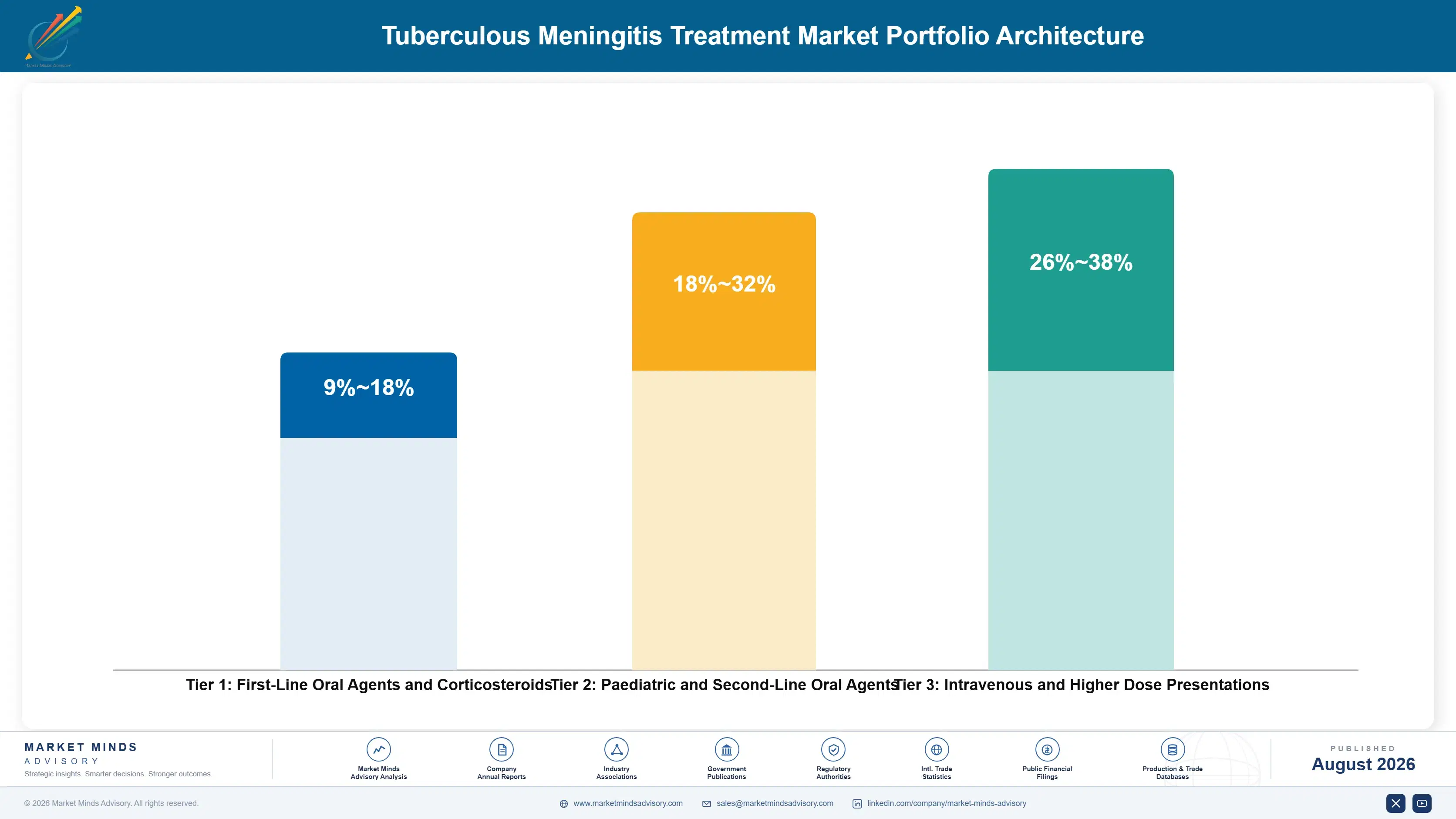
Margin here follows presentation complexity rather than therapeutic value, because the molecules are generic and programme tenders award on price. First-line oral agents and corticosteroids earn margins in the high single digits to high teens, where several qualified manufacturers meet identical specifications and a complete course costs around 42 dollars. Absolute margin per patient stays small however efficiently the products are made. Programme tenders award on price and nothing else at that level.
Paediatric dispersible formulations and second-line oral agents do better in the high teens to low thirties, because formulation complexity and smaller volumes both narrow the manufacturing field considerably. Dispersible paediatric presentations in particular require capability that few manufacturers have built. Smaller volumes also deter manufacturers whose economics depend on scale.

Intravenous and higher dose presentations hold the strongest position, reaching into the high thirties, where sterile manufacturing capability limits supply and clinicians adopting the regimens have few alternatives available. Those margins depend on sterile capacity remaining scarce relative to demand, and would compress if guideline adoption drew substantially more manufacturers into building it. Guideline adoption drawing more manufacturers into building sterile capacity would compress these margins considerably over time.

First-Line Oral Agents and Corticosteroids

Generic products meeting identical specifications where programme tenders award purely on price. The nine point range reflects manufacturing scale and ingredient sourcing rather than any therapeutic difference between suppliers. Price alone decides these awards.
Gross Margin: 9-18%

Paediatric and Second-Line Oral Agents

Products where formulation complexity and smaller volumes narrow the manufacturing field. The fourteen point range reflects dispersible formulation capability and how demanding the specific presentation actually is. Volumes are modest but defensible.
Gross Margin: 18-32%

Intravenous and Higher Dose Presentations

Sterile presentations where manufacturing capability rather than molecule access limits supply. The twelve point range reflects sterile capacity position and how far clinical adoption has run ahead of guidelines. Capacity scarcity sustains the position.
Gross Margin: 26-38%
tuberculous-meningitis-treatment-market-portfolio-architecture-1787640251799

High-value Sub-segments and Strategic Watch-out

High-Dose and Intravenous Rifamycin

High value and the fastest growth at 8.7%, raising exposure where standard dosing reaches roughly 8% of plasma concentration. Sterile manufacturing capability rather than molecule access is what limits supply here. Inpatient capacity requirements limit use in exactly the settings carrying most of the disease burden worldwide.
Gross Margin: 26-38%

Fluoroquinolone and Linezolid Regimens

High value and growing at 7.4% in resistant disease that newer agents largely bypassed on penetration grounds. Linezolid toxicity requires monitoring many high burden settings cannot readily provide. The population is small and concentrated in low income settings, which explains the limited development attention it receives.
Gross Margin: 22-34%

First-Line Oral Agents

The volume core, procured through programme tenders that award on price across several qualified manufacturers. A complete course costs around 42 dollars, so absolute margin per patient stays small. Several qualified manufacturers meet identical specifications, which leaves essentially no pricing latitude anywhere in the segment.
Gross Margin: 9-18%

Development Incentive Gap

The strategic watch-out. Severity and market value are badly mismatched, and the range reflects whether a participant engages with publicly funded development or waits for commercial returns that will not appear. Publicly funded trials are carrying work that commercial development would carry in almost any other condition.
Gross Margin: 0-30%

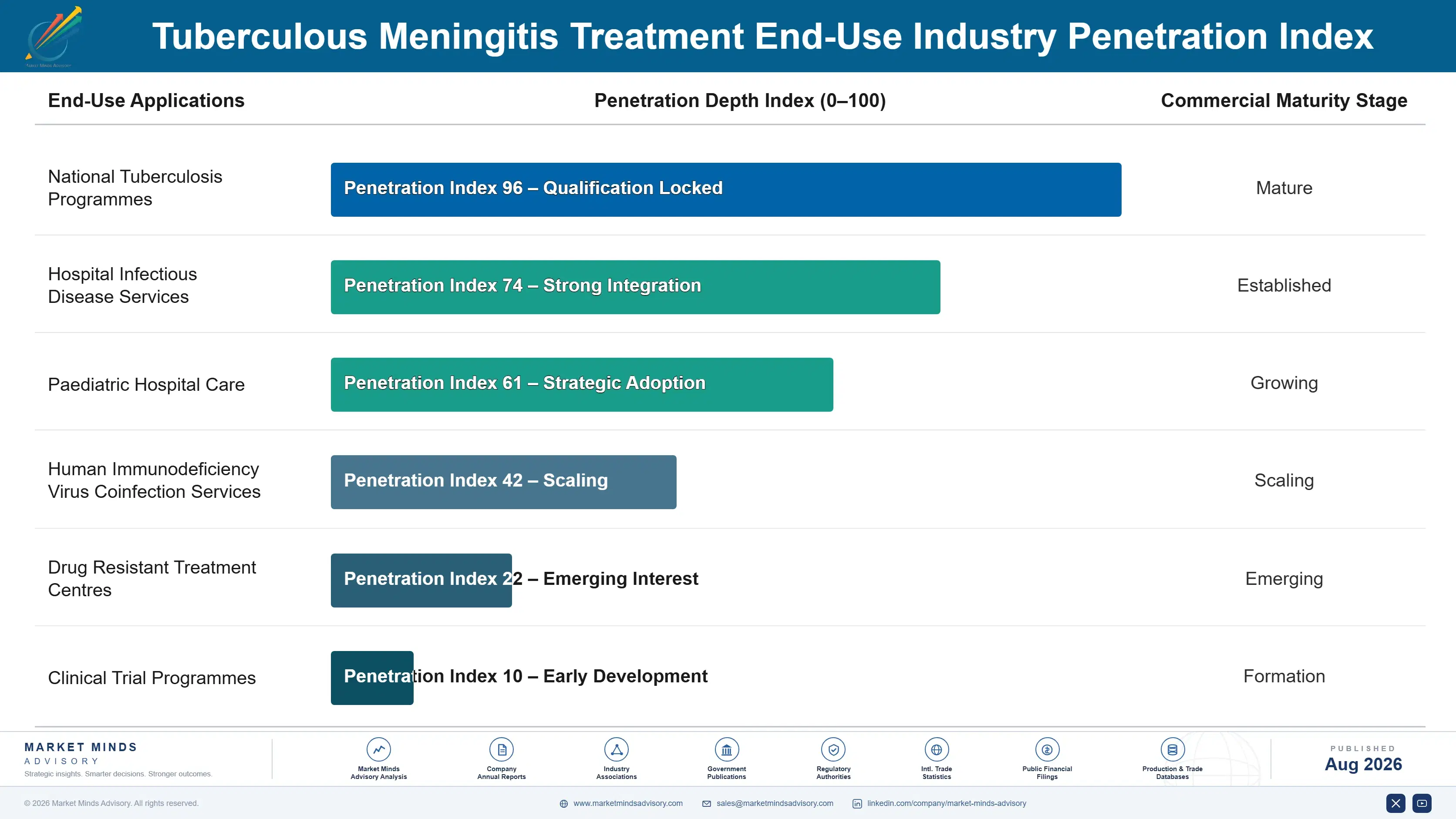
Started on Suspicion, Continued for Months

Demand here begins before anybody knows whether the diagnosis is correct. Roughly 71% of treatment starts empirically because culture takes about 21 days and delay costs lives, so drug consumption commences on clinical judgement. Treatment then continues for nine to twelve months, which makes each initiated patient a substantial and predictable course of consumption regardless of what confirmation eventually shows. Each initiation is a long course.
Stickiness follows programme procurement rather than any prescriber relationship. National tuberculosis programmes purchase centrally through tenders that reopen on schedule and award on price among prequalified manufacturers. Individual clinician preference has almost no influence on which manufacturer supplies the tablets. Intravenous and specialist presentations reopen less often, since fewer manufacturers can supply them at all. Clinician preference has almost no influence.

The deciding party sits with programme managers and guideline committees rather than with treating clinicians. National programmes set which regimens are procured and in what presentations. Guideline committees decide whether higher dosing becomes standard. A manufacturer engaging only with hospitals is talking to people implementing decisions taken centrally, frequently against a tender awarded a year earlier. Central decisions set everything here.
tuberculous-meningitis-treatment-market-end-use-penetration-index-1787640252291

Where We Would Put Effort

These are among the four positions where our research anticipates prominent divergence between winners and laggards over the coming forecast period. Each is grounded in the demand model, the regulatory perimeter, and the announced capacity pipeline.
01 / PRESENTATION RANGE BUILDING

Practice moved before the guidelines did

Higher dose and intravenous rifamycin regimens grow at 8.7% because clinicians treating a condition carrying around 27% mortality have moved ahead of formal guidance on the strength of the penetration evidence available. Manufacturers still supplying only standard oral strengths are serving a clinical practice that has been shifting underneath them steadily for years. Intravenous presentations and higher strength forms address an adoption that is already well under way, and availability rather than any persuasion is what currently limits how far it spreads.
02 / EMPIRICAL DEMAND ALIGNMENT

Confirmed cases understate real volume

Culture confirmation takes about 21 days, while roughly 71% of all treatment begins on clinical suspicion alone, which means any demand forecasting built on confirmed notifications understates actual consumption by a considerable margin. Supply planning built only on confirmed case data produces shortages in exactly those settings where empirical initiation is both most common and most clinically necessary. Aligning distribution with observed clinical presentation patterns rather than with laboratory confirmation matches supply to where the treatment genuinely starts in practice.
03 / RESISTANT DISEASE SUPPLY

The advances went past this population

The agents that transformed survival in drug resistant pulmonary tuberculosis penetrate the central nervous system poorly, which leaves resistant meningitis with fluoroquinolone and linezolid regimens growing at 7.4% and remarkably little else available at all. The affected population is small and concentrated almost entirely in low income settings, which is precisely why it has been so thoroughly neglected. Supplying reliable linezolid presentations alongside the monitoring support that its toxicity demands addresses a genuine clinical need that is currently largely unserved.
04 / DETECTION PROGRAMME FOLLOWING

Treatment follows diagnosis, not prevalence

Indonesia grows fastest of any country covered at 9.4% as case detection and national insurance coverage both widen at the same time, while the underlying prevalence has remained high and stable for several decades now. Treated volume follows detection capability rather than epidemiology, so suppliers still planning against burden estimates are targeting patients who will never reach a diagnosis at all. Programme funding and diagnostic rollout timetables are published well ahead of procurement and predict treated volume considerably better than prevalence does.

Engagement Snapshot From the Field

A live engagement with an industry participant carrying material or product regulatory and market exposure ahead of a defining policy shift, showing how our research translates into a defensible multi-year portfolio strategy.
MARKET MINDS ADVISORY · CLIENT ENGAGEMENT SUMMARY
Tuberculous Meningitis Treatment Producer Strategic Portfolio Review and Transition Roadmap 2026·Investment Scenario on Tuberculous Meningitis Treatment Exposure Evaluation 2025-26
CLIENT PROFILE
An anti-infective manufacturer supplying first-line anti-tubercular products to national programmes and donor funded procurement across Asian and African markets, at annual revenue near 310 million dollars (client-reported, unverified by MMA). Sterile presentation capability was absent and planning ran on confirmed case notifications. Supply planning ran against the smaller and later confirmed figure throughout. Coverage was tender led.
STRATEGIC CHALLENGE
Tender margins on first-line oral products had compressed to very little while clinicians were adopting intravenous regimens the client could not supply at all. Management wanted to know whether sterile capacity investment was justified by a market this small. Stockouts had also become a recurring problem in several programmes. A decision was needed.
MMA APPROACH
MMA quantified empirical initiation rates against confirmed notifications by market, modelled higher dose regimen adoption against guideline positions, assessed sterile capacity economics at realistic volumes, and mapped programme procurement cycles against the client's tender participation. Interviews with 47 experts covered tuberculosis programmes, infectious disease clinicians, procurement bodies and pharmaceutical manufacturing.
KEY FINDINGS
  1. Empirical initiation exceeded confirmed notifications substantially in every market examined, and the client had been planning supply against the smaller and later figure throughout.
  2. Higher dose and intravenous adoption was running well ahead of guideline change, and availability rather than clinical persuasion was limiting how far it had spread.
  3. Sterile capacity economics worked at realistic volumes because the qualified supplier field was very narrow, though absolute revenue remained modest against the investment required.
  4. Resistant meningitis was almost entirely unserved, since newer agents penetrate poorly and reliable linezolid supply with monitoring support was inconsistently available. Nobody was addressing it.
CLIENT PROFILE
An anti-infective manufacturer supplying first-line anti-tubercular products to national programmes and donor funded procurement across Asian and African markets, at annual revenue near 310 million dollars (client-reported, unverified by MMA). Sterile presentation capability was absent and planning ran on confirmed case notifications. Supply planning ran against the smaller and later confirmed figure throughout. Coverage was tender led.
STRATEGIC CHALLENGE
Tender margins on first-line oral products had compressed to very little while clinicians were adopting intravenous regimens the client could not supply at all. Management wanted to know whether sterile capacity investment was justified by a market this small. Stockouts had also become a recurring problem in several programmes. A decision was needed.
MMA APPROACH
MMA quantified empirical initiation rates against confirmed notifications by market, modelled higher dose regimen adoption against guideline positions, assessed sterile capacity economics at realistic volumes, and mapped programme procurement cycles against the client's tender participation. Interviews with 47 experts covered tuberculosis programmes, infectious disease clinicians, procurement bodies and pharmaceutical manufacturing.
KEY FINDINGS
  1. Empirical initiation exceeded confirmed notifications substantially in every market examined, and the client had been planning supply against the smaller and later figure throughout.
  2. Higher dose and intravenous adoption was running well ahead of guideline change, and availability rather than clinical persuasion was limiting how far it had spread.
  3. Sterile capacity economics worked at realistic volumes because the qualified supplier field was very narrow, though absolute revenue remained modest against the investment required.
  4. Resistant meningitis was almost entirely unserved, since newer agents penetrate poorly and reliable linezolid supply with monitoring support was inconsistently available. Nobody was addressing it.
RECOMMENDED STRATEGY
Phase 1: Phase one: plan supply against empirical initiation rather than confirmed notification, since the gap between them is both large and predictable. Phase 2: Phase two: build sterile presentation capability, because clinical adoption is already running ahead of what any manufacturer can currently supply. Phase 3: Phase three: establish reliable linezolid supply with monitoring support for a resistant population nobody currently serves properly. The clinical need is genuine and current supply is inconsistent.
OUTCOME
The manufacturer revised supply planning to empirical initiation during 2026 and stockouts fell substantially across participating programmes (client-reported, unverified by MMA). Sterile capacity investment was approved, and linezolid supply arrangements entered discussion with two programmes. Confirmed notification planning was abandoned across every programme the client serves.

Frequently Asked Questions

Foundational context covering the market sizes, CAGR, scope, country, region and competition that inform every finding below. This section is provided to cover basics and most often pre-purchase conversations, answered from the MMA Primary Research Dataset.

What is the current size of the Tuberculous Meningitis Treatment Market?

MMA sizes it at USD 0.18 billion in 2025, rising to USD 0.19 billion in 2026. The figure covers pharmacological treatment of the condition at manufacturer selling value.

How large will the Tuberculous Meningitis Treatment Market be by 2036?

USD 0.33 billion by 2036, an incremental USD 0.14 billion over the 2026 base and an expansion multiple of 1.74 times. Higher dose regimens carry most of that.

What is the CAGR for the Tuberculous Meningitis Treatment Market 2026 to 2036?

5.8% in the base case, with a bull case at 7.0% and a bear case at 4.6%. Case detection improvement drives most of the spread between them.

Which segment is growing fastest?

High-dose and intravenous rifamycin regimens at 8.7%, half again the market rate of 5.8%. Standard oral dosing reaches roughly 8% of plasma concentration at the infection site.

Who are the major companies in the Tuberculous Meningitis Treatment Market?

Sandoz, Lupin, Macleods Pharmaceuticals, Cipla and Sanofi lead on anti-tubercular revenue. Fifteen further participants are profiled in the full report on the same consistent revenue basis throughout.

Which country is growing fastest?

Indonesia at 9.4%, as tuberculosis case detection improves and national health insurance coverage widens across a very large population at the same time across a very substantial disease burden.

Report Segmentation Architecture

The full report scope spans multiple orthogonal segmentation dimensions, with cross-tabulated demand data provided for each dimension pair. Coverage extends further to regional breakdowns, trend trajectories, and the competitive detail needed to support segment-level decision-making.

By Therapy Class

  • First-Line Oral Anti-Tubercular Agents
  • High-Dose and Intravenous Rifamycin Regimens
  • Adjunctive Corticosteroids
  • Fluoroquinolone and Linezolid Regimens
  • Newer Anti-Tubercular Agents
  • Paediatric Formulations and Dispersible Forms

By End-Use Industry

  • National Tuberculosis Programmes
  • Hospital Infectious Disease Services
  • Paediatric Hospital Care
  • Human Immunodeficiency Virus Coinfection Services
  • Drug Resistant Treatment Centres
  • Clinical Trial Programmes

By Commercial Dimension

  • National Programme Tenders
  • Donor Funded Procurement
  • Hospital Direct Supply
  • Private Prescription Channels
  • Distributor and Wholesaler Supply
  • Research and Trial Supply

By Region

  • North America
  • Western Europe
  • East Asia
  • South Asia and Pacific
  • Latin America
  • Middle East and Africa
  • Eastern Europe

Scope, Methodology, and Coverage

Every figure in this report is reproducible from documented input assumptions. The scope below maps the historical period, the forecast horizon, the segmentation dimensions, and the countries covered, alongside the underlying primary and qualitative methodology.
Historical Period
2020 to 2025
Forecast Period
2026 to 2036
Base Year
2025 (USD billions; MMA Primary Research Dataset, August 2026)
Market Definition
Pharmacological treatment of tuberculous meningitis, covering first-line oral anti-tubercular agents, high-dose and intravenous rifamycin regimens, adjunctive corticosteroids, fluoroquinolone and linezolid regimens, newer anti-tubercular agents, and paediatric formulations and dispersible forms. Measured at manufacturer selling value. Diagnostic testing, neurosurgical procedures including shunt placement, general supportive and intensive care, and treatment of pulmonary tuberculosis are excluded from scope.
Quantitative Units
USD billions (current prices); treatment courses supplied; USD per course by therapy class
Segmentation Dimensions
Therapy class; end-use industry; commercial dimension; region
Regions Covered
North America, Western Europe, East Asia, South Asia and Pacific, Latin America, Middle East and Africa, Eastern Europe
Countries Covered
United States, Canada, Mexico, United Kingdom, France, Netherlands, Spain, China, Japan, Vietnam, India, Indonesia, Pakistan, Philippines, Australia, Brazil, Peru, South Africa, Nigeria, Russia
Key Companies Profiled
Sandoz, Lupin, Macleods Pharmaceuticals, Cipla, Sanofi, Viatris, Hetero Labs, Micro Labs, Wockhardt, Johnson and Johnson, Otsuka Pharmaceutical, Pfizer, Teva, Aurobindo Pharma, Sun Pharmaceutical Industries, Zydus Lifesciences, Fresenius Kabi, Panacea Biotec, Svizera Healthcare, Dr Reddys Laboratories
Quantitative Methodology
Primary survey, n=3,800 respondents, Q4 2025, six countries; demand-side model with trade association cross-validation
Qualitative Methodology
47 expert interviews, Q4 2025; applied to validate demand model assumptions, identify emerging dynamics, and assess competitive positioning
Report Format
PDF and XLSX data workbook (Word format preview document)
Publisher
Market Minds Advisory
Report Code
MMA-2026-HLT-138
Published
August 2026
Contact
sales@marketmindsadvisory.com | www.marketmindsadvisory.com

Purchase the full Tuberculous Meningitis Treatment Market Report (2026 to 2036).

The full report treats tuberculous meningitis as a condition managed with a regimen developed for a different organ, using a drug that reaches the infected site at a small fraction of blood concentration. It sizes all six therapy classes independently through 2036, quantifies empirical initiation against confirmed notification, and models higher dose adoption against guideline positions. Regional chapters cover all seven regions with disease burden assessed separately from treatment access. Competitive profiling covers 20 participants on one consistent revenue basis. Presentation capability is assessed against clinical adoption throughout the analysis.
Six therapy classes sized independently through 2036
Empirical initiation quantified against confirmed case notification by market
Higher dose regimen adoption modelled against formal guideline positions
Disease burden assessed separately from treatment access by region
Central nervous system penetration compared across available agent classes
Twenty participants profiled on one consistent revenue basis

Built For The People Who Decide

From boardroom strategy to bench-side execution, this report is read cover-to-cover by leaders shaping the next decade of their industry, turning demand scenarios, market dynamics and valuation benchmarks into decisions.
CXOs/ Presidents/ VPs/ Managers
M&A and Corporate Development
Strategy Teams and R&D Heads
Procurement and Product Directors
Regulatory and Compliance Leaders
Investor Relations and Equity Analysts