Market Minds Advisory
TSN Ethernet Chips Market

TSN Ethernet Chips Market: TSN Ethernet Chips Market. Deterministic Networking Silicon for Industrial, Automotive, and Aerospace Systems

Automotive zonal architecture and industrial automation convergence are pulling deterministic Ethernet silicon out of niche aerospace applications into mainstream vehicle and factory networks, forcing legacy fieldbus chipmakers into a rapid platform transition.

Lead Analyst

Published

September 2026

Make Smarter Decisions with Customized Research Insights

Request a free sample report and evaluate market opportunities, growth trends, and competitive dynamics relevant to your business needs.

2025 MARKET VALUE$1.2BMarket Size 2025
2036 FORECAST VALUE$5.1BBase Case , 2026 to 2036
CAGR 2026 TO 203614.0 %Bull 15.3% / Bear 12.7%
INCREMENTAL OPPORTUNITY$3.7BNet 10- year value creation
EXPANSION MULTIPLE3.71x2036 value over 2026 base
Strategic Levers
M&A Pipeline
Regional Outlook
Country Rankings
Competitive Intelligence
Segmental Deep-dive
Call-Us : 91 93563 13602

Executive Snapshot and Market Trajectory.

Automotive zonal architecture redesigns are pulling deterministic Ethernet silicon out of niche aerospace applications and into mainstream vehicle networks faster than most chipmakers anticipated when TSN standards were first ratified less than a decade ago, and adoption is now spreading well beyond the early aerospace and defense buyer base.
Industrial automation buyers are converging on TSN as the successor to fragmented proprietary fieldbus protocols, since a single deterministic Ethernet standard lets factory operators mix equipment from different vendors on one network without dedicated gateway hardware. Automotive OEMs are running the same calculation as they consolidate dozens of legacy vehicle networks into fewer, higher-bandwidth zonal architectures ahead of software-defined vehicle platforms reaching volume production.
Legacy fieldbus and CAN chipmakers face a genuine platform transition risk as TSN silicon captures design wins in next-generation vehicle and factory architectures, while established networking semiconductor vendors extending into TSN from adjacent product lines are moving faster than smaller specialists can match on manufacturing scale alone. Design win cycles now run two to three years from silicon sampling to volume production, rewarding vendors who committed engineering resources to TSN development early over slower-moving incumbents.
Market Definition
The TSN Ethernet chips market covers semiconductor devices implementing IEEE 802.1 time-sensitive networking standards for deterministic, low-latency Ethernet communication in industrial, automotive, and aerospace systems. It excludes standard commercial Ethernet chips without TSN protocol support and proprietary fieldbus silicon that has not adopted IEEE TSN standards.
Base Year Value
$1.2B in 2025 (MMA Primary Research Dataset, September 2026)
Forecast Period
2026 to 2036, eleven discrete annual values
CAGR
14.0% base case. Bull 15.3%. Bear 12.7%.
Fastest Growth Segment
TSN System-on-Chip Integrated Solutions: 19.0% CAGR
Fastest Growth Country
India: 16.2% CAGR
Fastest Growth Region
South Asia and Pacific: 16.2% CAGR
Largest Region
East Asia: 29% of 2025 global value
Market Leaders
Texas Instruments, NXP Semiconductors, Microchip Technology, Renesas Electronics, and Marvell Technology lead the market. Source: MMA Analysis, July 2026.
Primary Survey
n=3,800 procurement and R&D decision-makers, Q4 2025, six countries
Methodology
Demand-side build-up, cross-validated against public data, 47 expert interviews

TSN Ethernet Chips Market Forecast Scenarios

tsn-ethernet-chips-market-size-forecast-scenario-1789982582405
The TSN Ethernet chips market grew at an estimated 12.5 percent historical CAGR between 2020 and 2025, as early aerospace and defense adopters proved out deterministic Ethernet reliability before industrial automation and automotive buyers committed meaningful design-in volume. Standards ratification across the core IEEE 802.1 TSN specifications gave chipmakers the stable target needed to commit silicon development resources.
The base case assumes 14.0 percent CAGR through 2036, driven by three commercial mechanisms working together: automotive OEMs consolidating legacy vehicle networks into zonal architectures requiring deterministic Ethernet backbones, industrial automation buyers replacing fragmented proprietary fieldbus protocols with a single interoperable standard, and chipmakers integrating TSN capability directly into broader system-on-chip platforms rather than selling standalone TSN silicon, a bundling trend expanding the addressable buyer base into cost-sensitive mid-market industrial equipment makers previously priced out of deterministic networking entirely.
The bull case centers on faster software-defined vehicle platform adoption pulling automotive TSN silicon demand upward faster than modeled, with zonal architecture volume production acting as the named catalyst. The bear case centers on automotive OEM platform delays, a named risk that could push meaningful automotive design wins later into the forecast window than currently modeled.

Deterministic Networking Silicon Moves Into Volume Production

TSN Ethernet chips sit underneath the deterministic networking layer connecting sensors, controllers, and actuators across industrial and automotive systems that cannot tolerate variable latency. The category has moved well beyond its original aerospace and defense niche. Modern silicon now targets high-volume automotive and industrial automation applications, and that shift is reshaping how chipmakers price, package, and support products originally engineered for low-volume, high-margin defense contracts.
MARKET CONCENTRATION55% CR5share of market revenue held by top vendors
AVERAGE SELLING PRICE$8.50typical unit price for a mid-tier TSN switch chip
AUTOMOTIVE DESIGN WIN SHARE34%revenue from vehicle network and zonal architecture programs
PRODUCT DESIGN CYCLE2.5 Yearsaverage interval from silicon sampling to volume production
FABLESS MANUFACTURING MIX71%chip volume produced through outsourced foundry arrangements rather than in-house
STANDARDS COMPLIANCE CERTIFICATION RATE88%shipped units carrying formal IEEE TSN conformance certification
Automotive zonal architecture has become the sharpest growth vector, pulling TSN silicon demand from a category once dominated by industrial automation and aerospace buyers into vehicle network backbones supporting software-defined vehicle platforms. These automotive programs demand tighter automotive-grade qualification and functional safety certification than industrial buyers historically required, forcing chipmakers to invest in new certification processes or partner with automotive-focused specialists to compete.
Industrial automation buyers converging on TSN as a fieldbus replacement compound the competitive pressure on legacy proprietary networking chipmakers. As factory operators consolidate equipment sourcing around interoperable standards, TSN vendors increasingly compete on platform breadth and interoperability certification rather than raw price, and that repositioning is reshaping which vendors win the largest industrial automation design contracts across most major manufacturing regions tracked in this report.
"Automotive used to be a side bet for TSN chipmakers. Now it is the entire roadmap. Vendors who treated it as a niche two years ago are scrambling to catch up on automotive-grade qualification today."
Senior Director, Semiconductor and Industrial Networking Practice · MMA Time-Sensitive Networking Semiconductor Devices Practice · September 2026

Market Trends

Automotive Zonal Architecture Consolidates Vehicle Networks

Automakers are replacing dozens of legacy domain-based electronic control units and network protocols with fewer, higher-bandwidth zonal architectures built around deterministic Ethernet backbones, a redesign that requires TSN silicon capable of meeting automotive-grade reliability and functional safety certification standards. Vendors that shipped automotive-qualified TSN chips over the past two years are winning multi-year design contracts worth eight figures annually from OEMs previously running dozens of separate network segments across a single vehicle platform. This consolidation is accelerating as software-defined vehicle platforms move from pilot programs into volume production across most major automakers globally.
Market Impact: Requires TSN in 60 percent
Industrial Automation Standardizes on TSN Over Fieldbus

Factory operators historically ran multiple incompatible proprietary fieldbus protocols across different equipment vendors, requiring dedicated gateway hardware to bridge communication between systems that could not otherwise interoperate. TSN standardization lets operators mix equipment from different vendors on a single deterministic Ethernet network without that gateway overhead, cutting integration cost and complexity meaningfully for new factory buildouts. Chipmakers shipping certified interoperable TSN silicon are winning design contracts with industrial automation equipment makers previously locked into proprietary protocol arrangements that limited buyer flexibility and vendor switching options considerably across most factory automation product lines tracked.
Market Impact: Lifts new-line design wins 40 percent

Market Opportunities and Growth Drivers

Software-Defined Vehicle Platforms Require Deterministic Backbones

Software-defined vehicle architectures centralize compute and separate it from sensors and actuators distributed across the vehicle, requiring a network backbone capable of guaranteeing latency and bandwidth for safety-critical functions like braking and steering alongside high-bandwidth infotainment and sensor data traffic simultaneously. Standard automotive Ethernet without TSN capability cannot guarantee this determinism reliably at scale. Automakers committing to software-defined vehicle platforms are specifying TSN silicon as a baseline requirement in next-generation vehicle architecture programs, and that specification is cascading through the entire automotive semiconductor supply chain as Tier 1 suppliers align their own product roadmaps accordingly.
Market Impact: Extends design cycles 18 months longer

Factory Automation Investment Accelerates Deterministic Networking Demand

Manufacturers investing in automated production lines increasingly require real-time coordination between robotics, sensors, and control systems that standard Ethernet jitter and latency variability cannot reliably support at the precision modern automation demands. TSN chipmakers report meaningfully higher design win rates among automation equipment makers building new production lines compared to those retrofitting older facilities that still run legacy networking infrastructure without any deterministic capability built in. Adoption has moved from a competitive differentiator reserved for the most advanced factories to an increasingly standard specification across mid-market automation equipment over the past two years.
Market Impact: Adds 20 percent testing time

Market Restraints and Challenges

Automotive-Grade Qualification Requirements Extend Design Cycles

Automotive buyers require extensive functional safety certification and reliability testing under extreme temperature and vibration conditions before approving TSN silicon for vehicle programs, a friction point rooted in the automotive industry long-established qualification standards that were not originally designed with networking semiconductors in mind. The commercial impact extends product design cycles well beyond typical industrial timelines, delaying revenue recognition and raising upfront qualification cost for chipmakers without prior automotive experience. Vendors are mitigating the barrier by partnering with established automotive semiconductor specialists for qualification support and by investing early in automotive-specific test infrastructure ahead of design win opportunities becoming available.
Market Impact: Adds 34 percent design win share

Interoperability Fragmentation Slows Multi-Vendor Network Deployment

Despite formal IEEE standardization, TSN implementations across different chipmakers still show meaningful interoperability gaps in practice, a friction point whose root cause is the complexity and optional nature of many TSN sub-standards that vendors implement selectively rather than comprehensively. The commercial impact shows up as extended integration testing cycles for buyers combining equipment from multiple vendors, slowing multi-vendor factory and vehicle network deployments meaningfully. Industry consortiums are mitigating the problem through expanded interoperability certification testing programs and reference implementations, while some buyers are simplifying deployment by standardizing on fewer chip vendors per project.
Market Impact: Cuts integration cost 25 percent
4 additional market trends, 3 additional growth drivers, and 2 additional restraints and challenges are covered in the full report. Contact sales@marketmindsadvisory.com to access the complete intelligence.

Segment CAGR and Growth Architecture

The TSN Ethernet chips market splits into six segments by underlying silicon function, spanning switches, PHY transceivers, endpoint controllers, and integrated system-on-chip solutions. TSN SoC integrated solutions and endpoint controller chips are growing fastest as automotive and industrial buyers favor consolidated silicon over discrete component architectures across most new automotive and factory automation design programs entering production now.
tsn-ethernet-chips-market-market-share-analysis-1789982582975

TSN System-on-Chip Integrated Solutions

This segment covers integrated silicon that combines TSN switching, endpoint controller, and processing capability onto a single chip rather than requiring buyers to combine multiple discrete components. Growth is outpacing every other segment as automotive and industrial equipment makers increasingly prefer consolidated silicon that simplifies board design, reduces bill-of-materials cost, and shortens qualification cycles compared to discrete component architectures. Vendors shipping automotive-qualified TSN SoCs are capturing outsized share of new zonal architecture design wins. This segment barely existed in commercial volume three years ago and continues expanding into new automotive and industrial product categories each design cycle, from central vehicle compute modules into factory robotics controllers and, increasingly, aerospace avionics platforms adopting the same consolidated approach.
CAGR 19.0%

TSN Endpoint and NIC Controller Chips

This segment covers network interface controller chips that connect sensors, actuators, and compute modules to a deterministic TSN backbone, serving as the endpoint hardware distributed throughout vehicle and factory networks. Demand is expanding rapidly as zonal vehicle architectures and dense industrial automation deployments multiply the number of endpoints requiring TSN connectivity per system, well beyond the switch and gateway hardware count these networks also require. Vendors serving automotive Tier 1 suppliers and industrial equipment makers are winning multi-year volume contracts as endpoint density scales alongside broader vehicle and factory network sophistication requirements across nearly every new platform generation entering production, from passenger vehicles to dense factory robotics deployments requiring hundreds of endpoints each.
CAGR 17.0%
Full segment breakdown across 6 segments available in the complete report.

Regional Architecture and Country Demand Map

East Asia leads on concentrated semiconductor manufacturing and dense automotive and industrial equipment production, while South Asia and Pacific posts the fastest regional growth as factory automation and vehicle electronics manufacturing scale rapidly across expanding industrial and automotive manufacturing bases scaling rapidly across most emerging economies tracked in this report.

North America

North America anchors semiconductor design leadership for TSN silicon given concentrated chipmaker headquarters presence at Texas Instruments, NXP, and Microchip Technology, alongside deep automotive Tier 1 supplier relationships supporting zonal architecture programs. US defense and aerospace programs were among the first globally to adopt deterministic Ethernet standards, anchoring steady institutional demand alongside expanding automotive volume. Canadian industrial automation equipment makers are following a similar TSN adoption curve behind their US counterparts. Regulatory attention on vehicle safety systems is pushing automakers here toward TSN-based network architectures faster than almost any other region tracked in this report, reinforcing the local supplier advantage further and shortening design win cycles relative to overseas competitors entering later.
Share: 27% | CAGR: 13.5% (2026 to 2036)

Western Europe

German automotive OEMs and Tier 1 suppliers lead European TSN adoption given the region concentration of premium vehicle manufacturers investing heavily in zonal architecture and software-defined vehicle platforms ahead of most global peers. Industrial automation equipment makers across Germany and Switzerland, home to a dense concentration of factory automation specialists, are standardizing on TSN as a fieldbus replacement faster than most peer markets. UK and French chipmakers contribute meaningful design capability, though production volume concentrates more heavily in Germany. Regulatory harmonization across the EU is accelerating TSN certification standards for cross-border industrial equipment sales across the broader single market as harmonized requirements reduce duplicate certification costs for suppliers operating regionwide.
Share: 20% | CAGR: 12.3% (2026 to 2036)
Regional intelligence for 5 additional markets available in the complete report: East Asia, South Asia and Pacific, Latin America, Middle East and Africa, Eastern Europe. Contact sales@marketmindsadvisory.com.
tsn-ethernet-chips-market-country-cagr-analysis-1789982583501

Where TSN Chipmakers Can Capture Incremental Margin

TSN Ethernet chip economics reward vendors who move beyond discrete component sales toward integrated silicon and certification services. Four levers stand out for capturing incremental revenue over the forecast window: SoC integration, automotive qualification services, certification licensing, and geographic expansion through regional design partners across underserved manufacturing markets where direct sales investment is not yet economically justified.

Integrate TSN Capability Into Broader System-on-Chip Platforms

Vendors bundling TSN switching and endpoint controller capability directly into broader system-on-chip platforms, rather than selling standalone TSN silicon, are capturing outsized share of new automotive and industrial design wins. This consolidation cuts board design complexity for buyers while raising average selling price roughly 35 percent versus discrete component architectures requiring separate TSN chips alongside other processing silicon. Vendors without a credible SoC integration roadmap are increasingly losing shortlist position as buyers consolidate purchasing around fewer, more capable suppliers offering broader integrated product lines rather than piecing together separate discrete components themselves.
Market Impact: Raises average selling price by roughly 35 percent

Offer Automotive Qualification and Certification Support Services

Vendors building formal automotive-grade qualification and certification support services around their silicon, rather than selling chips alone, are winning larger design contracts and commanding meaningfully higher margins than chip-only competitors serving the same automotive Tier 1 buyers. Qualification services create ongoing revenue through recurring certification renewal and testing requirements that persist well beyond the initial silicon design win. Vendors offering this bundle report contract values roughly 40 percent higher than silicon-only bids submitted for comparable automotive design programs across similar vehicle platform categories and Tier 1 supplier relationships tracked in this report.
Market Impact: Raises design contract value by roughly 40 percent

License Interoperability Certification To Industry Consortiums

Vendors participating actively in TSN interoperability certification programs and licensing their reference test implementations to industry consortiums are building reputational credibility that translates directly into design win preference among buyers wary of interoperability gaps between vendors. This positioning captures a meaningful pricing premium among buyers deploying multi-vendor networks who value certified interoperability highly enough to pay roughly 15 percent more for chips carrying strong certification credentials. The approach also generates modest licensing revenue from consortium participation fees paid by smaller vendors seeking similar credibility without building the testing infrastructure themselves.
Market Impact: Commands a roughly 15 percent higher pricing premium

License Platform Technology To Regional Design Partners

Rather than building direct enterprise sales infrastructure in every manufacturing region, several chipmakers are licensing core TSN platform technology to regional design houses and local systems integrators across South Asia, Latin America, and Eastern Europe, collecting royalty and support fees while local partners handle sales, integration, and regional certification compliance. This model lets vendors capture revenue from markets where direct enterprise sales investment would not otherwise be justified given account size, while partners gain access to platform capability they could not replicate independently, generating royalty revenue equal to roughly 10 percent of partner contract value.
Market Impact: Adds about 10 percent margin at low cost

Who Controls the Margin Pool

TSN Ethernet chip concentration sits at moderately high levels, with the top five vendors holding an estimated 55 percent combined revenue share on a shipped-unit-volume basis, the yardstick applied throughout this section. Texas Instruments holds a clear leadership position given deep automotive semiconductor relationships, while NXP Semiconductors, Microchip Technology, Renesas Electronics, and Marvell Technology compete on industrial automation depth, automotive qualification breadth, and integrated SoC capability the largest platform has been slower to prioritize.
Competitive activity currently centers on automotive-grade qualification, SoC integration depth, and interoperability certification rather than price competition on core silicon alone. Vendors are racing to certify products for zonal vehicle architecture programs ahead of rivals, and several announced expanded industrial automation partnerships within the past year to capture factory automation buyers before competitors establish default positions.

Rankings are most likely to shift where challengers out-execute the market leader on automotive qualification speed and SoC integration depth, since automotive Tier 1 buyers increasingly favor vendors offering bundled qualification services over silicon-only bids. Smaller vendors focused narrowly on industrial automation are gaining share fastest among mid-market factory equipment makers prioritizing interoperability over deep automotive relationships.
tsn-ethernet-chips-market-company-positioning-matrix-1789982584030

Competitive Moat and Risk Dimensions

TEXAS INSTRUMENTS

Moat: Deep Automotive Design Relationships

Decades of automotive semiconductor supply relationships give Texas Instruments a qualification and reputational moat few competitors can approach quickly, since automotive Tier 1 buyers weigh prior automotive-grade certification track record heavily and switching silicon suppliers mid-program carries meaningful requalification cost and schedule risk few procurement teams want to absorb.
TEXAS INSTRUMENTS

Risk: Slower Industrial Automation Focus

Texas Instruments built its TSN strategy primarily around automotive relationships rather than industrial automation depth, leaving it somewhat exposed to specialist industrial networking vendors with deeper factory automation partnerships moving faster to capture that buyer segment before broader automotive-focused suppliers catch up meaningfully across the full range of factory automation applications.
NXP SEMICONDUCTORS

Moat: Broad Automotive and Industrial Portfolio

NXP built a wide product portfolio spanning both automotive and industrial TSN applications, giving it broader design win opportunities across buyer segments than narrower competitors, and that portfolio breadth continues driving strong customer relationships across both zonal vehicle architecture and factory automation programs simultaneously, a rare dual-market position among TSN specialists.
NXP SEMICONDUCTORS

Risk: Portfolio Breadth Dilutes Focus

Spreading engineering resources across both automotive and industrial TSN product lines leaves NXP potentially less specialized than competitors concentrating entirely on one buyer segment, a tradeoff that could slow feature development speed relative to more narrowly focused rivals chasing the same design win opportunities across a single buyer category exclusively.

Players Tracked

Prominent Players

Texas Instruments
NXP Semiconductors
Microchip Technology
Renesas Electronics
Marvell Technology

Other Key Players

Broadcom
Realtek Semiconductor
Analog Devices
STMicroelectronics
Intel
Cisco Systems
Lattice Semiconductor
Belden
Siemens
Moxa
Innodisk
KEB Automation
TTTech Auto
Onsemi
Infineon Technologies

Recent Developments

MARCH 2026

Texas Instruments Acquires Automotive TSN Software Specialist

Texas Instruments completed the acquisition of a smaller automotive TSN software specialist to strengthen its zonal architecture software stack ahead of further vehicle platform design wins, adding roughly 50 engineers and an established software platform to its existing silicon business line across both automotive and industrial product families.
Signal: Signals accelerating consolidation around embedded software as a core automotive TSN differentiator across the industry right now.
AUGUST 2025

Renesas Signs Multi-Year Industrial Automation Partnership

Renesas announced a multi-year technology partnership with a major industrial automation equipment maker to become preferred TSN silicon supplier across new factory automation product lines, expanding its footprint in a segment previously served only through smaller regional distributor relationships across fewer geographic markets than the new agreement now covers.
Signal: Confirms industrial automation partnership has become a primary growth channel for specialist vendors across the broader specialist vendor landscape today.
DECEMBER 2025

Marvell Launches Integrated TSN System-on-Chip Product

Marvell launched an integrated TSN system-on-chip product combining switching, endpoint controller, and processing capability onto a single die, positioning itself directly against larger competitors focused mainly on discrete component architectures for the largest automotive and industrial accounts with dedicated design and engineering teams available across most major product lines today.
Signal: Shows specialist vendors deliberately targeting the fast-growing SoC integration segment ahead of larger rivals still selling discrete components.

Foundry Capacity and Wafer Cost Exposure

Wafer fabrication and packaging make up an estimated 45 to 55 percent of TSN chip vendor cost of goods sold, since most vendors operate fabless business models sourcing manufacturing capacity from a small number of advanced foundries concentrated in Taiwan and South Korea. Automotive-grade qualification testing adds further cost exposure, since automotive buyers require extensive reliability validation beyond standard industrial chip testing protocols.
Advanced foundry capacity tightened meaningfully through 2024 and into 2025 as AI accelerator and automotive semiconductor demand competed for the same limited manufacturing nodes, a dynamic documented in national statistical office semiconductor trade data and corroborated by major foundry annual capacity disclosures. TSN chipmakers reported extended lead times and periodic price increases during the period, with several smaller vendors delaying product launches while waiting on foundry allocation from capacity-constrained suppliers.

The disadvantage falls hardest on smaller chipmakers lacking long-term foundry supply agreements, who pay meaningfully higher per-wafer costs than scaled competitors able to commit to large advance capacity reservations. Vendors dependent on a single foundry relationship face additional supply disruption risk that erodes their competitiveness against rivals maintaining diversified manufacturing relationships across multiple foundry partners.
tsn-ethernet-chips-market-cost-volatility-analysis-1789982584230

Sign Long-Term Foundry Capacity Agreements

Vendors are locking in multi-year capacity reservation agreements with advanced foundries rather than buying wafer allocation on the spot market, trading some pricing flexibility for guaranteed manufacturing access. This works best for vendors with predictable unit volume forecasts, letting them commit to advance capacity without overcommitting to unused allocation they cannot resell easily to other buyers.

Diversify Across Multiple Foundry Partners

Chipmakers are qualifying designs across two or more foundry partners rather than depending on a single manufacturing relationship, reducing exposure to any one supplier capacity constraint or pricing decision. The approach adds design validation overhead across multiple process nodes, but vendors report the supply security gained outweighs the added cost for most high-volume product lines.

Shift Toward Mature Process Nodes Where Feasible

Some chipmakers are designing TSN silicon around mature, less capacity-constrained process nodes rather than chasing the most advanced nodes facing the tightest allocation competition from AI accelerator demand. This trades a modest performance margin for meaningfully more reliable production scheduling, a tradeoff most TSN vendors now consider worthwhile given how disruptive recent capacity shortages proved for production scheduling.

Portfolio Architecture for Margin Defence

TSN chip margin economics split sharply by tier. Standard industrial PHY and switch chips compete largely on price against legacy fieldbus alternatives, compressing gross margin toward the lower end of semiconductor norms, while automotive-qualified and integrated SoC solutions command materially higher margins reflecting specialized qualification and engineering investment competitors cannot easily replicate without years of dedicated development effort behind them.
The volume versus premium tension shows up clearest in how vendors allocate engineering resources: teams chasing automotive qualification and SoC integration pull investment away from entry-level industrial PHY chips, gradually letting commodity component margins compress further as vendors deprioritize that layer relative to higher-margin specialty silicon capturing most new design win growth and driving the bulk of new bookings this cycle.

High-value margin pools concentrate overwhelmingly in automotive-qualified integrated SoC solutions and certified aerospace platforms, where technical differentiation and qualification barriers remain real and defensible for now against both commodity component competition and legacy fieldbus pricing pressure. Vendors positioned only in entry-level industrial silicon face the steepest long-term margin pressure as component costs commoditize further and buyers expect more capability at the same price point each year.

Standard Industrial PHY and Switch Chips

Basic industrial-grade TSN PHY and switch silicon competing largely on price against legacy fieldbus alternatives, with thin margins and limited differentiation beyond reliability, certification, and standard support quality across most industrial applications.
Gross Margin: 25-35%

Automotive-Qualified TSN Silicon

Automotive-grade TSN silicon meeting functional safety certification and extreme reliability standards, commanding premium pricing given specialized qualification investment competitors cannot easily replicate at comparable quality within a short qualification timeline.
Gross Margin: 45-55%

Integrated SoC and Aerospace-Certified Platforms

Fully integrated system-on-chip solutions and aerospace-certified platforms, the highest-margin layer given regulatory approval barriers and its growing role in next-generation vehicle, factory, and aerospace architecture programs across all major automotive and industrial markets tracked.
Gross Margin: 50-60%
tsn-ethernet-chips-market-portfolio-architecture-1789982584739

High-value Sub-segments and Strategic Watch-out

Automotive Zonal Architecture Silicon

The clearest high-value, high-growth pool in the category, combining premium pricing with the fastest unit growth as automakers standardize on TSN silicon for next-generation vehicle network architectures across nearly every major automotive platform now and through the remainder of the forecast window as adoption broadens.
Gross Margin: 50-60%

Certified Interoperability Platforms

A high-value pool growing at a more moderate pace than automotive silicon, anchored by durable multi-year design relationships with industrial automation buyers valuing certified interoperability across multi-vendor factory networks spanning most major manufacturing regions tracked in this report, giving vendors more predictable revenue than discretionary spending provides.
Gross Margin: 45-55%

Standard Industrial Switch Silicon

The volume core of the market, generating dependable recurring unit sales at thinner margins, serving as the baseline product most vendors bundle premium qualification services on top of rather than compete on directly against rival vendors in most procurement processes across nearly every geography tracked.
Gross Margin: 25-35%

Legacy Fieldbus Bridge Chips

A strategic watch-out segment facing steady margin erosion as TSN standardization eliminates the gateway hardware requirement these chips historically served, pressuring vendors still dependent on this layer for meaningful revenue heading into the back half of the forecast window as broader TSN adoption accelerates further this cycle.
Gross Margin: 10-20%

The Anatomy of Design Win Revenue

TSN chip revenue runs increasingly on annuity economics once a design win embeds silicon into a vehicle platform or factory equipment production run. Automotive design contracts typically span five to seven years matching vehicle platform lifecycles, and switching costs, including requalification and revalidation, keep churn near zero once a chip is designed into a production program.
Adoption stickiness varies meaningfully by end-use vertical. Automotive buyers embed TSN silicon deeply into platform architecture decisions made years before production begins, producing the lowest churn of any buyer segment tracked. Industrial automation buyers, replacing equipment on shorter cycles, show somewhat higher switching willingness at each equipment refresh, while aerospace buyers churn slowest of all given decades-long platform lifecycles and extensive requalification requirements that discourage any mid-program vendor switching entirely.

Buyer profiles are shifting generationally as automotive electrical architecture teams, rather than traditional powertrain engineers, increasingly drive net new TSN silicon demand. These buyers evaluate platforms on software-defined vehicle compatibility and zonal architecture support rather than legacy point-to-point wiring metrics, pushing chipmakers to hire automotive software and systems engineering talent alongside traditional silicon design staff to serve this expanding buyer base effectively.
tsn-ethernet-chips-market-end-use-penetration-index-1789982585238

Where TSN Chipmakers Should Focus Next

These are among the four positions where our research anticipates prominent divergence between winners and laggards over the coming forecast period. Each is grounded in the demand model, the regulatory perimeter, and the announced capacity pipeline.
01 / AUTOMOTIVE QUALIFICATION PRIORITY

Invest In Automotive Qualification Ahead of Volume Ramp

Automotive design win cycles run two to three years from silicon sampling to volume production, meaning qualification investments made now determine which vendors capture the zonal architecture ramp beginning later this decade. Vendors without automotive-grade certification are increasingly excluded from Tier 1 supplier shortlists regardless of how strong their industrial silicon performance remains. Committing engineering resources to automotive qualification now, even where the process is costly and lengthy, positions vendors ahead of competitors still waiting for demand signals to justify the investment.
02 / SOC INTEGRATION INVESTMENT

Build Integrated SoC Products Rather Than Discrete Chips

Buyers increasingly prefer consolidated silicon that simplifies board design and reduces bill-of-materials cost over discrete component architectures requiring separate TSN chips alongside other processing silicon. Vendors without a credible SoC integration roadmap are losing shortlist position as automotive and industrial buyers consolidate purchasing around fewer, more capable suppliers. Prioritizing integration now captures the fastest-growing segment of the category before rivals establish default positions with major automotive and industrial equipment buyers, particularly given how tightly design win cycles now run in this category.
03 / INTEROPERABILITY CERTIFICATION PURSUIT

Pursue Interoperability Certification To Win Multi-Vendor Deals

Interoperability gaps between vendor implementations remain a meaningful friction point despite formal IEEE standardization, and buyers deploying multi-vendor networks increasingly favor chips carrying strong certification credentials over uncertified alternatives. Pursuing active participation in industry certification programs, even where the process requires meaningful engineering and testing investment, builds reputational credibility that translates directly into design win preference. Vendors skipping this investment risk losing multi-vendor deployment deals to more thoroughly certified competitors as buyer certification requirements tighten further across most major manufacturing regions this report tracks in detail.
04 / REGIONAL GROWTH ALLOCATION

Prioritize East Asia and South Asia Alongside Core Markets

East Asia and South Asia and Pacific post the fastest regional growth in this report, driven by concentrated semiconductor manufacturing capacity and rapidly expanding automotive and industrial equipment production across the region. Vendors over-indexed on North American and Western European sales investment risk missing the fastest-growing accounts of the entire forecast window, particularly among Chinese electric vehicle manufacturers building TSN-native architectures from a clean slate. Building regional partnerships now positions vendors ahead of slower-moving competitors still focused primarily on mature markets.

Engagement Snapshot From the Field

A live engagement with an industry participant carrying material or product regulatory and market exposure ahead of a defining policy shift, showing how our research translates into a defensible multi-year portfolio strategy.
MARKET MINDS ADVISORY · CLIENT ENGAGEMENT SUMMARY
TSN Ethernet Chips Producer Strategic Portfolio Review and Transition Roadmap 2026·Investment Scenario on TSN Ethernet Chips Exposure Evaluation 2025-26
CLIENT PROFILE
The client manufactures factory automation equipment for automotive and electronics assembly customers across North America and Europe, generating revenue in the low hundreds of millions annually with a growing share tied to next-generation deterministic networking capability (client-reported, unverified by MMA). The organization was running legacy proprietary fieldbus protocols across its product line and evaluating a transition to TSN-based networking.
STRATEGIC CHALLENGE
Customers increasingly requested interoperability with equipment from other vendors on the same factory floor, something the client proprietary fieldbus protocol could not support without expensive dedicated gateway hardware, while competitors already shipping TSN-enabled equipment were winning deals specifically on interoperability grounds, threatening the client competitive position in its core factory automation market segment.
MMA APPROACH
MMA conducted a structured vendor evaluation across four candidate TSN silicon suppliers, benchmarking each against the client existing product performance requirements, integration complexity, and total cost of ownership over a five-year horizon. The engagement included primary interviews with the client engineering and sales teams to surface customer requirements the vendor evaluation needed to weigh appropriately.
KEY FINDINGS
  1. TSN-enabled equipment commanded a meaningful price premium over legacy fieldbus alternatives in competitive bids where customers explicitly valued multi-vendor interoperability capability over legacy proprietary networking approaches.
  2. Migration to TSN silicon was projected to cut integration engineering time meaningfully for customers combining the client equipment with other vendors on the same production line.
  3. Silicon vendor selection favored suppliers with established industrial automation certification track records over newer entrants lacking proven factory automation deployment experience at comparable scale.
  4. Customers in automotive-adjacent manufacturing segments showed the strongest willingness to pay a premium for verified interoperability certification across multi-vendor factory networks serving comparable production volumes.
CLIENT PROFILE
The client manufactures factory automation equipment for automotive and electronics assembly customers across North America and Europe, generating revenue in the low hundreds of millions annually with a growing share tied to next-generation deterministic networking capability (client-reported, unverified by MMA). The organization was running legacy proprietary fieldbus protocols across its product line and evaluating a transition to TSN-based networking.
STRATEGIC CHALLENGE
Customers increasingly requested interoperability with equipment from other vendors on the same factory floor, something the client proprietary fieldbus protocol could not support without expensive dedicated gateway hardware, while competitors already shipping TSN-enabled equipment were winning deals specifically on interoperability grounds, threatening the client competitive position in its core factory automation market segment.
MMA APPROACH
MMA conducted a structured vendor evaluation across four candidate TSN silicon suppliers, benchmarking each against the client existing product performance requirements, integration complexity, and total cost of ownership over a five-year horizon. The engagement included primary interviews with the client engineering and sales teams to surface customer requirements the vendor evaluation needed to weigh appropriately.
KEY FINDINGS
  1. TSN-enabled equipment commanded a meaningful price premium over legacy fieldbus alternatives in competitive bids where customers explicitly valued multi-vendor interoperability capability over legacy proprietary networking approaches.
  2. Migration to TSN silicon was projected to cut integration engineering time meaningfully for customers combining the client equipment with other vendors on the same production line.
  3. Silicon vendor selection favored suppliers with established industrial automation certification track records over newer entrants lacking proven factory automation deployment experience at comparable scale.
  4. Customers in automotive-adjacent manufacturing segments showed the strongest willingness to pay a premium for verified interoperability certification across multi-vendor factory networks serving comparable production volumes.
RECOMMENDED STRATEGY
Phase 1: Phase one: integrate TSN silicon into the highest-volume product line first to validate customer demand and pricing power before broader product rollout. Phase 2: Phase two: extend TSN capability across the remaining product portfolio, prioritizing lines serving automotive-adjacent manufacturing customers with the strongest willingness to pay. Phase 3: Phase three: pursue formal interoperability certification to support premium pricing and differentiate against competitors still selling uncertified proprietary fieldbus equipment across the same customer base.
OUTCOME
The client selected a TSN silicon supplier and completed the phased product integration within the recommended timeline, reporting improved win rates in competitive bids emphasizing interoperability (client-reported, unverified by MMA). Engineering headcount previously dedicated to proprietary gateway development was reallocated to TSN feature development work.

Frequently Asked Questions

Foundational context covering the market sizes, CAGR, scope, country, region and competition that inform every finding below. This section is provided to cover basics and most often pre-purchase conversations, answered from the MMA Primary Research Dataset.

What is the current size of the TSN Ethernet Chips Market?

The global TSN Ethernet chips market reached an estimated 1.2 billion dollars in 2025. This figure spans switches, PHY transceivers, and integrated silicon across industrial, automotive, and aerospace applications.

How large will the TSN Ethernet Chips Market be by 2036?

The market is projected to reach approximately 5.1 billion dollars by 2036. This reflects sustained demand from automotive zonal architecture adoption and industrial automation standardization worldwide.

What is the CAGR for the TSN Ethernet Chips Market 2026 to 2036?

The market is projected to grow at a 14.0 percent compound annual growth rate through the forecast period. Bull and bear scenarios range from roughly 12.7 to 15.3 percent depending on automotive adoption pace.

Which segment is growing fastest?

TSN system-on-chip integrated solutions are the fastest-growing segment, expanding at roughly 19 percent annually. That is close to 1.4 times the overall market growth rate through 2036.

Who are the major companies in the TSN Ethernet Chips Market?

Texas Instruments, NXP Semiconductors, Microchip Technology, Renesas Electronics, and Marvell Technology lead the market. These five vendors hold an estimated 55 percent combined revenue share on a shipped-unit basis.

Which country is growing fastest?

India is the fastest-growing country market, expanding at roughly 16.2 percent annually. Growth is driven by expanding domestic automotive manufacturing and electronics assembly capacity under national incentive programs.

Report Segmentation Architecture

The full report scope spans multiple orthogonal segmentation dimensions, with cross-tabulated demand data provided for each dimension pair. Coverage extends further to regional breakdowns, trend trajectories, and the competitive detail needed to support segment-level decision-making.

By Primary Market Dimension

  • TSN System-on-Chip Integrated Solutions
  • TSN Endpoint and NIC Controller Chips
  • TSN Switch Chips
  • TSN Time Synchronization Chips
  • TSN Gateway and Bridge Chips
  • TSN PHY Transceiver Chips

By End-Use Industry

  • Automotive and Zonal Vehicle Architecture
  • Industrial Automation and Manufacturing
  • Aerospace and Defense
  • Energy and Utilities
  • Telecommunications Infrastructure

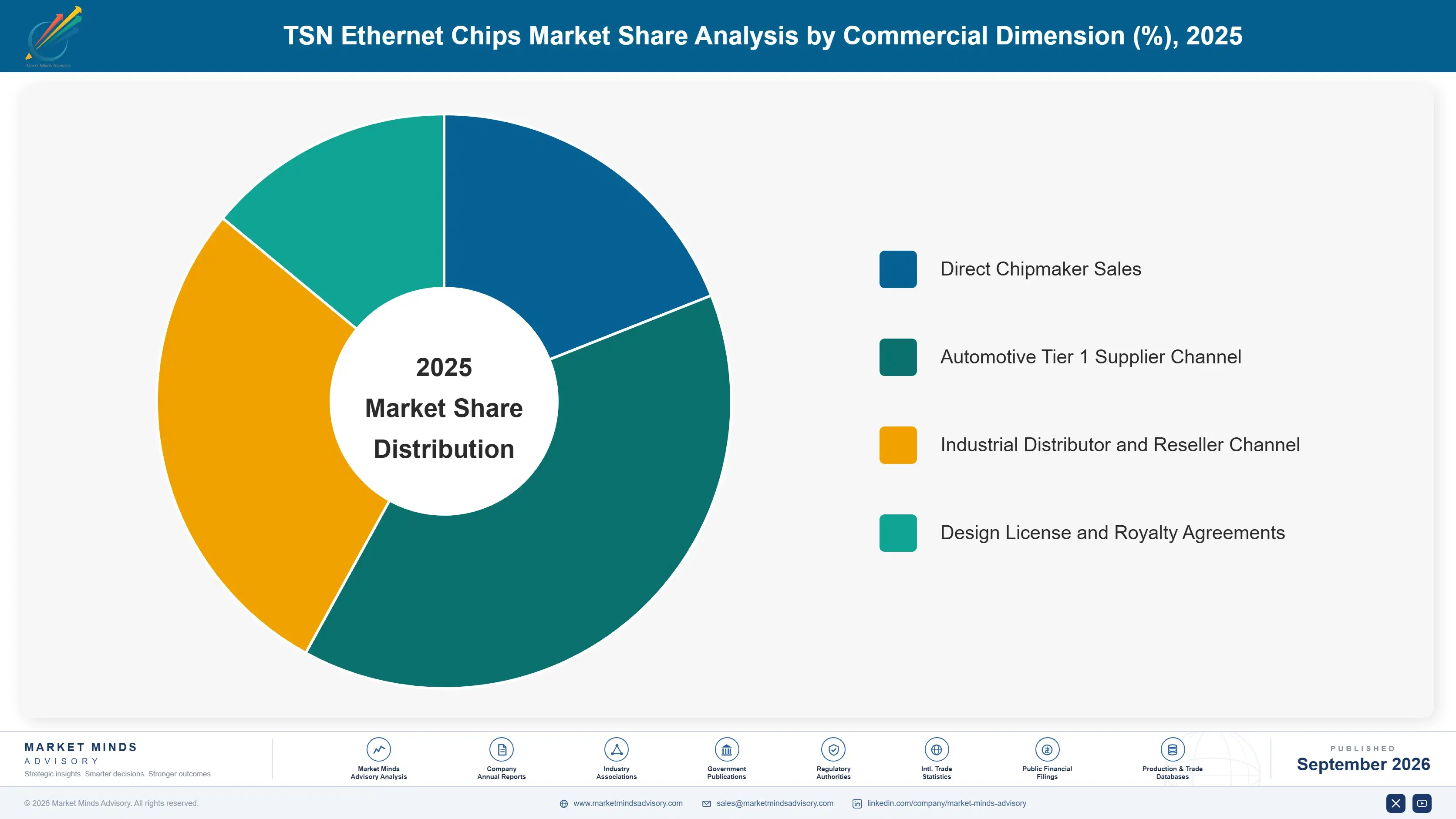
By Commercial Dimension

  • Direct Chipmaker Sales
  • Automotive Tier 1 Supplier Channel
  • Industrial Distributor and Reseller Channel
  • Design License and Royalty Agreements

By Region

  • North America
  • Western Europe
  • East Asia
  • South Asia and Pacific
  • Latin America
  • Middle East and Africa
  • Eastern Europe

Scope, Methodology, and Coverage

Every figure in this report is reproducible from documented input assumptions. The scope below maps the historical period, the forecast horizon, the segmentation dimensions, and the countries covered, alongside the underlying primary and qualitative methodology.
Historical Period
2020 to 2025
Forecast Period
2026 to 2036
Base Year
2025 (USD billions; MMA Primary Research Dataset, September 2026)
Market Definition
The TSN Ethernet chips market covers semiconductor devices implementing IEEE 802.1 time-sensitive networking standards for deterministic, low-latency Ethernet communication in industrial, automotive, and aerospace systems. It excludes standard commercial Ethernet chips without TSN protocol support and proprietary fieldbus silicon that has not adopted IEEE TSN standards.
Quantitative Units
USD billions, base year 2025, forecast period 2026 to 2036
Segmentation Dimensions
Product/technology type, end-use industry, commercial dimension, region
Regions Covered
North America, Western Europe, East Asia, South Asia and Pacific, Latin America, Middle East and Africa, Eastern Europe
Countries Covered
United States, Canada, Germany, United Kingdom, France, China, Japan, South Korea, India, Australia, Brazil, Mexico, Saudi Arabia, South Africa, Poland
Key Companies Profiled
Texas Instruments, NXP Semiconductors, Microchip Technology, Renesas Electronics, Marvell Technology, Broadcom, Analog Devices, Intel
Quantitative Methodology
Primary survey, n=3,800 respondents, Q4 2025, six countries; demand-side model with trade association cross-validation
Qualitative Methodology
47 expert interviews, Q4 2025; applied to validate demand model assumptions, identify emerging dynamics, and assess competitive positioning
Report Format
PDF and XLSX data workbook (Word format preview document)
Publisher
Market Minds Advisory
Report Code
MMA-2026-TEC-823
Published
September 2026
Contact
sales@marketmindsadvisory.com | www.marketmindsadvisory.com

Purchase the full TSN Ethernet Chips Market Report (2026 to 2036).

This report provides a comprehensive assessment of the global TSN Ethernet chips market, covering sizing, segmentation, regional dynamics, and competitive positioning through 2036. It examines the shift from proprietary fieldbus and legacy automotive networking toward deterministic Ethernet standards, tracking automotive qualification, SoC integration, and interoperability certification reshaping vendor strategy. The analysis draws on primary survey data, expert interviews, and company disclosures to quantify demand across seven world regions and six product segments. Product and investment teams gain a grounded view of where competitive advantage is shifting fastest.
Segment-level sizing and ten-year growth forecasts
Regional demand mapping across seven world regions
Competitive landscape and detailed player profiling
Revenue lever analysis with margin impact figures
Input cost exposure and supply risk assessment
Strategic verdict with prioritized action recommendations

Built For The People Who Decide

From boardroom strategy to bench-side execution, this report is read cover-to-cover by leaders shaping the next decade of their industry, turning demand scenarios, market dynamics and valuation benchmarks into decisions.
CXOs/ Presidents/ VPs/ Managers
M&A and Corporate Development
Strategy Teams and R&D Heads
Procurement and Product Directors
Regulatory and Compliance Leaders
Investor Relations and Equity Analysts