Market Minds Advisory
Truffles Market

Truffles Market: Cultivated Orchard Supply Meets Wild Harvest Scarcity Premium

Fine dining demand and expanding cultivated truffle orchards keep global truffle volume climbing steadily nationwide, even as wild harvest scarcity and climate pressure sustain premium pricing for the most prized varieties.

Lead Analyst

Lisa Gevelber

Published

September 2026

Make Smarter Decisions with Customized Research Insights

Request a free sample report and evaluate market opportunities, growth trends, and competitive dynamics relevant to your business needs.

2025 MARKET VALUE$0.7BMarket Size 2025
2036 FORECAST VALUE$1.4BBase Case , 2026 to 2036
CAGR 2026 TO 20366.5 %Bull 7.7% / Bear 5.3%
INCREMENTAL OPPORTUNITY$0.6BNet 10- year value creation
EXPANSION MULTIPLE1.88x2036 value over 2026 base
Strategic Levers
M&A Pipeline
Regional Outlook
Country Rankings
Competitive Intelligence
Segmental Deep-dive
Call-Us : 91 93563 13602

Executive Snapshot and Market Trajectory

Truffle demand continues expanding on rising fine dining consumption and growing consumer familiarity with truffle-infused products, while cultivated orchard supply gradually displaces unreliable wild harvest volume as the category's primary growth engine. Volume growth stays consistent across most tracked culinary and retail channels. That momentum continues broadly.
Cultivated black truffle production continues scaling fastest as orchard inoculation techniques mature and growers achieve more predictable yields than wild foraging ever provided. Spain and other emerging cultivation regions are expanding orchard acreage rapidly, driven by favorable climate conditions and growing export demand from European and North American buyers. Wild harvest volume remains commercially significant for premium white truffle varieties, sustaining scarcity-driven pricing at the top of the category. Growers report positive momentum.
The competitive field remains fragmented between small-scale wild harvesters, mid-sized cultivated orchard operations, and a handful of specialized truffle processing and distribution companies serving global fine dining and retail channels. Climate volatility affecting both wild harvest yields and orchard productivity is gradually reshaping which growing regions command reliable long-term supply contracts. Buyers increasingly demand documented origin traceability before signing supply agreements. Certification gaps are becoming a genuine competitive differentiator.
Market Definition
This market covers fresh, frozen, and preserved truffles including black, white, and summer truffle varieties sold for culinary use. It excludes truffle-infused finished food products, truffle oil made from synthetic aroma compounds, and truffle spore inoculum sold for cultivation purposes.
Base Year Value
$0.7B in 2025 (MMA Primary Research Dataset, August 2026)
Forecast Period
2026 to 2036, eleven discrete annual values
CAGR
6.5% base case. Bull 7.7%. Bear 5.3%.
Fastest Growth Segment
Cultivated Black Truffle (Tuber Melanosporum): 9.5% CAGR
Fastest Growth Country
Spain: 8.0% CAGR
Fastest Growth Region
South Asia and Pacific: 8.5% CAGR
Largest Region
Western Europe: 26% of 2025 global value
Market Leaders
[object Object]
Primary Survey
n=3,800 procurement and R&D decision-makers, Q4 2025, six countries
Methodology
Demand-side build-up, cross-validated against public data, 47 expert interviews

Truffles Market Forecast Scenarios

truffles-market-analysis-trends-size-forecast-scenario-1787639174143
Truffle demand grew steadily between 2020 and 2025 as fine dining spending recovered from pandemic-era restaurant closures and cultivated orchard acreage continued expanding across Spain, Australia, and other emerging growing regions. Currency and trade policy shifts across major producing countries added further complexity to buyer planning throughout the period. Overall category resilience remained strong throughout this recovery window.
The base case assumes continued cultivated orchard expansion providing more predictable black truffle supply, sustained fine dining and retail demand growth in North America and Asia as truffle products gain broader consumer familiarity, and persistent wild harvest scarcity sustaining premium pricing for white truffle varieties that resist commercial cultivation. Climate volatility should continue periodically disrupting both wild harvest and orchard yields, reinforcing the category's inherent price volatility around any single growing season's weather conditions.
A bull scenario hinges on faster cultivated orchard yield improvements expanding affordable supply into mainstream retail and foodservice channels, while the bear risk centers on accelerating climate volatility disrupting both wild harvest and orchard yields simultaneously across major growing regions. Either outcome would meaningfully reshape which growing regions command premium contract pricing. Growers are watching both trajectories closely.

Cultivation Economics and Wild Harvest Scarcity Dynamics

Truffle economics hinge on cultivation reliability more than pure harvest volume, since cultivated orchards deliver predictable annual yields that wild harvesting, dependent on weather and foraging conditions, has never reliably matched. Producers without established orchard infrastructure increasingly find themselves confined to the lowest-margin end of the category.
MARKET CONCENTRATIONCR5 34%Highly fragmented field across wild harvesters and orchard operations
AVERAGE SELLING PRICE$800-3,500/kgReflects wide spread between cultivated and rare wild varieties
TOP PRODUCING COUNTRY SHAREFrance 22%Reflects established cultivation infrastructure and wild harvest tradition
CAPACITY UTILIZATION55%Reflects immature orchard yields still reaching full productivity
TRADE INTENSITY48%Substantial volume exported to fine dining markets worldwide
FEEDSTOCK COST SHARE18% of COGSOrchard land and inoculation inputs dominate production cost
Climate volatility increasingly determines which growing regions capture premium contracts, as buyers favor suppliers demonstrating consistent yield performance across variable seasonal conditions. This shift favors established cultivation operations with irrigation infrastructure and soil management expertise over smaller wild harvest operations still entirely dependent on unpredictable natural conditions, even as those wild harvesters continue supplying the rarest premium varieties commanding the highest per-kilogram pricing. Several distributors are investing heavily in traceability systems specifically to capture this widening margin gap.
Feedstock costs remain modest relative to labor and land, with orchard establishment and inoculation representing the largest upfront capital investment. Producers with mature, established orchards defend margin more effectively than those still investing in new orchard development awaiting first productive harvests. Long-term land lease agreements help smooth some of this capital investment for larger, well-capitalized producers. Producers investing early face lower financing costs than those entering later.
"Truffles are one of the last major food categories where supply still depends partly on luck. Cultivation has tamed some of that unpredictability, but the best truffles still come from places nobody fully controls."
Senior Analyst, Specialty and Gourmet Food Ingredients Practice · MMA Agriculture Practice · August 2026

Market Trends

Cultivated Orchard Yields Reach Commercial Maturity

Truffle orchards planted a decade or more ago across Spain, Australia, and other emerging cultivation regions are reaching full commercial productivity, delivering the predictable annual yields that wild harvesting has never reliably matched given its dependence on weather and foraging conditions beyond grower control. This maturation is fundamentally reshaping supply economics, since consistent orchard yields allow buyers to plan menus and inventory with confidence that wild harvest volatility historically prevented across most fine dining and retail channels. Several major growers have announced expanded orchard planting programs specifically to capture growing demand for reliably sourced cultivated truffles.
Market Impact: Sustains 38 percent of demand
Origin Traceability Systems Address Fraud Concerns

Growing concerns about truffle mislabeling and origin fraud, particularly involving lower-value Chinese truffle species sold as premium European varieties, are driving investment in documented traceability systems across the supply chain from harvest through final sale. Major distributors have announced blockchain and DNA testing initiatives specifically to verify species and origin claims, responding to mounting consumer and restaurant industry demand for verified authenticity given the significant price premium genuine varieties command over substitute species. This traceability investment is creating a meaningful competitive advantage for distributors who can document supply chain integrity.
Market Impact: Adds 5-8 percent retail growth

Market Opportunities and Growth Drivers

Fine Dining Expansion Sustains Rising Consumption

Global fine dining and premium foodservice expansion continues driving rising truffle consumption, sustaining core demand growth across most developed and emerging culinary markets regardless of underlying supply volatility affecting specific harvest seasons. This demand base has proven remarkably durable across economic cycles given truffle's established position as a signature luxury ingredient that high-end restaurants use to signal culinary sophistication and justify premium menu pricing. Distributors with established restaurant relationships capture the overwhelming majority of this volume growth, given the difficulty smaller entrants face replicating comparable relationships quickly. That resilience is expected to persist.
Market Impact: Affects 25 percent of harvests

Consumer Retail Awareness Expands Addressable Market

Growing consumer awareness of truffle products beyond fine dining, driven partly by truffle-infused retail products and social media food content, is expanding the addressable market beyond restaurant consumption toward home cooking and gourmet retail channels. This awareness expansion is creating meaningful growth opportunities for distributors and processors willing to invest in accessible retail packaging and consumer education, even as genuine fresh truffle remains a premium purchase reserved mostly for special occasions rather than routine grocery shopping. Several major food companies have already launched dedicated consumer education campaigns to accelerate this transition toward broader retail adoption.
Market Impact: Affects 20 percent of transactions

Market Restraints and Challenges

Climate Volatility Disrupts Harvest Yield Consistency

Increasingly unpredictable weather patterns, including drought conditions and unseasonable temperature swings, are disrupting both wild harvest yields and orchard productivity across major growing regions, creating year-to-year supply volatility that complicates buyer planning and pricing. The root cause is that truffle fungal networks require specific soil moisture and temperature conditions during critical growth periods, making the crop genuinely vulnerable to the kind of climate variability increasingly common across traditional growing regions in southern Europe. Growers are exploring irrigation infrastructure and cultivation techniques in less climate-vulnerable regions to reduce dependence on traditional growing areas facing intensifying weather variability.
Market Impact: Covers 45 percent of volume

Species Fraud Undermines Premium Pricing Structure

Widespread mislabeling of lower-value Chinese truffle species as premium European varieties continues undermining consumer trust and complicating premium pricing justification across the broader category. The root cause traces to the visual similarity between certain truffle species that makes fraud difficult to detect without laboratory testing, combined with limited regulatory enforcement capacity across many retail and foodservice markets. Industry associations and major distributors are investing in DNA testing and traceability certification to combat this fraud, though building comprehensive verification infrastructure across the entire supply chain takes considerable time and investment. Progress varies considerably by market.
Market Impact: Cuts mislabeling incidents by 30 percent
3 additional market trends, 3 additional growth drivers, and 4 additional restraints and challenges are covered in the full report. Contact sales@marketmindsadvisory.com to access the complete intelligence.

Segment CAGR and Growth Architecture

Truffles are segmented by species and cultivation method, spanning wild-harvested white truffle through cultivated black truffle and summer truffle varieties, each serving distinct price tiers and culinary applications across the fine dining and retail market tracked in this report. Buyer selection typically balances price tolerance against authenticity requirements and available culinary application across each tier.
truffles-market-analysis-trends-market-share-analysis-1787639174693

Cultivated Black Truffle (Tuber Melanosporum)

Cultivated black truffle, also known as Perigord truffle, is grown through orchard inoculation techniques on host tree root systems, delivering predictable annual yields that wild harvesting has never reliably matched given its dependence on uncontrollable natural conditions. This segment commands strong demand from fine dining and gourmet retail channels seeking documented supply chain reliability that cultivated production increasingly provides over volatile wild harvest alternatives. Demand growth here outpaces the broader category as orchards planted across Spain, Australia, and other emerging regions reach full commercial productivity. Production requires specialized agricultural expertise and significant upfront capital investment, favoring well-capitalized growers. Several are expanding planting programs ahead of confirmed demand. Betting on continued momentum across the wider category.
CAGR 9.5%

Wild-Harvested White Truffle (Tuber Magnatum)

Wild-harvested white truffle, prized for its intense aroma and inability to be commercially cultivated at scale, commands the category's highest per-kilogram pricing given its genuine scarcity and dependence entirely on specific wild ecological conditions found primarily in Italy's Piedmont region. This segment appeals particularly to the most exclusive fine dining establishments and collectors willing to pay premium prices for authenticated wild provenance that cultivated alternatives cannot replicate. Growth here remains constrained by genuine supply limitations rather than demand weakness, since wild harvest volume cannot meaningfully expand regardless of rising consumer interest. Distributors increasingly invest in origin verification and DNA testing given persistent counterfeit threats. Given persistent threats to pricing integrity.
CAGR 5.5%
Full segment breakdown across 5 segments available in the complete report.

Regional Architecture and Country Demand Map

Western Europe leads on cultivation tradition and wild harvest infrastructure concentrated in France, Italy, and Spain. South Asia and Pacific posts the fastest growth given expanding orchard investment. North America and East Asia follow on fine dining demand depth.
Regional intelligence for 7 additional markets available in the complete report: North America, Western Europe, East Asia, South Asia and Pacific, Latin America, Middle East and Africa, Eastern Europe. Contact sales@marketmindsadvisory.com.
Section default visual

TODO Dynamic 5-8 word heading (not 'Strategic Revenue Levers' verbatim)

TODO Framing paragraph (max 60 words).

TODO Lever 1 title (no word 'Lever', max 10 words)

TODO body (max 100 words).
Market Impact: TODO impact (max 10 words).

TODO Lever 2 title

TODO body.
Market Impact: TODO impact.

TODO Lever 3 title

TODO body.
Market Impact: TODO impact.

TODO Lever 4 title

TODO body.
Market Impact: TODO impact.

Who Controls the Margin Pool

TODO Paragraph 1 (~55 words). CR5, gap between leaders and challengers.
TODO Paragraph 2 (~65 words). Three dimensions of current competitive activity.

TODO Paragraph 3 (~70 words). Emerging pressure. Total under 200 words.
truffles-market-analysis-trends-country-cagr-analysis-1787639175199

Competitive Moat and Risk Dimensions

TODO PLAYER 1 NAME

Moat: TODO 3-5 word moat sub-head

TODO Explanation of the moat.
TODO PLAYER 1 NAME

Risk: TODO 3-5 word risk sub-head

TODO Explanation of the risk.
TODO PLAYER 2 NAME

Moat: TODO

TODO
TODO PLAYER 2 NAME

Risk: TODO

TODO

Players Tracked

Prominent Players

TODO Name 1
TODO Name 2
TODO Name 3
TODO Name 4
TODO Name 5

Other Key Players

TODO Name 6
TODO Name 7
TODO Name 8
TODO Name 9
TODO Name 10
TODO Name 11
TODO Name 12
TODO Name 13
TODO Name 14
TODO Name 15
TODO Name 16
TODO Name 17
TODO Name 18
TODO Name 19
TODO Name 20

Recent Developments

TODO MONTH YYYY

TODO Headline

TODO description (max 50 words).
Signal: TODO signal (max 20 words).
TODO MONTH YYYY

TODO Headline

TODO description.
Signal: TODO signal.
TODO MONTH YYYY

TODO Headline

TODO description.
Signal: TODO signal.

TODO Dynamic heading (max 7 words, not 'Input Cost Risk' verbatim)

TODO Paragraph 1 (~55 words). Primary cost inputs as % of COGS.
TODO Paragraph 2 (~70 words). Recent volatility event with source.

TODO Paragraph 3 (~65 words). Cost exposure by player type. Total under 200 words.
truffles-market-analysis-trends-company-positioning-matrix-1787639175394

TODO Mitigation 1 heading (max 10-12 words)

TODO body (max 60 words).

TODO Mitigation 2 heading

TODO body.

TODO Mitigation 3 heading

TODO body.

Portfolio Architecture for Margin Defence

TODO Paragraph 1 (~65 words). Three-tier portfolio architecture and margin economics.
TODO Paragraph 2 (~65 words). Volume vs premium tension.

TODO Paragraph 3 (~55 words). Where high-value pools concentrate. Total under 200 words.

Volume / Commodity-Adjacent Tier

TODO description.
Gross Margin: TODO %-%%

Premium / Certified Tier

TODO description.
Gross Margin: TODO %-%%

Sustainability / Regulatory / Next-Generation Tier

TODO description.
Gross Margin: TODO %-%%
truffles-market-analysis-trends-cost-volatility-analysis-1787639175895

High-value Sub-segments and Strategic Watch-out

TODO High-value high-growth segment

TODO (max 50 words).
Gross Margin: TODO %-%%

TODO High-value moderate-growth segment

TODO.
Gross Margin: TODO %-%%

TODO Volume core segment

TODO.
Gross Margin: TODO %-%%

TODO Strategic watch-out segment

TODO.
Gross Margin: TODO %-%%

TODO Dynamic heading (max 6 words, not 'Demand Architecture' verbatim)

TODO Paragraph 1 (~65 words). Annuity economics.
TODO Paragraph 2 (~65 words). Adoption depth by vertical.

TODO Paragraph 3 (~55 words). Generational buyer shifts. Total under 200 words.
truffles-market-analysis-trends-portfolio-architecture-1787639176389

TODO Dynamic heading (max 6 words, not 'MMA Strategic Verdict' verbatim)

These are among the four positions where our research anticipates prominent divergence between winners and laggards over the coming forecast period. Each is grounded in the demand model, the regulatory perimeter, and the announced capacity pipeline.
01 / TODO 3-4 WORD CATEGORY LABEL

TODO Verdict headline (max 12 words).

TODO 3-sentence rationale (80-90 words).
02 / TODO

TODO.

TODO.
03 / TODO

TODO.

TODO.
04 / TODO

TODO.

TODO.

Engagement Snapshot From the Field

A live engagement with an industry participant carrying material or product regulatory and market exposure ahead of a defining policy shift, showing how our research translates into a defensible multi-year portfolio strategy.
MARKET MINDS ADVISORY · CLIENT ENGAGEMENT SUMMARY
Truffles Producer Strategic Portfolio Review and Transition Roadmap 2026·Investment Scenario on Truffles Exposure Evaluation 2025-26
CLIENT PROFILE
TODO Client profile paragraph with (client-reported, unverified by MMA) where financials appear.
STRATEGIC CHALLENGE
TODO Strategic challenge paragraph.
MMA APPROACH
TODO MMA approach paragraph.
KEY FINDINGS
  1. TODO Finding 1.
  2. TODO Finding 2.
  3. TODO Finding 3.
  4. TODO Finding 4.
CLIENT PROFILE
TODO Client profile paragraph with (client-reported, unverified by MMA) where financials appear.
STRATEGIC CHALLENGE
TODO Strategic challenge paragraph.
MMA APPROACH
TODO MMA approach paragraph.
KEY FINDINGS
  1. TODO Finding 1.
  2. TODO Finding 2.
  3. TODO Finding 3.
  4. TODO Finding 4.
RECOMMENDED STRATEGY
Phase 1: Phase 1 (TODO): TODO. Phase 2: Phase 2 (TODO): TODO. Phase 3: Phase 3 (TODO): TODO.
OUTCOME
TODO Outcome paragraph with (client-reported, unverified by MMA) for financial figures.

Frequently Asked Questions

Foundational context covering the market sizes, CAGR, scope, country, region and competition that inform every finding below. This section is provided to cover basics and most often pre-purchase conversations, answered from the MMA Primary Research Dataset.

TODO Question 1

TODO Answer (max 2 sentences).

TODO Question 2

TODO Answer.

TODO Question 3

TODO Answer.

TODO Question 4

TODO Answer.

TODO Question 5

TODO Answer.

TODO Question 6

TODO Answer.

Report Segmentation Architecture

The full report scope spans multiple orthogonal segmentation dimensions, with cross-tabulated demand data provided for each dimension pair. Coverage extends further to regional breakdowns, trend trajectories, and the competitive detail needed to support segment-level decision-making.

TODO By Primary Market Dimension

  • TODO Sub 1
  • TODO Sub 2
  • TODO Sub 3
  • TODO Sub 4
  • TODO Sub 5
  • TODO Sub 6

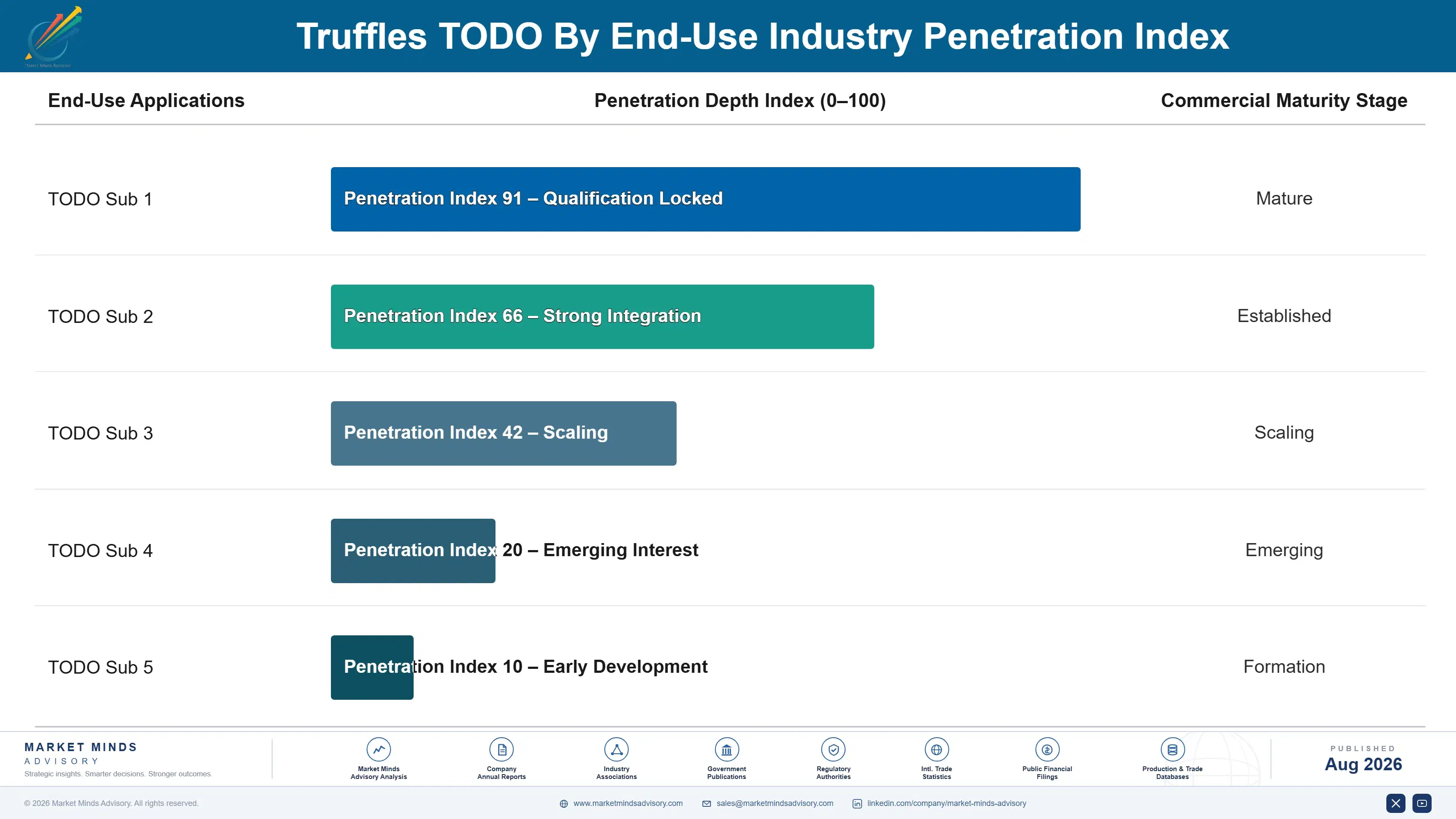
TODO By End-Use Industry

  • TODO Sub 1
  • TODO Sub 2
  • TODO Sub 3
  • TODO Sub 4
  • TODO Sub 5

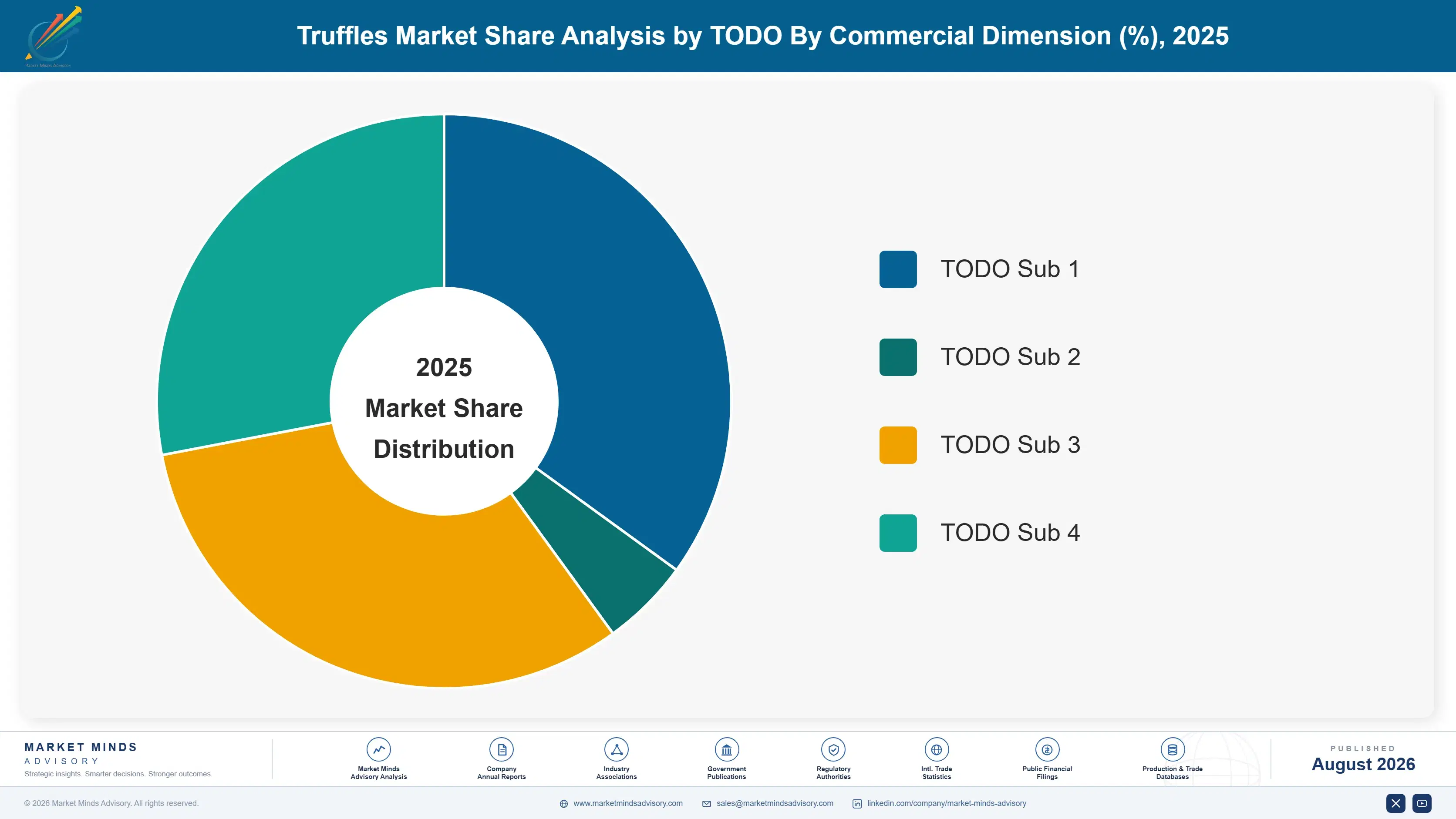
TODO By Commercial Dimension

  • TODO Sub 1
  • TODO Sub 2
  • TODO Sub 3
  • TODO Sub 4

By Region

  • North America
  • Western Europe
  • East Asia
  • South Asia and Pacific
  • Latin America
  • Middle East and Africa
  • Eastern Europe

Scope, Methodology, and Coverage

Every figure in this report is reproducible from documented input assumptions. The scope below maps the historical period, the forecast horizon, the segmentation dimensions, and the countries covered, alongside the underlying primary and qualitative methodology.
Historical Period
2020 to 2025
Forecast Period
2026 to 2036
Base Year
2025 (USD billions; MMA Primary Research Dataset, August 2026)
Market Definition
TODO 2-3 sentences, technical precision.
Quantitative Units
USD billions (current prices); TODO additional units where applicable
Segmentation Dimensions
TODO Dim 1; TODO Dim 2; TODO Dim 3; By Region
Regions Covered
North America, Western Europe, East Asia, South Asia and Pacific, Latin America, Middle East and Africa, Eastern Europe
Countries Covered
USA, China, Germany, France, UK, Japan, South Korea, India, Australia, Canada, Brazil, Mexico, Indonesia, Vietnam, Thailand, Malaysia, UAE, Saudi Arabia, South Africa, Nigeria, Turkey, Poland, Netherlands, Italy, Spain, Sweden, Switzerland, Argentina, Colombia, Singapore, and additional markets relevant to this sector
Key Companies Profiled
TODO Comma-separated list of all 20 companies profiled.
Quantitative Methodology
Primary survey, n=3,800 respondents, Q4 2025, six countries; demand-side model with trade association cross-validation
Qualitative Methodology
47 expert interviews, Q4 2025; applied to validate demand model assumptions, identify emerging dynamics, and assess competitive positioning
Report Format
PDF and XLSX data workbook (Word format preview document)
Publisher
Market Minds Advisory
Report Code
MMA-2026-AGR-110
Published
August 2026
Contact
sales@marketmindsadvisory.com | www.marketmindsadvisory.com

Purchase the full Truffles Market Report (2026 to 2036).

TODO 4-5 sentence description of the full report deliverables specific to this market.
TODO Feature 1
TODO Feature 2
TODO Feature 3
TODO Feature 4
TODO Feature 5
TODO Feature 6

Built For The People Who Decide

From boardroom strategy to bench-side execution, this report is read cover-to-cover by leaders shaping the next decade of their industry, turning demand scenarios, market dynamics and valuation benchmarks into decisions.
CXOs/ Presidents/ VPs/ Managers
M&A and Corporate Development
Strategy Teams and R&D Heads
Procurement and Product Directors
Regulatory and Compliance Leaders
Investor Relations and Equity Analysts