Market Minds Advisory
Tris Nonylphenyl Phosphite Market

Tris Nonylphenyl Phosphite Market: Processing Stabilization Meets Regulatory Retreat

Continued Asian polyolefin and PVC capacity growth is sustaining demand for this processing antioxidant even as European Union nonylphenol restrictions push formulators in regulated markets toward alternative phosphite chemistries. Producers must serve both dynamics.

Lead Analyst

Bilal Shaikh

Published

September 2026

Make Smarter Decisions with Customized Research Insights

Request a free sample report and evaluate market opportunities, growth trends, and competitive dynamics relevant to your business needs.

2025 MARKET VALUE$0.4BMarket Size 2025
2036 FORECAST VALUE$0.7BBase Case , 2026 to 2036
CAGR 2026 TO 20364.6 %Bull 5.7% / Bear 3.5%
INCREMENTAL OPPORTUNITY$0.2BNet 10- year value creation
EXPANSION MULTIPLE1.57x2036 value over 2026 base
Strategic Levers
M&A Pipeline
Regional Outlook
Country Rankings
Competitive Intelligence
Segmental Deep-dive
Call-Us : 91 93563 13602

Executive Snapshot and Market Trajectory

Tris nonylphenyl phosphite occupies an unusual position: a well-established, cost-effective processing antioxidant facing genuine regulatory pressure in developed markets even as demand keeps growing steadily across Asian polymer processing industries that face no comparable restriction. Producers must serve both dynamics without treating either as secondary.
Demand concentrates among PVC and polyolefin processors in Asia who value this phosphite's cost-effective oxidative stability during melt processing, while European formulators increasingly substitute alternative phosphite chemistries to comply with nonylphenol substance restrictions under REACH regulation. China alone accounts for close to a third of global consumption, driven by its dominant polymer processing manufacturing base. India's expanding polymer processing base is adding a further meaningful demand pool behind China. Growth concentrates among processors expanding capacity.
Competition remains fairly concentrated, with the top five holding well over half of global capacity given this market's mature, established production technology. SI Group and Clariant hold the deepest customer relationships across polymer processing industries, while regulatory pressure in Europe is reshaping where growth concentrates rather than slowing the market overall. This dual dynamic favors diversified producers over those concentrated in a single regulatory environment.
Market Definition
This market covers tris nonylphenyl phosphite, an organophosphite secondary antioxidant used to stabilize PVC, polyolefins, and rubber compounds against oxidative degradation during melt processing. It excludes primary phenolic antioxidants and alternative phosphite chemistries not based on nonylphenol feedstock.
Base Year Value
$0.4B in 2025 (MMA Primary Research Dataset, August 2026)
Forecast Period
2026 to 2036, eleven discrete annual values
CAGR
4.6% base case. Bull 5.7%. Bear 3.5%.
Fastest Growth Segment
Polyolefin Processing Stabilization: 6.4% CAGR
Fastest Growth Country
China: 5.9% CAGR
Fastest Growth Region
South Asia and Pacific: 6.8% CAGR
Largest Region
East Asia: 30% of 2025 global value
Market Leaders
SI Group Inc., Clariant AG, Songwon Industrial Co. Ltd., Solvay SA, Dover Chemical Corporation. Source: MMA Analysis based on company annual reports.
Primary Survey
n=3,800 procurement and R&D decision-makers, Q4 2025, six countries
Methodology
Demand-side build-up, cross-validated against public data, 47 expert interviews

Tris Nonylphenyl Phosphite Market Forecast Scenarios

tris-nonylphenyl-phosphite-market-trends-size-forecast-scenario-1787311054394
Tris nonylphenyl phosphite demand grew steadily through 2020 to 2025 as Asian polymer processing capacity expanded, even as European volume growth slowed under mounting regulatory pressure. The market grew at an estimated 4.0% historical CAGR across the period, with Asian demand consistently offsetting European decline after 2022. Rubber and elastomer processing volume grew more modestly, tracking broader industrial production cycles.
The base case assumes 4.6% CAGR through 2036, driven by three mechanisms operating together. First, continued Asian PVC and polyolefin capacity expansion sustains commodity-grade demand growth even as Western volume plateaus or declines. Second, cost-sensitive processors in price-competitive markets continue favoring this phosphite over higher-cost alternative chemistries where regulatory pressure remains absent. Third, rubber and elastomer processing applications add a smaller but steady secondary demand pool largely independent of PVC and polyolefin cycles.
The bull case (5.7% CAGR) assumes faster-than-expected Asian polymer capacity buildout, particularly in India and Southeast Asia, pulls demand growth ahead of current industry planning assumptions. The bear case (3.5% CAGR) reflects the risk that nonylphenol restriction spreads to additional major markets beyond Europe faster than currently expected, accelerating substitution toward alternative phosphite chemistries globally.

Regulatory Divergence Reshapes Regional Demand

This market increasingly splits along regulatory lines rather than application type alone, since European Union nonylphenol restriction under REACH is pushing formulators in that region toward alternative phosphite chemistries regardless of the cost premium involved. Producers serving Asian and other less-regulated markets continue competing on straightforward cost and supply reliability terms unaffected by this regulatory dynamic. Producers slow to make this distinction clear to customers risk
CR5 CONCENTRATION62%share held by the top five global producers
AVERAGE SELLING PRICE$1.80-2.60/kgrange spanning standard commodity grade in all regions
TOP PRODUCING COUNTRY SHAREChina, 28%share of global tris nonylphenyl phosphite production capacity
CAPACITY UTILIZATION71%average operating rate across qualified production facilities today
TRADE INTENSITY38%of finished product volume crossing borders before formulation
FEEDSTOCK COST SHARE51% of COGSnonylphenol and phosphorus trichloride raw material inputs combined
PVC processors and polyolefin processors behave somewhat differently as buyers. PVC processors have used this phosphite for decades in well-established formulations that rarely change once qualified, while polyolefin processors show somewhat more willingness to evaluate alternative stabilizer packages as new resin grades and processing technologies enter commercial production. This divergence in buying behavior requires distinctly different commercial approaches for each customer type.
Over the next decade, two forces will determine winners. Continued Asian polymer processing capacity growth will keep expanding the addressable commodity-grade base, while regulatory pressure spreading beyond Europe would add a second, restriction-driven vector that favors producers already diversified into alternative phosphite chemistries. Producers investing successfully in both vectors stand to capture the broadest share of future growth.
"This is about as unglamorous a chemical as you can find, and that's exactly why it's interesting. Demand keeps growing in Asia at a perfectly ordinary industrial pace while an entire regulatory apparatus in Europe works to phase it out. Both stories are true simultaneously."
Director, Polymer Additives and Stabilizers Practice · MMA Chemicals and Materia

Market Trends

European Union Nonylphenol Restriction Accelerates Substitution

European Union REACH regulation restricting nonylphenol and nonylphenol ethoxylate substances has extended increasing scrutiny to nonylphenol-derived phosphite antioxidants, pushing formulators serving European markets to qualify alternative phosphite chemistries not based on this feedstock. Several major polymer processors operating in Europe have already completed reformulation work, switching to bisphenol-based or other alternative phosphite antioxidants despite the cost premium these alternatives typically carry over tris nonylphenyl phosphite. This substitution has proceeded gradually, since existing formulations continue running until scheduled reformulation cycles or deadlines force the change. This has become the single most consequential variable affecting European demand for this chemistry today.
Market Impact: Adds 1.4 million kg Chinese demand

Asian Polyolefin Capacity Growth Sustains Commodity Demand

Continued polyolefin and PVC capacity expansion across China, India, and Southeast Asia keeps sustaining commodity-grade demand for this cost-effective processing antioxidant, since Asian processors face no comparable regulatory restriction and continue favoring it for straightforward cost and performance reasons. This capacity growth has more than offset the demand decline occurring in Europe, keeping the global market on a modest but steady growth trajectory despite the regulatory headwinds facing one major region. Producers with established Asian manufacturing and distribution relationships have captured the bulk of this growth, while producers concentrated in European production have faced a more difficult demand environment overall.
Market Impact: Adds 6% price-sensitive market dema

Market Opportunities and Growth Drivers

Chinese PVC and Polyolefin Capacity Expansion Continues

China's continued PVC and polyolefin production capacity expansion, tied to both domestic construction and packaging demand and export-oriented manufacturing, keeps sustaining commodity-grade antioxidant demand growth even as global polymer markets face periodic oversupply concerns in specific grades. This expansion has made China the single largest national consumer of tris nonylphenyl phosphite globally, and continued Chinese and broader Asian polymer capacity investment is expected to keep absorbing new antioxidant supply through the forecast period. Producers with established Chinese distribution relationships and local production capacity have captured a disproportionate share of this growth relative to producers relying solely on imported material.
Market Impact: Cuts European volume 8 percent annu

Cost Advantage Sustains Demand in Price-Sensitive Markets

Tris nonylphenyl phosphite continues offering a meaningful cost advantage over alternative phosphite antioxidants not based on nonylphenol feedstock, and this cost differential sustains its continued specification in price-sensitive polymer processing markets across Asia, Latin America, and other regions without comparable regulatory restriction. Processors in these markets, competing on thin margins in commodity polymer product categories, have limited ability to absorb the cost premium alternative chemistries carry, making this cost advantage a durable demand driver rather than a temporary one. This dynamic has kept demand growth steady even as European volume has declined under regulatory pressure.
Market Impact: Adds 10 percent reformulation reque

Market Restraints and Challenges

European Union Regulatory Restriction Limits Growth

European Union nonylphenol restriction under REACH regulation has directly reduced tris nonylphenyl phosphite demand in that region, as formulators reformulate away from this chemistry toward alternative phosphite antioxidants regardless of cost, driven by regulatory compliance requirements rather than commercial preference. This restriction represents a regulatory headwind that no amount of cost advantage can overcome once compliance deadlines take effect, unlike ordinary commercial competition where price and performance ultimately determine outcomes. Producers are addressing this through diversification into alternative phosphite chemistry production to retain European customer relationships even as this specific product loses share within those accounts.
Market Impact: Cuts European demand 8% since 2022

Regulatory Precedent Risk Extends Beyond Europe

The European regulatory approach to nonylphenol-derived chemistries has created a precedent that other regulatory bodies may eventually reference, creating genuine long-term uncertainty for producers evaluating capacity investment decisions in this chemistry beyond the near-term Asian growth story. Several major global brands sourcing polymer products manufactured in Asia have begun voluntarily requesting nonylphenol-free formulations for products destined for European retail markets, extending regulatory pressure indirectly into Asian supply chains even without formal restriction in those manufacturing regions themselves. Producers are addressing this by maintaining parallel alternative phosphite production capability to serve customers facing this indirect pressure.
Market Impact: Adds 7% Asian commodity demand grow
3 additional market trends, 4 additional growth drivers, and 3 additional restraints and challenges are covered in the full report. Contact sales@marketmindsadvisory.com to access the complete intelligence.

Segment CAGR and Growth Architecture

MMA segments this market by end-use polymer application, the classification processors use when specifying antioxidant stabilizer packages for a given polymer type. This lens separates PVC, polyolefin, rubber, lubricant, and specialty applications by underlying processing chemistry rather than region alone, reflecting genuinely different formulation requirements. Regional regulatory status is treated as a separate dimension.
tris-nonylphenyl-phosphite-market-trends-market-share-analysis-1787311054942

Polyolefin Processing Stabilization

Polyolefin processing stabilization is the fastest-growing segment, expanding directly alongside Asian polyolefin capacity growth as processors specify this cost-effective antioxidant for melt processing stability during extrusion and injection molding operations. Polyolefin processors, particularly in China and Southeast Asia, continue favoring this chemistry given its established performance track record and meaningful cost advantage over alternative phosphite antioxidants not facing comparable Asian regulatory scrutiny. SI Group and Songwon hold strong technical positions in this segment, having built established customer relationships across Asian polyolefin producers over many years of consistent supply. Growth here concentrates disproportionately in Asia, where continued polyolefin capacity investment keeps expanding the addressable base even as this segment faces some substitution pressure in European markets specifically.
CAGR 6.4%

Rubber and Elastomer Processing

Rubber and elastomer processing demand is expanding faster than the broader PVC-linked commodity base, driven by continued tire and industrial rubber product manufacturing growth across Asia that requires oxidative stability during compounding and vulcanization processing steps. This segment remains largely unaffected by the European nonylphenol restriction pressure facing PVC and packaging-linked applications, since rubber processing customers are concentrated more heavily in Asian manufacturing regions facing no comparable regulatory constraint. Clariant and Dover Chemical maintain established positions given long-standing technical relationships with rubber compounders. Growth here provides a demand pool with a somewhat different geographic and regulatory risk profile than the broader PVC-dominated commodity base, giving diversified producers a useful hedge against European regulatory pressure.
CAGR 5.5%
Full segment breakdown across 6 segments available in the complete report.

Regional Architecture and Country Demand Map

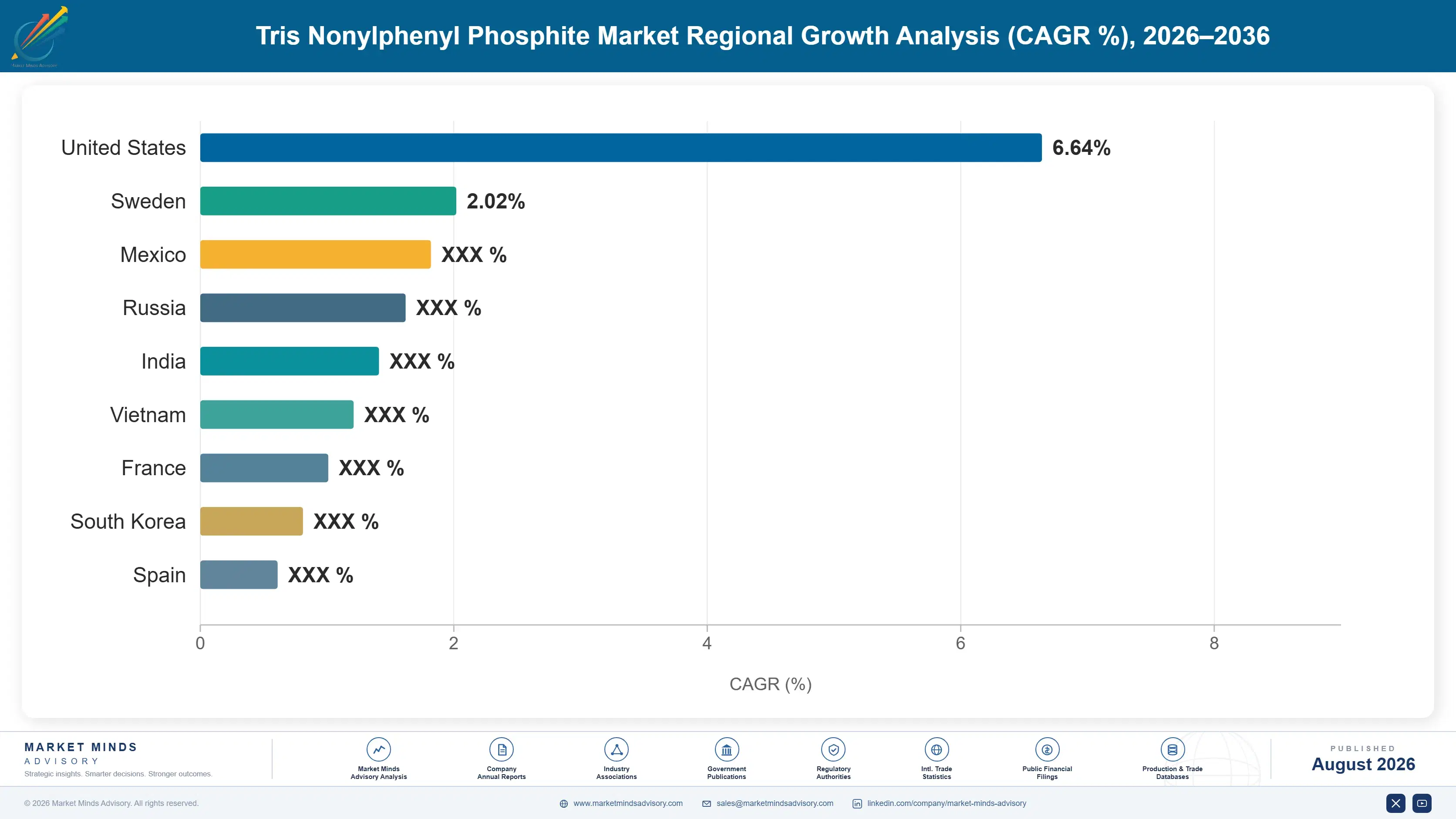
East Asia dominates tris nonylphenyl phosphite consumption given China's massive PVC and polyolefin processing base, while Western Europe's growth has slowed sharply under nonylphenol restriction that has no equivalent in Asian markets. South Asia posts the fastest regional growth given continued unrestricted capacity expansion nationally.

North America

United States PVC and polyolefin processing capacity, concentrated among major petrochemical and construction materials manufacturers, anchors North American demand alongside a smaller rubber processing buyer base. Dover Chemical maintains significant domestic production capacity serving this demand directly without the regulatory pressure facing European producers. Canada contributes through smaller polymer processing applications rather than large-scale PVC or polyolefin manufacturing comparable to leading American production centers. The region has not implemented restrictions comparable to European Union nonylphenol regulation, though some multinational brands sourcing from North American suppliers have begun requesting alternative formulations for products destined for European retail distribution. Growth trails East Asia's faster-expanding capacity base but remains steady given the region's mature, established polymer processing industry.
Share: 24% | CAGR: 4.9% (2026 to 2036)

Western Europe

European Union nonylphenol restriction under REACH regulation has fundamentally reshaped demand in this region, pushing major polymer processors in Germany, France, and the United Kingdom to reformulate toward alternative phosphite chemistries despite the cost premium these alternatives carry over established formulations. Clariant, maintaining significant regional production and technical support capability, has increasingly emphasized alternative phosphite chemistry sales to European customers navigating this transition rather than continuing to promote tris nonylphenyl phosphite specifically. This regulatory pressure has made Western Europe the only major region where absolute volume growth has slowed to a near standstill, in sharp contrast to every other region tracked in this report. Producers increasingly view it as a managed decline market.
Share: 18% | CAGR: 2.8% (2026 to 2036)
Regional intelligence for 5 additional markets available in the complete report: East Asia, South Asia and Pacific, Latin America, Middle East and Africa, Eastern Europe. Contact sales@marketmindsadvisory.com.
tris-nonylphenyl-phosphite-market-trends-country-cagr-analysis-1787311055451

Where Antioxidant Producers Can Expand Margins

Producers create outsized value not from standard commodity tonnage but from alternative phosphite diversification, Asian distribution depth, and long-term processor relationships. The levers below identify where margin expands fastest, moving beyond commodity antioxidant sales toward regulatory-compliant alternatives, distribution scale, and application-specific technical support. This favors producers investing ahead of visible regulatory and demand signals alike.

Alternative Phosphite Diversification Retains European Customers

Producers that develop and qualify alternative phosphite antioxidant chemistries not based on nonylphenol feedstock retain European customer relationships that would otherwise be lost entirely to competitors offering compliant alternatives, capturing continued revenue from accounts even as the specific legacy product line declines within them. This diversification typically commands pricing 20 to 30% above the legacy commodity product given the additional formulation research required, but producers achieving it preserve customer relationships built over decades that would otherwise transfer entirely to competitors. This positioning has proven durable across multiple reformulation cycles among major global brands.
Market Impact: Retains 20 to 30 percent of at-risk

Asian Distribution Depth Captures Growth Share

Producers that build dedicated distribution and technical support infrastructure across Chinese and Southeast Asian polymer processing hubs capture a disproportionate share of the market's actual growth, since this region represents nearly all of the market's net volume expansion given European decline. This distribution investment requires sustained commitment to regional relationship building, but producers achieving strong Asian distribution depth capture growth that offsets European softness more effectively than producers relying on distant export relationships alone. Producers achieving this depth typically capture an 8 to 12% share of the market's total net volume growth.
Market Impact: Adds 8 to 12 percent Asian volume s

Technical Support for Reformulation Wins Loyalty

Producers that offer technical support helping European customers navigate reformulation toward alternative phosphite chemistries, rather than simply ceding these customers to competitors, retain a commercial relationship through the transition period and often capture the replacement product sale as well. This support requires application engineering investment but converts a defensive customer retention challenge into a genuine cross-selling opportunity across the producer's broader antioxidant portfolio. Producers offering this support report cross-sell conversion rates of roughly 15% on replacement product sales within these accounts. This conversion opportunity has proven more valuable than most producers initially expected when first offering this support.
Market Impact: Adds a 15 percent lift in cross-sel

Long-Term Processor Supply Agreements in Asia

Producers that establish multi-year supply agreements with major Asian PVC and polyolefin processors, tied to specific production line qualification, secure durable revenue relationships that typically persist 3 to 5 years given the stability of these established formulations once qualified. Requalifying an alternative antioxidant supplier requires processors to repeat stability testing that most avoid absorbing without strong commercial or regulatory cause, keeping switching rare once a supply relationship is established. Producers value this predictability highly given the thin margins typical of this commodity category. This predictability supports better capacity and distribution planning across the producer's broader commodity portfolio.
Market Impact: Secures 3 to 5 years of forward vol

Who Controls the Margin Pool

CR5 stands at 62%, reflecting substantial concentration typical of a mature commodity chemical market with established production technology and limited recent new entrant activity. The gap between these five leaders and smaller regional producers is widest in Asian distribution depth and alternative phosphite diversification capability. This concentration has persisted for years given the mature, established nature of the underlying production technology involved.
Competition currently plays out across three dimensions: Asian distribution and capacity expansion timed to regional polymer demand growth, alternative phosphite chemistry development among producers serving European customers navigating regulatory transition, and cost competition among Chinese producers serving price-sensitive domestic and export markets. Chinese producers compete primarily on cost and supply reliability rather than chemistry diversification, where European producers hold a technical edge.

Emerging pressure comes from two directions. Chinese producers are scaling capacity fast enough to pressure established international suppliers on cost in Asian markets specifically. Regulatory precedent risk beyond Europe could also reorder competitive rankings if additional major markets adopt comparable nonylphenol restriction, favoring producers with early alternative phosphite investment over those still concentrated in legacy commodity production. Neither pressure is likely to reorder the top five within a few years.
tris-nonylphenyl-phosphite-market-trends-company-positioning-matrix-1787311055970

Competitive Moat and Risk Dimensions

SI GROUP INC.

Moat: Deepest Global Distribution Network

SI Group operates an extensive global distribution and technical support network spanning both Asian growth markets and legacy European and North American customer relationships, giving it flexibility to serve customers navigating very different regional demand dynamics simultaneously. This breadth remains difficult for narrower regional competitors to replicate quickly.
SI GROUP INC.

Risk: European Legacy Exposure

SI Group's established European customer base, while a historical strength, now represents a source of ongoing revenue pressure as nonylphenol restriction continues reducing legacy product demand within accounts the company has served for decades. This exposure has grown more pronounced as reformulation deadlines approach. Competitors are watching closely.
CLARIANT AG

Moat: Alternative Phosphite Chemistry Depth

Clariant has invested substantially in alternative phosphite antioxidant chemistry development, positioning it well to retain European customer relationships navigating nonylphenol reformulation requirements that competitors without comparable alternative chemistry depth cannot match. This positioning, built through sustained research investment, remains difficult for competitors to match quickly.
CLARIANT AG

Risk: Smaller Asian Distribution Presence

Clariant's distribution and technical support infrastructure remains less extensive across Chinese and Southeast Asian markets than some competitors with longer-established regional relationships, limiting its ability to capture the market's fastest-growing demand as fully. This gap could widen further as Asian demand continues outpacing European volume.

Players Tracked

Prominent Players

SI Group Inc.
Clariant AG
Songwon Industrial Co. Ltd.
Solvay SA
Dover Chemical Corporation

Other Key Players

Adeka Corporation
BASF SE
Lanxess AG
Sasol Limited
Jiangsu Liangjiang New Materials Co. Ltd.
Shandong Zhonghui New Materials Co. Ltd.
Hebei Jingu Chemical Co. Ltd.
Chitec Technology Co. Ltd.
Emerald Performance Materials
Valtris Specialty Chemicals
Baerlocher GmbH
PMC Group Inc.
Mayzo Inc.
Wuxi Xinji Rubber & Plastic Additives Co. Ltd.
Rianlon Corporation

Recent Developments

MARCH 2025

Clariant Expands Alternative Phosphite Capacity in Germany

Clariant announced completion of a capacity expansion at its German production facility, adding qualified alternative phosphite antioxidant capacity to serve European customers reformulating away from nonylphenol-based chemistry. The expansion follows several years of formulation development targeting REACH-compliant alternatives. The facility targets continued European reformulation demand.
Signal: Confirms leading producers are investing d
AUGUST 2025

Songwon Expands Production Capacity at Chinese Facility

Songwon announced completion of a capacity expansion at its Chinese production facility, adding qualified antioxidant capacity to serve growing domestic polyolefin and PVC processing demand. The expansion follows several years of steady Asian demand growth that has offset softening European volume. Analysts view this as evidence of continued Asian investment.
Signal: Signals producers are concentrating new ca
JANUARY 2026

SI Group and a Major Global Brand Sign Reformulation Support Agreement

SI Group signed a technical support agreement with a major global consumer brand to help transition its Asian-manufactured product formulations toward nonylphenol-free antioxidant chemistry ahead of European retail distribution requirements. The agreement reflects indirect regulatory pressure extending into Asian supply chains. The agreement reflects growing indirect regulatory pressure.
Signal: Signals regulatory pressure is extending i

Nonylphenol and Phosphorus Trichloride Feedstock Exposure

Nonylphenol and phosphorus trichloride feedstocks together account for roughly 51% of cost of goods sold across tris nonylphenyl phosphite production, with both inputs tied to broader petrochemical and phosphorus chemical pricing rather than antioxidant-specific supply dynamics. Producers without long-term feedstock agreements face direct exposure to these commodity input price movements. Larger producers with formal hedging programs manage this exposure more effectively than smaller regional pl
Phosphorus trichloride prices rose sharply during 2022, documented in company annual reports across the sector, as broader phosphorus chemical demand and supply constraints pulled global markets tighter than in prior years. Several producers reported compressed margins during this period, since customer pricing on longer-term commodity contracts could not be renegotiated quickly enough to reflect rising feedstock cost, illustrating how directly feedstock volatility can affect near-term profitability in this thin-margin commodity category.

This exposure disadvantages smaller regional producers relative to larger competitors with diversified feedstock sourcing and long-term supply agreements, widening margin gaps during volatile pricing periods that are difficult to close through efficiency gains alone. Producers without formal agreements absorb volatility directly in margin, while larger integrated players like SI Group hedge exposure through diversified sourcing and financial instruments.
tris-nonylphenyl-phosphite-market-trends-cost-volatility-analysis-1787311056165

Long-Term Feedstock Supply Contracts

Larger producers are locking in multi-year nonylphenol and phosphorus trichloride supply contracts at fixed or formula-based pricing, trading some upside flexibility for predictable production costs. This approach has become more common since 2022 as producers sought greater cost predictability across volatile periods. Larger producers with dedicated finance teams have adopted this discipline most consistently.

Diversified Feedstock Sourcing Geographies

Producers are diversifying feedstock sourcing across multiple suppliers and geographies, reducing exposure to any single region's production disruption or pricing pressure. This diversification requires established supplier relationships but provides meaningful protection during periods of localized supply constraint. Customers have generally accepted these terms given the mutual benefit of reduced uncertainty. This has proven valuable during recent feedstock disruption periods.

Frequent Pricing Formula Resets With Customers

Several producers have renegotiated customer contracts to reset feedstock-linked pricing formulas more frequently, reducing the lag between input cost movement and realized customer pricing. This shift protects margin more effectively during periods of rapid feedstock price movement across the industry. This approach has become more common since 2022 as pricing volatility increased across the industry.

Portfolio Architecture for Margin Defence

MMA organizes this market into three tiers by regulatory exposure and margin profile. The volume tier covers standard commodity-grade product sold into Asian and other unrestricted markets, competing primarily on price and feedstock cost position. The premium tier covers technical support and application-specific formulation services that deepen processor relationships beyond commodity sales. The sustainability tier captures alternative phosphite chemistries developed to meet nonylphenol restric
Volume tier producers compete on price and distribution reach with moderate margins, while producers with alternative chemistry capability protect European revenue that would otherwise transfer entirely to competitors. This creates real tension inside diversified producers, since capital allocated to sustaining legacy commodity capacity competes directly with capital needed to fund alternative chemistry development, and most large producers now favor the latter given the durable regulatory decline facing the legacy product in key markets.

The highest-value pools concentrate in alternative phosphite chemistry serving regulated markets and technical support services that retain at-risk European customer relationships, where genuine differentiation and durable customer relationships combine to support the strongest pricing power in the entire market. Asian distribution scale is emerging as a further high-value position as regional volume growth continues.

Volume / Commodity-Adjacent Tier

Standard commodity-grade tris nonylphenyl phosphite sold into Asian and other unrestricted markets, competing primarily on price and feedstock cost position with limited technical differentiation between qualified suppliers. Feedstock cost position and distribution scale dominate competitiveness in this tier.
Gross Margin: 14-20%

Premium / Certified Tier

Technical support and application-specific formulation services that deepen processor relationships and support reformulation transitions, commanding higher margins through genuine value-added service beyond commodity supply. Producers here typically hold multi-year customer relationships built through sustained technical collaboration.
Gross Margin: 26-34%

Sustainability / Regulatory / Next-Generation Tier

Alternative phosphite chemistries developed to meet nonylphenol restriction requirements in regulated markets, commanding premium pricing from customers requiring compliant reformulation alternatives. Scale remains modest today but growth here outpaces the rest of the market by a wide margin.
Gross Margin: 30-40%
tris-nonylphenyl-phosphite-market-trends-portfolio-architecture-1787311056656

High-value Sub-segments and Strategic Watch-out

Alternative Phosphite Chemistry for Regulated Markets

This segment combines genuine regulatory-driven demand with limited current competition, as most producers remain concentrated in legacy commodity production. Early movers hold a durable advantage as European reformulation continues. New entrants face years of formulation development before reaching comparable qualification depth. This barrier persists for years.
Gross Margin: 32-42%

Asian Distribution and Technical Support Services

Growing Asian polymer processing demand supports steady volume growth largely independent of European regulatory pressure, with established distribution relationships providing meaningful competitive protection against new entrants. Established distribution relationships provide meaningful protection against new entrants lacking comparable regional presence. This growth compounds steadily each year.
Gross Margin: 24-32%

Standard Commodity-Grade Antioxidant Supply

The largest volume base by tonnage, this segment covers standard-grade product sold into unrestricted markets, where competition is driven mostly by price and feedstock position rather than deep technical differentiation. Integrated producers with strong feedstock positions consistently outcompete smaller sellers lacking scale advantages. Distribution reach also matters.
Gross Margin: 12-18%

Chinese Cost-Competitive Capacity Buildout

Chinese producers are scaling cost-competitive capacity aggressively to serve growing domestic and export demand, a trajectory worth monitoring closely by established international producers over the coming several years. Established international producers are watching this trajectory closely as Chinese scale keeps expanding steadily. This trend bears watching.
Gross Margin: 14-20%

Formulation Stability Across Regulatory Regimes

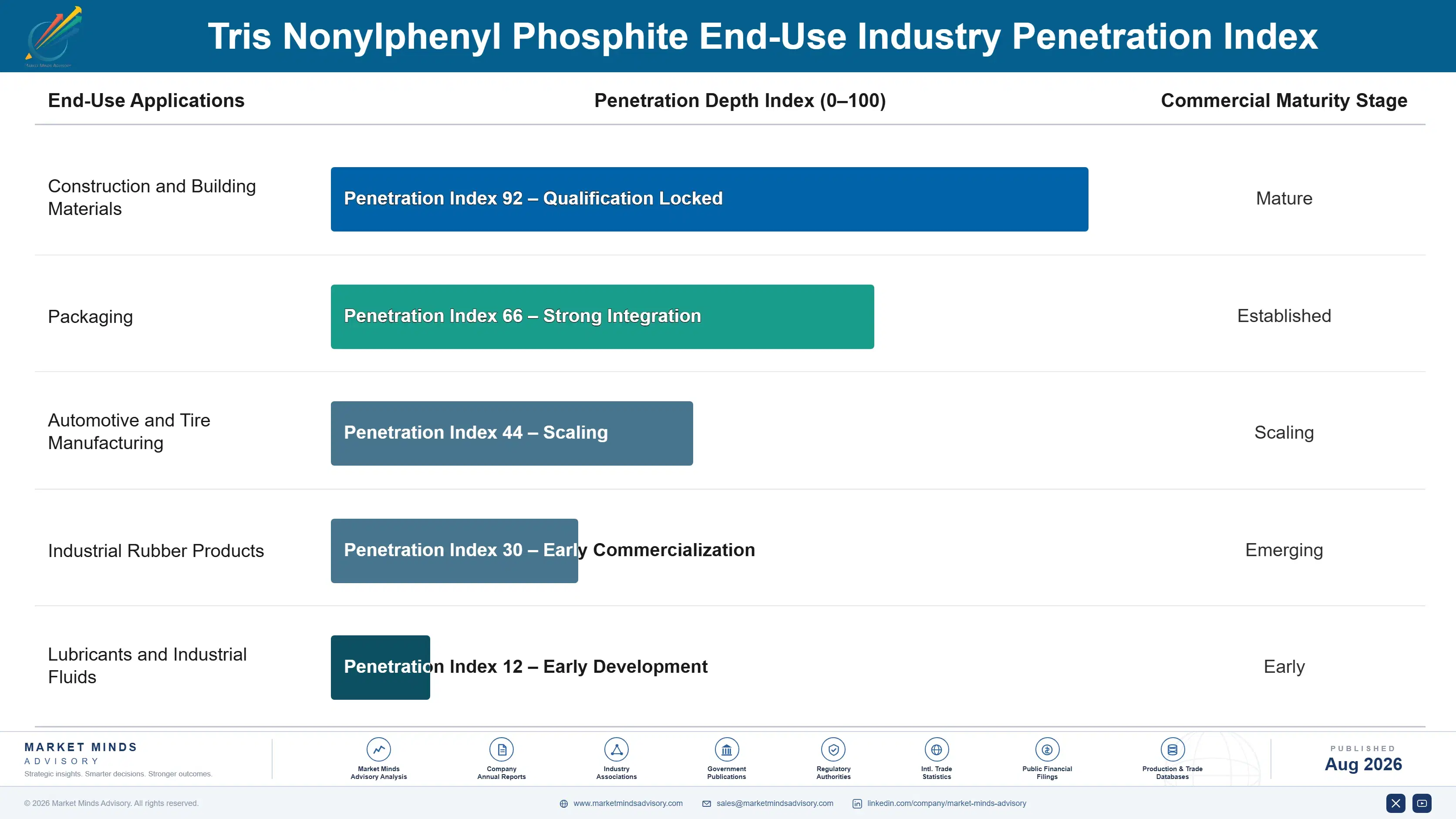
Once a processor qualifies this antioxidant into an established polymer formulation, that relationship typically persists for the full life of the product line in unrestricted markets, since reformulation requires stability retesting that most processors avoid absorbing without strong cause. This creates durable, low-churn revenue characteristics in Asian and other unregulated markets, distinct from the forced reformulation dynamic occurring in Europe.
Adoption depth varies sharply by region rather than by application alone in this market. Asian PVC and polyolefin processors show the deepest stickiness, since established formulations rarely change absent a specific technical or cost reason to do so. European processors show forced churn driven by regulatory deadlines rather than commercial preference. Rubber and elastomer processors globally show moderate stickiness tied to compounding cycles that occur less frequently than reformulation decisions in other segments.

Buyer profiles are shifting as global brands increasingly apply their most restrictive regional regulatory standard across all manufacturing regions regardless of local requirements, extending European-style reformulation pressure indirectly into Asian supply chains. This shift, still early, favors producers with credible alternative chemistry capability over those offering only legacy commodity product regardless of price advantage in the near term.
tris-nonylphenyl-phosphite-market-trends-end-use-penetration-index-1787311057155

Where MMA Sees the Opportunity

These are among the four positions where our research anticipates prominent divergence between winners and laggards over the coming forecast period. Each is grounded in the demand model, the regulatory perimeter, and the announced capacity pipeline.
01 / ALTERNATIVE CHEMISTRY INVESTMENT

Build Alternative Phosphite Capability to Retain European Accounts

European customer relationships built over decades represent genuine value that producers risk losing entirely to competitors offering compliant alternative phosphite chemistry, and producers that invest in this capability now retain revenue that would otherwise transfer completely away from their legacy commodity position. This capability requires formulation research investment, but producers achieving it convert a defensive regulatory challenge into a genuine premium revenue opportunity within existing customer relationships. Waiting until customers have already switched suppliers risks losing these relationships permanently rather than just the specific product line.
02 / ASIAN DISTRIBUTION EXPANSION

Deepen Asian Distribution Ahead of Continued Capacity Growth

Nearly all of this market's net volume growth now originates in Asia, and producers that build dedicated distribution and technical support infrastructure across Chinese and Southeast Asian polymer processing hubs capture a disproportionate share of this growth relative to competitors relying on distant export relationships. This investment requires sustained regional relationship building, but producers achieving strong Asian distribution depth offset European softness more effectively than those without comparable regional presence. This positioning also provides a hedge against any future regulatory precedent spreading from Europe.
03 / REFORMULATION TECHNICAL SUPPORT

Offer Reformulation Support Rather Than Cede European Customers

European customers navigating nonylphenol reformulation need technical support to validate alternative chemistry performance, and producers offering this support convert what could be a total customer loss into a continued relationship and cross-sell opportunity. This approach requires application engineering investment but is considerably less costly than losing established accounts entirely to competitors positioned to capture both the technical support relationship and the replacement product sale. Producers that move early on this positioning capture goodwill that pays dividends beyond the immediate transaction.
04 / REGULATORY PRECEDENT MONITORING

Monitor Regulatory Precedent Risk Beyond Europe Closely

The European regulatory approach to nonylphenol-derived chemistries could eventually influence regulatory thinking in other major markets, and producers that maintain parallel alternative chemistry capability position themselves defensively against this risk regardless of whether it materializes on any specific timeline. This monitoring and preparedness requires modest ongoing investment relative to the potential disruption a similar restriction could cause in currently unrestricted Asian markets. Producers that ignore this risk entirely could face a much more disruptive transition than those who prepared incrementally over time.

Engagement Snapshot From the Field

A live engagement with an industry participant carrying material or product regulatory and market exposure ahead of a defining policy shift, showing how our research translates into a defensible multi-year portfolio strategy.
MARKET MINDS ADVISORY · CLIENT ENGAGEMENT SUMMARY
Tris Nonylphenyl Phosphite Producer Strategic Portfolio Review and Transition Roadmap 2026·Investment Scenario on Tris Nonylphenyl Phosphite Exposure Evaluation 2025-26
CLIENT PROFILE
The client is a global consumer products manufacturer generating approximately $2.1 billion in annual revenue (client-reported, unverified by MMA) from packaged goods manufactured across multiple Asian facilities using PVC and polyolefin packaging components. The company faced growing pressure from European retail customers requesting nonylphenol-free formulation documentation for products sold into that market. The company had built its reputation on reliable global supply chain consistency.
STRATEGIC CHALLENGE
The client needed to decide whether to reformulate its Asian-manufactured packaging components globally, at an estimated cost of approximately $4.5 million (client-reported, unverified by MMA), or maintain dual formulation lines serving European and non-European markets separately, adding supply chain complexity but avoiding the full reformulation cost across its entire global manufacturing footprint.
MMA APPROACH
MMA's advisory team conducted primary interviews with antioxidant producers about alternative phosphite chemistry availability and cost, and analyzed the client's supply chain complexity under both a global reformulation and a dual-line approach. The analysis weighed reformulation cost against the operational complexity and error risk of maintaining separate formulations for different destination markets.
KEY FINDINGS
  1. Interview data indicated that alternative phosphite chemistry qualified for the client's applications carried an approximately 25% cost premium over the existing tris nonylphenyl phosphite formulation across all production volume.
  2. Maintaining dual formulation lines would require meaningful additional quality control and supply chain tracking investment to prevent formulation mix-ups between market-specific product batches.
  3. Comparable manufacturers that attempted dual-line approaches reported at least one formulation tracking error within the first year of implementation, creating compliance risk for European-destined shipments.
  4. Global reformulation, while more expensive upfront, eliminated ongoing tracking risk and positioned the client favorably ahead of potential future regulatory expansion beyond Europe.
CLIENT PROFILE
The client is a global consumer products manufacturer generating approximately $2.1 billion in annual revenue (client-reported, unverified by MMA) from packaged goods manufactured across multiple Asian facilities using PVC and polyolefin packaging components. The company faced growing pressure from European retail customers requesting nonylphenol-free formulation documentation for products sold into that market. The company had built its reputation on reliable global supply chain consistency.
STRATEGIC CHALLENGE
The client needed to decide whether to reformulate its Asian-manufactured packaging components globally, at an estimated cost of approximately $4.5 million (client-reported, unverified by MMA), or maintain dual formulation lines serving European and non-European markets separately, adding supply chain complexity but avoiding the full reformulation cost across its entire global manufacturing footprint.
MMA APPROACH
MMA's advisory team conducted primary interviews with antioxidant producers about alternative phosphite chemistry availability and cost, and analyzed the client's supply chain complexity under both a global reformulation and a dual-line approach. The analysis weighed reformulation cost against the operational complexity and error risk of maintaining separate formulations for different destination markets.
KEY FINDINGS
  1. Interview data indicated that alternative phosphite chemistry qualified for the client's applications carried an approximately 25% cost premium over the existing tris nonylphenyl phosphite formulation across all production volume.
  2. Maintaining dual formulation lines would require meaningful additional quality control and supply chain tracking investment to prevent formulation mix-ups between market-specific product batches.
  3. Comparable manufacturers that attempted dual-line approaches reported at least one formulation tracking error within the first year of implementation, creating compliance risk for European-destined shipments.
  4. Global reformulation, while more expensive upfront, eliminated ongoing tracking risk and positioned the client favorably ahead of potential future regulatory expansion beyond Europe.
RECOMMENDED STRATEGY
Phase 1: Phase 1 (Months 1-3): Qualify the alternative phosphite chemistry across all Asian manufacturing facilities currently using the legacy formulation for packaging components. Phase 2: Phase 2 (Months 4-8): Transition production progressively across all facilities to the new formulation, prioritizing lines producing products destined for European distribution first. Phase 3: Phase 3 (Months 9-12): Complete the global transition and retire the legacy formulation entirely, simplifying supply chain tracking and documentation requirements going forward.
OUTCOME
The client completed the global reformulation within the planned twelve-month window, eliminating the formulation tracking risk a dual-line approach would have introduced. The client reported that the unified formulation simplified documentation and positioned the company favorably for a subsequent similar request, avoiding an estimated additional $1.8 million (client-reported, unverified by MMA) in cost.

Frequently Asked Questions

Foundational context covering the market sizes, CAGR, scope, country, region and competition that inform every finding below. This section is provided to cover basics and most often pre-purchase conversations, answered from the MMA Primary Research Dataset.

What is the current size of the Tris Nonylphenyl Phosphite Market?

The Tris Nonylphenyl Phosphite Market was valued at $0.42 billion in 2025. MMA projects it will reach $0.44 billion in 2026 as Asian demand continues offsetting European regulatory decline.

How large will the Tris Nonylphenyl Phosphite Market be by 2036?

MMA forecasts the market will reach $0.69 billion by 2036, up from $0.44 billion in 2026. That represents a 1.57 times expansion over the ten-year forecast window.

What is the CAGR for the Tris Nonylphenyl Phosphite Market 2026 to 2036?

The market is projected to grow at a 4.6% CAGR between 2026 and 2036. MMA's bull and bear scenarios range from 5.7% to 3.5% depending on Asian capacity growth and regulatory precedent risk.

Which segment is growing fastest?

Polyolefin Processing Stabilization is the fastest-growing segment, expanding at a 6.4% CAGR, roughly 1.39 times the overall market rate as Asian polyolefin capacity growth continues.

Who are the major companies in the Tris Nonylphenyl Phosphite Market?

SI Group, Clariant, Songwon, Solvay, and Dover Chemical lead the market, together holding an estimated 62% of global production capacity. This concentration reflects the mature, established nature of production technology.

Which country is growing fastest?

China is the fastest-growing country market, expanding at an estimated 5.9% CAGR as PVC and polyolefin processing capacity continues rapid expansion without regulatory restriction. Continued industrial capacity investment supports this growth trajectory strongly.

Report Segmentation Architecture

The full report scope spans multiple orthogonal segmentation dimensions, with cross-tabulated demand data provided for each dimension pair. Coverage extends further to regional breakdowns, trend trajectories, and the competitive detail needed to support segment-level decision-making.

By Primary Market Dimension

  • PVC Stabilization Grade
  • Polyolefin Processing Grade
  • Rubber and Elastomer Processing Grade
  • Lubricant and Industrial Fluid Grade
  • Rubber Latex Antioxidant Grade
  • Specialty and Niche Application Grade

By End-Use Industry

  • Construction and Building Materials
  • Packaging
  • Automotive and Tire Manufacturing
  • Industrial Rubber Products
  • Lubricants and Industrial Fluids

By Commercial Dimension

  • Processor Direct Supply
  • Compounder Contract Supply
  • Distribution and Trading
  • Technical Support Services

By Region

  • North America
  • Western Europe
  • East Asia
  • South Asia and Pacific
  • Latin America
  • Middle East and Africa
  • Eastern Europe

Scope, Methodology, and Coverage

Every figure in this report is reproducible from documented input assumptions. The scope below maps the historical period, the forecast horizon, the segmentation dimensions, and the countries covered, alongside the underlying primary and qualitative methodology.
Historical Period
2020 to 2025
Forecast Period
2026 to 2036
Base Year
2025 (USD billions; MMA Primary Research Dataset, August 2026)
Market Definition
This report covers tris nonylphenyl phosphite, an organophosphite secondary antioxidant used to stabilize PVC, polyolefins, and rubber compounds against oxidative degradation during melt processing. It excludes primary phenolic antioxidants and alternative phosphite chemistries not based on nonylphenol feedstock.
Quantitative Units
USD billions (current prices); metric tons of production capacity where applicable
Segmentation Dimensions
By End-Use Polymer Application; By End-Use Industry; By Commercial Dimension; By Region
Regions Covered
North America, Western Europe, East Asia, South Asia and Pacific, Latin America, Middle East and Africa, Eastern Europe
Countries Covered
USA, China, Germany, France, UK, Japan, South Korea, India, Australia, Canada, Brazil, Mexico, Indonesia, Vietnam, Thailand, Malaysia, UAE, Saudi Arabia, South Africa, Nigeria, Turkey, Poland, Netherlands, Italy, Spain, Sweden, Switzerland, Argentina, Colombia, Singapore, and additional markets relevant to this sector
Key Companies Profiled
SI Group Inc., Clariant AG, Songwon Industrial Co. Ltd., Solvay SA, Dover Chemical Corporation, Adeka Corporation, BASF SE, Lanxess AG, Sasol Limited, Jiangsu Liangjiang New Materials Co. Ltd., Shandong Zhonghui New Materials Co. Ltd., Hebei Jingu Chemical Co. Ltd., Chitec Technology Co. Ltd., Emerald Performance Materials, Valtris Specialty Chemicals, Baerlocher GmbH, PMC Group Inc., Mayzo Inc., Wuxi Xinji Rubber & Plastic Additives Co. Ltd., Rianlon Corporation
Quantitative Methodology
Primary survey, n=3,800 respondents, Q4 2025, six countries; demand-side model with trade association cross-validation
Qualitative Methodology
47 expert interviews, Q4 2025; applied to validate demand model assumptions, identify emerging dynamics, and assess competitive positioning
Report Format
PDF and XLSX data workbook (Word format preview document)
Publisher
Market Minds Advisory
Report Code
MMA-2026-CHM-111
Published
August 2026
Contact
sales@marketmindsadvisory.com | www.marketmindsadvisory.com

Purchase the full Tris Nonylphenyl Phosphite Market Report (2026 to 2036).

The full Tris Nonylphenyl Phosphite Market report delivers ten-year forecasts across all seven regions, six product segments, and the full competitive landscape of twenty profiled producers. It includes detailed analysis of regulatory divergence between Asian and European demand, alternative phosphite chemistry economics, and demand drivers spanning PVC, polyolefin, and rubber processing applications. Buyers receive segment-level margin benchmarking across the volume, premium, and sustainability tiers identified in this summary. The report also includes primary survey data from 3,800 respondents and 47 expert interviews conducted in the fourth quarter of 2025, supporting every demand and pricing assumption in the forecast.
Ten-year regional and segment-level forecast models
Competitive profiles covering twenty antioxidant producers
Regulatory divergence analysis across major regions
Alternative phosphite chemistry economics and mapping
Portfolio margin benchmarking across three commercial tiers
Primary survey and expert interview data appendix

Built For The People Who Decide

From boardroom strategy to bench-side execution, this report is read cover-to-cover by leaders shaping the next decade of their industry, turning demand scenarios, market dynamics and valuation benchmarks into decisions.
CXOs/ Presidents/ VPs/ Managers
M&A and Corporate Development
Strategy Teams and R&D Heads
Procurement and Product Directors
Regulatory and Compliance Leaders
Investor Relations and Equity Analysts