Market Minds Advisory
Trichomonas Rapid Tests Market

Trichomonas Rapid Tests Market: Competing Against a Microscope Somebody Already Owns

The incumbent method misses roughly half of infections and costs nothing, which is a combination no diagnostic company has yet found a convincing way to argue against in a busy clinic.

Lead Analyst

Alice Ballenger

Published

September 2026

Make Smarter Decisions with Customized Research Insights

Request a free sample report and evaluate market opportunities, growth trends, and competitive dynamics relevant to your business needs.

2025 MARKET VALUE$0.2BMarket Size 2025
2036 FORECAST VALUE$0.6BBase Case , 2026 to 2036
CAGR 2026 TO 20368.8 %Bull 10.0% / Bear 7.6%
INCREMENTAL OPPORTUNITY$0.3BNet 10- year value creation
EXPANSION MULTIPLE2.31x2036 value over 2026 base
Strategic Levers
M&A Pipeline
Regional Outlook
Country Rankings
Competitive Intelligence
Segmental Deep-dive
Call-Us : 91 93563 13602

Executive Snapshot and Market Trajectory

The competitor here is not another test. Wet mount microscopy detects around 55% of infections, which means roughly half are missed, and it remains the default because the microscope is already on the bench and using it requires no purchase order from anybody. That combination has held for decades.
Rapid molecular tests grow at 13.2%, half again the market rate of 8.8%, and return a result in about 20 minutes. That matters because roughly 34% of patients never come back for results, so a test completed during the visit is the difference between treatment given and treatment merely recommended to somebody walking out of the door. Clinicians dismiss sensitivity claims readily and find follow-up loss much harder to argue away. Habit beats evidence.
Two structural gaps hold the category down. Only around 21% of jurisdictions treat this infection as notifiable, so no surveillance mandate creates institutional demand. And about 6% of male partners are tested at all, which means treated women are routinely reinfected by people the system never examined. Multiplex panels growing at 11.8% address the first by converting a deliberate request into an automatic one. Nobody sells against either one.
Market Definition
Near-patient diagnostic tests for Trichomonas vaginalis returning results within a single clinical encounter, covering antigen lateral flow tests, rapid molecular and isothermal tests, nucleic acid probe assays, rapid culture systems, self-collected and home sample kits, and multiplex rapid sexually transmitted infection panels. Measured at test selling value. Excludes centralised laboratory nucleic acid panels, wet mount microscopy, treatment products, and general sexual health services.
Base Year Value
$0.2B in 2025 (MMA Primary Research Dataset, August 2026)
Forecast Period
2026 to 2036, eleven discrete annual values
CAGR
8.8% base case. Bull 10.0%. Bear 7.6%.
Fastest Growth Segment
Rapid Molecular and Isothermal Tests: 13.2% CAGR
Fastest Growth Country
South Africa: 14.8% CAGR
Fastest Growth Region
South Asia and Pacific: 10.8% CAGR
Largest Region
North America: 30% of 2025 global value
Market Leaders
Abbott, Quidel Ortho, Hologic, Becton Dickinson, Sekisui Diagnostics. Source: MMA Primary Research Dataset, July 2026.
Primary Survey
n=3,800 procurement and R&D decision-makers, Q4 2025, six countries
Methodology
Demand-side build-up, cross-validated against public data, 47 expert interviews

Trichomonas Rapid Tests Market Forecast Scenarios

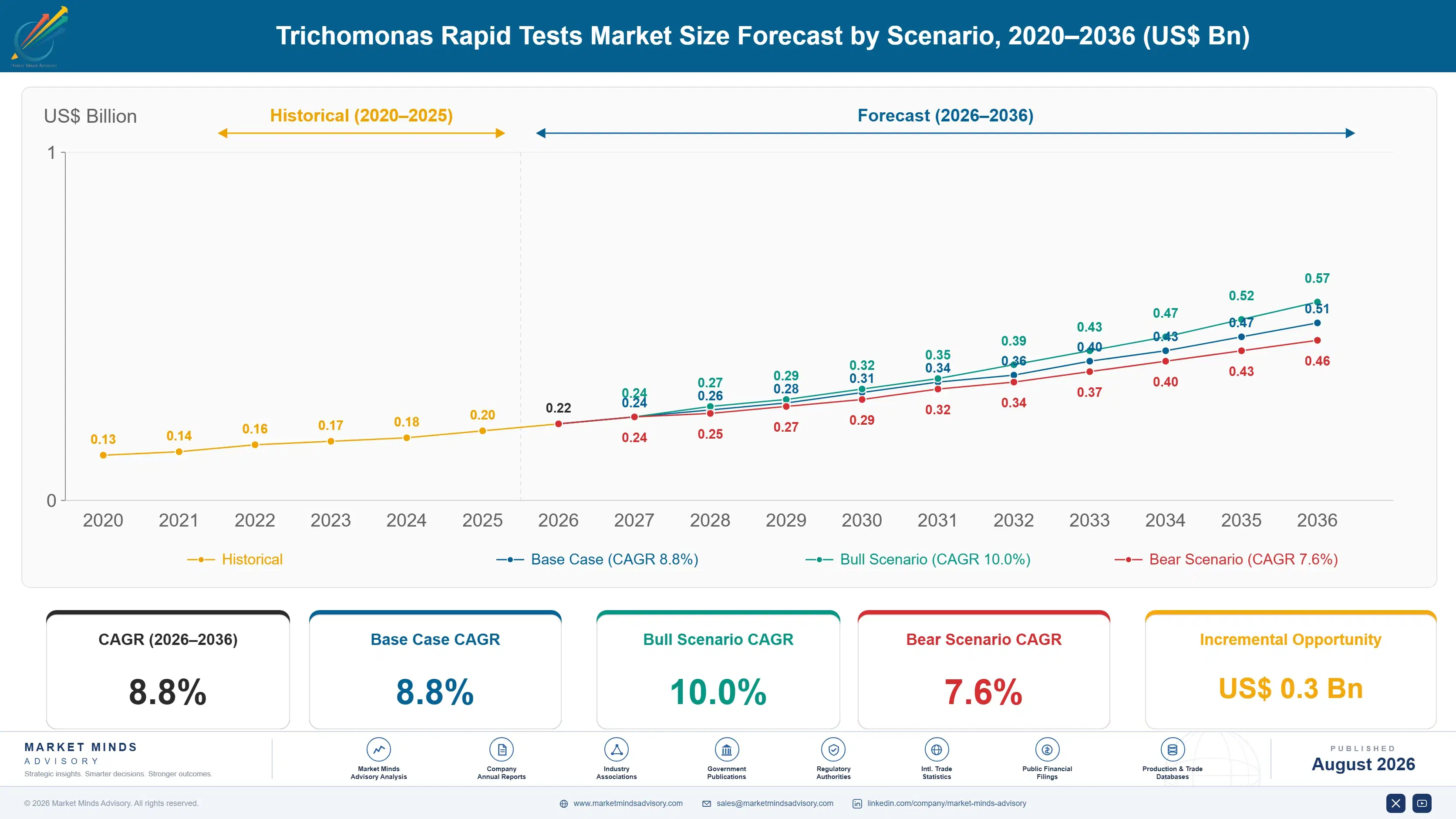
trichomonas-rapid-tests-market-size-forecast-scenario-1787640207435
Growth ran near 7.4% between 2020 and 2025 as antigen lateral flow tests displaced some wet mount use in settings where sensitivity mattered enough to fund a purchase. Rapid molecular formats arrived and grew quickly from a small base. Donor funded sexual health programmes across sub-Saharan Africa expanded etiologic testing where syndromic management had previously been standard practice throughout.
Base case 8.8% rests on three mechanisms. Rapid molecular tests grow at 13.2% as sensitivity and same-visit results both matter in populations with high loss to follow up. Multiplex rapid panels grow at 11.8% by including an infection most screening panels omit entirely. And South Africa grows fastest of any country at 14.8% on prevalence concentration and programme funding arriving together. None of the three depends on prevalence rising, which is already high and moves slowly.
The bull case at 10.0% assumes notifiable status widening beyond the current small minority of jurisdictions, which would create surveillance obligations and institutional testing demand where none exists today. The bear case at 7.6% is programme funding contracting across donor supported sexual health services, since those programmes carry a disproportionate share of testing volume in the highest prevalence settings.

Free, Immediate and Half Wrong

Every commercial argument in this category runs into the same obstacle. Wet mount microscopy detects around 55% of infections, which is poor, and it costs nothing beyond a slide because the microscope is already there and the clinician already knows how to use it. A test that performs better still has to be ordered, stocked, budgeted and justified, and the incumbent needs none of those things at any point.
TOP FIVE CONCENTRATION58%Established diagnostics companies hold most clinic purchasing positions
WET MOUNT SENSITIVITY55%Share of infections the incumbent microscopy method actually detects
RAPID RESULT TURNAROUND20 minutesTime from sample collection to a usable clinical result
MALE PARTNER TESTING6%Proportion of male partners tested during a treatment episode
LOSS TO FOLLOW UP34%Patients who never return for results or treatment
NOTIFIABLE JURISDICTION SHARE21%Places requiring this infection to be reported officially
Timing is where the newer formats have a genuine answer. Roughly 34% of patients never return for results in the settings where this infection concentrates, so a laboratory result arriving three days later frequently reaches nobody. Rapid molecular tests returning a result in about 20 minutes allow treatment during the same visit, and they grow at 13.2% on that argument rather than on sensitivity alone, which clinicians find easier to dismiss.
Two structural features hold the whole category below what prevalence would suggest. Only around 21% of jurisdictions treat trichomoniasis as notifiable, so there is no surveillance obligation generating institutional testing demand the way there is for chlamydia or gonorrhoea. And roughly 6% of male partners are ever tested, which leaves treated women exposed to reinfection.
"You are selling against a microscope that has already been paid for, sitting on a bench, operated by somebody who does not need anybody's permission to use it. Being twice as accurate is not automatically a winning argument in that room."
Director, Infectious Disease Diagnostics and Sexual Health Practice · MMA Healthcare and Life Sciences Practice · August 2026

Market Trends

Same-visit results displacing send-away laboratory testing

Roughly 34% of patients never return for results in the settings where this infection concentrates, which makes a three day laboratory turnaround close to useless however accurate it is. Rapid molecular tests returning results in about 20 minutes allow treatment before the patient leaves. They grow at 13.2% on that argument rather than on sensitivity, because clinicians find the follow-up problem considerably harder to dismiss than an accuracy claim. Instrument requirements and per test cost both run above lateral flow, so adoption concentrates where the follow-up loss is worst. Habit resists evidence.
Market Impact: South Africa growing fastest at 14.8%

Multiplex panels including an infection screening usually omits

Trichomoniasis is the most common non-viral sexually transmitted infection and sits outside most routine screening panels, which means it is looked for only when symptoms prompt it. Multiplex rapid panels grow at 11.8% by including it alongside chlamydia and gonorrhoea, which converts a deliberate test request into an automatic one. That change in ordering behaviour matters considerably more than any improvement in the individual assay. Guideline committees rather than commercial teams decide inclusion, which makes it slow, unpredictable and disproportionately valuable once achieved. Inclusion is disproportionately valuable once achieved and slow to obtain.
Market Impact: Reaches beyond 6% partner testing

Market Opportunities and Growth Drivers

Programme funding shifting syndromic management toward testing

South Africa grows fastest of any country at 14.8% as prevalence concentration and donor supported programme funding arrive together, moving sexual health services from syndromic management toward etiologic diagnosis. That transition creates testing demand where none previously existed, since syndromic treatment required no diagnostic at all. Programme funding cycles are published well ahead of procurement, which gives ample notice to suppliers tracking them properly. Prevalence alone purchases nothing, which is why disease burden maps make poor territory plans in this category. Funding rather than burden buys tests. Burden maps mislead badly.
Market Impact: Notifiable in only 21% of places

Self-collection widening access beyond clinical settings

Self-collected sampling removes the examination that deters many people from testing at all, which matters in a category where symptoms are frequently absent or dismissed. Home collection kits also reach populations that clinic based services never see. The constraint is linking a positive result to treatment, since a diagnosis without a prescription achieves nothing, and services solving that linkage grow considerably faster than those simply shipping kits. Around 6% of male partners are tested at all, and self-collection is the only realistic route to changing that figure meaningfully. Linkage decides the value.
Market Impact: Only 6% of partners tested

Market Restraints and Challenges

Absent notifiable status removing institutional testing demand

Only around 21% of jurisdictions require trichomoniasis to be reported, so no surveillance obligation generates the institutional testing that chlamydia and gonorrhoea programmes take for granted. The root cause is historic public health classification rather than any judgement about prevalence. Commercially it leaves testing dependent on individual clinical suspicion. Advocacy for notifiable status and inclusion in screening guidelines are the routes participants are actually pursuing. Guideline committees rather than commercial teams decide that, which makes it slow and largely outside supplier influence. Advocacy is the slow route available. Suspicion carries it all.
Market Impact: Results delivered within 20 minutes

Male partners untested leaving reinfection cycles unbroken

Around 6% of male partners are tested during a treatment episode, because infection in men is usually asymptomatic and services are configured around women presenting with symptoms. The root cause is service design rather than any diagnostic limitation. Commercially it caps testing volume at roughly half the infected population. Partner notification services, expedited partner therapy and male directed self-collection are the working responses available. Treated women are routinely reinfected by people the system never examined at any point. Testing volume caps at roughly half the infected population as a direct result of that service design.
Market Impact: Panels growing at 11.8% annually
4 additional market trends, 3 additional growth drivers, and 2 additional restraints and challenges are covered in the full report. Contact sales@marketmindsadvisory.com to access the complete intelligence.

Segment CAGR and Growth Architecture

Six segments split by test format, because format determines the sensitivity delivered, the time to result, the setting it can be used in and the purchasing route required. Sample type and packaging variants sit inside each format. Care setting and channel dimensions are handled separately within the framework here. Format decides the commercial position entirely.
trichomonas-rapid-tests-market-market-share-analysis-1787640207988

Rapid Molecular and Isothermal Tests

Growing at 13.2%, half again the market rate of 8.8%, rapid molecular formats combine laboratory grade sensitivity with a result in about 20 minutes, which allows treatment during the same visit. That matters more than accuracy in settings where roughly 34% of patients never return for results at all. Instrument requirements and per test cost both run above lateral flow, so adoption concentrates where loss to follow up is high enough to make the argument obvious to clinicians. Instrument placement rather than assay performance decides who supplies the cartridges afterwards, which makes the initial reader decision worth considerably more than its own price. Loss to follow up drives it. Cost sits above lateral flow.
CAGR 13.2%

Multiplex Rapid Sexually Transmitted Infection Panels

At 11.8% multiplex panels include trichomoniasis alongside chlamydia and gonorrhoea, which converts a test somebody has to deliberately request into one that happens automatically. Given that this is the most common non-viral sexually transmitted infection and sits outside most routine screening, inclusion changes detected prevalence far more than any assay improvement could. Panel pricing spreads the incremental cost across targets already being tested for anyway. Removing a target from a validated panel requires revalidation nobody undertakes lightly, which makes inclusion unusually durable once it has been achieved. Guideline change is the route. Detected prevalence rises sharply once the test becomes automatic rather than requested, which nothing about the assay itself achieves.
CAGR 11.8%
Full segment breakdown across 6 segments available in the complete report.

Regional Architecture and Country Demand Map

North America holds 30% of value on testing spend and sexual health service funding rather than on prevalence. East Asia follows at 22% on population scale and expanding clinical testing capacity. South Asia and Pacific grows fastest of the seven regions covered here. Programme funding drives both.

North America

Sexual health service funding and testing spend give this region its leading share despite prevalence being lower than in several others. Trichomoniasis is notifiable in only a small number of states, which leaves testing dependent on clinical suspicion rather than any surveillance requirement. Multiplex panel adoption is furthest advanced here. Growth at 7.6% reflects a mature testing base with format substitution rather than volume expansion driving the increase. Loss to follow up in the settings where this infection concentrates is high enough that same-visit testing carries a stronger argument than sensitivity does. Multiplex panel adoption is furthest advanced here, which converts a deliberate request into automatic ordering across large parts of the system.
Share: 30% | CAGR: 7.6% (2026 to 2036)

Western Europe

Sexual health services are well funded and testing is generally laboratory based, with rapid formats reaching outreach settings and community clinics rather than replacing central testing. Notifiable status is rare across the region. Screening guidelines mostly exclude trichomoniasis, which keeps testing symptom driven rather than routine. Regional growth of 7.2% is the slowest anywhere on mature services and guideline exclusion holding volume flat. Rapid formats reach outreach and community settings rather than replacing central laboratory testing, which limits the addressable share considerably. Screening guidelines mostly exclude trichomoniasis, which keeps testing symptom driven rather than routine and caps volume well below prevalence. Notifiable status is rare across the region. Volume stays well below prevalence.
Share: 18% | CAGR: 7.2% (2026 to 2036)
Regional intelligence for 5 additional markets available in the complete report: East Asia, South Asia and Pacific, Latin America, Middle East and Africa, Eastern Europe. Contact sales@marketmindsadvisory.com.
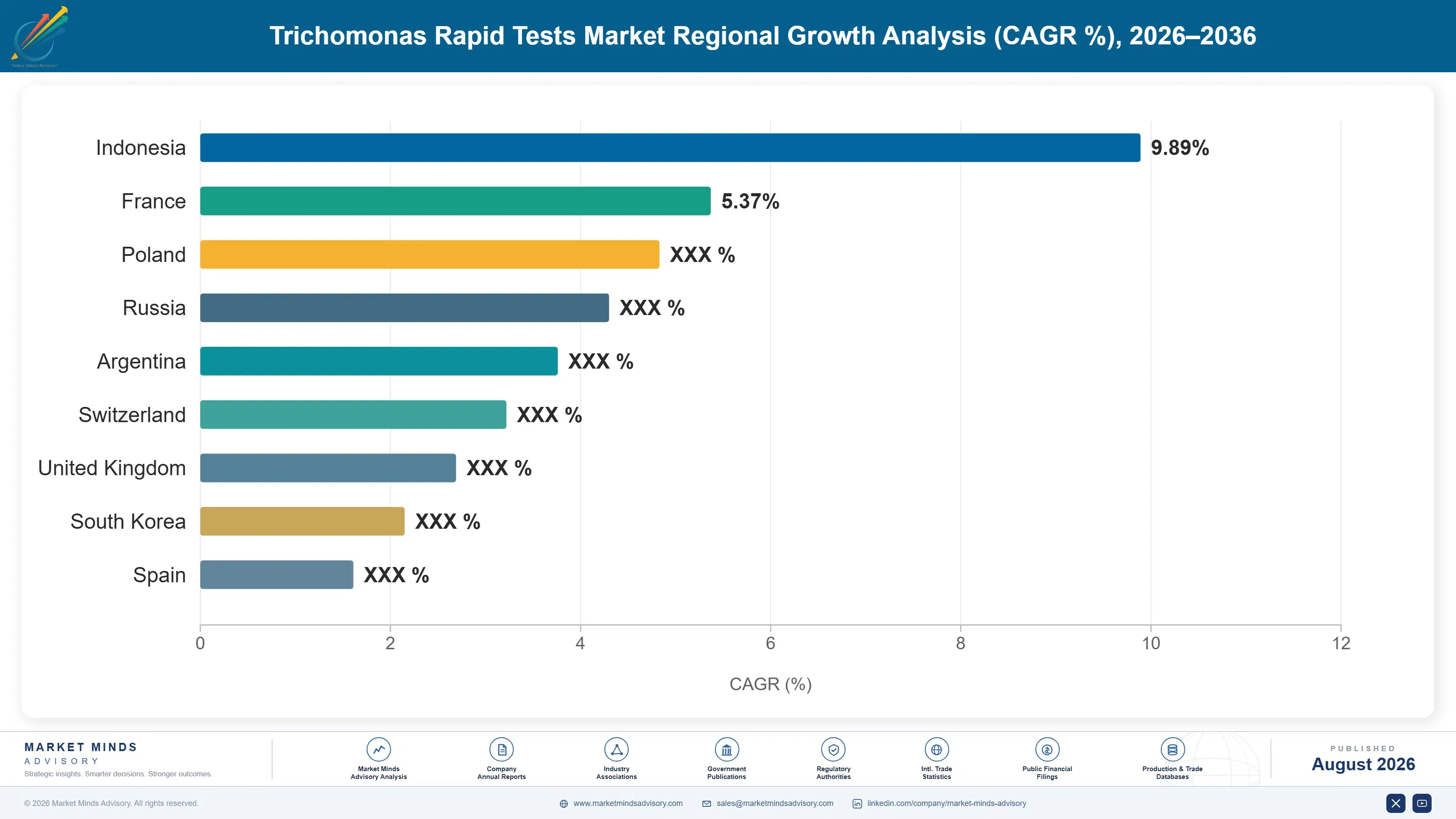
trichomonas-rapid-tests-market-country-cagr-analysis-1787640208524

Four Moves Against a Free Incumbent

Being more accurate than a microscope somebody already owns has not proved a winning argument for thirty years. What remains available is selling the visit rather than the assay, getting onto panels rather than being requested, and following programme funding rather than prevalence. Committees decide more than clinicians do here. Evidence rarely decides it.

Sell the completed visit, not the better assay

Wet mount misses around 45% of infections and costs nothing, which makes accuracy a difficult argument against an instrument already sitting on the bench. Roughly 34% of patients never return for results, so a test completed in about 20 minutes converts a recommendation into treatment actually given. Clinicians dismiss sensitivity claims readily and find the follow-up problem considerably harder to argue with. Habit rather than evidence is the obstacle. A test completed in about 20 minutes converts a recommendation into treatment given, which is a different claim entirely from being more accurate.
Market Impact: Treats the 34% who never come back at all

Get onto the panel rather than onto the request form

Trichomoniasis is the most common non-viral sexually transmitted infection and sits outside most routine screening, which means it is tested only when somebody specifically thinks of it. Multiplex panels growing at 11.8% convert a deliberate request into an automatic one, and panel pricing spreads the incremental cost across targets already being tested. Ordering behaviour rather than assay performance is what actually determines volume here. Guideline committees decide inclusion, which makes it slow and outside direct commercial influence, and disproportionately valuable once achieved. Panel pricing spreads the cost. Committees move slowly.
Market Impact: Multiplex panels growing at 11.8% every single year

Follow programme funding rather than prevalence maps

South Africa grows fastest at 14.8% because prevalence concentration and donor programme funding arrive together, and prevalence alone purchases nothing. Suppliers organised around disease burden are covering populations with no procurement budget attached to them at all. Programme funding cycles are published well ahead of tendering, which gives ample notice to anybody tracking them rather than reading epidemiology. Disease burden maps make poor territory plans here. Programme designers rather than procurement officers set what gets funded, and reaching them requires engagement well before any tender document exists. Tenders confirm decisions.
Market Impact: Follows the 14.8% South African programme funded growth

Solve the linkage problem in self-collected testing

Self-collection removes the examination that deters testing and reaches populations clinics never see, including the roughly 94% of male partners currently untested. A diagnosis without a prescription achieves nothing clinically, so services linking a positive result to treatment grow considerably faster than those simply shipping kits. Treatment linkage rather than sample collection is the part worth building and the part competitors keep neglecting. Sample collection is the easy part. Around 34% of patients never return for results even inside clinical services, and the figure is worse for anybody testing at home unassisted.
Market Impact: Reaches the 94% of male partners currently untested

Who Controls the Margin Pool

Participation is measured on annual revenue from trichomonas testing products, and the top five hold 58%. Concentration is high because the category is small enough that few companies build dedicated positions, and most participants supply it inside broader sexual health testing portfolios. The gap to challengers is portfolio breadth rather than any assay advantage, since a single infection cannot support dedicated commercial infrastructure on its own.
Competition runs on three fronts. Panel inclusion decides whether an assay is ordered at all, which precedes every other consideration. Instrument placement decides rapid molecular access, since the reader constrains the test. And programme tender pricing decides volume in the highest prevalence settings. Each front rewards a different capability, and very few participants hold all three of them properly.

Pressure ahead comes from multiplex panels changing ordering behaviour and from programme funding shifting toward etiologic diagnosis. Expect suppliers with panel positions to gain against single target test makers. Rankings shift on whoever gets included in routine screening rather than requested. Concentration should hold given the category size. Standalone single target test makers look most exposed as panels convert deliberate requests into automatic ordering across whole systems.
trichomonas-rapid-tests-market-company-positioning-matrix-1787640209077

Competitive Moat and Risk Dimensions

ABBOTT

Moat: Panel breadth and instrument placement

Holding sexual health testing across multiple targets and formats lets trichomoniasis ride inside panels and platforms already placed in clinics, rather than requiring a separate purchasing decision for a single infection nobody is obliged to report. Instrument placement in particular converts into consumable volume that a standalone test maker cannot access at all.
ABBOTT

Risk: Free incumbent method persistence

Wet mount microscopy detects around 55% of infections, costs nothing and requires no procurement, which makes it remarkably durable regardless of how much better any purchased test performs. Displacing it requires changing clinical habit rather than winning a technical comparison, and habit has proved resistant to evidence for several decades now.
QUIDEL ORTHO

Moat: Rapid format depth in clinics

Established rapid testing positions across community clinics and sexual health services give the business distribution into exactly the settings where same-visit results matter most, which is where loss to follow up runs highest. Those relationships were built across multiple infections and transfer readily rather than needing rebuilding for each new target.
QUIDEL ORTHO

Risk: Absent surveillance demand

Only around 21% of jurisdictions require this infection to be reported, so no institutional testing obligation generates the baseline volume that notifiable infections enjoy automatically. Growth therefore depends on clinical suspicion and guideline change rather than on any regulatory requirement, which makes it considerably slower and harder to forecast.

Players Tracked

Prominent Players

Abbott
Quidel Ortho
Hologic
Becton Dickinson
Sekisui Diagnostics

Other Key Players

Roche Diagnostics
Cepheid
bioMérieux
Bio-Rad Laboratories
Qiagen
Chembio Diagnostics
OraSure Technologies
Trinity Biotech
Meridian Bioscience
SD Biosensor
Premier Medical Corporation
CTK Biotech
Zephyr Biomedicals
Binx Health
Visby Medical

Recent Developments

FEBRUARY 2026

Screening guideline adds trichomonas to routine panel

A national sexual health guideline added trichomoniasis to routine screening alongside chlamydia and gonorrhoea, converting a test that required deliberate clinical suspicion into one performed automatically on every screening attendance. Detected prevalence rose sharply once testing became automatic. Nobody had changed the assay at all.
Signal: Guideline inclusion changes ordering behaviour far more than any assay improvement ever does in actual practice
AUGUST 2025

Clinic replaces wet mount with same-visit molecular testing

A sexual health clinic replaced wet mount microscopy with rapid molecular testing after auditing how many diagnosed patients actually returned for results, finding the follow-up loss exceeded the sensitivity gap by a wide margin. Treatment during the visit rose substantially afterwards. Sensitivity had not been the deciding factor.
Signal: Loss to follow up proved a considerably stronger commercial argument than sensitivity within that same clinic
DECEMBER 2025

Programme moves from syndromic management to etiologic testing

A donor supported sexual health programme moved from syndromic management toward etiologic diagnosis across its clinic network, creating testing demand in a setting where treatment had previously required no diagnostic at all. Testing demand appeared where none had previously existed. Procurement followed within two quarters.
Signal: Programme funding rather than any disease prevalence at all is what actually purchases the diagnostic tests

Antibodies, Cartridges and Distribution

Antibodies and conjugate reagents carry around 31% of lateral flow test cost, produced by a concentrated group of suppliers whose quality determines assay sensitivity. Cartridge moulding, reagents and lyophilised chemistry absorb roughly 48% of rapid molecular test cost. Nitrocellulose membrane and assembly take about 14% of lateral flow cost. Regulatory maintenance, quality release and distribution account for the balance.
Reagent and moulding costs held broadly stable across recent years while programme tender pricing fell steadily, per Abbott annual reporting for 2025 on diagnostics cost commentary and published global health procurement pricing. Suppliers absorbed most of that compression, since donor supported tenders award on price and volume commitments are made against fixed budget envelopes. Suppliers holding panel positions spread regulatory and distribution cost across targets, which cushions that compression considerably.

Exposure divides on format rather than on company size. A lateral flow manufacturer carries antibody cost against tender pricing that falls steadily. A rapid molecular supplier carries cartridge cost supported by pricing that same-visit capability sustains. A company supplying inside broader panels spreads regulatory and distribution cost across targets, which is a considerably more comfortable position than either standalone format.
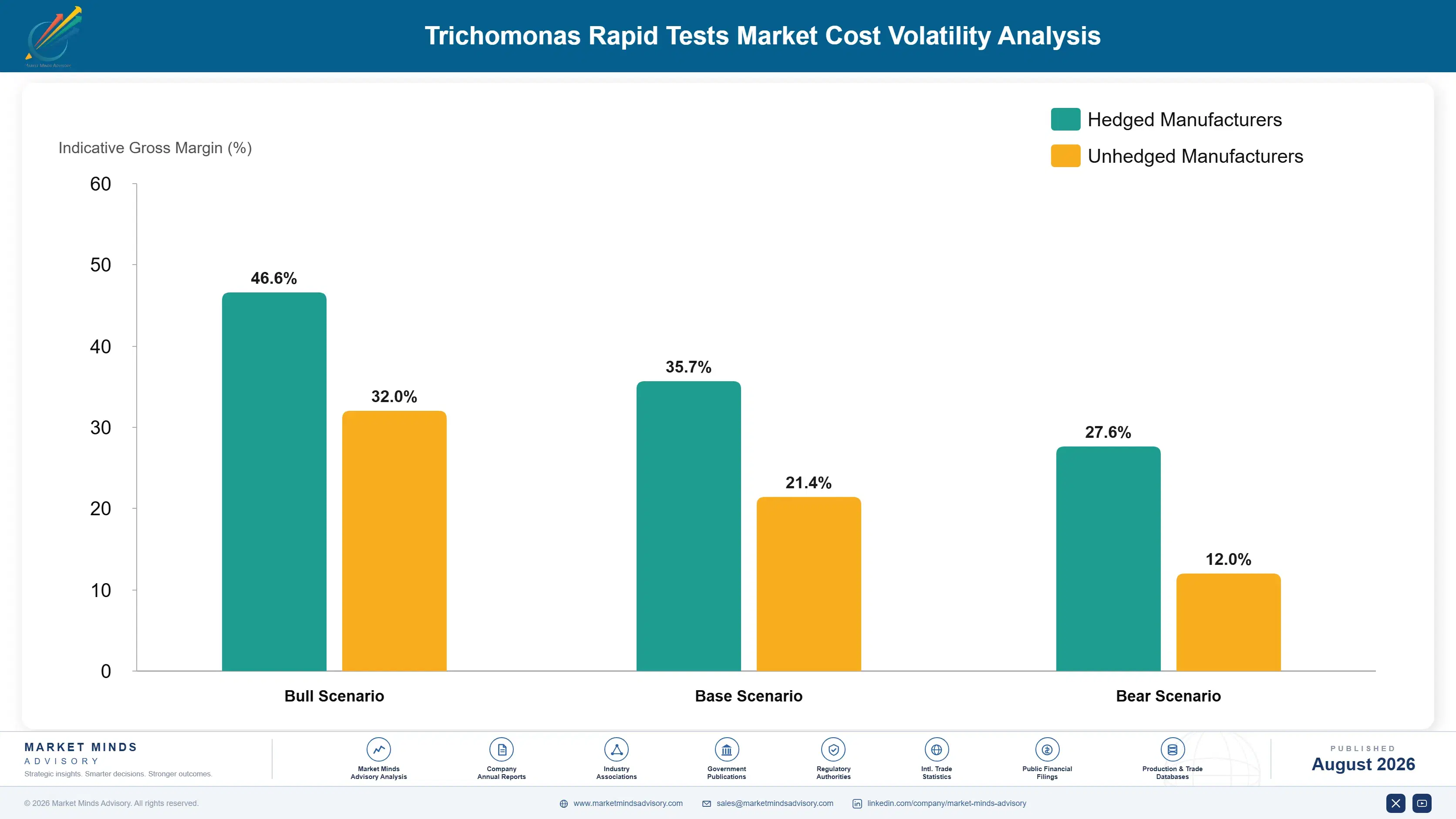
trichomonas-rapid-tests-market-cost-volatility-analysis-1787640209273

Qualify additional antibody sources ahead of any disruption

Antibodies carry close to a third of lateral flow cost and come from a narrow supplier field where quality directly determines assay sensitivity. Qualifying alternatives costs validation time and removes an exposure that halts production entirely when it bites, which is considerably worse for a supplier holding programme tender commitments than any price movement.

Supply inside panels rather than as a standalone test

Regulatory maintenance and distribution cost broadly the same whether a company supplies one target or several, which makes standalone single infection testing structurally disadvantaged. Panel inclusion spreads that fixed cost across targets and simultaneously solves the ordering behaviour problem that limits volume for this particular infection. Standalone testing is structurally disadvantaged. Fixed costs demand breadth.

Price programme tenders against multi-year volume commitment

Donor supported tenders award on price and set fixed budget envelopes, which compresses margin unless volume is committed for long enough to justify manufacturing scale. Multi-year commitments in exchange for pricing certainty benefit both sides, and programme funding cycles are published well ahead of tendering to make the planning feasible. Planning is entirely feasible.

Portfolio Architecture for Margin Defence

Margin here follows whether a test is ordered automatically or has to be requested, because a product nobody thinks to ask for generates no volume whatever its performance. Rapid culture and standalone lateral flow tests earn margins in the mid teens to high twenties, competing against a free incumbent and against tender pricing that falls year on year. A product nobody thinks to request generates no volume whatever it costs.
Nucleic acid probe assays and self-collected kits do better in the high twenties to low forties, because laboratory positioning and consumer channel economics both differ from clinic tender purchasing entirely. Treatment linkage rather than sample collection is what separates the consumer offerings commercially.

Rapid molecular tests and multiplex panels hold the strongest position, reaching into the low fifties, where same-visit results and automatic ordering both address problems that free microscopy cannot. Those margins depend on instrument placement and guideline inclusion respectively, and compress toward tender levels wherever a buyer treats the test as a commodity screening input. Guideline committees and instrument placement decisions rather than commercial effort determine whether either position is available at all.

Rapid Culture and Standalone Lateral Flow

Single target tests competing against free microscopy and falling tender pricing together. The thirteen point range reflects manufacturing scale and antibody sourcing rather than any clinical difference between suppliers. Both pressures ignore product quality.
Gross Margin: 15-28%

Probe Assays and Self-Collected Kits

Formats reaching laboratory and consumer channels with different economics from clinic tenders. The fourteen point range reflects channel position and whether treatment linkage accompanies the diagnostic result. Linkage decides consumer value entirely.
Gross Margin: 28-42%

Rapid Molecular and Multiplex Panels

Formats solving same-visit treatment and automatic ordering respectively. The twelve point range reflects instrument placement depth and guideline inclusion, which drive volume in quite different ways. Both routes bypass clinical suspicion.
Gross Margin: 40-52%
trichomonas-rapid-tests-market-portfolio-architecture-1787640209780

High-value Sub-segments and Strategic Watch-out

Rapid Molecular and Isothermal Tests

High value and the fastest growth at 13.2%, delivering results in about 20 minutes where roughly a third of patients never return. Instrument placement rather than assay performance decides who supplies them. Loss to follow up rather than sensitivity converts clinics away from free microscopy.
Gross Margin: 40-52%

Multiplex Rapid Panels

High value and growing at 11.8% by converting a deliberate test request into an automatic one. Guideline inclusion decides the volume entirely, and it moves slowly through committee rather than commercially. Revalidation requirements make inclusion unusually durable once achieved, which is worth the long committee timelines involved.
Gross Margin: 38-50%

Standalone Lateral Flow Tests

The volume core, competing directly against free wet mount microscopy and against programme tender pricing that falls each year. Neither pressure responds to any improvement in the product itself. Wet mount costs nothing and needs no purchase order, which is a combination no product improvement addresses.
Gross Margin: 15-28%

Ordering Behaviour Exposure

The strategic watch-out. Only around 21% of jurisdictions make this notifiable, and the range reflects whether a supplier sits inside routine panels or waits for somebody to specifically request the test. Guideline inclusion is the only structural fix, and it moves through committees rather than through commercial effort.
Gross Margin: 0-45%

Requested Rather Than Routine

Demand here depends on somebody deciding to look, which is a considerably weaker foundation than a screening obligation. Only around 21% of jurisdictions make this infection notifiable, so no surveillance requirement generates baseline volume the way it does for chlamydia and gonorrhoea. Testing therefore tracks clinical suspicion, which varies enormously between services and between individual clinicians within them. Suspicion is a weak foundation.
Stickiness follows platform placement rather than product preference. A clinic with a rapid molecular instrument installed continues buying cartridges for it, since the reader constrains the choice entirely. Panel inclusion holds similarly, because removing a target from a validated panel requires revalidation nobody undertakes lightly. Standalone lateral flow tests reopen on every tender, where price alone decides. Price alone decides those tenders.

The deciding party sits with guideline committees and programme designers rather than with purchasing or clinicians. A guideline adding trichomoniasis to routine screening changes ordering across an entire health system at once. Suppliers calling on clinics are competing for share of a testing volume that somebody else's committee decided the size of, frequently years earlier. Committees set the volume, not clinics.
trichomonas-rapid-tests-market-end-use-penetration-index-1787640210304

Where We Would Put Effort

These are among the four positions where our research anticipates prominent divergence between winners and laggards over the coming forecast period. Each is grounded in the demand model, the regulatory perimeter, and the announced capacity pipeline.
01 / VISIT COMPLETION SELLING

Accuracy loses to a free microscope

Wet mount microscopy misses around 45% of all infections and costs the clinic nothing whatsoever, which makes any sensitivity argument remarkably difficult to win against an instrument already sitting on the bench. Roughly 34% of patients never return for their results, so a test completed in about 20 minutes converts a treatment recommendation into treatment that is actually given. Clinicians dismiss accuracy claims readily and find the follow-up loss problem considerably harder to argue away when it is their own clinic.
02 / PANEL INCLUSION PRIORITY

Being requested is the losing position

Trichomoniasis is by some margin the most common non-viral sexually transmitted infection and yet it sits outside most routine screening panels entirely, so it gets tested for only when a clinician happens to think of it specifically. Multiplex panels growing at 11.8% convert that deliberate request into an entirely automatic one, and panel pricing spreads the incremental cost across targets already being tested anyway. Ordering behaviour rather than assay performance is what actually determines testing volume across this whole category.
03 / PROGRAMME FUNDING FOLLOWING

Prevalence buys nothing without a budget

South Africa grows fastest of any country covered at 14.8% because prevalence concentration and donor supported programme funding happen to arrive together, and prevalence on its own purchases absolutely nothing anywhere in this category. Suppliers who are still organised around disease burden maps are covering populations that have no procurement budget attached to them whatsoever. Programme funding cycles are published well ahead of any tendering, which gives ample notice to anybody actually tracking them rather than simply reading the epidemiology instead.
04 / TREATMENT LINKAGE BUILDING

A result without a prescription is nothing

Self-collection removes the physical examination that deters testing and reaches populations that clinics simply never see, including the roughly 94% of male partners who are currently never tested at any point at all. A diagnosis arriving without any prescription attached to it achieves nothing clinically at all for the person holding it. Services that link positive results directly through to treatment grow considerably faster than those simply shipping collection kits, and most competitors in this category keep neglecting exactly that step entirely.

Engagement Snapshot From the Field

A live engagement with an industry participant carrying material or product regulatory and market exposure ahead of a defining policy shift, showing how our research translates into a defensible multi-year portfolio strategy.
MARKET MINDS ADVISORY · CLIENT ENGAGEMENT SUMMARY
Trichomonas Rapid Tests Producer Strategic Portfolio Review and Transition Roadmap 2026·Investment Scenario on Trichomonas Rapid Tests Exposure Evaluation 2025-26
CLIENT PROFILE
A point-of-care diagnostics company supplying sexual health rapid tests to clinics and public health programmes across European and African markets, at annual revenue near 88 million dollars (client-reported, unverified by MMA). Trichomonas testing was sold standalone and panel positions were absent. Commercial messaging centred entirely on sensitivity against wet mount microscopy. Programme engagement began at tender.
STRATEGIC CHALLENGE
Standalone trichomonas test volumes were flat despite strong sensitivity data, and programme tender pricing was compressing margin each cycle. Management wanted to understand why a demonstrably better test was not displacing a method that misses half of infections. Panel partnerships had never been pursued at all. A different argument was needed.
MMA APPROACH
MMA observed testing decisions across clinic settings to establish what actually determined whether a test was performed, quantified loss to follow up against turnaround time, assessed guideline and notifiable status by market, and mapped programme funding cycles against the client's tender participation. Interviews with 47 experts covered sexual health services, public health programmes, laboratory operations and guideline development.
KEY FINDINGS
  1. Clinicians consistently defaulted to wet mount because it required no procurement decision, and accuracy data had never once changed that behaviour in any observed setting.
  2. Loss to follow up exceeded the sensitivity gap at every clinic examined, which made turnaround a considerably stronger commercial argument than assay performance.
  3. The client had no position in multiplex panels, where inclusion converts a deliberate test request into automatic ordering across an entire health system at once.
  4. Programme funding cycles were published well ahead of tendering and the client had been responding to tenders rather than positioning during the funding decision.
CLIENT PROFILE
A point-of-care diagnostics company supplying sexual health rapid tests to clinics and public health programmes across European and African markets, at annual revenue near 88 million dollars (client-reported, unverified by MMA). Trichomonas testing was sold standalone and panel positions were absent. Commercial messaging centred entirely on sensitivity against wet mount microscopy. Programme engagement began at tender.
STRATEGIC CHALLENGE
Standalone trichomonas test volumes were flat despite strong sensitivity data, and programme tender pricing was compressing margin each cycle. Management wanted to understand why a demonstrably better test was not displacing a method that misses half of infections. Panel partnerships had never been pursued at all. A different argument was needed.
MMA APPROACH
MMA observed testing decisions across clinic settings to establish what actually determined whether a test was performed, quantified loss to follow up against turnaround time, assessed guideline and notifiable status by market, and mapped programme funding cycles against the client's tender participation. Interviews with 47 experts covered sexual health services, public health programmes, laboratory operations and guideline development.
KEY FINDINGS
  1. Clinicians consistently defaulted to wet mount because it required no procurement decision, and accuracy data had never once changed that behaviour in any observed setting.
  2. Loss to follow up exceeded the sensitivity gap at every clinic examined, which made turnaround a considerably stronger commercial argument than assay performance.
  3. The client had no position in multiplex panels, where inclusion converts a deliberate test request into automatic ordering across an entire health system at once.
  4. Programme funding cycles were published well ahead of tendering and the client had been responding to tenders rather than positioning during the funding decision.
RECOMMENDED STRATEGY
Phase 1: Phase one: reposition commercial messaging around same-visit treatment rather than sensitivity, since clinicians dismiss accuracy claims and cannot dismiss follow-up loss. Phase 2: Phase two: pursue multiplex panel inclusion, because ordering behaviour rather than assay quality decides volume in this category entirely. Committees decide it slowly. Phase 3: Phase three: engage programme designers during funding decisions rather than responding to tenders once written. Tenders confirm decisions already taken elsewhere.
OUTCOME
The company repositioned around same-visit treatment during 2026 and clinic conversion improved measurably against wet mount (client-reported, unverified by MMA). Panel partnership discussions began, and programme engagement moved earlier in the funding cycle. Sensitivity based messaging was withdrawn from clinic conversations entirely. Panel positioning became the priority.

Frequently Asked Questions

Foundational context covering the market sizes, CAGR, scope, country, region and competition that inform every finding below. This section is provided to cover basics and most often pre-purchase conversations, answered from the MMA Primary Research Dataset.

What is the current size of the Trichomonas Rapid Tests Market?

MMA sizes it at USD 0.24 billion in 2025, rising to USD 0.26 billion in 2026. The figure covers near-patient trichomonas testing products at test selling value.

How large will the Trichomonas Rapid Tests Market be by 2036?

USD 0.60 billion by 2036, an incremental USD 0.34 billion over the 2026 base and an expansion multiple of 2.31 times. Rapid molecular formats carry most of that.

What is the CAGR for the Trichomonas Rapid Tests Market 2026 to 2036?

8.8% in the base case, with a bull case at 10.0% and a bear case at 7.6%. Programme funding and notifiable status changes drive most of the spread.

Which segment is growing fastest?

Rapid molecular and isothermal tests at 13.2%, half again the market rate of 8.8%. They deliver results in about 20 minutes, allowing treatment during the same visit.

Who are the major companies in the Trichomonas Rapid Tests Market?

Abbott, Quidel Ortho, Hologic, Becton Dickinson and Sekisui Diagnostics lead on trichomonas testing revenue. Fifteen further participants are profiled in the full report on the same consistent basis.

Which country is growing fastest?

South Africa at 14.8%, where prevalence concentration and donor supported programme funding arrive together as services move away from syndromic management and toward actual etiologic diagnosis.

Report Segmentation Architecture

The full report scope spans multiple orthogonal segmentation dimensions, with cross-tabulated demand data provided for each dimension pair. Coverage extends further to regional breakdowns, trend trajectories, and the competitive detail needed to support segment-level decision-making.

By Test Format

  • Antigen Lateral Flow Tests
  • Rapid Molecular and Isothermal Tests
  • Nucleic Acid Probe Assays
  • Rapid Culture Systems
  • Self-Collected and Home Sample Kits
  • Multiplex Rapid Sexually Transmitted Infection Panels

By End-Use Industry

  • Sexual Health Clinics
  • Primary Care Practices
  • Public Health Programmes
  • Obstetric and Antenatal Services
  • Community Outreach Services
  • Consumer Home Testing

By Commercial Dimension

  • Public Programme Tenders
  • Clinic Direct Purchase
  • Instrument Placement Agreements
  • Distributor and Wholesaler Supply
  • Consumer Direct Channels
  • Donor Funded Procurement

By Region

  • North America
  • Western Europe
  • East Asia
  • South Asia and Pacific
  • Latin America
  • Middle East and Africa
  • Eastern Europe

Scope, Methodology, and Coverage

Every figure in this report is reproducible from documented input assumptions. The scope below maps the historical period, the forecast horizon, the segmentation dimensions, and the countries covered, alongside the underlying primary and qualitative methodology.
Historical Period
2020 to 2025
Forecast Period
2026 to 2036
Base Year
2025 (USD billions; MMA Primary Research Dataset, August 2026)
Market Definition
Near-patient diagnostic tests for Trichomonas vaginalis returning results within a single clinical encounter, covering antigen lateral flow tests, rapid molecular and isothermal tests, nucleic acid probe assays, rapid culture systems, self-collected and home sample kits, and multiplex rapid sexually transmitted infection panels. Measured at test selling value. Centralised laboratory nucleic acid panels, wet mount microscopy, treatment products, and general sexual health services are excluded from scope.
Quantitative Units
USD billions (current prices); tests performed; USD per test by format
Segmentation Dimensions
Test format; end-use industry; commercial dimension; region
Regions Covered
North America, Western Europe, East Asia, South Asia and Pacific, Latin America, Middle East and Africa, Eastern Europe
Countries Covered
United States, Canada, Mexico, United Kingdom, Germany, France, Netherlands, Spain, China, Japan, South Korea, Taiwan, India, Australia, Indonesia, Brazil, Argentina, South Africa, Kenya, Poland
Key Companies Profiled
Abbott, Quidel Ortho, Hologic, Becton Dickinson, Sekisui Diagnostics, Roche Diagnostics, Cepheid, bioMérieux, Bio-Rad Laboratories, Qiagen, Chembio Diagnostics, OraSure Technologies, Trinity Biotech, Meridian Bioscience, SD Biosensor, Premier Medical Corporation, CTK Biotech, Zephyr Biomedicals, Binx Health, Visby Medical
Quantitative Methodology
Primary survey, n=3,800 respondents, Q4 2025, six countries; demand-side model with trade association cross-validation
Qualitative Methodology
47 expert interviews, Q4 2025; applied to validate demand model assumptions, identify emerging dynamics, and assess competitive positioning
Report Format
PDF and XLSX data workbook (Word format preview document)
Publisher
Market Minds Advisory
Report Code
MMA-2026-HLT-137
Published
August 2026
Contact
sales@marketmindsadvisory.com | www.marketmindsadvisory.com

Purchase the full Trichomonas Rapid Tests Market Report (2026 to 2036).

The full report treats trichomonas testing as a category competing against a free microscope that misses half of infections, which is why accuracy arguments have failed for decades. It sizes all six test formats independently through 2036, quantifies loss to follow up against turnaround time, and maps guideline inclusion and notifiable status by market. Regional chapters cover all seven regions with programme funding assessed separately from disease prevalence. Competitive profiling covers 20 participants on one consistent revenue basis. Ordering routes are traced by care setting throughout the analysis.
Six test formats sized independently through 2036
Loss to follow up quantified against turnaround time by setting
Guideline inclusion and notifiable status mapped across every market
Programme funding assessed separately from disease prevalence by region
Male partner testing coverage measured against reinfection cycles
Twenty participants profiled on one consistent revenue basis

Built For The People Who Decide

From boardroom strategy to bench-side execution, this report is read cover-to-cover by leaders shaping the next decade of their industry, turning demand scenarios, market dynamics and valuation benchmarks into decisions.
CXOs/ Presidents/ VPs/ Managers
M&A and Corporate Development
Strategy Teams and R&D Heads
Procurement and Product Directors
Regulatory and Compliance Leaders
Investor Relations and Equity Analysts