Market Minds Advisory
Triac Dimming System Market

Triac Dimming System Market: Triac Dimming System Market. Phase-Cut Control Meets the LED Retrofit Compatibility Shift

LED retrofit programs are exposing a compatibility gap between legacy triac dimmers and modern low-wattage fixtures, reshaping which manufacturers capture margin as universal and smart dimming platforms displace single-load legacy designs.

Lead Analyst

Published

September 2026

Make Smarter Decisions with Customized Research Insights

Request a free sample report and evaluate market opportunities, growth trends, and competitive dynamics relevant to your business needs.

2025 MARKET VALUE$2.3BMarket Size 2025
2036 FORECAST VALUE$4.7BBase Case , 2026 to 2036
CAGR 2026 TO 20366.8 %Bull 8.0% / Bear 5.6%
INCREMENTAL OPPORTUNITY$2.3BNet 10- year value creation
EXPANSION MULTIPLE1.93x2036 value over 2026 base
Strategic Levers
M&A Pipeline
Regional Outlook
Country Rankings
Competitive Intelligence
Segmental Deep-dive
Call-Us : 91 93563 13602

Executive Snapshot and Market Trajectory.

LED retrofit programs are exposing a compatibility gap between legacy triac dimmers and modern low-wattage fixtures, and that gap is reshaping which manufacturers capture the strongest position in new construction. Buyers now treat LED compatibility as a baseline purchasing requirement rather than a specialty feature upgrade.
Commercial momentum concentrates around universal and smart-connected dimming platforms, since mixed LED and incandescent load environments increasingly demand dimmers that were not designed for the low-wattage draw of modern fixtures. East Asia and North America account for the largest share of near-term shipment volume, reflecting dense electronics manufacturing and rapid LED retrofit programme rollout across both regions. Manufacturers without proven multi-load compatibility testing increasingly struggle to win specification in new residential and commercial retrofit projects.
Competition splits between large electrical equipment conglomerates bundling dimmers into whole-home lighting control platforms and specialist manufacturers selling standalone retrofit-focused devices. Smart home integration and rising sensitivity of LED drivers to phase-cut waveform quality are increasingly shaping which dimming architectures operators standardize around. Retailers and electricians are increasingly steering buyers toward universal dimmers as flickering and buzzing complaints keep rising steadily across most major markets nationwide.
Market Definition
This market covers TRIAC-based phase-cut dimming systems, including leading-edge, trailing-edge, and universal designs, used to control light output in residential and commercial lighting circuits. It excludes 0-10V and DALI digital dimming protocols and the light fixtures or bulbs themselves.
Base Year Value
$2.3B in 2025 (MMA Primary Research Dataset, September 2026)
Forecast Period
2026 to 2036, eleven discrete annual values
CAGR
6.8% base case. Bull 8.0%. Bear 5.6%.
Fastest Growth Segment
Smart and Connected Triac Dimming Systems: 12.4% CAGR
Fastest Growth Country
India: 10.6% CAGR
Fastest Growth Region
South Asia and Pacific: 8.8% CAGR
Largest Region
East Asia: 29% of 2025 global value
Market Leaders
Lutron Electronics Co Inc, Legrand SA, Leviton Manufacturing Co Inc, ABB Ltd, Schneider Electric SE. Source: MMA Analysis based on company annual reports.
Primary Survey
n=3,800 procurement and R&D decision-makers, Q4 2025, six countries
Methodology
Demand-side build-up, cross-validated against public data, 47 expert interviews

Triac Dimming System Market Forecast Scenarios

triac-dimming-system-market-size-forecast-scenario-1788234573791
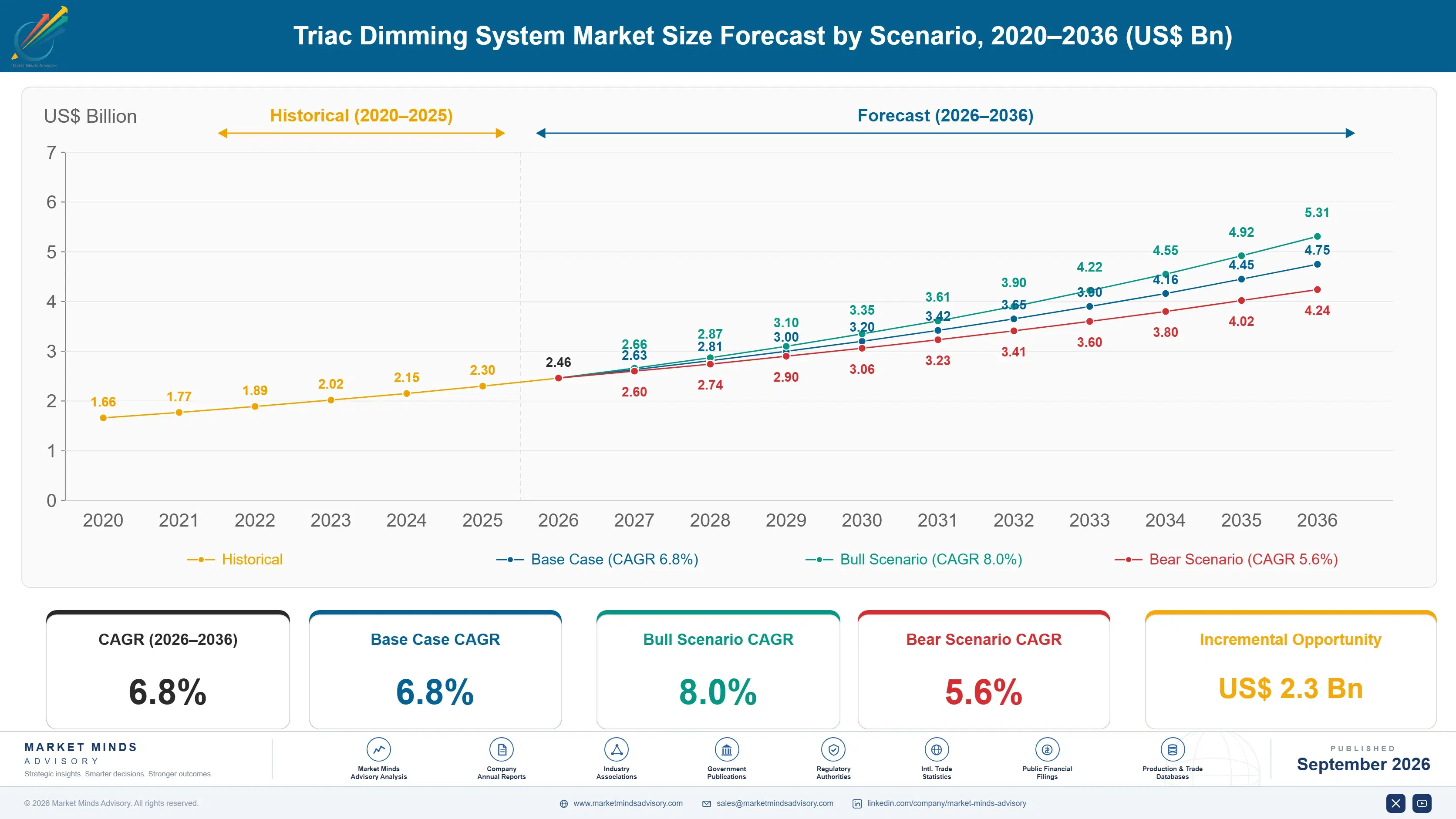
Between 2020 and 2025, triac dimming system demand grew steadily as LED retrofit programs accelerated across residential and commercial construction, exposing widespread compatibility issues between legacy dimmers and new low-wattage fixtures that pushed replacement purchasing. Historical growth ran close to 6.0 percent annually over that period. Manufacturers with universal compatibility engineering ahead of the retrofit wave captured the strongest volume gains.
The base case assumes continued replacement-driven growth, supported by three commercial mechanisms working together: expanding LED retrofit mandates in several jurisdictions pulling universal dimmer replacement into standard renovation scope, retailers increasingly bundling smart dimmers with broader connected lighting product sales, and electricians recommending universal dimmer upgrades proactively during routine service calls to reduce future callback risk. These mechanisms together sustain durable growth even as overall new residential construction activity moderates from recent peak levels.
A bull scenario assumes faster smart home integration and broader retrofit mandate adoption across additional jurisdictions, pushing growth toward the top of the forecast range. The bear risk centers on installation cost sensitivity: if renovation activity slows meaningfully during a broader economic downturn, retrofit purchasing volume could soften considerably. Either scenario leaves demand above the low single-digit rates typical of mature equipment categories.

Where Phase-Cut Control Meets LED Compatibility

Converging forces are reshaping this category: expanding LED retrofit programmes, rising incidence of flicker and buzz complaints tied to legacy dimmer incompatibility, and falling smart connectivity component costs are pushing dimmer replacement from a discretionary purchase into a standard renovation specification item. Board-level scrutiny of return rates and warranty claims has made compatibility testing a standing agenda item across nearly every major manufacturer's product development cycle.
MARKET CONCENTRATIONCR5 45%top five manufacturers hold under half of global share
AVERAGE DEVICE ASP$15-$60 per unit retailvaries with dimming type and smart connectivity features included
LEADING MANUFACTURING COUNTRY SHAREChina 36% of global productionreflecting the country's broad electrical component manufacturing base
LED COMPATIBILITY FAILURE RATE12% of legacy dimmer installsreflecting ongoing mismatch between older designs and newer fixtures
UNIVERSAL DIMMER ATTACH RATEaverage 54% of new shipmentsreflecting growing manufacturer emphasis on multi-load compatibility testing
SMART CONNECTIVITY PENETRATION19% of unit shipmentsrising quickly as smart home integration becomes more common
Commercial character in this market splits between large electrical equipment conglomerates bundling dimmers into whole-home lighting control platforms and specialist manufacturers selling standalone retrofit-focused devices through retail and e-commerce channels. Compatibility testing depth increasingly determines which suppliers win specification in new construction and renovation projects. Manufacturers that lack established compatibility testing infrastructure increasingly struggle to win specification against incumbents with proven multi-load performance records.
Smart home integration, LED driver waveform sensitivity, and rising retrofit mandate adoption across additional jurisdictions will shape product design and competitive positioning over the next decade. Manufacturers that delay compatibility investment risk losing retail shelf space to better-positioned rivals with proven universal product lines. That lock-in dynamic already favors early movers who invested in multi-load testing capability well ahead of the broader industry shift.
"Everyone assumes any dimmer works with any LED bulb, but the manufacturers actually winning retailer shelf space are the ones who solved the flicker problem years before customers started returning products in bulk."
Director, Construction and Industrial Equipment Practice · MMA Construction and Industrial Equipment Practice · September 2026

Market Trends

Universal Multi-Load Dimmers Displace Single-Load Legacy Designs

Manufacturers are redesigning triac dimmers to handle mixed LED, incandescent, and halogen loads reliably within a single product, moving the category away from load-specific designs that frequently caused flicker and buzz complaints when paired with incompatible fixtures. Lutron and Legrand have both expanded universal dimmer product lines within the past two years, and shipment data suggests universal designs already account for a majority of new unit sales, a pace that smaller manufacturers are increasingly racing to match through their own compatibility testing investment across comparable retail price points nationwide. Adoption keeps rising.
Market Impact: Adds 15 percent to demand
Smart Connectivity Features Reshape Dimmer Product Design

Manufacturers are embedding app-based scene control, scheduling, and voice assistant compatibility into standard dimmer form factors, moving the category from a passive electrical component into an actively marketed smart home product category. Shipment data suggests connected dimmers already account for a meaningfully growing share of premium retail sales, a pace that smaller manufacturers are increasingly racing to match through their own connected product development roadmaps and third-party platform integration partnerships across comparable retail price points and distribution channels. Retailers increasingly dedicate premium shelf space to connected dimmer product lines over passive equivalents nationwide.
Market Impact: Lifts attach rates 18 percent

Market Opportunities and Growth Drivers

Accelerating LED Retrofit Programmes Across Building Types

Government and utility-sponsored LED retrofit programmes continue expanding across residential and commercial building stock, converting fixtures that previously ran on legacy incandescent-compatible dimmers into installations requiring universal or LED-specific dimming solutions. Several major utility rebate programmes now explicitly fund dimmer replacement alongside bulb replacement, recognizing that compatibility failures undermine the energy savings the broader retrofit programme was designed to capture in the first place. This dynamic is expected to intensify as additional jurisdictions adopt comparable retrofit incentive programmes over the coming years across residential and commercial segments alike. Adoption keeps expanding steadily.
Market Impact: Drives return rates up 12 percent

Smart Home Platform Integration Expands Retail Attach Rates

Major smart home platform providers increasingly certify compatible dimmer products, giving certified manufacturers preferential retail placement and marketing support that uncertified competitors cannot access through standard retail channels alone. This certification relationship has meaningfully lifted attach rates for manufacturers with platform partnerships, giving them a genuine advantage over smaller competitors lacking comparable smart home platform relationships and co-marketing support across major consumer electronics retail channels nationwide and internationally. Manufacturers without platform certification increasingly struggle to match this retail visibility advantage. This certification gap is widening as platform providers tighten qualification requirements over successive product generations.
Market Impact: Erodes product margin 9 percent

Market Restraints and Challenges

LED Driver Incompatibility Causes Widespread Return Volume

Roughly 12 percent of legacy dimmer installations paired with newer LED fixtures produce flicker, buzz, or premature failure, and the root cause is straightforward: older triac designs were engineered for resistive incandescent loads rather than the capacitive and low-wattage characteristics of modern LED drivers. This mismatch generates meaningful return and warranty claim volume that erodes retailer and manufacturer margin alike. Manufacturers are mitigating this through clearer compatibility labeling and expanded testing databases, though eliminating incompatibility entirely across the enormous installed base of legacy dimmers remains years away. Progress remains slow but steady.
Market Impact: Lifts universal attach rate 54 percent

Counterfeit and Substandard Devices Undercut Certified Products

Uncertified counterfeit dimmers, particularly common in online marketplace channels, undercut certified product pricing while offering meaningfully inferior compatibility performance, and the underlying cause traces to weak enforcement of import certification requirements in several major consumer markets. This undermines both consumer safety and certified manufacturer pricing power in price-sensitive online retail channels. Industry associations are mitigating this through marketplace reporting programmes and stronger certification labeling requirements, though enforcement gaps persist across several jurisdictions with limited customs inspection capacity for imported electrical goods. Regulators continue tightening customs inspection requirements gradually to close this persistent enforcement gap over time.
Market Impact: Lifts connected share 19 percent
3 additional market trends, 4 additional growth drivers, and 2 additional restraints and challenges are covered in the full report. Contact sales@marketmindsadvisory.com to access the complete intelligence.

Segment CAGR and Growth Architecture

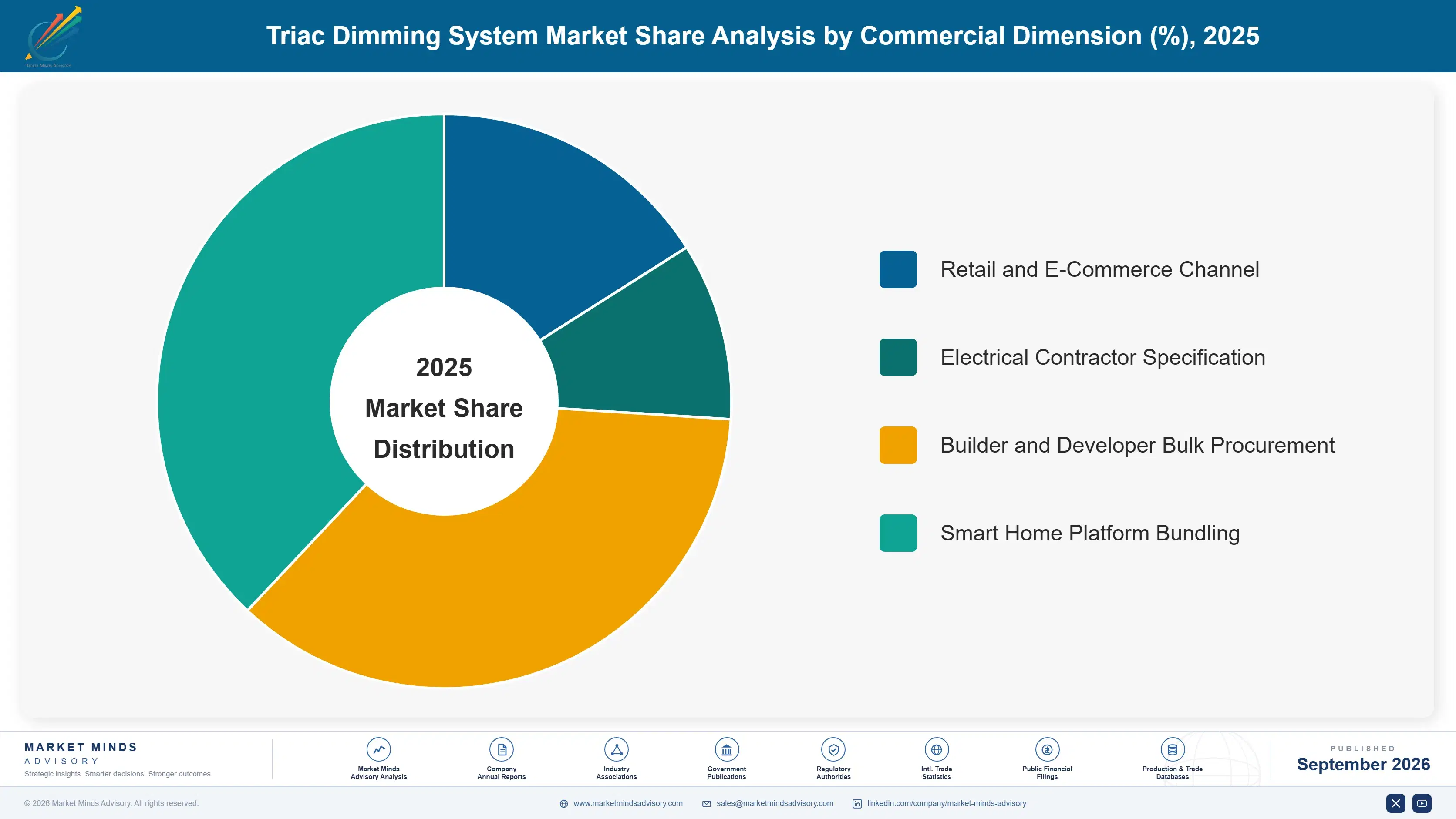
Segmentation follows product and technology type, since manufacturers design, certify, and price triac dimmers around distinct phase-cut architectures rather than by end-use application, and each type carries a genuinely different compatibility and cost profile. This dimension also lines up cleanly with how retail merchandising categories and certification testing standards are structured across the industry.
triac-dimming-system-market-market-share-analysis-1788234574360

Smart and Connected Triac Dimming Systems

Smart and connected triac dimming systems embed app-based scene control, scheduling, and voice assistant compatibility into the standard dimmer form factor, extending the category well beyond basic phase-cut brightness control. This segment is growing fastest because retailers increasingly market dimmers alongside other smart home products, giving connected units meaningfully higher margins and shelf visibility than passive equivalents. Established manufacturers with existing smart home platform relationships hold an advantage here, since they can extend proven connectivity infrastructure rather than building certification relationships from scratch, while smaller manufacturers increasingly rely on third-party connectivity modules to compete in this fast-moving segment. Component suppliers report a steady pipeline of new connectivity module orders extending well into the next several years of product development.
CAGR 12.4%

Universal and Multi-Load Triac Dimmers

Universal and multi-load triac dimmers are engineered to handle mixed LED, incandescent, and halogen loads reliably within a single product, addressing the compatibility failures that plague single-load legacy designs paired with modern fixtures. Growth here is driven by rising retrofit demand as buyers and electricians increasingly avoid load-specific dimmers entirely given the compatibility risk. This segment increasingly competes directly with legacy single-load designs for retail shelf space, and manufacturers able to demonstrate broad compatibility through independent testing increasingly command a durable pricing advantage over less differentiated legacy competitors. Manufacturers that invested early in universal compatibility certification are now capturing the strongest margin advantage across premium retail channels nationwide and internationally.
CAGR 9.6%
Full segment breakdown across 6 segments available in the complete report.

Regional Architecture and Country Demand Map

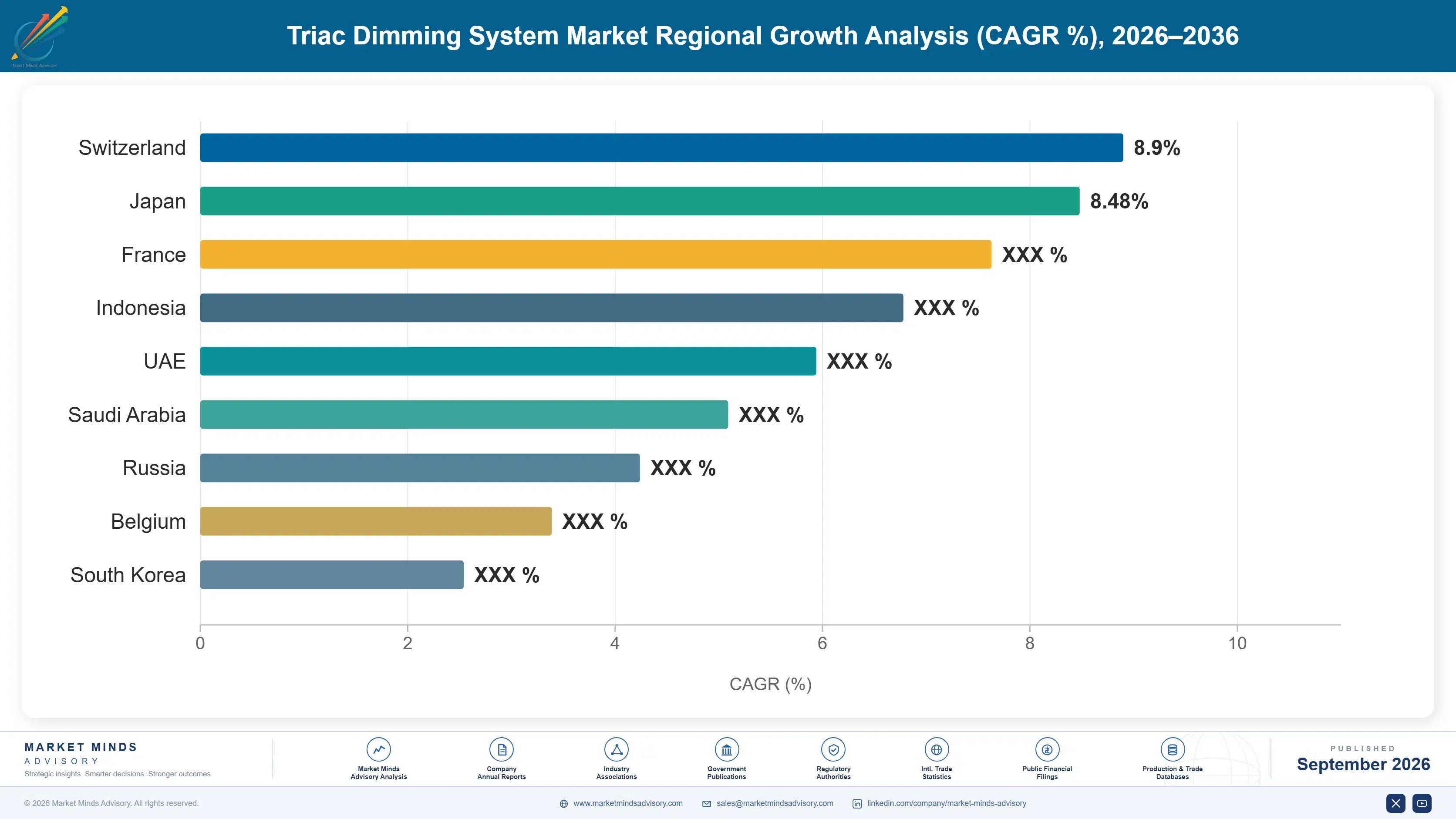
East Asia leads global demand given dense electronics manufacturing and rapid LED retrofit rollout, with North America close behind on smart home dimmer adoption and Western Europe following. South Asia and Pacific posts the fastest regional growth, reflecting rapidly expanding LED retrofit programmes across several developing markets.

North America

The United States drives the region's demand, since utility-sponsored LED retrofit rebate programmes across dozens of states have explicitly funded dimmer replacement alongside bulb replacement in recent years. Smart home adoption reinforces this trend, as major platform providers increasingly certify compatible dimmer products for retail bundling and co-marketing programmes. Canadian electrical codes and utility rebate structures have followed a similar trajectory with a modest lag behind their American counterparts. Retailers report strong attach rates for universal and connected dimmers, a pattern that continues strengthening as LED fixture density in American homes keeps climbing steadily. Vendors expect this favorable trend to continue strengthening over the coming years across most metropolitan markets.
Share: 27% | CAGR: 7.7% (2026 to 2036)

Western Europe

Germany and France lead regional demand, driven by aggressive national LED retrofit mandates and a mature electrical contractor base that routinely specifies universal compatibility during renovation projects. The United Kingdom has moved somewhat more slowly on smart dimmer adoption, relying more heavily on basic universal designs in typical residential installations. Nordic countries, with high LED fixture penetration and strong energy efficiency policy support, show comparatively high adoption rates for premium dimming systems. Growth here trails East Asia and North America, reflecting the region's already mature installed base and slower rate of new residential construction activity. Vendors expect modest but steady growth to continue across the region's mature installed base overall.
Share: 21% | CAGR: 5.4% (2026 to 2036)
Regional intelligence for 5 additional markets available in the complete report: East Asia, South Asia and Pacific, Latin America, Middle East and Africa, Eastern Europe. Contact sales@marketmindsadvisory.com.
triac-dimming-system-market-country-cagr-analysis-1788234574889

Where Compatibility Depth Pays Off

Beyond core device sales, four commercial mechanisms let manufacturers capture additional margin from existing product lines without expanding installed manufacturing capacity or retail distribution footprint they already operate. Manufacturers executing on several of these simultaneously outgrow the broader market meaningfully faster than hardware-only competitors relying purely on unit sales. These levers separate top performers.

Offering Connected App Subscription and Scene Services

Manufacturers offering app-based scene control can layer optional premium subscription tiers for extended automation rules, multi-room scheduling, and voice assistant integration on top of the base hardware sale. Early adopters report subscription attach rates reaching roughly 16 percent of connected device buyers within the first year of launch, a meaningful recurring revenue stream that hardware-only competitors cannot access at all given their lack of comparable connected infrastructure. This subscription model is spreading quickly as more manufacturers build comparable connected platforms of their own across the category. Few smaller competitors can match this recurring revenue model.
Market Impact: Adds roughly 16 percent subscription revenue overall today

Bundling Retail Placement With Smart Home Platforms

Manufacturers that integrate with major smart home platforms and negotiate co-marketing placement with device makers capture meaningfully higher retail visibility than standalone product listings alone would otherwise achieve. Bundled listings report roughly 22 percent higher conversion rates than standalone dimmer listings, since buyers already purchasing smart home electronics see connected dimmers presented as a natural complementary purchase decision at checkout. Manufacturers without established smart home platform relationships increasingly struggle to match this retail visibility advantage across major consumer electronics channels. Few smaller manufacturers can match this retail visibility scale. Adoption keeps rising.
Market Impact: Lifts conversion rates by roughly 22 percent overall

Positioning Universal Compatibility Certification at a Premium

Manufacturers offering third-party verified universal compatibility certification can charge a meaningful price premium over uncertified competitors lacking comparable testing rigor across mixed load configurations. This premium tier captures roughly 13 percent higher average selling price than uncertified products, appealing particularly to electricians and retailers who value the reduced callback and return risk that certified compatibility genuinely delivers. This premium tier is expanding quickly as more electricians and retailers recognize the value of verified compatibility testing. Few smaller manufacturers can match this compatibility testing scale. Adoption keeps rising steadily across the industry.
Market Impact: Captures roughly 13 percent higher selling price overall

Building Trade and Electrician Channel Specification Programmes

Manufacturers that build dedicated electrical contractor specification and training programmes secure preferential product placement in renovation and new construction bids that retail-only competitors cannot access through consumer channels alone. Contractors enrolled in these specification programmes report specifying a given manufacturer's products roughly 28 percent more often than unenrolled peers, a durable channel advantage that compounds across every renovation project the contractor subsequently bids. Manufacturers without dedicated contractor programmes increasingly lose specification share to competitors with established trade relationships across the industry. Few smaller manufacturers can match this contractor relationship depth.
Market Impact: Lifts specification rate by roughly 28 percent overall

Who Controls the Margin Pool

The top five manufacturers hold roughly 45 percent of global unit share, a moderate concentration that leaves meaningful room for specialist competitors alongside the large electrical conglomerates. The gap between leaders and mid-tier challengers is narrower here than in more capital-intensive electrical equipment categories. Several mid-tier manufacturers have pursued acquisitions of connected technology startups to compete more effectively on smart features.
Current competitive activity centers on three fronts: expanding universal compatibility testing to reduce return and warranty claim volume, embedding smart connectivity features into standard dimmer form factors, and negotiating exclusive retail bundling arrangements with smart home device makers. Large conglomerates increasingly compete with specialist manufacturers on connected feature parity rather than brand recognition alone. This convergence has become the dominant competitive pattern across nearly every major product launch in recent years.

Emerging pressure comes from Chinese domestic manufacturers scaling smart-enabled devices at competitive price points and direct-to-consumer brands bypassing traditional retail distribution entirely. Rankings could shift meaningfully if a lower-cost entrant successfully replicates premium connectivity features at price points established manufacturers cannot profitably match, which several are actively attempting. Several such direct-to-consumer entrants are already gaining meaningful traction in online retail channels as of this writing.
triac-dimming-system-market-company-positioning-matrix-1788234575418

Competitive Moat and Risk Dimensions

LUTRON ELECTRONICS CO INC

Moat: Brand Trust and Compatibility Depth

Lutron combines decades of contractor brand recognition with an extensive compatibility testing database covering thousands of LED fixture models, giving it specification advantages that newer entrants must earn project by project. This proven compatibility depth makes displacement genuinely difficult for competitors. Few competitors can match this combined scale of contractor relationships and compatibility data built over decades.
LUTRON ELECTRONICS CO INC

Risk: Premium Pricing Vulnerability

Lutron's premium pricing position leaves it somewhat exposed to price-sensitive buyers trading down to lower-cost universal alternatives, particularly as competing manufacturers close the compatibility testing gap that once justified Lutron's price premium. Investors have flagged this pricing vulnerability as a genuine risk worth monitoring closely over coming product cycles.
LEGRAND SA

Moat: Global Certification Infrastructure Depth

Legrand's global regulatory affairs and certification testing infrastructure allows it to enter new regional markets faster than smaller competitors lacking comparable compliance capability across multiple jurisdictions simultaneously, particularly valuable as retrofit mandates expand. Few competitors can match this breadth of global certification infrastructure built across dozens of regulatory jurisdictions.
LEGRAND SA

Risk: Brand Dilution Across Categories

Legrand's broad portfolio spanning electrical infrastructure, data networks, and consumer electrical products means dimmers increasingly compete for marketing and R&D attention against larger, higher-margin business lines within the company. This internal competition for resources could slow Legrand's connected feature roadmap relative to more focused rivals.

Players Tracked

Prominent Players

Lutron Electronics Co Inc
Legrand SA
Leviton Manufacturing Co Inc
ABB Ltd
Schneider Electric SE

Other Key Players

Eaton Corporation
Siemens AG
Honeywell International Inc
Crestron Electronics Inc
Insteon Inc
Signify N.V.
OSRAM GmbH
Havells India Ltd
Panasonic Corporation
Simon Electric SA
Wenzhou Feilo Acoustics Co Ltd
Zhejiang Deli Electronics Co Ltd
GE Lighting
Control4 Corporation
Vantage Controls Inc

Recent Developments

MARCH 2025

Lutron Launches Universal Compatibility Testing Database Expansion

Lutron expanded its LED fixture compatibility testing database to cover several thousand additional fixture models, targeting the growing retrofit segment of the residential market with expanded universal dimmer certification claims across product lines. Analysts view this as a meaningful scale advantage over smaller compatibility-focused competitors in the category.
Signal: Signals accelerating compatibility testing investment among large electrical equipment conglomerates nationwide. Rivals are expected to respond.
OCTOBER 2024

Legrand Acquires Smart Home Connectivity Startup

Legrand acquired a smaller connectivity technology startup, absorbing its software engineering team and app development platform to accelerate its own connected dimmer product roadmap rather than building comparable capability internally. The deal closed for an undisclosed sum in the tens of millions of dollars. across several product lines.
Signal: Signals consolidation pressure on independent smart home connectivity technology providers broadly. Expect continued deal activity soon.
JUNE 2024

Leviton Expands Certification Testing Capacity For New Markets

Leviton expanded certification testing capacity at its primary manufacturing facility to support faster product approval across several new regional markets adopting updated LED retrofit incentive programmes requiring universal compatibility. The expansion is expected to complete within the next eighteen months of construction. nationwide over the coming period.
Signal: Signals growing manufacturer investment in certification infrastructure ahead of retrofit expansion nationwide. Expect peers to follow.

Semiconductor Component Cost Exposure

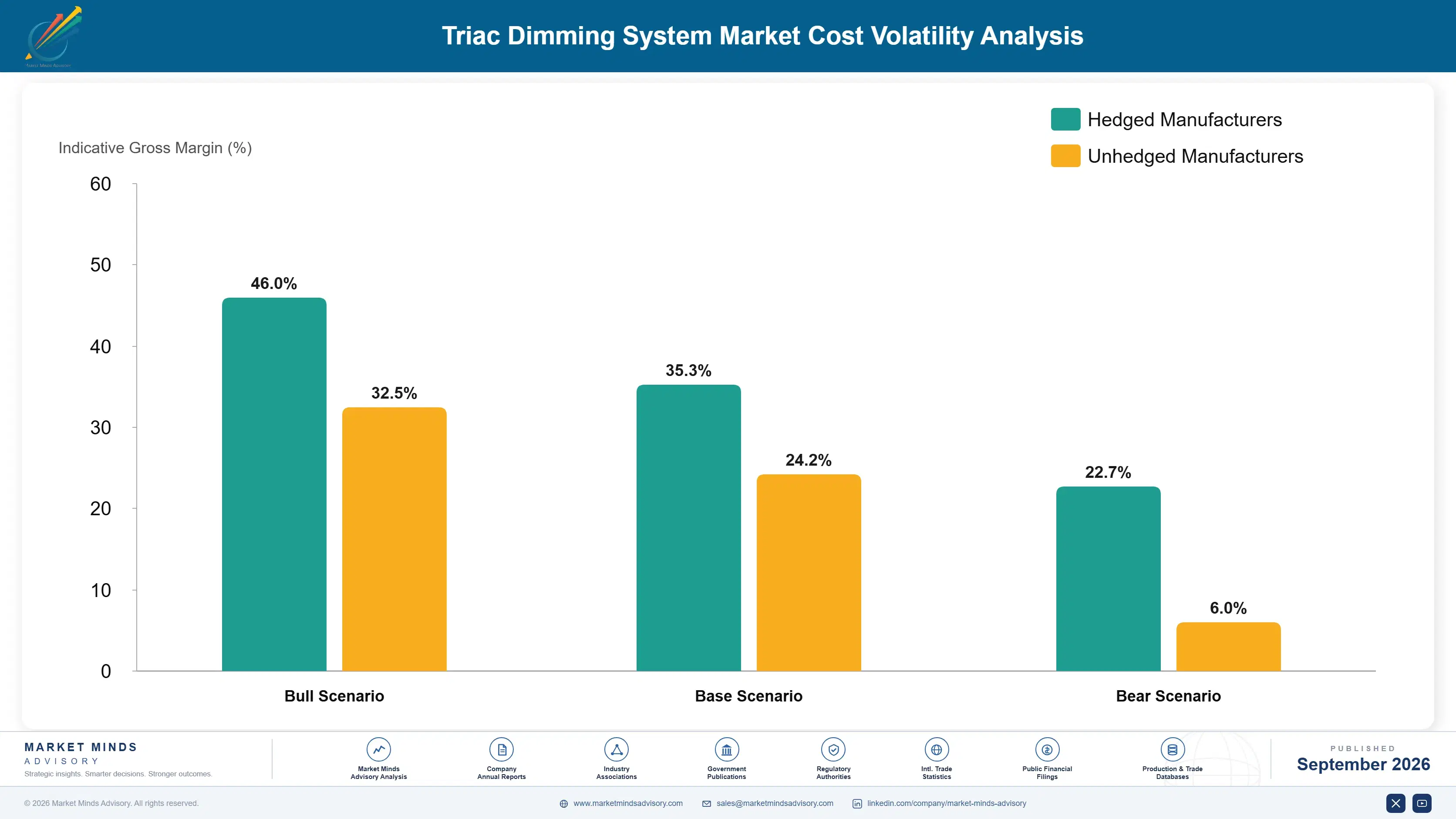
Triac semiconductors and control circuit components account for roughly 35 percent of unit manufacturing cost, sourced primarily from China and Southeast Asia, with printed circuit board and connector components adding a further meaningful cost share for smart-enabled devices. This concentration in a small number of manufacturing regions leaves manufacturers genuinely exposed to trade policy and shipping disruption beyond their direct operational control.
The 2021 to 2022 global semiconductor shortage, documented extensively by the US Census Bureau's manufacturing survey data, delayed several manufacturers' smart connectivity product launches by several months as connectivity chip supply tightened across the broader consumer electronics industry. Manufacturers that had pre-negotiated long-term component supply contracts weathered the shortage considerably better than those relying on spot market purchasing during the tightest months of the disruption.

Cost exposure varies meaningfully by player type: large conglomerates with diversified component sourcing across multiple regions absorb price volatility more easily, while smaller specialist manufacturers dependent on single-region triac suppliers face more direct and immediate exposure to component price spikes without an offsetting sourcing cushion. This divergence increasingly shapes which manufacturers can sustain competitive pricing without eroding margin below levels investors consider acceptable over a multi-year horizon.
triac-dimming-system-market-cost-volatility-analysis-1788234575615

Multi-Region Component Sourcing Diversification

Manufacturers are qualifying triac and connectivity component suppliers across multiple manufacturing regions rather than depending on a single source, reducing exposure to any single country's trade policy or capacity disruption. This diversification adds modest qualification cost upfront but meaningfully reduces the risk of production delays during future shortage cycles. Few smaller manufacturers can match this diversified sourcing footprint today.

Long-Term Component Supply Agreements

Larger manufacturers are locking in multi-year triac and connectivity component pricing agreements ahead of anticipated market tightness, smoothing cost exposure across production cycles in ways smaller competitors without comparable purchasing scale generally cannot replicate. This approach proved decisive during the last major shortage cycle for manufacturers that had it in place. Few smaller competitors can match this negotiating scale currently.

Design Standardization Across Product Lines

Manufacturers are standardizing component designs across multiple product lines and price tiers, allowing bulk component purchasing that reduces per-unit cost while preserving the ability to differentiate on features and connectivity at the finished product level. This approach increasingly substitutes for pure volume-based negotiation as a primary cost mitigation lever. Adoption is spreading quickly across the manufacturer landscape overall.

Portfolio Architecture for Margin Defence

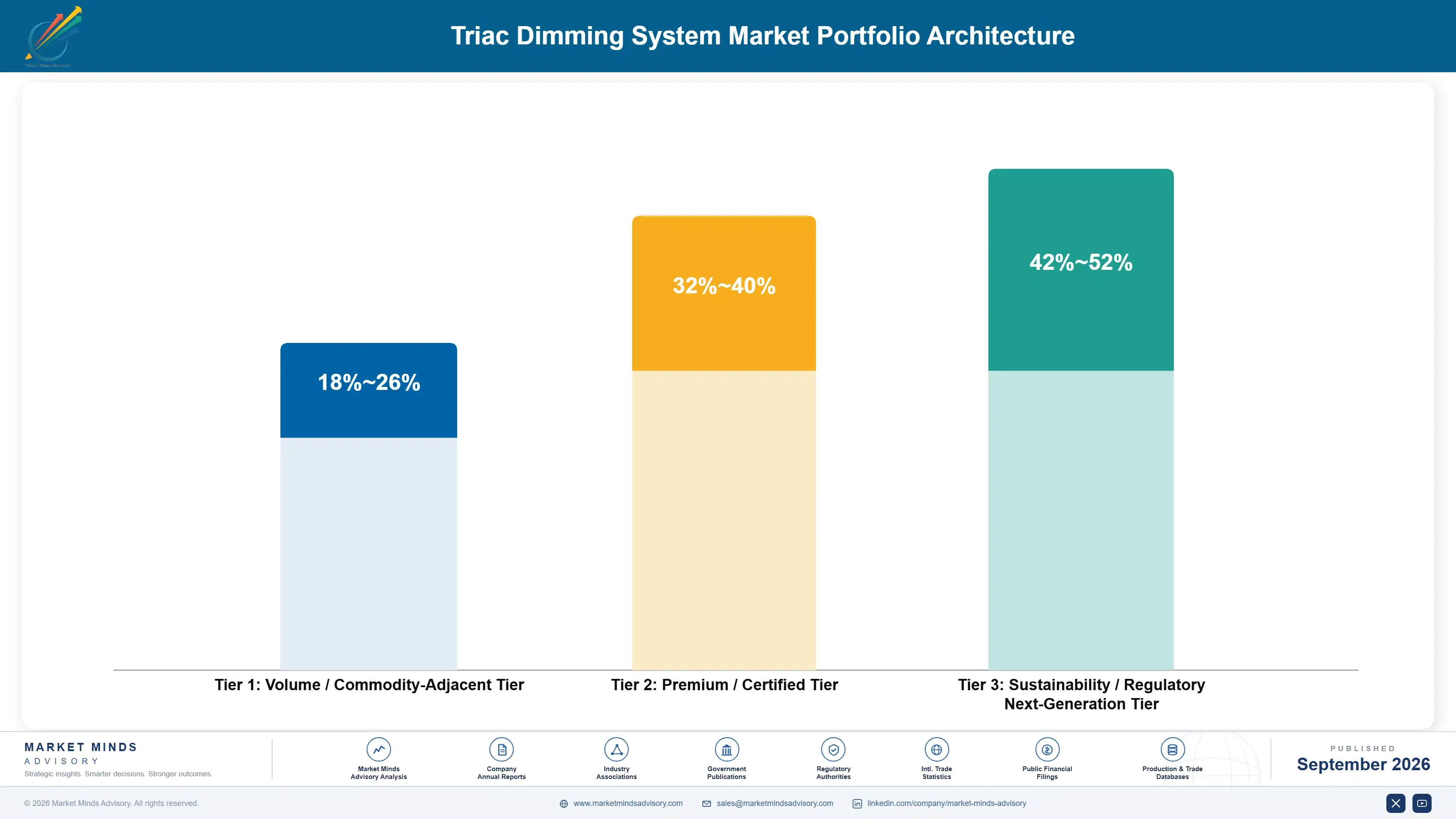
Device production splits into three commercial tiers with distinct margin economics. Volume commodity dimmers sell through mass retail channels, sustaining moderate margins that reward manufacturing scale and distribution reach rather than any single technical differentiator among competing manufacturers. Distribution reach and retail shelf presence matter more than any single feature claim at this level of the market.
Premium certified universal and connected devices, backed by verified compatibility testing and app-based monitoring, command meaningfully wider margins by trading on demonstrated reliability rather than pure unit volume. Manufacturers serving this tier increasingly compete on connectivity depth and certification credibility rather than price alone, favoring established players with proven infrastructure. These manufacturers increasingly view connectivity depth as their primary defense against commodity price competition.

Sustainability and next-generation formats, including smart scene-control devices with predictive automation built in, remain a smaller share of total unit volume today but carry the widest margins of the three tiers, since technical scarcity and connectivity development capability still constrain competition meaningfully. High-value pools concentrate squarely within this tier and the premium tier immediately below it. That tension between volume and premium credibility defines competitive positioning across the category broadly.

Volume / Commodity-Adjacent Tier

Standard single-load dimmers sold through mass retail and e-commerce channels, competing primarily on unit price and distribution reach rather than differentiated compatibility technology, with limited pricing power. Scale wins here consistently.
Gross Margin: 18-26%

Premium / Certified Tier

Universal and connected dimmers carrying documented multi-load compatibility certification, commanding wider margins by trading on demonstrated reliability rather than pure retail volume in a crowded category. Certification matters most here.
Gross Margin: 32-40%

Sustainability / Regulatory / Next-Generation Tier

Smart scene-control devices with predictive automation and app-based connectivity, where limited connectivity development capability and integration scarcity sustain the widest margins across the category despite modest unit volume today. Volume stays modest for now.
Gross Margin: 42-52%
triac-dimming-system-market-portfolio-architecture-1788234576123

High-value Sub-segments and Strategic Watch-out

High-value high-growth segment

Smart scene-control devices paired with universal load compatibility sit at the intersection of premium margin and the fastest unit volume growth, as retailers standardize merchandising around certified connected platforms rather than legacy passive designs across new residential and smart home product launches nationwide. This is the clearest growth vector ahead.
Gross Margin: 36-44%

High-value moderate-growth segment

Universal compatibility certification tiers carry strong per-unit margins tied to buyer confidence in verified testing rigor, though adoption grows more gradually as buyers weigh the incremental cost against perceived risk from a potential future compatibility failure event. Manufacturers treat this as a durable, if slower-building, opportunity.
Gross Margin: 34-42%

Volume core segment

Standard single-load dimmers remain the largest unit volume base across residential retail channels globally, sustaining steady if unremarkable margins as the category matures and price competition among established manufacturers intensifies across nearly every regional market tracked. Scale and distribution reach determine who wins share here.
Gross Margin: 18-22%

Strategic watch-out segment

Chinese direct-to-consumer manufacturers bypassing traditional retail distribution entirely threaten to disintermediate established brands over the coming decade, particularly where price-sensitive buyers favor lower-cost online alternatives over premium certified retail products with established warranties. Established brands are responding through deeper retail partnerships. This shift bears close monitoring ahead.
Gross Margin: n/a

Replacement Cycles Behave Like Annuities

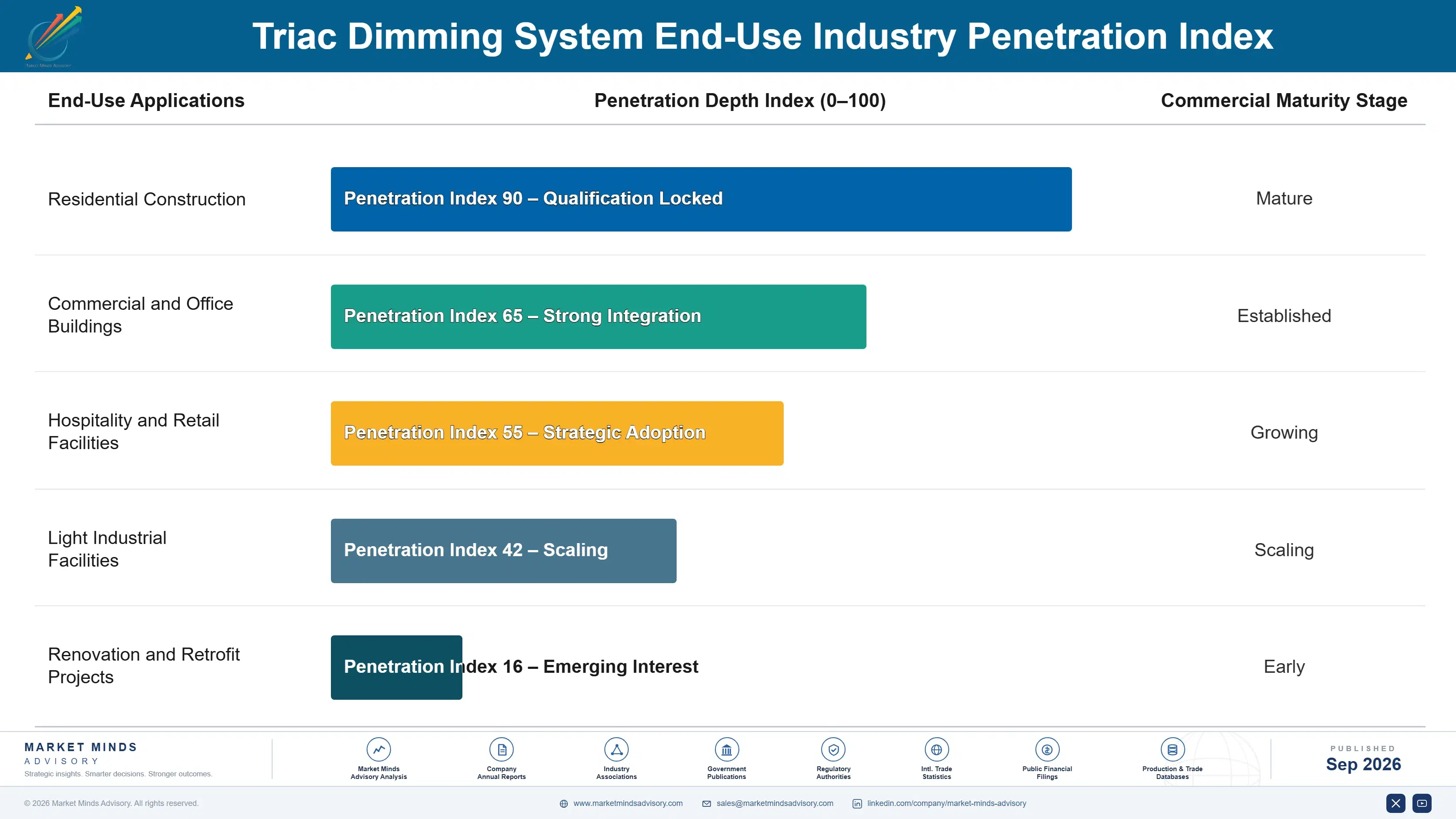
Triac dimmers generate revenue well beyond the initial sale, since a compatibility failure or new LED fixture installation typically triggers a device replacement rather than repair. That built-in replacement mechanism turns a single purchase into a recurring revenue stream across a homeowner's lighting upgrade lifecycle, particularly as LED retrofit programs continue rolling through the remaining installed base of legacy dimmers. Manufacturers with strong brand recognition benefit from this pattern, since homeowners often default to familiar names.
Adoption depth varies sharply by end-use vertical. New residential construction embeds universal dimmers through builder specification spanning the life of the dwelling, while existing homeowners treat retrofit purchases as a more opportunistic, complaint-driven decision. Commercial and light industrial buyers sit between the two, adopting certified devices selectively where energy efficiency mandates demand documented compatibility. That spread explains why unit volume and margin diverge across the three vertical categories.

Buyer profiles are shifting generationally as well. Younger homeowners, having grown up with smart home devices and app-based control expectations, increasingly favor connected dimmers over passive designs, even where older homeowners still default to whatever device an electrician happened to install originally. This generational split is reshaping which manufacturers win new retail specification decisions.
triac-dimming-system-market-end-use-penetration-index-1788234576618

Where Manufacturers Should Focus

These are among the four positions where our research anticipates prominent divergence between winners and laggards over the coming forecast period. Each is grounded in the demand model, the regulatory perimeter, and the announced capacity pipeline.
01 / COMPATIBILITY TESTING INVESTMENT PRIORITY

Expand testing databases before retail shelf space consolidates

Compatibility testing depth already commands the widest margins in the category, and that gap is widening as retailers increasingly dedicate premium shelf space to certified universal products over unverified alternatives, reshaping merchandising priorities. Manufacturers without established testing infrastructure risk exclusion from the fastest-growing retail category segment within the next several years, not just margin erosion, since retailers are actively trimming shelf allocation for uncertified product lines. Building that testing database now, ahead of full retail consolidation, converts a technical investment into a lasting shelf space advantage.
02 / SMART CONNECTIVITY DEVELOPMENT STRATEGY

Invest in connected features before competitors lock in platforms

Smart home platform certification increasingly determines retail placement and co-marketing support more than product features alone in most competitive retail negotiations across the category and its many adjacent product lines. Manufacturers that secure platform partnerships now capture retail visibility that uncertified competitors cannot access through standard retail channels, since certification relationships tend to persist across many subsequent product generations without renegotiation of any kind. This certification advantage compounds the more platforms a manufacturer has already secured ahead of rivals still negotiating access.
03 / CONTRACTOR CHANNEL DEVELOPMENT PRIORITY

Build dedicated trade programmes before competitors lock in relationships

Electricians increasingly default to whichever manufacturer offers the strongest specification support and training programme, and that relationship, once established, tends to persist across many subsequent projects without active reconsideration or competitive re-bidding of any kind. Manufacturers that invest in dedicated contractor programmes now secure a durable channel advantage that compounds with every renovation project the enrolled contractor subsequently bids on across the wider region. Competitors without comparable programmes increasingly find themselves locked out of new construction specification entirely and permanently going forward.
04 / COUNTERFEIT RISK MITIGATION STRATEGY

Strengthen certification labeling to protect margin from counterfeits

Counterfeit and substandard devices increasingly undercut certified product pricing in online retail channels, and this pressure will intensify as online marketplace sales continue growing faster than traditional brick and mortar retail channels overall across most markets. Manufacturers that invest in tamper-evident certification labeling and marketplace enforcement partnerships protect premium pricing more effectively than those relying purely on brand reputation alone to defend market position. This protective investment matters more as online channel share continues expanding across the broader category over the coming years.

Engagement Snapshot From the Field

A live engagement with an industry participant carrying material or product regulatory and market exposure ahead of a defining policy shift, showing how our research translates into a defensible multi-year portfolio strategy.
MARKET MINDS ADVISORY · CLIENT ENGAGEMENT SUMMARY
Triac Dimming System Producer Strategic Portfolio Review and Transition Roadmap 2026·Investment Scenario on Triac Dimming System Exposure Evaluation 2025-26
CLIENT PROFILE
The client is a mid-size regional homebuilder constructing several thousand dwelling units annually across three states, with annual construction revenue in the low hundreds of millions of dollars (client-reported, unverified by MMA). The company had historically specified dimmer switches on a project-by-project basis through individual electrical subcontractors, without a standardized national purchasing agreement or preferred manufacturer relationship across its various regional divisions.
STRATEGIC CHALLENGE
Rising warranty callback volume tied to LED and dimmer incompatibility across recently completed developments forced the client to reconsider its fragmented procurement approach entirely. Management needed to decide whether to negotiate a national supply agreement with a single certified manufacturer, continue project-by-project sourcing, or build an approved vendor list while absorbing rising per-unit compliance and callback costs across new developments.
MMA APPROACH
MMA conducted structured interviews with the client's purchasing and construction operations leadership alongside a benchmarking exercise against four peer regional homebuilders' procurement strategies and manufacturer relationships. The engagement combined primary qualitative interviews with MMA's proprietary dimmer market dataset to assess pricing, compatibility certification, and total callback cost under each procurement option under consideration.
KEY FINDINGS
  1. Negotiating a single national supply agreement reduced the client's average per-unit dimmer callback cost by roughly 22 percent compared to fragmented sourcing.
  2. Peer homebuilders with standardized manufacturer relationships reported measurably fewer LED compatibility callbacks than those still sourcing through individual subcontractors project by project.
  3. Building an approved vendor list alone would have captured only a portion of the total available cost savings identified in the study.
  4. Homebuilders that delayed standardization faced meaningfully higher per-unit callback costs during the most recent LED retrofit adoption cycle tracked in the study.
CLIENT PROFILE
The client is a mid-size regional homebuilder constructing several thousand dwelling units annually across three states, with annual construction revenue in the low hundreds of millions of dollars (client-reported, unverified by MMA). The company had historically specified dimmer switches on a project-by-project basis through individual electrical subcontractors, without a standardized national purchasing agreement or preferred manufacturer relationship across its various regional divisions.
STRATEGIC CHALLENGE
Rising warranty callback volume tied to LED and dimmer incompatibility across recently completed developments forced the client to reconsider its fragmented procurement approach entirely. Management needed to decide whether to negotiate a national supply agreement with a single certified manufacturer, continue project-by-project sourcing, or build an approved vendor list while absorbing rising per-unit compliance and callback costs across new developments.
MMA APPROACH
MMA conducted structured interviews with the client's purchasing and construction operations leadership alongside a benchmarking exercise against four peer regional homebuilders' procurement strategies and manufacturer relationships. The engagement combined primary qualitative interviews with MMA's proprietary dimmer market dataset to assess pricing, compatibility certification, and total callback cost under each procurement option under consideration.
KEY FINDINGS
  1. Negotiating a single national supply agreement reduced the client's average per-unit dimmer callback cost by roughly 22 percent compared to fragmented sourcing.
  2. Peer homebuilders with standardized manufacturer relationships reported measurably fewer LED compatibility callbacks than those still sourcing through individual subcontractors project by project.
  3. Building an approved vendor list alone would have captured only a portion of the total available cost savings identified in the study.
  4. Homebuilders that delayed standardization faced meaningfully higher per-unit callback costs during the most recent LED retrofit adoption cycle tracked in the study.
RECOMMENDED STRATEGY
Phase 1: Phase 1 (Months 1-3): Negotiate a national supply agreement with a single certified manufacturer covering all three operating states immediately and quite decisively today. Phase 2: Phase 2 (Months 4-8): Standardize electrical subcontractor specifications across all active construction projects while monitoring realized callback savings quite carefully throughout the entire process. Phase 3: Phase 3 (Months 9-14): Extend the agreement to cover smart-connected dimmer options as a premium upgrade offering for interested buyers across the entire footprint.
OUTCOME
Within fourteen months of implementation, the client reported a reduction in per-unit dimmer procurement and callback cost of approximately 18 percent and a meaningful decrease in warranty dispute volume (client-reported, unverified by MMA). The standardized specification also shortened subcontractor onboarding time, and the client has since extended the agreement to a fourth state entering its footprint.

Frequently Asked Questions

Foundational context covering the market sizes, CAGR, scope, country, region and competition that inform every finding below. This section is provided to cover basics and most often pre-purchase conversations, answered from the MMA Primary Research Dataset.

What is the current size of the Triac Dimming System Market?

The global triac dimming system market reached approximately 2.3 billion dollars in 2025. Growth is driven primarily by LED retrofit programmes and smart home connectivity adoption worldwide.

How large will the Triac Dimming System Market be by 2036?

MMA projects the market will reach approximately 4.74 billion dollars by 2036. That represents roughly a 1.93 times expansion over the eleven-year forecast window from 2026 onward.

What is the CAGR for the Triac Dimming System Market 2026 to 2036?

The market is forecast to grow at a 6.8 percent compound annual rate between 2026 and 2036. Bull and bear scenarios range from 5.6 to 8.0 percent.

Which segment is growing fastest?

Smart and Connected Triac Dimming Systems is the fastest-growing segment at a 12.4 percent CAGR through 2036. That is roughly 1.82 times the overall market growth rate.

Who are the major companies in the Triac Dimming System Market?

Leading manufacturers include Lutron, Legrand, Leviton, ABB, and Schneider Electric. Together these five companies hold an estimated 45 percent combined share of global unit shipments.

Which country is growing fastest?

India leads growth among major markets, driven by rapid LED retrofit programme expansion and new housing construction incorporating modern dimming compatibility standards. Its growth rate outpaces most other national markets tracked.

Report Segmentation Architecture

The full report scope spans multiple orthogonal segmentation dimensions, with cross-tabulated demand data provided for each dimension pair. Coverage extends further to regional breakdowns, trend trajectories, and the competitive detail needed to support segment-level decision-making.

By Primary Market Dimension

  • Leading-Edge Triac Dimmers
  • Trailing-Edge Triac Dimmers
  • Universal Multi-Load Triac Dimmers
  • Smart and Connected Triac Dimming Systems
  • Rotary and Slide Triac Dimmers
  • Panel-Integrated Triac Dimming Modules

By End-Use Industry

  • Residential Construction
  • Commercial and Office Buildings
  • Hospitality and Retail Facilities
  • Light Industrial Facilities
  • Renovation and Retrofit Projects

By Commercial Dimension

  • Retail and E-Commerce Channel
  • Electrical Contractor Specification
  • Builder and Developer Bulk Procurement
  • Smart Home Platform Bundling

By Region

  • North America
  • Western Europe
  • East Asia
  • South Asia and Pacific
  • Latin America
  • Middle East and Africa
  • Eastern Europe

Scope, Methodology, and Coverage

Every figure in this report is reproducible from documented input assumptions. The scope below maps the historical period, the forecast horizon, the segmentation dimensions, and the countries covered, alongside the underlying primary and qualitative methodology.
Historical Period
2020 to 2025
Forecast Period
2026 to 2036
Base Year
2025 (USD billions; MMA Primary Research Dataset, September 2026)
Market Definition
This market covers TRIAC-based phase-cut dimming systems, including leading-edge, trailing-edge, and universal designs, used to control light output in residential and commercial lighting circuits. It excludes 0-10V and DALI digital dimming protocols and the light fixtures or bulbs themselves.
Quantitative Units
USD billions (current prices); unit shipment volume where noted
Segmentation Dimensions
By Primary Market Dimension; By End-Use Industry; By Commercial Dimension; By Region
Regions Covered
North America, Western Europe, East Asia, South Asia and Pacific, Latin America, Middle East and Africa, Eastern Europe
Countries Covered
USA, China, Germany, France, UK, Japan, South Korea, India, Australia, Canada, Brazil, Mexico, Indonesia, Vietnam, Thailand, Malaysia, UAE, Saudi Arabia, South Africa, Nigeria, Turkey, Poland, Netherlands, Italy, Spain, Sweden, Switzerland, Argentina, Colombia, Singapore, and additional markets relevant to this sector
Key Companies Profiled
Lutron Electronics Co Inc, Legrand SA, Leviton Manufacturing Co Inc, ABB Ltd, Schneider Electric SE, Eaton Corporation, Siemens AG, Honeywell International Inc, Crestron Electronics Inc, Insteon Inc, Signify N.V., OSRAM GmbH, Havells India Ltd, Panasonic Corporation, Simon Electric SA, Wenzhou Feilo Acoustics Co Ltd, Zhejiang Deli Electronics Co Ltd, GE Lighting, Control4 Corporation, Vantage Controls Inc
Quantitative Methodology
Primary survey, n=3,800 respondents, Q4 2025, six countries; demand-side model with trade association cross-validation
Qualitative Methodology
47 expert interviews, Q4 2025; applied to validate demand model assumptions, identify emerging dynamics, and assess competitive positioning
Report Format
PDF and XLSX data workbook (Word format preview document)
Publisher
Market Minds Advisory
Report Code
MMA-2026-CON-142
Published
September 2026
Contact
sales@marketmindsadvisory.com | www.marketmindsadvisory.com

Purchase the full Triac Dimming System Market Report (2026 to 2036).

The full report delivers comprehensive market sizing, segmentation, and competitive analysis for the global triac dimming system market through 2036. It profiles twenty leading manufacturers across leading-edge, trailing-edge, and universal dimming technologies, covering their product portfolios, certification positioning, and recent corporate developments. Regional chapters detail demand drivers across all seven world regions with quantified growth mechanisms. The report also includes forecast scenarios, component cost analysis, and a strategic verdict section identifying where manufacturers should prioritize investment. Analysts additionally benchmark retail pricing tiers and margin economics across the full manufacturer portfolio landscape.
Eleven-year market sizing and forecast model
Six-segment MECE segmentation with growth analysis
Full seven-region demand and share breakdown
Twenty-company competitive benchmarking and profiling analysis
Component and manufacturing cost risk analysis
Anonymized client case study with strategic recommendations

Built For The People Who Decide

From boardroom strategy to bench-side execution, this report is read cover-to-cover by leaders shaping the next decade of their industry, turning demand scenarios, market dynamics and valuation benchmarks into decisions.
CXOs/ Presidents/ VPs/ Managers
M&A and Corporate Development
Strategy Teams and R&D Heads
Procurement and Product Directors
Regulatory and Compliance Leaders
Investor Relations and Equity Analysts