Market Minds Advisory
Western Europe Tennis Equipment Market

Western Europe Tennis Equipment Market: Western Europe Tennis Equipment: String Economics, Padel Court Conversion and Unverifiable Frame Specification

String and grip spend over a racket's life exceeds what the frame cost, the club player restrings 1.4 times a year, and the industry still markets frames. Padel has taken 11% of the courts.

Lead Analyst

Published

September 2026

Make Smarter Decisions with Customized Research Insights

Request a free sample report and evaluate market opportunities, growth trends, and competitive dynamics relevant to your business needs.

2025 MARKET VALUE$1.6BMarket Size 2025
2036 FORECAST VALUE$2.9BBase Case , 2026 to 2036
CAGR 2026 TO 20365.4 %Bull 6.6% / Bear 4.2%
INCREMENTAL OPPORTUNITY$1.2BNet 10- year value creation
EXPANSION MULTIPLE1.71x2036 value over 2026 base
Strategic Levers
M&A Pipeline
Regional Outlook
Country Rankings
Competitive Intelligence
Segmental Deep-dive
Call-Us : 91 93563 13602

Executive Snapshot and Market Trajectory.

The consumable is the string and the industry sells the frame. Over three to five years of ownership, string and grip spend runs about 1.6 times what the racket cost, yet brands build their marketing around a durable and treat the recurring item as an accessory.
Strings grow at 8.1%, half again the market rate of 5.4%, because polyester monofilament loses tension quickly and players who understand that restring far more often. Grips and accessories follow at 7.3%. Rackets grow slowest at 4.2%, held by long replacement intervals and by frames that play well enough that nobody needs a new one. Footwear replaces roughly every nine months and now carries a rising share of category spend in every market covered.
Padel is taking courts rather than players, which is a physical constraint. Roughly 11% of Western European tennis courts have been relaid for another racket sport, because three padel courts fit where one tennis court stood and utilisation runs far higher. Spanish and Italian clubs led; northern markets follow. Frame tolerance near seven grams unstrung means two rackets of one model play differently. Very few players ever measure.
Market Definition
This market covers tennis equipment sold to players across Western Europe, spanning rackets, strings, balls, tennis footwear, grips and accessories, and bags and court equipment. Sizing is at wholesale revenue into Western European channels. Padel and pickleball equipment, tennis apparel other than footwear, court construction and surfacing, ball machines and coaching services, and stadium or facility equipment are excluded from scope.
Base Year Value
$1.6B in 2025 (MMA Primary Research Dataset, September 2026)
Forecast Period
2026 to 2036, eleven discrete annual values
CAGR
5.4% base case. Bull 6.6%. Bear 4.2%.
Fastest Growth Segment
Strings: 8.1% CAGR
Fastest Growth Country
Italy: 8.2% CAGR
Fastest Growth Region
South Asia and Pacific: 7.4% CAGR
Largest Region
East Asia: 58% of 2025 global value
Market Leaders
Amer Sports, Head, Babolat, Yonex, Sumitomo Rubber Industries. Source: MMA Primary Research Dataset, July 2026.
Primary Survey
n=3,800 procurement and R&D decision-makers, Q4 2025, six countries
Methodology
Demand-side build-up, cross-validated against public data, 47 expert interviews

Western Europe Tennis Equipment Market Forecast Scenarios

trends-growth-and-opportunity-analysis-of-tennis-e-size-forecast-scenario-1790022843365
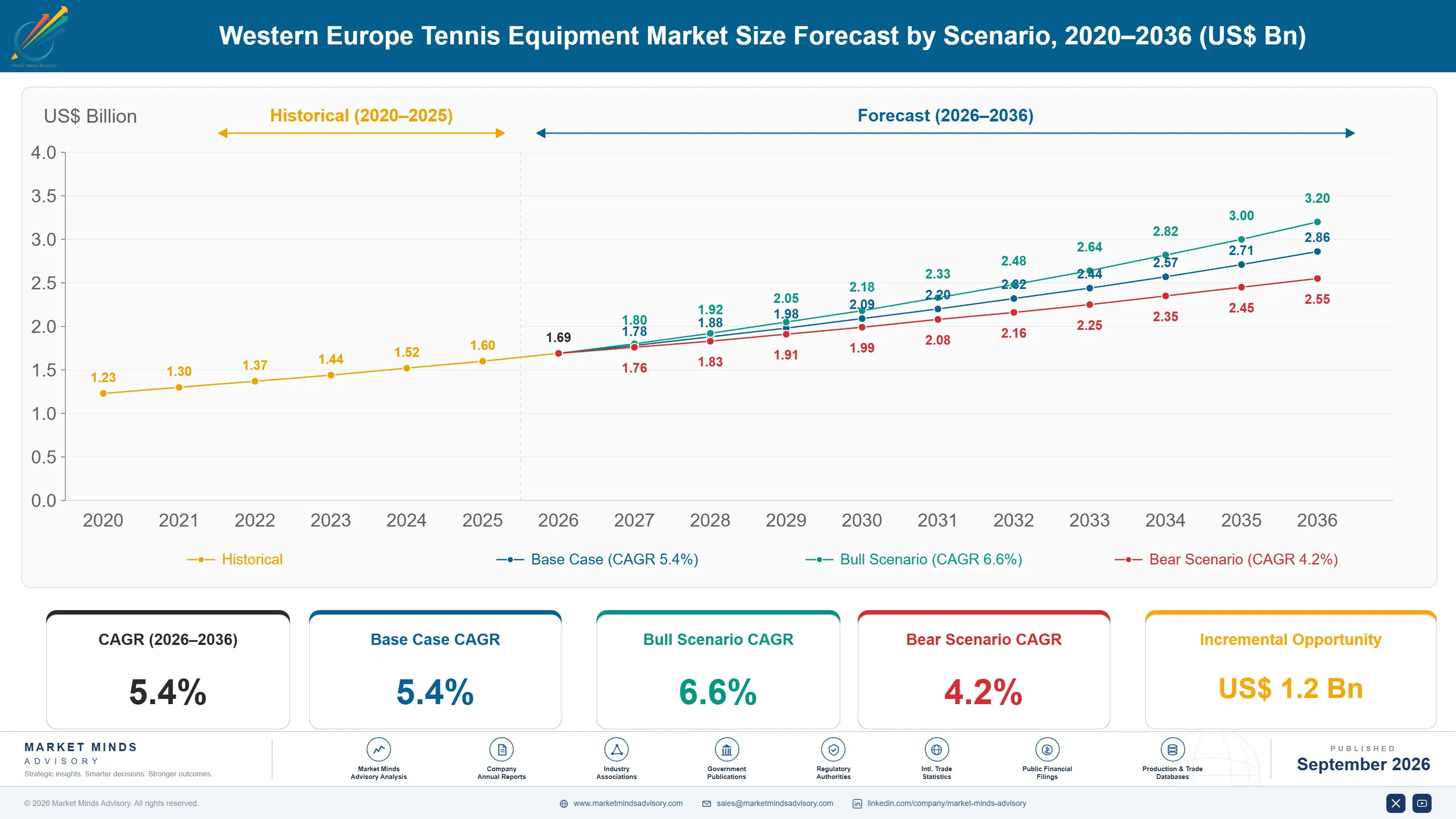
Growth of 4.3% between 2020 and 2025 was produced by two forces that partly cancelled. Tennis gained players through 2020 and 2021 as an outdoor sport permitted when indoor activity was not, and club memberships across the region rose sharply. Against that, padel conversion accelerated in the same period, removing capacity in Spain and Italy faster than courts were built.
Three mechanisms carry the base case forward. Strings grow at 8.1% as restringing discipline improves among club players and as polyester adoption spreads downward from competitive levels. Italian participation continues expanding at 8.2%, the fastest national market covered here, on federation investment and sustained competitive success. Footwear replaces on a far shorter cycle than frames and now carries a growing share of category spend across every market in the region.
The bull case is restringing frequency. A club player currently restrings about 1.4 times a year against a recommended figure several times higher, and closing even part of that gap grows the largest recurring revenue pool without adding a single player. The bear case is court availability. Continued padel conversion removes the capacity tennis participation depends on, and a court that has been relaid does not come back.

Where The Recurring Money Sits

The commercial shape of this category is inverted from how it is marketed. A racket lasts three to five years for a club player, while string and grip spend across that period runs about 1.6 times the frame price. Brands nonetheless build launches, sponsorship and retail theatre around the durable and leave the recurring item to stringers and pro shops.
TOP FIVE CONCENTRATION47%Combined wholesale revenue share held by the five largest participants
ANNUAL RESTRINGS PER PLAYER1.4Restrings a club player completes in a typical year
AVERAGE RACKET PRICEUSD 178Weighted wholesale price across performance and recreational frames
STRING REVENUE MULTIPLE1.6String and grip spend against frame price across ownership
FRAME WEIGHT TOLERANCE7 gramsUnstrung variance common between frames of one model
COURTS CONVERTED TO PADEL11%Share of tennis courts relaid for another racket sport
Restringing behaviour is where the pool is lost. Most recreational players restring only when a string breaks, which means they play most of a season on string that has lost tension and does nothing the frame's marketing claims. Club players average about 1.4 restrings annually against a guideline of as many times per year as they play per week. Nobody in the industry has made that case commercially.
Frame specification is less precise than any published figure suggests. Manufacturing tolerance of roughly seven grams unstrung is common between frames of the same model, so two identical rackets play differently and a player who liked one may dislike the next. Matching services exist for professionals and almost never reach retail. The industry relies on very few players measuring it.
"This industry has built its entire commercial identity around the one item its customers replace least often, and hands the recurring revenue to a stringer in a back room. The frame is the least interesting thing in the bag."
Director, Sporting Goods and Racket Sports Practice · MMA Consumer and Industrial Goods Practice · September 2026

Market Trends

Polyester String Adoption Spreads Below Competitive Levels

Polyester monofilament delivers the spin and control that shaped modern technique, and it has moved steadily downward from professional and national ranking play into ordinary club use. It also loses tension far faster than multifilament or gut, which raises restringing frequency among the players who adopt it. Strings grow at 8.1% against a category rate of 5.4% as a direct result. The commercial consequence is that a technical preference is quietly converting a durable-led category into a consumable-led one, and very few brands have organised their commercial teams around that shift.
Market Impact: Italy grows 2.8 points faster
Padel Conversion Removes Courts Rather Than Only Players

Three padel courts occupy roughly the footprint of one tennis court and generate considerably higher utilisation per square metre, which makes conversion an easy decision for a club treasurer. Around 11% of Western European tennis courts have been relaid, concentrated in Spain and Italy with northern markets following. This is a capacity constraint rather than a preference shift, and a relaid court does not return. Participants holding both tennis and padel ranges are hedged; those with tennis alone are exposed to a facility decision entirely outside their influence. The decision sits with club treasurers reading utilisation figures.
Market Impact: Footwear replaces every 9 months

Market Opportunities and Growth Drivers

Italian Participation Expands On Federation Investment

Italian tennis participation has grown faster than any other Western European market, supported by sustained federation investment in club infrastructure and coaching alongside competitive success that reached genuinely mainstream attention. Italy grows at 8.2%, the fastest national market covered here. Club membership rather than casual play drives most of it, which matters commercially because club players buy through club channels and restring far more often than recreational players do. Italian clubs have also been relatively slower to convert courts than Spanish ones. Club players restring far more often than recreational ones, which makes this growth worth more per participant.
Market Impact: Restringing runs at 1.4 yearly

Footwear Replaces Far More Often Than Frames Do

A tennis shoe lasts a club player roughly nine months on hard court and less on abrasive surfaces, against three to five years for a racket, which makes footwear the second recurring pool after string. Court surface variety across Western Europe complicates it further, since clay, hard and carpet each demand different outsoles and committed players own more than one pair. Footwear grows at 6.2% and now carries a rising share of category spend in every market covered here. Most players nonetheless own one pair and wear it on every surface.
Market Impact: Tolerance reaches 7 grams unstrung

Market Restraints and Challenges

Club Players Restring Only When The String Breaks

Average restringing sits near 1.4 times annually against a long-standing guideline of restringing as many times per year as a player plays per week. The root cause is that tension loss is invisible while breakage is obvious, so players have no cue until the string fails. Commercially this suppresses the largest recurring revenue pool in the category, and it also undermines the frame performance that marketing spend is built around. Participants are trialling tension monitoring and restring reminder programmes through clubs, and almost none have scaled. The frame performance that marketing spend celebrates is undermined by the string nobody manages.
Market Impact: Strings grow 2.7 points faster

Published Frame Specification Does Not Match What Ships

Manufacturing tolerance of around seven grams unstrung is common between frames of the same model, alongside comparable variance in balance and swingweight, so two rackets of one specification play differently. The root cause is composite layup, where hand-laid carbon prepreg introduces variation that mass production absorbs rather than eliminates. Commercially it produces returns, disappointed repeat buyers and a quiet reliance on players not measuring. Matching and customisation services exist for sponsored professionals and rarely reach any retail customer at all. Matching services exist for sponsored professionals and almost never reach retail.
Market Impact: 11% of courts already relaid
3 additional market trends, 4 additional growth drivers, and 2 additional restraints and challenges are covered in the full report. Contact sales@marketmindsadvisory.com to access the complete intelligence.

Segment CAGR and Growth Architecture

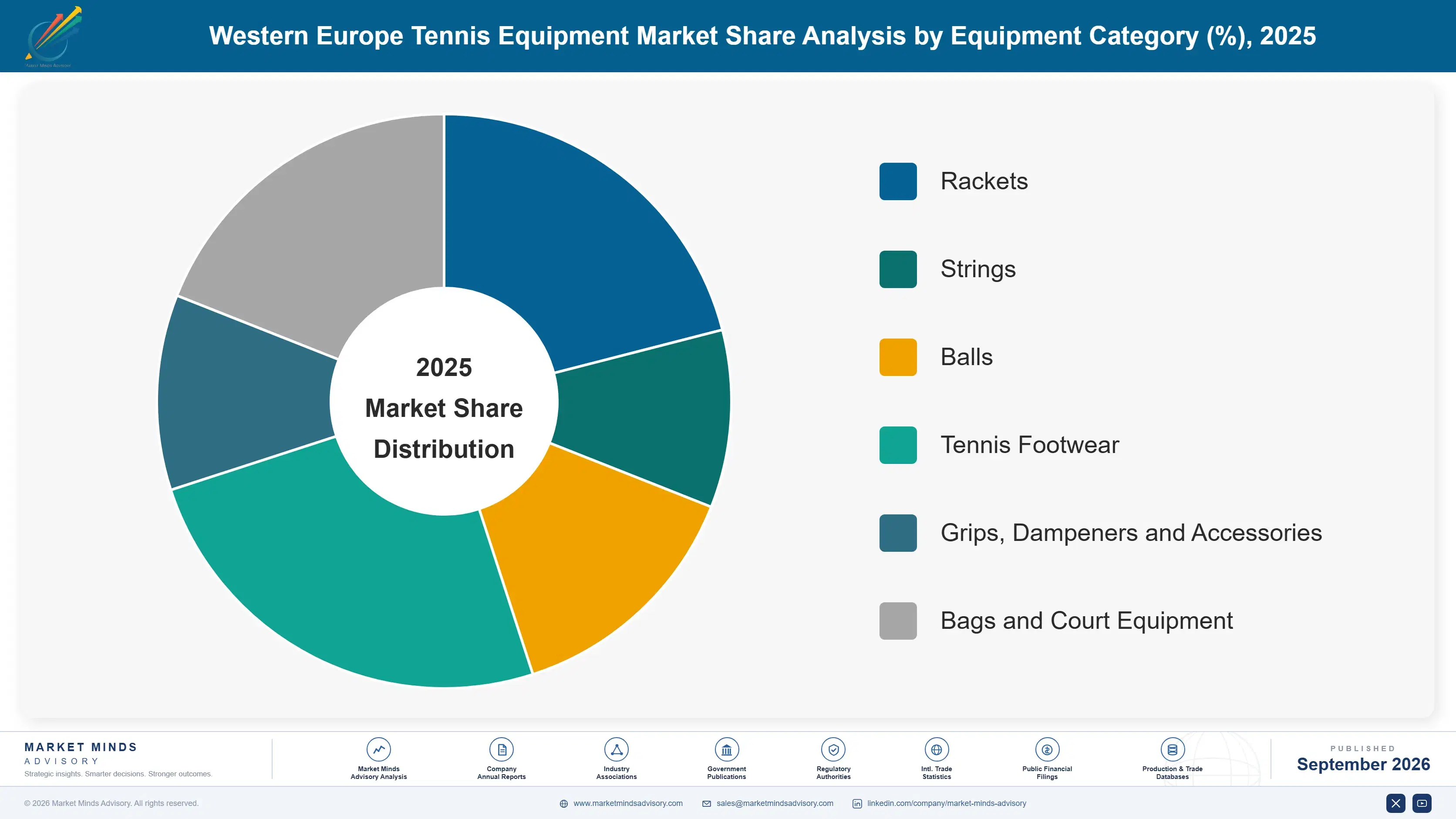
Segmentation follows equipment category, the dimension on which replacement cycle, manufacturing route, margin and channel all divide together in this market. Six categories are assessed at wholesale revenue. Padel and pickleball equipment, apparel other than footwear, court construction, ball machines and coaching services sit outside the defined scope. Both durable and consumable categories are sized together here.
trends-growth-and-opportunity-analysis-of-tennis-e-market-share-analysis-1790022844843

Strings

Strings grow at 8.1%, half again the market rate of 5.4%, and a technical preference rather than any marketing effort is driving it. Polyester monofilament delivers the spin and control that shaped how the modern game is played, and it has spread downward from professional and ranking play into ordinary club use over roughly fifteen years. It also loses tension considerably faster than multifilament or natural gut, which raises restringing frequency among exactly the players who adopt it. That makes the segment the largest recurring revenue pool in the category and the one most brands have organised around least, since string sits with the stringer rather than with the retailer or the brand.
CAGR 8.1%

Grips, Dampeners And Accessories

Grips and accessories grow at 7.3% on short replacement intervals and impulse purchase behaviour that the rest of the category cannot match. An overgrip lasts a committed player a handful of sessions and costs very little, which makes it the most frequently repurchased item in tennis by a wide margin. Margins are also the highest in the category, because the material cost is trivial against the retail price and the purchase happens at the counter without comparison. The commercial weakness is that the products are largely undifferentiated, so brand preference here follows the frame a player already owns rather than any attribute of the grip itself. Brand preference follows the frame a player already owns.
CAGR 7.3%
Full segment breakdown across 6 segments available in the complete report.

Regional Architecture and Country Demand Map

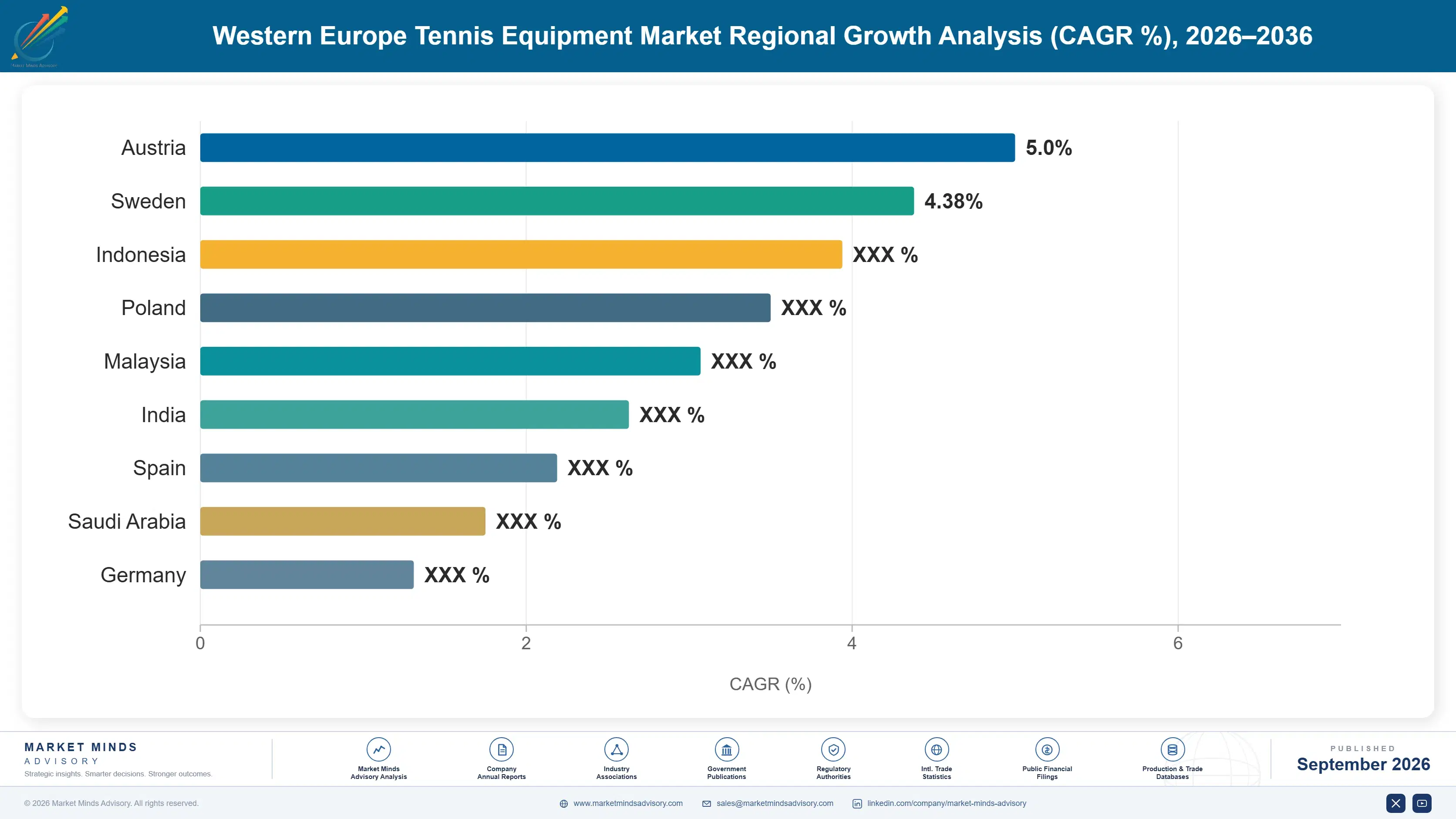
This analysis is scoped to Western European demand, so the regional table records where equipment serving those players is manufactured rather than where it is bought. Six origins consequently sit outside their standard bands. The deviation is flagged for operator ruling, since origin is not demand.

East Asia

East Asian manufacture supplies 58% of equipment reaching Western European players, far outside the standard band, and racket production is the reason. Graphite composite frame layup consolidated into Chinese and Taiwanese factories decades ago, and essentially every brand sold in Europe has frames built there regardless of where the company is headquartered. Chinese string extrusion has also grown substantially, and Japanese participation runs through Yonex manufacturing and through specialist string producers. Growth of 6.3% tracks the equipment mix rather than any shift in sourcing pattern, which has been stable for a long period. Essentially every brand sold in Europe has its frames built here regardless of headquarters, which makes construction a poor basis for differentiation anywhere in the category.
Share: 58% | CAGR: 6.3% (2026 to 2036)

South Asia and Pacific

At 14% this origin sits above the standard band and its contribution concentrates in balls and footwear rather than in frames. Tennis ball manufacture is labour-intensive, requiring rubber core moulding, wool cloth application and pressurisation, and it sits largely in Southeast Asia alongside footwear assembly in Vietnam and Indonesia. Indian and Pakistani production supplies bags and lower-tier accessories. Growth of 7.4% is the fastest of any supply origin covered, driven by footwear replacing on a nine month cycle while frames replace on a multi-year one. Footwear replacing on a nine month cycle against frames replacing on a multi-year one is what makes this origin grow fastest, and the gap is widening rather than closing over time.
Share: 14% | CAGR: 7.4% (2026 to 2036)
Regional intelligence for 5 additional markets available in the complete report: Western Europe, North America, Eastern Europe, Middle East and Africa, Latin America. Contact sales@marketmindsadvisory.com.
trends-growth-and-opportunity-analysis-of-tennis-e-country-cagr-analysis-1790022846347

Four Moves For Equipment Brands

These four address the same inversion: the category markets a durable while the money recurs on consumables, and the specification it advertises is not the specification that ships. Each has been executed by at least one participant with measurable results, and none requires new manufacturing capacity anywhere. Two of the four work on consumables the brands currently ignore.

Build Restringing Programmes Through Club Channels

Club players restring about 1.4 times a year against a guideline several times higher, and the reason is simply that tension loss is invisible while breakage is obvious. Running scheduled restring programmes through club professionals, with reminders tied to play frequency rather than to breakage, converts an invisible need into a booked appointment. Brands operating these programmes report string volume per player rising by roughly 2.3 times. The largest recurring pool in the category currently depends on players noticing something they cannot feel. Players cannot feel tension loss until it has already gone.
Market Impact: Raises string volume per player to 2.3 times

Publish Actual Frame Specification Per Unit

Manufacturing tolerance of around seven grams unstrung is common between frames of one model, along with comparable balance and swingweight variance, so two identical rackets play differently. Weighing and labelling each frame with its real specification costs pennies and a process step, and it converts a quiet liability into a credential. Participants doing this report returns falling by about 31% and repeat purchase of the same model rising, because the player who liked one frame can actually buy another like it. The industry currently relies on players not measuring anything.
Market Impact: Cuts frame return rates by roughly 31% overall

Hold A Padel Range Before Clubs Convert Courts

Around 11% of Western European tennis courts have been relaid for padel, and the decision belongs to club treasurers looking at utilisation per square metre rather than to anyone in this industry. Participants holding both ranges follow the member wherever the club goes; those with tennis alone lose the customer entirely at conversion. Brands with padel ranges report retaining roughly 74% of members at converted clubs against a small fraction for tennis-only competitors. The conversion decision is outside anyone's influence and the hedge is not. A relaid court never comes back.
Market Impact: Retains roughly 74% of members at converted clubs

Sell Footwear Against The Surface Not The Player

A tennis shoe lasts a club player around nine months and Western European play spans clay, hard and carpet, each demanding a different outsole, which means committed players should own more than one pair and mostly own one. Selling by surface through clubs, where the surface is known, rather than by player archetype at retail converts that gap directly. Participants selling surface-first report units per player rising by roughly 1.6 times, on the second largest recurring pool in the category. The coach knows the surface and the retailer does not.
Market Impact: Raises footwear units per player to 1.6 times

Who Controls the Margin Pool

Concentration is high at 47% held by the top five, measured consistently on wholesale revenue into Western European channels rather than on units, which would distort badly across a string set and a racket. The leader to challenger gap is wide in endorsement and club relationships, both accumulated over decades, and narrow in frame manufacturing, where the same factories build for nearly everyone.
Competition runs on three dimensions currently. Professional endorsement decides frame credibility, since a club player's frame choice follows what they watch more than what they test. Club and specialist retail relationships decide access, because racket sports purchase in Europe runs through coaches and stringers far more than through general sporting goods retail. Price decides the recreational tier, where Decathlon and private label hold substantial volume.

Pressure is building on padel exposure and on the string opportunity, and both are where positions will move. Participants without a padel range lose members outright when a club converts, which is a facility decision entirely outside their control. Those treating string as an accessory are leaving the largest recurring pool in the category to stringers who buy on cost and have no reason to promote any particular brand.
trends-growth-and-opportunity-analysis-of-tennis-e-company-positioning-matrix-1790022847612

Competitive Moat and Risk Dimensions

AMER SPORTS

Moat: Endorsement And Retail Reach

Wilson carries professional endorsement depth and retail distribution across every Western European market, and frame choice among club players follows what they watch far more closely than what they test. Group scale across sporting goods also supports footwear and accessory ranges that pure racket brands cannot fund at comparable breadth.
AMER SPORTS

Risk: Frame Led Commercial Organisation

Commercial structure built around frame launches leaves the recurring string and grip pool underdeveloped relative to its size, and that pool grows at 8.1% while frames grow at 4.2%. Reorganising around a consumable sold through stringers rather than retailers requires a channel capability the business was not designed to carry.
HEAD

Moat: Club Channel And Technical Credibility

Deep relationships with European club professionals and coaches place the brand inside the specification conversation where racket sports purchase actually happens, rather than beside it on a retail wall. Austrian technical heritage also supports credibility with players who evaluate frames on construction rather than on endorsement alone.
HEAD

Risk: Court Conversion Exposure In Europe

Revenue concentration in Western Europe places the business directly in the market where padel court conversion is removing tennis capacity fastest, particularly across Spain and Italy. A relaid court does not return, so the exposure is permanent rather than cyclical, and the decision sits with club treasurers rather than with anyone in the equipment industry.

Players Tracked

Prominent Players

Amer Sports
Head
Babolat
Yonex
Sumitomo Rubber Industries

Other Key Players

Tecnifibre
Prince Global Sports
Volkl Tennis
Solinco
Gamma Sports
Pacific Holding
Asics
Adidas
Nike
Lacoste
Decathlon
Frasers Group
Toalson
Kirschbaum
Signum Pro

Recent Developments

MARCH 2025

Amer Sports expands Wilson racket sports distribution across Europe

The company extended direct distribution for racket sports across additional Western European markets, reducing reliance on third party importers. This was organic commercial expansion funded internally, involving no acquisition, joint venture or distribution partnership with any external party. Existing retail accounts were retained through the transition.
Signal: Direct control of the club and specialist channel is now being valued well above simple distributor reach.
SEPTEMBER 2024

Babolat introduces dedicated padel equipment range in Europe

The company launched a padel-specific range across Spanish, Italian and French markets alongside its established tennis portfolio. This was internal product development involving no acquisition, licence or joint venture, and tennis ranges continue unchanged in the same channels. Distribution runs through the same club and specialist accounts.
Signal: Equipment brands are hedging against a facility conversion decision they have no influence over at all.
JUNE 2025

Sumitomo Rubber consolidates Dunlop ball manufacturing footprint

The company concentrated tennis ball production into fewer facilities as part of a wider manufacturing review. This was an internal footprint decision taken on cost grounds, involving no divestiture, acquisition or external manufacturing partner at any point. Product specification and approval status were unaffected throughout.
Signal: Ball manufacture remains labour intensive and cost pressure is consolidating it further. Labour cost is concentrating ball production further still.

What The Equipment Costs

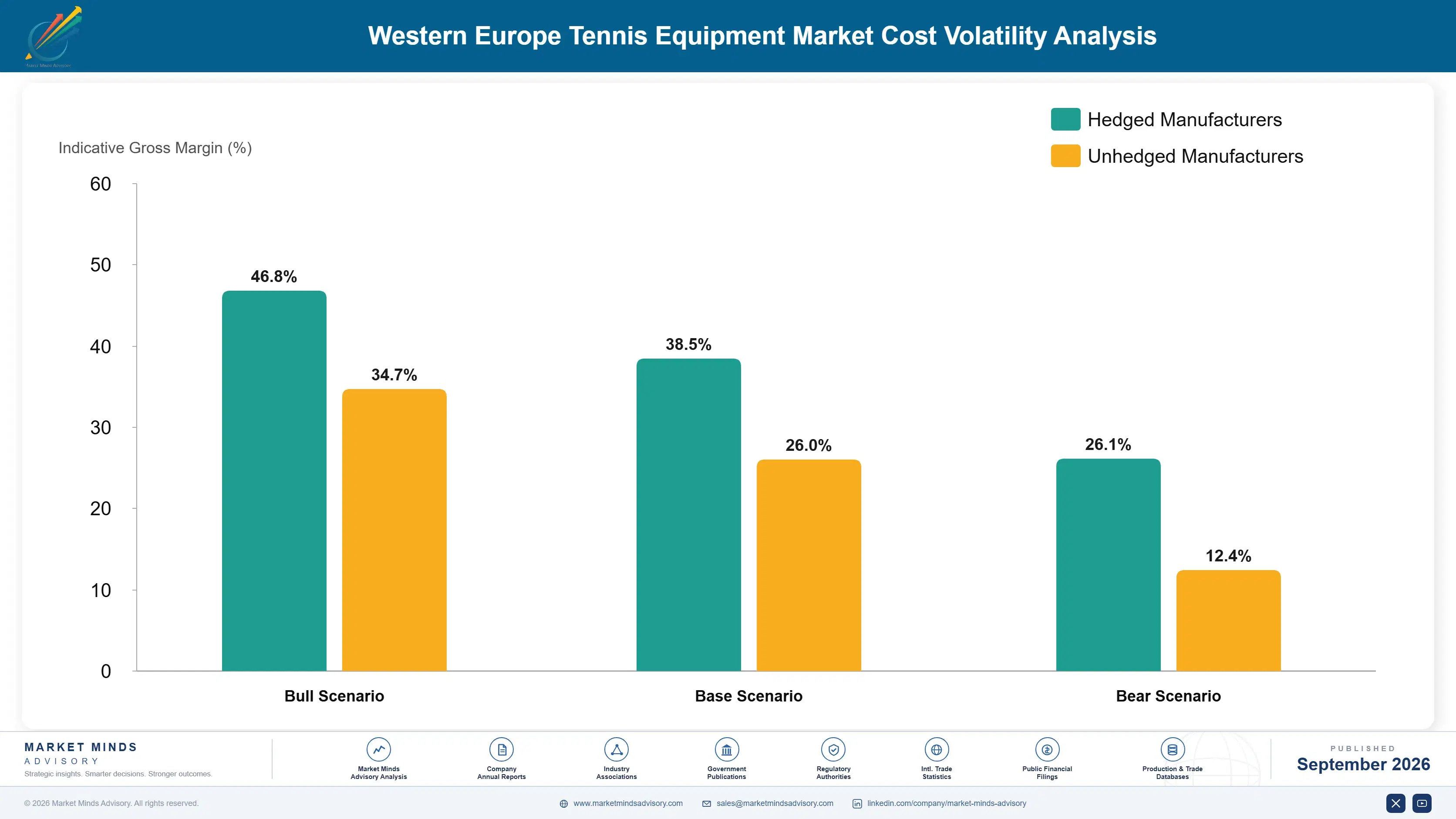
Carbon fibre prepreg dominates frame cost at roughly 29%, sourced from Japanese and Taiwanese producers, with layup labour accounting for a further 21% because composite frames are still largely hand laid. String cost is driven by polyester and co-polyester extrusion at modest material value, while natural gut carries an entirely different structure based on serosa processing. Ball manufacture is the most labour-intensive, combining rubber moulding, wool cloth and pressurisation.
European energy in 2022 hit ball and gut production hardest, since vulcanisation and gut processing are both energy-intensive and both sit partly in Europe. IEA reporting for that period documents the scale of industrial energy price movement across the continent. Sumitomo Rubber Industries reporting for those years identifies raw material and energy cost as requiring price action across its sports division, and ball pricing across the region moved accordingly.

Exposure varies sharply by category and by manufacturing location. Frame producers carry carbon fibre and Asian freight exposure that string extruders largely avoid. Ball manufacturers carry wool and rubber alongside energy, which move on unrelated agricultural and petrochemical cycles. European natural gut producers carry energy exposure with no relocation option, since the capability exists nowhere else.
trends-growth-and-opportunity-analysis-of-tennis-e-cost-volatility-analysis-1790022847991

Contract carbon fibre prepreg volume across a full model cycle

Prepreg pricing moves with aerospace and wind demand that has nothing to do with racket sports, and frame makers buying spot absorb movements they cannot pass through mid-season. Contracting across a model cycle stabilises cost through a launch window. The commitment lands before retail sell-through is known, which is the reason smaller brands avoid it.

Qualify a second ball manufacturing origin outside Southeast Asia

Ball production concentrates in a narrow group of Southeast Asian facilities and the process is labour-intensive rather than capital-intensive, which makes it relocatable in principle. Qualifying a second origin costs a specification and performance approval cycle. Most brands only investigate after a supply interruption has already cost a season of stock. A lost season of stock is an expensive lesson.

Extrude string in Europe for the premium tier specifically

String material cost is low relative to retail value, so freight and lead time matter more than factory price at the premium end. European extrusion supports faster replenishment for the club channel where restringing demand is immediate rather than planned. The volume tiers still suit Asian production, which means running two supply routes deliberately.

Portfolio Architecture for Margin Defence

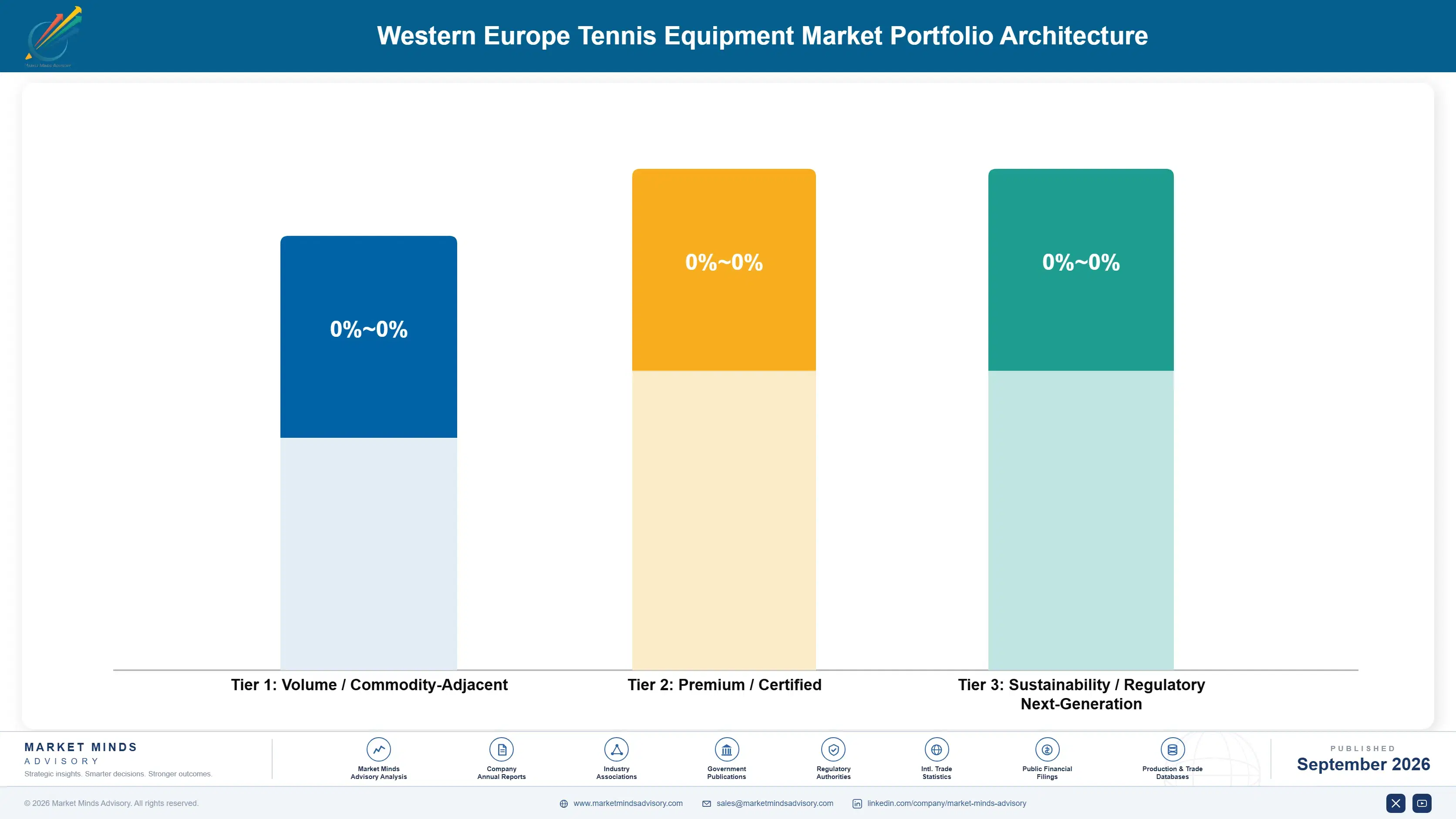
Margin architecture divides by replacement frequency and by material intensity, which produces an ordering most brands do not organise around. Rackets and balls sold through general sporting goods retail run at gross margins in the high twenties to mid thirties, competing against private label and against Decathlon's own production at price points brand overheads cannot support.
Performance frames and footwear sold through club and specialist channels hold gross margins in the low forties to around fifty. The spread reflects endorsement and channel position rather than construction cost, since the same Asian factories build frames for brands pricing thirty percent apart. Specialist retail also avoids the direct price comparison a general sporting goods wall enforces on a shopper.

The highest-value pool sits in strings, grips and accessories, at margins in the mid fifties to low sixties. Material cost is trivial against retail price, replacement is frequent and the purchase happens at a counter without comparison. That is also the pool brands have organised around least, because it sits with stringers and club professionals rather than with retailers they manage directly. A brand organised around retailers it manages directly is absent from its own best margin.

Volume / Commodity-Adjacent

Recreational rackets and balls sold through general sporting goods retail. These compete against private label and against integrated retailer production at price points that brand overhead structures cannot support. Brand overhead cannot be recovered at this tier.
Gross Margin: 26 to 34%

Premium / Certified

Performance frames and footwear sold through club and specialist channels. The eight-point range reflects endorsement and channel position rather than construction, since the same factories build across the tier. Specialist retail also avoids direct shelf comparison.
Gross Margin: 42 to 50%

Sustainability / Regulatory / Next-Generation

Strings, grips and accessories where material cost is trivial against retail price and replacement is frequent. The purchase happens at a counter without comparison, which is what holds the margin here.
Gross Margin: 54 to 62%
trends-growth-and-opportunity-analysis-of-tennis-e-portfolio-architecture-1790022848953

High-value Sub-segments and Strategic Watch-out

Polyester And Co-Polyester Strings

High value and high growth at 8.1%. Polyester loses tension faster than alternatives, which raises restringing frequency among exactly the players adopting it. Brands running club restring programmes report string volume per player rising around 2.3 times. The transaction currently sits with the stringer rather than the brand.
Gross Margin: 56 to 62%

Club Channel Performance Footwear

High value and moderate growth at 6.2%. Shoes last around nine months and European play spans clay, hard and carpet, so committed players should own more than one pair. Selling by surface through clubs lifts units per player materially. Clay, hard and carpet each need a different outsole entirely.
Gross Margin: 44 to 50%

Recreational Rackets

Volume core, growing slowest at 4.2% on replacement intervals of three to five years. It competes against integrated retailer production and holds shelf presence without funding the endorsement spend the category runs on. Replacement intervals of three to five years make it a poor recurring base.
Gross Margin: 26 to 33%

Tennis Only Product Portfolios

Strategic watch-out. Around 11% of Western European courts have been relaid for padel, and a tennis-only brand loses the member entirely at conversion. The eighteen-point range reflects how differently participants are exposed by category mix. Spanish and Italian exposure is considerably higher than northern European exposure at present.
Gross Margin: 30 to 48%

What Actually Recurs Here

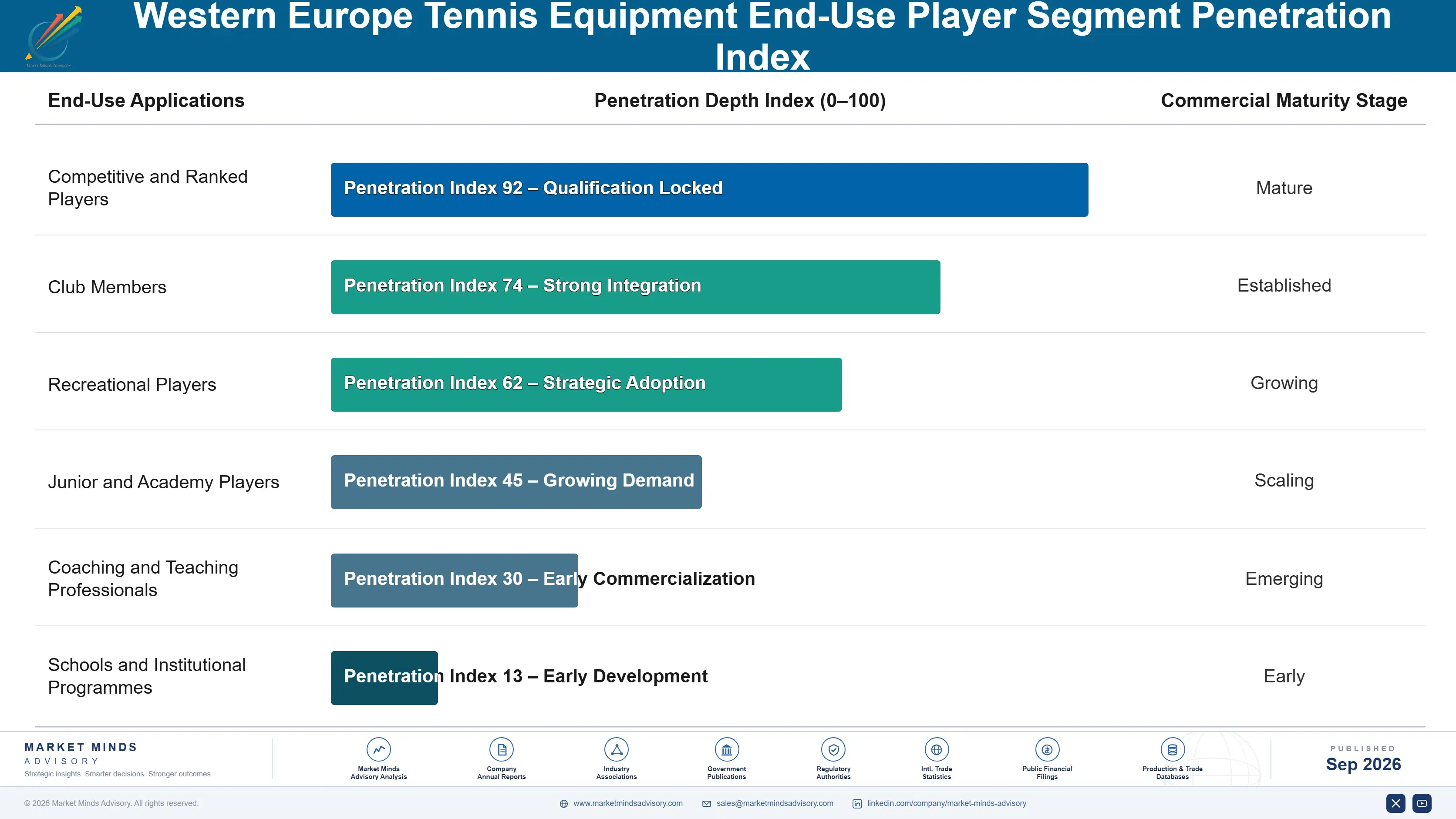
Recurring demand in tennis runs on consumables and the industry's commercial attention runs on durables, which is the central mismatch in this market. A frame lasts three to five years for a club player while string, grip and footwear all replace inside a single season for anyone playing regularly. String and grip spend across a racket's life reaches about 1.6 times the frame price, and most of that transaction never touches a brand's own channel.
Stickiness varies sharply by how the player buys. Club members purchasing through a coach or stringer are the most loyal, because the professional specifies and the player rarely overrides the recommendation. Specialist retail customers switch on testing and on frame availability. Casual players buying through general sporting goods retail have essentially no brand attachment and buy on price and appearance, which is where private label takes volume.

Player profiles shifted after 2020 in one direction that matters commercially. The cohort that joined clubs during that period has now been playing four or five years, has moved from recreational to competitive string setups, and restrings considerably more often than the players it joined alongside. That group now evaluates specification rather than endorsement.
trends-growth-and-opportunity-analysis-of-tennis-e-end-use-penetration-index-1790022850290

Where Brands Should Focus

These are among the four positions where our research anticipates prominent divergence between winners and laggards over the coming forecast period. Each is grounded in the demand model, the regulatory perimeter, and the announced capacity pipeline.
01 / RESTRINGING PROGRAMME DEVELOPMENT

Book the appointment before the string breaks

Club players restring about 1.4 times a year against a guideline of restringing as often annually as they play weekly, and the reason is that tension loss is invisible while breakage is obvious. Scheduled programmes run through club professionals, with reminders tied to play frequency rather than to failure, convert an unnoticed need into a booked appointment. Brands operating these report string volume per player rising by roughly 2.3 times on the largest recurring pool in the category, and that transaction currently happens with no brand contact at all.
02 / FRAME SPECIFICATION TRANSPARENCY

Weigh each frame and print what it is

Manufacturing tolerance near seven grams unstrung is common between frames of the same model, with comparable balance and swingweight variance, so two identical rackets genuinely play differently. The industry relies quietly on players not measuring. Weighing and labelling each frame with its actual specification costs pennies and one process step, and participants doing it report returns falling by about 31% with repeat purchase of the same model rising materially, because the player who liked one frame can then actually buy another that matches it.
03 / PADEL RANGE HEDGING

Follow the member when the club relays

Around 11% of Western European tennis courts have already been relaid for padel, because three padel courts fit where one tennis court stood and utilisation per square metre runs far higher. That decision belongs to club treasurers and no equipment brand influences it. Participants holding both ranges report retaining roughly 74% of members at converted clubs, while tennis-only competitors lose the customer outright at the moment the surface changes, and a relaid court does not return, which makes the exposure permanent rather than cyclical.
04 / SURFACE SPECIFIC FOOTWEAR SELLING

Sell the outsole the court actually needs

A tennis shoe lasts a club player around nine months, and Western European play spans clay, hard and carpet surfaces that each demand a different outsole pattern and durability specification. Committed players should own more than one pair and overwhelmingly own one. Selling by surface through clubs, where the surface is known and the coach is present, rather than by player archetype at retail, lifts units per player by roughly 1.6 times on the second largest recurring pool, because the coach knows the surface and the general retailer never does.

Engagement Snapshot From the Field

A live engagement with an industry participant carrying material or product regulatory and market exposure ahead of a defining policy shift, showing how our research translates into a defensible multi-year portfolio strategy.
MARKET MINDS ADVISORY · CLIENT ENGAGEMENT SUMMARY
Western Europe Tennis Equipment Producer Strategic Portfolio Review and Transition Roadmap 2026·Investment Scenario on Western Europe Tennis Equipment Exposure Evaluation 2025-26
CLIENT PROFILE
A Western European racket sports brand selling frames, strings and accessories across nine markets with revenue near USD 118 million (client-reported, unverified by MMA). Frames accounted for 64% of revenue and strings for 11%, with the remainder in accessories and bags. No padel range existed, and string was sold to stringers as a wholesale commodity with no player-facing programme anywhere.
STRATEGIC CHALLENGE
Frame revenue had been flat for three years while marketing spend on endorsement rose, and management attributed the stagnation to competitive pressure at the top of the range. A further endorsement investment had been proposed. Nobody had measured what a player spent with the brand across a frame's life, or examined what happened to members at clubs that converted courts.
MMA APPROACH
MMA reconstructed player lifetime spend across frames, strings, grips and footwear from club and stringer transaction records covering four markets. Frames were weighed and measured against published specification across three models. Member retention was tracked at 41 clubs that had converted courts to padel, and restringing frequency was surveyed across 620 club players.
KEY FINDINGS
  1. String and grip spend across a frame's ownership period reached 1.6 times the frame price, and 83% of that transaction occurred without any brand contact with the player.
  2. Measured frames varied by up to 9 grams unstrung within a single model, above the category norm of seven, and balance variance exceeded published tolerance on every model tested.
  3. At the 41 converted clubs the brand retained 12% of members against 74% retention reported by competitors carrying padel ranges in the same facilities.
  4. Surveyed players restrung 1.2 times annually, below the regional figure, and 71% reported restringing only when a string broke rather than on any schedule.
CLIENT PROFILE
A Western European racket sports brand selling frames, strings and accessories across nine markets with revenue near USD 118 million (client-reported, unverified by MMA). Frames accounted for 64% of revenue and strings for 11%, with the remainder in accessories and bags. No padel range existed, and string was sold to stringers as a wholesale commodity with no player-facing programme anywhere.
STRATEGIC CHALLENGE
Frame revenue had been flat for three years while marketing spend on endorsement rose, and management attributed the stagnation to competitive pressure at the top of the range. A further endorsement investment had been proposed. Nobody had measured what a player spent with the brand across a frame's life, or examined what happened to members at clubs that converted courts.
MMA APPROACH
MMA reconstructed player lifetime spend across frames, strings, grips and footwear from club and stringer transaction records covering four markets. Frames were weighed and measured against published specification across three models. Member retention was tracked at 41 clubs that had converted courts to padel, and restringing frequency was surveyed across 620 club players.
KEY FINDINGS
  1. String and grip spend across a frame's ownership period reached 1.6 times the frame price, and 83% of that transaction occurred without any brand contact with the player.
  2. Measured frames varied by up to 9 grams unstrung within a single model, above the category norm of seven, and balance variance exceeded published tolerance on every model tested.
  3. At the 41 converted clubs the brand retained 12% of members against 74% retention reported by competitors carrying padel ranges in the same facilities.
  4. Surveyed players restrung 1.2 times annually, below the regional figure, and 71% reported restringing only when a string broke rather than on any schedule.
RECOMMENDED STRATEGY
Phase 1: Phase one: introduce a padel range before the next season, prioritising Spanish and Italian club channels where conversion is fastest. Phase 2: Phase two: launch scheduled restring programmes through club professionals with reminders tied to play frequency. Breakage is the wrong trigger entirely. Phase 3: Phase three: weigh and label every frame with its actual specification and publish tolerance openly. Measured variance exceeded published tolerance on every model.
OUTCOME
String volume per player rose by roughly 2.1 times across three quarters and frame returns fell by about a third after labelling shipped (client-reported, unverified by MMA). The additional endorsement investment was cancelled once lifetime spend analysis showed where the revenue actually sat, and the padel range reached 9% of revenue in its first year.

Frequently Asked Questions

Foundational context covering the market sizes, CAGR, scope, country, region and competition that inform every finding below. This section is provided to cover basics and most often pre-purchase conversations, answered from the MMA Primary Research Dataset.

What is the current size of the Western Europe Tennis Equipment Market?

The market was valued at USD 1.6 billion in 2025, rising to USD 1.7 billion in 2026. Sizing is at wholesale revenue into Western European channels across six equipment categories.

How large will the Western Europe Tennis Equipment Market be by 2036?

MMA forecasts USD 2.9 billion by 2036, an increase of USD 1.2 billion over the 2026 base. That represents expansion of 1.71 times across the forecast period.

What is the CAGR for the Western Europe Tennis Equipment Market 2026 to 2036?

The base case CAGR is 5.4%, with a bull case of 6.6% and a bear case of 4.2%. Historical growth between 2020 and 2025 ran at 4.3%.

Which segment is growing fastest?

Strings grow at 8.1%, half again the market rate, because polyester monofilament loses tension quickly and raises restringing frequency. Grips and accessories follow at 7.3%.

Who are the major companies in the Western Europe Tennis Equipment Market?

Amer Sports, Head, Babolat, Yonex and Sumitomo Rubber Industries lead on wholesale revenue, holding a combined 47%. Decathlon and private label hold substantial recreational volume.

Which country is growing fastest?

This analysis is scoped to Western Europe, so comparison runs within the region. Italy grows fastest at 8.2%, on federation investment in clubs and sustained competitive success.

Report Segmentation Architecture

The full report scope spans multiple orthogonal segmentation dimensions, with cross-tabulated demand data provided for each dimension pair. Coverage extends further to regional breakdowns, trend trajectories, and the competitive detail needed to support segment-level decision-making.

By Equipment Category

  • Rackets
  • Strings
  • Balls
  • Tennis Footwear
  • Grips, Dampeners and Accessories
  • Bags and Court Equipment

By End-Use Player Segment

  • Competitive and Ranked Players
  • Club Members
  • Recreational Players
  • Junior and Academy Players
  • Coaching and Teaching Professionals
  • Schools and Institutional Programmes

By Distribution Channel

  • Club Pro Shops and Stringers
  • Specialist Racket Sports Retail
  • General Sporting Goods Retail
  • Brand Direct Online
  • Marketplace Platforms
  • Coaching and Academy Supply

By Region

  • East Asia
  • South Asia and Pacific
  • Western Europe
  • North America
  • Eastern Europe
  • Middle East and Africa
  • Latin America

Scope, Methodology, and Coverage

Every figure in this report is reproducible from documented input assumptions. The scope below maps the historical period, the forecast horizon, the segmentation dimensions, and the countries covered, alongside the underlying primary and qualitative methodology.
Historical Period
2020 to 2025
Forecast Period
2026 to 2036
Base Year
2025 (USD billions; MMA Primary Research Dataset, September 2026)
Market Definition
This analysis covers tennis equipment sold to players across Western Europe, spanning rackets, strings, balls, tennis footwear, grips and dampeners and accessories, and bags and court equipment. Sizing is at wholesale revenue into Western European club, specialist, general sporting goods, direct, marketplace and academy channels. Padel and pickleball equipment, tennis apparel other than footwear, court construction and surfacing, ball machines, coaching services, and stadium or facility equipment are excluded from scope throughout.
Quantitative Units
USD billions at wholesale revenue; volume in millions of units; frame specification in grams and points of balance.
Segmentation Dimensions
Equipment category, end-use player segment, distribution channel, and supply origin region.
Regions Covered
East Asia, South Asia and Pacific, Western Europe, North America, Eastern Europe, Middle East and Africa, Latin America
Countries Covered
France, Germany, Italy, Spain, United Kingdom, Netherlands
Key Companies Profiled
Amer Sports, Head, Babolat, Yonex, Sumitomo Rubber Industries, Tecnifibre, Prince Global Sports, Volkl Tennis, Solinco, Gamma Sports, Pacific Holding, Asics, Adidas, Nike, Lacoste, Decathlon, Frasers Group, Toalson, Kirschbaum, Signum Pro
Quantitative Methodology
Primary survey, n=3,800 respondents, Q4 2025, six countries; demand-side model with trade association cross-validation
Qualitative Methodology
47 expert interviews, Q4 2025; applied to validate demand model assumptions, identify emerging dynamics, and assess competitive positioning
Report Format
PDF and XLSX data workbook (Word format preview document)
Publisher
Market Minds Advisory
Report Code
MMA-2026-CON-779
Published
September 2026
Contact
sales@marketmindsadvisory.com | www.marketmindsadvisory.com

Purchase the full Western Europe Tennis Equipment Market Report (2026 to 2036).

The full report sizes the Western European tennis equipment market across six equipment categories, six player segments and six distribution channels, with supply-origin analysis covering all seven global manufacturing regions. It includes player lifetime spend reconstruction across frames, strings, grips and footwear built from club and stringer transaction records. Frames are weighed and measured against published specification across leading models. Member retention is tracked at clubs converting courts to padel, and restringing frequency is surveyed directly among club players. Competitive assessment covers 20 participants on a consistent wholesale revenue basis.
Player lifetime spend reconstructed from club transaction records
Frames weighed and measured against published specification
Member retention tracked at converted padel clubs
Restringing frequency surveyed among club players
Six equipment categories sized through 2036
Twenty participants assessed on wholesale revenue

Built For The People Who Decide

From boardroom strategy to bench-side execution, this report is read cover-to-cover by leaders shaping the next decade of their industry, turning demand scenarios, market dynamics and valuation benchmarks into decisions.
CXOs/ Presidents/ VPs/ Managers
M&A and Corporate Development
Strategy Teams and R&D Heads
Procurement and Product Directors
Regulatory and Compliance Leaders
Investor Relations and Equity Analysts