Market Minds Advisory
Transmission Fluids Market

Transmission Fluids Market: Electric Drivetrain Fluids Meet Combustion Fleet Legacy Economics

Electric vehicle drivetrain fluids and dual-clutch transmission formulations are pulling category growth beyond standard automatic transmission fluid, even as ATF remains the largest established segment across global vehicle fleets today.

Lead Analyst

Bilal Shaikh

Published

September 2026

Make Smarter Decisions with Customized Research Insights

Request a free sample report and evaluate market opportunities, growth trends, and competitive dynamics relevant to your business needs.

2025 MARKET VALUE$8.5BMarket Size 2025
2036 FORECAST VALUE$13.4BBase Case , 2026 to 2036
CAGR 2026 TO 20364.2 %Bull 5.4% / Bear 3.0%
INCREMENTAL OPPORTUNITY$4.5BNet 10- year value creation
EXPANSION MULTIPLE1.51x2036 value over 2026 base
Strategic Levers
M&A Pipeline
Regional Outlook
Country Rankings
Competitive Intelligence
Segmental Deep-dive
Call-Us : 91 93563 13602

Executive Snapshot and Market Trajectory

Electric vehicle drivetrain fluids and dual-clutch transmission formulations are pulling volume away from standard automatic transmission fluid, even as ATF still anchors most established category revenue across global combustion vehicle fleets worldwide. Producers are watching this shift closely across most manufacturing regions. This trend is accelerating quickly nationwide.
Electric drivetrain and dual-clutch formats now drive the fastest growth as automakers respond to electrification mandates and performance transmission adoption, while ATF still represents the largest single segment by volume given decades of entrenched combustion fleet demand. East Asia anchors the largest share of demand, tied closely to China's concentrated vehicle production and electric vehicle manufacturing capacity. This shapes producer investment priorities considerably.
ExxonMobil and Valvoline dominate through established OEM formulation partnerships and extensive aftermarket distribution reach that smaller regional producers cannot easily replicate at comparable qualification scale. Electric vehicle adoption and dual-clutch transmission expansion are the two forces most likely to reshape category allocation over the next decade, according to underlying survey data collected across six countries. Producers who move early on both fronts stand to capture disproportionate share of incremental industry value across manufacturing regions.
Market Definition
The transmission fluids market covers commercial production and sale of automatic, continuously variable, manual, dual-clutch, synthetic, and electric vehicle drivetrain and thermal management fluids formulated for vehicle transmission and drivetrain lubrication and cooling. It excludes engine oils, brake fluids, and coolants sold under separate automotive fluid classifications.
Base Year Value
$8.5B in 2025 (MMA Primary Research Dataset, August 2026)
Forecast Period
2026 to 2036, eleven discrete annual values
CAGR
4.2% base case. Bull 5.4%. Bear 3.0%.
Fastest Growth Segment
Electric Vehicle Drivetrain and Thermal Management Fluids: 12.5% CAGR
Fastest Growth Country
China: 9.5% CAGR
Fastest Growth Region
South Asia and Pacific: 6.2% CAGR
Largest Region
East Asia: 35% of 2025 global value
Market Leaders
Exxon Mobil Corporation, Royal Dutch Shell plc, Chevron Corporation, TotalEnergies SE, Valvoline Inc. Source: MMA Analysis based on company annual reports.
Primary Survey
n=3,800 procurement and R&D decision-makers, Q4 2025, six countries
Methodology
Demand-side build-up, cross-validated against public data, 47 expert interviews

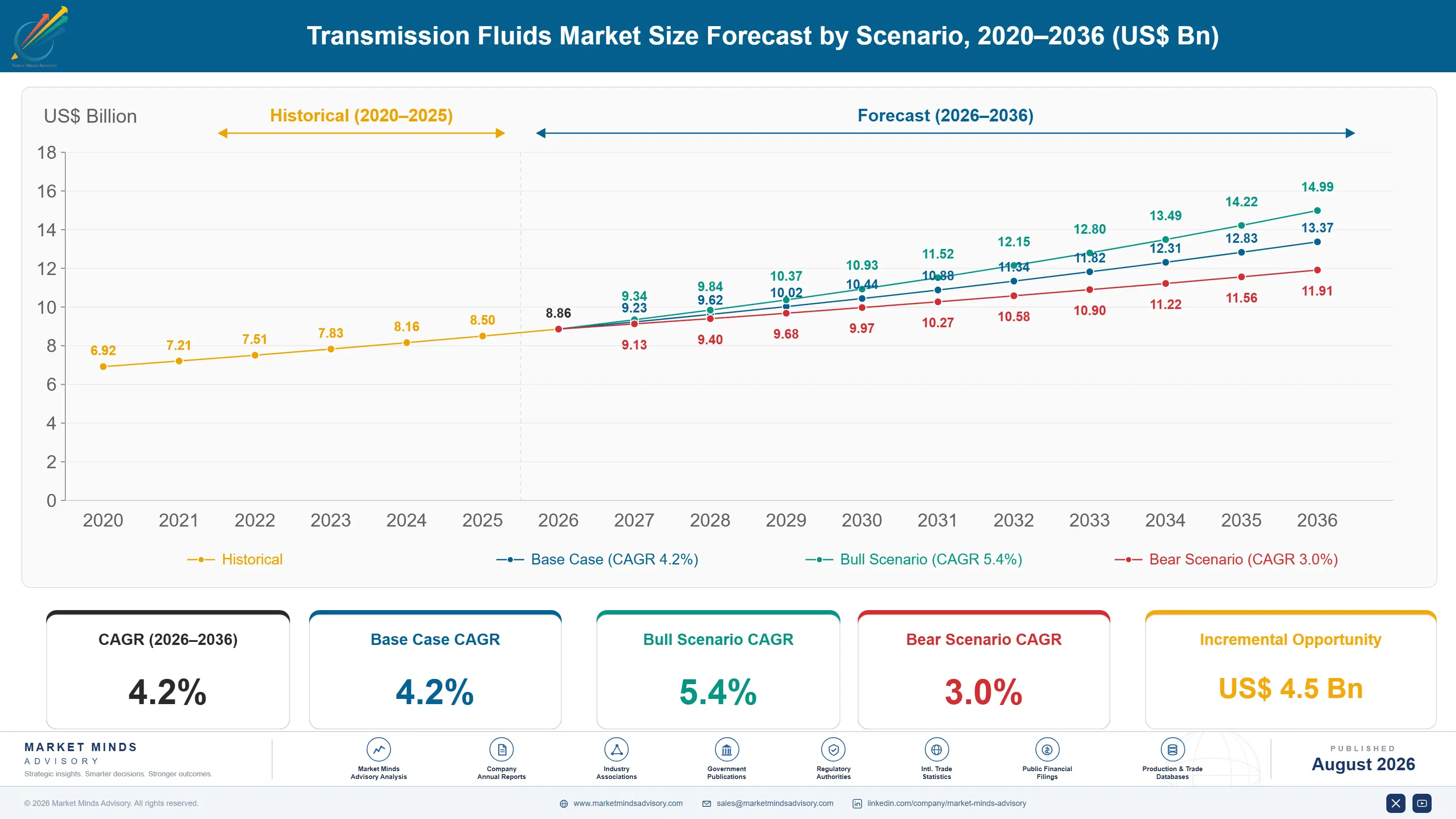
Transmission Fluids Market Forecast Scenarios

transmission-fluids-market-trends-size-forecast-scenario-1787639308974
Between 2020 and 2025 the market grew at a measured pace as combustion fleet demand held broadly steady while electric vehicle drivetrain fluid and dual-clutch transmission applications gained modest but consistent traction across manufacturing markets. Extended service interval adoption provided further steady support throughout this period. This measured pace reflects the category's fundamentally mature, cyclical demand character tied closely to global vehicle production trends.
The base case through 2036 rests on three mechanisms: continued global vehicle fleet size sustaining core ATF demand across established markets, expanding electric vehicle manufacturing pulling drivetrain fluid volume across regions, and rising dual-clutch transmission adoption tied to performance and efficiency requirements across major markets. These mechanisms support steady, unspectacular growth typical of a mature automotive fluids category. Buyers should expect this pattern to persist barring a significant regulatory or feedstock disruption across major manufacturing regions.
The bull case turns on faster-than-expected electric vehicle adoption pulling premium drivetrain fluid volume well above base case assumptions across several manufacturing markets. The bear risk is prolonged base oil feedstock price volatility forcing costly reformulation investment that could meaningfully compress near-term category volume growth. Both scenarios remain plausible, underscoring genuine uncertainty in how quickly electrification adoption actually accelerates.

Drivetrain Electrification Meets Combustion Fleet Economics

Two forces are shaping transmission fluids at once: rising electric drivetrain and dual-clutch demand pulling volume toward premium fluid formulations, and continued ATF production sustaining commodity-grade combustion fleet volume across established manufacturing markets. Each pulls producer investment priorities in a somewhat different direction, splitting the category into distinct margin tiers with genuinely separate formulation economics. Buyers evaluate each tier on its own terms rather than treating transmission fluids as a single undifferentiated commodity category.
MARKET CONCENTRATIONCR5 48%reflects a moderately concentrated global lubricant producer base
AVERAGE SELLING PRICE$6.80/literelectric drivetrain fluids command a substantial pricing premium
TOP PRODUCING COUNTRY SHAREChina 26%reflects concentrated vehicle production and fleet manufacturing capacity
AFTERMARKET CHANNEL SHARE56%share of volume sold through independent service and repair channels
FEEDSTOCK COST SHARE44%base oils and specialty additives dominate the overall cost structure
FLUID CHANGE INTERVAL60000 milesreflects the average interval between fluid replacement services
Commercially, transmission fluid supply behaves like a specialized materials relationship rather than a pure commodity lubricant trade. OEMs qualify producers against exacting compatibility and consistency standards before committing to multi-year supply agreements, and electric drivetrain pricing has held even through periods when standard ATF faced margin pressure from feedstock cost swings. This dynamic has held steady across recent cycles, reinforcing incumbent producer relationships considerably.
The next decade will be shaped by how fast electric vehicle manufacturing scales across major automotive markets, whether dual-clutch transmission adoption continues expanding fluid specification complexity, and how quickly producers can scale electric drivetrain fluid capacity while maintaining exacting compatibility standards across applications. Laggards risk ceding contract share to faster-moving competitors within a few short years.
"ATF built this industry's volume, but electric drivetrain fluids are where the interesting margin story sits now. Electrification keeps pulling that shift forward."
Director, Automotive Lubricants Practice · MMA Automotive Lubricants and Drivetrain Fluids Practice · August 2026

Market Trends

Electric Vehicle Adoption Accelerates Thermal Fluid Demand

Electric vehicle adoption is accelerating thermal fluid demand as automakers scale production of specialized coolants and lubricants supporting electric motor and battery thermal management systems. Several national automotive associations have documented continued electric vehicle production growth tied directly to decarbonization policy objectives across major markets. This shift gives producers with established thermal fluid engineering expertise a genuine advantage over competitors reliant purely on standard ATF production. Adoption is expected to accelerate through 2029 across most major automotive manufacturing regions. This trend should broaden as more automakers commit to similar electrification capacity expansion programs.
Market Impact: Adds 4 percent volume growth

Dual-Clutch Transmission Adoption Expands Fluid Specification Complexity

Dual-clutch transmission adoption is expanding fluid specification complexity as automakers scale production of performance and fuel-efficiency-focused vehicles requiring precisely engineered friction modifiers. Several leading automotive manufacturers have documented rising dual-clutch fluid demand tied directly to expanded performance vehicle production over recent years. This shift raises formulation complexity for producers investing in dual-clutch capability, though early movers report improved OEM qualification success rates. Smaller specialty producers have led this transition faster than legacy incumbents, forcing established players to accelerate their own investment timelines considerably. This transition is expected to continue accelerating as performance vehicle demand keeps rising steadily.
Market Impact: Adds 5 percent revenue growth

Market Opportunities and Growth Drivers

Rising Global Vehicle Fleet Size Sustains Core Demand

Rising global vehicle fleet size across China, India, and North America continues to drive steady demand for transmission fluids as automakers scale production to meet growing consumer and commercial vehicle demand. Several national automotive associations have documented continued vehicle fleet growth tied directly to rising disposable income and infrastructure investment across these markets. This demand base gives producers a durable multi-year volume foundation across automotive categories, supporting steady capacity utilization at production facilities. Established manufacturers favor producers who document consistent purity performance across shipment batches reliably. Reliability matters most overall.
Market Impact: Adds 6 percent cost pressure

Extended Service Interval Adoption Reshapes Fluid Formulation

Extended service interval adoption continues to reshape fluid formulation as automakers demand longer-lasting formulations that reduce total cost of ownership for vehicle owners across major markets. Several automotive engineering associations have documented continued extended-interval adoption tied directly to rising consumer demand for reduced maintenance frequency across these markets. This demand base gives producers a durable, premium-priced revenue channel that complements standard fluid volume considerably. Producers who serve both original equipment and aftermarket channels benefit from smoother production scheduling and capacity utilization overall across geographies. This benefit compounds steadily over time.
Market Impact: Adds 5 percent substitution risk

Market Restraints and Challenges

Base Oil Price Volatility Pressures Producer Margins

Base oil price volatility continues to pressure producer margins, driven by concentrated refining capacity and cyclical petrochemical supply affecting raw material availability across major sourcing regions. The root cause traces to a limited number of qualified base oil refiners globally, where disruption at any single facility can meaningfully tighten global production capacity. The commercial impact shows up fastest in fixed-price OEM contracts, where producers carry limited pricing flexibility once agreements are confirmed. Several producers are exploring multi-supplier sourcing agreements to dampen this exposure over time. This trend should ease gradually as sourcing diversification matures across the industry.
Market Impact: Adds 620 million dollars demand

Electric Vehicle Adoption Erodes Legacy Fluid Volume

Electric vehicle adoption continues to erode legacy fluid volume, driven by declining combustion vehicle production as automakers shift manufacturing capacity toward electric drivetrains across major markets. The root cause traces to electric vehicles requiring meaningfully less transmission fluid volume than combustion vehicles given simplified single-speed drivetrain architecture. The commercial impact falls hardest on producers serving markets with accelerated electrification timelines and limited electric fluid capability. Several producers are exploring electric drivetrain fluid formulations to mitigate this exposure over time. This trend should ease gradually as electric formulation technology continues to mature.
Market Impact: Adds 6 percent volume growth
3 additional market trends, 3 additional growth drivers, and 3 additional restraints and challenges are covered in the full report. Contact sales@marketmindsadvisory.com to access the complete intelligence.

Segment CAGR and Growth Architecture

Transmission fluids are segmented here by fluid type and technology rather than by distribution channel or end-use industry, since ATF, dual-clutch, and electric drivetrain fluids each require genuinely distinct formulation chemistry. Buyers evaluate categories separately, weighing compatibility against price. Upstream base oil processing sits apart from downstream formulation and additive engineering entirely. Timing matters greatly.
transmission-fluids-market-trends-market-share-analysis-1787639309554

Electric Vehicle Drivetrain and Thermal Management Fluids

Electric vehicle drivetrain and thermal management fluids are growing fastest as automakers respond to sustained electric vehicle production growth requiring specialized thermal management and lubrication chemistry. ExxonMobil and Shell lead this segment, benefiting from established thermal fluid engineering expertise that smaller regional producers lack entirely, particularly around dielectric properties and thermal conductivity optimization. This segment faces less price sensitivity than standard ATF, since thermal performance carries genuine value that automakers increasingly recognize across successive qualification cycles. Margins here remain comfortably above standard formulations given the specialized engineering these products require. Manufacturers continue expanding dedicated qualification programs for this category as electric vehicle production keeps rising steadily across most manufacturing markets nationwide.
CAGR 12.5%

Dual-Clutch Transmission (DCT) Fluid

Dual-clutch transmission fluid is growing rapidly as automakers respond to rising consumer demand for performance and fuel-efficiency-focused vehicles requiring precisely engineered friction modifiers. Valvoline and several specialty producers dominate this segment, benefiting from established friction modifier formulation relationships that smaller regional producers struggle to match at comparable reliability. This segment commands a meaningful premium over standard ATF, since dual-clutch complexity and consistency requirements both carry considerably higher production costs. Demand should stay durable given sustained performance vehicle momentum across most developed automotive markets broadly. Manufacturers increasingly treat dual-clutch formulation partnerships as a strategic sourcing decision rather than a routine procurement exercise, reinforcing incumbent advantage across renewal cycles across most markets.
CAGR 7.5%
Full segment breakdown across 6 segments available in the complete report.

Regional Architecture and Country Demand Map

East Asia represents the largest share of global transmission fluid demand given China's concentrated vehicle production and electric vehicle manufacturing capacity, while South Asia and Pacific posts the fastest regional growth on the strength of expanding automotive assembly investment. This split reflects genuinely distinct commercial drivers.

North America

Transmission fluid demand across North America centers on established ATF and aftermarket distribution rather than pure electric drivetrain volume, reflecting a mature manufacturing base with steady underlying growth. Manufacturers in the United States increasingly favor electric drivetrain fluid partnerships to support electrification roadmaps, a shift that has accelerated meaningfully over the past several years. Canada contributes a smaller but stable base of demand, anchored by established automotive manufacturing capacity serving both domestic and export markets. Producers headquartered in this region maintain strong OEM service networks, a factor buyers weigh heavily given formulation complexity during qualification. Capital investment in electric drivetrain fluid capacity remains comparatively accessible here relative to developing markets.
Share: 24% | CAGR: 3.5% (2026 to 2036)

Western Europe

Transmission fluid demand across Western Europe reflects a mature industrial base with automotive manufacturing already well established, limiting incremental volume growth relative to newer manufacturing markets. Germany and France host meaningful regional production capacity, supplying both domestic manufacturers and export markets across Europe and beyond. Regulatory pressure toward vehicle electrification across the European Union continues to drive drivetrain fluid reformulation investment, a compliance dynamic that sustains steady demand even as new capacity additions remain limited. Manufacturers here favor producers with proven qualification track records over newer entrants, reinforcing incumbent supplier relationships. Growth here should continue at a measured pace given the region's already-mature manufacturing base. today across most manufacturing hubs.
Share: 19% | CAGR: 2.8% (2026 to 2036)
Regional intelligence for 5 additional markets available in the complete report: East Asia, South Asia and Pacific, Latin America, Middle East and Africa, Eastern Europe. Contact sales@marketmindsadvisory.com.
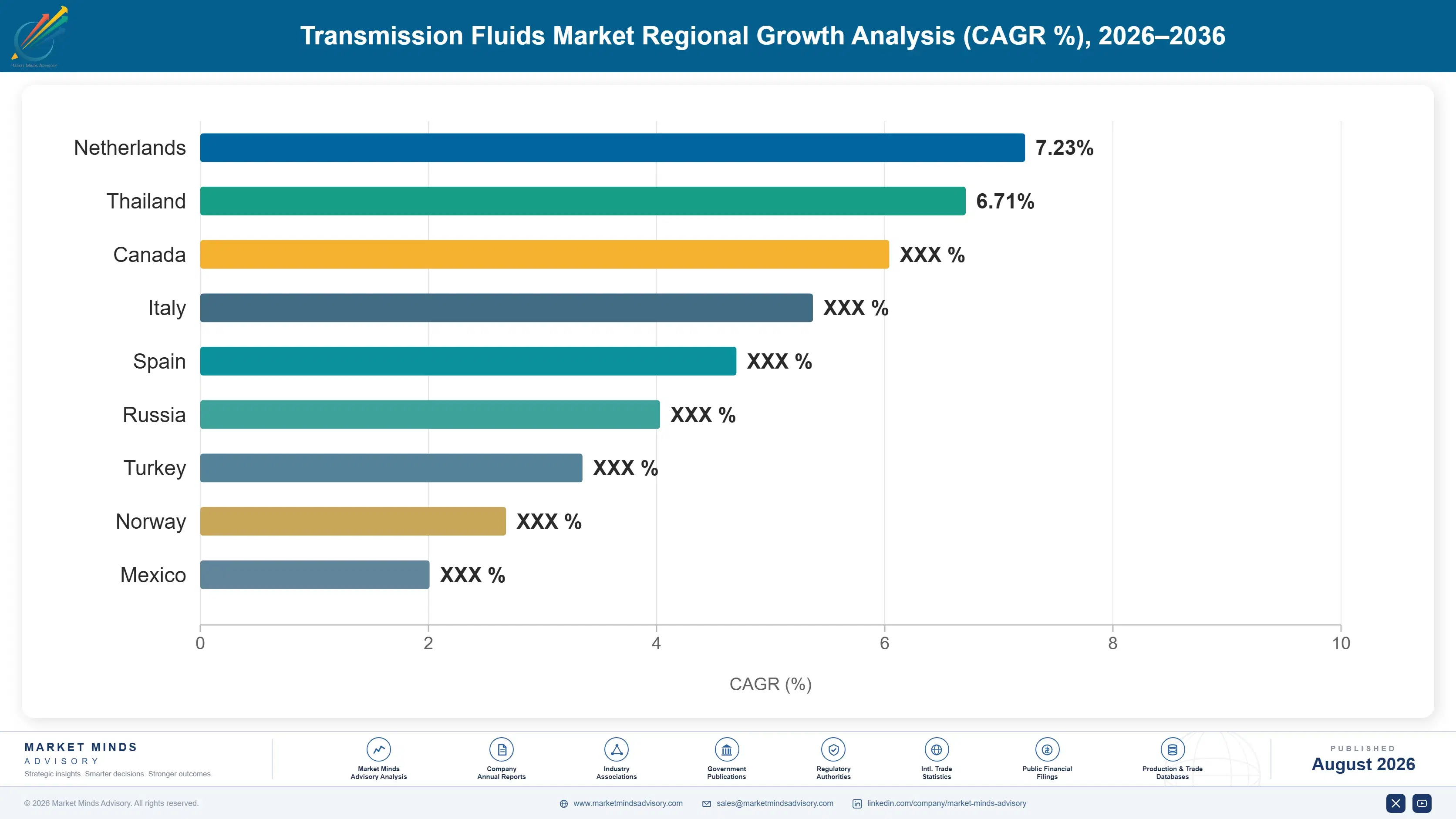
transmission-fluids-market-trends-country-cagr-analysis-1787639310069

Where Fluid Producers Can Capture More Margin

Producers can lift margin capture by shifting mix toward electric drivetrain and dual-clutch fluids, expanding OEM partnerships, and building long-term base oil supply agreements ahead of continued demand growth. These moves typically pay back within two to three years. Sequencing these moves correctly determines how quickly producers realize the full margin benefit available across categories.

Electric Drivetrain Fluid Investment Rollout Program

Producers who invest in electric drivetrain fluid capacity capture meaningfully better margins from automakers, since customers pay a premium of 22 to 28 percent for validated thermal performance that reduces overall component failure risk across multi-year supply contracts. ExxonMobil and Shell, which made this investment earliest, now command pricing consistently above producers still weighted toward standard ATF production. The capital investment required is significant, but payback has compressed as electric drivetrain demand continues expanding across additional automotive manufacturing regions. Second movers typically capture a smaller fraction of this upside once manufacturer qualification slots fill.
Market Impact: Adds 20 to 26 points of margin uplift

Dual-Clutch Fluid Formulation Technology Investment Program

Producers who develop dual-clutch formulation technology capture supply contract advantages from automakers actively reallocating supplier relationships toward performance and fuel-efficiency-focused vehicle programs. Several specialty producers report winning 13 to 17 percent more performance vehicle contracts after completing capability programs. Building credible dual-clutch positioning takes twelve to eighteen months of process validation before this lever converts fully into meaningful new revenue across categories. Producers pursuing this earlier than competitors tend to lock in better long-term contract terms overall. This edge compounds further as manufacturers consolidate purchasing around fewer, more reliable partners.
Market Impact: Adds 13 to 17 percent more contract wins

Base Oil Sourcing Diversification Program Strategy

Producers who diversify base oil sourcing across multiple regions capture supply reliability advantages that competitors reliant purely on single-region sourcing cannot credibly match during refining disruption periods. Several producers report winning 10 to 14 percent more long-term manufacturer contracts after completing this diversification. Building credible multi-region sourcing relationships takes two to four years before this lever converts fully into meaningful new revenue across manufacturing categories. Producers pursuing this earlier than competitors tend to secure better long-term feedstock pricing terms. This advantage compounds further as manufacturers consolidate purchasing around fewer, more reliable supply partners.
Market Impact: Adds 10 to 14 percent in contract wins

Long-Term OEM Partnership Rollout Program Strategy

Locking multi-year supply agreements with major OEMs trades some spot-market pricing upside for guaranteed volume and considerably reduced customer acquisition cost, an arrangement manufacturers increasingly prefer since it insulates production schedules from producer capacity disruption during peak demand phases. Producers with such agreements report churn rates roughly 15 percent lower than those competing primarily on individual contract bids, supporting more confident capacity planning years ahead. Manufacturers value this predictability enough to accept modestly higher pricing in exchange for reliable delivery. This advantage compounds further as manufacturers consolidate purchasing around fewer, more reliable partners.
Market Impact: Adds roughly 15 points of overall retention gain

Who Controls the Margin Pool

The top five producers hold roughly 48 percent of category shipment volume revenue, leaving a meaningful gap between ExxonMobil and Valvoline at the top and a long tail of regional producers competing mainly on ATF price rather than electric drivetrain qualification scale. ExxonMobil's OEM formulation partnerships and Valvoline's aftermarket distribution reach together anchor most category volume across North American and Asian manufacturing channels.
Current competitive activity centers on three dimensions: electric drivetrain fluid launches targeting electric vehicle manufacturers, dual-clutch formulation technology expansion to capture performance vehicle demand, and expanded base oil sourcing partnerships as producers seek supply security. Several mid-tier players have also pursued selective acquisitions of regional producers to accelerate capability entry. Several producers have also expanded pilot programs with regional distributors to broaden manufacturer reach in emerging markets.

Emerging pressure comes from Chinese producers expanding export capability with increasingly competitive pricing on standard ATF formulations, challenging Western incumbents in third-country markets they once dominated. Regional specialists in China are also steadily closing the formulation capability gap with global incumbents, particularly around electric drivetrain fluid production techniques that once required extensive proprietary expertise. Global incumbents remain comparatively cautious in responding to these emerging competitive threats across most manufacturing markets.
transmission-fluids-market-trends-company-positioning-matrix-1787639310596

Competitive Moat and Risk Dimensions

EXXON MOBIL CORPORATION

Moat: Established OEM formulation partnerships

ExxonMobil benefits from decades of accumulated OEM formulation partnership expertise across transmission fluid chemistry that newer entrants cannot easily replicate, giving it negotiating leverage with major automakers and distributors that smaller regional producers simply lack across most markets. This depth of expertise took decades to accumulate and remains genuinely difficult for rivals to shortcut.
EXXON MOBIL CORPORATION

Risk: Exposure to combustion fleet decline

ExxonMobil's specialty revenue remains heavily exposed to combustion fleet decline as electrification accelerates, leaving it more exposed than diversified electric fluid competitors to any single market's decision to move sharply against legacy volume assumptions. Losing even a modest share of that segment would matter considerably to overall revenue.
VALVOLINE INC

Moat: Extensive aftermarket distribution reach

Valvoline's extensive aftermarket distribution reach gives it durable retail shelf placement across service centers and independent repair channels that standalone specialty producers lacking equivalent scale cannot easily replicate, informing long-term purchasing decisions across comparable distribution relationships worldwide. Competitors attempting to replicate this reach still lag by several years in most distribution relationships.
VALVOLINE INC

Risk: Lower electric fluid brand focus

Valvoline's lower dedicated electric fluid brand focus can slow its response to increasingly competitive electric drivetrain demand in premium markets, a complexity that gives specialty producers an opening among electric vehicle manufacturers seeking validated performance. Regional challengers exploit this gap aggressively in price-sensitive markets. overall.

Players Tracked

Prominent Players

Exxon Mobil Corporation
Royal Dutch Shell plc
Chevron Corporation
TotalEnergies SE
Valvoline Inc

Other Key Players

BP p.l.c.
Fuchs Petrolub SE
Idemitsu Kosan Co Ltd
ENEOS Corporation
Petronas Lubricants International
Lukoil PJSC
Sinopec Lubricant Company
PetroChina Company Limited
Amsoil Inc
Motul S.A.
Repsol S.A.
Gulf Oil International Ltd
Liqui Moly GmbH
Phillips 66 Company
Indian Oil Corporation Limited

Recent Developments

MARCH 2026

ExxonMobil Launches New Electric Drivetrain Fluid Line

ExxonMobil launched a new electric drivetrain fluid line designed for electric vehicle manufacturers seeking validated thermal management performance, incorporating dielectric fluid technology validated through clinical research partnerships with automakers. The launch followed growing manufacturer demand across electric categories. Analysts viewed the move as validating continued electric demand nationally.
Signal: Confirms electric drivetrain capability is becoming a key competitive differentiator ahead of confirmed long-term manufacturer commitments industry-wide
NOVEMBER 2025

Valvoline Signs OEM Formulation Partnership Agreement

Valvoline Inc signed a multi-year OEM formulation partnership agreement with a major automaker, securing reliable qualification access ahead of planned capacity expansion across its dual-clutch product lines. Executives cited rising performance vehicle demand as a key motivation. Analysts framed the agreement as a competitive necessity.
Signal: Signals producers locking in OEM relationships ahead of expected demand growth and reshaping OEM qualification criteria industry-wide overall
JUNE 2025

Shell Commissions New Base Oil Production Facility

Royal Dutch Shell plc commissioned a new base oil production facility, materially increasing domestic capacity to serve both automotive manufacturer demand and export markets seeking reliable supply. Executives cited rising domestic electric vehicle investment as a key motivation. Analysts noted the facility targets export markets directly.
Signal: Signals incumbents investing well ahead of confirmed long-term electric demand even as pricing pressure intensifies further nationwide

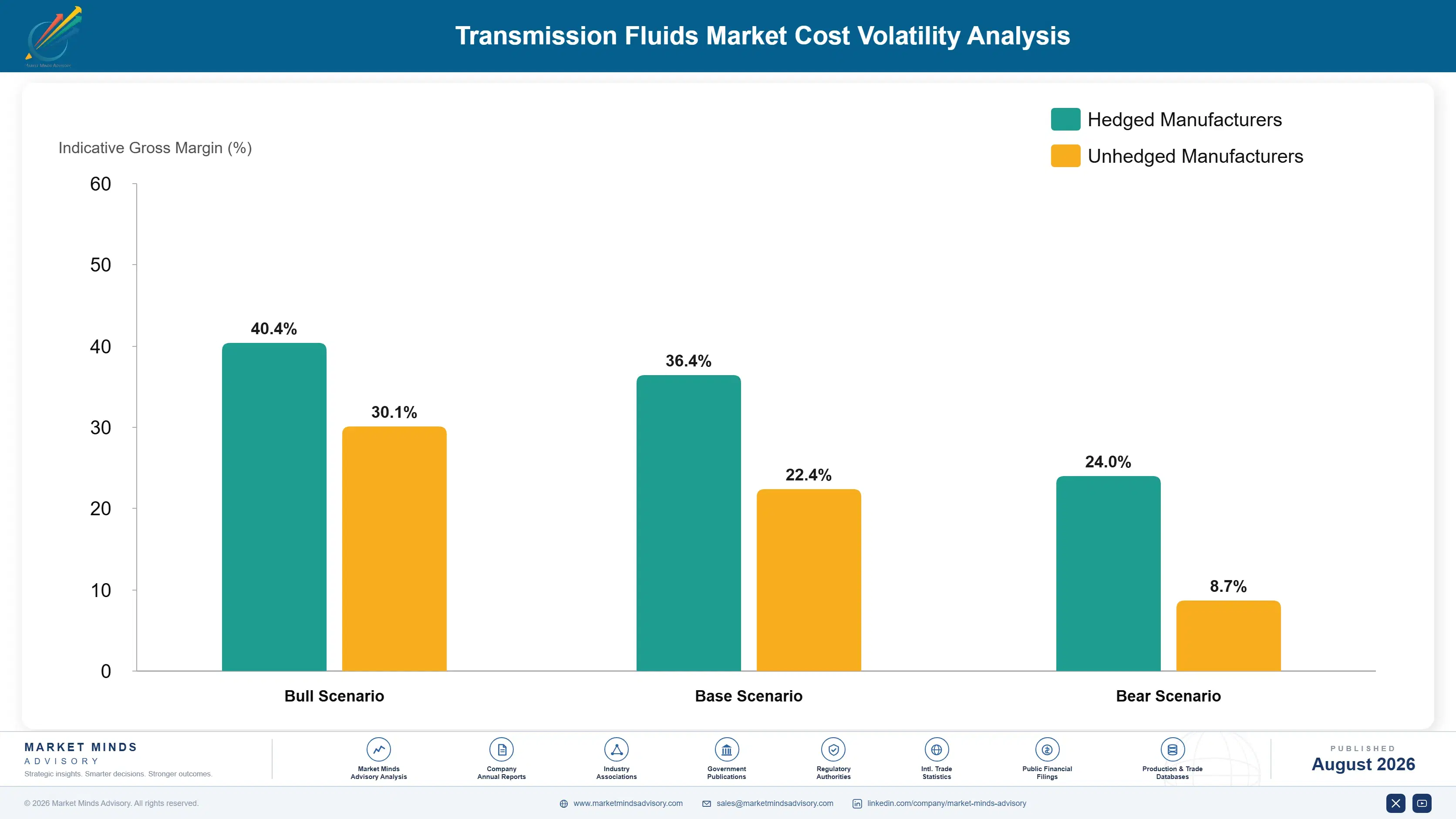
Base Oil and Specialty Additive Sourcing Risk

Base oils and specialty additives together account for roughly forty-four percent of production cost of goods sold for most transmission fluid producers, sourced primarily from refining and specialty chemical processing regions in the United States, China, and Western Europe. Friction modifier and dielectric compound costs add a further meaningful input, particularly for producers manufacturing electric drivetrain formulations requiring precise thermal control.
Global base oil prices spiked sharply during 2021 to 2022 following petrochemical supply chain disruption documented in IEA industrial reporting, pushing production costs up by an estimated nineteen percent within a single year before gradually easing through 2023 and 2024. Several mid-tier producers reported margin compression severe enough to delay planned capacity expansions during this period, according to company annual reports filed at the time.

Cost exposure varies considerably by producer scale and vertical integration. Large integrated producers like ExxonMobil, which maintain long-term feedstock supply contracts, absorb volatility more easily than standalone specialty producers reliant on spot market purchasing. Geographically, producers with diversified sourcing across multiple countries benefit from more stable costs, while smaller regional producers face higher exposure during periods of sharp price appreciation.
transmission-fluids-market-trends-cost-volatility-analysis-1787639310799

Multi-Year Base Oil Supply Agreements

Several producers have moved to multi-year base oil purchase agreements with major refiners, trading some pricing flexibility for protection against the kind of sharp spikes documented during the 2021 to 2022 disruption, reducing quarter-to-quarter cost unpredictability meaningfully for finance teams and manufacturer partners alike. This approach has grown more common since the 2021 disruption reshaped procurement strategy industry-wide.

Backward Integration Into Base Oil Refining

The largest producers are integrating backward into base oil refining and initial processing operations, capturing margin previously paid to third-party suppliers while also gaining direct visibility into feedstock cost trends ahead of broader market-wide price movements affecting smaller competitors. Smaller producers typically cannot justify this capital investment on their own without confirmed long-term demand.

Geographic Feedstock Sourcing Diversification

Producers are diversifying base oil and additive sourcing across multiple countries and suppliers to reduce dependence on any single region's supply disruption, trading some sourcing complexity for meaningfully improved delivery security across cycles and geographies going forward. This diversification takes years to build fully but pays off substantially during periods of acute regional disruption.

Portfolio Architecture for Margin Defence

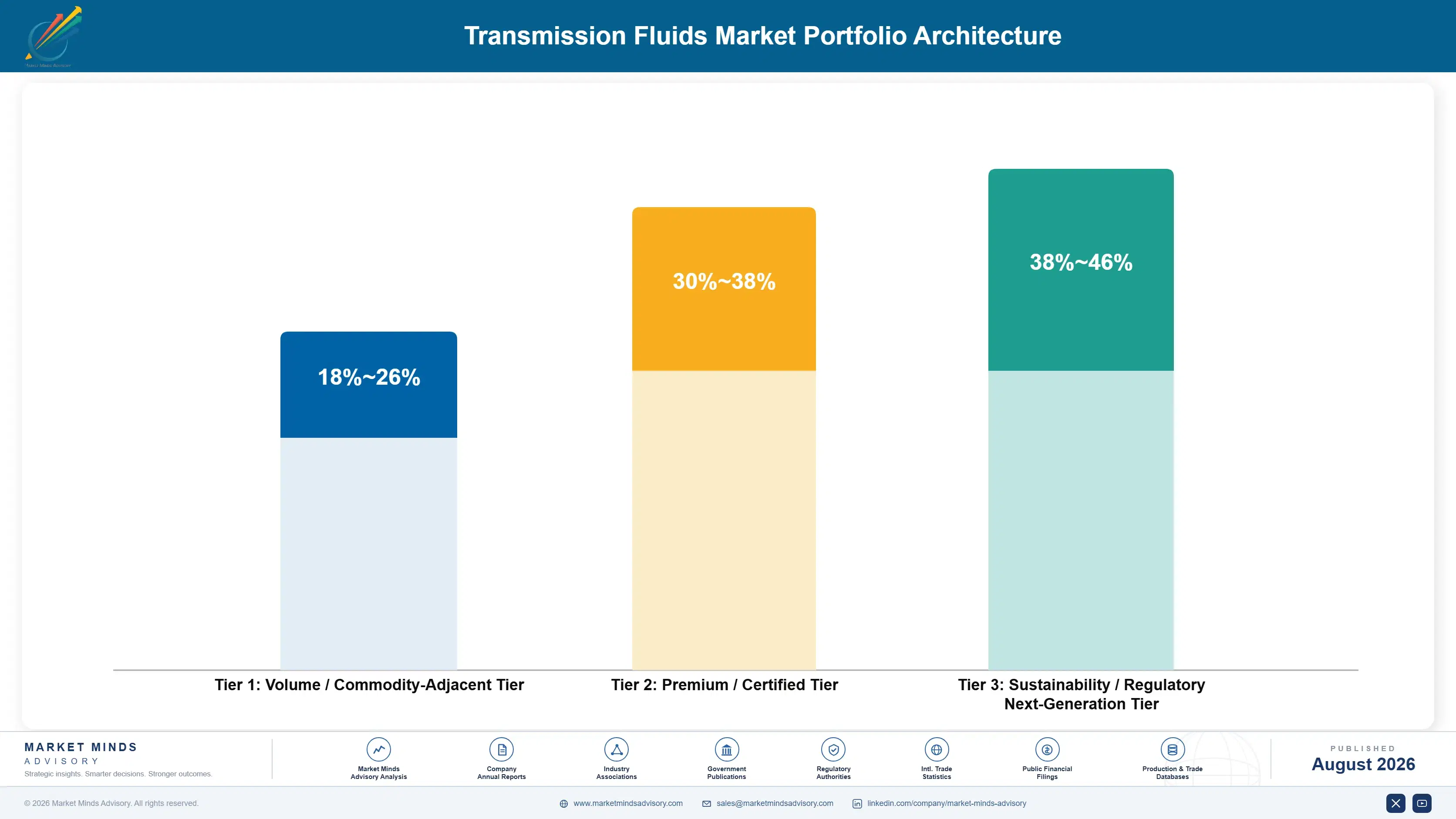
Transmission fluid portfolios split into three tiers with genuinely different margin economics. Volume commodity-adjacent standard ATF carries the thinnest margins but the broadest combustion fleet base, premium certified dual-clutch and synthetic formulations command meaningfully wider margins on lower absolute volume, and next-generation electric drivetrain fluids sit at the top of the pricing ladder despite modest overall volume relative to standard ATF. This structure has held stable across recent cycles. Producers who overlook this risk mispricing capacity.
The tension between volume and premium positioning shapes most producer investment decisions. Standard ATF still generates meaningful category revenue given its broad combustion fleet base, but margin growth increasingly concentrates in premium and next-generation tiers where producers can differentiate on formulation rather than competing purely on price against regional challengers. Manufacturers reward producers who straddle both tiers. This dynamic has held steady.

High-value margin pools concentrate most heavily in electric drivetrain and dual-clutch premium formats, where automakers actively expand capital budgets and demonstrate genuine willingness to pay above standard category pricing. Producers positioned early in these tiers are best placed to capture disproportionate profit growth over the coming decade. This concentration is likely to deepen further as manufacturer specifications continue tightening.

Volume / Commodity-Adjacent Tier

Standard automatic transmission fluid sold primarily on price and basic durability, where combustion fleet manufacturers dominate purchasing decisions and margins stay comparatively thin despite substantial overall manufacturing volume. Producers here compete mainly on cost efficiency and reliable delivery rather than formulation differentiation.
Gross Margin: 18-26%

Premium / Certified Tier

Dual-clutch and synthetic formulations sold to manufacturers seeking validated performance beyond standard ATF, commanding a meaningful and durable pricing premium across most manufacturing markets. Producers here differentiate through documented performance consistency rather than price competition alone.
Gross Margin: 30-38%

Sustainability / Regulatory / Next-Generation Tier

Electric drivetrain and thermal management fluids serving manufacturers with the most demanding thermal and dielectric requirements, commanding the category's widest margins on comparatively modest current volume. Producers here invest heavily in regulatory validation and specialized manufacturing infrastructure.
Gross Margin: 38-46%
transmission-fluids-market-trends-portfolio-architecture-1787639311310

High-value Sub-segments and Strategic Watch-out

Electric Vehicle Drivetrain and Thermal Management Fluids

This segment combines the fastest volume growth with the strongest margins in the category, driven by electric vehicle manufacturing demand and rewarding producers with dedicated formulation capability already in place today. This lead is unlikely to narrow soon given the qualification barriers involved for new entrants.
Gross Margin: 38-46%

Dual-Clutch Transmission (DCT) Fluid

Manufacturers increasingly demand validated dual-clutch performance here, supporting strong margins in the category, though volume remains smaller than standard ATF across the broader industry base currently. Manufacturers increasingly demand documented evidence before committing to multi-year contracts here. Early movers gain a durable competitive edge here.
Gross Margin: 32-40%

Automatic Transmission Fluid (ATF)

This remains the largest volume base in the category, with pricing under continuous competitive pressure, leaving margins thinner than premium and next-generation tiers by a wide margin overall. Producers largely view this as a stable revenue floor rather than a growth priority worth chasing. today.
Gross Margin: 18-26%

Manual Transmission Fluid (MTF)

A strategic watch-out segment where prolonged manual transmission decline in major automotive markets could delay reformulation investment currently supporting above-average category growth elsewhere. Producers who diversify formulation portfolios proactively reduce this exposure considerably over time. This threat merits close ongoing monitoring by all industry producers.
Gross Margin: 22-30%

Service Cycles Meet Electrification Transition

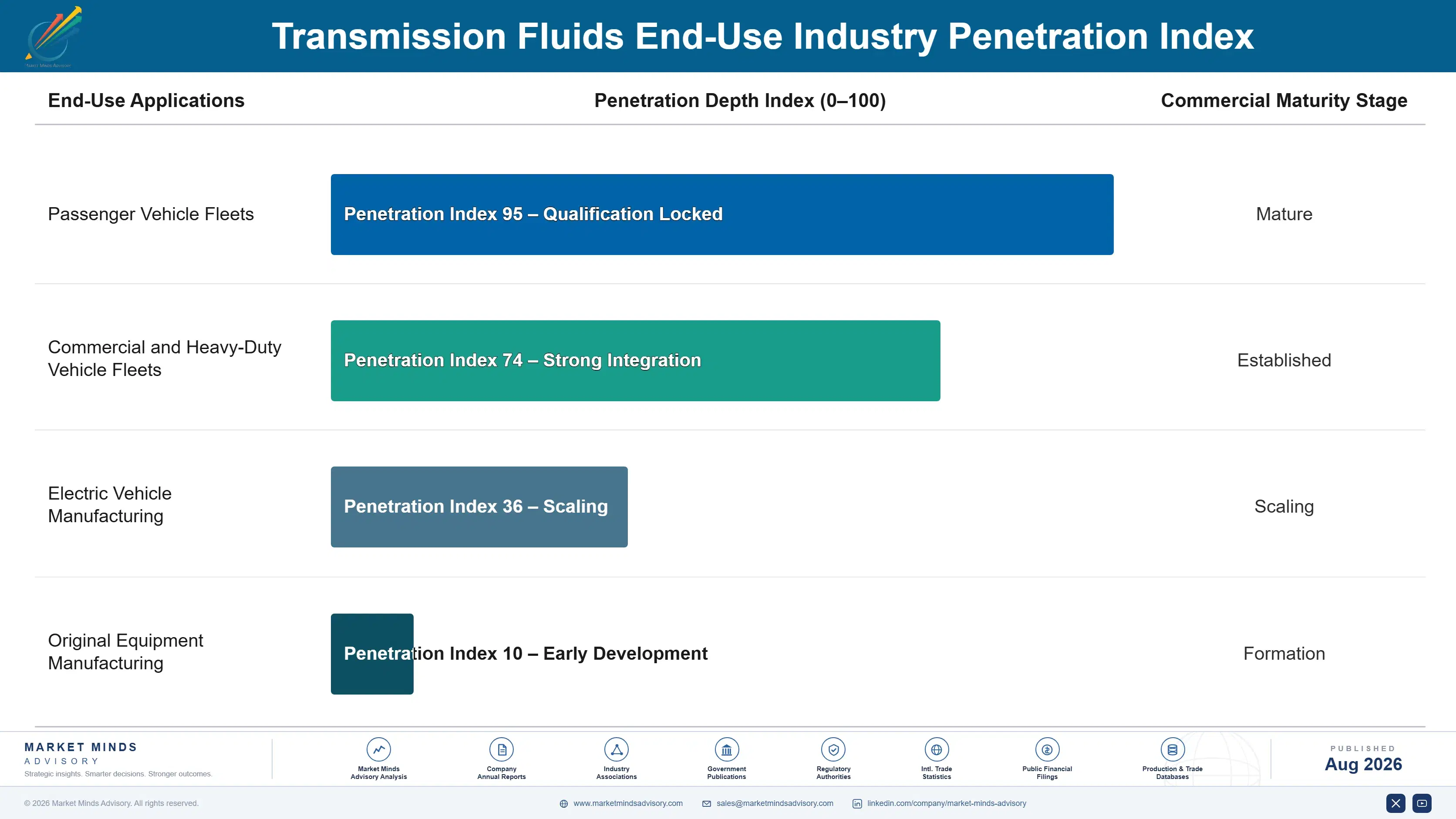
Transmission fluid demand behaves like an annuity for established producers, since OEM qualification cycles lock in supplier relationships for three to five years once formulation validation is secured. This recurring qualification pattern gives producers a durable revenue base that smooths out the volatility raw material cost swings otherwise introduce into quarterly earnings. Producers who invest early in qualification infrastructure are rewarded with multi-year contract stability few competitors can easily disrupt.
Adoption depth varies meaningfully by end-use vertical. Passenger vehicle fleets remain the deepest and most stable channel, commercial and heavy-duty vehicle fleets have grown steadily as a stable base demand channel, and electric vehicle manufacturing represents the shallowest but fastest-growing vertical as drivetrain fluid requirements expand across markets. This layered pattern shapes distribution and capacity investment priorities for producers weighing where to allocate scarce capital.

Generational buyer shifts are reshaping category expectations meaningfully. Younger fluid engineers increasingly treat thermal management and electric compatibility documentation as baseline requirements rather than optional upgrades, favoring producers who offer validated performance data over legacy suppliers their predecessors were comfortable purchasing from without such scrutiny. This shift is already visible in procurement specifications issued across several major automotive manufacturing regions.
transmission-fluids-market-trends-end-use-penetration-index-1787639311831

Where Producers Should Focus Now

These are among the four positions where our research anticipates prominent divergence between winners and laggards over the coming forecast period. Each is grounded in the demand model, the regulatory perimeter, and the announced capacity pipeline.
01 / ELECTRIC FLUID INVESTMENT PRIORITY

Build electric drivetrain fluid capability ahead of demand

Automakers increasingly require validated thermal performance that only producers with dedicated electric drivetrain engineering capability can credibly demonstrate ahead of expanding electric vehicle manufacturing demand. Producers without this capability risk losing meaningful contract share as competitors finalize electric fluid product lines over the coming several years across every major automotive manufacturing region and adjacent thermal management segment. This window will not stay open indefinitely, particularly as ambitious regional rivals accelerate their own investment programs, narrowing the gap considerably across every major market.
02 / BASE OIL SOURCING RESILIENCE

Diversify base oil sourcing across multiple regions

Base oil price volatility tied to concentrated global refining supply chains remains the category's most persistent and recurring margin risk across nearly every producer type. Producers who diversify sourcing across multiple regions and countries meaningfully reduce their exposure to any single supply disruption or export restriction affecting availability. Building this resilience takes years of supplier relationship development, but it increasingly separates durable margin performers from producers exposed to sharp quarterly cost swings across successive supply cycles, shortages, and export restrictions.
03 / GEOGRAPHIC EXPANSION FOCUS

Prioritize South Asia and Pacific ahead of slower regions

South Asia and Pacific is growing faster than every other region tracked in this report, on the strength of India's rapidly expanding automotive assembly investment and rising export-oriented production. Producers sequencing capacity expansion should weight this region ahead of slower-growing Eastern Europe or Western Europe markets, where transmission fluid demand growth remains comparatively muted for now and unlikely to accelerate soon. Early positioning here compounds this advantage meaningfully over the coming years across the broader category, well before slower-moving competitors can respond.
04 / ELECTRIFICATION TIMING URGENCY

Accelerate electric fluid formulation before volume erodes

Electric vehicle production continues to erode legacy fluid volume considerably faster than many producers initially projected, forcing established players to respond quickly or risk losing contracts during accelerating electrification cycles nationwide. Producers who delay electric formulation investment risk ceding contract share entirely to competitors already advancing validated thermal management technologies at meaningful global commercial scale. This urgency will only intensify as automakers continue reallocating supplier relationships toward electric drivetrain formats nationwide, rewarding early movers disproportionately over the coming several years.

Engagement Snapshot From the Field

A live engagement with an industry participant carrying material or product regulatory and market exposure ahead of a defining policy shift, showing how our research translates into a defensible multi-year portfolio strategy.
MARKET MINDS ADVISORY · CLIENT ENGAGEMENT SUMMARY
Transmission Fluids Producer Strategic Portfolio Review and Transition Roadmap 2026·Investment Scenario on Transmission Fluids Exposure Evaluation 2025-26
CLIENT PROFILE
The client is a mid-tier East Asian lubricant producer with an established standard ATF production base but limited presence in the faster-growing electric drivetrain segment. Annual revenue was approximately 175 million dollars at the time of engagement (client-reported, unverified by MMA), concentrated heavily in standard automotive fluid supply. The client had begun evaluating electric drivetrain capability but lacked confidence in projected payback timelines.
STRATEGIC CHALLENGE
The client faced declining margins on standard ATF amid intensifying regional competition, while lacking the technical expertise to evaluate electric drivetrain opportunities and negotiate favorable OEM partnerships. Leadership needed independent, data-driven clarity before committing capital to any single formulation upgrade pathway this planning cycle. Leadership also worried that continued delay would let regional competitors lock in the best OEM partnerships first.
MMA APPROACH
MMA conducted primary interviews with automaker process engineers and feedstock suppliers, benchmarked the client's production capability against leading electric drivetrain competitors, and modeled realistic margin uplift scenarios across three formulation investment pathways. The engagement combined quantitative survey data with qualitative expert interviews to triangulate a defensible recommendation overall. for leadership decisively.
KEY FINDINGS
  1. Electric drivetrain conversion offered a projected margin improvement of roughly 20 percentage points compared to the client's existing ATF portfolio (client-reported, unverified by MMA).
  2. Automaker process engineers indicated willingness to pay a validated thermal performance premium of up to 25 percent for consistent formulations overall. overall.
  3. Electric drivetrain qualification partnerships required a minimum fourteen-month validation timeline before manufacturers would commit to expanded supply agreements. a longer runway than the client initially assumed for planning purposes.
  4. Competing producers who delayed electric drivetrain investment lost an estimated 10 percent of premium contract share during the most recent qualification reset cycle.
CLIENT PROFILE
The client is a mid-tier East Asian lubricant producer with an established standard ATF production base but limited presence in the faster-growing electric drivetrain segment. Annual revenue was approximately 175 million dollars at the time of engagement (client-reported, unverified by MMA), concentrated heavily in standard automotive fluid supply. The client had begun evaluating electric drivetrain capability but lacked confidence in projected payback timelines.
STRATEGIC CHALLENGE
The client faced declining margins on standard ATF amid intensifying regional competition, while lacking the technical expertise to evaluate electric drivetrain opportunities and negotiate favorable OEM partnerships. Leadership needed independent, data-driven clarity before committing capital to any single formulation upgrade pathway this planning cycle. Leadership also worried that continued delay would let regional competitors lock in the best OEM partnerships first.
MMA APPROACH
MMA conducted primary interviews with automaker process engineers and feedstock suppliers, benchmarked the client's production capability against leading electric drivetrain competitors, and modeled realistic margin uplift scenarios across three formulation investment pathways. The engagement combined quantitative survey data with qualitative expert interviews to triangulate a defensible recommendation overall. for leadership decisively.
KEY FINDINGS
  1. Electric drivetrain conversion offered a projected margin improvement of roughly 20 percentage points compared to the client's existing ATF portfolio (client-reported, unverified by MMA).
  2. Automaker process engineers indicated willingness to pay a validated thermal performance premium of up to 25 percent for consistent formulations overall. overall.
  3. Electric drivetrain qualification partnerships required a minimum fourteen-month validation timeline before manufacturers would commit to expanded supply agreements. a longer runway than the client initially assumed for planning purposes.
  4. Competing producers who delayed electric drivetrain investment lost an estimated 10 percent of premium contract share during the most recent qualification reset cycle.
RECOMMENDED STRATEGY
Phase 1: Phase 1 (0-6 months): Commission a detailed electric drivetrain capability assessment and secure internal leadership buy-in while also mapping realistic capital requirements Phase 2: Phase 2 (6-14 months): Select an automaker partner and begin phased electric formulation development and validation testing prioritizing formulations with the clearest manufacturer demand Phase 3: Phase 3 (14-30 months): Complete manufacturer qualification for initial formulations and evaluate expansion into additional categories while tracking realized margin gains closely
OUTCOME
Fourteen months after implementation, the client reported securing two new automaker partnerships and expanding electric drivetrain related revenue by approximately 22 percent (client-reported, unverified by MMA). Leadership credited the phased validation approach with reducing formulation risk during the transition. The client also reported improved confidence among its board in pursuing further specialty investment.

Frequently Asked Questions

Foundational context covering the market sizes, CAGR, scope, country, region and competition that inform every finding below. This section is provided to cover basics and most often pre-purchase conversations, answered from the MMA Primary Research Dataset.

What is the current size of the Transmission Fluids Market?

The global transmission fluids market reached approximately 8.5 billion dollars in 2025, with China as the single largest producing country. Demand remains anchored by ATF applications.

How large will the Transmission Fluids Market be by 2036?

The market is projected to reach approximately 13.36 billion dollars by 2036, roughly 1.51 times its 2026 value. This reflects steady, mature-category growth across most regions.

What is the CAGR for the Transmission Fluids Market 2026 to 2036?

The market is projected to grow at a compound annual rate of 4.2 percent through 2036, up modestly from its historical pace. Bull and bear scenarios range from 3.0 to 5.4 percent respectively.

Which segment is growing fastest?

Electric vehicle drivetrain and thermal management fluids are growing fastest, at roughly 12.5 percent annually, well ahead of standard ATF formulations. This outpaces the overall market's 4.2 percent rate considerably.

Who are the major companies in the Transmission Fluids Market?

Leading companies include ExxonMobil, Shell, Chevron, TotalEnergies, and Valvoline, together holding roughly 48 percent of category shipment revenue. A long tail of regional producers competes on price.

Which country is growing fastest?

China is growing fastest among countries tracked, at approximately 9.5 percent annually, outpacing every other market covered. Concentrated vehicle production and electric vehicle manufacturing drive this acceleration.

Report Segmentation Architecture

The full report scope spans multiple orthogonal segmentation dimensions, with cross-tabulated demand data provided for each dimension pair. Coverage extends further to regional breakdowns, trend trajectories, and the competitive detail needed to support segment-level decision-making.

By Fluid Type

  • Automatic Transmission Fluid (ATF)
  • Continuously Variable Transmission (CVT) Fluid
  • Manual Transmission Fluid (MTF)
  • Dual-Clutch Transmission (DCT) Fluid
  • Synthetic and Full-Synthetic Transmission Fluids
  • Electric Vehicle Drivetrain and Thermal Management Fluids

By End-Use Industry

  • Passenger Vehicle Fleets
  • Commercial and Heavy-Duty Vehicle Fleets
  • Electric Vehicle Manufacturing
  • Original Equipment Manufacturing

By Commercial Dimension

  • OEM Direct Supply
  • Aftermarket Distribution Networks
  • Retail and Service Center Channels
  • Export Wholesale

By Region

  • North America
  • Western Europe
  • East Asia
  • South Asia and Pacific
  • Latin America
  • Middle East and Africa
  • Eastern Europe

Scope, Methodology, and Coverage

Every figure in this report is reproducible from documented input assumptions. The scope below maps the historical period, the forecast horizon, the segmentation dimensions, and the countries covered, alongside the underlying primary and qualitative methodology.
Historical Period
2020 to 2025
Forecast Period
2026 to 2036
Base Year
2025 (USD billions; MMA Primary Research Dataset, August 2026)
Market Definition
The transmission fluids market covers commercial production and sale of automatic, continuously variable, manual, dual-clutch, synthetic, and electric vehicle drivetrain and thermal management fluids formulated for vehicle transmission and drivetrain lubrication and cooling. It excludes engine oils, brake fluids, and coolants sold under separate automotive fluid classifications.
Quantitative Units
USD billions (current prices); liters for volume-referenced commentary
Segmentation Dimensions
By Fluid Type; By End-Use Industry; By Commercial Dimension; By Region
Regions Covered
North America, Western Europe, East Asia, South Asia and Pacific, Latin America, Middle East and Africa, Eastern Europe
Countries Covered
USA, China, Germany, France, UK, Japan, South Korea, India, Australia, Canada, Brazil, Mexico, Indonesia, Vietnam, Thailand, UAE, Saudi Arabia, South Africa, Turkey, Poland, Russia, Italy, Spain, Netherlands, and additional markets relevant to this sector
Key Companies Profiled
Exxon Mobil Corporation, Royal Dutch Shell plc, Chevron Corporation, TotalEnergies SE, Valvoline Inc, BP p.l.c., Fuchs Petrolub SE, Idemitsu Kosan Co Ltd, ENEOS Corporation, Petronas Lubricants International, Lukoil PJSC, Sinopec Lubricant Company, PetroChina Company Limited, Amsoil Inc, Motul S.A., Repsol S.A., Gulf Oil International Ltd, Liqui Moly GmbH, Phillips 66 Company, Indian Oil Corporation Limited
Quantitative Methodology
Primary survey, n=3,800 respondents, Q4 2025, six countries; demand-side model with trade association cross-validation
Qualitative Methodology
47 expert interviews, Q4 2025; applied to validate demand model assumptions, identify emerging dynamics, and assess competitive positioning
Report Format
PDF and XLSX data workbook (Word format preview document)
Publisher
Market Minds Advisory
Report Code
MMA-2026-AUT-101
Published
August 2026
Contact
sales@marketmindsadvisory.com | www.marketmindsadvisory.com

Purchase the full Transmission Fluids Market Report (2026 to 2036).

This report delivers a complete assessment of the global transmission fluids market through 2036, covering demand drivers, competitive dynamics, and segmentation across six fluid categories. It includes detailed regional analysis across all seven world regions, profiles of twenty leading producers, and quantified revenue lever analysis for margin improvement. The report draws on primary survey data from 3,800 respondents and 47 expert interviews conducted in the fourth quarter of 2025. Readers gain a defensible, data-driven view of where category investment should concentrate over the coming decade ahead.
Seven-region demand and CAGR breakdown analysis
Twenty-company competitive profile matrix with moat details
Quantified revenue lever impact modeling and ROI ranges
Primary survey data across six countries
Forty-seven expert interview synthesis summary insights
Anonymized client case study application and outcome

Built For The People Who Decide

From boardroom strategy to bench-side execution, this report is read cover-to-cover by leaders shaping the next decade of their industry, turning demand scenarios, market dynamics and valuation benchmarks into decisions.
CXOs/ Presidents/ VPs/ Managers
M&A and Corporate Development
Strategy Teams and R&D Heads
Procurement and Product Directors
Regulatory and Compliance Leaders
Investor Relations and Equity Analysts