Market Minds Advisory
Transaction Monitoring Market

Transaction Monitoring Market: Transaction Monitoring Market. Trends and Forecast 2026 to 2036

Rising regulatory enforcement penalties and real-time payment rail expansion are forcing banks and fintechs to replace legacy rule-based screening with adaptive machine learning platforms, reshaping vendor selection criteria across compliance teams managing alert volumes.

Lead Analyst

Published

September 2026

Make Smarter Decisions with Customized Research Insights

Request a free sample report and evaluate market opportunities, growth trends, and competitive dynamics relevant to your business needs.

2025 MARKET VALUE$17.5BMarket Size 2025
2036 FORECAST VALUE$52.5BBase Case , 2026 to 2036
CAGR 2026 TO 203610.5 %Bull 11.8% / Bear 9.2%
INCREMENTAL OPPORTUNITY$33.1BNet 10- year value creation
EXPANSION MULTIPLE2.71x2036 value over 2026 base
Strategic Levers
M&A Pipeline
Regional Outlook
Country Rankings
Competitive Intelligence
Segmental Deep-dive
Call-Us : 91 93563 13602

Executive Snapshot and Market Trajectory.

Real-time payment adoption is forcing transaction monitoring vendors to compress detection latency from minutes to milliseconds, a shift legacy rule-based platforms cannot meet without a complete architecture redesign across their core screening engines and alert generation logic, a challenge reshaping vendor roadmaps industry-wide.
Regulatory enforcement penalties exceeding several billion dollars annually across major jurisdictions are pushing banks toward AI-driven monitoring that reduces the false-positive alert volumes choking compliance teams today. Fintechs and mid-tier banks are adopting cloud-native platforms fastest, while North America and Western Europe together concentrate the largest share of compliance technology spending given their stringent Bank Secrecy Act and anti-money laundering enforcement regimes across retail and correspondent banking channels.
Competitive intensity centers on explainable machine learning models that satisfy examiner scrutiny without sacrificing detection accuracy, a balance few vendors have achieved convincingly at meaningful scale so far. Sanctions list expansion following geopolitical conflict and instant payment scheme mandates across multiple countries are compounding monitoring complexity, forcing industry consolidation as smaller point-solution vendors struggle to fund the machine learning research needed to remain competitive against larger, better-capitalized platform providers over the coming years ahead.
Market Definition
The Transaction Monitoring Market covers software platforms and managed services that screen financial transactions for money laundering, fraud, and sanctions violations across banking, payments, and fintech channels. It excludes general fraud analytics unrelated to regulatory compliance and standalone identity verification tools sold independently of transaction screening.
Base Year Value
$17.5B in 2025 (MMA Primary Research Dataset, September 2026)
Forecast Period
2026 to 2036, eleven discrete annual values
CAGR
10.5% base case. Bull 11.8%. Bear 9.2%.
Fastest Growth Segment
AI and Machine Learning-Based Transaction Monitoring Systems: 15.0% CAGR
Fastest Growth Country
India: 15.5% CAGR
Fastest Growth Region
South Asia and Pacific: 12.5% CAGR
Largest Region
North America: 30% of 2025 global value
Market Leaders
Leading participants include NICE Actimize, SAS Institute, Oracle, FICO, and BAE Systems Applied Intelligence.
Primary Survey
n=3,800 procurement and R&D decision-makers, Q4 2025, six countries
Methodology
Demand-side build-up, cross-validated against public data, 47 expert interviews

Transaction Monitoring Market Forecast Scenarios

transaction-monitoring-market-size-forecast-scenario-1789991862519
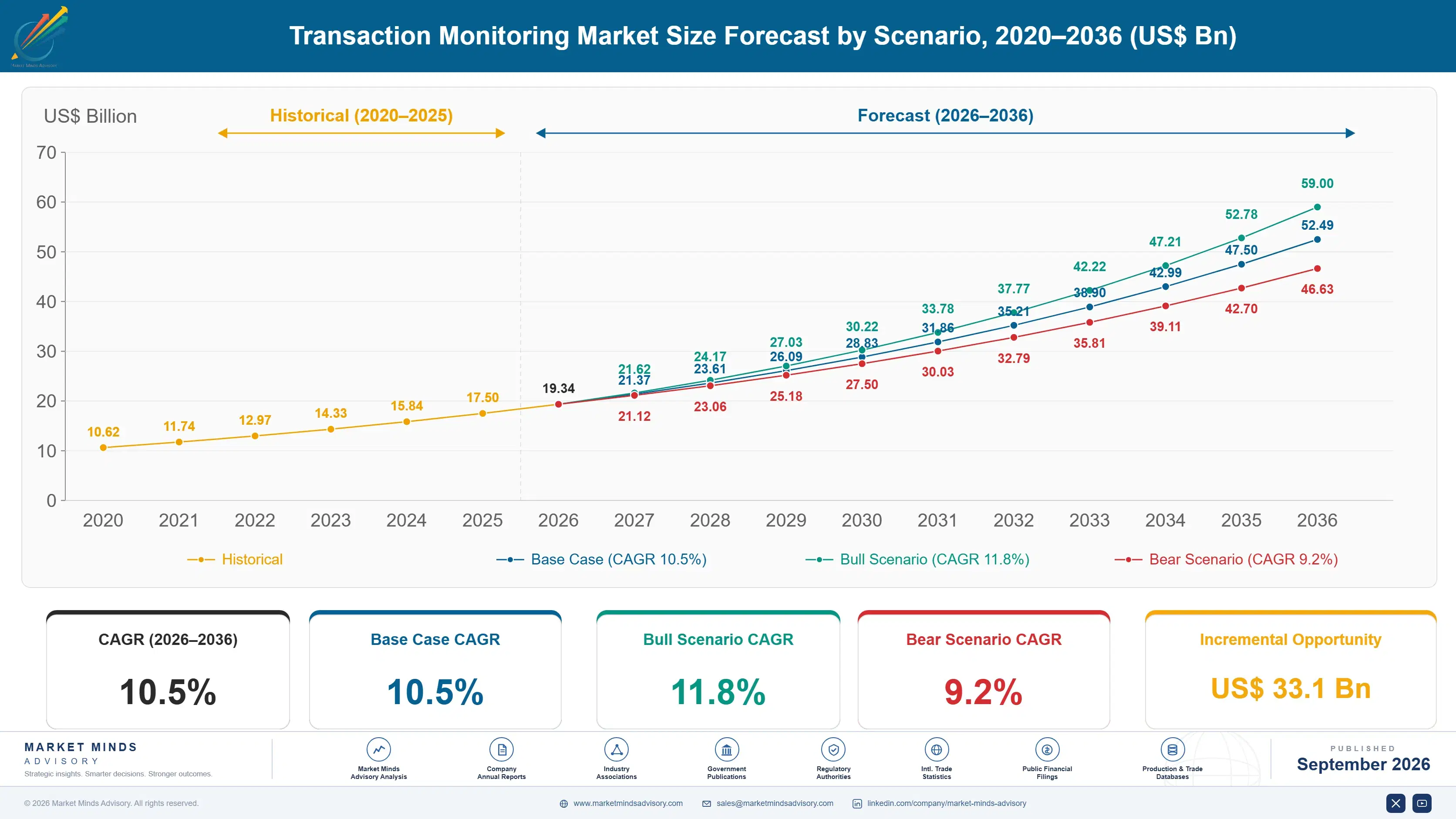
Between 2020 and 2025, the market grew steadily as banks digitized legacy screening infrastructure and expanded coverage to new payment rails following a wave of high-profile anti-money laundering enforcement settlements globally. Growth accelerated modestly toward the end of the period as cloud migration lowered deployment barriers for mid-tier institutions previously locked into expensive on-premise systems.
The base case assumes continued regulatory tightening, expanding real-time payment volumes, and gradual replacement of rule-based engines with machine learning models across the forecast period through 2036. Banks will prioritize reducing false-positive rates to cut investigation headcount costs, fintechs will adopt cloud-native platforms to meet new licensing requirements quickly, and expanding cross-border payment corridors will drive sustained demand for multi-jurisdictional sanctions screening capability across correspondent banking networks and emerging payment infrastructure.
A bull scenario emerges if a wave of new instant payment scheme mandates forces accelerated platform replacement across mid-tier banks globally within a tightly compressed multi-year window. The bear risk is prolonged litigation or regulatory delay around AI model explainability requirements, which could stall machine learning adoption and extend the life of legacy rule-based systems well beyond current projections.

Where False-Positive Reduction Determines Vendor Selection

Transaction monitoring platforms sit at the center of a compliance function under mounting pressure, since regulators worldwide have raised anti-money laundering enforcement expectations while payment volumes and velocity climb simultaneously across nearly every channel. Vendors that combine detection accuracy with defensible model explainability capture disproportionate deal volume as banks retire aging rule-based screening engines built for a slower payment era.
MARKET CONCENTRATIONCR5 35%Top five vendors hold roughly a third of revenue
AVERAGE CONTRACT VALUE$450KTypical annual enterprise license and support fee paid
TOP ADOPTING REGION SHARE30%North America leads global compliance technology spending overall
FALSE POSITIVE RATE90-95%Share of alerts requiring investigation that prove benign
CLOUD DEPLOYMENT SHARE48%Portion of new deployments choosing cloud over on-premise
ALERT INVESTIGATION COST$35 per alertAverage analyst labor cost incurred per reviewed alert
Alert volumes remain the industry's most persistent operational headache. Investigators routinely spend the overwhelming majority of their time clearing alerts that ultimately prove benign, a cost structure banks are increasingly unwilling to accept as compliance headcount budgets tighten under broader cost pressure. Machine learning models trained on historical case outcomes are gradually earning examiner trust, though full replacement of legacy systems remains a genuine multi-year undertaking for most large institutions.
Cloud deployment has become the default choice for new implementations, driven partly by faster time to production and partly by the elastic compute capacity needed to run increasingly sophisticated detection models at scale. Smaller fintechs favor fully managed services entirely, while larger banks pursue hybrid architectures that keep sensitive transaction data within regulated jurisdictional boundaries and existing data governance frameworks.
"Explainability isn't a compliance checkbox anymore, it's the deciding factor in vendor selection. The banks winning this transition are the ones treating false-positive reduction as a genuine engineering problem, not a marketing claim."
Director, Financial Crime Compliance Technology Practice · MMA Technology Practice · September 2026

Market Trends

Explainable AI Models Replace Opaque Detection Engines

Banks are shifting procurement criteria toward machine learning models that can produce examiner-ready explanations for every flagged transaction, moving away from opaque black-box scoring systems that regulators increasingly reject during routine compliance audits and examinations. Several major banks have publicly committed to replacing legacy rule engines within three to five years, citing the compounding cost of manual alert review under current false-positive rates exceeding 90% of all flagged transactions industry-wide. Vendors offering built-in explainability tooling are winning a disproportionate share of new enterprise contracts as a direct result of this shift.
Market Impact: Raises compliance budgets by roughly 25%

Real-Time Payment Rails Compress Detection Windows

The global rollout of instant payment schemes across more than 60 countries is forcing transaction monitoring vendors to redesign detection architecture around sub-second scoring windows, since transactions settle before traditional batch screening processes can complete their full review cycles under existing legacy systems built years ago. This shift has pushed several vendors toward in-memory processing and streaming architecture investments that smaller competitors struggle to fund at comparable scale. Banks operating in markets with mandatory instant payment participation face the most urgent pressure to upgrade monitoring infrastructure ahead of approaching regulatory deadlines.
Market Impact: Adds over 5,000 new sanctioned entities

Market Opportunities and Growth Drivers

Escalating Regulatory Fines Force Compliance Technology Upgrades

Global anti-money laundering enforcement penalties have exceeded several billion dollars annually in recent years, with individual bank settlements sometimes surpassing one billion dollars for systemic transaction monitoring failures identified during regulatory examinations across multiple jurisdictions worldwide. This enforcement climate is pushing chief compliance officers to secure larger technology budgets than in prior cycles, prioritizing platforms with proven detection accuracy over cheaper legacy alternatives that carry lingering examiner concerns. Boards increasingly treat monitoring system adequacy as a direct governance and reputational risk requiring active oversight and dedicated capital allocation each year.
Market Impact: Consumes 90% of investigator working hours

Cross-Border Payment Growth Expands Sanctions Screening Demand

Cross-border payment volumes have grown steadily as global trade and remittance flows expand, requiring transaction monitoring platforms to screen against an increasingly complex web of sanctions lists spanning dozens of jurisdictions simultaneously across correspondent banking networks and emerging payment corridors worldwide today and beyond. Recent geopolitical conflicts have added thousands of new sanctioned entities to global watchlists within a short period, forcing continuous list updates and rescreening of existing customer bases. Banks operating across multiple regulatory jurisdictions face compounding complexity, driving demand for unified screening platforms over fragmented, jurisdiction-specific point solutions.
Market Impact: Fragments monitoring across over 50 jurisdictions

Market Restraints and Challenges

False Positive Rates Strain Compliance Team Budgets

False positive rates above 90% remain the industry's core operational friction, rooted in rule-based detection logic that flags statistically unusual behavior without genuinely distinguishing legitimate activity from suspicious intent at the individual transaction level across most institution portfolios today. The commercial impact is severe: banks employ large investigation teams whose primary function is clearing alerts that ultimately require no further action, a cost structure that scales poorly as transaction volumes grow. Vendors are exploring machine learning retraining pipelines and analyst feedback loops to gradually reduce false-positive generation over successive model iterations.
Market Impact: Cuts alert latency by 90%

Data Privacy Regulation Limits Cross-Border Data Sharing

Data localization and privacy regulations across multiple jurisdictions restrict how transaction data can be transferred or processed outside national borders, rooted in growing government concern over customer financial data sovereignty and rising foreign surveillance risk exposure across regions. The commercial impact falls hardest on multinational banks needing a unified global view of customer transaction behavior for effective monitoring, since data residency requirements fragment their detection capability by country and regulatory regime. Some vendors now offer federated learning architectures that train shared models without physically moving raw transaction data across borders.
Market Impact: Spans over 60 countries now
3 additional market trends, 4 additional growth drivers, and 2 additional restraints and challenges are covered in the full report. Contact sales@marketmindsadvisory.com to access the complete intelligence.

Segment CAGR and Growth Architecture

Transaction monitoring segments by underlying detection technology and solution focus across six categories, spanning rule-based screening through AI and machine learning models to specialized sanctions and case management systems used across banking. Each represents a distinct technical approach to identifying suspicious financial activity, rather than overlapping product tiers within a single detection category or hierarchy.
transaction-monitoring-market-market-share-analysis-1789991863083

AI and Machine Learning-Based Transaction Monitoring Systems

AI and machine learning-based transaction monitoring systems are growing fastest as banks seek to escape the false-positive burden inherent in static rule-based detection logic built for an earlier, slower payment era. These platforms apply behavioral modeling and anomaly detection trained on historical case outcomes, continuously refining detection accuracy as new labeled data accumulates from investigator decisions across each review cycle. Regulatory acceptance has improved meaningfully as vendors invest in model explainability tooling that produces examiner-ready justifications for every flagged transaction. Large banks with dedicated data science teams are adopting these systems fastest, while mid-tier institutions increasingly access the same capability through managed cloud platforms rather than building in-house expertise from scratch.
CAGR 15.0%

Real-Time Payment Fraud Monitoring Systems

Real-time payment fraud monitoring systems are expanding rapidly alongside the global rollout of instant payment schemes that settle transactions within seconds rather than the batch cycles traditional monitoring architecture originally assumed decades ago across most banking networks. These systems require fundamentally different architecture, processing scoring decisions in-line before a payment settles rather than reviewing transactions after the fact once funds have already moved between accounts. Vendors serving this category increasingly differentiate on latency performance, since financial institutions treat detection speed as a direct proxy for overall platform quality and reliability. Adoption concentrates among banks and payment processors operating in jurisdictions with mandatory instant payment participation requirements imposed by national regulators.
CAGR 13.0%
Full segment breakdown across 6 segments available in the complete report.

Regional Architecture and Country Demand Map

North America leads global transaction monitoring spending given its stringent Bank Secrecy Act enforcement regime and dense concentration of major banking institutions. East Asia and Western Europe follow closely, while South Asia and Pacific posts the fastest regional growth as digital payment adoption accelerates across expanding fintech markets.

North America

North America's dominance rests on the Bank Secrecy Act's strict enforcement mechanism, which has produced some of the largest anti-money laundering settlements globally and forced banks to maintain the industry's most sophisticated monitoring infrastructure available anywhere in the world today. The region also hosts the headquarters of most leading vendors, including NICE Actimize, FICO, and Oracle's financial crime division, concentrating both demand and supply within the same geography and technology talent pool. Correspondent banking relationships spanning dozens of countries route through American financial institutions, adding cross-border screening complexity that keeps technology budgets elevated even as domestic transaction volume growth moderates relative to earlier decades of rapid expansion and industry consolidation activity.
Share: 30% | CAGR: 11.5% (2026 to 2036)

Western Europe

Western Europe's transaction monitoring demand traces directly to the European Union's Anti-Money Laundering Directive framework, which has meaningfully tightened reporting obligations for banks and payment institutions operating across member states considerably in recent years and continues to evolve further still. German and French banks have led adoption of consolidated monitoring platforms following several high-profile compliance failures at major regional institutions that drew significant regulatory scrutiny and lasting reputational damage across the wider sector. The region's fragmented regulatory landscape, spanning dozens of national supervisory authorities alongside the European Banking Authority, creates persistent complexity for vendors serving cross-border institutions that must satisfy multiple overlapping national reporting regimes simultaneously across jurisdictions and languages.
Share: 22% | CAGR: 9.0% (2026 to 2036)
Regional intelligence for 5 additional markets available in the complete report: East Asia, South Asia and Pacific, Latin America, Middle East and Africa, Eastern Europe. Contact sales@marketmindsadvisory.com.
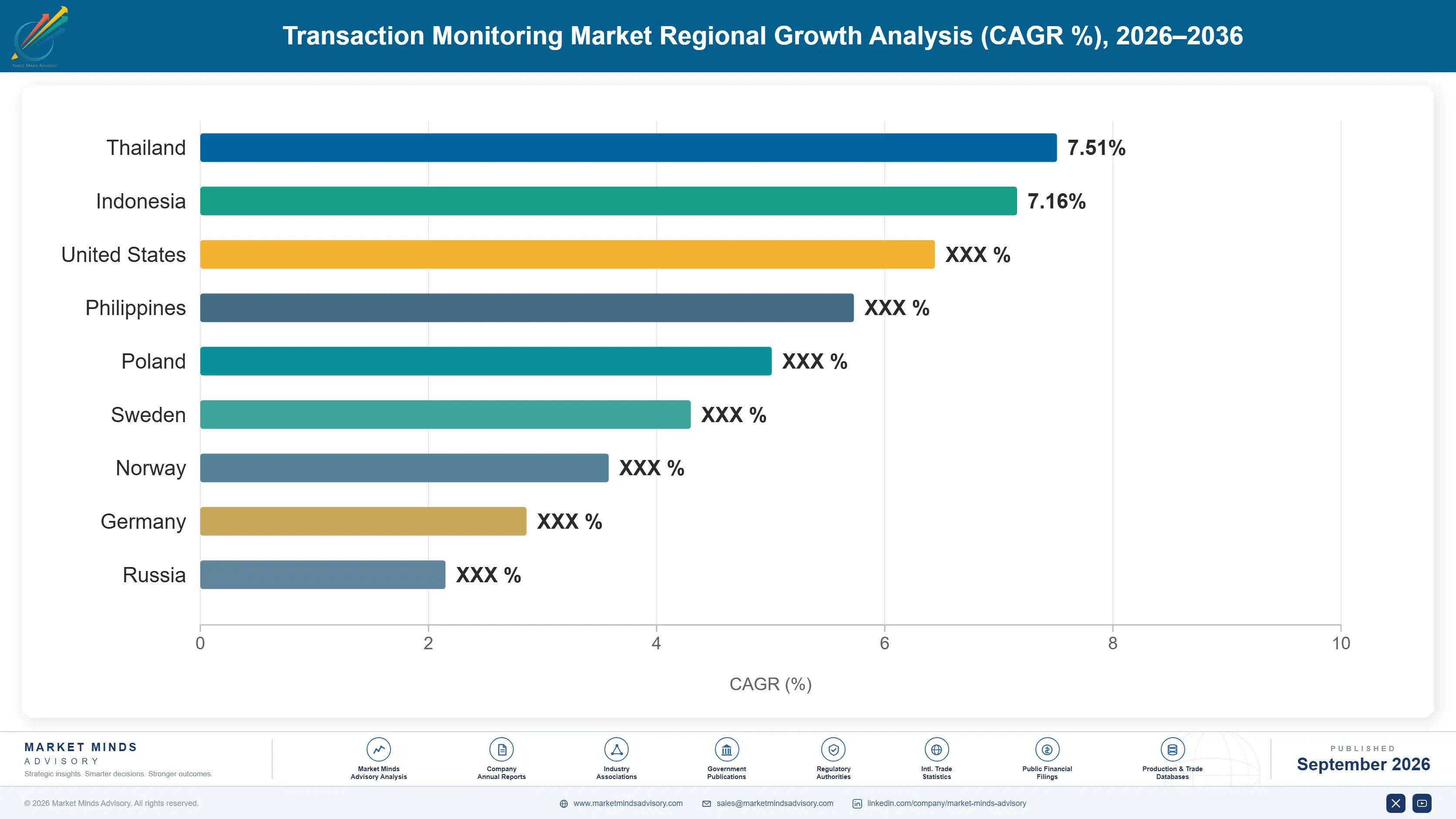
transaction-monitoring-market-country-cagr-analysis-1789991863634

Where Vendors Can Defend Contract Pricing

Revenue expansion in transaction monitoring depends less on new customer acquisition and more on deepening wallet share within existing accounts, since switching costs and regulatory requalification burdens keep customer churn low across the enterprise banking segment, favoring vendors who steadily expand their footprint account by account across each successive renewal cycle over the years.

Explainability and Model Governance Tooling Upsell

Vendors offering built-in model explainability and governance documentation can charge meaningful price premiums, since banks facing examiner scrutiny will pay for tooling that measurably reduces audit preparation time and overall compliance risk exposure across the entire organization structure and reporting hierarchy. Several vendors report contract values rising by roughly 20% when explainability modules are bundled into core platform licenses rather than sold separately as standalone add-ons afterward. This positioning matters most for large banks with dedicated model risk management teams evaluating every algorithmic decision system deployed across the compliance function today.
Market Impact: Lifts total contract value by roughly 20% overall

Managed Alert Investigation Services Expansion Strategy

Offering managed alert triage and investigation services alongside core software licenses lets vendors capture recurring revenue well beyond the initial platform sale, addressing the persistent staffing shortage compliance departments face across the industry today and for the foreseeable future ahead across most global markets and regulatory jurisdictions. This service layer can add 15 to 25% incremental revenue per account, since banks increasingly prefer outsourcing labor-intensive alert review rather than expanding internal headcount amid ongoing budget constraints across most institutions and jurisdictions worldwide, particularly among smaller regional and community banking players.
Market Impact: Adds 15 to 25% incremental revenue per account

Cross-Border Sanctions Screening Module Upgrade Strategy

Banks operating across multiple jurisdictions increasingly pay premium pricing for unified sanctions screening modules that consolidate dozens of national watchlists into a single searchable database, replacing fragmented point solutions previously purchased separately per country and regulatory regime. Vendors offering this consolidation typically see contract expansion of 10 to 18% when customers migrate from standalone screening tools to an integrated module bundled within the core monitoring platform license. This lever works best for banks with meaningful correspondent banking exposure across several regulatory regimes simultaneously, where fragmentation costs compound quickly over time.
Market Impact: Expands total contract value by 10 to 18%

Cloud Migration and Managed Hosting Contract Upsell

Vendors offering fully managed cloud hosting alongside their core software can convert one-time license sales into recurring subscription revenue, capturing ongoing infrastructure margin that on-premise deployments never generate for the vendor across the entire contract lifetime. Migration to managed cloud hosting typically increases total contract value by 12 to 20% over the equivalent on-premise deployment, since customers pay for elastic compute capacity and vendor-managed security patching bundled into a single subscription fee structure each month. Mid-tier banks without dedicated infrastructure teams represent the strongest adoption segment for this particular lever.
Market Impact: Increases total contract value by 12 to 20%

Who Controls the Margin Pool

The transaction monitoring market shows moderate concentration, with the top five vendors controlling roughly 35% of global revenue given the regulatory certification, model validation history, and deep banking relationships required to compete credibly. NICE Actimize and SAS Institute hold a substantial scale advantage over FICO and the remaining challengers, backed by decades of financial crime compliance deployment history that newer entrants cannot quickly replicate at comparable enterprise scale.
Current competitive activity centers on machine learning explainability tooling and managed alert investigation service expansion, with major vendors announcing integrated platforms that combine detection, case management, and analyst workflow automation into a single offering. Several vendors are pursuing cloud-native architecture rebuilds, seeking to displace legacy on-premise incumbents whose systems predate modern real-time payment requirements entirely.

Emerging pressure comes from specialized regtech startups like Quantexa and ThetaRay rapidly closing the technology gap with established compliance vendors, supported by venture capital targeting explainable AI and graph-based network analysis capability. Rankings could shift meaningfully over the coming decade as machine learning model performance, rather than legacy banking relationships alone, becomes the primary basis for competitive differentiation within the highest-value enterprise segment.
transaction-monitoring-market-company-positioning-matrix-1789991864161

Competitive Moat and Risk Dimensions

NICE ACTIMIZE

Moat: Entrenched Enterprise Deployment Base

NICE Actimize's moat rests on three decades of embedded relationships inside the largest global banks, where its platform has become the default system of record for financial crime investigation workflows. Switching costs run high: replacing a deployment touching every transaction requires a multi-year requalification project few compliance officers sponsor without a serious detection failure forcing the decision.
NICE ACTIMIZE

Risk: Slower Cloud Migration Pace

NICE Actimize's legacy architecture faces mounting pressure from cloud-native challengers offering faster implementation timelines and lower total cost of ownership. Customers increasingly compare multi-year implementation cycles against competitors promising deployment in months, and if NICE cannot accelerate its own cloud migration roadmap, it risks losing new logo growth to nimbler entrants even while retaining its large existing installed base.
SAS INSTITUTE

Moat: Bundled Analytics Software Stack

SAS Institute pairs its transaction monitoring platform with a broader analytics and data management software stack already embedded across many banks' risk functions, letting it sell integrated compliance solutions rather than standalone point products. This bundled positioning makes SAS difficult to displace within accounts already running its statistical modeling tools for credit risk and other analytical functions.
SAS INSTITUTE

Risk: Per-Seat Pricing Model Pressure

SAS Institute's per-seat licensing model faces pressure from vendors offering usage-based or transaction-volume pricing that scales more predictably for high-growth fintech customers. Younger, cloud-native competitors are winning fintech accounts specifically because SAS's pricing model penalizes rapid transaction growth, a segment increasingly important as instant payment adoption expands.

Players Tracked

Prominent Players

NICE Actimize
SAS Institute
Oracle
FICO
BAE Systems Applied Intelligence

Other Key Players

Verafin
ComplyAdvantage
Feedzai
ACI Worldwide
Fiserv
FIS
Temenos
London Stock Exchange Group Risk Intelligence
Dow Jones Risk and Compliance
Napier AI
Quantexa
ThetaRay
Featurespace
Hawk AI
SymphonyAI

Recent Developments

FEBRUARY 2026

NICE Actimize acquired a machine learning explainability startup in February 2026, adding examiner-ready model documentation tooling to its core transaction monitoring platform. The deal extends the company's ability to satisfy regulatory scrutiny of algorithmic decision systems, addressing a growing customer concern as banks migrate toward newer, more transparent detection approaches.
Signal: Signals explainability tooling becoming a required baseline feature for compliance vendors rather than a competitive differentiator.
MAY 2026

SAS Institute and a major cloud infrastructure provider announced a joint venture in May 2026 to deliver managed transaction monitoring hosting for mid-tier banks lacking dedicated infrastructure teams. The venture combines SAS's detection models with elastic cloud compute capacity, targeting institutions priced out of enterprise-grade monitoring by high infrastructure costs.
Signal: Signals major cloud infrastructure providers partnering directly with compliance vendors to reach underserved mid-tier banking customers.
APRIL 2026

Oracle secured a multi-year supply agreement in April 2026 with a consortium of regional banks to deploy its financial crime compliance suite across their combined transaction processing infrastructure. The agreement represents one of the largest multi-bank consortium deployments announced this year, reinforcing Oracle's positioning in cost-sharing arrangements among smaller institutions.
Signal: Signals consortium-based deployments emerging as a viable and durable cost-sharing model for smaller regional banking institutions.

Where Cloud Compute Costs Squeeze Vendor Margins

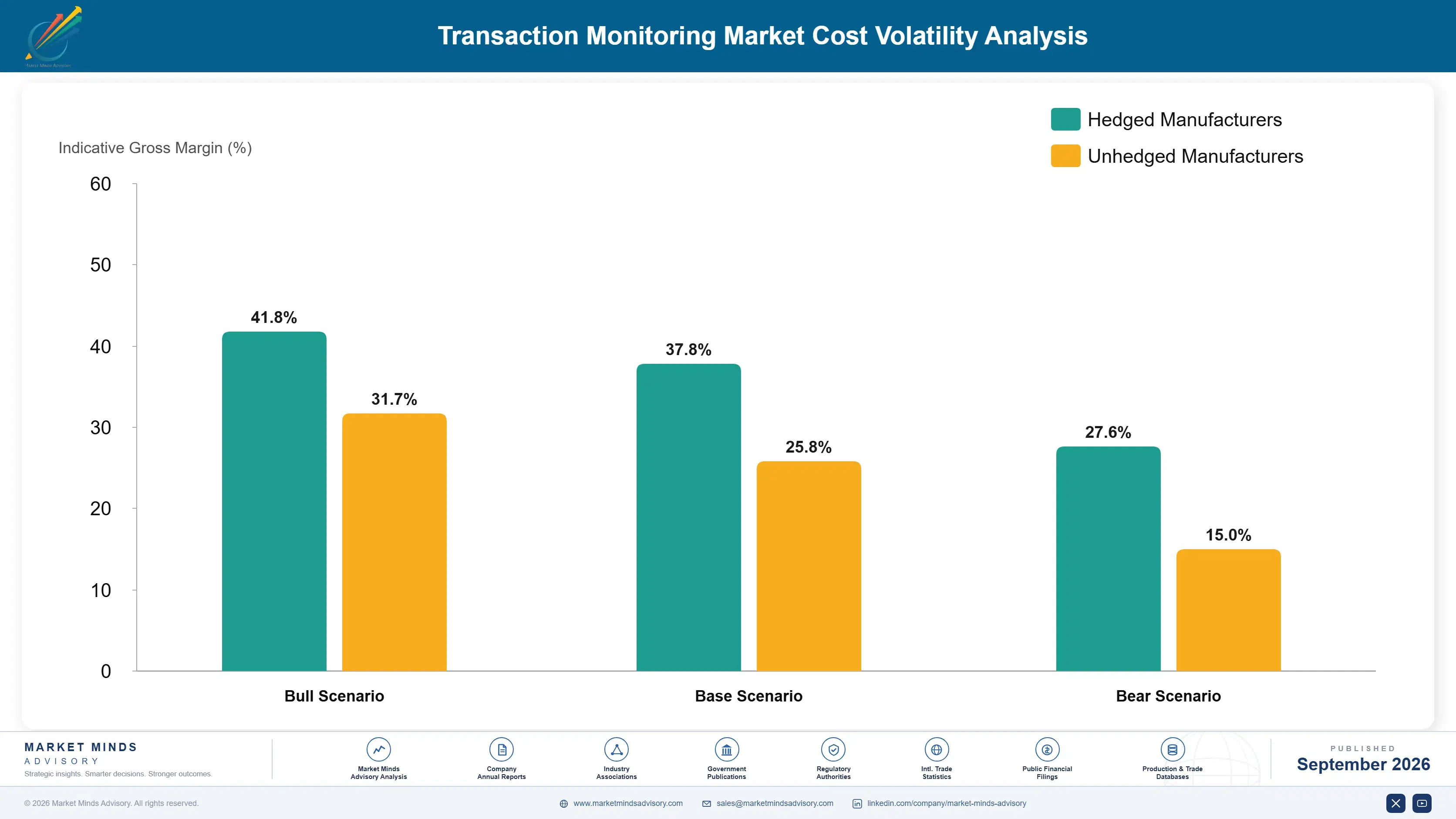
Cloud compute and data storage infrastructure represent approximately 35% of total cost of goods sold for transaction monitoring software vendors, with machine learning model training compute adding a further 15%. Most vendors source infrastructure from a concentrated group of three hyperscale cloud providers, leaving them exposed to pricing changes and regional capacity constraints during periods of elevated demand for graphics processing compute.
Cloud compute pricing volatility during 2023 and 2024 significantly raised operating costs for vendors running large-scale machine learning training workloads, with several major cloud providers reporting sustained graphics processing unit shortages in their annual investor filings during that period. The disruption forced smaller vendors to delay planned model retraining cycles, temporarily degrading detection accuracy improvements that customers had already been promised in contract renewal negotiations underway at the time.

Smaller vendors without long-term committed-use cloud contracts face a persistent competitive disadvantage, often paying on-demand pricing premiums of 20 to 30% above the negotiated rates larger competitors secure through multi-year enterprise agreements. This exposure varies by business model too: vendors offering fully managed cloud services absorb more infrastructure cost volatility directly than those licensing software for customer-hosted deployment.
transaction-monitoring-market-cost-volatility-analysis-1789991864357

Securing Multi-Year Committed-Use Cloud Agreements

Larger vendors are locking in multi-year committed-use agreements directly with hyperscale cloud providers, guaranteeing capacity priority and discounted pricing ahead of on-demand buyers during periods of tight compute supply. These agreements typically require upfront usage commitments but protect margins by fixing infrastructure pricing well ahead of customer contract renewal cycles and model retraining schedules.

Diversifying Compute Workloads Across Multiple Cloud Regions

Several vendors are distributing machine learning training workloads across multiple cloud regions and infrastructure providers, reducing dependency on any single provider's capacity constraints during periods of elevated market demand nationwide overall. This multi-cloud approach adds modest architectural complexity upfront but has proven effective at maintaining consistent model retraining schedules even during regional compute shortages.

Optimizing Model Architecture to Reduce Compute Intensity

Several vendors are redesigning machine learning model architectures to reduce compute intensity per training run, adopting more efficient algorithms that achieve comparable detection accuracy using meaningfully less graphics processing capacity overall. This engineering investment reduces ongoing infrastructure cost exposure and shortens the retraining cycle needed to keep detection models current with evolving fraud patterns.

Portfolio Architecture for Margin Defence

Portfolio architecture in transaction monitoring splits into three distinct tiers, ranging from commodity rule-based screening competing on price to certified AI-driven platforms carrying substantial margin premiums. Gross margins vary from the low twenties on basic rule engine licenses to over 55% on integrated machine learning platforms with proven explainability tooling, reflecting the regulatory certification and multi-year model validation history required to sell credibly into large enterprise banking accounts.
Volume economics still matter for smaller regional banks, since basic screening licenses account for a meaningful share of total contracts signed annually. But value concentrates elsewhere: large enterprise banks running AI-driven platforms with managed alert investigation services generate a disproportionate share of vendor profit, paying recurring subscription fees for capability that basic rule engines cannot deliver at comparable detection accuracy.

The highest-value pools sit at the intersection of explainable machine learning and managed services, where vendors combining both can command premium pricing that pure software licensors cannot match. Sustainability-adjacent regulatory categories, including environmental crime financing detection, remain smaller today but are attracting disproportionate development investment, since emerging mandates create durable competitive barriers that commodity rule-based vendors struggle to clear without years of specialized model development.

Basic rule-based screening engines sold largely on per-transaction price, with gross margins in the low twenties given intense competition from low-cost regional and legacy vendors offering limited product differentiation nationwide.
Gross Margin

AI-driven platforms carrying explainability certification and proven detection accuracy track records, commanding gross margins in the low forties as banks pay for reduced false-positive investigation costs and faster examiner approval.
Gross Margin

Fully explainable, regulator-validated platforms paired with managed alert investigation services, achieving gross margins above 55% through certification barriers and recurring subscription revenue streams that competitors cannot quickly or easily replicate.
Gross Margin
transaction-monitoring-market-portfolio-architecture-1789991864853

High-value Sub-segments and Strategic Watch-out

AI and Machine Learning-Based Transaction Monitoring Systems

AI and machine learning-based transaction monitoring systems combine the fastest projected growth with the highest per-contract margins in the portfolio, driven by accelerating false-positive reduction demand across enterprise banking accounts. Vendors capturing this segment early are positioned to defend pricing power as customers standardize on explainable analytics platforms.

Real-Time Payment Fraud Monitoring Systems

Real-time payment fraud monitoring systems pair strong growth with meaningful margin premiums, supported by mandatory instant payment scheme rollouts across dozens of countries. This segment carries higher technical barriers than legacy batch monitoring, which limits new entrant competition and helps established vendors with proven latency performance retain pricing discipline.

Sanctions and Watchlist Screening Systems

Sanctions and watchlist screening systems represent the volume core of the market, generating the largest contract count even as growth moderates relative to AI-driven and real-time categories. Margins here run thinner, but the recurring list update obligation provides vendors with a durable services revenue stream across every customer relationship.

Rule-Based Transaction Monitoring Systems

Rule-based transaction monitoring systems carry the slowest growth in the portfolio and warrant strategic monitoring rather than heavy near-term investment, given accelerating displacement by machine learning alternatives industry-wide. A slower-than-expected regulatory acceptance of AI explainability could extend this segment's relevance meaningfully within certain conservative jurisdictions.

Where Compliance Spending Becomes Recurring Infrastructure

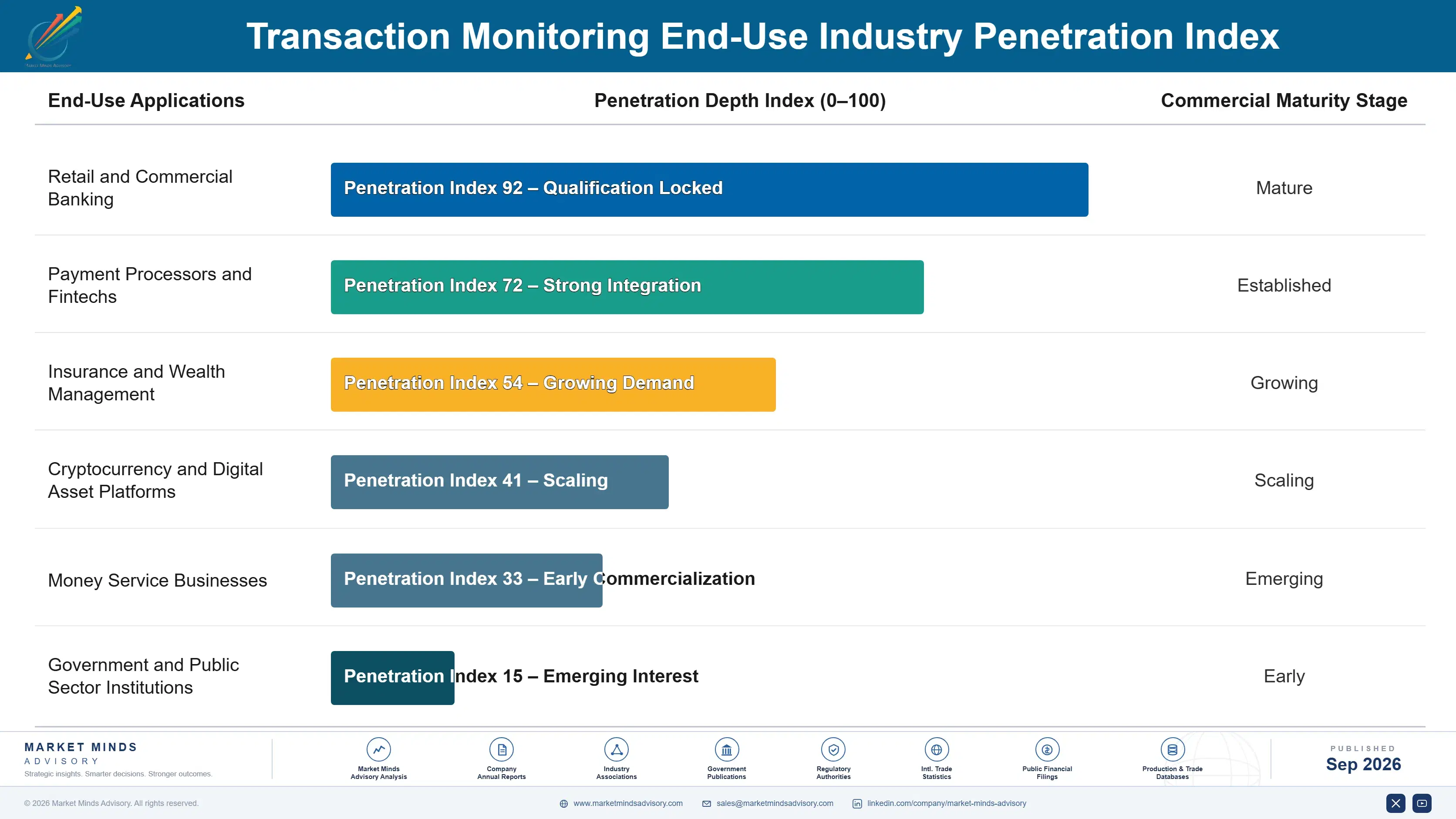
Transaction monitoring deployments generate annuity-like economics once installed, since banks rarely rip out functioning compliance infrastructure feeding regulatory reporting pipelines and instead expand coverage incrementally to additional transaction types. Vendors capture recurring revenue through model retraining subscriptions, list update services, and increasingly through managed alert investigation tiers layered on top of the original platform license, creating revenue that compounds over the customer relationship's lifetime.
Adoption depth and stickiness vary considerably by end-use vertical. Large money-center banks, once integrated with a vendor's regulatory reporting workflows, rarely switch providers given the requalification burden involved, while fintechs show comparatively higher churn given lower switching costs and more standardized integration protocols. Payment processors sit between these extremes, anchored by real-time latency requirements but still exposed to competitive displacement during major platform upgrade cycles.

A generational shift in buyer profile is underway as chief data officers and machine learning engineering leads, rather than pure compliance officers, increasingly influence the purchasing decision for monitoring platforms. These technical buyers prioritize model explainability and integration flexibility over vendor brand reputation, favoring providers who can demonstrate measurable false-positive reduction across comparable bank deployments rather than theoretical accuracy claims.
transaction-monitoring-market-end-use-penetration-index-1789991865345

Where Vendors Should Focus Investment

These are among the four positions where our research anticipates prominent divergence between winners and laggards over the coming forecast period. Each is grounded in the demand model, the regulatory perimeter, and the announced capacity pipeline.
01 / EXPLAINABILITY TOOLING INVESTMENT

Prioritize model explainability over raw detection accuracy improvements

Banks facing intensifying examiner scrutiny value model explainability as much as raw detection accuracy, since an unexplainable flag carries genuine regulatory risk regardless of its statistical precision. NICE Actimize and SAS Institute have already demonstrated this shift, investing heavily in governance documentation tooling to defend pricing power against cloud-native entrants lacking comparable regulatory track records. Vendors delaying this investment risk losing enterprise renewals to competitors offering examiner-ready model documentation as a standard platform feature within the next several contract cycles.
02 / MANAGED SERVICE LAYER EXPANSION

Build managed alert investigation services to capture recurring revenue

Banks facing persistent compliance staffing shortages increasingly prefer outsourcing labor-intensive alert investigation to vendors offering managed service tiers rather than expanding internal headcount amid tightening budget constraints across most institutions. Vendors without this service layer capture only the initial software license value, leaving substantial recurring revenue on the table that service-oriented competitors are actively capturing instead. Building managed investigation capability should be treated as a core strategic priority rather than an optional add-on offered opportunistically to a handful of large accounts.
03 / REAL-TIME LATENCY ENGINEERING

Invest in sub-second scoring architecture ahead of instant payment mandates

Instant payment schemes settling transactions within seconds are forcing a fundamental architecture shift away from batch monitoring toward in-line, sub-second scoring decisions that must complete before a payment finalizes entirely. Vendors that invest early in this architecture can differentiate on latency performance, a metric banks increasingly treat as a direct proxy for platform quality when comparing competing systems. This positioning matters most in jurisdictions with mandatory instant payment participation, where slow-to-adapt vendors risk exclusion from procurement entirely as deadlines approach.
04 / CROSS-BORDER SCREENING CONSOLIDATION

Consolidate sanctions screening across jurisdictions ahead of geopolitical volatility

Rapidly expanding sanctions lists following recent geopolitical conflicts are forcing banks operating across multiple jurisdictions to seek unified screening platforms rather than fragmented, country-specific point solutions purchased separately over time and rising cost. Vendors offering consolidated multi-jurisdictional screening capability early can position themselves as preferred partners for correspondent banking relationships spanning dozens of countries and regulatory regimes worldwide. This dynamic will likely accelerate as geopolitical volatility continues adding new sanctioned entities to global watchlists at an increasing pace each year.

Engagement Snapshot From the Field

A live engagement with an industry participant carrying material or product regulatory and market exposure ahead of a defining policy shift, showing how our research translates into a defensible multi-year portfolio strategy.
MARKET MINDS ADVISORY · CLIENT ENGAGEMENT SUMMARY
Transaction Monitoring Producer Strategic Portfolio Review and Transition Roadmap 2026·Investment Scenario on Transaction Monitoring Exposure Evaluation 2025-26
CLIENT PROFILE
The client is a regional bank holding company operating across a dozen states with several hundred billion dollars in assets under management, generating substantial annual revenue (client-reported, unverified by MMA). The organization had relied on a legacy rule-based transaction monitoring system for over fifteen years, accumulated through multiple bank acquisitions, resulting in fragmented detection logic across different acquired institutions.
STRATEGIC CHALLENGE
The client faced mounting false-positive alert volumes that had grown unsustainable, consuming compliance department resources exceeding budget projections by a wide margin every single year (client-reported, unverified by MMA). Leadership needed a unified monitoring strategy replacing fragmented legacy systems inherited from acquisitions without disrupting ongoing regulatory examination cycles already scheduled.
MMA APPROACH
MMA conducted a comprehensive audit of existing detection logic gaps, vendor consolidation opportunities, and total cost of ownership across three competing AI-driven monitoring platforms under evaluation by the client. The engagement combined primary interviews with compliance leadership, competitive vendor benchmarking against the framework outlined in this report, and a phased migration sequencing model prioritizing highest-risk business lines first.
KEY FINDINGS
  1. Detection logic inherited from three separate acquired institutions had never been consolidated, creating overlapping and sometimes contradictory alert rules that produced duplicate investigations across the same customer accounts.
  2. The false-positive rate exceeded 93% across all monitored channels, well above industry benchmarks, driven primarily by legacy rule thresholds never recalibrated since their original acquisition-era configuration years earlier.
  3. Branches serving small business customers showed the highest false-positive concentration, since legacy rules calibrated for consumer transaction patterns flagged normal commercial cash flow activity as suspicious repeatedly.
  4. Compliance staff turnover correlated directly with alert investigation workload, as experienced analysts left for competitors offering better-supported, lower-volume monitoring environments with more modern detection tooling.
CLIENT PROFILE
The client is a regional bank holding company operating across a dozen states with several hundred billion dollars in assets under management, generating substantial annual revenue (client-reported, unverified by MMA). The organization had relied on a legacy rule-based transaction monitoring system for over fifteen years, accumulated through multiple bank acquisitions, resulting in fragmented detection logic across different acquired institutions.
STRATEGIC CHALLENGE
The client faced mounting false-positive alert volumes that had grown unsustainable, consuming compliance department resources exceeding budget projections by a wide margin every single year (client-reported, unverified by MMA). Leadership needed a unified monitoring strategy replacing fragmented legacy systems inherited from acquisitions without disrupting ongoing regulatory examination cycles already scheduled.
MMA APPROACH
MMA conducted a comprehensive audit of existing detection logic gaps, vendor consolidation opportunities, and total cost of ownership across three competing AI-driven monitoring platforms under evaluation by the client. The engagement combined primary interviews with compliance leadership, competitive vendor benchmarking against the framework outlined in this report, and a phased migration sequencing model prioritizing highest-risk business lines first.
KEY FINDINGS
  1. Detection logic inherited from three separate acquired institutions had never been consolidated, creating overlapping and sometimes contradictory alert rules that produced duplicate investigations across the same customer accounts.
  2. The false-positive rate exceeded 93% across all monitored channels, well above industry benchmarks, driven primarily by legacy rule thresholds never recalibrated since their original acquisition-era configuration years earlier.
  3. Branches serving small business customers showed the highest false-positive concentration, since legacy rules calibrated for consumer transaction patterns flagged normal commercial cash flow activity as suspicious repeatedly.
  4. Compliance staff turnover correlated directly with alert investigation workload, as experienced analysts left for competitors offering better-supported, lower-volume monitoring environments with more modern detection tooling.
RECOMMENDED STRATEGY
Phase 1: Consolidate all acquired institutions onto a single AI-driven monitoring platform within twenty-four months, prioritizing small business banking channels showing the highest false-positive concentration first. Phase 2: Recalibrate detection thresholds using two years of historical case outcomes, retraining machine learning models specifically on small business transaction patterns previously misclassified as suspicious. Phase 3: Redesign compliance staffing model around the reduced alert volume, redeploying experienced analysts toward complex investigation work rather than high-volume routine alert clearing tasks.
OUTCOME
Within eighteen months of platform consolidation, the client reported false-positive rates falling from 93% to approximately 68%, cutting investigation labor costs by roughly twelve million dollars annually (client-reported, unverified by MMA). Compliance staff turnover also declined meaningfully following the reduced alert workload across all business units.

Frequently Asked Questions

Foundational context covering the market sizes, CAGR, scope, country, region and competition that inform every finding below. This section is provided to cover basics and most often pre-purchase conversations, answered from the MMA Primary Research Dataset.

What is the current size of the Transaction Monitoring Market?

The Transaction Monitoring Market reached an estimated $17.5 billion in 2025. This base reflects rising regulatory enforcement pressure and expanding real-time payment monitoring adoption across banks and fintechs.

How large will the Transaction Monitoring Market be by 2036?

The market is projected to reach approximately $52.5 billion by 2036. This growth reflects sustained regulatory tightening, real-time payment expansion, and machine learning adoption across global banking sectors.

What is the CAGR for the Transaction Monitoring Market 2026 to 2036?

The Transaction Monitoring Market is projected to grow at a 10.5% compound annual growth rate between 2026 and 2036. This rate reflects accelerating AI adoption and payment volume growth.

Which segment is growing fastest?

AI and Machine Learning-Based Transaction Monitoring Systems is the fastest-growing segment, expanding at 15.0% annually, roughly 1.43 times the overall market rate. This reflects accelerating demand for explainable detection models.

Who are the major companies in the Transaction Monitoring Market?

Major companies include NICE Actimize, SAS Institute, Oracle, FICO, and BAE Systems Applied Intelligence. These vendors combine deep banking relationships with expanding machine learning detection capability.

Which country is growing fastest?

India is the fastest-growing country, driven by rapid digital payment expansion through its Unified Payments Interface and tightening central bank compliance mandates. Its 15.5% projected CAGR outpaces the broader South Asia and Pacific regional average.

Report Segmentation Architecture

The full report scope spans multiple orthogonal segmentation dimensions, with cross-tabulated demand data provided for each dimension pair. Coverage extends further to regional breakdowns, trend trajectories, and the competitive detail needed to support segment-level decision-making.

By Solution Type

  • AI and Machine Learning-Based Transaction Monitoring Systems
  • Real-Time Payment Fraud Monitoring Systems
  • Cross-Border Transaction Monitoring Systems
  • Sanctions and Watchlist Screening Systems
  • Case Management and Investigation Systems
  • Rule-Based Transaction Monitoring Systems

By End-Use Industry

  • Retail and Commercial Banking
  • Payment Processors and Fintechs
  • Insurance and Wealth Management
  • Cryptocurrency and Digital Asset Platforms
  • Money Service Businesses
  • Government and Public Sector Institutions

By Commercial Dimension

  • Software Licensing
  • Managed Alert Investigation Services
  • Implementation and Integration Services
  • Model Retraining and Support Subscriptions

By Region

  • North America
  • Western Europe
  • East Asia
  • South Asia and Pacific
  • Latin America
  • Middle East and Africa
  • Eastern Europe

Scope, Methodology, and Coverage

Every figure in this report is reproducible from documented input assumptions. The scope below maps the historical period, the forecast horizon, the segmentation dimensions, and the countries covered, alongside the underlying primary and qualitative methodology.
Historical Period
2020 to 2025
Forecast Period
2026 to 2036
Base Year
2025 (USD billions; MMA Primary Research Dataset, September 2026)
Market Definition
The Transaction Monitoring Market covers software platforms and managed services that screen financial transactions for money laundering, fraud, and sanctions violations across banking, payments, and fintech channels. It excludes general fraud analytics unrelated to regulatory compliance and standalone identity verification tools sold independently of transaction screening.
Quantitative Units
USD Billion, CAGR (%)
Segmentation Dimensions
By Solution Type, By End-Use Industry, By Commercial Dimension, By Region
Regions Covered
North America, Western Europe, East Asia, South Asia and Pacific, Latin America, Middle East and Africa, Eastern Europe
Countries Covered
United States, Canada, Germany, United Kingdom, France, China, Japan, South Korea, India, Australia, Brazil, Mexico, Saudi Arabia, United Arab Emirates, Poland
Key Companies Profiled
NICE Actimize, SAS Institute, Oracle, FICO, BAE Systems Applied Intelligence, Verafin, ComplyAdvantage, Feedzai, ACI Worldwide, Fiserv, FIS, Temenos, London Stock Exchange Group Risk Intelligence, Dow Jones Risk and Compliance, Napier AI, Quantexa, ThetaRay, Featurespace, Hawk AI, SymphonyAI
Quantitative Methodology
Primary survey, n=3,800 respondents, Q4 2025, six countries; demand-side model with trade association cross-validation
Qualitative Methodology
47 expert interviews, Q4 2025; applied to validate demand model assumptions, identify emerging dynamics, and assess competitive positioning
Report Format
PDF and XLSX data workbook (Word format preview document)
Publisher
Market Minds Advisory
Report Code
MMA-2026-TEC-941
Published
September 2026
Contact
sales@marketmindsadvisory.com | www.marketmindsadvisory.com

Purchase the full Transaction Monitoring Market Report (2026 to 2036).

This report provides comprehensive analysis of the Transaction Monitoring Market across all major solution types, regions, and competitive dynamics through 2036. It combines primary survey data from 3,800 respondents with 47 expert interviews conducted across six countries during the fourth quarter of 2025. The analysis covers segment-level growth forecasts, regional demand architecture, and competitive positioning assessments across the full ten-year forecast horizon, spanning banking, payments, and fintech channels. Readers gain the strategic context needed to inform investment prioritization, vendor selection, and market entry timing decisions.
Ten-year market sizing and forecast model
Segment-level growth and margin analysis breakdown
Regional demand architecture across seven regions
Competitive benchmarking and moat risk assessment
Input cost exposure and mitigation strategies
Anonymized client engagement case study review

Built For The People Who Decide

From boardroom strategy to bench-side execution, this report is read cover-to-cover by leaders shaping the next decade of their industry, turning demand scenarios, market dynamics and valuation benchmarks into decisions.
CXOs/ Presidents/ VPs/ Managers
M&A and Corporate Development
Strategy Teams and R&D Heads
Procurement and Product Directors
Regulatory and Compliance Leaders
Investor Relations and Equity Analysts