Market Minds Advisory
Traffic Road Marking Coatings Market

Traffic Road Marking Coatings Market: Written for the Eye, Now Read by a Camera

Marking standards were written around headlights and human vision, and the machine reading the lane now needs consistent edges in the rain rather than a number measured on a dry road.

Lead Analyst

Bilal Shaikh

Published

September 2026

Make Smarter Decisions with Customized Research Insights

Request a free sample report and evaluate market opportunities, growth trends, and competitive dynamics relevant to your business needs.

2025 MARKET VALUE$6.4BMarket Size 2025
2036 FORECAST VALUE$11.7BBase Case , 2026 to 2036
CAGR 2026 TO 20365.6 %Bull 6.8% / Bear 4.4%
INCREMENTAL OPPORTUNITY$4.9BNet 10- year value creation
EXPANSION MULTIPLE1.72x2036 value over 2026 base
Strategic Levers
M&A Pipeline
Regional Outlook
Country Rankings
Competitive Intelligence
Segmental Deep-dive
Call-Us : 91 93563 13602

Executive Snapshot and Market Trajectory

Road markings acquired a second customer and nobody rewrote the specification. Lane keeping and driver assistance systems read lines with cameras, which need consistent edges and contrast rather than the dry retroreflectivity figure that standards have measured since headlights were the only reader.
The gap shows worst in rain. A water film destroys around 85% of retroreflective performance, which is exactly when lane departure matters most, and dry measurement records none of that. Cold applied plastics grow at 8.4%, half again the market rate of 5.6%, because profiled and structured systems keep working when the road is wet. Tenders measuring only the dry figure hand the work to a material that stops performing when it rains.
Application decides more than material does, which the industry rarely says plainly. Glass beads have to sit embedded to roughly 60% of their diameter: shallower and they fall out within months, deeper and light never reaches them. That is a crew and equipment variable, and it explains most premature failure. Material is only around 22% of applied cost anyway, so procurement optimising material price is negotiating the smallest line.
Market Definition
Materials applied to road surfaces to form durable visible markings, covering hot applied thermoplastics, waterborne traffic paints, cold applied plastics, solvent-borne traffic paints, preformed tapes and markings, and glass beads and retroreflective media. Measured at manufacturer selling value. Excludes application equipment and vehicles, road signage and delineators, traffic management services, and pavement construction materials.
Base Year Value
$6.4B in 2025 (MMA Primary Research Dataset, August 2026)
Forecast Period
2026 to 2036, eleven discrete annual values
CAGR
5.6% base case. Bull 6.8%. Bear 4.4%.
Fastest Growth Segment
Cold Applied Plastics: 8.4% CAGR
Fastest Growth Country
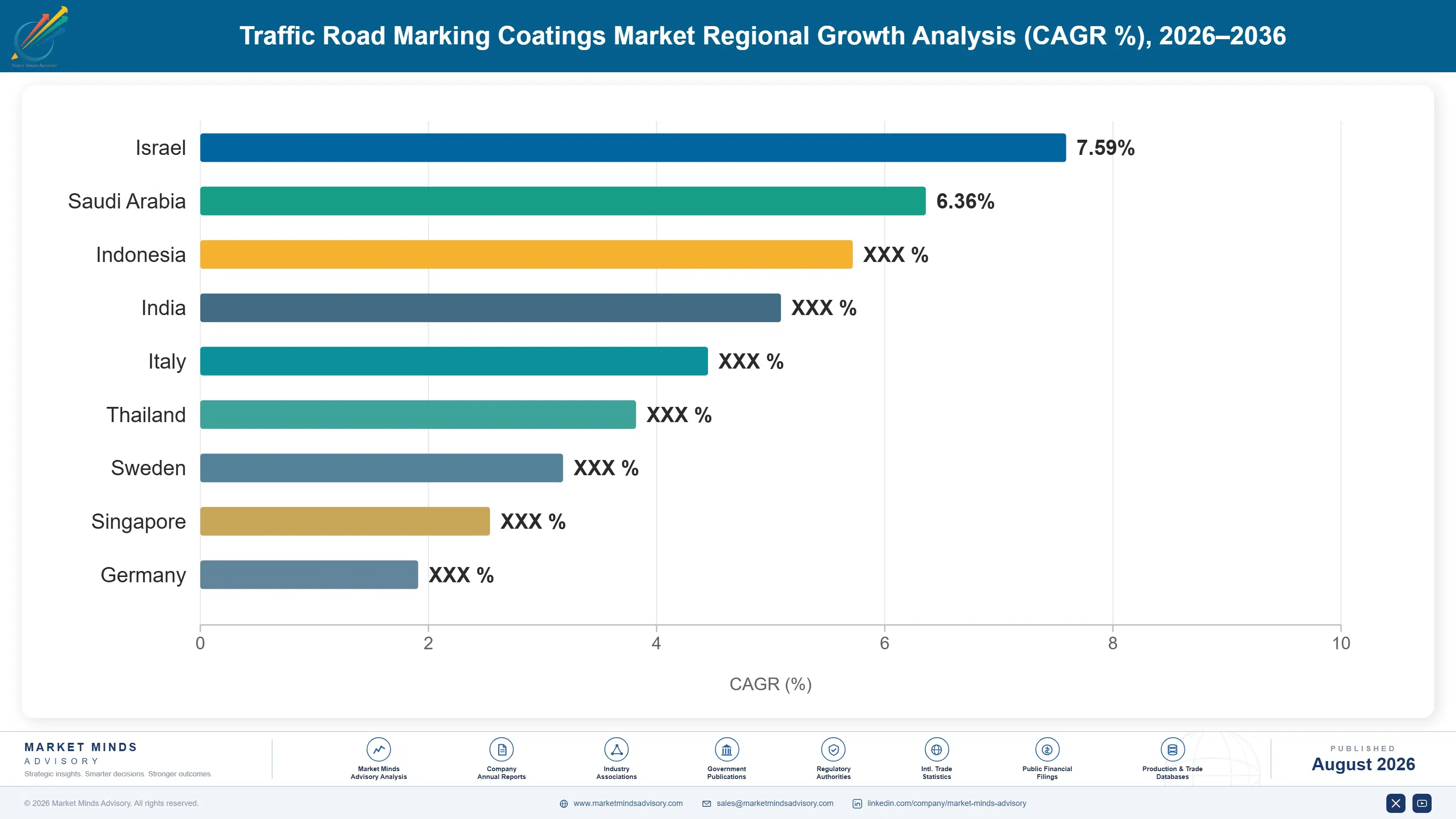
India: 10.4% CAGR
Fastest Growth Region
South Asia and Pacific: 7.6% CAGR
Largest Region
East Asia: 28% of 2025 global value
Market Leaders
3M, Swarco, Geveko Markings, PPG Industries, Sherwin-Williams. Source: MMA Primary Research Dataset, July 2026.
Primary Survey
n=3,800 procurement and R&D decision-makers, Q4 2025, six countries
Methodology
Demand-side build-up, cross-validated against public data, 47 expert interviews

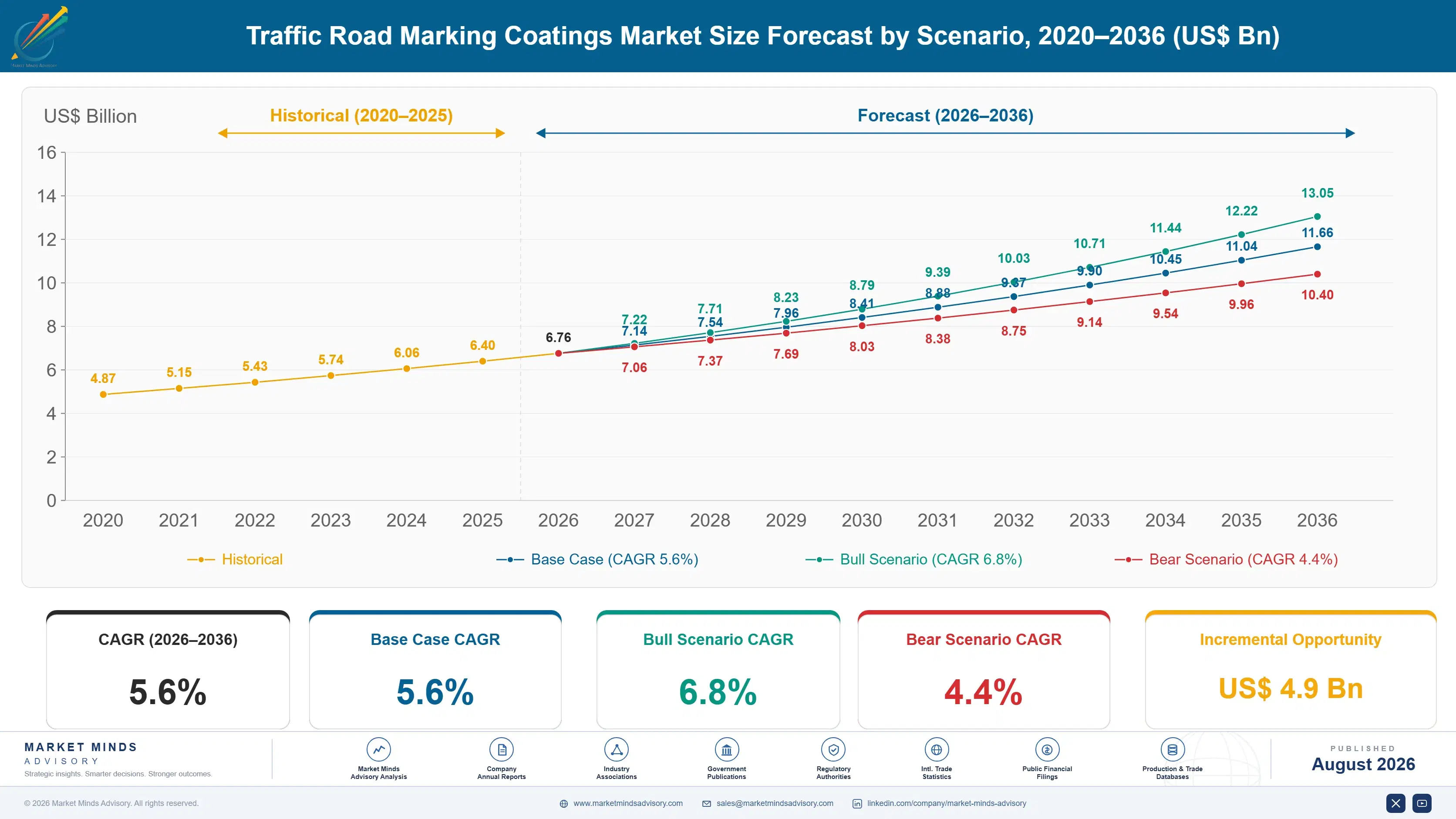
Traffic Road Marking Coatings Market Forecast Scenarios

traffic-road-marking-coatings-market-size-forecast-scenario-1787640127140
Growth ran near 4.6% between 2020 and 2025 on road construction volume across Asia and renewal cycles elsewhere. Solvent-borne systems declined steadily under emissions regulation across most developed markets. Machine vision requirements began appearing in specifications toward the end of the period, though rarely as measurable criteria rather than as stated intent. Glass bead quality became a more contested procurement subject throughout.
Base case 5.6% rests on three mechanisms. Cold applied plastics grow at 8.4% as profiled systems address wet night performance that flat markings cannot deliver. Preformed tapes grow at 6.8% on urban intersection and cycle infrastructure work. And India grows fastest of any country at 10.4% as national highway construction and state road programmes both run at unusual scale simultaneously. None of the three depends on renewal budgets rising, which are cut first whenever infrastructure funding tightens anywhere.
The bull case at 6.8% assumes machine readability entering specifications as a measurable requirement, which would reprice markings against a performance standard rather than against applied cost per kilometre. The bear case at 4.4% is infrastructure budgets tightening across major programmes, since marking renewal is deferred more easily than almost any other maintenance category when money is short.

Two Readers, One Specification

Every road marking standard in use was written when the only thing reading the line was a driver with headlights. Retroreflectivity measured on a dry surface in millicandelas made sense for that reader. Cameras running lane keeping need something different: consistent edges, contrast holding across weather, and a line a human could infer but an algorithm cannot.
TOP FIVE CONCENTRATION38%Material producers and bead suppliers occupy quite separate positions
BEAD EMBEDMENT TARGET60%Portion of each bead depth that must sit below surface
WET RETROREFLECTIVITY LOSS85%Performance lost when a water film covers the marking
THERMOPLASTIC SERVICE LIFE4 yearsInterval between renewals for hot applied marking systems
MATERIAL COST SHARE22%Portion of total marking cost sitting in the product
MACHINE VISION THRESHOLD100 mcdLevel camera systems need to read a line reliably
Wet performance is where the two readers diverge most sharply. A water film across a flat marking destroys around 85% of retroreflective return, because the light no longer refracts through the beads at all. That is precisely the condition in which lane departure matters most, and dry measurement captures none of it. Cold applied plastics grow at 8.4% because profiled and structured systems hold water off the bead surface and keep working.
Underneath the specification argument sits an application problem nobody sells against. Glass beads deliver retroreflection only when embedded to roughly 60% of their diameter, and the window is narrow: shallower and traffic strips them within months, deeper and light cannot reach the reflective surface. That is decided by crew technique and equipment calibration on the day, and it accounts for more premature failure than any material difference does.
"The line is being read by a camera that was never consulted about the standard, and the standard measures a dry road on a clear night. Rain is where the whole thing falls over, and rain is exactly when it matters."
Director, Infrastructure Materials and Highway Systems Practice · MMA Construction and Industrial Equipment Practice · August 2026

Market Trends

Machine vision arriving as an unwritten specification requirement

Lane keeping and departure warning systems read markings with cameras that need consistent edges and weather stable contrast rather than the dry retroreflectivity figure standards have measured for decades. Specifications increasingly state machine readability as intent without any measurable criterion attached. That gap leaves procurement buying on a number written for headlights while the actual reader needs something else, and suppliers with camera performance data are unusually well placed. Vehicle manufacturers have begun publishing readability requirements, which finally gives authorities a criterion to write into a document. Data beats argument here.
Market Impact: India growing fastest at 10.4%

Wet night performance separating profiled systems from flat markings

A water film destroys around 85% of retroreflective return from a flat marking, and that is the condition in which lane departure crashes concentrate. Profiled and structured systems hold water off the bead surface and keep returning light. Cold applied plastics grow at 8.4% on exactly that capability. Dry measurement in current standards records none of the difference, which leaves the better product losing tenders it should comfortably win. Adding wet measurement to tender criteria changes the ranking immediately, without any new product appearing at all. No product needs to change.
Market Impact: Preformed tapes growing at 6.8%

Market Opportunities and Growth Drivers

National highway programmes running at unusual construction scale

India grows fastest of any country at 10.4% as national highway construction and state road programmes run simultaneously at a scale no other market matches, and marking demand follows lane kilometres directly. Programme timetables are published years ahead of the marking work they eventually generate. Suppliers organised around established renewal markets are covering road networks that stopped expanding decades ago rather than those being built now. Renewal work is deferred easily when budgets tighten, because a faded line stays legally adequate longer than it stays effective. Construction cannot be deferred.
Market Impact: Beads need 60% embedment depth

Urban intersection and cycle infrastructure favouring preformed formats

Preformed tapes grow at 6.8% because intersection markings, cycle lane surfacing and coloured urban treatments need precise geometry and rapid installation that liquid systems cannot deliver under short traffic closures. Application speed matters more than material cost when a junction closure costs the authority far more than the marking itself. Urban infrastructure investment is therefore the driver rather than any highway maintenance cycle. Unit material cost is the highest in the category and largely irrelevant against what a junction closure costs an authority. Closure windows decide everything. Speed beats material cost.
Market Impact: Material is 22% of applied cost

Market Restraints and Challenges

Bead embedment decided by crew technique rather than material

Retroreflection requires beads embedded to roughly 60% of their diameter, and the window is narrow enough that equipment calibration and crew technique decide the outcome on the day. The root cause is application process control rather than any material property. Commercially it produces premature failure blamed on the coating supplier. Application training, equipment specification and post-application retroreflectivity verification are the mitigations that actually work here. Suppliers absorbing that blame without controlling the variable are carrying a risk they never priced. Verification protects both parties, and very few suppliers offer it as standard practice.
Market Impact: Cameras need 100 mcd minimum

Material being a small fraction of the applied cost

Marking material accounts for around 22% of applied cost, with traffic management, lane closures, crew time and equipment carrying the rest, so procurement optimising material price is negotiating over the smallest line. The root cause is tendering conventions that separate material from application. Commercially it drives selection toward cheaper shorter lived systems. Whole life tendering and performance based contracts are the routes participants are pursuing. Concession maintenance obligations create the one structure where service life becomes the buyer's own cost. Whole life tendering is the obvious answer and remains rare.
Market Impact: Water removes 85% of performance
4 additional market trends, 3 additional growth drivers, and 2 additional restraints and challenges are covered in the full report. Contact sales@marketmindsadvisory.com to access the complete intelligence.

Segment CAGR and Growth Architecture

Six segments split by material system, because system determines the service life achieved, the wet performance delivered, the application method required and the traffic closure it demands. Colour and format variants sit inside each system. Road class and channel dimensions are handled separately within the framework rather than mixed here. System decides the commercial position entirely.
traffic-road-marking-coatings-market-market-share-analysis-1787640127717

Cold Applied Plastics

Growing at 8.4%, half again the market rate of 5.6%, cold applied methacrylate systems deliver long service life and support profiled and structured application that holds water off the bead surface. That matters because a water film destroys around 85% of retroreflective return from flat markings, which is exactly when lane departure risk peaks. Material cost per kilometre runs well above thermoplastic, and the advantage only appears in tenders written against wet performance rather than dry retroreflectivity alone. Suppliers presenting wet measurement to highway engineers during specification drafting change what gets written, which is the only stage at which the comparison is genuinely contestable at all. Procurement selects inside it afterwards.
CAGR 8.4%

Preformed Tapes and Markings

At 6.8% preformed tapes deliver precise geometry and immediate trafficking, which suits intersections, cycle infrastructure and coloured urban treatments where a closure window is short and a junction shutdown costs the authority far more than the marking itself. Unit material cost is the highest in the category and largely irrelevant against traffic management savings. Growth follows urban infrastructure investment rather than highway maintenance cycles, which makes it a quite different demand pattern. Geometry precision also matters for machine vision, since a camera reading a lane edge needs a defined boundary rather than the ragged edge a worn liquid marking eventually presents. Immediate trafficking is the practical advantage. Worn liquid edges defeat cameras.
CAGR 6.8%
Full segment breakdown across 6 segments available in the complete report.

Regional Architecture and Country Demand Map

East Asia holds 28% of value on road construction volume that no other region approaches, with Chinese network expansion carrying most of it. North America follows at 24% on lane kilometres and renewal frequency together. South Asia and Pacific grows fastest of the seven regions covered here.

North America

Lane kilometres and renewal frequency together give this region most of its value, with waterborne paints still carrying substantial highway volume despite short service life. Machine vision requirements have entered specifications as stated intent rather than measurable criteria in most jurisdictions. Wet night visibility is a growing regulatory topic without yet being a purchasing standard. Growth at 4.8% reflects renewal cycles rather than any network expansion. Tender criteria are drafted by highway engineers well before procurement involvement, a stage most material suppliers never engage with at all. Waterborne paints still carry substantial highway volume despite short service life, because tenders evaluate material price rather than renewal frequency. Renewal frequency goes uncosted.
Share: 24% | CAGR: 4.8% (2026 to 2036)

Western Europe

Specification practice is the most performance driven anywhere, with several countries measuring wet retroreflectivity and requiring profiled systems on high speed roads. Solvent-borne materials have effectively disappeared under emissions regulation. Cold applied plastics carry a considerably higher share here than in any other region as a result. Regional growth of 4.2% is the slowest anywhere on a mature network and stable renewal volumes together. Wet retroreflectivity measurement in several national standards is the single reason cold plastics hold the share they do here. Solvent-borne materials have effectively disappeared under emissions regulation, which removed the cheapest option from the comparison entirely. Profiled systems dominate high speed roads here, and specification rather than price decides the selection on those routes.
Share: 20% | CAGR: 4.2% (2026 to 2036)
Regional intelligence for 5 additional markets available in the complete report: East Asia, South Asia and Pacific, Latin America, Middle East and Africa, Eastern Europe. Contact sales@marketmindsadvisory.com.
traffic-road-marking-coatings-market-country-cagr-analysis-1787640128238

Four Moves Against a Dry Standard

The specification measures a dry road on a clear night while the failures happen in rain and the reader is increasingly a camera. What remains available is generating the performance data specifications lack, owning the application variable, and following construction rather than renewal. Specification drafting is the only stage where any of it is contestable.

Generate the machine readability data specifications lack

Lane keeping systems need consistent edges and weather stable contrast rather than the dry retroreflectivity figure standards measure, and specifications state machine readability as intent without any criterion attached. Suppliers arriving with camera detection performance across weather conditions are supplying the missing measurement rather than arguing about an existing one. That positions the product against a requirement the authority already has but cannot yet express. Camera systems need around 100 millicandelas to read a line reliably, and nothing in current standards measures whether a marking delivers that in rain. Nobody measures rain.
Market Impact: Meets the full 100 mcd camera detection threshold

Sell wet performance where the failures actually happen

A water film destroys around 85% of retroreflective return from flat markings, and lane departure crashes concentrate in exactly those conditions. Profiled and structured systems keep working and cost more per kilometre. Where tenders measure dry retroreflectivity only, the better product loses on price to a material that stops performing when it rains. Presenting wet measurement during specification drafting changes what gets written entirely. Highway engineers rather than procurement write those criteria. Suppliers reaching engineering during drafting shape criteria, while those reaching procurement are competing inside an envelope somebody else wrote years earlier.
Market Impact: Recovers the 85% otherwise lost to water film

Own bead embedment rather than blaming the crew

Beads deliver retroreflection only when embedded to roughly 60% of diameter, and equipment calibration and crew technique decide that on the day. Premature failure gets blamed on the coating supplier regardless. Suppliers providing application training, equipment specification and post-application verification protect their own performance record and the customer's outcome together, which costs modestly against the reputational damage a failed scheme causes. A failed scheme costs reputation across every subsequent tender in that authority, which is worth considerably more than the training would ever cost. Training costs very little. Verification is rarely offered.
Market Impact: Protects the entire 60% bead embedment depth window

Follow construction programmes rather than renewal cycles

India grows fastest at 10.4% on national highway and state road programmes running simultaneously, and marking demand follows lane kilometres of new construction directly. Suppliers organised around established renewal markets are covering networks that stopped expanding decades ago. Programme timetables are published years ahead of the marking work they generate, which gives ample notice to anybody tracking infrastructure planning rather than maintenance schedules. Maintenance schedules are the wrong calendar entirely. Programme documents are published years ahead of any marking contract, and remarkably few suppliers read them at all. Renewal defers, construction does not.
Market Impact: Follows the 10.4% Indian road construction growth rate

Who Controls the Margin Pool

Participation is measured on annual revenue from road marking materials, and the top five hold 38%. Concentration is moderate because material producers, glass bead suppliers and preformed tape manufacturers occupy separate positions, and regional producers hold strong local shares on freight economics. The gap to challengers is technology in preformed and optical products and freight position in bulk materials, which are entirely different sources of advantage.
Competition runs on three fronts. Formulation and durability decide highway material selection where service life matters. Application support decides whether delivered performance matches specification. And local production decides cost, since marking materials carry high freight cost relative to value. Each front rewards a different capability, and remarkably few participants hold more than one of them properly.

Pressure ahead comes from machine readability entering specifications and from wet performance requirements spreading. Expect suppliers with profiled system capability and performance data to gain. Rankings shift on whoever supplies the measurement specifications are currently missing. Concentration should stay moderate given freight economics protecting regional producers. Producers without profiled system capability or wet performance data look most exposed as specifications begin measuring what actually matters on the road.
traffic-road-marking-coatings-market-company-positioning-matrix-1787640128765

Competitive Moat and Risk Dimensions

3M

Moat: Preformed tape and retroreflective technology

Retroreflective optics developed across signage and marking applications support preformed products that liquid systems cannot match on geometry or immediate trafficking, which matters where closure windows are short. That technology base also positions the business well as machine readability requirements emerge, since optical performance measurement is already core capability rather than something new to build.
3M

Risk: Material price against applied cost

Preformed tapes carry the highest material cost in the category while material is only around 22% of applied cost, which makes the price visible and the saving invisible to procurement optimising the wrong line. Winning requires tenders written around whole life or traffic management cost, and most authorities still tender material and application separately.
SWARCO

Moat: Glass bead and system integration

Producing glass beads alongside marking materials allows the retroreflective system to be specified as a whole rather than assembled from separately procured components, which matters because bead quality and embedment decide delivered performance. That integration is difficult for a coatings producer without bead capability to replicate at equivalent quality.
SWARCO

Risk: Application variable outside control

Bead embedment to roughly 60% of diameter is decided by crew technique and equipment calibration during application, and premature failure is attributed to the supplied system regardless of where it originated. Managing that requires application training and verification services that sit outside conventional material supply economics entirely.

Players Tracked

Prominent Players

3M
Swarco
Geveko Markings
PPG Industries
Sherwin-Williams

Other Key Players

Potters Industries
Ozark Materials
Nippon Road
Aximum
Sika
Hempel
Jotun
Asian Paints
Berger Paints India
Kansai Paint
Nippon Paint
Akzo Nobel
Weilburger Coatings
Reda National
Cleanosol

Recent Developments

APRIL 2026

Highway authority adds wet retroreflectivity to tender criteria

A highway authority added measured wet retroreflectivity to its marking tender criteria alongside the existing dry figure, which changed the material ranking immediately and moved specification toward profiled and structured systems across high speed roads. Cold applied and profiled systems gained share immediately. Material rankings reversed without any product changing.
Signal: Adding the right measurement changed the tender outcome without any new product appearing on the market
OCTOBER 2025

Vehicle manufacturers publish lane marking readability requirements

A group of vehicle manufacturers published readability requirements their lane keeping systems need from road markings, giving highway authorities a criterion where specifications had previously stated machine vision compatibility only as general intent. Several highway authorities began citing the requirements directly. Authorities gained a criterion they had lacked entirely.
Signal: The camera finally received a written specification after a full decade spent reading these lines anyway
JANUARY 2026

Post-application verification finds widespread bead embedment failure

A post-application audit across completed marking schemes found bead embedment outside specification on a substantial share of work, explaining premature retroreflectivity loss that had previously been attributed to material quality instead. Equipment calibration and crew technique accounted for nearly all of it. Material formulation was cleared entirely.
Signal: Application technique rather than any material formulation had been causing almost all of the early failures

Resins, Pigment and Glass

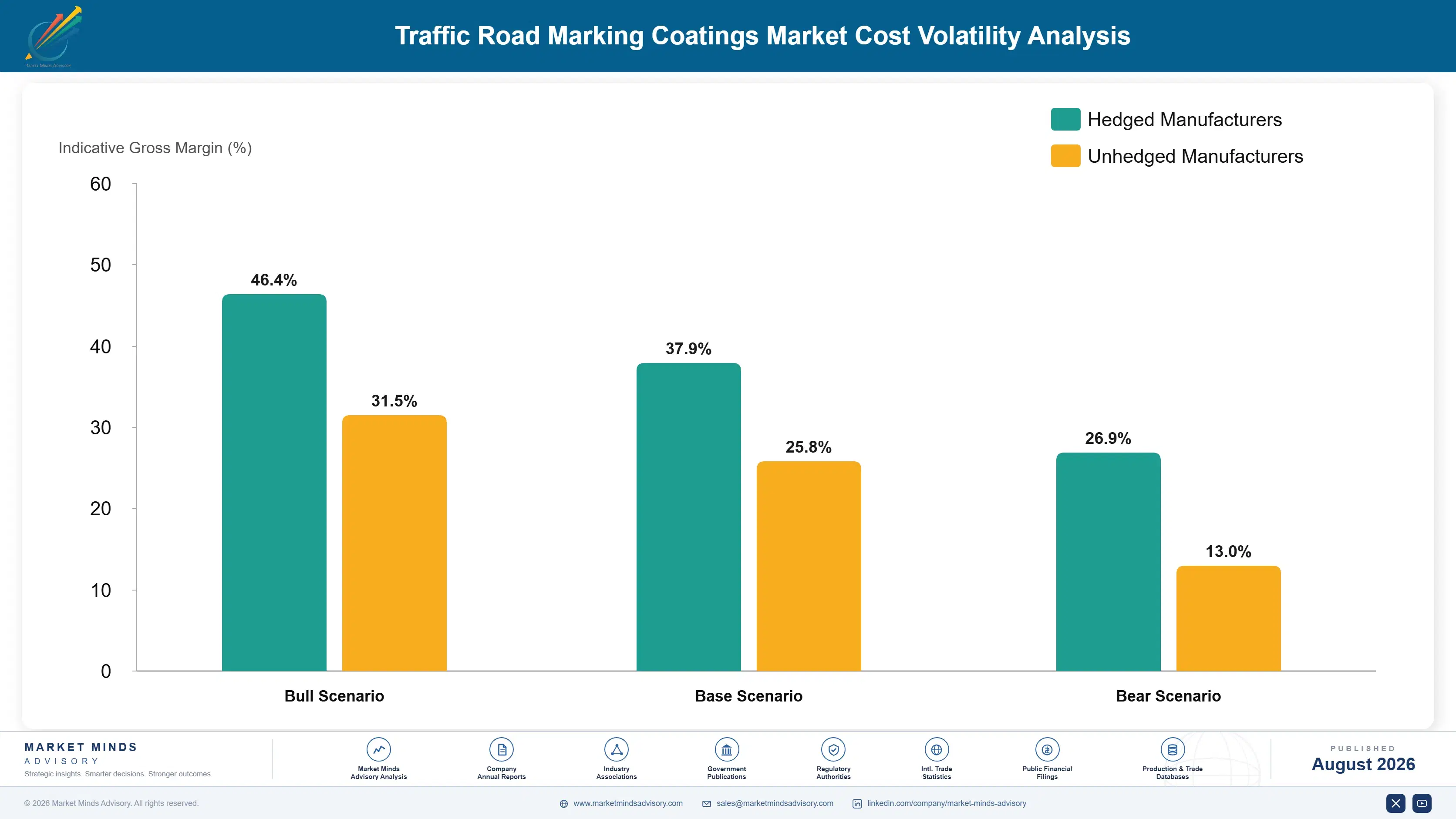
Hydrocarbon and rosin resins carry around 33% of thermoplastic cost, sourced from petrochemical and forestry derived supply. Titanium dioxide absorbs roughly 19% of white marking cost and moves on pigment market cycles no formulator influences. Glass beads account for about 24% of a complete retroreflective system. Methacrylate monomer, fillers, energy and packaging take the balance across the remaining systems.
Titanium dioxide and methacrylate pricing both moved sharply across recent years, per published pigment market reporting and PPG Industries annual reporting for 2025 on raw material cost commentary. Producers passed movements through unevenly, since public tender contracts frequently fix price for a season while material costs reset far more often, which left suppliers absorbing movement inside contract periods. Suppliers with indexation clauses matched to contract duration fared considerably better than those without them.

Exposure divides on system rather than on producer size. A thermoplastic manufacturer carries resin and pigment across more than half of cost against tender pricing fixed seasonally. A cold plastic producer carries methacrylate on a narrower base supported by performance pricing. A bead supplier carries silica sand and furnace energy, which is a quite different exposure moving on entirely separate drivers.
traffic-road-marking-coatings-market-cost-volatility-analysis-1787640128960

Index raw material exposure into seasonal tender contracts

Public tender contracts frequently fix marking prices for a season while resin and pigment costs reset far more often, which leaves suppliers absorbing movement they never agreed to carry. Indexation clauses matched to contract duration address it directly, and authorities accustomed to indexed asphalt pricing generally accept the same mechanism once presented. Asphalt indexation is the precedent.

Shift mix toward performance priced marking systems

Thermoplastic competes on applied cost per kilometre against tender pricing that reflects no performance difference at all. Cold applied and profiled systems price against wet performance and service life, which supports margin that commodity thermoplastic cannot reach, though it requires tenders written around measured performance rather than material cost alone. Specification drafting is where that happens.

Locate production close to application geography

Marking materials carry high freight cost relative to value, particularly thermoplastic supplied in bulk, which gives regional production a genuine advantage no distant supplier overcomes on price. Siting capacity near active construction programmes secures both position and margin, and programme timetables provide years of warning to anybody tracking them. Bulk thermoplastic is the clearest case.

Portfolio Architecture for Margin Defence

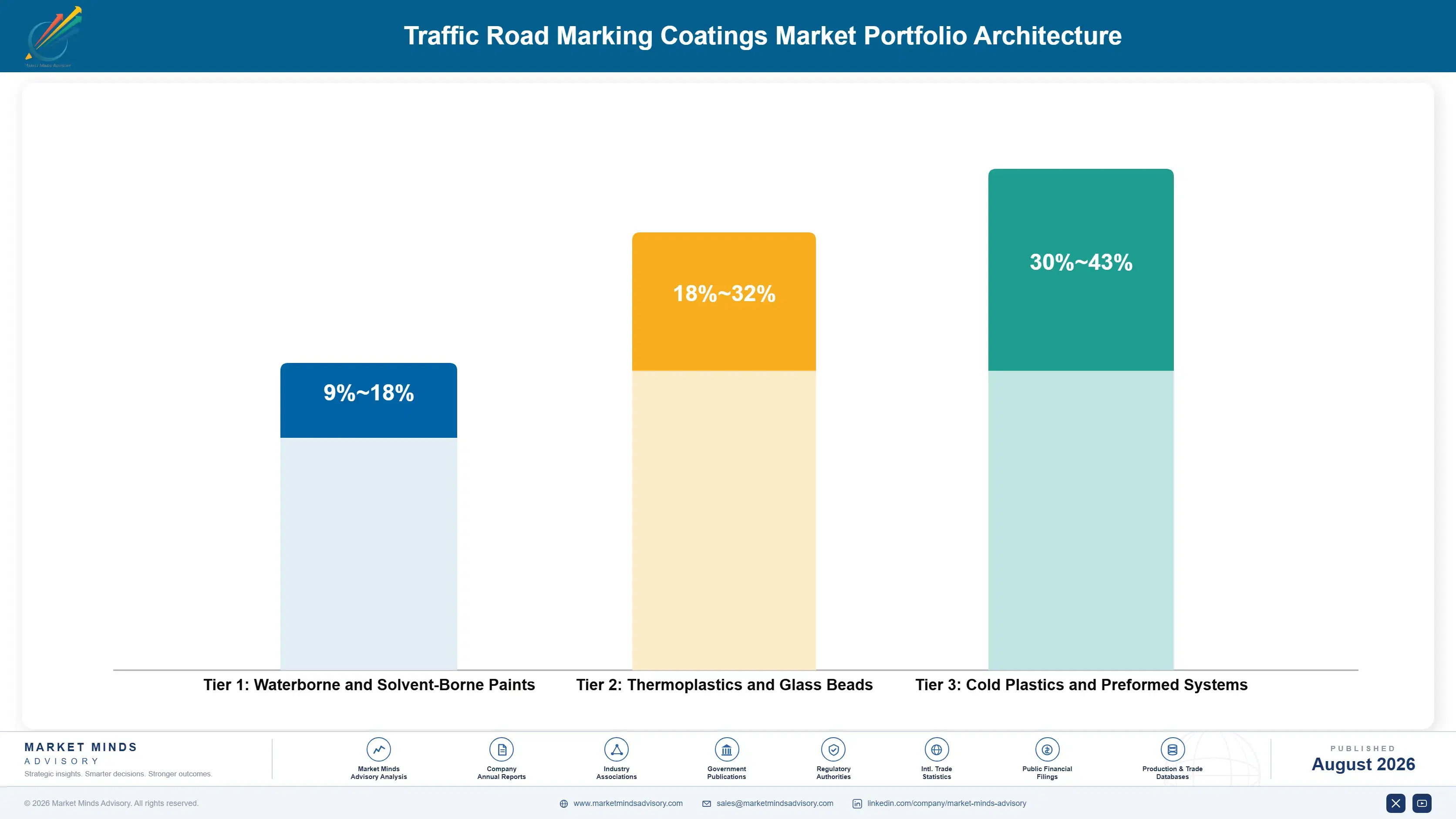
Margin here follows whether a tender measures performance or price, because a specification written around applied cost per kilometre rewards the cheapest system that meets a dry retroreflectivity number. Waterborne and solvent-borne paints earn margins in the high single digits to high teens, competing on delivered price where service life is not part of the evaluation at all. Renewal frequency then generates repeat demand nobody costs against the durable alternative.
Thermoplastics and glass beads do better in the high teens to low thirties, because durability and optical quality both differentiate and regional freight economics limit how many suppliers can realistically compete. Bead optical quality is genuinely variable between suppliers in a way procurement rarely examines.

Cold applied plastics and preformed systems hold the strongest position, reaching into the low forties, where wet performance and immediate trafficking address requirements that cheaper systems cannot meet at any price. Those margins depend entirely on tenders measuring what these products deliver, and collapse toward paint economics wherever procurement evaluates dry retroreflectivity and material cost alone. Tender criteria rather than product capability decide whether these margins are available in any given market at all.

Waterborne and Solvent-Borne Paints

Short life systems competing on delivered price where service life is not evaluated. The nine point range reflects regional freight position and raw material sourcing rather than any performance difference.
Gross Margin: 9-18%

Thermoplastics and Glass Beads

Durable systems and optical media where quality and freight economics both narrow the field. The fourteen point range reflects bead quality control and proximity to the application geography served. Optical quality varies considerably.
Gross Margin: 18-32%

Cold Plastics and Preformed Systems

Systems delivering wet performance and immediate trafficking that cheaper materials cannot match. The thirteen point range reflects whether tenders measure the performance or evaluate material cost alone. Criteria decide the margin entirely.
Gross Margin: 30-43%
traffic-road-marking-coatings-market-portfolio-architecture-1787640129475

High-value Sub-segments and Strategic Watch-out

Cold Applied Plastics

High value and the fastest growth at 8.4%, holding water off the bead surface where flat markings lose most performance. Tender criteria rather than product capability decide whether that advantage is recognised. Specification drafting rather than procurement is where that recognition has to be won by anybody selling it.
Gross Margin: 30-43%

Preformed Tapes and Markings

High value and growing at 6.8% on precise geometry and immediate trafficking in short urban closure windows. Material cost is highest in the category and largely irrelevant against traffic management savings. Urban infrastructure investment rather than highway maintenance cycles drives the demand pattern here entirely.
Gross Margin: 32-46%

Waterborne Traffic Paints

The volume core, carrying substantial highway volume despite short service life because tenders evaluate material price. Renewal frequency generates repeat demand that nobody costs against the alternative. Service life is simply not part of most tender evaluations, which sustains volume the economics would not. Nobody costs it.
Gross Margin: 9-18%

Application Variable Exposure

The strategic watch-out. Bead embedment near 60% of diameter is decided by crew technique, and the range reflects whether a supplier controls application quality or absorbs the blame for failures downstream. Verification after application is the practical answer, and very few suppliers offer it as standard.
Gross Margin: 5-40%

Renewal Deferred, Construction Fixed

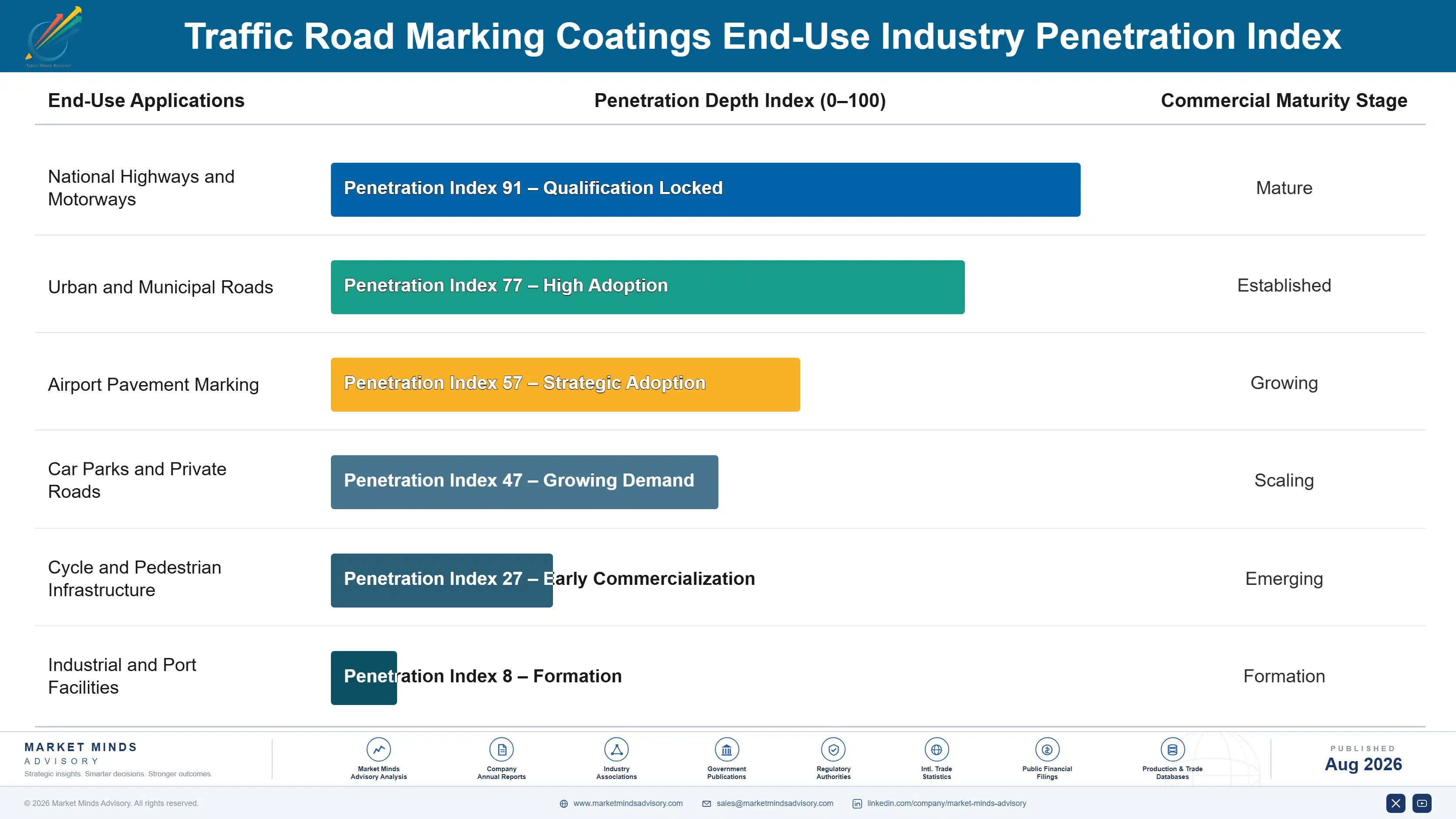
Demand splits between construction and renewal and the two behave nothing alike. New construction generates marking work on a fixed programme timetable that cannot be deferred, since a road cannot open unmarked. Renewal is discretionary within wide limits, because a faded line remains legally adequate for longer than it remains genuinely effective, which makes it the first maintenance category cut when budgets tighten. The two demand patterns share almost nothing.
Stickiness follows contract structure and freight geography together. Framework contracts with highway authorities run for years and reopen on competitive tender, decided largely on price where specifications measure only dry retroreflectivity. Regional production positions hold through freight economics that no distant supplier overcomes. Concession maintenance obligations create the steadiest demand of all, since service life becomes the concessionaire's own cost.

The specifying party sits further from procurement than most suppliers assume. Highway engineers and standards bodies write the criteria that decide which systems can be tendered at all. Procurement then selects on price within that envelope. Suppliers calling on procurement are competing inside a specification somebody else wrote, frequently years earlier and without their input at all.
traffic-road-marking-coatings-market-end-use-penetration-index-1787640129969

Where We Would Put Effort

These are among the four positions where our research anticipates prominent divergence between winners and laggards over the coming forecast period. Each is grounded in the demand model, the regulatory perimeter, and the announced capacity pipeline.
01 / MACHINE READABILITY EVIDENCE

Supply the measurement nobody has written

Lane keeping systems read markings with cameras needing consistent edges and weather stable contrast rather than the dry retroreflectivity figure that standards have measured since headlights were the only reader. Specifications increasingly state machine readability as a general intent with no measurable criterion attached to it at all. Suppliers arriving with measured camera detection performance across a range of weather conditions supply the missing measurement rather than arguing about an existing one, which is a considerably stronger commercial position to argue from.
02 / WET PERFORMANCE FRAMING

Failures happen in rain, measurement does not

A film of water destroys around 85% of the retroreflective return from a flat marking, and lane departure crashes concentrate in exactly those wet conditions rather than on the dry clear nights standards measure. Profiled and structured systems keep working in those conditions and cost more per kilometre accordingly, which is a trade nobody evaluates. Where tenders measure only dry retroreflectivity, the genuinely better product loses on price to a material that simply stops performing entirely the moment it starts raining.
03 / APPLICATION QUALITY OWNERSHIP

The crew decides your performance record

Glass beads deliver any retroreflection at all only when embedded to roughly 60% of their diameter, and equipment calibration and crew technique decide that on the day of application. Premature failure nonetheless gets attributed to the coating supplier regardless of where it actually originated on site. Providing application training, equipment specification and post-application verification protects both the supplier's own record and the customer's outcome at the same time, at genuinely modest cost against what a failed scheme costs in reputation.
04 / CONSTRUCTION PROGRAMME FOLLOWING

Renewal defers, new build cannot

India grows fastest of any country at 10.4% as national highway and state road programmes both run simultaneously at scale, and marking demand follows lane kilometres of new construction directly, unavoidably and on a fixed timetable. Renewal work by contrast is deferred easily whenever budgets tighten, because a faded line stays legally adequate for longer than it stays effective. Programme timetables are published years ahead, which gives ample notice to anybody tracking infrastructure planning documents rather than watching maintenance schedules.

Engagement Snapshot From the Field

A live engagement with an industry participant carrying material or product regulatory and market exposure ahead of a defining policy shift, showing how our research translates into a defensible multi-year portfolio strategy.
MARKET MINDS ADVISORY · CLIENT ENGAGEMENT SUMMARY
Traffic Road Marking Coatings Producer Strategic Portfolio Review and Transition Roadmap 2026·Investment Scenario on Traffic Road Marking Coatings Exposure Evaluation 2025-26
CLIENT PROFILE
A road marking materials producer supplying thermoplastics and waterborne paints to highway authorities and marking contractors across European and Middle Eastern markets, at annual revenue near 340 million dollars (client-reported, unverified by MMA). Cold plastic capability was limited and premature failure claims were rising. Specification engagement happened at procurement rather than at engineering level. Coverage was reactive.
STRATEGIC CHALLENGE
Thermoplastic tenders were being lost on price to regional producers with better freight positions, while premature retroreflectivity failures were generating claims the client believed originated in application rather than material. Management wanted both problems addressed together. Claims were expensive and the freight disadvantage was structural rather than temporary. A direction was needed.
MMA APPROACH
MMA audited bead embedment across completed schemes, measured wet retroreflectivity against dry figures on the client's systems, reviewed how tender criteria were drafted and by whom, and mapped construction programme timetables against the client's commercial coverage. Interviews with 47 experts covered highway engineering, marking application, procurement and standards development. Freight economics were modelled separately.
KEY FINDINGS
  1. Bead embedment fell outside specification on a substantial share of audited schemes, accounting for most of the premature failures being attributed to material quality.
  2. Wet retroreflectivity differed enormously between the client's systems while dry figures were nearly identical, and no tender examined measured the wet performance at all.
  3. Tender criteria were drafted by highway engineers and standards bodies well before procurement, a stage the client's commercial organisation had never engaged with.
  4. Commercial coverage followed established renewal markets while the largest volume growth sat in construction programmes published years in advance elsewhere. Coverage had never been reallocated.
CLIENT PROFILE
A road marking materials producer supplying thermoplastics and waterborne paints to highway authorities and marking contractors across European and Middle Eastern markets, at annual revenue near 340 million dollars (client-reported, unverified by MMA). Cold plastic capability was limited and premature failure claims were rising. Specification engagement happened at procurement rather than at engineering level. Coverage was reactive.
STRATEGIC CHALLENGE
Thermoplastic tenders were being lost on price to regional producers with better freight positions, while premature retroreflectivity failures were generating claims the client believed originated in application rather than material. Management wanted both problems addressed together. Claims were expensive and the freight disadvantage was structural rather than temporary. A direction was needed.
MMA APPROACH
MMA audited bead embedment across completed schemes, measured wet retroreflectivity against dry figures on the client's systems, reviewed how tender criteria were drafted and by whom, and mapped construction programme timetables against the client's commercial coverage. Interviews with 47 experts covered highway engineering, marking application, procurement and standards development. Freight economics were modelled separately.
KEY FINDINGS
  1. Bead embedment fell outside specification on a substantial share of audited schemes, accounting for most of the premature failures being attributed to material quality.
  2. Wet retroreflectivity differed enormously between the client's systems while dry figures were nearly identical, and no tender examined measured the wet performance at all.
  3. Tender criteria were drafted by highway engineers and standards bodies well before procurement, a stage the client's commercial organisation had never engaged with.
  4. Commercial coverage followed established renewal markets while the largest volume growth sat in construction programmes published years in advance elsewhere. Coverage had never been reallocated.
RECOMMENDED STRATEGY
Phase 1: Phase one: introduce application training and post-application verification, since crew technique rather than material was causing the failures being claimed. Phase 2: Phase two: take wet retroreflectivity measurement to highway engineers during specification drafting, well before any tender is issued. Procurement cannot change the criteria. Phase 3: Phase three: reallocate commercial coverage toward published construction programmes rather than established renewal geography. Renewal markets are static by comparison and will remain so.
OUTCOME
The producer introduced application verification during 2026 and premature failure claims fell substantially (client-reported, unverified by MMA). Wet performance data was taken to standards committees, and coverage was reallocated toward active construction corridors. Thermoplastic tender participation was reduced in markets where freight economics could not be overcome.

Frequently Asked Questions

Foundational context covering the market sizes, CAGR, scope, country, region and competition that inform every finding below. This section is provided to cover basics and most often pre-purchase conversations, answered from the MMA Primary Research Dataset.

What is the current size of the Traffic Road Marking Coatings Market?

MMA sizes it at USD 6.4 billion in 2025, rising to USD 6.76 billion in 2026. The figure covers road marking materials at manufacturer selling value.

How large will the Traffic Road Marking Coatings Market be by 2036?

USD 11.66 billion by 2036, an incremental USD 4.90 billion over the 2026 base and an expansion multiple of 1.72 times. Cold plastics carry a disproportionate share.

What is the CAGR for the Traffic Road Marking Coatings Market 2026 to 2036?

5.6% in the base case, with a bull case at 6.8% and a bear case at 4.4%. Whether machine readability enters specifications drives most of the spread.

Which segment is growing fastest?

Cold applied plastics at 8.4%, half again the market rate of 5.6%. Profiled systems hold water off the beads where flat markings lose most of their performance.

Who are the major companies in the Traffic Road Marking Coatings Market?

3M, Swarco, Geveko Markings, PPG Industries and Sherwin-Williams lead on marking material revenue. Fifteen further participants are profiled in the full report on the same consistent basis.

Which country is growing fastest?

India at 10.4%, as national highway construction and state road programmes run simultaneously at a scale no other market currently matches, generating marking demand by lane kilometre.

Report Segmentation Architecture

The full report scope spans multiple orthogonal segmentation dimensions, with cross-tabulated demand data provided for each dimension pair. Coverage extends further to regional breakdowns, trend trajectories, and the competitive detail needed to support segment-level decision-making.

By Material System

  • Hot Applied Thermoplastics
  • Waterborne Traffic Paints
  • Cold Applied Plastics
  • Solvent-Borne Traffic Paints
  • Preformed Tapes and Markings
  • Glass Beads and Retroreflective Media

By End-Use Industry

  • National Highways and Motorways
  • Urban and Municipal Roads
  • Airport Pavement Marking
  • Car Parks and Private Roads
  • Cycle and Pedestrian Infrastructure
  • Industrial and Port Facilities

By Commercial Dimension

  • Highway Authority Framework Contracts
  • Public Tender Supply
  • Marking Contractor Purchase
  • Concession Maintenance Contracts
  • Distributor and Dealer Channels
  • Performance Based Marking Contracts

By Region

  • North America
  • Western Europe
  • East Asia
  • South Asia and Pacific
  • Latin America
  • Middle East and Africa
  • Eastern Europe

Scope, Methodology, and Coverage

Every figure in this report is reproducible from documented input assumptions. The scope below maps the historical period, the forecast horizon, the segmentation dimensions, and the countries covered, alongside the underlying primary and qualitative methodology.
Historical Period
2020 to 2025
Forecast Period
2026 to 2036
Base Year
2025 (USD billions; MMA Primary Research Dataset, August 2026)
Market Definition
Materials applied to road surfaces to form durable visible markings, covering hot applied thermoplastics, waterborne traffic paints, cold applied plastics, solvent-borne traffic paints, preformed tapes and markings, and glass beads and retroreflective media. Measured at manufacturer selling value. Application equipment and vehicles, road signage and delineators, traffic management services, and pavement construction materials are excluded from scope.
Quantitative Units
USD billions (current prices); tonnes and square metres applied; USD per square metre by material system
Segmentation Dimensions
Material system; end-use industry; commercial dimension; region
Regions Covered
North America, Western Europe, East Asia, South Asia and Pacific, Latin America, Middle East and Africa, Eastern Europe
Countries Covered
United States, Canada, Mexico, Germany, France, United Kingdom, Netherlands, Sweden, China, Japan, South Korea, Taiwan, India, Australia, Indonesia, Brazil, Chile, Saudi Arabia, South Africa, Poland
Key Companies Profiled
3M, Swarco, Geveko Markings, PPG Industries, Sherwin-Williams, Potters Industries, Ozark Materials, Nippon Road, Aximum, Sika, Hempel, Jotun, Asian Paints, Berger Paints India, Kansai Paint, Nippon Paint, Akzo Nobel, Weilburger Coatings, Reda National, Cleanosol
Quantitative Methodology
Primary survey, n=3,800 respondents, Q4 2025, six countries; demand-side model with trade association cross-validation
Qualitative Methodology
47 expert interviews, Q4 2025; applied to validate demand model assumptions, identify emerging dynamics, and assess competitive positioning
Report Format
PDF and XLSX data workbook (Word format preview document)
Publisher
Market Minds Advisory
Report Code
MMA-2026-CON-120
Published
August 2026
Contact
sales@marketmindsadvisory.com | www.marketmindsadvisory.com

Purchase the full Traffic Road Marking Coatings Market Report (2026 to 2036).

The full report treats road markings as a product that acquired a second reader without anybody rewriting the specification, which is why dry retroreflectivity still decides tenders while cameras and rain decide performance. It sizes all six material systems independently through 2036, quantifies wet against dry performance across systems, and models bead embedment failure against application practice. Regional chapters cover all seven regions with construction programmes tracked separately from renewal cycles. Competitive profiling covers 20 participants on one consistent revenue basis. Specification drafting routes are mapped ahead of tender issue throughout.
Six material systems sized independently through 2036
Wet performance quantified against dry retroreflectivity across marking systems
Bead embedment failure modelled against application practice and equipment
Construction programmes tracked separately from renewal cycles by region
Specification drafting routes mapped ahead of tender issue
Twenty participants profiled on one consistent revenue basis

Built For The People Who Decide

From boardroom strategy to bench-side execution, this report is read cover-to-cover by leaders shaping the next decade of their industry, turning demand scenarios, market dynamics and valuation benchmarks into decisions.
CXOs/ Presidents/ VPs/ Managers
M&A and Corporate Development
Strategy Teams and R&D Heads
Procurement and Product Directors
Regulatory and Compliance Leaders
Investor Relations and Equity Analysts