Market Minds Advisory
Tracheal Tubes and Airway Products Market

Tracheal Tubes and Airway Products Market: The Parameter Nobody Measures

The single adjustable setting that decides whether a ventilated patient develops pneumonia or a permanently scarred trachea is still routinely judged by squeezing a small balloon between finger and thumb.

Lead Analyst

Alice Ballenger

Published

September 2026

Make Smarter Decisions with Customized Research Insights

Request a free sample report and evaluate market opportunities, growth trends, and competitive dynamics relevant to your business needs.

2025 MARKET VALUE$3.2BMarket Size 2025
2036 FORECAST VALUE$5.7BBase Case , 2026 to 2036
CAGR 2026 TO 20365.4 %Bull 6.6% / Bear 4.2%
INCREMENTAL OPPORTUNITY$2.3BNet 10- year value creation
EXPANSION MULTIPLE1.69x2036 value over 2026 base
Strategic Levers
M&A Pipeline
Regional Outlook
Country Rankings
Competitive Intelligence
Segmental Deep-dive
Call-Us : 91 93563 13602

Executive Snapshot and Market Trajectory

One number decides most of what goes wrong with a tracheal tube. Cuff pressure needs to sit near 25 centimetres of water: lower and secretions leak past into the lungs, higher and the mucosa loses its blood supply and scars. One gauge settles it entirely.
It is routinely set by squeezing the pilot balloon, a method correct about 32% of the time, which is worse than guessing between three options. A manometer costs a few dollars and removes the problem entirely. Cuff management devices grow at 7.2% on that argument, which has been available and largely ignored for decades. Persuasion was never the missing ingredient, since the evidence has always been unambiguous.
Video laryngoscopy is the other unresolved gap. It lifts first attempt success by around 14%, and a failed first attempt roughly doubles complication rates, yet the capital sits in a departmental equipment budget while the benefit lands in bed days somewhere else. Video devices grow at 8.1% anyway, half again the market rate of 5.4%, because single-use blade formats moved the spending. Single-use blade formats moved that spending out of capital approval entirely.
Market Definition
Devices establishing and maintaining an artificial airway, covering endotracheal tubes, supraglottic airway devices, tracheostomy tubes and accessories, video laryngoscopes and blades, basic airway adjuncts, and cuff management and airway monitoring devices. Measured at manufacturer selling value. Excludes mechanical ventilators and anaesthesia delivery systems, breathing circuits and humidification, oxygen masks and nasal cannulae, and home respiratory equipment.
Base Year Value
$3.2B in 2025 (MMA Primary Research Dataset, August 2026)
Forecast Period
2026 to 2036, eleven discrete annual values
CAGR
5.4% base case. Bull 6.6%. Bear 4.2%.
Fastest Growth Segment
Video Laryngoscopes and Blades: 8.1% CAGR
Fastest Growth Country
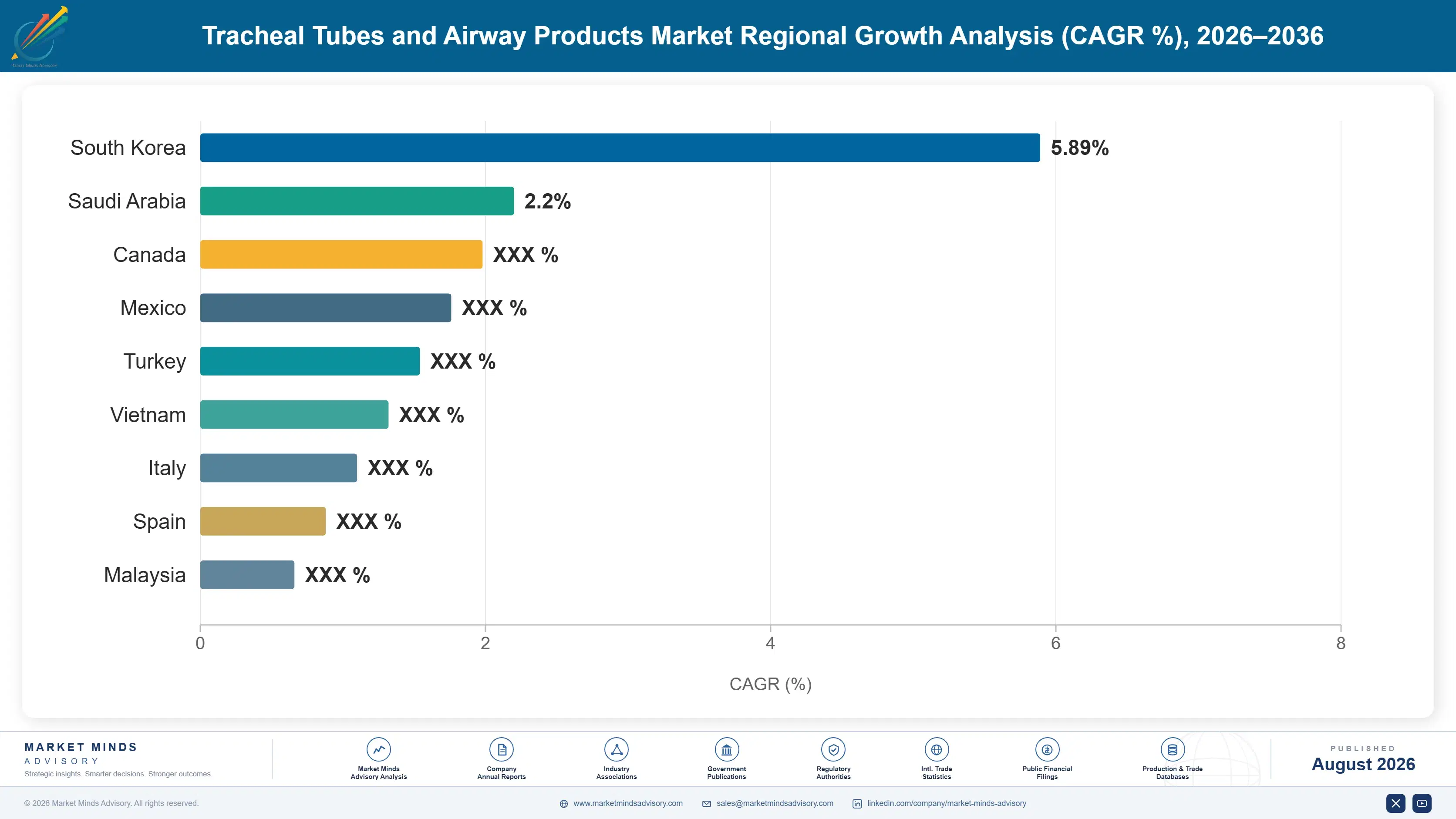
Indonesia: 9.6% CAGR
Fastest Growth Region
South Asia and Pacific: 7.4% CAGR
Largest Region
East Asia: 28% of 2025 global value
Market Leaders
Medtronic, Teleflex, Ambu, Verathon, ICU Medical. Source: MMA Primary Research Dataset, July 2026.
Primary Survey
n=3,800 procurement and R&D decision-makers, Q4 2025, six countries
Methodology
Demand-side build-up, cross-validated against public data, 47 expert interviews

Tracheal Tubes and Airway Products Market Forecast Scenarios

tracheal-tubes-and-airway-products-market-size-forecast-scenario-1787640088325
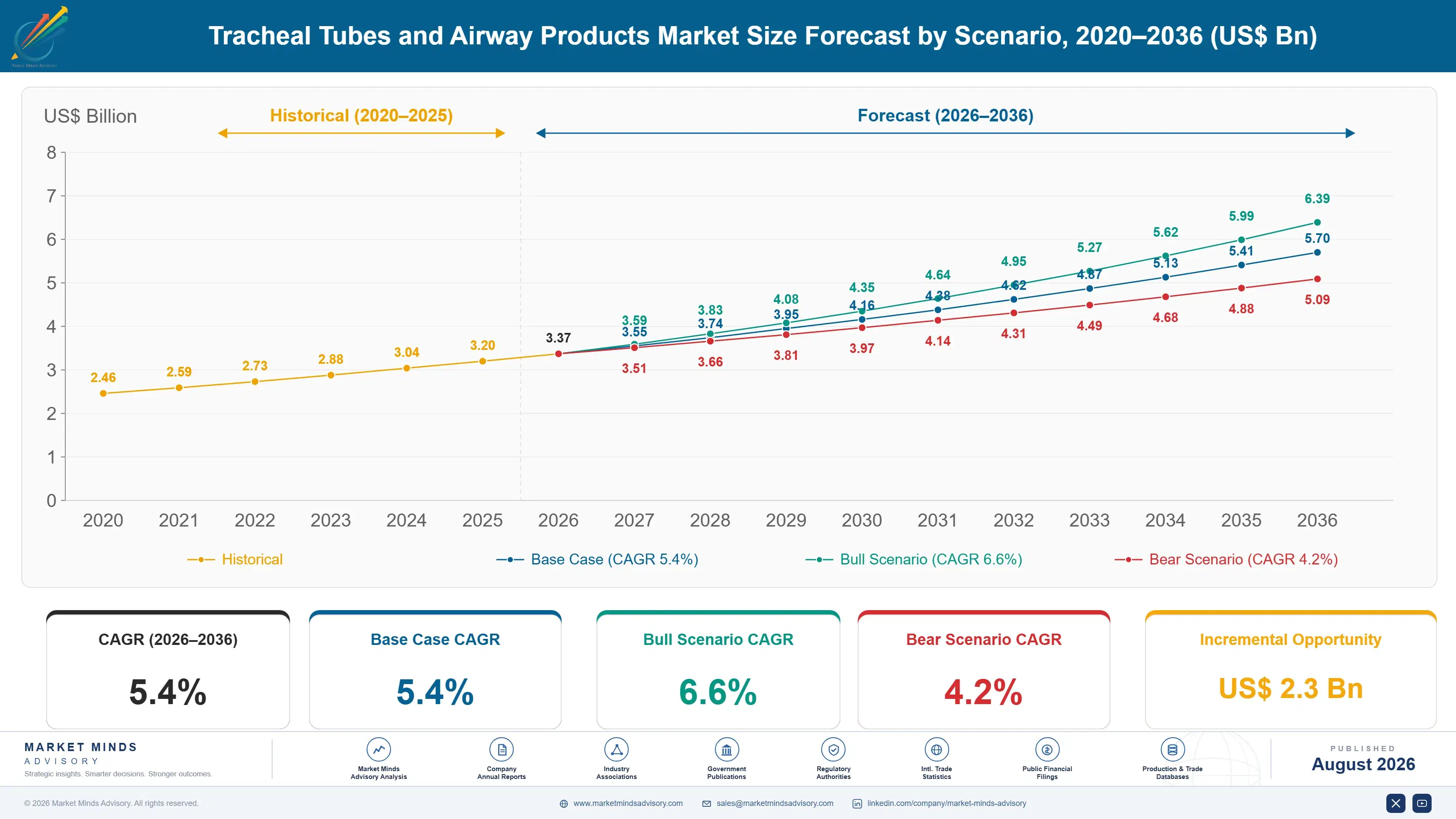
Growth ran near 4.4% between 2020 and 2025, with an unusual shape. Pandemic intubation volumes lifted demand sharply then fell back, leaving a distorted comparison base that has taken years to normalise. Single-use laryngoscopy displaced reusable equipment on cross-contamination evidence across most developed markets. Supraglottic airway use widened in day surgery where intubation had previously been the default choice.
Base case 5.4% rests on three mechanisms. Video laryngoscopes grow at 8.1% as first attempt success evidence accumulates and single-use blade formats remove reprocessing. Cuff management devices grow at 7.2% as pressure related injury attracts attention. And Indonesia grows fastest of any country at 9.6% as national health insurance widens surgical access across a very large population. Procedure volume is the only real lever here, since device pricing rises nowhere at all.
The bull case at 6.6% assumes video laryngoscopy becoming the standard first approach rather than a rescue device, which would replace direct laryngoscopy across routine intubation entirely. The bear case at 4.2% is surgical volume growth slowing in developed markets, since procedure count drives most consumption and no clinical improvement compensates for operations that do not happen.

Twenty Five Centimetres of Water

A tracheal tube cuff has to seal the airway without strangling the tissue holding it, and the window is narrow. Below roughly 20 centimetres of water, secretions pool above the cuff and leak into the lungs, which is how ventilator associated pneumonia begins. Above about 30, the pressure exceeds what tracheal capillaries can perfuse against, and prolonged ischaemia produces stenosis that surgery has to correct later.
TOP FIVE CONCENTRATION48%Established device manufacturers hold most hospital contract positions
TARGET CUFF PRESSURE25 cmH2OPressure holding a seal without compressing the tracheal mucosa
PALPATION ACCURACY32%Cuff pressures judged correctly by feeling the pilot balloon
FIRST ATTEMPT SUCCESS GAIN14%Improvement in first pass intubation using video assisted devices
MANOMETER UNIT COST5 USDPrice of the device that resolves the pressure problem
DIFFICULT AIRWAY CASE SHARE6%Proportion of intubations needing specialised equipment kept everywhere
The method used to set it in most hospitals is finger palpation of the pilot balloon, which is correct roughly 32% of the time. That is worse than choosing at random between under, correct and over. A manometer costs around five dollars and resolves the problem completely, and the argument for using one has been available in the literature for decades without becoming universal practice anywhere.
First attempt intubation success is the other measurable gap. Video laryngoscopy improves it by around 14%, and a failed first attempt roughly doubles complication rates including hypoxia and aspiration. The capital sits in a departmental equipment budget while the benefit accrues in bed days and complications that a different budget carries entirely. Video devices grow at 8.1% regardless.
"The most consequential setting on the whole device is judged by pinching a balloon, and everybody knows it does not work. A five dollar gauge fixes it, which is precisely why nobody has built a business around solving it properly."
Director, Critical Care and Anaesthesia Devices Practice · MMA Medical Devices and Diagnostics Practice · August 2026

Market Trends

Cuff pressure injury attracting measurement rather than estimation

Palpation of the pilot balloon judges cuff pressure correctly about 32% of the time, and the consequences divide between pneumonia from under-inflation and tracheal stenosis from over-inflation. Manometers cost a few dollars and resolve it entirely. Cuff management devices grow at 7.2% as infection control and airway injury reporting both bring attention to a parameter that has been unmeasured in routine practice for a very long time. A manometer costs around five dollars, which is why nobody has built a business around solving it. Reporting rather than persuasion is finally moving it.
Market Impact: Indonesia growing fastest at 9.6%
Single-use formats moving video laryngoscopy from capital to consumable

Video laryngoscopes were sold as departmental capital equipment competing against everything else on an equipment list, which limited adoption regardless of clinical evidence. Single-use blade formats moved most of the spending into consumable budgets that reorder without a business case. Video devices grow at 8.1% on that reclassification as much as on the roughly 14% first attempt success improvement the technology genuinely delivers in practice. Suppliers still selling reusable systems through capital approval are fighting a budget process rather than losing a clinical argument. Consumable reordering requires no approval from anybody at all.
Market Impact: Adds 6% of case volume

Market Opportunities and Growth Drivers

Insurance expansion widening surgical access in large populations

Indonesia grows fastest of any country at 9.6% as national health insurance widens surgical access across a very large population, and airway device consumption follows procedure count almost exactly. Suppliers organised around established surgical markets are covering volumes that stopped growing years ago. Coverage expansion timetables are published well ahead of the procedure volume they generate, which gives ample notice to anybody tracking them. Consumption follows procedure count with very little variance, which makes the forecasting unusually straightforward. Coverage expansion is therefore the only variable worth tracking, and its timetables are published years ahead of any procedures at all.
Market Impact: Saves days across 14% more

Day surgery favouring supraglottic devices over intubation

Supraglottic airway devices avoid tracheal intubation entirely for procedures where the airway does not need protecting from aspiration, which suits day surgery and shortens recovery. They also sidestep the cuff pressure problem, since there is no tracheal cuff to inflate wrongly. Growth follows the shift of surgical work into day case settings rather than any change in device preference among anaesthetists themselves. Anaesthetists adopted them readily where the case allows, and procurement rarely objects given the price difference is modest. No tracheal cuff means no cuff pressure problem either. That matters clinically.
Market Impact: Needed in about 6% of cases

Market Restraints and Challenges

Benefit and budget sitting in different parts of the hospital

Video laryngoscopy improves first attempt success by around 14% and reduces complications that cost bed days, but the equipment is bought by a department and the saving accrues to the organisation. The root cause is budget structure rather than any dispute about the evidence. Commercially it slows adoption of anything requiring capital approval. Single-use formats, consumable pricing and organisational business cases are the routes suppliers actually use. Organisational rather than departmental cases are what actually move these decisions. Departmental cases lose against unrelated equipment on the same list. Structure is the obstacle.
Market Impact: Palpation correct only 32% of time

Difficult airway equipment needing availability rather than usage

Around 6% of intubations require specialised difficult airway equipment, which must therefore be stocked in every location where intubation happens rather than where it is frequently used. The root cause is that difficulty is unpredictable at the bedside. Commercially it means value follows availability rather than volume, which conventional consumption based sales models handle poorly. Standardised difficult airway trolleys and consignment stocking are the working approaches. Understocking is the common result of selling against forecast consumption in this category. Consignment stocking prices availability rather than usage, which matches how a hospital actually needs to hold it.
Market Impact: Improves first attempt success 14%
4 additional market trends, 3 additional growth drivers, and 2 additional restraints and challenges are covered in the full report. Contact sales@marketmindsadvisory.com to access the complete intelligence.

Segment CAGR and Growth Architecture

Six segments split by device type, because device determines the clinical situation it serves, the training required to use it, the setting it is stocked in and the budget it is purchased from. Size and material variants sit inside each device type. Care setting and channel dimensions are handled separately within the framework. Device type decides the budget line.
tracheal-tubes-and-airway-products-market-market-share-analysis-1787640088902

Video Laryngoscopes and Blades

Growing at 8.1%, half again the market rate of 5.4%, video laryngoscopy improves first attempt intubation success by around 14% and a failed first attempt roughly doubles complication rates. Adoption was limited while the devices were departmental capital competing against everything else on an equipment list. Single-use blade formats moved most of the spending into consumable budgets that reorder without a business case, which changed the commercial dynamics considerably more than any new clinical evidence did. Reusable systems still compete against everything else on a departmental equipment list, which is a considerably harder sale than a consumable reorder that requires no approval from anybody. Capital approval was the barrier all along.
CAGR 8.1%

Cuff Management and Airway Monitoring Devices

At 7.2% manometers, continuous cuff pressure regulators and airway monitoring accessories address a parameter judged correctly about 32% of the time by the palpation method still used in most hospitals. The devices cost a few dollars and prevent both aspiration pneumonia and tracheal stenosis, which are expensive in entirely different ways. Adoption tracks infection control attention rather than clinical persuasion, since the clinical argument has been settled and ignored for decades. Attaching the parameter to ventilator associated pneumonia reporting reaches the function that can actually mandate measurement across an institution, which no amount of clinical argument to individual anaesthetists has ever achieved. Cost is trivial against the outcome. Reporting rather than persuasion moves it.
CAGR 7.2%
Full segment breakdown across 6 segments available in the complete report.

Regional Architecture and Country Demand Map

East Asia holds 28% of value on surgical procedure volume and device manufacturing scale together. North America follows at 27% on device pricing and single-use adoption running well ahead of other regions. South Asia and Pacific grows fastest of the seven regions covered here. Procedure volume drives both.

North America

Single-use adoption across laryngoscopy and airway devices runs further here than anywhere, driven by cross-contamination evidence and a liability environment that makes reprocessing compliance a genuine institutional risk. Device pricing is correspondingly higher. Ventilator associated pneumonia is tracked as a reportable outcome, which brings cuff pressure into infection control attention rather than leaving it purely clinical. Growth at 4.6% reflects mature procedure volumes with mix improving steadily. Video laryngoscopy adoption is furthest advanced here, helped considerably by single-use formats that removed capital approval from the purchasing path entirely. Liability exposure makes reprocessing compliance an institutional risk rather than merely a clinical preference, which sustains single-use pricing. Reporting drives the cuff conversation here.
Share: 27% | CAGR: 4.6% (2026 to 2036)

Western Europe

Reusable equipment retains more ground here than in North America, supported by reprocessing infrastructure and environmental procurement criteria that weigh against single-use formats. Difficult airway guidelines from national anaesthesia societies are detailed and widely followed, which standardises equipment stocking considerably. Cuff manometry is more routine than elsewhere. Regional growth of 4.0% is the slowest anywhere on flat procedure volumes and mature device adoption together. Environmental procurement criteria weigh against single-use formats in a way they do nowhere else, which slows adoption that clinical evidence alone would accelerate. Reprocessing infrastructure is well established and difficult airway guidelines standardise equipment stocking more thoroughly than in any other region. Cuff manometry is more routine here than anywhere else covered.
Share: 22% | CAGR: 4.0% (2026 to 2036)
Regional intelligence for 5 additional markets available in the complete report: East Asia, South Asia and Pacific, Latin America, Middle East and Africa, Eastern Europe. Contact sales@marketmindsadvisory.com.
tracheal-tubes-and-airway-products-market-country-cagr-analysis-1787640089425

Four Moves Around the Cuff

The clinical arguments here were settled long ago and the commercial ones were not. What remains available is moving spending out of capital budgets that block it, selling measurement where estimation has failed for decades, and stocking difficult airway equipment against availability rather than usage. Three of the four are budget problems rather than clinical ones.

Move spending from capital budgets into consumables

Video laryngoscopy improves first attempt success by around 14%, and adoption stalled for years while the devices competed as departmental capital against everything else on an equipment list. Single-use blade formats moved most of that spending into consumable budgets that reorder without any business case at all. Suppliers still selling reusable systems on capital approval are fighting a budget process rather than a clinical argument. Evidence was never the obstacle. Adoption stalled for years on budget structure rather than on any dispute about whether the devices work better. Structure was the barrier.
Market Impact: Delivers the whole 14% first attempt success improvement

Sell measurement where estimation is demonstrably failing

Palpation judges cuff pressure correctly about 32% of the time and a manometer costing around five dollars removes the problem entirely. The clinical case has been settled for decades without becoming routine practice, which means persuasion is not the missing ingredient. Attaching cuff pressure to infection control reporting and airway injury audit reaches the function that can actually mandate the change across an institution. Ventilator associated pneumonia sits in infection control reporting rather than in any equipment budget, which makes it the right door to knock on. Anaesthetists were never the audience.
Market Impact: Corrects the 68% of cuffs currently set wrong

Stock difficult airway equipment against availability

Around 6% of intubations need specialised difficult airway equipment, and difficulty is unpredictable, so the equipment must sit in every location where intubation happens rather than where it gets used often. Consumption based sales models handle that badly. Standardised trolleys and consignment stocking price availability rather than usage, which matches how the hospital actually needs to hold the inventory. Around 6% of intubations need it and nobody can predict which ones, so the equipment must be present rather than merely orderable. Consignment matches that requirement directly. Understocking is otherwise routine.
Market Impact: Covers the unpredictable 6% of all the intubations

Follow insurance coverage rather than existing procedure volume

Airway device consumption follows procedure count, and Indonesia grows fastest at 9.6% as national health insurance widens surgical access across a very large population. Suppliers organised around established surgical markets are covering volumes that stopped growing years ago. Coverage expansion timetables are published well ahead of the procedures they generate, which gives ample notice to anybody who bothers to read them. Established surgical markets stopped growing years ago. Coverage expansion timetables are published well ahead of the procedures they generate, and remarkably few commercial teams read them at all. Nobody reads them.
Market Impact: Follows the 9.6% Indonesian procedure volume growth rate

Who Controls the Margin Pool

Participation is measured on annual revenue from airway device manufacture, and the top five hold 48%. Concentration is high in video laryngoscopy and supraglottic devices where design and patent positions matter, and considerably lower in basic tubes where many manufacturers meet the same specification. The gap to challengers differs completely by category, since a video device position rests on evidence while a tube position rests on cost.
Competition runs on three fronts. Clinical evidence decides video laryngoscopy and supraglottic positions, where outcome data supports pricing. Manufacturing cost decides basic tubes and adjuncts, where Asian producers hold clear advantage. And contract breadth decides hospital access, since airway products are bought as a category rather than individually. Each front rewards a different capability, and very few participants hold all three of them properly.

Pressure ahead comes from single-use formats reclassifying spending and from cuff pressure attracting infection control attention. Expect suppliers with consumable business models to gain against capital equipment sellers. Rankings shift on whoever attaches airway devices to reportable outcomes. Concentration should hold in differentiated categories. Manufacturers holding only basic tube volume look most exposed, since bundling is their sole defence and it depends on holding differentiated products alongside.
tracheal-tubes-and-airway-products-market-company-positioning-matrix-1787640089953

Competitive Moat and Risk Dimensions

MEDTRONIC

Moat: Category breadth and hospital contracts

Supplying across tubes, supraglottic devices and monitoring lets the business hold a category position rather than compete product by product, and hospitals buying airway products as a bundle find single product challengers difficult to accommodate. That breadth also supports evidence generation across the whole airway pathway rather than for any single device in isolation.
MEDTRONIC

Risk: Basic tube commodity pressure

Endotracheal tubes and basic adjuncts meet identical specifications from many manufacturers, and Asian producers have taken substantial share on cost in exactly those categories. Defending them requires clinical differentiation that a standard tube cannot readily demonstrate, which pushes the defence toward bundling rather than toward the product itself.
TELEFLEX

Moat: Supraglottic design and clinical evidence

Supraglottic airway design positions supported by accumulated clinical outcome evidence sustain pricing that generic alternatives cannot reach, particularly where guidelines reference specific device performance characteristics. That evidence took years to build and a challenger must reproduce it rather than simply matching the physical design of the device.
TELEFLEX

Risk: Day surgery pricing pressure

Supraglottic devices are consumed in high volume day surgery where procurement negotiates hard and generic alternatives improve steadily in quality. Holding price requires continuing evidence generation and guideline presence, both expensive to maintain against competitors who invest in neither and price accordingly against the incumbent.

Players Tracked

Prominent Players

Medtronic
Teleflex
Ambu
Verathon
ICU Medical

Other Key Players

Smiths Medical
Fisher and Paykel Healthcare
Vyaire Medical
Intersurgical
Flexicare Medical
Karl Storz
Olympus
Boston Scientific
Convatec
Well Lead Medical
Sumitomo Bakelite
VBM Medizintechnik
Armstrong Medical
Pulmodyne
Salter Labs

Recent Developments

FEBRUARY 2026

Hospital system mandates cuff manometry on every intubation

A hospital system mandated manometer measurement of cuff pressure on every intubation after an audit found palpation estimates wrong in most cases, linking the change to its ventilator associated pneumonia reduction programme directly. Compliance was audited monthly thereafter across every unit. Palpation was withdrawn as acceptable practice.
Signal: Infection control reporting achieved what three full decades of clinical persuasion had never once managed anywhere
SEPTEMBER 2025

Single-use video blades move device spending to consumables

A device manufacturer shifted its video laryngoscopy range toward single-use blade formats, moving customer spending out of capital equipment approval and into consumable reordering that requires no business case at all. Adoption rose sharply within two quarters. Capital committees were never involved again. Reusable systems were withdrawn entirely.
Signal: Budget classification changed the adoption curve considerably more than any accumulated clinical evidence ever had done
DECEMBER 2025

Anaesthesia society standardises difficult airway trolley contents

A national anaesthesia society standardised difficult airway trolley contents across member institutions, converting equipment stocking from local judgement into a defined list every location where intubation occurs must hold. Stocking became a compliance requirement rather than a local decision. Consignment arrangements followed quickly. Local judgement was removed from stocking.
Signal: Value follows availability rather than usage for any equipment that is needed unpredictably at short notice

Polymers, Optics and Sterilisation

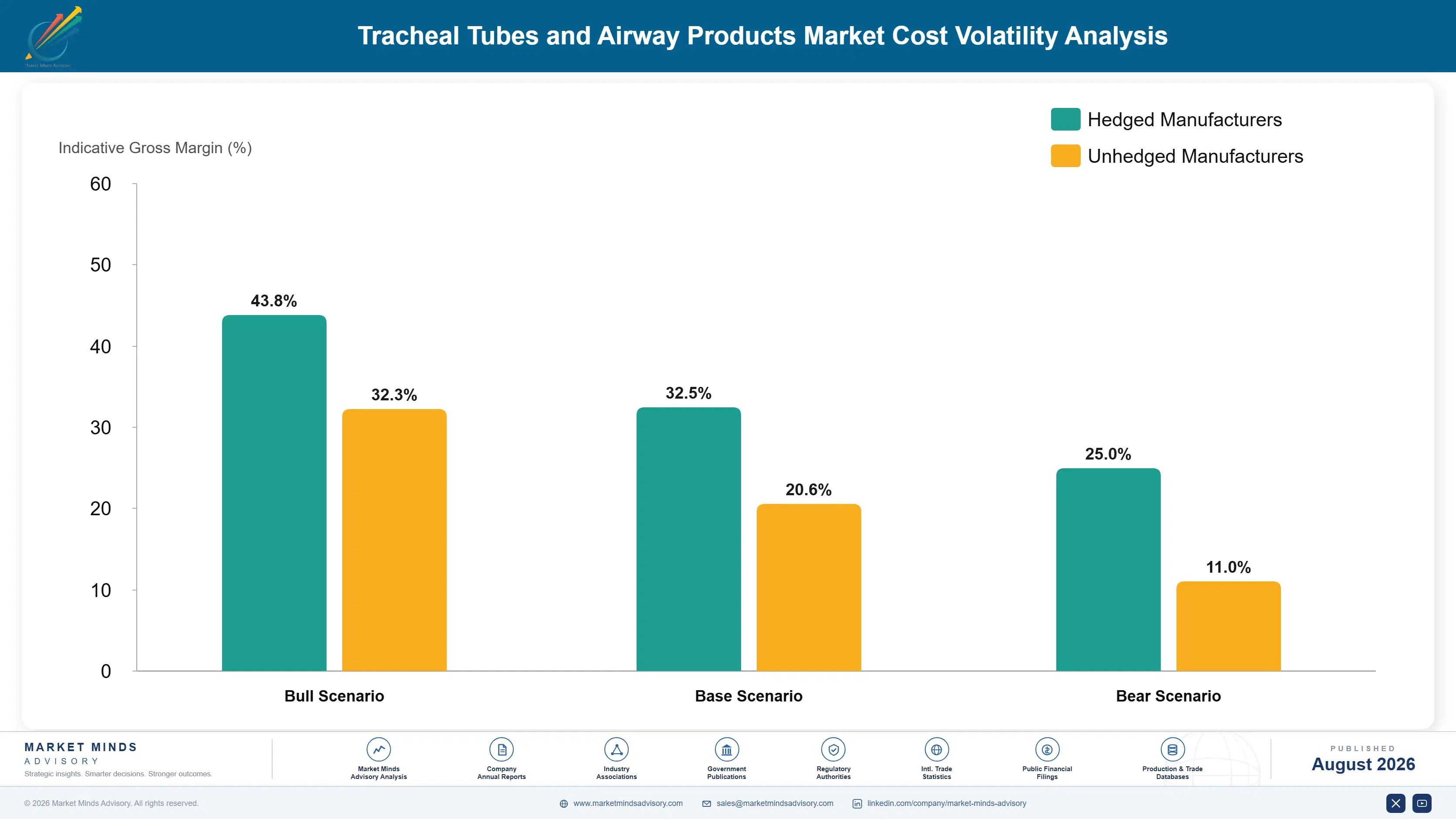
Medical grade polyvinyl chloride and silicone carry around 29% of tube manufacturing cost, sourced from a limited group of qualified compounders. Camera modules, optics and electronics absorb roughly 44% of video laryngoscope cost, supplied from consumer electronics chains at scale. Ethylene oxide sterilisation and packaging take about 13%. Assembly labour, regulatory maintenance and distribution account for the balance.
Sterilisation capacity tightened across recent years as ethylene oxide facilities faced emissions restrictions, per United States Environmental Protection Agency reporting on ethylene oxide regulation and Medtronic annual reporting for 2025 on manufacturing cost commentary. Manufacturers passed a portion through where clinical differentiation existed and almost none on basic tubes, where hospitals substitute readily between suppliers meeting the same specification. Sterilisation constraint halts shipment entirely when it bites, which is a considerably worse outcome than price movement.

Exposure divides on product type rather than on manufacturer size. A basic tube producer carries polymer and sterilisation cost against customers who substitute on price alone. A video device maker carries electronics on a cost curve that falls steadily, which is the more comfortable position. A supraglottic manufacturer carries silicone cost supported by clinical evidence that sustains pricing conversations the tube producers cannot have.
tracheal-tubes-and-airway-products-market-cost-volatility-analysis-1787640090147

Qualify additional sterilisation capacity ahead of restriction

Ethylene oxide facilities face tightening emissions regulation and capacity has already proved constrained during earlier restriction cycles. Qualifying alternative sterilisation sites and methods costs validation time and removes an exposure that halts shipment entirely when it bites, which is a far worse outcome than any price movement. Validation time is the only real cost. Shipment stoppage is the alternative.

Shift mix toward evidence supported device categories

Basic tubes compete against Asian manufacturing cost with no clinical differentiation available to defend price. Supraglottic devices and video laryngoscopy carry outcome evidence that sustains pricing, and moving mix reduces polymer exposure per unit of revenue while improving margin, though evidence generation is expensive and slow to build. Evidence generation is expensive and slow.

Package airway products as a category contract

Hospitals purchase airway products together rather than device by device, which lets a broad supplier defend commodity tube volume inside a contract that also carries differentiated products. Single product challengers find that structure difficult to break into, and the bundling protects volume that could not be defended on its own merits. Single product challengers struggle to break in.

Portfolio Architecture for Margin Defence

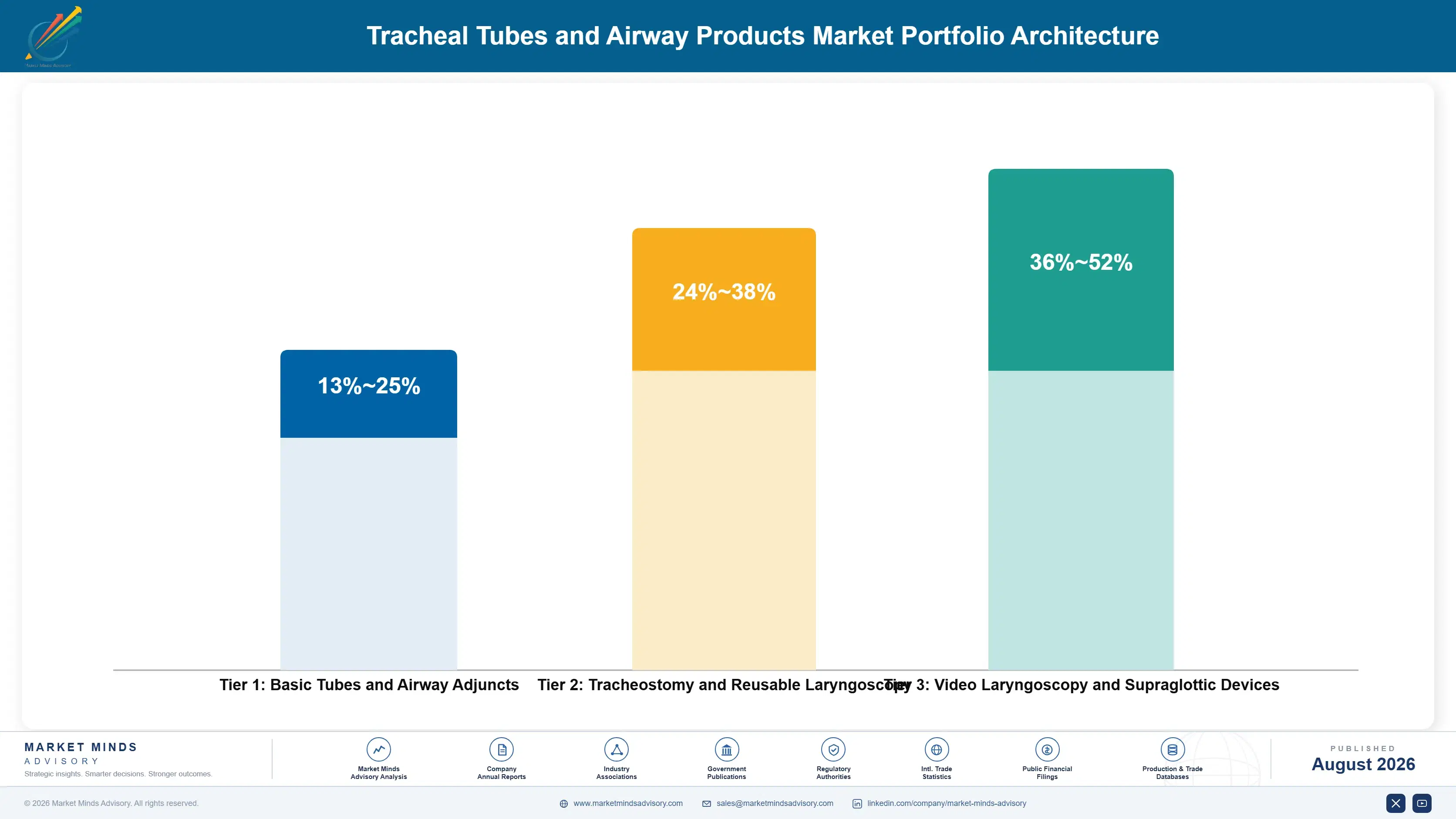
Margin here follows clinical evidence rather than manufacturing sophistication, because a tube meeting a standard specification is genuinely interchangeable and hospitals treat it that way. Basic endotracheal tubes and airway adjuncts earn margins in the low teens to mid twenties, where Asian manufacturing cost sets the reference and no differentiation is available to defend against it. Hospitals treat a standard tube as genuinely interchangeable, and they are entirely right to.
Tracheostomy tubes and reusable laryngoscopy do better in the mid twenties to high thirties, because sizing complexity, clinical training and long term patient relationships all narrow the field of practical suppliers. Long term ventilation patients bring relationships that reopen far less frequently than acute supply does.

Video laryngoscopy and supraglottic devices hold the strongest position, reaching into the low fifties, where outcome evidence supports pricing that generic alternatives cannot reach and guidelines frequently reference specific device performance. Those margins depend on maintaining evidence generation and guideline presence, both expensive, and they compress quickly wherever a category becomes a commodity purchase for procurement. Guideline presence is what actually sustains them, and it costs money every year to maintain.

Basic Tubes and Airway Adjuncts

Products meeting identical specifications from many manufacturers where hospitals substitute freely. The twelve point range reflects manufacturing scale and polymer sourcing rather than any clinical difference between suppliers. Substitution happens on every tender.
Gross Margin: 13-25%

Tracheostomy and Reusable Laryngoscopy

Products where sizing complexity and clinical training narrow the practical supplier field considerably. The fourteen point range reflects range depth and the strength of long term clinical relationships behind it.
Gross Margin: 24-38%

Video Laryngoscopy and Supraglottic Devices

Devices carrying outcome evidence that generic alternatives cannot reach on price alone. The sixteen point range reflects guideline presence and evidence depth, both expensive to build and maintain. Commodity drift compresses them quickly.
Gross Margin: 36-52%
tracheal-tubes-and-airway-products-market-portfolio-architecture-1787640090657

High-value Sub-segments and Strategic Watch-out

Video Laryngoscopes and Blades

High value and the fastest growth at 8.1%, improving first attempt success by around 14% where a failed attempt doubles complications. Single-use formats moved the spending into consumable budgets entirely. Capital approval was the barrier, not clinical evidence, and removing it changed everything about the adoption curve.
Gross Margin: 36-52%

Cuff Management and Monitoring

High value and growing at 7.2% against a parameter palpation judges correctly only about a third of the time. Infection control attention rather than clinical persuasion drives adoption here. A manometer costs a few dollars and the argument has been settled for decades without becoming routine practice.
Gross Margin: 30-44%

Basic Endotracheal Tubes

The volume core, meeting identical specifications from many manufacturers where price alone decides supply. Category contract bundling is the only practical defence available against Asian manufacturing cost. Asian manufacturing sets the reference price and no clinical differentiation exists to defend against it at all. Bundling is the answer.
Gross Margin: 13-25%

Difficult Airway Stocking Exposure

The strategic watch-out. Around 6% of intubations need it and difficulty is unpredictable, so the range reflects whether a supplier prices availability through consignment or sells against consumption that never materialises. Consumption based selling consistently understocks the locations where unpredictable cases actually present themselves. Consignment resolves it.
Gross Margin: 10-45%

Consumed Once Per Procedure

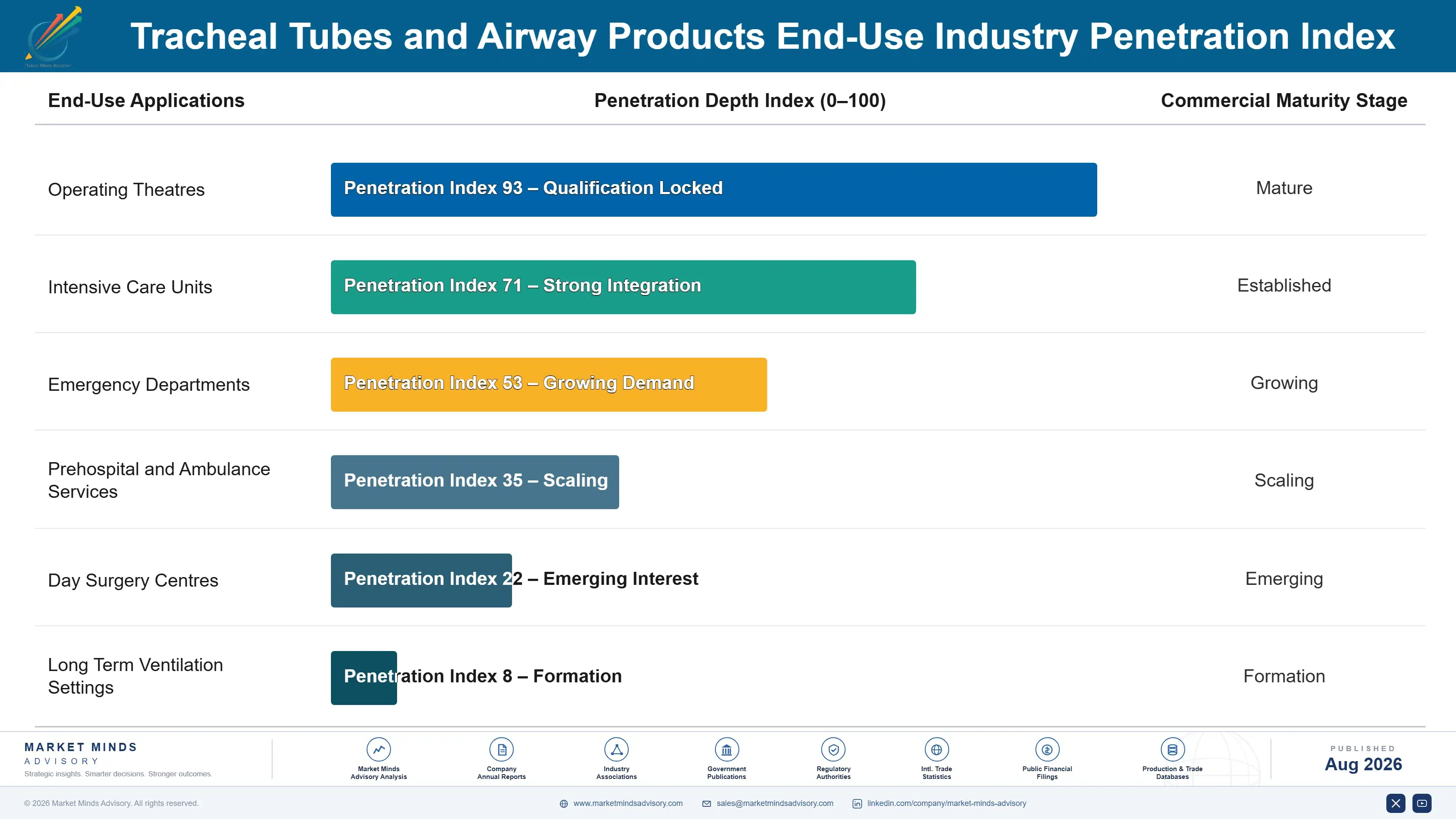
Demand here follows procedure count almost exactly, which makes it unusually predictable and unusually hard to grow independently. Every intubation consumes a tube and every anaesthetic consumes an airway device, so consumption tracks surgical and critical care volume with very little variance. Growth therefore comes from procedure volume, from mix improvement toward better devices, or from nowhere at all. There is no fourth route available.
Stickiness follows contract structure and clinical familiarity together. Category contracts covering airway products hold for years and are difficult for single product challengers to break into. Supraglottic and video device positions hold through clinician preference and training investment, which procurement overrides only with difficulty. Basic tube supply reopens with every tender because equivalence is genuine and everybody knows it. Equivalence is genuine and everybody knows it.

The deciding party differs by budget line in a way that shapes commercial approach entirely. Procurement decides basic tubes and consumables on price. Clinical leads decide supraglottic and video device selection on outcome evidence. Infection control increasingly decides cuff management, since ventilator associated pneumonia sits in its reporting rather than in any equipment budget. Coverage rarely reaches all three functions.
tracheal-tubes-and-airway-products-market-end-use-penetration-index-1787640091146

Where We Would Put Effort

These are among the four positions where our research anticipates prominent divergence between winners and laggards over the coming forecast period. Each is grounded in the demand model, the regulatory perimeter, and the announced capacity pipeline.
01 / BUDGET LINE REPOSITIONING

Capital approval is where adoption dies

Video laryngoscopy improves first attempt intubation success by around 14% against direct laryngoscopy, and yet adoption nonetheless stalled for years while these devices competed as departmental capital equipment against everything else sitting on an equipment list. Single-use blade formats moved most of that spending across into consumable budgets that simply reorder without any business case whatsoever. Suppliers still selling reusable systems through capital approval processes are fighting a hospital budget structure rather than losing any clinical argument at all here.
02 / MEASUREMENT MANDATE ACCESS

Persuasion failed for thirty years already

Palpation of the pilot balloon judges cuff pressure correctly about 32% of the time, and a manometer costing roughly five dollars removes the problem entirely and permanently. The clinical case has been settled for three decades without ever becoming routine practice anywhere, which means better persuasion is plainly not the missing ingredient here. Attaching cuff pressure to infection control reporting and to airway injury audit reaches the one function inside a hospital that can actually mandate the change across an entire institution.
03 / AVAILABILITY BASED STOCKING

Rarely used equipment must be everywhere

Around 6% of all intubations require specialised difficult airway equipment to be immediately available and the difficulty is genuinely unpredictable at the bedside beforehand, so the equipment must sit wherever intubation happens rather than only wherever it gets used often. Consumption based sales models handle that requirement badly and consistently understock exactly the places where it turns out to matter. Standardised difficult airway trolleys and consignment arrangements price availability rather than usage, which matches how a hospital actually has to hold that inventory.
04 / COVERAGE EXPANSION FOLLOWING

Devices follow procedures, procedures follow insurance

Airway device consumption tracks procedure count almost exactly, and Indonesia is growing fastest of any country at 9.6% as national health insurance widens surgical access across a very large and previously under-served population. Suppliers still organised around the established surgical markets are covering volumes that stopped growing several years ago now. Insurance coverage expansion timetables are published well ahead of the procedure volume they generate, which gives ample notice to anybody who actually bothers to sit down and read them.

Engagement Snapshot From the Field

A live engagement with an industry participant carrying material or product regulatory and market exposure ahead of a defining policy shift, showing how our research translates into a defensible multi-year portfolio strategy.
MARKET MINDS ADVISORY · CLIENT ENGAGEMENT SUMMARY
Tracheal Tubes and Airway Products Producer Strategic Portfolio Review and Transition Roadmap 2026·Investment Scenario on Tracheal Tubes and Airway Products Exposure Evaluation 2025-26
CLIENT PROFILE
An airway device manufacturer supplying endotracheal tubes, supraglottic devices and reusable laryngoscopy to hospital customers across European and Asian markets, at annual revenue near 380 million dollars (client-reported, unverified by MMA). Basic tube volume was substantial and video laryngoscopy was sold as capital equipment. Cuff management was sold to anaesthetists rather than to infection control.
STRATEGIC CHALLENGE
Basic tube margins had compressed steadily against Asian manufacturing while video laryngoscopy sales stalled in capital approval processes that competed against unrelated equipment. Management wanted to know which of those problems was actually solvable and which was not. Capital allocation for evidence generation depended on the answer. Time was short.
MMA APPROACH
MMA traced purchasing decisions by budget line across hospital customers, quantified cuff pressure measurement practice and its infection control consequences, assessed single-use format economics against reusable systems, and mapped difficult airway stocking against actual usage. Interviews with 47 experts covered anaesthesia, critical care, infection control and hospital procurement. Category contracts were reviewed separately.
KEY FINDINGS
  1. Video laryngoscopy proposals were failing in capital approval against unrelated equipment rather than on any clinical or commercial merit of their own.
  2. Cuff pressure was measured by palpation in almost every observed institution, despite manometers costing a few dollars and the evidence being unambiguous for decades.
  3. Difficult airway equipment was being sold against expected consumption and was consistently understocked in the locations where unpredictable cases actually presented. Forecasts were consistently wrong.
  4. Basic tube volume was being defended product by product when customers were purchasing airway products as a bundled category contract instead. Bundling was the missing defence.
CLIENT PROFILE
An airway device manufacturer supplying endotracheal tubes, supraglottic devices and reusable laryngoscopy to hospital customers across European and Asian markets, at annual revenue near 380 million dollars (client-reported, unverified by MMA). Basic tube volume was substantial and video laryngoscopy was sold as capital equipment. Cuff management was sold to anaesthetists rather than to infection control.
STRATEGIC CHALLENGE
Basic tube margins had compressed steadily against Asian manufacturing while video laryngoscopy sales stalled in capital approval processes that competed against unrelated equipment. Management wanted to know which of those problems was actually solvable and which was not. Capital allocation for evidence generation depended on the answer. Time was short.
MMA APPROACH
MMA traced purchasing decisions by budget line across hospital customers, quantified cuff pressure measurement practice and its infection control consequences, assessed single-use format economics against reusable systems, and mapped difficult airway stocking against actual usage. Interviews with 47 experts covered anaesthesia, critical care, infection control and hospital procurement. Category contracts were reviewed separately.
KEY FINDINGS
  1. Video laryngoscopy proposals were failing in capital approval against unrelated equipment rather than on any clinical or commercial merit of their own.
  2. Cuff pressure was measured by palpation in almost every observed institution, despite manometers costing a few dollars and the evidence being unambiguous for decades.
  3. Difficult airway equipment was being sold against expected consumption and was consistently understocked in the locations where unpredictable cases actually presented. Forecasts were consistently wrong.
  4. Basic tube volume was being defended product by product when customers were purchasing airway products as a bundled category contract instead. Bundling was the missing defence.
RECOMMENDED STRATEGY
Phase 1: Phase one: convert video laryngoscopy to single-use blade formats, moving customer spending from capital approval into consumable reordering. Approval was the obstacle. Phase 2: Phase two: take cuff management to infection control functions rather than to anaesthetists, since reporting rather than persuasion drives adoption. Phase 3: Phase three: price difficult airway equipment as consignment availability rather than against consumption that cannot be forecast. Availability is what hospitals buy.
OUTCOME
The manufacturer launched single-use video blade formats during 2026 and adoption rose sharply once capital approval was removed from the path (client-reported, unverified by MMA). Cuff management was repositioned toward infection control, and difficult airway consignment arrangements were piloted. Basic tube volume was moved into bundled category contracts rather than defended individually.

Frequently Asked Questions

Foundational context covering the market sizes, CAGR, scope, country, region and competition that inform every finding below. This section is provided to cover basics and most often pre-purchase conversations, answered from the MMA Primary Research Dataset.

What is the current size of the Tracheal Tubes and Airway Products Market?

MMA sizes it at USD 3.2 billion in 2025, rising to USD 3.37 billion in 2026. The figure covers artificial airway devices at manufacturer selling value.

How large will the Tracheal Tubes and Airway Products Market be by 2036?

USD 5.70 billion by 2036, an incremental USD 2.33 billion over the 2026 base and an expansion multiple of 1.69 times. Video laryngoscopy carries most of that gain.

What is the CAGR for the Tracheal Tubes and Airway Products Market 2026 to 2036?

5.4% in the base case, with a bull case at 6.6% and a bear case at 4.2%. Surgical procedure volume growth drives most of the spread between them.

Which segment is growing fastest?

Video laryngoscopes and blades at 8.1%, half again the market rate of 5.4%. They improve first attempt intubation success by around 14% over direct laryngoscopy.

Who are the major companies in the Tracheal Tubes and Airway Products Market?

Medtronic, Teleflex, Ambu, Verathon and ICU Medical lead on airway device revenue. Fifteen further participants are profiled in the full report on the same basis.

Which country is growing fastest?

Indonesia at 9.6%, as national health insurance widens surgical access across a very large population and airway device consumption follows procedure count almost exactly across every setting.

Report Segmentation Architecture

The full report scope spans multiple orthogonal segmentation dimensions, with cross-tabulated demand data provided for each dimension pair. Coverage extends further to regional breakdowns, trend trajectories, and the competitive detail needed to support segment-level decision-making.

By Device Type

  • Endotracheal Tubes
  • Supraglottic Airway Devices
  • Tracheostomy Tubes and Accessories
  • Video Laryngoscopes and Blades
  • Basic Airway Adjuncts
  • Cuff Management and Airway Monitoring Devices

By End-Use Industry

  • Operating Theatres
  • Intensive Care Units
  • Emergency Departments
  • Prehospital and Ambulance Services
  • Day Surgery Centres
  • Long Term Ventilation Settings

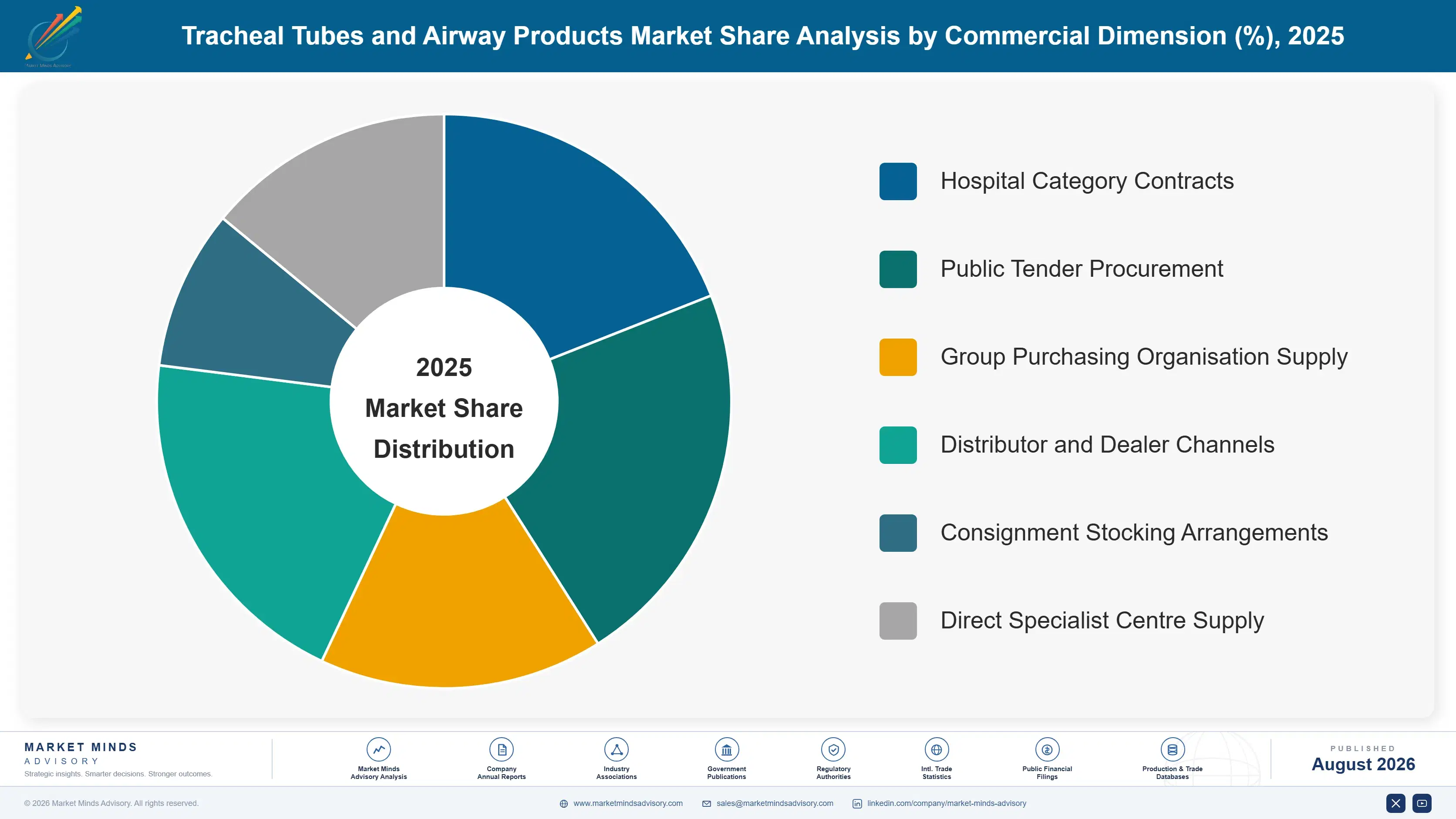
By Commercial Dimension

  • Hospital Category Contracts
  • Public Tender Procurement
  • Group Purchasing Organisation Supply
  • Distributor and Dealer Channels
  • Consignment Stocking Arrangements
  • Direct Specialist Centre Supply

By Region

  • North America
  • Western Europe
  • East Asia
  • South Asia and Pacific
  • Latin America
  • Middle East and Africa
  • Eastern Europe

Scope, Methodology, and Coverage

Every figure in this report is reproducible from documented input assumptions. The scope below maps the historical period, the forecast horizon, the segmentation dimensions, and the countries covered, alongside the underlying primary and qualitative methodology.
Historical Period
2020 to 2025
Forecast Period
2026 to 2036
Base Year
2025 (USD billions; MMA Primary Research Dataset, August 2026)
Market Definition
Devices establishing and maintaining an artificial airway, covering endotracheal tubes, supraglottic airway devices, tracheostomy tubes and accessories, video laryngoscopes and blades, basic airway adjuncts, and cuff management and airway monitoring devices. Measured at manufacturer selling value. Mechanical ventilators and anaesthesia delivery systems, breathing circuits and humidification, oxygen masks and nasal cannulae, and home respiratory equipment are excluded from scope.
Quantitative Units
USD billions (current prices); units shipped; USD per unit by device type
Segmentation Dimensions
Device type; end-use industry; commercial dimension; region
Regions Covered
North America, Western Europe, East Asia, South Asia and Pacific, Latin America, Middle East and Africa, Eastern Europe
Countries Covered
United States, Canada, Mexico, Germany, United Kingdom, France, Italy, Netherlands, China, Japan, South Korea, Taiwan, India, Indonesia, Australia, Brazil, Argentina, Saudi Arabia, South Africa, Poland
Key Companies Profiled
Medtronic, Teleflex, Ambu, Verathon, ICU Medical, Smiths Medical, Fisher and Paykel Healthcare, Vyaire Medical, Intersurgical, Flexicare Medical, Karl Storz, Olympus, Boston Scientific, Convatec, Well Lead Medical, Sumitomo Bakelite, VBM Medizintechnik, Armstrong Medical, Pulmodyne, Salter Labs
Quantitative Methodology
Primary survey, n=3,800 respondents, Q4 2025, six countries; demand-side model with trade association cross-validation
Qualitative Methodology
47 expert interviews, Q4 2025; applied to validate demand model assumptions, identify emerging dynamics, and assess competitive positioning
Report Format
PDF and XLSX data workbook (Word format preview document)
Publisher
Market Minds Advisory
Report Code
MMA-2026-MED-122
Published
August 2026
Contact
sales@marketmindsadvisory.com | www.marketmindsadvisory.com

Purchase the full Tracheal Tubes and Airway Products Market Report (2026 to 2036).

The full report treats airway devices as a category where the clinical arguments were settled decades ago and the commercial ones never were, which is why a five dollar gauge remains optional in most hospitals. It sizes all six device types independently through 2036, quantifies cuff pressure measurement practice against its consequences, and models budget line placement against adoption rates. Regional chapters cover all seven regions with single-use adoption assessed separately from procedure volume. Competitive profiling covers 20 participants on one consistent revenue basis. Decision functions are mapped by budget line throughout.
Six device types sized independently through 2036
Cuff pressure measurement practice quantified against clinical consequences
Budget line placement modelled against observed adoption rates
Single-use adoption assessed separately from procedure volume by region
Difficult airway stocking mapped against unpredictable actual usage
Twenty participants profiled on one consistent revenue basis

Built For The People Who Decide

From boardroom strategy to bench-side execution, this report is read cover-to-cover by leaders shaping the next decade of their industry, turning demand scenarios, market dynamics and valuation benchmarks into decisions.
CXOs/ Presidents/ VPs/ Managers
M&A and Corporate Development
Strategy Teams and R&D Heads
Procurement and Product Directors
Regulatory and Compliance Leaders
Investor Relations and Equity Analysts