Market Minds Advisory
Touchscreen Controller Market

Touchscreen Controller Market: Touchscreen Controller Market: Automotive Content, Noise Immunity and the Integration Collapse, 2026 to 2036

Integration into display drivers destroyed the discrete controller business in phones while cars quietly became the customer, paying many times the price for a part that has to work with wet gloves at minus forty.

Lead Analyst

Published

September 2026

Make Smarter Decisions with Customized Research Insights

Request a free sample report and evaluate market opportunities, growth trends, and competitive dynamics relevant to your business needs.

2025 MARKET VALUE$2.6BMarket Size 2025
2036 FORECAST VALUE$5.8BBase Case , 2026 to 2036
CAGR 2026 TO 20367.6 %Bull 8.8% / Bear 6.4%
INCREMENTAL OPPORTUNITY$3.0BNet 10- year value creation
EXPANSION MULTIPLE2.08x2036 value over 2026 base
Strategic Levers
M&A Pipeline
Regional Outlook
Country Rankings
Competitive Intelligence
Segmental Deep-dive
Call-Us : 91 93563 13602

Executive Snapshot and Market Trajectory.

The phone market that built this industry has mostly stopped buying the product. Integration into display driver devices left only about 11% of mobile devices using a discrete controller, and that share continues falling every year. The customer that built this industry left it. Nobody planned that transition.
A car replaced the phone as the interesting customer. A new vehicle now carries around 3.4 touch displays where it once carried none, and an automotive part sells for roughly 6.2 times a mobile equivalent because it must work through gloves, direct sun, standing water and temperatures no handset ever sees. Automotive qualified controllers grow at 11.4%, half again the market rate of 7.6%. Vehicle production is now the number that matters.
Five suppliers hold 74% of measured unit shipments. The engineering that separates them is noise rejection rather than sensitivity, since controllers fail on interference from the display beneath the sensor and from charging supplies rather than on detecting fingers. Automotive applications demand around 60 decibels of rejection, and qualification into a vehicle programme takes about 30 months. Qualification tests exactly that, over years rather than weeks.
Market Definition
The touchscreen controller market covers integrated circuits that drive and sense capacitive touch panels and interpret the resulting signals, spanning discrete mobile controllers, touch and display driver integrated devices, automotive qualified controllers, force and haptic feedback controllers, large-format and industrial controllers, and wearable small-format devices. Sizing is measured at semiconductor vendor shipment revenue. Display panels, display driver devices sold without touch function, cover glass, sensor films, touch panel module assembly and haptic actuators are excluded.
Base Year Value
$2.6B in 2025 (MMA Primary Research Dataset, September 2026)
Forecast Period
2026 to 2036, eleven discrete annual values
CAGR
7.6% base case. Bull 8.8%. Bear 6.4%.
Fastest Growth Segment
Automotive Qualified Touch Controllers: 11.4% CAGR
Fastest Growth Country
Vietnam: 12.8% CAGR
Fastest Growth Region
South Asia and Pacific: 9.6% CAGR
Largest Region
East Asia: 52% of 2025 global value
Market Leaders
Synaptics, Goodix, FocalTech Systems, Novatek Microelectronics, Himax Technologies. Source: MMA Analysis based on company annual reports and measured unit shipment volume.
Primary Survey
n=3,800 procurement and R&D decision-makers, Q4 2025, six countries
Methodology
Demand-side build-up, cross-validated against public data, 47 expert interviews

Touchscreen Controller Market Forecast Scenarios

touchscreen-controller-market-size-forecast-scenario-1788415863381
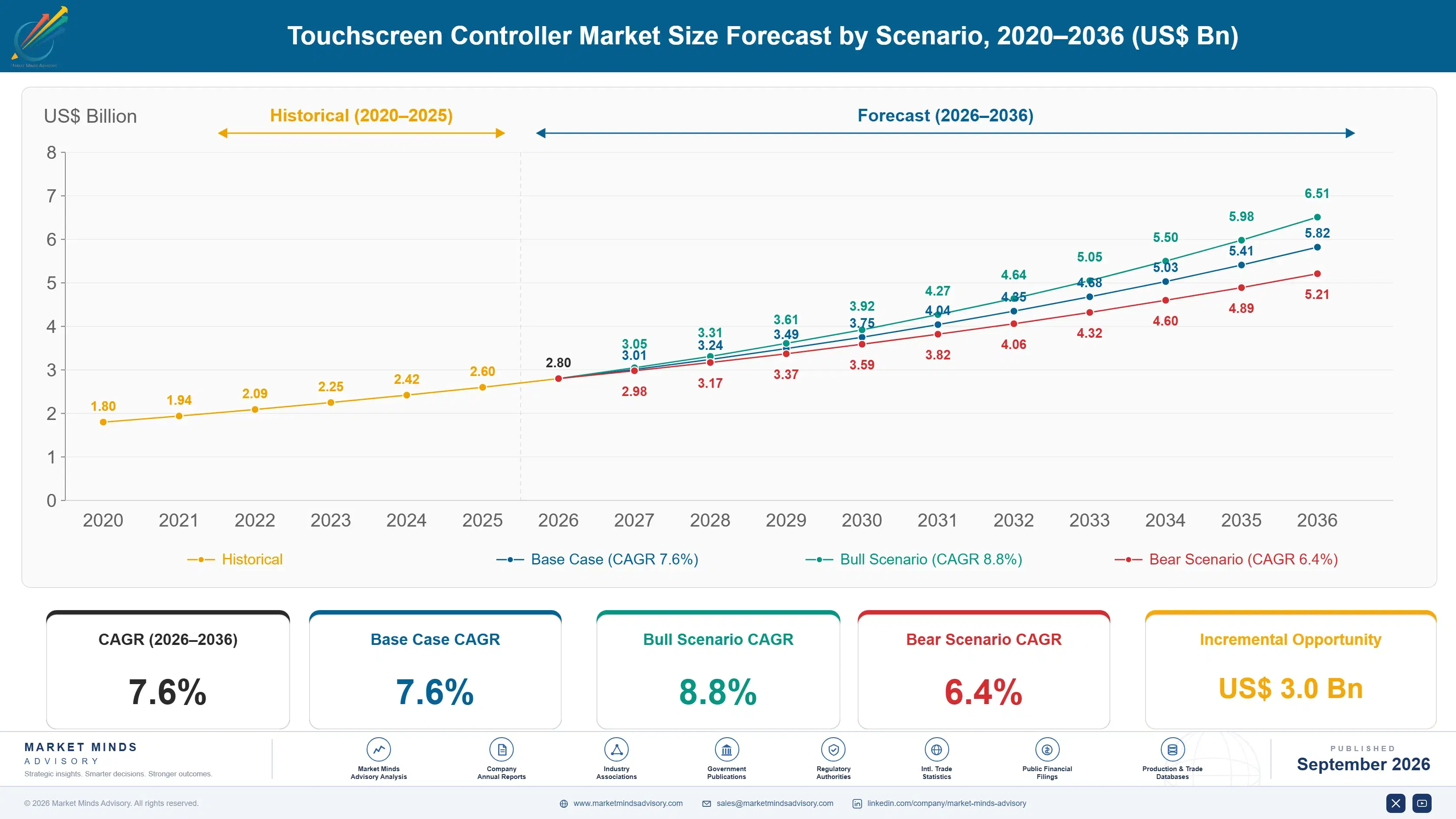
Between 2020 and 2025 the market compounded at 6.4%, and the composition inverted completely across that period. Discrete mobile controllers, which had been the entire business, collapsed as touch function migrated into display driver devices and several specialist suppliers disappeared or were absorbed. Automotive and industrial demand grew steadily throughout at prices that made a fraction of the units worth a great deal more revenue.
The 7.6% base case rests on three commercial mechanisms. Vehicle display count keeps rising as instrument clusters, centre stacks, passenger screens and rear units all become touch surfaces, and each carries a part priced several times a mobile equivalent. Industrial and appliance interfaces continue replacing physical controls for cost and sealing reasons. And force sensing with haptic feedback is being specified where regulators and safety bodies now discourage pure touch interaction.
The bull case is haptic and force feedback becoming standard rather than optional across vehicle interiors, which would add controller content to displays that already exist. The bear case is automotive integration following the same path as mobile, with touch function absorbed into display drivers or display controllers, removing the discrete automotive part exactly as it removed the discrete mobile one.

Phones Left, Cars Arrived, Value Followed

This industry was built on smartphones and smartphones stopped buying from it. Touch and display driver integration folded the controller into the display driver device, leaving only around 11% of mobile products using a discrete part, and that share falls further each year. Several specialists did not survive, and value migrated to display driver vendors owning both functions.
TOP FIVE CONCENTRATION74%Share of measured unit shipments held by leading suppliers
AUTOMOTIVE PRICE MULTIPLE6.2xAutomotive qualified part price against mobile equivalent controller
DISPLAYS PER VEHICLE3.4 displaysTouch displays fitted to a typical new passenger vehicle
MOBILE DISCRETE SHARE11%Portion of mobile devices still using a discrete controller
QUALIFICATION DURATION30 monthsTime to qualify a controller into an automotive display programme
NOISE REJECTION REQUIREMENT60 dBInterference rejection demanded on automotive and industrial applications
What replaced that demand is the car. A new vehicle carries around 3.4 touch displays where it recently carried none, and the part driving them sells for roughly 6.2 times a mobile equivalent. The premium is earned rather than extracted: the part must register a gloved finger, work in sun and standing water, operate from minus forty degrees and pass functional safety qualification.
The engineering that separates good controllers from poor ones is noise rejection rather than sensitivity, which surprises anyone assuming the difficulty lies in detecting a finger. The display driving underneath the sensor, the charging supply and moisture on the surface all inject interference far larger than the signal being measured. Automotive applications demand around 60 decibels of rejection, and achieving it consistently is what a 30 month qualification actually tests.
"Everyone assumes touch is a solved problem because their phone works. Put the same finger on a wet screen in a car in bright sun with the charger plugged in and you discover that the whole discipline is about rejecting interference, and almost nobody does it well."
Director, Human Interface Semiconductors Practice · MMA Technology and Semiconductors Practice · September 2026

Market Trends

Vehicle Display Count Carries The Whole Market

A new passenger vehicle now carries around 3.4 touch displays across instrument cluster, centre stack, passenger and rear positions, where a car built fifteen years ago carried none at all. Each requires a controller priced at roughly 6.2 times a mobile equivalent, because the part must handle gloves, sunlight, water and a temperature range no consumer device approaches. That converts a small share of units into a large share of revenue and makes vehicle production rather than handset shipment the number that matters. Automotive qualified controllers grow at 11.4% against a market at 7.6%.
Market Impact: Takes 30 months to qualify
Safety Bodies Push Back On Pure Touch Interiors

Physical controls disappeared from vehicle interiors under cost and styling pressure, and safety assessment bodies have begun rewarding their return for functions drivers need without looking. That does not restore mechanical switches so much as demand force sensing and haptic feedback that behaves like a button, which requires a different controller rather than a simpler one. The reversal is genuine and dateable rather than speculative. Force and haptic controllers grow at 10.2% as designers respond to assessment criteria they cannot afford to fail on. Force sensing and haptic driving must be tuned together with genuine care.
Market Impact: Demands 60 decibel rejection

Market Opportunities and Growth Drivers

Automotive Qualification Creates Genuine Pricing Power

Qualifying a controller into a vehicle display programme takes around 30 months of testing against temperature, vibration, electromagnetic compatibility and functional safety requirements, after which it ships for the platform's production life without further competition. That length of qualification is what supports pricing at roughly 6.2 times mobile equivalents, and it excludes suppliers who cannot fund the programme. The barrier is time rather than technology, which is the only kind capital does not shorten for anybody. A supplier absent at design-in waits an entire vehicle generation for the next chance.
Market Impact: Threatens the 11.4% growth segment

Industrial Interfaces Replace Physical Control Panels

Machine interfaces, appliance controls and medical equipment panels have moved to touch surfaces for sealing, cleaning and cost reasons, and these applications demand noise rejection near 60 decibels because they sit alongside motors, inverters and switching supplies that inject enormous interference. Product lifetimes run to a decade or more, which makes supply longevity a purchase criterion consumer suppliers do not offer. Prices sit between mobile and automotive levels with far lower volume per design and a great many more designs. Prices sit between mobile and automotive levels across a great many separate designs.
Market Impact: Swings across 2 capacity cycles

Market Restraints and Challenges

Automotive Integration Threatens The Growing Segment

The same commercial logic that folded touch into display drivers in mobile applies to vehicle displays, and several display driver suppliers are pursuing it. The root cause is that a vehicle manufacturer counting components has the same incentive a handset maker had, and integration removes a device, a supplier and an interface. Commercial impact would fall on exactly the segment carrying this market's growth at 11.4%. Participants mitigate by pursuing integration themselves, by holding functional safety qualifications that display driver vendors lack, and by moving into force and haptic functions that integration does not cover.
Market Impact: Fits 3.4 displays per vehicle

Mature Node Capacity Swings Without Warning

Touch controllers are built on mature process nodes rather than leading edge ones, and mature node capacity has alternated between severe shortage and evident oversupply within a few years as foundries responded to automotive and industrial demand signals. The root cause is that mature capacity investment is decided against forecasts that keep being wrong. Commercial impact is allocation difficulty in shortage and price collapse in glut. Mitigation runs through long-term foundry agreements, multi-node design portability and inventory positions that carry working capital cost through the good years. Neither position is right across a full cycle.
Market Impact: Restores 1 button-like function
4 additional market trends, 3 additional growth drivers, and 2 additional restraints and challenges are covered in the full report. Contact sales@marketmindsadvisory.com to access the complete intelligence.

Segment CAGR and Growth Architecture

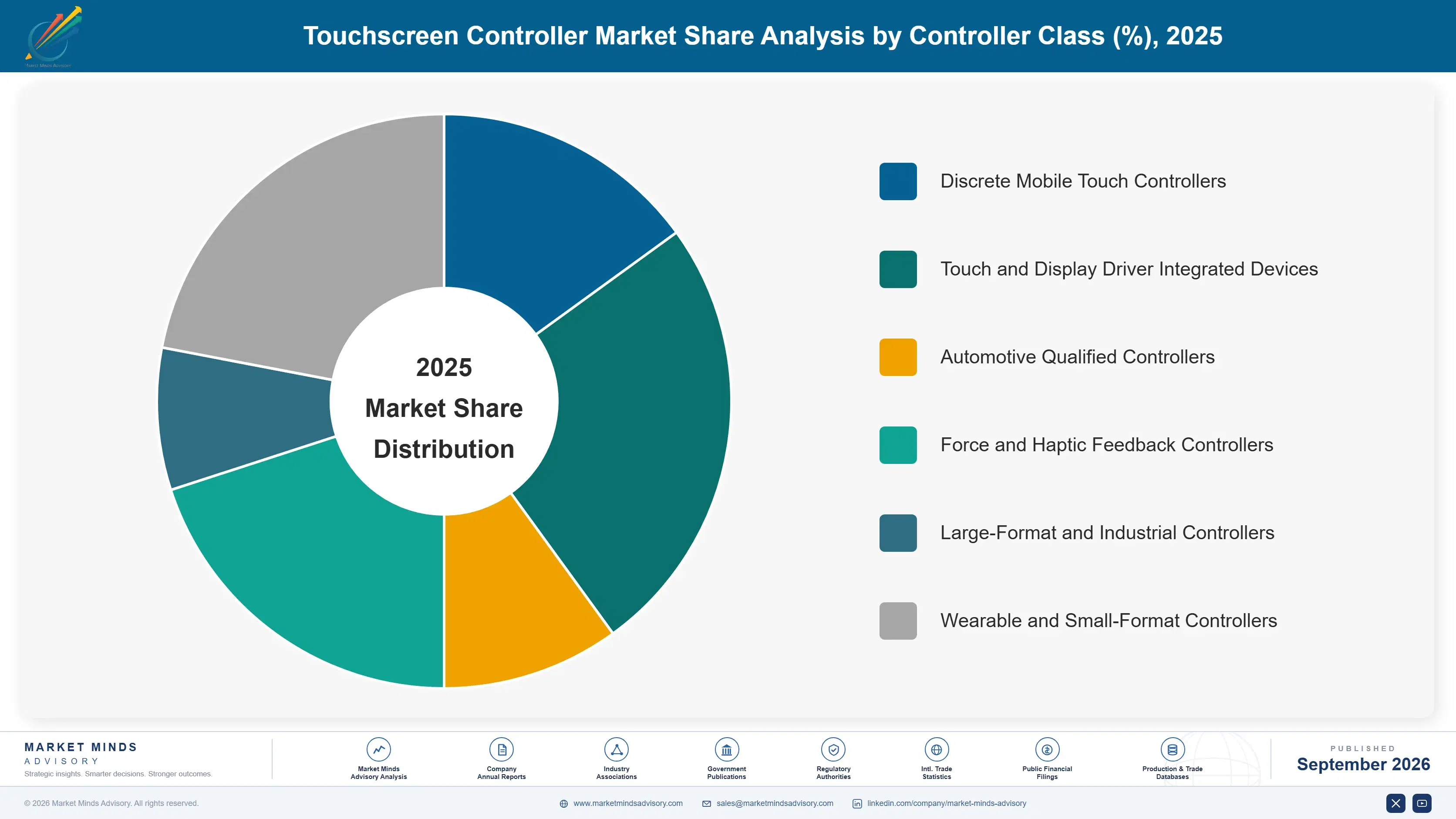
Segmentation follows controller class and qualification level, which determines the price commanded, the design cycle involved and who the customer actually is. Discrete mobile, integrated display driver, automotive qualified, force and haptic, large-format industrial and wearable devices face entirely different economics and are moving in opposite directions. Several are moving in opposite directions entirely.
touchscreen-controller-market-market-share-analysis-1788415863951

Automotive Qualified Touch Controllers

Vehicles now carry around 3.4 touch displays each and the controllers driving them sell at roughly 6.2 times mobile equivalents, because the part must register gloved fingers, function in direct sunlight and standing water, operate from minus forty degrees and satisfy functional safety requirements no consumer device faces. Qualification runs about 30 months and then ships for the platform's production life without further competition. Growth at 11.4% is half again the market rate of 7.6%. The risk is that display driver integration reaches automotive as it reached mobile, which would remove the discrete part from exactly the segment carrying this market. Nothing else in this market prices comparably. Integration is the only real threat.
CAGR 11.4%

Force and Haptic Feedback Controllers

Safety assessment bodies rewarding the return of physical controls for functions drivers should not look away for have created demand for surfaces that behave like buttons without being buttons, which requires force measurement and haptic actuation driven together. That is a more complex controller rather than a simpler one, and it adds content to displays that already exist rather than requiring new ones. Growth at 10.2% reflects designers responding to assessment criteria they cannot afford to fail. Tuning the haptic response so it genuinely feels like a detent rather than a buzz is where suppliers differentiate, and most do it badly. Customers notice the difference immediately in a way no specification sheet captures.
CAGR 10.2%
Full segment breakdown across 6 segments available in the complete report.

Regional Architecture and Country Demand Map

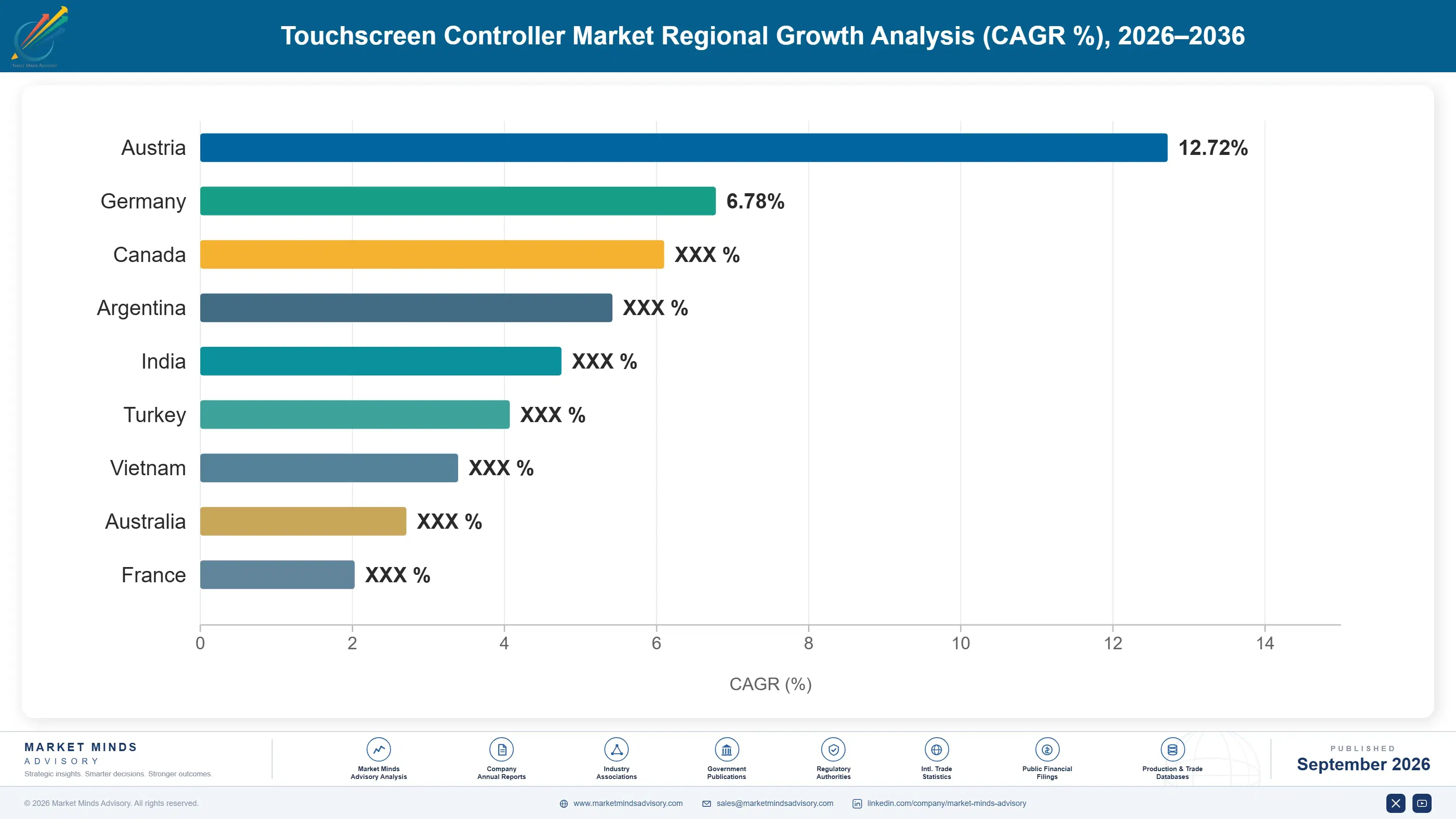
Demand records where display modules are assembled rather than where devices are designed or sold, because the controller ships bonded into the module. East Asia assembles the overwhelming majority of touch modules made anywhere. Design location and consumption location are entirely different places on this map.

East Asia

Display panel and touch module assembly concentrates in China, Taiwan, Korea and Japan to a degree that puts East Asia at 52%, far above the 30% ceiling of the standard band, and the concentration is genuine because the controller ships bonded into a module rather than shipped loose to a device maker. Taiwanese and Chinese suppliers dominate the volume tiers. Korean and Japanese display makers serve automotive programmes requiring the qualifications that carry premium pricing. Domestic controller vendors have taken most of the mobile business as integration consolidated it. Domestic controller vendors have taken most of the mobile business as integration consolidated it into display driver devices they already supplied.
Share: 52% | CAGR: 8.4% (2026 to 2036)

South Asia and Pacific

Vietnamese display module assembly has grown quickly as manufacturers diversified away from single-country concentration, and Vietnam grows at 12.8%, the fastest of any country in this market, which puts the region at 14%, above the standard band ceiling of 12%. Indian module and device assembly is expanding behind production incentives. Suppliers without technical support presence at those assembly sites are excluded from decisions taken by module makers rather than by brands. Australian demand is negligible in manufacturing terms. Indian module and device assembly is expanding steadily behind production incentives, and suppliers without local technical support presence are excluded from decisions taken there entirely. Australian demand is negligible in manufacturing terms.
Share: 14% | CAGR: 9.6% (2026 to 2036)
Regional intelligence for 5 additional markets available in the complete report: North America, Western Europe, Latin America, Middle East and Africa, Eastern Europe. Contact sales@marketmindsadvisory.com.
touchscreen-controller-market-country-cagr-analysis-1788415864517

Where Controller Value Now Sits

Four positions carry margin in a market whose original customer integrated the product away. Each depends on qualification, capability or presence secured years before revenue arrives, which is why the field narrowed so sharply during the mobile transition and why the survivors look quite different from the originals. The survivors look nothing like the originals.

Qualify Into Vehicle Programmes And Hold Them

Automotive qualification takes around 30 months against temperature, vibration, electromagnetic and functional safety requirements, after which the part ships for the platform's production life with no further competition at all. That length of programme supports pricing at roughly 6.2 times mobile equivalents and excludes suppliers unwilling to fund it. Time rather than technology is the barrier, which is the only kind capital cannot shorten. A supplier absent at design-in waits an entire vehicle generation. Automotive programmes ship for the platform's production life without any recompetition, which is why the qualification cost is recovered many times over.
Market Impact: Holds pricing at 6.2 times the mobile equivalent

Compete On Noise Rejection Not Sensitivity

Controllers fail on interference from the display beneath the sensor, from charging supplies and from moisture, not on detecting fingers, and automotive applications demand around 60 decibels of rejection. That is where the engineering difficulty genuinely lies and where evaluation actually happens once a customer tests properly. Suppliers marketing sensitivity and report rate are describing specifications every competent competitor also meets. Demonstrating rejection under realistic interference wins evaluations that datasheet comparison never does. Demonstrating rejection under realistic interference wins evaluations that datasheet comparison never does, and very few suppliers bother to arrange it.
Market Impact: Delivers the full 60 decibels that automotive demands

Pursue Integration Rather Than Resisting It

Display driver integration removed the discrete controller from roughly 89% of mobile devices and the same logic is being applied to vehicle displays now. Suppliers holding only a touch function will lose that segment exactly as touch specialists lost mobile. Acquiring or building display driver capability, or partnering to offer an integrated device, is the only response that survives the transition. Functional safety qualification is the one asset display driver vendors generally lack, and it buys time rather than permanence. Functional safety qualification buys time rather than permanence here. The socket disappears entirely.
Market Impact: Answers a threat to the 11.4% growth segment

Own The Haptic Feel Rather Than The Actuation

Safety assessment criteria rewarding button-like controls create demand for surfaces that feel like detents rather than buzzing, which requires force sensing and haptic driving tuned together with genuine care. Most suppliers do this badly and customers can feel the difference immediately in a way no specification captures. Growth of 10.2% adds content to displays that already exist rather than needing new ones. The differentiation is perceptual rather than measurable, which suits suppliers willing to invest in tuning that no datasheet will ever show. No datasheet will ever show it. Customers judge it by feel.
Market Impact: Grows at 10.2% on displays already fitted today

Who Controls the Margin Pool

Measured on unit shipment volume, the basis used throughout this section, the top five hold 74%. Concentration rose sharply through the mobile integration transition, which removed specialist suppliers rather than merely reducing their share. The gap between leaders and the rest is display driver capability and automotive qualification portfolio rather than any difference in touch sensing itself, which is understood across the industry.
Competition runs on integration capability at the volume end, on qualification portfolio and noise performance in automotive and industrial, and increasingly on force and haptic tuning that specifications cannot capture. Taiwanese and Chinese suppliers hold the mobile and consumer volume through display driver positions. Established international suppliers hold automotive and industrial qualification depth built over many programme cycles.

Pressure builds from two directions. Display driver integration is being examined for vehicle displays, which would remove the discrete part from the segment carrying this market's growth. And mature node capacity swings between shortage and glut, punishing suppliers without foundry agreements in one phase and those with them in the other. Rankings shift where suppliers acquired display driver capability and built qualification portfolios rather than defending touch specialisation.
touchscreen-controller-market-company-positioning-matrix-1788415865079

Competitive Moat and Risk Dimensions

SYNAPTICS

Moat: Qualification portfolio and breadth

Long-established positions across automotive, industrial and consumer applications give a qualification portfolio that takes competitors thirty months per programme to begin matching, and those positions ship for platform lifetimes without recompetition. Capability spanning touch, display driver and connectivity supports integrated devices rather than single functions. Functional safety experience is genuinely difficult for display driver specialists to assemble quickly.
SYNAPTICS

Risk: Mobile volume base erosion

The consumer volume that amortises development has been eroded by integration and by Asian suppliers competing at prices that do not attempt to match capability, which leaves fixed costs spread across fewer units. Automotive growth must outrun that erosion continuously. Display driver integration reaching vehicle displays would attack the position from the same direction it came from before.
GOODIX

Moat: Volume scale with integrated devices

Very large consumer volume across touch, fingerprint and audio functions amortises development across far more units than specialist competitors manage, and integrated devices combining several functions suit handset makers counting components. Close proximity to display module assembly gives design access that distant suppliers reach late. Cost position at the volume tiers is difficult for international competitors to approach.
GOODIX

Risk: Automotive qualification depth

Automotive programmes demand functional safety evidence and qualification history that consumer volume does not build, and the thirty month cycle cannot be shortened by scale or by pricing. Western vehicle manufacturers have been slow to qualify suppliers without established programme records. Trade measures affecting Chinese semiconductor suppliers could restrict access to exactly the premium automotive segment.

Players Tracked

Prominent Players

Synaptics
Goodix
FocalTech Systems
Novatek Microelectronics
Himax Technologies

Other Key Players

LX Semicon
Samsung Electronics
Infineon Technologies
Microchip Technology
STMicroelectronics
Texas Instruments
Renesas Electronics
Melfas
Sitronix Technology
ILITEK
Chipone Technology
Elan Microelectronics
Azoteq
Analog Devices
Parade Technologies

Recent Developments

JULY 2025

Safety assessment protocol rewards physical control availability

A vehicle safety assessment body confirmed protocols favouring direct physical or button-like access to certain functions, a rating decision rather than any commercial transaction. Vehicle manufacturers responded by specifying force sensing and haptic feedback rather than restoring mechanical switches to interiors. Mechanical switches were not restored.
Signal: The response to losing physical buttons was not restoring them but making glass behave like one.
NOVEMBER 2024

Supplier launches automotive qualified large-format controller

A semiconductor supplier launched a touch controller qualified for automotive use across large pillar-to-pillar display formats, a product launch rather than any corporate transaction. Noise rejection performance and functional safety classification were emphasised ahead of sensing resolution in the technical documentation. Pillar-to-pillar formats were targeted.
Signal: Marketing noise rejection rather than raw sensitivity shows exactly which specification the customers here actually evaluate.
MARCH 2025

Display driver and touch suppliers announce integrated automotive device

A display driver supplier and a touch controller specialist announced availability of a combined device for automotive displays, a technical collaboration rather than any merger or acquisition. Component count reduction for vehicle manufacturers was cited as the principal commercial rationale for the work. Availability was announced for automotive programmes.
Signal: Integration is now reaching automotive, which is precisely where the discrete controller business still lives today.

Mature Node Wafers And Packaging

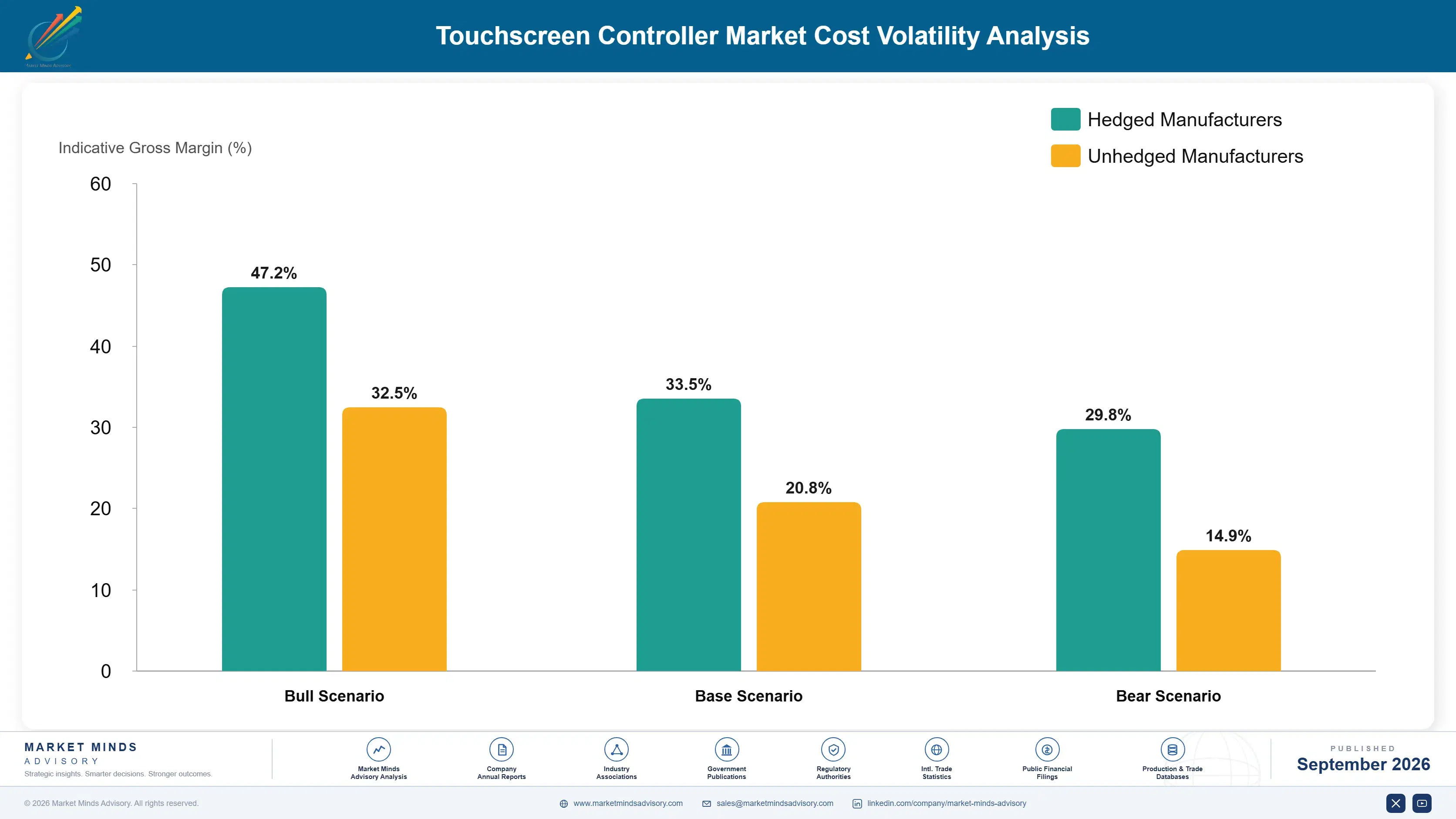
Wafer cost accounts for roughly 42% of manufactured device cost, packaging and substrate around 19%, test near 14%, and design amortisation, intellectual property and overhead the balance. These devices are built on mature process nodes rather than leading edge ones, and SEMI industry reporting documents mature node capacity behaving quite differently from advanced capacity, with investment decided against forecasts that have repeatedly proved wrong in both directions.
Mature node capacity moved from severe shortage through 2021 and 2022, when allocation rather than price determined who could ship at all, to evident oversupply as foundry investment arrived against automotive demand that then softened. Suppliers holding long-term capacity agreements paid above spot in the glut having been protected in the shortage. Several disclosed inventory writedowns in results covering the transition. Neither position proved right across the whole cycle.

The disadvantage mechanism is commitment structure rather than purchasing scale. A supplier with long-term foundry agreements ships through shortage and overpays through glut, while one buying on shorter terms does the opposite, and neither position is right across a full cycle. Design portability across nodes and foundries provides the only genuine flexibility, and it costs engineering effort that suppliers under margin pressure consistently defer.
touchscreen-controller-market-cost-volatility-analysis-1788415865289

Design portability across nodes and foundries

Building designs that can be moved between process nodes and foundries preserves the ability to respond when capacity or pricing shifts, which no purchasing arrangement provides. It costs engineering effort at design time that suppliers under margin pressure defer routinely, and then regret during the next allocation round. Regret arrives at the next allocation round.

Long-term capacity agreements sized below peak demand

Committing volume below expected peak rather than at it secures allocation through shortage without carrying the full overpayment through glut, which is the only sensible position given that both phases arrive and nobody predicts the timing. Most suppliers commit at peak expectation and suffer the consequences accordingly. Most commit at peak expectation instead. Timing is never predicted.

Package standardisation across product families

Using common package formats across controller families spreads substrate tooling and test hardware across many more units and simplifies supply during shortage. It constrains product differentiation on footprint, which customers occasionally care about and which product teams consistently overvalue relative to the cost involved. Product teams overvalue footprint differentiation considerably. Supply simplifies during shortage.

Portfolio Architecture for Margin Defence

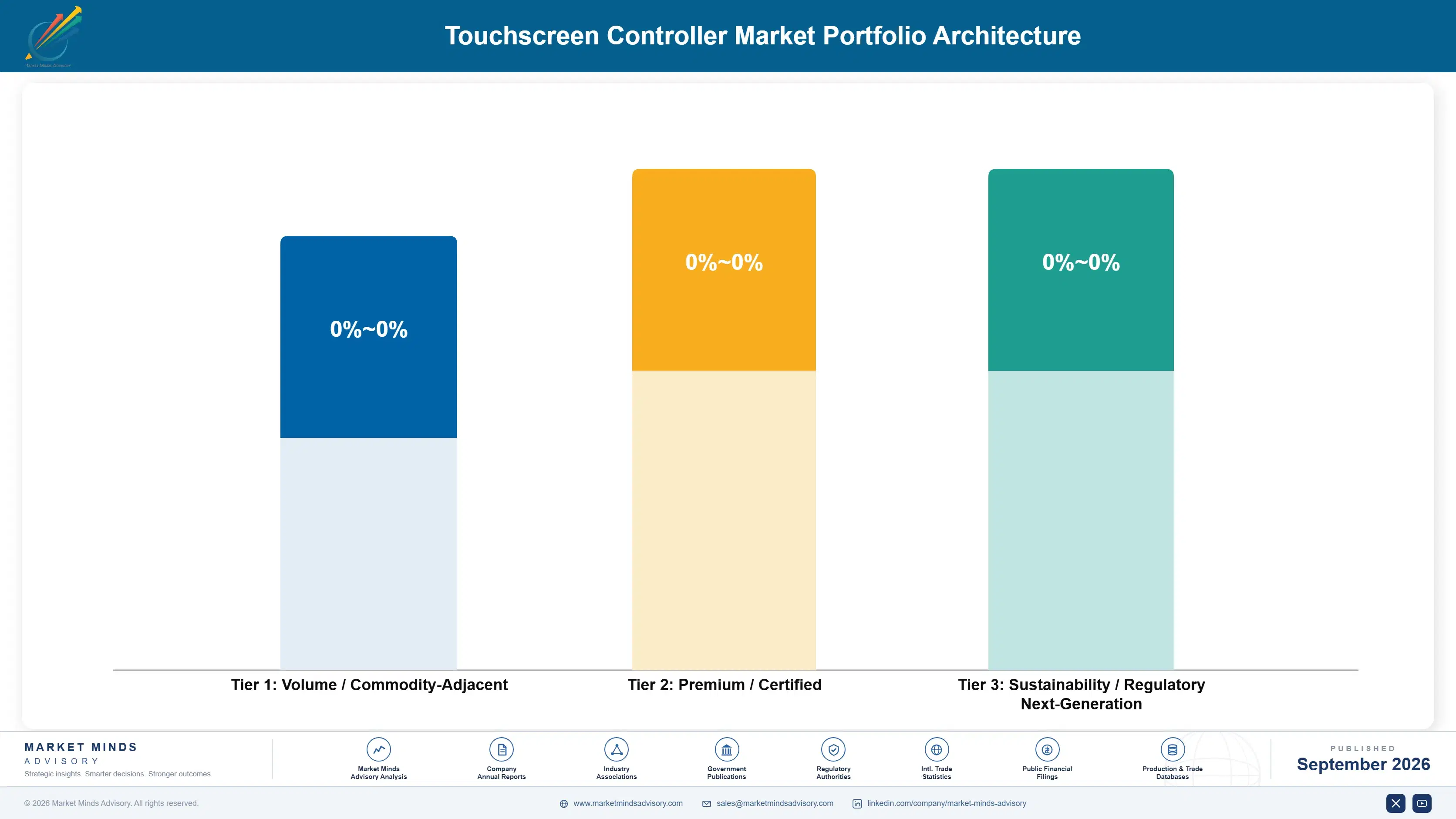
Margin separates by qualification rather than by capability. Consumer and mobile devices compete at prices set by suppliers with enormous volume and adequate performance, and the outcome depends on wafer cost and design amortisation rather than on anything a user notices. Automotive and industrial parts are chosen after qualification programmes lasting years, ship for platform lifetimes and price at multiples that reflect what the qualification cost rather than what the silicon does.
The volume against premium tension runs through amortisation. Consumer volume spreads design cost across units that automotive alone could never support, so a supplier abandoning it funds automotive development from a much smaller base. But consumer pricing has been competed down by suppliers with lower cost positions and the segment is shrinking through integration. Most established suppliers are managing a decline they cannot arrest while funding growth they cannot yet afford.

High-value pools sit where qualification or perception decides: automotive display programmes, functional safety classified parts, and haptic tuning that customers judge by feel rather than by specification. Each is defended by something a competitor cannot buy quickly. The pools are small in units against consumer volumes and carry a very disproportionate share of this industry's remaining profit.

Volume / Commodity-Adjacent

Consumer and mobile controllers competing at prices set by high volume suppliers with adequate performance. Outcomes depend on wafer cost and design amortisation, and the segment is shrinking as integration removes the discrete device entirely.
Gross Margin: 18 to 27%

Premium / Certified

Industrial, medical and large-format controllers requiring high noise rejection and long supply commitments. The 12 point range reflects how demanding the electrical environment is and whether supply longevity forms part of the purchase.
Gross Margin: 34 to 46%

Sustainability / Regulatory / Next-Generation

Automotive qualified controllers, functional safety classified devices and force and haptic parts meeting safety assessment criteria. The 16 point range reflects how completely a multi-year qualification removes competitive pressure on price.
Gross Margin: 44 to 60%
touchscreen-controller-market-portfolio-architecture-1788415865805

High-value Sub-segments and Strategic Watch-out

Automotive Qualified Controllers

Priced at roughly 6.2 times mobile equivalents behind a thirty month qualification that ships for the platform's life. Display driver integration reaching automotive is the single genuine threat to this entire position. Qualification cost is recovered many times across a platform life. Nothing else compares.
Gross Margin: 46 to 60%

Force And Haptic Feedback Devices

Growing at 10.2% on safety assessment criteria rewarding button-like controls, and adding content to displays that already exist. Differentiation is perceptual rather than measurable, which suits suppliers willing to invest in tuning. Safety assessment criteria created this demand rather than any customer request. Tuning quality decides it.
Gross Margin: 42 to 54%

Industrial And Medical Controllers

Demanding around sixty decibels of noise rejection alongside supply commitments running a decade or more, which consumer suppliers do not offer at all. Low volume per design across a great many separate designs. Supply longevity commitments matter more than price to these buyers. Consumer suppliers cannot offer it.
Gross Margin: 36 to 46%

Consumer And Mobile Controllers

Shrinking through integration to around eleven percent of mobile devices and competed at prices set by suppliers with far larger volume. Necessary for amortisation rather than attractive, and the decline cannot be arrested. Integration removes the socket rather than losing the design win. The decline cannot be arrested.
Gross Margin: 18 to 27%

Who Decides Which Controller Ships

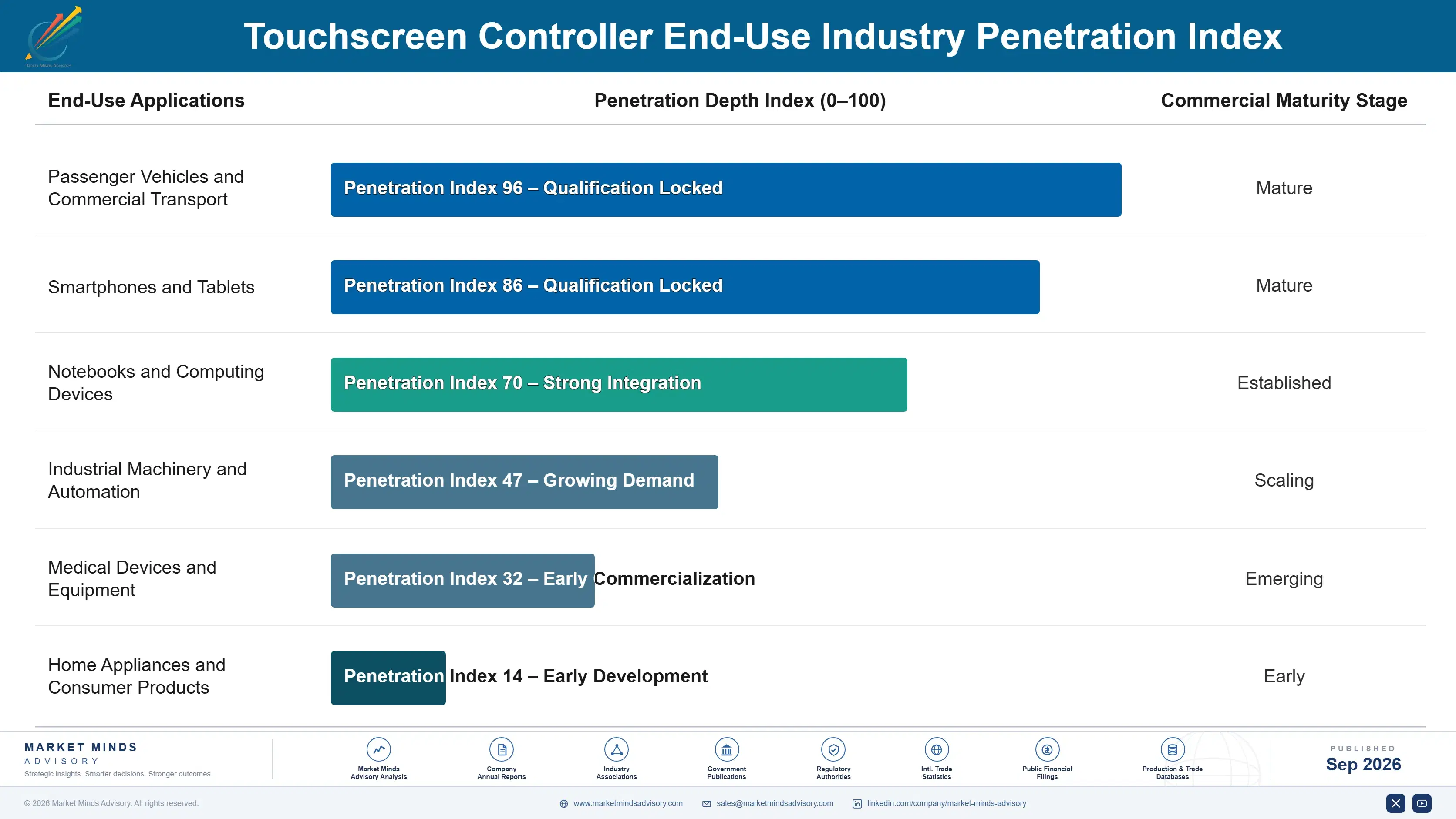
Annuity economics come from design-in, and their duration varies enormously by application. An automotive programme qualification lasts the platform's production life, often seven years or more, and ships without recompetition once granted. A consumer design win lasts a single product cycle and is contested again within the year. Industrial designs sit between the two and add supply longevity commitments measured in decades that consumer suppliers cannot offer.
Adoption depth varies sharply by customer. Vehicle manufacturers specify deeply through tier one suppliers, demand functional safety documentation and change supplier essentially never mid-platform. Industrial and medical customers specify against electrical environment and longevity, and value supply commitments above price. Consumer device makers specify to a price and a footprint, and treat parts within a tier as interchangeable because at that level they largely are.

The buyer profile has moved away from the brand entirely. Controllers were once chosen by device makers specifying components for their own products. They are now frequently chosen by display module assemblers who bond the controller into the module before anyone downstream sees it, which means the decision happens somewhere most suppliers were not calling. Automotive is the exception, where the vehicle manufacturer still specifies directly.
touchscreen-controller-market-end-use-penetration-index-1788415866339

Where Suppliers Should Compete

These are among the four positions where our research anticipates prominent divergence between winners and laggards over the coming forecast period. Each is grounded in the demand model, the regulatory perimeter, and the announced capacity pipeline.
01 / AUTOMOTIVE QUALIFICATION PRIORITY

Fund the thirty month programme or lose the segment

Automotive qualification runs around thirty months against temperature, vibration, electromagnetic and functional safety requirements, after which the part ships for the whole of that platform's production life without any further competition of any kind at all. That length supports pricing at roughly 6.2 times mobile equivalents and it excludes every single supplier unwilling to fund that programme upfront. Time rather than technology is the barrier here, which is the only kind of barrier that capital genuinely cannot shorten for anybody.
02 / NOISE PERFORMANCE POSITIONING

Demonstrate rejection instead of quoting sensitivity

Controllers fail on interference from the display beneath the sensor, from charging supplies and from surface moisture rather than on any difficulty whatsoever in detecting a finger on the surface, and automotive applications demand around sixty decibels of rejection. That is where the engineering difficulty genuinely lies and it is where evaluation genuinely happens once a customer tests the part properly. Suppliers marketing sensitivity and report rate are describing specifications every competent competitor in this market also meets perfectly comfortably already.
03 / INTEGRATION RESPONSE STRATEGY

Join the integration rather than defending against it

Display driver integration removed the discrete controller from roughly eighty nine percent of mobile devices, and the identical commercial logic is now being applied to vehicle displays by suppliers who can see exactly the same component count argument in front of them. A supplier holding only a touch function will lose automotive exactly as touch specialists lost mobile before it. Acquiring display driver capability or partnering to offer an integrated device is the only response that survives the transition intact.
04 / HAPTIC FEEL INVESTMENT

Tune the sensation nobody can put on a datasheet

Safety assessment criteria that reward button-like controls create demand for glass surfaces that feel like a detent rather than simply buzzing, which requires force sensing and haptic driving to be tuned together with considerable care. Most suppliers do this badly and customers notice the difference immediately, in a way that no specification sheet has ever captured. The segment grows at 10.2% by adding content to displays that already exist, which makes it unusually easy to sell into existing vehicle programmes.

Engagement Snapshot From the Field

A live engagement with an industry participant carrying material or product regulatory and market exposure ahead of a defining policy shift, showing how our research translates into a defensible multi-year portfolio strategy.
MARKET MINDS ADVISORY · CLIENT ENGAGEMENT SUMMARY
Touchscreen Controller Producer Strategic Portfolio Review and Transition Roadmap 2026·Investment Scenario on Touchscreen Controller Exposure Evaluation 2025-26
CLIENT PROFILE
An Asian supplier of touch sensing and display interface semiconductors with annual revenue reported at approximately USD 340 million (client-reported, unverified by MMA). The business was very heavily weighted toward consumer and mobile controllers, held only a single automotive qualification, and had watched integration remove a substantial part of its own addressable mobile market entirely.
STRATEGIC CHALLENGE
Consumer revenue had declined for three consecutive years as integration advanced and larger suppliers competed on price, while the company's single automotive position was profitable and could not be scaled quickly. Management disagreed about whether to fund automotive qualification programmes or defend the consumer position. Neither case had been quantified properly.
MMA APPROACH
MMA modelled the consumer decline against integration adoption rates by device tier, sized the automotive opportunity against qualification timelines and platform award schedules, and assessed whether the client's noise rejection performance was competitive in automotive evaluations rather than only in consumer comparisons. Competitor qualification portfolios were benchmarked alongside. Programme schedules were mapped.
KEY FINDINGS
  1. Consumer decline was permanent and would continue regardless of pricing action, since integration removes the socket rather than merely losing the design win to a competitor.
  2. The client's noise rejection performance was genuinely competitive in automotive evaluation, which nobody internally had established because consumer customers never tested for it.
  3. Qualification for three additional vehicle programmes was achievable within four years, and the revenue from them would exceed the entire remaining consumer business.
  4. Force and haptic capability was absent from the portfolio, and safety assessment changes were creating demand the client could not currently address at all.
CLIENT PROFILE
An Asian supplier of touch sensing and display interface semiconductors with annual revenue reported at approximately USD 340 million (client-reported, unverified by MMA). The business was very heavily weighted toward consumer and mobile controllers, held only a single automotive qualification, and had watched integration remove a substantial part of its own addressable mobile market entirely.
STRATEGIC CHALLENGE
Consumer revenue had declined for three consecutive years as integration advanced and larger suppliers competed on price, while the company's single automotive position was profitable and could not be scaled quickly. Management disagreed about whether to fund automotive qualification programmes or defend the consumer position. Neither case had been quantified properly.
MMA APPROACH
MMA modelled the consumer decline against integration adoption rates by device tier, sized the automotive opportunity against qualification timelines and platform award schedules, and assessed whether the client's noise rejection performance was competitive in automotive evaluations rather than only in consumer comparisons. Competitor qualification portfolios were benchmarked alongside. Programme schedules were mapped.
KEY FINDINGS
  1. Consumer decline was permanent and would continue regardless of pricing action, since integration removes the socket rather than merely losing the design win to a competitor.
  2. The client's noise rejection performance was genuinely competitive in automotive evaluation, which nobody internally had established because consumer customers never tested for it.
  3. Qualification for three additional vehicle programmes was achievable within four years, and the revenue from them would exceed the entire remaining consumer business.
  4. Force and haptic capability was absent from the portfolio, and safety assessment changes were creating demand the client could not currently address at all.
RECOMMENDED STRATEGY
Phase 1: Phase one: fund automotive qualification for three programmes immediately, accepting the consumer decline rather than spending anything to slow it. Phase 2: Phase two: develop force sensing and haptic driving capability, since safety assessment criteria are creating demand on displays that already exist. Phase 3: Phase three: pursue display driver partnership or capability so that automotive integration does not repeat exactly what already happened in mobile.
OUTCOME
Within fifteen months the client had entered qualification on two vehicle programmes, launched a force sensing development, and reported automotive revenue up 41% from a small base (client-reported, unverified by MMA). Consumer revenue declined further as expected, and total gross margin nonetheless improved across the period.

Frequently Asked Questions

Foundational context covering the market sizes, CAGR, scope, country, region and competition that inform every finding below. This section is provided to cover basics and most often pre-purchase conversations, answered from the MMA Primary Research Dataset.

What is the current size of the Touchscreen Controller Market?

The market was valued at USD 2.6 billion in 2025 and reaches USD 2.80 billion in 2026. Automotive content rather than handset volume drives the growth now.

How large will the Touchscreen Controller Market be by 2036?

MMA forecasts USD 5.82 billion by 2036, an increase of USD 3.02 billion over the 2026 base. That represents an expansion multiple of 2.08 times.

What is the CAGR for the Touchscreen Controller Market 2026 to 2036?

The base case CAGR is 7.6%, with a bull case of 8.8% and a bear case of 6.4%. The historical rate between 2020 and 2025 was 6.4%.

Which segment is growing fastest?

Automotive qualified controllers grow at 11.4%, half again the market rate of 7.6%. They sell at roughly six times mobile equivalents behind long qualification programmes.

Who are the major companies in the Touchscreen Controller Market?

Synaptics, Goodix, FocalTech Systems, Novatek Microelectronics and Himax Technologies lead on measured unit shipments. Together they account for roughly 74% of a concentrated global market.

Which country is growing fastest?

Vietnam grows fastest at 12.8%, as display module assembly moved there and controllers ship bonded into the modules rather than as loose components to device makers.

Report Segmentation Architecture

The full report scope spans multiple orthogonal segmentation dimensions, with cross-tabulated demand data provided for each dimension pair. Coverage extends further to regional breakdowns, trend trajectories, and the competitive detail needed to support segment-level decision-making.

By Controller Class

  • Discrete Mobile Touch Controllers
  • Touch and Display Driver Integrated Devices
  • Automotive Qualified Controllers
  • Force and Haptic Feedback Controllers
  • Large-Format and Industrial Controllers
  • Wearable and Small-Format Controllers

By End-Use Industry

  • Passenger Vehicles and Commercial Transport
  • Smartphones and Tablets
  • Notebooks and Computing Devices
  • Industrial Machinery and Automation
  • Medical Devices and Equipment
  • Home Appliances and Consumer Products

By Design Decision Point and Sales Route

  • Vehicle Manufacturer Specification
  • Display Module Assembler Selection
  • Device Brand Direct Design-In
  • Distributor and Channel Sales
  • Tier One Supplier Procurement
  • Reference Design Adoption

By Region

  • East Asia
  • South Asia and Pacific
  • North America
  • Western Europe
  • Latin America
  • Middle East and Africa
  • Eastern Europe

Scope, Methodology, and Coverage

Every figure in this report is reproducible from documented input assumptions. The scope below maps the historical period, the forecast horizon, the segmentation dimensions, and the countries covered, alongside the underlying primary and qualitative methodology.
Historical Period
2020 to 2025
Forecast Period
2026 to 2036
Base Year
2025 (USD billions; MMA Primary Research Dataset, September 2026)
Market Definition
The touchscreen controller market covers integrated circuits that drive and sense capacitive touch panels and interpret the resulting signals, spanning discrete mobile controllers, touch and display driver integrated devices, automotive qualified controllers, force and haptic feedback controllers, large-format and industrial controllers, and wearable small-format devices. Sizing is measured at semiconductor vendor shipment revenue. Display panels, display driver devices sold without touch function, cover glass, sensor films, touch panel module assembly and haptic actuators are excluded.
Quantitative Units
USD billions at semiconductor vendor shipment revenue, with supporting unit shipments and average selling prices by controller class and region
Segmentation Dimensions
Controller class, end-use industry, design decision point and sales route, region
Regions Covered
East Asia, South Asia and Pacific, North America, Western Europe, Latin America, Middle East and Africa, Eastern Europe
Countries Covered
China, Taiwan, South Korea, Japan, Vietnam, India, Australia, United States, Canada, Mexico, Brazil, Germany, France, Sweden, Poland, Hungary, Slovakia, United Arab Emirates
Key Companies Profiled
Synaptics, Goodix, FocalTech Systems, Novatek Microelectronics, Himax Technologies, LX Semicon, Samsung Electronics, Infineon Technologies, Microchip Technology, STMicroelectronics, Texas Instruments, Renesas Electronics, Melfas, Sitronix Technology, ILITEK, Chipone Technology, Elan Microelectronics, Azoteq, Analog Devices, Parade Technologies
Quantitative Methodology
Primary survey, n=3,800 respondents, Q4 2025, six countries; demand-side model with trade association cross-validation
Qualitative Methodology
47 expert interviews, Q4 2025; applied to validate demand model assumptions, identify emerging dynamics, and assess competitive positioning
Report Format
PDF and XLSX data workbook (Word format preview document)
Publisher
Market Minds Advisory
Report Code
MMA-2026-TEC-711
Published
September 2026
Contact
sales@marketmindsadvisory.com | www.marketmindsadvisory.com

Purchase the full Touchscreen Controller Market Report (2026 to 2036).

The full report separates unit volume from value by controller class throughout, which is the distinction that explains how a market losing its largest customer keeps growing in revenue. It sizes six controller classes with individual growth rates, seven regions built from display module assembly rather than from device consumption, and the integration dynamic that removed the discrete part from mobile and is now reaching automotive. Competitive analysis covers twenty suppliers on a consistent unit shipment basis, with qualification portfolio and display driver capability treated as the decisive variables. Input cost modelling breaks out mature node wafer, packaging and test exposure by commitment structure.
Six controller classes with individual growth rates
Unit volume separated from value by application
Automotive qualification timelines mapped by programme
Integration adoption tracked across device tiers
Twenty suppliers on consistent unit shipment basis
Mature node wafer and packaging cost exposure

Built For The People Who Decide

From boardroom strategy to bench-side execution, this report is read cover-to-cover by leaders shaping the next decade of their industry, turning demand scenarios, market dynamics and valuation benchmarks into decisions.
CXOs/ Presidents/ VPs/ Managers
M&A and Corporate Development
Strategy Teams and R&D Heads
Procurement and Product Directors
Regulatory and Compliance Leaders
Investor Relations and Equity Analysts