Market Minds Advisory
Touch Screen Film Market

Touch Screen Film Market: Silver Nanowire Now Challenges ITO's Legacy

A commercial reading of touch screen film, where silver nanowire displaces brittle ITO in large-format displays, foldable devices demand genuinely flexible sensor films, and East Asia's manufacturing concentration sets global supply patterns.

Lead Analyst

Bilal Shaikh

Published

September 2026

Make Smarter Decisions with Customized Research Insights

Request a free sample report and evaluate market opportunities, growth trends, and competitive dynamics relevant to your business needs.

2025 MARKET VALUE$5.6BMarket Size 2025
2036 FORECAST VALUE$13.9BBase Case , 2026 to 2036
CAGR 2026 TO 20368.6 %Bull 9.9% / Bear 7.1%
INCREMENTAL OPPORTUNITY$7.8BNet 10- year value creation
EXPANSION MULTIPLE2.28x2036 value over 2026 base
Strategic Levers
M&A Pipeline
Regional Outlook
Country Rankings
Competitive Intelligence
Segmental Deep-dive
Call-Us : 91 93563 13602

Executive Snapshot and Market Trajectory

A foldable phone that creases visibly at the hinge after six months is not a design flaw, it is the touch film reaching the limit of what conventional ITO chemistry was ever built to survive, and that specific failure point has become the industry's most closely watched engineering problem.
The market stands at USD 5.6 billion in 2025 and reaches USD 13.88 billion by 2036 at an 8.6% CAGR. Flexible and foldable touch films grow fastest at 13.5%, about 1.57 times the overall rate, pulled forward by foldable smartphone and tablet shipment growth. East Asia holds 42% of value given the region's dominant touch panel manufacturing base, while South Korea posts the fastest national growth at 11.5% on foldable device leadership.
Concentration sits at a moderate 52% among the top five, led by Nissha's touch sensor manufacturing scale and LG Display's integrated panel-touch engineering depth built over years of relationships. Two forces reshape the field now. Silver nanowire films are displacing brittle ITO in large-format automotive and industrial displays, and foldable device growth is driving flexible touch film innovation that conventional rigid sensor technology simply cannot support.
Market Definition
The touch screen film market covers conductive sensor films used in capacitive, resistive, and flexible touch panel assemblies, including ITO, metal mesh, silver nanowire, and foldable film technologies, sold to display and device manufacturers. Complete finished touch panel modules sold as integrated assemblies and touch controller semiconductors are excluded.
Base Year Value
$5.6B in 2025 (MMA Primary Research Dataset, August 2026)
Forecast Period
2026 to 2036, eleven discrete annual values
CAGR
8.6% base case. Bull 9.9%. Bear 7.1%.
Fastest Growth Segment
Flexible and Foldable Touch Films: 13.5% CAGR
Fastest Growth Country
South Korea: 11.5% CAGR
Fastest Growth Region
South Asia and Pacific: 10.6% CAGR
Largest Region
East Asia: 42% of 2025 global value
Market Leaders
Nissha, LG Display, Samsung Display, Toppan, Japan Display Inc. Source: MMA Analysis based on company annual reports and industry association data.
Primary Survey
n=3,800 procurement and R&D decision-makers, Q4 2025, six countries
Methodology
Demand-side build-up, cross-validated against public data, 47 expert interviews

Touch Screen Film Market Forecast Scenarios

touch-screen-film-market-size-forecast-scenario-1787325561516
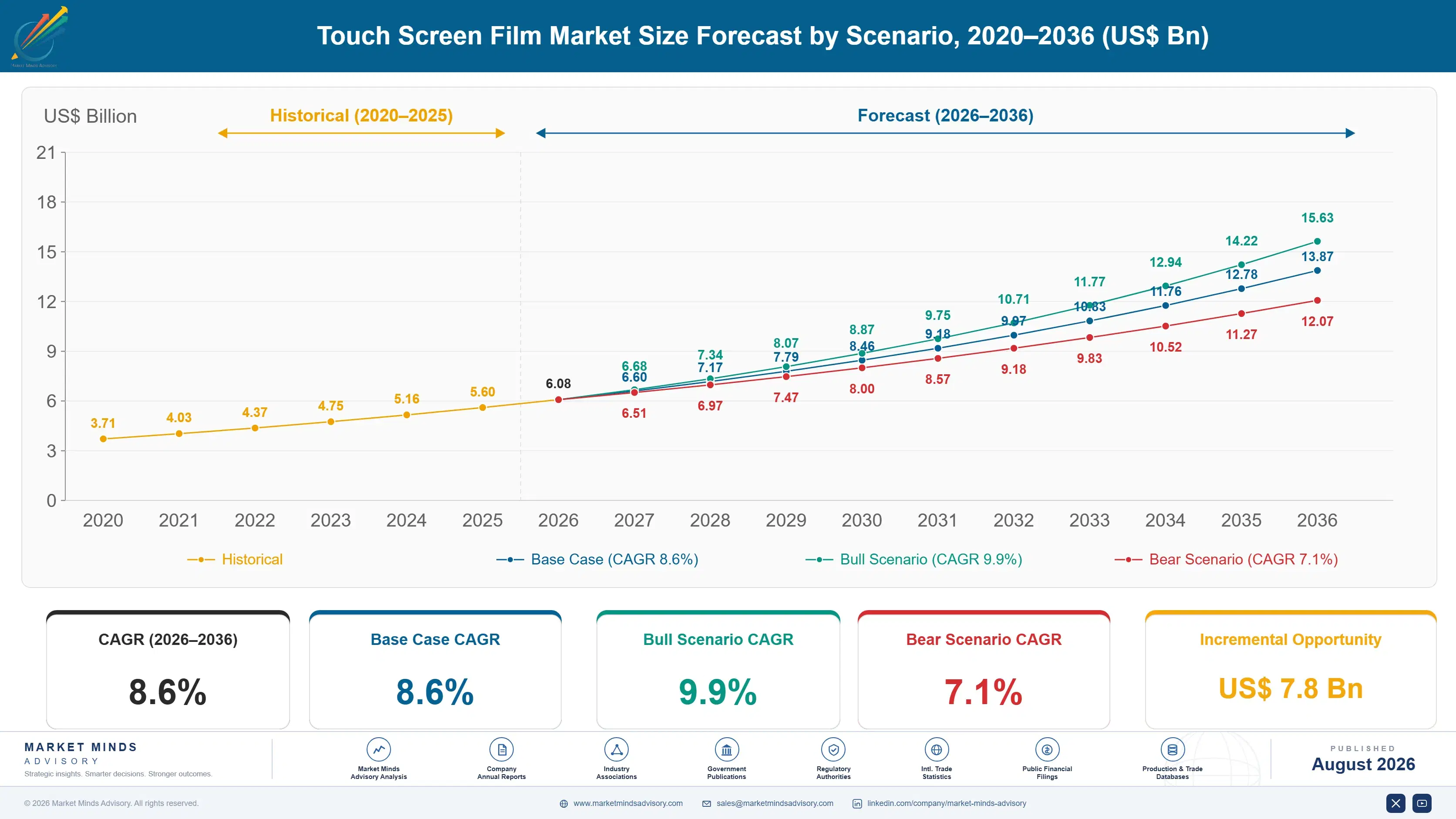
Growth from 2020 to 2025 compounded near 7.8%, supported by steady smartphone and tablet touch film demand before accelerating from 2023 onward as foldable device shipments expanded considerably and automotive in-vehicle touchscreen adoption grew much faster than the broader display category overall across most major global markets tracked closely by industry analysts and manufacturers alike.
Three mechanisms carry the base case to 8.6%. First, foldable smartphone and tablet growth, which requires flexible touch film technology that conventional rigid sensor designs cannot support at all today. Second, rising in-vehicle touchscreen adoption, which drives large-format film demand as digital cockpit designs replace physical buttons and dials across most vehicle segments. Third, silver nanowire displacement of ITO, which is expanding across large-format and flexible applications where brittleness limits conventional sensor technology.
The bull case at 9.9% assumes foldable device shipments accelerate faster than current manufacturer roadmaps suggest and automotive digital cockpit adoption spreads more quickly across mainstream vehicle segments beyond premium models. The bear case at 7.1% assumes high cost of silver nanowire films continues limiting adoption in budget devices and durability concerns keep slowing flexible film adoption in rugged-use applications.

Why the Fold Line Became the Engineering Battleground

Three forces set demand. Smartphone and tablet display volume provides the steadiest layer, since every touch-enabled device requires sensor film at first fit regardless of underlying panel technology. Foldable device growth adds a fast-growing second layer, requiring flexible film technology that conventional rigid ITO sensors cannot support through repeated folding cycles. Automotive in-vehicle touchscreen adoption adds a third layer, driving large-format film demand as digital cockpit designs
MARKET CONCENTRATIONCR5: 52%Moderately concentrated behind established touch sensor manufacturing leaders
AVERAGE SELLING PRICEUSD 3 to 45 per unitVaries considerably by film technology and display size specification
TOP PRODUCING REGIONEast Asia: 42% of global valueReflects concentrated touch panel and display manufacturing capacity
SILVER NANOWIRE PENETRATIONRoughly 18% of new unitsRising steadily as large-format and flexible applications expand
REPLACEMENT CYCLE LENGTH2 to 4 years typicalReflects device upgrade cycles rather than component wear alone
TRADE INTENSITYAbout 55% of units exportedTracks cross-border display assembly supply chains across regions
The commercial character rewards material science depth and application-specific engineering over price competition alone in premium segments. A device manufacturer choosing a film supplier increasingly weighs flex durability test data and optical clarity as heavily as price, since a film that fails after months of folding creates warranty costs far exceeding any price difference between suppliers. Nissha's manufacturing scale and LG Display's integrated engineering give both a trust advantage newer entrants must earn.
The next decade turns on two things. Whether silver nanowire technology can displace ITO quickly enough across large-format and flexible applications where brittleness genuinely limits conventional sensor performance. And whether flexible film durability can improve fast enough to satisfy foldable device manufacturers demanding multi-year fold cycle guarantees without visible crease formation at the hinge.
"Everyone obsesses over the display panel, but the touch film underneath is what actually determines whether a foldable phone survives its warranty period. That is where the real engineering risk sits."
Director, Display Components and Touch Sensing Practice · MMA Technology / Displ

Market Trends

Silver Nanowire Films Displace ITO in Large Formats

Large-format automotive and industrial displays increasingly specify silver nanowire touch film over conventional ITO, since silver nanowire delivers comparable conductivity while remaining considerably more flexible and resistant to the micro-cracking that limits ITO at larger panel sizes. Silver nanowire penetration has reached roughly 18 percent of new units, a share that has risen steadily as automotive digital cockpit designs expand across more segments and price tiers. C3Nano and Cambrios Film Solutions have both expanded production capacity considerably to meet rising large-format display demand. ITO-only manufacturers increasingly lose specification where brittleness genuinely limits conventional sensor performance.
Market Impact: Cockpit displays grew 25% larger
Foldable Growth Drives Flexible Film Innovation

Foldable smartphone and tablet shipments continue growing considerably faster than the broader rigid display category, directly requiring touch film technology engineered to withstand repeated folding cycles without cracking or forming a visible crease at the hinge over the device's service life. This capability requires fundamentally different film chemistry than conventional rigid sensor designs ever needed to support. Samsung Display and LG Display have both invested heavily in flexible film engineering specifically to meet this fast-growing category's demanding durability requirements. The commercial consequence is that manufacturers without genuine flexible film capability increasingly cannot compete for foldable device platform awards at all.
Market Impact: Foldable shipments passed 18 millio

Market Opportunities and Growth Drivers

Rising In-Vehicle Touchscreen Adoption Drives Demand

Automotive digital cockpit designs increasingly replace physical buttons and dials with large-format touchscreen displays, directly driving demand for touch film technology engineered to handle the panel sizes and durability requirements automotive applications demand beyond typical consumer electronics. Every vehicle equipped with a digital cockpit requires substantially more touch film area than a smartphone, meaningfully increasing per-vehicle film content compared with earlier generation infotainment systems. Chinese, European, and American automakers have all expanded digital cockpit specification considerably across new vehicle platforms launched recently. This driver continues strengthening as digital cockpit adoption expands further beyond premium vehicle segments into mainstream models.
Market Impact: Nanowire costs run 3-5x ITO

Foldable Smartphone Growth Sustains Film Demand

Foldable smartphone shipments continue expanding considerably faster than the broader smartphone category overall, directly sustaining demand for flexible touch film technology that conventional rigid sensor designs cannot support through repeated daily folding cycles. Samsung, Huawei, and several Chinese smartphone manufacturers have all expanded foldable device production considerably, directly driving film demand growth across the category. Every foldable device shipped requires this specialized film technology regardless of which manufacturer produces the underlying display panel itself. This driver continues strengthening as foldable device adoption expands further across price tiers beyond the premium segment where it currently concentrates.
Market Impact: Fold cycles average 200,000 uses

Market Restraints and Challenges

High Cost Limits Silver Nanowire Adoption in Budget Devices

Silver nanowire films cost meaningfully more than conventional ITO sensors, a premium that remains genuinely difficult to justify in budget smartphone and tablet tiers where manufacturers face intense cost pressure across the entire bill of materials. The root cause is the precious metal content and specialized deposition processes silver nanowire technology requires, keeping unit manufacturing cost elevated compared with mature ITO production infrastructure. Commercially this concentrates silver nanowire adoption among premium devices and automotive applications, leaving budget segments served predominantly by conventional ITO film. Manufacturers are responding with reduced silver loading formulations specifically targeting price-sensitive market segments.
Market Impact: Nanowire units reach 18% share

Durability Concerns Slow Flexible Film Adoption

Flexible touch films used in foldable devices face genuine durability challenges, including visible crease formation at the fold line and gradual conductivity degradation after repeated folding cycles that manufacturers have not yet fully resolved. The root cause is that flexible film chemistry must balance conductivity, optical clarity, and mechanical durability simultaneously, a combination that resists simple engineering solutions manufacturers could otherwise deploy quickly. Commercially this creates warranty risk and consumer confidence concerns that slow adoption beyond early adopter segments in some markets. Manufacturers are responding with reinforced multi-layer coating designs specifically engineered to extend fold cycle durability considerably.
Market Impact: Foldable film demand rose 30% yearl
3 additional market trends, 4 additional growth drivers, and 3 additional restraints and challenges are covered in the full report. Contact sales@marketmindsadvisory.com to access the complete intelligence.

Segment CAGR and Growth Architecture

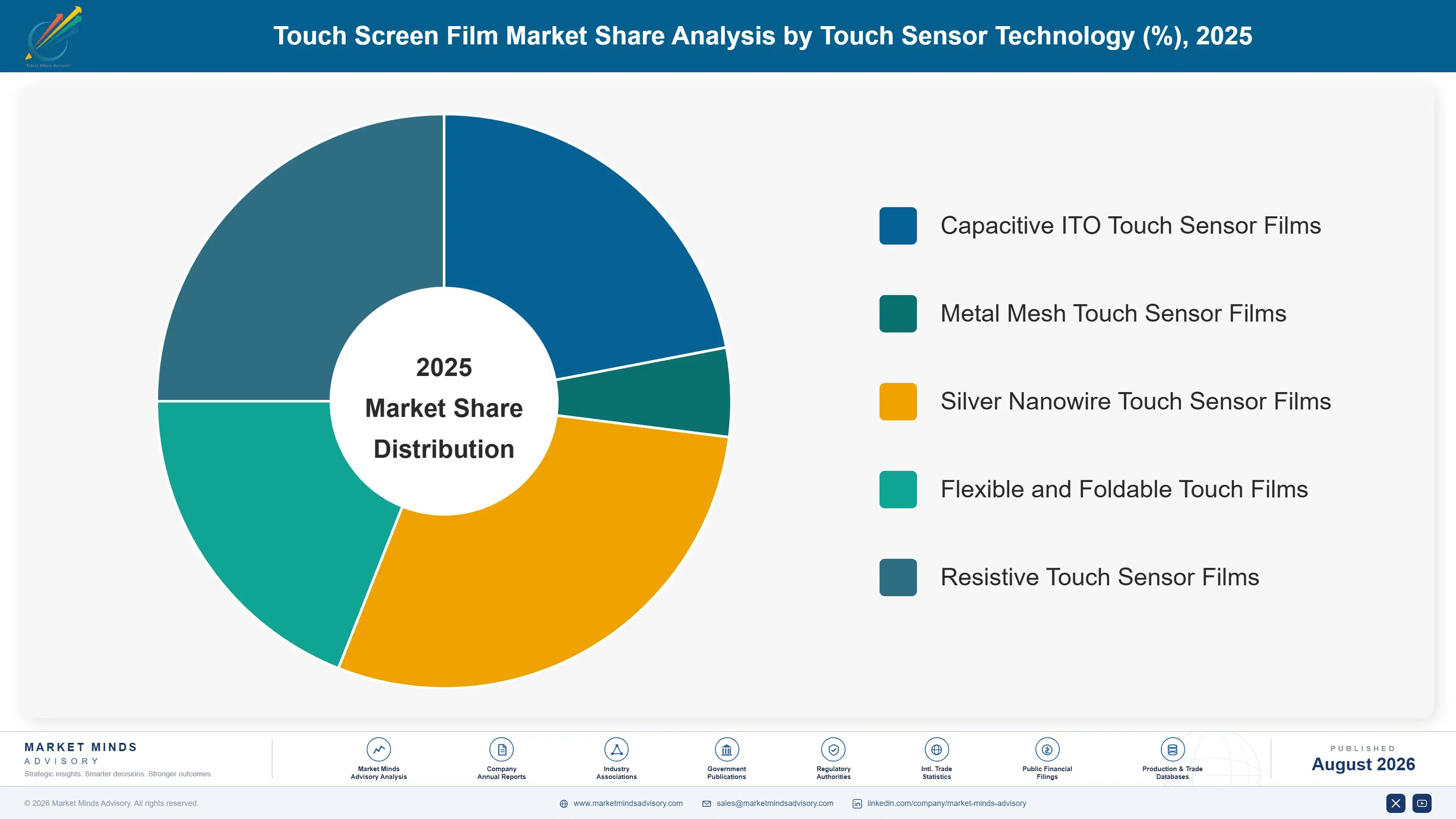
Segmentation follows touch sensor conductive material and technology, a single product logic describing how each film type conducts and senses touch input across applications, device categories, and manufacturing regions. Each technology carries distinct performance characteristics and cost structures, so commercial position tracks technology rather than end application, which appears separately within the framework below.
touch-screen-film-market-market-share-analysis-1787325562062

Flexible and Foldable Touch Films

Flexible and foldable touch films grow fastest at 13.5%, about 1.57 times the overall 8.6% rate, pulled forward by foldable smartphone and tablet shipment growth across major device manufacturers expanding their premium product lineups considerably. This category requires fundamentally different film chemistry engineered to withstand repeated folding cycles without cracking or forming a visible crease, a technical distinction that favours manufacturers with genuine flexible material science depth over conventional rigid sensor specialists. Samsung Display and LG Display have both invested heavily in flexible film engineering specifically to meet this fast-growing category's demanding durability requirements. Device manufacturers increasingly specify this category first when designing new foldable platforms given the direct compatibility requirement with their hinge mechanisms.
CAGR 13.5%

Silver Nanowire Touch Sensor Films

Silver nanowire touch sensor films grow at 11.0%, the second-fastest technology, as large-format automotive and industrial displays increasingly specify this technology over conventional ITO given its superior flexibility and resistance to the micro-cracking that limits ITO at larger panel sizes. This category benefits from expanding automotive digital cockpit adoption, since silver nanowire delivers comparable conductivity while remaining considerably more durable across the panel sizes automotive applications require. C3Nano and Cambrios Film Solutions both maintain meaningful positions here given established relationships with automotive display integrators across multiple vehicle platforms and programmes. Industrial touchscreen applications add a further layer of demand alongside the faster-growing automotive category specifically across most major markets tracked currently worldwide.
CAGR 11.0%
Full segment breakdown across 5 segments available in the complete report.

Regional Architecture and Country Demand Map

Touch panel manufacturing concentration and device shipment volume together set this distribution, since film demand tracks closely where displays are physically assembled worldwide today. East Asia dominates on manufacturing scale, while South Asia and Pacific posts the fastest regional growth of all seven regions tracked.

North America

Device design leadership and automotive digital cockpit adoption together anchor North American demand more than manufacturing scale does. North America holds 22% of value, with American smartphone and automotive brands specifying touch film technology even though final assembly occurs predominantly overseas in East Asian facilities. Automotive digital cockpit adoption has expanded considerably across domestic vehicle brands, driving substantial large-format film specification through their supply chains. Canadian and Mexican markets follow broadly similar demand patterns, though tied closely to American brand design decisions. Growth of 7.5% reflects mature market dynamics tempered by continued digital cockpit and foldable device specification growth. Component distribution and design engineering remain concentrated domestically despite offshore manufacturing.
Share: 22% | CAGR: 7.5% (2026 to 2036)

Western Europe

Automotive digital cockpit adoption and premium device demand together define this market above manufacturing scale considerations. Western Europe holds 18% of value, with German, French, and British automotive markets driving meaningful large-format touch film specification through their vehicle design and engineering functions. Premium smartphone and tablet demand across the region sustains steady conventional and flexible film specification through European brand design decisions. Environmental and material sourcing regulation runs considerably stricter here than in most other regions, pushing suppliers toward more responsibly sourced silver nanowire alternatives. Growth of 7.0%, the slowest of the seven, reflects mature market penetration in the region's largest automotive and electronics design centers specifically. Scandinavian markets lead in per-capita premium device adoption given strong consumer purchasing power.
Share: 18% | CAGR: 7.0% (2026 to 2036)
Regional intelligence for 5 additional markets available in the complete report: East Asia, South Asia and Pacific, Latin America, Middle East and Africa, Eastern Europe. Contact sales@marketmindsadvisory.com.
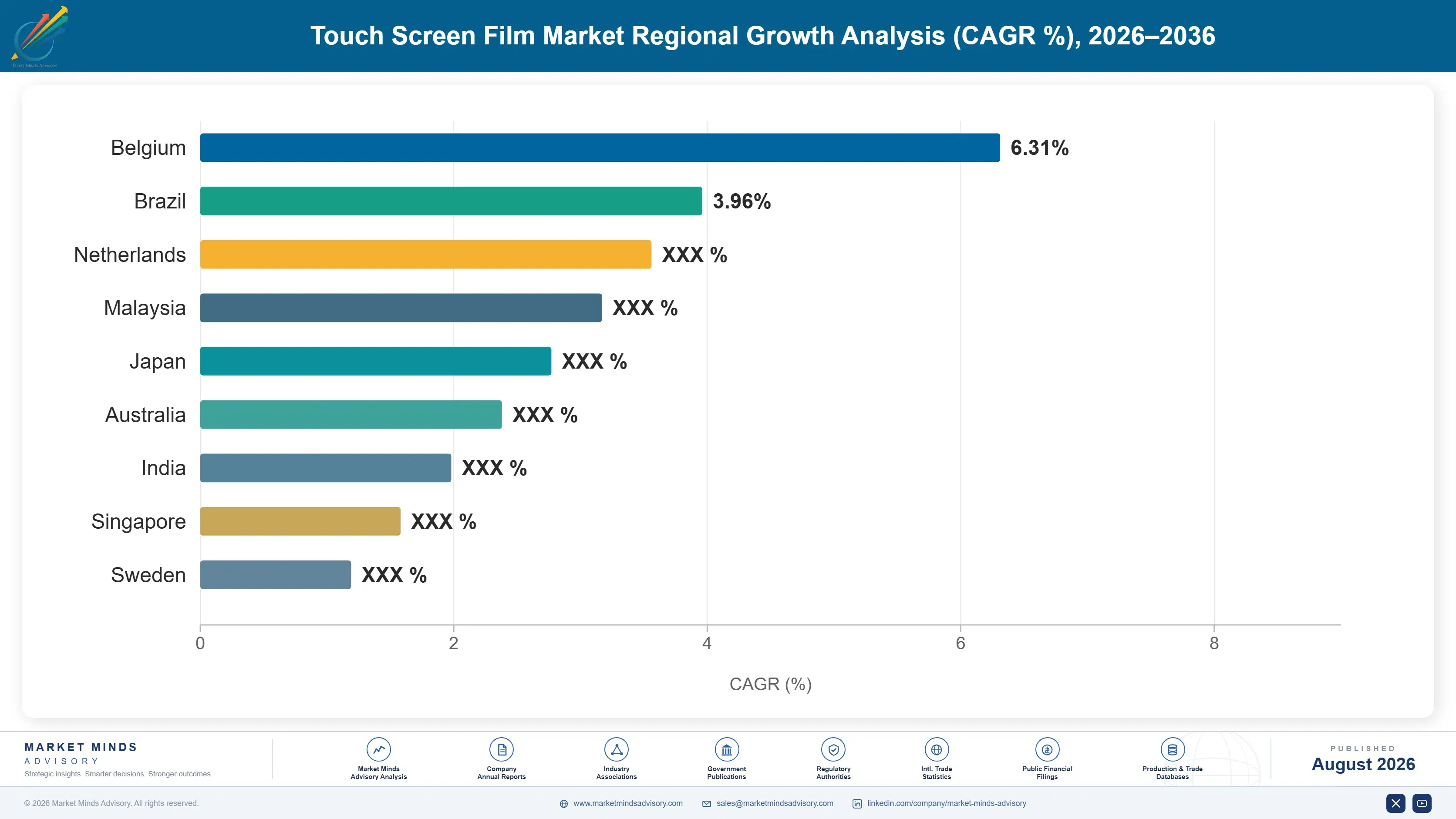
touch-screen-film-market-country-cagr-analysis-1787325562583

Where Touch Film Manufacturer Margin Concentrates

Competing purely on film price per unit concentrates margin in exactly the commodity ITO segment where regional producers undercut established manufacturers easily. The four moves below shift value toward positions material science depth and application relationships genuinely protect: silver nanowire manufacturing capability, flexible film durability engineering, automotive display partnerships, and foldable device platform integration.

Build Silver Nanowire Manufacturing Capability Now

Silver nanowire penetration has reached roughly 18 percent of new units, a share that has risen steadily as automotive digital cockpit designs expand across more vehicle segments and price tiers where ITO brittleness genuinely limits conventional sensor performance and durability under repeated flexing. Manufacturers with genuine silver nanowire production capability capture specification that ITO-only competitors increasingly cannot match as large-format and flexible applications continue expanding across automotive and industrial categories. Building this capability requires sustained investment in precious metal deposition processes beyond conventional ITO manufacturing expertise entirely, a multi-year commitment.
Market Impact: Nanowire units now reach roughly 18

Develop Flexible Film Durability Engineering Depth

Foldable film demand has risen roughly 30 percent annually as device manufacturers increasingly demand fold cycle durability approaching 200,000 uses without visible crease formation or conductivity degradation at the hinge line across most major device platforms tracked. Manufacturers with genuine flexible film durability engineering capture specification that competitors offering only conventional rigid sensor technology increasingly cannot match as foldable device shipments continue expanding across price tiers globally and steadily. This capability requires sustained materials engineering investment in multi-layer coating chemistry that most conventional film producers have not historically needed to develop.
Market Impact: Fold cycles now reach roughly 200,0

Deepen Automotive Display Partnership Relationships Now

Automotive digital cockpit displays require touch film engineered for panel sizes and durability requirements considerably beyond typical consumer electronics specifications, and cockpit display sizes have grown roughly 25 percent larger on average across recent vehicle model launches worldwide and regionally. Manufacturers investing in deep automotive engineering relationships capture large-format specification that generalist film producers increasingly cannot match given the multi-year platform validation cycles automotive customers require before committing meaningful volume. This relationship depth compounds over successive vehicle generations as automakers default to validated, trusted film suppliers across their broader model lineup.
Market Impact: Cockpit displays have grown roughly

Secure Foldable Device Platform Integration Early

Device manufacturers increasingly specify flexible film technology first when designing new foldable platforms, and foldable shipments have already passed 18 million units annually, giving early-validated suppliers a durable specification advantage that later entrants struggle to displace once a hinge mechanism and film combination has been validated together across product generations and platforms. Manufacturers securing early platform integration capture multi-generation specification loyalty that transactional, price-focused competitors cannot easily overcome even with meaningfully lower unit costs offered upfront. This integration depth compounds over successive device generations as validated combinations carry forward reliably.
Market Impact: Foldable shipments have already pas

Who Controls the Margin Pool

Concentration sits at a moderate 52% among the top five, led by Nissha's touch sensor manufacturing scale and LG Display's integrated panel-touch engineering depth built over years of device manufacturer relationships. The gap between leaders and challengers is material science depth and application-specific engineering rather than raw price, which regional producers undercut easily in commodity ITO categories. All participants are assessed on global unit shipment volume as disclosed in company
Competition runs along four lines. First, silver nanowire manufacturing capability, increasingly the fastest-growing purchase consideration in large-format applications. Second, flexible film durability engineering that serves the expanding foldable device category. Third, automotive display partnership depth built across multi-year platform validation cycles. Fourth, foldable device platform integration secured early in the design process.

Pressure is building from two directions. Chinese manufacturers including BOE Technology and O-Film Tech have built substantial manufacturing scale and are converting cost advantages into meaningful share gains in price-sensitive smartphone segments. Meanwhile established leaders continue defending position through sustained silver nanowire and flexible film investment that smaller competitors struggle to match. Rankings should favour manufacturers combining material science depth with genuine automotive and foldable relationships over ITO price alone.
touch-screen-film-market-company-positioning-matrix-1787325563095

Competitive Moat and Risk Dimensions

NISSHA

Moat: Touch sensor manufacturing scale

Nissha maintains one of the largest touch sensor manufacturing footprints in the category, built over decades of production scale spanning conventional ITO through emerging silver nanowire technology. Its diversified application base across consumer electronics, automotive, and industrial customers provides considerable revenue stability. Strong relationships with major device manufacturers sustain steady specification wins across multiple product categories globally.
NISSHA

Risk: Chinese manufacturers scaling aggressively

Chinese manufacturers now offer comparable conventional ITO film specifications at meaningfully lower prices, eroding the premium Nissha has historically commanded in cost-sensitive smartphone and tablet segments specifically. Its scale advantages matter less as ITO technology commoditizes faster than emerging silver nanowire and flexible categories. Newer, more agile competitors are moving faster on next-generation flexible film chemistry currently.
LG DISPLAY

Moat: Integrated panel-touch engineering

LG Display's broader display panel business gives it direct integration advantage combining touch film and panel engineering that standalone film suppliers cannot easily replicate across device platforms. Its flexible film engineering, developed across multiple foldable device generations, positions it strongly for this fastest-growing category specifically. Established relationships with major global smartphone and automotive manufacturers provide considerable specification leverage.
LG DISPLAY

Risk: Broad portfolio dilutes focus

LG Display's touch film business competes for engineering and capital investment against its considerably larger core display panel division internally. Specialist competitors focused purely on touch film can sometimes out-innovate on niche technical requirements more quickly. Korean rival Samsung Display increasingly challenges its position in foldable device specification decisions specifically.

Players Tracked

Prominent Players

Nissha
LG Display
Samsung Display
Toppan
Japan Display Inc

Other Key Players

TPK Holding
General Interface Solution
Innolux
AU Optronics
BOE Technology
Truly International
O-Film Tech
Fujifilm
Nitto Denko
C3Nano
Zytronic
Microchip Technology
Synaptics
Cambrios Film Solutions
Guardian Industries

Recent Developments

APRIL 2025

Samsung Display expands flexible film production capacity

Samsung Display expanded manufacturing capacity for its flexible touch film product line to meet rising demand from foldable device launches across multiple smartphone and tablet platforms globally and regionally. This was an organic capacity expansion rather than any acquisition, reflecting confidence in sustained foldable demand growth.
Signal: Established display leaders are scaling fl
SEPTEMBER 2024

C3Nano signs supply agreement with automotive display integrator

C3Nano signed a multi-year supply agreement with a major automotive display integrator to provide silver nanowire touch film across an expanding digital cockpit platform lineup through the end of the decade. This was a supply agreement rather than a joint venture, securing volume without shared ownership.
Signal: Silver nanowire specialists are locking in
JANUARY 2025

LG Display acquires flexible coating technology firm

LG Display acquired a specialist flexible coating technology firm to strengthen its foldable device film durability capability across its existing touch sensor product line and future development roadmap. This was an acquisition rather than a joint venture, adding proprietary coating technology directly into its existing organization.
Signal: Established display manufacturers are buyi

Silver, Indium, and Polymer Substrates

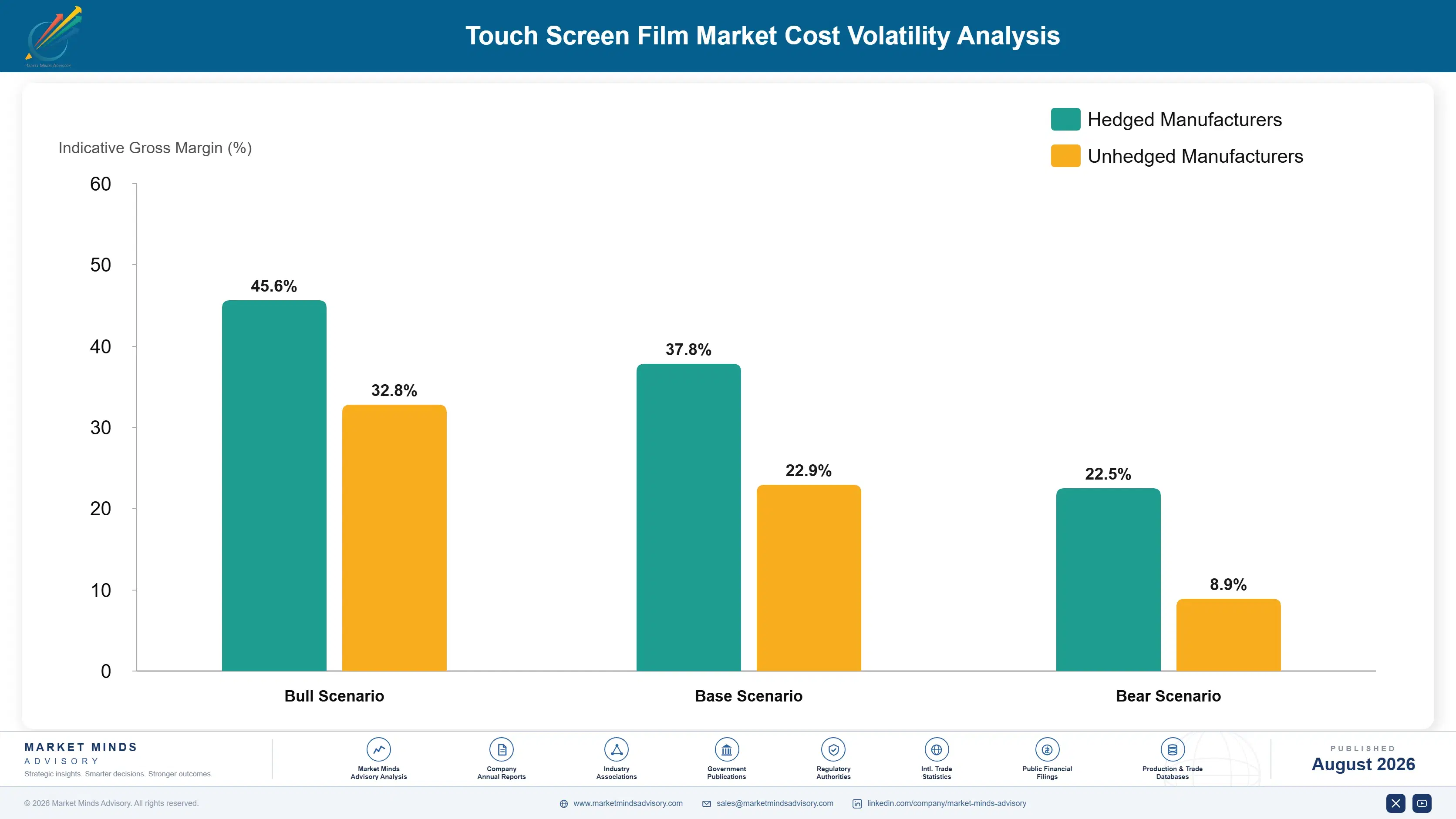
Silver nanowire ink, indium tin oxide targets, and specialty polymer substrates together account for 42% to 56% of cost of goods sold, reflecting the precious metal and precision material inputs touch film manufacturing requires across most technology categories. These inputs are sourced predominantly from specialty metal and chemical suppliers concentrated in East Asia directly and reliably.
Indium prices, a byproduct of zinc mining with limited global supply, rose sharply through 2021 and 2022 amid broader commodity market volatility, with several touch film manufacturers disclosing meaningfully higher input costs during that period, per IEA and company annual report commentary on the same commodity cycle. Several manufacturers passed through a portion of this cost increase to device manufacturer customers with a lag of several months, compressing margin temporarily.

Exposure separates clearly by film technology and procurement contract structure. Silver nanowire manufacturers face considerably higher precious metal exposure than conventional ITO producers, given silver's higher baseline cost and price volatility compared with indium tin oxide inputs. Larger manufacturers with hedged metal procurement contracts absorbed less disruption than smaller competitors purchasing silver and indium on the spot market during the tightest volatility periods.
touch-screen-film-market-cost-volatility-analysis-1787325563291

Hedge precious metal procurement through contracts

Spot-market silver and indium purchasing exposed several manufacturers to meaningful cost spikes during the 2021 and 2022 volatility period specifically and repeatedly across the industry. Longer-term hedged procurement contracts reduce this exposure considerably across future commodity price cycles ahead for most manufacturers. The trade-off is reduced flexibility to benefit from price declines when metal markets soften unexpectedly.

Diversify indium supply sourcing geographically

Indium supply concentration in a small number of producing countries exposed several manufacturers to meaningful disruption risk during recent supply tightness across the broader zinc mining industry. Diversifying indium sourcing across multiple geographic regions reduces this concentration risk considerably over time. This requires supplier qualification investment that smaller manufacturers sometimes cannot justify economically at current volumes.

Reduce silver loading through formulation research

Silver nanowire cost pressure compresses margin considerably in price-sensitive segments, and manufacturers investing in reduced silver loading formulations that maintain comparable conductivity capture cost advantages competitors relying on standard formulations cannot match easily or quickly. This research investment shifts manufacturer economics toward genuine formulation differentiation rather than pure raw material cost exposure over time and across cycles.

Portfolio Architecture for Margin Defence

The portfolio splits into three tiers with distinct economics. Standard ITO touch films form the volume tier, competing increasingly on price against regional producers with margin set by component cost and production efficiency. Silver nanowire and flexible foldable films earn considerably more since material science depth and application engineering breadth deter competitors lacking comparable technical investment. Automotive display partnerships and foldable platform integration services are
The tension runs between standard ITO film revenue that funds the business today and silver nanowire and flexible film investment that positions it for the next decade of premium demand. A manufacturer defending ITO volume too aggressively against regional producer competition cedes the highest-margin nanowire and flexible segments to competitors investing there directly. Companies managing this well use ITO cash flow to fund material science research rather than treating them as competing priorities.

High-value pools concentrate where material science depth, flexible engineering, or automotive relationships limit competition: silver nanowire large-format films, foldable device sensors, and automotive digital cockpit partnerships. Standard ITO films sold without differentiated capability sit at the other end, competing almost entirely on price against every regional producer now serving cost-sensitive consumer buyers.

Volume / Commodity-Adjacent Tier

Standard ITO touch films competing increasingly on price against regional producers, with margin set overwhelmingly by component cost and production efficiency across most conventional categories tracked and monitored closely across the industry.
Gross Margin: 18-28%

Premium / Certified Tier

Silver nanowire and flexible foldable films supporting meaningfully stronger margin than standard ITO production, reflecting genuine material science and application engineering differentiation earned over years of validation testing and field trials.
Gross Margin: 28-40%

Sustainability / Regulatory / Next-Generation Tier

Reduced-silver formulations, automotive digital cockpit partnerships, and next-generation foldable durability platforms developed ahead of tightening device warranty expectations across multiple manufacturer roadmaps currently under active review and ongoing revision cycles.
Gross Margin: 26-42%
touch-screen-film-market-portfolio-architecture-1787325563789

High-value Sub-segments and Strategic Watch-out

Flexible and Foldable Touch Films

High value and high growth at 13.5%, the fastest category in the market, driven by foldable smartphone and tablet shipment growth across major device manufacturers expanding their premium product lineups considerably each year worldwide and across most established markets, price tiers, and manufacturer roadmaps currently tracked.
Gross Margin: 28-40%

Silver Nanowire Touch Sensor Films

High value with strong growth at 11.0%, the second-fastest category, driven by large-format automotive and industrial displays increasingly specifying this technology over conventional ITO given its superior flexibility across most major manufacturers, platforms, vehicle programmes, industrial display integrators, and export markets globally today and going forward.
Gross Margin: 28-40%

Metal Mesh Touch Sensor Films

The volume core by revenue, growing near 8.0% as this remains a well-established technology across nearly every major large-format display application tracked currently worldwide, though growth has moderated meaningfully as nanowire alternatives gain share steadily each year across most established markets, channels, and display categories.
Gross Margin: 18-28%

Capacitive ITO Touch Sensor Films

The strategic watch-out, growing near 6.5% and facing commoditization pressure from regional producers offering comparable specifications across most standard institutional procurement categories currently under sustained budget pressure everywhere globally and across most device manufacturers, distributors, supply chain partners, retail channels, wholesalers, and regional trade agents.
Gross Margin: 18-28%

How Platform Validation Locks In Volume

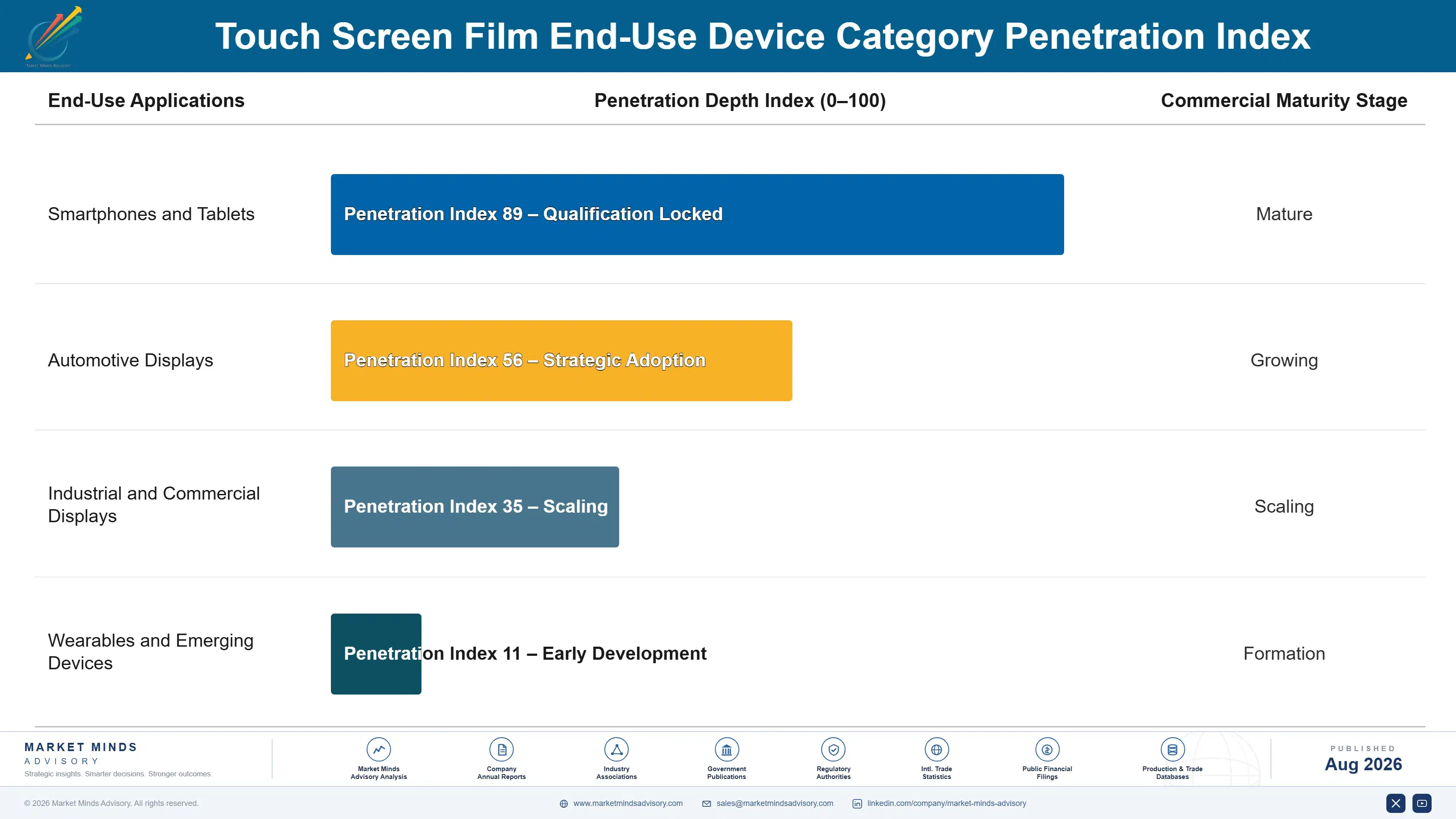
Revenue depends on device platform validation cycles and multi-generation specification loyalty, and a manufacturer's default status on a device or vehicle platform generates years of guaranteed volume across that platform's full production run. Switching suppliers mid-platform requires costly requalification and durability testing, a barrier that deters displacement even when a competitor offers marginally better pricing after initial award.
Adoption depth varies sharply by technology. Foldable film buyers commit hardest, given the engineering integration complexity and hinge mechanism interdependence once specified and validated for production at scale. Automotive silver nanowire buyers sit in the middle, balancing established supplier relationships against periodic competitive retendering during platform refreshes. Standard ITO film buyers switch most readily, since specification differentiation between qualified manufacturers remains genuinely minimal across comparable conventional products.

Buyer profiles have shifted from purchasing engineers evaluating unit cost alone toward platform engineering teams weighing durability data, flexibility performance, and multi-generation reliability together. Foldable adoption has introduced a new buyer consideration around crease visibility and fold cycle guarantees that conventional rigid film economics never required previously. Younger device engineering teams also weigh sustainability and reduced precious metal content more heavily than predecessors did.
touch-screen-film-market-end-use-penetration-index-1787325564279

Our Call on Touch Screen Film

These are among the four positions where our research anticipates prominent divergence between winners and laggards over the coming forecast period. Each is grounded in the demand model, the regulatory perimeter, and the announced capacity pipeline.
01 / SILVER NANOWIRE TRANSITION

Large-format displays now reward nanowire

Silver nanowire penetration has reached roughly 18 percent of new units, a share that has risen steadily as automotive digital cockpit designs expand across more vehicle segments and price tiers where ITO brittleness genuinely limits conventional sensor performance and durability. Manufacturers with genuine silver nanowire production capability capture specification that ITO-only competitors increasingly cannot match as large-format applications continue expanding across automotive and industrial categories. Companies should build this capability now, since it increasingly gates access to the fastest-growing large-format segment available.
02 / FLEXIBLE FILM ENGINEERING

Fold durability now decides platform awards

Foldable film demand has risen roughly 30 percent annually as device manufacturers increasingly demand fold cycle durability approaching 200,000 uses without visible crease formation or conductivity degradation at the hinge line across most major device platforms tracked. Manufacturers with genuine flexible film durability engineering capture specification that competitors offering only conventional rigid sensor technology increasingly cannot match as foldable shipments expand globally. Companies should invest in durability engineering deliberately, since it increasingly determines specification on the fastest-growing electronics category worldwide today.
03 / AUTOMOTIVE DISPLAY PARTNERSHIPS

Platform validation depth beats transactional pricing

Automotive digital cockpit displays require touch film engineered for panel sizes and durability requirements considerably beyond typical consumer electronics specifications, making automotive display partnership depth a genuine competitive moat that consumer-focused competitors cannot easily replicate quickly or cheaply anywhere. Manufacturers investing in deep automotive engineering relationships capture large-format specification that generalist film producers increasingly cannot match given multi-year platform validation cycles required beforehand. Companies should prioritise these relationships as a strategic asset, not a transactional bidding exercise repeated each cycle.
04 / FOLDABLE PLATFORM INTEGRATION

Early validation locks in multi-generation loyalty

Device manufacturers increasingly specify flexible film technology first when designing new foldable platforms, giving early-validated suppliers a durable specification advantage that later entrants struggle to displace once a hinge mechanism and film combination has been validated together across product generations and platforms. Manufacturers securing early platform integration capture multi-generation specification loyalty that transactional, price-focused competitors cannot easily overcome even with lower costs offered. Companies should pursue early integration deliberately, since it compounds across a manufacturer's broader foldable product lineup over time.

Engagement Snapshot From the Field

A live engagement with an industry participant carrying material or product regulatory and market exposure ahead of a defining policy shift, showing how our research translates into a defensible multi-year portfolio strategy.
MARKET MINDS ADVISORY · CLIENT ENGAGEMENT SUMMARY
Touch Screen Film Producer Strategic Portfolio Review and Transition Roadmap 2026·Investment Scenario on Touch Screen Film Exposure Evaluation 2025-26
CLIENT PROFILE
A mid-tier touch film component supplier generating the majority of its revenue from conventional ITO film sales to smartphone and tablet manufacturers engaged MMA ahead of a decision on whether and how quickly to invest in flexible and silver nanowire film engineering capability. The client reported growing pressure from device manufacturer customers requesting flexible film samples it currently could not fully deliver (client-reported, unverified by MMA).
STRATEGIC CHALLENGE
Leadership faced a choice between a rapid, capital-intensive push into flexible film engineering or a slower, more measured transition that risked ceding early foldable platform awards to faster-moving competitors already investing heavily. The board worried that moving too aggressively could strain balance sheet capacity, while moving too slowly could permanently exclude the company from the fastest-growing segment of its core market entirely.
MMA APPROACH
MMA benchmarked flexible film engineering investment requirements against the client's existing balance sheet capacity and conventional ITO cash flow generation over a five-year horizon. We assessed which of the client's existing device manufacturer relationships were most likely to award early flexible film platform business given historical loyalty patterns. We then modelled phased investment scenarios balancing capability development against continued ITO service commitments.
KEY FINDINGS
  1. Two of the client's four largest existing device manufacturer customers had already begun sourcing flexible film from competitors, representing an estimated 20 percent revenue risk over five years.
  2. A phased investment approach could fund flexible film engineering primarily through existing ITO cash flow without requiring significant new external capital immediately.
  3. Early flexible film platform awards typically required at least twelve months of validated fold cycle durability data before a device manufacturer would commit significant volume.
  4. Partnering with a specialty coating firm for initial flexible film programmes reduced time to market by roughly 35 percent compared with fully in-house development.
CLIENT PROFILE
A mid-tier touch film component supplier generating the majority of its revenue from conventional ITO film sales to smartphone and tablet manufacturers engaged MMA ahead of a decision on whether and how quickly to invest in flexible and silver nanowire film engineering capability. The client reported growing pressure from device manufacturer customers requesting flexible film samples it currently could not fully deliver (client-reported, unverified by MMA).
STRATEGIC CHALLENGE
Leadership faced a choice between a rapid, capital-intensive push into flexible film engineering or a slower, more measured transition that risked ceding early foldable platform awards to faster-moving competitors already investing heavily. The board worried that moving too aggressively could strain balance sheet capacity, while moving too slowly could permanently exclude the company from the fastest-growing segment of its core market entirely.
MMA APPROACH
MMA benchmarked flexible film engineering investment requirements against the client's existing balance sheet capacity and conventional ITO cash flow generation over a five-year horizon. We assessed which of the client's existing device manufacturer relationships were most likely to award early flexible film platform business given historical loyalty patterns. We then modelled phased investment scenarios balancing capability development against continued ITO service commitments.
KEY FINDINGS
  1. Two of the client's four largest existing device manufacturer customers had already begun sourcing flexible film from competitors, representing an estimated 20 percent revenue risk over five years.
  2. A phased investment approach could fund flexible film engineering primarily through existing ITO cash flow without requiring significant new external capital immediately.
  3. Early flexible film platform awards typically required at least twelve months of validated fold cycle durability data before a device manufacturer would commit significant volume.
  4. Partnering with a specialty coating firm for initial flexible film programmes reduced time to market by roughly 35 percent compared with fully in-house development.
RECOMMENDED STRATEGY
Phase 1: Phase 1 (0 to 6 months): Partner with a specialty coating firm to accelerate flexible film engineering capability development quickly. Phase 2: Phase 2 (6 to 15 months): Pursue early flexible film platform validation with the client's most loyal existing device customers. Phase 3: Phase 3 (15 to 30 months): Scale flexible film manufacturing capacity based on validated platform award volume secured earlier on.
OUTCOME
The client partnered with a specialty coating firm and secured its first flexible film platform validation within eleven months, ahead of its original twelve-month internal target set earlier. Existing ITO customer relationships were maintained throughout the transition without measurable service disruption (client-reported, unverified by MMA).

Frequently Asked Questions

Foundational context covering the market sizes, CAGR, scope, country, region and competition that inform every finding below. This section is provided to cover basics and most often pre-purchase conversations, answered from the MMA Primary Research Dataset.

What is the current size of the Touch Screen Film Market?

The global touch screen film market is valued at USD 5.6 billion in 2025, covering ITO, metal mesh, silver nanowire, and flexible touch sensor film technologies. Complete finished touch panel modules and touch controllers are excluded.

How large will the Touch Screen Film Market be by 2036?

The market is forecast to reach USD 13.88 billion by 2036 in the base case, about 2.28 times the 2026 level. That represents incremental value of roughly USD 7.8 billion across the decade.

What is the CAGR for the Touch Screen Film Market 2026 to 2036?

The market grows at an 8.6% CAGR in the base case, with bull and bear scenarios at 9.9% and 7.1%. The spread turns mainly on foldable device shipment growth and silver nanowire adoption pace.

Which segment is growing fastest?

Flexible and foldable touch films grow fastest at 13.5%, about 1.57 times the overall rate, pulled forward by foldable smartphone and tablet shipment growth. Silver nanowire touch sensor films follow at 11.0%.

Who are the major companies in the Touch Screen Film Market?

Leading companies include Nissha, LG Display, Samsung Display, Toppan, and Japan Display Inc. Concentration sits at a moderate 52%, led by Nissha's manufacturing scale and reach.

Which country is growing fastest?

South Korea grows fastest at an 11.5% CAGR, driven by Samsung's continued foldable smartphone leadership and expanding domestic manufacturing. China follows on national electronics manufacturing policy.

Report Segmentation Architecture

The full report scope spans multiple orthogonal segmentation dimensions, with cross-tabulated demand data provided for each dimension pair. Coverage extends further to regional breakdowns, trend trajectories, and the competitive detail needed to support segment-level decision-making.

By Touch Sensor Technology

  • Capacitive ITO Touch Sensor Films
  • Metal Mesh Touch Sensor Films
  • Silver Nanowire Touch Sensor Films
  • Flexible and Foldable Touch Films
  • Resistive Touch Sensor Films

By End-Use Device Category

  • Smartphones and Tablets
  • Automotive Displays
  • Industrial and Commercial Displays
  • Wearables and Emerging Devices

By Commercial Dimension

  • Original Equipment Manufacturer Supply
  • Display Module Integrator Supply
  • Platform Co-Development Agreements
  • Aftermarket Replacement Supply

By Region

  • North America
  • Western Europe
  • East Asia
  • South Asia and Pacific
  • Latin America
  • Middle East and Africa
  • Eastern Europe

Scope, Methodology, and Coverage

Every figure in this report is reproducible from documented input assumptions. The scope below maps the historical period, the forecast horizon, the segmentation dimensions, and the countries covered, alongside the underlying primary and qualitative methodology.
Historical Period
2020 to 2025
Forecast Period
2026 to 2036
Base Year
2025 (USD billions; MMA Primary Research Dataset, August 2026)
Market Definition
The touch screen film market comprises conductive sensor films used in capacitive, resistive, and flexible touch panel assemblies, valued at manufacturer revenue for ITO, metal mesh, silver nanowire, and foldable film technologies sold to display and device manufacturers. Complete finished touch panel modules sold as integrated assemblies and touch controller semiconductors are excluded from this scope.
Quantitative Units
USD billions (current prices); unit shipment volume by film technology where applicable
Segmentation Dimensions
By Touch Sensor Technology; By End-Use Device Category; By Commercial Dimension; By Region
Regions Covered
North America, Western Europe, East Asia, South Asia and Pacific, Latin America, Middle East and Africa, Eastern Europe
Countries Covered
China, South Korea, Japan, Taiwan, USA, Canada, Mexico, Germany, France, UK, Italy, Spain, India, Australia, Vietnam, Indonesia, Brazil, Argentina, Saudi Arabia, UAE, Turkey, South Africa, Nigeria, Poland, Czech Republic, Romania, Thailand, Philippines, Sweden, Netherlands, and additional markets relevant to this sector
Key Companies Profiled
Nissha, LG Display, Samsung Display, Toppan, Japan Display Inc, TPK Holding, General Interface Solution, Innolux, AU Optronics, BOE Technology, Truly International, O-Film Tech, Fujifilm, Nitto Denko, C3Nano, Zytronic, Microchip Technology, Synaptics, Cambrios Film Solutions, Guardian Industries
Quantitative Methodology
Primary survey, n=3,800 respondents, Q4 2025, six countries; demand-side model with trade association cross-validation
Qualitative Methodology
47 expert interviews, Q4 2025; applied to validate demand model assumptions, identify emerging dynamics, and assess competitive positioning
Report Format
PDF and XLSX data workbook (Word format preview document)
Publisher
Market Minds Advisory
Report Code
MMA-2026-TEC-208
Published
August 2026
Contact
sales@marketmindsadvisory.com | www.marketmindsadvisory.com

Purchase the full Touch Screen Film Market Report (2026 to 2036).

The full MMA Touch Screen Film report sizes the market across five touch sensor technologies, four device categories, four commercial channels, and seven regions through 2036. It profiles 20 companies on a consistent unit shipment volume basis, scoring each on silver nanowire manufacturing capability, flexible film durability engineering, automotive display partnership depth, and foldable device platform integration. Scenario models quantify how foldable device growth, automotive digital cockpit adoption, and silver nanowire displacement trends move both unit demand and achievable margin by technology. The report also includes platform validation mapping and foldable durability benchmarking for manufacturer and investor strategy teams.
Five-technology and four-channel market sizing to 2036
Twenty-company benchmark on unit shipment volume basis
Silver nanowire displacement competitive positioning analysis
Flexible film durability engineering benchmarking review
Automotive display partnership and platform mapping
Foldable device platform integration and loyalty tracking

Built For The People Who Decide

From boardroom strategy to bench-side execution, this report is read cover-to-cover by leaders shaping the next decade of their industry, turning demand scenarios, market dynamics and valuation benchmarks into decisions.
CXOs/ Presidents/ VPs/ Managers
M&A and Corporate Development
Strategy Teams and R&D Heads
Procurement and Product Directors
Regulatory and Compliance Leaders
Investor Relations and Equity Analysts