Market Minds Advisory
Topical Bioadhesives Market

Topical Bioadhesives Market: Stickier Is the Wrong Direction

The outer skin layer renews about every fourteen days, so an adhesive that grips harder than skin holds itself together does not last longer; it simply leaves with a piece of the patient.

Lead Analyst

Alice Ballenger

Published

September 2026

Make Smarter Decisions with Customized Research Insights

Request a free sample report and evaluate market opportunities, growth trends, and competitive dynamics relevant to your business needs.

2025 MARKET VALUE$2.6BMarket Size 2025
2036 FORECAST VALUE$6.4BBase Case , 2026 to 2036
CAGR 2026 TO 20368.6 %Bull 9.8% / Bear 7.4%
INCREMENTAL OPPORTUNITY$3.6BNet 10- year value creation
EXPANSION MULTIPLE2.28x2036 value over 2026 base
Strategic Levers
M&A Pipeline
Regional Outlook
Country Rankings
Competitive Intelligence
Segmental Deep-dive
Call-Us : 91 93563 13602

Executive Snapshot and Market Trajectory

Adhesion strength stopped being the right objective some time ago. The stratum corneum renews roughly every 14 days, so an adhesive bonded more firmly than skin holds itself together does not stay attached longer. It detaches with skin attached, which around 18% of patients experience as injury.
Silicone adhesives grow at 12.9%, half again the market rate of 8.6%, because gentle removal and repositionability solve the problem that greater tack makes worse. Continuous sensors need 14 day wear on a surface renewing on precisely the same schedule, which is the binding design constraint that device makers still treat as a commodity purchase item. Adhesive is roughly 3% of sensor cost and decides whether the device works. Engineering decides it, not procurement.
Sensitisation is the quieter risk and it is permanent. Around 7% of wearable users develop contact allergy to acrylate chemistry, and once sensitised they cannot use it again. A chemistry decision taken to save a fraction of a percent of device cost can exclude a patient from the platform for life. For a manufacturer selling consumable sensors that is a lifetime customer lost rather than a complaint handled.
Market Definition
Adhesive materials bonding to external skin and mucosal tissue for medical purposes, covering cyanoacrylate adhesives, acrylic pressure sensitive adhesives, silicone adhesives, hydrocolloid and hydrogel adhesives, polyurethane and hybrid adhesives, and natural polymer bioadhesives. Measured at supplier selling value. Excludes internal surgical sealants and haemostats, wound dressings and gauze products, sutures and mechanical closure devices, and cosmetic adhesive products.
Base Year Value
$2.6B in 2025 (MMA Primary Research Dataset, August 2026)
Forecast Period
2026 to 2036, eleven discrete annual values
CAGR
8.6% base case. Bull 9.8%. Bear 7.4%.
Fastest Growth Segment
Silicone Adhesives: 12.9% CAGR
Fastest Growth Country
China: 14.6% CAGR
Fastest Growth Region
South Asia and Pacific: 10.6% CAGR
Largest Region
North America: 31% of 2025 global value
Market Leaders
3M, Henkel, Dow, Avery Dennison, Elkem Silicones. Source: MMA Primary Research Dataset, July 2026.
Primary Survey
n=3,800 procurement and R&D decision-makers, Q4 2025, six countries
Methodology
Demand-side build-up, cross-validated against public data, 47 expert interviews

Topical Bioadhesives Market Forecast Scenarios

topical-bioadhesives-market-size-forecast-scenario-1787640051051
Growth ran near 7.2% between 2020 and 2025 and wearable medical devices did most of the work. Continuous glucose monitoring shifted adhesive requirements from a few days to two weeks, which exposed limitations that nobody had needed to confront while patches came off after a shower. Surgical skin closure adhesive volume grew steadily. Reported adhesive related skin injury rose alongside device penetration.
Base case 8.6% rests on three mechanisms. Silicone adhesives grow at 12.9% as gentle removal and repositionability address injury that stronger tack makes worse. Polyurethane and hybrid adhesives grow at 11.2% where moisture handling and conformability both matter. And China grows fastest of any country at 14.6% on domestic wearable sensor manufacturing scaling alongside its own device approvals. Patient numbers grow far more slowly than device penetration does anywhere. Device penetration is the only variable that matters.
The bull case at 9.8% assumes wearable device wear times extending beyond two weeks, which would force adhesive specification onto skin compatibility rather than tack and reprice the whole category upward. The bear case at 7.4% is acrylate sensitisation prompting regulatory restriction, since a chemistry facing labelling requirements or restriction loses volume faster than alternatives can qualify to replace it.

Bonded to a Surface That Leaves

The engineering instinct in adhesives is to increase bond strength, and in this application that instinct is actively harmful. Skin is not a stable substrate. The stratum corneum renews roughly every 14 days and sheds continuously, so an adhesive gripping more firmly than skin holds itself together does not achieve longer wear. It removes skin instead, and around 18% of patients with medical adhesives experience that as a recorded injury.
TOP FIVE CONCENTRATION44%Chemistry specialists and converters occupy quite different commercial positions
SKIN RENEWAL CYCLE14 daysTime for the outer skin layer to renew completely
ADHESIVE RELATED INJURY18%Patients experiencing skin damage from medical adhesive removal
REQUIRED WEARABLE DURATION14 daysTime continuous sensors must remain attached to skin
ACRYLATE SENSITISATION PREVALENCE7%Wearable users developing contact allergy to acrylate chemistry
ADHESIVE COST SHARE3%Portion of wearable sensor cost sitting in attachment
Wearable devices made the problem unavoidable. A continuous sensor must stay attached for 14 days on a surface that completely renews across the same interval, which means the adhesive is being asked to outlive the layer it bonded to. Silicone adhesives grow at 12.9% because gentle removal, repositionability and low trauma solve what greater tack makes worse. Device manufacturers nonetheless treat adhesive as a component purchase worth around 3% of sensor cost.
Sensitisation carries the consequence that nobody prices. Around 7% of wearable users develop contact allergy to acrylate chemistry, and sensitisation is cumulative and permanent, so an affected patient cannot use that adhesive on any device thereafter. A material decision saving a fraction of device cost can therefore remove a patient permanently.
"Everybody asks for a stronger adhesive and what they actually need is one that knows when to let go. You are bonding to a surface that has decided to leave within a fortnight, and no amount of tack argues with that."
Director, Medical Materials and Wearable Technology Practice · MMA Medical Devices and Diagnostics Practice · August 2026

Market Trends

Wearable wear time exposing the skin turnover limit

Continuous sensors and wearable pumps require 14 day attachment on a surface that renews across exactly that interval, which turns adhesive selection into a skin biology problem rather than a bonding one. Silicone adhesives grow at 12.9% because gentle removal and repositionability address what greater tack makes worse. Device makers still specify adhesive as a component worth around 3% of sensor cost, which understates its influence on whether the product works at all. Wear studies during development decide it, and procurement never revisits the choice. Engineering holds it entirely. Nobody revisits it.
Market Impact: China growing fastest at 14.6%
Acrylate sensitisation becoming a clinical and regulatory concern

Around 7% of wearable users develop contact allergy to acrylate chemistry, and sensitisation is cumulative and permanent rather than a transient irritation that resolves. Once affected, a patient cannot use that adhesive on any device again. Clinical reporting has grown enough to attract regulatory attention, and manufacturers reformulating away from implicated monomers are protecting patient retention as much as they are managing any compliance exposure. Requalification takes time and repeat wear studies, which is why reformulation decisions are taken reluctantly and only when patient loss becomes visible in the numbers.
Market Impact: Injury affects about 18% of patients

Market Opportunities and Growth Drivers

Domestic wearable sensor manufacturing scaling in volume markets

China grows fastest of any country at 14.6% as domestic continuous sensor manufacturing scales alongside national device approvals, which creates adhesive demand at volumes that follow the manufacturing rather than the patient population. Suppliers organised around western device makers are covering a shrinking share of global sensor production. Adhesive qualification happens during device development, so reaching those programmes early is the only route into the platform. Coverage organised around western device makers is following a shrinking share of world production. Development access is the only route in at all. Timing decides access.
Market Impact: Adds 18 months to timelines

Skin injury reporting shifting hospital adhesive purchasing

Around 18% of patients with medical adhesives experience removal related skin damage, and hospital quality reporting has begun capturing it as a preventable harm rather than an unavoidable consequence of treatment. That reframing moves purchasing from unit price toward skin outcome, which favours silicone and hydrocolloid chemistries considerably. Procurement teams comparing adhesive cost per unit are answering a question their own quality reporting has already superseded. Silicone chemistries growing at 12.9% are the direct beneficiaries of that shift in purchasing basis. Unit price answers a superseded question. Quality reporting superseded the price question.
Market Impact: Only 3% of device cost

Market Restraints and Challenges

Regulatory classification diverging by claim and geography

The same adhesive formulation may be regulated as a device, a drug-device combination or a cosmetic depending on the claim made and the market entered, which produces wildly different approval timelines from identical chemistry. The root cause is regulatory frameworks written around intended use rather than material composition. Commercially it delays launch unpredictably. Early regulatory strategy, claim discipline and parallel filing routes are the practical mitigations suppliers actually use. Chemistry identical in composition can face approval timelines differing by well over a year. Launch sequencing suffers accordingly. Chemistry is not the variable.
Market Impact: Sensors need 14 day attachment

Device makers pricing adhesive as a commodity component

Adhesive accounts for around 3% of wearable sensor cost and is frequently tendered accordingly, despite determining whether the device stays attached for its labelled duration. The root cause is bill of materials management treating small line items as interchangeable. Commercially it pushes selection toward cheaper chemistries carrying sensitisation and injury risk. Wear time data, skin outcome evidence and clinical study support are how suppliers reframe that conversation. Engineering rather than purchasing holds the decision, and it is taken during development. Procurement confirms rather than decides. Evidence reframes the conversation. Component thinking misses it.
Market Impact: Around 7% develop acrylate allergy
4 additional market trends, 3 additional growth drivers, and 2 additional restraints and challenges are covered in the full report. Contact sales@marketmindsadvisory.com to access the complete intelligence.

Segment CAGR and Growth Architecture

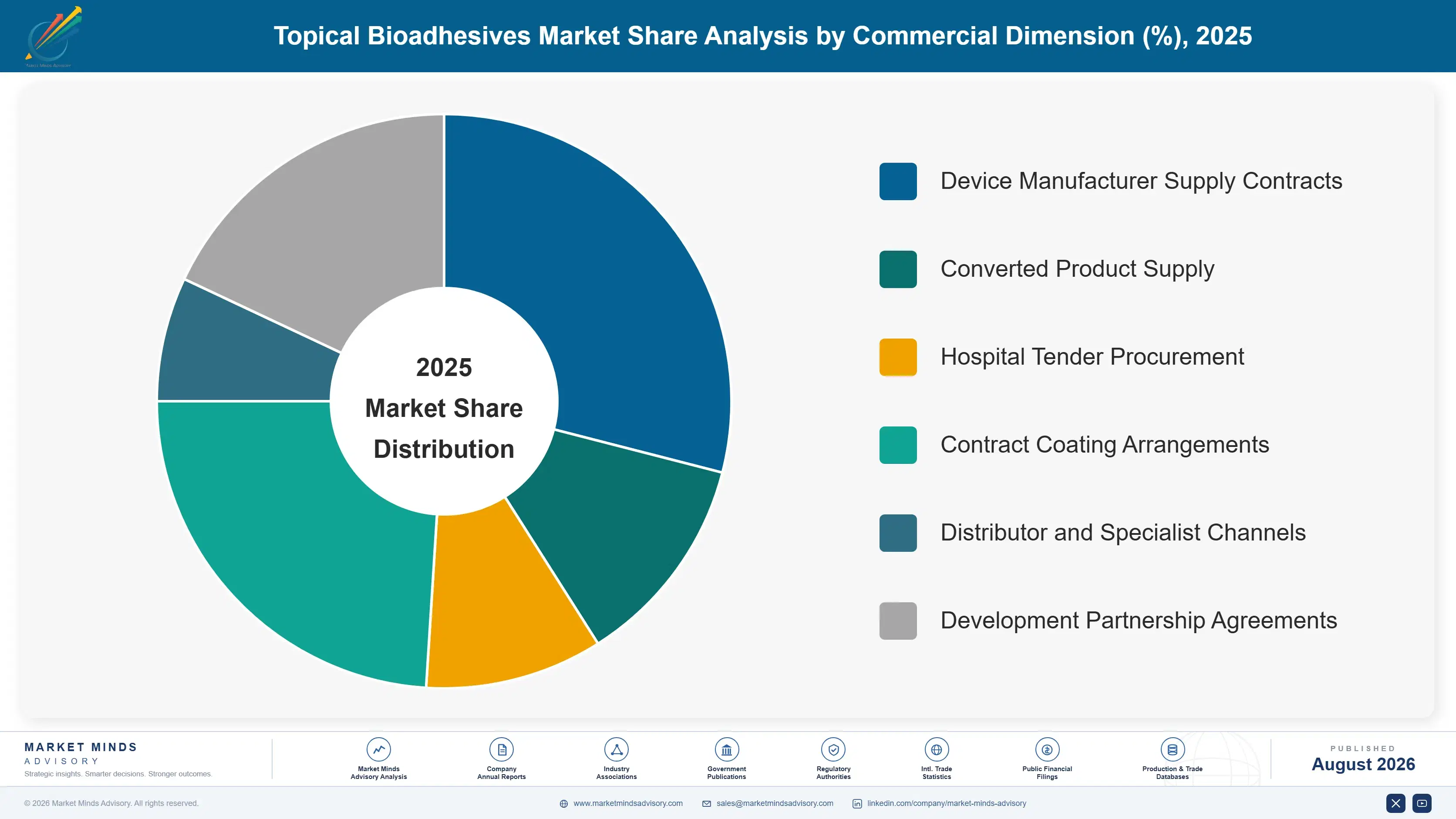
Six segments split by adhesive chemistry, because chemistry determines the bond profile achieved, the skin trauma on removal, the sensitisation risk carried and the regulatory route required. Format and carrier variants sit inside each chemistry. Application and channel dimensions are handled separately within the framework rather than mixed here. Chemistry determines the commercial position entirely.
topical-bioadhesives-market-market-share-analysis-1787640051666

Silicone Adhesives

Growing at 12.9%, half again the market rate of 8.6%, soft silicone gel adhesives release from skin without taking stratum corneum with them and can be repositioned during application without losing tack. That combination directly addresses the injury affecting around 18% of patients with medical adhesives, which stronger acrylic chemistries make worse rather than better. Cost per unit runs higher than acrylics, which loses arguments decided on component price and wins those decided on wear time and skin outcome. Repositionability during application also matters practically, since a sensor placed slightly wrong can be lifted and reseated rather than discarded, which reduces waste that patients themselves notice and resent. Skin outcome decides it.
CAGR 12.9%

Polyurethane and Hybrid Adhesives

At 11.2% polyurethane and hybrid systems handle moisture vapour transmission while conforming to skin movement, which matters on limbs and around joints where rigid adhesives lift at the edges within days. They sit between acrylic tack and silicone gentleness, which suits applications needing secure attachment without the trauma acrylics cause on removal. Formulation flexibility also allows tuning toward specific wear durations rather than accepting whatever a standard chemistry happens to deliver. Edge lifting within days is the common failure mode for rigid chemistries, and it defeats the labelled wear duration long before any adhesive bond actually fails anywhere. Tuning toward a specific wear duration is possible in a way that standard chemistries never allow.
CAGR 11.2%
Full segment breakdown across 6 segments available in the complete report.

Regional Architecture and Country Demand Map

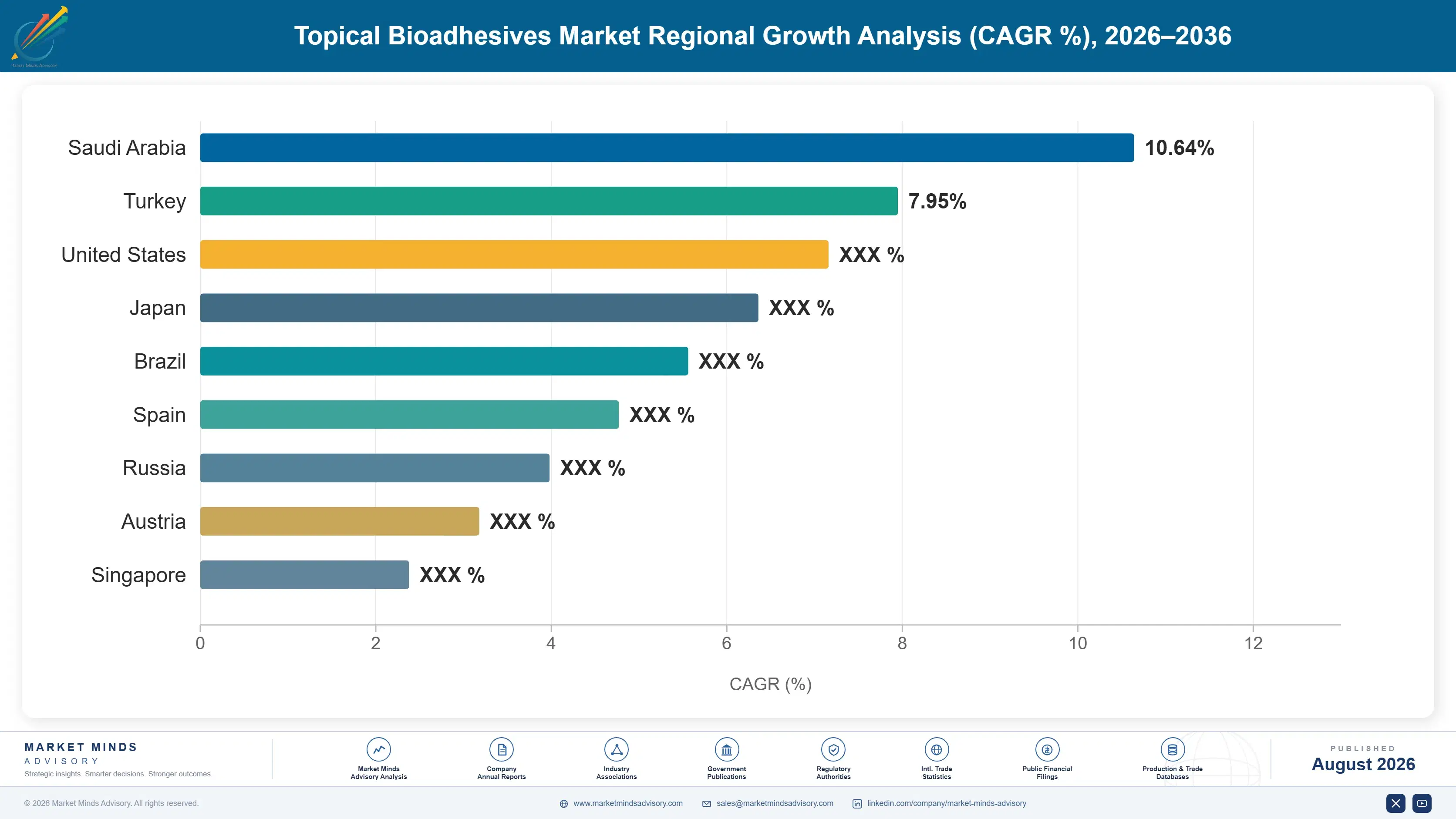
North America holds 31% of value on wearable device penetration and pricing that no other region matches. East Asia follows at 26% on manufacturing scale and rapidly expanding domestic sensor production. South Asia and Pacific grows fastest of the seven regions covered here. Device production drives both.

North America

Continuous glucose monitoring penetration is the highest anywhere and drives adhesive requirements toward 14 day wear that older chemistries were never designed to deliver. Hospital quality reporting increasingly captures adhesive related skin injury as preventable harm, which has begun moving acute care purchasing away from unit price comparison. Surgical skin closure adhesive use is well established. Growth at 7.6% reflects a mature device base rather than any limit on demand. Device engineering rather than hospital procurement decides most of the value here, since wearable programmes qualify chemistry during development and never reopen it. Surgical closure adhesive is decided by surgeons individually rather than by any procurement process, which is a third distinct decision function entirely.
Share: 31% | CAGR: 7.6% (2026 to 2036)

Western Europe

Regulatory classification under device rules is applied more strictly here than elsewhere, and the same formulation frequently takes a longer route to market than it does in other regions. Sensitisation reporting from continuous sensor users has been particularly active across several national systems. Silicone chemistry adoption is well advanced in wound and ostomy applications. Regional growth of 7.2% is the slowest anywhere on mature adoption and demanding approval requirements together. Silicone chemistry adoption is well advanced, and hospital purchasing has moved toward skin outcome measures ahead of most other regions. Regulatory classification differences mean identical formulations reach market here considerably later than elsewhere, which shapes launch sequencing for every supplier.
Share: 22% | CAGR: 7.2% (2026 to 2036)
Regional intelligence for 5 additional markets available in the complete report: East Asia, South Asia and Pacific, Latin America, Middle East and Africa, Eastern Europe. Contact sales@marketmindsadvisory.com.
topical-bioadhesives-market-country-cagr-analysis-1787640052192

Four Moves Against Component Pricing

Adhesive decides whether a wearable device works and gets bought as though it decides nothing. What remains available is reframing the purchase around wear time and skin outcome, reaching device development before chemistry is locked, and treating sensitisation as the retention problem it genuinely is. Engineering decides, procurement confirms. Development access is everything. Timing decides access.

Sell wear time achieved, not adhesion measured

A continuous sensor must stay attached 14 days on skin that renews across the same interval, and greater tack shortens rather than extends that by removing stratum corneum. Suppliers quoting peel strength are answering the wrong question entirely. Wear time data from actual use, including on perspiring and mobile patients, addresses what the device maker genuinely needs and moves the comparison off a component price sheet. Peel strength is the wrong specification entirely. Perspiring and mobile patients are where the difference actually shows, and temperate laboratory data predicts none of it.
Market Impact: Delivers the full 14 day required wear time

Reach device development before chemistry is locked

Adhesive qualification happens during device development and rarely reopens afterwards, since changing chemistry means repeating wear studies and regulatory documentation. Suppliers arriving at procurement are quoting against a decision already taken, on a line item worth around 3% of device cost that nobody wants to revisit. Engineering rather than purchasing holds this decision, and reaching it requires an entirely different commercial approach. Wear studies and regulatory documentation must be repeated to change chemistry on an approved platform, which nobody undertakes without genuine cause. Engineering never meets the supplier's commercial team.
Market Impact: Locks in the whole 3% of device cost

Price sensitisation as patient retention, not compliance

Around 7% of wearable users develop permanent acrylate contact allergy, and an affected patient cannot use that chemistry on any device again. For a device maker selling consumable sensors, that is a lifetime customer lost rather than a complaint handled. Framing chemistry selection as retention economics reaches commercial leadership, while framing it as regulatory risk reaches a compliance function with no budget authority. Compliance functions hold no budget authority. Consumable sensor revenue over a patient lifetime dwarfs any saving available on a component worth 3% of device cost. Retention is the frame.
Market Impact: Protects the 7% of patients already sensitised permanently

Follow device manufacturing rather than patient geography

Adhesive is consumed where devices are built, and China grows fastest at 14.6% as domestic sensor manufacturing scales. Suppliers organised around western device makers are covering a shrinking share of global production regardless of where patients live. Manufacturing programmes qualify suppliers during development, so commercial coverage must follow production siting rather than the markets those devices are eventually sold into. Programmes qualify suppliers during development rather than at production launch. Patient geography is close to useless as a coverage indicator here, since the material is consumed at the factory. Factories consume it.
Market Impact: Follows the 14.6% Chinese device manufacturing growth rate

Who Controls the Margin Pool

Participation is measured on annual revenue from medical grade skin contact adhesives, and the top five hold 44%. Concentration is moderate because base chemistry producers and converting specialists occupy different positions, and device makers frequently buy converted product rather than raw adhesive. The gap to challengers is chemistry breadth and clinical evidence rather than any manufacturing advantage, and both take years to assemble properly.
Competition runs on three fronts. Chemistry capability decides silicone and hybrid positions, where formulation depth matters. Converting and coating capability decides delivered format. And regulatory support decides whether a device maker can use the material without extending its own approval timeline. Each front rewards a different capability, and very few participants hold all three of them properly.

Pressure ahead comes from wear time requirements and sensitisation concern reshaping chemistry selection. Expect silicone capable suppliers to gain against acrylic specialists. Rankings shift on whoever reaches device engineering before chemistry gets locked into a platform. Concentration should hold as evidence requirements rise. Acrylic specialists without silicone capability or device specific evidence look most exposed as wear time requirements and injury reporting both tighten.
topical-bioadhesives-market-company-positioning-matrix-1787640052718

Competitive Moat and Risk Dimensions

3M

Moat: Chemistry breadth and clinical evidence

Holding acrylic, silicone and hydrocolloid chemistries alongside clinical evidence on skin outcomes lets the business match chemistry to application rather than defending one platform against every requirement. That breadth also supports device development conversations where the right answer depends on wear duration, anatomical site and patient population rather than on any single product specification.
3M

Risk: Acrylate sensitisation portfolio exposure

Acrylic chemistries carry the sensitisation risk affecting around 7% of wearable users, and regulatory attention to implicated monomers has grown steadily. Reformulating a portfolio built over decades takes years of requalification with device customers, each of whom must repeat wear studies before accepting any change to an approved platform.
HENKEL

Moat: Cyanoacrylate depth and surgical positions

Cyanoacrylate formulation expertise developed across industrial and medical applications supports skin closure positions that compete against sutures rather than against other adhesives, which is a different and considerably less crowded comparison. Regulatory documentation accumulated across markets also shortens approval timelines for device customers building products around the chemistry.
HENKEL

Risk: Limited wearable device presence

Growth in this category concentrates in pressure sensitive chemistries for wearable devices rather than in the closure applications where cyanoacrylate leads, and silicone growing at 12.9% sits outside that core capability. Building position in wearables requires formulation investment and device development relationships that closure customers never demanded.

Players Tracked

Prominent Players

3M
Henkel
Dow
Avery Dennison
Elkem Silicones

Other Key Players

DuPont
Shin-Etsu Chemical
Momentive Performance Materials
Scapa Healthcare
Lohmann
Nitto Denko
Bostik
HB Fuller
Adhezion Biomedical
Chemence Medical
Ethicon
Baxter
Coloplast
Convatec
Smith and Nephew

Recent Developments

APRIL 2026

Sensor manufacturer reformulates adhesive away from implicated monomer

A continuous sensor manufacturer reformulated its skin adhesive to remove a monomer implicated in contact sensitisation reports, accepting requalification and repeat wear studies rather than continuing to lose sensitised patients from its platform permanently. Sensitised users had been leaving the platform steadily for several years.
Signal: Sensitised patients leave the platform permanently, which makes adhesive chemistry a customer retention question entirely here
SEPTEMBER 2025

Hospital system records adhesive skin injury as preventable harm

A hospital system began recording medical adhesive related skin injury within its preventable harm reporting rather than treating it as an unavoidable consequence of treatment, which moved acute care purchasing toward gentler chemistries immediately. Silicone volumes rose sharply across the system within two quarters. Unit costs rose modestly.
Signal: Quality reporting reframes adhesive purchasing away from simple unit price and toward measurable skin outcome instead
JANUARY 2026

Wearable programme specifies silicone during device development

A wearable device programme specified soft silicone adhesive during development after wear studies showed acrylic chemistry failing before the labelled duration on perspiring and physically active patients across the trial population. Component cost rose while device returns fell substantially. Procurement was not consulted on the change at all.
Signal: Adhesive chemistry gets locked during device development and almost never reopens at the procurement stage afterwards

Monomers, Silicone and Coating

Acrylate monomers carry around 44% of acrylic adhesive cost, priced from petrochemical supply that adhesive formulators do not control. Silicone polymers and crosslinkers absorb roughly 58% of silicone adhesive cost, sourced from a concentrated group of siloxane producers. Release liners, carrier films and coating energy account for about 17% across converted product. Sterilisation, regulatory documentation and quality release take the balance.
Siloxane and acrylate monomer pricing both moved sharply across recent years, per Dow annual reporting for 2025 on siloxane input commentary and published petrochemical market reporting on acrylate monomers. Suppliers passed movements through more readily on silicone, where alternatives are limited, than on acrylics, where device makers can switch between formulators with comparatively little requalification burden. That difference reflects substitutability rather than negotiating skill. Every recent cost cycle has confirmed it.

Exposure divides on chemistry rather than on scale. A silicone formulator carries siloxane across well over half of cost from a concentrated supply base with genuine pass through capability. An acrylic formulator carries monomer on a smaller share but faces customers who substitute easily. A converter buying finished adhesive carries only purchase price and coating cost, which is the most comfortable position and also the least defensible one.
topical-bioadhesives-market-cost-volatility-analysis-1787640052912

Contract siloxane supply against multi-year volume commitment

Siloxane carries more than half of silicone adhesive cost and comes from a concentrated producer base where spot exposure has proved genuinely damaging during periods of tight supply. Multi-year agreements with volume commitment secure both price and availability, and the commitment is straightforward given medical demand grows predictably rather than cyclically. Supply tightness has proved costly.

Build requalification barriers through documented wear evidence

Acrylic formulators face easy customer substitution because device makers can change supplier without repeating much work. Generating wear and skin outcome evidence specific to a customer's device raises the switching cost considerably, since a replacement supplier must reproduce that evidence before any approved platform accepts the change. Evidence is the barrier rather than chemistry.

Move converted product mix toward regulatory supported supply

Selling adhesive alone leaves the device maker carrying documentation burden that slows its own approval. Supplying converted product with biocompatibility data and regulatory files attached shortens the customer's timeline measurably, which supports pricing that raw material supply cannot and deepens the relationship considerably. Documentation shortens the customer's own approval timeline measurably, which supports pricing that raw material supply never can.

Portfolio Architecture for Margin Defence

Margin here follows requalification difficulty rather than chemistry cost, because a device maker who can substitute a supplier without repeating wear studies will do so on price alone. Standard acrylic adhesives earn margins in the mid teens to high twenties, where several formulators meet the same specification and switching costs the customer very little. Switching costs the customer almost nothing, and purchasing knows it precisely.
Cyanoacrylate closure adhesives and hydrocolloid systems do better in the high twenties to low forties, because regulatory documentation and clinical positioning both narrow the field of usable suppliers considerably. Approval breadth across markets takes years to accumulate and cannot be purchased quickly. Clinical positioning narrows the usable field considerably at this level.

Silicone and hybrid systems supplied with device specific wear evidence hold the strongest position, reaching into the low fifties, where changing supplier means repeating studies and regulatory work on an approved platform. Those margins depend entirely on the evidence being device specific, and compress toward acrylic levels wherever a supplier offers only a general material specification. Device specific evidence rather than material quality carries these margins, and a general specification collapses them toward acrylic levels immediately.

Standard Acrylic Adhesives

Chemistries several formulators supply against the same specification with easy substitution. The thirteen point range reflects monomer position and coating efficiency rather than any performance difference between suppliers. Substitution is straightforward here.
Gross Margin: 15-28%

Cyanoacrylate and Hydrocolloid Systems

Chemistries carrying regulatory documentation and clinical positioning that narrow usable supply. The fourteen point range reflects approval breadth across markets, which takes years to accumulate properly. Documentation is the real asset.
Gross Margin: 28-42%

Silicone and Hybrid with Device Evidence

Systems supplied with wear and skin outcome evidence specific to the customer device. The fourteen point range reflects how device specific that evidence is, which determines the switching barrier entirely.
Gross Margin: 38-52%
topical-bioadhesives-market-portfolio-architecture-1787640053416

High-value Sub-segments and Strategic Watch-out

Silicone Adhesives

High value and the fastest growth at 12.9%, releasing without taking stratum corneum and repositionable during application. Unit cost loses arguments decided on component price and wins those decided on wear time. Development stage access decides who supplies it, since procurement only confirms a choice already made.
Gross Margin: 38-52%

Polyurethane and Hybrid Adhesives

High value and growing at 11.2% on moisture handling and conformability around joints where rigid chemistries lift. Formulation flexibility allows tuning toward specific wear durations rather than accepting defaults. Joint movement is where rigid chemistries fail first, and that failure defeats labelled wear duration. Conformability matters most.
Gross Margin: 32-46%

Standard Acrylic Adhesives

The volume core, meeting the same specification from several formulators where device makers substitute on price with minimal requalification. Sensitisation exposure is the quiet liability sitting underneath that volume. Sensitisation exposure accumulates quietly underneath that volume, and it is permanent once a patient develops it.
Gross Margin: 15-28%

Acrylate Sensitisation Exposure

The strategic watch-out. Around 7% of wearable users develop permanent contact allergy, and the range reflects whether a supplier has reformulated away from implicated monomers or is waiting for regulatory attention. Reformulation requires requalification across every affected customer platform, which takes years to complete properly.
Gross Margin: 0-45%

Locked During Device Development

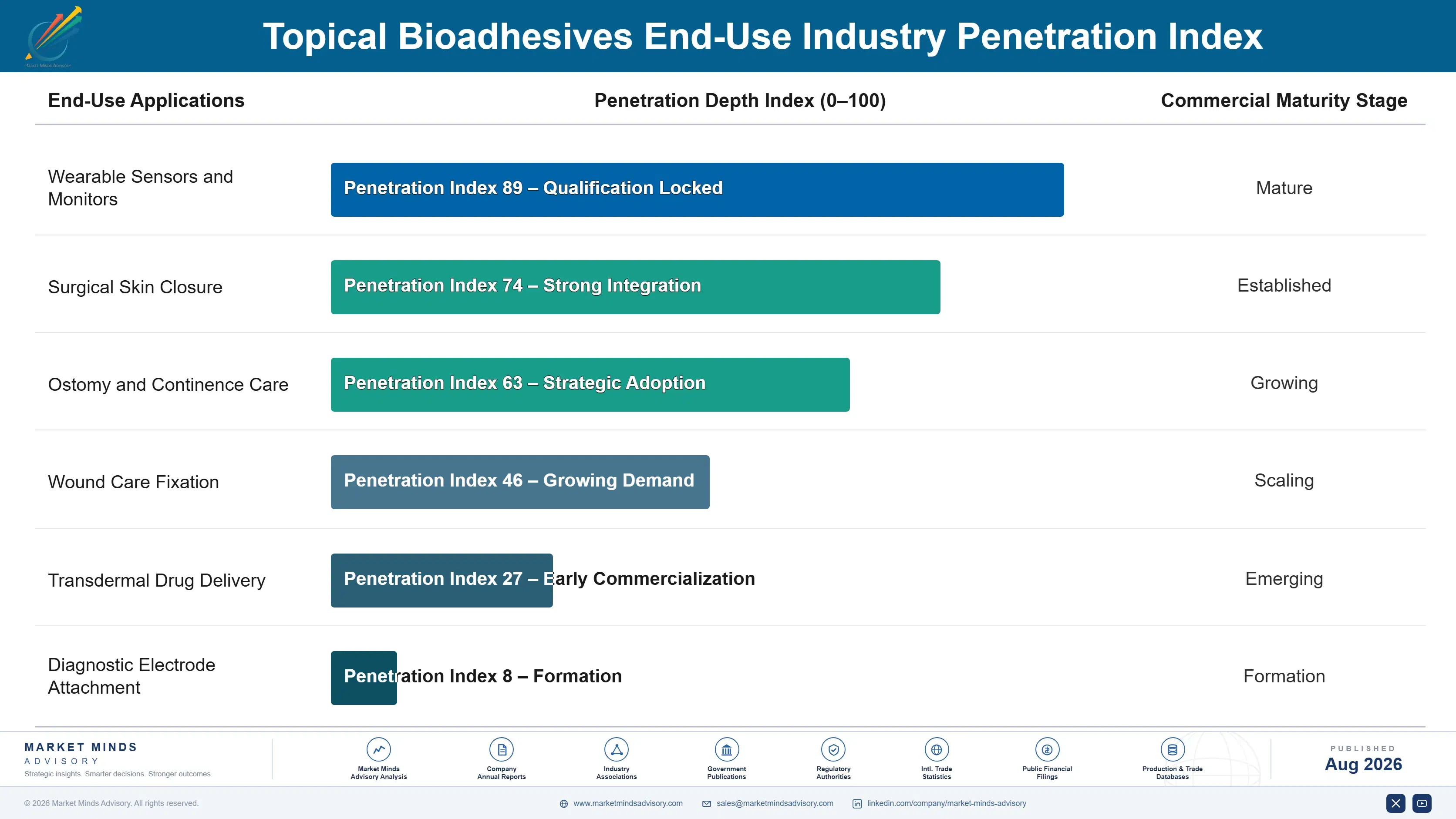
Demand here is genuinely repeating once it is won, because a wearable sensor is a consumable and every unit carries adhesive. A patient wearing continuous sensors gets through roughly 26 units a year, indefinitely. That makes a single platform qualification worth years of volume, and it makes losing one an unusually expensive event for a supplier who took the account for granted. Consumable volume is the whole prize.
Stickiness follows requalification difficulty rather than any commercial relationship. Changing adhesive on an approved device means repeating wear studies and regulatory documentation, which nobody undertakes without cause. Acute care hospital adhesives reopen with every tender because substitution costs the buyer nothing. Surgical closure adhesive sits between the two, held by surgeon preference more than by procurement. Cause is the only thing that reopens it.

The deciding function differs sharply by application and most suppliers cover only one of them. Device engineering decides wearable adhesive during development, years before commercial volume. Hospital procurement decides acute care supply annually on price. Surgeons decide closure adhesive individually. A commercial organisation built around hospital purchasing reaches the least valuable of those three. Coverage rarely reaches the valuable one.
topical-bioadhesives-market-end-use-penetration-index-1787640053902

Where We Would Put Effort

These are among the four positions where our research anticipates prominent divergence between winners and laggards over the coming forecast period. Each is grounded in the demand model, the regulatory perimeter, and the announced capacity pipeline.
01 / WEAR TIME EVIDENCE SELLING

Peel strength answers nothing that matters

A continuous sensor must remain attached for a full 14 days on skin that completely renews across the same interval, and greater tack shortens rather than extends that by removing stratum corneum with it. Suppliers quoting peel strength figures are answering a question that no device maker actually needs resolved at all. Wear time data from actual use, including on perspiring and physically active patients, moves the whole comparison off a component price sheet and onto the ground the material wins.
02 / DEVELOPMENT STAGE ACCESS

Procurement quotes a decision already made

Adhesive chemistry is qualified during device development and almost never reopens afterwards, because changing it means repeating wear studies and regulatory documentation on a platform already approved. Suppliers arriving at procurement are quoting against a decision taken years earlier by an engineering team they have never met. The line item is worth around 3% of total device cost and nobody wants to revisit it once approved, which makes development stage access the only genuine route into a platform at all.
03 / SENSITISATION RETENTION FRAMING

A sensitised patient never comes back

Around 7% of wearable device users develop a permanent acrylate contact allergy, and an affected patient cannot use that chemistry on any device again for the whole of the rest of their life. For a manufacturer selling consumable sensors that represents a lifetime customer lost outright rather than a complaint resolved. Framing the chemistry selection as retention economics reaches commercial leadership directly and immediately, while framing it as regulatory risk reaches a compliance function that holds no budget authority whatsoever.
04 / MANUFACTURING GEOGRAPHY COVERAGE

Adhesive is bought where devices are built

Adhesive gets consumed at the device factory rather than in whichever market the patients eventually happen to live, and China grows fastest of any country at 14.6% as its domestic sensor manufacturing base scales rapidly. Suppliers still organised around western device makers are quietly covering a steadily shrinking share of total global production volume. Manufacturing programmes qualify their adhesive suppliers during development, so commercial coverage has to follow production siting rather than the patient geography those finished devices eventually go on to serve.

Engagement Snapshot From the Field

A live engagement with an industry participant carrying material or product regulatory and market exposure ahead of a defining policy shift, showing how our research translates into a defensible multi-year portfolio strategy.
MARKET MINDS ADVISORY · CLIENT ENGAGEMENT SUMMARY
Topical Bioadhesives Producer Strategic Portfolio Review and Transition Roadmap 2026·Investment Scenario on Topical Bioadhesives Exposure Evaluation 2025-26
CLIENT PROFILE
A medical adhesive formulator supplying acrylic and hydrocolloid systems to wound care and device manufacturers across European and North American markets, at annual revenue near 290 million dollars (client-reported, unverified by MMA). Silicone capability was limited and commercial effort ran through procurement contacts. Device engineering relationships were absent entirely. Coverage was procurement led. Silicone was absent.
STRATEGIC CHALLENGE
Acrylic volumes were being substituted on price with minimal requalification, while wearable device programmes the business had never reached were specifying silicone during development. Management wanted to know whether silicone investment was necessary or whether acrylic positions could be defended. Capital allocation depended on resolving that question. Time was short.
MMA APPROACH
MMA traced adhesive qualification decisions across wearable device programmes, quantified sensitisation reporting and its consequences for device platforms, measured requalification barriers by chemistry and evidence type, and mapped decision functions by application against the client's commercial coverage. Interviews with 47 experts covered device engineering, dermatology, hospital procurement and adhesive formulation.
KEY FINDINGS
  1. Every wearable programme examined had qualified adhesive chemistry during development, years before procurement involvement, and none had reopened the decision afterwards. Procurement had never been consulted.
  2. Acrylic positions were substitutable because the client supplied material specifications rather than device specific wear evidence, which left switching cost near zero for customers.
  3. Sensitisation reporting was being treated as a compliance matter by suppliers while device makers viewed it as permanent loss of consumable revenue from affected patients.
  4. Commercial coverage reached hospital procurement almost exclusively, the least valuable of the three decision functions operating across the client's addressable applications. The other two were unreached entirely.
CLIENT PROFILE
A medical adhesive formulator supplying acrylic and hydrocolloid systems to wound care and device manufacturers across European and North American markets, at annual revenue near 290 million dollars (client-reported, unverified by MMA). Silicone capability was limited and commercial effort ran through procurement contacts. Device engineering relationships were absent entirely. Coverage was procurement led. Silicone was absent.
STRATEGIC CHALLENGE
Acrylic volumes were being substituted on price with minimal requalification, while wearable device programmes the business had never reached were specifying silicone during development. Management wanted to know whether silicone investment was necessary or whether acrylic positions could be defended. Capital allocation depended on resolving that question. Time was short.
MMA APPROACH
MMA traced adhesive qualification decisions across wearable device programmes, quantified sensitisation reporting and its consequences for device platforms, measured requalification barriers by chemistry and evidence type, and mapped decision functions by application against the client's commercial coverage. Interviews with 47 experts covered device engineering, dermatology, hospital procurement and adhesive formulation.
KEY FINDINGS
  1. Every wearable programme examined had qualified adhesive chemistry during development, years before procurement involvement, and none had reopened the decision afterwards. Procurement had never been consulted.
  2. Acrylic positions were substitutable because the client supplied material specifications rather than device specific wear evidence, which left switching cost near zero for customers.
  3. Sensitisation reporting was being treated as a compliance matter by suppliers while device makers viewed it as permanent loss of consumable revenue from affected patients.
  4. Commercial coverage reached hospital procurement almost exclusively, the least valuable of the three decision functions operating across the client's addressable applications. The other two were unreached entirely.
RECOMMENDED STRATEGY
Phase 1: Phase one: build device specific wear evidence for major accounts, since material specifications alone leave switching cost at effectively zero. Phase 2: Phase two: establish device engineering relationships during development programmes, because procurement only ever confirms a decision already taken. Timing is everything here. Phase 3: Phase three: invest in silicone formulation capability, which is where wearable growth and skin outcome requirements both concentrate. Acrylic defence is not viable.
OUTCOME
The formulator began generating device specific wear evidence during 2026 and retained accounts previously lost on price comparison (client-reported, unverified by MMA). Device engineering coverage was established, and silicone capability investment was approved for the following year. Hospital procurement coverage was reduced in favour of device programme engagement.

Frequently Asked Questions

Foundational context covering the market sizes, CAGR, scope, country, region and competition that inform every finding below. This section is provided to cover basics and most often pre-purchase conversations, answered from the MMA Primary Research Dataset.

What is the current size of the Topical Bioadhesives Market?

MMA sizes it at USD 2.6 billion in 2025, rising to USD 2.82 billion in 2026. The figure covers medical grade skin and mucosal adhesives at supplier selling value.

How large will the Topical Bioadhesives Market be by 2036?

USD 6.43 billion by 2036, an incremental USD 3.61 billion over the 2026 base and an expansion multiple of 2.28 times. Silicone chemistry carries a disproportionate share.

What is the CAGR for the Topical Bioadhesives Market 2026 to 2036?

8.6% in the base case, with a bull case at 9.8% and a bear case at 7.4%. Wearable device wear time requirements drive most of the spread between them.

Which segment is growing fastest?

Silicone adhesives at 12.9%, half again the market rate of 8.6%. They release without removing stratum corneum, which addresses injury that stronger chemistries make worse.

Who are the major companies in the Topical Bioadhesives Market?

3M, Henkel, Dow, Avery Dennison and Elkem Silicones lead on medical adhesive revenue. Fifteen further participants are profiled in the full report on the same basis.

Which country is growing fastest?

China at 14.6%, as domestic continuous sensor manufacturing scales alongside national device approvals and pulls adhesive demand toward production volume rather than toward where the patients themselves happen to live.

Report Segmentation Architecture

The full report scope spans multiple orthogonal segmentation dimensions, with cross-tabulated demand data provided for each dimension pair. Coverage extends further to regional breakdowns, trend trajectories, and the competitive detail needed to support segment-level decision-making.

By Adhesive Chemistry

  • Cyanoacrylate Adhesives
  • Acrylic Pressure Sensitive Adhesives
  • Silicone Adhesives
  • Hydrocolloid and Hydrogel Adhesives
  • Polyurethane and Hybrid Adhesives
  • Natural Polymer Bioadhesives

By End-Use Industry

  • Wearable Sensors and Monitors
  • Surgical Skin Closure
  • Ostomy and Continence Care
  • Wound Care Fixation
  • Transdermal Drug Delivery
  • Diagnostic Electrode Attachment

By Commercial Dimension

  • Device Manufacturer Supply Contracts
  • Converted Product Supply
  • Hospital Tender Procurement
  • Contract Coating Arrangements
  • Distributor and Specialist Channels
  • Development Partnership Agreements

By Region

  • North America
  • Western Europe
  • East Asia
  • South Asia and Pacific
  • Latin America
  • Middle East and Africa
  • Eastern Europe

Scope, Methodology, and Coverage

Every figure in this report is reproducible from documented input assumptions. The scope below maps the historical period, the forecast horizon, the segmentation dimensions, and the countries covered, alongside the underlying primary and qualitative methodology.
Historical Period
2020 to 2025
Forecast Period
2026 to 2036
Base Year
2025 (USD billions; MMA Primary Research Dataset, August 2026)
Market Definition
Adhesive materials bonding to external skin and mucosal tissue for medical purposes, covering cyanoacrylate adhesives, acrylic pressure sensitive adhesives, silicone adhesives, hydrocolloid and hydrogel adhesives, polyurethane and hybrid adhesives, and natural polymer bioadhesives. Measured at supplier selling value. Internal surgical sealants and haemostats, wound dressings and gauze products, sutures and mechanical closure devices, and cosmetic adhesive products are excluded from scope.
Quantitative Units
USD billions (current prices); square metres coated; USD per square metre by adhesive chemistry
Segmentation Dimensions
Adhesive chemistry; end-use industry; commercial dimension; region
Regions Covered
North America, Western Europe, East Asia, South Asia and Pacific, Latin America, Middle East and Africa, Eastern Europe
Countries Covered
United States, Canada, Mexico, Germany, United Kingdom, France, Denmark, Sweden, China, Japan, South Korea, Taiwan, India, Australia, Singapore, Brazil, Argentina, Saudi Arabia, South Africa, Poland
Key Companies Profiled
3M, Henkel, Dow, Avery Dennison, Elkem Silicones, DuPont, Shin-Etsu Chemical, Momentive Performance Materials, Scapa Healthcare, Lohmann, Nitto Denko, Bostik, HB Fuller, Adhezion Biomedical, Chemence Medical, Ethicon, Baxter, Coloplast, Convatec, Smith and Nephew
Quantitative Methodology
Primary survey, n=3,800 respondents, Q4 2025, six countries; demand-side model with trade association cross-validation
Qualitative Methodology
47 expert interviews, Q4 2025; applied to validate demand model assumptions, identify emerging dynamics, and assess competitive positioning
Report Format
PDF and XLSX data workbook (Word format preview document)
Publisher
Market Minds Advisory
Report Code
MMA-2026-MED-121
Published
August 2026
Contact
sales@marketmindsadvisory.com | www.marketmindsadvisory.com

Purchase the full Topical Bioadhesives Market Report (2026 to 2036).

The full report treats skin adhesion as a biology problem rather than a bonding one, because the surface being bonded to renews completely every fortnight and greater tack makes matters worse. It sizes all six chemistries independently through 2036, quantifies adhesive related skin injury and sensitisation against chemistry choice, and maps where qualification decisions are actually taken. Regional chapters cover all seven regions with device manufacturing tracked separately from patient population. Competitive profiling covers 20 participants on one consistent revenue basis. Decision functions are mapped by application throughout the analysis.
Six adhesive chemistries sized independently through 2036
Skin injury and sensitisation quantified against chemistry selection
Qualification decision points mapped by application and care setting
Device manufacturing geography tracked separately from patient population regionally
Requalification barriers assessed by evidence type and customer platform
Twenty participants profiled on one consistent revenue basis

Built For The People Who Decide

From boardroom strategy to bench-side execution, this report is read cover-to-cover by leaders shaping the next decade of their industry, turning demand scenarios, market dynamics and valuation benchmarks into decisions.
CXOs/ Presidents/ VPs/ Managers
M&A and Corporate Development
Strategy Teams and R&D Heads
Procurement and Product Directors
Regulatory and Compliance Leaders
Investor Relations and Equity Analysts