

Market Minds Advisory
Tomato Seed Oil Market

Tomato Seed Oil Market: Pomace Recovery Economics, Campaign Seasonality and Cosmetic Grade Value, 2026 to 2036

Tomato seed oil is a by-product of a by-product, and almost all of the potential supply still leaves paste factories as animal feed because nobody bothered to separate the seed from the skin.

Lead Analyst

Lisa Gevelber

Published

September 2026

Make Smarter Decisions with Customized Research Insights

Request a free sample report and evaluate market opportunities, growth trends, and competitive dynamics relevant to your business needs.

2025 MARKET VALUE$0.1BMarket Size 2025
2036 FORECAST VALUE$0.2BBase Case , 2026 to 2036
CAGR 2026 TO 20367.8 %Bull 9.0% / Bear 6.5%
INCREMENTAL OPPORTUNITY$0.1BNet 10- year value creation
EXPANSION MULTIPLE2.12x2036 value over 2026 base
Strategic Levers
M&A Pipeline
Regional Outlook
Country Rankings
Competitive Intelligence
Segmental Deep-dive
Call-Us : 91 93563 13602

Executive Snapshot and Market Trajectory

Supply here is not constrained by agriculture at all. Tomato paste factories generate enormous quantities of pomace every campaign, roughly a fifth of it seed, and most of that leaves the site as bulk animal feed because separating seed from skin was never worth anybody's trouble.
Supercritical carbon dioxide extracted cosmetic grade grows at 11.7%, a full 1.50 times the market rate, because skincare formulators pay for lycopene and tocopherol content that heat and solvent extraction destroy. East Asia holds 30% of global value, the largest single share, because Xinjiang processes more tomatoes than any other region on earth, and Chinese cosmetic ingredient demand has grown steadily alongside that enormous feedstock base.
Concentration is low at 27% for the top five, which is what happens when supply originates at hundreds of separate processing plants. Cosmetics take 58% of output at pricing that culinary buyers would never accept for a moment. The binding commercial problem is campaign seasonality: tomato processing runs sixty to ninety days a year, so seed must be dried and then stored for the other nine months before anybody extracts anything from it at all.
Market Definition
The market covers oil extracted from tomato seeds recovered from processing pomace, spanning supercritical carbon dioxide extracted cosmetic grade, cold-pressed culinary and nutraceutical grade, refined and crude solvent-extracted grades, and lycopene-enriched oleoresin fractions. It excludes tomato pomace sold as animal feed, lycopene extracted directly from tomato pulp or skin, tomato paste, juice and other processed tomato products, seed sold for planting, and finished cosmetic or food formulations containing the oil.
Base Year Value
$0.1B in 2025 (MMA Primary Research Dataset, August 2026)
Forecast Period
2026 to 2036, eleven discrete annual values
CAGR
7.8% base case. Bull 9.0%. Bear 6.5%.
Fastest Growth Segment
Supercritical Carbon Dioxide Extracted Cosmetic Grade: 11.7% CAGR
Fastest Growth Country
India: 11.4% CAGR
Fastest Growth Region
South Asia and Pacific: 10.1% CAGR
Largest Region
East Asia: 30% of 2025 global value
Market Leaders
Lycored, Gustav Heess, Botanic Innovations, Provital, Henry Lamotte Oils. Source: MMA Primary Research Dataset, July 2026.
Primary Survey
n=3,800 procurement and R&D decision-makers, Q4 2025, six countries
Methodology
Demand-side build-up, cross-validated against public data, 47 expert interviews

Tomato Seed Oil Market Forecast Scenarios

tomato-seed-oil-market-trends-size-forecast-scenario-1787313525560
The market compounded at 6.5% between 2020 and 2025, and cosmetic reformulation rather than food demand did the work. Clean beauty positioning made upcycled botanical oils genuinely marketable, and tomato seed oil carried a story that other seed oils could not match. Culinary volumes barely moved. Extraction capacity remained the limit throughout, since very few processors invested in seed separation.
The 7.8% base case rests on three mechanisms. First, cosmetic formulators keep specifying upcycled and traceable botanical oils, and tomato seed oil answers that brief while delivering genuine barrier repair performance from its linoleic acid content. Second, supercritical extraction capacity is being added at several processing sites, which converts latent pomace into saleable oil. Third, lycopene co-product value improves the economics of any seed recovery investment considerably, which moves stalled projects past approval.
The bull case at 9.0% assumes seed separation investment spreads across Chinese and Mediterranean processing capacity as upcycled ingredient demand holds. The bear case at 6.5% turns on the same investment failing to materialise: pomace continues moving to feed at low but certain value, extraction capacity stays scarce, and the category remains supply-limited regardless of what cosmetic formulators would happily buy at current pricing.

Why Seed Separation Decides Available Supply

Every tomato paste factory produces the raw material for this market and almost none sells it. Pomace, the skin and seed left after pressing, is a substantial share of intake by weight, and roughly a fifth of that mass is seed carrying a quarter of its weight as oil.
TOP FIVE CONCENTRATION27%Combined position of the five largest tomato seed oil suppliers
AVERAGE SELLING PRICE$38 per kilogramTypical realised price across cosmetic and culinary grades
SEED SHARE OF POMACE22%Share of tomato processing pomace recoverable as separated seed
OIL YIELD FROM SEED24%Portion of dried seed convertible into extractable oil
COSMETIC DEMAND SHARE58%Portion of output consumed by cosmetic and personal care
LINOLEIC ACID CONTENT55% typicalDominant fatty acid share within the finished oil
The reason so little reaches market is that separating seed from skin requires equipment a paste factory has no other use for. Pomace sold whole as wet feed fetches very little but costs nothing to produce, and the alternative demands drying, separation, storage and a buyer who wants seed nine months after the campaign ended. Most processors have looked at that arithmetic and declined, which is why the supply constraint here is a logistics question rather than an agricultural one.
Value sits overwhelmingly at the cosmetic end of this market. Tomato seed oil is roughly 55% linoleic acid, which supports skin barrier function credibly, and it carries lycopene and tocopherols that survive gentle extraction. Supercritical extraction preserves both and produces an oil that formulators will pay several times culinary pricing for. The upcycled origin story, once a curiosity, now genuinely helps in a beauty market where provenance sells well.
"This category exists in a strange state where the demand is real, the pricing is good and the raw material is being thrown away by the tanker load. What stops it is that a tomato paste business does not want to become a seed oil business for ninety days a year. The winners will be the extractors who solve storage and take the seed off the processor's hands entirely."
Senior Analyst, Specialty Oils and Upcycled Ingredients Practice · MMA Agricultu

Market Trends

Upcycled Provenance Becomes A Genuine Formulation Asset

Cosmetic brands have moved upcycled ingredient sourcing from a sustainability report footnote into front-of-pack positioning, and tomato seed oil carries a provenance story that synthesised or conventionally farmed alternatives cannot match. Certification schemes verifying upcycled content have made the claim substantiable rather than merely asserted. Roughly 31% of new facial oil and serum launches in 2025 featured at least one upcycled botanical ingredient, against about 14% four years earlier. That demand pays for verified traceability documentation quite as much as it pays for the oil itself, which is unusual in botanical ingredients.
Market Impact: Supplies 44% of cosmetic volume
Supercritical Extraction Displaces Solvent At The Premium End

Hexane extraction recovers more oil per tonne of seed but destroys the lycopene and much of the tocopherol content that gives the oil its cosmetic value. Supercritical carbon dioxide extraction preserves both, produces a solvent-free product that clean beauty formulators require, and yields oil realising roughly 2.6 times refined solvent-extracted pricing. Capital cost is the genuine barrier, since a supercritical plant costs several times a solvent line of comparable throughput. Producers who installed it find themselves supply-constrained rather than demand-constrained, which is a genuinely unusual position anywhere in specialty oils.
Market Impact: Lifts project returns by 40%

Market Opportunities and Growth Drivers

Linoleic Acid Content Supports Barrier Repair Claims

Tomato seed oil runs at around 55% linoleic acid, which is unusually high among botanical oils and directly relevant to skin barrier function, because linoleic acid is a direct precursor for ceramide synthesis within the epidermis. Formulators developing products for compromised or acne-prone skin specifically seek high-linoleic low-oleic oils, and the choices genuinely available to them are limited. That gives the ingredient a genuine functional argument rather than merely a provenance story to tell. Roughly 44% of cosmetic volume goes into barrier repair and blemish-focused formulations for exactly this reason.
Market Impact: Compresses intake into 90 days

Lycopene Co-Product Value Improves Recovery Economics

Both the seed and skin fractions carry lycopene, and an extraction operation configured to recover it alongside the oil generates a second revenue stream from the same pomace. Lycopene oleoresin sells at many times the oil price per kilogram into supplement and colourant applications, which materially changes the return on any seed separation investment that a paste processor might contemplate making. Co-product recovery lifts project returns by roughly 40% against oil-only economics. That single improvement is what has moved several previously stalled investment cases across the internal approval threshold recently.
Market Impact: Diverts 80% of pomace to feed

Market Restraints and Challenges

Campaign Seasonality Forces Storage Before Extraction

Tomato processing runs a campaign of sixty to ninety days, so a year of seed arrives within three months and must then be dried, stabilised and stored until extraction capacity works through it. The root cause is agronomic rather than industrial: tomatoes ripen when they ripen. Commercially this means working capital tied up in inventory, drying energy cost and oxidation risk on a high-linoleic seed that degrades if stored badly. Participants manage it through controlled-atmosphere storage, through nitrogen blanketing and by spreading extraction deliberately across the full year rather than campaigning it.
Market Impact: Appears in 31% of new launches

Pomace Economics Favour Feed Over Separation

Selling wet pomace whole to a feedlot requires no equipment, no drying energy and no storage, and it earns a small but certain return within days of the campaign. The root cause is that seed separation demands capital investment a paste business cannot use for anything else. Commercially this keeps the great majority of potential feedstock out of the market entirely. Participants are addressing it by taking the separation and storage burden off the processor completely, operating equipment on site under toll arrangements and paying for seed rather than asking for investment.
Market Impact: Realises 2.6 times solvent-extracte
3 additional market trends, 4 additional growth drivers, and 2 additional restraints and challenges are covered in the full report. Contact sales@marketmindsadvisory.com to access the complete intelligence.

Segment CAGR and Growth Architecture

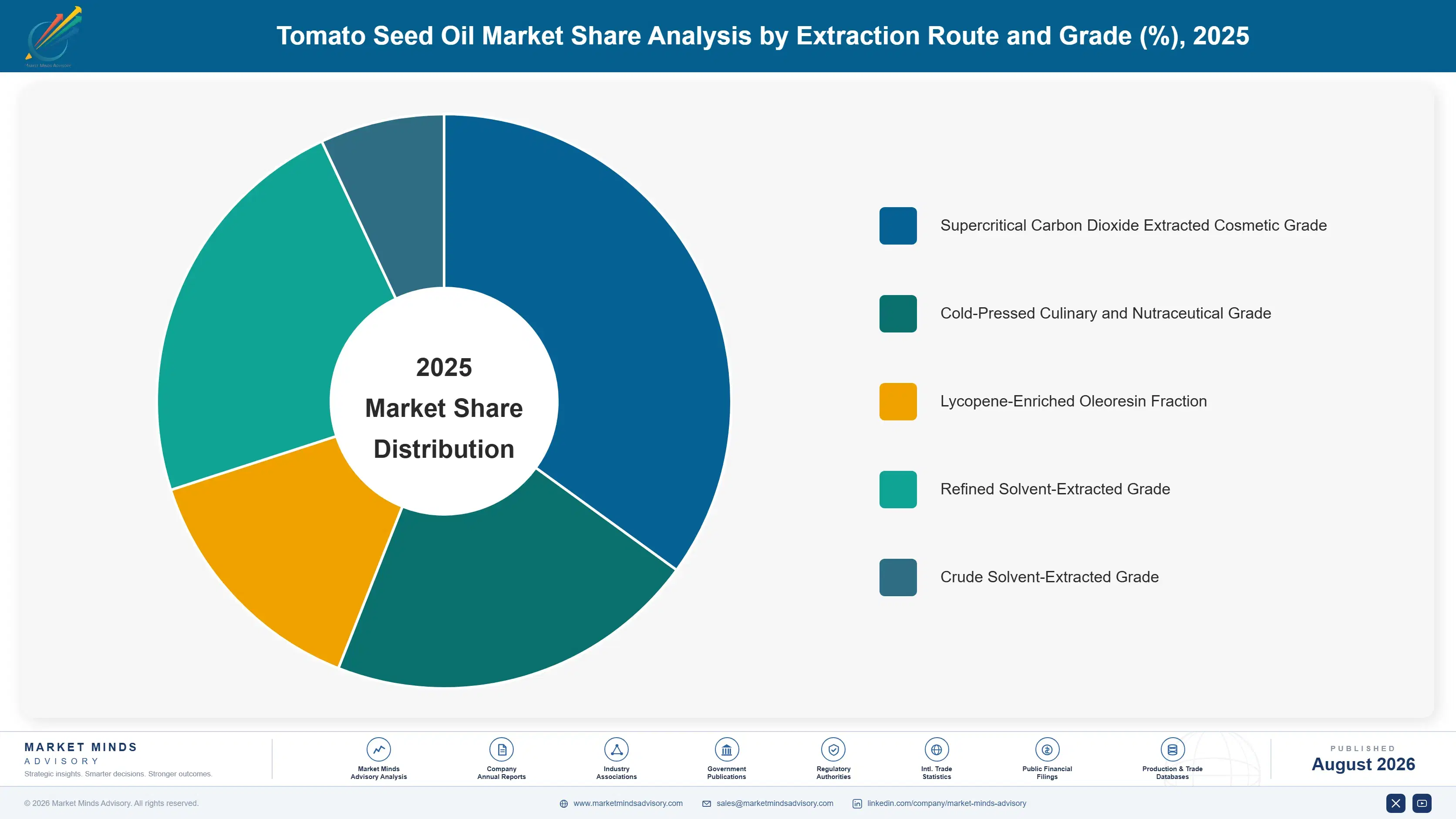
Segmentation follows extraction route and resulting grade, meaning how the oil is removed from the seed and what survives that process. That single dimension determines lycopene and tocopherol retention, solvent residue status, achievable price, which formulators can use the material, and how much capital a producer must commit before it can participate in the segment at all.
tomato-seed-oil-market-trends-market-share-analysis-1787313526089

Supercritical Carbon Dioxide Extracted Cosmetic Grade

The fastest segment at 11.7%, a full 1.50 times the market rate, covering oil extracted using supercritical carbon dioxide rather than by hexane solvent or mechanical pressing. The process preserves the lycopene and tocopherol content that solvent extraction largely destroys, and it leaves no residual solvent whatsoever, which clean beauty formulators now require outright rather than merely prefer. Realised pricing runs roughly 2.6 times refined solvent-extracted material. Capital cost is the genuine barrier, since a supercritical plant costs several times a solvent line of comparable throughput and the throughput itself is lower. Producers holding this capability find themselves supply-constrained rather than demand-constrained today, which almost never happens in botanical oils.
CAGR 11.7%

Cold-Pressed Culinary and Nutraceutical Grade

Growing at 10.1% annually on mechanically pressed oil produced without any heat above ambient conditions, supplied into culinary use, nutraceutical softgel manufacture and natural cosmetic formulation alike. Cold pressing preserves more of the minor constituents than solvent extraction while requiring far less capital than supercritical equipment, which makes it the only practical route open to smaller extractors. Oil yield is considerably lower here, typically around two thirds of what solvent recovery achieves, so the economics depend entirely on realised pricing rather than on volume. Culinary positioning has proved harder than expected, since consumers have no established reference point at all for what tomato seed oil is supposed to taste like.
CAGR 10.1%
Full segment breakdown across 5 segments available in the complete report.

Regional Architecture and Country Demand Map

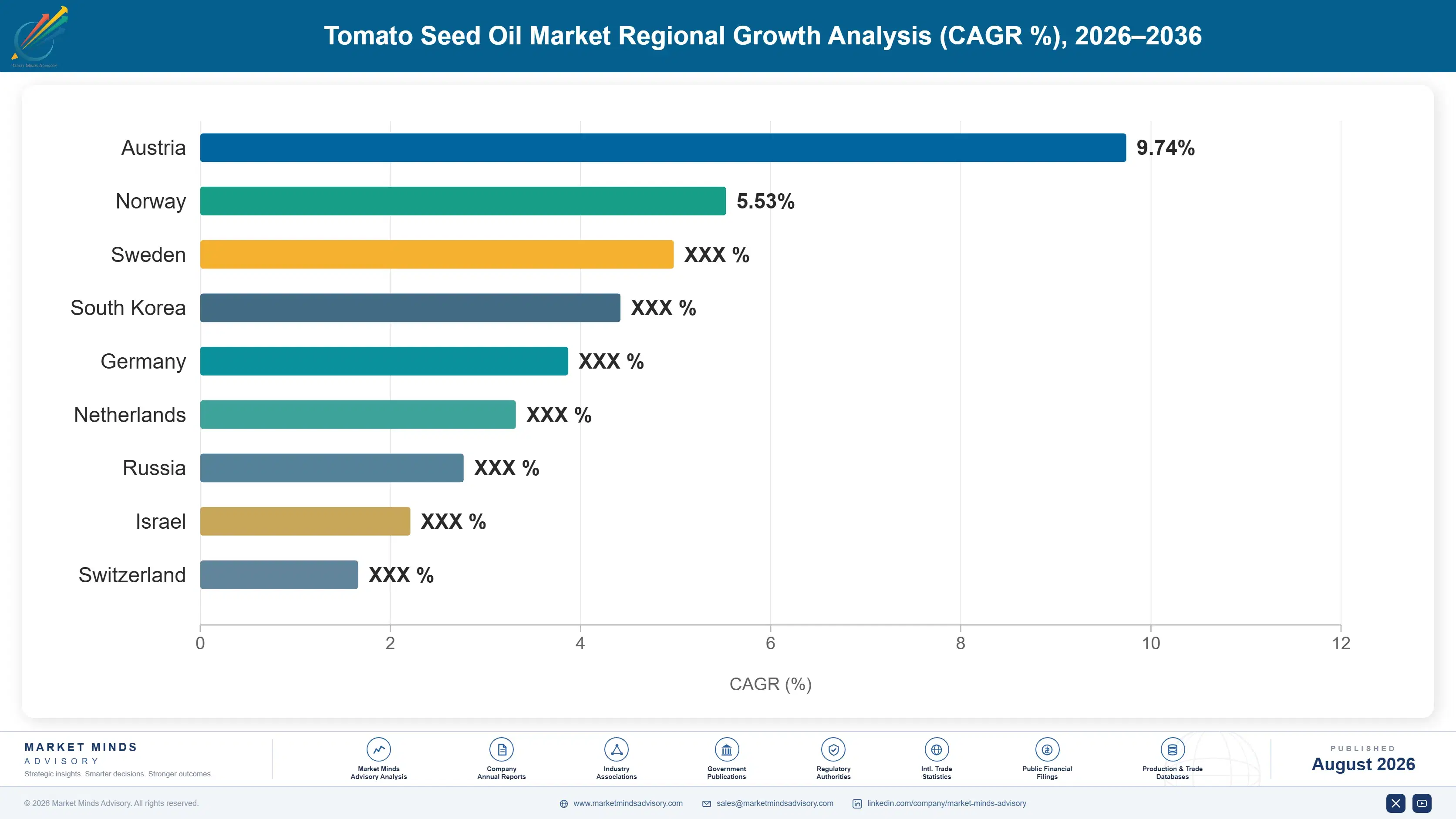
East Asia leads on Xinjiang processing volume combined with growing Chinese cosmetic ingredient demand. South Asia and Pacific grows fastest of all as Indian processing and personal care manufacture both expand. Middle East and Africa holds an outsized share on Turkish and Egyptian tomato processing volume.

East Asia

Thirty percent of global value, the largest single regional share, and it rests on feedstock more than on consumption. Xinjiang processes more tomatoes for paste than any other region on earth, generating pomace volumes that dwarf anything available in Europe or North America. Chinese cosmetic ingredient demand has grown alongside it, and domestic skincare brands have adopted upcycled botanical positioning quickly. Japanese formulators buy smaller volumes at considerably higher specification. Growth of 9.0% reflects both feedstock availability and demand expansion. Seed separation infrastructure remains the constraint rather than any shortage of raw material. Domestic skincare brands have adopted upcycled positioning unusually quickly. Feedstock volume dwarfs anything available elsewhere. Separation capacity is the constraint.
Share: 30% | CAGR: 9.0% (2026 to 2036)

Western Europe

Twenty-four percent of value on 6.2% growth, and this is where the highest realised pricing anywhere sits. Italian and Spanish tomato processing generates substantial pomace, and Italian extractors in particular have built genuine supercritical capability serving cosmetic formulators across the region. Clean beauty positioning is furthest advanced here, and upcycled certification schemes carry real commercial weight with brands rather than functioning as marketing decoration. Growth runs below the global rate because the base is comparatively mature. Regulatory documentation requirements are the strictest anywhere, which favours established suppliers over new entrants considerably. Italian extractors hold the deepest supercritical capability anywhere in the region. Certification schemes carry genuine commercial weight with brands.
Share: 24% | CAGR: 6.2% (2026 to 2036)
Regional intelligence for 5 additional markets available in the complete report: North America, South Asia and Pacific, Latin America, Middle East and Africa, Eastern Europe. Contact sales@marketmindsadvisory.com.
tomato-seed-oil-market-trends-country-cagr-analysis-1787313526604

Where Extraction Margin Actually Sits

Four commercial moves separate the extractors earning genuine cosmetic ingredient margins from those merely selling crude oil at commodity spread. Each one depends on solving something that the paste processor itself simply will not: seed separation on site, storage across the off-season, supercritical capability, or the traceability documentation cosmetic brands now demand before they will buy.

Take Seed Separation Off The Processor Entirely

Paste factories decline seed recovery because it demands capital and handling they cannot use for anything else, and wet pomace to a feedlot earns a small but certain return with no effort. Extractors installing and then operating separation equipment on the processor's own site under toll arrangements convert that refusal directly into secured supply. The arrangement typically costs between $1.5 million and $3 million per site and secures feedstock that competitors cannot access at all, because the only alternative buyer for that pomace is a feedlot paying almost nothing for it.
Market Impact: Secures feedstock at under $3 milli

Build Controlled Storage Across The Off-Season

A full year of seed arrives within ninety days and must then survive nine months before extraction, and tomato seed is high in linoleic acid, which oxidises readily whenever it is stored badly. Controlled-atmosphere and nitrogen-blanketed storage together cost roughly $900,000 per thousand tonnes of installed capacity and preserves the tocopherol and lycopene content that cosmetic pricing depends upon. Extractors without that capability either buy seed at distress prices during the campaign itself or accept degraded material later, and neither of those positions supports premium grade supply to a cosmetic formulator.
Market Impact: Protects oil quality across 9 month

Install Supercritical Rather Than Solvent Extraction

Hexane recovers more oil per tonne of seed but destroys the lycopene and much of the tocopherol content that gives this oil its entire cosmetic value, and it leaves residual solvent that clean beauty formulators now refuse outright. Supercritical carbon dioxide extraction realises roughly 2.6 times refined solvent-extracted pricing, albeit on a materially lower yield. Capital cost runs several times a comparable solvent line, which is precisely why so few extractors hold the capability and why the few who do hold it are supply-constrained rather than chasing customers at all.
Market Impact: Realises about 2.6 times refined so

Document Upcycled Provenance To Certification Standards

Cosmetic brands have now moved upcycled sourcing from a sustainability report footnote to a front-of-pack claim, and that claim must now be substantiable through verified third-party certification rather than merely asserted by a supplier. Extractors holding certified traceability back to named processing sites win specifications outright against chemically identical material carrying thinner documentation, and they then hold their realised pricing 15% to 22% higher for having done so. Certification costs under $200,000 annually across an entire product range, which makes it among the cleanest returns available anywhere across the whole specialty oils business.
Market Impact: Holds pricing up to 22% above undoc

Who Controls the Margin Pool

Concentration is low at 27% for the five largest suppliers, measured on tomato seed oil revenue across all participants, and it stays low because supply originates at hundreds of separate paste processing plants rather than any concentrated base. Lycored leads on tomato-derived ingredient breadth combined with lycopene expertise, and the gap to the second tier is widest in extraction capability rather than in feedstock access.
Competition runs on three dimensions. Feedstock access decides participation entirely, since seed that has already gone to a feedlot cannot be bought back at any price. Extraction capability decides which grades a supplier can offer, and supercritical capacity is genuinely scarce. Price competition is confined to crude and refined solvent-extracted material sold into industrial and lower-specification uses, where the oil is largely interchangeable and buyers compare on fatty acid profile alone.

Two pressures are building. Chinese extractors with Xinjiang feedstock proximity are adding supercritical capability and will compete directly for European cosmetic customers that Mediterranean suppliers have held on quality and documentation. Meanwhile lycopene co-product economics are improving recovery project returns enough that several paste processors are reconsidering separation investment themselves. Rankings shift where feedstock contracts meet extraction capability, since holding either alone is insufficient.
tomato-seed-oil-market-trends-company-positioning-matrix-1787313527123

Competitive Moat and Risk Dimensions

LYCORED

Moat: Deepest tomato-derived ingredient position

Operating across lycopene, tomato extracts and seed oil lets the company recover multiple value streams from the same pomace, which improves the economics of any feedstock arrangement it enters. Processors negotiating with a buyer who wants the whole stream rather than one fraction of it receive a materially better offer than single-product extractors can make.
LYCORED

Risk: Seed oil subordinate to lycopene

Lycopene generates considerably more revenue per tonne of pomace than seed oil does, and processing capacity naturally follows the higher-value output first. Seed oil customers may find supply deprioritised when lycopene demand is strong. That internal ranking is rational for the company and a genuine continuity risk for anyone depending on it for oil.
GUSTAV HEESS

Moat: Broadest specialty oil customer base

Long-established relationships across European cosmetic and food formulators give the company distribution reach that extraction-focused competitors lack entirely. Buyers consolidating specialty oil purchasing onto fewer suppliers reinforce that position, since a supplier offering forty oils is far easier to work with than forty suppliers offering one each.
GUSTAV HEESS

Risk: Limited upstream extraction control

The company sources rather than extracts most of what it sells, which means feedstock access and extraction quality both sit with third parties. As supercritical capacity becomes the differentiator, depending on other people's plants for it is a weak position. Building extraction capability would mean competing with the suppliers currently filling its catalogue.

Players Tracked

Prominent Players

Lycored
Gustav Heess
Botanic Innovations
Provital
Henry Lamotte Oils

Other Key Players

All Organic Treasures
Statfold Seed Oil
O and 3
Aromaaz International
Kanta Enterprises
Vigon International
Bioriginal Food and Science
Connoils
Berje
AAK
Bunge Loders Croklaan
Wilmar International
Xinjiang Chalkis
COFCO Tunhe
Nutrasource

Recent Developments

MARCH 2025

Xinjiang Chalkis commissions seed separation and extraction capacity

Seed separation and oil extraction capacity together entered commercial service alongside the company's existing tomato paste operations in Xinjiang, converting the pomace that had previously moved entirely to animal feed into a recovered oil and lycopene stream serving the domestic Chinese cosmetic ingredient market directly.
Signal: Paste processors are now beginning to reco
JULY 2025

Provital expands supercritical extraction for cosmetic grade oils

Additional supercritical carbon dioxide botanical extraction capacity entered commercial service at the company's Spanish site during the year, targeting those cosmetic formulators now requiring genuinely solvent-free botanical oils in every formulation carrying the lycopene and tocopherol content that conventional hexane extraction destroys almost entirely during processing.
Signal: Supercritical capability rather than any f
NOVEMBER 2025

Lycored secures multi-year pomace supply agreements

Multi-year pomace supply arrangements were concluded with several large Mediterranean tomato processors covering both the seed and the skin fractions of the pomace, reflecting how recovering the lycopene alongside the seed oil improves the economics of any feedstock arrangement considerably for both of the parties involved in it.
Signal: Whole-stream pomace agreements now clearly

What Drives Delivered Oil Cost

Seed feedstock accounts for roughly 24% of cost of goods, which is unusually low because the raw material would otherwise be sold as cheap animal feed. Drying and storage across the off-season contribute 19%, extraction energy and carbon dioxide 21% on supercritical lines, refining and filtration 12%, and certification and analytical testing a further 8% on cosmetic grades.
The 2022 energy episode hit this category harder than its feedstock share suggests. Seed drying and supercritical extraction are both energy-intensive, and European extractors faced industrial energy costs at several times their historical range through that winter. IEA data recorded the movement across all European industrial gas and electricity markets. Several smaller Mediterranean extractors ran reduced campaigns rather than process at negative margin, which tightened cosmetic grade supply into the following year.

The competitive disadvantage mechanism runs through storage and extraction route rather than through feedstock purchasing. An extractor without controlled storage buys seed during the campaign when everyone is selling, or buys degraded material later, and neither supports premium grade output. One running solvent rather than supercritical extraction achieves better yield but cannot serve the customers paying most. Carrying both disadvantages confines a producer to industrial and lower-specification demand permanently.
tomato-seed-oil-market-trends-cost-volatility-analysis-1787313527319

Contract pomace on multi-year whole-stream terms

Processors deciding between a feedlot and an extractor compare certainty rather than price, since pomace earns little either way. Multi-year agreements covering both seed and skin fractions give the processor a reliable outlet and give the extractor feedstock security, and they consistently outcompete single-fraction offers that leave the processor still managing a residue afterwards.

Recover lycopene alongside oil from the same stream

Lycopene oleoresin sells at many times the oil price per kilogram into both supplement and colourant applications, and recovering it from the same pomace lifts project returns by roughly 40% against oil-only economics. That improvement is frequently what moves a previously stalled seed recovery investment past an internal approval threshold at a paste business.

Nitrogen blanket seed storage through the off-season

Tomato seed is unusually high in linoleic acid and oxidises readily across nine full months of storage, degrading precisely the tocopherol and lycopene content that all cosmetic grade pricing depends upon. Nitrogen blanketing and controlled atmosphere storage together cost roughly $900,000 for each thousand tonnes of capacity installed and preserve that quality premium entirely.

Portfolio Architecture for Margin Defence

Margin architecture separates almost entirely on extraction route and documentation. Crude solvent-extracted oil sold into industrial and lower-specification uses runs at gross margins in the high teens, because the fatty acid profile is the only thing buyers compare and the material is essentially interchangeable.
The volume-versus-premium tension is unusual because feedstock arrives whole regardless. A campaign delivers all the seed at once, and an extractor serving only cosmetic customers still has to place the fractions and grades those customers do not want. Industrial and culinary outlets absorb that material at thin margin, and refusing them means either wasting seed already paid for or reducing throughput below what the storage investment assumed. Nobody in this category runs a single-grade operation successfully.

Value concentrates where the buyer cannot verify quality independently. Certified supercritical extracted cosmetic grade sits at the top, because a formulator cannot assess lycopene retention or solvent residue without testing it would rather not perform. Cold-pressed nutraceutical material sits alongside on similar logic. Crude solvent oil sits at the other extreme, where a certificate of analysis settles the discussion and pricing compresses toward extraction cost.

Volume / Commodity-Adjacent

Crude and refined solvent-extracted oil supplied into industrial, soap and lower-specification cosmetic uses. Buyers compare fatty acid profile and price, the material is interchangeable, and no supplier holds any defensible position. This volume places fractions premium customers do not want.
Gross Margin: 17-24%

Premium / Certified

Cold-pressed culinary and nutraceutical grades supplied with basic quality documentation into food, softgel and natural cosmetic formulation. Gentler processing and preserved minor constituents support pricing well above solvent-extracted material across every application.
Gross Margin: 28-38%

Sustainability / Regulatory / Next-Generation

Supercritical carbon dioxide extracted cosmetic grade supplied with certified upcycled provenance and full traceability to named processing sites. Extraction capability and verified documentation, rather than any property of the seed, justify the pricing achieved here.
Gross Margin: 42-58%
tomato-seed-oil-market-trends-portfolio-architecture-1787313527816

High-value Sub-segments and Strategic Watch-out

Certified Supercritical Cosmetic Grade

High value on genuinely high growth at 11.7%, and the only pool where suppliers are constrained by capacity rather than by demand. Capital cost keeps the competitive field here very small indeed, and certified upcycled traceability adds a documentation barrier that newer entrants consistently underestimate.
Gross Margin: 46-58%

Cold-Pressed Nutraceutical Grade

Strong margins on solid growth at 10.1%, and it is reachable without any of the capital that supercritical extraction demands. Yield is considerably lower than solvent recovery achieves, so the economics rest entirely on realised pricing rather than on any throughput advantage the route could ever deliver.
Gross Margin: 32-42%

Solvent-Extracted Industrial Oil

The outlet that places whatever grades and fractions premium customers will not take, earning gross margins in the high teens on entirely interchangeable material. Refusing it means wasting seed already paid for, which is precisely why nobody in this category successfully operates a single-grade business.
Gross Margin: 17-24%

Culinary Positioned Oil

The strategic watch-out sitting squarely in this portfolio. Margins here look attractive enough on paper, but consumers have no reference point at all for what tomato seed oil is supposed to taste like, and culinary adoption has consistently disappointed against forecasts built on cosmetic demand growth instead.
Gross Margin: 24-34%

How This Demand Actually Repeats

Cosmetic demand behaves as an annuity attached to a formulation. Once tomato seed oil is designed into a serum or facial oil, it ships against every production run for years, because changing a botanical oil means reworking stability testing, sensory assessment and often the front-of-pack provenance claim built around it.
Stickiness varies considerably by application. Certified upcycled cosmetic supply is the tightest, since the brand has built marketing around a specific traceable origin and cannot substitute quietly. Nutraceutical softgel formulations sit close behind, held by specification and stability validation. Natural cosmetic manufacture is moderately sticky through relationship and consistency. Industrial and soap use is barely sticky at all, with buyers switching between botanical oils on delivered price and fatty acid profile whenever the arithmetic moves.

Buyer profiles have shifted noticeably. Purchasing once sat with cosmetic chemists comparing fatty acid profiles and price per kilogram. It now frequently involves sustainability, regulatory and brand marketing functions asking about upcycled certification, processing site traceability and solvent residue status. Suppliers whose commercial approach still leads with a specification sheet find themselves talking to buyers for whom provenance was settled before price was ever discussed.
tomato-seed-oil-market-trends-end-use-penetration-index-1787313528303

Where To Place Capital

These are among the four positions where our research anticipates prominent divergence between winners and laggards over the coming forecast period. Each is grounded in the demand model, the regulatory perimeter, and the announced capacity pipeline.
01 / FEEDSTOCK ACCESS CONTROL

Seed sold to a feedlot never comes back

Paste processors decline seed recovery because it demands capital and handling they cannot use for anything else, and wet pomace earns a small certain return with no effort at all. Extractors installing and operating separation equipment on the processor's site convert that refusal into secured supply, at a cost of between $1.5 million and $3 million per processing site. The competing buyer is a feedlot paying almost nothing, which makes this comfortably the cheapest feedstock security available anywhere in specialty oils today.
02 / EXTRACTION ROUTE COMMITMENT

Supercritical or accept commodity pricing forever

Hexane extraction recovers more oil per tonne but destroys the lycopene and tocopherol content that gives this oil its entire cosmetic value, and it leaves residual solvent that clean beauty formulators now refuse outright rather than merely tolerate. Supercritical extraction realises roughly 2.6 times refined solvent pricing, albeit on a lower yield. Capital cost runs several times that of a comparable solvent line, which is exactly why the few producers holding it find themselves supply-constrained rather than chasing customers at all.
03 / OFF-SEASON STORAGE INVESTMENT

Ninety days of intake, nine months of risk

A full year of seed arrives within a single ninety day campaign and must then survive nine months before extraction, while the seed itself oxidises readily on its unusually high linoleic acid content. Controlled-atmosphere storage costs roughly $900,000 per thousand tonnes of capacity and preserves precisely the tocopherol and lycopene content that all premium pricing depends upon. Extractors without it buy at distress prices during the campaign or accept degraded seed later, and neither of those positions supports genuine premium grade supply.
04 / PROVENANCE DOCUMENTATION DEPTH

Certification costs less than any other advantage

Cosmetic brands have now moved upcycled sourcing onto front-of-pack claims which must be substantiable through verified third-party certification rather than through any mere supplier assertion. Extractors holding certified traceability back to named processing sites hold their realised pricing 15% to 22% above chemically identical material that carries thinner documentation. Third-party certification costs under $200,000 annually across an entire product range, which makes the return considerably cleaner than any extraction investment available and a good deal faster to realise in practice.

Engagement Snapshot From the Field

A live engagement with an industry participant carrying material or product regulatory and market exposure ahead of a defining policy shift, showing how our research translates into a defensible multi-year portfolio strategy.
MARKET MINDS ADVISORY · CLIENT ENGAGEMENT SUMMARY
Tomato Seed Oil Producer Strategic Portfolio Review and Transition Roadmap 2026·Investment Scenario on Tomato Seed Oil Exposure Evaluation 2025-26
CLIENT PROFILE
A Mediterranean specialty oil extractor with annual revenue near $34 million (client-reported, unverified by MMA), producing cold-pressed and solvent-extracted botanical oils including a small tomato seed oil line. Seed was purchased on spot during the tomato campaign from three regional paste processors, storage was ambient and uncontrolled, and no supercritical extraction capability existed at either site.
STRATEGIC CHALLENGE
Cosmetic customers had begun specifying solvent-free extraction and certified upcycled traceability, neither of which the company could supply, and two accounts had moved to a Spanish competitor within a year. Meanwhile seed purchased during the campaign was arriving in variable condition and degrading in storage before extraction. Management needed to rank three investments against limited capital.
MMA APPROACH
MMA modelled returns on supercritical extraction, controlled storage and on-site seed separation separately, quantified the pricing gap between certified supercritical and the client's existing output, and assessed feedstock security across the three processors supplying it. Findings were tested against 47 expert interviews covering cosmetic formulator specification practice, pomace recovery economics and upcycled certification requirements.
KEY FINDINGS
  1. Certified supercritical extracted material realised roughly 2.4 times the client's existing cold-pressed pricing into the same cosmetic customer base it was already serving.
  2. Uncontrolled ambient storage was degrading tocopherol content by an estimated 30% across the off-season (client-reported, unverified by MMA), which alone disqualified the material from premium specification.
  3. All three supplying processors were selling the majority of their pomace to feedlots, meaning available feedstock was several times what the client was actually purchasing.
  4. Upcycled certification cost under $150,000 annually and was the cheapest of the three options, though it delivered little value without the extraction capability to exploit it.
CLIENT PROFILE
A Mediterranean specialty oil extractor with annual revenue near $34 million (client-reported, unverified by MMA), producing cold-pressed and solvent-extracted botanical oils including a small tomato seed oil line. Seed was purchased on spot during the tomato campaign from three regional paste processors, storage was ambient and uncontrolled, and no supercritical extraction capability existed at either site.
STRATEGIC CHALLENGE
Cosmetic customers had begun specifying solvent-free extraction and certified upcycled traceability, neither of which the company could supply, and two accounts had moved to a Spanish competitor within a year. Meanwhile seed purchased during the campaign was arriving in variable condition and degrading in storage before extraction. Management needed to rank three investments against limited capital.
MMA APPROACH
MMA modelled returns on supercritical extraction, controlled storage and on-site seed separation separately, quantified the pricing gap between certified supercritical and the client's existing output, and assessed feedstock security across the three processors supplying it. Findings were tested against 47 expert interviews covering cosmetic formulator specification practice, pomace recovery economics and upcycled certification requirements.
KEY FINDINGS
  1. Certified supercritical extracted material realised roughly 2.4 times the client's existing cold-pressed pricing into the same cosmetic customer base it was already serving.
  2. Uncontrolled ambient storage was degrading tocopherol content by an estimated 30% across the off-season (client-reported, unverified by MMA), which alone disqualified the material from premium specification.
  3. All three supplying processors were selling the majority of their pomace to feedlots, meaning available feedstock was several times what the client was actually purchasing.
  4. Upcycled certification cost under $150,000 annually and was the cheapest of the three options, though it delivered little value without the extraction capability to exploit it.
RECOMMENDED STRATEGY
Phase 1: Phase one: install controlled-atmosphere seed storage before anything else, since degraded feedstock disqualifies premium output regardless of what extraction equipment is installed. Phase 2: Phase two: negotiate on-site separation arrangements with the two largest processors, securing feedstock currently leaving as animal feed at very low value. Phase 3: Phase three: install supercritical extraction sized against certified cosmetic demand, completing upcycled certification in parallel so that both arrive together.
OUTCOME
The client commissioned controlled storage before the following campaign and concluded separation arrangements with two processors, reporting tocopherol retention improving substantially and seed volumes roughly trebling (client-reported, unverified by MMA). Supercritical extraction was approved on that basis, and one of the two lost cosmetic accounts has since returned.

Frequently Asked Questions

Foundational context covering the market sizes, CAGR, scope, country, region and competition that inform every finding below. This section is provided to cover basics and most often pre-purchase conversations, answered from the MMA Primary Research Dataset.

What is the current size of the Tomato Seed Oil Market?

The market was worth $0.1 billion in 2025 and is forecast to reach $0.11 billion in 2026. Cosmetic and personal care applications absorb 58% of that output.

How large will the Tomato Seed Oil Market be by 2036?

MMA forecasts $0.23 billion by 2036, an expansion multiple of 2.12 times the 2026 base. That represents $0.12 billion of incremental value across the forecast period.

What is the CAGR for the Tomato Seed Oil Market 2026 to 2036?

The base case compound annual growth rate is 7.8%, with a bull case of 9.0% and a bear case of 6.5%. Historical growth from 2020 to 2025 also ran at 6.5%.

Which segment is growing fastest?

Supercritical carbon dioxide extracted cosmetic grade at 11.7%, a full 1.50 times the market rate. The process preserves lycopene and tocopherol content that solvent extraction destroys.

Who are the major companies in the Tomato Seed Oil Market?

Lycored, Gustav Heess, Botanic Innovations, Provital and Henry Lamotte Oils lead with 27% between them. Fifteen further suppliers hold meaningful grade-specific or regional positions across the market.

Which country is growing fastest?

India at 11.4% annually, as tomato processing expands and domestic personal care manufacture adopts botanical and upcycled ingredient positioning across an increasingly wide product range.

Report Segmentation Architecture

The full report scope spans multiple orthogonal segmentation dimensions, with cross-tabulated demand data provided for each dimension pair. Coverage extends further to regional breakdowns, trend trajectories, and the competitive detail needed to support segment-level decision-making.

By Extraction Route and Grade

  • Supercritical Carbon Dioxide Extracted Cosmetic Grade
  • Cold-Pressed Culinary and Nutraceutical Grade
  • Lycopene-Enriched Oleoresin Fraction
  • Refined Solvent-Extracted Grade
  • Crude Solvent-Extracted Grade

By End-Use Industry

  • Skincare and Facial Oil Formulation
  • Haircare and Scalp Treatment
  • Nutraceutical Softgels and Supplements
  • Culinary and Speciality Food Oils
  • Soap and Industrial Oleochemicals
  • Pet Care and Animal Nutrition

By Commercial Dimension

  • Direct Supply to Cosmetic Formulators
  • Specialty Oil Distributor Catalogue
  • Contract Extraction and Toll Processing
  • On-Site Separation Partnership With Processors
  • Export Supply to Ingredient Houses

By Region

  • North America
  • Western Europe
  • East Asia
  • South Asia and Pacific
  • Latin America
  • Middle East and Africa
  • Eastern Europe

Scope, Methodology, and Coverage

Every figure in this report is reproducible from documented input assumptions. The scope below maps the historical period, the forecast horizon, the segmentation dimensions, and the countries covered, alongside the underlying primary and qualitative methodology.
Historical Period
2020 to 2025
Forecast Period
2026 to 2036
Base Year
2025 (USD billions; MMA Primary Research Dataset, August 2026)
Market Definition
This report covers oil extracted from tomato seeds recovered from processing pomace, spanning supercritical carbon dioxide extracted cosmetic grade, cold-pressed culinary and nutraceutical grade, refined and crude solvent-extracted grades, and lycopene-enriched oleoresin fractions recovered alongside the oil. Coverage includes the seed separation, storage and certification services supplied around extraction. Tomato pomace sold as animal feed, lycopene extracted directly from pulp or skin, tomato paste, juice and other processed tomato products, seed sold for planting, and finished cosmetic or food formulations are excluded from scope.
Quantitative Units
USD billions at supplier realised prices; volume in tonnes of extracted oil; gross margin percentages and extraction yields by grade.
Segmentation Dimensions
Extraction route and grade, end-use industry, commercial dimension, region.
Regions Covered
North America, Western Europe, East Asia, South Asia and Pacific, Latin America, Middle East and Africa, Eastern Europe
Countries Covered
China, Japan, South Korea, India, Australia, Thailand, United States, Canada, Mexico, Italy, Spain, France, Portugal, Germany, Brazil, Chile, Turkey, Egypt, Hungary, Ukraine.
Key Companies Profiled
Lycored, Gustav Heess, Botanic Innovations, Provital, Henry Lamotte Oils, All Organic Treasures, Statfold Seed Oil, Xinjiang Chalkis, COFCO Tunhe, AAK, and ten further suppliers.
Quantitative Methodology
Primary survey, n=3,800 respondents, Q4 2025, six countries; demand-side model with trade association cross-validation
Qualitative Methodology
47 expert interviews, Q4 2025; applied to validate demand model assumptions, identify emerging dynamics, and assess competitive positioning
Report Format
PDF and XLSX data workbook (Word format preview document)
Publisher
Market Minds Advisory
Report Code
MMA-2026-AGR-844
Published
August 2026
Contact
sales@marketmindsadvisory.com | www.marketmindsadvisory.com

Purchase the full Tomato Seed Oil Market Report (2026 to 2036).

The full report sets out ten-year forecasts for tomato seed oil by extraction route and grade, end-use industry and commercial model across seven regions. It quantifies latent feedstock by processing region, showing how much pomace currently leaves paste factories as animal feed and what recovering it would yield. Competitive assessment covers twenty suppliers on a consistent revenue basis, mapping extraction capability and feedstock arrangements separately from traded volume. Storage and campaign seasonality costs are modelled against quality retention across the off-season. Findings draw on a quantitative survey of 3,800 respondents across six countries and 47 expert interviews conducted during the fourth quarter of 2025.
Ten-year forecasts by extraction route and region
Latent pomace feedstock quantified by processing region
Extraction capability mapped across twenty named suppliers
Storage and seasonality costs modelled against quality retention
Upcycled certification requirements compared across cosmetic buyers
Margin architecture across three commercial portfolio tiers

Built For The People Who Decide

From boardroom strategy to bench-side execution, this report is read cover-to-cover by leaders shaping the next decade of their industry, turning demand scenarios, market dynamics and valuation benchmarks into decisions.
CXOs/ Presidents/ VPs/ Managers
M&A and Corporate Development
Strategy Teams and R&D Heads
Procurement and Product Directors
Regulatory and Compliance Leaders
Investor Relations and Equity Analysts