Market Minds Advisory
Tokenization Market

Tokenization Market: Tokenization Market: Payment Credentials, Personal Data Substitution and Audit Scope Reduction, 2026 to 2036

This is sold as a security control and bought as an audit exemption. The business case that actually gets approved removes systems from assessment scope, and prevention of breach is the secondary argument.

Lead Analyst

Published

September 2026

Make Smarter Decisions with Customized Research Insights

Request a free sample report and evaluate market opportunities, growth trends, and competitive dynamics relevant to your business needs.

2025 MARKET VALUE$4.2BMarket Size 2025
2036 FORECAST VALUE$16.9BBase Case , 2026 to 2036
CAGR 2026 TO 203613.4 %Bull 14.7% / Bear 12.1%
INCREMENTAL OPPORTUNITY$12.1BNet 10- year value creation
EXPANSION MULTIPLE3.52x2036 value over 2026 base
Strategic Levers
M&A Pipeline
Regional Outlook
Country Rankings
Competitive Intelligence
Segmental Deep-dive
Call-Us : 91 93563 13602

Executive Snapshot and Market Trajectory.

Deployments remove roughly 78% of systems from assessment scope, and that is the number written into every approved business case. Breach prevention appears in the security team's justification and rarely in the finance approval. Knowing which argument signs the contract explains most of this market. Both arguments are true.
Personal data and identity tokenization grows at 20.1%, half again the market rate of 13.4%, as privacy regimes push substitution beyond payment credentials into names, identifiers, and contact details held across analytic systems. Cloud and database field tokenization follows it closely. North America holds 31% of contracted spend, on payment volume and audit regime intensity arriving in the same jurisdictions. Confusing the two arguments loses deals.
Five providers hold 44% of contracted spend, and two of them are card networks whose tokenization moved the stored credential relationship away from merchants entirely. The uncomfortable finding is that 54% of deployments permit broad detokenization without narrow access control, which relocates the exposure rather than removing it and leaves the audit exemption resting on an assumption nobody tested. Assessors have started asking who can detokenize, and many exemptions will not survive it.
Market Definition
This market covers technologies substituting sensitive data with non-sensitive surrogate values, including payment card network tokenization, merchant vault and acquirer tokenization, personal data and identity tokenization, healthcare record tokenization, cloud and database field tokenization, and industrial and machine identity tokenization. It excludes blockchain based asset tokenization and digital securities, general encryption key management sold separately, data masking for test environments, and payment processing or acquiring services themselves.
Base Year Value
$4.2B in 2025 (MMA Primary Research Dataset, September 2026)
Forecast Period
2026 to 2036, eleven discrete annual values
CAGR
13.4% base case. Bull 14.7%. Bear 12.1%.
Fastest Growth Segment
Personal Data And Identity Tokenization: 20.1% CAGR
Fastest Growth Country
India: 18.9% CAGR
Fastest Growth Region
South Asia and Pacific: 15.6% CAGR
Largest Region
North America: 31% of 2025 global value
Market Leaders
Visa, Mastercard, Thales, Fiserv, and Protegrity lead the field. Source: MMA Primary Research Dataset, July 2026.
Primary Survey
n=3,800 procurement and R&D decision-makers, Q4 2025, six countries
Methodology
Demand-side build-up, cross-validated against public data, 47 expert interviews

Tokenization Market Forecast Scenarios

tokenization-market-size-forecast-scenario-1790007988175
Growth between 2020 and 2025 came from two quite separate forces that happened to arrive together. Card networks pushed stored credential tokenization through the merchant base, while data protection regimes made holding raw personal information a liability. Historical growth of 12.0% blends network driven payment adoption with privacy adoption chosen for different reasons. They arrived together by coincidence.
The base case at 13.4% rests on three mechanisms. Privacy regulation continues expanding what counts as sensitive personal data, which extends substitution well beyond payment credentials into ordinary analytic and operational systems. Cloud migration forces organisations to decide what raw data may leave their perimeter, and tokenization is the answer most legal functions accept. And national mandates oblige tokenization of stored credentials on timetables leaving no room for deferral. India is the clearest example.
The bull case at 14.7% depends on privacy supervisors treating tokenized data as genuinely out of scope, which would convert substitution from a risk reduction into a compliance exemption with quantifiable value. The bear case at 12.1% is the opposite: if regulators conclude that reversible tokens remain personal data, the audit scope argument collapses and adoption reverts to payment applications where the network mandate carries it anyway.

Scope Reduction Signs The Contract

The security argument and the buying argument are different arguments, and providers who confuse them lose deals. A full deployment removes about 78% of systems from assessment scope, which converts directly into fewer controls, shorter audits, and lower assessor fees. That is a number a finance director can approve. Breach prevention is a probability nobody can price. Security teams write the justification and finance approves the exemption.
TOP FIVE CONCENTRATION44%Share of contracted spend held by the leading providers
AUDIT SCOPE REDUCTION78%Systems removed from assessment following a full deployment
TOKENIZED CARD SHARE67%Stored payment credentials now held as network tokens
UNRESTRICTED DETOKENIZATION SHARE54%Deployments allowing broad detokenization without narrow access control
MEDIAN DEPLOYMENT DURATION26 weeksPeriod from contract signature to production token issuance
AUTHORISATION UPLIFT2.4%Improvement in approval rates following network token adoption
Payment tokenization carried a second benefit that turned out to matter commercially. Network tokens improve authorisation rates by roughly 2.4% because credentials update automatically when cards are reissued, and for a subscription business that is straightforward incremental revenue. Around 67% of stored credentials are now network tokens, and that migration moved the credential relationship from merchant to network permanently.
The weakness sits in detokenization. In 54% of deployments the service will return the original value to any authorised caller, with authorisation defined loosely enough that compromising one application yields the underlying data. The tokens are safe; the vault is not necessarily. Assessors have begun asking about this, and a good number of scope reductions will not survive the question. A good number of scope reductions will not survive it.
"Ask a buyer why they tokenized and you get a compliance answer. Ask them who can detokenize and how often that is reviewed, and the room goes quiet. The control is real, and in a majority of deployments the thing it protects can still be requested by anything holding a service credential."
Practice Director, Data Security and Payments Infrastructure · MMA Technology Practice · September 2026

Market Trends

Privacy Regimes Extend Substitution Beyond Payment Credentials

Data protection rules across Europe, several United States states, India, and Brazil have widened what counts as sensitive personal information, and holding raw identifiers in analytic systems has become a liability organisations now quantify. Substituting names, contact details, and national identifiers lets the same analysis run without the exposure. Personal data and identity tokenization grows at 20.1% on that shift. The buyer is a privacy or legal function rather than a security team, and they evaluate on residual regulatory exposure rather than on cryptographic strength. Cryptographic strength interests them very little.
Market Impact: Drives 18.9% Indian growth
Cloud Migration Forces Decisions About Raw Data Movement

Moving workloads to cloud infrastructure obliges an organisation to decide explicitly what raw sensitive data may leave its own perimeter, a question that on-premise systems allowed everybody to avoid for decades. Field level tokenization is the answer most legal functions will accept, since the cloud environment processes surrogates while the mapping stays behind. Cloud and database field tokenization grows at 17.8%. Migration programmes now routinely include a tokenization workstream that was not in the original business case or budget. Demand therefore arrives suddenly, with a deadline, and without any budget allocated for it.
Market Impact: Lifts approval rates 2.4%

Market Opportunities and Growth Drivers

National Mandates Remove The Option To Defer

India's requirement that stored card credentials be replaced with tokens obliged every merchant, payment service provider, and issuer in the country to implement on a fixed timetable, which is the most comprehensive mandate of its kind anywhere. Indian growth of 18.9% leads every country covered as a direct result. Comparable requirements are under consideration elsewhere, and supervisors watching the Indian implementation have a working precedent to point at, which shortens the argument considerably wherever the question next arises. Deployment breadth there exceeds anything contract values would suggest. The precedent shortens every subsequent argument.
Market Impact: Affects 54% of deployments

Authorisation Uplift Pays For Payment Tokenization Outright

Network tokens update automatically when a card is reissued, lost, or replaced, which removes the failed recurring payments that subscription businesses previously chased manually. Approval rates improve by roughly 2.4%, and for a business billing millions of customers monthly that recovers more revenue than the tokenization costs. Around 67% of stored credentials are already network tokens. This is the rare security control with a revenue argument attached, and merchants adopted it faster than any purely defensive measure would have moved. Purely defensive controls have never moved this quickly through a merchant base.
Market Impact: Extends deployment to 26 weeks

Market Restraints and Challenges

Detokenization Access Is Rarely Restricted Properly

In 54% of deployments any authorised service can request the original value, and authorisation is defined broadly enough that compromising one application yields the underlying data. The root cause is that restricting detokenization narrowly requires understanding which processes genuinely need raw values, which nobody wants to map. Commercially this leaves audit scope reductions resting on an untested assumption, and assessors have started asking. Participants respond with per-field access policies, detokenization rate limiting and alerting, and formats that let common operations proceed without ever reversing the token. Mapping which processes need raw values is the work nobody wants.
Market Impact: Segment grows at 20.1%

Legacy System Field Formats Resist Substitution

Older applications frequently validate field length, character set, or checksum in ways that reject anything other than a genuine value, and the root cause is decades of embedded assumptions nobody documented. Commercially this extends deployments to a median 26 weeks, most of it spent discovering which systems break, and it is the single largest source of programme overrun. Participants respond with format preserving substitution that satisfies legacy validation, discovery tooling that maps data flows before implementation begins, and phased cutover by application rather than by data type. Discovery before implementation is what separates the programmes that finish on time.
Market Impact: Segment grows at 17.8%
3 additional market trends, 4 additional growth drivers, and 2 additional restraints and challenges are covered in the full report. Contact sales@marketmindsadvisory.com to access the complete intelligence.

Segment CAGR and Growth Architecture

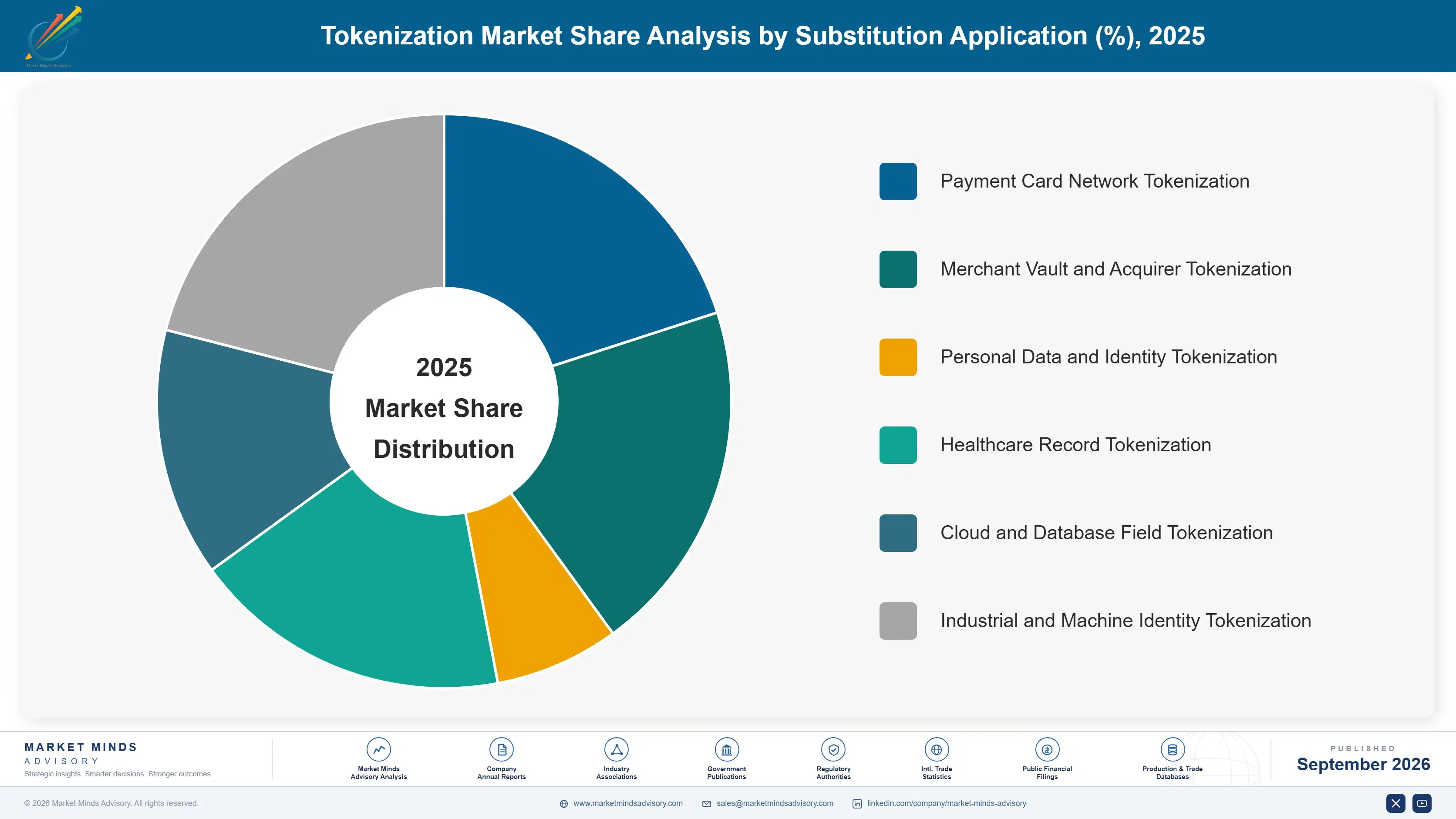
Segmentation follows what is being substituted and where. Six categories cover the market: payment card network tokenization, merchant vault and acquirer tokenization, personal data and identity tokenization, healthcare record tokenization, cloud and database field tokenization, and industrial and machine identity tokenization. Payment applications still dominate spending while privacy applications grow faster. The buyer differs entirely between them.
tokenization-market-market-share-analysis-1790007988726

Personal Data And Identity Tokenization

Personal data substitution grows at 20.1%, half again the market rate of 13.4%, and the buyer is not the security team. Privacy and legal functions are quantifying the liability of holding raw identifiers across analytic and operational systems, and substitution lets the same analysis proceed against surrogates. Evaluation therefore turns on residual regulatory exposure rather than on cryptographic design, which favours providers who can explain their position to a supervisor rather than to an engineer. The open question is whether regulators will treat reversible tokens as genuinely out of scope, and the answer is not yet settled anywhere. Supervisors have not settled the question anywhere yet. Regulatory position is the product.
CAGR 20.1%

Cloud And Database Field Tokenization

Field level tokenization grows at 17.8% because cloud migration forces a question that on-premise architecture allowed organisations to avoid entirely. Once workloads move, somebody must decide explicitly what raw sensitive data may leave the perimeter, and substitution is the answer legal functions accept most readily since the mapping stays behind. Migration programmes now include a tokenization workstream that was absent from the original budget, which makes demand arrive suddenly and with a deadline attached. Format preservation matters enormously here, because legacy applications reading the same fields will reject anything that fails their embedded validation. Legacy validation decides the timeline. Applications reading the same fields reject anything failing their embedded checks.
CAGR 17.8%
Full segment breakdown across 6 segments available in the complete report.

Regional Architecture and Country Demand Map

Regional shares follow payment volume and the intensity of audit and privacy regimes together, since both drive the same purchase for different reasons. Mandate driven markets appear larger in deployment terms than contracted spending alone would indicate. Mandate driven markets deploy far more broadly than their contracted spending indicates.

North America

Payment volume and audit regime intensity coincide here, which makes the region the largest by contracted spend without holding the most aggressive regulation. Card network tokenization reached scale first in this market, and the authorisation uplift argument was proved on subscription businesses billing at very large volumes. State privacy legislation has since extended substitution into personal data across analytic systems. Growth of 12.4% is moderate, held back by high existing penetration in payment applications where 67% of stored credentials are already tokenized and further conversion is incremental. State privacy legislation has extended substitution into analytic systems that payment rules never touched. Further card conversion is now incremental. Penetration is already high.
Share: 31% | CAGR: 12.4% (2026 to 2036)

Western Europe

Data protection regulation drives adoption here more than payment fraud does, and the buyer is frequently a data protection officer rather than a security architect. The unresolved question of whether reversible tokens remain personal data matters more in this region than anywhere else, since supervisory interpretation determines whether the compliance benefit is real. Growth of 11.9% is the slowest of the seven regions. Cloud migration programmes are the largest single source of new demand, since moving workloads forces explicit decisions about what raw data may cross a perimeter. Whether reversible tokens remain personal data matters more here than anywhere else, since supervisory interpretation decides the value. Migration programmes dominate demand.
Share: 22% | CAGR: 11.9% (2026 to 2036)
Regional intelligence for 5 additional markets available in the complete report: East Asia, South Asia and Pacific, Latin America, Middle East and Africa, Eastern Europe. Contact sales@marketmindsadvisory.com.
tokenization-market-country-cagr-analysis-1790007989249

How Providers Win These Programmes

Four commercial moves separate providers winning tokenization programmes from those explaining cryptography to buyers who are not asking about it. Each starts from the same observation: the approved business case is about audit scope or revenue recovery, and security is the reason the project exists rather than the reason it is funded. That distinction decides who signs.

Quantify Assessment Scope Reduction Before Anything Else

A full deployment removes roughly 78% of systems from assessment, which converts into fewer controls, shorter audits, and lower assessor fees that a finance director can verify against last year's invoice. Providers leading with a scoped, system-by-system reduction estimate close 2.8 times more often than those leading with security architecture. The analysis requires understanding the buyer's assessment boundary rather than their data model, which is unfamiliar work for engineering-led sales organisations. Engineering led sales organisations find this unfamiliar and frequently skip it entirely. Assessment boundaries differ from data models. Few sales teams do this work.
Market Impact: Closes 2.8 times more programmes than other providers

Sell Authorisation Recovery To Subscription Businesses

Network tokens update automatically when cards are reissued, lifting approval rates about 2.4%, which for a business billing millions monthly recovers revenue exceeding the entire cost of the programme. Providers presenting this as a revenue case rather than a security one reach commercial leadership directly and shorten approval cycles by 30% to 45%. It is the only argument in data security that increases a customer's revenue rather than reducing their risk, and remarkably few providers lead with it. Remarkably few providers lead with it. It raises revenue rather than reducing risk.
Market Impact: Shortens approval cycles by roughly 30% to 45%

Solve Detokenization Access Before Assessors Ask

In 54% of deployments any authorised service can retrieve original values, which leaves the scope reduction resting on an assumption assessors have begun testing. Providers offering per-field access policy, rate limiting, and alerting as standard rather than optional protect their customers' exemptions and their own references. Those doing so report retention 18 to 24 points higher through assessment cycles, because a customer who loses a scope reduction blames the provider whatever the contract says. A customer who loses an exemption blames the provider whatever the contract says. References depend on it.
Market Impact: Improves customer retention by 18 to 24 points

Map Legacy Field Validation Before Implementation Starts

Deployments run a median 26 weeks and most of the overrun comes from discovering which legacy applications reject substituted values on length, character set, or checksum grounds. Providers running discovery and format analysis before contract rather than during delivery cut implementation duration by 8 to 11 weeks and remove the largest single cause of programme dissatisfaction. The discovery exercise also surfaces data flows the customer had forgotten, which routinely expands the scope of the eventual deployment. Discovery also surfaces data flows the customer had forgotten, which routinely expands the eventual deployment.
Market Impact: Cuts deployment time by 8 to 11 weeks

Who Controls the Margin Pool

Concentration is moderate and the participants are fundamentally unalike. Five providers hold 44% of contracted spend, measured consistently on that basis across all participants, and two of them are card networks whose tokenization arrived as a scheme requirement rather than as a competitive product. That distinction matters, because network tokenization is not something a merchant chooses between suppliers to obtain. Every merchant in the scheme receives it regardless of preference.
Competition currently turns on three things: credible quantification of assessment scope reduction, format preservation that survives legacy field validation, and detokenization access control that assessors will accept. Cryptographic design differentiates very little, since the underlying techniques are well understood and every credible provider implements them adequately. The underlying techniques are well understood by everybody involved.

Pressure comes from two directions. Privacy specialists are taking personal data substitution work from payment focused providers whose products were never built for analytic systems. Meanwhile cloud platforms include field level substitution with services customers already buy. Rankings will shift toward providers who can defend a scope reduction under assessment, which is the only claim with money attached. Only one claim in this market has money attached to it.
tokenization-market-company-positioning-matrix-1790007989776

Competitive Moat and Risk Dimensions

VISA

Moat: Scheme Level Token Issuance

Tokenization issued at network level reaches every merchant and issuer in the scheme without any of them selecting a supplier, which is a distribution position no independent provider can approach. The automatic credential updating behind the authorisation uplift also depends on network access to issuer reissuance data that nobody else holds.
VISA

Risk: Merchant Credential Relationship Tension

Network tokenization moved the stored credential relationship away from merchants, and larger merchants understand exactly what that transferred. Pressure toward account-to-account payment methods that bypass card schemes entirely is partly motivated by this, and the largest merchants have both the volume and the incentive to pursue alternatives seriously.
THALES

Moat: Hardware Rooted Key Custody

Hardware security module capability underpinning token vault key custody suits regulated buyers whose assessors expect demonstrable key protection rather than a software assertion. That position also satisfies data localisation requirements, since the hardware and therefore the mapping stay physically within a jurisdiction where regulators insist on it.
THALES

Risk: Cloud Native Competitor Simplicity

Newer providers deliver substitution as a service with no infrastructure for the customer to operate, which suits cloud migration programmes where the entire objective is to run less hardware. Competing there means offering a delivery model that undercuts the hardware position the company's credibility with assessors was built upon.

Players Tracked

Prominent Players

Visa
Mastercard
Thales
Fiserv
Protegrity

Other Key Players

FIS
Global Payments
American Express
Adyen
Stripe
Entrust
OpenText
Comforte AG
Fortanix
Skyflow
TokenEx
Very Good Security
Baffle
Marqeta
Worldline

Recent Developments

FEBRUARY 2026

Mastercard Extends Tokenization To Stored Account Credentials

Mastercard extended token issuance beyond card credentials to stored bank account details used in account-to-account payments, applying the same automatic updating that produces authorisation uplift in card transactions to a payment method that previously lacked it. Issuer reissuance data feeds the updating mechanism directly. Coverage expands progressively.
Signal: Networks are extending tokenization into payment methods that were designed partly to route around them entirely.
SEPTEMBER 2025

Skyflow Signs Data Substitution Agreement With Healthcare Group

Skyflow entered an agreement providing field level substitution across a healthcare group's analytic systems, allowing patient records to be analysed against surrogate identifiers while the mapping remains inside a separately controlled environment entirely. Analysts work against surrogates without any detokenization permission. The mapping stays inside a separately controlled environment throughout.
Signal: Privacy specialists are now winning analytic system work that payment focused providers were never designed for.
MAY 2025

Thales Acquires Cloud Native Tokenization Service Provider

Thales completed an acquisition of a cloud delivered tokenization provider, adding a service model requiring no customer operated infrastructure alongside a hardware rooted portfolio built for regulated buyers who expect demonstrable physical key custody. Both delivery models will continue to be offered. Regulated buyers keep the hardware option available.
Signal: Hardware rooted providers are buying service delivery because cloud programmes want less infrastructure rather than more.

What Running Token Services Costs

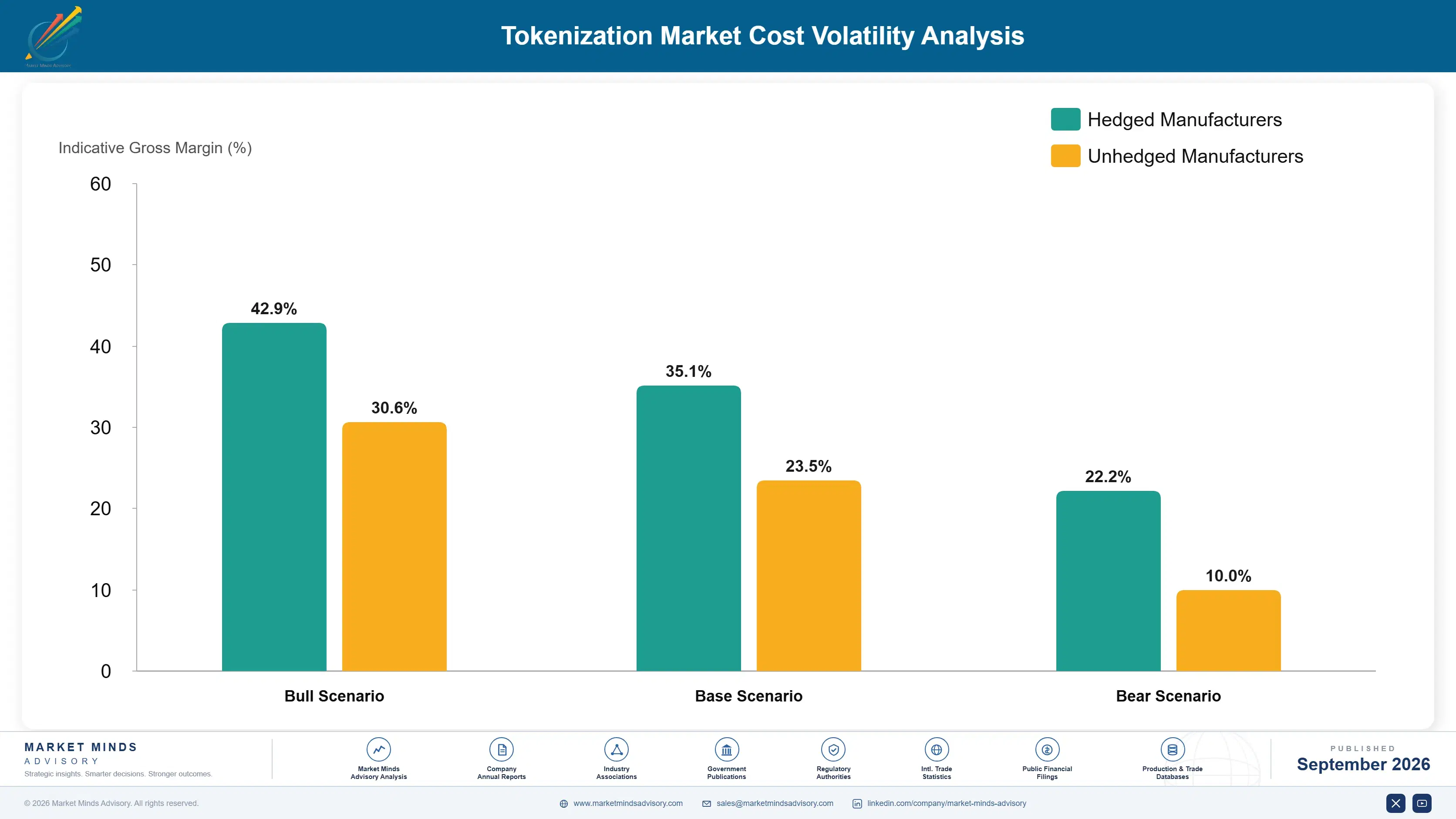
Three inputs dominate provider cost. Cloud infrastructure and hardware security modules for vault operation run 24% to 31% of cost of goods sold, since token services must be continuously available and every transaction depends on them. Cryptographic and platform engineering takes 26% to 33%. Compliance certification, assessment, and audit support adds a further 12% to 18%, repeated annually across every regime a provider claims coverage for.
Hardware security module pricing and certification costs rose materially through 2024 and 2025 as demand from adjacent applications competed for constrained supply, and several providers described the resulting margin pressure in their annual reports for those years. Certification is the harder cost, because it recurs annually and expands with every jurisdiction entered rather than amortising across a growing customer base. Nobody amortises it away. Every jurisdiction adds more.

The competitive disadvantage mechanism runs through availability rather than through cryptography. A token service that fails takes every dependent transaction with it, so redundancy is bought at levels most software businesses never approach. Exposure varies by provider type. Card networks carry token services on infrastructure already built for authorisation. Independent providers build equivalent availability from nothing against a much smaller revenue base.
tokenization-market-cost-volatility-analysis-1790007989971

Operate Token Vaults On Shared Authorisation Infrastructure

Token services require availability comparable with payment authorisation itself, and building that independently is expensive for any provider without existing infrastructure. Running vaults on platforms already engineered for transaction availability spreads the cost across two revenue streams and is the clearest reason network operated tokenization prices the way it does. Independent providers cannot match that.

Reuse Certification Evidence Across Adjacent Regimes

Assessment and certification recur annually and multiply with every jurisdiction a provider claims, which makes them the least forgiving cost line in the business. Structuring evidence so a single control set maps to several regimes reduces the repeated effort substantially, and providers who invested report certification cost per market falling by roughly a third.

Offer Format Preserving Substitution As Standard

Legacy field validation is the largest source of implementation overrun, and every week of unplanned delivery effort erodes project margin directly. Format preserving substitution that satisfies existing length, character, and checksum rules removes most of that work, which improves delivery economics while also shortening the customer's deployment considerably. Customer deployments shorten considerably at the same time.

Portfolio Architecture for Margin Defence

Margin follows what the buyer is exempted from. Merchant vault and acquirer tokenization is close to commodity, bundled into processing relationships and rarely priced separately at all. Network token issuance earns well on scheme economics that no independent provider can replicate. Personal data substitution defended under privacy assessment earns most, because the buyer is purchasing a regulatory position rather than a technical capability.
The tension between volume and premium runs through delivery cost. High-volume payment tokenization is profitable only where infrastructure is shared with authorisation systems already built, and independent providers matching that availability from nothing carry cost their pricing cannot support. Privacy and analytic work carries better margin but requires implementation effort that scales with the customer's legacy estate rather than with transaction volume.

High-value pools concentrate where an exemption has measurable worth: assessment scope reductions defended under audit, privacy positions a supervisor has accepted, and jurisdictions requiring vaults to remain locally resident. These share a buyer who can price what they are avoiding. Where the substitution is merely good practice, it is bundled into something else and earns almost nothing on its own.

Volume / Commodity-Adjacent

Merchant vault and acquirer tokenization bundled into processing relationships and rarely priced separately. Cloud platforms include comparable field substitution with services customers already buy. The ten-point range reflects whether the provider shares infrastructure with an existing transaction platform.
Gross Margin: 34% to 44%

Premium / Certified

Network token issuance and format preserving field substitution across legacy estates. Scheme economics and implementation capability limit the credible field considerably. The ten-point range separates providers with shared authorisation infrastructure from those building equivalent availability independently.
Gross Margin: 56% to 66%

Sustainability / Regulatory / Next-Generation

Personal data substitution defended under privacy assessment, locally resident vault operation, and detokenization control that assessors accept. The buyer is purchasing a regulatory position. The eleven-point range reflects how differently providers price positions that supervisors have or have not yet tested.
Gross Margin: 66% to 77%
tokenization-market-portfolio-architecture-1790007990473

High-value Sub-segments and Strategic Watch-out

Privacy Defended Data Substitution

Highest value and fastest growth at 20.1%, sold to privacy and legal functions evaluating residual regulatory exposure rather than cryptographic design. Whether supervisors treat reversible tokens as out of scope remains unsettled. The ten-point range reflects that unresolved interpretation across jurisdictions. Interpretation risk is real.
Gross Margin: 68% to 78%

Network Token Issuance Services

Large and profitable, reaching 67% of stored credentials through scheme requirement rather than supplier selection. Automatic credential updating delivers roughly 2.4% authorisation uplift. Merchant concern about transferred credential relationships is the principal long-term threat to the position. Merchants are pursuing alternatives seriously. Scheme distribution remains unmatched.
Gross Margin: 58% to 68%

Cloud Migration Field Substitution

Growing at 17.8% as migration programmes force explicit decisions about raw data leaving the perimeter. Demand arrives suddenly with deadlines attached and no original budget. Format preservation decides whether implementation completes on schedule or overruns against legacy field validation. Budgets appear afterwards. Deadlines arrive first.
Gross Margin: 54% to 64%

Bundled Acquirer Vault Tokenization

The strategic watch-out. Bundled into processing relationships, rarely priced separately, and increasingly matched by cloud platform capability included at no charge. The twelve-point range reflects the gap between providers sharing transaction infrastructure and those operating token vaults as standalone services. Standalone pricing is disappearing. Bundling continues.
Gross Margin: 30% to 42%

Why These Deployments Persist

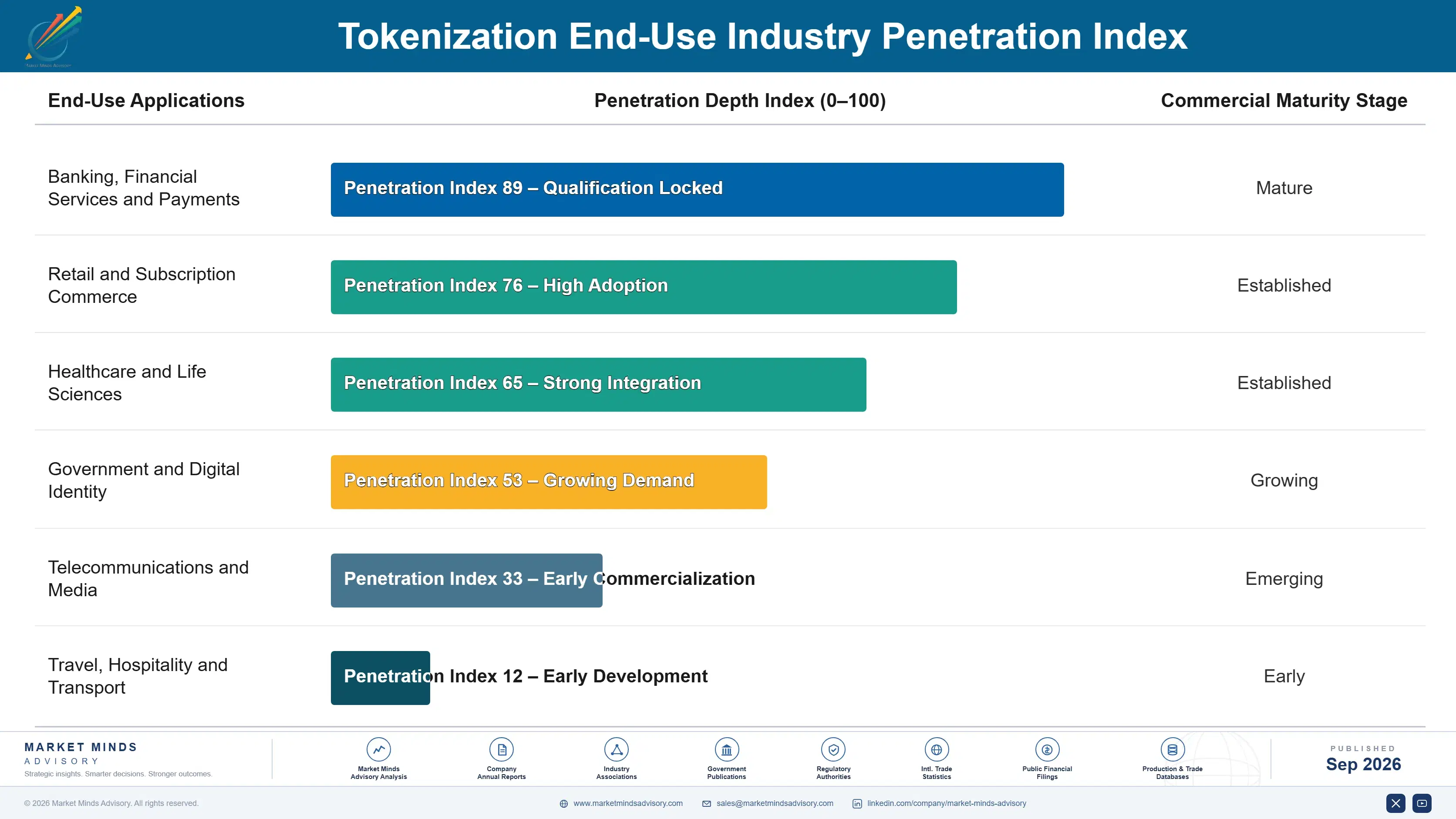
Once tokenization is deployed it is effectively permanent, because reversing it means returning systems to assessment scope that were removed years earlier and rebuilding controls nobody has maintained since. That produces exceptionally durable revenue with very little competitive pressure at renewal. What it does not produce is expansion, since a system either holds surrogates or it does not, and there is no middle position to sell into.
Commitment depth varies by what the deployment exempts. Payment programmes under scheme requirement are permanent by definition, since the alternative is non-compliance with a network rule. Privacy deployments are almost as durable, because the legal position depends on them and counsel will not reopen it. Cloud migration substitution is the least attached, occasionally replaced when the underlying platform relationship changes for unrelated reasons.

The buyer profile has spread across three functions that rarely agree. Security architects still evaluate technically. Compliance and audit functions care about assessment scope and will fund on that basis alone. Privacy counsel decides personal data substitution entirely, and increasingly asks whether reversible tokens satisfy the regulation at all. Providers speaking only to security are addressing the participant with the least budget authority of the three.
tokenization-market-end-use-penetration-index-1790007990963

Where This Market Rewards

These are among the four positions where our research anticipates prominent divergence between winners and laggards over the coming forecast period. Each is grounded in the demand model, the regulatory perimeter, and the announced capacity pipeline.
01 / SCOPE REDUCTION QUANTIFICATION

Finance approves exemptions, not risk reductions

A full deployment removes roughly 78% of systems from assessment scope, converting into fewer controls, shorter audits, and assessor fees a finance director can check against last year's invoice, while breach prevention remains a probability nobody prices. Providers leading with a scoped system-by-system reduction estimate close 2.8 times more often than those leading with security architecture. The work requires understanding an assessment boundary rather than a data model, which is unfamiliar territory for engineering led sales teams selling this product.
02 / REVENUE ARGUMENT OWNERSHIP

Tokenization is the security control that pays

Network tokens update automatically when cards are reissued, lifting approval rates roughly 2.4%, which for a subscription business billing millions monthly recovers more revenue than the entire programme costs to run. Providers presenting this commercially rather than defensively reach business leadership directly and shorten approval cycles by 30% to 45%. It is the only argument in data security that increases customer revenue, and remarkably few providers lead with it, preferring an argument the buyer finds harder to approve than a revenue one.
03 / DETOKENIZATION CONTROL DISCIPLINE

The tokens are safe; the vault frequently is not

In 54% of deployments any authorised service can retrieve original values, with authorisation defined loosely enough that compromising one application yields the underlying data and relocates rather than removes the exposure. Assessors have begun testing exactly this, and a good number of scope reductions will not survive the question. Providers offering per-field policy and rate limiting as standard report retention 18 to 24 points higher through assessment cycles, because a lost exemption is blamed on the provider regardless of the wording.
04 / LEGACY VALIDATION DISCOVERY

Old field checks cause most programme overruns

Deployments run a median 26 weeks and most of the overrun comes from discovering which legacy applications reject substituted values on length, character set, or checksum grounds that nobody documented decades ago. Providers running discovery and format analysis before contract rather than during delivery cut duration by 8 to 11 weeks. The same exercise surfaces forgotten data flows, which routinely expands the deployment the customer ends up buying, frequently doubling what was originally scoped, which is a welcome surprise for the provider.

Engagement Snapshot From the Field

A live engagement with an industry participant carrying material or product regulatory and market exposure ahead of a defining policy shift, showing how our research translates into a defensible multi-year portfolio strategy.
MARKET MINDS ADVISORY · CLIENT ENGAGEMENT SUMMARY
Tokenization Producer Strategic Portfolio Review and Transition Roadmap 2026·Investment Scenario on Tokenization Exposure Evaluation 2025-26
CLIENT PROFILE
A multinational subscription business billing approximately 41 million customers monthly across nineteen markets, with annual recurring revenue above USD 5.8 billion (client-reported, unverified by MMA). Card credentials were stored in a merchant operated vault built eight years earlier, and personal data sat in analytic systems across three cloud regions with no substitution applied at all.
STRATEGIC CHALLENGE
Failed recurring payments from reissued cards were costing significant revenue that nobody had quantified, while an assessment covering the merchant vault had grown expensive and slow. Separately, privacy counsel had raised concerns about personal identifiers in analytic systems that the security team considered adequately protected already. Nobody had quantified either exposure properly.
MMA APPROACH
MMA quantified revenue recovered through network token adoption against actual reissuance patterns, modelled assessment scope reduction system by system across the merchant estate, and assessed detokenization access controls across both the payment vault and the analytic environments against what assessors had begun requiring elsewhere. Legacy field validation was mapped across the billing estate.
KEY FINDINGS
  1. Failed recurring payments from reissued cards represented an estimated 2.7% of billable revenue annually, recoverable almost entirely through network token adoption across the card estate.
  2. Migrating from the merchant vault would remove 81% of systems from assessment scope, reducing assessor effort and internal control maintenance by a substantial and quantifiable margin.
  3. Any service holding a valid platform credential could detokenize without restriction in both the payment vault and two of the three analytic environments examined.
  4. Eleven legacy billing and reconciliation applications validated card field checksums in ways that would reject substituted values without format preserving substitution applied.
CLIENT PROFILE
A multinational subscription business billing approximately 41 million customers monthly across nineteen markets, with annual recurring revenue above USD 5.8 billion (client-reported, unverified by MMA). Card credentials were stored in a merchant operated vault built eight years earlier, and personal data sat in analytic systems across three cloud regions with no substitution applied at all.
STRATEGIC CHALLENGE
Failed recurring payments from reissued cards were costing significant revenue that nobody had quantified, while an assessment covering the merchant vault had grown expensive and slow. Separately, privacy counsel had raised concerns about personal identifiers in analytic systems that the security team considered adequately protected already. Nobody had quantified either exposure properly.
MMA APPROACH
MMA quantified revenue recovered through network token adoption against actual reissuance patterns, modelled assessment scope reduction system by system across the merchant estate, and assessed detokenization access controls across both the payment vault and the analytic environments against what assessors had begun requiring elsewhere. Legacy field validation was mapped across the billing estate.
KEY FINDINGS
  1. Failed recurring payments from reissued cards represented an estimated 2.7% of billable revenue annually, recoverable almost entirely through network token adoption across the card estate.
  2. Migrating from the merchant vault would remove 81% of systems from assessment scope, reducing assessor effort and internal control maintenance by a substantial and quantifiable margin.
  3. Any service holding a valid platform credential could detokenize without restriction in both the payment vault and two of the three analytic environments examined.
  4. Eleven legacy billing and reconciliation applications validated card field checksums in ways that would reject substituted values without format preserving substitution applied.
RECOMMENDED STRATEGY
Phase 1: Phase one: migrate stored card credentials to network tokens, presenting the programme internally on recovered revenue rather than on any security or compliance argument. Phase 2: Phase two: implement per-field detokenization policy with rate limiting across both payment and analytic environments before the next scheduled assessment cycle begins. Phase 3: Phase three: apply format preserving substitution to personal identifiers in analytic systems, sequencing around the eleven applications identified as validating field formats.
OUTCOME
Recurring payment approval improved by 2.6 percentage points within two quarters, recovering revenue that exceeded the whole programme cost several times over (client-reported, unverified by MMA). Assessment scope fell by 79% of systems. Privacy counsel accepted the analytic position following the detokenization restrictions. Eleven legacy applications required format preserving substitution.

Frequently Asked Questions

Foundational context covering the market sizes, CAGR, scope, country, region and competition that inform every finding below. This section is provided to cover basics and most often pre-purchase conversations, answered from the MMA Primary Research Dataset.

What is the current size of the Tokenization Market?

The market was worth USD 4.2 billion in 2025 and reaches USD 4.8 billion in 2026. Value covers data substitution technologies, excluding blockchain based asset tokenization entirely.

How large will the Tokenization Market be by 2036?

MMA forecasts USD 16.9 billion by 2036, an increase of USD 12.1 billion across the forecast period. That represents 3.52 times the 2026 base of USD 4.8 billion.

What is the CAGR for the Tokenization Market 2026 to 2036?

The base case compound annual growth rate is 13.4%, with a bull case at 14.7% and a bear case at 12.1%. Historical growth from 2020 to 2025 ran at 12.0%.

Which segment is growing fastest?

Personal data and identity tokenization grows at 20.1%, half again the market rate of 13.4%. Privacy and legal functions buy it rather than security teams.

Who are the major companies in the Tokenization Market?

Visa, Mastercard, Thales, Fiserv, and Protegrity lead, holding 44% of contracted spend between them. Two are card networks whose tokenization arrives as a scheme requirement.

Which country is growing fastest?

India grows at 18.9%, on a mandate requiring stored card credentials to be replaced with tokens across the entire payments industry on a fixed timetable.

Report Segmentation Architecture

The full report scope spans multiple orthogonal segmentation dimensions, with cross-tabulated demand data provided for each dimension pair. Coverage extends further to regional breakdowns, trend trajectories, and the competitive detail needed to support segment-level decision-making.

By Substitution Application

  • Payment Card Network Tokenization
  • Merchant Vault and Acquirer Tokenization
  • Personal Data and Identity Tokenization
  • Healthcare Record Tokenization
  • Cloud and Database Field Tokenization
  • Industrial and Machine Identity Tokenization

By End-Use Industry

  • Banking, Financial Services and Payments
  • Retail and Subscription Commerce
  • Healthcare and Life Sciences
  • Government and Digital Identity
  • Telecommunications and Media
  • Travel, Hospitality and Transport

By Commercial Dimension

  • Card Scheme Issued Tokens
  • Direct Enterprise Subscription
  • Processor Bundled Provision
  • Cloud Platform Included Capability
  • Systems Integrator Delivered
  • Managed Vault Service Contract

By Region

  • North America
  • Western Europe
  • East Asia
  • South Asia and Pacific
  • Latin America
  • Middle East and Africa
  • Eastern Europe

Scope, Methodology, and Coverage

Every figure in this report is reproducible from documented input assumptions. The scope below maps the historical period, the forecast horizon, the segmentation dimensions, and the countries covered, alongside the underlying primary and qualitative methodology.
Historical Period
2020 to 2025
Forecast Period
2026 to 2036
Base Year
2025 (USD billions; MMA Primary Research Dataset, September 2026)
Market Definition
This market covers technologies substituting sensitive data with non-sensitive surrogate values, including payment card network tokenization, merchant vault and acquirer tokenization, personal data and identity tokenization, healthcare record tokenization, cloud and database field tokenization, and industrial and machine identity tokenization. It excludes blockchain based asset tokenization and digital securities, general encryption key management sold separately, data masking for test environments, and payment processing or acquiring services themselves.
Quantitative Units
USD billions, contracted technology and service spend
Segmentation Dimensions
Substitution application, end-use industry, commercial dimension, region
Regions Covered
North America, Western Europe, East Asia, South Asia and Pacific, Latin America, Middle East and Africa, Eastern Europe
Countries Covered
United States, Canada, Mexico, United Kingdom, Germany, France, Netherlands, Spain, Italy, Sweden, China, Japan, South Korea, Taiwan, India, Australia, Singapore, Indonesia, Brazil, Colombia, Chile, Saudi Arabia, United Arab Emirates, South Africa, Poland, Romania
Key Companies Profiled
Visa, Mastercard, Thales, Fiserv, Protegrity, FIS, Global Payments, American Express, Adyen, Stripe, Entrust, OpenText, Comforte AG, Fortanix, Skyflow, TokenEx, Very Good Security, Baffle, Marqeta, Worldline
Quantitative Methodology
Primary survey, n=3,800 respondents, Q4 2025, six countries; demand-side model with trade association cross-validation
Qualitative Methodology
47 expert interviews, Q4 2025; applied to validate demand model assumptions, identify emerging dynamics, and assess competitive positioning
Report Format
PDF and XLSX data workbook (Word format preview document)
Publisher
Market Minds Advisory
Report Code
MMA-2026-TEC-551
Published
September 2026
Contact
sales@marketmindsadvisory.com | www.marketmindsadvisory.com

Purchase the full Tokenization Market Report (2026 to 2036).

The full report sizes the data tokenization market across six substitution applications, seven regions, and twenty-six countries, with forecasts to 2036 under base, bull, and bear cases. It examines why assessment scope reduction rather than breach prevention funds these programmes, what unrestricted detokenization means for the exemptions being claimed, and how national mandates are accelerating deployment. Competitive analysis covers twenty participants evaluated consistently on contracted spend, with detailed treatment of scheme level issuance and privacy specialist entry. Cost structure, margin architecture by application, and regional regulatory drivers are analysed in full. Primary research includes 3,800 survey responses and 47 expert interviews.
Six substitution applications sized and forecast separately
Twenty participants evaluated on contracted technology spend
Regional payment and privacy drivers across seven geographies
Margin architecture by application and infrastructure sharing
Detokenization access control analysis across deployed environments
Assessment scope reduction benchmarks by estate and industry

Built For The People Who Decide

From boardroom strategy to bench-side execution, this report is read cover-to-cover by leaders shaping the next decade of their industry, turning demand scenarios, market dynamics and valuation benchmarks into decisions.
CXOs/ Presidents/ VPs/ Managers
M&A and Corporate Development
Strategy Teams and R&D Heads
Procurement and Product Directors
Regulatory and Compliance Leaders
Investor Relations and Equity Analysts