

Market Minds Advisory
Tissue-Based Genomic Profiling Market

Tissue-Based Genomic Profiling Market: The Constraint Is the Biopsy, Not the Sequencer

Sequencing capacity has never been the limiting factor here; roughly a quarter of profiling attempts fail because pathology used the tissue first and nothing usable was left in the block.

Lead Analyst

Alice Ballenger

Published

September 2026

Make Smarter Decisions with Customized Research Insights

Request a free sample report and evaluate market opportunities, growth trends, and competitive dynamics relevant to your business needs.

2025 MARKET VALUE$3.4BMarket Size 2025
2036 FORECAST VALUE$9.3BBase Case , 2026 to 2036
CAGR 2026 TO 20369.6 %Bull 10.8% / Bear 8.2%
INCREMENTAL OPPORTUNITY$5.6BNet 10- year value creation
EXPANSION MULTIPLE2.50x2036 value over 2026 base
Strategic Levers
M&A Pipeline
Regional Outlook
Country Rankings
Competitive Intelligence
Segmental Deep-dive
Call-Us : 91 93563 13602

Executive Snapshot and Market Trajectory

The bottleneck in this market has never been the sequencer. Around 28% of comprehensive profiling attempts fail on specimen quantity or quality, because diagnostic slides and immunohistochemistry consumed the block before anybody thought about molecular testing at all. Nobody in the sequencing industry sells into that problem.
Timing does similar damage at the other end. Median turnaround runs about 14 days from receipt, while the oncology appointment that starts treatment frequently arrives sooner, so the result lands after the patient is already on chemotherapy. Comprehensive panels grow at 14.4%, half again the market rate of 9.6%, and turnaround decides whether any of that information changes a decision. Ordering point rather than laboratory speed decides it. Fourteen days beats most clinic appointments.
Payment compounds both problems. Most systems reimburse one profile per tumour, so repeat testing at progression, exactly when resistance mechanisms emerge and the information is worth most, goes unfunded in around 78% of cases. The money sits at the least informative moment in the disease course. Roughly 13% of profiled patients receive a matched targeted therapy, and tumour board review raises that by around 2.4 times.
Market Definition
Laboratory analysis of tumour tissue for DNA level alterations guiding cancer therapy selection, covering comprehensive genomic profiling panels, targeted hotspot sequencing panels, immunohistochemistry companion diagnostics, in situ hybridisation assays, whole exome and genome tissue sequencing, and single gene PCR and fragment analysis. Measured at test selling value. Excludes liquid biopsy and circulating tumour DNA testing, RNA expression and transcriptomic assays, germline hereditary cancer testing, and sequencing instruments and consumables sold separately.
Base Year Value
$3.4B in 2025 (MMA Primary Research Dataset, August 2026)
Forecast Period
2026 to 2036, eleven discrete annual values
CAGR
9.6% base case. Bull 10.8%. Bear 8.2%.
Fastest Growth Segment
Comprehensive Genomic Profiling Panels: 14.4% CAGR
Fastest Growth Country
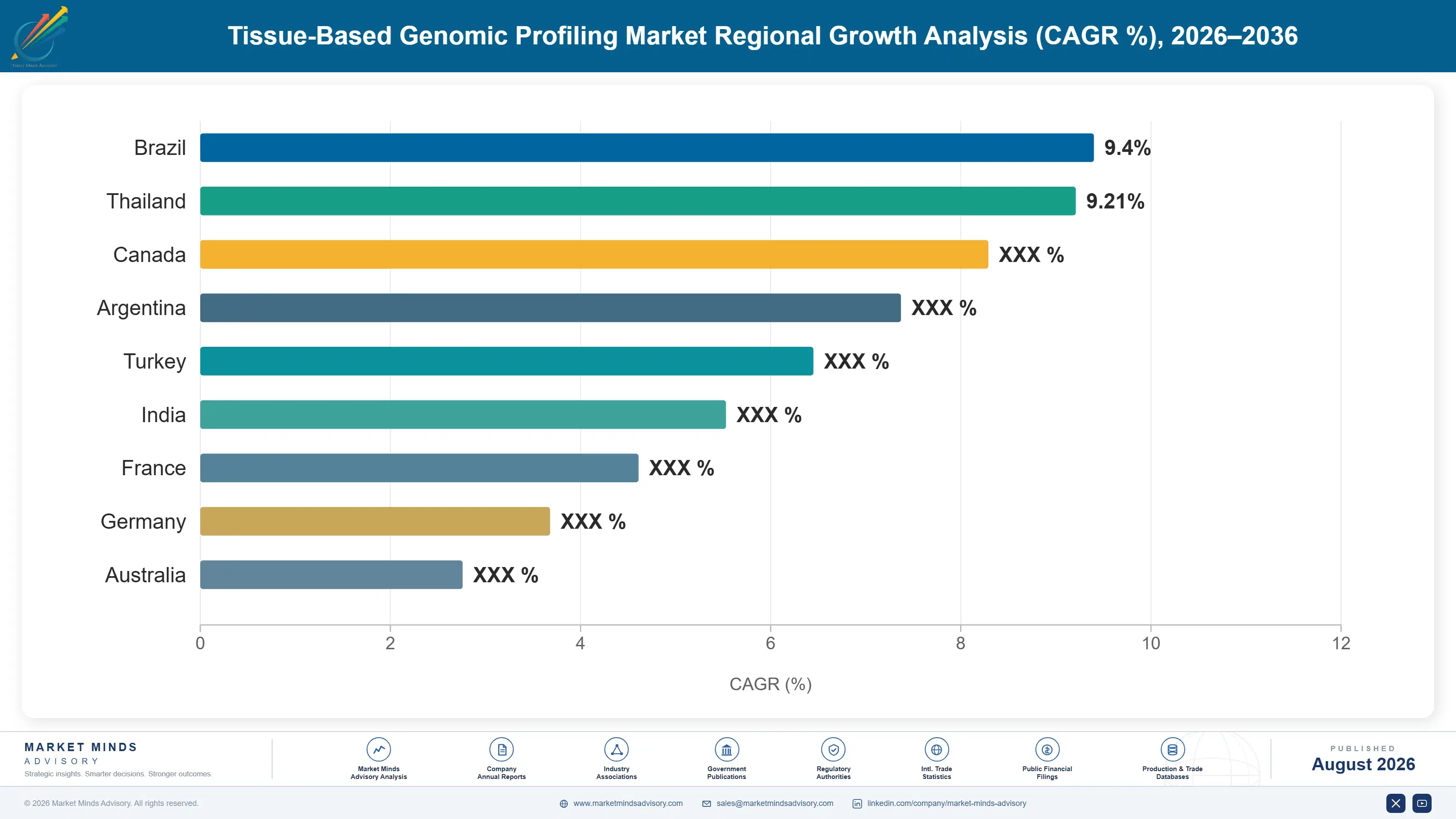
Japan: 16.2% CAGR
Fastest Growth Region
South Asia and Pacific: 11.6% CAGR
Largest Region
North America: 32% of 2025 global value
Market Leaders
Foundation Medicine, Caris Life Sciences, Tempus AI, Illumina, Thermo Fisher Scientific. Source: MMA Primary Research Dataset, July 2026.
Primary Survey
n=3,800 procurement and R&D decision-makers, Q4 2025, six countries
Methodology
Demand-side build-up, cross-validated against public data, 47 expert interviews

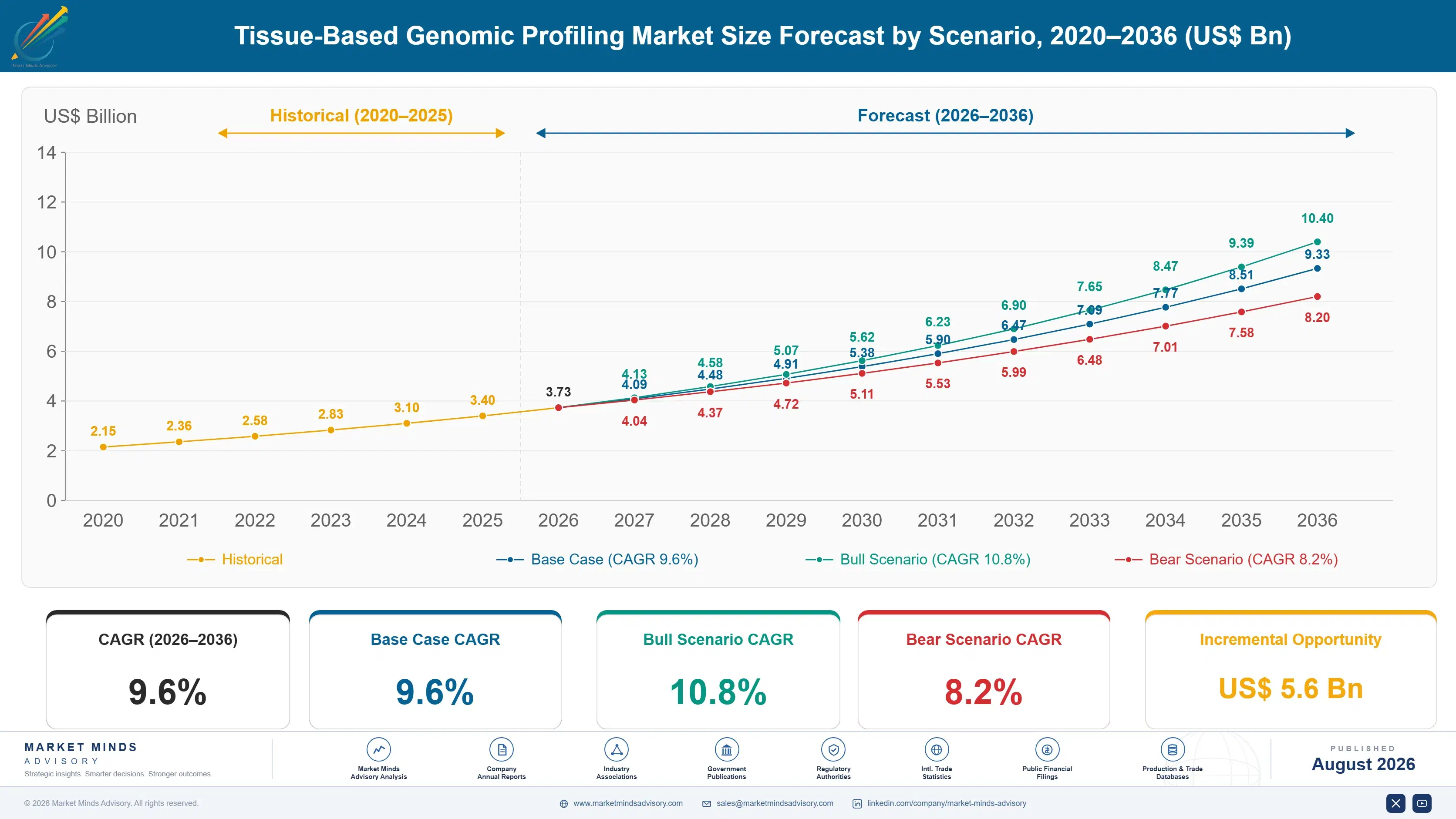
Tissue-Based Genomic Profiling Market Forecast Scenarios

tissue-based-genomic-profiling-market-size-forecast-scenario-1787640012585
Growth ran near 8.4% between 2020 and 2025 as comprehensive panels displaced single gene testing across most solid tumours. Guideline recommendations for broad profiling in advanced lung, colorectal and breast cancer did most of the work. Reimbursement widened unevenly, with some systems funding comprehensive panels and others still paying only for individual biomarkers, which produced very different adoption curves in otherwise comparable healthcare economies.
Base case 9.6% rests on three mechanisms. Comprehensive panels grow at 14.4% as guidelines widen beyond the tumour types where broad profiling is already standard. Whole exome and genome tissue sequencing grows at 12.6% in academic and complex cases where panels miss the answer. And Japan grows fastest of any country at 16.2%, where national reimbursement and a central genomic database arrived together and reinforced each other. None depends on incidence rising.
The bull case at 10.8% assumes repeat profiling at progression gaining reimbursement, which would roughly double testing volume per patient across the advanced disease population. The bear case at 8.2% is tissue insufficiency persisting unaddressed, since failed attempts consume laboratory cost without producing a billable result and quietly cap how far volume growth can actually run.

Enough Tissue, Then Everything Else

Sequencing has been abundant and cheap for years, and this market is still limited by how much tumour a radiologist managed to retrieve from a lung nodule. Diagnostic sections, immunohistochemistry and staining consume the block in order of clinical urgency, and molecular testing arrives last. Around 28% of attempts fail on specimen adequacy as a result, and nobody in sequencing is solving that.
TOP FIVE CONCENTRATION54%Comprehensive profiling laboratories hold considerably stronger positions than component suppliers
TISSUE INSUFFICIENCY FAILURES28%Attempts abandoned for inadequate specimen quantity or quality
MEDIAN TURNAROUND14 daysInterval from specimen receipt to reported result delivery
MATCHED THERAPY RECEIPT13%Share of profiled patients who receive a targeted treatment
REPEAT PROFILING UNFUNDED78%Proportion of systems declining to fund a second profile
TUMOUR BOARD UPLIFT2.4xIncrease in matched therapy where a board reviews results
Turnaround creates a second and equally practical failure. Median time from receipt to report runs about 14 days, while the oncology appointment at which treatment starts frequently comes sooner in advanced disease where waiting is not clinically safe. A result arriving after chemotherapy has begun is a record rather than a decision input, and comprehensive panels growing at 14.4% will not change that unless the specimen reaches the laboratory considerably earlier in the pathway.
Payment structure works against the clinical logic in a way that rarely gets stated plainly. Most systems fund one profile per tumour, so testing happens at diagnosis when the tumour is treatment naive, and around 78% decline to fund a repeat at progression when resistance alterations have emerged and the information would genuinely change therapy.
"Everybody sells a bigger panel and the block is already empty. The interventional radiologist who took two cores instead of four decided the whole molecular pathway, months before anybody in the laboratory saw the case."
Director, Oncology Diagnostics and Precision Medicine Practice · MMA Healthcare and Life Sciences Practice · August 2026

Market Trends

Tissue insufficiency capping volume regardless of assay capability

Around 28% of comprehensive profiling attempts fail on specimen quantity or quality, because diagnostic sections and immunohistochemistry consume the block before molecular testing is requested. Failed attempts consume laboratory cost without producing a billable result, which quietly caps volume growth whatever the panel offers. The fix sits with biopsy protocols and pathology tissue stewardship rather than with any sequencing technology, and almost nobody in this industry sells into that. Biopsy protocols and pathology tissue stewardship decide the ceiling, and both sit well upstream of any laboratory. Almost nobody sells into either.
Market Impact: Panels growing 14.4% each year

National reimbursement pairing with central genomic databases

Japan grows fastest of any country at 16.2% because national reimbursement for comprehensive profiling and a central genomic data repository arrived together, so each test both guides a patient and contributes to a resource that supports the next one. That combination has produced adoption well beyond what reimbursement alone achieved elsewhere. Other systems considering coverage are examining the model closely, since the data asset justifies the spending politically. The data asset justifies the spending politically in a way that clinical evidence alone rarely manages to. Other systems considering coverage are examining that pairing closely.
Market Impact: Board review raises matching 2.4 times

Market Opportunities and Growth Drivers

Guideline expansion beyond the established tumour types

Broad profiling is already standard in advanced lung and colorectal cancer, and guidelines are steadily extending recommendations into tumour types where single biomarker testing has been the norm. Comprehensive panels grow at 14.4% on that expansion rather than on any increase in cancer incidence. Each guideline change converts a population from single gene testing to a panel, which multiplies revenue per patient several times over without adding a single new patient. Each conversion multiplies revenue per patient without adding a single new patient to the population. Guideline watching beats epidemiology here.
Market Impact: Turnaround runs about 14 days

Molecular tumour boards raising the matched therapy rate

Roughly 13% of profiled patients receive a matched targeted therapy, and formal molecular tumour board review raises that by around 2.4 times by interpreting variants that a report alone leaves an oncologist to judge. That uplift is the strongest argument available for funding comprehensive profiling, since payers reasonably ask what proportion of results change treatment. Laboratories offering board support are selling the outcome rather than the assay. Community oncology settings without in-house board capability are the largest under-served portion of this market entirely. Almost nobody sells to them properly. Boards are scarce.
Market Impact: Around 78% fund one profile

Market Restraints and Challenges

Turnaround arriving after the treatment decision was taken

Median turnaround runs about 14 days from receipt while the oncology appointment that starts treatment frequently arrives sooner, so the result becomes a record rather than a decision input. The root cause is specimen transit and pathology scheduling rather than laboratory processing speed. Commercially it undermines the value case payers are asked to fund. Reflex ordering at diagnosis, courier logistics and pathology workflow changes are the mitigations laboratories are pursuing. Ordering point rather than laboratory speed decides whether a result arrives in time. Pathology holds that decision entirely. Laboratories cannot fix it alone.
Market Impact: About 28% of attempts fail

Single profile reimbursement excluding testing at progression

Around 78% of systems fund one profile per tumour, which places testing at diagnosis and excludes repeat profiling at progression when resistance alterations emerge and the information matters most. The root cause is coverage policy written before resistance biology was well characterised. Commercially it caps testing volume per patient at one. Evidence generation on resistance directed therapy and coverage with evidence development arrangements are the active responses. Reimbursing a second profile would roughly double testing volume across the advanced disease population. Coverage policy predates resistance biology. Evidence generation is the route.
Market Impact: Japan growing fastest at 16.2%
4 additional market trends, 3 additional growth drivers, and 2 additional restraints and challenges are covered in the full report. Contact sales@marketmindsadvisory.com to access the complete intelligence.

Segment CAGR and Growth Architecture

Six segments split by assay type, because assay determines the breadth of alterations detected, the tissue quantity required, the turnaround achievable and the reimbursement it attracts. Tumour type and platform variants sit inside each assay. Care setting and channel dimensions are handled separately within the framework rather than mixed here. Assay determines everything commercially here.
tissue-based-genomic-profiling-market-market-share-analysis-1787640013163

Comprehensive Genomic Profiling Panels

Growing at 14.4%, half again the market rate of 9.6%, comprehensive panels interrogate hundreds of genes from a single specimen and replace sequential single gene testing that exhausted tissue faster and took longer overall. Guideline expansion into new tumour types drives adoption rather than any rise in cancer incidence. Tissue requirement remains the practical constraint, since around 28% of attempts fail on specimen adequacy, and larger panels do not require less material than smaller ones. Guideline expansion converts populations from single gene testing to a panel, which multiplies revenue per patient several times over without adding anybody new to the tested population at all. Larger panels need no less material than smaller ones.
CAGR 14.4%

Whole Exome and Genome Tissue Sequencing

At 12.6% exome and genome sequencing on tumour tissue serves academic centres and complex cases where a targeted panel returns nothing actionable and the question remains open. Cost has fallen enough to make it clinically defensible in selected patients rather than only in research protocols. Tissue and computational requirements are both higher, and interpretation demands molecular tumour board capability that most community settings simply do not have available to them. Reporting turnaround is longer than for targeted panels, which matters less here because these cases have generally already exhausted the faster options and time pressure has eased considerably by then. Interpretation capability rather than sequencing access is the binding constraint on wider adoption.
CAGR 12.6%
Full segment breakdown across 6 segments available in the complete report.

Regional Architecture and Country Demand Map

North America holds 32% of value on reimbursement breadth and laboratory infrastructure that no other region matches. East Asia follows at 26%, where national coverage decisions have moved adoption faster than elsewhere. South Asia and Pacific grows fastest of the seven regions covered. Coverage decisions rather than incidence drive both.

North America

Reimbursement for comprehensive profiling is broader here than anywhere and commercial laboratories operate at scale that supports rapid turnaround across a continental geography. Molecular tumour board capability is concentrated in academic centres, which leaves community oncology interpreting complex reports without the support that raises matched therapy rates. Tissue insufficiency runs at similar levels to elsewhere. Growth at 8.4% reflects a mature adoption base rather than any constraint on capability. Repeat profiling at progression remains largely unfunded despite the clinical rationale, which caps volume per patient at one across most of the insured population. Reflex ordering practice varies widely between health systems, and where it exists results reach oncologists before treatment begins rather than afterwards.
Share: 32% | CAGR: 8.4% (2026 to 2036)

Western Europe

Coverage decisions are taken nationally and vary considerably between systems, so adoption differs sharply across otherwise comparable healthcare economies. Several countries fund comprehensive profiling through centralised genomic medicine programmes with strong molecular tumour board structures attached. Repeat profiling at progression is funded almost nowhere. Regional growth of 8.0% is the slowest anywhere on fragmented coverage and health technology assessment scrutiny of clinical utility evidence. Molecular tumour board structures attached to national programmes raise matched therapy rates considerably, which is the strongest evidence anywhere for interpretation service value. Health technology assessment scrutiny of clinical utility evidence is heavier here than anywhere, which slows coverage but strengthens the evidence base considerably once granted.
Share: 22% | CAGR: 8.0% (2026 to 2036)
Regional intelligence for 5 additional markets available in the complete report: East Asia, South Asia and Pacific, Latin America, Middle East and Africa, Eastern Europe. Contact sales@marketmindsadvisory.com.
tissue-based-genomic-profiling-market-country-cagr-analysis-1787640013709

Four Moves Before the Block Empties

Sequencing capability stopped being the constraint years ago. What limits this market is tissue that pathology already used, results arriving after treatment started, and payment structures that fund testing at the least informative point in the disease. All three sit outside the laboratory. All three sit outside the laboratory entirely, which is uncomfortable for organisations built around assay capability.

Work biopsy protocols upstream of the laboratory

Around 28% of profiling attempts fail on specimen adequacy, and the decision that caused it was taken by an interventional radiologist months earlier when the number of cores was chosen. Laboratories engaging biopsy and pathology teams on tissue stewardship recover volume that no panel improvement reaches. Failed attempts consume cost without producing a billable result, so the recovery falls straight through to margin rather than merely adding revenue. Panel improvement reaches none of it. Engaging interventional radiology on core numbers and pathology on sectioning order addresses the constraint at its actual origin rather than downstream of it.
Market Impact: Recovers the 28% of attempts now failing entirely

Move ordering to reflex at diagnosis

Median turnaround runs about 14 days while the treatment decision frequently arrives sooner, which turns a result into a record. Reflex ordering at the point of diagnostic confirmation, before an oncologist has even seen the patient, removes days from the pathway that no laboratory process improvement can recover. Laboratories negotiating reflex protocols with pathology departments are addressing the timing problem where it actually originates. Pathology rather than oncology holds the timing decision, and laboratories calling on oncologists are reaching the wrong function entirely for this particular problem. Timing beats processing speed.
Market Impact: Removes days from the 14 day median turnaround

Sell tumour board support, not report delivery

Roughly 13% of profiled patients receive matched targeted therapy, and molecular tumour board review raises that by around 2.4 times. Payers fund tests that change treatment, not tests that produce reports. Laboratories offering board participation and interpretation support are selling the clinical outcome payers are actually buying, and community oncology settings without in-house board capability represent the largest under-served portion of the market entirely. Board participation is the service, not the report. Interpretation is where the clinical value genuinely sits, and it is the part a report format alone cannot deliver to anybody working without specialist support.
Market Impact: Raises matched therapy by roughly 2.4 times over

Build the evidence case for testing at progression

Around 78% of systems fund one profile per tumour, which excludes repeat testing exactly when resistance alterations emerge and the result would change therapy. That single policy caps volume per patient at one. Generating outcome evidence on resistance directed treatment addresses the coverage argument directly, and reimbursement for repeat profiling would roughly double testing volume across the advanced disease population. Coverage with evidence development arrangements are the practical route, since payers will fund a second profile against outcome data they can examine themselves. Volume per patient is capped at one.
Market Impact: Unfunded across roughly 78% of all health systems

Who Controls the Margin Pool

Participation is measured on annual revenue from tissue based genomic profiling services and assays, and the top five hold 54%. Concentration is high because comprehensive profiling requires scale in bioinformatics, variant curation and regulatory approval that smaller laboratories cannot fund. Foundation Medicine and Caris Life Sciences lead through approval breadth and clinical database depth. The gap to challengers is regulatory approval breadth and accumulated case volume, both of which compound rather than depreciate over time.
Competition runs on three fronts. Regulatory approval decides which panels can be billed as companion diagnostics. Data assets decide interpretation quality, where accumulated case volume improves variant calling. And turnaround decides clinical usefulness, which laboratory scale and courier logistics determine together. Each front rewards a different capability, and very few participants hold all three of them properly.

Pressure ahead comes from tissue insufficiency limiting volume and from payers demanding clinical utility evidence. Expect laboratories offering tumour board support to gain against report-only providers. Rankings shift on whoever solves specimen adequacy upstream of the laboratory. Concentration should hold, since the scale required keeps rising. Report-only providers without interpretation services look most exposed as payers tighten their clinical utility requirements across every major market.
tissue-based-genomic-profiling-market-company-positioning-matrix-1787640014241

Competitive Moat and Risk Dimensions

FOUNDATION MEDICINE

Moat: Regulatory approval and database depth

Companion diagnostic approvals across many therapies allow the panel to be billed where laboratory developed tests cannot, and accumulated case volume improves variant interpretation in a way that smaller laboratories cannot replicate at any speed. Both assets compound, since each approved indication brings volume that further strengthens the interpretation database behind it.
FOUNDATION MEDICINE

Risk: Tissue insufficiency volume ceiling

Around 28% of attempts fail on specimen adequacy, and those failures consume laboratory cost while producing no billable result at all. No panel improvement addresses a problem created during biopsy and pathology handling months earlier, which places a ceiling on volume that the business cannot lift through its own capability.
CARIS LIFE SCIENCES

Moat: Multi-modal profiling and network reach

Combining genomic profiling with additional molecular analysis on the same specimen extracts more information from tissue that is genuinely scarce, which matters commercially when around a quarter of attempts fail for want of material. An extensive oncology network relationship also secures specimen flow that a laboratory competing on assay specification alone must win case by case.
CARIS LIFE SCIENCES

Risk: Clinical utility evidence demands

Payers increasingly ask what proportion of results change treatment, and roughly 13% of profiled patients receive matched targeted therapy without tumour board support. Meeting that scrutiny requires outcome evidence generation that is expensive and slow, and the answer improves considerably only where interpretation support accompanies the report itself.

Players Tracked

Prominent Players

Foundation Medicine
Caris Life Sciences
Tempus AI
Illumina
Thermo Fisher Scientific

Other Key Players

NeoGenomics
Exact Sciences
Bio-Rad Laboratories
Agilent Technologies
Qiagen
Myriad Genetics
Sophia Genetics
OncoDNA
Labcorp
Quest Diagnostics
Fulgent Genetics
BGI Genomics
Burning Rock Biotech
Sysmex
Amoy Diagnostics

Recent Developments

MARCH 2026

Pathology network adopts tissue stewardship protocol

A pathology network introduced a tissue stewardship protocol reserving material for molecular testing before diagnostic sectioning consumed the block, addressing specimen insufficiency at its origin rather than at the sequencing laboratory downstream. Failure rates fell substantially across participating sites within two quarters. Molecular testing was reserved first.
Signal: Specimen adequacy is decided during biopsy and pathology handling, long before any laboratory ever receives it
SEPTEMBER 2025

Health system adds reflex profiling at diagnostic confirmation

A health system moved comprehensive profiling to reflex ordering at the point of diagnostic confirmation rather than at oncology referral, removing several days from a pathway where results had routinely arrived after treatment started. Oncologists received results before the first treatment appointment. Ordering moved to pathology entirely.
Signal: Ordering point rather than laboratory processing speed determines whether the results actually reach the treatment decision
JANUARY 2026

Coverage decision funds repeat profiling at disease progression

A national payer agreed to fund repeat comprehensive profiling at documented disease progression under an evidence development arrangement, recognising that resistance alterations emerging after treatment change therapy selection materially. Outcome data collection was a condition of the arrangement. Volume per patient effectively doubled. Resistance alterations drove the case.
Signal: Funding a second profile roughly doubles the testing volume across the whole of the advanced disease population

Reagents, Compute and Curation

Sequencing reagents and consumables carry around 31% of test cost, supplied by a concentrated group of platform manufacturers whose instruments lock the consumable choice. Bioinformatics compute and storage absorb roughly 14%. Variant curation, molecular pathology review and medical interpretation account for about 26%, which is labour that scales poorly. Laboratory operations, accreditation, courier logistics and billing take the balance.
Sequencing consumable pricing has fallen steadily while interpretation labour cost has risen, per Illumina annual reporting for 2025 on consumable pricing and laboratory sector wage data from national statistical offices. The net effect moved cost away from chemistry and toward people, which changed the economics of scale considerably for laboratories built on reagent volume assumptions. Laboratories built on reagent volume assumptions found their scale economics considerably weaker than planned as a result.

Exposure divides on where a participant sits in the chain. A platform manufacturer carries instrument development against a declining consumable price curve. A commercial laboratory carries interpretation labour that automation only partly addresses. A hospital laboratory running smaller volumes carries fixed accreditation and curation costs across far fewer tests, which is the weakest position of the three by a considerable margin.
tissue-based-genomic-profiling-market-cost-volatility-analysis-1787640014444

Automate variant curation against curated knowledge bases

Interpretation labour carries more than a quarter of test cost and scales poorly with volume, since each case requires review whatever the platform throughput. Automated curation against maintained knowledge bases handles routine variants and reserves specialist time for genuinely ambiguous findings, which is where the clinical value of the review actually sits anyway. Ambiguity is where judgement earns.

Reduce failed attempts through upstream tissue protocols

Roughly 28% of attempts fail on specimen adequacy and consume laboratory cost without generating any billable result at all. Engaging biopsy and pathology teams on tissue stewardship converts that waste into revenue, and the recovery falls straight through to margin because the fixed cost of the failed attempt was already being absorbed. Recovery is almost pure margin.

Consolidate low volume testing into regional laboratories

Accreditation, curation and quality infrastructure cost broadly the same whether a laboratory runs hundreds or thousands of cases, which makes small volume operations structurally uncompetitive. Consolidating into regional centres with courier networks preserves turnaround while spreading fixed cost across volume that actually supports it. Courier networks preserve turnaround while consolidation happens behind them. Scale is the whole point.

Portfolio Architecture for Margin Defence

Margin here follows interpretation content rather than sequencing breadth, because the chemistry has become cheap and the judgement has not. Single gene assays and in situ hybridisation earn margins in the mid teens to high twenties, competing on turnaround and price where the result is unambiguous and requires no interpretation beyond reading it. Chemistry became cheap and judgement did not, which reshaped the economics of the whole category.
Targeted panels and immunohistochemistry companion diagnostics do better in the high twenties to low forties, because regulatory approval allows companion diagnostic billing and the reporting carries real interpretive content. Approval breadth decides how many therapies an assay can support, which is where the value concentrates.

Comprehensive profiling with tumour board support holds the strongest position, reaching into the high fifties, where matched therapy rates rise around 2.4 times and payers can see what they are funding. Those margins depend on the interpretation service rather than the sequencing, and compress toward panel economics wherever a laboratory delivers a report and leaves the oncologist to work out what it means. Interpretation service rather than sequencing breadth carries these margins entirely.

Single Gene and Hybridisation Assays

Unambiguous results competing on turnaround and price across many capable laboratories. The thirteen point range reflects volume scale and automation rather than any difference in the clinical answer produced. Interpretation adds nothing here.
Gross Margin: 15-28%

Targeted Panels and Companion Diagnostics

Approved assays carrying companion diagnostic billing and genuine interpretive content. The fourteen point range reflects regulatory approval breadth, which determines how many therapies the assay can support. Approval takes years to accumulate.
Gross Margin: 28-42%

Comprehensive Profiling with Board Support

Broad panels delivered with molecular tumour board interpretation attached. The sixteen point range reflects whether the service includes board participation or simply delivers a detailed report to somebody. Board access decides the outcome.
Gross Margin: 42-58%
tissue-based-genomic-profiling-market-portfolio-architecture-1787640014943

High-value Sub-segments and Strategic Watch-out

Comprehensive Genomic Profiling Panels

High value and the fastest growth at 14.4%, expanding through guideline extension into new tumour types. Tissue adequacy caps volume regardless, since around 28% of attempts fail before sequencing begins. Guideline extension rather than incidence drives the growth, which makes regulatory watching more useful than epidemiology.
Gross Margin: 42-58%

Whole Exome and Genome Sequencing

High value and growing at 12.6% in complex cases where panels return nothing actionable. Interpretation demands molecular tumour board capability that most community oncology settings do not have. Cost has fallen enough to make it clinically defensible in selected patients rather than only within research protocols.
Gross Margin: 38-52%

Single Gene and Hybridisation Testing

The volume core, delivering unambiguous results where guidelines have not yet moved to broad profiling. Each guideline change converts part of this base into panel revenue worth several times more. Each guideline change converts part of this base into panel revenue worth several times as much per patient.
Gross Margin: 15-28%

Tissue Adequacy Exposure

The strategic watch-out. Around 28% of attempts fail on specimen quantity, and the range reflects whether a laboratory engages biopsy and pathology upstream or absorbs the failures as unbillable cost. Upstream engagement is the only fix, and it sits with people the laboratory has no commercial relationship with.
Gross Margin: 0-50%

One Test, One Tumour

Demand here repeats far less than the biology would justify, because coverage funds one profile per tumour in around 78% of systems. Testing therefore clusters at diagnosis, when the tumour is treatment naive and the alteration landscape is at its simplest. Progression, when resistance mechanisms have emerged and the result would genuinely redirect therapy, goes untested in most patients across most healthcare systems.
Stickiness follows the specimen pathway rather than any commercial relationship. A pathology department sending material to one laboratory continues doing so because the courier arrangement, requisition workflow and report format are all established. Changing laboratory means changing all three. Academic centres running in-house testing rarely send material out at all, which makes that volume effectively unavailable to commercial providers. Workflow rather than assay quality holds the account.

The ordering party has shifted upstream over the past decade. Oncologists once ordered profiling after seeing a patient, which placed the request after the treatment clock had started running. Reflex ordering at diagnostic confirmation moves the decision to pathology, where the specimen already sits. Laboratories still calling on oncologists are reaching the wrong function for the timing problem entirely.
tissue-based-genomic-profiling-market-end-use-penetration-index-1787640015439

Where We Would Put Effort

These are among the four positions where our research anticipates prominent divergence between winners and laggards over the coming forecast period. Each is grounded in the demand model, the regulatory perimeter, and the announced capacity pipeline.
01 / UPSTREAM TISSUE STEWARDSHIP

The radiologist decided your volume ceiling

Around 28% of comprehensive profiling attempts fail on specimen quantity or quality, and the decision that caused it was taken months earlier when an interventional radiologist chose how many cores to retrieve from the lesion. Laboratories engaging biopsy and pathology teams directly on tissue stewardship recover volume that no panel improvement can ever reach. Failed attempts already consume laboratory cost without producing any billable result at all, so recovered volume falls almost entirely through to margin rather than merely adding revenue.
02 / REFLEX ORDERING PLACEMENT

Fourteen days beats the clinic appointment

Median turnaround runs about 14 days from receipt while the oncology appointment that starts treatment frequently arrives sooner, which turns a result into a retrospective record rather than any kind of decision input. Reflex ordering at the point of diagnostic confirmation removes days from the pathway that no amount of laboratory process improvement can recover afterwards. Laboratories negotiating reflex protocols directly with pathology departments are addressing the timing problem exactly where it originates, rather than trying to compress laboratory processing further.
03 / INTERPRETATION SERVICE SALE

Payers buy decisions, not detailed reports

Roughly 13% of profiled patients receive a matched targeted therapy, and formal molecular tumour board review raises that figure by around 2.4 times through interpretation that the report format alone simply cannot supply to anybody. Payers fund tests that demonstrably change treatment decisions rather than tests producing comprehensive documentation for somebody else to interpret. Community oncology settings without any in-house board capability represent the largest under-served portion of this entire market, and almost nobody sells to them properly at all.
04 / PROGRESSION COVERAGE EVIDENCE

The second test is the missing market

Around 78% of health systems fund only a single profile per tumour, which places testing at diagnosis and excludes repeat profiling at progression at the moment when resistance alterations emerge and the result would genuinely redirect therapy. That single coverage policy caps testing volume per patient at exactly one, regardless of clinical need or disease course. Generating outcome evidence on resistance directed treatment addresses that coverage argument directly, and success would roughly double testing volume across the whole advanced disease population.

Engagement Snapshot From the Field

A live engagement with an industry participant carrying material or product regulatory and market exposure ahead of a defining policy shift, showing how our research translates into a defensible multi-year portfolio strategy.
MARKET MINDS ADVISORY · CLIENT ENGAGEMENT SUMMARY
Tissue-Based Genomic Profiling Producer Strategic Portfolio Review and Transition Roadmap 2026·Investment Scenario on Tissue-Based Genomic Profiling Exposure Evaluation 2025-26
CLIENT PROFILE
A commercial oncology laboratory providing comprehensive genomic profiling to hospital and community oncology customers across European markets, at annual revenue near 210 million dollars (client-reported, unverified by MMA). Commercial effort ran entirely through oncologist relationships and report delivery. Pathology and interventional radiology relationships were absent, and specimen failures were treated as an operational cost rather than a commercial problem.
STRATEGIC CHALLENGE
Test volume was growing more slowly than panel adoption suggested it should, and a substantial proportion of received specimens were failing before sequencing. Management wanted to understand whether the constraint was commercial reach or something happening before specimens arrived. Sequencing capacity was not the limiting factor at any point. Capacity was never short.
MMA APPROACH
MMA measured specimen failure rates against biopsy practice at referring sites, traced turnaround against treatment decision timing across completed cases, quantified matched therapy rates with and without tumour board review, and assessed coverage policy on repeat profiling. Interviews with 47 experts covered pathology, interventional radiology, oncology and payer assessment. Coverage policy was assessed separately.
KEY FINDINGS
  1. Specimen failures traced almost entirely to biopsy core numbers and pathology sectioning practice at referring sites, decisions taken well before any test was ordered.
  2. Results arrived after treatment had already started in a substantial share of cases, because ordering happened at oncology referral rather than at diagnostic confirmation.
  3. Matched therapy rates at customer sites with molecular tumour board access ran several times higher than at community sites receiving reports without interpretation support.
  4. Repeat profiling at progression was funded almost nowhere, capping volume per patient at one despite clear clinical rationale for testing again after resistance emerged.
CLIENT PROFILE
A commercial oncology laboratory providing comprehensive genomic profiling to hospital and community oncology customers across European markets, at annual revenue near 210 million dollars (client-reported, unverified by MMA). Commercial effort ran entirely through oncologist relationships and report delivery. Pathology and interventional radiology relationships were absent, and specimen failures were treated as an operational cost rather than a commercial problem.
STRATEGIC CHALLENGE
Test volume was growing more slowly than panel adoption suggested it should, and a substantial proportion of received specimens were failing before sequencing. Management wanted to understand whether the constraint was commercial reach or something happening before specimens arrived. Sequencing capacity was not the limiting factor at any point. Capacity was never short.
MMA APPROACH
MMA measured specimen failure rates against biopsy practice at referring sites, traced turnaround against treatment decision timing across completed cases, quantified matched therapy rates with and without tumour board review, and assessed coverage policy on repeat profiling. Interviews with 47 experts covered pathology, interventional radiology, oncology and payer assessment. Coverage policy was assessed separately.
KEY FINDINGS
  1. Specimen failures traced almost entirely to biopsy core numbers and pathology sectioning practice at referring sites, decisions taken well before any test was ordered.
  2. Results arrived after treatment had already started in a substantial share of cases, because ordering happened at oncology referral rather than at diagnostic confirmation.
  3. Matched therapy rates at customer sites with molecular tumour board access ran several times higher than at community sites receiving reports without interpretation support.
  4. Repeat profiling at progression was funded almost nowhere, capping volume per patient at one despite clear clinical rationale for testing again after resistance emerged.
RECOMMENDED STRATEGY
Phase 1: Phase one: engage interventional radiology and pathology on tissue stewardship, since specimen adequacy decides the volume ceiling entirely. No panel improvement reaches it. Phase 2: Phase two: negotiate reflex ordering at diagnostic confirmation with pathology departments, which removes days no laboratory process can recover. Oncologists cannot make that change. Phase 3: Phase three: offer molecular tumour board participation to community oncology customers, where matched therapy rates are lowest. Payers fund treatment changes, not reports.
OUTCOME
The laboratory established tissue stewardship engagement during 2026 and specimen failure rates fell substantially across participating sites (client-reported, unverified by MMA). Reflex ordering was agreed with several pathology departments, and tumour board services launched the following quarter. Oncologist directed commercial effort was rebalanced toward pathology departments entirely.

Frequently Asked Questions

Foundational context covering the market sizes, CAGR, scope, country, region and competition that inform every finding below. This section is provided to cover basics and most often pre-purchase conversations, answered from the MMA Primary Research Dataset.

What is the current size of the Tissue-Based Genomic Profiling Market?

MMA sizes it at USD 3.4 billion in 2025, rising to USD 3.73 billion in 2026. The figure covers DNA level tumour tissue analysis at test selling value.

How large will the Tissue-Based Genomic Profiling Market be by 2036?

USD 9.33 billion by 2036, an incremental USD 5.60 billion over the 2026 base and an expansion multiple of 2.50 times. Comprehensive panels carry most of that gain.

What is the CAGR for the Tissue-Based Genomic Profiling Market 2026 to 2036?

9.6% in the base case, with a bull case at 10.8% and a bear case at 8.2%. Coverage of repeat profiling at progression drives most of the spread.

Which segment is growing fastest?

Comprehensive genomic profiling panels at 14.4%, half again the market rate of 9.6%. Guideline expansion into new tumour types drives that rather than rising incidence.

Who are the major companies in the Tissue-Based Genomic Profiling Market?

Foundation Medicine, Caris Life Sciences, Tempus AI, Illumina and Thermo Fisher Scientific lead on profiling revenue. Fifteen further participants are profiled in the full report.

Which country is growing fastest?

Japan at 16.2%, where national reimbursement for comprehensive profiling and a central genomic database arrived together and reinforced each other, with every test contributing to a shared national resource.

Report Segmentation Architecture

The full report scope spans multiple orthogonal segmentation dimensions, with cross-tabulated demand data provided for each dimension pair. Coverage extends further to regional breakdowns, trend trajectories, and the competitive detail needed to support segment-level decision-making.

By Assay Type

  • Comprehensive Genomic Profiling Panels
  • Targeted Hotspot Sequencing Panels
  • Immunohistochemistry Companion Diagnostics
  • In Situ Hybridisation Assays
  • Whole Exome and Genome Tissue Sequencing
  • Single Gene PCR and Fragment Analysis

By End-Use Industry

  • Academic Cancer Centres
  • Community Oncology Practices
  • Hospital Pathology Laboratories
  • Commercial Reference Laboratories
  • Pharmaceutical Clinical Trials
  • National Genomic Medicine Programmes

By Commercial Dimension

  • Direct Laboratory Service Contracts
  • Assay Kit and Reagent Supply
  • Reflex Pathology Arrangements
  • Payer Reimbursed Testing
  • Self-Pay and Private Testing
  • Pharmaceutical Sponsored Testing Programmes

By Region

  • North America
  • Western Europe
  • East Asia
  • South Asia and Pacific
  • Latin America
  • Middle East and Africa
  • Eastern Europe

Scope, Methodology, and Coverage

Every figure in this report is reproducible from documented input assumptions. The scope below maps the historical period, the forecast horizon, the segmentation dimensions, and the countries covered, alongside the underlying primary and qualitative methodology.
Historical Period
2020 to 2025
Forecast Period
2026 to 2036
Base Year
2025 (USD billions; MMA Primary Research Dataset, August 2026)
Market Definition
Laboratory analysis of tumour tissue for DNA level alterations guiding cancer therapy selection, covering comprehensive genomic profiling panels, targeted hotspot sequencing panels, immunohistochemistry companion diagnostics, in situ hybridisation assays, whole exome and genome tissue sequencing, and single gene PCR and fragment analysis. Measured at test selling value. Liquid biopsy and circulating tumour DNA testing, RNA expression and transcriptomic assays, germline hereditary cancer testing, and separately sold sequencing instruments and consumables are excluded from scope.
Quantitative Units
USD billions (current prices); tests reported; USD per test by assay type
Segmentation Dimensions
Assay type; end-use industry; commercial dimension; region
Regions Covered
North America, Western Europe, East Asia, South Asia and Pacific, Latin America, Middle East and Africa, Eastern Europe
Countries Covered
United States, Canada, Mexico, Germany, France, United Kingdom, Netherlands, Spain, Japan, China, South Korea, Taiwan, India, Australia, Singapore, Brazil, Argentina, Saudi Arabia, South Africa, Poland
Key Companies Profiled
Foundation Medicine, Caris Life Sciences, Tempus AI, Illumina, Thermo Fisher Scientific, NeoGenomics, Exact Sciences, Bio-Rad Laboratories, Agilent Technologies, Qiagen, Myriad Genetics, Sophia Genetics, OncoDNA, Labcorp, Quest Diagnostics, Fulgent Genetics, BGI Genomics, Burning Rock Biotech, Sysmex, Amoy Diagnostics
Quantitative Methodology
Primary survey, n=3,800 respondents, Q4 2025, six countries; demand-side model with trade association cross-validation
Qualitative Methodology
47 expert interviews, Q4 2025; applied to validate demand model assumptions, identify emerging dynamics, and assess competitive positioning
Report Format
PDF and XLSX data workbook (Word format preview document)
Publisher
Market Minds Advisory
Report Code
MMA-2026-HLT-134
Published
August 2026
Contact
sales@marketmindsadvisory.com | www.marketmindsadvisory.com

Purchase the full Tissue-Based Genomic Profiling Market Report (2026 to 2036).

The full report treats tissue based profiling as a market limited by biopsy practice rather than by sequencing capability, which is why volume growth trails panel adoption almost everywhere. It sizes all six assay types independently through 2036, quantifies specimen failure against biopsy and pathology practice, and models turnaround against actual treatment decision timing. Regional chapters cover all seven regions with coverage policy assessed separately from clinical guideline recommendation. Competitive profiling covers 20 participants on one consistent revenue basis. Tissue stewardship practice is benchmarked across referring site types throughout the analysis.
Six assay types sized independently through 2036
Specimen failure rates quantified against biopsy and pathology practice
Turnaround modelled against actual treatment decision timing by tumour
Coverage policy assessed separately from clinical guideline recommendation regionally
Matched therapy rates measured with and without tumour board review
Twenty participants profiled on one consistent revenue basis

Built For The People Who Decide

From boardroom strategy to bench-side execution, this report is read cover-to-cover by leaders shaping the next decade of their industry, turning demand scenarios, market dynamics and valuation benchmarks into decisions.
CXOs/ Presidents/ VPs/ Managers
M&A and Corporate Development
Strategy Teams and R&D Heads
Procurement and Product Directors
Regulatory and Compliance Leaders
Investor Relations and Equity Analysts